Voltammetry: Principles, Methods, and Applications in Pharmaceutical Research and Drug Development
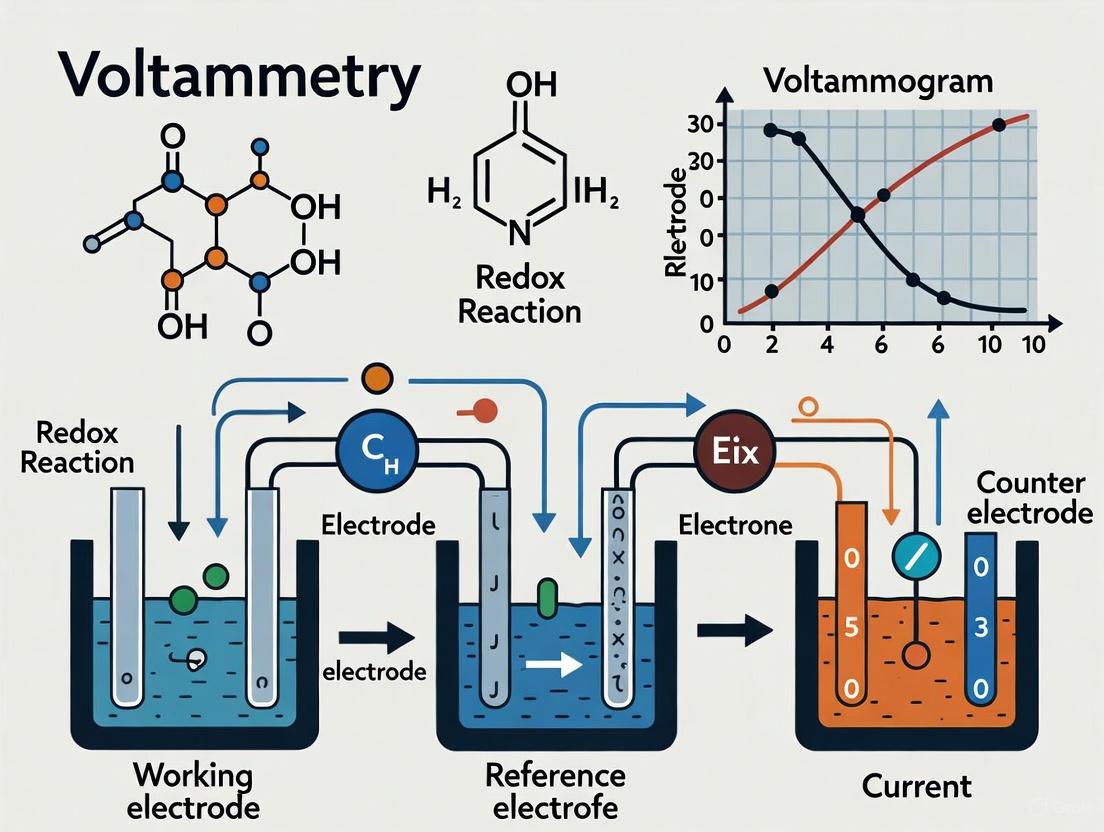
This article provides a comprehensive overview of voltammetry, an essential electrochemical technique in analytical chemistry.
Voltammetry: Principles, Methods, and Applications in Pharmaceutical Research and Drug Development
Abstract
This article provides a comprehensive overview of voltammetry, an essential electrochemical technique in analytical chemistry. Tailored for researchers, scientists, and drug development professionals, it covers the foundational principles of voltammetry, including the three-electrode system and the interpretation of voltammograms. It delves into key methodological variations such as Cyclic Voltammetry and Differential Pulse Voltammetry, highlighting their specific applications in pharmaceutical analysis, quality control, and environmental monitoring of drug residues. The article also addresses common troubleshooting scenarios, optimization strategies for enhanced sensitivity, and a comparative analysis of voltammetry against other analytical techniques, providing a vital resource for its implementation in biomedical and clinical research.
Understanding Voltammetry: Core Principles and Electrochemical Fundamentals
Voltammetry comprises a set of powerful electrochemical techniques used for both quantitative analysis and the study of reaction mechanisms. These methods are defined by their core operational principle: measuring current as a function of an applied potential in an electrochemical cell [1] [2]. The resulting current-potential plot, known as a voltammogram, provides a wealth of information about the analyte, including its identity, concentration, and the kinetics of its redox reactions [1]. The relationship between current, potential, and analyte concentration forms the theoretical foundation that makes voltammetry an indispensable tool in modern analytical chemistry, particularly in fields like drug development where it offers distinct advantages of high sensitivity, rapid analysis times, and cost-effective instrumentation [1] [3].
The significance of voltammetry stems from its ability to exploit Faraday's laws of electrolysis, which establish a direct relationship between the electrical charge passed through an electrode and the amount of substance produced or consumed at the electrode-solution interface [1] [2]. This fundamental relationship enables researchers to precisely quantify analytes at trace levels while simultaneously gaining insights into their redox behavior. When properly executed, voltammetric techniques can detect analytes at remarkably low concentrations, with careful method validation allowing for reliable determination of limits of detection (LOD) appropriate for forensic and pharmaceutical applications [3].
Fundamental Principles and Theoretical Framework
The Electrochemical Cell and Three-Electrode System
While a simple electrochemical cell requires only two electrodes, modern voltammetry almost universally employs a three-electrode system to ensure precise potential control and accurate current measurement [2] [4]. This configuration addresses a critical limitation of two-electrode systems: the difficulty in maintaining a constant potential while measuring resistance and compensating for redox events at the working electrode [4].
Diagram: Three-Electrode System Configuration. The potentiostat applies potential between working (WE) and reference (RE) electrodes while measuring current between WE and counter (CE) electrodes [2] [4].
The three-electrode configuration consists of:
- Working Electrode (WE): The electrode where the redox reaction of interest occurs. Its potential is precisely controlled relative to the reference electrode. Common materials include mercury, gold, platinum, and various carbon forms (glassy carbon, graphite) [2].
- Reference Electrode (RE): Provides a stable, known potential against which the working electrode's potential is measured and controlled. No significant current passes through this electrode to prevent potential drift. Common examples include saturated calomel (SCE) and silver/silver chloride (Ag/AgCl) electrodes [1] [4].
- Counter Electrode (CE): Completes the electrical circuit by carrying the current needed to balance the current flowing at the working electrode. Typically has a much larger surface area than the working electrode to prevent current limitation [1] [4].
This separation of function ensures that the current observed at the working electrode is completely balanced by the current passing at the counter electrode, while the reference electrode maintains a stable potential without significant current passage [4].
Faradaic and Capacitive Currents
The total current measured in voltammetric experiments consists of two distinct components with different origins and characteristics:
Faradaic Current: This current results from the reduction or oxidation of electroactive species at the electrode surface, following Faraday's law of electrolysis [2]. The faradaic current is the analytical signal of interest, as it directly correlates with analyte concentration through the relationship:
q = nFm
where q is the electric charge passed, n is the number of electrons transferred, F is Faraday's constant (96,485 C/mol), and m is the number of moles of substance reacted [2].
Capacitive Current: Also known as charging current, this non-faradaic current arises from the charging and discharging of the electrical double layer at the electrode-electrolyte interface, which behaves similarly to a capacitor [2]. This current represents a significant source of background signal that can obscure faradaic responses, particularly at low analyte concentrations.
The sensitivity of any voltammetric technique is ultimately determined by the ratio of faradaic to capacitive currents [2]. A key goal in developing voltammetric methods is therefore to maximize this ratio through electronic instrumentation, electrode design, and chemical modification of the electrode-solution interface.
Mass Transport to the Electrode Surface
For a species to undergo electron transfer and generate faradaic current, it must first reach the electrode surface through one of three mass transport mechanisms:
- Diffusion: Movement due to a concentration gradient established when electroactive species are consumed or generated at the electrode surface [2]. This is the primary mass transport mechanism in unstirred solutions during most voltammetric experiments.
- Migration: Movement of charged species in an electric field, which can be minimized by adding excess supporting electrolyte to the solution [2].
- Convection: Bulk movement of solution due to stirring, flow, or electrode rotation, which can enhance mass transport in certain experimental configurations [2].
The diffusion-limited current (i_d) is described by a combination of Faraday's law and Fick's first law of diffusion [4]:
i_d = nFAD_0(∂C_0/∂x)_0
where A is the electrode area, D_0 is the diffusion coefficient of the analyte, and (∂C_0/∂x)_0 is the concentration gradient at the electrode surface.
Major Voltammetric Techniques
Cyclic Voltammetry (CV)
Cyclic Voltammetry is one of the most widely used voltammetric techniques for studying redox mechanisms and thermodynamics [4]. In CV, the potential of the working electrode is scanned linearly in time between two set values (initial potential and vertex potential) before being reversed back to the initial potential, creating a triangular waveform [4]. The resulting voltammogram typically shows characteristic "duck-shaped" curves with peak currents for both the forward and reverse scans [4].
The peak current (i_p) in a reversible system is described by the Randles-Sevcik equation [4]:
i_p = (2.69×10^5)n^(3/2)AD^(1/2)Cv^(1/2) (at 298 K)
where C is the concentration (mol/cm³), v is the potential scan rate (V/s), and the other parameters are as previously defined. This equation demonstrates the direct dependence of the measured current on analyte concentration, forming the basis for quantitative analysis.
Square Wave Voltammetry (SWV)
Square Wave Voltammetry is a pulsed technique that offers significant advantages in sensitivity and background suppression compared to traditional CV [5]. In SWV, the potential waveform consists of a series of symmetric square-wave pulses superimposed on a staircase ramp [5]. Current is sampled twice during each square-wave cycle: once at the end of the forward pulse and once at the end of the reverse pulse [5]. The differential current (forward minus reverse) is plotted against the base potential, resulting in a peak-shaped voltammogram where the peak height is proportional to analyte concentration [5].
The strength of SWV lies in its effective minimization of capacitive currents through the current sampling protocol, resulting in significantly improved signal-to-noise ratios compared to continuous scanning techniques [5]. For a reversible one-electron reduction, the peak current can be described by [5]:
i_p = nFAD_0^(1/2)C_0(πtp)^(-1/2)ψ
where tp is the experimental timescale, and ψ is a dimensionless peak current parameter.
Table 1: Comparison of Major Voltammetric Techniques
| Technique | Excitation Waveform | Key Features | Primary Applications | Detection Limits |
|---|---|---|---|---|
| Cyclic Voltammetry (CV) | Linear potential sweep with reversal | "Duck-shaped" voltammogram; studies reversibility | Mechanism studies, thermodynamics, qualitative analysis | Moderate (μM range) |
| Square Wave Voltammetry (SWV) | Square pulses on staircase baseline | Background suppression, sensitive differential current | Trace analysis, quantitative measurements, kinetics | Low (nM range) [3] |
| Differential Pulse Voltammetry (DPV) | Small amplitude pulses on linear ramp | Minimized charging current, peak-shaped output | Trace analysis of organic compounds, pharmaceuticals | Low (nM range) [1] |
Comparative Performance of Voltammetric Techniques
Different voltammetric techniques offer varying capabilities for electron transfer rate measurement and quantitative analysis. Recent research has systematically compared these approaches for studying immobilized redox systems:
Table 2: Applicable Ranges of Electron Transfer Rate Constants (k_HET) for Immobilized Redox Proteins
| Technique | Applicable k_HET Range (s⁻¹) | Strengths | Limitations |
|---|---|---|---|
| Cyclic Voltammetry (CV) | 0.5 - 70 | Direct visualization of reversibility, established theory | Limited upper range for immobilized systems |
| Square Wave Voltammetry (SWV) | 5 - 120 | Broad dynamic range, high sensitivity | Complex interpretation for non-reversible systems |
| Electrochemical Impedance Spectroscopy (EIS) | 0.5 - 5 | Complementary frequency-domain information | Limited to small potential perturbations |
This comparative analysis demonstrates that SWV covers a broader range of electron transfer rates compared to CV and EIS, making it particularly valuable for studying systems with faster kinetics [6].
Experimental Considerations and Protocols
The Scientist's Toolkit: Essential Research Reagents and Materials
Successful voltammetric analysis requires careful selection of reagents and materials to ensure reproducible and meaningful results:
Table 3: Essential Research Reagent Solutions and Materials
| Item | Function/Purpose | Typical Composition/Examples |
|---|---|---|
| Supporting Electrolyte | Minimizes migration current, provides conductivity | Inert salts (KCl, NaClO₄, TBAPF₆) at 0.1-1.0 M concentration |
| Solvent System | Dissolves analyte and electrolyte, wide potential window | Aqueous buffers, acetonitrile, DMF, dichloromethane |
| Internal Standard | Potential calibration, method validation | Ferrocene/Ferrocenium (Fc/Fc⁺) in non-aqueous systems |
| Working Electrodes | Platform for redox reactions, defines active surface | Glassy carbon, gold, platinum, mercury film electrodes |
| Reference Electrodes | Provides stable potential reference | Ag/AgCl, Saturated Calomel Electrode (SCE) |
| Purifying Agents | Removes oxygen and impurities from solutions | Nitrogen/argon sparging, chemical scrubbers |
| Standard Solutions | Calibration, method validation | Certified reference materials of target analytes |
General Experimental Protocol for Square Wave Voltammetry
The following protocol provides a standardized approach for conducting Square Wave Voltammetry experiments, based on established methodologies [5]:
Instrument Setup: Configure the potentiostat with a three-electrode system in an electrochemical cell. Ensure proper connections of working, reference, and counter electrodes.
Solution Preparation: Prepare the analyte solution in appropriate solvent with supporting electrolyte at concentration 0.1-0.5 M. Degas with inert gas (N₂ or Ar) for 10-15 minutes to remove dissolved oxygen.
Parameter Optimization:
- Square Wave Amplitude: Typically 25-50 mV
- Step Potential: Usually 1-10 mV
- Frequency: 5-25 Hz (higher frequencies increase sensitivity but may distort kinetics)
- Potential Window: Set initial and final potentials to bracket the expected redox event
Induction Period: Apply initial potential conditions for 10-30 seconds to equilibrate the system before data collection [5].
Data Acquisition: Execute the SWV experiment, collecting both forward and reverse currents. Most modern instruments will automatically calculate the differential current.
Relaxation Period: Allow the system to equilibrate under final conditions before returning to idle state [5].
Data Analysis: Plot differential current versus applied potential. Measure peak height for quantitative analysis or peak potential for qualitative characterization.
Determining Limits of Detection in Voltammetry
Accurate determination of the Limit of Detection (LOD) is crucial for validating voltammetric methods, particularly in regulated fields like pharmaceutical development [3]. Several approaches can be employed:
Visual Evaluation: The lowest concentration providing an observable oxidation or reduction peak is reported as LOD. This subjective approach requires presentation of appropriate data for justification [3].
Signal-to-Noise Ratio (SNR): A more objective method where LOD is defined as the concentration yielding a signal 3-3.3 times the noise level [3]:
LOD = 3 × noise (in current units)
where noise is measured as the highest-lowest point in baseline near analyte response.
Statistical Method from Blank Measurement: Following established guidelines [3]:
LOD = X̄_B + 3.3 × σ_B
where X̄_B is the mean blank signal and σ_B is the standard deviation of the blank signal.
Recent comparative studies have highlighted that LOD values can vary significantly depending on the calculation method employed, emphasizing the need for consistent application of a single validated approach, particularly when comparing methods across different studies [3].
Advanced Applications and Future Directions
Voltammetric techniques continue to evolve, with recent advancements pushing the boundaries of sensitivity and spatial resolution. The development of opto-iontronic microscopy represents a cutting-edge innovation that combines optical microscopy with nanohole electrodes to monitor electrochemical processes at the nanoscale, enabling detection within volumes as small as an attoliter (100 nm)³ [7]. This approach uses total internal reflection illumination, electric-double-layer modulation, cyclic voltammetry, and lock-in detection to probe ion dynamics in nanoconfined environments [7].
Such advancements highlight the ongoing potential of voltammetry to address increasingly challenging analytical problems, from single-molecule electrochemistry to real-time monitoring of reaction intermediates. The fundamental relationship between current, potential, and analyte concentration continues to provide the theoretical foundation for these technological innovations, ensuring voltammetry's continued relevance in both basic research and applied analytical science.
For researchers in drug development and related fields, voltammetry offers a versatile toolkit for quantitative analysis, mechanism elucidation, and method validation. When properly implemented with attention to the core principles outlined in this guide, voltammetric methods can provide reliable, sensitive, and reproducible data to support the development and characterization of new chemical entities and pharmaceutical compounds.
In electrochemical research, particularly in voltammetry, the three-electrode system represents a fundamental experimental configuration that enables precise measurement and control of electrochemical reactions. Voltammetry, the study of current as a function of applied potential, relies on this system to obtain accurate analytical data in the form of voltammograms [8]. Unlike the simpler two-electrode setups used in everyday batteries, the three-electrode system separates the functions of potential measurement and current control, thereby overcoming significant limitations that previously hampered precise electrochemical investigations [9] [10]. This sophisticated approach allows researchers to study electrochemical half-cell reactivity with unprecedented accuracy, making it indispensable for applications ranging from fundamental reaction mechanism studies to drug development and battery material characterization [11] [1].
The evolution from two-electrode to three-electrode configurations in the 1920s marked a critical advancement in electrochemical science [9]. In a two-electrode system, the substantial current passing through the cell causes solution voltage drop (IR drop) and polarization of the counter electrode, making the working electrode potential challenging to determine accurately [10]. The introduction of a reference electrode created the now-standard "three-electrode, two-circuit" system that effectively eliminates this ambiguity by providing a stable potential reference point unaffected by current flow [9] [10]. This technical whitpaper explores the core components, working principles, and experimental implementation of the three-electrode system within the context of voltammetry research, providing drug development professionals and scientists with essential knowledge for leveraging this powerful configuration in their investigative work.
Core Components and Their Functions
The three-electrode system consists of three distinct electrodes, each serving a specific function in the electrochemical cell. Understanding the role and requirements of each component is essential for proper experimental setup and reliable data acquisition.
Working Electrode (WE)
The Working Electrode serves as the stage where the electrochemical reaction of interest occurs [9] [12]. This electrode must exhibit specific characteristics to ensure reproducible and meaningful results. The working electrode should be chemically inert relative to the electrolyte, possess a reproducible surface state, and present a controlled geometric area to the solution [9]. During voltammetric experiments, the potential at the working electrode is precisely controlled and varied while the resulting current is measured, providing the fundamental data for analysis [11] [8].
Common working electrode materials include glassy carbon, platinum, gold, and conductive oxides such as FTO and ITO [9]. For specific applications like battery research, composite battery electrodes prepared as test coupons may serve as working electrodes [9]. In corrosion testing, the working electrode is typically a sample of the corroding metal, while for physical electrochemistry experiments, inert materials like platinum or gold are preferred [12]. Proper preparation of the working electrode surface is critical, often requiring standardized cleaning and pretreatment protocols to ensure experimental reproducibility [9].
Reference Electrode (RE)
The Reference Electrode provides a stable, known potential against which the working electrode's potential is measured and controlled [9] [12]. This component is crucial for precise potential control because it ideally draws negligible current, allowing its potential to remain constant regardless of current flow in the rest of the circuit [9]. An ideal reference electrode exhibits good reversibility, follows the Nernst equation, has high exchange current density for quick potential restoration, and demonstrates excellent stability and reproducibility [13].
The choice of reference electrode depends on the experimental conditions, particularly the electrolyte composition. Common reference electrodes include the saturated calomel electrode (SCE), silver/silver chloride (Ag/AgCl), and the standard hydrogen electrode (SHE) for aqueous systems [13] [10]. For non-aqueous systems, such as those used in lithium-ion battery research, non-aqueous reference electrodes like Ag/Ag+ (acetonitrile) are employed [13]. In some field applications, a pseudo-reference electrode (a piece of the working electrode material) may be used [12]. To minimize potential drift and measurement errors, the reference electrode is often connected to the test solution via a salt bridge or Luggin capillary, which reduces uncompensated solution resistance [13].
Counter Electrode (CE)
The Counter Electrode, also known as the Auxiliary Electrode, completes the current path in the electrochemical cell and supplies the current needed to balance the electron flow at the working electrode [9] [12]. This electrode must be highly conductive, chemically stable in the electrolyte, and typically possesses a larger surface area than the working electrode to avoid becoming polarized itself [9] [13]. The counter electrode's primary function is to ensure that current measurements accurately reflect processes occurring at the working electrode without introducing additional experimental variables.
Common counter electrode materials include platinum, graphite, and other inert conductors [13] [10]. In laboratory cells, platinum wire or mesh is frequently used, while graphite rods may be preferred in certain applications to avoid contamination—for instance, in prolonged tests where platinum dissolution and deposition onto the working electrode could artificially affect activity measurements [10]. The counter electrode often operates at extreme potentials where solvent or supporting electrolyte oxidation or reduction occurs, but this does not interfere with measurements because the critical potential control is maintained between the working and reference electrodes [8].
Table 1: Electrode Types and Their Characteristics in Three-Electrode Systems
| Electrode Type | Primary Function | Common Materials | Key Characteristics |
|---|---|---|---|
| Working Electrode (WE) | Site of electrochemical reaction of interest; potential controlled and current measured | Glassy carbon, platinum, gold, conductive oxides (FTO/ITO) [9] | Chemically inert, reproducible surface, controlled geometric area [9] |
| Reference Electrode (RE) | Provides stable potential reference for WE potential measurement/control | Ag/AgCl, SCE, Hg/HgO [13] [10] | Minimal current draw, stable potential, follows Nernst equation [9] [13] |
| Counter Electrode (CE) | Completes current circuit; balances current at WE | Platinum, graphite [9] [13] | High conductivity, large surface area, chemically stable [9] [13] |
Working Principle and Instrumentation
The three-electrode system operates on the principle of separating potential measurement from current control, enabled by sophisticated instrumentation known as a potentiostat. This arrangement creates what is often described as a "three-electrode, two-circuit" system that forms the foundation for modern electrochemical experiments [9] [10].
The "Two-Circuit" Concept
In the three-electrode configuration, two distinct electrical circuits operate simultaneously yet independently. The potential circuit consists of a high-impedance voltmeter connected between the working and reference electrodes, dedicated to measuring and controlling the working electrode potential without drawing significant current [9] [10]. The current circuit includes an ammeter between the working and counter electrodes, responsible for supplying and measuring the current required for the electrochemical reaction [9] [10]. This separation is crucial because it allows precise control of the working electrode potential while preventing current flow from affecting the stability of the reference electrode potential [9].
The potentiostat serves as the central control unit that implements this two-circuit concept. As illustrated in the schematic below, the potentiostat's electrometer circuit measures the voltage difference between the reference and working electrodes with high input impedance and minimal input current, preserving the reference electrode's stable potential [12]. The control amplifier compares this measured cell voltage with the desired voltage from the signal source (typically a computer-controlled digital-to-analog converter) and drives current into the cell through the counter electrode to maintain the set potential [12]. Simultaneously, a current-to-voltage converter measures the cell current by forcing it to flow through a measurement resistor, with the voltage drop providing a precise current measurement [12].
Diagram 1: The "Two-Circuit" Concept of a Three-Electrode System
The Role of the Potentiostat
The potentiostat is the electronic instrument that makes three-electrode measurements possible by serving as both a precise voltage source and a sensitive current meter [12]. Its fundamental operation involves maintaining a user-defined potential between the working and reference electrodes while measuring the resulting current flowing between the working and counter electrodes [12]. Modern potentiostats incorporate multiple measurement ranges to accommodate currents varying by several orders of magnitude, from picoamperes to amperes, using autoranging algorithms to select appropriate measurement resistors [12].
Key components of a potentiostat include the electrometer for high-impedance voltage measurement, the control amplifier for maintaining the set potential, the signal source for generating potential waveforms, and the current-to-voltage converter for current measurement [12]. The instrument's performance characteristics—including voltage and current measurement accuracy, low-noise design, bandwidth, and input capacitance—significantly impact data quality, particularly in sensitive techniques like electrochemical impedance spectroscopy (EIS) [9] [12]. For voltammetric methods such as cyclic voltammetry (CV) and linear sweep voltammetry (LSV), the potentiostat must accurately generate potential sweeps while precisely measuring the resulting faradaic currents that carry information about analyte concentration and reaction kinetics [11] [8].
Experimental Implementation and Methodologies
Successful implementation of the three-electrode system requires careful attention to experimental design, electrode preparation, and selection of appropriate measurement techniques. This section outlines key methodologies and practical considerations for researchers.
Electrode Preparation and Cell Assembly
Proper electrode preparation is essential for obtaining reproducible electrochemical data. The working electrode typically requires meticulous surface pretreatment, which may include polishing with alumina or diamond slurry to a mirror finish, followed by sonication in solvents to remove adsorbed particles [10]. For modified electrodes, catalyst inks are prepared by dispersing the catalyst material in a solvent with binders like Nafion, then drop-casting onto the electrode surface [10]. The reference electrode must be verified to have a stable potential, often checked against standard solutions, and properly maintained according to manufacturer specifications to prevent contamination [13]. The counter electrode should be cleaned and may require periodic regeneration or replacement if degradation occurs.
Cell assembly follows specific geometric considerations to minimize measurement errors. The reference electrode should be positioned close to the working electrode using a Luggin capillary to reduce uncompensated solution resistance (IR drop), but not so close as to shield the working electrode surface [9] [13]. The counter electrode should have sufficient surface area and be positioned symmetrically relative to the working electrode to ensure uniform current distribution [9]. All electrodes must be firmly fixed in place, and the cell must be sealed to prevent contamination or evaporation of the electrolyte during experiments.
Common Voltammetric Techniques
The three-electrode system enables various voltammetric techniques that provide insights into electrochemical processes. Two of the most prominent methods are cyclic voltammetry and linear sweep voltammetry:
Cyclic Voltammetry (CV) is a powerful technique where the potential at the working electrode is scanned linearly with time in a forward direction, then reversed back to the starting potential while measuring the current [11] [4]. This method provides information about the thermodynamics of redox processes, reaction kinetics, and coupled chemical reactions [4]. The resulting voltammogram typically shows characteristic peaks corresponding to oxidation and reduction events, with the peak separation indicating the reversibility of the electrochemical reaction [11]. For reversible systems, the peak separation is approximately 57/n mV, where n is the number of electrons transferred [11].
Linear Sweep Voltammetry (LSV) involves scanning the potential in a single direction from a starting potential to an end potential while monitoring the current [11]. This technique is particularly useful for determining onset potentials of electrochemical reactions, studying diffusion-controlled processes, and evaluating electrocatalytic activity [11]. In LSV, the voltage sweep starts in a region where few reactions occur, continues through the kinetically controlled region, and into the diffusion-limited region where current reaches a maximum before decreasing as the diffusion layer expands [11].
Table 2: Key Voltammetric Techniques Enabled by Three-Electrode Systems
| Technique | Potential Waveform | Key Applications | Data Output |
|---|---|---|---|
| Cyclic Voltammetry (CV) | Linear forward and reverse sweep between two potentials [11] | Study of redox mechanisms, reaction kinetics, reversibility [11] [4] | Current vs. potential plot with oxidation/reduction peaks [4] |
| Linear Sweep Voltammetry (LSV) | Linear sweep in one direction [11] | Determination of onset potentials, diffusion studies [11] | Current vs. potential plot with characteristic waves [11] |
| Electrochemical Impedance Spectroscopy (EIS) | Small AC potential perturbation over range of frequencies [9] | Interface characterization, resistance analysis, kinetic studies [9] | Complex impedance plotted in Nyquist or Bode format [9] |
| Potentiostatic/Galvanostatic Intermittent Titration (PITT/GITT) | Potential or current steps with relaxation periods [9] [13] | Diffusion coefficient measurements, battery material characterization [9] [13] | Current or potential transients during steps [13] |
Experimental Workflow
A generalized workflow for three-electrode experiments encompasses several critical stages, from initial setup to data analysis, as illustrated below:
Diagram 2: Experimental Workflow for Three-Electrode Voltammetry
Research Reagent Solutions and Materials
Successful implementation of three-electrode systems requires specific materials and reagents tailored to the electrochemical application. The table below details essential components for assembling and utilizing these systems in research settings.
Table 3: Essential Research Reagents and Materials for Three-Electrode Systems
| Category | Specific Items | Function/Purpose |
|---|---|---|
| Working Electrodes | Glassy carbon electrode, Platinum electrode, Gold electrode, Metal oxide electrodes (FTO/ITO) [9] [10] | Provide controlled surface for electrochemical reactions; choice depends on potential window and reactivity requirements |
| Reference Electrodes | Ag/AgCl (aqueous), Saturated calomel electrode (SCE), Hg/HgO (alkaline), Ag/Ag+ (non-aqueous) [13] [10] | Maintain stable, known reference potential for accurate potential control and measurement |
| Counter Electrodes | Platinum wire/mesh, Graphite rod, Glassy carbon rod [9] [13] [10] | Complete current circuit with sufficient conductivity and stability to not limit reactions |
| Electrolyte Salts | KCl, NaClO₄, TBAPF₆, LiPF₆ [13] [8] | Provide ionic conductivity while being electrochemically inert in potential window of interest |
| Solvents | Water, Acetonitrile, Dimethylformamide (DMF), Propylene carbonate [13] [8] | Dissolve electrolyte and analyte; choice depends on analyte solubility and required potential window |
| Redox Probes | Ferrocene, Potassium ferricyanide, Ruthenium hexamine [4] [8] | Validate system performance and reference potential calibration |
| Surface Treatment | Alumina polishing slurry, Diamond paste, Detergents [10] | Create reproducible electrode surface finish for consistent results |
| Binders/Modifiers | Nafion solution, Conductive carbon black [10] | Immobilize catalysts on electrode surfaces or modify electrode properties |
Critical Practical Considerations
Implementing three-electrode systems effectively requires attention to several practical aspects that significantly impact data quality and interpretation.
Optimization and Troubleshooting
Several factors require optimization for reliable three-electrode measurements. Reference electrode placement is critical—positioning too far from the working electrode increases uncompensated solution resistance, while positioning too close can cause shielding effects [9] [13]. The counter electrode surface area should significantly exceed that of the working electrode to prevent current limitations [9]. IR compensation techniques should be applied to correct for potential drops across solution resistance, either manually (typically 80-95% of measured solution resistance) or using automatic compensation features in modern potentiostats [10].
Common issues encountered in three-electrode systems include unstable reference potentials (often due to contamination or clogged frits), noisy current measurements (frequently caused by improper shielding or ground loops), and distorted voltammetric shapes (potentially indicating improper cell geometry or insufficient electrolyte conductivity) [12]. Regular validation using standard redox couples like ferrocene/ferrocenium (for non-aqueous systems) or potassium ferricyanide (for aqueous systems) helps identify systematic errors [4] [8].
Advanced Applications in Research
The three-electrode system finds diverse applications across scientific disciplines. In battery research, it enables precise characterization of individual electrode materials within complete cells, allowing researchers to study formation of solid-electrolyte interphase (SEI) layers, measure diffusion coefficients via GITT and PITT, and analyze impedance characteristics of electrode materials [9] [13]. For electrocatalyst development, three-electrode configurations facilitate evaluation of new materials for reactions like hydrogen evolution (HER), oxygen evolution (OER), and oxygen reduction (ORR) by providing accurate overpotential measurements free from counter electrode effects [10].
In pharmaceutical and biosensing applications, three-electrode systems support drug quantification, metabolite detection, and mechanistic studies of biological redox processes [1]. The ability to precisely control potential makes these systems ideal for studying redox-active drug molecules and developing sensitive detection schemes based on pulsed voltammetric techniques like differential pulse voltammetry and square wave voltammetry, which offer enhanced sensitivity for trace analysis [1]. The fundamental principles of the three-electrode system thus underpin advancements across energy storage, materials science, and biomedical research.
The three-electrode system represents an essential configuration in modern electrochemical research, providing the foundation for precise potential control and accurate current measurement in voltammetric experiments. By separating the functions of potential referencing and current balancing into distinct electrodes, this system enables researchers to study electrochemical processes with unprecedented accuracy, free from the limitations that plagued earlier two-electrode setups. The continued refinement of three-electrode methodologies—coupled with advancements in potentiostat technology, electrode materials, and experimental protocols—ensures that this fundamental approach will remain indispensable for unraveling complex electrochemical mechanisms across diverse fields including energy storage, materials science, and pharmaceutical development.
For researchers engaged in drug development and related disciplines, mastery of three-electrode systems provides powerful capabilities for characterizing redox-active compounds, understanding reaction mechanisms, and developing sensitive analytical methods. The principles and practices outlined in this technical guide offer both foundational knowledge and practical insights for implementing these systems effectively, ultimately supporting the advancement of electrochemical science and its applications to pressing challenges in health and technology.
Voltammetry is a category of electroanalytical methods used in analytical chemistry and various industrial processes where information about an analyte is obtained by measuring the current as the potential is varied [8]. The analytical data for a voltammetric experiment is presented in the form of a voltammogram, a plot that displays the current produced by the analyte versus the potential of the working electrode [8]. This current-potential curve serves as a fingerprint of the electrochemical activity of the system under study, providing critical insights into redox behavior, reaction kinetics, and mass transport properties.
The interpretation of these curves is fundamental across numerous scientific disciplines, including battery research [14], electrocatalysis [15], pharmaceutical analysis [16] [17], and environmental monitoring. For researchers in drug development, voltammetry offers a rapid, cost-effective, and precise means for quantifying active pharmaceutical ingredients and their metabolites in complex matrices such as biological fluids [16] [17]. This guide provides a comprehensive framework for interpreting voltammograms, enabling researchers to extract maximum information from these powerful electrochemical signatures.
Fundamental Principles and Plotting Conventions
The Electrochemical Cell and the Three-Electrode System
Most voltammetry experiments employ a three-electrode system to investigate half-cell reactivity [4] [8]. Each electrode has a distinct role:
- Working Electrode: This is the electrode where the redox reaction of interest occurs. Its potential is varied in a controlled manner relative to the reference electrode. Common materials include glassy carbon, platinum, gold, and mercury [18] [8].
- Reference Electrode: This electrode maintains a constant, known potential (e.g., Ag/AgCl, saturated calomel electrode - SCE) against which the potential of the working electrode is measured and controlled [15] [18]. It is designed to pass minimal current [4] [8].
- Counter Electrode (Auxiliary Electrode): This electrode completes the electrical circuit, facilitating the flow of current needed to balance the charge transfer occurring at the working electrode [18] [8]. It is typically made from an inert material like platinum or graphite [15] [18].
This configuration separates the role of potential measurement (reference electrode) from current carrying (counter electrode), enabling precise control of the working electrode potential even when current is flowing [4] [8].
Figure 1: Three-Electrode System Setup.
Voltammogram Plotting Conventions
Before interpreting a voltammogram, it is crucial to identify the plotting convention used, as there is no universal standard [19]. The two most common conventions are:
- IUPAC Convention: This is the modern standard. It plots anodic (oxidizing) currents upward on the vertical axis and more positive (anodic) potentials toward the right on the horizontal axis [19].
- Polarographic (Classic) Convention: This older tradition plots cathodic (reducing) currents upward and negative (cathodic) potentials toward the right [19].
The IUPAC convention is more intuitive for those outside specialized electroanalytical research because positive values are plotted to the right and upward [19]. For the remainder of this guide, the IUPAC convention will be used.
Interpreting a Cyclic Voltammogram
Cyclic Voltammetry (CV) is a cornerstone technique where the electrode potential is swept linearly between two limits and then swept back, completing one or more cycles [14] [4]. The resulting "duck-shaped" voltammogram provides a wealth of qualitative and quantitative information [14] [4].
Characteristic Features and Processes
The interpretation of a cyclic voltammogram hinges on recognizing its characteristic features, which correspond to specific electrochemical processes. The diagram below maps the key components of a typical CV for a reversible redox couple.
Figure 2: Cyclic Voltammogram Interpretation.
The forward scan (from A to D) typically drives an oxidation reaction, while the reverse scan (from D to F) drives the corresponding reduction [4]. The process at the working electrode is governed by the Nernst equation (E = E⁰ - (RT/zF) ln(Q)) which relates the applied potential to the concentration ratio of the reduced and oxidized species [4] [8]. The current response is a combination of faradaic current (from electron transfer) and capacitive current (from charging the electrical double-layer) [18].
Criteria for Reversibility, Quasi-Reversibility, and Irreversibility
The reversibility of an electrochemical reaction is diagnostically important and is assessed by examining the peak separation and shape [18].
Table 1: Diagnostic Criteria for Electrochemical Reversibility in Cyclic Voltammetry.
| Parameter | Reversible System | Quasi-Reversible System | Irreversible System | ||
|---|---|---|---|---|---|
| Peak Separation (ΔEp) | ΔEp = Epa - Epc ≈ 59/n mV at 25°C [18] | > 59/n mV | Large separation; reverse peak often absent | ||
| Peak Current Ratio ( | ipa/ipc | ) | ≈ 1 [4] | ≈ 1 (but peaks broader) | ≠ 1 |
| Peak Potential vs. Scan Rate | Independent of scan rate | Shifts with scan rate | Shifts with scan rate | ||
| Peak Current vs. Scan Rate | ip ∝ v1/2 [4] | ip ∝ v1/2 (deviation at high rates) | ip ∝ v1/2 |
For example, a study on Ni/Al-carbonate hydrotalcite catalysts reported anodic and cathodic peaks at 0.62 V and 0.42 V, respectively, corresponding to a quasi-reversible redox behavior of Ni(II)/Ni(III) centers [15].
Quantitative Analysis: The Randles-Sevcik Equation
For a reversible, diffusion-controlled system, the peak current (ip) is quantitatively described by the Randles-Sevcik equation [4] [18]. This relationship allows researchers to determine the concentration of an analyte or its diffusion coefficient.
At 298 K (25°C), the equation is [4]: ip = (2.69 × 10⁵) * n3/2 * A * D1/2 * C * v1/2
Table 2: Parameters of the Randles-Sevcik Equation.
| Symbol | Parameter | Typical Units |
|---|---|---|
| ip | Peak Current | Amperes (A) |
| n | Number of electrons transferred in the redox event | dimensionless |
| A | Electrode surface area | cm² |
| D | Diffusion coefficient of the analyte | cm²/s |
| C | Bulk concentration of the analyte | mol/cm³ |
| v | Scan rate | V/s |
The direct proportionality between the peak current (ip) and the square root of the scan rate (v1/2) is a key indicator of a diffusion-controlled process [4] [18]. A plot of ip vs. v1/2 should yield a straight line, and its slope can be used to determine n or D if the other parameters are known. If the current is instead proportional to the scan rate itself (ip ∝ v), it suggests a surface-confined, adsorption-controlled process [15].
Experimental Protocols and the Researcher's Toolkit
A Standard Cyclic Voltammetry Methodology
The following protocol, inspired by studies on modified electrodes and pharmaceutical compounds, outlines a typical CV experiment [15] [16].
- Electrode Preparation: Polish the working electrode (e.g., a 3 mm diameter glassy carbon electrode) with an alumina slurry (e.g., 0.3 μm) on a microcloth. Rinse thoroughly with purified water and then sonicate in water and/or ethanol for a few minutes to remove adsorbed polishing material. Air dry [15].
- Solution Preparation: Prepare a solution containing the analyte of interest and a supporting electrolyte (e.g., 0.04 M Britton-Robinson buffer, KCl, etc.) at a concentration much higher than the analyte (typically 0.1 M) to minimize solution resistance and ensure diffusion-controlled mass transport [16] [8]. For drug analysis, this may involve dissolving a pure standard in a solvent like methanol and diluting with the buffer [16].
- Cell Assembly: Transfer the solution to the electrochemical cell. Insert the three electrodes: working, reference, and counter. Degas the solution by purging with an inert gas (e.g., nitrogen or argon) for 5-15 minutes to remove dissolved oxygen, which can interfere by undergoing reduction [15].
- Instrumental Parameters: Set the following parameters on the potentiostat:
- Initial and Vertex Potentials: Define the potential window to encompass the expected redox events while avoiding solvent/electrolyte decomposition [14].
- Scan Rate: A common starting point is 0.1 V/s (100 mV/s), but a range should be tested (e.g., 0.01 - 1 V/s) for kinetic analysis [14] [15].
- Number of Cycles: Often 3-5 cycles are run to observe stability and achieve a reproducible response [14].
- Data Acquisition: Initiate the potential scan. The potentiostat will apply the potential waveform and record the resulting current, generating the voltammogram.
- Data Analysis: Identify peak currents and potentials. Perform a scan rate study and analyze the data using the Randles-Sevcik equation and reversibility criteria.
The Scientist's Toolkit: Essential Research Reagent Solutions
Table 3: Key Reagents and Materials for Voltammetric Experiments.
| Reagent/Material | Function and Importance |
|---|---|
| Supporting Electrolyte (e.g., KCl, KNO₃, Bu₄NPF₆) | Minimizes solution resistance, eliminates migratory mass transport, and ensures the reaction is diffusion-controlled. The choice depends on the solvent (aqueous/non-aqueous) [4] [8]. |
| Buffer Solutions (e.g., Britton-Robinson, Phosphate) | Controls the pH of the solution, which is critical for proton-coupled electron transfer reactions and studying drug molecules [16]. |
| Electrode Polishing Supplies (Alumina, Diamond slurry) | Ensures a clean, reproducible electrode surface, which is vital for obtaining consistent and accurate current measurements [15]. |
| Internal Standard (e.g., Ferrocene) | Used in non-aqueous electrochemistry as a reference to report and correct potentials, as recommended by IUPAC [4] [8]. |
| Redox Mediators / Modified Electrodes (e.g., Ni-LDH, nRGO) | Enhance sensitivity and selectivity. They can catalyze reactions or pre-concentrate analytes at the electrode surface [15] [16]. |
| Solvents (Water, Acetonitrile, DMF) | The medium for the electrochemical reaction. Must be pure, electrochemically inert in the chosen potential window, and able to dissolve the analyte and electrolyte [16]. |
Advanced Interpretation and Practical Applications
The Impact of Scan Rate
Scan rate is a critical experimental parameter that acts as a "temporal lens" on the electrochemical process [14]. Its effect on the voltammogram provides deep insight into the reaction mechanism.
- Kinetic vs. Diffusion Control: As shown in Figure 5 of the search results, faster scan rates produce higher peak currents [14]. The relationship between peak current and scan rate (ip ∝ v1/2 for diffusion control; ip ∝ v for adsorption control) helps distinguish the nature of the electrochemical process [4] [15].
- Observing Intermediates: At faster scan rates, the timescale of the experiment becomes shorter than the lifetime of a chemical reaction that may follow the electron transfer (a CE or EC mechanism). This can allow for the detection of unstable intermediates that would not be visible at slower scan rates.
- Hysteresis and Catalysis: In electrocatalysis studies, the difference between the forward and reverse scans (hysteresis) can indicate catalytic behavior. For instance, in the study of Ni-LDH for methanol oxidation, hysteresis observed at 0.60 V highlighted efficient charge transport and catalytic activity [15].
Applications in Pharmaceutical and Bioanalytical Research
Voltammetry is indispensable in drug development due to its sensitivity, selectivity, and ability to handle complex matrices without extensive sample preparation [16] [17].
- Drug Quantification and Degradant Analysis: Voltammetric methods can be developed to quantify active pharmaceutical ingredients in the presence of their degradation products. For example, a novel method was established for the anti-inflammatory drug bumadizone (BUM) that successfully determined the drug in the presence of its alkaline-induced degradant without preliminary separation, achieving excellent recovery from spiked serum and urine samples [16].
- Alkaloid and Metabolite Determination: A recent review covering 2005-2025 critically analyzed voltammetric methodologies for 26 alkaloids and their metabolites, linking their electrochemical behavior to chemical structure. This provides a valuable resource for pharmaceutical analysis, food safety, and forensic monitoring [17].
- Sensor Development: The use of modified electrodes, such as nano-reduced graphene oxide (nRGO), significantly enhances analytical performance. One study found that a 10% nRGO-modified carbon paste electrode offered high selectivity and low detection limits for BUM, demonstrating the power of material science in advancing voltammetric drug analysis [16].
The voltammogram is a rich source of electrochemical information. A systematic approach to its interpretation—involving the identification of characteristic features, assessment of reversibility, application of quantitative models like the Randles-Sevcik equation, and thoughtful variation of experimental parameters like scan rate—enables researchers to decode complex electrode processes. For professionals in drug development and related fields, mastering this interpretation is key to leveraging voltammetry's full potential for sensitive, selective, and reliable analysis of pharmaceuticals and biologics, thereby accelerating discovery and ensuring quality.
Voltammetry, a cornerstone of electrochemical analysis, provides profound insights into reaction mechanisms and analyte concentrations by measuring current as a function of applied potential. The interpretation of voltammetric data relies fundamentally on three interconnected theoretical pillars: the Nernst equation, which describes electrochemical equilibrium; Butler-Volmer kinetics, which governs electron transfer rates; and Fick's laws of diffusion, which quantify mass transport. Together, these models form a comprehensive framework for understanding and deconvoluting the complex current-potential-time relationships observed in techniques such as cyclic voltammetry and linear sweep voltammetry. This guide examines each component in detail and demonstrates their integrated application in voltammetric analysis for research and drug development applications.
Theoretical Foundations
The Nernst Equation: Predicting Equilibrium Potentials
The Nernst Equation describes the thermodynamic relationship between the electrochemical potential of a half-cell and the activities (or concentrations) of the participating redox species under equilibrium conditions [20] [21]. For a general reduction reaction:
[ \text{O} + z\text{e}^- \rightleftharpoons \text{R} ]
The Nernst Equation is expressed as:
[ E = E^0 - \frac{RT}{zF} \ln \frac{a{\text{Red}}}{a{\text{Ox}}} ]
Where E is the equilibrium potential, E⁰ is the standard electrode potential, R is the universal gas constant (8.314 J·K⁻¹·mol⁻¹), T is the absolute temperature, z is the number of electrons transferred, F is the Faraday constant (96,485 C·mol⁻¹), and aRed and aOx are the activities of the reduced and oxidized species, respectively [22] [20].
For practical applications with dilute solutions where activities approximate concentrations, the equation is commonly written using the formal potential E⁰':
[ E = E^{0'} - \frac{RT}{zF} \ln \frac{[\text{Red}]}{[\text{Ox}]} ]
At room temperature (25°C), substituting the constants and converting to base-10 logarithm yields the simplified form:
[ E = E^{0'} - \frac{0.0591\, \text{V}}{z} \log_{10} \frac{[\text{Red}]}{[\text{Ox}]} ]
This simplified version is particularly useful for quick calculations [22]. The Nernst equation fundamentally predicts how the equilibrium position shifts with applied potential—as the voltage is swept to more reductive values, the equilibrium shifts to favor conversion of reactant at the electrode surface, driving current flow [23].
Table 1: Key Parameters in the Nernst Equation
| Parameter | Symbol | Typical Units | Description |
|---|---|---|---|
| Electrode Potential | E | Volt (V) | Potential at the working electrode |
| Standard Potential | E⁰ | Volt (V) | Potential under standard conditions |
| Formal Potential | E⁰' | Volt (V) | Potential under specific experimental conditions |
| Gas Constant | R | J·K⁻¹·mol⁻¹ | Universal gas constant |
| Temperature | T | Kelvin (K) | Absolute temperature |
| Electrons Transferred | z | Dimensionless | Number of electrons in redox reaction |
| Faraday Constant | F | C·mol⁻¹ | Charge per mole of electrons |
Butler-Volmer Kinetics: Describing Electron Transfer Rates
While the Nernst equation addresses electrochemical equilibrium, the Butler-Volmer model describes the kinetics of electron transfer when the system is perturbed from equilibrium by an overpotential, η = E - E_eq [24] [25]. This model quantifies how the current density depends on the overpotential and the intrinsic properties of the electron transfer reaction.
For the reaction O + z e⁻ ⇌ R, the Butler-Volmer equation is given by:
[ j = j0 \left{ \exp\left(-\frac{\alphac z F \eta}{RT}\right) - \exp\left(\frac{\alpha_a z F \eta}{RT}\right) \right} ]
Where j is the current density, j₀ is the exchange current density, αa and αc are the anodic and cathodic charge transfer coefficients (typically αa + αc = 1), and η is the overpotential [24] [25] [8].
The model rests on several key assumptions: a simple one-step electron transfer mechanism, a homogeneous electrode surface, the absence of significant mass transport limitations, and a constant symmetry factor [25]. Under high overpotential conditions (|η| > ~0.1 V), the Butler-Volmer equation simplifies to the Tafel equation, where the current depends exponentially on the overpotential [24] [8].
Table 2: Key Parameters in the Butler-Volmer Equation
| Parameter | Symbol | Typical Units | Description |
|---|---|---|---|
| Current Density | j | A·m⁻² | Current per unit electrode area |
| Exchange Current Density | j₀ | A·m⁻² | Current at equilibrium, reflects inherent reaction rate |
| Overpotential | η | Volt (V) | Deviation from equilibrium potential |
| Anodic Transfer Coefficient | αₐ | Dimensionless | Measure of anodic activation barrier symmetry |
| Cathodic Transfer Coefficient | αc | Dimensionless | Measure of cathodic activation barrier symmetry |
Fick's Laws of Diffusion: Quantifying Mass Transport
In quiescent (unstirred) voltammetric experiments, the supply of electroactive species to the electrode surface is governed by diffusion, as described by Fick's laws [26] [27] [8]. These laws quantify how concentration gradients drive mass transport.
Fick's First Law states that the diffusive flux is proportional to the negative concentration gradient:
[ J = -D \frac{\partial C}{\partial x} ]
Where J is the diffusion flux (mol·m⁻²·s⁻¹), D is the diffusion coefficient (m²·s⁻¹), and ∂C/∂x is the concentration gradient (mol·m⁻⁴) [26] [27]. The negative sign indicates flux occurs from high to low concentration.
Fick's Second Law describes how concentration changes with time due to diffusion:
[ \frac{\partial C}{\partial t} = D \frac{\partial^2 C}{\partial x^2} ]
This partial differential equation is identical in form to the heat equation and provides the foundation for modeling time-dependent diffusion processes [26]. In voltammetry, the current is proportional to the flux of electroactive species at the electrode surface (Jx=0), linking Fick's laws directly to the faradaic current response [8].
Table 3: Key Parameters in Fick's Laws of Diffusion
| Parameter | Symbol | Typical Units | Description |
|---|---|---|---|
| Diffusion Flux | J | mol·m⁻²·s⁻¹ | Amount of substance flowing per unit area per time |
| Diffusion Coefficient | D | m²·s⁻¹ | Measure of mobility in solution |
| Concentration | C | mol·m⁻³ | Amount of substance per unit volume |
| Distance from Electrode | x | meter (m) | Spatial coordinate normal to electrode surface |
Integrated Framework for Voltammetry
Interrelationship of Theoretical Models in Voltammetry
In voltammetric techniques, the three models operate in concert to determine the observed current response. The Nernst equation establishes the equilibrium conditions and predicts how the surface concentrations of redox species relate to the applied potential [23]. When the potential is swept away from equilibrium, the Butler-Volmer kinetics determine the rate of electron transfer based on the overpotential and the surface concentrations [24] [8]. Simultaneously, Fick's laws govern the diffusion of fresh reactant to the electrode surface and the removal of product, creating the characteristic current peaks observed in voltammograms [23] [8].
The following diagram illustrates the fundamental relationship between these core models in shaping a voltammetric experiment:
The interplay between these processes determines whether a system exhibits "reversible" (fast kinetics, Nernstian), "quasi-reversible," or "irreversible" (slow kinetics) behavior in voltammetry [23]. In reversible systems, electron transfer is rapid relative to the voltage scan rate, and the surface concentrations follow the Nernst equation, with the response dominated by mass transport. In irreversible systems, slow electron transfer kinetics control the response, leading to broader peaks that shift with scan rate [23].
Application to Voltammetric Techniques
Linear Sweep Voltammetry (LSV) applies a linear potential ramp from an initial to a final value [23] [8]. The current response initially rises as the potential shifts the equilibrium to favor the redox reaction, increasing the flux of reactant to the electrode. A peak current occurs when the diffusion layer has grown sufficiently that the flux of reactant to the electrode can no longer satisfy the surface concentration demanded by the Nernst equation for that potential [23]. The current then decays following Cottrell-like behavior (current ∝ time⁻¹/²) [23].
Cyclic Voltammetry (CV) extends LSV by reversing the potential scan at a defined switching potential [23] [8]. The resulting voltammogram contains both forward and reverse scans, providing information about the redox reaction and the stability of the generated products. For a reversible, single-electron transfer with stable species, key characteristics include [23]:
- Peak separation (ΔEp) = 59/z mV
- Peak current ratio (Ipa/Ipc) = 1
- Peak current proportional to the square root of scan rate (Ip ∝ v¹/²)
The scan rate (v) critically affects the voltammetric response by controlling the relative timescales of diffusion and electron transfer. Faster scans allow less time for diffusion, resulting in higher flux, larger peak currents, and a thinner diffusion layer [23]. The following diagram visualizes how the theoretical models interact during a cyclic voltammetry experiment:
Experimental Protocols
Standard Three-Electrode Configuration
Voltammetric measurements require a carefully controlled electrochemical cell. The standard three-electrode system consists of [8]:
- Working Electrode (WE): The electrode where the reaction of interest occurs. Common materials include glassy carbon, platinum, gold, and for historical context, mercury (e.g., HMDE, DME) [28] [8]. The surface must be clean and well-defined.
- Reference Electrode (RE): Provides a stable, known reference potential against which the working electrode potential is measured and controlled (e.g., Ag/AgCl, saturated calomel). It should not pass significant current [8].
- Counter Electrode (Auxiliary Electrode): Completes the electrical circuit, passing all current required to balance the reaction at the working electrode (e.g., platinum wire) [8].
A supporting electrolyte (e.g., 0.1 M KCl) is added at a high concentration to minimize solution resistance and eliminate electrostatic migration of the analyte [28] [8]. The solution is typically purged with an inert gas (e.g., N₂, Ar) before analysis to remove dissolved oxygen, which can be electrochemically reduced and interfere with measurements [28].
Essential Research Reagent Solutions
Table 4: Key Reagents and Materials for Voltammetric Experiments
| Reagent/Material | Function/Purpose | Typical Examples |
|---|---|---|
| Supporting Electrolyte | Minimizes solution resistance; ensures diffusion-controlled conditions | Potassium chloride (KCl), Tetraalkylammonium salts, Phosphate buffer |
| Solvent | Dissolves analyte and electrolyte; defines electrochemical window | Water, Acetonitrile, Dimethylformamide (DMF) |
| Redox Probe (for calibration) | Validates electrode performance and instrument response | Potassium ferricyanide, Ferrocene (for non-aqueous) |
| Working Electrode Material | Surface for electron transfer; defines reactivity and potential window | Glassy Carbon, Platinum, Gold, Hanging Mercury Drop Electrode (HMDE) |
| Purging Gas | Removes dissolved oxygen to prevent interference | Nitrogen (N₂), Argon (Ar) |
The Nernst equation, Butler-Volmer kinetics, and Fick's laws of diffusion provide an indispensable, interconnected framework for interpreting voltammetric data. The Nernst equation establishes the thermodynamic foundation, Butler-Volmer kinetics describes the electron transfer rates, and Fick's laws quantify the mass transport by diffusion. Their combined application allows researchers to deconvolute complex voltammograms, extract critical parameters such as formal potentials, rate constants, and diffusion coefficients, and elucidate underlying reaction mechanisms. For drug development professionals and researchers, mastery of these core models is essential for leveraging voltammetry in applications ranging from antioxidant capacity assessment and metal complex characterization to the study of biological electron transfer processes.
The Role of the Supporting Electrolyte and Solvent Electrochemical Window
In the field of electroanalytical chemistry, voltammetry stands as a powerful technique for investigating electron transfer processes, with applications spanning from trace metal detection to neurotransmitter monitoring [29] [30]. The methodology involves measuring current as a function of applied potential to obtain quantitative and qualitative information about electroactive species [8]. While the fundamental instrumentation—typically a three-electrode system consisting of working, reference, and auxiliary electrodes—is well-established [8], the experimental outcomes are profoundly influenced by two critical components: the supporting electrolyte and the solvent's electrochemical window [31] [32]. These elements collectively establish the thermodynamic and kinetic boundaries within which electrochemical reactions can be reliably studied. This technical guide examines the fundamental roles, selection criteria, and practical considerations for these components within the context of voltammetric analysis, providing researchers with a framework for optimizing electrochemical experiments.
Fundamental Principles of Voltammetry
Voltammetry encompasses a category of electroanalytical methods where information about an analyte is obtained by measuring current as the potential is varied [8]. The resulting output, a voltammogram, plots current against applied potential and provides insights into analyte concentration, redox potentials, and reaction kinetics [8]. The technique relies on a three-electrode system to precisely control the working electrode potential while measuring the faradaic current resulting from the oxidation or reduction of analytes [8].
The governing mathematical models include the Nernst equation for thermodynamic predictions, the Butler-Volmer equation for describing the current-potential relationship in heterogeneous electron transfer, and Fick's laws of diffusion for modeling mass transport [8]. Various voltammetric techniques have been developed, including linear sweep voltammetry (LSV), cyclic voltammetry (CV), differential pulse voltammetry (DPV), and square-wave voltammetry (SWV), each offering distinct advantages for specific analytical challenges [29] [30].
The Supporting Electrolyte: Functions and Selection Criteria
Primary Functions in Voltammetric Analysis
The supporting electrolyte, often referred to as background or inert electrolyte, is an essential component added to the electrochemical cell to ensure interpretable results [33]. Its fundamental purposes include:
- Conductivity Enhancement: Most liquid media used in electrochemistry (e.g., water, organic solvents) are poor conductors, making it difficult to pass electrical current between electrodes. The supporting electrolyte provides ionic conductivity to the solution, facilitating current flow [31] [30].
- Migration Current Elimination: Application of a potential difference creates an electric field that causes charged species to move toward oppositely charged electrodes (migration). The supporting electrolyte, added in excess (typically 10-50 times the concentration of the analyte), carries the majority of this migration current, ensuring that the transport of electroactive species occurs primarily through diffusion [30]. This simplifies data interpretation, as the current becomes directly proportional to analyte concentration via the Cottrell equation [29].
- IR Drop Minimization: Solution resistance leads to an ohmic potential drop (IR drop) that can distort voltammetric measurements. By increasing conductivity, the supporting electrolyte minimizes this effect, ensuring accurate potential control at the working electrode [33] [34].
- Controlling Experimental Conditions: Supporting electrolytes help maintain constant ionic strength and, when using buffers, constant pH, both critical for obtaining reproducible results [30] [33].
Essential Properties and Common Selection
To properly fulfill its functions, an ideal supporting electrolyte should be [33]:
- Completely dissociated in the solvent (a strong electrolyte)
- Sufficiently soluble to achieve the required ionic strength
- Chemically inert toward other solutes (no precipitation, complexation, or redox reactions)
- Electroinactive within the potential range being studied
- Non-adsorbing on electrode surfaces, or at least not inhibiting the reaction of interest
Table 1: Commonly Used Supporting Electrolytes and Their Applications
| Electrolyte | Common Solvents | Key Properties and Applications |
|---|---|---|
| Sodium Perchlorate (NaClO₄) | Water, acetone, acetonitrile, DMF, DMSO | High solubility (2096 g/L at 25°C); kinetically inert redox behavior; suitable for complexation studies [30] [33]. |
| Tetraalkylammonium Salts (e.g., Bu₄N⁺) | Acetone, acetonitrile, DMF, DMSO | Wide potential windows in organic solvents; minimal specific adsorption on many electrodes [30]. |
| Alkali Metal Salts (e.g., NaCl, KCl) | Water, acetone, acetonitrile | Cost-effective; chloride ions can break down protective layers on anode surfaces in electrocoagulation processes [31] [30]. |
| Strong Acids (e.g., H₂SO₄) | Water | Provides high proton concentration; acts as both supporting electrolyte and pH buffer [31] [30]. |
| Buffer Solutions | Water | Maintains constant pH; essential for reactions involving H⁺ or OH⁻ participation [30]. |
Impact on Analytical Performance
The choice of supporting electrolyte can significantly influence voltammetric results. In electrocoagulation processes, chloride ions (Cl⁻) can break down protective layers on anode surfaces, increasing dissolution rates, while sulfate (SO₄²⁻) and bicarbonate (HCO₃⁻) ions may form or strengthen such layers, potentially hindering electrode processes [31]. Furthermore, specific ions can compete with target analytes for surface sites on metal hydroxides, potentially interfering with adsorption or co-precipitation processes [31]. For instance, high concentrations of SO₄²⁻ and HCO₃⁻ can hinder arsenate adsorption in electrocoagulation systems [31].
The Electrochemical Window: Definition and Determining Factors
Fundamental Concept
The electrochemical window (EW) refers to the potential range within which the solvent-electrolyte system remains electrochemically inert [32]. It is defined as the voltage difference between the anodic limit (where oxidation occurs) and the cathodic limit (where reduction occurs), typically determined using techniques like linear sweep voltammetry (LSV) or cyclic voltammetry (CV) [32]. Outside this window, the electrolyte or solvent undergoes irreversible redox reactions, generating background currents that obscure analytical signals.
Factors Influencing the Electrochemical Window
Several factors determine the practical electrochemical window in voltammetric experiments:
- Solvent Properties: The inherent stability of the solvent molecules against oxidation and reduction establishes the fundamental boundaries. Aqueous solutions typically offer a limited window of approximately 1.2-2 V due to water electrolysis, while organic solvents like acetonitrile or propylene carbonate can provide windows exceeding 3 V [32].
- Electrolyte Composition: Both the cation and anion of the supporting electrolyte have decomposition potentials that can become the limiting factors. For ionic liquids, the [TFSI]⁻ anion demonstrates wider EWs compared to [BF₄]⁻-based systems [32].
- Electrode Material: The working electrode material significantly influences the observed EW. Research has shown that for 1-n-butyl-3-methylimidazolium tetrafluoroborate, the reductive window followed the sequence Au ≈ GC > Pt, while the oxidation window magnitude followed Au > GC ≈ Pt [32].
- Water and Impurity Content: Trace water can dramatically narrow the EW, particularly in non-aqueous systems, by participating in electrolysis reactions. One study noted a 2 V narrowing of the EW for imidazolium-based ionic liquids in the presence of water [32].
- Cut-off Current Density: The EW is conventionally determined at an arbitrary current density cutoff, typically between 0.1 and 1.0 mA/cm², which can affect the reported values [32].
Table 2: Factors Affecting the Electrochemical Window and Experimental Control Strategies
| Factor | Impact on Electrochemical Window | Experimental Control Methods |
|---|---|---|
| Solvent Type | Determines fundamental anodic and cathodic stability limits | Select solvent with appropriate dielectric constant and donor/acceptor properties for the target potential range. |
| Electrolyte Ions | Cation and anion have specific decomposition potentials | Choose electroinactive ions with redox potentials beyond the region of interest (e.g., perchlorate salts) [33]. |
| Working Electrode | Catalyzes specific decomposition reactions; affects overpotentials | Select electrode material (Au, GC, Pt) based on required anodic and cathodic limits [32]. |
| Water Content | Enables water electrolysis, narrowing usable window | Implement rigorous drying procedures for non-aqueous studies; use hydrophobic ionic liquids [32]. |
| Temperature | Affects reaction kinetics and decomposition rates | Maintain constant temperature; report experimental conditions for reproducibility [32]. |
Methodologies for Determining Electrochemical Windows and Optimizing Supporting Electrolytes
Experimental Protocol for Electrochemical Window Determination
The following methodology provides a standardized approach for determining the electrochemical window of a solvent-electrolyte system:
- Cell Preparation: Use a three-electrode system with a polished working electrode (e.g., glassy carbon, platinum, or gold), a non-reactive counter electrode (e.g., platinum wire), and an appropriate reference electrode (e.g., Ag/Ag⁺ for non-aqueous systems) [32].
- Solution Preparation: Dry the solvent thoroughly and store over molecular sieves. Use high-purity supporting electrolyte at a concentration sufficient to provide adequate conductivity (typically 0.1-1.0 M) [33] [35].
- Deaeration: Sparge the solution with an inert gas (nitrogen or argon) for 15-20 minutes to remove dissolved oxygen, which can contribute to redox processes within the potential window [35].
- Voltammetric Measurement:
- Data Analysis:
- Identify the anodic limit (EAL) and cathodic limit (ECL) at a predetermined current density cutoff (e.g., 0.1-1.0 mA/cm²) [32].
- Calculate the electrochemical window as EW = EAL - ECL.
- Report all experimental conditions including electrode material, reference electrode, scan rate, and temperature.
Supporting Electrolyte Optimization Procedure
To select and optimize a supporting electrolyte for a specific voltammetric application:
- Preliminary Selection: Based on the solvent and target potential range, identify candidate electrolytes that are soluble, conductive, and likely electroinactive in the region of interest (refer to Table 1) [30] [33].
- Background Current Assessment:
- Record voltammograms (preferably CV or DPV) of the candidate electrolyte solutions without analyte.
- Compare background currents and flatness of the current-potential relationship in the target region.
- Select electrolytes with minimal background currents in the potential range of interest.
- Analyte Response Evaluation:
- Add the target analyte to each candidate electrolyte solution.
- Record voltammograms and evaluate key parameters: peak sharpness, signal-to-noise ratio, stability on repeated cycling, and reproducibility.
- Interference Testing:
- Test for complexation effects by comparing formal potentials across different electrolytes.
- Evaluate adsorption tendencies by examining peak current ratios in CV.
- Concentration Optimization:
- Perform a concentration series of the selected supporting electrolyte (typically 0.05-1.0 M) while monitoring analyte response.
- Choose the minimum concentration that provides satisfactory conductivity and elimination of migration effects.
The Researcher's Toolkit: Essential Materials and Reagents
Table 3: Essential Research Reagents and Materials for Voltammetric Studies
| Category | Specific Examples | Function and Application Notes |
|---|---|---|
| Supporting Electrolytes | Sodium perchlorate (NaClO₄), Tetrabutylammonium hexafluorophosphate (TBAPF₆), Potassium nitrate (KNO₃), Lithium perchlorate (LiClO₄) | Provide ionic conductivity; suppress migration effects; maintain constant ionic strength [30] [33] [35]. |
| Solvent Systems | Deionized water, Acetonitrile, Dimethylformamide (DMF), Dimethyl sulfoxide (DMSO) | Dissolve analyte and electrolyte; determine fundamental electrochemical window; must be purified and dried for non-aqueous work [30] [32]. |
| Working Electrodes | Glassy carbon (GC), Platinum (Pt), Gold (Au), Hanging mercury drop electrode (HMDE) | Serve as electron transfer surface; choice affects electrochemical window and catalytic properties [8] [32]. |
| Reference Electrodes | Saturated calomel electrode (SCE), Ag/AgCl, Ag/Ag⁺ (non-aqueous), Ferrocene/Ferrocenium (internal) | Provide stable, known reference potential for accurate potential control [8] [35]. |
| Purification Materials | Molecular sieves, Nitrogen/Argon gas, Alumina powder for polishing | Remove contaminants and oxygen; maintain electrode reproducibility [32] [35]. |
The supporting electrolyte and solvent electrochemical window represent fundamental parameters that dictate the success and interpretation of voltammetric experiments. The supporting electrolyte ensures controlled mass transport and minimizes resistive effects, while the electrochemical window defines the thermodynamic boundaries within which redox processes can be studied without solvent interference. Through careful selection and optimization of these components—guided by the methodologies and reference data presented herein—researchers can design robust voltammetric analyses tailored to specific analytical challenges. As electrochemical applications continue to expand into complex biological systems, energy storage materials, and pharmaceutical development, the principled selection of these foundational elements remains essential for generating reliable, reproducible electrochemical data.
Voltammetric Techniques in Action: From Method Selection to Drug Analysis
Cyclic Voltammetry (CV) is a powerful and widely used electroanalytical technique for studying redox mechanisms and assessing the reversibility of electrochemical reactions. As a sophisticated potentiometric and voltammetric method, CV measures the current response of a redox-active solution or a surface-adsorbed species to a linearly cycled potential sweep [4] [36]. This technique provides a wealth of information about the thermodynamics of redox processes, energy levels of analytes, and kinetics of electron-transfer reactions, making it indispensable in fields ranging from conductive polymer characterization and battery material research to fuel cell development and pharmaceutical analysis [37] [4] [36]. The significance of CV within the broader context of voltammetry lies in its ability to probe interfacial charge transfer phenomena with high sensitivity and precision, building upon the historical foundation of polarography developed by Jaroslav Heyrovsky [38]. By cycling the potential between set limits and analyzing the resulting current-voltage plot (cyclic voltammogram), researchers can extract critical parameters such as redox potentials, diffusion coefficients, electron-transfer kinetics, and mechanistic pathways for complex electrochemical reactions [36] [39].
Fundamental Principles of Cyclic Voltammetry
Theoretical Framework
The theoretical foundation of cyclic voltammetry combines potentiometric principles with voltammetric measurement techniques. Potentiometry involves measuring the electrical potential of an electrochemical cell under static conditions (no current flow), governed by the Nernst equation which relates the electrode potential to the standard potential and concentrations of redox species [4]:
[E = E^{0'} - \frac{RT}{nF} \ln Q]
where (E) is the reduction potential, (E^{0'}) is the formal potential, (R) is the universal gas constant, (T) is temperature in Kelvin, (n) is the number of moles of electrons transferred, (F) is the Faraday constant, and (Q) is the reaction quotient [36]. In voltammetry, current is generated by electron transfer between redox species and electrodes, with the current carried through solution via diffusion and migration of ions [4]. The current response depends on the concentration of redox species at the working electrode surface, described by a combination of Faraday's law and Fick's first law of diffusion [4]:
[id = nFAD0 \left( \frac{\partial C0}{\partial x} \right){x=0}]
where (id) is the diffusion-limited current, (A) is the electrode area, (D0) is the diffusion coefficient of the analyte, and (\left( \frac{\partial C0}{\partial x} \right){x=0}) is the concentration gradient at the electrode surface [4].
The Three-Electrode System
Cyclic voltammetry employs a three-electrode system that separates the role of referencing the applied potential from balancing the current produced [4]. This configuration is crucial for maintaining precise potential control while measuring the current response accurately.
The working electrode (WE), where the redox reaction of interest occurs, is typically constructed from inert materials such as glassy carbon, platinum, or gold with a well-defined surface area [40]. Common configurations include a 1 mm diameter platinum disk electrode or quartz indium tin oxide (ITO) for spectroelectrochemical measurements [37]. The reference electrode (RE), such as silver/silver chloride (Ag/AgCl) or saturated calomel, maintains a constant, well-defined potential against which the working electrode potential is measured [37] [4]. The counter electrode (CE), also called the auxiliary electrode (typically a platinum wire or coil), completes the electrical circuit and balances the current generated at the working electrode [37] [40]. This three-electrode configuration ensures minimal current passes between the reference and working electrodes, allowing for precise potential control while the current observed at the working electrode is balanced by the counter electrode [4].
In a CV experiment, the potentiostat applies a triangular potential waveform to the working electrode, ramping the voltage linearly between two potential limits (vertex potentials) at a constant rate known as the scan rate (V/s) [36] [40]. The scan typically begins at an initial potential where no faradaic reaction occurs, proceeds to a switching potential where sufficient voltage exists to drive oxidation or reduction of the analyte, then reverses direction to return to the initial potential [41]. This cycle may be repeated multiple times until the system reaches a cyclic steady state [40]. The resulting current response is plotted against the applied potential to produce the characteristic "duck-shaped" cyclic voltammogram [4]. Key features of this response include the anodic peak current ((i{pa})) and anodic peak potential ((E{pa})) observed during oxidation, and the cathodic peak current ((i{pc})) and cathodic peak potential ((E{pc})) observed during reduction [41]. The shape and position of these peaks provide critical information about the redox process, including its reversibility, kinetics, and mechanism [36] [39].
Experimental Methodology
Instrumentation and Setup
Proper experimental setup is crucial for obtaining reliable cyclic voltammetry data. The core instrumentation includes a potentiostat capable of generating precise potential waveforms and measuring resulting currents, an electrochemical cell, and the three-electrode system [37] [4]. The electrochemical cell must be chemically compatible with the solvent system and designed to minimize electrical interference. Before measurements, thorough cleaning of all cell components is essential to prevent contamination. The cell should be cleaned with water and acetone, with all solid residues removed using a paper towel [37]. PTFE parts should be cleaned with acetone and air-dried before use [37].
Electrode preparation requires particular attention. For platinum disk working electrodes, polishing on a pad with 1 µm alumina slurry for 3 minutes, followed by rinsing with deionized water and ultrasonic cleaning in deionized water for 15 minutes is recommended [37]. The electrode should then be rinsed with isopropanol and acetone (3 × 1 mL each) using a syringe, dried with a paper towel to remove residues, and air-dried for 3 minutes [37]. Platinum electrodes, wires, and coils should be burned using a high-temperature gas torch (>1000°C) for 1 minute, then allowed to cool for 5 minutes before use [37]. For ITO and FTO electrodes, cleaning with deionized water followed by ultrasonic bathing in acetone for 15 minutes and then isopropanol for 15 minutes is appropriate [37].
Solution Preparation
The electrolyte solution typically consists of 0.1 M electrolyte in an appropriate solvent [37]. Common salts include tetrabutylammonium hexafluorophosphate (Bu₄NPF₆) or tetrabutylammonium tetrafluoroborate (Bu₄NBF₄), while frequently used solvents are dichloromethane, acetonitrile, or tetrahydrofuran [37]. The solvent choice depends primarily on the solubility of the test compounds, though it should ideally be in a solid state when the material is used in devices as a thin film deposited on the working electrode surface [37]. For reduction analysis, oxygen removal is critical and is achieved by bubbling argon or nitrogen through the solution for at least 5 minutes before measurements, then maintaining a gas flow above the solution level during experimentation [37] [40]. When using highly volatile solvents like dichloromethane or for extended experiments (longer than 30 minutes), a Drechsel bottle should be used to saturate the argon or nitrogen gas with the solvent to prevent concentration changes due to evaporation [37].
Step-by-Step Experimental Protocol
Instrument Preparation: Turn on the potentiostat and computer. Initialize the software and select the cyclic voltammetry procedure [37].
Cell Assembly: Fill the electrochemical cell with 1.5 mL of the prepared electrolyte solution. Position the three electrodes (WE, RE, CE) in the cell, keeping the working and reference electrodes as close as possible to minimize uncompensated resistance [37].
Solution Degassing: For reduction studies, insert argon or nitrogen piping through an additional hole in the electrode holder and bubble gas through the solution for at least 5 minutes. After degassing, position the gas pipe above the solution level while maintaining a slow gas flow throughout the measurement [37].
Parameter Setup: Configure the CV parameters in the potentiostat software. Typical initial settings include: start potential of 0.00 V, upper vertex potential of 2.0 V, lower vertex potential of -2.5 V (for reduction studies), stop potential of 0.00 V, 6 stop crossings, and a scan rate of 0.05 V/s [37]. These parameters should be adjusted based on the electrochemical window and the sample's electrochemical activity.
Blank Measurement: Perform a CV scan with only the electrolyte solution to verify the absence of contaminant peaks. If peaks are visible in the positive potential range, repeat the cleaning procedure. If peaks appear in the negative potential range, extend degassing for an additional 5 minutes [37].
Sample Measurement: Add a small volume of concentrated analyte solution to the cell [37]. Execute the CV measurement, ensuring proper data saving in the defined export format (e.g., ASCII data) [37].
Post-measurement Procedures: Upon completion, carefully remove electrodes from the solution and clean according to established protocols to prevent cross-contamination between experiments.
Table 1: Essential Research Reagent Solutions for Cyclic Voltammetry
| Reagent Type | Specific Examples | Function/Purpose | Notes |
|---|---|---|---|
| Supporting Electrolytes | Tetrabutylammonium hexafluorophosphate (Bu₄NPF₆), Tetrabutylammonium tetrafluoroborate (Bu₄NBF₄) | Ensures sufficient conductivity; minimizes iR drop | Prevents migration of electroactive species under electric field [37] [40] |
| Solvents | Dichloromethane, Acetonitrile, Tetrahydrofuran | Dissolves analyte and electrolyte; determines potential window | Choice based on analyte solubility and electrochemical stability [37] |
| Internal Standards | Ferrocene (Fc) | Reference for potential calibration; reversibility benchmark | Commonly used for potential alignment between experiments [4] |
| Working Electrodes | Platinum disk, Glassy carbon, Gold, ITO/FTO | Site of redox reaction; determines electron transfer kinetics | Material choice affects potential window and electron transfer rates [37] [40] |
| Reference Electrodes | Ag/AgCl, Saturated Calomel Electrode (SCE) | Provides stable, known reference potential | Potential reported relative to this electrode [37] [4] |
| Counter Electrodes | Platinum wire, Platinum coil, Graphite rod | Completes electrical circuit; balances working electrode current | Large surface area preferred to prevent current limitation [37] [40] |
Data Interpretation and Analysis
Characterizing Voltammogram Features
The cyclic voltammogram provides rich information about redox processes through analysis of its characteristic features. For a reversible couple, key parameters include the peak separation ((\Delta Ep = E{pa} - E{pc})), peak current ratio ((i{pa}/i_{pc})), and the formal reduction potential ((E^{0'})) [41] [40]. The formal reduction potential is calculated as the midpoint between the anodic and cathodic peak potentials:
[E^{0'} = \frac{E{pa} + E{pc}}{2}]
For a reversible one-electron transfer process, the theoretical peak separation is 56.5/n mV (approximately 59 mV at 25°C for n=1), and the peak current ratio should equal unity [41] [40]. Experimentally observed values often approach 70-80 mV due to factors such as uncompensated solution resistance [40]. The width at half-height of the peak provides additional diagnostic information, with a theoretical value of 59 mV for a reversible one-electron process under diffusion control [40].
Table 2: Diagnostic Parameters for Reversible, Quasi-Reversible, and Irreversible Systems
| Parameter | Reversible System | Quasi-Reversible System | Irreversible System |
|---|---|---|---|
| Peak Separation (\Delta E_p) | ~59/n mV | >59/n mV | Not defined (single peak) |
| Peak Current Ratio (i{pa}/i{pc}) | ≈1 | <1 or >1 | Not applicable |
| Peak Potential Shift with Scan Rate | Independent of scan rate | Dependent on scan rate | Shifts ~30/αn mV per decade increase |
| Peak Current vs. Scan Rate | (i_p \propto v^{1/2}) | (i_p \propto v^{1/2}) (deviation at high scan rates) | (i_p \propto v^{1/2}) |
| Electron Transfer Kinetics | Fast ((k^0 > 0.3) cm/s) | Moderate ((10^{-5} < k^0 < 0.3) cm/s) | Slow ((k^0 < 10^{-5}) cm/s) |
Quantitative Analysis Using the Randles-Sevcik Equation
For reversible systems under diffusion control, the peak current is quantitatively described by the Randles-Sevcik equation, which at 25°C is expressed as [4] [39]:
[i_p = (2.69 \times 10^5) n^{3/2} A D^{1/2} C v^{1/2}]
where (ip) is the peak current (amperes), (n) is the number of electrons transferred, (A) is the electrode area (cm²), (D) is the diffusion coefficient (cm²/s), (C) is the concentration (mol/cm³), and (v) is the scan rate (V/s) [4] [39]. This relationship demonstrates that peak current increases with the square root of scan rate, a hallmark of diffusion-controlled processes. When electroactive species are adsorbed onto the electrode surface rather than freely diffusing, the peak current becomes directly proportional to scan rate ((ip \propto v)) rather than its square root [36] [40]. This distinction provides a valuable diagnostic tool for identifying surface-confined versus solution-phase redox processes.
Assessing Reaction Reversibility and Mechanisms
Cyclic voltammetry excels at probing electrochemical reaction mechanisms and determining the reversibility of redox processes. The technique can identify coupled chemical reactions (EC mechanisms), follow-up reactions, and catalytic processes through analysis of peak shapes, positions, and their dependence on scan rate [39] [40]. For reversible systems, the voltammetric profile remains consistent regardless of scan rate, with peak potentials independent of scan rate [40]. In contrast, irreversible systems show shifting peak potentials with changing scan rate and may display only one peak (either oxidation or reduction) [40]. Quasi-reversible systems exhibit behavior intermediate between these extremes, with peak separations exceeding the theoretical value and increasing with scan rate [42] [40].
Advanced Applications in Research
Materials Characterization and Energy Research
Cyclic voltammetry serves as an indispensable tool in materials science and energy research for characterizing electrochemical properties of novel materials. In battery research, CV helps investigate electrode materials, electrolytes, and additives by revealing redox potentials, reaction reversibility, and degradation mechanisms [36] [39]. For supercapacitor development, CV distinguishes between capacitive behavior (rectangular voltammograms) and pseudocapacitance (redox peaks within a capacitive background) [39]. The technique is particularly valuable for studying conductive polymers, where it can identify doping/dedoping processes, determine band gap energies, and assess charge carrier mobility [37] [39]. When analyzing conjugated compounds, CV provides estimates of ionization potential (IP) and electron affinity (EA), which correlate with highest occupied molecular orbital (HOMO) and lowest unoccupied molecular orbital (LUMO) energy levels critical for organic electronic devices [37].
Biological and Pharmaceutical Applications
In pharmaceutical research and bioelectrochemistry, CV enables study of redox properties of drugs, biomolecules, and proteins. The technique can analyze drug stability, release mechanisms, and interactions [36] [38]. For protein electrochemistry, CV reveals electron transfer kinetics of redox-active enzymes and proteins, particularly when adsorbed directly on electrode surfaces in protein film voltammetry [40]. This approach provides insights into enzymatic mechanisms, redox potentials of active sites, and coupled chemical processes [38] [40]. CV also facilitates biosensor development by characterizing electrode modifications, detecting specific analytes based on redox activity, and optimizing sensor performance [36] [38]. Applications range from glucose monitoring for diabetes management to environmental pollutant detection and biomolecule sensing [36].
Coupled Techniques and Future Directions
The integration of CV with complementary analytical methods significantly expands its capabilities. Spectroelectrochemistry combines CV with ultraviolet-visible-near infrared (UV-Vis-NIR) spectroscopy to monitor changes in absorption bands during doping processes, characterizing fundamental chromatic properties of conjugated compounds and identifying generated charge carriers [37]. Similarly, coupling CV with electron paramagnetic resonance (EPR) spectroscopy allows direct observation and tracking of paramagnetic polarons, distinguishing them from diamagnetic bipolarons in conjugated systems [37]. These combined approaches provide unparalleled insights into doping mechanisms and charge carrier dynamics in organic electronic materials. Emerging directions in voltammetry include scanning electrochemical microscopy (SECM), which brings voltammetry closer to probing real biological systems, and novel pulse voltammetric techniques that enhance sensitivity and precision for studying interfacial electron transfer processes [38] [43]. The ongoing development of nanomaterials for electrode modification continues to extend the applications and detection limits of voltammetric methods [38].
Cyclic voltammetry stands as a cornerstone technique in modern electrochemistry, providing unparalleled insights into redox mechanisms and reaction reversibility. Through careful experimental implementation and systematic data analysis, CV enables researchers to extract fundamental thermodynamic parameters, elucidate electron transfer kinetics, and characterize complex reaction mechanisms. The technique's versatility spans diverse fields from energy storage and materials science to pharmaceutical research and biosensing. As voltammetry continues to evolve through coupling with complementary spectroscopic methods and development of novel pulse techniques, its utility for probing interfacial charge transfer processes continues to expand. For researchers and drug development professionals, mastering cyclic voltammetry principles and applications provides a powerful approach for understanding redox behavior of molecular systems, optimizing electrochemical devices, and developing advanced analytical methodologies.
Voltammetry encompasses a group of powerful electroanalytical techniques used to study electrochemical properties and quantify analytes by measuring current as a function of applied potential. These techniques are fundamental tools in analytical chemistry, playing critical roles in pharmaceutical development, environmental monitoring, and materials science [1]. Their widespread adoption stems from excellent sensitivity, cost-effectiveness, and ability to analyze complex matrices with minimal sample preparation [44]. This technical guide focuses on two key voltammetric methods: Linear Sweep Voltammetry (LSV) and Staircase Voltammetry (SCV), detailing their fundamental principles, experimental protocols, and practical applications within modern research and industrial contexts.
Both LSV and SCV are classified as potentiostatic sweep techniques, typically performed using a three-electrode system consisting of a working electrode (where the reaction of interest occurs), a reference electrode (providing a stable potential reference), and a counter electrode (completing the electrical circuit) [11] [1]. This configuration allows precise control of the working electrode's potential while accurately measuring the resulting faradaic current generated by redox reactions at the electrode-solution interface.
Core Principles of Linear Sweep Voltammetry (LSV)
Fundamental Operation and Theory
Linear Sweep Voltammetry is a fundamental technique where the potential of the working electrode is swept linearly from an initial value to a final potential at a constant rate, while the resulting current is measured [45] [46]. Unlike cyclic voltammetry (CV), LSV employs only a single, unidirectional sweep, making it particularly advantageous for studying irreversible systems where a reverse scan provides little additional information [45].
The characteristic voltammogram (current vs. potential plot) features a peak shape, which can be rationalized by considering the interplay between electrode kinetics and mass transport. As the applied potential reaches the reduction or oxidation threshold of the analyte, the current rises due to the electrochemical reaction. The current reaches a maximum when the concentration of the electroactive species at the electrode surface drops to near zero, creating the strongest concentration gradient and thus the highest flux of species to the electrode. Subsequently, the current decays as the reaction becomes limited by the diffusion of fresh analyte from the bulk solution to the electrode surface [23] [47].
Quantitative Relationships and the Randles-Ševčík Equation
The peak current ((i_p)) in LSV is quantitatively described by the Randles-Ševčík equation, which at 25°C is expressed as [46]:
[ i_p = (2.69 \times 10^5) \cdot n^{3/2} \cdot A \cdot D^{1/2} \cdot C \cdot v^{1/2} ]
Table 1: Parameters in the Randles-Ševčík Equation
| Parameter | Symbol | Units | Description |
|---|---|---|---|
| Peak Current | (i_p) | A (amperes) | Maximum current in the voltammogram |
| Number of Electrons | (n) | dimensionless | Electrons transferred in the redox reaction |
| Electrode Area | (A) | cm² | Surface area of the working electrode |
| Diffusion Coefficient | (D) | cm²/s | Measure of analyte's diffusion rate |
| Bulk Concentration | (C) | mol/cm³ | Concentration of analyte in solution |
| Scan Rate | (v) | V/s | Rate of potential sweep |
For a reversible system, the peak potential ((Ep)) is independent of scan rate, whereas for irreversible or quasi-reversible processes, (Ep) shifts with changing scan rate, providing crucial kinetic information [23] [45]. The scan rate ((v)) significantly impacts the voltammetric response; faster scans yield higher currents due to thinner diffusion layers, but may introduce kinetic limitations [23].
Figure 1: LSV Experimental Workflow. The protocol begins with an induction period for cell equilibration, followed by the linear potential sweep where current measurement occurs, and concludes with a relaxation period before data output [46].
Principles of Staircase Voltammetry (SCV)
Waveform Generation and Sampling
Staircase Voltammetry represents the digital approximation of LSV, where the linear potential ramp is replaced by a series of small discrete potential steps [48] [46]. In SCV, the user controls two critical parameters: the step amplitude (potential increment per step) and the step period (duration of each step). The effective scan rate is calculated as step amplitude divided by step period [48].
The primary distinction from traditional LSV lies in the waveform generation. Modern potentiostats are digital instruments that inherently produce staircase waveforms rather than perfectly linear sweeps [46]. In SCV, this waveform is not approximated as a linear ramp but is explicitly controlled, allowing operation at very high effective scan rates (typically 10-100 V/s) [48]. Current measurement is typically performed at the end of each potential step, just before the next step is applied, which helps minimize the contribution of non-faradaic (charging) current to the overall signal [48].
Comparative Analysis: SCV vs. LSV
Table 2: Comparison of LSV and SCV Characteristics
| Characteristic | Linear Sweep Voltammetry (LSV) | Staircase Voltammetry (SCV) |
|---|---|---|
| Waveform | Continuous linear ramp | Discrete potential steps |
| Primary Control | Scan rate (V/s) | Step amplitude and period |
| Effective Scan Rate | Directly set by user | Calculated as (Step Amplitude/Step Period) |
| Current Sampling | Continuous or at specified intervals | Typically at end of each step (minimizes capacitive current) |
| Optimal Use Cases | Standard electrochemical characterization, reversible systems | High-speed scans (>10 V/s), kinetic studies, irreversible systems |
| Digital Implementation | Approximated with small steps | Explicitly controlled steps |
Under ideal conditions with negligible uncompensated resistance, SCV produces results nearly identical to LSV [48]. The choice between techniques often depends on the required scan rates and the need for explicit control over the potential waveform. For very high scan rate applications, SCV provides superior performance and control.
Figure 2: Waveform Comparison. LSV uses a continuous potential ramp, while SCV applies discrete potential steps with current sampling typically occurring at the end of each step [48] [46].
Experimental Protocols and Methodologies
LSV Experimental Setup
A standardized protocol for conducting LSV experiments ensures reliable and reproducible results:
Instrumentation and Electrode Preparation: Utilize a potentiostat equipped with LSV capability. Polish the working electrode (e.g., glassy carbon) with alumina slurry to a mirror finish, then rinse thoroughly with deionized water. Clean reference (e.g., Ag/AgCl) and counter (e.g., platinum wire) electrodes according to established procedures [49].
Solution Preparation: Prepare a solution containing the analyte of interest with a supporting electrolyte (e.g., 0.1 M KCl or phosphate buffer) at a concentration approximately 100 times greater than the analyte to minimize migration effects [49]. Decoxygenate with inert gas (N₂ or Ar) for 10-15 minutes before measurements.
Parameter Configuration:
- Set initial potential: 200-500 mV before expected redox potential
- Set final potential: 200-500 mV after expected redox potential
- Select appropriate scan rate: Typically 10-500 mV/s for initial characterization
- Set current range: Auto-range or manually select based on expected current
- Configure sampling: Alpha (α) = 100% (sample just before potential step) [46]
Data Collection and Analysis: Execute the experiment in triplicate. Record peak current ((ip)), peak potential ((Ep)), and half-peak potential ((E_{p/2})). Use the Randles-Ševčík equation to determine concentration or diffusion coefficient [45].
SCV Experimental Setup
The SCV protocol shares similarities with LSV but includes key distinctions in parameter selection:
Initial Setup: Follow the same electrode preparation and solution preparation steps as for LSV [48].
Waveform Parameter Selection:
- Set step amplitude: Typically 1-10 mV for high-resolution scans
- Set step period: Duration of each potential step
- Calculate effective scan rate: Step amplitude/step period
- Configure sample window: Typically 25-75% of step period [48]
Experimental Execution: Run the induction period (if applicable), apply the staircase waveform while measuring current, then proceed to relaxation period. For cyclic staircase voltammetry (CSCV), define reversal potentials and multiple segments [48].
The Researcher's Toolkit: Essential Materials and Reagents
Table 3: Essential Research Reagents and Materials for Voltammetric Experiments
| Item | Function/Purpose | Examples/Specifications |
|---|---|---|
| Potentiostat | Applies potential and measures current | WaveDriver (Pine Research), µAutolab (Metrohm) [48] [49] |
| Working Electrode | Site of redox reaction | Glassy carbon, gold, platinum, carbon paste [49] |
| Reference Electrode | Provides stable potential reference | Ag/AgCl (3M KCl), saturated calomel electrode (SCE) [1] [49] |
| Counter Electrode | Completes electrical circuit | Platinum wire, graphite rod [1] |
| Supporting Electrolyte | Minimizes migration, provides conductivity | KCl, phosphate buffer, Britton-Robinson buffer [49] |
| Solvents | Dissolves analyte and electrolyte | Water, acetonitrile, methanol (HPLC grade) [49] |
| Standard Solutions | Method validation and calibration | Ferricyanide, hydroquinone, thymoquinone [49] [47] |
Applications in Pharmaceutical Research and Beyond
Pharmaceutical Analysis and Quality Control
Voltammetric techniques have become indispensable in pharmaceutical sciences due to their sensitivity, selectivity, and cost-effectiveness compared to traditional chromatographic methods [44]. A notable application demonstrated the quantification of thymoquinone (a bioactive compound in Nigella sativa) using square-wave voltammetry, achieving excellent detection limits (8.9 nmol·L⁻¹) comparable to HPLC methods [49]. This approach offers practical benefits for routine analysis of active pharmaceutical ingredients (APIs), monitoring drug metabolites, and ensuring product stability with minimal sample preparation [44].
Electroanalysis enables real-time monitoring crucial for therapeutic drug monitoring and point-of-care diagnostics. Recent advancements integrate nanotechnology, artificial intelligence, and miniaturized sensors to enhance sensitivity and specificity for drug screening applications [44]. The development of portable and wearable electrochemical sensors further expands possibilities for personalized medicine and precise dosing strategies [44].
Kinetic Studies and Mechanism Elucidation
LSV and SCV provide powerful approaches for investigating electron transfer kinetics and reaction mechanisms. By varying scan rates and analyzing the resulting changes in peak parameters, researchers can classify processes as reversible, quasi-reversible, or irreversible [11] [23].
For reversible systems, the peak current ratio approaches 1, peak separation is approximately 57/n mV, and peak potentials remain constant with changing scan rate. In contrast, irreversible processes show missing or strongly shifted peaks in reverse scans, with peak potentials shifting to higher values at faster scan rates [11]. SCV proves particularly valuable for studying fast electron transfer kinetics due to its capability for high-speed scans and minimized capacitive current [48].
Materials Characterization and Catalyst Evaluation
These voltammetric techniques are extensively employed in materials science for characterizing novel electrode materials, electrocatalysts, and energy storage systems. LSV enables rapid screening of catalyst performance by determining onset potentials for reactions such as oxygen reduction, hydrogen evolution, and alcohol oxidation [45]. The scan rate dependence of current response helps distinguish between diffusion-controlled and surface-bound processes, providing insights into reaction mechanisms at electrode interfaces [11] [23].
Linear Sweep Voltammetry and Staircase Voltammetry represent foundational techniques in the electrochemical analysis toolkit, each offering distinct advantages for specific applications. LSV provides a straightforward approach for characterizing redox systems and determining analytical parameters, while SCV enables high-speed measurements and explicit control over potential waveforms. The continuing advancement of these techniques, particularly through integration with nanotechnology and artificial intelligence, ensures their growing importance in pharmaceutical research, materials science, and analytical chemistry. As electrochemical methods evolve toward miniaturization and automation, LSV and SCV will remain essential tools for researchers seeking to understand redox processes and develop innovative analytical solutions.
Voltammetry encompasses a group of electroanalytical methods that measure current as a function of an applied potential, providing crucial quantitative and qualitative information about electroactive species [50]. Within this field, pulse techniques represent significant advancements that minimize non-faradaic currents and dramatically enhance sensitivity compared to classical methods like linear sweep voltammetry. These sophisticated approaches enable researchers to study redox properties of extremely low chemical concentrations and analyze electrode reactions with greater precision [51]. Differential Pulse Voltammetry (DPV) and Square-Wave Voltammetry (SWV) stand as two particularly powerful pulse methods that have revolutionized trace analysis across chemical, biological, and pharmaceutical domains. By strategically sampling currents at specific times during potential pulses, these techniques effectively isolate the faradaic current from the charging current, thereby achieving detection limits extending to nanomolar and even sub-nanomolar concentrations [52] [51]. This technical guide explores the fundamental principles, experimental parameters, and practical applications of DPV and SWV within the broader context of modern electroanalytical chemistry, with particular emphasis on their implementation in drug development research.
Fundamental Principles and Waveforms
Differential Pulse Voltammetry (DPV)
Differential Pulse Voltammetry operates by superimposing a series of regular, small-amplitude voltage pulses onto a gradually changing baseline potential (typically a linear ramp or staircase) [51]. The current is measured twice for each pulse: immediately before the pulse application (I₁) and again near the end of the pulse duration (I₂). The fundamental innovation of DPV lies in plotting the difference between these two current measurements (ΔI = I₂ - I₁) against the baseline potential [52] [51]. This differential current measurement effectively cancels out the charging current component, leaving primarily the faradaic current resulting from electron transfer reactions. The minimization of charging current, which constitutes the primary limitation for detection limits in direct current voltammetry, allows DPV to achieve significantly enhanced sensitivity with detection limits approximately reaching 10⁻⁸ M [51].
The DPV waveform parameters critically determine the method's performance. The pulse amplitude (typically 10-100 mV) influences both sensitivity and peak shape, while pulse duration (usually 5-100 milliseconds) must be optimized to ensure sufficient faradaic current development [52]. The baseline potential step increment and scan rate determine the experiment duration and potential resolution. For reversible redox systems, DPV produces symmetric peaks with peak potentials (Ep) related to the formal potential (E°) by the equation Ep = E₁/₂ - ΔE/2, where E₁/₂ represents the polarographic half-wave potential [51]. The peak current in DPV is proportional to analyte concentration, forming the basis for quantitative applications, and the symmetric peak shape facilitates qualitative identification of reversible systems while irreversible reactions produce asymmetric peaks [51].
Square-Wave Voltammetry (SWV)
Square-Wave Voltammetry employs a sophisticated potential waveform characterized by large-amplitude square pulses superimposed on a staircase baseline. Each square wave cycle consists of two complementary halves: a forward pulse and a reverse pulse of equal duration [52]. The current is sampled at the end of both the forward pulse (producing current If) and the reverse pulse (producing current Ir). The primary measured responses in SWV include the forward current, reverse current, and most importantly, the difference current (ΔI = If - Ir), which offers superior sensitivity by amplifying the faradaic component while suppressing background currents [52].
The SWV waveform provides several distinctive advantages, including exceptionally fast scan rates (with effective scanning rates determined by the product of square wave frequency and potential step height) and extremely efficient rejection of capacitive currents [52]. The rapid scanning capability enables complete voltammograms to be recorded in seconds rather than minutes, facilitating high-throughput analysis and monitoring of fast electrochemical processes. The technique is particularly well-suited for studying highly reversible systems, though it can be applied to quasi-reversible systems with appropriate parameter optimization [52]. The net current in SWV displays a peak-shaped response similar to DPV but with even greater sensitivity enhancement, often achieving sub-nanomolar detection limits under optimal conditions.
Comparative Analysis of Waveform Characteristics
Table 1: Comparative Characteristics of DPV and SWV Techniques
| Parameter | Differential Pulse Voltammetry (DPV) | Square-Wave Voltammetry (SWV) |
|---|---|---|
| Basic Waveform | Small pulses on linear ramp/staircase | Large symmetrical square waves on staircase baseline |
| Current Sampling | Before pulse and at end of pulse | End of forward and reverse pulses |
| Primary Output | Difference current (ΔI = I₂ - I₁) | Net current (ΔI = If - Ir) |
| Scan Speed | Moderate | Very fast (complete scans in seconds) |
| Sensitivity | High (~10⁻⁸ M) [51] | Very High (often 10⁻⁹ M or better) [52] |
| Charging Current Rejection | Excellent | Superior |
| Reversibility Requirement | Suitable for reversible and irreversible systems | Optimal for highly reversible systems |
| Peak Shape | Symmetric for reversible systems | Peak-shaped net response |
| Primary Applications | Trace analysis, irreversible systems | Ultra-trace analysis, fast kinetics, high-throughput screening |
Experimental Methodology and Protocols
Instrumentation and Electrode Configuration
Modern voltammetric measurements utilize a three-electrode potentiostat system, which provides precise control of the working electrode potential relative to the reference electrode while measuring the current flowing between the working and auxiliary electrodes [50]. The three-electrode configuration eliminates errors associated with solution resistance and polarization of the reference electrode that plagued earlier two-electrode systems. The working electrode selection depends on the specific application, with common materials including glassy carbon, platinum, gold, and mercury-based electrodes [50]. The reference electrode (typically Ag/AgCl or SCE) maintains a stable potential reference, while the auxiliary electrode (usually a platinum wire) completes the current circuit without significantly affecting the measurement.
For DPV and SWV measurements, the potentiostat must be capable of generating the specific pulse waveforms with precise timing control and synchronized current sampling. Modern digital potentiostats offer pre-configured methods for both techniques with customizable parameters including pulse amplitude, pulse width, step potential, and scan rate. The measurement cell requires careful design to ensure uniform mass transport, minimize solution resistance, and exclude oxygen when necessary through inert gas purging.
Step-by-Step DPV Experimental Protocol
Electrode Preparation: Polish the working electrode (typically glassy carbon) with successive grades of alumina slurry (1.0, 0.3, and 0.05 μm) on a microcloth pad. Rinse thoroughly with deionized water between polishing steps and sonicate in both ethanol and water for 2 minutes each to remove adsorbed particles.
Solution Preparation: Prepare a degassed supporting electrolyte solution (e.g., 0.1 M phosphate buffer, pH 7.0) with ionic strength sufficient to minimize migration effects. Add the analyte to appropriate concentration (typically 10⁻⁷ to 10⁻⁴ M for DPV analysis). Purge with high-purity nitrogen or argon for at least 10 minutes to remove dissolved oxygen, which can interfere with many redox reactions.
Instrument Parameters: Set the DPV parameters based on the system requirements. Typical initial conditions include: pulse amplitude = 50 mV, pulse width = 50 ms, step height = 2-4 mV, step time = 200-500 ms. Adjust the potential window to encompass the expected redox activity of the analyte.
Measurement Procedure: Immerse the electrode system in the solution, ensuring complete coverage of the working electrode surface. Initiate the degassing stream above the solution surface during measurements to maintain an oxygen-free environment. Apply the potential waveform and record the differential current response. Multiple scans may be averaged to improve signal-to-noise ratio.
Data Analysis: Identify the peak potential (E_p) for qualitative analysis. For quantitative determination, measure the peak current height and compare with a calibration curve constructed from standard additions or external standards.
Step-by-Step SWV Experimental Protocol
Electrode Preparation: Follow the same polishing procedure as for DPV. For some applications, particularly with mercury electrodes, mechanical polishing may not be required between measurements due to the renewable surface.
Solution Preparation: Prepare degassed electrolyte and analyte solutions as described for DPV. For SWV, higher supporting electrolyte concentrations (≥0.2 M) may be beneficial to further minimize solution resistance effects due to the faster scan rates.
Instrument Parameters: Optimize SWV parameters for maximum sensitivity. Typical conditions include: square wave amplitude = 25 mV, frequency = 15-25 Hz, step height = 1-2 mV. The effective scan rate is calculated as the product of frequency and step height (e.g., 20 Hz × 2 mV = 40 mV/s).
Measurement Procedure: Position electrodes in the solution with continuous inert gas blanket. Execute the square wave potential program, which typically completes within seconds to minutes depending on the potential range and step size. The rapid scanning allows for multiple replicates in a short time frame.
Data Analysis: Examine the net current response (ΔI) which produces the peak-shaped voltammogram. The peak current is proportional to concentration, while peak potential provides thermodynamic information. For reversible systems, the forward and reverse currents can be analyzed separately to extract kinetic information.
Optimization Strategies for Enhanced Sensitivity
Both DPV and SWV offer numerous parameters that can be optimized for specific analytical challenges. For DPV, increasing pulse amplitude generally enhances peak current up to a point, but excessively large amplitudes can broaden peaks and decrease resolution. Longer pulse durations allow greater faradaic current development but increase total experiment time. For SWV, higher frequencies improve sensitivity and speed but may distort responses for kinetically slow systems. A systematic approach to parameter optimization should include:
- Pulse Amplitude Screening: Evaluate amplitudes from 10-100 mV for DPV and 10-50 mV for SWV
- Duration/Frequency Optimization: Test pulse widths from 10-100 ms for DPV or frequencies from 5-100 Hz for SWV
- Step Potential Adjustment: Balance between resolution (smaller steps) and experiment duration (larger steps)
- Supporting Electrolyte Effects: Investigate different electrolyte compositions and pH conditions to enhance response
Table 2: Optimal Parameter Ranges for DPV and SWV in Pharmaceutical Applications
| Parameter | DPV Range | SWV Range | Effect on Response |
|---|---|---|---|
| Pulse Amplitude | 25-75 mV | 10-50 mV | Increased peak height, but potential peak broadening |
| Pulse Duration/Frequency | 25-100 ms | 10-50 Hz | Longer durations/higher frequencies enhance response |
| Step Potential | 1-5 mV | 1-5 mV | Smaller steps improve resolution but increase time |
| Scan Rate | 1-10 mV/s | Effective: 20-200 mV/s | Faster scans reduce time but may decrease sensitivity |
| Equilibrium Time | 5-30 s | 5-30 s | Longer times improve reproducibility |
| Supporting Electrolyte | 0.05-0.2 M | 0.1-0.5 M | Higher concentrations minimize IR drop |
Visualization of Pulse Techniques
DPV Waveform and Current Sampling
SWV Waveform and Current Components
Experimental Workflow for Pulse Voltammetry
The Scientist's Toolkit: Essential Research Reagents and Materials
Table 3: Essential Research Reagents and Materials for Pulse Voltammetry
| Reagent/Material | Function/Purpose | Typical Specifications |
|---|---|---|
| Supporting Electrolyte | Provides ionic conductivity; minimizes migration current; controls ionic strength | High-purity salts (KCl, KNO₃, NaClO₄) 0.05-0.5 M concentration |
| Buffer Solutions | Controls pH for proton-coupled electron transfers; maintains stable potential window | Phosphate, acetate, borate, or Britton-Robinson buffers |
| Working Electrodes | Site of electron transfer; determines potential window and reaction kinetics | Glassy carbon, gold, platinum, mercury (HMDE, DME, film) |
| Reference Electrodes | Provides stable potential reference for potentiostatic control | Ag/AgCl, SCE, Hg/Hg₂Cl₂ with proper salt bridges |
| Auxiliary Electrodes | Completes electrical circuit without polarization effects | Platinum wire or coil, carbon rods |
| Redox Probes | Method validation and electrode characterization | Potassium ferricyanide, ruthenium hexamine, quinones |
| Oxygen Scavengers | Removes interfering dissolved oxygen for cathodic measurements | Nitrogen, argon gas purging; chemical scavengers (ascorbate) |
| Surface Modifiers | Enhances selectivity and sensitivity through functionalization | Nafion, chitosan, carbon nanotubes, molecularly imprinted polymers |
| Standard Solutions | Quantitative calibration and method validation | Certified reference materials with known concentrations |
Applications in Pharmaceutical Research and Drug Development
The exceptional sensitivity and selectivity of DPV and SWV have established these techniques as invaluable tools throughout the drug development pipeline. In early discovery phases, both methods facilitate the study of drug-receptor interactions through monitoring redox-active centers or label-free detection of binding events. DPV finds particular application in quantifying electroactive pharmaceuticals and their metabolites in biological matrices, with successful implementations reported for antihypertensives, antibiotics, chemotherapeutic agents, and neurotransmitters at clinically relevant concentrations [51]. The technique's capacity for analyzing irreversible systems makes it suitable for many organic drug molecules that exhibit quasi-reversible or irreversible electrochemical behavior.
Square-Wave Voltammetry excels in high-throughput screening applications due to its rapid scanning capability, enabling kinetic studies of fast biological processes and automated quality control of pharmaceutical formulations. SWV has been successfully employed in DNA hybridization assays, protein binding studies, and enzymatic activity monitoring, providing real-time information about biomolecular interactions. The technique's superior sensitivity makes it ideal for tracing ultralow concentrations of drugs in pharmacokinetic studies and analyzing minute samples from single cells or microdialysis probes.
The combination of DPV and SWV with chemically modified electrodes has further expanded their pharmaceutical applications. Electrodes modified with molecularly imprinted polymers, nanomaterials, or biological recognition elements can achieve remarkable selectivity for target analytes in complex matrices like blood serum, urine, and tissue homogenates. These sensor platforms enable direct detection of drugs without extensive sample preparation, significantly reducing analysis time and cost while maintaining the sensitivity required for therapeutic drug monitoring and compliance testing.
Comparative Performance in Analytical Applications
Table 4: Analytical Performance Metrics for DPV and SWV
| Performance Characteristic | DPV | SWV | Implications for Drug Development |
|---|---|---|---|
| Detection Limit | 10⁻⁸ - 10⁻⁹ M | 10⁻⁹ - 10⁻¹⁰ M | SWV superior for trace metabolite analysis |
| Quantitative Precision | 1-3% RSD | 1-2% RSD | Both suitable for quality control applications |
| Analysis Time | 1-5 minutes | 10-60 seconds | SWV enables high-throughput screening |
| Irreversible Systems | Well-suited | Limited application | DPV preferred for many organic pharmaceuticals |
| Resolution of Close Peaks | Good (50-100 mV) | Excellent (30-50 mV) | SWV better for multi-component formulations |
| Oxygen Sensitivity | Moderate | Moderate | Both require deaeration for cathodic measurements |
| Adsorption Processes | Good sensitivity | Excellent sensitivity | Both useful for adsorption-based sensors |
| Kinetic Information | Limited | Extensive | SWV provides electron transfer kinetics |
Differential Pulse Voltammetry and Square-Wave Voltammetry represent sophisticated advancements in electrochemical analysis that deliver exceptional sensitivity through intelligent waveform design and strategic current sampling. By effectively suppressing non-faradaic background currents, these pulse techniques achieve detection limits up to three orders of magnitude lower than conventional voltammetric methods, enabling precise quantification of trace analytes in complex matrices. While DPV offers robust performance across both reversible and irreversible systems with well-established theoretical foundations, SWV provides unparalleled speed and sensitivity for reversible electrochemical processes. The complementary strengths of these techniques make them indispensable tools in modern analytical laboratories, particularly in pharmaceutical research and drug development where sensitivity, selectivity, and throughput are paramount. As electrochemical instrumentation continues to evolve and nanomaterial-based electrode modifications advance, the implementation and capabilities of DPV and SWV are expected to expand further, solidifying their role as cornerstone methodologies in analytical chemistry.
Voltammetry encompasses a group of electrochemical techniques where a varying potential is applied to an electrode in an electrolyte solution, and the resulting current is measured to study redox reactions of target analytes [11] [53]. The current response provides quantitative and qualitative information about the analyte, including its concentration, identity, and the kinetics of electron transfer processes [54]. These techniques are foundational in electrochemical research and applications spanning drug development, environmental monitoring, and clinical diagnostics due to their sensitivity, simplicity, and cost-effectiveness [53]. Central to any voltammetric system is the working electrode, whose surface properties critically influence sensitivity, selectivity, and overall performance [55]. Carbon-based electrodes, particularly glassy carbon (GC) and boron-doped diamond (BDD), have become materials of choice for many applications. More recently, modifications of these electrodes with nanomaterials have further expanded their capabilities, enabling unprecedented detection limits and selectivity for complex analyses [56] [53].
The following diagram illustrates the general workflow of a voltammetric experiment and the role of the electrode.
Carbon Electrode Materials: Properties and Characteristics
Glassy Carbon Electrodes
Glassy carbon is one of the most commonly used carbon-based electrode materials in electrochemistry [55]. It is produced by the pyrolysis of polymeric resins under controlled conditions, resulting in a material with a complex, interconnected graphitic microstructure [57]. This structure confers several advantageous properties, including high temperature resistance, significant hardness, low density, low electrical resistance, and impermeability to gases or liquids [55]. A key feature of GC is its relatively wide potential window in aqueous solutions, which allows for the investigation of redox processes over a broad potential range without encountering the solvent electrolysis limits that constrain other electrodes [55]. Furthermore, GC is noted for being electrochemically inert in many media, which minimizes interference from the electrode itself in analytical measurements [55].
However, the electrochemical performance of a GC electrode is highly dependent on its surface state. The microcrystallite structure of graphite nets can show significant variability, affecting baseline current, pseudo-capacitance, adsorption capacity, and electron transfer kinetics [57]. Consequently, GC electrodes require careful pre-treatment to ensure reproducible and reliable results. Common pre-treatment methods include polishing with abrasives, thermal annealing, and electrochemical activation through potential cycling in acidic or basic media [57]. Electrochemical pre-treatment (ECP), for instance, can clean the surface, remove impurities, and introduce oxygen-containing functional groups, effectively creating a modified GC (MGC) interface. This ECP process enhances the electrode's activity, which can be quantified by the parameter Q₀, representing the total charge from both the double layer (Qdl) and the surface functionalities (Qsc) [57].
Boron-Doped Diamond Electrodes
Boron-doped diamond electrodes represent a distinct class of carbon-based electrode material with properties that differ significantly from glassy carbon. BDD is fabricated by chemical vapor deposition of a diamond film on a substrate, during which boron atoms are incorporated into the diamond lattice, rendering it electrically conductive [58].
The unique sp³ carbon structure of BDD confers several exceptional electrochemical properties [58]:
- An exceptionally wide working potential window, wider than that of GC, which minimizes interference from water hydrolysis and allows for the detection of species with high redox potentials.
- Very low background currents, leading to improved signal-to-noise ratios and lower limits of detection.
- Outstanding mechanical and chemical stability, making it robust for use in harsh environments.
- High resistance to fouling, as the non-polar, dense diamond surface exhibits low adsorption of contaminants and biomolecules.
A significant application of BDD is in the detection of neurotransmitters like serotonin (5-HT) using Fast-Scan Cyclic Voltammetry (FSCV). Implantable sensors face challenges from biofouling, the adsorption of proteins and biomolecules that degrade performance. Studies show that BDD microelectrodes (BDDMEs) exhibit significantly less pronounced biofouling-induced current reductions compared to traditional carbon fiber microelectrodes (CFMEs) [58]. This fouling resistance is attributed to BDD's sp³ carbon structure, extended π-electron system, and fewer carbon–oxygen surface groups, which collectively reduce non-specific adsorption [58]. A noted trade-off is that BDD surfaces can sometimes exhibit slower electron transfer kinetics and lower sensitivity for certain analytes compared to activated carbon fibers, though this can often be mitigated through waveform optimization and surface engineering [58].
Comparative Analysis of Electrode Materials
The table below provides a structured comparison of the key properties of glassy carbon and boron-doped diamond electrodes, highlighting their respective advantages and limitations.
Table 1: Comparative properties of glassy carbon and boron-doped diamond electrodes
| Property | Glassy Carbon (GC) | Boron-Doped Diamond (BDD) |
|---|---|---|
| Atomic Structure | Primarily sp² hybridized carbon | sp³ hybridized carbon lattice |
| Potential Window | Wide [55] | Very wide [58] |
| Background Current | Moderate [55] | Very low [58] |
| Fouling Resistance | Moderate | Very high [58] |
| Surface Reproducibility | Requires careful pre-treatment [57] | Highly reproducible (wafer-fabricated) [58] |
| Electron Transfer Kinetics | Variable, dependent on pre-treatment [57] | Can be slower for some analytes [58] |
| Mechanical/Chemical Robustness | High hardness, chemically inert [55] | Exceptional stability [58] |
| Key Advantage | Well-established, versatile, good sensitivity | Fouling resistance, wide window, low noise [58] |
| Common Challenge | Surface reproducibility and fouling [57] | Potentially lower sensitivity for some analytes [58] |
Nanomaterial Modifications for Enhanced Performance
The performance of carbon electrodes can be substantially enhanced by modifying their surfaces with various nanomaterials. This strategy aims to combine the inherent benefits of the bulk electrode material with the unique properties of nanostructures, leading to synergistic effects [53]. Common modifiers include carbon nanotubes (single-walled and multi-walled), graphene and its derivatives, metal nanoparticles, and metal oxides [56] [53] [59].
The incorporation of nanomaterials provides several key signal enhancement mechanisms [53]:
- Increased Electroactive Surface Area: Nanostructures dramatically increase the surface-to-volume ratio, providing more sites for redox reactions and leading to higher currents.
- Enhanced Electron Transfer Kinetics: Many nanomaterials, such as graphene and metal nanoparticles, exhibit high electrical conductivity, facilitating faster electron transfer between the analyte and the electrode.
- Electrocatalytic Effects: Nanomaterials can lower the overpotential required for a redox reaction, improving selectivity by resolving overlapping peaks from different analytes.
- Preconcentration Effects: Some modified surfaces can selectively adsorb target analytes, effectively concentrating them at the electrode surface prior to measurement.
For example, carbon paste electrodes (CPEs) modified with multi-walled carbon nanotubes (MWCNTs) or graphene nanosheets (Gr) have demonstrated superior performance in the detection of pharmaceutical compounds like naproxen compared to unmodified CPEs [56]. The nanomaterial-enhanced surfaces provide sharper peaks and increased current responses, which are critical for sensitive detection in complex matrices such as biological fluids [56]. Similarly, sensors decorated with gold nanoparticles (AuNPs) or silver nanoparticles (AgNPs) leverage the high electrocatalytic activity and biocompatibility of these metals for the precise detection of low-abundance bioactive compounds [53].
The following diagram outlines common strategies for modifying electrode surfaces with nanomaterials.
Experimental Protocols and Methodologies
Electrochemical Pre-treatment of Glassy Carbon Electrodes
A standardized electrochemical pre-treatment (ECP) protocol is essential for activating and standardizing the response of GC electrodes [57].
Materials:
- Glassy Carbon Electrode: 6 mm diameter disk (geometrical area 0.28 cm²).
- Polishing Supplies: Silicon carbide paper (600 mesh), glass paper, ultra-pure water.
- Electrolytes: 1 M H₂SO₄ for pre-treatment; selected electrolyte (SE) for subsequent measurements.
- Sonication Bath.
Procedure [57]:
- Mechanical Polishing: Begin by polishing the GC surface with 600-mesh silicon carbide paper.
- Dry Scraping: Scrape the surface with dry glass paper to remove gross impurities.
- Sonication: Sonicate the electrode in ultra-pure water for approximately 10 minutes to remove fine polishing particles.
- Electrochemical Activation:
- Immerse the electrode in a 1 M H₂SO₄ solution.
- Perform repetitive voltammetric cycling between -0.5 V and +1.8 V (vs. a suitable reference electrode) at a scan rate of 0.15 V/s for a predetermined number of cycles.
- Stabilization:
- Rinse the electrode thoroughly with the selected electrolyte (SE).
- Cycle the electrode in the SE between -0.5 V and +1.0 V at 0.15 V/s until a stable voltammetric profile is obtained (typically ~15 cycles).
Characterization: The resulting modified GC (MGC) electrode is characterized by its surface activity parameter, Q₀, which is the anodic charge integrated from the stable cyclic voltammogram in the SE between -0.5 V and +1.0 V [57]. This value correlates with the density of surface oxide groups and the electrode's adsorption capacity.
Fabrication of Nanomaterial-Modified Carbon Paste Electrodes
Carbon paste electrodes are versatile, and their modification with nanomaterials is a straightforward process [56].
Materials [56]:
- Carbon Materials: Graphite powder or glassy carbon powder.
- Pasting Liquid: Paraffin oil (PO) or silicone oil (SO).
- Nanomaterials: Multi-walled carbon nanotubes (MWCNTs), single-walled carbon nanotubes (SWCNTs), graphene nanosheets (Gr), or graphene oxide (GO).
- Solvent: N,N-Dimethylformamide (DMF).
- Mortar and Pestle: Ceramic.
- Electrode Holder: Teflon piston with electrical contact.
Procedure [56]:
- Prepare Unmodified Paste:
- Thoroughly mix 0.5 g of graphite powder with 0.2 g of paraffin oil in a ceramic mortar for 15 minutes until a homogeneous paste is formed.
- Prepare Modified Paste (Alternative 1 - Bulk Modification):
- Replace 10% (w/w) of the graphite powder with the desired nanomaterial (e.g., MWCNTs).
- Mix the carbon/nanomaterial powder with the pasting liquid as in step 1.
- Prepare Modified Paste (Alternative 2 - Drop-Casting):
- Prepare a suspension of the nanomaterial (e.g., 2 mg/mL of GO) in DMF.
- Pack the unmodified carbon paste into the electrode holder.
- Invert the electrode and drop-cast 20 µL of the nanomaterial suspension onto the surface.
- Allow the electrode to dry for 24 hours at 25°C.
- Final Preparation: Pack the homogeneous paste into the Teflon holder of the electrode. For drop-casted electrodes, rinse with deionized water before use.
Regeneration: The electrode surface can be easily regenerated between measurements by gently polishing on wet filter paper, which creates a fresh, reproducible surface [56].
Voltammetric Detection of Neurotransmitters at Boron-Doped Diamond Electrodes
This protocol details the use of BDD microelectrodes (BDDMEs) for serotonin (5-HT) detection, highlighting their resistance to biofouling [58].
Materials and Equipment:
- BDD Microelectrode (BDDME) and traditional Carbon Fiber Microelectrode (CFME) for comparison.
- Chemicals: Serotonin (5-HT) stock solution (1 mM in 1 mM perchloric acid), artificial cerebrospinal fluid (aCSF, pH 7.4), Bovine Serum Albumin (BSA) for biofouling studies.
- Apparatus: Fast-scan cyclic voltammetry (FSCV) setup with a potentiostat, flow injection analysis system.
Procedure [58]:
- Waveform Application:
- Apply an FSCV waveform. For 5-HT detection, the "Jackson" waveform is often used: start at 0.2 V, scan to 1.0 V, then to -0.1 V, and back to 0.2 V at a high scan rate (e.g., 1000 V/s), repeated at 10 Hz.
- Calibration and Measurement:
- Introduce standard solutions of 5-HT in aCSF to the electrode using a flow injection system.
- Record the background-subtracted voltammograms, noting the current at the characteristic oxidation potential for 5-HT.
- Biofouling Experiment:
- Soak the BDDME and CFME in a 4% BSA solution in aCSF for a set duration to simulate protein fouling.
- Re-measure the 5-HT response and calculate the percentage current reduction compared to the pre-fouling signal.
Analysis: BDDMEs typically show a significantly less pronounced current reduction after BSA exposure compared to CFMEs, demonstrating their superior fouling resistance, a critical advantage for in vivo biosensing applications [58].
The Scientist's Toolkit: Essential Research Reagents and Materials
Table 2: Key reagents and materials for voltammetric research with carbon-based electrodes
| Item Name | Function/Application | Key Characteristics |
|---|---|---|
| Glassy Carbon Electrode | Versatile working electrode for general voltammetry [55] | Wide potential window, high hardness, chemically inert [55] |
| Boron-Doped Diamond Electrode | Working electrode for fouling-prone environments and extended potential range [58] | Extreme fouling resistance, very low background current, wide window [58] |
| Carbon Nanotubes (MWCNTs/SWCNTs) | Electrode modifier to enhance surface area and electron transfer [56] [53] | High conductivity, large surface area, electrocatalytic [56] [53] |
| Graphene Oxide (GO) | Electrode modifier for sensitive biomarker detection [53] | Superior charge transfer properties, functionalizable surface [53] |
| Gold Nanoparticles (AuNPs) | Electrode modifier for electrocatalysis and biocompatibility [53] | High electrocatalytic activity, biocompatible, surface plasmon properties [53] |
| Paraffin Oil | Standard pasting liquid for carbon paste electrodes [56] | Hydrophobic binder, creates uniform paste [56] |
| Bovine Serum Albumin (BSA) | Model protein for biofouling studies [58] | Simulates protein adsorption in biological samples [58] |
| Artificial Cerebrospinal Fluid (aCSF) | Physiological buffer for neurotransmitter and in vivo simulation studies [58] | Mimics ionic composition and pH of the brain's extracellular fluid [58] |
Advanced Applications and Future Perspectives
Carbon-based electrodes, particularly when enhanced with nanomaterials, have found transformative applications across diverse fields. In medical diagnostics and neuroscience, BDD and nanomaterial-modified CFMEs are used with FSCV for the real-time, sub-second detection of neurotransmitters like serotonin and dopamine in the brain, providing insights into neurological disorders and their treatments [58] [53]. In the pharmaceutical industry, modified carbon paste electrodes are employed for the highly sensitive determination of active pharmaceutical ingredients, such as naproxen, directly in formulations and biological fluids (e.g., human plasma), even in the presence of their degradation products [56]. In environmental and food monitoring, sensors incorporating nanomaterials like chitosan-metal oxide composites are being developed to detect pollutants, including microplastics, with high selectivity [53].
Future developments in this field are likely to focus on several key trends [53]. The integration of sensors with digital and portable platforms will facilitate real-time, on-site analysis outside the traditional laboratory. The use of machine learning and artificial intelligence for data analysis and sensor calibration will improve accuracy and enable the deconvolution of complex signals from multi-analyte samples. Research into sustainable nanomaterials and greener fabrication methods will align electrochemical sensing with the principles of green chemistry. Finally, the development of multifunctional wearable sensors for continuous health monitoring represents a major frontier, where the biocompatibility and fouling resistance of materials like BDD will be paramount.
Voltammetry represents a powerful category of electroanalytical techniques that are increasingly vital in modern drug development, particularly for neurotransmitters and psychotropic pharmaceuticals. These techniques function by applying a time-dependent potential to an electrochemical cell and measuring the resulting current, generating a plot of current versus applied potential known as a voltammogram [60]. This output serves as the electrochemical equivalent of a spectrum in spectroscopy, providing both quantitative and qualitative information about electroactive species involved in oxidation or reduction reactions [60]. In the context of neuropharmacology, voltammetry enables researchers to probe neurochemical dynamics in real-time with exceptional temporal resolution and spatial precision, capabilities that are paramount for understanding drug mechanisms of action, pharmacokinetics, and pharmacodynamics directly in the brain [61].
The relevance of these techniques is magnified by our growing understanding that many neuropsychiatric disorders—including depression, addiction, schizophrenia, and Parkinson's disease—stem from disruptions in tonic concentrations of neurotransmitters [62]. Unlike phasic neurotransmitter release, which involves burst-firing neurons releasing neurochemicals in response to salient stimuli, tonic-level release involves pacemaker-like spontaneous firing that periodically releases neurotransmitters into the extrasynaptic space [62]. This extracellular tonic concentration is critical for maintaining network homeostasis by modulating neural excitability, and significant long-term disruptions are implicated in disease pathology [62]. Voltammetric methods therefore offer a direct means to investigate how antidepressant medications and other neuropharmaceuticals modulate these fundamental processes, bridging the gap between molecular interactions and therapeutic outcomes.
Voltammetric Techniques for Neurochemical Analysis
Several voltammetric techniques have been developed to address different aspects of neurochemical measurement in pharmaceutical research. Fast-scan cyclic voltammetry (FSCV) has been widely used for measuring phasic neurotransmitter release due to its excellent temporal resolution (sub-second timescales) [62] [61]. In FSCV, a triangular potential waveform is applied at a high scan rate (typically 300-1000 V/s) to a carbon-fiber microelectrode, enabling the detection of rapid fluctuations in neurotransmitter concentrations following discrete events such as neuronal firing or drug administration [61].
For measuring tonic concentrations, which are essential for understanding the homeostatic imbalances underlying neuropsychiatric disorders, several specialized techniques have emerged. These include multiple cyclic square-wave voltammetry (M-CSWV), N-shaped multiple cyclic square-wave voltammetry (N-MCSWV), and fast scan controlled-adsorption cyclic voltammetry (FSCAV) [62]. These methods enable measurement of steady-state extracellular neurotransmitter levels with minimal tissue damage, making them particularly suitable for longitudinal studies of drug effects [62]. The fundamental principle underlying all these techniques is the identification of molecules by the specific voltages at which they undergo oxidation or reduction, creating distinctive electrochemical "fingerprints" that can be resolved with appropriate analytical approaches [62].
Table 1: Key Voltammetric Techniques Used in Neuropharmaceutical Research
| Technique | Temporal Resolution | Primary Applications | Key Advantages |
|---|---|---|---|
| Fast-Scan Cyclic Voltammetry (FSCV) | Sub-second | Measuring phasic neurotransmitter release evoked by stimuli or drugs | Excellent temporal resolution; well-established for dopamine detection |
| Multiple Cyclic Square-Wave Voltammetry (M-CSWV) | Minutes | Measuring tonic concentrations of neurotransmitters | High sensitivity for steady-state levels; reduced biofouling effects |
| Fast Scan Controlled-Adsorption Voltammetry (FSCAV) | Minutes | Measuring tonic concentrations with adsorption control | Improved signal stability; better discrimination against interferents |
| Semi-circular/Elliptic Voltammetry | Variable | Discrimination of similar neurotransmitters; improved sensitivity | Enhanced peak resolution; superior discrimination capabilities [63] |
A significant challenge in applying voltammetry to neuropharmacology is the structural similarity of many monoamine neurotransmitters—including dopamine, norepinephrine, and serotonin—which oxidize or reduce at nearly identical voltages [62]. This creates particular difficulties in brain regions where these neurotransmitters co-localize. Recent advances have addressed this limitation through the development of novel waveform designs and sophisticated data analysis algorithms. For instance, non-triangular potential waveforms, such as semi-circular or elliptic scans, have demonstrated superior ability to discriminate between multiple species with similar formal potentials compared to conventional triangular waveforms [63]. These alternative potential perturbations can produce voltammograms with distinct features—often a sharp spike followed by a round peak—that enhance analytical sensitivity and specificity [63].
Experimental Protocols and Methodologies
Electrode Fabrication and Preparation
The foundation of reliable voltammetric measurements in pharmaceutical applications lies in proper electrode fabrication. Carbon-fiber microelectrodes (CFMs) are predominantly used due to their favorable electrochemical properties, small size (minimizing tissue damage), and biocompatibility. A standardized fabrication protocol follows these steps [62]:
- A single carbon fiber (typically 7 μm diameter) is inserted into a silica tubing (ID = 20 μm, OD = 90 μm).
- The connection between the carbon fiber and silica tubing is sealed with epoxy resin.
- The silica tubing is attached to a nitinol extension wire using a silver-based conductive paste.
- The nitinol wire is insulated with polyimide tubing up to the exposed carbon fiber tip.
- The exposed carbon fiber is trimmed under a dissecting microscope to a length of 50 μm.
- An Ag/AgCl reference electrode is prepared by chlorinating the stripped tip of a Teflon-coated silver wire in saline.
- CFMs are chemically tested in TRIS buffer prior to coating with a PEDOT:Nafion deposition solution, which minimizes the effects of in vivo biofouling and enhances sensitivity to electroactive monoamine neurotransmitters [62].
For human translation, recent research has explored metal-free hydrogel electrodes composed of laser-induced graphene (LIG) and mixed electron-ion conducting polymer (PEDOT:PSS). These electrodes demonstrate notable improvement in electrochemical stability and prolonged stable potentials during long-term stimulation compared to clinical-standard silver-silver chloride (Ag/AgCl) electrodes, while maintaining comparable recording and stimulation performance [64].
In Vitro Characterization of Neurotransmitters and Pharmaceuticals
Before in vivo applications, voltammetric systems require rigorous in vitro characterization to establish detection parameters and analytical figures of merit. A standard protocol for characterizing neurotransmitter detection involves [62]:
- Solution Preparation: Monoamine neurotransmitters (dopamine, norepinephrine, serotonin) or pharmaceutical compounds are dissolved in TRIS buffer at appropriate concentrations. Other potential interferents such as ascorbic acid, DOPAC, and pH changes have been shown to be excluded by specific waveforms like M-CSWV [62].
- Electrode Stabilization: The CFM is allowed to stabilize in TRIS buffer for 30 minutes, then inserted into the analyte solution and stabilized for an additional 10 minutes.
- Voltammogram Recording: 50 voltammograms are typically recorded at a scan repetition rate of 0.1 Hz [62].
- Sensor Regeneration: Between solutions, the CFM is rinsed with TRIS buffer to prevent carryover effects.
- Data Processing: Current data measured by the CFM undergoes processing, including temporal averaging, filtering, and dynamic background subtraction of the non-Faradaic current to obtain the analytical signal [62].
In Vivo Assessment of Drug Effects
The following protocol exemplifies how voltammetry can be used to demonstrate drug action in vivo, using the assessment of compounds that alter dopamine dynamics as an example [61]:
- Animal Preparation: Adult male Sprague-Dawley rats (125-250 g) are anesthetized with urethane (1.5 mg/kg i.p.). Once deeply anesthetized, the animal is placed in a stereotaxic frame.
- Surgical Procedure: Holes are drilled through the skull at coordinates corresponding to the placement of reference, stimulating, and recording electrodes.
- Electrode Placement:
- Reference electrodes are positioned in the superficial cortex.
- A bipolar stimulating electrode is positioned in the medial forebrain bundle (-4.6 AP, 1.4 ML, -7.5 to -8.5 DV) to evoke dopamine release.
- A carbon-fiber microelectrode is positioned in the caudate putamen (1.2 AP, 1.4 ML, -4.3 to -4.9 DV) [61].
- Baseline Recording: Stable baseline recordings are collected before any drug administration to serve as within-subject controls.
- Drug Administration: Test compounds are administered systemically (intraperitoneal injection). Example drugs and doses include:
- Haloperidol (0.5 mg/kg i.p.), a D2 receptor antagonist—post-injection recordings after 10 minutes.
- Methylphenidate (1.5 mg/kg i.p.), a dopamine transporter inhibitor—post-injection recordings after 10 minutes.
- Alpha-methyl-para-tyrosine (200 mg/kg i.p.), a tyrosine hydroxylase inhibitor—post-injection recordings after 60 minutes [61].
- Data Acquisition: Voltammetric measurements are continuously or intermittently recorded following drug administration to capture dynamic changes in neurotransmitter levels.
- Kinetic Analysis: A mathematical model relating the rate of change of extracellular dopamine elicited by electrical stimulation to the opposing actions of dopamine release and uptake is applied [61]: d[DA]/dt = [DA]p × f - Vmax / (Km / [DA] + 1) where f is the stimulation frequency, [DA]p is the concentration of dopamine evoked per stimulus pulse, Vmax is related to dopamine transporter density, and Km is inversely related to dopamine affinity for its transporter.
Figure 1: Experimental workflow for in vivo assessment of drug effects using voltammetry
Advanced Data Analysis and Discrimination Algorithms
A persistent challenge in neuropharmacological voltammetry is resolving concentrations of structurally similar neurotransmitters from complex mixtures in the in vivo environment. While traditional analytical approaches struggle with this discrimination, recent advances in artificial intelligence have yielded powerful solutions.
Shallow Learning Algorithms
Early attempts to discriminate neurotransmitters employed various shallow learning algorithms, including [62]:
- Principal Components Regression (PCR)
- Partial Least Squares Linear Regression (PLSR)
- Support Vector Regression (SVR)
- Lasso, Ridge, and Elastic Net Regression
These methods showed limited success when extended to predict neurotransmitter mixtures in the complex in vivo environment, particularly for resolving tonic concentrations [62].
Deep Learning Approaches
The emergence of deep learning has dramatically improved the capability to resolve neurotransmitter concentrations. DiscrimNet, a convolutional autoencoder, represents a significant advancement in this area [62]. This deep learning network architecture can accurately predict individual tonic concentrations of dopamine, norepinephrine, and serotonin from both in vitro mixtures and in vivo environments in anesthetized rats [62].
Key features and performance characteristics of DiscrimNet include [62]:
- Capability to generalize well to data captured from electrodes unseen during model training, eliminating the need to retrain the model for each new electrode.
- Accurate prediction of expected changes in dopamine and serotonin after administration of cocaine and oxycodone in anesthetized rats.
- Vastly superior performance compared to shallow learning algorithms previously used for neurotransmitter discrimination.
- Demonstrated ability to resolve neurotransmitter concentrations in brain regions including the nucleus accumbens, dorsal hippocampus CA1 region, and medial prefrontal cortex.
Figure 2: DiscrimNet deep learning architecture for resolving neurotransmitter concentrations
The Scientist's Toolkit: Essential Research Reagents and Materials
Table 2: Key Research Reagent Solutions for Voltammetric Drug Development Studies
| Reagent/Material | Function/Application | Specifications |
|---|---|---|
| Carbon Fiber Microelectrodes (CFMs) | Working electrode for neurotransmitter detection | 7 μm diameter carbon fiber; 50 μm exposed length; PEDOT:Nafion coating to minimize biofouling [62] |
| Ag/AgCl Reference Electrode | Stable reference potential for voltammetric measurements | Teflon-coated silver wire chlorinated in saline [62] |
| LIG/PEDOT:PSS Hydrogel Electrodes | Metal-free alternative for skin recording and stimulation | Laser-induced graphene with PEDOT:PSS hydrogel; improved electrochemical stability [64] |
| TRIS Buffer | Electrochemical cell medium for in vitro characterization | Provides stable pH environment for electrochemical measurements [62] |
| Monoamine Neurotransmitters | Analytical standards for sensor calibration | Dopamine, norepinephrine, serotonin dissolved in TRIS buffer at appropriate concentrations [62] |
| Pharmacological Agents | Tools for manipulating neurochemical systems | Haloperidol (D2 antagonist), methylphenidate (DAT inhibitor), α-methyl-para-tyrosine (synthesis inhibitor) [61] |
Quantitative Analysis of Drug Effects on Neurotransmitter Dynamics
Voltammetric measurements enable precise quantification of drug effects on neurotransmitter dynamics. The following data illustrate how different classes of pharmaceutical compounds alter extracellular dopamine levels and uptake kinetics, providing insights into their mechanisms of action.
Table 3: Quantitative Effects of Selected Drugs on Dopamine Dynamics Measured by Voltammetry
| Drug | Mechanism of Action | Effect on Extracellular DA | Effect on Release (DAp) | Effect on Uptake (Vmax) |
|---|---|---|---|---|
| Haloperidol | D2 receptor antagonist | +55% increase | +30% significant increase | -26% significant decline [61] |
| Methylphenidate | Dopamine transporter inhibitor | +30% increase | Not specified | Significant decrease (broadened signal) [61] |
| Alpha-methyl-para-tyrosine | Tyrosine hydroxylase inhibitor | -95% decline | Not applicable (synthesis inhibition) | Not applicable [61] |
| Cocaine | Monoamine transporter inhibitor | Significant increase (specific % not reported) | Not reported in source | Not reported in source [62] |
| Oxycodone | Opioid receptor agonist | Alters dopamine and serotonin dynamics | Not reported in source | Not reported in source [62] |
The interpretation of these voltammetric measurements relies on understanding characteristic patterns in the resulting voltammograms. For example, the "upward" slope in FSCV signals contains components related to neurotransmitter release rates, while the "downward" slope consists purely of uptake processes [61]. Drugs that primarily affect release mechanisms (e.g., haloperidol through autoreceptor blockade) demonstrate distinct voltammetric signatures compared to those primarily affecting uptake (e.g., methylphenidate through transporter inhibition) [61].
For reversible redox systems, the cyclic voltammogram exhibits specific characteristic parameters: peak potential separation (ΔEp = Epc - Epa) = 59.2/n mV at 25°C; peak current ratio (ipa/ipc) = 1; and the peak current function (ip/n¹/²) is independent of scan rate [65]. The peak current follows the Randles-Ševčík equation: ip = 2.69×10⁵n³/²ACD¹/²ν¹/² where n = number of electrons, A = electrode surface area, C = concentration, D = diffusion coefficient, and ν = scan rate [65]. Departures from these ideal relationships provide valuable diagnostic information about electron transfer kinetics and coupled chemical reactions that may be relevant to drug mechanisms.
Future Directions and Clinical Translation
The field of voltammetry in drug development continues to evolve with several promising directions. The integration of advanced waveform designs, such as elliptic potential perturbations, offers enhanced sensitivity and discrimination capabilities for structurally similar analytes [63]. These non-triangular waveforms produce voltammograms with distinct features—often a sharp spike followed by a rounded peak—that may provide superior analytical performance compared to conventional triangular scans [63].
The application of deep learning algorithms like DiscrimNet represents a paradigm shift in resolving complex neurochemical mixtures, moving beyond traditional shallow learning approaches that showed limited success in vivo [62]. As these models demonstrate robust generalization to unseen electrodes and accurate prediction of drug-induced neurochemical changes, they pave the way for more sophisticated analysis of pharmaceutical effects on neurotransmitter systems.
Perhaps most significantly, the development of metal-free hydrogel electrodes addresses critical barriers to clinical translation [64]. Traditional metal electrodes present challenges including cost, stiffness, inefficient electron-ion transduction, and potential for toxic metal ion by-products during stimulation [64]. The emergence of organic, economical electrode alternatives that rival the performance of clinical-standard Ag/AgCl electrodes while offering improved biocompatibility and electrochemical stability represents a crucial advancement toward human applications [64].
As these technological innovations converge, voltammetry is poised to transition from primarily a preclinical research tool to an increasingly valuable methodology for clinical neuropharmacology, potentially enabling real-time monitoring of neurotransmitter dynamics in human patients and providing unprecedented insights into the neurochemical basis of therapeutic interventions for psychiatric and neurological disorders.
Optimizing Voltammetric Analysis: Troubleshooting Common Issues and Improving Performance
Managing Background and Capacitive Currents for a Lower Detection Limit
In voltammetric analysis, the faradaic current originating from the oxidation or reduction of electroactive analytes represents the target signal of interest. However, two significant contributors to the total measured current often obscure this signal: background current and capacitive current (also known as non-faradaic current). The background current arises from redox processes involving impurities, solvent molecules, or electrode material itself within the potential window of interest [66]. The capacitive current results from the charging and discharging of the electrical double layer at the electrode-electrolyte interface as the applied potential changes [67] [66]. This capacitive component exhibits a direct proportionality to the scan rate and the double-layer capacitance, distinguishing its behavior from faradaic processes [67].
Managing these non-faradaic components is crucial for achieving lower detection limits because they contribute significantly to the total measured current, particularly at low analyte concentrations. When the faradaic current from the target analyte becomes comparable to or smaller than the non-faradaic background, the signal-to-noise ratio decreases substantially, compromising detection capability and quantitative accuracy [66]. This technical guide explores systematic approaches to characterize, minimize, and correct for these interfering currents across various voltammetric techniques.
Theoretical Foundations of Current Components
Mathematical Decomposition of Voltammetric Current
The total current (iₜₒₜₐₗ) measured in a voltammetric experiment can be conceptually decomposed into three primary components:
iₜₒₜₐₗ = iƒ + ic + ib
Where:
- iƒ represents the faradaic current from the analyte of interest
- ic represents the capacitive (charging) current
- ib represents the background current from secondary faradaic processes
The capacitive current (ic) can be quantified as ic = CdL × (dE/dt), where CdL is the double-layer capacitance and (dE/dt) is the potential scan rate [67]. This relationship explains why capacitive effects become more pronounced at higher scan rates. In contrast, for diffusion-controlled faradaic processes, the peak current follows the Randles-Ševčík equation, exhibiting proportionality to the square root of scan rate: ip = (2.69×10⁵)n³/²AD¹/²Cv¹/² (at 25°C) [67].
Table 1: Characteristics of Current Components in Voltammetry
| Current Type | Origin | Scan Rate Dependence | Mathematical Relationship |
|---|---|---|---|
| Faradaic (Diffusion-controlled) | Analyte redox reaction | v¹/² | ip ∝ n³/²AD¹/²Cv¹/² |
| Capacitive (Non-faradaic) | Double-layer charging | v¹ | ic = CdL × (dE/dt) |
| Background Faradaic | Impurities/electrode processes | Variable | Dependent on specific reaction |
Impact on Detection Limits
The detection limit in voltammetry is fundamentally constrained by the magnitude and variability of background and capacitive currents. As analyte concentration decreases, the faradaic current diminishes proportionally, while the non-faradaic components remain relatively constant. The practical detection limit is reached when the faradaic signal becomes indistinguishable from the background fluctuations, typically at a signal-to-noise ratio of 3:1. Effective management of non-faradaic currents therefore directly improves detection sensitivity by reducing both the background magnitude and its variance.
Experimental Strategies for Current Management
Electrode Selection and Pretreatment
The choice and preparation of the working electrode significantly influence both background and capacitive currents. Proper electrode pretreatment is essential for achieving reproducible surfaces with minimized background contributions [66].
Electrode Material Selection: Different electrode materials exhibit distinct double-layer capacitance and background redox windows. Common options include glassy carbon (moderate capacitance), platinum (low capacitance but potential surface oxidation), and mercury (high hydrogen overpotential but limited anodic range) [67] [66].
Surface Polishing Protocol: Regular polishing with alumina or diamond slurry (typically 0.3-1.0 μm) followed by thorough rinsing creates a fresh, reproducible electrode surface with minimized adsorption of contaminants that contribute to background current [15] [66].
Electrochemical Activation: Cycling the electrode potential in blank electrolyte solution (e.g., -1.0 to +1.0 V vs. Ag/AgCl at 100 mV/s for 20 cycles) stabilizes the electrochemical interface before measurement [66].
Electrolyte Optimization and System Configuration
The composition of the electrolyte system profoundly affects both background and capacitive currents:
Supporting Electrolyte Selection: High-purity electrolytes with appropriate ionic strength (typically ≥0.1 M) minimize solution resistance while providing a defined electrochemical window. Common choices include KCl for negative potentials, KNO₃ for intermediate ranges, and H₂SO₄ or KOH for positive potentials [66].
Oxygen Elimination: Dissolved oxygen undergoes reduction at approximately -0.3 V vs. Ag/AgCl, contributing significant background current. Deaeration with high-purity nitrogen or argon for 15-20 minutes prior to measurements is essential [66].
Three-Electrode System: A proper three-electrode configuration with a stable reference electrode and high-surface-area counter electrode ensures accurate potential control and minimizes IR drop, which can distort voltammetric waveforms and increase apparent background [67] [66].
Instrumental Parameters and Measurement Techniques
Strategic control of instrumental parameters can significantly suppress capacitive contributions:
Scan Rate Optimization: While faster scan rates increase temporal resolution, they proportionally increase capacitive current. For trace analysis, slower scan rates (10-50 mV/s) often provide superior signal-to-noise ratios by reducing the capacitive component relative to diffusion-controlled faradaic current [66].
Potential Waveform Modification: Advanced potential waveforms beyond traditional linear scans can help discriminate against capacitive currents. Pulse techniques (differential pulse, square wave voltammetry) measure current after capacitive decay, while novel elliptic potential perturbations have shown promise in reducing capacitive contributions [63].
IR Compensation: In high-resistance solutions or at high current densities, uncompensated solution resistance (IR drop) distorts voltammetric responses and increases apparent background. Positive feedback IR compensation should be applied judiciously to correct this effect without introducing instability [66].
Advanced Correction Protocols
Background Subtraction Methodologies
Even with optimized conditions, accurate quantification requires mathematical correction for residual background:
Blank Subtraction Protocol: Systematically record voltammograms of blank electrolyte solution using identical parameters, then digitally subtract from sample measurements. This requires high system stability between runs [66].
Mathematical Modeling: For systems with well-characterized background, mathematical functions (polynomial, exponential) can be fitted to background-dominated regions and subtracted from the total signal.
Table 2: Experimental Parameters for Background Characterization
| Parameter | Typical Settings | Impact on Background | Optimization Approach |
|---|---|---|---|
| Scan Rate | 10-500 mV/s | Directly proportional to capacitive current | Lower for trace analysis; higher for kinetic studies |
| Filter Frequency | 1-20 Hz | Reduces noise but may distort signal | Set 5-10× higher than signal frequency |
| Step Potential | 1-10 mV | Affects resolution and capacitive contribution | Balance between resolution and measurement time |
| Quiet Time | 1-10 s | Allows capacitive decay | Optimize for system stability |
| Stirring | On/Off | Affects convective contributions | Typically off during measurement |
Double-Layer Capacitance Quantification
The electrochemical active surface area (ECSA) and its associated double-layer capacitance can be quantified to normalize results and understand capacitive contributions [66]:
Cyclic Voltammetry in Non-Faradaic Region: Record CVs at multiple scan rates (e.g., 10-100 mV/s) in a potential window where no faradaic processes occur [15].
Current Sampling: Measure the current at the center potential of the window for each scan rate.
Capacitance Calculation: Plot current versus scan rate; the slope equals the double-layer capacitance (CdL = Δi/Δv).
ECSA Determination: Calculate ECSA = CdL/Cspecific, where Cspecific is the material-specific capacitance (typically 20-60 μF/cm²).
Research Reagent Solutions for Background Management
Table 3: Essential Reagents for Background Current Control
| Reagent/Category | Function | Example Specifications |
|---|---|---|
| High-Purity Supporting Salts | Minimize faradaic contributions from impurities | ≥99.99% purity; low heavy metal content |
| Electrode Polishing Materials | Create reproducible electrode surfaces | Alumina or diamond suspensions (0.05-1.0 μm) |
| Inert Gases | Remove dissolved oxygen for reduced background | High-purity N₂ or Ar (≥99.998%) |
| Reference Electrodes | Provide stable potential reference | Ag/AgCl (3M KCl) or saturated calomel electrodes |
| Faradaic Cage Enclosures | Minimize electronic noise | Electrically shielded enclosure connected to ground |
Emerging Techniques and Future Directions
Recent research has explored innovative approaches to the fundamental challenge of background and capacitive currents:
Alternative Waveform Voltammetry: Non-triangular potential scans, including semi-circular and elliptic waveforms, can provide enhanced sensitivity and improved discrimination against capacitive currents compared to conventional cyclic voltammetry [63]. These approaches leverage singularities in the potential scan rate to generate distinctive faradaic features.
Nanostructured Electrodes: Engineered electrode materials with controlled porosity and high surface area can amplify faradaic currents relative to capacitive background through nanoconfinement effects and increased active sites [15].
Multidimensional Techniques: Combining voltammetry with spectroscopic methods (spectroelectrochemistry) enables independent monitoring of faradaic processes, facilitating more accurate background correction [15].
Effective management of background and capacitive currents requires a systematic approach integrating careful experimental design, optimized instrumentation parameters, and appropriate mathematical correction. By understanding the origins of non-faradaic currents and implementing the strategies outlined in this guide, researchers can significantly lower detection limits in voltammetric analysis. The continuing development of novel waveforms and advanced materials promises further improvements in signal discrimination, opening new possibilities for trace-level electrochemical detection across analytical chemistry, pharmaceutical development, and environmental monitoring applications.
Selecting the Optimal Scan Rate and Understanding its Impact on Peak Current and Shape
Cyclic Voltammetry (CV) is a versatile electrochemical technique employed to investigate electron transfer reactions and species diffusion at electrode surfaces. Its widespread application encompasses analytical chemistry, materials science, and electrochemical research due to its capacity to elucidate redox processes and reaction mechanisms [68]. CV operates on the principle of applying a triangular waveform potential to a working electrode while recording the current response, generating a closed current-voltage curve known as a voltammogram. This process simulates dynamic battery charge/discharge behavior, making it an indispensable "diagnostic report" for electrode materials [69]. The scan rate, defined as the pace at which the potential of the working electrode changes, is a critical experimental parameter. It exerts profound influence on the observed current response, shaping the voltammogram and determining whether the experiment is under diffusion, kinetic, or mixed control [70] [71]. Understanding and selecting the appropriate scan rate is therefore fundamental to extracting accurate quantitative and qualitative information from voltammetric experiments.
Theoretical Foundations: Scan Rate and Current Response
The Fundamental Relationship
The current response in a voltammetric experiment is a complex function of the scan rate, governed by the interplay between the rate of electron transfer (kinetics) and the rate of mass transport (diffusion) of electroactive species to the electrode surface [72]. At its core, the current equation, j = nFAkc, reveals that for a fixed electrode area (A), the current is governed by two variables: the reaction rate constant (k), which is potential-dependent, and the reactant concentration (c) at the electrode surface, which is controlled by mass transport [72].
- At lower scan rates, the electrochemical system has more time to respond. Redox reactions proceed more thoroughly, and a pronounced diffusion layer develops, often leading to well-defined, symmetric peaks. However, the completeness of the reaction concurrently intensifies mass transport limitations [72].
- At higher scan rates, the timescale is shorter. The diffusion layer is confined to a thinner region near the electrode, reducing mass transport resistance but often resulting in incomplete reactions. This leads to increased peak currents but also to larger peak separations and more distorted shapes due to the growing influence of charge-transfer resistance and kinetic polarization [69].
The peak current (i_p) for a reversible, diffusion-controlled system is quantitatively described by the Randles-Ševčík equation [69]:
Where:
i_p= peak current (A)n= electron transfer numberA= electrode area (cm²)D= diffusion coefficient (cm²/s)C_0= bulk concentration (mol/cm³)v= scan rate (V/s)
This equation establishes the foundational principle that for a diffusion-controlled process, the peak current is directly proportional to the square root of the scan rate [69].
Reversibility and Peak Separation
The scan rate is a key diagnostic tool for determining the reversibility of an electrochemical system.
- Reversible Systems: For a highly reversible reaction, the peak potential separation (ΔE_p) between the oxidation and reduction peaks is small and remains constant with changing scan rate. The peak current ratio (
i_pa / i_pc) is close to 1 [72]. - Quasi-Reversible and Irreversible Systems: As the scan rate increases, electron transfer kinetics may become too slow relative to the potential sweep. This causes the peak potentials to become scan-rate dependent, the peak separation (ΔE_p) to widen significantly (exceeding the theoretical 59/n mV for a reversible one-electron transfer), and the peak shapes to become broadened and more rounded [72].
Table 1: Diagnostic Criteria for System Reversibility from Cyclic Voltammetry
| System Type | Peak Separation (ΔE_p) | Peak Current Ratio (ipa/ipc) | Scan Rate Dependence |
|---|---|---|---|
| Reversible | ~59/n mV | ≈ 1 | ΔE_p is independent of scan rate |
| Quasi-Reversible | >59/n mV | ≈ 1 (at low scan rates) | ΔE_p increases with increasing scan rate |
| Irreversible | Not well-defined | N/A | Reduction and oxidation peaks are separated; significant peak broadening |
Selecting the Optimal Scan Rate: A Practical Guide
Choosing the correct scan rate is not a one-size-fits-all process; it depends heavily on the experimental goals, the system under study, and the equipment capabilities. The scan rate can be configured over an exceptionally wide range, from 1×10⁻⁴ V/s to 10,000 V/s [72].
Scan Rate Regimes and Their Applications
Table 2: Guide to Selecting Scan Rates for Different Experimental Objectives
| Scan Rate Regime | Typical Range | Primary Application & Rationale | Key Considerations |
|---|---|---|---|
| Very Slow | 0.1 - 5 mV/s | Steady-state measurements, studying systems with slow kinetics (e.g., batteries), determining thermodynamic properties [72] [69]. | Proximity to steady-state; may cause irreversible sample changes or fouling over long durations [70]. |
| Standard / Moderate | 0.01 - 5 V/s | General-purpose electrode studies, assessment of reaction reversibility, determination of formal redox potential (E_(1/2)) [72]. | Offers a balance between kinetic and diffusional information. Suitable for most macro-electrodes in routine analysis. |
| Fast / High | 1 - 100 V/s | Probing electron-transfer kinetics, studying reaction mechanisms, minimizing fouling or interference from coupled chemical reactions [71]. | Requires effective solution resistance compensation; can lead to large capacitive currents and ohmic drops (iR) [72]. |
| Very Fast (FSCV) | 100 - 10,000 V/s | Ultrafast kinetics on microelectrodes, in vivo neurochemical monitoring (e.g., dopamine, serotonin), decoupling charge-transfer from mass-transfer [73] [71]. | Essential for positioning the experiment under kinetic control at the interface, minimizing the influence of mass transport and surface layers like the SEI [71]. |
Optimizing for Specific Analytical Goals
- To Determine Diffusion Coefficient (D): Perform CV at multiple scan rates. A plot of peak current (
i_p) versus the square root of the scan rate (v^(1/2)) should yield a straight line. The diffusion coefficient can then be calculated from the slope of this line using the Randles-Ševčík equation [72] [69]. - To Probe Charge-Transfer Kinetics (k⁰): Use fast scan rates to decouple the influence of mass transfer. The region of the voltammogram where the current is under 10% of its peak current value is identified as the region of kinetic control, which can be used to fit kinetic models and calculate parameters like the exchange current (
i_0) with negligible error from mass transport [71]. - To Assess Stability and Degradation: The scan rate significantly impacts the observed electrochemical stability window. For supercapacitors and batteries, the stability window reduces as the scan rate decreases because slow, irreversible degradation processes have more time to occur. Therefore, stability should be explored at multiple scan rates relevant to the application [74].
Experimental Protocols for Multi-Scan Rate Analysis
Standard Protocol for Multi-Scan Rate CV
This protocol is designed to characterize the fundamental electrochemical properties of a new material or molecule [72].
- Electrode Preparation: Clean and polish the working electrode (e.g., glassy carbon, gold disk) according to standard procedures. For battery materials, prepare a composite electrode slurry and cast it on a current collector [74].
- Cell Assembly: Assemble a standard three-electrode cell with working, reference (e.g., Ag/AgCl), and counter (e.g., Pt wire) electrodes in an electrolyte containing the analyte.
- Initial Conditioning: Apply a stable initial potential (often the open-circuit potential) for a "quiet time" of 5-60 seconds to allow the system to stabilize [72].
- Voltammetry Run:
- Set the potential window to encompass the redox events of interest, typically confining the range within ±3 V of the rest potential [72].
- Program the potentiostat to run multiple cycles (typically 3-50) at a fixed, moderate scan rate (e.g., 0.1 V/s) to condition the electrode and confirm stability.
- Without disturbing the setup, run a series of CV experiments across a wide range of scan rates (e.g., 0.01, 0.02, 0.05, 0.1, 0.2, 0.5 V/s). It is crucial to use a fresh electrode or a thoroughly re-conditioned surface for each rate if the reaction causes fouling.
- Data Analysis:
- Plot all CV curves on the same axis to visualize changes in peak current and shape.
- Extract
i_p,E_p, and ΔEp for each scan rate. - Plot
i_pvs.v^(1/2)to verify diffusion control and calculateD. - Plot ΔEp vs. scan rate to assess reaction reversibility.
Protocol for Fast-Scan Voltammetry (FSCV) to Study Electrodeposition Kinetics
This protocol, adapted from research on battery metals, uses ultramicroelectrodes (UMEs) to access very fast scan rates and study kinetics [71].
- Ultramicroelectrode Setup: Utilize a UME (e.g., 25 µm diameter Tungsten or Copper) in a two-electrode configuration with a suitable reference/counter electrode (e.g., Ag/AgCl). UMEs are chosen for their low cell time constant, which allows measurements in the microsecond time domain [71].
- Electrolyte Selection: Use an electrolyte relevant to the system (e.g., ZnSO₄ for zinc deposition studies).
- FSCV Parameters:
- Set a wide potential window that encompasses the full deposition and stripping process (e.g., 0 V to -1.6 V vs. Ag/AgCl for Zn).
- Apply very fast scan rates (e.g., 20 V/s to 1000 V/s).
- Data Collection and Interpretation:
- Record the cyclic voltammogram, noting the nucleation potential, deposition peak, and stripping peak.
- Identify the "nucleation loop," which is characteristic of metal electrodeposition.
- Locate the region of kinetic control (typically where the current is under 10% of the peak current) for analysis of charge-transfer kinetics using the Butler-Volmer formulation [71].
The Scientist's Toolkit: Essential Research Reagent Solutions
Table 3: Key Materials and Reagents for Voltammetry Experiments
| Item | Function / Description | Example Applications |
|---|---|---|
| Potentiostat/Galvanostat | Core instrument for applying potential and measuring current. High precision (e.g., 0.01% F.S. accuracy) and ability to handle fast scan rates are critical [69]. | All voltammetry experiments. |
| Glassy Carbon Electrode | Common, versatile working electrode with a wide potential window. | General-purpose electroanalysis of soluble analytes. |
| Ultramicroelectrode (UME) | Electrode with a critical dimension in the micrometer range. Reduces ohmic drop and cell time constant, enabling very fast scan rates [71]. | Fast-scan voltammetry, kinetics studies, in vivo sensing. |
| Ag/AgCl Reference Electrode | Provides a stable and reproducible reference potential. | Most aqueous electrolyte experiments. |
| Activated Carbon (e.g., YP80F) | High-surface-area material for supercapacitor electrodes [74]. | Studying capacitive behavior, energy storage materials. |
| Lithium Salts (LiPF₆, LiClO₄) | Conducting salts for non-aqueous electrolytes. | Battery research (Li-ion, Li metal). |
| Supporting Electrolyte (e.g., NBu₄PF₆) | Provides high ionic strength to minimize migration effects; electrochemically inert in the potential range of interest. | All experiments, to ensure mass transport is primarily by diffusion. |
| Ferrocene / Ferrocenemethanol | Internal redox standard with well-behaved, reversible electrochemistry. Used to calibrate electrode potentials and assess electrode performance. | Method validation and calibration. |
Advanced Considerations and Impact on Data Interpretation
The Interplay Between Charge-Transfer and Mass Transfer
A critical balance exists between charge-transfer kinetics and mass transfer dynamics, which is profoundly affected by scan rate. In battery research, for example, the morphology of electrodeposited zinc is closely tied to this balance [71]. Using fast scan voltammetry is essential to decouple these factors and accurately probe the intrinsic charge transfer kinetics (e.g., exchange current, i_0). Without fast scanning, the measured kinetic parameters are often convoluted with mass transport effects, leading to inaccurate conclusions about the system [71].
Impact on Stability and Degradation
The stability window of an electrochemical system is not an absolute value but is highly dependent on the charging regime. For electrical double-layer capacitors, the stability window reduces as the scan rate decreases. This is because degradation processes are often irreversible electrochemical reactions that have more time to proceed at slower rates [74]. This finding is crucial for translating lab-scale results, often obtained at slow rates, to real-world applications with faster charge/discharge cycles. Failure to account for this effect can lead to overestimation of stability and premature device failure [74].
Emerging Trends: Machine-Learning-Guided Optimization
The design of voltammetry waveforms, including the selection of optimal scan rates and pulse sequences, remains challenging due to prohibitively large combinatorial search spaces. Recently, Bayesian optimization has been used to navigate these intractable spaces. This machine-learning workflow can automatically hone searches for optimized waveforms, outperforming random and human-guided designs after only a handful of iterations [73]. This represents a new, data-driven paradigm for electroanalytical method development that can be extended to optimize scan rates for any electroactive analyte.
In voltammetry, the condition and composition of the working electrode surface directly govern the electron transfer kinetics, mass transport, and overall analytical performance of electrochemical measurements. The reproducible generation of current-potential data in techniques such as cyclic voltammetry (CV) and linear sweep voltammetry (LSV) necessitates rigorously controlled electrode interfaces. Proper surface preparation eliminates fouling, minimizes overpotential requirements, and ensures that observed current responses accurately reflect analyte concentration and reaction kinetics rather than surface artifacts. Electrode treatment protocols range from mechanical polishing with abrasive materials to remove contaminants and expose fresh electrode material, to the deliberate fabrication of chemically modified electrodes (CMEs) designed to impart selectivity, enhance sensitivity, or catalyze specific reactions [75] [76]. The foundational principle underlying all voltammetric methods is that the applied potential drives electron transfer reactions, with the resulting current providing quantitative and qualitative information about the electroactive species [77]. Consequently, meticulous attention to electrode surface integrity is not merely a preparatory step but a fundamental requirement for obtaining reliable, interpretable electrochemical data, particularly in demanding applications such as pharmaceutical analysis and biosensing [76].
Electrode Cleaning and Polishing Protocols
The Critical Role of Polishing in Voltammetry
Electrode polishing is an essential maintenance procedure to remove redox reaction products, adsorbed contaminants, and surface oxides that accumulate during electrochemical experiments [78]. These surface layers can significantly inhibit electron transfer, leading to distorted voltammograms, increased background current, poor peak resolution, and irreproducible data [79] [78]. The rate of surface fouling depends on multiple factors including the analyte molecule, its concentration, the electrolyte composition, the applied potential, and frequency of electrode use [78]. A properly polished electrode surface exhibits minimal surface roughness, uniform electrochemical activity, and reproducible electron transfer kinetics, which are manifested in voltammetry as well-defined peaks, low background currents, and predictable response to standard redox probes. For voltammetric techniques particularly sensitive to surface conditions, such as CV and LSV, polishing immediately before use is recommended as even brief air exposure can degrade surface quality and impair electron transfer [79].
Mechanical Polishing Procedures and Materials
Mechanical polishing employs progressively finer abrasive materials to physically erode and level the electrode surface, removing contaminated layers and exposing fresh, electroactive material. The specific protocol varies based on electrode material and the extent of contamination, following a hierarchical approach from routine maintenance to aggressive restoration.
Table 1: Hierarchy of Electrode Polishing Procedures
| Procedure Type | Abrasive Sequence | Typical Frequency | Primary Indications |
|---|---|---|---|
| Routine Cleaning | 0.05 μm alumina on microcloth | Daily or between experiments | Gentle surface refreshment; minimal contamination [80] |
| Periodic Cleaning | 0.3 μm alumina → 0.05 μm alumina | Several times per week | Moderate contamination; restored electron transfer [80] |
| Aggressive Cleaning | 5 μm alumina → 0.3 μm alumina → 0.05 μm alumina | As needed for visible contamination | Adsorbed species; visible surface deposits [80] |
| Complete Re-polish | 600 grit SiC paper → aggressive cleaning sequence | Major damage or deep scratches | Severely damaged surfaces; removes 250-500 μm of material [80] |
The general mechanical polishing methodology involves several critical steps. The electrode is polished on a stiff, flat surface (typically glass) with affixed polishing pads using a figure-8 pattern or circular motion while maintaining the electrode surface parallel to the polishing surface [80] [78]. This technique ensures uniform wear and prevents grooving. Between polishing steps with different abrasives, the electrode must be thoroughly rinsed with distilled water to prevent cross-contamination of abrasive particles [80] [78]. An optional but recommended ultrasonication step (1-5 minutes in distilled water) helps dislodge embedded abrasive particles from the electrode surface [80]. Finally, the electrode is dried at room temperature, as heating can damage the electrode assembly due to differential thermal expansion of component materials [78].
Table 2: Common Polishing Materials and Their Applications
| Material | Particle Size | Typical Substrate | Suitable Electrode Types |
|---|---|---|---|
| Alumina (Al₂O₃) | 5 μm, 0.3 μm, 0.05 μm | Microcloth pad | Glassy carbon, platinum, gold [80] [78] |
| Diamond Slurry | 1-15 μm | Nylon pad | Platinum, native gold [78] |
| Silicon Carbide (SiC) | 600 grit | Hard flat surface | All (initial rough polishing) [80] |
Specialized protocols exist for different electrode materials. Glassy carbon electrodes are typically polished directly with alumina slurry (0.05 μm) on a microcloth pad, followed by thorough rinsing and sonication [80] [78]. Platinum and gold electrodes often benefit from a two-step process beginning with 1-μm diamond polish on a nylon pad, followed by 0.05-μm alumina on a microcloth pad to achieve a mirror-like finish [78]. It is crucial to avoid homemade polishing compounds such as toothpaste or jeweler's rouge, and concentrated acids should never be used as they may irreparably damage the electrode surface [78].
Diagram 1: Electrode Polishing Decision Workflow - This flowchart guides the selection of appropriate polishing intensity based on electrode condition, progressing from assessment through specific cleaning protocols to final preparation steps.
Electrochemical Cleaning and Conditioning
For electrodes that cannot be mechanically polished or require maintenance between polishing sessions, electrochemical methods provide an alternative cleaning approach. Electrochemical polishing involves cycling the electrode potential through a wide range, typically extending just beyond both sides of the solvent window, at relatively fast scan rates (e.g., 1 V/s) [79]. This process promotes the formation and reduction of surface oxides, desorbing contaminants without abrasive treatment. For metal electrodes like platinum and gold in aqueous solutions, electrochemical conditioning through repeated potential cycling across the entire solvent window in clean electrolyte serves to remove surface impurities and establish a stable, reproducible electrochemical interface before analyte introduction [79]. This is particularly important in voltammetry as it ensures a consistent double-layer structure and surface oxidation state, which significantly influences electron transfer kinetics.
Chemically Modified Electrodes (CMEs) in Voltammetry
Fundamental Principles and Advantages of CMEs
Chemically modified electrodes (CMEs) represent a sophisticated advancement in electroanalysis wherein electrodes are coated with selected molecular, ionic, or polymeric films to impart specific chemical functionality to the electrode interface [75] [76]. Unlike conventional bare electrodes, CMEs are engineered structures designed to interact with target analytes through predetermined chemical pathways. In voltammetry, CMEs function as integrated systems where the modifier layer facilitates the interaction with the analyte, and the underlying electrode transducer converts this interaction into a measurable electrochemical signal [76]. The development of CMEs has dramatically expanded the capabilities of voltammetric techniques by providing enhanced selectivity through specific molecular recognition, increased sensitivity via catalytic processes, resistance to surface fouling, and the ability to lower overpotentials for electrochemical reactions, thereby improving signal-to-noise ratios and enabling detection in complex matrices [75] [76]. For instance, in the detection of paracetamol, CMEs can reduce the overpotential required for oxidation and enhance the electron transfer rate, transforming an irreversible reaction at a bare electrode into a reversible or quasi-reversible process [76].
Major Classes of Modification Materials
Carbon-Based Nanomaterials
Carbon nanomaterials have revolutionized electrode modification due to their exceptional electrical conductivity, high surface area, and versatile functionalization chemistry. Multi-walled carbon nanotubes (MWCNTs) and their composites are among the most efficient modifiers for detecting various pharmaceuticals, including paracetamol, offering significant improvements in electron transfer kinetics and detection limits [76]. Graphene (Gr) and its derivatives provide a two-dimensional platform with extraordinary electrical properties and large specific surface area, enhancing current response in voltammetric sensors [76]. Carbon quantum dots (CQDs) and fullerene structures offer unique photophysical and electrochemical properties that can be exploited in sensing architectures, though they are less commonly applied than CNTs and graphene [76].
Polymers and Molecularly Imprinted Polymers (MIPs)
Polymer-modified electrodes constitute a major category of CMEs with diverse mechanisms of action. Redox polymers contain electroactive functional groups within their backbone or as pendent groups, with poly(vinylferrocene) being a classic example [75]. Ion-exchange polymers, such as the perfluorosulfonate ionomer Nafion, incorporate electroactive guest molecules through ion-exchange interactions, providing selectivity based on charge [75]. Electronically conductive polymers including polyaniline, polypyrrole, and polythiophene feature conjugated π-systems that support electronic charge transport through their chains, enabling their use as both modifier and transducer [75]. Molecularly imprinted polymers (MIPs) represent a particularly sophisticated approach where polymerization around a template molecule creates specific recognition sites complementary to the target analyte in shape, size, and functional group orientation [75] [81]. After template removal, these artificial receptors enable highly selective detection, as demonstrated in sensors for various pharmaceuticals, biological macromolecules, and even cells [75].
Metal and Metal Oxide Nanoparticles
Metal and metal oxide nanoparticles provide exceptional catalytic properties and large surface-to-volume ratios that significantly enhance voltammetric responses. These materials facilitate electron transfer processes, lower overpotentials, and can be tailored for specific catalytic reactions. Gold nanoparticles are frequently employed for their excellent conductivity and biocompatibility, while platinum nanoparticles offer outstanding catalytic activity for various oxidation reactions [76]. Metal oxide nanoparticles such as those based on iron, nickel, or copper oxides provide alternative electron transfer pathways and can be synthesized with controlled morphologies to maximize active surface area [76]. When combined with carbon nanomaterials, these nanoparticles form composite structures that synergistically enhance sensor performance.
Metal-Organic Frameworks (MOFs)
Metal-organic frameworks (MOFs) represent an emerging class of porous crystalline materials formed by coordination bonds between metal ions/clusters and organic linkers [76]. Their exceptionally high surface areas, tunable pore sizes, and structural diversity make them ideal for sensing applications where size-selective recognition is crucial. MOF-modified electrodes have demonstrated remarkable sensitivity in voltammetric detection, enabling paracetamol sensing at picomolar levels in some configurations [76]. The porous structure of MOFs facilitates analyte preconcentration at the electrode surface, significantly enhancing the faradaic response relative to non-faradaic background currents in techniques like LSV and CV.
Fabrication Techniques for CMEs
The method employed for modifying electrode surfaces significantly influences the uniformity, stability, and performance of the resulting CME. Several well-established techniques offer distinct advantages for different modifier types and applications.
Table 3: Comparison of CME Fabrication Techniques
| Technique | Advantages | Disadvantages | Common Applications |
|---|---|---|---|
| Drop-casting | Inexpensive, quick, easy; produces relatively thick films | Films are not uniform; difficult to control thickness and porosity | CNTs, graphene, nanoparticle suspensions [76] |
| Electrodeposition | Cost-effective, time-saving; precise control of film thickness and uniformity | Requires process setup with current/voltage application; more complex handling | Metallic NPs, conducting polymers, CNTs, graphene composites [76] |
| Electropolymerization | Ease of synthesis; reproducible control over film thickness; diverse electrode geometries | Difficult to remove film; post-modification of bulk modifier is challenging | Conductive polymers (polyaniline, polypyrrole) [76] |
| Paste Mixing | Simple operation; greater stability than coated films; low cost | Difficult to control paste uniformity; requires care to achieve reproducibility | Carbon paste electrodes with various powder modifiers [76] |
The drop-casting method involves depositing a suspension of the nanomaterial with suitable binders or solvents onto the electrode surface, allowing the solvent to evaporate and leave a modifier film behind [76]. While simple and accessible, this approach typically produces non-uniform films with limited control over thickness. Electrodeposition utilizes a controlled electrochemical process to deposit modifier materials directly onto the electrode surface from solution, enabling precise control over film thickness and morphology through manipulation of deposition potential/current and duration [76]. Electropolymerization generates polymer films directly on the electrode surface through electrochemical oxidation or reduction of monomeric precursors, creating highly adherent, uniform films with controlled thickness [76]. For carbon paste electrodes, the paste mixing method involves physically blending the modifier material with graphite powder and binder before packing the composite into the electrode body, ensuring intimate contact between modifier and conductive matrix [76].
Diagram 2: CME Fabrication Strategy - This workflow outlines the decision process for selecting appropriate modification materials and fabrication methods based on the intended application of the chemically modified electrode.
Practical Applications in Voltammetric Analysis
Integration with Voltammetric Techniques
The combination of properly prepared and modified electrodes with specific voltammetric techniques enables sophisticated electrochemical analysis across diverse applications. In cyclic voltammetry (CV), CMEs can significantly improve peak resolution, enhance current response, and provide insights into reaction mechanisms through well-defined redox couples [81]. Linear sweep voltammetry (LSV) benefits from modified electrodes through reduced overpotentials, sharper response peaks, and improved sensitivity, particularly in analytical applications such as detection of pharmaceuticals [76] [77]. Differential pulse voltammetry (DPV) and square wave voltammetry (SWV) are particularly effective when paired with CMEs for analytical determinations, as their pulse techniques effectively discriminate against capacitive currents while the modification provides selectivity and signal enhancement [76]. The successful integration of electrode modification with voltammetry requires careful matching of the modifier properties with the operational parameters of the technique, including potential window, scan rate, and electrolyte composition.
Case Study: Paracetamol Detection
The voltammetric detection of paracetamol (PCT) illustrates the significant advantages of CMEs over bare electrodes. At conventional electrodes, PCT oxidation is irreversible and requires high overpotentials, limiting sensitivity and selectivity [76]. When electrodes are modified with nanomaterials such as multi-walled carbon nanotubes (MWCNTs) or graphene, the electron transfer kinetics are dramatically enhanced, transforming the irreversible process into a reversible or quasi-reversible reaction [76]. This improvement manifests in voltammetry as sharper, well-defined oxidation peaks at lower potentials, enabling sensitive detection in complex matrices like pharmaceutical formulations and biological fluids [76]. The linear detection range for PCT at MWCNT-modified electrodes spans from 2-400 μM with a detection limit of 0.8 μM using square wave voltammetry, demonstrating the analytical utility of this approach [76]. Furthermore, MIP-based electrodes provide molecular recognition capability that enables selective PCT detection even in the presence of structurally similar compounds like ascorbic acid and uric acid, which commonly interfere in pharmaceutical and biological analysis [76].
The Scientist's Toolkit: Essential Materials for Electrode Modification
Table 4: Essential Research Reagents for Electrode Surface Modification
| Material Category | Specific Examples | Primary Function | Application Notes |
|---|---|---|---|
| Abrasive Polishes | Alumina suspensions (0.05, 0.3, 5 μm); Diamond slurries (1, 3, 6, 15 μm) | Mechanical surface refinement; contaminant removal | Use different pads for each grade; diamond slurries require methanol rinse [80] [78] |
| Carbon Nanomaterials | MWCNTs; Graphene; Carbon quantum dots | Enhance electron transfer; increase surface area | Often used in composites; functionalization improves dispersion and binding [76] |
| Conductive Polymers | Polyaniline; Polypyrrole; Polythiophene | Provide conductive matrix; enable entrapment of recognition elements | Typically applied via electropolymerization for controlled film growth [75] |
| Metal Nanoparticles | Au, Pt, Ag nanoparticles | Catalyze specific reactions; lower overpotentials | Size and shape control critical for reproducible performance [76] |
| Ion-Exchange Polymers | Nafion; Poly(vinylpyridine) | Incorporate charged electroactive species; provide charge selectivity | Particularly useful for discriminating against interferents in biological samples [75] |
| Molecularly Imprinted Polymers | MIPs for specific pharmaceuticals, biomarkers | Provide synthetic recognition sites; enable molecular specificity | Template removal critical for performance; balance between rigidity and accessibility needed [75] [81] |
| Binding Agents | Nafion solution; Chitosan; Polyvinyl alcohol | Immobilize modifiers on electrode surface; improve adhesion | Concentration optimization necessary to avoid blocking active sites [76] |
Electrode surface preparation and modification constitute foundational practices in modern voltammetry, directly determining the quality, reliability, and analytical utility of electrochemical measurements. The meticulous processes of mechanical polishing and electrochemical conditioning establish a pristine, reproducible electrode interface essential for fundamental electrochemical studies. Beyond these baseline requirements, the strategic implementation of chemically modified electrodes represents a powerful paradigm for enhancing voltammetric analysis, enabling unprecedented levels of sensitivity, selectivity, and catalytic activity. As voltammetry continues to evolve, particularly in pharmaceutical analysis and point-of-care diagnostics, the synergy between novel modification materials and advanced voltammetric techniques will undoubtedly yield increasingly sophisticated sensing platforms. The protocols and principles outlined in this guide provide a framework for researchers to systematically approach electrode surface design, matching specific modification strategies to their unique analytical challenges within the broader context of voltammetric research.
Addressing Irreversible and Quasi-Reversible Processes in Kinetic Analysis
Within the broader context of voltammetry—an electrochemical technique where a time-dependent potential is applied to a cell and the resulting current is measured—the concept of "reversibility" requires precise definition, as its common meaning often leads to confusion [82]. A voltammogram, which is a plot of current versus applied potential, serves as the electrochemical equivalent of a spectrum in spectroscopy, providing rich quantitative and qualitative information about the species involved in redox reactions [60]. In electrochemical kinetics, reversibility specifically describes the rate of electron transfer between the electrode and solution species, not merely the chemical stability of the redox products [83]. Properly classifying an electrode process as reversible, quasi-reversible, or irreversible is therefore fundamental to accurate kinetic analysis, particularly in applications such as drug development where electrochemical methods are used to study biologically active compounds like alkaloids [17].
Electrochemical reversibility exists on a spectrum governed by the relationship between the electron transfer rate and the experimental time scale. A reversible electron transfer occurs when the process is sufficiently fast that the system maintains near-equilibrium conditions at the electrode surface throughout the potential scan [84]. In contrast, an irreversible process features slow electron transfer kinetics, requiring significant overpotential to drive the reaction and resulting in widely separated reduction and oxidation peaks in cyclic voltammetry [83]. The intermediate case, termed quasi-reversible, describes electron transfer rates that are finite but not slow enough to be considered fully irreversible, exhibiting characteristics between these two extremes [83] [82]. This technical guide provides researchers and drug development professionals with comprehensive frameworks for identifying, analyzing, and interpreting these distinct kinetic regimes in voltammetric experiments.
Fundamental Concepts and Theoretical Framework
Defining Chemical vs. Electrochemical Reversibility
A critical distinction in voltammetric analysis lies between chemical and electrochemical reversibility. Chemical reversibility refers to the stability of the electrogenerated species on the experimental time scale [82]. For a reduction process (Ox + ne⁻ → Red), chemical reversibility requires that the product Red remains stable in solution and can be re-oxidized back to Ox during the reverse potential scan. When the product undergoes a following chemical reaction (Red → Z), the system becomes chemically irreversible, potentially eliminating the return oxidation wave [82].
Electrochemical reversibility, in contrast, pertains specifically to the kinetics of electron transfer across the electrode-solution interface [82]. This heterogeneous process is characterized by the standard heterogeneous rate constant (k⁰, sometimes denoted as kₛ), which has units of cm/s [82]. Systems with large k⁰ values (typically > 0.1-0.01 cm/s) achieve equilibrium rapidly and exhibit reversible behavior, while those with small k⁰ values (< 10⁻⁵ cm/s) display irreversible characteristics, with quasi-reversible systems falling between these ranges [84]. The transfer coefficient (α), which typically ranges from 0.3 to 0.7, represents the symmetry of the activation energy barrier for the electron transfer reaction [85].
Current-Potential Relationships Across Kinetic Regimes
The current-potential response for a one-electron transfer reaction (O + e⁻ ⇌ R) varies significantly across kinetic regimes. For reversible systems, a universal current-potential relationship exists that is independent of electrode size and geometry when appropriate normalization is applied [84]. This occurs because electron transfer is fast enough that the surface concentrations of O and R continuously follow the Nernst equation: E = E⁰' + (RT/F)ln(Cₛᴼ/Cₛᴿ) [84].
For irreversible systems, the current is governed by the rate of electron transfer rather than diffusion. The current-density for a quasi-reversible redox system where only the reduced form is initially present can be expressed as j(E) = nFcᵣₑ𝒹k(E), where k(E) is the potential-dependent rate coefficient [86]. This relationship highlights how irreversible systems deviate from the ideal Nernstian behavior observed in reversible processes.
Quasi-reversible systems display mixed behavior, where both electron transfer kinetics and diffusion influence the current response. Recent research has demonstrated that by measuring a set of quasi-reversible cyclic voltammograms at different scan rates, these processes can be transformed to yield two scan-rate independent functions—one characterizing charge transfer kinetics and the other characterizing diffusional flux [86].
Figure 1: Classification Framework for Electrode Processes showing the relationship between chemical/electrochemical reversibility and the resulting process classification.
Quantitative Characterization of Kinetic Regimes
Diagnostic Parameters for Process Classification
Voltammetric responses for different kinetic regimes exhibit characteristic features that enable their identification. The table below summarizes the key diagnostic parameters used to distinguish between reversible, quasi-reversible, and irreversible electron transfer processes in cyclic voltammetry.
Table 1: Characteristic Voltammetric Parameters Across Kinetic Regimes
| Parameter | Reversible | Quasi-Reversible | Irreversible |
|---|---|---|---|
| Peak Separation (ΔEₚ) | ~59/n mV at 25°C, scan rate independent | >59/n mV, increases with scan rate | >200/n mV, strongly scan rate dependent |
| Current Function (iₚ/v¹́²) | Constant | Decreases with increasing scan rate | Decreases with increasing scan rate |
| Peak Potential (Eₚ) | Scan rate independent | Shifts with scan rate | Shifts significantly with scan rate |
| Standard Heterogeneous Rate Constant (k⁰) | > 0.1-0.01 cm/s [84] | ~10⁻⁵ to 0.01 cm/s [84] | < 10⁻⁵ cm/s [84] |
| Return Peak Ratio (iₚc/iₚa) | ~1 | <1 | No return peak observed |
For quasi-reversible systems, the peak separation (ΔEₚ) serves as a particularly sensitive indicator. Systems with n × ΔEₚ < 200 mV at 25°C can be investigated using the theoretical treatment proposed by Nicholson, while reactions with slower kinetics require alternative approaches [85]. Recent research emphasizes that inappropriate use of the quasi-reversible model for processes approaching the reversible limit can lead to significant errors in parameter estimation [87].
Mathematical Formalisms for Kinetic Analysis
The mathematical description of electrode kinetics employs distinct formalisms for each kinetic regime. For reversible systems, the current-potential curve follows the established relationship where the half-wave potential (E₁/₂) equals the formal potential (E⁰') of the redox couple, and the current is governed by diffusion limitations [84].
For irreversible systems, the current function can be described by relatively simple analytical expressions. The rate constant (k𝒹) for an irreversible reduction exhibits exponential potential dependence: k𝒹 = k⁰exp(-αnF(E-E⁰')/RT) [88]. This relationship enables the derivation of expressions for surface concentrations of redox species, diffusion layer thickness, and conductance associated with the electron transfer reaction [88].
Quasi-reversible systems require more complex treatment. Recent approaches involve transforming multiple cyclic voltammograms measured at different scan rates to obtain scan-rate independent representations using equations that combine semi-integration with potential-dependent rate constants [86]. This transformation enables simultaneous characterization of both charge transfer kinetics and diffusional flux, addressing the challenge that quasi-reversible cyclic voltammograms cannot be transformed to a single function unlike their reversible counterparts [86].
Experimental Methodologies for Kinetic Studies
Voltammetric Approaches for Kinetic Parameter Extraction
Multiple voltammetric techniques provide pathways for extracting kinetic parameters across different regimes. Cyclic Voltammetry (CV) remains the most widely employed method, where the variation of peak separation with scan rate enables determination of k⁰ for quasi-reversible systems [85]. For systems with n × ΔEₚ < 200 mV, the Nicholson method provides a reliable approach, while the Klingler-Kochi method extends analysis to systems with higher ΔEₚ values [85]. Research highlights that CV analysis requires measurements at multiple scan rates and typically demands knowledge of the diffusion coefficient [85].
Linear Sweep Voltammetry (LSV) offers alternative pathways for characterizing irreversible processes. Recent work has formulated simple analytical expressions for computing the current function pertaining to irreversible electron transfer processes in LSV [88]. This approach enables derivation of parametric equations for surface concentrations of reactants and products, diffusion layer thickness, and conductance [88].
Electrochemical Impedance Spectroscopy (EIS) provides complementary kinetic information through analysis of the potential-dependent charge-transfer resistance (Rcₜ) [85]. While EIS requires specialized instrumentation with frequency response analyzer capabilities, it enables determination of kinetic parameters through non-linear least squares fitting of equivalent circuit models [85].
Pulse and Step Techniques for Kinetic Studies
Pulse techniques offer distinct advantages for kinetic characterization, particularly for fast electron transfer processes. Double-Pulse Chronoamperometry (DPC) using short times and macroelectrodes enables determination of heterogeneous rate constants under conditions where mass-transport limitations are minimized [85]. This approach exploits the linear potential-current relationship that exists at very low overpotentials when diffusional mass-transfer limitations are practically absent [85].
Sampled-Current Voltammetry and related pulse techniques (Differential Double Pulse Voltammetry, Square Wave Voltammetry) have been successfully applied to determine kinetic parameters for reversible, quasi-reversible, and irreversible electrochemical reactions [85]. For quasi-reversible cases, kinetic parameters are commonly obtained by numerical analysis using fitting procedures that compare experimental data with analytical, semi-analytical, and numerical simulations [85].
Table 2: Comparison of Experimental Methods for Kinetic Parameter Determination
| Method | Kinetic Range | Key Measurable Parameters | Requirements/Limitations |
|---|---|---|---|
| Cyclic Voltammetry | Reversible to Quasi-Reversible | k⁰, α, E⁰' (via ΔEₚ analysis) | Multiple scan rates, known diffusion coefficient for quantitative analysis |
| Double-Pulse Chronoamperometry | Quasi-Reversible | k⁰ at low overpotentials | Short time measurements to minimize diffusion effects |
| Electrochemical Impedance Spectroscopy | Reversible to Irreversible | k⁰, α (via Rcₜ analysis) | FRA module, equivalent circuit modeling |
| Rotating Disc Electrode | Quasi-Reversible to Irreversible | k⁰ (via Koutecký-Levich plots) | Controlled convection system |
| Microelectrode Steady-State | All regimes | k⁰, α (via steady-state waveshape) | Microfabricated electrodes |
Figure 2: Experimental Workflow for Kinetic Analysis illustrating the pathway from technique selection to parameter validation.
The Scientist's Toolkit: Essential Research Reagents and Materials
Table 3: Key Research Reagent Solutions for Voltammetric Kinetic Studies
| Reagent/Material | Function/Purpose | Application Notes |
|---|---|---|
| Supporting Electrolyte (e.g., (n-Bu)₄NPF₆, KCl) | Minimizes ohmic drop, dominates conductivity, ensures diffusion-controlled transport | Concentration ≥100× analyte concentration [84] |
| Redox Probes (e.g., Ferrocene, [Fe(CN)₆]³⁻/⁴⁻, [Ru(NH₃)₆]³⁺/²⁺) | Reference systems for electrode kinetics characterization | Ferrocene in CH₃CN for organic media; Fe(CN)₆³⁻/⁴⁻ in aqueous solutions [87] |
| Working Electrodes (Glassy Carbon, Gold, Platinum, Mercury) | Electron transfer interface; choice affects accessible potential window and kinetics | Mercury offers high H⁺ overpotential; GC most common for solid electrodes [60] [85] |
| Solvent Systems (Acetonitrile, DMF, Aqueous Buffers) | Medium for electrochemical reactions; affects solubility and potential window | DMF useful for extended potential windows; aqueous for biological systems [88] |
| Reference Electrodes (Ag/AgCl, SCE) | Provide stable potential reference | SCE common in aqueous systems; Ag/AgCl more compact alternative [60] |
Advanced Considerations in Kinetic Analysis
Pitfalls and Best Practices in Model Selection
A critical consideration in kinetic analysis is the appropriate application of theoretical models to experimental data. Research has demonstrated that inappropriate use of the quasi-reversible model for processes approaching the reversible limit represents a common pitfall in the field [87]. For very fast electrode kinetics (e.g., ferrocene oxidation in acetonitrile), fitting experimental data to a quasi-reversible model can generate physically meaningful but incorrect parameter values due to overparameterization [87].
For electrode processes approaching the reversible limit, it is recommended that the reversible model be used for theory-experiment comparisons, with only E⁰', uncompensated resistance (Rᵤ), and double-layer capacitance (C𝒹ₗ) being quantified, while reporting a lower limit for k⁰ (e.g., k⁰ ≥ 9 cm/s for the ferrocene process) [87]. This approach avoids the pitfalls associated with overparameterization while still providing meaningful kinetic information.
Transformation Approaches for Quasi-Reversible Systems
Recent methodological advances have addressed the challenge of analyzing quasi-reversible systems through transformation techniques. By measuring a set of quasi-reversible cyclic voltammograms at different scan rates, researchers can transform the data to yield two scan-rate independent functions—one characterizing charge transfer kinetics and the other characterizing diffusional flux [86]. This transformation enables meaningful comparison of voltammograms measured with different scan rates, which is otherwise complicated by the intricate dependence of current on scan rate in quasi-reversible systems [86].
The transformation employs a combination of established equations, including semi-integration (for diffusional flux) and potential-dependent rate constants (for kinetic control), to extract scan-rate independent information from quasi-reversible cyclic voltammograms [86]. This approach effectively uses the implicit scan-rate dependence of the current and its semi-integral to extrapolate to ideally kinetics-controlled and transport-controlled situations [86].
The kinetic analysis of irreversible and quasi-reversible processes represents a critical component of comprehensive voltammetric characterization, particularly in pharmaceutical applications where electrochemical methods are employed to study drug compounds and their metabolites [17]. Proper classification of electrode processes according to their kinetic regime—guided by diagnostic parameters such as peak separation, scan rate dependence, and current-potential relationships—forms the foundation for accurate parameter extraction.
Methodological advances, including transformation techniques that render quasi-reversible voltammograms scan-rate independent [86], combined with appropriate model selection to avoid overparameterization of nearly reversible systems [87], have significantly enhanced the rigor of kinetic analysis in recent years. By applying the frameworks and methodologies outlined in this technical guide, researchers and drug development professionals can confidently address the challenges inherent in kinetic analysis across the reversibility spectrum, ultimately advancing the application of voltammetry in pharmaceutical research and development.
Strategies to Minimize Solution Resistance and Ohmic Drop
In the field of electrochemistry, voltammetry encompasses a range of techniques used to study electrode processes by measuring current as a function of applied potential. Ohmic drop, often referred to as iR drop, represents a fundamental challenge in obtaining accurate electrochemical measurements. This phenomenon describes the potential loss caused by electrical resistance encountered as current flows through the electrolyte solution between the working and reference electrodes [89] [90]. According to Ohm's Law, this voltage drop is quantified as EiR = icell × Rs, where icell is the cell current and R_s is the solution resistance [91].
In practical terms, the ohmic drop creates a discrepancy between the potential applied by the potentiostat and the actual potential experienced at the working electrode surface [90]. This discrepancy can significantly distort voltammetric data, manifesting as enlarged peak separations in cyclic voltammetry, reduced peak currents, and skewed voltammogram shapes that lead to incorrect interpretations of electrode kinetics and reaction mechanisms [90] [92]. Understanding and mitigating ohmic drop is therefore essential for researchers, scientists, and drug development professionals who rely on voltammetric techniques for characterizing electrochemical processes in areas ranging from catalyst evaluation to biological sensing.
Fundamental Causes and Impacts of Ohmic Drop
Origins of Solution Resistance
The uncompensated solution resistance (Ru) arises from the intrinsic electrical resistivity of the electrolyte solution through which current must flow between the working electrode (where the reaction of interest occurs) and the reference electrode (which provides a stable potential reference) [89]. In a standard three-electrode system, the potentiostat compensates for resistance between the auxiliary and reference electrodes (Rc), but cannot fully compensate for resistance between the reference and working electrodes (R_u) [91]. This uncompensated resistance exists because the reference electrode cannot be placed directly at the working electrode surface without causing shielding effects that distort the current distribution [89].
Three primary factors govern the magnitude of the ohmic drop in electrochemical systems:
- Electrolyte Conductivity: Lower conductivity electrolytes (e.g., organic solvents, pure water, or low ionic strength solutions) exhibit higher resistance, leading to more significant iR drops [89] [90]. The conductivity is inversely proportional to the resistivity and therefore to R_u [89].
- Geometric Configuration: The distance between the reference and working electrodes directly affects R_u, with greater separations resulting in higher resistance [89]. The geometry of the electrochemical cell and the shape of the working electrode also influence the current and potential distribution, changing the shape of the equipotential lines in the electrolyte [89].
- Current Magnitude: According to Ohm's Law, the voltage drop scales directly with the current flowing through the cell [91] [89]. Systems operating at high current densities (e.g., electrosynthesis, battery testing) or using fast scan rates that generate large transient currents are particularly susceptible to significant ohmic losses [89] [90].
Consequences on Voltammetric Measurements
The practical impacts of ohmic drop on voltammetric data are profound and multifaceted. In cyclic voltammetry, iR drop manifests as an increased separation between oxidation and reduction peaks that exceeds the theoretical 59/n mV expected for reversible systems [92]. For example, a solution resistance of 530 Ω can distort the peak separation of ferrocene from the expected 59 mV to 185 mV, simultaneously skewing the shape of the voltammogram [92]. These distortions complicate the assessment of electrochemical reversibility and the extraction of accurate kinetic parameters.
In extreme cases, ohmic drop can induce unusual behaviors including peak potential shifts, current underestimation, and the appearance of hysteresis between forward and reverse scans [90]. For quantitative applications such as Tafel analysis to determine corrosion currents, uncompensated resistance can introduce substantial errors—potentially doubling the apparent corrosion current in some systems [90]. In fast scan voltammetry, the situation is exacerbated by the RC time constant of the system, where the measured potential lags behind the applied potential according to the relationship: Emeasured = Eapplied × (1 - e^(-t/RuCdl)), with significant errors occurring when the measurement time (t) is much smaller than the product RuCdl [89].
Experimental Strategies for Minimizing Ohmic Drop
Electrolyte Optimization
The most straightforward approach to reducing solution resistance involves enhancing ionic conductivity through electrolyte engineering as outlined in Table 1.
Table 1: Electrolyte Optimization Strategies for Ohmic Drop Reduction
| Strategy | Implementation | Mechanism | Considerations |
|---|---|---|---|
| Supporting Electrolyte | Add high concentration (0.1-0.5 M) inert salts (KCl, Na₂SO₄, TBAPF₆) [90] [66] | Increases ionic strength and solution conductivity | Electrochemical stability window; reactant compatibility |
| Solvent Selection | Choose solvents with inherent high dielectric constant | Enhances electrolyte dissociation | Polarity requirements for solute solubility |
| Temperature Control | Operate at elevated temperatures | Decreases viscosity, increases ion mobility | Thermal stability of system components |
The supporting electrolyte serves to carry the majority of the ionic current without participating in the electrode reactions, thereby minimizing the potential drop through the solution [66]. Typical supporting electrolytes include potassium chloride (KCl), sodium sulfate (Na₂SO₄), and tetrabutylammonium salts in organic media, with concentrations typically between 0.1-0.5 M to ensure sufficient conductivity [90] [66]. The supporting electrolyte should be electrochemically inert in the potential range of interest and should not complex with or precipitate the analyte species.
Electrode Configuration and Cell Design
Proper physical arrangement of the electrochemical cell components significantly influences the uncompensated resistance as detailed in Table 2.
Table 2: Electrode and Cell Design Considerations
| Parameter | Optimization Approach | Expected Benefit | Limitations |
|---|---|---|---|
| Reference Electrode Position | Use Luggin capillary positioned 2d from WE (d = capillary tip diameter) [89] | Minimizes R_u by reducing current path length | Shielding effects if placed too close (<2d) |
| Working Electrode Size | Use ultramicroelectrodes for high scan rates [91] | Reduces absolute current and double-layer capacitance | Decreased total signal magnitude |
| Counter Electrode Placement | Position to face working electrode with uniform separation | Promotes uniform current distribution | Geometric constraints of cell design |
The Luggin capillary represents a particularly important innovation for minimizing ohmic drop. This fine-tipped capillary extends the reference electrode solution into close proximity with the working electrode surface, dramatically reducing the uncompensated solution resistance in the critical measurement region [91] [89]. However, proper placement is essential—if positioned too close (closer than twice the capillary tip diameter), the Luggin tip can cause shielding effects that distort the current distribution across the working electrode surface [89]. The optimal compromise typically places the capillary tip at a distance of approximately twice its diameter from the working electrode surface.
The following diagram illustrates the optimal three-electrode configuration with a Luggin capillary for minimizing ohmic drop:
Reducing the size of the working electrode represents another effective strategy, particularly for high-speed voltammetry. Smaller electrodes generate lower absolute currents (reducing the i term in iR drop) and feature smaller double-layer capacitances (C_dl), which decreases the RC time constant that limits measurement speed [91] [89]. Ultramicroelectrodes with diameters of micrometers or less enable voltammetric measurements at extremely fast scan rates (up to 100 V/s) while minimizing distortion from ohmic drop [91].
Measurement and Compensation Techniques
Determining Uncompensated Resistance
Accurate quantification of the uncompensated solution resistance (R_u) is a prerequisite for effective compensation. Several established experimental protocols enable this measurement:
Electrochemical Impedance Spectroscopy (EIS) represents the gold standard for determining Ru. In this technique, a small amplitude sinusoidal potential perturbation is applied across a range of frequencies, and the system response is analyzed to determine impedance. At high frequencies, the double-layer capacitance acts as a short circuit, allowing current to bypass the faradaic impedance, leaving only the solution resistance. Thus, the high-frequency intercept on the real axis in a Nyquist plot provides a direct measurement of Ru [90] [92]. The experimental protocol involves:
- Setting the DC potential to a value where no faradaic processes occur
- Applying an AC perturbation with amplitude of 5-10 mV over a frequency range from 100 kHz to 1 Hz
- Fitting the high-frequency data to a equivalent circuit model to extract R_u [92]
Current Interrupt Technique offers a time-domain alternative for determining uncompensated resistance. This method applies a constant current to the electrochemical cell, then abruptly interrupts the current while monitoring the potential transient. The instantaneous potential drop immediately following current interruption corresponds to the iR drop, from which Ru can be calculated as Ru = ΔE / i [92]. For accurate measurements:
- The current should be sufficient to generate a measurable potential drop but not so large as to drive significant polarization
- The potentiostat must have a sufficiently fast sampling rate (microsecond domain) to capture the initial potential drop before the double-layer capacitance begins to discharge
- Multiple measurements should be averaged to improve precision [92]
Potential Step Chronoamperometry provides another diagnostic approach, particularly suited to systems where applying large currents is problematic. In this method, a potential step is applied at a value where no faradaic reactions occur, and the resulting current transient is monitored. The initial current spike corresponds to charging of the double-layer capacitance through the solution resistance, allowing calculation of Ru from the relationship Ru = ΔE / i_initial [92]. The experimental workflow comprises:
- Selecting a test potential within the capacitive current region (no faradaic activity)
- Applying a potential step of 10-50 mV
- Measuring the instantaneous current response before faradaic processes commence
- Calculating R_u using Ohm's Law [93] [92]
The following diagram illustrates the relationship between these measurement techniques and the electrochemical cell model:
Instrument-Based Compensation Methods
Once quantified, the uncompensated resistance can be actively compensated through modern potentiostat electronics, primarily using Positive Feedback iR Compensation. This approach adds a compensating potential equal to imeasured × Rcompensated to the applied potential, effectively neutralizing the ohmic drop [93] [92]. The implementation protocol involves:
- Determining R_u using one of the previously described measurement techniques
- Accessing the iR compensation settings in the potentiostat software (typically via an "IR-COMP" or similar button)
- Entering the measured resistance value for compensation
- Performing a stability test to ensure the compensation doesn't drive the system into oscillation [93]
Most modern potentiostats, including those from manufacturers like BioLogic, Metrohm Autolab, and BASi, incorporate automatic iR compensation routines that streamline this process [90] [93]. These systems typically employ incremental compensation with circuit stability testing, increasing the compensation level until either the target compensation is achieved or the system approaches oscillation (detected as "ringing" in the current response to a potential step) [93]. The maximum stable compensation level is typically 80-90% of the measured R_u, as 100% compensation frequently induces instability [93].
Manual iR Compensation remains an option when automatic routines prove insufficient, though it requires careful optimization to avoid system instability. The researcher systematically increases the compensation resistance while monitoring the current response to a potential step, selecting the maximum value that doesn't produce oscillatory behavior [92]. This approach demands considerable expertise, as over-compensation can damage both electronics and electrodes.
The Researcher's Toolkit: Essential Materials and Reagents
Successful minimization of ohmic drop requires appropriate selection of experimental components as summarized in Table 3.
Table 3: Essential Research Reagents and Materials for Ohmic Drop Management
| Item | Function/Purpose | Application Notes |
|---|---|---|
| Supporting Electrolytes | Carries ionic current without participating in faradaic reactions | KCl (aqueous), TBAPF₆ (organic), concentration 0.1-0.5 M [90] [66] |
| Luggin Capillary | Minimizes distance between RE and WE without shielding | Maintain distance of 2×tip diameter from WE surface [89] |
| Ultramicroelectrodes | Reduces absolute current and double-layer capacitance | Essential for fast scan voltammetry (>100 V/s) [91] |
| Reference Electrodes | Provides stable potential reference | Ag/AgCl, SCE; maintain proper filling solution [67] |
| Potentiostat with iR Compensation | Actively compensates for measured solution resistance | Automatic routines preferred over manual adjustment [93] |
| Faraday Cage Enclosure | Minimizes external electromagnetic interference | Critical for low-current measurements |
Implementation of these tools follows a hierarchical approach: first, physical optimization through proper cell design and electrolyte composition; second, measurement of remaining uncompensated resistance; and finally, application of appropriate electronic compensation for the specific experimental requirements. This systematic methodology ensures accurate potential control across diverse voltammetric applications, from fundamental electrode kinetics studies to analytical determination in pharmaceutical development.
Ohmic drop represents an inherent challenge in voltammetric measurements that demands both theoretical understanding and practical mitigation strategies. Through optimized electrolyte composition, careful cell design, appropriate electrode selection, and judicious application of electronic compensation, researchers can significantly minimize the distorting effects of solution resistance. The approaches detailed in this guide provide a comprehensive framework for obtaining high-quality voltammetric data essential for accurate electrochemical analysis across scientific disciplines and industrial applications. As voltammetry continues to evolve, particularly toward faster scan rates and lower electrolyte concentrations, continued attention to ohmic drop management will remain fundamental to electrochemical research and development.
Validating Voltammetric Methods: Comparative Advantages and Analytical Figures of Merit
Voltammetry encompasses a class of electroanalytical techniques that measure current as a function of an applied potential to provide quantitative and qualitative information about an analyte. [94] [95] For any analytical method, particularly in regulated fields like pharmaceutical development and forensic science, rigorously assessing key performance metrics is paramount to ensuring the reliability, accuracy, and fitness-for-purpose of the technique. [96] [3] This guide provides an in-depth examination of four core performance parameters—sensitivity, selectivity, reproducibility, and the limit of detection—within the context of voltammetric analysis. It offers a detailed framework for their evaluation, supported by practical examples and current methodologies, to aid researchers and scientists in validating their electrochemical methods.
Core Principles of Voltammetry
Voltammetry is a potent analytical technique where a time-dependent potential is applied to an electrochemical cell, and the resulting current is measured. [94] The resulting plot of current versus applied potential is called a voltammogram, which serves as an electrochemical spectrum, providing rich information about the identity, concentration, and reactivity of electroactive species. [94] [11]
- The Electrochemical Cell: Voltammetry is typically performed using a three-electrode system [97] [11]. The Working Electrode (WE), where the reaction of interest occurs, is often made from materials like glassy carbon (GCE), mercury, or platinum. [98] [95] The Reference Electrode (RE), such as Ag/AgCl, maintains a stable, known potential, while the Counter Electrode (CE), often a platinum wire, completes the electrical circuit. [97]
- Key Techniques: Several voltammetric techniques are employed, each with unique advantages:
- Cyclic Voltammetry (CV): The potential is swept linearly in a triangular waveform between two set values, allowing the study of redox reversibility and reaction mechanisms. [11] [63]
- Square-Wave Voltammetry (SWV): A pulse technique that applies a square wave on a staircase potential ramp, offering high sensitivity and speed. [98] [99]
- Differential Pulse Voltammetry (DPV): Another pulse technique that minimizes capacitive current, providing very low detection limits. [100]
- The Analytical Signal: The faradaic current, resulting from the oxidation or reduction of the analyte, is the primary analytical signal. Its magnitude is directly related to the analyte concentration. The peak potential ((E_p)) provides qualitative information about the analyte's identity. [11]
The following diagram illustrates a generalized workflow for developing and validating a voltammetric method, showing the logical relationship between key steps from problem definition to final validation.
Key Performance Parameters
Sensitivity
Sensitivity refers to the ability of a method to produce a detectable change in signal for a small change in analyte concentration. In voltammetry, sensitivity is often reflected in the slope of the calibration curve. [96]
- Enhancing Sensitivity: The intrinsic sensitivity of a voltammetric method can be significantly enhanced through electrode modification. Modifying the working electrode surface with materials like nanoparticles, polymers, or carbon nanotubes can increase the electroactive surface area, catalyze the redox reaction, and pre-concentrate the analyte at the electrode surface. [98] For instance, a GCE modified with 2-amino nicotinamide (2-AN) was developed specifically to enhance the sensitivity for detecting the hazardous compound 2-nitrophenol. [98]
- Technique Selection: Pulse techniques like SWV and DPV are inherently more sensitive than linear sweep methods because they effectively discriminate against the non-faradaic (capacitive) current. [98] [96] Furthermore, optimizing the parameters of the chosen technique, such as pulse amplitude, frequency, and step potential in SWV, is critical for maximizing the current response. [98]
Selectivity
Selectivity is the ability of an analytical method to distinguish and quantify the target analyte in the presence of other components in the sample, such as interferents, matrix effects, or concomitant drugs. [96]
- Strategies for Achieving Selectivity:
- Exploiting Electrode Potential: The most straightforward strategy is based on the distinct redox potentials of different analytes. If an analyte and an interferent have sufficiently separated peak potentials ((E_p)), they can be determined simultaneously without separation. A recent study demonstrated the simultaneous determination of two anticancer drug candidates, DIHB and HDIT, on an unmodified GCE, as their oxidation peaks were separated by 0.2 V. [100]
- Chemical Modification: Chemically modified electrodes can be designed for selective recognition. Modifiers like molecularly imprinted polymers (MIPs), cyclodextrins, or ion-selective membranes can provide a selective binding site for the target analyte, excluding interferents. [96]
- pH Control and Medium Selection: The redox potential of many analytes, particularly organic compounds involving proton-coupled electron transfers, is pH-dependent. Carefully selecting the supporting electrolyte and its pH can help resolve overlapping peaks. [100]
- Standard Addition Method: This technique, where known quantities of the analyte are added to the sample, helps account for matrix effects and improves accuracy in complex samples. [96]
Reproducibility
Reproducibility (or precision) refers to the closeness of agreement between independent results obtained under stipulated conditions. It encompasses repeatability (same operator, short time) and intermediate precision (different days, different analysts). [96]
- Factors Affecting Reproducibility:
- Electrode Surface Renewal: A major source of variability in voltammetry is the state of the working electrode surface. For unmodified solid electrodes like GCEs, a strict and consistent protocol for surface polishing, cleaning, and activation between measurements is essential. [100]
- Sensor Fabrication Reproducibility: For modified electrodes, the process of depositing the modifying layer must be highly controlled to ensure uniformity. The reproducibility of the sensor is typically reported as the relative standard deviation (RSD%) of the signals obtained from multiple independently prepared sensors. [98]
- Solution Conditions: Factors such as temperature, dissolved oxygen, and stirring must be controlled, as they can influence the current response. [96]
- Reporting: Reproducibility should be reported as the RSD% for multiple measurements (n ≥ 3) of the same sample. [96]
Limit of Detection (LOD)
The Limit of Detection (LOD) is the lowest concentration of an analyte that can be reliably distinguished from the background noise with a specified degree of confidence. [3] It is a critical metric for assessing the sensitivity of a method, especially in trace analysis.
- Calculation Methods: There is no single, universally mandated method for LOD determination, leading to a variety of approaches in the literature. [3] The most common and statistically rigorous methods are summarized in the table below.
Table 1: Common Methods for Calculating the Limit of Detection (LOD) in Voltammetry
| Method | Description | Formula | Application Example |
|---|---|---|---|
| Signal-to-Noise (S/N) [3] | Direct comparison of analyte signal to background noise. | ( LOD = C \times (3 \times \sigma{noise}/S) )Where (C) is a low concentration, (S) is its signal, (\sigma{noise}) is noise std dev. | Best for techniques with low, stable baselines. Simple but can be subjective. |
| Blank Standard Deviation [3] | Measures the response of multiple blank samples. | ( LOD = \bar{X}B + 3.3 \times \sigmaB )(\bar{X}B): mean blank signal, (\sigmaB): std dev. | Recommended by forensic standards (ASB Standard 036). Requires a measurable blank signal. |
| Calibration Curve [3] | Uses the standard error of the regression from a calibration plot. | ( LOD = 3.3 \times sb / m )(sb): std dev of the blank/residual, (m): slope of calibration curve. | One of the most common and statistically robust methods. Recommended by ICH guidelines. |
It is critical to determine a realistic LOD that reflects the entire intended analytical process, including sample treatment and the presence of a complex matrix, rather than just ideal standard solutions. [3] Overestimation of LOD capabilities remains a common issue in the literature. [3]
Experimental Protocols & Data Presentation
Case Study: Determination of Anticancer Drug Candidates
A 2024 study provides an excellent model for a validated voltammetric protocol for the determination of two novel anticancer drug candidates, DIHB and HDIT, using an unmodified GCE. [100]
- Electrode and Instrumentation: A commercially available unmodified GCE was used as the working electrode, with an Ag/AgCl (3.0 M KCl) reference electrode and a platinum wire counter electrode. Differential Pulse Voltammetry (DPV) was the primary quantitative technique. [100]
- Optimization of Experimental Parameters: The researchers meticulously optimized key DPV parameters to achieve maximum sensitivity and signal shape. The optimized conditions were: accumulation time (t) of 60 s, pulse amplitude (ΔEA) of 75 mV, scan rate (ν) of 225 mV s⁻¹, and modulation time (tm) of 2 ms. The supporting electrolyte was a 0.125 mol L⁻¹ acetate buffer at pH 4.5. [100]
- Analytical Performance Data: Under the optimized conditions, the method demonstrated high performance, as summarized in the table below.
Table 2: Analytical Performance Data for DIHB and HDIT Determination [100]
| Parameter | DIHB | HDIT |
|---|---|---|
| Linear Range | 1 – 200 nmol L⁻¹ | 5 – 200 nmol L⁻¹ |
| Limit of Detection (LOD) | 0.18 nmol L⁻¹ | 1.1 nmol L⁻¹ |
| Limit of Quantification (LOQ) | 0.60 nmol L⁻¹ | 3.6 nmol L⁻¹ |
| Application | Determination in spiked urine reference material without prior treatment. |
Case Study: Electrode Modification for Environmental Analysis
Another protocol involves enhancing performance through electrode modification. A study aimed at detecting 2-nitrophenol (2-NP) created a 2-AN/GC sensor by electropolymerizing 2-amino nicotinamide on a GCE surface. [98]
- Modification Protocol: The bare GCE was immersed in a solution of 1 × 10⁻³ M 2-AN in 0.1 M H₂SO₄. Electropolymerization was achieved using the Cyclic Voltammetry (CV) technique, scanning the potential for multiple cycles to form a stable, adherent polymer film on the electrode surface. [98]
- Parameter Optimization with RSM: To achieve the highest sensitivity for 2-NP, the researchers employed Response Surface Methodology (RSM) with a Box-Behnken Design (BBD) to optimize the SWV parameters (pulse amplitude, frequency, and potential step) simultaneously with a minimal number of experiments. This statistical approach is more efficient than the traditional "one-variable-at-a-time" method. [98]
The process of modifying an electrode and integrating it into an analytical workflow can be visualized as follows:
The Scientist's Toolkit: Essential Research Reagent Solutions
The following table details key reagents, materials, and equipment essential for conducting voltammetric analysis, as referenced in the studies discussed.
Table 3: Essential Research Reagents and Materials for Voltammetric Analysis
| Item | Function/Description | Example from Literature |
|---|---|---|
| Glassy Carbon Electrode (GCE) | A common, versatile working electrode with a wide potential window and chemical inertness. [98] [100] | Used as-is for unmodified sensing [100] or as a substrate for modified electrodes. [98] |
| Reference Electrodes | Provides a stable, known potential for the cell. | Ag/AgCl (3.0 M KCl) [100] and Saturated Calomel (SCE) are common. |
| Counter Electrodes | Completes the electrical circuit; typically made from inert materials. | Platinum wire or foil. [97] [100] |
| Supporting Electrolyte | Carries current and controls ionic strength and pH. Essential for defining the electrochemical window. [11] | Acetate buffer (pH 4.5) [100], sulfuric acid, phosphate-buffered saline (PBS). |
| Electrode Modifiers | Substances used to functionalize the electrode surface to enhance sensitivity and selectivity. | 2-amino nicotinamide (2-AN) [98], nanoparticles, chitosan, carbon nanotubes. |
| Standard Analytic Solutions | High-purity compounds used for calibration curves and method validation. | Prepared in appropriate solvents (water, methanol) and diluted with the supporting electrolyte or relevant biological fluid. [96] |
The rigorous assessment of sensitivity, selectivity, reproducibility, and the limit of detection is non-negotiable for developing a reliable and valid voltammetric method. As demonstrated, strategies such as electrode modification, careful technique selection, and systematic parameter optimization can dramatically enhance analytical performance. The ongoing innovation in voltammetric techniques, including the exploration of novel waveforms like elliptic scans [63] and advanced statistical optimization [98], continues to push the boundaries of what is possible. For researchers in drug development and other applied fields, adhering to a structured validation framework, as outlined in this guide and informed by current literature and established guidelines [96] [3], is essential for generating data that meets the stringent standards of scientific and regulatory scrutiny.
The accurate and reliable analysis of pharmaceutical compounds, from active ingredients to complex biologics, is a cornerstone of drug development, quality control, and therapeutic monitoring. Among the plethora of available analytical techniques, voltammetry, chromatography, and spectrometry have emerged as pivotal tools. Each technique offers a distinct set of principles, capabilities, and limitations. This whitepaper provides a comparative analysis of these methods, focusing on their operational fundamentals, sensitivity, selectivity, cost-effectiveness, and applicability in modern pharmaceutical science. The objective is to equip researchers and drug development professionals with a clear understanding of how to select and apply the optimal analytical strategy for their specific challenges, framed within the ongoing research into what voltammetry is and how it functions.
Core Principles and Instrumentation
Voltammetry: Measuring Current from Electron Transfer
Voltammetry is an electrochemical technique that measures the current generated by the oxidation or reduction of an analyte at a working electrode under a controlled, varying potential. The resulting plot of current versus applied potential is called a voltammogram, which provides quantitative and qualitative information about the redox-active species involved [60] [4].
Fundamental Setup: A modern voltammeter uses a three-electrode potentiostat system [60] [4]:
- Working Electrode: The electrode where the redox reaction of interest occurs. Common materials include mercury, platinum, gold, silver, and carbon, often modified with nanomaterials or ionic liquids to enhance performance [60] [101] [16].
- Reference Electrode (e.g., Ag/AgCl or SCE): Provides a stable, known potential against which the working electrode's potential is controlled [60] [4].
- Counter Electrode (or Auxiliary Electrode, often a platinum wire): Completes the electrical circuit, allowing current to flow [60] [4].
The potentiostat applies a time-dependent potential excitation signal between the working and reference electrodes and measures the resulting current flowing between the working and counter electrodes [60]. Key voltammetric techniques include Cyclic Voltammetry (CV), used to study redox mechanisms and kinetics, and pulse techniques like Differential Pulse Voltammetry (DPV) and Square Wave Voltammetry (SWV), which enhance sensitivity and lower detection limits by minimizing charging (capacitive) currents [44] [4].
Chromatography: Separating Components in a Mixture
Chromatography is primarily a separation technique. It separates the components of a mixture based on their differential partitioning between a mobile phase (a liquid or gas that moves) and a stationary phase (a solid or liquid held in a column) [102] [103].
High-Performance Liquid Chromatography (HPLC), a workhorse in pharmaceutical labs, operates under high pressure to achieve efficient separation. Its core components are [102]:
- Pump: Delivers the mobile phase at a constant, high-pressure flow rate.
- Injector: Introduces the sample into the mobile phase stream.
- Column: Contains the stationary phase where the physical separation of analytes occurs.
- Detector: Measures the concentration of separated components as they elute from the column.
Spectrometry: Identifying and Quantifying by Mass
Spectrometry, particularly Mass Spectrometry (MS), analyzes ions based on their mass-to-charge ratio (m/z). It is used for identification, confirmation, and quantification [103] [104].
A mass spectrometer consists of three main units [102] [104]:
- Ion Source: Ionizes sample molecules (e.g., Electrospray Ionization - ESI, for liquid samples).
- Mass Analyzer: Separates the ions based on their m/z (e.g., quadrupole, time-of-flight - TOF).
- Detector: Records the number of ions at each m/z value.
The Hyphenated Approach: Liquid Chromatography-Mass Spectrometry (LC-MS)
Chromatography and spectrometry are often combined into a single, powerful hyphenated technique. Liquid Chromatography-Mass Spectrometry (LC-MS) merges the superior separation power of HPLC with the exceptional identification and quantification capabilities of MS [102] [103] [104]. In this setup, the HPLC column efficiently separates the complex mixture, and the eluted components are then ionized and introduced into the mass spectrometer for mass analysis. This dual selectivity makes LC-MS an exceptionally powerful tool for analyzing complex biological and pharmaceutical samples [105] [104].
Comparative Analysis of Key Analytical Parameters
The following table summarizes the core characteristics of these techniques for pharmaceutical analysis.
Table 1: Comparative Analysis of Voltammetry, Chromatography, and Spectrometry in Pharmaceutical Applications
| Parameter | Voltammetry | Chromatography (HPLC) | Spectrometry (MS) & LC-MS |
|---|---|---|---|
| Core Principle | Measurement of current from redox reactions at an electrode [4]. | Separation based on differential partitioning between mobile and stationary phases [102]. | Separation and identification based on mass-to-charge ratio (m/z) [102] [104]. |
| Primary Information | Redox potential, reaction kinetics, concentration of electroactive species [44] [4]. | Retention time, concentration of separated components [102]. | Molecular mass, structural information, absolute quantification [105] [104]. |
| Sensitivity | Very high (nanomolar to picomolar), especially with modified electrodes and pulse techniques [44] [101] [16]. | High (nanogram level) with UV detection [102]. | Extremely high (picogram to femtogram) with MRM on triple quadrupole MS [105] [106]. |
| Selectivity | Good for electroactive species; can be enhanced with electrode modification and pH control [101]. | High, based on separation mechanism (reverse-phase, ion-exchange, etc.) [102]. | Exceptional, based on precise mass and fragmentation patterns (MS/MS) [103] [104]. |
| Analyte Scope | Limited to electroactive compounds (e.g., phenols, catechols, nitro-compounds) [44]. | Very broad, including non-ionic, ionic, and thermally unstable molecules [102]. | Virtually universal with appropriate ionization sources [104]. |
| Sample Throughput | Very high; rapid analysis (seconds to minutes) [101] [16]. | Moderate; run times can be several minutes to over an hour [102]. | Moderate to slow; includes LC separation time and often complex data analysis [106]. |
| Cost & Operational Complexity | Low to moderate; equipment is relatively inexpensive and easy to operate [101]. | Moderate; HPLC systems and solvents represent a recurring cost [102]. | High; capital cost, maintenance, and required expertise are significant [105]. |
| Key Pharmaceutical Applications | API and metabolite determination in formulations and biological fluids; stability studies; impurity profiling [44] [101]. | Purity testing, dissolution studies, potency assays, stability-indicating methods [102]. | Bioanalysis (PK/PD), metabolomics, biopharmaceutical characterization (e.g., mAbs, ADCs), impurity identification [105] [106]. |
Experimental Protocols and Workflows
Detailed Protocol: Voltammetric Determination of Resorcinol in a Cream Formulation
This protocol, adapted from a recent study, exemplifies the application of a modified carbon paste electrode for sensitive pharmaceutical analysis [101].
4.1.1 Research Reagent Solutions and Materials
Table 2: Key Reagents and Materials for Voltammetric Sensor Preparation
| Reagent/Material | Function in the Experiment |
|---|---|
| Graphite Fine Powder | Conducting matrix of the carbon paste electrode [101]. |
| Paraffin Oil | Binder for the carbon paste, providing a cohesive mixture [101]. |
| ZnFe₂O₄ Nanoparticles | Nanomaterial modifier; enhances electrocatalytic activity and surface area [101]. |
| 1-Ethyl-3-methylimidazolium tetrafluoroborate (IL) | Ionic liquid modifier; improves conductivity and electron transfer rate [101]. |
| Resorcinol (RC) | Analytic, the active pharmaceutical ingredient being measured [101]. |
| Phosphate Buffer Solution (PBS, 0.1 M, pH 6.0) | Supporting electrolyte; provides a conductive medium and controls pH [101]. |
4.1.2 Step-by-Step Workflow
- Synthesis of ZnFe₂O₄ Nanoparticles: Prepare an aqueous solution of 0.4 M FeCl₃·6H₂O and 0.2 M ZnCl₂. Mix 25 mL of each solution and add 25 mL of 3.0 M NaOH dropwise under constant stirring. Filter the resulting precipitate, adjust the pH to 7.0, and dry the product. Finally, subject the precipitate to microwave heating (600W, 30 min) and a reflux process to improve nanoparticle crystallinity [101].
- Fabrication of the Modified Electrode (ZnFe₂O₄/NPs/IL/CPE): Thoroughly mix 0.1 g of synthesized ZnFe₂O₄ nanoparticles with 0.9 g of graphite powder. Add a volatile solvent like ethyl ether to ensure uniformity and evaporate completely. To this mixture, add 0.2 g of ionic liquid and 0.8 g of paraffin oil dropwise, mixing continuously to form a uniform, paste. Pack the resulting paste into a glass tube electrode body and secure a electrical connection with a copper wire. Polish the electrode tip on a smooth paper to create a flat, renewable surface [101].
- Sample Preparation: Accurately weigh a portion of the resorcinol cream formulation. Disperse and dissolve it in a suitable solvent (e.g., methanol-water mixture) and dilute to volume with 0.1 M phosphate buffer (pH 6.0) to obtain a solution within the linear calibration range [101].
- Voltammetric Measurement: Transfer 15 mL of the supporting electrolyte (PBS, pH 6.0) into the electrochemical cell. Immerse the three-electrode system (modified CPE as working electrode, Pt wire counter electrode, Ag/AgCl reference electrode). Using square wave voltammetry (SWV), record a background voltammogram. Then, introduce an aliquot of the prepared sample solution into the cell. After a short accumulation time (e.g., 10 s) at a fixed potential, record the SWV voltammogram. The oxidation peak current of resorcinol is measured at around its characteristic potential [101].
- Quantification: The concentration of resorcinol in the unknown sample is determined by interpolating the measured peak current against a calibration curve constructed from standard solutions of pure resorcinol [101].
Detailed Protocol: LC-MS/MS for Protein Biopharmaceutical Characterization
This protocol outlines a standard quantitative LC-MS workflow for monitoring product quality attributes (PQAs) in a biopharmaceutical, such as a monoclonal antibody [106].
4.2.1 Step-by-Step Workflow
- Sample Digestion: To reduce complexity, the protein biotherapeutic is denatured, reduced, alkylated, and digested with a specific protease (e.g., trypsin) to generate a mixture of peptides. These peptides represent the primary structure of the protein [106].
- Liquid Chromatography (Separation): The complex peptide mixture is injected onto a reverse-phase UHPLC column. A gradient of increasing organic solvent (e.g., acetonitrile) in water, both modified with acid, is applied to separate the peptides based on their hydrophobicity. Each peptide elutes at a specific retention time [106].
- Electrospray Ionization (Ionization): As the peptides elute from the LC column, they are nebulized into a fine spray of charged droplets in the ESI source. Solvent evaporation leads to the formation of gas-phase, protonated ions ([M+nH]ⁿ⁺) of the peptides [104].
- Mass Analysis (Quantification): The ionized peptides enter the mass spectrometer. For high-sensitivity quantification, a triple quadrupole mass spectrometer operating in Multiple Reaction Monitoring (MRM) mode is often used [106] [104].
- The first quadrupole (Q1) is set to filter a specific precursor ion (e.g., a protonated peptide unique to the protein).
- The second quadrupole (Q2, the collision cell) fragments the selected precursor ion using an inert gas.
- The third quadrupole (Q3) is set to filter a specific, characteristic product ion from that peptide. This two-stage mass filtering provides exceptional selectivity and sensitivity, minimizing background interference [104].
- Data Analysis: The intensity of the MRM signal for each peptide is quantified. By using isotopically labeled internal standards (identical peptides with heavy isotopes), highly accurate absolute quantification of the protein and its post-translational modifications (e.g., oxidation, deamidation) can be achieved, providing a multi-attribute monitoring (MAM) approach for comprehensive quality control [106].
Visualizing the Core Workflows
The following diagrams illustrate the fundamental operational workflows for voltammetry and the hyphenated LC-MS technique.
Voltammetry Analysis Workflow
Voltammetry Measurement Process: This workflow outlines the key steps in a voltammetric analysis, from electrode preparation to analyte quantification [101] [4] [16].
LC-MS Analysis Workflow
LC-MS Analysis Process: This diagram visualizes the integrated process of liquid chromatography separation followed by mass spectrometric analysis and detection [102] [103] [104].
The choice between voltammetry, chromatography, and spectrometry is not a matter of identifying a single superior technique, but rather of selecting the most appropriate tool for a specific analytical question within the pharmaceutical landscape.
Voltammetry excels in the rapid, cost-effective, and highly sensitive analysis of electroactive species, finding strong application in routine quality control of specific APIs, dissolution testing, and decentralized therapeutic drug monitoring. Its ongoing evolution, driven by nanotechnology (e.g., graphene oxide, metal nanoparticles) and advanced sensor designs, continues to broaden its scope and sensitivity [44] [101] [16]. Chromatography (HPLC), particularly when coupled with UV detection, remains the undisputed leader for high-throughput separation and quantification of a wide range of compounds in formulations and stability studies.
The hyphenated technique of LC-MS represents the gold standard for applications requiring maximum selectivity, sensitivity, and structural confirmation. It is indispensable in complex matrices such as for bioanalysis, metabolomics, and the characterization of sophisticated biopharmaceuticals like monoclonal antibodies and antibody-drug conjugates [105] [106] [104]. The trade-off for this performance is higher cost and operational complexity.
Future trends point towards the integration of these techniques with artificial intelligence for data analysis and optimization, the continued miniaturization of devices for point-of-care testing, and a stronger emphasis on green analytical chemistry, where voltammetry's low solvent consumption is a significant advantage [44] [16]. Ultimately, a deep understanding of the comparative strengths of voltammetry, chromatography, and spectrometry empowers pharmaceutical scientists to ensure drug safety, efficacy, and quality from the development lab to the manufacturing floor.
Standard Addition and Calibration Curves for Accurate Quantification in Complex Matrices
The accurate determination of analyte concentrations forms the cornerstone of reliable analytical chemistry, particularly in fields such as drug development, environmental monitoring, and biological research. However, when analyzing complex sample matrices—such as biological fluids, tissue homogenates, or pharmaceutical formulations—analysts frequently encounter the significant challenge of matrix effects. This phenomenon occurs when interfering substances within the sample alter the instrument's response, leading to potential inaccuracies in the calculated analyte concentration [107]. Traditional calibration methods, which rely on standards prepared in simple solvents, often fail to account for these matrix-induced deviations, resulting in compromised data quality.
Voltammetric techniques, renowned for their high sensitivity and rapid detection capabilities, are particularly susceptible to these matrix effects [108]. The electrochemical response can be influenced by numerous factors present in complex samples, including proteins, lipids, and salts. To counteract these issues, the standard addition method has emerged as a powerful analytical tool that enhances measurement accuracy by compensating for matrix effects while still leveraging traditional calibration principles. This technical guide explores the integration of standard addition methodology and calibration curves, with a specific focus on applications within voltammetric analysis and drug development contexts.
Theoretical Foundations of Calibration Methods
The Matrix Effect Problem
Matrix effects represent a fundamental challenge in analytical chemistry, especially when utilizing sensitive techniques like voltammetry. In complex samples, interfering substances can alter the electrochemical response through various mechanisms, including competitive adsorption on electrode surfaces, changes in diffusion coefficients, or direct electrochemical interference [108]. These effects cause the same analyte concentration to yield different instrument responses depending on the sample matrix, thereby violating a core assumption of traditional calibration methods.
In voltammetric analysis, these interferences are particularly problematic because the technique relies on measuring current resulting from electrochemical reactions at the electrode surface [108]. Complex matrices can foul the electrode surface, modify the double-layer structure, or participate in side reactions, all of which distort the analytical signal. For drug development professionals working with biological samples such as plasma, urine, or tissue homogenates, these challenges are frequently encountered and must be adequately addressed to ensure data validity [109].
External Calibration Curve Method
The external calibration method involves constructing a relationship between instrument response and analyte concentration using a series of standard solutions prepared in a clean matrix [107]. This approach assumes that the matrix of the standards perfectly matches that of the sample—an assumption that often fails in practice with complex biological or pharmaceutical samples. While straightforward to implement, this method suffers from a critical limitation: it cannot account for matrix-induced signal variations between the standards and the actual samples.
In voltammetric analysis, traditional calibration curves are constructed by measuring current responses (e.g., peak current in differential pulse voltammetry) across a range of known analyte concentrations [108]. The resulting curve provides a mathematical relationship for converting the measured signal of an unknown sample into a concentration value. However, when matrix components affect the electron transfer kinetics or diffusion processes, the extrapolated concentrations become unreliable.
Standard Addition Method Principles
The standard addition method provides an alternative approach designed specifically to overcome matrix effects by performing the calibration directly in the sample matrix. This technique involves adding known amounts of the analyte standard to aliquots of the sample itself [107]. The fundamental principle is that any matrix effects will equally impact both the native analyte and the added standards, as they exist in the same chemical environment.
The mathematical foundation of standard addition relies on the linear relationship between instrument response and analyte concentration in the sample. For a sample with an unknown concentration (Cx) and volume (Vx), to which a standard of concentration (Cs) and volume (Vs) is added, the instrument response (S) can be expressed as:
[S = k \left( \frac{Cx Vx + Cs Vs}{Vx + Vs} \right)]
where (k) is the sensitivity factor. By measuring the response after multiple standard additions and extrapolating the line to zero response, the original concentration can be determined [107] [110]. This method effectively cancels out matrix effects, as the same matrix is present in all measurements.
Table 1: Comparison of Calibration Methods for Voltammetric Analysis
| Parameter | External Calibration | Standard Addition |
|---|---|---|
| Matrix Effects | Not accounted for | Compensated |
| Sample Consumption | Low | Higher |
| Preparation Time | Shorter | Longer |
| Accuracy in Simple Matrices | High | High |
| Accuracy in Complex Matrices | Variable | High |
| Best Applications | Standardized solutions, simple matrices | Biological fluids, environmental samples, complex formulations |
Standard Addition Methodologies in Experimental Practice
Fundamental Protocol for Standard Addition
The implementation of standard addition in voltammetric analysis follows a systematic procedure to ensure accurate results:
Sample Aliquot Preparation: Divide the sample with unknown analyte concentration ((Cx)) into multiple equal portions. Typically, 4-6 aliquots are prepared, each containing the same volume of sample ((Vx)) [107].
Standard Spiking: To all but one portion, add increasing volumes ((Vs)) of a standard solution with known concentration ((Cs)). One portion remains unspiked to measure the original signal. The spikes should cover a concentration range that brackets the expected unknown concentration [111].
Matrix Matching: Dilute all samples to the same final volume with appropriate solvent to maintain consistent matrix conditions across all measurements.
Voltammetric Analysis: Analyze each solution using the optimal voltammetric technique (e.g., DPV, SWV, or CV) and record the electrochemical response (current) [108].
Data Plotting: Plot the measured signals against the added standard concentration or volume. The resulting curve should be linear within the analytical range.
Extrapolation: Extrapolate the linear regression line to the x-axis (where signal = 0). The absolute value of the x-intercept corresponds to the unknown concentration (C_x) [110].
The following workflow diagram illustrates the standard addition process:
Quantitative Calculation Approaches
The unknown concentration in standard addition can be determined through both graphical and mathematical approaches:
Graphical Method: After plotting the instrument response against the concentration of added standard, perform linear regression to obtain the equation (y = mx + b), where (m) is the slope and (b) is the y-intercept. The unknown concentration (C_x) is calculated as [107] [110]:
[Cx = \frac{b \cdot Cs}{m \cdot V_x}]
Extrapolation Method: The x-intercept (where (y = 0)) represents (-C_x). In a plot of signal versus added standard volume, the unknown concentration can be determined as [107]:
[Cx = \frac{- \text{x-intercept} \cdot Cs}{V_x}]
For voltammetric techniques, the response is typically the peak current in differential pulse voltammetry or square wave voltammetry, which scales linearly with concentration under diffusion-controlled conditions [108].
Method Optimization and Validation
To design valid and optimized standard addition calibrations, several factors must be considered:
Number of Additions: While traditional protocols use 4-6 additions, research indicates that careful method validation can sometimes reduce this number, significantly decreasing analytical workload without compromising accuracy [111].
Spike Concentration Range: The added standards should produce signals that bracket the original sample signal, typically increasing the total concentration by 50% to 200% [111].
Volume Considerations: Added standard volumes should be small relative to the sample volume (typically <10%) to minimize dilution of the matrix [107].
Linear Range Verification: The method assumes linearity between signal and concentration within the studied range. This assumption must be verified for each new matrix-analyte combination [111].
Accuracy Optimization: The uncertainty of extrapolated concentrations depends on the design of the standard addition experiment. Optimal uncertainty is achieved when the maximum addition produces a signal approximately 2.5 times that of the unspiked sample [111].
Table 2: Research Reagent Solutions for Voltammetric Analysis with Standard Addition
| Reagent/Equipment | Function in Analysis | Application Example |
|---|---|---|
| Graphite/SiO2 Film Electrode | Working electrode for voltammetric measurements | Detection of peptides in conjugates [112] |
| Electrochemical Cell (3-electrode) | Platform for controlled electrochemical measurements | All voltammetric analyses [108] |
| Supporting Electrolyte | Provides ionic strength and controls potential drop | Almost all voltammetric measurements |
| Standard Solution | Known concentration for standard addition | Quantification of unknown samples |
| Antioxidants (e.g., metabisulfite) | Stabilize easily oxidized analytes | Neurotransmitter analysis in brain tissue [109] |
| Protein Precipitation Agents | Remove interfering proteins from biological samples | Biofluid analysis (plasma, urine) [109] |
| Mobile Phase Buffers | HPLC separation combined with electrochemical detection | Neurotransmitter analysis [109] |
Voltammetric Techniques in Conjunction with Standard Addition
Voltammetric Methods for Analytical Applications
Voltammetry encompasses several powerful techniques for quantifying electroactive species, each with distinct advantages for specific applications:
Differential Pulse Voltammetry (DPV): This technique applies small amplitude potential pulses and measures the current difference just before and after each pulse. DPV offers excellent sensitivity and resolution for trace analysis, with detection limits often reaching nanomolar or even picomolar levels [108]. The peaked output signals are ideal for quantification in complex mixtures.
Square Wave Voltammetry (SWV): SWV uses a symmetrical square wave superimposed on a staircase ramp, measuring both forward and reverse currents. This technique provides rapid scanning capabilities and effective rejection of capacitive currents, making it suitable for fast analysis and kinetic studies [108].
Cyclic Voltammetry (CV): While primarily used for mechanistic studies due to its ability to probe redox reversibility, CV can also be quantitative when carefully calibrated. The technique applies a linear potential sweep that reverses direction at a set switching potential [108].
The selection of an appropriate voltammetric technique depends on the analytical requirements, including sensitivity needs, concentration range, sample complexity, and the electrochemical properties of the analyte.
Integration of Standard Addition with Voltammetry
The combination of standard addition methodology with voltammetric detection creates a powerful approach for analyzing complex samples. The procedural aspects include:
Electrode Selection: Choose an appropriate working electrode (e.g., glassy carbon, boron-doped diamond, or modified electrodes) based on the analyte's redox properties and potential interferences [108] [112].
Technique Optimization: Select voltammetric parameters (pulse amplitude, step potential, frequency) to maximize signal-to-noise ratio while maintaining sufficient resolution [108].
Standard Addition Protocol: Implement standard additions directly in the sample solution within the electrochemical cell, ensuring minimal disturbance to the measurement conditions.
Signal Processing: Apply chemometric tools when necessary to resolve overlapping signals from multiple electroactive components in the matrix [108].
This integrated approach is particularly valuable in pharmaceutical analysis, where researchers must quantify active compounds or metabolites in biological matrices with complex compositions that can severely distort electrochemical responses.
Advanced Applications and Case Studies
Neurotransmitter Analysis in Brain Tissue
The determination of neurotransmitters in brain tissue represents a challenging analytical scenario due to the complex matrix and low analyte concentrations. A recently developed HPLC method with electrochemical detection employed standard addition principles for simultaneous analysis of nine neurotransmitters in rat brain samples, including dopamine, serotonin, and their metabolites [109].
The methodology achieved impressive detection limits ranging from 0.01 to 0.03 ng/mL, with correlation coefficients exceeding 0.99 for all calibration curves [109]. The successful application required careful consideration of stability issues through the use of antioxidant-containing stability solutions (0.1 M perchloric acid with 0.1 mM sodium metabisulfite) to prevent analyte degradation during sample preparation and analysis.
Evaluation of Peptide-Carrier Conjugation Efficiency
In the development of conjugate vaccines for multiple sclerosis treatment, researchers utilized voltammetric techniques with standard addition methodology to monitor the conjugation efficiency of peptides to carrier molecules [112]. Graphite/SiO2 film electrodes provided a cost-effective and sensitive platform for detecting the presence and quantity of peptides in complex conjugates.
The approach enabled researchers to confirm conjugation success and evaluate peptide stability without the need for expensive equipment or extensive sample pretreatment. This application demonstrates the versatility of standard addition in addressing emerging analytical challenges in biopharmaceutical development.
Analysis of Anions in Seawater
Although not directly related to voltammetry, a comprehensive study on the determination of anions in seawater illustrates the optimization principles for standard addition methodologies [111]. Researchers developed a strategy for designing valid standard addition calibrations based on models of signal variation with analyte concentration, achieving relative expanded uncertainties smaller than 20% for major components.
This work emphasized the importance of working in concentration ranges where sensitivity remains equivalent to that observed near the analytical zero and provided guidance on minimizing resources while maintaining fit-for-purpose data quality [111].
Method Selection Guide
The choice between calibration approaches depends on multiple factors, which can be guided by the following decision pathway:
Emerging Trends and Future Perspectives
The field of quantitative analysis in complex matrices continues to evolve, with several promising trends enhancing the standard addition approach:
Integration of Chemometrics: Advanced mathematical tools, including machine learning and deep learning algorithms, are increasingly being applied to voltammetric data to extract meaningful information from complex signals [108]. These approaches can help resolve overlapping voltammetric peaks and identify patterns indicative of matrix effects.
Miniaturized Sensing Platforms: The development of portable, low-cost electrochemical sensors combined with standard addition methodology enables on-site analysis of complex samples [108]. These systems are particularly valuable for therapeutic drug monitoring and environmental field studies.
Hybrid Analytical Systems: Combining voltammetric detection with separation techniques like liquid chromatography provides multidimensional analysis capabilities [109] [112]. The standard addition method can be applied to each component detected, improving accuracy across multiple analytes.
Automated Standard Addition: Modern automated fluid handling systems facilitate the implementation of standard addition protocols with minimal analyst intervention, improving precision and throughput while reducing the operational barriers to this powerful methodology.
As these advancements continue to mature, the integration of standard addition methodology with voltammetric analysis will likely become more accessible and robust, further solidifying its role as a critical tool for accurate quantification in complex matrices across pharmaceutical development and clinical research applications.
Validating Sensor Performance with Carbon Nanomaterials for Specific Drug Molecules
Voltammetry encompasses a group of electrochemical techniques where a specific voltage profile is applied to a working electrode as a function of time, and the resulting current generated by electrochemical reactions is measured [28]. These methods are performed with an instrument called a potentiostat, which applies variable potentials to the working electrode relative to a reference electrode while measuring the current flow resulting from electrode reactions [28]. When a reduction occurs, the current is termed cathodic current, while oxidation produces anodic current [28]. The most common voltammetric techniques include cyclic voltammetry (CV), linear sweep voltammetry (LSV), differential pulse voltammetry (DPV), and square-wave voltammetry (SWV), each with distinct voltage profiles and applications in pharmaceutical analysis [113] [114].
According to IUPAC definition, a chemical sensor is "a device that converts chemical data, ranging from the concentration of a single sample component to complete composition analysis, into an analytically usable signal" [113]. In voltammetric sensors, this signal is the current measured as a function of the varying potential that causes oxidation or reduction of electroactive species at the working electrode surface [113]. The resulting current is proportional to the concentration of the electrochemical species, forming the basis for quantitative analysis [113].
Carbon and its derivatives are considered exceptional materials in electrochemistry due to their remarkable properties, including low cost, relatively wide potential window, chemical inertness, rich surface chemistry, high electrical conductivity, and suitability for different types of analytes [113] [115]. These materials play crucial roles both as working electrode materials and as modifying agents that enhance electrode performance [113]. The combination of voltammetric approaches with the unique characteristics of carbon nanomaterials has led to the development of powerful electrochemical sensing tools for detecting pharmaceutical compounds, which are highly desirable in healthcare, environmental monitoring, and the pharmaceutical industry [113].
Carbon Nanomaterials in Electrochemical Sensing
Properties and Advantages
Carbon nanomaterials offer diverse advantages for electrochemical sensing applications due to their unique structural and electronic properties. These materials typically exhibit high surface-to-volume ratios, excellent electrical conductivity, chemical stability, biocompatibility, and robust mechanical strength [115]. Carbon's capacity to hybridize into sp, sp², and sp³ configurations with narrow gaps between their 2s and 2p electron shells enables the design of versatile carbon-based nanomaterials for sensitive detection of biological and pharmaceutical compounds [115].
The enhanced performance of carbon nanomaterial-based sensors stems from several key factors: they improve the effective surface area while facilitating electron transfer between analytes and the electrode surface at the electrode-solution interface [116]. Additionally, these materials can more effectively adsorb analytes and enhance electrochemical responses through pre-concentration on the electrode surface [116]. The combination of these properties makes carbon nanomaterials particularly suitable for detecting drugs at trace levels in complex matrices such as biological fluids and environmental samples.
Types of Carbon Nanomaterials
Various carbon nanostructures have been employed in electrode modification for pharmaceutical analysis, each offering distinct advantages:
- Carbon nanotubes (CNTs): These may consist of a single graphitic layer (single-walled carbon nanotubes, SWCNTs) or multiple coaxial layers (multi-walled carbon nanotubes, MWCNTs) [115]. SWCNTs are seamlessly wrapped into cylindrical tubes with diameters between 0.4 nm and 2.5 nm, offering excellent physical and chemical properties that enable a wide range of applications in biomedicine [115].
- Graphene and derivatives: Graphene is an atomically thin film consisting of hexagonally arranged carbon atoms with sp² hybridization in two dimensions [115]. The combination of high surface area, enhanced charge carrier mobility, and high stability makes graphene an ideal platform for anchoring metal nanoparticles for electrochemical sensing applications [115]. Common derivatives include graphene oxide (GO) and reduced graphene oxide (rGO).
- Glassy carbon: Also known as vitreous carbon, this material is fabricated through the carbonization of thermosetting resins under an inert atmosphere [113]. The resulting material comprises low-ordered graphite layers with sp² carbon organized into a hexagonal pattern, characterized by a turbostratic structure where graphitic layers are randomly positioned and rotated toward each other [113].
- Boron-doped diamond (BDD): These electrodes offer exceptional properties including wide potential windows, low background currents, and high resistance to fouling.
- Carbon black and carbon quantum dots: These emerging carbon nanomaterials offer unique properties for specialized sensing applications [116].
- Buckypaper: This material consists of thin films (5–25 µm) comprising laterally arranged networks of nanotubes, which constitute a promising platform for fabricating highly concentrated and aligned nanotube-reinforced composites [115].
Nanomaterial Functionalization and Composite Structures
The combination of carbon nanostructures with other nanomaterials such as metals, metal oxides, and polymers has provided multifunctional hybrid composites that can significantly improve the sensing properties of electrochemical sensors [116]. Nanomaterials with various morphologies including nanoparticles, nanowires, nanoribbons, and nanospheres have been integrated with carbon nanostructures to create heterogeneous nanostructures with outstanding potential in sensing applications [116].
For instance, nanocomposites of Au nanoparticle-coated β-cyclodextrin functionalized rGO have been synthesized for ciprofloxacin determination, achieving a detection limit of 2.7 nM using differential pulse voltammetry [116]. Similarly, Cu₂O-reduced graphene oxide nanocomposites have been employed for dopamine analysis with a wide linear range of 0.01 to 80 µM and a low detection limit of 6.0 nM [116]. These composite materials often exhibit synergistic effects that enhance both sensitivity and selectivity toward specific drug molecules.
Table 1: Carbon Nanomaterial Types and Their Key Characteristics for Drug Sensing
| Nanomaterial | Key Properties | Representative Drugs Detected | Advantages |
|---|---|---|---|
| SWCNTs | High aspect ratio, excellent conductivity, facile functionalization | Valacyclovir, methylglyoxal, acetaminophen [115] | Fast electron transfer, high sensitivity |
| MWCNTs | Multi-layered structure, large surface area | Isoxsuprine, timolol maleate [116] | Enhanced loading capacity, good stability |
| Graphene/rGO | Atomic thickness, high surface area, exceptional conductivity | NADH, acetaminophen [115] | Wide potential window, minimal fouling |
| Glassy Carbon | Hard, smooth surface, reproducible performance | Multiple antidepressants [113] | Reliable baseline, easy polishing |
| Boron-Doped Diamond | Wide potential window, low background current | Various pharmaceuticals [113] | Reduced fouling, robust in complex matrices |
| Carbon Black | Low cost, high conductivity, dispersibility | Dopamine, epinephrine, paracetamol [116] | Cost-effective, suitable for disposable sensors |
Validation Parameters and Performance Metrics
Key Analytical Figures of Merit
Validating sensor performance requires rigorous assessment of multiple analytical parameters to ensure reliability, accuracy, and practicality for pharmaceutical analysis. The following parameters constitute the essential figures of merit for carbon nanomaterial-based voltammetric sensors:
- Limit of Detection (LOD): The lowest concentration of an analyte that can be reliably distinguished from the background signal, typically calculated as 3×SD/slope (where SD is the standard deviation of the blank signal) [117].
- Limit of Quantification (LOQ): The lowest concentration that can be quantitatively measured with acceptable precision and accuracy, typically calculated as 10×SD/slope.
- Linear Dynamic Range: The concentration range over which the sensor response remains linearly proportional to the analyte concentration [116].
- Sensitivity: The slope of the calibration curve, representing the change in signal per unit change in analyte concentration.
- Selectivity: The sensor's ability to measure the target analyte without interference from other compounds that may be present in the sample matrix [118].
- Reproducibility: The precision of measurements obtained when the sensor is fabricated and used multiple times under identical conditions [115].
- Stability: The ability of the sensor to maintain its performance characteristics over time and under specific storage conditions [118].
- Accuracy: The closeness of the measured value to the true value, often determined through recovery studies in spiked samples [117].
Comprehensive Performance of Carbon Nanomaterial-Based Sensors
Extensive research has demonstrated the exceptional performance of carbon nanomaterial-based voltammetric sensors for various drug molecules. The following table summarizes representative performance metrics reported in recent studies:
Table 2: Performance Metrics of Carbon Nanomaterial-Based Sensors for Various Drug Molecules
| Drug Analyte | Sensor Platform | Technique | Linear Range | LOD | Application | Reference |
|---|---|---|---|---|---|---|
| Doxorubicin | DNA/polyPhTz/GCE | CV | 10 pM - 0.2 mM | 5 pM | Pharmaceutical formulations, spiked plasma | [117] |
| Valacyclovir | SWCNT-rGO/GCE | DPV | 0.1 - 100 µM | 0.05 µM | Pharmaceutical analysis | [115] |
| Acetaminophen | Au-rGO/GCE | SWV | 0.5 - 100 µM | 0.1 µM | Pharmaceutical formulations | [115] |
| Timolol Maleate | Nafion/MWCNTs/GCE | DPV | 1.0 nM - 20 µM | 0.7 nM | Eye drops, urine, water | [116] |
| Isoxsuprine | Ag-MWCNTs/GCE | LSV | 0.1 - 10 µM | 12.0 nM | Pharmaceutical formulations | [116] |
| Ciprofloxacin | Au-β-CD-rGO/GCE | DPV | 0.01 - 1.0 µM | 2.7 nM | Biological fluids | [116] |
| Methylglyoxal | SWCNT/GCE | Amperometry | 0.5 - 100 µM | 0.2 µM | Plasma (diabetic patients) | [115] |
| NADH | Au-rGO/GCE | CV | 10 - 500 µM | 5 µM | Enzymatic reaction monitoring | [115] |
Assessment of Sensor Selectivity, Stability, and Reproducibility
Beyond sensitivity and detection limits, comprehensive sensor validation must address selectivity, stability, and reproducibility – critical parameters for practical applications:
Selectivity is typically evaluated by challenging the sensor with potential interferents that may coexist with the target analyte in real samples. For instance, a sensor designed for dopamine analysis using Cu₂O-RGO nanocomposite demonstrated peak-to-peak separations of approximately 204 mV and 144 mV between the oxidation peaks of ascorbic acid-dopamine and dopamine-uric acid, respectively, enabling selective determination without interference from these common biological compounds [116]. Similarly, a Nafion/carboxylated-MWCNTs modified sensor for timolol maleate showed high selectivity toward the target drug in the presence of other organic and inorganic compounds in eye drop formulations, urine, and water samples [116].
Stability assessments involve monitoring sensor response over time under specific storage conditions or after repeated use. Buckypaper-based glucose sensors have demonstrated high stability, selectivity, and reproducibility in mediator-free configurations [115]. However, many electrochemical sensors face challenges with restricted temperature ranges of operation and relatively short shelf life, with many maintaining optimal functionality for less than one year [118]. Signal drift, necessitating frequent calibration, represents another stability concern for some sensor designs [118].
Reproducibility is quantified through the relative standard deviation (RSD) of multiple measurements using different sensors fabricated with the same protocol. For instance, SWCNT-rGO nanocomposite sensors exhibited excellent reproducibility in the detection of acetaminophen and valacyclovir, with RSD values typically below 5% [115]. The reproducibility of carbon nanotube-based sensors can be enhanced through functionalization strategies that improve dispersion stability, addressing the challenge of precipitation that can negatively affect modification reproducibility [116].
Experimental Methodologies and Protocols
Sensor Fabrication and Modification Protocols
The fabrication of carbon nanomaterial-based voltammetric sensors follows systematic procedures to ensure reproducible performance. The following protocols represent common approaches for sensor development:
Glassy Carbon Electrode (GCE) Pretreatment Protocol:
- Polish the GCE surface with 0.05 μm alumina powder slurry on a polishing cloth [115].
- Rinse thoroughly with purified water between polishing steps.
- Sonicate for 3 minutes in purified water to remove adsorbed alumina particles [115].
- Allow the electrode to dry at room temperature before modification.
SWCNT Modification Protocol:
- Prepare a 0.5 mg/mL suspension by dispersing 0.5 mg SWCNTs in 1.0 mL N,N-dimethylformamide via ultrasonic agitation [115].
- Coat the pretreated GCE surface with a known volume (typically 40 μL) of this suspension.
- Allow the modified electrode to dry at room temperature [115].
rGO Modification Protocol:
- Add a 4 mg/mL GO solution to a 0.1 M (pH 9) phosphate buffer solution to obtain a 0.3 mg/mL GO colloidal dispersion followed by 30 minutes of sonication [115].
- Deoxygenate the GO suspension within the electrochemical cell using Ar gas for 15 minutes.
- Perform cyclic voltammetric deposition in the GO suspension with an electrode potential range between 0.5 to -1.5 V at a scan rate of 10 mV/s using a three-electrode system with bare GCE as the working electrode [115].
- Apply five reduction cycles to deposit rGO onto the GCE surface.
SWCNT-rGO Nanohybrid Fabrication:
- Cast 40 μL of SWCNT suspension (0.5 mg/mL in N,N-dimethylformamide) and GO suspension (4 mg/mL) on the GCE surface.
- Allow to air dry.
- Electrochemically reduce GO through continuous cycles under a potential range between 0.5 and -1.5 V for five cycles [115].
Au Nanoparticle-rGO Nanocomposite Fabrication:
- Cast a 5 μL mixture of GO (0.5 mg/mL), AuCl₃ (10 mM), and Nafion (0.5%) on the cleaned GC electrode.
- Allow to air dry.
- Achieve in situ formation of Au nanoparticle-rGO sheets on the GCE in 0.1 M H₂SO₄ by applying a potential of -1.0 V versus Ag/AgCl for 500 s [115].
Buckypaper-Based Sensor Fabrication:
- Attach a portion of the buckypaper to a gold-coated titanium electrode [115].
- Implement a design suitable for mediator-free glucose sensing with high sensitivity, stability, selectivity, and reproducibility [115].
Voltammetric Measurement Procedures
The experimental workflow for voltammetric drug detection follows a systematic process from sample preparation to data analysis, as illustrated in the following diagram:
Cyclic Voltammetry (CV) Measurements:
- Prepare the supporting electrolyte solution (typically 0.1 M phosphate buffer, pH 7.4) [115].
- Purge the solution with inert gas (N₂ or Ar) for 10-15 minutes to remove dissolved oxygen [28].
- Maintain an inert atmosphere over the solution during measurements.
- Set the potential window appropriate for the target drug's redox behavior.
- Apply multiple scan rates (typically 10-500 mV/s) to study the reaction mechanism [11].
- Record both anodic and cathodic peaks for reversible systems.
Differential Pulse Voltammetry (DPV) Measurements:
- Optimize pulse parameters (pulse amplitude, pulse width, and scan rate) for maximum signal-to-noise ratio [114].
- Typically use a pulse amplitude of 50 mV, pulse width of 50 ms, and scan rate of 10-20 mV/s.
- Measure the current difference just before and at the end of each potential pulse.
- Plot the current difference versus the base potential to obtain the voltammogram.
Sample Preparation Protocols:
- Pharmaceutical formulations: Accurately weigh and dissolve in appropriate solvent, followed by dilution with supporting electrolyte [117].
- Biological fluids: Deproteinize plasma or serum samples typically with acetonitrile or perchloric acid, followed by centrifugation and filtration [117].
- Environmental samples: Filter water samples to remove particulate matter, possibly with solid-phase extraction for preconcentration [114].
The Scientist's Toolkit: Essential Research Reagents and Materials
Table 3: Essential Research Reagents and Materials for Carbon Nanomaterial-Based Sensor Development
| Category | Item | Specification/Properties | Primary Function |
|---|---|---|---|
| Electrode Materials | Glassy carbon electrode | 2-3 mm diameter, polished surface | Transducer platform [115] |
| Screen-printed carbon electrode | Disposable, three-electrode system | Point-of-care applications [113] | |
| Boron-doped diamond electrode | Wide potential window, low background | Analysis in complex matrices [113] | |
| Carbon Nanomaterials | Single-walled carbon nanotubes | Diameter 0.4-2.5 nm, high purity | Electron transfer enhancement [115] |
| Multi-walled carbon nanotubes | Functionalized (-COOH, -OH) | Improved dispersion and binding [116] | |
| Graphene oxide | Aqueous dispersion (4 mg/mL) | Precursor for rGO modification [115] | |
| Reduced graphene oxide | High conductivity, large surface area | Signal amplification [115] | |
| Chemical Reagents | Phosphate buffer saline | 0.1 M, pH 7.4 | Supporting electrolyte [115] |
| Chitosan | Biopolymer, film-forming agent | Binder for nanomaterial immobilization [116] | |
| Nafion | Perfluorinated polymer cation exchanger | Selective membrane, binder [116] | |
| Potassium hexacyanoferrate(III) | Electrochemical probe | Electrode characterization [117] | |
| Instrumentation | Potentiostat/Galvanostat | μSTAT 400, Autolab PGSTAT302N | Applied potential and current measurement [117] |
| Three-electrode cell | Working, reference, counter electrodes | Electrochemical measurement setup [11] | |
| Ultrasonic bath | Frequency 40 kHz, power 100W | Nanomaterial dispersion [116] |
Advanced Sensing Mechanisms and Signaling Pathways
Carbon nanomaterial-based sensors detect drugs through various mechanisms, with the signaling pathway involving multiple steps from molecular recognition to signal transduction. The following diagram illustrates the primary signaling pathways for drug detection using carbon nanomaterial-modified electrodes:
Molecular Recognition Mechanisms
The exceptional performance of carbon nanomaterial-based sensors stems from multiple recognition mechanisms that operate synergistically:
Adsorption and Preconcentration: Carbon nanomaterials, particularly CNTs and graphene, possess large specific surface areas that enable efficient adsorption and preconcentration of drug molecules onto the electrode surface, significantly enhancing sensitivity [116]. This preconcentration effect allows trace-level detection by increasing the local concentration of the analyte at the electrode-solution interface before measurement.
Electrocatalytic Effects: The unique electronic properties of carbon nanomaterials facilitate electron transfer between the electrode and drug molecules, often reducing the overpotential required for redox reactions [115]. This electrocatalytic effect improves signal-to-noise ratios and enables selective detection in complex matrices by minimizing interference from other electroactive species that may require higher overpotentials.
Specific Interactions: Functionalized carbon nanomaterials can be designed to interact specifically with target drug molecules through various mechanisms. For instance, DNA-functionalized sensors specifically detect drugs like doxorubicin through intercalation mechanisms, where the drug molecules insert between DNA base pairs, altering the electrochemical properties of the interface [117]. Similarly, molecularly imprinted polymers create specific recognition sites complementary to the target drug molecules [118].
Hybrid Composites for Enhanced Recognition: The combination of carbon nanomaterials with other functional materials creates hybrid composites with enhanced recognition capabilities. For example, Au nanoparticle-rGO nanocomposites leverage the synergistic effects between the metallic nanoparticles and carbon nanomaterials, providing additional catalytic sites and enhanced electron transfer pathways [115]. Similarly, composites with polymers like Nafion or chitosan can impart selective permeability or additional functional groups for specific interactions [116].
Signal Transduction Pathways
The recognition events are translated into measurable electrical signals through several transduction pathways:
Direct Electron Transfer: Many drug molecules undergo direct oxidation or reduction at the electrode surface, with carbon nanomaterials facilitating the electron transfer process. The measured current is directly proportional to the concentration of the electroactive species [113].
Mediated Electron Transfer: In some sensor designs, redox mediators such as phenothiazine derivatives (e.g., thionine, methylene blue) are incorporated to shuttle electrons between the drug molecule and the electrode surface [117]. These mediators can enhance sensitivity and reduce fouling by preventing direct contact between the electrode and reaction products.
Interface Modification Signals: Some detection mechanisms rely on changes in the electrical properties of the electrode-solution interface upon drug binding. For instance, in DNA-based sensors, intercalation of drug molecules like doxorubicin alters the charge distribution in the surface layer, affecting the redox equilibrium of the underlying polymer coating [117]. Electrochemical impedance spectroscopy is particularly sensitive to such interfacial changes.
Catalytic Signal Amplification: Hybrid nanomaterials often exhibit catalytic properties that amplify the electrochemical signal. Metal nanoparticle-carbon nanomaterial composites can catalyze the oxidation or reduction of drug molecules, leading to enhanced currents and lower detection limits [115]. This catalytic amplification is particularly valuable for detecting drugs at trace concentrations in complex matrices.
Carbon nanomaterial-based voltammetric sensors represent a powerful analytical platform for detecting specific drug molecules with exceptional sensitivity, selectivity, and reliability. The integration of various carbon nanostructures including CNTs, graphene, and their composites with other functional materials has enabled the development of sensors capable of detecting pharmaceuticals across a wide concentration range, from micromolar to picomolar levels, in diverse matrices including pharmaceutical formulations, biological fluids, and environmental samples.
The validation of sensor performance requires comprehensive assessment of multiple analytical parameters including detection limits, linear dynamic range, sensitivity, selectivity, reproducibility, and stability. Standardized protocols for sensor fabrication, modification, and measurement are essential for obtaining reliable and comparable results across different laboratories and applications. The experimental methodologies outlined in this guide provide a solid foundation for researchers developing and validating carbon nanomaterial-based sensors for specific drug molecules.
Future developments in this field will likely focus on several key areas: (1) the design of increasingly selective recognition interfaces through advanced functionalization strategies and molecular imprinting techniques; (2) the development of multiplexed sensor platforms capable of simultaneously detecting multiple drug compounds; (3) the integration of carbon nanomaterial-based sensors into point-of-care devices for therapeutic drug monitoring and personalized medicine; and (4) the implementation of these sensors in environmental monitoring networks for tracking pharmaceutical pollution. As research continues to advance, carbon nanomaterial-based voltammetric sensors are poised to play an increasingly important role in pharmaceutical analysis, clinical diagnostics, and environmental protection.
The Role of Voltammetry in Quality Control and Environmental Monitoring of Pharmaceuticals
Voltammetry comprises a suite of electroanalytical techniques used to study electrochemical behavior by measuring the current response in an electrochemical cell as a function of an applied potential [28] [18]. These methods have gained significant importance in pharmaceutical analysis and environmental monitoring due to their exceptional sensitivity, selectivity, and cost-effectiveness compared to traditional chromatographic or spectroscopic methods [16] [119]. The core principle involves applying a specific voltage profile to a working electrode and measuring the resulting current generated from the oxidation or reduction (redox) reactions of electroactive species in solution [28]. This current-potential relationship, recorded as a voltammogram, provides both qualitative identification and quantitative concentration data for target analytes [18].
The applicability of voltammetry has been greatly expanded through the integration of advanced electrode materials and modification techniques, particularly nanomaterials, which enhance sensitivity and enable the detection of target compounds at trace concentrations in complex matrices such as pharmaceutical dosage forms, biological fluids, and environmental waters [53] [120] [121]. This technical guide explores the fundamental principles, methodologies, and diverse applications of voltammetry, framing them within its critical role in ensuring drug quality and environmental safety.
Fundamental Principles and Instrumentation
Core Principles of Voltammetry
Voltammetric techniques operate on the principle of controlling the potential applied to a working electrode and monitoring the current generated by the subsequent redox reactions of analytes at the electrode-solution interface [18] [4]. When the applied potential reaches a sufficient value to drive the oxidation or reduction of an analyte, a faradaic current is produced. The magnitude of this current is proportional to the concentration of the analyte at the electrode surface, following the relationship derived from a combination of Faraday’s law and Fick’s first law of diffusion: id = n * F * A * D0 * (∂C0/∂x0), where id is the diffusion-limited current, n is the number of electrons transferred, F is the Faraday constant, A is the electrode area, D0 is the diffusion coefficient, and (∂C0/∂x0) is the concentration gradient at the electrode surface [4].
For reversible redox processes, the peak current (ip) in cyclic voltammetry is quantitatively described by the Randles-Sevcik equation: ip = (2.69 × 10^5) n^(3/2) A D^(1/2) v^(1/2) C, where v is the potential scan rate and C is the analyte concentration [18] [4]. This relationship is fundamental for quantitative analysis.
The Three-Electrode System
Voltammetric measurements typically employ a three-electrode system to ensure accurate and controlled potential application [18] [4].
The working electrode serves as the platform where the redox reaction of interest occurs. Common materials include glassy carbon, platinum, gold, and, historically, mercury [28]. The reference electrode, such as Ag/AgCl or saturated calomel (SCE), provides a stable, known potential against which the working electrode's potential is measured and controlled [18]. The counter electrode (often made of platinum or graphite) completes the electrical circuit, allowing current to flow through the cell [4]. This configuration allows the potentiostat to precisely control the potential at the working electrode while accurately measuring the current.
Common Voltammetric Techniques
Different voltammetric techniques are selected based on the required sensitivity, resolution, and analytical goal.
Table 1: Key Voltammetric Techniques and Their Characteristics
| Technique | Principle | Key Features | Common Applications |
|---|---|---|---|
| Cyclic Voltammetry (CV) [53] [4] | Potential is linearly swept forward and backward. | Assesses reversibility, studies reaction mechanisms and kinetics. | Characterizing redox behavior of drug molecules [16]. |
| Differential Pulse Voltammetry (DPV) [53] | Small potential pulses superimposed on a linear base potential. | High sensitivity, low detection limits, reduced background capacitive current. | Trace-level quantification of pharmaceuticals and metals [16] [120]. |
| Square Wave Voltammetry (SWV) [53] | A square wave is superimposed on a staircase potential waveform. | Very fast, high sensitivity, excellent for kinetic studies. | Rapid detection of bioactive compounds [16] [53]. |
| Anodic Stripping Voltammetry (ASV) [28] [120] | Two-step: Pre-concentration (reduction) at a set potential, followed by stripping (oxidation) with a potential sweep. | Extremely low detection limits for metals. | Trace heavy metal analysis (e.g., Pb, Cd, Hg) [120] [121]. |
Voltammetry in Pharmaceutical Quality Control
Voltammetry offers a robust and green alternative for the analysis of active pharmaceutical ingredients (APIs), excipients, and the detection of degradation products.
Analysis of Active Pharmaceutical Ingredients
A prime example is the determination of Bumadizone (BUM), an anti-inflammatory drug, using a nano-reduced graphene oxide (nRGO)-modified carbon paste electrode [16]. The method successfully quantified BUM in pharmaceutical formulations and biological fluids with high selectivity and low detection limits, demonstrating excellent recovery without the need for preliminary separation [16]. The nRGO modification significantly enhanced the electrode's performance by increasing the electroactive surface area and improving electron transfer kinetics [16] [53].
Another study highlights the use of various modified electrodes for the determination of antibiotics, including metronidazole, sulfonamides, and ciprofloxacin, in pharmaceutical formulations and biological fluids using CV, DPV, and SWV [122]. Electrode modification with nanomaterials was crucial for increasing method selectivity and sensitivity, overcoming interference from complex sample matrices [122].
Stability-Indicating Assays and Forced Degradation Studies
Voltammetry is particularly valuable for stability-indicating methods that can quantify an API in the presence of its degradation products. The BUM assay was successfully applied for the simultaneous determination of the drug in the presence of its alkaline-induced degradant, diphenyl hydrazine (DPH), without interference [16]. This capability allows for rapid monitoring of drug stability under various stress conditions (e.g., hydrolysis, oxidation), which is essential for ensuring shelf-life and product safety.
Voltammetry in Environmental Monitoring of Pharmaceuticals
The presence of pharmaceutical residues in aquatic environments is a growing concern, and voltammetry has emerged as a powerful tool for their monitoring in water bodies and wastewater.
Monitoring Pharmaceutical Residues in Water
Screen-printed voltammetric sensors have been applied for the determination of painkiller residues, including non-steroidal anti-inflammatory drugs (NSAIDs) like diclofenac, ibuprofen, and paracetamol, in environmental water samples [119]. These sensors are characterized by their simplicity, reliability, portability, and modest cost, making them ideal for on-site monitoring [119]. The consumption of these drugs leads to their excretion and introduction into wastewater. As conventional wastewater treatment plants (WWTPs) are often not designed to remove them completely, these substances enter surface and groundwater [119].
Table 2: Environmental Occurrence and Voltammetric Analysis of Selected Pharmaceuticals
| Pharmaceutical | Excretion as Unchanged Drug | WWTP Removal Rate (%) | Typical Concentration in Surface Water (ng/L) | Voltammetric Approach |
|---|---|---|---|---|
| Diclofenac [119] | 5–10% | 9–60 | Up to 1,410 | Screen-printed sensors, modified electrodes |
| Ibuprofen [119] | ~1% | 78–100 | 126 - 400 | Screen-printed sensors, modified electrodes |
| Paracetamol [119] | Mostly as conjugates | 91–99 | 66 - 10,000 | Screen-printed sensors, modified electrodes |
| Sulfamethoxazole [123] | Information missing | Information missing | Information missing | Cyclic Voltammetry, Differential Pulse Voltammetry |
A specific study developed a voltammetric methodology for the quality control and monitoring of sulfamethoxazole removal from water using techniques such as anodic oxidation and electro-Fenton processes [123]. This highlights the role of voltammetry not only in detecting pollutants but also in optimizing and monitoring advanced water treatment processes.
Advantages for Environmental Screening
Compared to traditional lab methods like LC-MS or GC-MS, voltammetric techniques are characterized by their low cost, simplicity, and the possibility of in-situ analysis [119] [121]. The ability to modify electrodes with nanomaterials allows for the pre-concentration of the analyte directly on the sensor surface, often eliminating the need for costly and time-consuming sample pre-concentration techniques like solid-phase extraction [119]. This facilitates rapid screening and a higher spatial and temporal resolution for environmental monitoring campaigns.
Experimental Protocols and Methodologies
Representative Protocol: Voltammetric Determination of Bumadizone
The following detailed methodology for the determination of BUM using a nRGO-modified electrode illustrates a typical voltammetric analysis workflow [16].
1. Apparatus and Reagents:
- Instrumentation: Metrohm computrace voltammetric analyzer (or equivalent potentiostat) with a three-electrode cell: Ag|AgCl reference electrode, platinum counter electrode, and a carbon paste-based working electrode [16].
- Chemicals: Bumadizone standard, graphite powder, paraffin oil, nRGO, Britton-Robinson (BR) buffer, methanol. All reagents should be of analytical grade [16].
2. Electrode Modification and Preparation:
- Carbon Paste Electrode (CPE): Thoroughly mix 0.3 g of graphite powder with 120 µL of paraffin oil in a mortar to form a homogeneous paste. Pack the paste into the tip of an insulin syringe body (3.0 mm diameter) containing a connecting copper wire. Polish the tip on smooth paper until shiny [16].
- 10% nRGO-modified CPE: Disperse 5.0 mg of nRGO in 50 mL of dimethylformamide via sonication for 30 minutes. Using a micropipette, deposit 20 µL of this dispersion onto the polished surface of the CPE and allow it to dry in air. Repeat this coating process three times to create a multi-layered nRGO film [16].
3. Standard Solution Preparation:
- Prepare a stock solution of BUM (e.g., 0.8 mg/mL) by dissolving an accurately weighed amount in methanol and diluting with distilled water [16].
- Prepare a series of standard solutions by diluting the stock solution with the supporting electrolyte (BR buffer, pH optimized for the analysis).
4. Voltammetric Measurement (Square Wave Voltammetry):
- Transfer 15 mL of the BR buffer (supporting electrolyte) into the voltammetric cell.
- Add an appropriate volume of the BUM standard or sample solution to the cell.
- Immerse the three electrodes.
- Apply an accumulation potential (e.g., 0.4 V) for a set time (e.g., 10 s) while stirring the solution. This step pre-concentrates the analyte on the electrode surface.
- Stop stirring and allow the solution to become quiescent for a short period (e.g., 5 s).
- Record the square wave voltammogram by scanning the potential from 0.4 V to 1.1 V (or the optimized range) using parameters such as a scan rate of 100 mV/s, pulse amplitude, and frequency as determined during method development [16].
- Measure the peak current response for quantification.
5. Quantification:
- Construct a calibration curve by plotting the peak current against the concentration of the BUM standard solutions.
- Use the linear regression equation of the calibration curve to determine the concentration of BUM in unknown samples.
The Scientist's Toolkit: Key Research Reagent Solutions
Table 3: Essential Materials and Reagents for Voltammetric Analysis
| Item | Function/Description | Example Use-Case |
|---|---|---|
| Potentiostat [28] | Instrument that applies potential and measures current. | Core instrument for all voltammetric experiments. |
| Screen-Printed Electrodes (SPEs) [119] | Disposable, miniaturized three-electrode systems printed on a ceramic or polymer substrate. | Portable, on-site environmental monitoring of painkillers in water [119]. |
| Glassy Carbon Electrode (GCE) | Common, versatile solid working electrode. | Base electrode for many modification procedures. |
| Nano-Reduced Graphene Oxide (nRGO) [16] [53] | A nanomaterial that enhances conductivity and electroactive surface area. | Modifier for CPE to increase sensitivity for BUM detection [16]. |
| Britton-Robinson (BR) Buffer [16] | A universal buffer usable over a wide pH range (pH 2-12). | Supporting electrolyte for investigating pH-dependent redox behavior [16]. |
| Inert Electrolyte (e.g., KCl) [28] | Added at high concentration to the sample solution. | Reduces solution resistance and minimizes electrostatic migration of ions, ensuring current is dominated by diffusion. |
| Sodium Dodecyl Sulfate (SDS) [16] | Anionic surfactant. | Used in some methods to enhance signals or modify electrode surfaces. |
Sensor Enhancement and Future Directions
The Role of Nanomaterials and Modified Electrodes
The modification of electrode surfaces is a central strategy for enhancing the performance of voltammetric sensors. Nanomaterials play a transformative role by providing:
- Increased Electroactive Surface Area: This amplifies the current response, leading to higher sensitivity [53].
- Improved Electron Transfer Kinetics: Materials like graphene and carbon nanotubes enhance conductivity, reducing overpotential and yielding sharper peaks [120] [53].
- Enhanced Selectivity: Functionalized nanomaterials can be designed to interact preferentially with specific analytes, reducing interference from complex sample matrices [121] [53].
Table 4: Nanomaterials Used in Voltammetric Sensor Modification
| Nanomaterial Category | Examples | Key Properties and Analytical Benefits |
|---|---|---|
| Carbon-Based [120] [53] | Graphene, Carbon Nanotubes (CNTs), reduced Graphene Oxide (rGO) | High conductivity, large surface area, functionalizable surface, mechanical stability. |
| Metal Nanoparticles [121] [53] | Gold (AuNPs), Silver (AgNPs) | High electrocatalytic activity, biocompatibility, surface plasmon resonance. |
| Metal Oxides [121] [53] | Titanium Dioxide (TiO₂), Zinc Oxide (ZnO) | Catalytic properties, high surface area, often used in composites. |
| Composites & Hybrids [120] [121] | Polymer-nanoparticle composites, Metal-Organic Frameworks (MOFs) | Synergistic effects; combine conductivity, catalysis, and selective permeability. |
The mechanism of signal enhancement in a nanomaterial-modified electrode can be visualized as follows:
Emerging Trends and Future Outlook
The field of voltammetry continues to evolve rapidly, with several key trends shaping its future:
- Portability and In-Situ Analysis: The development of screen-printed electrodes (SPEs) and miniaturized potentiostats is driving the deployment of voltammetric sensors for field-deployable, real-time analysis [119] [121]. This is crucial for environmental monitoring and point-of-care diagnostics.
- Integration with Digital Technology: The incorporation of artificial intelligence (AI) and machine learning is emerging to improve data processing accuracy, automate signal interpretation, and enable adaptive sensor recalibration in complex matrices [53].
- Multifunctional Sensors and Sustainable Materials: Research is focused on developing sensors capable of simultaneously detecting multiple analytes (multiplexing) and using greener, more sustainable nanomaterials and solvents to align with the principles of green analytical chemistry [16] [53].
- Advanced Manufacturing: Techniques like 3D printing are being explored for the scalable, cost-effective, and reproducible fabrication of customized electrochemical sensors [53].
Voltammetry has firmly established itself as an indispensable analytical tool within the pharmaceutical and environmental sciences. Its foundational principles, which leverage the dynamic relationship between applied potential and faradaic current, provide a versatile platform for both quantitative and qualitative analysis. The integration of advanced materials, particularly nanomaterials, has pushed the detection capabilities of voltammetry to new heights, enabling the sensitive and selective measurement of trace-level pharmaceuticals and pollutants in increasingly complex sample matrices. As the technology progresses towards greater portability, intelligence, and sustainability, its role in safeguarding drug quality and monitoring environmental health is poised to expand further, offering researchers and professionals powerful solutions for ensuring public health and safety.
Conclusion
Voltammetry stands as a powerful, versatile, and cost-effective analytical technique that offers an exceptional balance of sensitivity, selectivity, and temporal resolution for drug development. Its foundational principles underpin a suite of methods, from the mechanistic insights of Cyclic Voltammetry to the highly sensitive detection capabilities of pulse techniques. The ongoing development of advanced electrode materials, particularly carbon-based nanostructures, continues to push the boundaries of analytical performance. For biomedical and clinical research, the future of voltammetry lies in its expanded integration into real-time monitoring systems, the development of miniaturized, point-of-care sensors for therapeutic drug monitoring, and its growing importance in tracking pharmaceutical pollutants in the environment. By mastering both its theoretical underpinnings and practical optimization, researchers can fully leverage voltammetry to accelerate drug discovery and ensure pharmaceutical quality and safety.
References
- 1. Electrochemical Analysis Methods: Potentiometry, ... [https://www.labmanager.com/electrochemical-analysis-methods-potentiometry-voltammetry-and-more-34242]
- 2. Voltammetric techniques of analysis: the essentials [https://link.springer.com/article/10.1007/s40828-015-0016-y]
- 3. Strategies for Assessing the Limit of Detection in ... [https://pmc.ncbi.nlm.nih.gov/articles/PMC11300140/]
- 4. Cyclic Voltammetry Basic Principles, Theory & Setup [https://www.ossila.com/pages/cyclic-voltammetry]
- 5. Square Wave Voltammetry (SWV) [https://pineresearch.com/support-article/square-wave-voltammetry/]
- 6. Cyclic voltammetry, square wave voltammetry or ... [https://www.sciencedirect.com/science/article/pii/S2667160323000248]
- 7. Optical Voltammetry of redox processes inside a nanohole ... [https://arxiv.org/html/2509.01815v2]
- 8. Voltammetry [https://en.wikipedia.org/wiki/Voltammetry]
- 9. Three Electrode System: The Key To Electrochemical ... [https://iestbattery.com/case/introduce-the-three-electrode-system/]
- 10. Differences Between Three-Electrode System and Two- ... [https://universallab.org/blog/fundamentals_of_electrochemical_experiments_part_2]
- 11. Understanding linear sweep voltammetry and cyclic ... [https://www.metrohm.com/en/discover/blog/2025/lsv-and-cv-explained.html]
- 12. Potentiostat/Galvanostat Electrochemical Instrument Basics ... [https://www.gamry.com/application-notes/instrumentation/potentiostat-fundamentals/]
- 13. A Guide to the Application and Customization of Three- ... [https://www.neware.net/news/three-electrode-battery-testing-guide/230/112.html]
- 14. Cyclic Voltammetry: Instrumentation & CV Analysis Guide [https://iestbattery.com/case/unveiling-magical-world-of-cyclic-voltammetry/]
- 15. Cyclic voltammetry insights into Ni/Al-carbonate ... [https://www.nature.com/articles/s41598-025-96933-4]
- 16. emphasizing green, white, and blue analytical approaches [https://www.nature.com/articles/s41598-024-69518-w]
- 17. Voltammetric Determination of Alkaloids and Metabolites [https://pubmed.ncbi.nlm.nih.gov/41168644/]
- 18. 6.1 Principles of Voltammetry and Polarography [https://fiveable.me/electrochemistry/unit-6/principles-voltammetry-polarography/study-guide/JCXbvuATrQXKZsMf]
- 19. Voltammetry Plotting Conventions [https://pineresearch.com/support-article/voltammetry-plotting-conventions/]
- 20. Nernst equation [https://en.wikipedia.org/wiki/Nernst_equation]
- 21. Nernst Equation explained (practical example included) [https://www.palmsens.com/knowledgebase-topic/nernst-equation/]
- 22. Nernst Equation [https://chem.libretexts.org/Bookshelves/Analytical_Chemistry/Supplemental_Modules_(Analytical_Chemistry)/Electrochemistry/Nernst_Equation]
- 23. Linear Sweep and Cyclic Voltammetry: The Principles [https://www.ceb.cam.ac.uk/research/groups/rg-eme/Edu/linear-sweep-and-cyclic-voltametry-the-principles]
- 24. sciencedirect.com/topics/engineering/ butler - volmer - kinetics [https://www.sciencedirect.com/topics/engineering/butler-volmer-kinetics]
- 25. - Butler Equation: A Deep Dive Volmer [https://www.numberanalytics.com/blog/butler-volmer-equation-deep-dive]
- 26. Fick's laws of diffusion [https://en.wikipedia.org/wiki/Fick%27s_laws_of_diffusion]
- 27. 9: Diffusion [https://chem.libretexts.org/Bookshelves/Physical_and_Theoretical_Chemistry_Textbook_Maps/Supplemental_Modules_(Physical_and_Theoretical_Chemistry)/Kinetics/09%3A_Diffusion]
- 28. 7.5: Voltammetric Methods [https://chem.libretexts.org/Bookshelves/Analytical_Chemistry/Supplemental_Modules_(Analytical_Chemistry)/Analytical_Sciences_Digital_Library/In_Class_Activities/Electrochemical_Methods_of_Analysis/02_Text/7%3A_Electrochemical_Analytical_Methods/7.5%3A_Voltammetric_Methods]
- 29. Perspective—Advances in Voltammetric Methods for the ... [https://pmc.ncbi.nlm.nih.gov/articles/PMC11024638/]
- 30. sciencedirect.com/topics/chemistry/ voltammetry [https://www.sciencedirect.com/topics/chemistry/voltammetry]
- 31. Supporting Electrolyte - an overview [https://www.sciencedirect.com/topics/engineering/supporting-electrolyte]
- 32. Investigating the electrochemical windows of ionic liquids [https://www.sciencedirect.com/science/article/abs/pii/S1226086X12002353]
- 33. Supporting electrolyte [https://en.wikipedia.org/wiki/Supporting_electrolyte]
- 34. Supporting Electrolyte [https://doc.comsol.com/5.6/doc/com.comsol.help.battery/battery_ug_electrochem.07.094.html]
- 35. Comparison of Different Electrochemical Methodologies for ... [https://www.mdpi.com/2673-3293/5/1/4]
- 36. Electrochemical Measurements: Cyclic Voltammetry [https://www.nanoscience.com/techniques/electrochemistry/electrochemical-measurements-cyclic-voltammetry/]
- 37. Using Cyclic Voltammetry, UV-Vis-NIR, and EPR ... [https://pmc.ncbi.nlm.nih.gov/articles/PMC6235551/]
- 38. The Future of Voltammetry [https://mjcce.org.mk/index.php/MJCCE/article/view/2555]
- 39. Cyclic Voltammetry - an overview [https://www.sciencedirect.com/topics/materials-science/cyclic-voltammetry]
- 40. Cyclic voltammetry [https://en.wikipedia.org/wiki/Cyclic_voltammetry]
- 41. Cyclic Voltammetry [https://chem.libretexts.org/Bookshelves/Analytical_Chemistry/Supplemental_Modules_(Analytical_Chemistry)/Instrumentation_and_Analysis/Cyclic_Voltammetry]
- 42. Electrochemical Simulation Symbols, Terms, and ... [https://aftermathlive.com/help/symbols-terms-and-variables/]
- 43. Genuine differential voltammetry [https://www.sciencedirect.com/science/article/abs/pii/S0039914024009391]
- 44. Electroanalysis Advances in Pharmaceutical Sciences [https://www.mdpi.com/2673-4532/6/2/12]
- 45. Linear Sweep Voltammetry: Intro & Applications [https://www.ossila.com/pages/linear-sweep-voltammetry]
- 46. Linear Sweep Voltammetry (LSV) [https://pineresearch.com/support-article/linear-sweep-voltammetry-lsv/]
- 47. 25.3: Linear Sweep Voltammetry [https://chem.libretexts.org/Bookshelves/Analytical_Chemistry/Instrumental_Analysis_(LibreTexts)/25%3A_Voltammetry/25.03%3A_Hydrodynamic_Voltammetry]
- 48. Staircase Voltammetry (SCV) [https://pineresearch.com/uncategorized/pine-aftermath-echem-staircase-voltammetry/]
- 49. A voltammetric approach for the quantification of ... [https://www.nature.com/articles/s41598-025-03347-3]
- 50. 2.4: Voltammetric and Amperometric Methods [https://chem.libretexts.org/Bookshelves/Analytical_Chemistry/Analytical_Chemistry_Volume_II_(Harvey)/02%3A_Electrochemical_Methods/2.04%3A_Voltammetric_and_Amperometric_Methods]
- 51. Differential pulse voltammetry [https://en.wikipedia.org/wiki/Differential_pulse_voltammetry]
- 52. 1.2.1 电化学分析仪 [https://www.zensorrd.com/cn/Article10.html]
- 53. Voltammetric sensors modified with nanomaterials [https://link.springer.com/article/10.1007/s44373-025-00027-9]
- 54. Cyclic Voltammetry (CV) [https://pineresearch.com/support-article/cyclic-voltammetry-cv/]
- 55. Glassy Carbon Voltammetry Electrode [https://www.sigmaaldrich.com/US/en/product/aldrich/basmf2012?srsltid=AfmBOoqwlXcvyofp07gv712ccf_o-6A5aVhwU2hOJPg-poLcd9V9nVHD]
- 56. Nanomaterial-Based Carbon Paste Electrodes for ... [https://pmc.ncbi.nlm.nih.gov/articles/PMC6501153/]
- 57. Modified glassy carbon electrodes obtained by ... [https://www.sciencedirect.com/science/article/abs/pii/S0013468698000693]
- 58. In Vitro Biofouling Performance of Boron-Doped Diamond ... [https://pmc.ncbi.nlm.nih.gov/articles/PMC10296319/]
- 59. Carbon-Based Electrodes for Supercapacitors, with a ... [https://www.mdpi.com/1996-1944/18/22/5215]
- 60. 11.4: Voltammetric Methods [https://chem.libretexts.org/Courses/Northeastern_University/CHEM_1000%3A_General_Chemistry/11%3A_Electrochemical_Methods/11.4%3A_Voltammetric_Methods]
- 61. Using In Vivo Voltammetry to Demonstrate Drug Action [https://pmc.ncbi.nlm.nih.gov/articles/PMC3598088/]
- 62. Resolution of tonic concentrations of highly similar ... [https://www.nature.com/articles/s41380-024-02537-1]
- 63. Theoretical approach to the elliptic cyclic voltammetry of ... [https://www.sciencedirect.com/science/article/abs/pii/S1572665725003686]
- 64. Skin stimulation and recording: Moving towards metal-free ... [https://www.sciencedirect.com/science/article/pii/S2590137022000383]
- 65. Cyclic Voltammetry - Data Analysis [https://www.basinc.com/manuals/EC_epsilon/Techniques/CycVolt/cv_analysis]
- 66. 循环伏安法CV原理、操作到电催化应用全解析 [https://www.huasuankeji.com/news/?p=345589]
- 67. 循環伏安法- 維基百科,自由的百科全書 [https://zh.wikipedia.org/wiki/%E5%BE%AA%E7%92%B0%E4%BC%8F%E5%AE%89%E6%B3%95]
- 68. The formula for peak current density of cyclic ... [https://www.sciencedirect.com/science/article/abs/pii/S0167273825000980]
- 69. Cyclic Voltammetry Analysis Of Electrode Materials [https://iestbattery.com/cyclic-voltammetry-analysis-of-electrode-materials/]
- 70. The effect of scan rate on the precision of determining ... [https://www.sciencedirect.com/science/article/abs/pii/S0013468619307418]
- 71. How the Kinetic Balance Between Charge‐Transfer and ... [https://pmc.ncbi.nlm.nih.gov/articles/PMC11926490/]
- 72. Principles and Case Studies of Cyclic Voltammetry Testing ... [https://www.neware.net/news/principles-and-case-studies-of-cyclic-voltammetry-testing-with-multiple-scan-rat/230/127.html]
- 73. Machine-learning-guided design of electroanalytical pulse ... [https://pubs.rsc.org/en/content/articlehtml/2025/dd/d5dd00005j]
- 74. Impact of the Scan Rate on the Stability Window ... [https://www.mdpi.com/1996-1073/16/15/5687]
- 75. Chemically Modified Electrodes - an overview [https://www.sciencedirect.com/topics/chemistry/chemically-modified-electrodes]
- 76. Chemically modified carbon-based electrodes for the ... [https://pmc.ncbi.nlm.nih.gov/articles/PMC8116204/]
- 77. Linear Sweep Voltammetry : Theory and Practice [https://www.numberanalytics.com/blog/linear-sweep-voltammetry-theory-and-practice]
- 78. Working Electrodes [https://www.basinc.com/manuals/LC_epsilon/Maintenance/Working/working]
- 79. Electrode Polishing [https://sop4cv.com/chapters/ElectrodePolishing.html]
- 80. Electrode Polishing Guide [https://pineresearch.com/support-article/electrode-polishing-guide/]
- 81. Voltammetric techniques at chemically modified electrodes [https://link.springer.com/article/10.1134/S1061934815040152]
- 82. 2. Reversibility – Chemical vs. Electrochemical [https://chem.libretexts.org/Bookshelves/Analytical_Chemistry/Supplemental_Modules_(Analytical_Chemistry)/Analytical_Sciences_Digital_Library/Courseware/Analytical_Electrochemistry%3A_The_Basic_Concepts/03_Fundamentals_of_Electrochemistry/B%3A_The_Electrode_Process/02_Reversibility__Chemical_vs._Electrochemical]
- 83. Electrochemical Reversibility [https://sop4cv.com/chapters/ElectrochemicalReversibility.html]
- 84. Voltammetric Kinetic Studies of Electrode Reactions [https://pmc.ncbi.nlm.nih.gov/articles/PMC9933535/]
- 85. Double-pulse chronoamperometry using short times for the ... [https://www.sciencedirect.com/science/article/pii/S1572665719305594]
- 86. Analysis of quasi-reversible cyclic voltammograms [https://www.sciencedirect.com/science/article/abs/pii/S1388248118300742]
- 87. Inappropriate use of the quasi-reversible electrode kinetic ... [https://pubmed.ncbi.nlm.nih.gov/25047798/]
- 88. Formulation of a simple analytical expression for ... [https://www.sciencedirect.com/science/article/abs/pii/S0013468604001690]
- 89. Ohmic Drop Part 1 – Basic Principles [https://www.metrohm.com/en/applications/application-notes/autolab-applikationen-anautolab/an-ec-003.html]
- 90. Ohmic Drop Part I: Effect on measurements ... [https://www.biologic.net/documents/ohmic-drop-effect-on-measurements-electrochemistry-battery-corrosion-application-note-27/]
- 91. iv) Additional considerations in cyclic voltammetry [https://chem.libretexts.org/Bookshelves/Analytical_Chemistry/Supplemental_Modules_(Analytical_Chemistry)/Analytical_Sciences_Digital_Library/Courseware/Analytical_Electrochemistry%3A_The_Basic_Concepts/04_Voltammetric_Methods/A._Basics_of_Voltammetry/02_Potential_Sweep_Methods/b)_Cyclic_Voltammetry/iv)_Additional_considerations_in_cyclic_voltammetry]
- 92. What is iR drop? [https://pineresearch.com/support-article/what-is-ir-drop/]
- 93. iR Compensation [https://www.basinc.com/manuals/EC_epsilon/Setup/ir_comp]
- 94. 11: Electrochemical Methods [https://chem.libretexts.org/Bookshelves/Analytical_Chemistry/Analytical_Chemistry_2.1_(Harvey)/11%3A_Electrochemical_Methods]
- 95. Electroanalytical methods [https://en.wikipedia.org/wiki/Electroanalytical_methods]
- 96. Voltammetric analysis of drugs [https://www.sciencedirect.com/science/article/abs/pii/S1567539404001732]
- 97. Electrochemical Analysis [https://www.eag.com/techniques/electrochemical-analysis/]
- 98. Optimization of voltammetric parameters and sensitive ... [https://www.sciencedirect.com/science/article/abs/pii/S2214714425012371]
- 99. Multi-frequency analysis in a single square-wave ... [https://www.sciencedirect.com/science/article/pii/S1388248121000278]
- 100. First voltammetric analysis of two possible anticancer drug ... [https://www.nature.com/articles/s41598-024-68309-7]
- 101. Voltammetric approach for pharmaceutical samples analysis [https://pmc.ncbi.nlm.nih.gov/articles/PMC9743491/]
- 102. Basic Principles of LC, HPLC, MS, & MS [https://chemyx.com/resources/knowledge-base/general-syringe-pump-info/basic-principles-hplc-ms-lc-ms/?srsltid=AfmBOor6FnHofCoIenfFiDVGsr6O5nSsUhL-1YX8yFi_H_ewLaaCIQ_F]
- 103. Chromatography and Spectrometry - The Perfect ... [https://blog.organomation.com/blog/chromatography-and-spectrometry-the-perfect-combination]
- 104. Principles and Applications of Liquid Chromatography ... [https://pmc.ncbi.nlm.nih.gov/articles/PMC2643089/]
- 105. Quantitative mass spectrometry methods for ... [https://pmc.ncbi.nlm.nih.gov/articles/PMC5031633/]
- 106. Recent applications of quantitative mass spectrometry in ... [https://www.sciencedirect.com/science/article/abs/pii/S0731708523003503]
- 107. Standard Addition Procedure in Analytical Chemistry [https://alpha-measure.com/standard-addition-method/]
- 108. Application and Progress of Chemometrics in Voltammetric ... [https://pmc.ncbi.nlm.nih.gov/articles/PMC9313226/]
- 109. The Development and Full Validation of a Novel Liquid ... [https://pmc.ncbi.nlm.nih.gov/articles/PMC10631362/]
- 110. Standard Additions [https://www.sepscience.com/hplc-solutions-89-standard-additions-6922]
- 111. Designing valid and optimised standard addition calibrations [https://www.sciencedirect.com/science/article/abs/pii/S0039914015002696]
- 112. The Use of Electrochemical Voltammetric Techniques and ... [https://www.mdpi.com/2076-3425/10/9/577]
- 113. Carbon Materials in Voltammetry: An Overview of Versatile ... [https://pmc.ncbi.nlm.nih.gov/articles/PMC12029611/]
- 114. Recent Advances in Electrochemical Sensors for the ... [https://www.mdpi.com/2079-6374/15/10/676]
- 115. Carbon Nanomaterials Based Electrochemical Sensors ... [https://pmc.ncbi.nlm.nih.gov/articles/PMC4610543/]
- 116. Development of Carbon Nanostructured Based ... [https://brieflands.com/journals/ijpr/articles/126252]
- 117. Voltammetric Sensor for Doxorubicin Determination Based ... [https://pmc.ncbi.nlm.nih.gov/articles/PMC10459114/]
- 118. Modern designs of electrochemical sensor for accurate ... [https://www.sciencedirect.com/science/article/abs/pii/S0254058425002342]
- 119. Screen-Printed Voltammetric Sensors—Tools for ... [https://pmc.ncbi.nlm.nih.gov/articles/PMC9003516/]
- 120. A review article on: Voltammetric detection of lead, mercury ... [https://www.sciencedirect.com/science/article/pii/S1388248125001353]
- 121. Recent Trends in Electrochemical Methods for Real-Time ... [https://www.sciencedirect.com/science/article/abs/pii/S2451910325001085]
- 122. Mini Review Recent reports on electrochemical ... [https://www.sciencedirect.com/science/article/pii/S1388248120302149]
- 123. Voltammetric methodology for the quality control and ... [https://www.sciencedirect.com/science/article/pii/S0039914024016345]