Pseudocapacitive Charge Storage: Fundamentals, Mechanisms, and Advanced Applications for Next-Generation Energy Devices
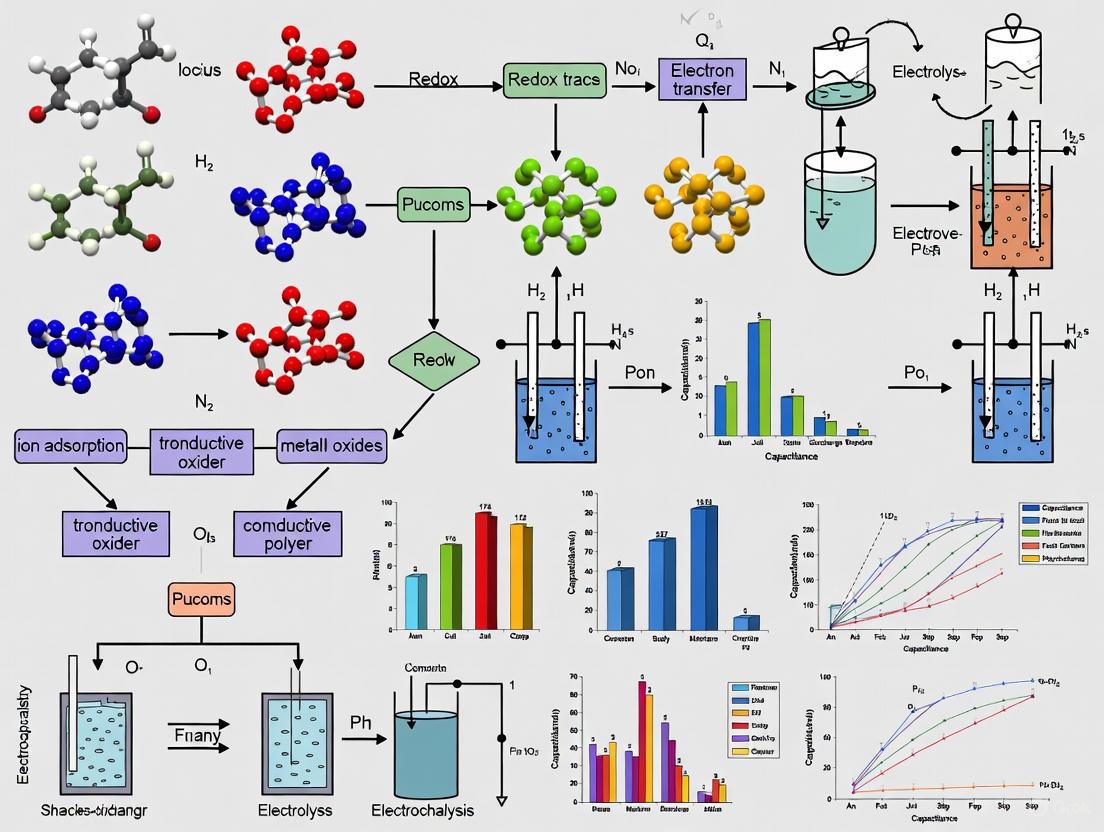
This article provides a comprehensive exploration of pseudocapacitive charge storage, a critical mechanism bridging the gap between high-energy batteries and high-power supercapacitors.
Pseudocapacitive Charge Storage: Fundamentals, Mechanisms, and Advanced Applications for Next-Generation Energy Devices
Abstract
This article provides a comprehensive exploration of pseudocapacitive charge storage, a critical mechanism bridging the gap between high-energy batteries and high-power supercapacitors. Tailored for researchers and scientists in energy storage and related fields, we delve into the foundational principles distinguishing pseudocapacitance from battery and double-layer capacitor behavior. The scope encompasses a detailed analysis of charge storage mechanisms, advanced characterization and computational methods, strategic material design to overcome conductivity and stability challenges, and performance validation through comparative analysis. This review synthesizes the latest research to guide the rational design of high-performance, durable energy storage systems for a sustainable future.
Unraveling Pseudocapacitance: Core Principles and Charge Storage Mechanisms
Pseudocapacitance represents a critical charge storage mechanism that elegantly bridges the gap between high-energy battery materials and high-power electrochemical capacitors. This in-depth technical guide examines the fundamental principles, classification, and material systems underlying pseudocapacitive behavior. Unlike battery processes limited by solid-state diffusion, pseudocapacitance enables rapid, reversible faradaic reactions at or near the electrode surface without significant phase transformations. The comprehensive analysis presented herein covers theoretical frameworks, advanced characterization methodologies, and material design strategies that exploit pseudocapacitive charge storage. As the demand for electrochemical energy storage devices combining high energy and power densities intensifies, pseudocapacitive materials offer promising pathways toward next-generation systems that transcend traditional performance trade-offs, making this resource particularly valuable for researchers and scientists developing advanced energy storage solutions.
Electrochemical energy storage technologies have traditionally been divided into two distinct categories: batteries and capacitors. Batteries, which store energy through bulk faradaic reactions, offer high energy density but suffer from limited power density and cycle life due to slow ion diffusion and structural degradation during charge-discharge cycles [1]. In contrast, electrochemical double-layer capacitors (EDLCs) store energy electrostatically at the electrode-electrolyte interface, delivering high power density and exceptional cycle life but limited energy density [2] [1]. This fundamental divide has constrained energy storage applications for decades, creating a performance gap that pseudocapacitive materials strategically address.
The global energy landscape demands sustainable solutions to address pressing environmental challenges and the intermittent nature of renewable energy sources [3] [4]. Supercapacitors have emerged as crucial components in this ecosystem, with the global market projected to grow at a CAGR of 15.3% from 2026-2036 [5]. Pseudocapacitors specifically offer enhanced energy density compared to EDLCs while maintaining superior power density and cycling stability compared to batteries, positioning them as transformative technologies for applications ranging from hybrid electric vehicles to grid storage and portable electronics [1] [5].
Historical Foundations and Theoretical Framework
Evolution of Pseudocapacitance
The concept of pseudocapacitance was first introduced by Conway et al. in 1962 to describe the reversible capacitance associated with electrochemical ion adsorption on electrode surfaces [3] [6]. Their seminal work established that the heat of adsorption is linearly related to the surface coverage of electro-adsorbed ions, resulting in capacitance described in terms of surface coverage. This foundational research primarily focused on underpotential deposition and ion adsorption processes.
The field advanced significantly with the investigation of hydrous RuO₂ films in acidic electrolytes in the 1970s, which demonstrated ideal pseudocapacitive behavior [6]. A pivotal moment came in 1999 when Lee and Goodenough reported capacitor-like charge storage in disordered MnOₓ electrodes in mild-pH electrolytes, establishing a new direction for designing high-performance electrochemical devices [6]. These historical developments created the theoretical scaffolding for contemporary pseudocapacitance research, bridging fundamental electrochemistry with materials science.
Fundamental Charge Storage Mechanisms
Pseudocapacitive materials store charge through fast, reversible faradaic reactions occurring at or near the electrode surface, unlike batteries where charge storage occurs via diffusion-limited processes in the bulk material [3] [6]. This surface-dominated mechanism enables rapid kinetics and exceptional rate capability while avoiding the structural degradation associated with phase transformations in battery materials.
Table 1: Comparison of Energy Storage Mechanisms
| Parameter | EDLC | Pseudocapacitor | Battery |
|---|---|---|---|
| Storage Mechanism | Physical ion adsorption | Surface redox reactions | Bulk redox reactions |
| Kinetics | Very fast | Fast | Slow |
| Cycle Life | Excellent (>100,000) | Good (10,000-100,000) | Limited (1,000-5,000) |
| Energy Density | Low (5 Wh/kg) | Moderate (10-50 Wh/kg) | High (150-250 Wh/kg) |
| Power Density | Very High (10 kW/kg) | High (1-10 kW/kg) | Low (<1 kW/kg) |
Three primary pseudocapacitive mechanisms have been identified, each with distinct characteristics. Surface redox pseudocapacitance involves reversible faradaic reactions at the electrode surface with charge transfer, as observed in transition metal oxides like RuO₂ and MnO₂ [3]. Intercalation pseudocapacitance occurs when ions reversibly insert into tunnels or layers of a material without phase transformation, exemplified by Nb₂O₅ and TiO₂ [2] [4]. Electrosorption involves reversible redox reactions accompanied by specific ion adsorption at electrode surfaces [3]. These mechanisms can operate independently or synergistically within a single material system.
Classification of Pseudocapacitive Materials
Intrinsic vs. Extrinsic Pseudocapacitance
Pseudocapacitive materials are fundamentally categorized as intrinsic or extrinsic based on their inherent properties and structural characteristics. Intrinsic pseudocapacitors exhibit charge storage behavior inherent to their crystal structure and chemical composition, with materials like MnO₂ and RuO₂ demonstrating ideal pseudocapacitive behavior regardless of morphology [3]. These materials typically feature disordered structures, multiple oxidation states, and inherent fast ion transport pathways that enable surface-dominated charge storage.
Extrinsic pseudocapacitance emerges in materials that are typically battery-like in bulk form but exhibit pseudocapacitive behavior when engineered with specific nanostructures or morphologies [3]. This category includes materials like Nb₂O₅ and V₂O₅, which normally undergo diffusion-limited intercalation but can demonstrate capacitive-like kinetics when fabricated as nanostructures with reduced ion diffusion lengths and enhanced surface areas [2] [4]. The distinction between these categories has significant implications for material design and performance optimization.
Major Material Classes
Transition metal oxides represent the most extensively studied class of pseudocapacitive materials. Ruthenium oxide (RuO₂) historically served as the benchmark pseudocapacitive material due to its high conductivity, multiple oxidation states, and exceptional specific capacitance (up to 1000 F/g) [3]. Manganese oxide (MnO₂) has emerged as an attractive alternative, offering advantages of natural abundance, low toxicity, and high theoretical capacitance (∼1100-1300 F/g) [2] [4]. Nickel-based compounds including NiO and Ni(OH)₂ have gained significant attention due to their high theoretical capacitance, multiple valence states, cost-effectiveness, and environmental friendliness [2] [4].
Two-dimensional materials such as MXenes have recently expanded the pseudocapacitive materials landscape. These transition metal carbides and nitrides offer tunable surface chemistry, high electronic conductivity, and exceptional volumetric capacitance [3] [2]. Their layered structures facilitate rapid ion intercalation while surface functional groups provide abundant redox-active sites. Metal-organic frameworks (MOFs) and covalent organic frameworks (COFs) represent another emerging class, featuring tunable porosity, hierarchical architectures, and multiple accessible oxidation states that can be strategically engineered to enhance pseudocapacitive storage [2] [4].
Table 2: Performance Characteristics of Pseudocapacitive Materials
| Material Class | Specific Capacitance (F/g) | Key Advantages | Limitations |
|---|---|---|---|
| RuO₂ | 600-1000 [3] | High conductivity, Excellent reversibility | High cost, Limited natural abundance |
| MnO₂ | 200-500 [2] | Low cost, Environmentally friendly | Poor intrinsic conductivity |
| Ni-based | 500-3000 [4] | High theoretical capacitance, Cost-effective | Limited cycling stability |
| MXenes | 300-500 [3] | High conductivity, Tunable chemistry | Synthesis complexity |
| MOFs/COFs | 100-800 [2] | Ultrahigh porosity, Design flexibility | Poor electronic conductivity |
Advanced Material Design Strategies
Nanostructuring and Morphological Control
Nanostructuring represents a fundamental strategy for enhancing pseudocapacitive performance by reducing ion diffusion path lengths and increasing electroactive surface areas. Fabricating materials as nanoparticles, nanowires, nanosheets, or hierarchical structures significantly improves electrochemical accessibility and reaction kinetics [3]. For instance, designing faceted structures with specific crystal plane exposures has demonstrated remarkable effectiveness in achieving high-rate performance by providing optimal surface orientations for ion adsorption and charge transfer [3].
Controlling material morphology at multiple length scales creates synergistic benefits. Mesoporous structures with pore sizes between 2-50 nm facilitate efficient electrolyte penetration while maintaining structural stability [3]. Hierarchical architectures combining micro-, meso-, and macroporosity further optimize mass transport without compromising specific surface area. These engineered nanostructures enable extrinsic pseudocapacitive behavior in materials that would otherwise exhibit battery-like diffusion-limited kinetics, effectively expanding the palette of available pseudocapacitive materials.
Atomic-Level Engineering and Composite Design
Atomic-level engineering through defect creation, doping, and interlayer tuning has emerged as a powerful approach for enhancing pseudocapacitive charge storage [3]. Introducing oxygen vacancies, cation vacancies, or interstitial defects can dramatically improve electronic conductivity and create additional active sites for surface redox reactions. Heteroatom doping with elements such as nitrogen, sulfur, or phosphorus modifies electronic structure and enhances surface wettability, facilitating ion accessibility to electroactive sites [7].
Composite materials strategically combine pseudocapacitive components with conductive matrices to overcome individual material limitations. For example, integrating lignosulfonate (a biomass-derived redox-active material) with porous carbon creates synergistic effects where the carbon framework provides conductive pathways and ion diffusion channels while the lignosulfonate contributes quinone groups for faradaic reactions [7]. Such composites have demonstrated specific capacitances of 571 F/g—approximately double that of the carbon component alone (279 F/g) [7]. Similarly, combining transition metal oxides with conductive polymers or carbon nanomaterials creates multifunctional architectures that balance high capacitance with excellent rate capability and cycling stability.
Characterization and Experimental Methodologies
Electrochemical Analysis Techniques
Cyclic voltammetry (CV) serves as the primary technique for identifying pseudocapacitive behavior through its characteristic rectangular-shaped curves, which indicate rapid, reversible charge storage with minimal kinetic limitations [6]. The scan rate dependence of CV measurements provides critical insights into charge storage mechanisms; pseudocapacitive materials typically maintain their shape even at high scan rates (≥100 mV/s), while battery-type materials show significant peak shifts and shape distortions due to diffusion limitations.
Galvanostatic charge-discharge (GCD) measurements quantify specific capacitance through symmetrical triangular charge-discharge profiles according to the equation: C = (I × Δt) / (m × ΔV), where I is current, Δt is discharge time, m is active mass, and ΔV is voltage window [1]. The linear voltage-time relationship during charge and discharge indicates ideal capacitive behavior, while deviations suggest battery-like contributions. Electrochemical impedance spectroscopy (EIS) complements these techniques by characterizing charge transfer resistance and ion diffusion processes through Nyquist plots, where pseudocapacitive materials typically exhibit nearly vertical lines in the low-frequency region, indicating ideal capacitive behavior [3].
Quantitative Mechanistic Analysis
Distinguishing pseudocapacitive from battery-type behavior requires quantitative analysis of current response using the relationship: i = avᵇ, where i is current, v is scan rate, and a and b are adjustable parameters [6]. A b-value of 0.5 indicates diffusion-controlled battery behavior, while a b-value of 1.0 signifies ideal capacitive behavior. Intermediate values represent pseudocapacitive processes with varying contributions from diffusion and surface-controlled mechanisms.
Trasatti's method provides additional quantification by separating total charge into surface-controlled and diffusion-controlled components through analysis of scan rate dependence [3]. Dunn's method further enables quantitative deconvolution of current response into capacitive and diffusion-controlled contributions at fixed potentials, providing a detailed profile of charge storage mechanisms operating throughout the potential window [3]. These analytical frameworks allow researchers to precisely engineer materials with optimized pseudocapacitive contributions for specific application requirements.
Table 3: Research Reagent Solutions for Pseudocapacitor Development
| Material/Reagent | Function | Key Characteristics |
|---|---|---|
| Transition Metal Precursors (e.g., RuCl₃, MnAc₂, NiNO₃) | Active material synthesis | Provide metal cations for pseudocapacitive oxides/hydroxides |
| Structural Directing Agents (e.g., CTAB, P123) | Morphology control | Template mesoporous structures with high surface area |
| Conductive Additives (e.g., Carbon black, CNTs) | Electronic conductivity enhancement | Provide electron pathways in composite electrodes |
| Aqueous Electrolytes (e.g., H₂SO₄, KOH, Na₂SO₄) | Ion conduction medium | Enable fast ion transport for surface redox reactions |
| Binder Materials (e.g., PVDF, Nafion) | Electrode integrity maintenance | Maintain structural stability during cycling |
Applications and Future Perspectives
Current and Emerging Applications
Pseudocapacitors have found significant applications in areas requiring high power delivery and rapid charge-discharge capabilities. In the automotive and transportation sector, they enable regenerative braking systems, start-stop functionality, and acceleration assist in hybrid electric vehicles [1] [5]. Their exceptional power density and cycling stability make them ideal for capturing and storing energy during braking events, then rapidly releasing it during acceleration, thereby improving overall energy efficiency.
The power grid and renewable energy integration represent growing application areas where pseudocapacitors provide frequency regulation, stabilize intermittent renewable sources, and deliver short-term bridging power during grid disturbances [5]. Uninterruptible power supplies (UPS) for data centers and semiconductor manufacturing facilities increasingly incorporate pseudocapacitors to ensure continuous operation during power interruptions, offering advantages over batteries in terms of faster response, longer cycle life, and wider operating temperature ranges [1] [5]. Emerging applications in flexible electronics leverage the adaptable form factors of advanced pseudocapacitors for integration into wearable devices, smart textiles, and rollable displays [6].
Challenges and Future Research Directions
Despite significant advances, pseudocapacitive materials face several challenges that require continued research attention. Limited energy density remains a fundamental constraint, with current pseudocapacitors typically delivering 10-50 Wh/kg compared to 150-250 Wh/kg for lithium-ion batteries [1]. Strategies to enhance energy density include developing asymmetric configurations, expanding operational voltage windows through advanced electrolytes, and creating materials with higher intrinsic specific capacitance.
Material stability and cycling lifetime present additional challenges, particularly for transition metal oxides that may undergo structural degradation or dissolution during extended cycling [3] [2]. Future research directions focus on developing novel material architectures with enhanced stability, including core-shell structures, surface passivation layers, and advanced composite designs. The exploration of new pseudocapacitive material families, such as high-entropy oxides and two-dimensional materials beyond MXenes, offers promising avenues for discovering materials with unprecedented combinations of capacitance, conductivity, and stability [1].
The integration of pseudocapacitive materials with battery technologies in hybrid systems represents a particularly promising direction, potentially enabling devices that combine the best attributes of both energy storage mechanisms [1] [5]. Such hybrid systems could deliver the high energy density of batteries with the high power density and long cycle life of pseudocapacitors, effectively bridging the performance divide that has long constrained electrochemical energy storage technologies.
Pseudocapacitance represents a sophisticated charge storage mechanism that transcends traditional boundaries between capacitors and batteries, offering a promising pathway toward electrochemical energy storage systems combining high power and energy densities. Through strategic material design encompassing nanostructuring, atomic-level engineering, and composite architectures, researchers can optimize pseudocapacitive behavior in diverse material systems. Advanced characterization methodologies enable precise quantification of charge storage mechanisms, guiding rational material development.
As global energy demands continue to evolve and the transition to renewable sources accelerates, pseudocapacitive materials are poised to play increasingly critical roles in applications ranging from grid stabilization to electric mobility and portable electronics. Future advancements will likely emerge from interdisciplinary approaches combining materials synthesis, electrochemical engineering, and device architecture optimization. By bridging the fundamental divide between battery and capacitor technologies, pseudocapacitive materials represent a cornerstone in the ongoing development of advanced electrochemical energy storage systems capable of meeting the complex demands of a sustainable energy future.
Ruthenium dioxide (RuO₂) has established a foundational role in the research and development of advanced energy storage technologies, particularly pseudocapacitors. Its historical significance stems from a unique combination of high electrical conductivity, exceptional electrochemical activity, remarkable thermal stability, and reversible redox reactions that enable efficient charge storage. RuO₂ was among the first materials studied for pseudocapacitive behavior, where charge is stored not just in the electrochemical double layer but through fast, reversible faradaic reactions at the surface and near-surface of the material. This dual mechanism unlocks a higher energy density than traditional capacitive materials while retaining the high-power density and long cycle life characteristic of capacitors. The journey of RuO₂ from a bulk material to precisely engineered nanostructures exemplifies the broader evolution in materials science, where control over morphology, size, and composition at the nanoscale has unlocked unprecedented electrochemical performance. This article frames this evolution within the context of pseudocapacitive charge storage research, tracing the pathway from fundamental RuO₂ studies to the modern toolkit of nanostructured materials.
Fundamental Pseudocapacitive Mechanisms in RuO₂
The exceptional performance of RuO₂ as a pseudocapacitive material is governed by its ability to undergo highly reversible redox reactions across a wide potential window. Unlike batteries, which store charge via slow, diffusion-limited bulk reactions often accompanied by phase transitions, pseudocapacitors like RuO₂ engage in rapid surface and near-surface processes.
The charge storage mechanism in RuO₂ in an acidic electrolyte can be represented by the following reversible reaction: [ \text{RuO}2 + x\text{H}^+ + x\text{e}^- \leftrightarrow \text{RuO}{2-x}(\text{OH})_x ] where (0 \le x \le 2). This reaction involves the simultaneous injection of protons and electrons into the RuO₂ lattice, leading to a continuous change in the oxidation state of the ruthenium ions. This process is not limited to the outermost surface; it can extend into the bulk of the material, provided the proton and electron can readily access the reaction sites. The reversibility of this reaction is key to the material's long-term cycling stability. The specific capacitance of RuO₂ is directly linked to its specific surface area and the accessibility of these redox-active sites, which has driven research into nanostructured and hydrated forms of RuO₂ to maximize performance.
Historical Evolution: From Bulk Synthesis to Nanoscale Engineering
The synthesis of RuO₂ has progressed significantly from traditional solid-state methods to sophisticated chemical and green processes that enable precise control over particle size, morphology, and crystallinity.
Table 1: Evolution of RuO₂ Synthesis Methods and Key Characteristics
| Synthesis Method | Typical Precursors | Key Characteristics | Historical Significance |
|---|---|---|---|
| Chemical Precipitation & Autoclaving [8] | RuNO(NO₃)₃, RuCl₃, NH₄OH | Amorphous precursors crystallize to nanosized particles (up to 450°C); particle size increases significantly at higher temperatures (e.g., 600°C). | Early "wet" chemical method demonstrating controlled nanocrystalline RuO₂ formation. |
| Calcination of Ru(III) Complexes [9] | Ru(III) complexes with ofloxacin/amino acids | Produces RuO₂ nanoparticles with orthorhombic structure after calcination at 600°C for 3 hours. | Illustrates use of molecular complexes as shape-defining precursors for nanomaterials. |
| Green Synthesis [10] | Ru precursors, Murraya koenigii leaf extract | Yields tetragonal RuO₂ nanoparticles (5-12 nm); pseudospherical morphology; utilizes sustainable capping agents. | Environmentally friendly approach, avoiding harsh chemicals; demonstrates bio-capping for size control. |
Early synthesis routes, such as the chemical precipitation of amorphous precursors from RuNO(NO₃)₃ or RuCl₃ solutions followed by thermal treatment, established that nanocrystalline RuO₂ particles could be formed at temperatures up to 450°C [8]. This foundational work highlighted the critical relationship between processing parameters and material properties, a theme that continues to dominate materials science research. The progression to more complex synthesis methods, including the calcination of metal-organic precursors and, more recently, biologically mediated green synthesis, reflects a continuous drive towards greater control, sustainability, and functionality.
The following workflow diagram summarizes the historical evolution of RuO₂ synthesis methods from traditional approaches to modern nanostructuring techniques:
Modern Nanostructuring: Morphology, Composition, and Strain Engineering
Contemporary research has moved beyond simple nanoparticle synthesis to the sophisticated engineering of RuO₂ nanostructures with defined shapes, complex composites, and intentional strain profiles to enhance both activity and stability.
Shape-Dependent Catalysis and Performance
The morphology of RuO₂ nanomaterials directly influences their catalytic properties. A seminal study demonstrated that using polyethylene glycol (PEG) as a surfactant during synthesis transformed spherical RuO₂ nanoparticles into one-dimensional nanorods supported on γ-Al₂O₃ [11]. This shape control led to a dramatic improvement in performance: the nanorod-based catalyst achieved total CO oxidation at 175°C, a 25°C lower temperature than the spherical nanoparticle counterpart [11]. This performance enhancement was attributed to improved porosity, better dispersion, and the higher surface energy of the specific crystal facets exposed in the nanorod morphology.
Strain Heterogeneity Engineering for Enhanced Electrocatalysis
A groundbreaking strategy to overcome the classic activity-stability trade-off in RuO₂ involves engineering strain heterogeneity within the crystal lattice. Recent work has shown that doping RuO₂ with single-atom platinum (Pt) introduces a unique structure with bulk tensile strain and localized compressive strain regions [12].
- Bulk Tensile Strain: Induced by the larger Pt atoms expanding the RuO₂ crystal lattice, this strain stabilizes the entire structure by weakening the Ru–O bond covalency. This increases the enthalpy change for lattice oxygen loss, thereby suppressing Ru dissolution and enhancing thermodynamic stability during the harsh acidic oxygen evolution reaction (OER) [12].
- Localized Compressive Strain: The same Pt dopants repel surrounding Ru atoms, creating pockets of compressive strain. This compressive strain shifts the Ru d-band center downward, weakening the binding energy of oxo-intermediates (O, OH) and thereby boosting OER activity [12].
In a proton exchange membrane water electrolyzer (PEMWE), this Pt-RuO₂ catalyst achieved an exceptionally low voltage of 1.791 V at a high current density of 3 A cm⁻² and maintained stable operation for over 500 hours at 500 mA cm⁻², far surpassing the stability of pure RuO₂ and meeting performance targets set by the US Department of Energy [12].
Table 2: Electrochemical Performance of Advanced RuO₂-Based Nanomaterials
| Material / Application | Key Performance Metric | Result | Reference |
|---|---|---|---|
| Pt-RuO₂ (Strain-Engineered) / PEMWE OER | Current Density @ 1.791 V | 3 A cm⁻² | [12] |
| Stability @ 500 mA cm⁻² | > 500 hours | [12] | |
| RuO₂/MWCNT / VRFB Positive Electrode | Peak Current Ratio & Potential Difference | High current ratio, small potential difference | [13] |
| PEG-Stabilized RuO₂ Nanorods / CO Oxidation | Temperature for Total CO Conversion | 175 °C | [11] |
| Ru(acac)₃ / Redox Flow Battery | Voltage Efficiency (0.1 M conc.) | 55% (battery full) | [14] |
The diagram below illustrates the strain heterogeneity concept in Pt-doped RuO₂, showing how different strain regions contribute to stability and activity:
Experimental Protocols: Synthesis and Characterization
This protocol is adapted from the seminal work on synthesizing nanocrystalline RuO₂ powders.
Objective: To synthesize nanocrystalline RuO₂ via chemical precipitation of an amorphous precursor, followed by autoclaving and thermal treatment.
Materials:
- Precursor: Ruthenium(III) nitrosyl nitrate (RuNO(NO₃)₃) or Ruthenium(III) chloride hydrate (RuCl₃·xH₂O).
- Precipitating Agent: 25% Aqueous Ammonia (NH₄OH).
- Solvent: Doubly distilled water.
- Equipment: Autoclave, programmable tube furnace.
Procedure:
- Precipitation: Prepare a 0.1 M solution of the ruthenium precursor (e.g., RuNO(NO₃)₃) in doubly distilled water. Under vigorous stirring, slowly add the NH₄OH solution until the pH reaches approximately 5.25.
- Aging & Washing: Age the resulting precipitate for 24 hours at room temperature. Separate the precipitate by filtration and wash thoroughly with doubly distilled water to remove soluble by-products like nitrates or chlorides.
- Autoclaving: Transfer the washed precipitate into a Teflon-lined autoclave. Treat hydrothermally at 220°C for 2 hours.
- Drying & Calcination: Dry the autoclaved product at 110°C. The final crystallization is achieved by calcining the amorphous precursor in a tube furnace at a temperature between 400°C and 600°C in air for a defined period (e.g., 2 hours). Critical Note: Crystallite size is temperature-dependent. Calcination at 400°C will yield nanosized particles, while treatment at 600°C will result in a significant increase in particle size [8].
Characterization:
- X-ray Diffraction (XRD): Confirm the formation of crystalline RuO₂ and determine crystal structure and approximate crystallite size using the Scherrer equation.
- Thermal Analysis (DTA/TGA): Identify exothermic recrystallization peaks (~380-385°C) and monitor weight loss due to decomposition of residuals [8] [10].
- Electron Microscopy (TEM/HRTEM): Analyze particle size, morphology, and distribution. Typical nanoparticles synthesized via this route are in the nanoscale range below 50 nm [8] [10].
- FT-IR Spectroscopy: Verify the removal of precursor-related functional groups (e.g., NO, Cl) and confirm the formation of Ru-O bonds.
The Scientist's Toolkit: Essential Research Reagents for RuO₂ Research
Table 3: Key Research Reagents for RuO₂ Nanomaterial Synthesis
| Reagent / Material | Function in Synthesis | Example Application |
|---|---|---|
| RuCl₃·xH₂O | Common Ru precursor salt; provides Ru³⁺ ions. | Wet chemical precipitation [8], electrode preparation [13]. |
| RuNO(NO₃)₃ | Common Ru precursor; provides Ru in nitrosyl complex. | Wet chemical precipitation [8]. |
| Ru(acac)₃ | Ruthenium acetylacetonate; molecular complex for redox flow batteries. | Electrolyte in ruthenium-based redox flow batteries [14]. |
| NH₄OH (Aqueous Ammonia) | Precipitating agent to form amorphous Ru hydroxide precursors. | pH adjustment to ~5 for precipitation [8]. |
| Polyethylene Glycol (PEG) | Polymer surfactant / stabilizer; directs morphology. | Synthesis of RuO₂ nanorods for enhanced CO oxidation [11]. |
| Single-Atom Pt Precursors | Dopant to induce strain heterogeneity. | Synthesizing Pt-RuO₂ for stable and active OER catalysts [12]. |
| Murraya koenigii Extract | Green reducing and capping agent. | Biogenic synthesis of 5-12 nm RuO₂ nanoparticles [10]. |
The historical context from bulk RuO₂ to modern nanostructured materials underscores a fundamental paradigm in materials science: intrinsic properties are merely the starting point. The evolution of RuO₂ research demonstrates that performance is profoundly dictated by structure at the nanoscale. Through meticulous engineering of particle size, morphology, and even internal lattice strain, researchers have progressively decoupled and enhanced the activity-stability relationship that is crucial for applications in electrocatalysis and energy storage.
Future research directions will likely focus on several key areas. The exploration of strain heterogeneity, as demonstrated with Pt-doping, provides a blueprint for designing a new class of catalysts that are both highly active and durable. The expansion of green synthesis methodologies will be critical for developing sustainable and scalable production routes. Furthermore, the integration of RuO₂ with other nanomaterials, such as carbon nanotubes (CNTs) and two-dimensional supports, to create synergistic composites will continue to push the boundaries of performance. As pseudocapacitive charge storage research advances, the lessons learned from the historical journey of RuO₂—emphasizing control over structure-property relationships—will remain fundamental to the development of next-generation energy storage and conversion materials.
Deconstructing the Three Primary Pseudocapacitive Mechanisms
The growing global demand for efficient energy storage systems has intensified research into pseudocapacitive materials, which are renowned for their high-power density and rapid charge-discharge capabilities [4]. Pseudocapacitance represents a unique charge storage mechanism that occupies the middle ground between the electrostatic processes of electrochemical double-layer capacitors (EDLCs) and the diffusion-limited faradaic reactions of batteries [15]. Unlike battery materials, which store charge through slow, solid-state diffusion processes, pseudocapacitive materials undergo fast, reversible faradaic reactions at or near the electrode surface without phase transformations that typically limit reaction kinetics [15] [16]. This fundamental distinction enables pseudocapacitive devices to achieve energy densities significantly higher than conventional EDLCs while maintaining the high power density and long cycle life characteristic of capacitors [4]. The concept of pseudocapacitance was first introduced following the discovery of capacitive-like behavior in hydrous RuO₂ by Trasatti and Buzzanca in 1971 [15], which demonstrated that faradaic processes could occur at rates comparable to electrostatic charging when appropriate material properties and structural designs are implemented.
The historical development of pseudocapacitors began in earnest during the 1980s, approximately a decade after the first carbon-based "Supercap" electrodes entered the market [4]. These early devices represented a fundamentally new approach to energy storage by combining double-layer formation with faradaic reactions, thereby merging the advantageous properties of both batteries and capacitors [4]. Contemporary research focuses on developing advanced pseudocapacitive materials—including transition metal oxides, two-dimensional materials like MXenes, metal-organic frameworks, and covalent organic frameworks—that offer enhanced energy storage capabilities through multiple accessible oxidation states and tunable porous architectures [4]. Understanding the three primary pseudocapacitive mechanisms is crucial for guiding the rational design of next-generation electrode materials that can overcome the current limitations in energy storage technology, particularly the trade-off between energy and power density that has long constrained electrochemical energy storage devices [15].
Fundamental Principles and Classification
Pseudocapacitive energy storage is predominantly based on faradaic redox reactions, but unlike battery systems, its charge storage is not limited by solid-state ion diffusion [15]. This critical distinction enables pseudocapacitive materials to achieve high power densities while maintaining substantial energy storage capacity. The operational principle of pseudocapacitors involves fast, reversible redox reactions at the electrode-electrolyte interface, where charge transfer occurs between the electrode and electrolyte when an external voltage is applied [4]. The kinetics of these reactions are significantly faster than those in conventional battery materials due to the surface-controlled nature of the charge storage process [16].
The classification of pseudocapacitive mechanisms has evolved since Conway and co-workers first formalized the concept in the 1990s [15]. Contemporary electrochemistry recognizes three primary pseudocapacitive mechanisms based on their operational characteristics and underlying physical processes. Each mechanism exhibits distinct electrochemical signatures that can be identified through techniques such as cyclic voltammetry and electrochemical impedance spectroscopy. The quantitative analysis of these signatures enables researchers to distinguish true pseudocapacitive behavior from battery-like behavior, which is crucial for proper material classification and device configuration [16].
Table 1: Fundamental Characteristics of Primary Energy Storage Mechanisms
| Characteristic | EDLC | Pseudocapacitance | Battery-Type |
|---|---|---|---|
| Storage Mechanism | Electrostatic ion adsorption | Surface redox reactions | Bulk redox reactions with phase changes |
| Kinetic Control | Electronic/ionic resistance | Surface-controlled | Diffusion-controlled |
| Cyclic Voltammetry | Rectangular shape | Rectangular/quasi-rectangular | Distinct redox peaks |
| Rate Capability | Excellent | High | Moderate to poor |
| Cycle Life | Excellent (~10⁶ cycles) | Good (~10⁵ cycles) | Limited (~10³ cycles) |
The following diagram illustrates the hierarchical classification of pseudocapacitive mechanisms and their key distinguishing features:
Figure 1: Classification tree of the three primary pseudocapacitive mechanisms with their defining characteristics.
The Three Primary Pseudocapacitive Mechanisms
Underpotential Deposition (Monolayer Adsorption)
Underpotential deposition represents a specialized form of pseudocapacitance that involves the reversible electrochemisorption of ions onto a foreign substrate at potentials positive to their thermodynamic reduction potential [15]. This phenomenon occurs when the interaction between the depositing species and the substrate surface is stronger than the interaction between the depositing species themselves in their bulk crystalline form. A classic example of this mechanism is the deposition of lead on gold, where Pb adatoms form a monolayer on the Au surface at potentials more positive than the Nernst potential for Pb/Pb²⁺ reduction [15]. The stronger Pb-Au interaction compared to Pb-Pb bonding in metallic lead enables this unique deposition behavior, which results in a well-defined, reversible capacitive signature during electrochemical cycling.
The charge storage in underpotential deposition occurs through a highly reversible faradaic process that exhibits capacitive characteristics due to the potential-dependent coverage of the adsorbed species. The resulting cyclic voltammograms typically display symmetric, peaked currents that are directly proportional to the scan rate, indicating surface-controlled kinetics. The mathematical relationship between current (i) and scan rate (v) follows a linear dependence (i ∝ v), which distinguishes it from diffusion-controlled battery reactions where i ∝ v¹/² [16]. While underpotential deposition represents a fundamental pseudocapacitive mechanism, its practical applications in energy storage systems are relatively limited compared to other pseudocapacitive types due to constraints in achievable capacity and the specificity of required electrode-electrolyte combinations.
Surface Redox Pseudocapacitance
Surface redox pseudocapacitance occurs when electroactive species undergo fast, reversible faradaic reactions directly on or near the surface of electrode materials through charge-transfer processes [15]. This mechanism was first identified in hydrous ruthenium oxide (RuO₂), which demonstrated rectangular cyclic voltammograms characteristic of capacitive behavior despite involving faradaic reactions [15]. The exceptional pseudocapacitive performance of RuO₂ arises from a combination of factors: the multivalent redox behavior of Ru⁴⁺ centers, high electronic conductivity, short diffusion distances due to large "outer surface" area, and an extensive structural-water-induced "inner surface" within the porous hydrous material [15].
In surface redox pseudocapacitance, alkali ions are electrochemically adsorbed onto the electrode surface through charge-transfer processes that occur without crystallographic phase transformations. The absence of phase changes eliminates the kinetic limitations typically associated with nucleation and growth processes in battery materials, enabling exceptionally fast reaction rates. This mechanism is particularly prominent in transition metal oxides and hydroxides such as MnO₂, NiO, Ni(OH)₂, and Co₃O₄, which offer multiple oxidation states for reversible redox reactions [4]. Recent research has also demonstrated surface redox pseudocapacitance in two-dimensional materials like MXenes, where surface termination groups (–OH, –O, and –F) participate in faradaic reactions while maintaining structural stability [17] [18]. For instance, vanadium carbide (V₂CTₓ) MXene exhibits pseudocapacitive charge storage in water-in-salt calcium-ion electrolytes through the V³⁺/V⁴⁺ redox couple, achieving a specific capacitance of 380 F g⁻¹ at 2 mV s⁻¹ [17].
Intercalation Pseudocapacitance
Intercalation pseudocapacitance arises when alkali ions are rapidly and reversibly inserted into the tunnels or layers of a redox-active material without phase transformations that would typically limit solid-state diffusion kinetics [15]. This mechanism enables bulk-like charge storage while maintaining capacitive-like rate capabilities, effectively bridging the gap between surface-limited pseudocapacitors and diffusion-limited batteries. The key distinction between intercalation pseudocapacitance and battery behavior lies in the absence of nucleation barriers and two-phase separation during the ion insertion/extraction processes [15].
This mechanism is particularly prevalent in materials with open crystal structures that permit rapid ion transport, such as niobium oxide (Nb₂O₅), titanium oxide (TiO₂), and vanadium oxide (V₂O₅) [4] [19]. These intercalation-type materials offer fast and reversible ion insertion without significant phase transitions, enabling them to maintain capacitive behavior even when charge storage occurs throughout the particle volume rather than being limited to the surface region [4]. The structural features that facilitate intercalation pseudocapacitance include well-defined diffusion pathways, minimal structural rearrangements upon ion insertion, and electronic structures that support rapid redox reactions. Recent advances have demonstrated intercalation pseudocapacitance in heterostructured materials such as α-Fe₂O₃/NH₄V₃O₈ composites, where the difference in work function between constituent materials generates a built-in electric field that enhances charge separation and facilitates bidirectional charge transport with different energy storage mechanisms [20].
Table 2: Comparative Analysis of the Three Primary Pseudocapacitive Mechanisms
| Parameter | Underpotential Deposition | Surface Redox Pseudocapacitance | Intercalation Pseudocapacitance |
|---|---|---|---|
| Primary Materials | Metal substrates with adsorbed ions (e.g., Pb on Au) | Transition metal oxides (RuO₂, MnO₂, NiO), MXenes | Layered/tunneled oxides (Nb₂O₅, TiO₂, V₂O₅) |
| Reaction Depth | Monolayer surface coverage | Surface and near-surface (1-2 nm) | Bulk-like (throughout material) |
| Kinetic Signature | i ∝ v | i ∝ v | i ∝ v |
| Phase Changes | None | None | None |
| Cyclic Voltammetry | Symmetric peaked currents | Rectangular shape | Rectangular shape with broad peaks |
| Real-World Impact | Limited practical application | High power density, moderate energy density | Balanced energy and power density |
Experimental Methodologies and Characterization
Electrochemical Profiling of Pseudocapacitive Mechanisms
The accurate identification and quantification of pseudocapacitive mechanisms require comprehensive electrochemical characterization using standardized protocols. Cyclic voltammetry (CV) serves as the primary technique for distinguishing pseudocapacitive behavior from battery-type and double-layer capacitive processes. For true pseudocapacitive materials, CV curves maintain a similar shape regardless of scan rate, with current response scaling linearly with scan rate [16]. This contrasts with battery-type materials that exhibit distinct, shifting redox peaks indicative of diffusion-limited processes. Quantitative analysis of the current response relationship to scan rate (i = avᵇ) allows determination of the b-value, where b = 1 indicates ideal capacitive behavior and b = 0.5 signifies diffusion-controlled battery behavior [16].
Electrochemical impedance spectroscopy (EIS) provides complementary information about charge storage mechanisms and degradation processes. For MnOₓ electrodes under floating conditions, EIS has revealed that degradation is primarily structural, related to inner pore collapse and blockage, which decreases inner layer active sites and increases electrolyte resistance in the inner pores [21]. In-situ ellipsometry studies have further correlated these electrochemical changes with physical properties, showing that aged MnOₓ films exhibit reduced thickness (from 138 nm to 136 nm), decreased porosity, and increased resistivity after floating tests at 1.2 V vs. SCE [21]. These combined techniques enable researchers to establish structure-property relationships critical for optimizing pseudocapacitive materials.
Advanced Synthesis Protocols
Hydrothermal Synthesis of Cr₂CTₓ/NiFe₂O₄ Composites
The development of heterostructured pseudocapacitive materials with enhanced performance requires sophisticated synthesis approaches. A representative protocol for creating Cr₂CTₓ/NiFe₂O₄ composites demonstrates this complexity [18]:
MAX Phase Synthesis: Begin by mixing chromium metal powder and graphite powder in a 2:1 weight ratio using a turbo mixer for 2 hours with toluene as a solvent. Dry the mixture, pelletize, and heat in a tubular furnace at 1150°C for 1 hour to form chromium carbide.
MAX Phase Formation: Combine the obtained chromium carbide with aluminum powder in a 1:1.2 weight ratio using the same mixing, drying, and pelletizing process. Heat the pellets again at 1150°C for 1 hour to obtain the Cr₂AlC MAX phase, then crush and sieve using a ~200 mesh.
MXene Etching: Synthesize Cr₂CTₓ MXene from the Cr₂AlC MAX phase through selective etching with hydrofluoric acid (HF) for 45 minutes to remove aluminum layers.
Composite Formation: Dissolve 1 mM nickel nitrate and 2 mM ferric nitrate in 50 mL deionized water under stirring for 60 minutes. Separately, disperse 100 mg of Cr₂CTₓ in 10 mL of deionized water via sonication for 30 minutes. Mix the solutions, stir thoroughly, and transfer to an autoclave for reaction at 180°C for 24 hours.
Purification: Wash the resulting Cr₂CTₓ/NiFe₂O₄ composite thoroughly with deionized water and ethanol, then dry overnight at 60°C [18].
This carefully optimized procedure yields a composite with exceptional pseudocapacitive performance, demonstrating a specific capacitance of 1719.5 F g⁻¹ with 88% retention over 5000 cycles in a three-electrode system [18].
Fabrication of α-Fe₂O₃/NH₄V₃O₈ Heterostructures
The creation of integrated electrodes with multiple charge storage mechanisms follows alternative synthetic pathways:
α-Fe₂O₃ Nanoparticle Synthesis: Dissolve 1 mM iron(III) nitrate nonahydrate (Fe(NO₃)₃·9H₂O) and 1 g of urea in deionized water, then add 20 µL tetrapropylammonium hydroxide (TPAOH) as a surfactant. Heat the solution at 90°C for 10 hours, then separate the precipitate via centrifugation and wash with ethanol and deionized water.
Heterostructure Assembly: Dissolve 1 mM of ammonium metavanadate (NH₄VO₃) in 30 mL DI water, then add 120 µL of 2 M HCl as an etchant. Add 40 mL of the α-Fe₂O₃ nanoparticle colloidal solution dropwise to the NH₄VO₃ solution with continuous stirring.
Hydrothermal Treatment: Transfer the growth solution to a Teflon-lined autoclave and heat at 180°C for 10 hours with a ramp-up rate of 2°C/min. After cooling, separate the precipitate of α-Fe₂O₃-decorated NH₄V₃O₈ multiwalled nanotubes via centrifugation at 6000 rpm for 5 minutes.
Final Processing: Wash the purified material multiple times with DI water and ethanol, then dehydrate at 70°C [20].
This synthesis strategy produces heterostructures that leverage the work function difference between components to generate a built-in electric field, enabling simultaneous operation at both positive and negative potentials and supporting dual charge storage mechanisms [20].
The following diagram illustrates the experimental workflow for synthesizing and characterizing pseudocapacitive materials:
Figure 2: Experimental workflow for pseudocapacitive material synthesis and characterization.
Research Reagent Solutions and Essential Materials
Table 3: Essential Research Reagents for Pseudocapacitive Material Investigation
| Reagent/Material | Function/Application | Representative Use |
|---|---|---|
| Transition Metal Precursors (Ni(NO₃)₂, Fe(NO₃)₃, NH₄VO₃) | Provide metal centers for redox-active materials | Synthesis of NiFe₂O₄, NH₄V₃O₈ [18] [20] |
| MAX Phase Components (Cr, Al, C graphite powder) | Form precursor for MXene synthesis | Cr₂AlC MAX phase creation [18] |
| Etching Agents (HF, HCl) | Selective removal of layers from MAX phases | Aluminum removal from Cr₂AlC to form Cr₂CTₓ [18] |
| Structure-Directing Agents (TPAOH, urea) | Control morphology and nanoparticle growth | α-Fe₂O₃ nanoparticle synthesis [20] |
| Conductive Additives (Carbon black, CNTs, graphene) | Enhance electronic conductivity of electrodes | Composite electrode fabrication [22] |
| Binders (PVDF, NMP) | Provide structural integrity to electrodes | Electrode preparation for testing [18] |
| Electrolytes (Ca(TFSI)₂, Na₂SO₄, KOH) | Provide ionic conductivity and operating voltage window | Water-in-salt electrolytes for extended voltage windows [17] [20] |
Performance Metrics and Degradation Analysis
Quantitative Performance Assessment
The evaluation of pseudocapacitive materials requires multiple performance metrics to fully characterize their electrochemical behavior. Specific capacitance remains the fundamental parameter, with advanced materials such as Cr₂CTₓ/NiFe₂O₄ composites achieving remarkable values of 1719.5 F g⁻¹ in three-electrode configurations [18]. When assembled into full asymmetric supercapacitor devices, these materials maintain substantial specific capacitance (486.66 F g⁻¹) while delivering exceptional energy density (97.66 W h kg⁻¹) and power density (1203.95 W kg⁻¹) [18]. Cycling stability represents another critical metric, with high-performance pseudocapacitive materials typically retaining >85% of initial capacitance after 5000 cycles, as demonstrated by both Cr₂CTₓ/NiFe₂O₄ (88% retention) [18] and V₂CTₓ MXene in water-in-salt calcium-ion electrolytes (good stability over 10,000 cycles) [17].
The operational voltage window significantly influences energy density, with recent advances in electrolyte engineering enabling substantial improvements. For instance, V₂CTₓ MXene exhibits an operational potential window of 1.3 V in water-in-salt electrolyte, significantly superior to dilute electrolytes, while α-Fe₂O₃/NH₄V₃O₈ heterostructures achieve 2.2 V in aqueous Na₂SO₄ electrolyte [17] [20]. These expanded voltage windows directly contribute to enhanced energy storage capabilities while maintaining the safety advantages of aqueous systems. The interplay between these performance metrics underscores the importance of balanced material design that optimizes multiple parameters simultaneously rather than maximizing individual characteristics at the expense of others.
Degradation Mechanisms and Mitigation Strategies
Understanding degradation pathways is essential for developing durable pseudocapacitive materials. Accelerated aging studies on MnOₓ electrodes under floating conditions have revealed that failure time decreases exponentially with increasing floating potential, highlighting the sensitivity of pseudocapacitive materials to voltage stress [21]. The primary degradation mechanisms involve structural changes rather than chemical decomposition, specifically inner pore collapse and blockage that reduce active sites accessible for charge storage [21]. Quantitative analysis shows that the electrolyte resistance in inner pores increases linearly with floating time, while inner layer capacitance decreases correspondingly [21].
In-situ ellipsometry studies provide detailed physical insights into these degradation processes, showing that aged MnOₓ films exhibit reduced thickness (from 138 nm to 136 nm), decreased porosity, and increased resistivity after floating tests [21]. Additionally, the charge storage mechanism evolves during aging, with the initial capacitive response dominated by inner surface processes (~68%) shifting toward outer surface dominance (~74% at endpoint) as internal active sites become inaccessible [21]. These findings emphasize the critical importance of robust morphological stability in pseudocapacitive materials, suggesting that mitigation strategies should focus on maintaining pore structure and preventing mechanical degradation during extended cycling rather than solely addressing chemical stability.
Table 4: Performance Comparison of Advanced Pseudocapacitive Materials
| Material | Specific Capacitance | Energy Density | Power Density | Cycle Stability | Charge Storage Mechanism |
|---|---|---|---|---|---|
| Cr₂CTₓ/NiFe₂O₄ [18] | 1719.5 F g⁻¹ (3-electrode) | 97.66 W h kg⁻¹ | 1203.95 W kg⁻¹ | 88% (5000 cycles) | Surface redox pseudocapacitance |
| V₂CTₓ MXene in WIS Ca²⁺ [17] | 380 F g⁻¹ | N/A | N/A | Good (10,000 cycles) | Surface redox pseudocapacitance |
| α-Fe₂O₃/NH₄V₃O₈ Heterostructure [20] | N/A | 79 W h kg⁻¹ | 5996 W kg⁻¹ | N/A | Dual mechanism: conversion + intercalation |
| MnOₓ (initial) [21] | Dominated by inner surface (68%) | N/A | N/A | Exponential decay with potential | Surface redox pseudocapacitance |
Future Perspectives and Research Directions
The field of pseudocapacitive energy storage continues to evolve rapidly, with several promising research directions emerging from current understanding of the three primary mechanisms. Dimensional engineering of carbon-pseudocapacitive hybrids represents a particularly active area, where the strategic design of architectures ranging from zero-dimensional quantum dots to three-dimensional interconnected frameworks enables synergistic coupling between conductive carbon matrices and high-capacity pseudocapacitive components [22]. This approach effectively addresses the fundamental trade-off between power density and energy density that has long constrained energy storage devices.
The development of heterostructured integrated electrodes that combine multiple charge storage mechanisms within a single platform offers exciting possibilities for next-generation supercapacitors [20]. These systems leverage built-in electric fields generated by work function differences between constituent materials to enhance charge separation and enable simultaneous operation at both positive and negative potentials. The α-Fe₂O₃/NH₄V₃O₈ system exemplifies this strategy, supporting sulfate ion conversion reactions and sodium ion intercalation processes concurrently [20]. Such innovative designs point toward increasingly sophisticated material architectures that maximize the advantages of different pseudocapacitive mechanisms while mitigating their individual limitations.
Future research will likely focus on optimizing interfacial engineering between pseudocapacitive components, developing standardized protocols for distinguishing true pseudocapacitance from battery-like behavior, and scaling up synthesis processes for commercial applications [22] [16]. Additionally, the exploration of novel electrolyte systems—such as water-in-salt electrolytes that expand voltage windows while maintaining safety—will continue to enhance the practical performance of pseudocapacitive devices [17]. As fundamental understanding of charge storage mechanisms deepens, the rational design of pseudocapacitive materials with tailored architectures and optimized properties will play an increasingly important role in meeting the growing global demand for advanced energy storage technologies.
The escalating demand for advanced energy storage systems has catalyzed intensive research into mechanisms that bridge the performance gap between conventional capacitors and batteries. Redox pseudocapacitance represents a pivotal charge storage mechanism that leverages fast, reversible faradaic reactions occurring at or near electrode surfaces, enabling devices that combine high power density with appreciable energy density [23] [24]. Unlike battery-type storage, which relies on slow, diffusion-limited bulk ion intercalation, redox pseudocapacitance involves surface-confined electrochemical reactions that produce a current response similar to electrostatic capacitors while delivering significantly higher capacitance values [23] [4].
This phenomenon was first systematically characterized by Brian E. Conway in the 1990s, who distinguished it from electric double-layer capacitance (EDLC) and battery-type behavior through its unique thermodynamic and kinetic signatures [24]. The fundamental distinction lies in its faradaic nature—electron transfer across the electrode-electrolyte interface—while maintaining capacitive-like linear charge-potential relationships [23]. Early experimental observations in noble metal oxides, particularly ruthenium dioxide (RuO₂) in the 1970s, demonstrated nearly rectangular cyclic voltammograms despite faradaic charge transfer, with capacitances reaching 200-300 F/g [24]. Subsequent research has expanded the palette of pseudocapacitive materials to include various transition metal oxides, hydroxides, chalcogenides, and conducting polymers, with ongoing efforts focused on enhancing their performance and stability for next-generation energy storage applications [4].
Fundamental Principles and Mechanisms
Defining Redox Pseudocapacitance
Redox pseudocapacitance is a faradaic charge storage mechanism characterized by fast, highly reversible redox reactions that occur at or near the surface of electrode materials [23] [24]. These reactions involve electron transfer between the electrode and electrolyte species, resulting in changes to the oxidation states of surface atoms without crystallographic phase transformations [25]. The term "pseudo" derives from the capacitive-like electrochemical signatures—particularly the nearly linear relationship between stored charge and applied potential—despite the faradaic origin of charge storage [23].
The thermodynamic foundation of redox pseudocapacitance lies in the continuous dependence of oxidation state coverage on electrode potential, as described by the Nernst equation [24]. This potential-dependent surface coverage enables charge to accumulate progressively across a potential window rather than at discrete potentials, yielding the characteristic rectangular cyclic voltammograms and triangular galvanostatic charge-discharge curves [24]. Kinetically, these surface-confined reactions are not limited by solid-state diffusion, allowing them to proceed at rates approaching those of purely electrostatic processes while delivering higher specific capacitance [26] [23].
Comparative Charge Storage Mechanisms
Understanding redox pseudocapacitance requires distinguishing it from other primary charge storage mechanisms, particularly electric double-layer capacitance and battery-type intercalation.
Table 1: Comparison of Charge Storage Mechanisms in Electrochemical Energy Storage
| Mechanism | Charge Storage Type | Energy Density | Power Density | Cycle Life | Kinetic Limitations |
|---|---|---|---|---|---|
| Electric Double-Layer Capacitance | Non-faradaic (physical ion adsorption) | Low (5-10 Wh/kg) | Very High (10-20 kW/kg) | Excellent (>100,000 cycles) | Limited only by ion mobility at interface |
| Redox Pseudocapacitance | Faradaic (surface redox reactions) | Moderate (10-100 Wh/kg) | High (>10 kW/kg) | Very Good (>100,000 cycles) | Surface reaction kinetics |
| Battery-Type Intercalation | Faradaic (bulk redox with phase change) | High (100-300 Wh/kg) | Low (0.1-1 kW/kg) | Moderate (1,000-10,000 cycles) | Solid-state diffusion limitations |
Electric double-layer capacitance (EDLC) stores charge electrostatically through reversible ion adsorption at the electrode-electrolyte interface without electron transfer [27] [28]. This physical process enables exceptionally fast response times and virtually unlimited cycle life but offers limited energy density constrained by the available surface area [27]. In contrast, battery-type storage relies on faradaic reactions involving bulk phase transformations through ion intercalation or conversion reactions [24]. While delivering high energy density, these processes are typically diffusion-limited, resulting in slower charge-discharge kinetics and reduced power density [24].
Redox pseudocapacitance occupies an intermediate position, leveraging faradaic charge transfer for higher energy density than EDLC while maintaining surface-confined reactions that avoid the kinetic limitations of bulk processes [23] [24]. This unique combination enables applications requiring both appreciable energy storage and rapid charge-discharge capabilities.
Material Systems and Their Properties
Classical Pseudocapacitive Materials
The development of pseudocapacitive materials has evolved from precious metal oxides to abundant transition metal compounds, with ongoing research focused on optimizing their performance, cost, and scalability.
Ruthenium Oxide (RuO₂): As the prototypical pseudocapacitive material, hydrous RuO₂ demonstrates exceptional capacitance (up to 1000 F/g) and reversibility in acidic electrolytes [23] [24]. Its charge storage mechanism involves reversible proton insertion coupled with electron transfer across multiple oxidation states (Ru²⁺/Ru³⁺/Ru⁴⁺) [24]. Despite its outstanding performance, high cost and limited abundance have restricted its commercial application, driving research into alternative materials [4].
Manganese Oxide (MnO₂): Among the most extensively studied alternatives, MnO₂ offers advantages of natural abundance, environmental compatibility, and high theoretical capacitance (~1370 F/g) [23] [4]. Its charge storage mechanism primarily involves surface adsorption of electrolyte cations (C⁺ = H⁺, Li⁺, Na⁺) accompanied by faradaic redox transitions between Mn³⁺ and Mn⁴⁺ oxidation states [23]:
[ \text{MnO}_2 + \text{C}^+ + e^- \leftrightarrow \text{MnOOC} ]
Nanostructured MnO₂ morphologies, particularly nanowires and nanosheets, have demonstrated specific capacitances up to 450 F/g by enhancing surface area and reducing ion diffusion paths [24] [4].
Molybdenum Phosphide (MoP): Recent research has identified MoP as a promising pseudocapacitive material, with freestanding MoP nanowire films demonstrating reversible specific capacities of 293 mAh g⁻¹ at 0.1 A g⁻¹ [26]. Advanced characterization techniques have revealed that amorphous surface oxides on MoP nanograins are positively correlated with sodium ion storage capacity, highlighting the critical role of surface chemistry in pseudocapacitive performance [26].
Emerging and Hybrid Materials
Perovskite Oxides: Oxygen-deficient perovskites such as CaSrFeCoO₆₋δ have demonstrated exceptional pseudocapacitive properties influenced by oxygen-vacancy ordering [25]. These materials exhibit oxide ion intercalation pseudocapacitance, where the specific arrangement of oxygen vacancies significantly impacts charge storage capabilities [25]. Symmetric full cells fabricated with CaSrFeCoO₆₋δ have shown superior specific capacitance, energy density, and power density compared to many previously reported pseudocapacitors, with excellent stability over 10,000 cycles [25].
MXenes and 2D Materials: Two-dimensional transition metal carbides and nitrides (MXenes) such as Ti₃C₂Tₓ have emerged as high-rate pseudocapacitive materials, achieving volumetric capacitances up to 1500 F/cm³ [24]. Their layered structures facilitate rapid ion transport while surface redox-active sites enable faradaic charge storage [4].
Nickel-Based Compounds: NiO and Ni(OH)₂ have attracted significant attention due to their high theoretical capacitance (up to 2573 F/g for NiO), multiple accessible oxidation states, and cost-effectiveness [4] [2]. Their charge storage involves reversible redox transitions between Ni²⁺ and Ni³⁺ states in alkaline electrolytes [4].
Table 2: Performance Metrics of Representative Pseudocapacitive Materials
| Material | Electrolyte | Specific Capacitance/Capacity | Rate Capability | Cycle Stability |
|---|---|---|---|---|
| Hydrous RuO₂ | H₂SO₄ (0.5 M) | 700-1000 F/g | Excellent | >100,000 cycles |
| Nanostructured MnO₂ | Na₂SO₄ (0.5 M) | 200-450 F/g | Good | ~10,000 cycles |
| MoP Nanowires | Organic Na⁺ electrolyte | 293 mAh g⁻¹ at 0.1 A g⁻¹ | Excellent | Superior cycling stability |
| CaSrFeCoO₆₋δ | Aqueous alkaline | Superior to many reported | Good | >10,000 cycles |
| Ti₃C₂Tₓ MXene | H₂SO₄ (1 M) | 1500 F/cm³ | Excellent | >100,000 cycles |
| Ni(OH)₂ | KOH (1 M) | 200-2600 F/g (theory) | Moderate | ~5,000 cycles |
Experimental Characterization Methodologies
Electrochemical Techniques
Accurate characterization of redox pseudocapacitance requires complementary electrochemical techniques that elucidate charge storage mechanisms, kinetics, and stability.
Cyclic Voltammetry (CV): This primary diagnostic technique applies a linear potential sweep while measuring current response [23] [24]. Ideal pseudocapacitive materials exhibit quasi-rectangular voltammograms without sharp redox peaks, indicating potential-dependent charge storage without diffusion limitations [24]. The scan rate dependence of current response follows a power-law relationship:
[ i = av^b ]
where the b-value approaching 1 indicates capacitive-dominated behavior, while b = 0.5 suggests diffusion-limited processes [24]. Systematic CV measurements at varying scan rates (typically 1-100 mV/s) enable quantification of capacitive versus diffusion-controlled contributions.
Galvanostatic Charge-Discharge (GCD): This technique applies constant current while monitoring potential evolution, producing characteristic triangular profiles for pseudocapacitive materials [23]. Specific capacitance is calculated from discharge curves using:
[ C = \frac{I \Delta t}{m \Delta V} ]
where I is current, Δt is discharge time, m is active mass, and ΔV is potential window [23]. GCD cycling at varying current densities provides critical information about rate capability and Coulombic efficiency.
Electrochemical Impedance Spectroscopy (EIS): EIS measures frequency-dependent impedance, generating Nyquist plots that reveal kinetic information [29]. Pseudocapacitive materials typically display a steep Warburg region (approximately 45° slope) at intermediate frequencies, indicating limited diffusion limitations, followed by a near-vertical line at low frequencies characteristic of capacitive behavior [29]. Recent advances in large-amplitude EIS and AC voltammetry provide enhanced characterization of nonlinear system responses [29].
Material Characterization Techniques
Correlating electrochemical performance with material properties requires sophisticated characterization methods that probe structure, composition, and morphology at multiple length scales.
X-ray Photoelectron Spectroscopy (XPS): This surface-sensitive technique quantifies elemental composition and oxidation states of electrode materials, providing critical information about redox-active species [26]. For example, XPS analysis of MoP nanowires confirmed the presence of surface oxides correlated with enhanced sodium storage capacity [26]. High-resolution scans of relevant core levels (e.g., Mo 3d, P 2p) before and after electrochemical cycling reveal oxidation state changes during faradaic reactions.
Scanning/Transmission Electron Microscopy (S/TEM): Advanced STEM techniques directly visualize surface amorphous layers and nanograin boundaries responsible for pseudocapacitive behavior [26]. In MoP nanowires, STEM combined with energy-dispersive X-ray spectroscopy (EDS) mapping demonstrated amorphous oxides on MoP nanograins that facilitate surface redox reactions [26]. High-resolution imaging reveals crystallographic structures and defect sites that influence ion transport and charge transfer.
X-ray Diffraction (XRD): This technique identifies crystalline phases and structural changes during electrochemical cycling [26]. The absence of peak shifts or new phase formation in operando XRD measurements confirms surface-confined reactions without bulk structural transformations, distinguishing pseudocapacitance from battery-type behavior [26].
Research Reagent Solutions and Experimental Materials
Successful investigation of redox pseudocapacitance requires carefully selected materials and reagents tailored to specific material systems and electrochemical environments.
Table 3: Essential Research Reagents and Materials for Pseudocapacitance Studies
| Category | Specific Examples | Function/Purpose | Application Notes |
|---|---|---|---|
| Electrode Materials | MoP nanowires, MnO₂ nanostructures, RuO₂, MXenes (Ti₃C₂Tₓ) | Active charge storage components | Morphology control critical; surface area optimization essential |
| Conductive Additives | Carbon black (Super P), carbon nanotubes, graphene | Enhance electronic conductivity | Minimize addition to maximize energy density; ensure homogeneous distribution |
| Binders | Polyvinylidene fluoride (PVDF), Polytetrafluoroethylene (PTFE) | Structural integrity and current collector adhesion | Optimize ratio for mechanical stability vs. electrochemical performance |
| Current Collectors | Carbon paper, foams; Au, Pt, or stainless steel foils | Electron transfer pathway | Select based on chemical compatibility and electrical conductivity |
| Aqueous Electrolytes | H₂SO₄ (0.5 M), KOH (1-6 M), Na₂SO₄ (0.5 M) | Ion source for charge compensation | Match pH stability window to electrode material; consider corrosion effects |
| Organic Electrolytes | LiClO₄ in PC, TEABF₄ in ACN | Wider voltage window for higher energy | Strict anhydrous conditions required; purification often necessary |
| Characterization Reagents | N₂ gas for deaeration, standard redox couples (Fe(CN)₆³⁻/⁴⁻) | Create controlled environments; validate instrument performance | Essential for reproducible results; removes oxygen interference |
Recent Advances and Future Perspectives
The field of redox pseudocapacitance continues to evolve through innovative material design, advanced characterization techniques, and novel device architectures. Recent research has elucidated the critical role of surface amorphous oxides in metal phosphides and nitrides, demonstrating that controlled surface oxidation can enhance pseudocapacitive performance without compromising stability [26]. In situ and operando characterization techniques provide unprecedented insights into dynamic interfacial processes during charge storage, enabling rational material design [26] [30].
Nanostructuring represents a powerful strategy for enhancing pseudocapacitive performance by increasing surface area and reducing ion diffusion paths [26] [4]. Morphology control through templating, self-assembly, or electrospinning creates optimized architectures for rapid ion access while maintaining structural stability during cycling [26]. The development of freestanding electrodes incorporating conductive frameworks (e.g., carbon nanotubes, graphene) eliminates inactive components, enhancing overall device performance [26].
Future research directions include the exploration of multi-electron redox processes, the design of hierarchical porous structures, and the integration of computational screening with experimental validation to accelerate material discovery [4]. Machine learning approaches show particular promise for identifying novel material combinations and optimizing synthesis parameters [4]. Additionally, understanding interfacial phenomena at the atomic scale through techniques such as single-entity electrochemistry will provide fundamental insights into charge transfer mechanisms [30].
As the demand for high-power energy storage continues to grow across applications from portable electronics to grid stabilization, redox pseudocapacitance represents a critical technology bridging the performance gap between conventional capacitors and batteries. Through continued fundamental research and material innovation, pseudocapacitive systems are poised to play an increasingly important role in the global energy landscape.
Intercalation pseudocapacitance represents a distinct charge storage mechanism that bridges the gap between conventional batteries and supercapacitors, enabling both high energy density and high power density. Unlike battery-type intercalation, which is typically limited by slow solid-state diffusion and phase transformations, intercalation pseudocapacitance involves fast, reversible ion insertion into the bulk of redox-active materials without significant crystallographic phase changes [31]. This mechanism combines the high-capacity characteristics of batteries with the rapid charge-discharge capabilities of supercapacitors, making it particularly valuable for developing advanced electrochemical energy storage systems [3] [6].
The fundamental distinction of intercalation pseudocapacitance lies in its surface-controlled charge storage behavior, even though charge storage occurs within the material's bulk through intercalation. The charge storage kinetics are not limited by solid-state diffusion, allowing for exceptionally high-rate capability [31] [32]. This review comprehensively examines the material systems, charge transfer mechanisms, experimental characterization techniques, and performance metrics relevant to intercalation pseudocapacitance, framed within the broader context of pseudocapacitive charge storage research.
Fundamental Mechanisms and Distinguishing Characteristics
Comparison of Charge Storage Mechanisms
Table 1: Fundamental charge storage mechanisms in electrochemical energy storage devices.
| Mechanism Type | Charge Storage Process | Kinetic Control | Electrochemical Signature | Key Characteristics |
|---|---|---|---|---|
| Electrical Double-Layer Capacitance | Electrostatic ion adsorption at electrode-electrolyte interface | Surface-controlled | Rectangular cyclic voltammetry (CV) | Non-Faradaic, highly reversible, high power density |
| Battery-Type Intercalation | Faradaic redox reactions with ion insertion into bulk | Diffusion-controlled | Distinct redox peaks in CV | Phase transformations, high energy density, slower kinetics |
| Surface Pseudocapacitance | Fast, reversible Faradaic reactions at/near surface | Surface-controlled | CV shapes similar to EDL capacitors | No ion intercalation, confined to surface |
| Intercalation Pseudocapacitance | Fast, reversible ion insertion into bulk without phase change | Surface-controlled | CV shapes similar to EDL capacitors with broad peaks | Bulk ion intercalation, no phase transformation, high energy and power density |
Essential Criteria for Intercalation Pseudocapacitance
Intercalation pseudocapacitance requires three critical conditions to distinguish it from battery-like behavior. First, the host material must possess a crystal structure that provides two-dimensional fast-ion diffusion channels, enabling rapid ion transport without significant energy barriers [31]. Second, the material must contain highly redox-active sites that facilitate fast ion intercalation followed by rapid Faradaic charge transfer [31]. Third, the material must maintain considerable structural stability to prevent crystallographic phase transitions during ion intercalation, which typically occur in batteries [31].
The kinetic signature of intercalation pseudocapacitance demonstrates a surface-controlled process, where the current (i) response follows a power-law relationship with scan rate (v): i = av^b. The b-value approaches 1.0 for ideal capacitive behavior, distinguishing it from diffusion-controlled battery processes where b = 0.5 [32]. This fundamental difference in charge storage kinetics enables intercalation pseudocapacitive materials to achieve both high capacity and exceptional rate capability.
Material Systems Exhibiting Intercalation Pseudocapacitance
Two-Dimensional and Layered Materials
Table 2: Performance metrics of intercalation pseudocapacitive materials.
| Material System | Specific Capacity/Capacitance | Rate Capability | Cycling Stability | Charge Storage Contribution |
|---|---|---|---|---|
| N-doped V₂O₃ nanosheets [32] | 136 mAh g⁻¹ after 1000 cycles at 2 A g⁻¹ | High capacity retention at high current densities | 136 mAh g⁻¹ after 1000 cycles | Dominant intercalation pseudocapacitance |
| NiMn-MOF nanosheets [31] | 502 C g⁻¹ (1025 F g⁻¹) at 1 A g⁻¹ | High-rate performance maintained | 97.5% capacity retention after 10,000 cycles | Combined intercalation and surface pseudocapacitance |
| MXenes (Ti₃C₂Tₓ) [33] | Varies with intercalated transition metal | Excellent rate capability | High cycle life | Tunable based on intercalated species |
| Nb₂O₅ [4] | High capacitance values | Extremely high-rate capability | Long-term stability | Predominant intercalation pseudocapacitance |
Two-dimensional materials provide ideal structures for intercalation pseudocapacitance due to their open layered frameworks that facilitate rapid ion transport. Nitrogen-doped V₂O₃ (N-V₂O₃) nanosheets exemplify this advantage, featuring a 3D V-V tunnel structure that enables efficient Li⁺ diffusion and adsorption to V-O active sites without crystalline phase transition [32]. The nitrogen modifications in these nanosheets enhance conductivity and provide sufficient active sites, resulting in improved Li⁺ diffusion kinetics and robust structural stability [32].
MXenes, particularly Ti₃C₂Tₓ, represent another promising material class where intercalation of redox-active transition metal cations (Ni²⁺, Co²⁺, Mn²⁺, Zn²⁺) between MXene layers creates distinct electronic interactions that influence pseudocapacitive behavior [33]. The spatial arrangements and coordination environments of intercalated cations significantly impact their electronic density of states and interactions with MXene surfaces, enabling tailored electrochemical properties [33].
Metal-Organic Frameworks (MOFs) and Coordination Polymers
Bimetallic MOFs have emerged as exceptional candidates for intercalation pseudocapacitance due to their tunable porous structures and abundant redox-active sites. NiMn-MOFs with unique 2D layered structures containing ample voids and pores enable rapid intercalation of electrolyte ions followed by Faradaic redox reactions [31]. The multiple oxidation states of both Ni and Mn metal ions facilitate enhanced electrochemical activity through synergistic effects [31]. The extended π-conjugated structures in coordination polymers like cobalt naphthalocyanine/graphene oxide (CoNc/GO) composites facilitate electronic delocalization and construct pseudocapacitive synergistic effects, significantly enhancing electrical conductivity and lithium-ion insertion/extraction efficiency [34].
Experimental Characterization and Analysis
Electrochemical Techniques for Mechanism Identification
Cyclic voltammetry (CV) analysis represents the primary method for distinguishing intercalation pseudocapacitance from other charge storage mechanisms. The shape of CV curves remains relatively constant with increasing scan rates for capacitive processes, while diffusion-controlled systems show significant peak shifts [31] [32]. Quantitative analysis involves measuring peak currents at different scan rates and applying the power-law relationship (i = avᵇ) to determine the b-value, where values approaching 1.0 indicate capacitive-dominated processes [32].
Galvanostatic charge-discharge (GCD) measurements provide complementary information through symmetrical triangular-shaped profiles with minimal voltage drops, indicating rapid kinetics [31]. Electrochemical impedance spectroscopy (EIS) typically reveals small charge-transfer resistances and rapid ion diffusion characteristics in intercalation pseudocapacitive materials [35].
In Situ/Operando Structural Characterization
In situ X-ray absorption spectroscopy (XAS) enables real-time monitoring of oxidation state changes during electrochemical operation. For transition metal-intercalated MXenes, in situ XAS reveals distinct behaviors where Co exhibits significant redox activity with less participation from Ti in MXene, while Ni ions show negligible oxidation state changes with predominant Ti redox involvement [33]. This technique provides direct evidence of the redox processes contributing to charge storage.
X-ray diffraction (XRD) analysis confirms structural stability during ion intercalation, with minimal shifts in diffraction peaks indicating the absence of phase transformations [33] [32]. The maintenance of crystal structure throughout charge-discharge cycles validates one of the defining characteristics of intercalation pseudocapacitance.
Advanced Synthesis and Fabrication Methods
Nanostructuring and Atomic-Level Engineering
Material design strategies focusing on nanostructurization and atomic-level engineering through defect creation significantly enhance intercalation pseudocapacitance [3]. Creating facet-controlled structures, interlayer tuning of nanostructures, and introducing vacancy defects improve ionic conductivity and increase the density of active sites [3]. These approaches reduce ion diffusion path lengths and enhance surface area accessibility for electrolyte ions.
The ULPING (ultra-short laser pulses for in situ nanostructure generation) technique enables single-step, environmentally friendly fabrication of pseudocapacitor electrodes by generating porous oxide layers on transition metal substrates [35]. This method creates binder-free and carbon-free pseudocapacitor electrodes efficiently and sustainably, with laser parameters directly controlling the resulting electrochemical performance [35].
Composite Formation and Hybrid Structures
Constructing composite materials represents an effective strategy for enhancing intercalation pseudocapacitance. Combining pseudocapacitive materials with conductive matrices such as graphene oxide improves electron delocalization and constructs pseudocapacitive synergistic effects [34]. In cobalt naphthalocyanine/graphene oxide (CoNc/GO) composites, the extended π-conjugated structure facilitates electronic delocalization and markedly improves electrical conductivity, enabling high initial discharge capacity and durable cyclability [34].
Research Reagent Solutions and Essential Materials
Table 3: Key research reagents and materials for intercalation pseudocapacitance studies.
| Reagent/Material | Function/Application | Examples from Literature |
|---|---|---|
| Transition Metal Salts (NiCl₂, MnCl₂, CoCl₂) [31] | Metal precursors for MOF and oxide synthesis | NiMn-MOF electrode preparation |
| 2D Material Precursors (Ti₃AlC₂ MAX phase) [33] | MXene synthesis through selective etching | Ti₃C₂Tₓ MXene preparation |
| Organic Linkers (1,3,5-benzene tricarboxylic acid) [31] | MOF framework construction | NiMn-MOF synthesis |
| Conductive Additives (graphene oxide) [34] | Enhanced electron transport in composites | CoNc/GO composite electrodes |
| Structural Modifiers (nitrogen dopants) [32] | Electronic structure modification | N-doped V₂O₃ nanosheets |
| Aqueous Electrolytes (KOH, NaOH) [36] | Hydroxide ion source for redox reactions | Cobaltosic oxide pseudocapacitors |
Charge Storage Mechanisms and Pathways
Material Design Strategy for Enhanced Performance
Intercalation pseudocapacitance represents a sophisticated charge storage mechanism that effectively bridges the performance gap between conventional batteries and supercapacitors. Through careful material design—incorporating two-dimensional layered structures, tailored porosity, and strategic elemental doping—researchers can engineer systems that exhibit both high energy density and exceptional power density. The fundamental requirement for intercalation pseudocapacitance remains the preservation of surface-controlled kinetics despite charge storage occurring within the material bulk, achieved through rapid ion intercalation without destructive phase transformations.
Future research directions should focus on developing novel material architectures with optimized ion transport pathways, advancing in situ characterization techniques to better understand interfacial processes, and exploring sustainable synthesis methods that enable scalable production. Machine learning approaches show particular promise for accelerating electrode design by theoretically bridging fabrication parameters with electrochemical performance [35]. As these interdisciplinary efforts progress, intercalation pseudocapacitive materials are poised to play an increasingly vital role in meeting the growing demands for advanced electrochemical energy storage systems capable of supporting renewable energy integration and powering next-generation electronic devices.
Electrosorption pseudocapacitance represents a advanced charge storage mechanism that combines the high-energy density of battery-type materials with the rapid kinetics and excellent cycling stability of capacitive systems. Unlike electric double-layer capacitance (EDLC), which relies purely on electrostatic ion adsorption at the electrode-electrolyte interface, pseudocapacitance involves fast, reversible Faradaic processes that occur at the surface or in the near-surface region of electrode materials without causing significant phase transformations [2] [4]. This mechanism is particularly valuable for specific ion adsorption in applications ranging from water desalination to energy storage, where selective ion removal and high capacitance are critical requirements.
The fundamental distinction between pseudocapacitance and battery behavior lies in the kinetic profile of the charge storage process. True pseudocapacitance maintains a linear relationship between the stored charge and the applied potential, leading to current-voltage responses similar to those of EDLC systems despite involving Faradaic reactions [2]. This unique characteristic enables the development of advanced electrochemical systems capable of efficiently capturing target ions from complex aqueous environments while maintaining high power density and exceptional cycle life, making pseudocapacitive materials increasingly important in sustainable technologies such as capacitive deionization (CDI) for water purification [37] [38].
Fundamental Mechanisms of Pseudocapacitive Ion Adsorption
Pseudocapacitive charge storage encompasses three primary mechanisms that facilitate specific ion adsorption, each with distinct characteristics and material requirements.
Surface Redox Pseudocapacitance
Surface redox pseudocapacitance occurs when electroactive species undergo highly reversible oxidation-reduction reactions with the electrode surface. This process involves electron transfer across the electrode-electrolyte interface accompanied by the adsorption of ions to maintain charge neutrality. The redox reactions are confined to the surface and near-surface regions, typically at depths of a few nanometers, which enables rapid kinetics comparable to non-Faradaic EDLC processes while providing significantly higher charge storage capacity [2]. Materials such as transition metal oxides (e.g., RuO₂, MnO₂) and conductive polymers exhibit this behavior, where specific functional groups or metal centers undergo reversible redox transitions while interacting with target ions in the electrolyte.
Intercalation Pseudocapacitance
Intercalation pseudocapacitance involves the reversible insertion of ions into the layered tunnels or interplanar spacings of a host material without causing destructive phase transformations. This process is characterized by minimal structural change during ion insertion/extraction, enabling exceptional cycling stability. Two-dimensional materials such as MXenes and layered transition metal oxides exemplify this mechanism, where their controlled interlayer spacing allows for selective ion uptake based on ionic radius and charge density [2] [38]. The crystalline structure of these materials provides well-defined pathways for ion diffusion, with the intercalation process occurring simultaneously with charge transfer. For instance, NiFe₂O₄ (NFO) nanocrystals demonstrate remarkable pseudocapacitive behavior through intercalation mechanisms, achieving high salt adsorption capacities despite their non-porous nature [39].
Ion Adsorption Pseudocapacitance
Ion adsorption pseudocapacitance involves the specific adsorption of ions onto active sites through Faradaic processes that do not involve bulk redox reactions or intercalation. This mechanism typically occurs when ions form covalent bonds with surface atoms or undergo underpotential deposition, where a monolayer of ions deposits onto a surface at potentials less negative than the thermodynamic deposition potential. Organic molecules with tailored active sites, such as the ladder-type PTQN compound with its imine-based functional groups, exemplify this mechanism through selective coordination with target ions without structural rearrangement [40].
Table 1: Comparison of Pseudocapacitance Mechanisms for Ion Adsorption
| Mechanism | Key Characteristics | Representative Materials | Kinetic Profile | Ion Selectivity Factors |
|---|---|---|---|---|
| Surface Redox | Surface-confined Faradaic reactions, electron transfer across interface | RuO₂, MnO₂, conductive polymers | Diffusion-independent | Charge density, hydration radius, specific coordination |
| Intercalation | Reversible ion insertion into layers/tunnels, minimal phase change | MXenes, NiFe₂O₄, layered oxides | May show diffusion limitations | Ionic radius, charge density, solvation energy |
| Ion Adsorption | Specific adsorption at active sites, underpotential deposition | PTQN, functionalized organic molecules | Diffusion-independent | Molecular recognition, electrochemical potential |
Advanced Pseudocapacitive Materials for Specific Ion Adsorption
Inorganic Intercalation Materials
Inorganic materials with tailored crystalline structures have demonstrated exceptional pseudocapacitive behavior for specific ion adsorption. NiFe₂O₄ (NFO) nanocrystals represent a significant advancement in this category, exhibiting a remarkable preference for sulfate ions (SO₄²⁻) over chloride ions (Cl⁻) with a selectivity coefficient of 76 within the first 30 minutes of operation [39]. This pronounced selectivity stems from the stronger electrostatic attraction between the positively charged NFO electrode surface (+15.2 mV) and the higher divalent negative charge of SO₄²⁻ anions. The well-defined crystalline lattice spacing and available interstitial spaces in NFO enable efficient ion intercalation and electrosorption, achieving a salt adsorption capacity of 231 mg g⁻¹ in Al(NO₃)₃·9H₂O solution despite the material's non-porous nature and low surface area [39].
MXenes, a class of two-dimensional transition metal carbides and nitrides, have also emerged as promising pseudocapacitive materials for ion adsorption applications. Their tunable interlayer spacing and surface chemistry enable selective ion intercalation based on size and charge characteristics [37] [38]. The modular structure of MXenes allows for functionalization with various surface groups (-O, -OH, -F) that can be optimized for targeting specific ions in complex aqueous environments, making them particularly valuable for capacitive deionization applications where selective ion removal is paramount.
Organic Pseudocapacitive Materials
Organic molecules with tailored architectures offer unprecedented opportunities for designing selective pseudocapacitive materials. The ladder-type PTQN compound, featuring a centrosymmetric structure enriched with imine-based active sites, demonstrates exceptional pseudocapacitive properties for sodium ion adsorption [40]. This advanced molecular design promotes extended π-electron delocalization, enhanced structural stability, and improved electrophilicity, enabling efficient Na⁺ electrosorption through coordination at symmetrical active sites.
The PTQN electrode achieves a remarkable pseudocapacitive capacitance of 238.26 F g⁻¹ in NaCl solution with outstanding long-term stability, retaining approximately 100% of its initial capacitance after 5,000 cycles [40]. When deployed in a hybrid capacitive deionization (HCDI) device, PTQN delivers an impressive salt removal capacity of 61.55 mg g⁻¹ with a rapid average removal rate of 2.05 mg g⁻¹ min⁻¹, significantly exceeding the performance of conventional carbon-based materials. The material's unique molecular architecture facilitates the adsorption of eight Na⁺ ions per molecule, as confirmed by theoretical calculations and ex situ characterization, highlighting the potential of rationally designed organic compounds for advanced electrochemical desalination systems [40].
Composite and Hybrid Materials
Composite materials that combine multiple pseudocapacitive mechanisms offer enhanced performance for specific ion adsorption. Prussian blue analogs (PBAs) and their derivatives have demonstrated exceptional ion selectivity while maintaining high capacitance through their open framework structures that allow reversible alkali metal ion insertion [37] [38]. These materials can be integrated with conductive carbon matrices to improve electron transfer kinetics while preserving their intrinsic selectivity, creating synergistic systems that outperform their individual components.
Table 2: Performance Metrics of Advanced Pseudocapacitive Materials
| Material | Ion Selectivity | Salt Adsorption Capacity (mg g⁻¹) | Capacitance (F g⁻¹) | Cycling Stability | Key Mechanism |
|---|---|---|---|---|---|
| NiFe₂O₄ (NFO) | SO₄²⁻ over Cl⁻ (76:1) | 231 (in Al(NO₃)₃ solution) | Not specified | Not specified | Intercalation pseudocapacitance |
| PTQN Organic Molecule | Na⁺ selectivity | 61.55 (in NaCl solution) | 238.26 | ~100% after 5,000 cycles | Ion adsorption pseudocapacitance |
| rGO | Limited selectivity | 243 (in Al(NO₃)₃ solution) | Not specified | Not specified | Electric double-layer |
| Conventional Activated Carbon | Limited selectivity | <50 | Typically 100-200 | Good | Electric double-layer |
Experimental Methodologies for Investigating Electrosorption Pseudocapacitance
Material Synthesis Protocols
Synthesis of NiFe₂O₄ Nanocrystals: Prepare a homogeneous mixture of nickel and iron precursors in a molar ratio of 1:2 dissolved in deionized water. Adjust the pH to approximately 10 using sodium hydroxide solution under continuous stirring. Transfer the solution to a Teflon-lined autoclave and maintain at 180°C for 12 hours to facilitate hydrothermal crystallization. Recover the resulting nanocrystals by centrifugation, followed by repeated washing with ethanol and deionized water to remove residual impurities. Finally, anneal the product at 400°C for 2 hours in air to enhance crystallinity and structural stability [39].
Synthesis of PTQN Organic Molecule: Employ a one-step dehydration condensation reaction using 4,5,9,10-pyrenetetrone (PTO) and 2,3-diaminoquinoline (DAQN) as precursor materials. Conduct the reaction under inert atmosphere in a suitable organic solvent (e.g., N-methyl-2-pyrrolidone) at 120°C for 24 hours with continuous stirring. The CO groups of the PTO precursor react with the -NH₂ groups of DAQN to form eight-membered CN linkages within the PTQN molecule. Purify the resulting product through Soxhlet extraction using appropriate organic solvents to remove unreacted starting materials and oligomeric byproducts. Characterize the final compound using solid-state NMR, XPS, and XRD to confirm the formation of the ladder-type structure with extended π-conjugation [40].
Electrode Fabrication and Cell Assembly
For pseudocapacitive electrode preparation, create a homogeneous slurry containing 80% active material, 10% conductive additive (e.g., carbon black), and 10% polymeric binder (e.g., polyvinylidene fluoride) dissolved in an appropriate solvent. Uniformly coat this slurry onto a current collector (typically graphite foil or titanium mesh) using a doctor blade technique to control thickness. Dry the coated electrodes at 80°C under vacuum for 12 hours to remove residual solvent and ensure proper adhesion.
For capacitive deionization cell assembly, arrange the prepared electrodes in a parallel configuration separated by a porous spacer or ion exchange membrane. Incorporate appropriate current collectors (titanium or graphite) and ensure proper sealing using non-conductive end plates equipped with inlet and outlet valves for water flow. Utilize a DC power supply or potentiostat to apply controlled potentials across the electrode assembly, typically ranging from 0.8 to 1.2 V to avoid water splitting reactions [38].
Electrochemical Characterization Techniques
Cyclic Voltammetry (CV): Perform CV measurements using a three-electrode configuration with the pseudocapacitive material as working electrode, platinum mesh as counter electrode, and Ag/AgCl as reference electrode. Use scan rates ranging from 1 to 100 mV s⁻¹ in the electrolyte of interest. Analyze the voltammetric shapes to distinguish pseudocapacitive behavior (rectangular voltammograms with redox peaks) from battery-type behavior (sharply defined redox peaks) and EDLC behavior (perfectly rectangular shape) [39] [40].
Galvanostatic Charge-Discharge (GCD): Conduct GCD testing at various current densities to evaluate the charge storage capacity, rate capability, and cycling stability of the pseudocapacitive materials. Calculate the specific capacitance from the discharge curve using the formula: C = (I × Δt) / (m × ΔV), where I is current, Δt is discharge time, m is active mass, and ΔV is voltage window [40].
Electrochemical Impedance Spectroscopy (EIS): Measure impedance spectra over a frequency range of 100 kHz to 10 mHz with an AC amplitude of 5 mV at the open circuit potential. Use equivalent circuit modeling to extract series resistance, charge transfer resistance, and Warburg diffusion elements to understand the ion transport kinetics and interfacial processes [39].
Quantitative Analysis of Ion Selectivity and Adsorption Performance
The ion selectivity of pseudocapacitive materials is quantitatively evaluated using several key performance metrics that provide insights into their efficacy for specific ion adsorption applications.
Salt Adsorption Capacity (SAC) represents the mass of salt removed per unit mass of electrode material, typically expressed in mg g⁻¹. This parameter is calculated from the change in ion concentration between the influent and effluent streams during the charging phase: SAC = (C₀ - C) × V / m, where C₀ and C are the initial and final ion concentrations, V is the volume of solution treated, and m is the total mass of active electrode material [39] [40].
The Ion Selectivity Coefficient (α) quantifies the preference for target ions over competing ions in multicomponent solutions. For anions, this coefficient is defined as α{A/B} = (qA/qB) × (CB/CA), where qA and qB represent the adsorbed amounts of ions A and B, while CA and C_B denote their respective concentrations in the bulk solution [39]. The NFO nanocrystals demonstrated an exceptional selectivity coefficient of 76 for SO₄²⁻ over Cl⁻ within the first 30 minutes of operation, highlighting their remarkable preference for divalent anions [39].
Charge Efficiency (Λ) indicates the effectiveness of charge utilization for ion removal, calculated as the ratio between the adsorbed salt and the charge consumed: Λ = (F × Γ) / Q, where F is Faraday's constant, Γ is the moles of salt adsorbed, and Q is the total charge passed during the adsorption process. Pseudocapacitive materials typically exhibit higher charge efficiencies than traditional carbon-based EDLC electrodes due to their Faradaic charge storage mechanisms that minimize co-ion repulsion effects [38].
Table 3: Key Performance Metrics for Pseudocapacitive Ion Adsorption Systems
| Performance Metric | Definition | Calculation Formula | Significance |
|---|---|---|---|
| Salt Adsorption Capacity (SAC) | Mass of salt removed per unit mass of electrode | SAC = (C₀ - C) × V / m | Indicates overall deionization performance |
| Ion Selectivity Coefficient (α) | Preference for target ion over competing ion | α{A/B} = (qA/qB) × (CB/C_A) | Quantifies specificity of ion adsorption |
| Charge Efficiency (Λ) | Effectiveness of charge utilization for ion removal | Λ = (F × Γ) / Q | Reflects energy efficiency of the process |
| Average Salt Adsorption Rate (ASAR) | Rate of salt removal per unit mass | ASAR = SAC / t | Measures kinetics of deionization process |
| Capacity Retention | Maintenance of performance over multiple cycles | CR = (SACn / SAC1) × 100% | Indicates long-term stability and recyclability |
Research Reagent Solutions and Essential Materials
Table 4: Essential Research Reagents for Pseudocapacitive Ion Adsorption Studies
| Reagent/Material | Function/Application | Key Characteristics | Representative Examples |
|---|---|---|---|
| Transition Metal Precursors | Synthesis of inorganic pseudocapacitive materials | High purity, water-soluble salts | Nickel nitrate, iron chloride, vanadium oxide |
| Organic Monomers | Building blocks for molecular electrode materials | Specific functional groups for redox activity | 4,5,9,10-pyrenetetrone (PTO), 2,3-diaminoquinoline (DAQN) |
| Conductive Additives | Enhancing electron transport in composite electrodes | High electrical conductivity, large surface area | Carbon black, graphene, carbon nanotubes |
| Polymeric Binders | Mechanical integrity of electrode films | Chemical stability, adhesion properties | Polyvinylidene fluoride (PVDF), Nafion |
| Ion Exchange Membranes | Selective ion transport in hybrid systems | Controlled permselectivity, chemical stability | Cation/anion exchange membranes (Nafion, ASE) |
| Current Collectors | Electron transfer between electrode and external circuit | High conductivity, corrosion resistance | Graphite foil, titanium mesh, stainless steel |
| Electrolyte Salts | Providing target ions for adsorption studies | High purity, controlled composition | NaCl, Na₂SO₄, mixed salt solutions |
Mechanisms and Workflow Visualization
Electrosorption pseudocapacitance represents a transformative approach to specific ion adsorption that transcends the limitations of conventional electric double-layer mechanisms. Through tailored material design—encompassing inorganic crystals with defined intercalation pathways, organic molecules with precise active sites, and composite structures with synergistic properties—researchers can achieve unprecedented levels of ion selectivity while maintaining high capacity and exceptional cycling stability. The continued advancement of this field requires interdisciplinary approaches that combine materials synthesis, electrochemical engineering, and theoretical modeling to unlock the full potential of pseudocapacitive systems for addressing critical challenges in water purification, resource recovery, and sustainable energy storage.
The growing global demand for efficient energy storage has intensified research into pseudocapacitive materials, which uniquely combine the high-power density of conventional capacitors with energy density approaching that of batteries [4]. Unlike electrostatic electrical double-layer capacitors (EDLCs) that store charge purely through physical ion adsorption, pseudocapacitors undergo fast, reversible Faradaic reactions at or near the electrode surface [41]. This charge storage mechanism enables significantly higher energy densities than EDLCs while maintaining rapid charging/discharging capabilities characteristic of supercapacitors [2]. The fundamental pseudocapacitive mechanisms can be categorized into three distinct types: underpotential deposition (monolayer adsorption of metal ions), redox pseudocapacitance (reversible surface redox reactions), and intercalation pseudocapacitance (ion insertion without phase transitions) [25].
The field has evolved significantly since early research on pseudocapacitors began in the 1980s, with pioneering work on materials like RuO₂ [4]. Recent advances in nanoscience and nanotechnology have propelled nanostructured electrodes to the forefront of electrochemical energy storage, as nanomaterials' high surface-to-volume ratios and expansive surface areas blur the distinction between "surface" and "bulk" charge storage mechanisms [41]. This technical guide comprehensively examines three key material classes—transition metal oxides, MXenes, and conductive polymers—that are shaping the future of pseudocapacitive research and applications.
Transition Metal Oxides
Properties and Charge Storage Mechanisms
Transition metal oxides (TMOs) represent a prevalent class of pseudocapacitive materials that store charge through reversible Faradaic redox reactions involving multiple oxidation states [41]. Their performance depends critically on three factors: (i) rapid charge/discharge rates, (ii) high surface area for facilitating redox reactions, and (iii) an extended potential window [41]. Common TMOs include RuO₂, MnO₂, NiO, CoO, CuO, and ZnO, each offering different advantages in terms of specific capacitance, cost, and environmental impact [41].
RuO₂ has been extensively studied as a benchmark pseudocapacitive material due to its high specific capacitance, excellent conductivity, and exceptional cycling stability, though its high cost and limited natural abundance have driven research toward alternative TMOs [4]. MnO₂ offers an attractive combination of low cost, natural abundance, environmental compatibility, and high theoretical specific capacitance (∼1370 F/g), though its practical application is limited by poor electrical conductivity [42]. Nickel-based compounds (NiO, Ni(OH)₂) have emerged as particularly promising candidates due to their high theoretical capacitance, multiple valence states, cost-effectiveness, and natural abundance [4].
Table 1: Performance Characteristics of Selected Transition Metal Oxides
| Material | Specific Capacitance | Cycling Stability | Key Advantages | Limitations |
|---|---|---|---|---|
| RuO₂ | ~1000 F/g [4] | Excellent | High conductivity, excellent stability | High cost, limited abundance |
| MnO₂ | Theoretical: 1370 F/g [42] | Good | Low cost, environmentally friendly | Poor conductivity |
| NiO/Ni(OH)₂ | High theoretical capacitance [4] | Good | Cost-effective, multiple oxidation states | Moderate conductivity |
| Co₃O₄/CoO | Theoretical: 3560/4292 F/g [43] | Moderate | Very high theoretical capacitance | Lower electrical conductivity |
Enhancement Strategies and Composite Structures
A primary limitation of many TMOs is their relatively poor electrical conductivity, which restricts electron transfer rates and results in limited power density [41]. Additionally, these materials often suffer from poor cyclability caused by particle swelling, agglomeration, and morphological degradation during charge-discharge cycling [41]. To address these challenges, researchers have developed sophisticated composite approaches that combine TMOs with conductive carbon matrices.
The synergistic integration of TMOs with carbon-based materials creates hybrid composites that bridge the gap between energy and power density [41]. Combining the pseudocapacitive properties of TMOs with the high conductivity and surface area of carbon architectures significantly enhances electrochemical performance [41]. For instance, one study demonstrated that a POAP/MnO₂@Zeolite-Y composite electrode achieved a specific capacitance of 422 F g⁻¹ at 1 A g⁻¹ with exceptional cyclic stability of 97.2% over 10,000 cycles [42]. The impressive performance was attributed to the manganese metal in MOZ and nitrogen/oxygen species of POAP working synergistically to improve pseudocapacitance behavior [42].
Perovskite oxides with ordered oxygen-vacancies represent another promising class of TMOs for pseudocapacitive applications [25]. Research has demonstrated that the distribution of oxygen-vacancies significantly impacts pseudocapacitive energy storage properties. In a comparative study of Ca₂FeCoO₆₋δ and CaSrFeCoO₆₋δ, the latter exhibited superior pseudocapacitive performance due to its specific vacancy-ordering scheme, achieving higher specific capacitance, energy density, and power density while maintaining excellent stability over 10,000 charge-discharge cycles [25].
Figure 1: Transition metal oxides enhancement strategy through carbon composite formation
MXenes
Fundamental Characteristics and Properties
MXenes represent an emerging class of two-dimensional (2D) transition metal carbides, nitrides, and carbonitrides with the general chemical formula Mₙ₊₁XₙTₓ, where M represents a transition metal, X is carbon or nitrogen, and Tₓ denotes surface functional groups [44]. First discovered in 2011, MXenes are typically synthesized by selectively etching the A-layer atoms (e.g., Al, Si) from MAX phase precursors, resulting in 2D layered structures with exceptional physicochemical properties [44]. To date, approximately 30 different MXene compositions have been developed, with Ti₃C₂Tₓ being the most extensively studied for energy storage applications [45].
MXenes exhibit exceptional metallic conductivity, hydrophilicity, tunable surface chemistries, and layered structures that enable high capacitance, rapid charge-discharge rates, and excellent stability [45]. Their unique 2D atomic-layer structure results in outstanding mechanical properties, with monolayer Ti₃C₂Tₓ demonstrating an impressive effective Young's modulus of 0.33 ± 0.03 TPa [44]. The abundance of surface functional groups (-O, -OH, -F) provides hydrophilicity and enables transition between conductive and semiconducting behavior, positioning MXenes as ideal candidates for high-rate electrode materials or conductive frameworks within composite materials [44].
Charge Storage Mechanisms and Electrochemical Behavior
MXenes exhibit a dominant pseudocapacitive charge storage behavior facilitated by redox reactions at surface functional groups and intercalation of ions within the interlayer spacing [45]. The charge storage mechanism involves both electric double-layer formation and Faradaic processes, with functional groups acting as active centers that facilitate charge transfer through interactions with ionic electrolytes [45]. In acidic electrolytes, Ti₃C₂Tₓ MXene undergoes reversible H⁺ ion intercalation characterized by transformation between Ti₃C₂O₂ and Ti₃C₂(OH)₂ on the MXene surface, highlighting the role of oxygen-rich functional groups in enhancing pseudocapacitive behavior [45].
Advanced electrochemical characterization reveals that MXene's capacitance derives predominantly (85%) from surface-controlled processes rather than diffusion-limited mechanisms [45]. This accounts for their exceptional rate capability and power density. However, a significant challenge for MXene supercapacitors is oxidative degradation, particularly in aqueous electrolytes. Research has demonstrated that irreversible anodic oxidation of MXene begins around 0.3 V due to water molecule attack, resulting in formation of a titanium oxide layer that increases charge transfer resistance and impairs charge storage [45]. This degradation mechanism reduces initial capacitance (typically 493 F/g at 100 mV/s for Ti₃C₂Tₓ) by 27.5% after 1000 cycles [45].
Table 2: MXene Materials for Supercapacitor Applications
| Property | Ti₃C₂Tₓ MXene | MXene Composites | Performance Enhancement Strategies |
|---|---|---|---|
| Electrical Conductivity | Metallic conductivity [44] | Improved charge transfer | Conductive polymer integration |
| Specific Capacitance | 246-493 F/g [45] | Significantly enhanced | Surface functionalization |
| Volumetric Capacitance | Up to 910 F/cm³ [45] | High packing density | Interlayer spacing engineering |
| Cycling Stability | ~72.5% retention after 1000 cycles [45] | Greatly improved | Protective coatings |
| Charge Storage Mechanism | Surface redox + ion intercalation [45] | Synergistic effects | Composite architecture design |
Synthesis and Modification Approaches
MXene synthesis typically begins with MAX phase precursors (e.g., Ti₃AlC₂) that undergo selective etching of the Al layers using fluoride-containing solutions such as HF or LiF+HCl mixtures [44]. The resulting multilayer MXene can be delaminated into single或少-layer flakes via mechanical shaking or sonication in appropriate solvents. The etching method strongly influences MXene morphology, surface chemistry, and ultimately electrochemical performance [44].
Several approaches have been employed to enhance MXenes' energy storage properties, including intercalation, dispersion modification, and doping [44]. Surface functionalization plays a critical role in stabilizing redox reactions and improving energy storage efficiency [45]. For instance, functionalizing titanium carbide MXenes with quinones has been shown to create specific surface functional groups that act as active centers for charge transfer [45]. Similarly, hydrothermal treatment and other post-synthesis modifications can optimize surface chemistry to enhance both surface redox reactions and ion diffusion kinetics [45].
Conductive Polymers
Structural Characteristics and Classification
Conductive polymers (CPs) are organic macromolecules that uniquely combine metal-like electronic conductivity with the processing advantages and mechanical flexibility of plastics [46]. These intrinsically conducting polymers (ICPs) feature conjugated π-electron backbones that can be doped to achieve high conductivity, transitioning from insulators/semiconductors (10⁻⁹–10⁻⁷ S cm⁻¹) to conductors (≳10–10³ S cm⁻¹) [46]. Key CP families include polyaniline (PANI), polypyrrole (PPy), polythiophenes, and poly(3,4-ethylenedioxythiophene) (PEDOT), each offering distinct advantages for pseudocapacitive applications.
CPs can be classified by various schemes: (1) by origin of conductivity as intrinsically conducting polymers (ICPs) or conductive polymer composites (CPCs); (2) by charge transport type as electronic conductors, ionic conductors, or mixed ionic-electronic conductors (OMIECs); and (3) by doping chemistry as p-type (oxidative) or n-type (reductive) doping [46]. PEDOT:PSS represents a particularly important category of mixed ionic-electronic conductors that support both electronic and ionic transport in swollen states, making them ideal for electrochemical energy devices where ion flux couples to redox processes [46].
Energy Storage Mechanisms and Performance
Conductive polymers store charge through rapid and reversible redox reactions (pseudocapacitance), enabling very high capacitance values in electrochemical systems [46]. This charge storage occurs via doping and dedoping processes that involve the movement of ions in and out of the polymer matrix during electrochemical cycling. The doping mechanism typically involves oxidation (p-doping) or reduction (n-doping) of the polymer backbone, accompanied by incorporation of counter-ions from the electrolyte to maintain charge neutrality [46].
Despite their advantages, CPs face challenges including limited long-term cycling stability due to volumetric swelling and shrinkage during doping/dedoping, which can cause mechanical degradation [46]. Additionally, achieving optimal ionic and electronic conductivity simultaneously remains challenging. To address these limitations, researchers have developed hybrid composite approaches that combine CPs with other materials. For instance, a novel bicontinuous microemulsion approach was used to fabricate highly cross-linked, continuously porous PPy-CoO electrodes for micro-pseudocapacitors, achieving an areal capacitance of 30.58 mF cm⁻² with 83% capacitance retention after 10,000 cycles even in a bent position [43]. The synergistic design leveraged PPy's fast charge transfer with CoO's high charge-storage capacity while the continuously porous morphology facilitated efficient ion transport [43].
Figure 2: Conductive polymer charge storage mechanism and stability challenges
Synthesis and Fabrication Methods
Various synthesis techniques have been developed for conductive polymer films, including electrochemical polymerization, chemical oxidation polymerization, vapor-phase polymerization, and solution-processing methods [46]. Recent advances include template-free approaches that enable controlled nanostructuring without requiring post-synthesis template removal. For example, a bicontinuous microemulsion (BME) polymerization technique was used to create three-dimensional polypyrrole soft gels with continuously porous structures [43]. This method forms an intricate nanoreactor system composed of water, oil, surfactant, and pyrrole monomer, where controlled polymerization at the oil-water interface promotes formation of spatially confined, closely packaged, and continuously porous polypyrrole chains [43].
The cross-linking in such systems is attributed to multiple interactions: strong π-π stacking between pyrrole rings, hydrogen bonding with doping molecules, and van der Waals forces facilitated by surfactant molecules [43]. The resulting 3D interconnected network provides both mechanical stability and efficient ion transport pathways. Experimental findings indicate that reactor composition, oil-to-monomer ratio, and oxidant concentration significantly influence the degree of cross-linking and porosity of the resultant material [43].
Experimental Methodologies and Characterization
Synthesis Protocols
MXene Synthesis (Ti₃C₂Tₓ): The synthesis begins with MAX phase precursor Ti₃AlC₂. Slowly add 1g of Ti₃AlC₂ powder to 10mL of 50% concentrated hydrofluoric acid (HF) while stirring continuously at 35°C for 24 hours. Centrifuge the resulting suspension and wash repeatedly with deionized water until neutral pH is achieved. The multilayer MXene sediment is then dispersed in deionized water and subjected to probe sonication under argon atmosphere for 1 hour. Finally, centrifuge at 3500 rpm for 30 minutes to collect the delaminated MXene supernatant [45] [44].
Conductive Polymer Composite (PPy-CoO): Prepare a bicontinuous microemulsion system containing Triton X-100/n-butanol surfactant system, pyrrole monomer dissolved in oil phase, and aqueous solution. Add cobalt salt (e.g., CoCl₂) to the microemulsion and stir using ultrasonication for 30 minutes. Adjust pH to 11 using NH₃ solution. Add oxidant solution (FeCl₃ doped with p-toluenesulfonic acid) to initiate polymerization. The resulting PPy-CoO composite forms as a continuously porous 3D network, which is then washed and dried [43].
TMO/Zeolite Composite (MnO₂@Zeolite-Y): Dissolve 0.5g Zeolite-Y in solvent using ultrasound for 20 minutes until fully dissolved. Add 0.5mmol MnCl₂ to the solution and stir using ultrasonic assistance for 30 minutes. Adjust pH to 11 with NH₃ solution under ultrasound irradiation. Age the resulting suspension for 24 hours, then centrifuge, wash with deionized water, and dry at 60°C for 12 hours [42].
Electrochemical Characterization Techniques
Standard electrochemical characterization for pseudocapacitive materials includes cyclic voltammetry (CV), galvanostatic charge-discharge (GCD), and electrochemical impedance spectroscopy (EIS) [42] [45]. These techniques are typically performed in three-electrode configurations for fundamental material characterization or two-electrode symmetric systems for device-level assessment.
Electrochemical Impedance Spectroscopy is particularly valuable for deconvoluting charge storage mechanisms and interfacial processes. A novel equivalent circuit model incorporating a diffusion layer resistance and constant phase element has been developed specifically for MXene systems, achieving low error margins of 4.6% [45]. EIS data interpretation focuses on three distinct regions in Nyquist plots: a semicircle at high frequency representing charge transfer resistance, a tilted linear section at middle frequencies indicating diffusion processes, and a vertical tail at low frequencies signifying ideal capacitive behavior [45].
Table 3: Standard Experimental Conditions for Electrochemical Testing
| Test Parameter | Standard Conditions | Variations | Key Measurements |
|---|---|---|---|
| Electrolyte | 1M H₂SO₄ (aqueous) [45] | KOH, Na₂SO₄, organic electrolytes | Potential window, stability |
| Current Density | 1 A g⁻¹ [42] | 0.1-10 A g⁻¹ for rate capability | Specific capacitance |
| Voltage Window | Dependent on material [45] | Material-specific optimization | Energy density |
| Cycle Life | 10,000 cycles [42] [43] | Extended testing for degradation analysis | Capacity retention |
| Scan Rate (CV) | 5-100 mV/s [45] | Multiple rates for mechanism analysis | Kinetic behavior |
The Scientist's Toolkit: Essential Research Reagents
Table 4: Key Research Reagents for Pseudocapacitive Material Studies
| Reagent/Category | Function | Examples/Specific Types |
|---|---|---|
| Transition Metal Salts | Precursors for TMO synthesis | MnCl₂, Ni(NO₃)₂, CoCl₂, RuCl₃ [42] |
| MAX Phase Precursors | MXene synthesis | Ti₃AlC₂, V₂AlC, Mo₂TiAlC₂ [44] |
| Conductive Polymer Monomers | Polymerization substrates | Pyrrole, aniline, EDOT [43] [46] |
| Etching Agents | Selective etching for MXenes | HF, LiF+HCl mixtures [44] |
| Oxidants | Polymerization initiation | FeCl₃, (NH₄)₂S₂O₈ [43] |
| Structure-Directing Agents | Morphology control | Block copolymers, surfactants (Triton X-100) [43] |
| Dopants | Conductivity enhancement | p-TSA, camphorsulfonic acid [43] [46] |
| Electrolytes | Electrochemical testing | H₂SO₄, KOH, organic electrolytes [45] |
The field of pseudocapacitive energy storage continues to evolve rapidly, with transition metal oxides, MXenes, and conductive polymers representing three cornerstone material classes. Each category offers distinct advantages: TMOs provide high theoretical capacitance and rich redox chemistry, MXenes deliver exceptional conductivity and tunable surface properties, while CPs offer mechanical flexibility and processing versatility. The future development of these materials will likely focus on overcoming current limitations—including cycling stability for CPs, oxidative stability for MXenes, and electrical conductivity for TMOs—through sophisticated composite architectures and nanoscale engineering.
Emerging research directions include the development of multifunctional hybrid systems that intelligently combine complementary material classes, exploration of novel synthesis routes for precise morphology control, and implementation of advanced computational methods to guide material design. As understanding of charge storage mechanisms deepens and fabrication techniques advance, these pseudocapacitive materials are poised to play an increasingly important role in meeting global energy storage demands across applications ranging from portable electronics to grid storage and electric vehicles.
Material Synthesis, Characterization, and Real-World Device Integration
The pursuit of advanced electrochemical energy storage systems has placed pseudocapacitive materials at the forefront of materials science research due to their unique ability to bridge the performance gap between high-energy batteries and high-power capacitors. These materials store charge through highly reversible Faradaic reactions, enabling both high energy and power densities [4]. Among the various fabrication techniques, hydrothermal synthesis has emerged as a cornerstone method for producing nanostructured pseudocapacitive materials with tailored architectures, controlled crystallinity, and enhanced electrochemical properties. This technical guide explores the fundamental principles, experimental protocols, and recent advances in hydrothermal synthesis and nanostructuring strategies for pseudocapacitive materials, framed within the broader context of charge storage mechanism research.
Fundamental Principles of Pseudocapacitive Charge Storage
Pseudocapacitance describes charge storage through surface or near-surface Faradaic reactions that exhibit capacitive-like electrochemical signatures despite their Faradaic nature [4]. Unlike electric double-layer capacitance (EDLC) which relies purely on electrostatic ion adsorption, pseudocapacitance involves fast, reversible redox reactions, electrosorption processes, or ion intercalation without phase transformations [41]. The charge storage mechanism differs from batteries in that the current response is directly proportional to the scan rate in cyclic voltammetry, indicating surface-controlled kinetics rather than diffusion-limited processes [2].
Three primary pseudocapacitive mechanisms have been identified:
- Surface redox pseudocapacitance: Fast, reversible Faradaic reactions occurring at or near the electrode surface [41].
- Intercalation pseudocapacitance: Fast ion insertion into layered materials without crystallographic phase changes [4].
- Adsorption pseudocapacitance: Specific adsorption/desorption of ions with charge transfer [4].
The kinetics of these processes are significantly enhanced in nanostructured materials where the distinction between "surface" and "bulk" becomes blurred due to high surface-to-volume ratios and short ion diffusion paths [41].
Hydrothermal Synthesis: Core Principles and Advantages
Hydrothermal synthesis involves crystallizing substances from high-temperature aqueous solutions at high vapor pressures, typically conducted in sealed autoclaves under controlled temperature and pressure conditions. This method offers distinct advantages for synthesizing pseudocapacitive materials, including precise morphology control, uniform doping capability, and the ability to create complex hierarchical structures [47].
The fundamental parameters governing hydrothermal synthesis include:
- Temperature (typically 120-250°C): Controls nucleation and growth rates
- Reaction duration: Influences crystallinity and particle size
- Precursor concentration and chemistry: Determines final composition and morphology
- pH and solvent composition: Affects reaction kinetics and product formation
- Template or surfactant agents: Directs morphological development
The method is particularly valued for being simple, cost-effective, and environmentally friendly while enabling the creation of nanomaterials with desired morphology and size [47]. Recent studies have demonstrated that optimized hydrothermal synthesis can produce materials with exceptional electrochemical performance, including high specific capacitance and excellent cycling stability [48].
Experimental Protocols for Key Material Systems
Ternary Metal Oxide Synthesis (NiCoMn-O)
Objective: To synthesize NiCoMn ternary metal oxides with optimized molar ratios and processing parameters for enhanced pseudocapacitive performance [49].
Materials:
- Nickel foam substrate (1 × 1 cm²)
- Nickel nitrate (Ni(NO₃)₂·6H₂O), 99.99%
- Cobalt nitrate (Co(NO₃)₂·6H₂O), 99%
- Manganese precursor (e.g., Mn acetate or chloride)
- Deionized water
- Ethanol for washing
Synthesis Procedure:
- Solution Preparation: Dissolve metal precursors in deionized water with molar ratios optimized for pseudocapacitive performance (e.g., Ni:Co:Mn = 8:2:0.5).
- Hydrothermal Reaction: Transfer the solution to a Teflon-lined autoclave, immerse cleaned nickel foam, and maintain at 190°C for 15 hours.
- Post-processing: Cool naturally to room temperature, remove the nickel foam with deposited material, wash thoroughly with ethanol and deionized water, and dry at 60°C overnight.
- Optional Annealing: For improved crystallinity, anneal at 300-400°C for 2 hours in air.
Key Findings: The optimal sample (Ni₈Co₂Mn₀.5 synthesized at 190°C for 15 hours) demonstrated the highest specific capacity of 439.12 F g⁻¹ and low resistance of 65.24 Ω in electrochemical impedance spectroscopy tests [49].
Doped Ternary Oxide Synthesis (Mo-doped ZnV₂O₄)
Objective: To enhance the pseudocapacitive performance of ZnV₂O₄ through molybdenum doping to tune electronic conductivity and increase redox activity [47].
Materials:
- Zinc precursor (e.g., Zn nitrate)
- Vanadium precursor (e.g., NH₄VO₃)
- Molybdenum dopant (e.g., (NH₄)₆Mo₇O₂₄)
- Hydrazine hydrate (reducing agent)
- Deionized water
Synthesis Procedure:
- Precursor Solution: Prepare aqueous solutions of zinc, vanadium, and molybdenum precursors with precise stoichiometry (e.g., ZnV₁.₉₈Mo₀.₀₂O₄).
- Hydrothermal Treatment: Adjust pH to alkaline conditions, transfer to autoclave, and maintain at 180°C for 12-24 hours.
- Product Recovery: Filter the resulting precipitate, wash with deionized water and ethanol, and dry at 80°C.
- Calcination: Anneal the powder at 400-500°C in air for 2 hours to obtain the crystalline phase.
Key Findings: Mo-doped ZnV₂O₄ exhibited enhanced specific capacitance (752.08 F g⁻¹ at 5 mV s⁻¹) compared to undoped material (697.14 F g⁻¹), higher BET surface area (100.42 m² g⁻¹ vs. 77.25 m² g⁻¹), and excellent cyclic stability (97.2% retention after 10,000 cycles) [47].
Binary Metal Oxide Synthesis (NiCo₂O₄)
Objective: To synthesize mesoporous NiCo₂O₆ nanomaterials using reagent-assisted hydrothermal method for efficient supercapacitor electrodes [48].
Materials:
- Nickel nitrate hexahydrate (Ni(NO₃)₂·6H₂O), 99.99%
- Cobalt nitrate hexahydrate (Co(NO₃)₂·6H₂O), 99%
- Cetyltrimethyl ammonium bromide (CTAB) or NH₄F
- Urea (precipitating agent)
- Ethanol solvent
- Nickel foam substrate
Synthesis Procedure:
- Precursor Preparation: Dissolve 2 mmol Ni(NO₃)₂·6H₂O and 4 mmol Co(NO₃)₂·6H₂O in 10 mL ethanol with vigorous stirring.
- Additive Incorporation: Add 12 mmol urea and 0.5 g ammonium fluoride dropwise to the dispersion under continuous stirring.
- Hydrothermal Treatment: Transfer the mixture to autoclave, maintain at 120-150°C for 6-12 hours.
- Calcination: Recover the precipitate, wash thoroughly, and calcine at 350°C in air to obtain crystalline NiCo₂O₄.
Key Findings: The NH₄F-assisted sample (NCO-N) showed specific capacitance of 357 F g⁻¹ at 1 A g⁻¹, while the CTAB-assisted sample (NCO-C) achieved 403 F g⁻¹ at the same current density. The materials exhibited excellent capacitance retention (92.83% after 5000 cycles) in asymmetric supercapacitor configuration [48].
Carbon-Metal Oxide Nanohybrid Synthesis (N-rGO/Mn₃O₄)
Objective: To prepare nitrogen-doped reduced graphene oxide/Mn₃O₄ nanohybrids with improved conductivity and pseudocapacitive performance [50].
Materials:
- Graphene oxide (prepared by modified Hummers' method)
- KMnO₄ (manganese precursor and oxidizing agent)
- 25% NH₃ solution (nitrogen source)
- Hydrazine hydrate (reducing agent)
- Deionized water
Synthesis Procedure:
- GO Dispersion: Disperse 0.31 g GO in 600 mL deionized water by ultrasonication for 1 hour.
- Reaction Mixture: Add 150 mL of 1 mg/mL KMnO₄ aqueous solution, followed by 3.0 mL 25% NH₃ solution and 3.0 mL 99% hydrazine hydrate under constant stirring.
- Hydrothermal Treatment: Reflux the mixture at 95°C for 3 hours.
- Product Recovery: Filter the black product, wash copiously with water and ethanol, and dry overnight at 60°C.
Key Findings: The N-rGO/Mn₃O₄ nanohybrid demonstrated superior specific capacitance (345 F g⁻¹ at 0.1 A g⁻¹) compared to undoped rGO/Mn₃O₄ (264 F g⁻¹), with exceptional power density (22.5 kW kg⁻¹) and extended cycling stability [50].
Quantitative Performance Comparison of Hydrothermally Synthesized Materials
Table 1: Electrochemical performance of selected hydrothermally synthesized pseudocapacitive materials
| Material | Specific Capacitance | Test Conditions | Energy Density | Power Density | Cycle Stability | Citation |
|---|---|---|---|---|---|---|
| NiCoMn-O (Ni₈Co₂Mn₀.₅) | 439.12 F g⁻¹ | GCD, not specified | Not reported | Not reported | Not reported | [49] |
| ZnV₂O₄ | 697.14 F g⁻¹ | 5 mV s⁻¹ | 34.85 Wh kg⁻¹ | 313.71 W kg⁻¹ | 96.1% (10,000 cycles) | [47] |
| ZnV₁.₉₈Mo₀.₀₂O₄ | 752.08 F g⁻¹ | 5 mV s⁻¹ | 37.60 Wh kg⁻¹ | 323.08 W kg⁻¹ | 97.2% (10,000 cycles) | [47] |
| NiCo₂O₄ (NCO-N) | 357 F g⁻¹ | 1 A g⁻¹ | 33.22 Wh kg⁻¹* | 400 W kg⁻¹* | 92.83% (5,000 cycles) | [48] |
| NiCo₂O₄ (NCO-C) | 403 F g⁻¹ | 1 A g⁻¹ | 33.22 Wh kg⁻¹* | 400 W kg⁻¹* | 92.83% (5,000 cycles) | [48] |
| N-rGO/Mn₃O₄ | 345 F g⁻¹ | 0.1 A g⁻¹ | 34.6 Wh kg⁻¹ | 14.01 kW kg⁻¹ | Not reported | [50] |
*Values for asymmetric device with Typha Angustifolia activated carbon negative electrode.
Table 2: Impact of synthesis parameters on material properties and performance
| Synthesis Parameter | Impact on Material Properties | Effect on Electrochemical Performance | Optimal Range |
|---|---|---|---|
| Temperature | Controls crystallinity, morphology, and phase composition | Higher temperature typically improves crystallinity and conductivity | 150-200°C for most oxides |
| Reaction Duration | Determines particle size, morphology development | Longer duration can improve crystallinity but may cause aggregation | 6-24 hours |
| Dopant Concentration | Modifies electronic structure, creates defects | Optimizes redox activity and conductivity; excessive doping detrimental | 2-5% for most cation dopants |
| Surfactant/Template | Directs morphology, controls surface area | Higher surface area increases active sites; controlled porosity enhances ion transport | Varies by system (e.g., 0.5g NH₄F for NiCo₂O₄) |
| pH | Affects nucleation kinetics, product composition | Influences reaction mechanisms and resulting capacitive behavior | System-dependent |
Advanced Nanostructuring Strategies
Nanoheterojunction Design
Recent research has demonstrated that creating nanoheterojunctions between different metal compounds within a conductive carbon framework can significantly enhance pseudocapacitive performance. The MoS₂-NiS@OMGC (ordered macroporous graphenic carbon) system exemplifies this approach, where active components MoS₂ and NiS are uniformly encapsulated as well-dispersed nanocrystals (>18 nm) within an OMGC framework, forming a core-shell or pomegranate-like structure (>100 nm) [51].
Despite the larger crystal size compared to typical pseudocapacitive materials (<10 nm), this heterojunction design exhibited exceptional pseudocapacitive behavior with a record-breaking capacitive contribution of over 90% even at a low scan rate of 0.1 mV s⁻¹. The system achieved full-cell devices with competitive energy and power densities (202 Wh kg⁻¹ and 9.1 kW kg⁻¹) when paired with NaNi₁/₃Fe₁/₃Mn₁/₃O₂ or activated carbon cathodes [51].
Morphological Engineering
Hydrothermal synthesis enables precise control over material morphology, which directly influences electrochemical performance:
- Nanosheet networks: The NiCoMn ternary metal oxide synthesized at 190°C for 15 hours formed interconnected nanosheets that created a porous network facilitating ion diffusion and electron transport [49].
- Nanoneedle arrays: Using CTAB and NH₄F as auxiliary reagents during NiCo₂O₄ synthesis resulted in nanoneedle arrays that provided efficient charge transport pathways and high surface area [48].
- Interconnected nanostructures: Mo-doped ZnV₂O₄ formed highly interconnected nanostructures that promoted rapid ion diffusion and electron transport, contributing to enhanced rate capability [47].
Characterization Techniques for Pseudocapacitive Materials
Comprehensive characterization is essential for correlating synthesis conditions with material properties and electrochemical performance:
- Structural Analysis: XRD, RAMAN, and FTIR confirm phase formation, crystallinity, and chemical bonding.
- Morphological Analysis: FE-SEM and TEM reveal surface morphology, particle size, and distribution.
- Surface Area and Porosity: BET analysis quantifies specific surface area and pore size distribution, critical for understanding ion accessibility.
- Electrochemical Characterization: CV, GCD, and EIS assess specific capacitance, rate capability, charge transfer resistance, and cycling stability.
- Advanced In-situ Techniques: In-situ SANS and XAS provide insights into charge storage mechanisms, such as anion insertion/extraction in micropores [52].
Research Reagent Solutions
Table 3: Essential reagents for hydrothermal synthesis of pseudocapacitive materials
| Reagent Category | Specific Examples | Function in Synthesis |
|---|---|---|
| Metal Precursors | Ni(NO₃)₂·6H₂O, Co(NO₃)₂·6H₂O, (NH₄)₆Mo₇O₂₄, KMnO₄ | Provide metal cations for oxide formation; concentration determines stoichiometry |
| Structure-Directing Agents | CTAB, NH₄F, urea | Control morphology, pore structure, and surface area through templating effects |
| Dopant Sources | (NH₄)₆Mo₇O₂₄, NH₃ solution | Modify electronic structure, create defects, enhance conductivity |
| Reducing Agents | Hydrazine hydrate | Reduce graphene oxide to rGO, control oxidation states of metal cations |
| Carbon Sources | Graphene oxide, graphite | Form conductive carbon matrices, support structures, enhance electron transport |
| Substrates | Nickel foam | Provide 3D conductive scaffold for direct growth of active materials |
Hydrothermal synthesis has established itself as a versatile, efficient, and scalable method for producing advanced pseudocapacitive materials with tailored nanostructures and enhanced electrochemical performance. The ability to precisely control composition, morphology, and interface properties through manipulation of synthesis parameters makes this technique particularly valuable for both fundamental research and practical applications.
Future research directions should focus on:
- Developing multi-modal porous structures that facilitate ion transport across different length scales
- Exploring advanced doping strategies to optimize electronic conductivity and redox activity
- Designing complex heterostructures that leverage synergistic effects between different materials
- Scaling up hydrothermal processes while maintaining precise control over material properties
- Integrating in-situ characterization techniques to better understand formation mechanisms
As the demand for high-performance energy storage continues to grow, hydrothermal synthesis and nanostructuring strategies will play an increasingly important role in developing next-generation pseudocapacitive materials that bridge the gap between conventional capacitors and batteries.
Workflow and Structural Diagrams
Diagram 1: Hydrothermal Synthesis and Characterization Workflow
Diagram 2: Structure-Property Relationships in Pseudocapacitive Materials
Understanding charge storage mechanisms is fundamental to advancing pseudocapacitive materials research. Three principal electroanalytical techniques form the cornerstone of this investigation: Cyclic Voltammetry (CV), Galvanostatic Charge-Discharge (GCD), and Electrochemical Impedance Spectroscopy (EIS). These methods provide complementary insights into the kinetic and thermodynamic processes governing charge storage. CV reveals redox characteristics and reaction reversibility through potential cycling, while GCD offers direct measurement of capacitance and cycling stability under constant current conditions. EIS decouples complex interfacial processes by probing the electrochemical system across a spectrum of frequencies, enabling researchers to distinguish between purely capacitive behavior and faradaic reactions with capacitive-like signatures. When applied to pseudocapacitive materials—which store charge through fast, reversible surface redox reactions without phase transformations—these techniques collectively enable researchers to deconvolute contributions from electric double-layer formation and faradaic processes, quantify charge storage kinetics, and ultimately guide the rational design of next-generation energy storage materials with enhanced performance and durability [53] [54] [4].
The following diagram illustrates how these core techniques integrate into a comprehensive workflow for analyzing pseudocapacitive charge storage mechanisms:
Theoretical Foundations of Pseudocapacitive Charge Storage
Pseudocapacitance represents a unique charge storage phenomenon that bridges the gap between battery-type faradaic processes and electrostatic double-layer capacitance. Unlike battery materials that store charge through bulk phase transformations with slow kinetics, pseudocapacitive materials undergo fast, reversible surface or near-surface faradaic reactions while maintaining capacitive electrical characteristics [4]. This hybrid behavior results in significantly higher energy density than traditional electric double-layer capacitors (EDLCs) while preserving the high power density and excellent cycling stability characteristic of capacitive systems [53].
Three primary mechanisms govern pseudocapacitive charge storage: underpotential deposition, redox pseudocapacitance, and intercalation pseudocapacitance. Underpotential deposition occurs when ions adsorb onto a surface at potentials less negative than their thermodynamic reduction potential, typically forming a monolayer. Redox pseudocapacitance involves reversible surface oxidation-reduction reactions of transition metal oxides such as RuO₂, MnO₂, or conducting polymers like polyaniline. Intercalation pseudocapacitance, observed in materials like Nb₂O₅ and TiO₂, allows ions to rapidly insert into tunnels or layers of a redox-active material without crystallographic phase changes, mimicking capacitive behavior while involving faradaic charge transfer [53] [4]. The hydrogen adsorption on platinum (HAoPt) represents a classical example of pseudocapacitance, where the potentiodynamic response appears predominantly capacitive despite involving faradaic chemical processes [54].
A critical challenge in pseudocapacitive research lies in accurately distinguishing between these mechanisms and battery-type behavior, as they exist on a continuum rather than as discrete categories. True pseudocapacitive materials exhibit current responses that are both capacitive in shape and show minimal peak separation in CV scans, along with a linear relationship between charge storage and scan rate. The interplay between double layer dynamics and charge transfer reactions forms the physicochemical basis for pseudocapacitance, with recent theories suggesting that the phenomenon may arise from the coupling of these processes rather than from adsorption kinetics alone [54].
Technique 1: Cyclic Voltammetry (CV)
Fundamental Principles and Methodology
Cyclic voltammetry is a potentiodynamic electrochemical technique that provides critical information about the redox characteristics and charge storage mechanisms of pseudocapacitive materials. In a standard CV experiment, the potential of a working electrode is scanned linearly between two set values at a controlled rate while measuring the resulting current. The forward scan oxidizes electroactive species, generating an anodic current peak, while the reverse scan reduces the formed species, producing a cathodic current peak [55]. For a reversible system, the Randles-Ševčík equation describes the peak current (Ip) dependence on scan rate:
Ip = 2.69 × 10⁵ × n³/² × A × D¹/² × C × υ¹/²
where n is the number of electrons transferred, A is the electrode area (cm²), D is the diffusion coefficient (cm²/s), C is the concentration (mol/mL), and υ is the scan rate (V/s) [55]. This relationship forms the basis for distinguishing between diffusion-controlled and capacitive processes.
The experimental protocol for CV analysis of pseudocapacitive materials requires careful parameter selection. The potential window must be sufficient to encompass all relevant redox activity without driving undesirable side reactions or electrolyte decomposition. Scan rates typically range from 0.1 mV/s to 1 V/s, with slower rates emphasizing thermodynamic behavior and faster rates revealing kinetic information. For pseudocapacitive materials, the ideal CV profile exhibits nearly rectangular shape with broad, weakly defined redox peaks, indicating highly reversible faradaic reactions with capacitive characteristics. Materials exhibiting distinct, sharp redox peaks with significant peak separation are typically classified as battery-type rather than pseudocapacitive [53] [4].
Data Interpretation and Mechanism Analysis
Interpreting CV data for pseudocapacitive mechanism analysis involves examining three key aspects: the shape of the voltammogram, the relationship between peak current and scan rate, and the potential shift of redox peaks with changing scan rate. The current response (i) at any potential can be described by the equation:
i = k₁υ + k₂υ¹/²
where k₁υ represents the capacitive contribution and k₂υ¹/² represents the diffusion-controlled contribution [53]. For ideal pseudocapacitive materials, the capacitive contribution dominates across a wide range of scan rates, whereas battery-type materials show predominantly diffusion-controlled behavior.
Table 1: Diagnostic Criteria from CV for Charge Storage Mechanisms
| Mechanism | CV Shape | Peak Current vs. Scan Rate | Peak Potential vs. Scan Rate | Examples |
|---|---|---|---|---|
| Electric Double-Layer | Rectangular | i ∝ υ | No peaks | Activated carbon, graphene |
| Redox Pseudocapacitance | Rectangular with broad peaks | i ∝ υ | Minimal shift | RuO₂, MnO₂ |
| Intercalation Pseudocapacitance | Broad peaks with rectangular background | i ∝ υ | Small shift (< 30 mV) | Nb₂O₅, TiO₂ |
| Battery-Type | Distinct, sharp peaks | i ∝ υ¹/² | Significant shift (> 59/n mV) | NiO, Co₃O₄ |
Normalized CVs, where the current is divided by the square root of the scan rate, provide valuable mechanistic information when overlaid. Perfectly overlapping normalized CVs indicate ideal capacitive behavior, while diverging curves suggest diffusion limitations characteristic of battery-type materials [55]. This approach enables researchers to quantitatively deconvolute the contributions of surface-capacitive and diffusion-controlled processes to the total charge storage.
Technique 2: Galvanostatic Charge-Discharge (GCD)
Fundamental Principles and Methodology
Galvanostatic charge-discharge represents the most direct method for evaluating the capacitive performance and stability of pseudocapacitive materials. In GCD testing, a constant current is applied to the electrode, and the potential variation with time is recorded. The resulting charge-discharge profiles provide quantitative information about specific capacitance, energy and power densities, Coulombic efficiency, and cycling stability [53]. For supercapacitor applications, GCD testing typically employs current densities ranging from 0.1 A/g to 20 A/g, with higher rates testing the material's high-power capability.
The specific capacitance (Cₛ) from GCD curves is calculated using the equation:
Cₛ = (I × Δt) / (m × ΔV)
where I is the discharge current (A), Δt is the discharge time (s), m is the active mass of the electrode material (g), and ΔV is the potential window during discharge (V) [53]. For symmetric devices, this formula is adapted to account for the total active mass of both electrodes. The linear slope of the discharge curve indicates ideal capacitive behavior, while distinct plateaus suggest battery-type faradaic processes.
Data Interpretation and Mechanism Analysis
Analysis of GCD curves provides critical insights into charge storage mechanisms through examination of curve shape, voltage drop at the charge-discharge switch (IR drop), and capacitance retention at increasing current densities. Pseudocapacitive materials typically exhibit nearly triangular charge-discharge profiles with slight curvature due to faradaic contributions, whereas EDLCs show perfect linear slopes, and battery-type materials display distinct voltage plateaus corresponding to phase transformations.
Table 2: GCD Characteristics of Different Charge Storage Mechanisms
| Parameter | Electric Double-Layer | Pseudocapacitive | Battery-Type |
|---|---|---|---|
| Curve Shape | Perfectly linear | Nearly linear with slight curvature | Distinct charge/discharge plateaus |
| IR Drop | Small, increases moderately with current | Moderate, increases with current | Significant, increases substantially with current |
| Rate Capability | Excellent (>90% retention) | Good (>80% retention) | Limited (<70% retention) |
| Cycling Stability | Excellent (>95% after 10,000 cycles) | Good (>85% after 10,000 cycles) | Variable (50-90% after 1,000 cycles) |
| Coulombic Efficiency | Near 100% | 95-99% | 90-99% |
The IR drop at the beginning of discharge reflects the internal resistance of the electrode and interface, with pseudocapacitive materials typically showing higher resistance than EDLCs due to charge transfer resistance associated with faradaic processes. Excellent capacitance retention with increasing current density indicates rapid charge storage kinetics characteristic of pseudocapacitive materials, while significant capacity fading suggests diffusion limitations typical of battery-type behavior [53]. Long-term GCD cycling further differentiates these mechanisms, with pseudocapacitive materials maintaining stable performance over thousands of cycles, while battery-type materials often show gradual capacity fading due to structural changes during redox reactions.
Technique 3: Electrochemical Impedance Spectroscopy (EIS)
Fundamental Principles and Methodology
Electrochemical impedance spectroscopy characterizes the frequency-dependent behavior of electrochemical systems by applying a small amplitude sinusoidal potential excitation and measuring the current response across a wide frequency range (typically 100 kHz to 10 mHz) [56]. This technique excels at deconvoluting complex interfacial processes and identifying individual contributions to the overall impedance, making it indispensable for pseudocapacitive mechanism analysis.
The impedance data is commonly presented in two formats: Nyquist plots (imaginary vs. real impedance) and Bode plots (impedance magnitude and phase angle vs. frequency) [56]. In a Nyquist plot of a pseudocapacitive system, key features include the high-frequency intercept with the real axis (representing solution resistance, Rₛ), a depressed semicircle in the mid-frequency range (representing charge transfer resistance, Rₜ, and double-layer capacitance, Cᵈˡ), and a nearly vertical low-frequency line (representing Warburg diffusion impedance and pseudocapacitance) [54] [56].
The experimental protocol requires the system to be at steady-state throughout measurement, with a sufficiently small excitation amplitude (typically 5-10 mV) to ensure pseudo-linearity [56]. For pseudocapacitive materials, EIS spectra should be collected at multiple DC bias potentials to characterize potential-dependent behavior, particularly across known redox transitions.
Data Interpretation and Mechanism Analysis
Analyzing EIS data for pseudocapacitive materials involves fitting the spectra to appropriate equivalent circuit models that represent the physical processes occurring at the electrode-electrolyte interface. A common circuit for pseudocapacitive materials includes Rₛ(RₜCPEᵈˡ)(CPEₚW), where CPE represents constant phase elements that account for non-ideal capacitive behavior, and W represents Warburg diffusion impedance [54] [57].
The constant phase element (CPE) impedance is described by:
Z(ω)CPE = ξ / (iω)ⁿ
where ξ is the proportionality factor, ω is the angular frequency, and n is the exponent indicating deviation from ideal capacitive behavior (n = 1 for ideal capacitor) [54] [58]. For pseudocapacitive materials, the CPE exponent typically ranges from 0.8 to 1.0, reflecting the homogeneous surface properties and fast charge transfer kinetics.
Table 3: EIS Parameters for Different Charge Storage Mechanisms
| Parameter | Electric Double-Layer | Redox Pseudocapacitance | Intercalation Pseudocapacitance | Battery-Type |
|---|---|---|---|---|
| Rₜ (Ω) | Very small (<1) | Small (1-10) | Moderate (5-20) | Larger (10-100) |
| CPE Exponent (n) | 0.9-1.0 | 0.8-0.95 | 0.7-0.9 | 0.5-0.8 |
| Low-Frequency Slope | Nearly vertical (~90°) | Nearly vertical (>80°) | Moderately steep (>70°) | Shallower (45-70°) |
| Characteristic Frequency | Higher (>100 Hz) | Moderate (1-100 Hz) | Lower (0.1-10 Hz) | Lowest (<1 Hz) |
The complex capacitance representation, derived by transforming impedance data (C(ω) = 1/(iωZ(ω))), provides additional insights by separating the real (C') and imaginary (C") components of capacitance. This approach helps distinguish between the interfacial double layer capacitance and oxide-based or pseudocapacitance contributions [57]. For pseudocapacitive materials, the imaginary capacitance (C") typically shows a well-defined peak whose position indicates the characteristic time constant of the system, with shorter time constants corresponding to faster charge storage kinetics.
Integrated Analytical Approaches and Experimental Protocols
Complementary Technique Integration
The most robust mechanism analysis emerges from integrating data across all three techniques, as each method provides complementary information about charge storage processes. CV identifies redox activity and reversibility, GCD quantifies performance metrics under realistic operating conditions, and EIS deconvolutes the individual resistive and capacitive contributions to charge storage. This multi-technique approach enables researchers to construct a comprehensive picture of pseudocapacitive behavior and accurately differentiate it from battery-type or double-layer mechanisms.
A particularly powerful integrated approach involves collecting EIS spectra at multiple DC bias potentials corresponding to different regions of the CV curve. This potential-dependent EIS analysis directly correlates specific redox events with their impedance signatures, revealing how charge transfer resistance and pseudocapacitance evolve throughout the potential window [54]. Similarly, performing CV at multiple scan rates and analyzing the current response with the i = k₁υ + k₂υ¹/² relationship provides quantitative information about the capacitive versus diffusion-controlled contributions to charge storage [53].
The following workflow diagram illustrates a recommended experimental protocol for comprehensive pseudocapacitive mechanism analysis:
Essential Research Reagents and Materials
Successful pseudocapacitive mechanism analysis requires carefully selected materials and reagents that ensure reliable and reproducible results. The table below outlines key components for these investigations:
Table 4: Essential Research Reagents and Materials for Pseudocapacitive Studies
| Category | Specific Examples | Function/Role | Selection Considerations |
|---|---|---|---|
| Electrode Materials | RuO₂, MnO₂, Nb₂O₅, MXenes, MOFs | Active charge storage components | Specific capacitance, electrical conductivity, synthetic control |
| Conductive Additives | Carbon black, acetylene black, graphene | Enhance electronic conductivity | Particle size, surface area, dispersion quality |
| Binders | PVDF, PTFE, Nafion | Structural integrity and adhesion | Chemical stability, ionic conductivity, processing requirements |
| Current Collectors | Carbon paper, foil, foam | Electron transfer to active material | Electrical conductivity, chemical stability, surface area |
| Electrolytes | Aqueous (H₂SO₄, KOH), organic, ionic liquids | Ion conduction medium | Potential window, ionic conductivity, solvation properties |
| Reference Electrodes | Ag/AgCl, Hg/HgO, SCE | Stable potential reference | Compatibility with electrolyte, potential stability |
| Separators | Glass fiber, polypropylene, celgard | Prevent electrical short circuits | Porosity, electrolyte wettability, chemical stability |
Electrode formulation typically follows the mass ratio of 70-80% active material, 10-15% conductive additive, and 5-10% binder. Electrolyte selection critically impacts the observed charge storage mechanism, with aqueous electrolytes (e.g., 1 M H₂SO₄ or KOH) providing high ionic conductivity but limited potential windows (~1.0 V), while organic electrolytes (e.g., 1 M TEABF₄ in acetonitrile) and ionic liquids enable wider operating potentials (>2.5 V) but lower conductivity [53] [4]. Recent advances incorporate redox-active additives into electrolytes to enhance pseudocapacitive contributions through reversible faradaic reactions in the electrolyte bulk [53].
Advanced Applications and Future Perspectives
The electroanalytical toolkit of CV, GCD, and EIS continues to evolve with emerging materials and research questions in pseudocapacitive energy storage. Advanced applications include investigating hybrid materials that combine double-layer capacitive components with pseudocapacitive elements to achieve synergistic performance enhancements. For instance, metal-organic frameworks (MOFs) represent a promising class of materials whose tunable porosity and redox activity enable both high surface area for double-layer formation and faradaic sites for pseudocapacitance [59]. Similarly, MXenes and 2D materials offer unique combinations of conductivity and surface redox activity that manifest as exceptional pseudocapacitive performance [4].
Future developments in pseudocapacitive mechanism analysis will likely focus on in situ and operando applications of these techniques, enabling real-time observation of charge storage processes during device operation. In situ EIS can track changes in interfacial properties during cycling, while in situ CV can reveal mechanistic evolution under realistic operating conditions [59]. Additionally, combining these electrochemical techniques with complementary characterization methods such as X-ray diffraction, spectroscopy, and microscopy provides direct correlations between structural changes and electrochemical responses, offering unprecedented insights into charge storage mechanisms.
As the field progresses toward more complex hybrid materials and multi-mechanism charge storage systems, the integrated application of CV, GCD, and EIS will remain essential for elucidating fundamental processes and guiding the rational design of next-generation pseudocapacitive materials with enhanced energy and power characteristics for advanced energy storage applications.
The pursuit of high-performance pseudocapacitive materials relies on a fundamental understanding of their charge storage dynamics. While ex situ characterization provides snapshots of material properties, it often misses critical transient states and interfacial processes. In situ and operando characterization techniques have thus emerged as pivotal tools, enabling researchers to observe structural and surface evolution under operating conditions in real time [60]. Among these, X-ray diffraction (XRD) and atomic force microscopy (AFM) provide complementary insights: XRD reveals bulk and nanoscale structural transformations during ion intercalation, while AFM probes surface morphological changes, interfacial phenomena, and electrical properties at the nanoscale.
This technical guide examines how these techniques are fundamentally advancing pseudocapacitive research by directly correlating material dynamics with electrochemical performance. By integrating findings from recent studies, we establish how real-time observation is reshaping the design principles for next-generation energy storage materials, moving beyond static analysis to dynamic interrogation of charge storage mechanisms.
In Situ X-Ray Diffraction (XRD) for Probing Structural Dynamics
Fundamental Principles and Methodologies
In situ XRD employs specialized electrochemical cells with X-ray transparent windows (e.g., Kapton polyimide or beryllium) that allow diffraction patterns to be collected simultaneously with electrochemical measurements [61]. This configuration enables direct correlation between structural parameters (lattice spacing, phase composition, crystallite size) and electrochemical states (potential, current, charge).
A typical experimental setup involves:
- Cell Design: A three-electrode configuration integrated into an X-ray diffractometer.
- Data Collection: Sequential XRD patterns are acquired during galvanostatic charge-discharge cycling or potentiostatic holds.
- Data Analysis: Rietveld refinement quantifies lattice parameter evolution, while multivariate analysis deconvolutes complex phase transformations.
Protocol: Investigating Intercalation Mechanisms in Metal Oxides
Application: Direct observation of Al³⁺ ion intercalation in tetragonal WO₃₋ₓ nanowire networks [61].
- Electrode Preparation: Grow 3D WO₃₋ₓ nanowire networks (730 nm thickness) on fluorine-doped tin oxide (FTO) via solvothermal method and annealing at 400°C.
- Electrochemical Cell: Assemble a custom cell with the WO₃₋ₓ/FTO as working electrode, Al foil counter/reference electrode, and 0.5 M AlCl₃ aqueous electrolyte. The cell features an X-ray transparent window.
- Data Acquisition:
- Apply galvanostatic charge-discharge cycles at 1 A g⁻¹.
- Collect XRD patterns (2θ range: 10°-40°) at 30-second intervals during cycling.
- Synchronize electrochemical and diffraction data via trigger signals.
- Data Analysis:
- Refine lattice parameters using Rietveld method.
- Track (110) peak position shift (d-spacing evolution).
- Correlate lattice expansion/contraction with charge-discharge plateaus.
Table 1: Key Structural Parameters Resolved via In Situ XRD for WO₃₋ₓ during Al³⁺ Intercalation [61]
| State of Charge | d-Spacing (110) (Å) | Lattice Strain (%) | Phase Composition | Observation Time (s) |
|---|---|---|---|---|
| Fully Discharged | 5.31 | 0.00 | Tetragonal WO₃₋ₓ | 0 |
| During Charging | 5.38 (+1.3%) | +1.32 | Expanded Tetragonal | 150 |
| Fully Charged | 5.42 (+2.1%) | +2.07 | AlₓWO₃ Intercalation | 300 |
| After Discharge | 5.32 (+0.2%) | +0.19 | Tetragonal WO₃₋ₓ | 600 |
Insights into Pseudocapacitive Mechanisms
The data in Table 1 reveals a synergistic charge storage mechanism in WO₃₋ₓ. The highly reversible lattice expansion (∼2.1%) during charging indicates Al³⁺ intercalation, which accounts for the bulk contribution to charge storage. This is complemented by a surface pseudocapacitive reaction, as evidenced by the rapid current response in cyclic voltammetry that persists despite the crystalline phase transformation [61]. The in situ XRD data directly confirms that the intercalation is non-destructive and highly reversible, explaining the material's excellent cycling stability (85.05% optical modulation retention after extensive cycling).
Operando Atomic Force Microscopy (AFM) for Surface and Interface Analysis
Fundamental Principles and Methodologies
Operando AFM integrates standard AFM with electrochemical control to monitor topographical, mechanical, and electrical property changes at the solid-electrolyte interface during operation. Advanced modes provide multifaceted insights:
- Scanning Kelvin Probe Microscopy (SKPM): Maps surface potential changes under bias.
- Electrochemical Strain Microscopy (ESM): Visualizes local ion diffusion and electromechanical response.
- Conductive AFM (C-AFM): Measures localized conductivity evolution.
Protocol: Mapping Surface Potential Evolution in Graphite Electrodes
Application: Quantifying work function changes during anion/cation co-intercalation in graphite for Al-ion batteries [62].
- Electrode Preparation: Use highly ordered pyrolytic graphite (HOPG) freshly cleaved to provide an atomically flat basal plane.
- Electrochemical Cell: Construct a planar model battery with HOPG working electrode, Al foil counter electrode, and 1-ethyl-3-methylimidazolium chloride/AlCl₃ ionic liquid electrolyte.
- Data Acquisition:
- Perform SKPM measurements simultaneously with galvanostatic charging at 0.5 A g⁻¹.
- Maintain constant tip-sample distance (∼50 nm) in lift mode.
- Acquire surface potential maps (5 μm × 5 μm) every 30 seconds.
- Reference all potentials to a grounded electrode region.
- Data Analysis:
- Calculate work function change: Δϕ = -eΔVₛₚ, where Vₛₚ is contact potential difference.
- Correlate potential shifts with intercalation stages identified by operando Raman.
Table 2: Surface Properties Monitored via Operando AFM/SKPM During Graphite Electrode Charging [62]
| Applied Potential (V) | Work Function Increase (eV) | Surface Roughness (nm) | Intercalation Stage | Dominant Charge Storage Mechanism |
|---|---|---|---|---|
| OCP (~1.5 V) | 0.00 | 0.15 | Pristine Graphite | Electric Double-Layer |
| 2.10 V | +0.85 | 0.22 | Stage-2 GIC | Intercalation Pseudocapacitance |
| 2.35 V | +1.70 | 0.35 | Stage-1 GIC | Anion/Cation Co-intercalation |
| 2.45 V (Fully Charged) | +1.72 | 0.38 | Stage-1 GIC | Super-Dense Co-intercalation |
Insights into Interfacial Charge Storage
The operando SKPM results reveal a crucial surface amplification effect in energy storage materials. The work function increase of ∼1.7 eV indicates substantial electron transfer and Fermi level downshift at the graphite surface during charging [62]. This surface region exhibits distinct electrochemical behavior compared to the bulk, with a higher concentration of intercalated ions (one order of magnitude greater than bulk) enabling intercalation pseudocapacitance. This surface-dominant mechanism explains why nanometer-thick graphite cathodes outperform bulkier counterparts, achieving doubled specific capacity in real devices.
Integrated Workflow and Experimental Design
The power of in situ and operando characterization is maximized when techniques are combined in multimodal approaches and carefully integrated with electrochemical control.
Figure 1. Integrated Operando Characterization Workflow. This workflow illustrates the systematic approach for correlating material dynamics with electrochemical performance through synchronized multimodal characterization.
Critical Design Considerations
- Synchronization: Precise temporal alignment of electrochemical stimuli and characterization data is paramount. Use trigger signals from potentiostats to initiate measurement sequences [61] [62].
- Spatial Resolution: Match length scales of characterization with relevant material features (e.g., AFM for surface layers, XRD for bulk crystals).
- Cell Design: Optimize for minimal X-ray absorption (thin windows) and mechanical stability (vibration isolation for AFM).
- Reference Measurements: Always collect baseline data at open circuit potential and include standard samples for instrumental calibration.
The Scientist's Toolkit: Essential Research Reagents and Materials
Table 3: Key Research Reagent Solutions for In Situ/Operando Studies of Pseudocapacitive Materials
| Reagent/Material | Function/Application | Technical Considerations |
|---|---|---|
| Highly Ordered Pyrolytic Graphite (HOPG) | Atomically flat substrate for fundamental surface studies; model electrode material [62]. | Fresh cleavage required for each experiment; sensitive to ambient contamination. |
| Ionic Liquid Electrolytes (e.g., EMImCl-AlCl₃) | UHV-compatible electrolytes for surface-sensitive measurements; wide electrochemical windows [62]. | Require careful drying and oxygen-free handling; hygroscopic. |
| Metal Oxide Precursors (e.g., Tungstate salts for WO₃) | Synthesis of nanostructured metal oxide electrodes with defined crystallography [61]. | Solvothermal conditions critical for morphology control; annealing parameters affect stoichiometry. |
| X-Ray Transparent Windows (Kapton, Beryllium) | Enable transmission geometry for in situ XRD during electrochemical operation [61]. | Beryllium offers superior transmission but requires safety protocols; Kapton is chemically resistant. |
| Conductive AFM Probes (Pt/Ir coated cantilevers) | Nanoscale electrical measurements during electrochemical cycling (C-AFM, SKPM) [62]. | Coating durability limits experiment lifetime; spring constant calibration essential. |
| Aqueous Metal Salt Electrolytes (e.g., AlCl₃, LiCl) | Electrolytes for intercalation studies; compatible with various material systems [61]. | pH control critical to prevent material dissolution; concentration affects ion transport kinetics. |
In situ XRD and operando AFM have transformed our understanding of pseudocapacitive charge storage by revealing dynamic processes that were previously inaccessible. The integration of these techniques provides a multiscale perspective: XRD captures the bulk structural response to ion intercalation, while AFM elucidates nanoscale surface and interfacial phenomena. Together, they enable direct correlation between material dynamics and electrochemical function, guiding the rational design of advanced energy storage systems with enhanced performance, stability, and efficiency. As these techniques continue to evolve with improved temporal resolution and multimodal integration, they will undoubtedly uncover deeper structure-property relationships, accelerating the development of next-generation pseudocapacitive materials.
The development of advanced pseudocapacitive materials represents a core challenge in modern energy storage research. Pseudocapacitors, which store charge through fast, reversible Faradaic reactions, bridge the performance gap between batteries and traditional capacitors, offering both high energy and high power densities [2] [4]. However, the intrinsic complexity of pseudocapacitive interfaces and their rapid charge-discharge dynamics pose considerable challenges for conventional experimental techniques to elucidate the coupled ion transport and charge transfer mechanisms [63]. Computational modeling has therefore emerged as an indispensable tool for probing these fundamental processes at atomic and electronic scales, enabling the predictive design of next-generation energy storage materials.
First-principles calculations and molecular dynamics (MD) simulations provide a virtual laboratory to investigate material properties and behaviors that are difficult or impossible to observe experimentally [64]. These approaches offer valuable theoretical insights into interfacial reaction kinetics, ion transport pathways, and structure-property relationships, thereby informing the rational design of high-performance pseudocapacitors [63]. This technical guide examines the foundational methodologies, integration strategies, and practical applications of computational modeling within pseudocapacitive charge storage research, providing researchers with a comprehensive framework for leveraging these powerful tools in materials discovery and optimization.
Theoretical Foundations and Computational Methodologies
First-Principles Calculations Based on Density Functional Theory
Density Functional Theory (DFT) has become the cornerstone of computational materials science, providing insights into electronic structure, thermodynamic stability, and reaction mechanisms at the quantum mechanical level. In pseudocapacitor research, DFT calculations enable researchers to predict key material properties prior to synthesis, significantly accelerating the discovery cycle [64].
The fundamental principle of DFT is that the ground-state energy of a quantum system is a unique functional of its electron density, thereby simplifying the many-body Schrödinger equation into computationally tractable problems. For pseudocapacitive materials, DFT applications span several critical areas: (1) Electronic structure analysis through density of states (DOS) and band structure calculations reveals conductivity characteristics essential for high-power applications, as demonstrated in studies of MXene materials like Ti₃C₂Tₓ which show metal-like conductivity with exceeded states at the Fermi level [64]; (2) Adsorption energy calculations quantify interactions between electrolyte ions and electrode surfaces, helping identify favorable binding sites and interface reaction mechanisms [64]; and (3) Diffusion barrier estimations for ions within electrode structures, such as lithium diffusion in TiO₂ anatase nanosheets, provide insights into charge/discharge kinetics [63] [64].
For pseudocapacitor materials specifically, DFT has been instrumental in understanding the dipole-assisted subsurface intercalation mechanism in TiO₂ anatase nanosheets [63] and elucidating the unusual pseudocapacitance of RuO₂·nH₂O through its hierarchical nanostructure [63]. These insights at the electronic level help researchers establish clear structure-property relationships that guide material selection and design.
Molecular Dynamics Simulations
While DFT provides electronic-level insights, Molecular Dynamics simulations model the temporal evolution of atomic systems based on classical Newtonian mechanics, offering complementary information about ion transport, interfacial phenomena, and thermodynamic properties [64]. MD is particularly valuable for studying the electrode-electrolyte interface where pseudocapacitive charge storage occurs.
In MD simulations, atoms and molecules interact according to predefined force fields that describe bonded and non-bonded interactions. For pseudocapacitor systems, specialized force fields have been developed to accurately capture the behavior of transition metal oxides, conductive polymers, and various electrolyte compositions. Key applications of MD in pseudocapacitor research include: (1) Ion transport dynamics within porous electrode structures and at interfaces, revealing how confinement affects ionic mobility and organization [63]; (2) Interfacial structure characterization at electrode-electrolyte interfaces, including the formation of electrical double layers and specifically adsorbed ions; and (3) Phase behavior and structural transformations during charge/discharge cycles.
Recent advances have employed MD to understand continuous transitions from double-layer to Faradaic charge storage in confined electrolytes [63] and to provide molecular-level understanding of charge storage and charging dynamics in metal-organic framework (MOF) electrodes with ionic liquid electrolytes [63]. These simulations have revealed how subtle changes in pore size and surface chemistry can dramatically impact energy storage mechanisms and performance.
Table 1: Key Computational Methods in Pseudocapacitor Research
| Method | Theoretical Basis | Key Applications | Limitations |
|---|---|---|---|
| Density Functional Theory (DFT) | Quantum mechanics, electron density functional | Electronic structure analysis, adsorption energy calculations, diffusion barrier estimation, band structure determination | Limited to small system sizes (~100-1000 atoms), short timescales, accuracy depends on exchange-correlation functional |
| Molecular Dynamics (MD) | Classical Newtonian mechanics with empirical force fields | Ion transport dynamics, interfacial structure characterization, phase behavior, thermal properties | Accuracy depends on force field parameterization, neglects quantum effects, limited by available computational power |
| Implicit Solvation Models | Continuum dielectric approaches with atomic-scale resolution | Efficient simulation of electrochemical interfaces, solvation effects, ion distribution | Approximates molecular nature of solvent, may miss specific solvent-electrode interactions |
| Ab Initio Molecular Dynamics (AIMD) | Combines DFT electronic structure with molecular dynamics | Reactive processes, bond formation/breaking, electrochemical reactions at interfaces | Computationally intensive, limited to small systems and short timescales (ps-ns) |
Integrated and Multiscale Simulation Strategies
The complexity of pseudocapacitive systems necessitates integrated approaches that bridge multiple length and time scales. Multiscale simulation strategies combine the accuracy of quantum mechanical methods with the efficiency of classical simulations, enabling comprehensive investigation from electronic to mesoscopic scales [63].
A prominent framework is Integrated Computational Materials Engineering (ICME), which links various computational techniques to establish processing-structure-property relationships [65]. In practice, this might involve using DFT to parameterize force fields for MD simulations, which in turn inform continuum models of mass and charge transport [63]. For example, a multiscale ICME framework combining CALPHAD-based thermodynamic modeling, machine learning, and molecular dynamics has been successfully applied to accelerate microstructure-driven materials design [65].
Continuum transport models extend these insights to device-level performance predictions, while implicit solvation models strike a balance between computational efficiency and atomic-scale resolution for simulating electrochemical interfaces [63]. The integration of these complementary approaches provides a more complete understanding of pseudocapacitive mechanisms than any single method could achieve independently.
Experimental Protocols and Workflows
Protocol 1: DFT Workflow for Pseudocapacitive Material Screening
A standardized DFT protocol enables efficient screening of novel pseudocapacitive materials with targeted properties. The following workflow outlines key steps for evaluating candidate materials:
Structure Modeling and Optimization
- Build initial crystal structure based on experimental data or theoretical predictions
- Perform geometry optimization until forces on all atoms are below 0.01 eV/Å and total energy convergence reaches 10⁻⁵ eV/atom
- Validate optimized structure against known experimental parameters (lattice constants, bond lengths)
Electronic Structure Analysis
- Calculate band structure and density of states using hybrid functionals (e.g., HSE06) for improved accuracy
- Determine electronic conductivity from band gap and states at Fermi level
- Analyze orbital contributions to identify redox-active centers
Surface and Interface Modeling
- Create surface slabs with appropriate Miller indices, ensuring sufficient vacuum thickness (>15 Å) to prevent spurious interactions
- Determine surface energies and identify most stable terminations
- Model electrode-electrolyte interfaces using implicit or explicit solvation models
Adsorption and Reaction Energetics
- Calculate adsorption energies for electrolyte ions at various surface sites
- Identify preferred adsorption configurations and coordination environments
- Determine charge transfer upon adsorption through Bader charge analysis or density difference calculations
Diffusion Pathway Analysis
- Identify possible diffusion pathways for intercalating ions using nudged elastic band (NEB) or density functional perturbation theory
- Calculate activation energy barriers for ion migration
- Relate diffusion barriers to predicted rate capability
This protocol has been successfully applied to diverse pseudocapacitive materials, including MXenes, transition metal oxides, and metal-organic frameworks [64]. For example, DFT studies of Ti₃C₂Tₓ MXenes confirmed their metallic conductivity and identified favorable adsorption sites for various cations, explaining their high pseudocapacitive performance [64].
Protocol 2: MD Simulation of Electrode-Electrolyte Interfaces
Molecular Dynamics simulations provide atomic-scale insights into the structural and dynamic properties of electrode-electrolyte interfaces under operating conditions. The following protocol outlines a comprehensive approach:
System Preparation
- Build electrode structure with appropriate surface termination and dimensions (typically 3×3 or 4×4 surface supercells)
- Solvate electrode in electrolyte solution (aqueous, organic, or ionic liquid) with sufficient ions to match target concentration
- Ensure adequate system size (typically 5,000-50,000 atoms) for meaningful statistics
Force Field Selection and Validation
- Select appropriate force fields for all system components (e.g., CLAYFF for metal oxides, OPLS-AA for organic electrolytes)
- Validate force fields against DFT calculations or experimental data for key properties (density, viscosity, diffusion coefficients)
- For reactive systems, consider reactive force fields (ReaxFF) or ab initio MD
Equilibration Procedure
- Perform energy minimization using steepest descent or conjugate gradient algorithms
- Conduct gradual heating from 0 K to target temperature (typically 300-400 K) over 100-200 ps using NVT ensemble
- Equilibrate system in NPT ensemble until density stabilizes (200-500 ps)
- Final production run in NVT or NVE ensemble for 10-100 ns, saving trajectories every 1-10 ps for analysis
Analysis Methods
- Calculate ionic density profiles perpendicular to electrode surface
- Determine molecular orientation distributions near interface
- Compute diffusion coefficients from mean-squared displacement analysis
- Analyze hydrogen bonding networks and coordination numbers
- Calculate vibrational density of states for interfacial species
This approach has revealed how ion structuring at electrified interfaces influences charge storage mechanisms, particularly the transition from capacitive to Faradaic behavior in confined spaces [63]. Studies of ionic liquid electrolytes have uncovered kinetic charging inversion phenomena where cations adsorb at negative potentials, contrary to simple electrostatic predictions [63].
Protocol 3: Multiscale Framework for Materials Design
Integrating computational methods across scales provides a powerful approach for designing pseudocapacitive materials with tailored properties. The following workflow outlines a multiscale framework:
High-Throughput Computational Screening
- Define composition space based on thermodynamic feasibility and application requirements
- Use machine learning models trained on CALPHAD data or DFT calculations to rapidly screen candidate compositions [65]
- Apply filters for key properties (electronic conductivity, thermal stability, phase stability)
Atomistic Evaluation
- Perform DFT calculations on top candidates to validate stability and electronic properties
- Conduct MD simulations to assess ion transport and interfacial behavior
- Calculate nanoscale descriptors (lattice misfit, diffusion barriers, local distortion)
Continuum Modeling
- Translate atomistic insights into continuum models for charge and mass transport
- Predict device-level performance metrics (capacitance, rate capability, cycle life)
- Optimize electrode architecture (porosity, thickness, tortuosity)
Experimental Validation and Feedback
- Synthesize and characterize top candidate materials
- Perform electrochemical testing to validate predictions
- Incorporate experimental results into computational databases to refine models
This framework has been successfully applied to identify promising MOF structures with high stability for energy storage applications [66] and to design Ni-based superalloys with tailored microstructures [65]. The integration of computational prediction with experimental validation creates a powerful feedback loop that continuously improves design accuracy.
Computational Workflow Visualization
Computational Workflow for Predictive Material Design
Successful implementation of computational modeling for pseudocapacitor research requires both software tools and conceptual frameworks. The following table outlines key resources in the computational scientist's toolkit:
Table 2: Essential Research Reagents for Computational Pseudocapacitor Research
| Resource Category | Specific Tools/Approaches | Function/Role in Research |
|---|---|---|
| Quantum Chemistry Software | VASP, Quantum ESPRESSO, CASTEP, Gaussian | Perform DFT calculations for electronic structure, adsorption energetics, and diffusion barriers |
| Molecular Dynamics Engines | LAMMPS, GROMACS, NAMD, AMBER | Simulate ion transport, interfacial structure, and thermodynamic properties |
| Multiscale Frameworks | ICME platforms, MOOSE, MEDE | Integrate simulations across length scales from atomic to continuum |
| Materials Databases | Materials Project, AFLOWlib, OQMD | Provide reference data for validation and machine learning training |
| Analysis & Visualization | VESTA, OVITO, VMD, Python (Matplotlib) | Process simulation results and create publication-quality visualizations |
| Machine Learning Libraries | TensorFlow, PyTorch, scikit-learn | Develop predictive models for material properties and screen composition spaces |
Computational modeling through first-principles calculations and molecular dynamics simulations has transformed the research paradigm for pseudocapacitive materials, enabling predictive design rather than serendipitous discovery. These approaches provide unparalleled insights into charge storage mechanisms at multiple scales, from electronic interactions to mesoscopic transport. The integration of these methods into cohesive multiscale frameworks represents the cutting edge of energy storage research [63] [64].
Future advancements will likely focus on several key areas: (1) improved accuracy and efficiency through better exchange-correlation functionals in DFT and machine learning-potentials in MD; (2) tighter integration with experimental characterization to validate predictions and refine models; and (3) application of these computational approaches to emerging pseudocapacitive materials such as MXenes, MOFs, and hierarchical composites [2] [4]. As computational power continues to grow and algorithms become more sophisticated, the role of modeling in pseudocapacitor research will expand further, potentially enabling fully virtual design of materials with tailored performance characteristics for specific applications.
By adopting the methodologies and protocols outlined in this guide, researchers can leverage computational modeling to accelerate the development of advanced pseudocapacitive materials, ultimately contributing to more efficient and sustainable energy storage solutions for transportation, portable electronics, and grid storage applications.
The development of advanced energy storage systems is critical for meeting global sustainable energy goals. This technical guide explores the engineering of high-performance pseudocapacitive electrodes through composite and heterostructure designs. By combining materials with complementary properties—such as transition metal oxides (TMOs) with carbon nanomaterials or MXenes with spinel ferrites—researchers can overcome intrinsic limitations of individual components and achieve synergistic performance enhancements. This whitepaper provides a comprehensive analysis of charge storage mechanisms, material systems, synthesis methodologies, and characterization techniques, supported by experimental protocols and performance data. The strategic integration of composite architectures enables unprecedented electrochemical performance, bridging the gap between conventional capacitors and batteries for next-generation energy storage applications.
Pseudocapacitance represents a distinct electrochemical charge storage mechanism that bridges the gap between electrostatic double-layer capacitance and battery-type faradaic processes. Unlike electric double-layer capacitors (EDLCs) that store charge electrostatically at the electrode-electrolyte interface, pseudocapacitive materials undergo highly reversible faradaic reactions that exhibit capacitive electrical characteristics [41] [67]. The fundamental difference between battery-type and pseudocapacitive behavior lies in the reaction kinetics and the relationship between potential and charge storage. Pseudocapacitive processes demonstrate a linear dependence between charge stored and applied potential, unlike the phase-based reactions typical of batteries [67].
Three primary mechanisms govern pseudocapacitive charge storage:
- Surface redox pseudocapacitance: Fast, reversible faradaic reactions occurring at or near the electrode surface without phase transformations [41].
- Intercalation pseudocapacitance: Rapid ion insertion into layered or tunneled structures without crystallographic phase changes [4].
- Underpotential deposition: Formation of adsorbed monolayers of ions at potentials positive to their thermodynamic deposition potential [67].
The growing demand for efficient energy storage has intensified interest in pseudocapacitive materials known for their high-power density, rapid charge-discharge capabilities, and tunable physicochemical properties [4] [2]. Pseudocapacitors offer significantly higher energy density than EDLCs while maintaining the high-power density and long cycle life characteristic of capacitive systems [41]. This unique combination of properties makes them particularly promising for applications requiring both rapid energy delivery and substantial storage capacity, including electric vehicles, renewable energy grid storage, and portable electronics [68].
Fundamental Mechanisms and Material Systems
Charge Storage Mechanisms
Pseudocapacitive materials store charge through faradaic processes that are thermodynamically or kinetically confined to surface or near-surface regions, enabling rapid reaction kinetics comparable to non-faradaic double-layer formation [67]. The electrical behavior resembles that of a capacitor despite the faradaic nature of the charge transfer, creating a hybrid mechanism that combines the best attributes of batteries and capacitors [69].
A key differentiator from battery behavior is that pseudocapacitive processes do not involve chemical bond formation or breaking, but rather involve ions "clinging" to the electrode surface through physical adsorption processes [67]. This distinction is crucial for understanding the superior cycling stability of pseudocapacitive systems compared to batteries. For example, in ruthenium oxide-based pseudocapacitors, charge storage occurs through a reversible redox reaction where protons are incorporated into or removed from the RuO₂ crystal lattice according to: RuO₂ + xH⁺ + xe⁻ ⇌ RuO₂₋ₓ(OH)ₓ, where 0 < x < 2 [67]. This reaction generates storage of electrical energy without chemical transformation, behaving like a capacitor rather than a battery.
Key Material Classes
Transition Metal Oxides (TMOs)
Transition metal oxides represent a prevalent class of pseudocapacitive materials valued for their multiple oxidation states enabling rich redox chemistry [41] [68]. Individual TMOs exhibit varying performance characteristics:
- RuO₂ demonstrates excellent reversibility with a cycle life exceeding several hundred thousand cycles and operates over a window of approximately 1.2 V per electrode [67].
- MnO₂ offers environmental compatibility and low cost but suffers from limited electrical conductivity [41].
- NiO and Ni(OH)₂ provide high theoretical capacitance, cost-effectiveness, and multiple valence states but experience challenges with cycling stability [4] [2].
- V₂O₅, Nb₂O₅, and TiO₂ are primarily known for intercalation pseudocapacitance, allowing fast and reversible ion insertion without phase transitions [4].
Binary and ternary TMOs (e.g., NiCo₂O₄, ZnCo₂O₄) have emerged as advanced materials leveraging synergistic effects between different metal cations to enhance electrochemical performance beyond single-metal oxides [68].
Conjugated Conducting Polymers
Conjugated conducting polymers including polypyrrole (PPy), polyaniline (PANI), and poly(3,4-ethylenedioxythiophene) (PEDOT) store charge through reversible redox reactions coupled with doping/de-doping processes [70]. During doping, charged species such as polarons and bipolarons form along the conjugated backbone, facilitating the movement of counterion dopants and ionic species between the polymer matrix and electrolyte [70]. These materials offer mechanical flexibility, tunable conductivity, and high specific capacity but generally exhibit lower reversibility and cycling stability compared to transition metal oxides [67].
MXenes and 2D Materials
MXenes, with general formula Mₙ₊₁XₙTₓ (where M is a transition metal, X is carbon/nitrogen, and T represents surface termination groups), have emerged as promising pseudocapacitive materials due to their high conductivity, tunable surface chemistry, and layered structures [18]. Materials such as Cr₂CTₓ offer enhanced redox activity, hydrophilicity, and structural stability, making them ideal candidates for composite electrodes [18]. Their two-dimensional morphology provides large surface areas for charge storage and efficient ion transport pathways.
Composite and Heterostructure Engineering Strategies
Design Principles
The strategic combination of materials in composite electrodes addresses intrinsic limitations of individual components by creating synergistic relationships that enhance overall performance [41]. Key design principles include:
- Conductivity Enhancement: Integrating conductive materials (e.g., graphene, carbon nanotubes, MXenes) with pseudocapacitive TMOs or conducting polymers to improve electron transfer rates and reduce internal resistance [41] [71].
- Structural Stabilization: Using carbon matrices or conductive polymer networks to mitigate volume expansion, particle agglomeration, and morphological degradation during cycling [41].
- Surface Area Maximization: Designing hierarchical porous structures that provide extensive electroactive surfaces and facilitate ion access to redox sites [41] [67].
- Interface Engineering: Creating heterostructures with strong interfacial bonding to promote efficient charge transfer and mechanical integrity [18].
Material Integration Approaches
TMO/Carbon Composites
Combining transition metal oxides with carbon nanomaterials represents one of the most extensively studied composite strategies [41]. This approach addresses the poor electrical conductivity that plagues many TMOs while leveraging their high theoretical specific capacitance [41]. The carbon component enhances electron transport and provides mechanical support, while the TMO contributes faradaic charge storage capacity [41]. For instance, graphene-based TMO composites exploit graphene's exceptional conductivity, mechanical strength, and high specific surface area to create conductive networks that improve charge transfer kinetics [71].
MXene-Based Heterostructures
MXenes serve as excellent platforms for constructing heterostructures with metal oxides due to their tunable surface chemistry with termination groups (–OH, –O, –F) that facilitate strong interactions with other materials [18]. For example, in Cr₂CTₓ/NiFe₂O₄ composites, these functional groups form hydrogen bonds or coordination bonds with metal ions in the NiFe₂O₄ structure, enhancing stability and dispersion [18]. The synergy between these components leads to improved overall electrochemical performance, with the MXene providing conductivity and the metal oxide contributing rich redox activity.
Conducting Polymer Hybrids
Conducting polymers can be combined with carbon materials or metal oxides to create hybrid systems that balance processability, conductivity, and pseudocapacitive performance [70]. The polymer component offers flexibility and rapid doping/dedoping kinetics, while the additive materials enhance mechanical stability and electrical percolation networks. Optimizing these composites involves controlling polymer chain length, crystallinity, and counterion selection to maximize charge storage capacity and cycling stability [70].
Experimental Protocols and Synthesis Methods
Synthesis of TMO/Carbon Composites
Hydrothermal Synthesis of Metal Oxide/Graphene Composites Objective: To create uniformly dispersed transition metal oxide nanoparticles on graphene nanosheets. Materials: Graphene oxide suspension, transition metal salt (e.g., Ni(NO₃)₂·6H₂O, FeCl₃), reducing agent (hydrazine hydrate or NaBH₄), solvent (deionized water/ethanol). Procedure:
- Prepare a homogeneous dispersion of graphene oxide in water (1 mg/mL) using probe sonication for 1 hour.
- Add transition metal salt to the dispersion with vigorous stirring (typical mass ratio: 70% TMO to 30% graphene).
- Adjust pH to 9-10 using ammonium hydroxide to promote metal hydroxide formation.
- Transfer the mixture to a Teflon-lined autoclave and heat at 120-180°C for 6-24 hours.
- Cool naturally to room temperature, collect product by centrifugation, and wash repeatedly with water/ethanol.
- Dry at 60°C overnight and optionally anneal at 300-400°C in inert atmosphere to enhance crystallinity. Key Parameters: Temperature, reaction time, precursor concentration, and pH significantly influence nanoparticle size, distribution, and composite morphology [41] [71].
Fabrication of MXene-Based Heterostructures
Hydrothermal Synthesis of Cr₂CTₓ/NiFe₂O₄ Composite Objective: To integrate spinel ferrite nanoparticles with MXene layers to create synergistic heterostructures. Materials: Cr₂CTₓ MXene suspension, nickel nitrate (Ni(NO₃)₂·6H₂O), ferric nitrate (Fe(NO₃)₃·9H₂O), hydrofluoric acid (HF), autoclave. Procedure:
- Synthesize Cr₂CTₓ MXene from Cr₂AlC MAX phase by etching with HF for 45 minutes [18].
- Prepare NiFe₂O₄ precursor by dissolving 1 mM nickel nitrate and 2 mM ferric nitrate in 50 mL DI water with stirring for 60 minutes.
- Disperse 100 mg of Cr₂CTₓ MXene in 10 mL DI water by sonication for 30 minutes.
- Mix the solutions and stir for 30 minutes to ensure homogeneous distribution.
- Transfer to Teflon-lined autoclave and maintain at 180°C for 24 hours.
- Collect composite by centrifugation, wash with DI water and ethanol, and dry at 60°C overnight. Key Parameters: MXene concentration, metal salt ratios, reaction temperature, and duration control the nucleation, growth, and interface quality [18].
Electrode Preparation and Cell Assembly
Preparation of Working Electrodes for Three-Electrode Testing Objective: To fabricate reproducible electrodes for electrochemical characterization. Materials: Active material, conductive carbon (Super P), binder (PVDF), solvent (NMP), current collector (nickel foam or carbon paper). Procedure:
- Prepare homogeneous slurry by mixing active material, conductive carbon, and binder in mass ratio 80:15:5 in NMP solvent.
- Coat slurry onto current collector (1×1 cm² area) using doctor blade technique with controlled thickness (~100-200 μm).
- Dry at 80°C for 12 hours in vacuum oven to remove solvent.
- Press electrode at 5-10 MPa to enhance adhesion and electrical contact.
- Assemble three-electrode cell with platinum counter electrode and Ag/AgCl reference electrode in appropriate electrolyte (e.g., 1M KOH for aqueous systems). Key Parameters: Slurry viscosity, coating uniformity, drying temperature, and compression pressure significantly impact electrochemical performance [18].
Characterization and Performance Metrics
Electrochemical Characterization Techniques
Comprehensive electrochemical characterization is essential for evaluating pseudocapacitive performance and elucidating charge storage mechanisms.
Cyclic Voltammetry (CV)
- Purpose: Identify charge storage mechanisms, evaluate reversibility, and determine potential windows of operation.
- Parameters: Scan rates from 5-100 mV/s, various potential windows.
- Data Interpretation: Rectangular-shaped voltammograms indicate ideal capacitive behavior, while distinct redox peaks suggest faradaic processes. Pseudocapacitive materials typically exhibit a combination of these features [67].
Galvanostatic Charge-Discharge (GCD)
- Purpose: Quantify specific capacitance, evaluate cycling stability, and measure energy/power densities.
- Parameters: Current densities ranging from 1-20 A/g, multiple cycles (typically 1000-10,000).
- Data Interpretation: Triangular-shaped charge-discharge profiles with small voltage drops (iR drop) indicate good capacitive behavior and low internal resistance [41].
Electrochemical Impedance Spectroscopy (EIS)
- Purpose: Probe charge transfer kinetics, ion diffusion, and interfacial properties.
- Parameters: Frequency range 0.01 Hz-100 kHz, amplitude 5-10 mV.
- Data Interpretation: Nyquist plots reveal solution resistance, charge transfer resistance, and ion diffusion characteristics. Pseudocapacitive materials typically show small semicircles (low charge transfer resistance) and nearly vertical low-frequency lines [54].
Performance Comparison of Composite Electrodes
Table 1: Electrochemical Performance of Representative Composite Electrodes
| Material System | Specific Capacitance | Cycle Stability | Energy Density | Power Density | Key Advantages |
|---|---|---|---|---|---|
| Cr₂CTₓ/NiFe₂O₄ [18] | 1719.5 F/g (3-electrode) | 88% (5000 cycles) | 97.66 Wh/kg | 1203.95 W/kg | Synergistic heterostructure, rich redox activity |
| TMO/Graphene Composites [41] | 500-1500 F/g | 80-95% (5000 cycles) | 50-80 Wh/kg | 500-5000 W/kg | Enhanced conductivity, mechanical stability |
| Conducting Polymer/Carbon [70] | 200-800 F/g | 70-90% (10000 cycles) | 30-60 Wh/kg | 1000-10000 W/kg | Flexibility, rapid doping/dedoping |
| MXene/TMO Hybrids [18] | 800-2000 F/g | 85-95% (5000 cycles) | 60-100 Wh/kg | 500-3000 W/kg | Tunable surface chemistry, high conductivity |
Table 2: Comparison of Synthesis Methods for Composite Electrodes
| Synthesis Method | Advantages | Limitations | Typical Materials | Key Parameters |
|---|---|---|---|---|
| Hydrothermal [18] | Uniform morphology, controlled crystallinity, scalable | High pressure, long duration | TMOs, MXene composites | Temperature, time, pH, precursor concentration |
| Sol-Gel [41] | Homogeneous mixing, low temperature, good stoichiometry control | Shrinkage, residual organics | TMO/carbon composites | Catalyst, concentration, gelation time |
| Electrochemical Deposition [70] | Direct electrode formation, thickness control, room temperature | Limited to conductive substrates, small scale | Conducting polymers, metal oxides | Potential/current, electrolyte, deposition time |
| In-Situ Polymerization [70] | Strong interface, uniform coating, versatile | Molecular weight distribution, doping control | Polymer/MXene, polymer/TMO | Monomer concentration, oxidant, temperature |
The Scientist's Toolkit: Essential Research Reagents
Table 3: Essential Research Reagents for Pseudocapacitive Material Development
| Reagent/Category | Function | Examples & Specifications | Application Notes |
|---|---|---|---|
| Transition Metal Salts | Precursors for metal oxide synthesis | Ni(NO₃)₂·6H₂O, FeCl₃, MnCl₂, Co(Ac)₂ (high purity >99%) | Concentration and counterions affect morphology |
| Carbon Nanomaterials | Conductive additives, support matrices | Graphene oxide, carbon nanotubes, carbon black (Super P) | Dispersion quality critical for composite performance |
| MXene Precursors | 2D conductive framework for composites | Cr₂AlC, Ti₃AlC₂ MAX phases (purity >98%) | Etching conditions determine surface termination |
| Conducting Monomers | Polymer-based pseudocapacitive materials | Aniline, pyrrole, EDOT (redistilled before use) | Storage under inert atmosphere prevents oxidation |
| Etching Agents | Selective removal to create 2D materials | HF, LiF+HCl mixtures (handling with proper PPE) | Concentration and time control layer separation |
| Binders | Electrode integrity and adhesion | PVDF, PTFE, Na-alginate (battery grade) | Solvent choice (NMP vs water) affects slurry rheology |
| Electrolytes | Ionic conduction medium | KOH, H₂SO₄, organic electrolytes (LiClO₄ in PC) | Concentration and pH tune operating potential window |
| Surface Modifiers | Interface engineering, functionality | Silanes, phosphonic acids, ionic surfactants | Can impact both conductivity and active sites |
Visualization of Composite Architectures and Workflows
The engineering of high-performance electrodes through composites and heterostructures represents a paradigm shift in pseudocapacitive materials design. By strategically combining materials with complementary properties—such as transition metal oxides with carbon nanomaterials or MXenes with spinel ferrites—researchers can overcome fundamental limitations of individual components and achieve synergistic performance enhancements. The experimental protocols and characterization methodologies outlined in this technical guide provide a foundation for systematic development of advanced electrode systems.
Future research directions should focus on several key areas:
- Interface Engineering: Developing precise control over interfacial interactions to optimize charge transfer while maintaining structural integrity during cycling.
- Multifunctional Architectures: Designing hierarchical structures that integrate multiple length scales to simultaneously optimize ion transport, electron conduction, and redox activity.
- Advanced Characterization: Employing in-situ and operando techniques to elucidate real-time structural evolution and reaction mechanisms during operation.
- Sustainable Materials: Exploring earth-abundant alternatives to critical materials while maintaining high performance standards.
- Machine Learning Approaches: Utilizing computational design tools to predict optimal material combinations and synthesis parameters.
As the field progresses, the rational design of composite electrodes will continue to play a pivotal role in advancing energy storage technologies toward higher performance, greater reliability, and broader implementation across diverse applications from portable electronics to grid-scale storage systems.
The escalating demand for advanced electrochemical energy storage systems has catalyzed the exploration of innovative electrode materials that transcend the capabilities of conventional batteries and capacitors. This pursuit is fundamentally rooted in the principles of pseudocapacitive charge storage, a faradaic process characterized by rapid, reversible redox reactions that enable high energy density without compromising power density or cycle life [3] [2]. Within this research domain, two families of materials have generated significant interest: MXenes, two-dimensional transition metal carbides/nitrides known for their metallic conductivity and rich surface chemistry, and ternary metal oxides (TMOs), which leverage synergistic effects from multiple metal cations to achieve superior electrochemical performance [72] [41] [73].
The integration of MXenes with ternary TMOs represents a strategic approach to engineering composite electrodes. MXenes address the inherent limitations of metal oxides, such as poor electrical conductivity and structural instability during cycling, by providing a highly conductive, mechanically robust scaffold [74] [75]. Concurrently, ternary TMOs contribute high theoretical specific capacitance through multi-metal redox chemistry, offering a pathway to devices that combine high energy and power densities [76] [73]. This case study examines the fundamental pseudocapacitive mechanisms, synthesis methodologies, and electrochemical performance of these advanced hybrids, framing them within the broader context of next-generation energy storage research.
Fundamentals of Pseudocapacitive Charge Storage
Pseudocapacitance describes charge storage via surface-controlled faradaic reactions, where the current response is directly proportional to the scan rate in cyclic voltammetry, mirroring the behavior of electrostatic double-layer capacitors [3]. This distinguishes it from the diffusion-limited kinetics typical of battery-type materials. The key charge storage mechanisms include:
- Surface Redox Pseudocapacitance: Fast, reversible faradaic reactions occur on or near the electrode surface without significant phase transformation [2].
- Intercalation Pseudocapacitance: Ions are rapidly and reversibly inserted into the tunnels or layers of a material without causing a crystallographic phase change, as observed in MXenes in acidic electrolytes [3] [77].
- Electrosorption: Involves the specific adsorption/desorption of ions onto electrode surfaces [3].
MXenes, particularly Ti₃C₂Tₓ, store charge in acidic media through a concerted mechanism involving proton intercalation into interlayer spaces coupled with redox switching of titanium centres (Ti³⁺/Ti⁴⁺) and protonation/deprotonation of surface functional groups (=O to -OH) [77]. Nanoscale electrochemical measurements on monolayer Ti₃C₂Tₓ flakes have revealed that pseudocapacitive charging can occur across the entire flake surface, even when electrochemical contact is restricted to a small sub-region, indicating a highly efficient and delocalized charging mechanism [77].
Ternary TMOs enhance pseudocapacitance by utilizing multiple transition metal cations (e.g., Ni, Co, Cu, Mn) that participate in redox reactions across a wider potential window, creating a synergistic effect that boosts both capacity and electronic conductivity [41] [73].
Experimental Synthesis and Protocols
Synthesis of V-Doped MXene (V₀.₂Ti₂.₈C₂) via an Alloying Strategy
A proven methodology for enhancing the intrinsic properties of MXenes involves doping the transition metal site during the precursor stage [72].
Protocol:
- MAX Phase Precursor Synthesis: V₀.₂Ti₂.₈AlC₂ MAX phase is synthesized by mixing vanadium (V), titanium (Ti), aluminum (Al), and graphite (C) powders in a molar ratio of 0.2:2.8:1.1:1.9. The mixture undergoes ball milling at 500 rpm for 24 hours, followed by annealing at 1450 °C for 2 hours under an argon atmosphere with a heating rate of 10 °C per minute [72].
- Etching and Delamination: The Al layer is selectively etched from the V₀.₂Ti₂.₈AlC₂ precursor using concentrated hydrofluoric acid (HF, 38%). The process involves slowly adding 1 gram of the powder into 10 mL of HF under constant stirring for 5 hours at 35 °C. The resulting multilayer V₀.₂Ti₂.₈C₂ MXene is repeatedly washed with deionized water via centrifugation until a neutral pH (~6) is achieved [72] [74].
- Film Formation: The washed sediment is dried at 80 °C for 12 hours in an inert nitrogen environment to obtain multilayered powder. Free-standing films can then be fabricated through vacuum-assisted filtration of the MXene dispersion [72].
Fabrication of MXene/Ternary Metal Oxide Composite Electrodes
The following protocol details the synthesis of a CuO@MnO₂/MXene (MMC) ternary composite on a flexible stainless steel mesh (FSSM) substrate, as exemplified in the literature [74].
Protocol:
- Substrate Preparation: Clean a Flexible Stainless Steel Mesh (FSSM) substrate ultrasonically in detergent solution, followed by rinsing with deionized water and acetone, then dry thoroughly [74].
- Deposition of CuO Nanostructures: Deposit CuO onto FSSM using the Successive Ionic Layer Adsorption and Reaction (SILAR) method.
- Cationic Precursor: 0.05 M CuSO₄·5H₂O solution, with pH adjusted to ~10 using ammonia to form a [Cu(NH₃)₄]²⁺ complex.
- Anionic Precursor: 0.1 M NaOH solution.
- Process Cycle: Immerse the FSSM substrate in the cationic precursor for 20 seconds, transfer to the anionic precursor for 20 seconds, and rinse in distilled water for 5 seconds. Repeat for 20 cycles to achieve an optimized CuO20@FSSM electrode [74].
- Synthesis of MnO₂/MXene Composite (MMC):
- MXene Preparation: Prepare multilayered Ti₃C₂Tₓ powder by etching Ti₃AlC₂ with HF, as described in section 3.1 [74].
- Composite Deposition: Deposit the MMC onto the CuO20@FSSM electrode using a cost-effective redox-assisted chemical bath deposition (R-CBD) method. The specific parameters for the R-CBD process can be optimized based on the desired morphology and performance [74].
Electrochemical Deposition of Co-Ni-Cu Ternary Metal Oxide
For ternary oxides without MXene, a scalable electrochemical approach can be employed.
Protocol:
- Electrolyte Preparation: Prepare a nitrate bath containing 30 g L⁻¹ Co(NO₃)₂·7H₂O, 30 g L⁻¹ Ni(NO₃)₂·7H₂O, and 10 g L⁻¹ Cu(NO₃)₂·3H₂O. To modify microstructure, add surfactants like Dodecyltrimethylammonium bromide (DTAB) at its critical micelle concentration (1 mM) [73].
- Galvanostatic Deposition: Use a two-compartment diaphragm cell. Perform electrodeposition at a cathodic current density of 200 A m⁻² for 2 hours at room temperature. An iridium oxide-coated titanium (IrO₂–Ti) anode is used. This process precipitates Co-Ni-Cu ternary hydroxide onto the cathode [73].
- Calcination: Collect the deposited ternary hydroxide, wash it with deionized water, and dry it. Subsequently, calcine the material at 300 °C in air to convert the hydroxide into the final ternary metal oxide [73].
The workflow for fabricating a MXene/ternary metal oxide composite electrode is summarized in the diagram below.
Diagram 1: Workflow for MXene/ternary oxide composite electrode synthesis.
Electrochemical Performance and Data Analysis
The integration of MXenes with ternary metal oxides consistently results in enhanced electrochemical performance, as evidenced by the quantitative data from recent studies summarized in the table below.
Table 1: Electrochemical performance metrics of MXene and ternary metal oxide-based electrodes.
| Material | Specific Capacitance/Gravimetric Capacity | Cycle Stability | Test Conditions | Reference |
|---|---|---|---|---|
| V₀.₂Ti₂.₈C₂ MXene | N/A | 86% retention after 10,000 cycles at 10 A/g | Neutral aqueous electrolyte | [72] |
| CuO₂₀@MMC Ternary Composite | 924.16 F g⁻¹ (Electrode)25.54 F g⁻¹ (Full ASC Device) | 87.27% retention after 2,000 cycles | Asymmetric Supercapacitor (ASC) | [74] |
| Co-Ni-Cu Ternary Oxide (with DTAB) | 188 F g⁻¹ | 95.1% retention after 1,000 cycles; stable to 5,000 cycles | Current density of 0.1 A g⁻¹ | [73] |
| Monolayer Ti₃C₂Tₓ MXene Flake | 4,000 - 12,000 F g⁻¹ (Local measurement) | N/A | 0.5 M H₂SO₄, localized SECCM measurement | [77] |
The performance enhancements are attributed to several synergistic effects, illustrated in the following diagram. MXenes provide a conductive network facilitating rapid electron transport, while the ternary oxides contribute high pseudocapacitance via multi-metal redox reactions. The composite structure also mitigates volume changes in the metal oxides during cycling, improving longevity [74] [75].
Diagram 2: Synergistic effects in MXene/ternary metal oxide composites.
The Scientist's Toolkit: Essential Research Reagents and Materials
The experimental protocols for developing these advanced electrodes rely on a specific set of chemical reagents and materials, each serving a critical function.
Table 2: Essential research reagents and materials for synthesizing MXene and ternary metal oxide electrodes.
| Reagent/Material | Function | Example Application |
|---|---|---|
| MAX Phase Precursor (e.g., Ti₃AlC₂, V₀.₂Ti₂.₈AlC₂) | The starting material for MXene synthesis, containing the 'A' layer (e.g., Al) that can be selectively etched. | Source for transition metals and carbon in the final MXene structure [72] [74]. |
| Hydrofluoric Acid (HF) | A highly corrosive and toxic etchant used to selectively remove the 'A' layer from the MAX phase, producing multilayered MXene. | Etching of Al from Ti₃AlC₂ to produce Ti₃C₂Tₓ MXene [72] [74]. Requires extreme caution and non-glassware setups. |
| Transition Metal Nitrates (e.g., Co(NO₃)₂, Ni(NO₃)₂, Cu(NO₃)₂) | Metal cation precursors for the synthesis of ternary metal oxides via electrodeposition or other wet-chemical methods. | Formation of Co-Ni-Cu ternary hydroxide/oxide in a nitrate bath [73]. |
| Surfactants (e.g., CTAB, DTAB) | Structure-directing agents that modify the nucleation and growth of crystals, controlling the final morphology (e.g., nanosheets vs. microspheres) of the deposited material. | DTAB added to a Co-Ni-Cu bath to produce nanostructured porous composites with enhanced capacitance [73]. |
| Flexible Stainless Steel Mesh (FSSM) | A conductive, flexible, and mechanically robust substrate for directly growing active electrode materials. | Used as a current collector for the direct deposition of CuO and MnO₂/MXene composite [74]. |
| Poly(vinylidene fluoride) (PVDF) | A hydrophobic binder used to cohesively adhere active electrode materials to current collectors in slurry-based electrode fabrication. | Binding agent in the preparation of working electrodes for supercapacitor testing [74]. |
This case study demonstrates that the strategic integration of MXenes and ternary metal oxides constitutes a formidable approach for developing high-performance pseudocapacitive electrodes. The synergy between the components—where MXenes provide unparalleled conductivity and mechanical stability, and ternary oxides deliver high, multi-metal redox capacity—successfully addresses key limitations of the individual materials.
Future research should focus on scaling up the synthesis protocols, particularly mitigating the environmental and safety concerns associated with HF etching of MXenes. Exploring a wider range of ternary and high-entropy metal oxide compositions coupled with surface-modified MXenes will further unlock potential. Ultimately, a deeper understanding of the interfacial charge storage dynamics through advanced in situ and operando characterization techniques will be crucial for the rational design of next-generation energy storage devices, solidifying the role of these composites in the broader thesis of pseudocapacitive research.
The rapid proliferation of wearable electronics, from health monitoring systems to flexible displays, has generated unprecedented demand for energy storage devices that combine electrochemical performance with mechanical compliance [78]. This technological shift has propelled research into flexible aqueous energy storage systems, which leverage water-based electrolytes to deliver enhanced safety, cost-effectiveness, and environmental sustainability compared to conventional organic electrolyte-based systems [79]. These devices represent a convergence of material science and electrochemistry, where the fundamental charge storage mechanisms—particularly pseudocapacitance—play a pivotal role in determining overall performance [6].
Pseudocapacitive storage occupies a unique position in the electrochemical spectrum, bridging the gap between the high power density of electrical double-layer capacitors (EDLCs) and the high energy density of batteries [6]. Unlike battery-type storage, which relies on slow diffusion-limited intercalation processes, pseudocapacitance involves fast, reversible faradaic reactions occurring at or near the electrode surface [6] [53]. This mechanism enables devices to achieve both substantial energy storage and rapid charging capabilities—precisely the characteristics required for next-generation flexible electronics [6].
This technical guide examines the fundamental principles, advanced materials, characterization methodologies, and emerging applications of flexible aqueous energy storage systems, with particular emphasis on the role of pseudocapacitive charge storage in expanding their performance horizons.
Fundamental Charge Storage Mechanisms
Pseudocapacitive Storage Fundamentals
Pseudocapacitance represents a hybrid charge storage mechanism that combines the faradaic nature of batteries with the surface-dominated processes of capacitors. First reported in 1962 using hydrous RuO₂ films in acidic electrolyte, pseudocapacitance supports fast and reversible electrochemical reactions, exhibiting higher energy storage than EDLCs and superior rate performance to batteries [6]. The significance lies in its ability to overcome kinetic limitations plaguing conventional lithium-ion batteries while achieving energy densities beyond those of EDLCs [6].
Pseudocapacitive storage occurs through three primary pathways:
- Surface redox pseudocapacitance: Fast, reversible faradaic reactions at the electrode-electrolyte interface without phase transformation [53].
- Intercalation pseudocapacitance: Rapid insertion of ions into layered materials without crystallographic phase change [53].
- Reversible electrochemical adsorption: Ion adsorption on electrode surfaces accompanied by charge transfer [6].
A key advancement in understanding pseudocapacitive mechanisms comes from recent research on sulfur-doped carbon materials, where in situ electron paramagnetic resonance (EPR) spectroscopy has revealed that pseudocapacitive behavior is governed by a reversible polaron-to-bipolaron transition facilitated by thiophenic sulfur sites [80]. This provides direct experimental evidence linking spin dynamics to charge storage in heteroatom-doped carbon systems [80].
Comparative Mechanisms in Energy Storage
The charge storage mechanisms in electrochemical systems differ fundamentally in their kinetics and operational principles:
Battery-type storage relies on faradaic processes involving solid-state diffusion and phase transformations, typically delivering high energy density but suffering from slow reaction kinetics and limited cycle life [6]. In aqueous battery systems, this involves multi-electron redox reactions of multivalent charge carriers (Zn²⁺, Mg²⁺, Al³⁺) that shuttle between anode and cathode [81].
Electrical double-layer capacitance stores energy electrostatically through reversible ion adsorption at the electrode-electrolyte interface, delivering high power density and exceptional cyclability but limited energy density [6] [53]. The capacitance in EDLCs follows the Helmholtz model: C = εA/d, where ε is the electrolyte dielectric constant, A is the electrode surface area, and d is the effective charge separation distance [6].
Pseudocapacitive storage uniquely combines faradaic charge transfer with capacitive-like kinetics, enabling both substantial energy storage and rapid charge-discharge capabilities [6]. This hybrid mechanism makes it particularly suitable for flexible aqueous systems where both performance and mechanical compliance are essential.
The following diagram illustrates the relationship between these charge storage mechanisms and their characteristic electrochemical responses:
Materials for Flexible Aqueous Energy Storage
Electrode Materials Engineering
The development of advanced electrode materials is crucial for optimizing the performance of flexible aqueous energy storage devices. Different material classes offer distinct advantages for pseudocapacitive storage:
Carbon-based materials provide the foundation for EDLC-dominated storage but can be enhanced through heteroatom doping to introduce pseudocapacitance. Sulfur-doped carbon, for instance, demonstrates faradaic contributions accounting for up to 83% of total capacitance through reversible polaron-to-bipolaron transitions at thiophenic sulfur sites [80]. Graphene and carbon nanotubes offer high conductivity and mechanical flexibility, making them ideal substrates for flexible devices [82] [78].
Two-dimensional materials like MXenes (transition metal carbides and nitrides) have emerged as promising pseudocapacitive materials due to their high surface area, metallic conductivity, and rich surface chemistry that facilitates rapid ion transport and reversible redox reactions [78] [53]. Their layered structure enables intercalation pseudocapacitance, while their mechanical properties suit flexible applications.
Conducting polymers including polyaniline (PANI), polypyrrole (PPy), and poly(3,4-ethylenedioxythiophene) (PEDOT) offer unique advantages for flexible electrodes through their inherent elasticity, moderate conductivity, and rapid redox kinetics [78]. These materials store charge through reversible doping/dedoping processes that occur throughout their bulk, combining high capacitance with mechanical compliance.
Metal oxides and hydroxides, particularly transition metal oxides (TMOs) like MnO₂, RuO₂, and Co₃O₄, provide high theoretical pseudocapacitance through surface redox reactions [78]. Their charge storage mechanism involves reversible changes in oxidation state accompanied by ion adsorption or intercalation. Nanostructuring these materials is essential for maximizing surface area and reducing ion diffusion paths.
Framework materials including Metal-Organic Frameworks (MOFs) and Covalent Organic Frameworks (COFs) offer precisely tunable pore structures and functional sites that can be engineered for specific pseudocapacitive behaviors [78]. Their high surface areas and ordered channels facilitate rapid ion transport while providing numerous active sites for faradaic reactions.
Electrolyte Engineering Strategies
Aqueous electrolytes for flexible energy storage devices require careful engineering to balance electrochemical performance with mechanical requirements:
Water-based electrolytes offer high ionic conductivity, low cost, and non-flammability but suffer from a narrow electrochemical window (~1.23 V theoretically) that limits energy density [81]. Strategies to expand this window include:
- "Water-in-salt" electrolytes: High concentration solutions that reduce free water molecules and shift hydrogen evolution potential [81].
- Hydrate melt electrolytes: Utilizing molten salt hydrates to create water-deficient environments [81].
- Additive engineering: Incorporating functional additives to suppress hydrogen evolution and electrode dissolution [81].
Gel polymer electrolytes represent a crucial innovation for flexible systems, providing leak-proof operation while maintaining mechanical compliance. These electrolytes typically consist of polymer networks (e.g., PVA, PAM) swollen with aqueous electrolyte solutions, creating ion-conducting pathways within a solid matrix [83]. Recent advances demonstrate exceptional stability, with quasi-solid-state flexible aqueous cobalt-ion batteries maintaining 95.9% capacity retention after 500 bending cycles [83].
The following table summarizes key electrolyte design strategies and their impact on device performance:
Table 1: Aqueous Electrolyte Engineering Strategies for Enhanced Performance
| Strategy | Mechanism | Impact on Performance | Example Formulation |
|---|---|---|---|
| High-Concentration Electrolyte | Reduces free water activity, expands voltage window | Increases energy density, reduces side reactions | 20-30 m LiTFSI/H₂O [81] |
| Hydrogel Polymer Matrix | Provides mechanical stability, prevents leakage | Enables flexibility, improves safety | PAM-CoSO₄ quasi-solid electrolyte [83] |
| Redox-Active Additives | Introduces additional faradaic reactions | Enhances specific capacitance, energy density | Quinone-based derivatives [53] |
| Hydrogen Bond Modulators | Disrupts water network structure | Suppresses HER, improves low-temperature performance | Ethylene glycol, sorbitol [81] |
| Common-Ion Effect Utilization | Suppresses electrode dissolution | Enhances cycling stability, extends lifetime | Co²⁺ in PAM-CoSO₄ for CoHCF cathode [83] |
Flexible Substrate and Current Collector Design
Flexible energy storage devices require substrates that combine mechanical robustness with electrochemical functionality:
Conducting substrates including flexible metal foils and carbon-based materials (carbon fabrics, graphene films) serve as both mechanical supports and current collectors [78]. These materials must maintain electrical conductivity under repeated deformation while providing strong adhesion to active materials.
Textile-based substrates enable integration into wearable electronics by leveraging conventional fabrics as flexible, breathable platforms for energy storage [84]. Carbonization of natural textiles (cotton, linen) can create conductive networks while preserving flexibility and porosity.
Self-supporting electrodes eliminate the need for separate substrates by creating mechanically robust active materials. Examples include carbon nanotube buckypapers, graphene foams, and polymer-bonded active materials that can function as both electrode and structural component [78].
Experimental Characterization Methodologies
Electrochemical Analysis Techniques
Understanding charge storage mechanisms requires sophisticated electrochemical characterization methods that can deconvolute faradaic and capacitive contributions:
Cyclic Voltammetry (CV) analysis provides initial mechanistic insights through shape examination. Capacitive processes yield rectangular voltammograms, diffusion-controlled battery behavior shows sharp peaks, and pseudocapacitance presents as slightly distorted rectangular shapes with broad redox features [53]. Quantitative analysis uses the power-law relationship: i = avᵇ, where b-value determination distinguishes surface-capacitive (b=1) from diffusion-controlled (b=0.5) processes [53].
Galvanostatic Charge-Discharge (GCD) profiling offers complementary information through analysis of charge-discharge curve shapes. Symmetric triangular profiles indicate capacitive behavior, while plateaus suggest battery-type faradaic processes. The Dunn method can quantitatively separate capacitive and diffusion-controlled contributions by analyzing current response at different scan rates [53].
Electrochemical Impedance Spectroscopy (EIS) characterizes ion transport kinetics and charge transfer processes through Nyquist plots. The high-frequency region intercept indicates series resistance, the semicircle represents charge transfer resistance, and the low-frequency slope reflects ion diffusion behavior [53]. EIS is particularly valuable for quantifying changes in internal resistance under mechanical deformation.
Step Potential Electrochemical Spectroscopy (SPECS) applies small potential steps and monitors current decay, enabling time-domain separation of fast (capacitive) and slow (diffusion-limited) processes [53]. This technique provides direct quantification of capacitive contributions to total charge storage.
Table 2: Quantitative Techniques for Analyzing Charge Storage Mechanisms
| Method | Fundamental Principle | Key Parameters | Mechanistic Insights |
|---|---|---|---|
| Dunn Method | Analysis of scan rate-dependent current response | b-value from i = avᵇ | Distinguishes surface-capacitive (b=1) from diffusion-controlled (b=0.5) processes |
| Trasatti Analysis | Separation of inner/outer surface contributions | Linear regression of q vs. v⁻¹/² | Quantifies diffusion-controlled and surface-controlled charge components |
| Impedance Modeling | Equivalent circuit fitting of EIS data | Rct, Zw, CPE parameters | Reveals ion transport limitations and charge transfer kinetics |
| In Situ EPR Spectroscopy | Monitoring electron spin states during operation | Polaron/bipolaron concentration | Direct observation of redox states in heteroatom-doped carbons [80] |
| Bent Configuration Testing | Electrochemical analysis under mechanical stress | Capacitance retention, resistance change | Quantifies performance stability in flexible operating conditions |
The Researcher's Toolkit: Essential Materials and Methods
Advanced research in flexible aqueous energy storage requires specialized materials and characterization tools:
Essential Research Reagents:
- Conductive polymers: PEDOT:PSS for flexible transparent electrodes, PANI and PPy for pseudocapacitive coatings [78].
- MXene dispersions: Ti₃C₂Tₓ aqueous colloids for creating conductive, pseudocapacitive networks [78].
- Molecular additives: Ethylene glycol (anti-freezing agent), TA (tranexamic acid for zinc anode stabilization), sorbitol (hydrogen bond modulator) [81].
- Gel electrolyte precursors: Acrylamide (monomer), N,N'-methylenebisacrylamide (crosslinker), potassium persulfate (initiator) for synthesizing PAM-based hydrogels [83].
- Current collector materials: Carbon cloth, stainless steel mesh, and flexible metal foils for substrate fabrication [78].
Specialized Characterization Equipment:
- In situ EPR spectroscopy: For real-time monitoring of electron spin states during charge/discharge [80].
- Electrochemical AFM: For correlating mechanical properties with electrochemical performance.
- Custom bending testers: For quantifying performance under repeated mechanical stress.
- X-ray photoelectron spectroscopy (XPS): For analyzing surface chemistry and oxidation states.
The experimental workflow for developing and characterizing flexible aqueous energy storage devices typically follows this sequence:
Performance Metrics and Application Horizons
Performance Benchmarking
Flexible aqueous energy storage devices targeting wearable applications must balance multiple performance metrics:
Energy and power density requirements vary by application, with medical sensors typically needing moderate energy but high reliability, while interactive displays require higher power capabilities. Recent advances in quasi-solid-state flexible aqueous cobalt-ion batteries demonstrate energy densities of 70.4 Wh kg⁻¹ at power densities of 105.6 W kg⁻¹ [83].
Cycling stability under mechanical deformation represents a critical metric for flexible devices. State-of-the-art systems now achieve remarkable retention, with examples maintaining 95.2% capacity after 15,000 cycles and 95.9% retention after 500 bending cycles [83]. This represents significant progress toward commercial viability.
Mechanical robustness encompasses not just bendability but also stretchability, twistability, and compressibility depending on the target application. Materials strategies include creating wavy structures, helical architectures, origami-inspired designs, and self-healing materials that can recover from mechanical damage.
Table 3: Performance Metrics of Advanced Flexible Aqueous Energy Storage Devices
| Device Type | Energy Density | Power Density | Cycle Stability | Mechanical Performance |
|---|---|---|---|---|
| Quasi-solid-state FACIB [83] | 70.4 Wh kg⁻¹ | 105.6 W kg⁻¹ | 95.2% (15,000 cycles) | 95.9% retention (500 bends) |
| Textile Supercapacitors [84] | 8-25 Wh kg⁻¹ | 1-10 kW kg⁻¹ | 85-95% (10,000 cycles) | >90% retention (180° bending) |
| MXene-based Flexible SC [78] | 15-40 Wh kg⁻¹ | 5-50 kW kg⁻¹ | 90% (20,000 cycles) | Maintains performance at 180° bend |
| Zn-Ion Hybrid SC [81] | 50-120 Wh kg⁻¹ | 0.1-20 kW kg⁻¹ | 80% (5,000 cycles) | Limited bending stability |
| Conducting Polymer SC [78] | 10-30 Wh kg⁻¹ | 1-15 kW kg⁻¹ | 75% (10,000 cycles) | Excellent stretchability (up to 100%) |
Emerging Applications and Market Prospects
The application horizons for flexible aqueous energy storage continue to expand across multiple sectors:
Wearable healthcare represents a dominant application, including continuous glucose monitors, smart patches, and medical sensors that require safe, flexible power sources conformable to the human body [84]. The healthcare sector prioritizes safety (ensured by aqueous electrolytes) and comfort (enabled by flexibility).
Smart packaging and logistics monitoring utilize thin, flexible batteries for temperature, humidity, and shock sensors during transportation. Printed zinc-carbon batteries dominate this sector due to their low cost, environmental friendliness, and suitable power characteristics [85].
Interactive media and smart labels represent emerging applications where flexibility and thinness are prioritized over energy density. Audio Paper technology and similar innovations enable talking packaging and interactive displays powered by thin flexible batteries [85].
Portable electronics increasingly incorporate flexible power sources to enable novel form factors, including rollable displays, foldable phones, and wearable sensors. Advanced lithium-ion and bulk solid-state batteries target this high-value market [85].
Market projections indicate significant growth, with the flexible battery market expected to reach US$531 million by 2035, representing a CAGR of 22.2% [85]. This growth will be driven by technological advances that address current limitations in energy density and mechanical reliability.
Flexible aqueous energy storage systems have matured significantly from scientific curiosities to technologically viable solutions for emerging electronics. The strategic exploitation of pseudocapacitive charge storage mechanisms has been instrumental in this progression, enabling devices that combine the rate capability of capacitors with the energy storage of batteries while maintaining mechanical compliance.
Future research priorities include:
- Advanced material architectures that optimize ion transport pathways while maintaining mechanical integrity under deformation.
- Multifunctional electrolytes that provide wider voltage windows, enhanced interfacial stability, and self-healing capabilities.
- Accelerated degradation testing protocols that can reliably predict long-term performance under real-world operating conditions.
- Seamless integration strategies that enable direct incorporation of energy storage into structural components and textiles.
The convergence of pseudocapacitance research with flexible aqueous systems continues to expand application horizons, promising to enable electronics that are not just portable but truly conformable, wearable, and seamlessly integrated into our daily lives. As research addresses current challenges in energy density and lifetime under mechanical stress, these systems are poised to power the next generation of wearable healthcare, IoT, and portable electronics.
Overcoming Performance Barriers: Strategies for Stability and Conductivity
Pseudocapacitive materials represent a cornerstone of advanced electrochemical energy storage, bridging the performance gap between traditional capacitors and batteries. These materials store charge through highly reversible Faradaic reactions, offering significantly higher energy density than electric double-layer capacitors (EDLCs) while maintaining the rapid charging and discharging capabilities characteristic of supercapacitors [4] [41]. However, their widespread application in commercial energy storage systems is hampered by two persistent intrinsic limitations: low electrical conductivity and structural instability during cycling [4] [86].
The conductivity challenge predominantly affects transition metal oxides (TMOs), which constitute a major class of pseudocapacitive materials. Many TMOs exhibit semiconductor-like or insulating properties, restricting electron transfer rates and consequently limiting power density [41]. Simultaneously, the repeated insertion and extraction of ions during charge-discharge cycles often induces mechanical stress, leading to particle swelling, agglomeration, and morphological degradation that ultimately manifests as poor cyclability [41]. This comprehensive technical guide examines the fundamental origins of these limitations and details advanced strategies being developed to overcome them, framed within the broader context of pseudocapacitive charge storage research.
Material-Specific Limitations and Underlying Mechanisms
Conductivity Limitations Across Material Classes
The electrical conductivity challenge varies significantly across different pseudocapacitive material classes. Intrinsic electronic structure fundamentally governs charge transport capabilities.
Transition Metal Oxides (TMOs) frequently suffer from poor charge transport due to their narrow conduction bands and localized d-electron states. For instance, metal oxides such as MnO₂ and Co₃O₄ exhibit limited intrinsic conductivity, restricting electron transfer rates and resulting in low power density [41] [86]. While RuO₂ demonstrates exceptional conductivity and represents a performance benchmark, its prohibitive cost and scarcity preclude widespread commercial adoption [86].
MXenes, particularly Ti₃C₂Tₓ, exhibit metallic conductivity (~2.4 × 10⁴ S cm⁻¹) but face different charge transport challenges [86]. Restacking of MXene nanosheets reduces electrolyte-accessible surface area and creates tortuous ion pathways that diminish rate capability despite high intrinsic electronic conductivity [86].
Organic Pseudocapacitive Materials including conductive polymers like polyaniline (PANI) and polypyrrole (PPy) experience conductivity degradation during doping-undoping cycles. Their π-conjugated backbone structures are susceptible to volumetric swelling and mechanical degradation that disrupts charge transport pathways over extended cycling [53] [86].
Structural Instability and Degradation Pathways
Structural degradation mechanisms in pseudocapacitive materials primarily stem from repeated phase transitions and volume changes during Faradaic processes.
Intercalation-type pseudocapacitive materials including Nb₂O₅ and V₂O₅ experience lattice strain during ion insertion/extraction, which can induce microcracking and eventual particle isolation [4]. Surface-driven pseudocapacitive materials undergo reversible redox reactions without phase transitions, but still suffer from surface reconstruction and active site loss over time [4].
Two-dimensional materials such as MXenes and transition metal dichalcogenides experience layer restacking through strong van der Waals interactions, progressively reducing electrochemically active surface area [86]. This restacking phenomenon effectively diminishes ion-accessible surfaces and creates diffusion barriers that compromise performance.
Conductive polymers including PANI and PPy undergo significant volumetric expansion/contraction (~20-30%) during doping-undoping cycles, leading to mechanical fatigue, chain scission, and eventual conductivity loss [86]. This mechanical degradation fundamentally limits their cycling stability compared to carbon-based EDLC materials.
Table 1: Quantitative Performance Limitations of Pseudocapacitive Materials
| Material Class | Specific Conductivity | Typical Capacitance Retention | Cycle Life | Key Limitation Factors |
|---|---|---|---|---|
| Transition Metal Oxides (e.g., MnO₂) | 10⁻⁶ - 10⁻³ S cm⁻¹ | 70-80% after 10,000 cycles | 10,000-50,000 | Low intrinsic conductivity, surface reconstruction |
| MXenes (Ti₃C₂Tₓ) | ~2.4 × 10⁴ S cm⁻¹ | 80-90% after 10,000 cycles | 20,000-100,000 | Nanosheet restacking, oxidative degradation |
| Conductive Polymers (e.g., PANI) | 1-100 S cm⁻¹ (doped) | 60-70% after 5,000 cycles | 1,000-10,000 | Volumetric swelling, polymer chain degradation |
| Transition Metal Chalcogenides | 10⁻² - 10² S cm⁻¹ | 75-85% after 10,000 cycles | 10,000-50,000 | Polysulfide dissolution, phase separation |
Advanced Strategies for Enhanced Conductivity
Carbon Nanomaterial Hybridization
Integrating pseudocapacitive materials with conductive carbon matrices represents the most prevalent approach for enhancing overall electrode conductivity. This strategy creates synergistic composites that combine Faradaic charge storage with improved electron transport.
Graphene-based composites utilize graphene's exceptional electrical conductivity (~1.5 × 10⁴ S cm⁻¹) and high surface area (~2600 m² g⁻¹) to create conductive networks [86]. In these architectures, pseudocapacitive nanoparticles decorate graphene sheets, maintaining electrolyte accessibility while ensuring efficient electron transport to current collectors. Graphene also functions as a physical spacer in MXene composites, effectively preventing nanosheet restacking [86].
Carbon nanotube (CNT) integration creates three-dimensional conductive pathways throughout the electrode matrix. CNTs function as "electron highways" that bridge pseudocapacitive particles, significantly reducing internal resistance [41] [22]. The tubular structure facilitates electrolyte penetration while maintaining mechanical resilience during cycling.
Carbon quantum dots (CQDs) and graphene quantum dots (GQDs) provide unique advantages due to their small size (2-10 nm) and abundant surface functional groups [87]. These zero-dimensional carbon materials act as conductive bridges between active material particles and can be uniformly distributed within the electrode architecture. Their tunable surface chemistry enables strong interfacial interactions with pseudocapacitive materials, facilitating charge transfer across interfaces [87].
Doping and Defect Engineering
Strategic introduction of heteroatoms and controlled defects represents a powerful approach for enhancing the intrinsic conductivity of pseudocapacitive materials.
Cationic doping involves partial substitution of host cations with alternative metal ions to increase charge carrier concentration. For instance, Fe-doping in NiO introduces additional hole states near the valence band, effectively increasing electrical conductivity [41]. Similarly, Mn-doping in Co₃O₄ creates mixed valency that enhances electronic transport through hopping mechanisms.
Anionic doping with elements such as nitrogen, sulfur, or phosphorus modifies the electronic structure of metal oxides. Nitrogen doping in TiO₂ creates oxygen vacancies and introduces states within the band gap, significantly reducing electrical resistance [86]. This approach is particularly effective for wide-bandgap semiconductor metal oxides.
Surface functionalization of MXenes through controlled termination groups (─O, ─OH, ─F) directly influences their electronic properties [86]. Carefully engineered surface chemistry can optimize the balance between hydrophilicity (for electrolyte access) and electronic conductivity. Defect engineering creates favorable vacancies and edge sites that simultaneously enhance conductivity and provide additional active sites for charge storage.
Table 2: Conductivity Enhancement Strategies and Performance Outcomes
| Enhancement Strategy | Material System Example | Conductivity Improvement | Specific Capacitance | Rate Capability |
|---|---|---|---|---|
| Graphene Hybridization | MnO₂/RGO composite | 10²-10³ fold increase | ~758 F g⁻¹ | ~80% retention (1-20 A g⁻¹) |
| Carbon Nanotube Integration | PANI/CNT fiber | ~150 S cm⁻¹ | ~500 F g⁻¹ | ~75% retention (1-10 A g⁻¹) |
| MXene Conductive Matrix | Nb₂O₅/Ti₃C₂Tₓ | ~10⁴ S cm⁻¹ (matrix) | ~400 F g⁻¹ | ~90% retention (1-50 A g⁻¹) |
| Nitrogen Doping | N-TiO₂ nanofibers | 10⁴-10⁵ fold increase | ~250 F g⁻¹ | ~85% retention (1-20 C-rate) |
Structural Stabilization Approaches
Nanostructural Design and Morphological Control
Rational design of nanoscale architectures addresses structural instability by controlling interfacial interactions and strain distribution during electrochemical cycling.
Core-shell structures consist of a conductive core (e.g., carbon, metal) surrounded by an active pseudocapacitive shell. This configuration provides mechanical support and efficient charge transport while minimizing absolute volume changes in the active layer [41]. The core material remains electrochemically inactive but structurally supportive throughout cycling.
Hierarchical porous networks with multimodal pore size distribution (micro-, meso-, and macropores) accommodate volumetric changes while maintaining electrolyte accessibility [53]. Macropores serve as ion-buffering reservoirs, mesopores facilitate rapid ion transport, and micropores contribute to large surface area for charge storage. This hierarchical design effectively dissipates mechanical stress during ion insertion/extraction.
Two-dimensional (2D) heterostructures combining MXenes with stabilizing interlayers (e.g., graphene, CNTs) maintain interlayer spacing and prevent restacking [86]. The intercalated species function as permanent spacers that preserve ion-accessible surfaces throughout extended cycling, addressing one of the primary failure mechanisms in 2D material systems.
Interface Engineering and Composite Design
Precise control of interfacial properties represents a critical approach for maintaining structural integrity across multiple length scales.
Chemical bonding between components in hybrid materials ensures mechanical cohesion during volume changes. Covalent linkages between pseudocapacitive materials and carbon supports maintain electrical contact even when microcracking occurs [22]. This approach significantly extends cycle life by preventing particle isolation.
Polymer reinforcement using flexible but robust polymers (e.g., polyurethane) creates resilient electrode architectures [88]. These polymers function as binders with intrinsic flexibility that accommodates volumetric changes while maintaining structural integration. The resulting electrodes demonstrate exceptional mechanical durability under bending and cycling stress.
Interfacial buffer layers with intermediate modulus values gradually transition stress between materials with significantly different mechanical properties. These buffer layers prevent stress concentration at interfaces, reducing delamination and contact loss during prolonged cycling [86].
Experimental Protocols for Performance Validation
Synthesis Methodologies for Enhanced Materials
Solvothermal Synthesis of Hybrid Composites:
- Procedure: Dissolve transition metal precursors (e.g., Ni(NO₃)₂·6H₂O) and carbon source (e.g., glucose) in ethanol/water solvent. Add structural directing agents (e.g., hexamethylenetetramine). Transfer to Teflon-lined autoclave and react at 120-180°C for 6-24 hours. Collect precipitate by centrifugation and anneal at 300-500°C under inert atmosphere to enhance crystallinity and conductivity [41].
- Key Parameters: Precursor concentration (0.1-0.5 M), temperature ramp rate (2-5°C/min), reaction time, and annealing conditions critically influence morphology and interface quality.
In Situ Polymerization for Conductive Polymer Composites:
- Procedure: Suspend carbon nanomaterials (CNTs, graphene) in aqueous acid solution (1 M HCl). Add monomer (aniline or pyrrole) and dissolve completely. Slowly add oxidant solution (ammonium persulfate in water) dropwise with vigorous stirring. Polymerize for 6-12 hours at 0-5°C. Filter and wash composite thoroughly with water and ethanol [86].
- Critical Controls: Monomer/oxidant ratio (1:1.25), doping level (pH 0-2), and polymerization temperature significantly impact conductivity and morphological development.
Layer-by-Layer MXene Hybrid Assembly:
- Procedure: Prepare MXene dispersion (1 mg mL⁻¹) by etching MAX phase in HF/LiF and subsequent exfoliation. Prepare counter-polyelectrolyte solution (e.g., PDDA). Alternately dip substrate in MXene dispersion and polyelectrolyte solution with intermediate washing steps. Control layer thickness by number of deposition cycles (10-100 cycles). Vacuum dry at 60°C [86].
- Optimization Parameters: MXene concentration, pH-dependent surface charge, immersion time (5-30 minutes), and drying conditions determine interlayer spacing and film homogeneity.
Electrochemical Characterization Techniques
Cyclic Voltammetry (CV) for Charge Storage Analysis:
- Protocol: Record CV curves at scan rates from 0.1 to 100 mV s⁻¹ in appropriate potential window. Analyze peak currents (iₚ) versus scan rate (v) relationship: iₚ = avᵇ. b-value of 0.5 indicates diffusion-controlled behavior, while 1.0 signifies capacitive-dominated storage [53]. Calculate capacitive contribution using Dunn's method for detailed mechanism elucidation.
- Experimental Conditions: Three-electrode configuration with Pt counter electrode and appropriate reference (Ag/AgCl for aqueous, Ag/Ag⁺ for non-aqueous). Electrolyte degassing with N₂/Ar for 30 minutes prior to measurement.
Galvanostatic Charge-Discharge (GCD) with Cycling Stability:
- Protocol: Perform constant-current charging/discharging between voltage limits at current densities ranging from 0.5 to 20 A g⁻¹. Calculate specific capacitance from discharge time: Cₛ = (I × Δt) / (m × ΔV). Monitor capacitance retention over 10,000-50,000 cycles at elevated current density (5-10 A g⁻¹) to assess long-term stability [53].
- Data Interpretation: Coulombic efficiency (charge vs. discharge time ratio) reveals reversibility. Voltage drop (IR drop) at current switching quantifies internal resistance.
Electrochemical Impedance Spectroscopy (EIS) for Transport Properties:
- Protocol: Measure impedance spectrum from 100 kHz to 10 mHz at open-circuit potential with 5-10 mV AC perturbation. Fit data to equivalent circuit models to extract series resistance (Rₛ), charge transfer resistance (Rcₜ), and Warburg diffusion element [53].
- Critical Analysis: Low-frequency slope indicates capacitive behavior (ideal ~ -90°). Bode plot analysis reveals characteristic time constants. Monitor impedance evolution during cycling to probe degradation mechanisms.
The Scientist's Toolkit: Essential Research Reagents and Materials
Table 3: Key Research Reagents for Pseudocapacitive Material Development
| Reagent/Material | Function | Application Examples | Considerations |
|---|---|---|---|
| Ti₃C₂Tₓ MXene | High-conductivity 2D matrix | Hybrid electrodes, conductive additives | Sensitivity to oxidation, requires argon storage |
| Nafion Binder | Proton-conductive binder | Electrode fabrication for aqueous systems | Can block pores at high concentrations |
| Lithium Bis(trifluoromethanesulfonyl)imide (LiTFSI) | Salt for organic electrolytes | High-voltage supercapacitors (>3V) | Hygroscopic, requires rigorous drying |
| 1-Ethyl-3-methylimidazolium tetrafluoroborate (EMIM-BF₄) | Ionic liquid electrolyte | Wide voltage window applications | High viscosity, limited low-temperature performance |
| Polyurethane Dispersions | Flexible binder matrix | Stretchable/flexible electrodes | Tunable mechanical properties, sustainable sourcing options [88] |
| Carbon Nanodots (CNDs) | Conductive additive, surface modifier | Interface engineering, composite electrodes | Tunable surface chemistry, size-dependent properties [87] |
| Ammonium Persulfate | Oxidant for polymer synthesis | PANI, PPy polymerization | Concentration controls polymerization rate and conductivity |
| Hydrofluoric Acid (HF) | Etchant for MXene synthesis | Selective etching of MAX phases | Extreme toxicity requires specialized handling |
Addressing the intertwined challenges of low conductivity and structural instability in pseudocapacitive materials requires multidisciplinary approaches spanning materials synthesis, interface science, and electrochemical engineering. The integration of conductive carbon nanomaterials, strategic doping, and sophisticated nanostructural design has yielded substantial improvements in both power density and cycling stability. Future research directions will likely focus on atomic-scale interface control, multifunctional binder systems, and computationally guided materials design. Machine learning approaches are emerging as powerful tools for predicting optimal composite formulations and accelerating the development of next-generation pseudocapacitive materials with tailored properties [89]. As these fundamental challenges are systematically addressed through continued research, pseudocapacitive materials are poised to play an increasingly critical role in advancing energy storage technologies for sustainable power systems.
Combating Restacking and Swelling in 2D Materials
Two-dimensional (2D) materials, with their exceptional physicochemical properties, are pivotal for advancing technologies in energy storage, filtration, and flexible electronics. However, their practical application is significantly hindered by two intrinsic instabilities: restacking and swelling [90] [91].
Restacking occurs due to strong van der Waals forces and π-π interactions between atomically thin nanosheets, causing them to aggregate irreversibly. This phenomenon reduces the active surface area, impedes ion transport, and diminishes electrochemical performance in energy storage devices [92]. Swelling happens when solvents or ions intercalate into the interlayer spaces of 2D membranes, expanding the interlayer spacing and disrupting the precise nanochannel architecture crucial for selective separation and charge storage [90] [91]. Within the context of pseudocapacitive charge storage, where fast, reversible faradaic reactions are essential, controlling the interlayer spacing and surface chemistry of 2D materials is paramount. These instabilities lead to rapid performance degradation, inconsistent behavior, and limited device lifetimes.
This whitepaper provides an in-depth technical guide to the fundamental mechanisms of restacking and swelling and details the latest strategies to mitigate them, with a specific focus on implications for pseudocapacitive research.
Core Challenges and Fundamental Mechanisms
The Restacking Problem
Restacking is a thermodynamic process where nanosheets lower their surface energy by aggregating. In energy storage applications, this leads to:
- Reduced Active Surface Area: Decreased accessibility for ion adsorption, a critical factor for electrical double-layer capacitance (EDLC) and surface-redox pseudocapacitance [6].
- Inefficient Ion Transport Pathways: Tortuous and narrowed channels slow ion diffusion, limiting power density [92] [91].
- Turbostratic Disorder: Random orientation of restacked nanosheets creates variability in electronic properties, which is detrimental to integrated device performance [92].
The Swelling Problem
Swelling is particularly detrimental in aqueous environments. Water molecules and hydrated ions infiltrate the interlayer galleries, leading to:
- Expanded and Unstable Interlayer Spacing: This destroys the size-exclusion capabilities of membranes for separation and alters the ion desolvation landscape for pseudocapacitive charge storage [90] [91].
- Weakened Interlayer Interactions: van der Waals forces are overcome, potentially causing mechanical disintegration of the layered structure [90].
- Inconsistent Electrochemical Performance: Dynamic changes in interlayer spacing during operation lead to fluctuating ion transport kinetics and capacity fading in supercapacitors and batteries [91].
Mitigation Strategies and Experimental Protocols
Advanced strategies have been developed to combat these challenges, moving beyond simple cross-linking to sophisticated atomic-level engineering.
External Armor Strategy
This approach involves constructing a robust, protective layer on the membrane surface to physically constrain swelling.
Representative Protocol: Fabrication of VM-PEI-TMC (VPTM) Membrane [90]
- Material Preparation: Begin with a vermiculite membrane (VM) prepared via vacuum filtration of exfoliated nanosheets.
- Surface Coating: Spin-coat a solution of branched polyethyleneimine (PEI, M.W. 10000) onto the VM surface.
- Interfacial Polymerization: Immerse the PEI-coated membrane in a solution of trimesoyl chloride (TMC) in n-hexane. The amine groups of PEI and acyl chloride groups of TMC react to form a robust polyamide "armor" layer.
- Post-processing: Rinse and dry the resulting VM-PEI-TMC membrane (VPTM) to remove residual solvents.
Key Findings: This armor strategy demonstrated remarkable anti-swelling performance, reducing the swelling rate from 23.70% (pristine VM) to only 0.83%. The membrane maintained dye rejection rates exceeding 95% even at high temperatures (80 °C), confirming its stability [90].
Internal Ion Exchange-Induced Crystalline Restacking
This method controls the restacking process at the ionic level to achieve highly ordered, non-turbostratic structures.
- Representative Protocol: pH-Induced Crystalline Restacking of Sb3P2O14 Nanosheets [92]
- Suspension Preparation: Prepare a colloidal suspension of exfoliated H3Sb3P2O14 nanosheets, which forms a lamellar liquid crystalline phase.
- Controlled Cation Exchange: Titrate the acidic suspension with an alkaline base (MOH, where M = Li, Na, K, Rb, Cs). This neutralization reaction (H3Sb3P2O14 + 3xMOH → H3(1−x)M3xSb3P2O14 + 3xH2O) gradually exchanges H+ with M+.
- Precipitation and Restacking: Above a critical cation exchange rate (x), the nanosheets precipitate into a restacked crystalline phase. The process exhibits characteristics of a first-order phase transition.
- Characterization: Use Small- and Wide-Angle X-ray Scattering (SAXS/WAXS) to confirm the structure. The diffraction pattern of the restacked phase is nearly identical to the original M3Sb3P2O14 crystal, indicating highly ordered restacking without turbostratic disorder [92].
Advanced Atomic-Level Manufacturing
For 2D transition metal dichalcogenides (TMDCs), strategies beyond simple exfoliation and restacking are emerging for precise quantum state control [93].
- Solid-State Ion Intercalation–Exfoliation: Using safer lithium sources (e.g., LiBH4) for ultra-fast, gram-scale production of high-quality nanosheets, avoiding the use of explosive reagents like n-BuLi [93].
- Liquid Metal Intercalation: Utilizing the fluidic and metallic properties of gallium (Ga) to gently weaken van der Waals interactions, enabling exfoliation at near-room temperature to produce surfactant-free nanosheets [93].
The following diagram illustrates the core mechanisms and relationships between the primary mitigation strategies.
Quantitative Comparison of Anti-Restacking and Anti-Swelling Strategies
Table 1: Performance comparison of different mitigation strategies for 2D materials
| Strategy | Material System | Key Metric | Performance Before Mitigation | Performance After Mitigation | Reference |
|---|---|---|---|---|---|
| Armor Strategy | Vermiculite Membrane (VM) | Swelling Rate | 23.70% | 0.83% | [90] |
| Armor Strategy | Graphene Oxide Membrane (GM) | Swelling Rate | 55.93% | 5.02% | [90] |
| Crystalline Restacking | H3Sb3P2O14 | Structural Order | Turbostratic Disorder | Crystal-like Order | [92] |
| Ion Sieving | VM-PEI-TMC Membrane | Rejection Rate (K+/Mg2+ Selectivity) | — | ~4.5 | [90] |
| Dye Rejection | VM-PEI-TMC Membrane | Rejection Rate (Methylene Blue) | — | >95% (at 80°C) | [90] |
The Scientist's Toolkit: Essential Research Reagents
Successful implementation of these strategies requires specific reagents and materials.
Table 2: Key research reagents and their functions in combating restacking and swelling
| Reagent / Material | Function / Role | Technical Note |
|---|---|---|
| Polyethyleneimine (PEI) | A branched polymer providing amine groups for cross-linking; forms the polyamide "armor" layer with TMC. | Branched PEI (M.W. ~10,000) is commonly used. The high amine density facilitates robust cross-linking [90]. |
| Trimesoyl Chloride (TMC) | A cross-linker that reacts with PEI via interfacial polymerization to form a robust, anti-swelling polyamide surface layer [90]. | Typically used in an organic phase (e.g., n-hexane) for interfacial reaction with aqueous PEI. |
| n-Butyllithium (n-BuLi) | A strong alkyl lithium reagent used for chemical lithiation and exfoliation of layered materials. | Highly pyrophoric; requires strict anaerobic/glovebox conditions. Safer alternatives like LiBH4 are being developed [93]. |
| Alkaline Bases (MOH) | Used for pH-induced cation exchange (M = Li, Na, K, Rb, Cs) to trigger crystalline restacking of exfoliated nanosheets [92]. | The cation size (Li+ to Cs+) influences the critical exchange rate and the lattice parameters of the restacked crystal. |
| Lithium Tetrahydroborate (LiBH4) | A safer solid-state lithium source for intercalation–exfoliation, enabling gram-scale synthesis of nanosheets [93]. | Less hazardous than n-BuLi; allows for ultra-fast (minutes), solid-state lithiation. |
Implications for Pseudocapacitive Charge Storage
The control over restacking and swelling is not merely a structural concern; it is directly intertwined with the fundamentals of pseudocapacitive charge storage. Implementing the strategies outlined above enables:
- Stable Nanoconfined Environments: Maintaining a fixed, sub-2-nanometer interlayer spacing is crucial for ion desolvation and surface-induced redox reactions, which are the hallmarks of intercalation pseudocapacitance [91] [6].
- Enhanced Kinetics: Ordered, non-turbostratic structures and surface-armored layers provide unimpeded pathways for fast ion transport, leading to high power density [92] [91].
- Mitigation of Capacity Fade: By preventing uncontrolled swelling and structural degradation, these strategies ensure consistent cycling performance and longevity of pseudocapacitive electrodes [90] [6].
The experimental workflow for developing and validating stable 2D materials for pseudocapacitors integrates material design, fabrication, and characterization.
Combating restacking and swelling is a critical frontier in the fundamental research of 2D materials. The development of sophisticated strategies like external armor layers, ion-exchange-induced crystalline restacking, and atomic-level manufacturing provides a robust toolkit for researchers. Successfully implementing these methods ensures the structural integrity and functional stability of 2D materials, which is a prerequisite for unlocking their full potential in high-performance pseudocapacitive energy storage systems and other advanced technological applications. The continued refinement of these strategies, particularly with a focus on scalability and industrial compatibility, will be essential for translating laboratory breakthroughs into real-world devices.
In the pursuit of advanced energy storage technologies, pseudocapacitive materials have emerged as a pivotal class of components capable of delivering high energy density without compromising power density. Unlike batteries that rely on slow diffusion-limited redox reactions and traditional double-layer capacitors that store charge electrostatically, pseudocapacitors store charge through highly reversible faradaic reactions occurring at or near the electrode surface [94] [95]. The performance of these materials is intrinsically governed by their electronic and ionic conductivity, which dictates the rate of electron transfer and ion diffusion during charge and discharge cycles. However, many promising pseudocapacitive materials, particularly transition metal oxides and chalcogenides, inherently suffer from poor electrical conductivity, limiting their practical application.
Doping and defect engineering have proven to be transformative strategies for overcoming these intrinsic limitations. By deliberately introducing foreign atoms (dopants) or creating structural imperfections (defects), researchers can precisely tailor the electronic structure of host materials, thereby enhancing their charge transport properties [96] [97]. This strategic modification not only improves electronic conductivity but also creates additional active sites for redox reactions, reduces ion diffusion pathways, and enhances structural stability during cycling. The synergy between controlled doping, defect creation, and nanoscale architectural design represents a powerful paradigm for optimizing pseudocapacitive performance, bridging the gap between fundamental material science and practical energy storage applications.
Fundamental Mechanisms of Conductivity Enhancement
Electronic Structure Modulation
The enhancement of electronic conductivity through doping fundamentally originates from alterations in the host material's electronic band structure. Introducing heteroatoms with different valence states or electronegativities creates new electronic states within the band gap, effectively narrowing the bandgap and facilitating electron excitation from the valence to the conduction band [98] [96]. For instance, nitrogen doping in Ti2Nb2O9 nanosheets reduces the material's bandgap, significantly increasing its electrical conductivity and enabling improved lithium storage performance [98]. Similarly, in carbon-based materials, nitrogen incorporation creates electron-rich centers that enhance electrical conductivity and surface reactivity [99].
The dopant electronegativity, ionic radius, and concentration critically determine the extent of electronic structure modification. Dopants with significantly different electronegativities than the host atoms induce strong electron polarization and redistribution, leading to the formation of localized states that can serve as charge carrier pathways. Furthermore, the introduction of strain due to size mismatch between dopant and host ions can distort the local crystal field, potentially modifying orbital overlap and bandwidth, which consequently affects charge carrier mobility [96] [97].
Defect-Induced Charge Carrier Generation
Defect engineering operates on the principle of creating charge carrier sources within the material matrix. Oxygen vacancies in metal oxides, for instance, act as n-type dopants, donating electrons to the conduction band and substantially increasing electronic conductivity [100] [97]. In cerium-doped NiO, the formation of Ce3+/Ce4+ redox couples facilitates the generation of oxygen vacancies and structural imperfections, which play a crucial role in the charge-discharge process by providing localized states for charge compensation and enhanced ion mobility [100].
These intentionally introduced defects, including vacancies, interstitials, and grain boundaries, serve multiple functions: they not only increase charge carrier concentration but also act as active sites for electrochemical reactions and ion transport pathways [99] [101]. The defect density and distribution must be carefully optimized, as excessive defects can lead to charge recombination centers or structural degradation, ultimately impairing electrochemical performance [99] [96].
Table 1: Fundamental Mechanisms of Conductivity Enhancement through Doping and Defect Engineering
| Mechanism | Effect on Material Properties | Impact on Pseudocapacitive Performance |
|---|---|---|
| Bandgap Narrowing | Reduced electronic bandgap, facilitated electron excitation | Enhanced charge transfer kinetics, improved rate capability |
| Charge Carrier Generation | Increased electron/hole concentration | Higher electronic conductivity, reduced internal resistance |
| Surface Structure Modification | Creation of active sites, altered surface energy | Increased pseudocapacitive contribution, enhanced specific capacitance |
| Crystal Field Distortion | Modified orbital overlap, strain induction | Tuned adsorption/desorption energy, optimized redox activity |
Material-Specific Doping Strategies and Outcomes
Transition Metal Oxides
Transition metal oxides (TMOs) represent a prominent class of pseudocapacitive materials, but their widespread application has been hindered by intrinsic semiconductor properties. Doping strategies have successfully addressed this limitation across various TMO systems.
In ternary metal oxides such as ZnV2O4, molybdenum doping at vanadium sites (ZnV0.98Mo0.02O2) has demonstrated remarkable effectiveness, achieving a specific capacitance of 752.08 F g−1 compared to 697.14 F g−1 for the undoped material [94]. This enhancement is attributed to Mo doping tailoring electronic conductivity, increasing redox activity through additional oxidation states, and enhancing structural stability, ultimately yielding a high energy density of 37.60 Wh kg−1 and exceptional cyclic stability of 97.2% after 10,000 cycles [94] [95].
For nickel oxide (NiO) systems, cerium doping has produced significant improvements. Pristine NiO exhibits a specific capacitance of 419 F g−1, while 2% Ce-doped NiO (Ni1-xCexO) achieves 604 F g−1 at a scan rate of 5 mV s−1 [100]. The Ce3+/Ce4+ redox couple facilitates oxygen vacancy formation and introduces structural imperfections that enhance charge storage capabilities. The doped material maintains 95.1% capacitance retention over 3000 cycles, demonstrating superior cycling stability [100].
Iron oxide (Fe2O3), despite its abundance and low cost, typically suffers from poor cyclic stability and limited specific capacitance. Phosphorus doping through a diatomite template approach has transformed its performance, yielding a hierarchically porous P-Fe2O3 electrode with an impressive specific capacitance of 1050 F/g at 1 mV/s and exceptional retention of 98.92% after 5000 cycles at 1 A/g [102]. The phosphorus incorporation enhances both electronic conductivity and structural stability, while the porous architecture facilitates ionic diffusion.
Two-Dimensional Layered Materials
Two-dimensional transition metal dichalcogenides (TMDCs) like WS2 have attracted significant interest for pseudocapacitive applications due to their large surface area and tunable electronic properties. However, their typically semiconducting nature limits charge transport kinetics.
Cation doping has proven highly effective in modulating the electronic properties of WS2 nanosheets. Ruthenium-doped WS2 exhibits a specific capacitance of 438 F g−1 in 2 M H2SO4 electrolyte, substantially outperforming pristine WS2 [103]. The doping strategy expands interlayer separation, facilitating ion intercalation, and modifies the electronic structure to enhance intrinsic conductivity and redox activity. The study compared various dopants (Co, Ir, Ru), revealing that Ru provided the most significant enhancement, underscoring the importance of dopant selection based on electronic configuration and ionic radius [103].
Carbon-Based Materials
While carbon materials typically exhibit electric double-layer charge storage, heteroatom doping can introduce pseudocapacitive characteristics. Nitrogen doping in carbon structures creates electron-rich sites that enhance surface reactivity and facilitate faradaic reactions [99] [101]. In titanium niobium oxides, nitrogen doping of Ti2Nb2O9 nanosheets increases ionic conductivity and pseudocapacitive behavior, resulting in an improved reversible capacity of 348.1 mAh g−1 for lithium storage [98]. The nitrogen atoms occupy oxygen sites in the crystal lattice, enhancing electrical conductivity and creating active sites for charge storage.
Table 2: Performance Enhancement of Doped Pseudocapacitive Materials
| Material System | Dopant/Defect Type | Specific Capacitance/Capacity | Cycle Stability | Key Improvement Mechanisms |
|---|---|---|---|---|
| ZnV2O4 | Mo (2% at V site) | 752.08 F g−1 at 5 mV s−1 | 97.2% after 10,000 cycles | Enhanced electronic conductivity, additional oxidation states, structural stability |
| NiO | Ce (2%) | 604 F g−1 at 5 mV s−1 | 95.1% after 3,000 cycles | Ce3+/Ce4+ redox couple, oxygen vacancies, structural imperfections |
| Fe2O3 | Phosphorus | 1050 F g−1 at 1 mV s−1 | 98.92% after 5,000 cycles | P-induced conductivity enhancement, hierarchical porosity |
| WS2 | Ruthenium | 438 F g−1 in 2 M H2SO4 | High stability demonstrated | Expanded interlayer spacing, modified electronic structure |
| Ti2Nb2O9 | Nitrogen | 348.1 mAh g−1 reversible capacity | Excellent cycling stability | Bandgap reduction, enhanced Li+ diffusion, pseudocapacitive contribution |
Experimental Protocols and Methodologies
Synthesis Techniques for Doped Materials
Hydrothermal Method for Ternary Metal Oxides
The hydrothermal method provides an effective approach for synthesizing doped ternary metal oxides with tailored nanostructures. For Mo-doped ZnV2O4 [94] [95]:
- Precursor Preparation: Stoichiometric amounts of zinc salts, vanadium precursors, and molybdenum dopant sources are dissolved in deionized water. For ZnV0.98Mo0.02O2, the vanadium precursor is partially replaced with a molybdenum source at 2% atomic ratio.
- Reaction Process: The homogeneous solution is transferred to a Teflon-lined autoclave and maintained at elevated temperatures (typically 150-200°C) for several hours to facilitate crystal growth and dopant incorporation.
- Post-processing: The resulting precipitate is collected, washed thoroughly, and dried. A final calcination step is often performed to achieve the desired crystallinity and phase purity.
- Key Advantages: This method enables uniform dopant distribution and formation of highly interconnected nanostructures that promote rapid ion diffusion and electron transport, as confirmed by comprehensive structural and morphological analyses [94].
Combustion Synthesis for Doped NiO
A single-step auto ignition combustion method has been successfully employed for synthesizing Ce-doped NiO nanoparticles [100]:
- Solution Preparation: Stoichiometric amounts of nickel nitrate hexahydrate and cerium nitrate hexahydrate are dissolved in deionized water. The solution is mixed with citric acid as a fuel agent.
- Combustion Process: The mixture is heated at approximately 300°C, leading to a self-sustaining exothermic reaction that produces voluminous, fluffy nanoparticles.
- Thermal Treatment: The as-synthesized powder is annealed at temperatures around 600°C to remove residual organics and improve crystallinity.
- Material Characteristics: This efficient synthesis route produces materials with enriched structural diversity and optimal surface characteristics for charge storage applications [100].
Structural and Electrochemical Characterization
Comprehensive characterization is essential to correlate doped material properties with electrochemical performance:
- Structural Analysis: X-ray diffraction (XRD) determines phase purity, crystal structure, and lattice parameter changes due to doping. Rietveld refinement provides detailed information on structural modifications [100]. X-ray photoelectron spectroscopy (XPS) confirms dopant incorporation and identifies oxidation states and chemical environment [100] [101].
- Morphological Assessment: Scanning electron microscopy (SEM) and transmission electron microscopy (TEM) reveal material morphology, particle size, and distribution. Nitrogen adsorption-desorption measurements (BET) quantify specific surface area and pore size distribution, which critically influence ion accessibility [94] [100].
- Electrochemical Evaluation: Cyclic voltammetry (CV) at various scan rates determines specific capacitance and charge storage mechanisms. Galvanostatic charge-discharge (GCD) assesses capacitance, rate capability, and cycling stability. Electrochemical impedance spectroscopy (EIS) elucidates charge transfer resistance and ion diffusion characteristics [100] [102].
The Scientist's Toolkit: Essential Research Reagents and Materials
Table 3: Key Research Reagents and Materials for Doping and Defect Engineering Studies
| Reagent/Material | Function in Research | Exemplary Application |
|---|---|---|
| Transition Metal Salts (Nitrates, chlorides, acetylacetonates) | Primary metal precursors for host lattice and dopants | Nickel nitrate for NiO matrix; cerium nitrate for dopant [100] |
| Heteroatom Sources | Dopant incorporation to modify electronic structure | Ammonium compounds for N-doping; phosphoric acid for P-doping; molybdenum salts for cation doping [94] [98] [102] |
| Structure-Directing Agents | Template for creating porous architectures | Diatomite template for hierarchical porosity in P-Fe2O3 [102] |
| Fuel Agents | Facilitate combustion synthesis through exothermic reaction | Citric acid in combustion synthesis of Ce-doped NiO [100] |
| Conductive Additives | Enhance electronic conductivity in composite electrodes | Carbon black (Super-P), carbon nanotubes, graphene [101] |
| Binders | Provide mechanical stability to electrode structure | Polyvinylidene fluoride (PVDF), carboxymethyl cellulose (CMC) [100] [102] |
| Electrolytes | Medium for ion transport between electrodes | Aqueous (KOH, H2SO4, Na2SO4); organic; ionic liquids [100] [103] |
Visualization of Concepts and Workflows
Conceptual Framework of Doping Effects
Experimental Workflow for Material Synthesis and Testing
Doping and defect engineering represent powerful strategies for enhancing the electronic conductivity of pseudocapacitive materials, directly addressing a fundamental limitation that has hindered their practical implementation. Through careful selection of dopant elements, control of defect types and densities, and optimization of synthesis parameters, researchers can precisely tailor the electronic structure and electrochemical properties of energy storage materials. The synergistic integration of multiple doping strategies with nanostructural design holds particular promise for developing next-generation pseudocapacitive systems that combine high energy density, exceptional power density, and long-term cycling stability. As characterization techniques continue to advance and our understanding of structure-property relationships deepens, defect engineering approaches will undoubtedly play an increasingly central role in the development of advanced energy storage technologies for a sustainable future.
The escalating global demand for efficient renewable energy storage has galvanized the scientific community to develop innovative electrochemical energy storage (EES) technologies [104]. Among these, supercapacitors (SCs) have emerged as reliable clean energy resources for instant power supply, with applications spanning smart gadgets, electronic devices, and electric vehicles due to their exceptional power density, rapid charge-discharge capabilities, and long cycle life [104] [4]. However, traditional electrical double-layer capacitors (EDLCs) based on carbonaceous materials suffer from limited energy density (5–10 Wh·kg⁻¹), while batteries, though energy-dense, cannot meet high-power demands during operations such as vehicle acceleration and braking [41] [4].
Pseudocapacitive materials, particularly transition metal oxides (TMOs), represent a promising alternative that bridges the gap between high energy and power densities through Faradaic redox reactions at or near the electrode surface [41] [4]. Despite their high theoretical capacity, most TMOs exhibit poor electrical conductivity and cycling stability, restricting their practical application [41] [105]. This technical guide addresses these limitations by exploring the strategic integration of TMOs with conductive carbon matrices to create synergistic hybrid architectures that enhance both energy and power densities while maintaining excellent cycling durability, framed within the broader context of pseudocapacitive charge storage research.
Fundamental Charge Storage Mechanisms
Pseudocapacitive Charge Storage
Pseudocapacitive materials store charge through highly reversible Faradaic processes, encompassing three primary mechanisms: surface redox pseudocapacitance, intercalation pseudocapacitance, and electrosorption [41] [4]. Unlike battery-type materials that undergo diffusion-controlled phase transitions, pseudocapacitive materials exhibit capacitive-like kinetics with linear voltage-time profiles during galvanostatic charge-discharge [41]. The key distinction lies in the potential independence of charge storage, where electrochemical responses remain capacitive despite Faradaic charge transfer [41].
Transition metal oxides (TMOs) including RuO₂, MnO₂, NiO, Co₃O₄, and their binary counterparts represent prevalent pseudocapacitive materials that leverage multiple oxidation states for enhanced charge storage [104] [41] [4]. For instance, ZnMn₂O₄ (ZMO) operates through a conversion-intercalation mechanism, enabling high lithium/sodium storage capacity while its spinel structure provides robust mechanical integrity to accommodate volume expansion during cycling [105].
Synergistic Coupling in Hybrid Architectures
The integration of TMOs with conductive carbon matrices creates a synergistic relationship where each component addresses the limitations of the other. Carbon materials provide high conductivity, structural stability, and additional double-layer capacitance, while TMOs contribute high specific capacitance through Faradaic reactions [41] [22]. This synergy enables rapid electron transfer through conductive pathways and efficient ion transport to redox-active sites, resulting in enhanced electrochemical performance [41].
Synergistic Mechanism in TMO-Carbon Hybrids
Figure 1: Fundamental synergistic mechanisms in TMO-carbon hybrid architectures, illustrating how component properties combine to enhance overall performance.
Carbon Matrix Dimensional Engineering
The dimensionality of carbon matrices significantly influences charge storage kinetics and overall electrochemical performance through distinct structural architectures and interfacial properties.
Zero-Dimensional (0D) Carbon Quantum Dots (CQDs)
0D CQDs serve as effective conductive additives and surface modification agents due to their quantum confinement effects and abundant surface functional groups. These materials enhance interfacial interactions between TMOs and carbon matrices, facilitating electron transfer and providing nucleation sites for uniform TMO distribution [22].
One-Dimensional (1D) Carbon Nanotubes (CNTs) and Nanofibers (CNFs)
1D carbon structures create continuous conductive pathways for rapid electron transport while preventing TMO aggregation. Their high aspect ratio and mechanical flexibility enable the fabrication of free-standing electrodes with excellent structural integrity, accommodating volume changes during cycling [22]. Composite electrodes incorporating MnCo₂O₄ with multi-walled carbon nanotubes (MWCNTs) demonstrated a specific capacitance of 800 F/g at 3 A/g with 91% cyclic retention after 5000 cycles [104].
Two-Dimensional (2D) Graphene and MXenes
2D carbon materials provide extensive basal planes for dense TMO loading while enabling efficient in-plane charge transport. MXenes, such as Ti₃C₂Tₓ, exhibit metallic conductivity (~4000 S/cm) and surface functional groups that offer atomic active sites for uniform TMO nucleation [106]. Recent studies demonstrate that CrCo₂O₄/MXene hybrids with 40% MXene content achieved a specific capacity of 1009 C/g at 5.8 A/g with outstanding cyclic stability (97% capacity retention after 3000 cycles) [104].
Three-Dimensional (3D) Hierarchical Frameworks
3D carbon architectures, including graphene aerogels (GAs) and hierarchical porous carbons, create interconnected networks for efficient ion and electron transport throughout the electrode volume. These frameworks facilitate high mass loadings while minimizing diffusion pathways, enabling the development of thick electrodes with high areal capacitance [106] [22]. A novel "more from less but precise" concept utilizing 3D MXene aerogel scaffolds achieved industry-relevant pseudocapacitance of 448 F/g with high-mass-loading MnO₂ (5 mg/cm²), nearly twice the performance of state-of-the-art devices [106].
Comparative Charge Transport Pathways
Figure 2: Charge transport pathways across different carbon matrix dimensionalities, illustrating evolution from discrete to fully integrated conduction networks.
Experimental Protocols and Methodologies
Hydrothermal Synthesis of CrCo₂O₄/MXene Nanocomposites
Objective: Facile synthesis of CrCo₂O₄ (CCO) and subsequent formation of composites with 10-40% MXene/Ti₃C₂ (CCO-10, CCO-20, CCO-40) [104].
Materials Preparation:
- MXene Dispersion: Ti₃C₂Tₓ MXene prepared by fluoride-based salt etching of Ti₃AlC₂ (400 mesh) using LiF/HCl etchant at 35°C for 24 hours, followed by repeated washing and centrifugation until pH ~6.0 [106].
- Metal Precursor Solution: Chromium and cobalt metal precursors dissolved in deionized water according to stoichiometric calculations at 200 rpm for 45 minutes [104].
Synthesis Procedure:
- Hydrothermal Synthesis of CCO: Add 2M KOH solution dropwise to metal nitrate solution under continuous stirring while monitoring pH. Transfer the mixture to a Teflon-lined autoclave and maintain at 120°C for 12 hours. Cool naturally to room temperature, collect precipitate via centrifugation, and dry at 80°C for 6 hours [104].
- Composite Formation: Dispense as-prepared CCO in ethylene glycol using ultrasonication. Introduce varying concentrations (10-40%) of MXene dispersion into the solution with continuous stirring. Transfer the mixture to a round-bottom flask and heat at 160°C for 6 hours under reflux conditions. Filter the resulting precipitate and dry overnight at 80°C [104].
Key Characterization: XRD for structural analysis, BET surface area measurement, electrochemical impedance spectroscopy, Dunn's model analysis for charge storage mechanism [104].
Atomic-Precise Loading of MnO₂ on MXene Aerogel
Objective: Implementation of "more from less but precise" concept for homogeneous dispersion of high-mass-loading MnO₂ on 3D MXene aerogel to achieve industry-relevant pseudocapacitance [106].
Materials Preparation:
- MXene Aerogel Scaffold: Prepare 3D MXene scaffolds through one-step hydrothermal method followed by van der Waals-assisted freeze-drying procedure based on gelation nanomaterials [106].
- Electrodeposition Solution: 0.1 M Mn(CH₃COO)₂ and 0.1 M Na₂SO₄ in deionized water [106].
Synthesis Procedure:
- Aerogel Preparation: Subject MXene dispersion to hydrothermal treatment at 180°C for 12 hours. Subsequently freeze-dry the resulting hydrogel to obtain 3D macroporous MXene aerogel with hierarchical structure [106].
- Electrodeposition: Employ cyclic voltammetric electrodeposition with potential range of 0-0.8 V (vs. Ag/AgCl) at scan rate of 50 mV/s for 30 cycles. Utilize three-electrode system with MXene aerogel as working electrode, Pt plate as counter electrode, and Ag/AgCl as reference electrode [106].
- Post-treatment: Rinse the MnO₂/MXene composite thoroughly with deionized water and dry at 60°C for 12 hours under vacuum [106].
Key Characterization: XPS analysis for covalent bonding confirmation, SEM/TEM for morphological evaluation, electrochemical performance assessment based on whole electrode mass [106].
Silver Nanoparticle Encapsulation of Micro-Sized Silicon
Objective: Development of pseudocapacitive composite via electrodes deposition of silver nanoparticles (AgNPs) on micro-sized silicon (mSi) flakes for enhanced charge storage [107].
Materials Preparation:
- Micro-Sized Silicon Powder: Prepare by crushing/grinding p-type Si wafer in agate mortar, followed by mechanical sieving to obtain fine Si flakes (<50 μm) [107].
- Reaction Solution: 3 mM AgNO₃ and 5 M HF in deionized water [107].
Synthesis Procedure:
- Surface Activation: Add 0.15 g mSi powder to 15.6 mL DI water in Teflon beaker with stirring for 20 minutes. Introduce 4.4 mL HF (40%) to solution while stirring until complete mixing [107].
- Silver Deposition: Add 0.01 g AgNO₃ to solution. Silver particles immediately begin reducing from silver salt onto Si surface according to the reaction: Si + 6HF + 4Ag⁺ → 4Ag + SiF₆²⁻ + 6H⁺ [107].
- Product Isolation: Observe color change from black to pale grey as AgNP@mSi powder settles. Wash powder thoroughly with DI water and dry at 80°C for 4 hours in vacuum oven [107].
Key Characterization: SEM for encapsulation verification, EDX for elemental confirmation, Raman spectroscopy for phase identification, three-electrode electrochemical testing [107].
Composite Fabrication Workflow
Figure 3: Comprehensive workflow for TMO-carbon composite fabrication, covering material preparation, hybridization methods, and characterization techniques.
Performance Analysis and Comparative Assessment
Quantitative Performance Metrics
Table 1: Electrochemical performance metrics of advanced TMO-carbon composites
| Composite Material | Specific Capacitance/Capacity | Energy Density | Power Density | Cycling Stability | Reference |
|---|---|---|---|---|---|
| CrCo₂O₄/MXene (CCO-40) | 1009 C/g at 5.8 A/g | 70.0 Wh/kg | 1470 W/kg | 97% retention after 3000 cycles | [104] |
| MnO₂/MXene aerogel | 448 F/g (industry-relevant) | 50.1 Wh/kg | 9492 W/kg | - | [106] |
| AgNP@mSi | 330.6 F/g at 5 mV/s | 37.83 Wh/kg | 6374 W/kg | - | [107] |
| ZnMn₂O₄-based composites | Varies with morphology | Varies with composite design | Varies with composite design | Enhanced via carbon integration | [105] |
| MnCo₂O₄/Ti₃C₂ | 860.22 F/g at 2 A/g | 40 Wh/kg | 4828 W/kg | 87% retention after 5000 cycles | [104] |
| MnCo₂O₄/MWCNT | 800 F/g at 3 A/g | 27.04 Wh/kg | 1448 W/kg | 91% retention after 5000 cycles | [104] |
Charge Storage Mechanism Analysis
Dunn's model and electrochemical impedance spectroscopy provide critical insights into charge storage mechanisms and kinetics. For CrCo₂O₄/MXene composites, Dunn's model analysis revealed battery-type behavior with significant diffusion-controlled contributions, while impedance spectroscopy showed high ionic conductivity of 7.8 × 10⁻⁴ S/cm and diffusion coefficient of 2.59 × 10⁻⁵ cm²/K [104]. Similarly, vanadium carbide MXene in water-in-salt calcium-ion electrolyte exhibited pseudocapacitive charge storage with an extended operational potential window of 1.3 V, enabling additional charge storage capacity through V³⁺/V⁴⁺ redox couples [17].
Table 2: Charge storage properties and transport characteristics
| Material System | Charge Storage Mechanism | Ionic Conductivity | Diffusion Coefficient | Key Redox Couples |
|---|---|---|---|---|
| CrCo₂O₄/MXene | Battery-type with diffusion control | 7.8 × 10⁻⁴ S/cm | 2.59 × 10⁻⁵ cm²/K | Cr³⁺/Cr⁴⁺, Co²⁺/Co³⁺ |
| V₂CTₓ MXene in WIS Ca²⁺ electrolyte | Pseudocapacitive with surface redox | - | - | V³⁺/V⁴⁺ |
| ZnMn₂O₄ | Conversion-intercalation | Enhanced via carbon compositing | Improved with nanostructuring | Mn³⁺/Mn⁴⁺, Zn²⁺/Zn⁰ |
| MnO₂/MXene | Capacitive-controlled redox | - | - | Mn³⁺/Mn⁴⁺ |
The Scientist's Toolkit: Essential Research Reagents and Materials
Table 3: Key research reagents and materials for TMO-carbon composite fabrication
| Material/Reagent | Function | Representative Examples | Experimental Role |
|---|---|---|---|
| Transition Metal Salts | TMO precursors | Chromium, cobalt, manganese, nickel nitrates/acetates | Provide metal cations for oxide formation via hydrothermal/calcination |
| MXene (Ti₃C₂Tₓ) | 2D conductive matrix | Etched from Ti₃AlC₂ MAX phase | Provides atomic nucleation sites, enhances conductivity, enables 3D scaffolding |
| Carbon Nanotubes | 1D conductive additive | MWCNTs, SWCNTs | Creates continuous electron pathways, prevents aggregation, improves mechanical strength |
| Graphene Oxide | 2D carbon precursor | Modified Hummers' method | Forms 3D aerogels, provides functional groups for TMO anchoring, reduces to rGO |
| Etching Agents | MXene synthesis | LiF/HCl, HF | Selective etching of Al from MAX phase to produce MXene layers |
| Structure-Directing Agents | Morphology control | CTAB, PVP, F127 | Templates porous structures, controls nanocrystal growth, prevents aggregation |
| Reducing Agents | Material processing | Hydrazine, NaBH₄, ascorbic acid | Reduces graphene oxide, controls metal nanoparticle deposition |
| Electrolytes | Electrochemical testing | KOH, Na₂SO₄, water-in-salt electrolytes | Provides ionic conductivity, determines voltage window, participates in redox |
The strategic integration of transition metal oxides with conductive carbon matrices represents a paradigm shift in pseudocapacitive material design, enabling synergistic performance that transcends the limitations of individual components. As research progresses, several emerging trends are shaping the future of this field: (1) the development of "more from less but precise" architectures that maximize atom utilization efficiency through single-atom dispersal concepts [106]; (2) the exploration of water-in-salt electrolytes that expand voltage windows while maintaining safety and sustainability [17]; and (3) the advancement of multifunctional composites that combine energy storage with structural properties [108].
Future research should address key challenges including scalable synthesis methods for uniform TMO distribution, interface engineering to enhance charge transfer kinetics, and the development of standardized protocols for industry-relevant performance evaluation. The integration of computational materials design with experimental validation will accelerate the discovery of optimal composite formulations, while operando characterization techniques will provide unprecedented insights into charge storage mechanisms at the nanoscale. As these advanced composites transition from laboratory prototypes to commercial applications, they hold significant promise for powering the next generation of energy storage systems that combine high energy and power densities with exceptional cycling durability.
Pseudocapacitive energy storage bridges the gap between conventional batteries and supercapacitors by utilizing fast, reversible faradaic reactions at or near the electrode surface. The performance of pseudocapacitive materials is intrinsically governed by their ability to facilitate rapid ion transport and electron transfer while providing abundant electroactive sites. Nanostructuring and morphology control have emerged as fundamental strategies for maximizing the active surface area of these materials, directly influencing key electrochemical performance metrics including specific capacitance, rate capability, and cycling stability [2] [4].
The pursuit of enhanced surface area must be balanced with considerations of material density, electrical conductivity, and structural integrity. Challenging conventional assumptions, recent research indicates that surface area alone is not always the primary factor driving increased pseudocapacitive performance [109]. Instead, a holistic approach that optimizes ion accessibility, electronic conductivity, and redox activity through careful morphological design has proven most effective. This technical guide examines the fundamental principles, synthesis strategies, and characterization methods for maximizing the active surface area of pseudocapacitive materials within the broader context of charge storage fundamentals.
Fundamental Principles and Charge Storage Mechanisms
Relationship Between Surface Area and Pseudocapacitive Performance
The relationship between specific surface area and pseudocapacitive performance is complex and multifaceted. While high surface area generally provides more electroactive sites for faradaic reactions, the nature of these surfaces and their accessibility to electrolyte ions ultimately determines their effectiveness. For instance, in hydrotalcite-like cobalt hydroxides, the layered structure characterized by lower skeletal density and larger basal plane spacing outperforms other crystalline forms by an order of magnitude in capacitance, despite not necessarily having the highest surface area [109]. This demonstrates that structural factors that enhance ion accessibility can be more important than surface area measurements alone.
The coordinated hydrate in the crystalline layers of hydrated WO3 nanostructures provides a significant surface area and enables fast electrochemical proton insertion via the Eigen–Zundel–Eigen mechanism [110]. This combination of structural water and crystalline order enables both high surface area and efficient ion transport. Similarly, the heterostructure of α-Fe2O3 nanoparticles decorating NH4V3O8 multiwalled nanotubes creates a high-surface-area interface that supports simultaneous anion conversion and cation intercalation mechanisms [20].
Ion Transport Kinetics in Nanostructured Materials
Ion transport kinetics represent a critical factor in pseudocapacitive performance, particularly at high charge-discharge rates. Nanostructuring strategies directly address kinetic limitations by shortening ion diffusion pathways and creating more accessible surfaces. In conjugated polyelectrolytes, the presence of mixed ionic and electronic conduction (MIEC) enables ion transport within the bulk material, with the co-ion desorption mechanism minimizing steric effects during charging and enabling high-rate performance even at practical mass loadings exceeding 10 mg cm⁻² [111].
The ionic conductivity of conjugated polymers varies significantly between crystalline domains and amorphous regions, with edge-on oriented polymer thin films exhibiting higher charge storage capacities during charge/discharge cycles [70]. Smaller counter-ion dopants enhance ionic conductivity and accelerate redox reactions, demonstrating that both morphological and chemical factors govern ion transport.
Material Systems and Morphological Design Strategies
Nanostructured Metal Oxides and Hydroxides
Transition metal oxides and hydroxides represent a prominent class of pseudocapacitive materials whose performance is strongly morphology-dependent. Cobalt layered double hydroxide with a hexagonal hydrotalcite-like structure demonstrates significantly enhanced pseudocapacitive properties compared to other crystalline forms, achieving an order of magnitude higher capacitance due to enhanced accessibility of Co²⁺ sites for electrochemical oxidation throughout the bulk material [109].
The hydrogenation of NiCo₂O₄ double-shell hollow spheres exemplifies the successful integration of large specific surface area and high conductivity. The transformation from single-shell to double-shell structures increased specific surface area by 50% (from 76.6 to 115.2 m² g⁻¹), while subsequent hydrogenation decreased both internal resistance and Warburg impedance, collectively achieving a specific capacitance increase of >62% (from 445 to 718 F g⁻¹ at 1 A g⁻¹) [112].
Table 1: Performance Metrics of Nanostructured Metal Oxide/Hydroxide Pseudocapacitive Materials
| Material | Morphology | Specific Surface Area (m²/g) | Specific Capacitance (F/g) | Test Conditions | Capacitance Retention |
|---|---|---|---|---|---|
| NiCo₂O₄ [112] | Double-shell hollow spheres | 115.2 | 718 | 1 A g⁻¹ | - |
| α-MoO₃/CoS₂ [113] | Nanocomposite | - | 553 | 0.5 A g⁻¹ | 82.1% after 5000 cycles |
| WO₃·H₂O [110] | 3D slabs | - | 386 | 2 mV s⁻¹ | 96% after 3000 cycles |
| MnCO₃ [114] | Nanocube arrays | - | 370 | 1 A g⁻¹ | 99.94% after 5000 cycles |
| Co(OH)₂ [109] | Hydrotalcite-like structure | - | Significantly enhanced | - | - |
Two-Dimensional Materials and Layered Structures
Two-dimensional materials offer unique opportunities for morphology control through their layered structures and tunable interlayer spacing. MXenes, particularly Ti₃C₂Tₓ, combine high conductivity, hydrophilic surfaces, and flexible interlayer spacing that allows highly reversible surface-mediated redox reactions at high operating rates [111]. The macroporous architecture of Ti₃C₂Tₓ enables exceptional rate performance with >80% capacitance retention at scan rates up to 10 V s⁻¹ [111].
Hydrated WO₃ nanostructures demonstrate how morphology tuning from 2D nanosheets to 3D slabs enhances both capacitance and stability. The 3D slab morphology exhibits higher specific capacitance (386 F g⁻¹ compared to 254 F g⁻¹ for 2D nanosheets) and superior capacitance retention (96% compared to 86% after 3000 cycles) due to enhanced crystalline nature, improved in-plane conductivity, and structural defects that promote faradaic redox reactions [110].
Conjugated Polyelectrolytes and Conducting Polymers
Conjugated polymers represent a distinct class of pseudocapacitive materials whose morphology can be precisely controlled at the molecular level. Conjugated polyelectrolytes (CPEs) with mixed electronic ionic conduction (OMIECs) offer ion conduction within the bulk material due to the ionic lattice inherent to their chemical structure [111]. Solid-state CPE-K achieves high-rate charge storage through a co-ion desorption mechanism, retaining 70% of its capacitance at 100 A g⁻¹ with minimal impact on ion diffusivity even when electrode thickness increases fourfold [111].
The pseudocapacitive properties of conjugated conducting polymers can be enhanced by increasing semi-crystalline characteristics and attaining longer polymer chains [70]. Ion diffusivity differs between crystalline domains and amorphous regions, with conducting polymer thin films exhibiting an edge-on orientation demonstrating higher charge storage capacities during charge/discharge cycles [70].
Table 2: Nanostructured Conducting Polymers and Their Pseudocapacitive Properties
| Polymer System | Key Morphological Features | Charge Storage Mechanism | Performance Highlights |
|---|---|---|---|
| CPE-K [111] | Solid-state conjugated backbone with ionic pendant groups | Co-ion desorption | 70% capacitance retention at 100 A g⁻¹; 100,000 cycle life |
| PEDOT [70] | High molecular weight, semi-crystalline | Doping/de-doping with counterion exchange | Resilience to expansion/contraction during reactions |
| PPy, PANI [70] | Low molecular weight polymers | Reversible redox with ion movement | High theoretical capacitance (one charge per monomer) |
| General CPEs [111] | Mixed electronic ionic conductors | Bulk intercalation of ionic species | High rate performance without additives |
Synthesis Methods and Experimental Protocols
Hydrothermal/Solvothermal Synthesis
Hydrothermal methods provide versatile approaches for morphology control through careful manipulation of reaction parameters. The synthesis of MnCO₃ nanocube arrays on nickel foam demonstrates how systematic optimization of chemical ratios, reaction time, and temperature yields ultra-fine cube-shaped nanoparticles that form porous arrays essential for controlling volume expansion during charging/discharging [114].
Protocol: Synthesis of MnCO₃ Nanocube Arrays on Ni Foam [114]
- Reagent Preparation: Dissolve manganese nitrate (Mn(NO₃)₂) and urea in deionized water.
- Substrate Preparation: Clean nickel foam (1 mm thickness) with acid and ethanol to remove surface oxides.
- Reaction Mixture: Transfer the solution and nickel foam to a Teflon-lined autoclave.
- Hydrothermal Treatment: Heat at specified temperature (100-140°C) for 5-9 hours.
- Post-treatment: Wash the resulting material with ethanol and deionized water, then dry at 60°C for 12 hours.
The synthesis of α-MoO₃/CoS₂ nanocomposites with varying CoS₂ contents (0-7% wt) further illustrates how one-step hydrothermal methods can create optimal heterostructures, with the 5% wt CoS₂ composition exhibiting the highest specific capacitance (553 F g⁻¹) due to enlarged interlayer distance and structural defects that facilitate efficient ion adsorption and intercalation [113].
Template-Assisted Synthesis
Template methods enable precise control over hollow structures and porous architectures. The fabrication of NiCo₂O₄ double-shell hollow spheres employs programmed coating of carbon spheres as templates, with the number of coating cycles determining the shell structure [112].
Protocol: NiCo₂O₄ Double-Shell Hollow Sphere Synthesis [112]
- Carbon Sphere Template: Prepare carbon spheres by hydrothermal treatment of sucrose solution (190°C, 2 hours).
- First Coating Cycle:
- Disperse carbon spheres in Ni²⁺ and Co²⁺ solution (Ni(NO₃)₂·6H₂O and Co(NO₃)₂·6H₂O)
- Add urea and react at 90°C for 4 hours to form NiCo₂(OH)₆/C precursors
- Calcinate at 400°C for 4 hours to obtain single-shell spheres
- Second Coating Cycle: Repeat the coating process on the single-shell spheres
- Hydrogenation Treatment: Expose materials to hydrogen at low temperature to enhance conductivity
Heterostructure Construction
Creating interfaces between different materials generates built-in electric fields that enhance charge separation and facilitate bidirectional charge transport. The development of α-Fe₂O₃/NH₄V₃O₈ multiwalled nanotube-nanoparticle heterostructures demonstrates how work function differences between materials can be exploited to create internal electric fields [20].
Protocol: α-Fe₂O₃/NH₄V₃O₈ Heterostructure Synthesis [20]
- α-Fe₂O₃ Nanoparticle Synthesis:
- Dissolve Fe(NO₃)₃·9H₂O and urea in deionized water
- Add tetrapropylammonium hydroxide (TPAOH) surfactant
- Heat at 90°C for 10 hours
- Heterostructure Formation:
- Dissolve NH₄VO₃ in DI water with HCl as etchant
- Add α-Fe₂O₃ nanoparticle colloidal solution dropwise
- Perform hydrothermal treatment at 180°C for 10 hours
- Product Isolation: Centrifuge, wash with ethanol and DI water, dry at 70°C
Characterization Techniques for Morphology and Performance
Structural and Morphological Analysis
Comprehensive characterization of nanostructured materials requires multiple complementary techniques to fully understand structure-property relationships:
- X-ray diffraction (XRD): Determines crystal structure, phase purity, and crystallite size [110] [112]
- Raman spectroscopy: Identifies chemical bonding, structural defects, and phase composition [110]
- Electron microscopy (SEM/TEM): Visualizes morphology, particle size, and structural features at nanoscale [114] [110] [112]
- Surface area analysis (BET): Quantifies specific surface area and pore size distribution [112]
- X-ray photoelectron spectroscopy (XPS): Determines chemical composition, elemental states, and surface chemistry [110] [112]
Electrochemical Performance Evaluation
Standardized electrochemical characterization is essential for comparing pseudocapacitive performance across different material systems:
Three-Electrode Cell Configuration [114] [110]
- Working electrode: Active material coated on current collector (e.g., nickel foam, glassy carbon)
- Counter electrode: Platinum wire or mesh
- Reference electrode: Hg/HgO, Ag/AgCl, or saturated calomel electrode
- Electrolyte: Aqueous (H₂SO₄, KOH, Na₂SO₄) or organic depending on operating voltage
Key Electrochemical Measurements
- Cyclic voltammetry (CV): Identifies redox behavior and charge storage mechanisms at different scan rates
- Galvanostatic charge-discharge (GCD): Determines specific capacitance and cycling stability at various current densities
- Electrochemical impedance spectroscopy (EIS): Analyzes charge transfer resistance, ion diffusion, and interfacial properties
The Scientist's Toolkit: Essential Research Reagents and Materials
Table 3: Essential Research Reagents for Nanostructured Pseudocapacitor Development
| Reagent/Material | Function/Application | Example Use Cases | |
|---|---|---|---|
| Transition Metal Salts (Ni(NO₃)₂·6H₂O, Co(NO₃)₂·6H₂O, Fe(NO₃)₃·9H₂O, NH₄VO₃) [20] [112] | Metal oxide/hydroxide precursors | NiCo₂O₄ hollow spheres, α-Fe₂O₃/NH₄V₃O₈ heterostructures | |
| Structure-Directing Agents (urea, TPAOH) [114] [20] | Control morphology during synthesis | Nanoparticle growth, hollow sphere formation | |
| Conductive Additives (acetylene black, graphene, CNTs) [112] | Enhance electronic conductivity | Electrode formulation, composite materials | |
| Current Collectors (nickel foam, carbon cloth) [114] [112] | Provide electronic connection to active materials | Substrate for direct growth of nanoarrays | |
| Aqueous Electrolytes (H₂SO₄, KOH, Na₂SO₄) [111] [114] [110] | Ion transport medium for charge storage | Proton insertion in WO₃, operation of Ti₃C₂Tₓ | CPE-K devices |
| Conjugated Polymer Monomers (EDOT, pyrrole, aniline) [70] | Building blocks for conducting polymers | Synthesis of PEDOT, PPy, PANI with controlled morphology |
Nanostructuring and morphology control represent powerful strategies for maximizing the active surface area of pseudocapacitive materials, directly addressing fundamental challenges in electrochemical energy storage. The integration of large specific surface area with high electrical conductivity and optimized ion transport pathways enables significant improvements in specific capacitance, rate capability, and cycling stability. Future research directions will likely focus on increasingly sophisticated hierarchical structures, precise control of crystallographic orientation, and advanced heterostructure design that leverages built-in electric fields for enhanced charge separation. As characterization techniques continue to advance, particularly in operando and in situ methods, our understanding of structure-property relationships in complex nanostructured materials will deepen, enabling the rational design of next-generation pseudocapacitive materials for advanced energy storage applications.
Electrolytes serve as the vital circulatory system of electrochemical energy storage devices, governing ion transport and defining the operational voltage window. Within the context of pseudocapacitive charge storage, where energy is stored via fast, reversible Faradaic reactions, the electrolyte is not merely a passive ion reservoir but an active component that directly influences redox kinetics, charge storage capacity, and cycling stability [4] [2]. The fundamental challenge in electrolyte engineering lies in simultaneously optimizing often conflicting parameters: high ionic conductivity against low viscosity, a wide electrochemical stability window (ESW) against cost and environmental impact, and rapid ion transport against electrode/electrolyte interfacial stability [115] [116]. This guide provides a comprehensive technical framework for designing and characterizing advanced electrolytes tailored for high-performance pseudocapacitors, with a focus on bridging fundamental principles with practical experimental methodologies.
Fundamental Properties and Trade-offs in Electrolyte Design
The performance of an electrolyte is quantified by several interdependent physical and electrochemical properties. A deep understanding of these parameters and their intrinsic trade-offs is a prerequisite for rational design.
- Freezing Point and Viscosity: The operating temperature range of a supercapacitor is largely determined by the electrolyte's freezing point. Aqueous electrolytes, with their extensive hydrogen-bonding networks, are particularly susceptible to freezing at low temperatures, leading to a drastic loss in ionic mobility [115]. Viscosity (η), which follows an exponential relationship with temperature (η = η₀e^(-Eb/αKBT)), directly controls ion mobility. As temperature decreases, viscosity increases markedly, reducing ionic conductivity and worsening the wetting of electrode and separator materials [115].
- Ionic Conductivity (σ): This parameter dictates the equivalent series resistance and thus the power density of the device. It depends on the concentration of free-moving ions and their mobility. Ionic conductivity typically decreases gradually with falling temperature and then plummets sharply near the freezing point due to ion aggregation or salt precipitation [115].
- Electrochemical Stability Window (ESW): The ESW defines the voltage range within which the electrolyte does not decompose. It is a critical determinant of energy density, which scales with the square of the operating voltage (E = 1/2 CV²). The ESW is influenced by the electronic properties of the solvent molecules. Notably, at low temperatures, the slowed kinetics of side reactions can sometimes lead to a widened ESW [115] [116].
A key design principle is to avoid optimizing a single parameter in isolation. For instance, introducing organic solvents into aqueous electrolytes can effectively depress the freezing point but often at the cost of reduced ionic conductivity. Similarly, Water-in-Salt (WIS) electrolytes can widen the operating voltage and lower the freezing point, but their high viscosity inherently compromises ionic conductivity [115].
Table 1: Key Physical Parameters for Evaluating Low-Temperature Electrolytes
| Parameter | Description | Impact on Performance | Design Challenge |
|---|---|---|---|
| Freezing Point | Temperature at which liquid solidifies | Dictates low-temperature operational limit; prevents ion transport blockage | Disrupting solvent crystallization (e.g., H-bond networks in water) without sacrificing other properties [115] |
| Viscosity (η) | Resistance to fluid flow | Directly affects ion transport kinetics and electrode/separator wetting | Preventing exponential rise at low T (η = η₀e^(-Eb/αKBT)); balancing salt concentration [115] |
| Ionic Conductivity (σ) | Measure of ions able to move freely | Governs equivalent series resistance, rate performance, and power density | Maintaining high ion mobility and free ion count at low T; avoiding salt precipitation [115] [116] |
| Electrochemical Stability Window (ESW) | Voltage range before decomposition | Determines maximum cell voltage and energy density (E ∝ V²) | Balancing wide ESW with other parameters; solvent HOMO/LUMO levels are key but not sole factor [115] [116] |
Electrolyte Chemistries and Their Design Strategies
Electrolytes are categorized by their solvent system, each with distinct advantages, limitations, and tailored engineering strategies to overcome inherent challenges.
Aqueous Electrolytes
Aqueous electrolytes are prized for high ionic conductivity (> 70 mS/cm), safety, and environmental friendliness. Their primary limitation is a narrow thermodynamic ESW (~1.23 V), which constrains energy density [116] [111]. Key design strategies include:
- Water-in-Salt (WIS) Electrolytes: Employing very high salt concentrations (exceeding the conventional 1-2 M) significantly reshapes the solvation structure and electrode/electrolyte interface. This approach can expand the ESW to up to 3.0 V by suppressing water hydrolysis and forming a passivating interphase on the electrode surface [116].
- Anti-Freezing Aqueous Electrolytes: Low-temperature performance is enhanced by strategically disrupting water's hydrogen-bonding network. This is achieved by adding organic co-solvents (e.g., ethylene glycol) or high-concentration solutes, which lower the freezing point and suppress ice crystallization [115].
Organic and Ionic Liquid Electrolytes
Organic electrolytes, typically comprising Li-ion salts (e.g., LiPF₆) in carbonate solvents, enable higher operating voltages (~2.5-2.7 V) due to their wider ESW. However, they suffer from lower ionic conductivity, higher viscosity, flammability, and sensitivity to moisture [115] [117]. Ionic liquids (ILs), or molten salts, offer a negligible vapor pressure, high thermal stability, and a very wide ESW (> 5 V), making them attractive for high-voltage and high-safety applications. Their drawbacks include high cost and elevated viscosity at room temperature [115] [116]. Design innovations focus on formulating hybrid systems, such as adding organic solvents to ILs, to reduce viscosity and cost while maintaining a reasonably wide ESW [115].
Solid-State and Gel Electrolytes
These electrolytes are essential for flexible, leak-proof, and miniaturized devices. Their development is crucial for the integration of supercapacitors into wearable electronics and on-chip storage [116] [111]. The central challenge is achieving high ionic conductivity, which requires engineering materials with facile ion transport pathways. Promising strategies include creating composite solid-state electrolytes that combine polymers for flexibility with inorganic fillers (e.g., LLZO garnets) to enhance ionic conductivity and mechanical strength [116].
Table 2: Advanced Electrolyte Systems: Compositions and Performance
| Electrolyte System | Typical Composition | Key Advantages | Key Limitations |
|---|---|---|---|
| Water-in-Salt (WIS) | High concentration (e.g., 21m LiTFSI in water) [116] | Wide ESW (up to 3.0 V), low freezing point, enhanced safety | High viscosity, low conductivity, high cost, potential salt precipitation [115] |
| Organic Electrolyte | 1M LiPF₆ in EC/DMC [117] | Wider voltage window (~2.7 V), good energy density | Flammable, toxic, lower conductivity, sensitive to moisture [115] [116] |
| Ionic Liquid (IL) | e.g., [EMIM][TFSI] [115] | Wide ESW (>5 V), non-flammable, high thermal stability | High viscosity at low T, high cost, reduced conductivity [115] [116] |
| Composite Solid-State | Polymer (e.g., PEO) + Ceramic Fillers (e.g., LLZO) [116] | Enhanced safety (no leaks), enables flexible devices, inhibits dendrites | Low ionic conductivity, high interfacial resistance, complex fabrication [116] |
| Conjugated Polyelectrolyte (CPE) | e.g., CPE-K or CPE-Br in water [118] [111] | High electronic/ionic conductivity, intrinsic redox activity, water-processable | Performance depends on pendant group ion (e.g., sulfonate vs. ammonium) [118] |
Advanced Characterization and Theoretical Modeling
A deep understanding of electrolyte behavior and its interaction with electrodes requires a combination of sophisticated experimental characterization and theoretical modeling.
Experimental Characterization Techniques
- Electrochemical Impedance Spectroscopy (EIS): This technique is indispensable for deconvoluting the various resistive and capacitive processes in a device. It is used to measure ionic conductivity of the bulk electrolyte, charge-transfer resistance at the electrode/electrolyte interface, and ion diffusion kinetics within the electrode [118]. For example, EIS has revealed lower charge-transfer resistance and Warburg factors (indicating faster ion diffusion) in conjugated polyelectrolytes with cationic pendant groups compared to their anionic counterparts [118].
- Spectroelectrochemistry: This method couples electrochemical manipulation with in situ spectroscopic measurement. It is powerfully used to confirm reversible doping and dedoping processes in redox-active materials like conjugated polyelectrolytes by tracking changes in their absorption spectra during cycling [111].
- Operando Characterization: Techniques such as operando X-ray diffraction or microscopy provide real-time, molecular-level insights into structural changes, phase evolution, and ion (de)intercalation processes during device operation, guiding the rational design of stable materials [119].
Theoretical Modeling and AI
Computational methods are increasingly vital for accelerating electrolyte discovery. AI-driven high-throughput screening can rapidly predict properties like ESW, solubility, and conductivity from molecular structure, identifying promising candidates for synthesis [116]. Furthermore, theoretical simulations help elucidate microscopic structures, such as solvation sheaths and ion aggregation, providing comprehensive insights into energy storage mechanisms that are difficult to probe experimentally [115].
Experimental Protocols for Electrolyte Evaluation
A standardized experimental workflow is essential for the rigorous and comparable evaluation of novel electrolytes. The following protocols outline key procedures.
Protocol: Electrolyte Formulation and Freezing Point Test
Objective: To prepare a homogeneous electrolyte and determine its low-temperature operational limit.
- Formulation: In an argon-filled glovebox (for oxygen/moisture-sensitive electrolytes), dissolve the predetermined mass of salt (e.g., LiTFSI, KCl) into the solvent (e.g., H₂O, EC/DMC) using magnetic stirring until a clear, homogeneous solution is obtained.
- Drying: For non-aqueous systems, use molecular sieves or other appropriate methods to remove trace water.
- Freezing Point Test: Place a vial containing ~5 mL of electrolyte into a programmable temperature chamber. Equip the vial with a thermocouple. Cool the chamber at a rate of 1°C/min while monitoring temperature and visually observing the solution. The freezing point is identified by a sudden, sharp temperature increase (due to the release of latent heat of fusion) and visible solidification.
Protocol: Ionic Conductivity Measurement via EIS
Objective: To measure the ionic conductivity of the bulk electrolyte.
- Cell Setup: Use a conductivity cell with two parallel, inert blocking electrodes (e.g., platinum) of known surface area (A) and a fixed distance (L) between them.
- Data Acquisition: Fill the cell with the electrolyte. Perform EIS measurement (e.g., from 1 MHz to 100 mHz) at the desired temperature(s) using a potentiostat. Apply a small sinusoidal perturbation (e.g., 10 mV).
- Data Analysis: The impedance spectrum will typically show a linear region at high frequencies. The ionic conductivity (σ, in S/cm) is calculated from the bulk resistance (Rb, in Ω) obtained from the intercept of this line with the real axis, using the formula: σ = L / (Rb × A).
Protocol: Determining the Electrochemical Stability Window
Objective: To define the stable operating voltage window of the electrolyte.
- Cell Assembly: Construct a three-electrode cell with an inert working electrode (e.g., glassy carbon, ~3 mm diameter), a Pt counter electrode, and a stable reference electrode (e.g., Ag/AgCl for aqueous, Ag/Ag⁺ for non-aqueous).
- Cyclic Voltammetry: Perform CV scans at a slow scan rate (e.g., 1-5 mV/s) over a wide potential range (e.g., -1.5 V to +1.5 V vs. OCP).
- Window Definition: The ESW is defined as the potential range between the anodic and cathodic decomposition currents exceed a pre-defined threshold current density (e.g., 0.1 mA/cm²). The breakdown potentials are identified as the voltages where the current rapidly increases.
The Scientist's Toolkit: Essential Research Reagents and Materials
Table 3: Key Research Reagent Solutions for Electrolyte Engineering
| Reagent/Material | Function/Application | Key Characteristics |
|---|---|---|
| LiTFSI Salt | High-voltage & Water-in-Salt electrolytes [116] | High solubility, hydrolytic stability, wide electrochemical window, forms stable SEI/CEI |
| Ionic Liquids (e.g., [EMIM][TFSI]) | High-temperature & high-voltage stability studies [115] [116] | Non-flammable, negligible vapor pressure, wide liquidus range, high thermal/electrochemical stability |
| Conjugated Polyelectrolytes (CPEs) | Redox-active mixed conductors for electrodes [118] [111] | Combines electronic conduction with ionic transport; enables co-ion desorption mechanism for high rates |
| Fluoroethylene Carbonate (FEC) | Functional additive for interfacial stabilization [116] | Reduces prior to main electrolyte, forms stable LiF-rich SEI on anode surfaces, suppresses dendrites |
| Ti₃C₂Tx MXene | High-rate pseudocapacitive electrode material [111] | High electronic conductivity, hydrophilic surface, tunable interlayer spacing for fast ion intercalation |
| Single-Walled Carbon Nanotubes (SWCNTs) | Conductive additive for composite electrodes [118] | High aspect ratio, excellent conductivity, forms percolating network in poorly conducting active materials |
Electrolyte engineering is a critical frontier in advancing pseudocapacitive energy storage. Moving beyond conventional formulations requires a multifaceted strategy that integrates molecular-level design with a firm grasp of bulk transport properties and interfacial phenomena. Promising paths forward include the development of multifunctional "designer" electrolytes where solvents, salts, and additives work synergistically to widen the ESW, suppress freezing, and passivate electrode surfaces. The integration of AI and high-throughput computational screening will dramatically accelerate the discovery of new salts and solvent systems. Furthermore, the pursuit of solid-state and gel electrolytes is paramount for enabling safe, flexible, and high-energy-density devices of the future. By systematically addressing the intricate trade-offs between ion transport, stability, and temperature resilience, researchers can unlock the full potential of pseudocapacitors, bridging the persistent performance gap between conventional capacitors and batteries.
Mitigating Degradation Pathways for Extended Cycle Life
Pseudocapacitive materials, known for their high-power density and rapid charge–discharge capabilities, bridge the performance gap between batteries and traditional supercapacitors [4] [2]. Their charge storage relies on fast, reversible faradaic reactions, including surface redox processes, electrochemical adsorption, and ion intercalation, without the phase transformations typical of battery materials [4]. However, achieving long-term cycle stability remains a significant challenge for their commercial viability. Degradation pathways such as structural instability during cycling, irreversible phase transformations, and active material dissolution progressively diminish capacity and increase impedance [120] [4]. This technical guide, framed within a broader thesis on pseudocapacitive fundamentals, examines the primary degradation mechanisms in these materials and details advanced characterization and mitigation strategies to enable extended cycle life, providing researchers with a comprehensive experimental toolkit.
Fundamental Degradation Pathways in Pseudocapacitive Materials
Understanding the root causes of performance fade is prerequisite to developing effective mitigation strategies. Degradation often stems from the intrinsic structural and chemical evolution of electrode materials, electrolytes, and their interfaces during electrochemical cycling.
Structural Degradation and Phase Transformation: While pseudocapacitance is ideally characterized by non-diffusion-limited, surface-controlled reactions, many materials exhibit a mixture of capacitive and diffusion-controlled battery-like processes. The latter often involves slow solid-state ion diffusion and cyclical lattice strain, which can induce mechanical fracture, particle pulverization, and detrimental crystalline phase changes over time [120] [121]. For instance, in some layered oxides or 2D materials, repeated ion insertion and extraction can cause irreversible collapse of the interlayer structure, reducing ion-accessible surfaces and active sites [120].
Active Material Dissolution and Surface Reconstruction: Many promising pseudocapacitive materials, particularly transition metal oxides in aqueous electrolytes, suffer from dissolution. The leaching of redox-active metal cations (e.g., Mn, V) into the electrolyte permanently depletes the charge-storage reservoir [4]. Furthermore, the electrode-electrolyte interface can undergo continuous reconstruction, leading to an unstable and thickening passivation layer that increases charge-transfer resistance and impedes ion transport [121].
Unstable Solid Electrolyte Interphase (SEI) Formation: Although more common in battery anodes, surface passivation layers can form on pseudocapacitive electrodes. An unstable SEI does not self-limit its growth; it continuously consumes active lithium and electrolyte during cycling, increasing internal resistance and capacity fade. This is exacerbated at extreme voltages or temperatures [121].
Table 1: Primary Degradation Pathways and Their Impacts on Performance
| Degradation Pathway | Underlying Cause | Impact on Device Performance |
|---|---|---|
| Structural Pulverization | Repeated lattice strain from ion intercalation/de-intercalation | Loss of electrical contact, increased impedance, capacity fade |
| Active Material Dissolution | Instability of material surface in the electrolyte | Permanent loss of redox-active sites, decreased capacitance |
| Irreversible Phase Change | Diffusion-controlled faradaic reactions leading to phase transformation | Hysteresis in charge-discharge curves, reduced kinetics |
| Unstable SEI Growth | Electrochemical reduction/oxidation of electrolyte components | Continuous consumption of electrolyte, rise in charge-transfer resistance |
Advanced Characterization for Probing Degradation
Elucidating degradation mechanisms requires sophisticated characterization techniques that probe changes in chemical composition, structure, and ion transport dynamics.
Advanced in situ and operando methods are indispensable for observing real-time material evolution under operating conditions.
X-ray and Neutron-Based Methods: X-ray diffraction (XRD) tracks dynamic changes in crystal structure and lattice parameters during cycling, identifying phase purity and structural disorder [120]. X-ray photoelectron spectroscopy (XPS) provides quantitative data on elemental composition, chemical states, and the evolution of surface species, such as a thickening oxide or SEI layer, directly quantifying surface degradation [120] [20]. Neutron depth profiling (NDP) is a non-destructive technique that can precisely map the distribution and concentration of specific ions (e.g., Li) across an electrode, identifying regions of ion trapping or inhomogeneous reaction [120].
Microscopy and Spectroscopy: Raman spectroscopy monitors molecular vibrations and crystal symmetry, useful for identifying disorder, amorphous phase formation, and surface reconstruction in carbonaceous materials or metal oxides [120]. In situ Raman, as demonstrated in a study on a heterostructured electrode, can directly confirm the involvement of specific anions and cations in the charge storage process, validating mechanism stability [20]. Electron microscopy (TEM, SEM) reveals morphological changes, particle cracking, and layer exfoliation at high resolution, providing visual evidence of structural failure [120].
Probing Ion Dynamics: Nuclear Magnetic Resonance (NMR) spectroscopy can quantify ion mobility and diffusion coefficients within materials, identifying the onset of sluggish kinetics that precede degradation [120]. Electrochemical impedance spectroscopy (EIS) tracks the evolution of internal resistances, including solution resistance, charge-transfer resistance, and Warburg diffusion resistance, pinpointing the source of performance loss [121].
Experimental Protocols for Key Characterization Techniques
Protocol 1: In Situ X-ray Diffraction (XRD) for Structural Analysis
- Objective: To monitor real-time structural changes (e.g., lattice parameter shifts, phase transitions) in an electrode material during electrochemical cycling.
- Materials: In situ electrochemical cell with X-ray transparent window (e.g., beryllium), synchrotron or laboratory X-ray source, potentiostat/galvanostat.
- Procedure:
- Fabricate a thin electrode film on the current collector within the in situ cell.
- Assemble the cell with a counter/reference electrode and electrolyte in a glovebox.
- Mount the cell on the XRD stage and connect it to the potentiostat.
- Define an electrochemical cycling protocol (e.g., cyclic voltammetry, galvanostatic charge-discharge).
- Collect XRD patterns (e.g., 5-10 minute intervals) continuously throughout the cycling process.
- Correlate peak shifts, intensity changes, or new phase appearance with the applied potential or specific capacity.
Protocol 2: Ex Situ X-ray Photoelectron Spectroscopy (XPS) for Surface Analysis
- Objective: To determine the chemical composition and evolution of the electrode surface and SEI after cycling.
- Materials: XPS instrument, ultra-high vacuum chamber, Ar+ ion sputtering gun, air-free transfer vessel (for air-sensitive samples).
- Procedure:
- Cycle electrodes to different states of charge (SoC) or after a set number of cycles.
- Disassemble cells in a glovebox and carefully retrieve the working electrode.
- Rinse the electrode with a pure solvent (e.g., DMC for LIBs) to remove residual electrolyte salts and dry.
- Transfer the sample to the XPS instrument using an air-free vessel to prevent air exposure.
- Acquire wide survey scans and high-resolution spectra of relevant core levels (e.g., C 1s, O 1s, F 1s, transition metals).
- Use gentle Ar+ sputtering to depth-profile the SEI and near-surface region, analyzing composition as a function of depth.
The following workflow diagram illustrates the logical relationship between performance observation, root-cause analysis, and mitigation strategy development.
Material Engineering and Design Strategies
Proactive material design is the most effective approach to intrinsically mitigate degradation, focusing on enhancing structural and interfacial stability.
Structural Design and Composite Formation
Heterostructure Engineering: Creating heterointerfaces between different materials can induce a built-in electric field that enhances charge separation and transport kinetics. A 2025 study on an α-Fe₂O₃/NH₄V₃O₈ heterostructure demonstrated that the work function difference between the materials generated a built-in field, which supported dual redox mechanisms and contributed to exceptional stability over 10,000 cycles [20]. Designing such interfaces requires careful selection of materials with complementary properties and work functions.
Oxygen Vacancy Engineering in Perovskites: The concentration and ordering of oxygen vacancies in perovskite oxides (ABO₃–δ) significantly impact their pseudocapacitive properties. Research on CaSrFeCoO₆–δ showed that a specific vacancy ordering led to superior charge-storage properties and cycling stability compared to a different ordered phase in Ca₂FeCoO₆–δ [25]. This highlights that controlling defect chemistry is a powerful lever for improving performance and longevity.
Integration with Conductive Frameworks: Compositing pseudocapacitive materials with conductive matrices like graphene, carbon nanotubes, or MXenes mitigates the common issue of limited electrical conductivity [4]. The conductive scaffold provides a robust network for electron transport, buffers volume changes, and can prevent the aggregation of active material nanoparticles, thereby maintaining a high electroactive surface area over many cycles.
Table 2: Material Engineering Strategies and Their Functions
| Strategy | Example Materials | Primary Function in Mitigating Degradation |
|---|---|---|
| Heterostructuring | α-Fe₂O₃/NH₄V₃O₈, p-n junctions | Creates built-in electric field to enhance charge transport and stability [20] |
| Oxygen Vacancy Control | CaSrFeCoO₆–δ, LaMnO₃ | Tunes electronic structure and ion transport pathways [25] |
| Conductive Composite | NiO/Graphene, MOF-derived carbon | Enhances electronic conductivity and buffers volume strain [4] |
| Morphology Control | Nanotubes, Nanoflowers | Shortens ion diffusion paths and provides robust mechanical structure |
Interface and Electrolyte Stabilization
The electrode-electrolyte interface is a critical locus of degradation, and its stabilization is paramount for long cycle life.
Electrolyte Formulation Engineering: The choice of electrolyte—aqueous, organic, or ionic liquid—directly impacts the operational voltage window and rate of side reactions. Using neutral or mildly acidic aqueous electrolytes can suppress water electrolysis and corrosion compared to strong acids or bases [20]. Introducing functional additives, such as film-forming agents, can promote the formation of a stable, protective SEI, thereby preventing continuous electrolyte decomposition and active material dissolution [121].
Surface Coatings and Functionalization: Applying an ultrathin, conformal, and ionically conductive artificial SEI (e.g., Al₂O₃, TiO₂, or polymer coatings) via atomic layer deposition (ALD) can shield the active material from direct contact with the electrolyte, physically inhibiting dissolution and suppressing unfavorable surface reactions [121]. For 2D materials like MXenes, surface functional groups (-O, -OH, -F) can be modified to enhance electrochemical stability and tune interlayer spacing for more reversible ion intercalation [120].
The Scientist's Toolkit: Essential Reagents and Materials
Successful research in this field relies on a suite of specialized reagents and materials for synthesizing advanced materials and formulating stable electrochemical systems.
Table 3: Key Research Reagent Solutions for Pseudocapacitor Development
| Reagent/Material | Example Function | Specific Application Example |
|---|---|---|
| Ammonium Metavanadate (NH₄VO₃) | Vanadium precursor for synthesis | Synthesis of NH₄V₃O₈ nanotubes for intercalation pseudocapacitance [20] |
| Iron(III) Nitrate Nonahydrate | Iron source for nanoparticle synthesis | Preparation of α-Fe₂O3 nanoparticles for conversion reactions [20] |
| Urea (CON₂H₄) | Hydrolyzing and complexing agent | Controlled hydrolysis for metal oxide nanoparticle synthesis [20] |
| Tetrapropylammonium Hydroxide | Surfactant / Structure-directing agent | Controlling morphology and growth during nanoparticle synthesis [20] |
| Lithium Perchlorate (LiClO₄) | Lithium salt for organic electrolytes | Providing Li⁺ ions for non-aqueous pseudocapacitive studies |
| Propylene Carbonate (PC) | Aprotic organic solvent | High-voltage stability electrolyte component for wide voltage window [121] |
| Nafion Binder | Ion-conducting polymer binder | Enhances adhesion and ionic conductivity in composite electrodes |
Extending the cycle life of pseudocapacitive materials is a multifaceted challenge that requires a fundamental understanding of degradation pathways rooted in structural, surface, and interfacial instabilities. As detailed in this guide, a combination of advanced in situ characterization techniques and proactive material design strategies—such as constructing heterostructures, engineering defect chemistry, and stabilizing interfaces—provides a robust framework for mitigating these failure modes. The experimental protocols and toolkit outlined herein offer a foundation for researchers to diagnose degradation and implement effective solutions. The continued refinement of these approaches, guided by insights into nanoscale interfacial electrochemistry, is essential for realizing the full potential of pseudocapacitive materials in next-generation, durable energy storage devices.
Benchmarking Performance: Metrics, Analysis, and Distinguishing Mechanisms
The evaluation of pseudocapacitive materials relies on a set of core quantitative performance metrics that allow researchers to objectively compare charge storage capability, energy delivery potential, and operational speed. Specific capacitance defines the fundamental charge storage capacity per unit mass or volume. Energy density represents the amount of energy that can be stored in a given mass or volume, while power density characterizes how quickly that energy can be delivered or absorbed [4] [53]. These metrics are intrinsically linked through fundamental physical relationships yet often compete in practical devices, creating the central optimization challenge in pseudocapacitor research.
Understanding these metrics and their interrelationships is crucial for advancing the fundamental thesis that pseudocapacitive charge storage represents a distinct energy storage mechanism occupying the critical performance gap between batteries and traditional capacitors. This technical guide provides a comprehensive framework for quantifying and evaluating pseudocapacitive performance through standardized metrics, experimental methodologies, and current benchmark data, serving as an essential reference for researchers developing next-generation energy storage systems.
Fundamental Performance Metrics and Their Relationships
Defining the Core Quantitative Metrics
Three primary metrics form the foundation of pseudocapacitive performance evaluation. Each captures a distinct aspect of electrochemical behavior essential for targeted application development.
Specific Capacitance: The charge stored per unit mass or volume under specified potential conditions. Gravimetric specific capacitance (F g⁻¹) is most commonly reported for material-level comparisons, while volumetric capacitance (F cm⁻³) becomes critical for device-level optimization where space constraints dominate. Pseudocapacitive materials typically achieve significantly higher specific capacitance than electric double-layer capacitor (EDLC) materials due to faradaic charge storage contributions [4] [2].
Energy Density: The amount of energy stored per unit mass (Wh kg⁻¹) or volume (Wh L⁻¹). This metric is arguably the most critical for application performance, as it determines operational duration between charging events. Energy density scales with both capacitance and the square of the operational voltage window (E = ½CV²), making voltage optimization equally important as capacitance enhancement [111] [53].
Power Density: The rate at which energy can be delivered or absorbed per unit mass (W kg⁻¹) or volume (W L⁻¹). Pseudocapacitors excel in this metric compared to batteries, enabling rapid charging and high pulse power capability. The fundamental relationship P = V²/(4R) demonstrates the critical impact of internal resistance (R) on power capability, highlighting the importance of conductive composite designs [4] [111].
Mathematical Relationships and Trade-offs
The intrinsic coupling between these metrics creates fundamental performance trade-offs that guide material and device optimization strategies. The Ragone plot visually represents the relationship between energy and power densities, clearly positioning pseudocapacitors between batteries and traditional capacitors.
The mathematical relationship governing the energy-power trade-off is expressed as:
[P = \frac{E}{t}]
where (t) is the discharge time. This inverse relationship demonstrates that achieving high power density (short discharge time) necessarily compromises energy density, and vice versa. However, pseudocapacitive materials uniquely mitigate this trade-off through fast, reversible surface redox reactions that maintain high capacitance even at rapid charging rates [4] [111] [2].
Table 1: Key Mathematical Relationships for Performance Metrics
| Metric | Mathematical Formula | Key Dependencies |
|---|---|---|
| Specific Capacitance | ( C = \frac{I \times \Delta t}{\Delta V \times m} ) (from GCD)( C = \frac{1}{m \times \nu \times \Delta V} \int i(V)dV ) (from CV) | Current (I), time (Δt), mass (m),scan rate (ν), voltage window (ΔV) |
| Energy Density | ( E = \frac{1}{2} \times C \times V^2 ) | Capacitance (C), voltage window (V) |
| Power Density | ( P = \frac{E}{\Delta t} ) | Energy (E), discharge time (Δt) |
Experimental Protocols for Metric Quantification
Material Synthesis and Electrode Fabrication
Standardized material synthesis and electrode preparation are prerequisites for reliable metric quantification. Recent advanced protocols demonstrate the sophistication required for high-performance pseudocapacitors.
Composite Synthesis via Hydrothermal Methods: For Cr₂CTₓ/NiFe₂O₄ composites, a multi-step synthesis achieves optimal interfacial properties. First, the Cr₂AlC MAX phase is synthesized from elemental chromium and graphite powders (2:1 ratio) using turbo mixing and thermal treatment at 1150°C for 1 hour. The MAX phase is then etched with HF for 45 minutes to produce Cr₂CTₓ MXene. Composite formation employs hydrothermal treatment at 180°C for 24 hours with nickel nitrate and ferric nitrate precursors in the presence of MXene dispersions [18].
Electrode Fabrication: Active materials are typically mixed with conductive additives (carbon black, graphene) and binders (PVDF, PTFE) in mass ratios around 80:15:5. The slurry is coated onto current collectors (stainless steel, nickel foam, or carbon paper) and dried under vacuum at 60-100°C. Mass loading optimization is critical for practical relevance, with recent studies demonstrating high performance at loadings of 2-10 mg cm⁻² [18] [111].
Electrochemical Characterization Techniques
Accurate metric quantification requires complementary electrochemical techniques that provide cross-validated performance data.
Cyclic Voltammetry (CV) Protocol:
- Purpose: Evaluate charge storage mechanisms, redox characteristics, and rate capability
- Standard Parameters: Voltage window determination via initial full-range scan, scan rates from 0.5-100 mV s⁻¹, equilibrium waiting at open circuit potential
- Data Analysis: Specific capacitance calculation via ( C = \frac{1}{m \times \nu \times \Delta V} \int i(V)dV ); capacitive contribution quantification via power-law analysis (i = aνᵇ) [53]
- Quality Validation: Redox peak symmetry, minimal peak separation (< 100 mV for surface-controlled processes), shape retention at high scan rates
Galvanostatic Charge-Discharge (GCD) Protocol:
- Purpose: Direct capacitance measurement, cycling stability assessment, coulombic efficiency determination
- Standard Parameters: Current densities from 0.1-10 A g⁻¹, voltage windows matching CV results, cycle counts from 100-10,000 for stability testing
- Data Analysis: Specific capacitance calculation via ( C = \frac{I \times \Delta t}{\Delta V \times m} ); energy/power density calculation from discharge characteristics [53]
- Quality Validation: Triangular symmetry, minimal IR drop, high coulombic efficiency (>95%), voltage plateau correspondence with CV peaks
Electrochemical Impedance Spectroscopy (EIS) Protocol:
- Purpose: Analyze charge transfer kinetics, ion diffusion characteristics, and interfacial properties
- Standard Parameters: Frequency range 0.01 Hz-100 kHz, amplitude 5-10 mV, bias at open circuit potential
- Data Analysis: Equivalent circuit modeling, series resistance (Rₛ) and charge transfer resistance (R𝒸ₜ) quantification, Bode and Nyquist plot interpretation [53]
- Quality Validation: Linearity verification, stability testing, Kramers-Kronig compliance checking
Diagram 1: Experimental workflow for pseudocapacitive performance quantification, showing the interconnected stages from material preparation to final metric determination.
Current Performance Benchmarks and Material Comparisons
Representative Performance Data
Recent advances in pseudocapacitive materials have produced remarkable performance metrics that highlight the rapid progress in this field. The following data represents current state-of-the-art achievements from recent literature.
Table 2: Quantitative Performance Metrics of Representative Pseudocapacitive Materials
| Material | Specific Capacitance | Energy Density | Power Density | Cycling Stability | Ref. |
|---|---|---|---|---|---|
| Cr₂CTₓ/NiFe₂O₄ | 1719.5 F g⁻¹ (3-electrode)486.66 F g⁻¹ (device) | 97.66 Wh kg⁻¹ | 1203.95 W kg⁻¹ | 88% (5000 cycles)94% (device, 5000 cycles) | [18] |
| Conjugated Polyelectrolyte (CPE-K) | 915 mF cm⁻² (areal)Retains 70% at 100 A g⁻¹ | 71 μWh cm⁻² (areal) | 160 mW cm⁻² (areal) | 100,000 cycles | [111] |
| Ti₃C₂Tₓ MXene | 380 F g⁻¹1500 F cm⁻³ (volumetric) | - | >80% retention at 10 V s⁻¹ | - | [111] |
| Mn₂O₃@COP Composite | 113 F g⁻¹ (5 mV s⁻¹)69.1 F g⁻¹ (0.1 A g⁻¹) | 9.6 Wh kg⁻¹ | 500 W kg⁻¹ | 95% (10,000 cycles) | [122] |
Performance Analysis and Trends
The tabulated data reveals several key trends in current pseudocapacitor research. Composite strategies that combine conductive frameworks with redox-active materials consistently outperform single-component systems, as demonstrated by the exceptional specific capacitance of Cr₂CTₓ/NiFe₂O₄ (1719.5 F g⁻¹) [18]. High-rate capability has emerged as a critical advancement, with materials like CPE-K maintaining 70% capacitance at extreme current densities of 100 A g⁻¹, enabled by novel charge storage mechanisms such as co-ion desorption that minimize steric effects [111].
The data also highlights the importance of device-level performance validation, as evidenced by the retention of 94% capacitance after 5000 cycles in full asymmetric devices [18]. Areal metrics are gaining prominence for practical applications, with CPE-K achieving 915 mF cm⁻² at substantial mass loadings of 2.8 mg cm⁻², addressing the critical challenge of scaling laboratory performance to commercially relevant electrode dimensions [111].
The Scientist's Toolkit: Essential Research Reagents and Materials
Successful pseudocapacitive research requires carefully selected materials and reagents that enable precise synthesis and accurate characterization.
Table 3: Essential Research Reagents for Pseudocapacitor Development
| Category/Reagent | Typical Function | Research Significance |
|---|---|---|
| Transition Metal SaltsNickel nitrate, Ferric nitrate, Vanadyl sulfate | Precursors for metal oxide/hydroxide active materials | Provide redox-active metal centers for faradaic reactions; control morphology and crystallinity |
| MXene ComponentsChromium powder, Graphite, Aluminum, HF | Synthesis of MAX phases and subsequent MXene etching | Create conductive 2D frameworks with tunable surface chemistry; enhance ion accessibility |
| Conductive AdditivesCarbon black, Graphene, Carbon nanotubes | Electron conduction pathways in composite electrodes | Mitigate limited conductivity of metal oxides; improve rate capability and power density |
| BindersPVDF, PTFE, NMP solvent | Structural integrity of electrode films | Maintain mechanical stability during cycling; influence ion transport pathways |
| ElectrolytesH₂SO₄, KOH, Organic electrolytes, Ionic liquids | Ion transport medium; determine voltage window | Govern operational voltage; influence charge storage kinetics; affect cycling stability |
The quantitative metrics of specific capacitance, energy density, and power density provide the essential framework for evaluating and advancing pseudocapacitive charge storage technologies. This guide has established the fundamental relationships between these metrics, detailed standardized protocols for their accurate quantification, presented current performance benchmarks, and identified essential research tools. As the field progresses toward increasingly sophisticated materials and device architectures, these metrics will continue to serve as the critical foundation for assessing breakthroughs in this rapidly evolving domain. The ongoing optimization of these interdependent parameters remains central to realizing the fundamental promise of pseudocapacitive systems: bridging the historical performance gap between conventional capacitors and batteries to enable a new generation of high-power, efficient energy storage solutions.
In the pursuit of advanced energy storage systems, pseudocapacitive materials have emerged as a crucial class of electrodes that bridge the performance gap between batteries and traditional supercapacitors. Unlike electric double-layer capacitors (EDLCs) that store charge electrostatically and batteries that rely on diffusion-limited faradaic processes, pseudocapacitors store charge through fast, reversible surface and near-surface redox reactions without phase transformations [4]. The fundamental challenge in this field lies in accurately distinguishing and quantifying the charge storage contributions arising from capacitive effects versus those from diffusion-controlled processes. This distinction is not merely academic; it directly informs material design strategies, guides synthesis protocols, and ultimately determines the performance characteristics of energy storage devices.
The growing complexity of modern electrode materials, including heterostructures, bimetallic metal-organic frameworks (MOFs), and MXene composites, has further intensified the need for precise quantitative analytical techniques [123] [20] [18]. As researchers develop increasingly sophisticated materials with multiple charge storage mechanisms operating simultaneously, the ability to deconvolute these contributions becomes paramount for rational material design and performance optimization. This technical guide examines the foundational principles and cutting-edge methodologies for quantifying pseudocapacitive contributions, providing researchers with both established protocols and emerging approaches for comprehensive electrochemical analysis.
Fundamental Principles of Pseudocapacitive Charge Storage
Defining Pseudocapacitance
Pseudocapacitance represents a special category of faradaic charge storage where electrochemical reactions occur at the electrode-electrolyte interface while exhibiting capacitive-like electrochemical signatures. The defining characteristic of pseudocapacitive behavior is that the current response follows a capacitive relationship (i = C × dv/dt) despite involving electron transfer reactions [4]. This behavior manifests experimentally as nearly rectangular cyclic voltammetry (CV) curves and linear galvanostatic charge-discharge (GCD) profiles, distinguishing it from both purely capacitive EDLC behavior and battery-type behavior with distinct redox peaks.
Three primary mechanisms govern pseudocapacitive charge storage:
- Surface redox pseudocapacitance: Fast, reversible faradaic reactions occurring at or near the electrode surface.
- Intercalation pseudocapacitance: Faradaic charge transfer accompanied by ion insertion into layered materials without crystallographic phase changes.
- Adsorption pseudocapacitance: Specific adsorption/desorption of ions with partial charge transfer [4].
Electrochemical Signatures of Different Charge Storage Mechanisms
Proper quantification begins with recognizing the characteristic electrochemical signals of different storage mechanisms. EDLC materials typically exhibit perfectly rectangular CV curves and symmetrical triangular GCD profiles. Battery-type materials display pronounced redox peaks in CV measurements and voltage plateaus in GCD curves. True pseudocapacitive materials demonstrate quasi-rectangular CV shapes and nearly linear GCD profiles, while many advanced materials exhibit hybrid behavior combining multiple mechanisms [124].
The complexity arises from the continuum of electrochemical behaviors, where materials rarely exhibit purely ideal characteristics. This continuum has led to the development of quantitative frameworks, such as the "capacitive tendency" concept, which moves beyond binary classification toward a spectrum-based understanding of charge storage behavior [124].
Dunn's Method: Foundation for Quantitative Analysis
Theoretical Basis and Mathematical Framework
Dunn's method represents the most widely adopted approach for quantifying capacitive and diffusion-controlled contributions to charge storage. The method is predicated on the principle that the total current response (i) at a fixed potential (V) can be separated into surface-controlled (k₁v) and diffusion-controlled (k₂v¹/²) components according to the relationship:
i(V) = k₁v + k₂v¹/²
Where v represents the scan rate (mV s⁻¹), and k₁ and k₂ are constants that quantify the capacitive and diffusion-controlled contributions, respectively [125]. By determining the values of k₁ and k₂ at different potentials, researchers can quantify the relative contributions of each charge storage mechanism across the entire operating voltage window.
Experimental Protocol for Dunn's Analysis
Step 1: Electrochemical Measurements
- Conduct cyclic voltammetry experiments across a wide range of scan rates (typically from 0.5-2 mV s⁻¹ to 50-100 mV s⁻¹).
- Ensure consistent electrode conditioning between measurements.
- Utilize a three-electrode configuration for intrinsic material characterization or two-electrode configuration for device-level analysis.
Step 2: Data Processing
- Extract current values (i) at fixed potential intervals across the voltage window for each scan rate.
- Plot i/v¹/² versus v¹/² at each potential of interest.
- Perform linear regression analysis where the slope corresponds to k₁ (capacitive component) and the intercept corresponds to k₂ (diffusion component).
Step 3: Quantification and Visualization
- Calculate the capacitive contribution at each potential using the formula: Capacitive (%) = (k₁v / i) × 100.
- Integrate across the potential window to determine the total capacitive contribution.
- Generate heat maps or stacked area plots to visualize the potential-dependent distribution of charge storage mechanisms.
Practical Application: Case Study of Pb-MOF/FCNT Composite
A recent study on a Pb-based MOF/FCNT composite demonstrates the practical application of Dunn's method. Researchers calculated a b-value of 0.747 through log(i) versus log(v) analysis, indicating a mixed charge storage mechanism. Subsequent Dunn analysis revealed that the capacitive contribution increased significantly from 32.02% to 65.33% as the scan rate increased from 5 to 80 mV s⁻¹ [125]. This scan-rate-dependent behavior is characteristic of hybrid materials where surface-controlled processes dominate at high rates, while diffusion-limited processes contribute more significantly at lower scan rates.
Table 1: Quantitative Analysis of Capacitive Contributions in Recent Studies
| Material System | b-value | Capacitive Contribution Range | Testing Conditions | Reference |
|---|---|---|---|---|
| Pb-MOF/FCNT composite | 0.747 | 32.02% (5 mV s⁻¹) to 65.33% (80 mV s⁻¹) | Three-electrode, 0.5 A g⁻¹ | [125] |
| α-Fe₂O₃/NH₄V₃O₈ heterostructure | Not specified | Dual mechanisms: anion conversion & cation intercalation | Symmetric device, Na₂SO₄ electrolyte | [20] |
| Cr₂CTₓ/NiFe₂O₄ composite | Not specified | Predominantly pseudocapacitive | Three-electrode, 1719.5 F g⁻¹ | [18] |
Advanced Methodologies Beyond Dunn's Method
Machine Learning Approaches for Capacitive Tendency Classification
Recent advances have introduced machine learning (ML) approaches to classify electrochemical behavior, moving beyond traditional quantitative methods. Supervised ML models trained on thousands of CV and GCD curves can now predict "capacitive tendency" – a quantitative descriptor of how closely a material's electrochemical signature aligns with ideal capacitive behavior [124].
The ML workflow involves:
- Dataset Construction: Compiling over 5,500 CV and 2,900 GCD curves from scientific literature.
- Model Training: Utilizing Convolutional Neural Networks (CNNs) to classify curve shapes.
- Prediction Output: Generating a confidence percentage (0-100%) representing the capacitive tendency.
This approach successfully transcends the limitations of human-based classification and provides statistical trends regarding electrochemical behavior, with online tools now available for researchers to categorize their data [124].
In Situ/Operando Characterization Techniques
While Dunn's method provides quantitative insights based on electrochemical signatures, advanced characterization techniques offer mechanistic understanding:
- In Situ Raman Spectroscopy: Probes structural changes during operation, as demonstrated in studies of α-Fe₂O₃/NH₄V₃O₈ heterostructures where simultaneous SO₄²⁻ anion conversion and Na⁺ cation intercalation were confirmed [20].
- Ex Situ XPS Analysis: Identifies chemical state changes and reaction products post-cycling.
- Electrochemical Quartz Crystal Microbalance (EQCM): Monitors mass changes during redox processes, distinguishing between capacitive and faradaic processes.
Trasatti Analysis for Surface and Bulk Contributions
The Trasatti method provides complementary information by distinguishing surface-controlled from bulk (diffusion-controlled) processes based on the scan rate dependence of total stored charge. The analysis involves:
- Plotting reciprocal capacitance (1/C) versus v¹/² to extract the diffusion-controlled contribution.
- Plotting capacitance (C) versus v⁻¹/² to extract the surface-controlled contribution.
- This method is particularly valuable for materials with significant intercalation pseudocapacitance.
Experimental Design and Material Considerations
The Scientist's Toolkit: Essential Research Reagents and Materials
Table 2: Key Research Reagent Solutions for Pseudocapacitive Characterization
| Reagent/Material | Function in Research | Example Application |
|---|---|---|
| HF Etching Solution | Selective etching of MAX phases to produce MXenes | Synthesis of Cr₂CTₓ MXene from Cr₂AlC MAX phase [18] |
| Na₂SO₄ Electrolyte | Neutral electrolyte for wide voltage window operation | Enabling 2.2V operation in α-Fe₂O₃/NH₄V₃O₈ heterostructures [20] |
| N-Methyl-2-pyrrolidone (NMP) | Solvent for electrode slurry preparation | Dispersion of active materials for thin film electrodes [18] |
| Conductive Additives (Carbon Black, FCNTs) | Enhancing electrical conductivity of composite electrodes | Improving charge transfer in Pb-MOF/FCNT composites [125] |
| Polyvinylidene Fluoride (PVDF) | Binder for electrode preparation | Structural integrity in Cr₂CTₓ/NiFe₂O₄ composite electrodes [18] |
Synthesis Strategies for Enhanced Pseudocapacitive Contributions
Material design plays a crucial role in controlling pseudocapacitive behavior. Recent studies highlight several effective strategies:
- Heterostructure Engineering: Creating interfaces with built-in electric fields, as demonstrated in α-Fe₂O₃/NH₄V₃O₈ systems, enhances charge separation and enables dual mechanisms [20].
- Bimetallic MOF Design: Step-by-step synthesis approaches for Cu/Co-MOFs yield optimal metal-ion loading and stable heterostructures, enhancing capacitive performance [123].
- MXene Composites: Combining Cr₂CTₓ MXenes with spinel ferrites (NiFe₂O₄) leverages synergistic effects between conductive frameworks and redox-active materials [18].
Data Interpretation and Common Pitfalls
Challenges in Quantitative Analysis
Despite established protocols, several challenges persist in accurately quantifying pseudocapacitive contributions:
- Scan Rate Range Selection: Overly narrow scan rate ranges can lead to inaccurate b-value calculations and misclassification of charge storage mechanisms.
- Ohmic Drop Effects: Uncompensated resistance can distort CV shapes, particularly at high scan rates, leading to misinterpretation of capacitive contributions.
- Material Complexity: Heterogeneous materials with multiple redox processes complicate simplified models, requiring more sophisticated analysis approaches.
- Electrode Architecture Effects: Nanostructuring and porosity can influence electrochemical signatures independently of intrinsic material properties.
Validation and Cross-Correlation
Robust quantification requires cross-validation using multiple complementary techniques:
- Correlate Dunn's analysis results with Trasatti analysis to confirm consistency.
- Validate quantitative conclusions with mechanistic insights from in situ characterization.
- Compare electrochemical signatures with structural characterization to establish structure-property relationships.
Future Perspectives and Emerging Techniques
The field of pseudocapacitive quantification is evolving toward more sophisticated and automated approaches. Machine learning algorithms are being developed to not only classify capacitive tendency but also to predict optimal material compositions for targeted electrochemical behavior [124]. The integration of computational modeling with experimental quantification represents a promising direction for accelerating materials discovery and optimization.
Advanced synchrotron techniques, including in situ X-ray absorption spectroscopy and transmission X-ray microscopy, offer unprecedented spatial and temporal resolution for probing charge storage mechanisms. These techniques, while less accessible, provide direct visualization of ion insertion and surface reactions that complement electrochemical quantification methods.
The development of standardized protocols and benchmark materials remains an ongoing need in the field. As research continues to push the boundaries of energy storage materials, the methods for quantifying pseudocapacitive contributions will undoubtedly continue to evolve, providing ever more powerful tools for understanding and designing next-generation energy storage materials.
Visualizing Quantification Workflows
Quant Method Selection
Dunn Method Protocol
The Ragone plot serves as a fundamental tool for the comparative analysis and selection of electrochemical energy storage (EES) devices. Named after its originator, David V. Ragone, this framework graphically represents the critical trade-off between energy density (Wh/kg) and power density (W/kg) for various energy storage technologies [126] [127]. Both axes typically employ a logarithmic scale, enabling the visualization of a wide spectrum of devices on a single chart—from slow-releasing batteries to rapid-discharge capacitors. The plot also features iso-curves, diagonal lines that represent constant discharge times, which aid in estimating how long a device can deliver a specific power output [127]. For researchers and engineers, the Ragone plot provides an indispensable snapshot for initial technology screening, performance benchmarking, and understanding the fundamental limitations of different energy storage mechanisms.
This analysis is situated within a broader thesis on the fundamentals of pseudocapacitive charge storage, which has emerged as a critical research domain for overcoming the intrinsic limitations of traditional EES devices. Batteries, which store energy via bulk Faradaic reactions, offer high energy density but suffer from lower power density and limited cycle life. In contrast, electrochemical double-layer capacitors (EDLCs), which rely on purely non-Faradaic physical ion adsorption, provide high power and excellent cyclability but lack sufficient energy density for many modern applications [128] [129]. Pseudocapacitors occupy a crucial middle ground, utilizing fast, reversible surface redox reactions to achieve higher energy density than EDLCs while maintaining high power capabilities [4] [2]. This review leverages the Ragone plot framework to precisely situate pseudocapacitors among competing EES technologies and explores the material science advancements driving their performance.
Fundamental Principles of Pseudocapacitive Charge Storage
Pseudocapacitance fundamentally differs from both battery-type and EDLC charge storage mechanisms. Unlike the diffusion-limited, faradaic processes occurring in the bulk of battery electrodes, pseudocapacitive reactions are confined to the surface or near-surface region of materials. Unlike the purely physical charge separation in EDLCs, pseudocapacitance involves highly reversible Faradaic electron transfer without phase transformations, leading to electrochemical behaviors that superficially resemble those of capacitors [4] [2]. The kinetics of these surface-redox reactions are exceptionally fast, which is the key to achieving both high energy and high power density.
The charge storage in pseudocapacitors can be mechanistically categorized into three primary types:
- Surface Redox Pseudocapacitance: Involves fast, reversible redox reactions between electrolyte ions and functional groups on the electrode surface (e.g., in RuO₂ or MnO₂).
- Intercalation Pseudocapacitance: Occurs when ions reversibly insert into the tunnels or layers of a material (e.g., Nb₂O₅, TiO₂) without causing significant crystallographic phase changes [4].
- Electrosorption: Includes processes like the reversible underpotential deposition of ions onto electrode surfaces.
These mechanisms enable pseudocapacitive materials to store significantly more charge than EDLCs while preserving the rapid charge-discharge kinetics that are characteristic of capacitors. This unique combination is what positions pseudocapacitors favorably on the Ragone plot, bridging the performance gap between batteries and supercapacitors.
Experimental Protocols for Ragone Plot Construction
Galvanostatic Charge-Discharge (GCD) Method
The Galvanostatic Charge-Discharge technique is one of the most direct and widely used methods for evaluating the performance of EES devices for Ragone plot construction [129]. In this protocol, a constant current is applied to the device, and the voltage response is measured over time.
Detailed Protocol:
- Cell Preparation: Assemble a two-electrode coin cell or pouch cell configuration using the synthesized pseudocapacitive material as the working electrode, an appropriate counter electrode (e.g., activated carbon), a separator, and a suitable electrolyte (e.g., aqueous KOH, organic LiClO₄).
- Charge Cycle: Apply a constant charging current to the cell until it reaches its upper cutoff voltage. The current magnitude is typically expressed as a C-rate, where 1C is the current required to fully charge or discharge the nominal capacity in one hour.
- Discharge Cycle: Immediately following the charge cycle, discharge the cell at the same constant current until the voltage reaches the lower cutoff voltage.
- Data Collection: Record the precise time-voltage data throughout the discharge process. Repeat steps 2-4 at multiple, increasing discharge C-rates (e.g., 0.5 A g⁻¹, 1 A g⁻¹, 2 A g⁻¹, 5 A g⁻¹).
- Data Analysis:
- Discharge Energy (E) is calculated by integrating the discharge segment of the GCD curve: ( E = i \int{t1}^{t2} V(t)dt ), where ( i ) is the discharge current, ( V(t) ) is the voltage as a function of time, and ( t1 ) to ( t_2 ) is the discharge time after the initial IR drop [129].
- Average Power (P) is calculated as ( P = E / (t2 - t1) ).
- Specific Energy (Eₛ) and Specific Power (Pₛ) are obtained by normalizing E and P by the active mass of the electrode material(s).
Constant Power Discharge (CPD) Technique
The Constant Power Discharge technique is a more specialized method designed specifically for battery testing and Ragone plot generation, available in advanced electrochemical software like EC-Lab [130]. This method directly provides the relationship between power and energy.
Detailed Protocol:
- Initial Setup: Begin with a fully charged cell.
- Sequential Discharge: Subject the cell to a series of discharge sequences. Each sequence consists of discharging the cell at a constant power level (e.g., P, 2P, 4P...) until a minimum cutoff voltage is reached.
- Rest Periods: Allow an open-circuit period between each constant power step to let the electrochemical system equilibrate. This period can be limited by a minimal potential variation over time (e.g., dER/dt = 2 mV/h) [130].
- Data Processing: Use dedicated software tools (e.g., "Constant Power protocol summary") to automatically extract the energy delivered at each constant power level. This data pair (Energy, Power) for each step forms a single point on the Ragone plot.
The following workflow summarizes the experimental pathway from material synthesis to Ragone plot generation:
Comparative Ragone Plot Analysis of EES Devices
The definitive value of a Ragone plot lies in its capacity for direct, visual comparison of diverse energy storage technologies. The following table synthesizes typical performance ranges for key EES devices, highlighting the strategic position of pseudocapacitors.
Table 1: Typical Ragone Plot Performance Ranges for EES Devices
| Energy Storage Device | Specific Energy (Wh/kg) | Specific Power (W/kg) | Key Characteristics |
|---|---|---|---|
| Dielectric Capacitors | < 0.1 | > 10,000,000 | Ultra-high power, very low energy, millisecond discharge |
| Electrochemical Double-Layer Capacitors (EDLCs) | 1 - 10 | 1,000 - 10,000 | High power density, long cycle life, rapid charge/discharge [4] |
| Pseudocapacitors | 5 - 50 | 1,000 - 10,000 | Higher energy than EDLCs, maintains high power, surface-redox mechanism [4] [2] |
| Supercapatteries (Hybrid Devices) | 10 - 100 | 500 - 5,000 | Bridges gap between SCs and batteries, combines capacitive & battery electrodes [128] [129] |
| Li-ion Batteries | 50 - 250 | 50 - 1,000 | High energy density, limited power density, slower charge/discharge |
As the data illustrates, pseudocapacitors effectively double the energy density of conventional EDLCs while operating within a similar high-power density realm [2]. This performance enhancement is directly attributable to the Faradaic charge storage mechanism, which utilizes both the surface and near-surface regions of the electrode material, thereby increasing the total charge stored without significantly compromising the kinetics. Consequently, on a Ragone plot, pseudocapacitors are positioned distinctly above and to the right of EDLCs, indicating a superior balance of energy and power.
The emergence of supercapatteries—hybrid devices integrating a battery-type electrode (for high energy) with a capacitor-type electrode (for high power)—further extends this performance frontier. As shown in Figure 2 of the cited research [129], supercapatteries occupy a region on the Ragone plot that successfully bridges the gap between supercapacitors and batteries, offering a more balanced combination of energy and power. This progression from EDLCs to pseudocapacitors to supercapatteries underscores a central theme in modern energy storage research: the strategic hybridization of charge storage mechanisms to overcome the inherent limitations of any single mechanism.
The Researcher's Toolkit: Essential Reagents and Materials
The development and evaluation of high-performance pseudocapacitors rely on a specific set of materials and reagents, each serving a critical function.
Table 2: Essential Research Reagents and Materials for Pseudocapacitor Research
| Reagent/Material | Function/Application | Examples & Notes |
|---|---|---|
| Transition Metal Oxides | Redox-active pseudocapacitive electrode materials | RuO₂ (high cost), MnO₂, NiO, Co₃O₄, V₂O₅ [4] [2] |
| Conductive Additives | Enhance electrical conductivity of the electrode | Carbon black (Super P), carbon nanotubes (CNTs), graphene |
| Binders | Provide structural integrity to the electrode film | Polyvinylidene fluoride (PVDF), Polytetrafluoroethylene (PTFE) |
| Current Collectors | Conduct electrons to/from the active material | Foams (Ni, Cu), carbon cloth, aluminum foil, stainless steel |
| Electrolytes | Medium for ionic charge transport | Aqueous (e.g., KOH, H₂SO₄), organic, ionic liquids (determine voltage window) [128] |
| Intercalation-type Oxides | Materials exhibiting intercalation pseudocapacitance | Nb₂O₅, TiO₂ - known for fast, reversible ion insertion [4] |
| Nickel-based Compounds | High theoretical capacitance, cost-effective | NiO, Ni(OH)₂ - multiple valence states for redox activity [4] |
| 2D Materials | High surface area, tunable chemistry for enhanced storage | MXenes (e.g., Ti₃C₂Tₓ), Metal-Organic Frameworks (MOFs) [4] |
The Ragone plot remains an indispensable framework for contextualizing the performance of pseudocapacitors within the broader EES landscape. This analysis confirms that pseudocapacitors successfully fill a critical performance gap, offering a viable compromise between the high energy of batteries and the high power of supercapacitors. The ongoing refinement of pseudocapacitive materials—such as intercalation-type metal oxides and nanostructured composites—continues to push the performance boundaries further, narrowing the gap towards battery-level energy density.
Future research directions are likely to focus on the rational design of hybrid materials and devices that transcend traditional categories. The exploration of advanced pseudocapacitive materials, including MXenes, MOFs, and their composites, promises higher conductivity and more efficient charge storage mechanisms [4]. Furthermore, optimizing device architectures like the supercapattery will be crucial for maximizing both energy and power metrics simultaneously [128] [129]. As these innovations mature, the Ragone plot will continue to evolve, serving as the primary map for navigating the next generation of electrochemical energy storage technologies.
Distinguishing Pseudocapacitive vs. Battery-Like Behavior in Thin Films
The development of advanced electrochemical energy storage (EES) systems represents a critical frontier in addressing global energy challenges and enabling the transition to renewable resources. Within this field, thin-film electrodes have emerged as pivotal components for next-generation supercapacitors and batteries, with their performance fundamentally governed by underlying charge storage mechanisms. The distinction between pseudocapacitive and battery-like behavior in thin films represents a cornerstone concept in electrochemical energy storage research, influencing everything from material selection to device architecture [3] [131]. While both mechanisms involve Faradaic (redox) reactions, they differ profoundly in their reaction kinetics, depth of charge storage, and resulting electrochemical signatures.
Pseudocapacitive materials store charge through fast, highly reversible surface or near-surface redox reactions that exhibit capacitive characteristics in their current response, enabling them to transcend the capacity limitations of electrical double-layer capacitors while maintaining high power density [3] [4]. In contrast, battery-like materials undergo slower, diffusion-controlled redox reactions that typically involve phase transformations throughout the bulk material, providing higher energy density but often at the expense of rate capability [131] [132]. This technical guide provides a comprehensive framework for distinguishing these behaviors through electrochemical signatures, material properties, and experimental methodologies, contextualized within the broader fundamentals of pseudocapacitive charge storage research.
Core Mechanisms and Theoretical Foundations
Pseudocapacitive Charge Storage
Pseudocapacitance originates from Faradaic processes that occur at the surface or near-surface region of electrode materials while exhibiting capacitive current-potential responses. The concept was first introduced by Conway in 1962 to characterize reversible capacitance associated with electrochemical ion adsorption on electrode surfaces [3]. Three primary mechanisms govern pseudocapacitive storage:
- Surface redox pseudocapacitance: Involves fast, reversible redox reactions between electrolyte ions and surface atoms of the electrode material without structural rearrangement [3] [6]. This is exemplified by ruthenium dioxide (RuO₂), which exhibits proton exchange across its surface.
- Intercalation pseudocapacitance: Occurs when ions reversibly insert into tunnels or layers of a material without causing phase transformations or significant crystallographic changes [3] [4]. Materials such as Nb₂O₅, TiO₂, and V₂O₅ demonstrate this behavior through rapid ion intercalation while maintaining structural stability.
- Electrosorption pseudocapacitance: Involves underpotential deposition, where ions adsorb onto electrode surfaces at potentials less negative than their thermodynamic reduction potential [3].
A key advancement in this field has been the recognition of extrinsic pseudocapacitance, where materials traditionally considered battery-type can be engineered to exhibit pseudocapacitive behavior through nanoscale structuring, compositional modification, doping, or morphological control [131]. This blurring of traditional boundaries has enabled the development of hybrid materials that combine the advantageous properties of both capacitive and battery-type systems.
Battery-Like (Bulk Faradaic) Charge Storage
Battery-like electrodes store energy through diffusion-controlled Faradaic reactions that typically involve phase transformations throughout the bulk material [131] [6]. These processes are governed by solid-state diffusion laws and often involve significant structural changes during charge and discharge cycles. The reaction kinetics are generally slower than pseudocapacitive processes, as they depend on ion diffusion through the material's bulk rather than being limited to surface or near-surface regions [132]. This fundamental difference in charge storage depth and mechanism creates distinct electrochemical signatures that enable researchers to differentiate between these behaviors.
Table 1: Fundamental Characteristics of Pseudocapacitive vs. Battery-Like Charge Storage
| Parameter | Pseudocapacitive Behavior | Battery-Like Behavior |
|---|---|---|
| Reaction Kinetics | Surface-controlled, fast kinetics | Diffusion-controlled, slower kinetics |
| Reaction Depth | Surface and near-surface | Bulk material |
| Phase Transitions | Typically absent | Often present |
| Rate Capability | Excellent | Moderate to poor |
| Cycle Life | Very long | Limited by structural changes |
| Voltage Profile | Linear (capacitive) | Plateau (redox) |
| Ion Diffusion Path | Short | Long |
Electrochemical Signatures and Distinguishing Criteria
Cyclic Voltammetry Analysis
Cyclic voltammetry (CV) serves as a primary diagnostic tool for distinguishing charge storage mechanisms. The shape of the CV curve reveals fundamental information about the underlying electrochemical processes:
- Pseudocapacitive Signature: Exhibits nearly rectangular, mirror-image CV curves with small potential separation between anodic and cathodic peaks. The current response follows a power-law relationship where i = aνᵇ, with b-value approaching 1.0, indicating surface-controlled kinetics [3] [133]. As scan rate increases, the CV shape remains relatively constant with minor distortion.
- Battery-Like Signature: Displays distinct, separated redox peaks corresponding to phase transformations. The current response shows a b-value closer to 0.5, indicating diffusion-controlled kinetics [131] [6]. With increasing scan rates, peak separation becomes more pronounced, and the CV shape significantly distorts.
For intercalation pseudocapacitance materials like Nb₂O₅, a rectangular CV shape is maintained despite the intercalation mechanism, distinguishing it from battery-type intercalation [3].
Galvanostatic Charge-Discharge Behavior
Galvanostatic charge-discharge (GCD) profiles provide complementary information for mechanism identification:
- Pseudocapacitive Signature: Exhibits nearly triangular, symmetric charge-discharge curves with a linear voltage-time relationship, reflecting the continuous nature of surface redox reactions [134] [135].
- Battery-Like Signature: Shows distinct voltage plateaus in charge-discharge curves corresponding to two-phase redox reactions, resulting in more non-linear profiles [131].
Advanced analysis techniques include calculating the capacitive contribution to the total charge storage by analyzing current response at different scan rates, allowing quantification of the proportion of surface-controlled versus diffusion-controlled processes [133].
Table 2: Electrochemical Signatures for Distinguishing Charge Storage Mechanisms
| Analysis Technique | Pseudocapacitive Signature | Battery-Like Signature |
|---|---|---|
| Cyclic Voltammetry | Rectangular shape; minimal peak separation; b-value ≈ 1.0 | Distinct redox peaks; significant peak separation; b-value ≈ 0.5 |
| Galvanostatic Profiles | Linear voltage-time relationship; triangular shape | Voltage plateaus; non-linear profile |
| Impedance Spectroscopy | Nearly vertical line in low-frequency region; low charge-transfer resistance | Warburg impedance (45° line) in low-frequency region |
| Rate Performance | High capacitance retention at high scan rates/current densities | Significant capacity loss at high rates |
Material Systems and Design Strategies
Intrinsic Pseudocapacitive Materials
Certain materials exhibit intrinsic pseudocapacitive behavior due to their crystallographic structure and electronic properties:
- Transition Metal Oxides: RuO₂ represents the benchmark pseudocapacitive material, offering high conductivity and reversible surface redox reactions [3] [133]. MnO₂ demonstrates pseudocapacitive behavior through surface adsorption of cations and reversible redox transitions [4].
- Two-Dimensional Materials: MXenes (transition metal carbides/nitrides) exhibit exceptional pseudocapacitive properties due to their high conductivity and surface-redox reactions [4] [132]. For example, Ti₃C₂Tₓ MXene shows excellent rate capability and cyclic stability.
- Conductive Polymers: Polyaniline (PANI), polypyrrole (PPy), and poly(3,4-ethylenedioxythiophene) (PEDOT) store charge through rapid, reversible doping/dedoping processes [46].
Engineered Extrinsic Pseudocapacitance
Extrinsic pseudocapacitance can be induced in traditionally battery-type materials through strategic engineering:
- Nanostructuring: Reducing particle size to nanoscale dimensions shortens ion diffusion paths and increases surface area, enhancing surface-controlled contributions [131]. For example, nano-structured MoN and Mo₂N exhibit pseudocapacitive behavior despite their bulk counterparts showing battery-like characteristics [133].
- Cationic/Anionic Doping: Introducing heteroatoms into crystal structures can enhance conductivity and create electroactive sites. Hexagonal MoN demonstrates improved rate performance due to its high conductivity and small K⁺ ion migration barrier [133].
- Compositional Tuning: Developing mixed metal compounds such as cobalt manganese nickel sulfide (CoMnNiS) can produce rich redox behavior with enhanced pseudocapacitive contributions [134].
- Defect Engineering: Creating oxygen vacancies or other defects in metal oxides can improve ionic conductivity and increase active sites for surface redox reactions [3].
Experimental Protocols for Thin-Film Characterization
Thin-Film Fabrication Methods
Electrodeposition Protocol
Electrodeposition provides a versatile method for depositing uniform thin films on conductive substrates:
- Substrate Preparation: Clean conductive substrates (e.g., Ni foam, FTO glass) sequentially with HCl, acetone, ethanol, and deionized water via sonication for 15 minutes each to remove surface impurities [134].
- Electrolyte Preparation: Dissolve metal precursors (e.g., 0.01 M cobalt nitrate, 0.01 M manganese nitrate, 0.01 M nickel nitrate) in 15 mL deionized water with stirring at 400 rpm for 30 minutes. Add chalcogen sources (e.g., 0.1 M sodium sulfite) and supporting electrolytes (e.g., 0.01 M KCl) with additional stirring for 20 minutes [134].
- Deposition Parameters: Utilize a standard three-electrode system with substrate as working electrode, Pt foil as counter electrode, and Ag/AgCl as reference electrode. Apply potential of -1.2 V for 10 minutes at 90°C electrolyte temperature [134].
- Post-treatment: Rinse deposited films with deionized water and dry at 70°C for 12 hours.
Spin-Coating Protocol
Spin-coating enables precise control over film thickness and uniformity:
- Precursor Solution: Prepare vanadium oxide precursor solution (e.g., vanadium alkoxide in appropriate solvent) [135].
- Deposition Parameters: Deposit solution onto clean FTO substrates using spin-coater at optimized speed and time (typically 3000-5000 rpm for 30-60 seconds) [135].
- Thermal Treatment: Anneal films at 573 K in air to crystallize the amorphous precursor into orthorhombic V₂O₅ phase [135].
Electrochemical Characterization Workflow
A comprehensive electrochemical characterization protocol should include:
- Cyclic Voltammetry: Perform CV measurements across a wide scan rate range (e.g., 1-100 mV/s) to analyze current response and calculate b-values from log(i) vs. log(ν) plots [134] [133].
- Galvanostatic Charge-Discharge: Conduct GCD tests at various current densities (e.g., 2.5-75 A/g) to assess rate capability and analyze voltage profile shapes [134].
- Electrochemical Impedance Spectroscopy: Measure impedance from 100 kHz to 10 mHz at open-circuit potential with 10 mV amplitude to evaluate charge transfer resistance and ion diffusion characteristics [135].
- Cycling Stability: Perform long-term cycling tests (typically 1000-10,000 cycles) at elevated current densities to evaluate capacity retention and structural stability [134] [135].
The Scientist's Toolkit: Essential Research Reagents and Materials
Table 3: Essential Research Reagents and Materials for Thin-Film Pseudocapacitance Studies
| Category | Specific Examples | Function/Application |
|---|---|---|
| Conductive Substrates | Ni foam, FTO glass, carbon cloth | Current collector with high surface area for thin-film deposition |
| Metal Precursors | Cobalt nitrate, nickel nitrate, manganese nitrate, vanadium alkoxides | Source of redox-active metal centers in pseudocapacitive materials |
| Chalcogen Sources | Sodium sulfide, thiourea, sodium sulfite | Provide sulfur for transition metal sulfide synthesis |
| Electrolytes | KOH (aqueous), Na₂SO₄ (aqueous), LiClO₄ (organic) | Ion conduction medium; significantly influences operational voltage and capacitance |
| Conductive Polymers | PANI, PPy, PEDOT:PSS | Pseudocapacitive active materials with rapid doping/dedoping capability |
| Structural Templates | Block copolymers, surfactants (CTAB) | Control nanostructure morphology during synthesis |
| Dopants | Nitrogen, phosphorus, heteroatom precursors | Enhance conductivity and create active sites |
| Binder Materials | PVDF, Nafion | Adhesion of active materials to current collectors |
The distinction between pseudocapacitive and battery-like behavior in thin films represents a fundamental consideration in electrochemical energy storage research. While these mechanisms were historically viewed as discrete phenomena, contemporary understanding recognizes a continuum where material properties and electrode design dictate electrochemical behavior. The emergence of extrinsic pseudocapacitance has particularly blurred traditional boundaries, enabling the rational design of materials that combine the high energy density of batteries with the high power density and longevity of supercapacitors [131].
Future research directions will likely focus on developing more precise quantitative models for distinguishing charge storage mechanisms, particularly for hybrid materials exhibiting mixed behaviors. Advanced in situ and operando characterization techniques will provide deeper insights into structural changes during charge storage, enabling more accurate classification. Furthermore, the exploration of new material systems—including advanced MXenes, metal-organic frameworks, and high-entropy compounds—will expand the palette of pseudocapacitive materials beyond traditional oxides and chalcogenides [4] [132]. As the field progresses, standardized protocols for distinguishing pseudocapacitive and battery-like behavior will become increasingly important for comparing materials across different studies and accelerating the development of advanced energy storage devices.
The evaluation of cycle life and rate capability is fundamental to advancing pseudocapacitive materials for next-generation energy storage devices. Unlike batteries, which store energy via slow, diffusion-limited bulk reactions, pseudocapacitors leverage fast, reversible surface and near-surface Faradaic processes, enabling high power density and exceptional longevity [4] [6]. However, the practical deployment of these materials hinges on a rigorous and standardized assessment of their durability and kinetics under operational stressors.
This guide provides a detailed framework for quantifying these critical performance parameters. It is structured within a broader research context where understanding charge storage mechanisms—whether surface redox, intercalation pseudocapacitance, or reversible electrosorption—is key to designing materials that bridge the performance gap between traditional capacitors and batteries [3] [2]. We present standardized testing protocols, data analysis methodologies, and material design considerations to ensure that reported performance metrics are accurate, reproducible, and meaningful for the research community.
Fundamentals of Pseudocapacitive Durability
The exceptional cycle life of pseudocapacitive materials stems from their fundamental charge storage mechanism. True pseudocapacitance involves fast, reversible Faradaic reactions that occur without significant crystallographic phase changes [4] [136]. This contrasts with battery-type materials, which often undergo drastic phase transformations that lead to mechanical degradation and capacity fade over many cycles.
- Mechanistic Stability: Materials like intercalation-type pseudocapacitors (e.g., Nb2O5, TiO2) exhibit minimal lattice strain during ion insertion/extraction, a characteristic known as the "zero-strain" property, which is crucial for long-term durability [136].
- Kinetic Superiority: The surface-controlled nature of pseudocapacitive storage means that charge storage is not limited by solid-state ion diffusion. This results in superior rate capability, as the reactions can proceed at very high charge and discharge rates [137] [6].
The following diagram illustrates the core experimental workflow for assessing these properties, connecting material design to performance validation and mechanistic analysis.
Standardized Testing Protocols
Cycle Life Testing
The primary goal of cycle life testing is to evaluate the electrochemical stability of a material over an extended number of charge-discharge cycles.
Experimental Protocol:
- Cell Configuration: Assemble a symmetric or asymmetric two-electrode cell to simulate device-level performance. A three-electrode setup can be used for fundamental material characterization [138] [111].
- Electrolyte Selection: Choose an electrolyte compatible with the material's operational voltage window. Aqueous (e.g., 1 M H2SO4, 1 M Na2SO4), organic, or ionic liquid electrolytes are common choices [4] [139].
- Testing Parameters:
- Apply a constant current density (e.g., 1-10 A g⁻¹) for repeated charge-discharge cycles.
- Define the voltage window based on the electrolyte's stability and electrode materials.
- Conduct the test for a minimum of 10,000 cycles to meet industrial standards for supercapacitors. High-performance materials may be tested for 50,000 to 100,000 cycles [111].
- Data Recording: Record the capacitance retention (%) and Coulombic efficiency (%) at regular intervals throughout the test.
Rate Capability Testing
Rate capability assessment determines how the capacity of a material is retained as the charge-discharge rate is increased.
Experimental Protocol:
- Baseline Measurement: Begin by measuring the specific capacitance at a low current density (e.g., 0.1 or 0.5 A g⁻¹) to establish a baseline value.
- Stepwise Increment: Increase the current density progressively (e.g., 0.5, 1, 2, 5, 10 A g⁻¹) [137] [138].
- Stable Cycling: Perform a sufficient number of cycles (typically 5-10) at each current density to ensure a stable performance reading.
- Recovery Test: Return to the initial low current density to assess the material's ability to recover its original capacitance, which indicates structural reversibility and the absence of permanent damage at high rates.
Quantitative Performance Metrics and Data Analysis
A critical step in assessment is the quantitative analysis of cycling and rate performance data. The following tables summarize key metrics and representative data from recent research on advanced pseudocapacitive materials.
Table 1: Key Metrics for Cycle Life and Rate Capability Assessment
| Metric | Formula / Description | Interpretation |
|---|---|---|
| Capacitance Retention (%) | ( Cn / C{initial} \times 100\% ) | Percentage of initial capacitance retained after ( n ) cycles. Indicates long-term stability. |
| Coulombic Efficiency (%) | ( Q{discharge} / Q{charge} \times 100\% ) | Reversibility of charge-discharge processes. Values close to 100% are ideal. |
| Capacity Decay Rate (% per cycle) | ( (1 - (Cn / C{initial})^{1/n}) \times 100\% ) | Average rate of capacitance loss per cycle. A lower value indicates better durability. |
| Rate Performance Index | ( C{high-rate} / C{low-rate} ) | Ratio of capacitance at high current density to that at low current density. Measures kinetic performance. |
Table 2: Representative Performance of Recent Pseudocapacitive Materials
| Material | Electrolyte | Cycle Life Performance | Rate Capability | Ref. |
|---|---|---|---|---|
| Conjugated Polyelectrolyte (CPE-K) | 1 M H2SO4 | 100,000 cycles with ~85% retention (thin film) | 70% capacitance retention at 100 A g⁻¹ | [111] |
| MoO(_{3-x}) QDs / rGO | APC Mg electrolyte | 3,000 cycles with stable capacity | 53.4 mAh g⁻¹ at 3.0 A g⁻¹ | [137] |
| Mn(2)O(3)@COP Composite | 1 M H2SO4 | 10,000 cycles with 95% retention | Specific capacitance of 69.1 F g⁻¹ at 0.1 A g⁻¹ | [138] |
| Pseudocapacitive LTO | Organic Li-ion | Excellent long-term cycling due to zero-strain characteristic | Enhanced via nanostructuring and doping | [136] |
To effectively interpret the data, researchers must deconvolute the charge storage mechanisms. Cyclic voltammetry (CV) at various scan rates is a powerful tool for this purpose. A shift in the CV peak current relationship from linear (surface-controlled) to square-root (diffusion-controlled) can identify the dominant storage process [3]. In-situ characterization techniques like X-ray diffraction (XRD) and electrochemical impedance spectroscopy (EIS) are vital for correlating electrochemical performance with structural evolution and interfacial changes during cycling, as demonstrated in studies of surface-redox pseudocapacitance [137].
The Scientist's Toolkit: Essential Research Reagents and Materials
The reliable assessment of pseudocapacitive materials depends on a suite of essential reagents and instruments.
Table 3: Essential Research Reagents and Equipment for Durability Testing
| Item | Function / Rationale | Examples & Notes |
|---|---|---|
| High-Purity Salts & Solvents | Formulation of electrolytes with precisely controlled ion concentration and minimal impurities. | Li(2)SO(4), H(2)SO(4), TEABF(_4) in acetonitrile. Water should be deionized and degassed. |
| Conductive Additives | Enhance electronic conductivity of the electrode composite. | Carbon black (Super P), carbon nanotubes, graphene. |
| Binder Materials | Provide mechanical integrity to the electrode film. | Polyvinylidene fluoride (PVDF), polytetrafluoroethylene (PTFE), sodium carboxymethyl cellulose (CMC). |
| Current Collectors | Provide a low-resistance path for electron transfer to/from the active material. | Carbon-coated aluminum foil, platinum mesh, nickel foam. Must be electrochemically inert in the operating window. |
| Separator | Prevents physical short-circuit while allowing ion transport. | Glass fiber filter, Celgard membrane. |
| Reference Electrodes | Provide a stable potential reference in three-electrode tests. | Ag/AgCl (aqueous), Li/Li(^+) (non-aqueous). Critical for accurate potential control. |
| Glovebox | Allows assembly of cells in a controlled, moisture-free, and oxygen-free atmosphere. | Essential for systems using air-sensitive electrolytes (e.g., organic, ionic liquids). |
Material Design Strategies for Enhanced Durability
The long-term performance of a pseudocapacitive material is intrinsically linked to its design. Several advanced strategies have been developed to mitigate degradation and enhance kinetics, as shown in the following diagram.
- Nanostructuring: Engineering materials at the nanoscale (e.g., quantum dots, nanosheets) drastically reduces the ion diffusion distance, facilitating faster surface-redox reactions and improving rate performance. The quantum size effect can itself excite pseudocapacitive behavior [137].
- Carbon Hybridization: Creating composites with conductive carbon materials (e.g., graphene, carbon nanotubes) forms a robust conductive network. This enhances electron transport, buffers against volume changes, and prevents the aggregation of active material particles, thereby boosting both cycle life and rate capability [137] [22].
- Doping and Defect Engineering: Introducing heteroatoms or creating oxygen vacancies can significantly improve the intrinsic electronic conductivity of metal oxides and create more electroactive sites for charge storage, directly enhancing rate performance [136] [137].
- Interfacial and Interlayer Tuning: For intercalation pseudocapacitors, designing materials with stable, open crystal structures or engineering the interlayer spacing allows for rapid and reversible ion insertion without destructive phase transitions, which is the cornerstone of long-term cycling [136] [3].
The rigorous assessment of cycle life and rate capability is non-negotiable for validating new pseudocapacitive materials. By adhering to standardized testing protocols and leveraging advanced characterization techniques, researchers can move beyond simple performance reporting to gain deep insights into the underlying charge storage and degradation mechanisms. The future of pseudocapacitive research lies in the intelligent design of materials—through nanostructuring, composite formation, and defect engineering—that intrinsically embody the principles of durability and kinetic efficiency. This systematic approach to assessment and design is paramount for transforming laboratory breakthroughs into reliable, high-performance energy storage technologies.
The pursuit of advanced electrochemical energy storage systems has positioned asymmetric and hybrid supercapacitors as pivotal technologies bridging the performance gap between conventional capacitors and batteries. Framed within the broader context of pseudocapacitive charge storage research, the validation of these devices under real working conditions is fundamental to understanding their practical potential. Unlike fundamental material studies conducted in three-electrode cells, real-device validation assesses the integrated performance of a complete system, comprising both positive and negative electrodes with a suitable electrolyte, under operational voltage windows [140] [141]. This assessment is critical because the promising properties of individual electrode materials—such as high theoretical capacitance and excellent conductivity—do not always translate directly into functional device performance due to complexities in electrode-electrolyte compatibility, kinetic balancing, and long-term stability [142] [4].
This technical guide synthesizes recent advances in the real-device validation of asymmetric and hybrid supercapacitors, with a specific focus on how pseudocapacitive charge storage mechanisms manifest in full devices. It provides a detailed examination of performance metrics, experimental protocols for device fabrication and testing, and a critical analysis of the relationship between material design and device-level performance, serving as a resource for researchers and scientists developing next-generation energy storage systems.
Performance Metrics and Quantified Data
The performance of validated asymmetric and hybrid supercapacitor devices is quantified using several key metrics, which are summarized in Table 1. These metrics provide a comprehensive picture of a device's energy storage capability, power delivery, and durability.
Table 1: Performance Summary of Recent Asymmetric and Hybrid Supercapacitor Devices
| Device Configuration | Specific Capacitance/Capacity | Energy Density | Power Density | Cycle Life (Retention) | Ref. |
|---|---|---|---|---|---|
| NiCoSe₂–Zn15/30PPY‖AC | 1370.5 C g⁻¹ (1957.9 F g⁻¹ at 0.5 A g⁻¹) | 130.7 Wh kg⁻¹ | 11,900 W kg⁻¹ | 94.3% (5,000 cycles) | [142] |
| MXene@MZF1‖AS* | 646.9 F g⁻¹ (at 5 mV s⁻¹) | 47.0 Wh kg⁻¹ | 4,937 W kg⁻¹ | ~129%* (6,000 cycles) | [143] |
| AC‖N-Nb₂CTx MXene | N/A | N/A | N/A | 90% (5,000 cycles at 5 A g⁻¹) | [144] |
| CaSrFeCoO₆‑δ (Symmetric Cell) | Superior to Ca₂FeCoO₆‑δ | Superior to many reported pseudocapacitors | Superior to many reported pseudocapacitors | Largely retained (10,000 cycles) | [25] |
The reported 128.9% capacitance retention after 6000 cycles is attributed to electrochemical activation processes during cycling [143].
The data reveals significant progress in device performance. The NiCoSe₂–Zn15/30PPY‖AC hybrid device achieves an exceptional energy density of 130.7 Wh kg⁻¹, a value that competes with some battery technologies, while maintaining a high power density and excellent cycling stability [142]. This underscores the success of combining battery-type and capacitive electrodes. The MXene-based composite device also demonstrates a well-balanced combination of energy and power density [143]. Furthermore, devices based on perovskite oxides and doped MXenes exhibit outstanding long-term cycle life, retaining their performance over thousands of charge-discharge cycles, which is a critical requirement for commercial applications [25] [144].
Experimental Protocols for Device Fabrication and Testing
Electrode Synthesis and Fabrication
The performance of a supercapacitor device is profoundly influenced by the synthesis and fabrication of its electrode materials. Below are detailed protocols for creating some of the high-performing electrodes from recent research.
Protocol 1: Hydrothermal Synthesis of Zn-Doped NiCo Selenide (NiCoSe₂–Zn15) This method produces a battery-grade electrode material with optimized electronic structure [142].
- Solution Preparation: Dissolve 0.786 g of Ni(NO₃)₂·6H₂O, 0.735 g of Co(NO₃)₂·6H₂O, and 0.134 g of Zn(NO₃)₂·6H₂O in 35 mL of deionized water. Stir continuously for 30 minutes to form a homogeneous solution (Solution A).
- Selenide Source Preparation: Dissolve 0.343 g of Na₂SeO₃ in 15 mL of deionized water and stir for 15 minutes.
- Mixing and Reduction: Add Solution A dropwise into the sodium selenite solution under constant stirring. Then, introduce 3 mL of hydrazine hydrate (N₂H₄) into the mixture as a reducing agent and stir for an additional hour.
- Hydrothermal Reaction: Transfer the final mixture into a 100 mL Teflon-lined stainless-steel autoclave and maintain it at 160 °C for 24 hours.
- Product Recovery: After natural cooling to room temperature, collect the precipitate via filtration. Wash the product repeatedly with deionized water and absolute ethanol to remove impurities. Dry the pure product in a vacuum oven at 75 °C for 10 hours.
Protocol 2: Synthesis of a CoO-Reduced Graphene Oxide (rGO) Hybrid Electrode This protocol describes a simple, binder-free co-precipitation method for creating a composite electrode [145].
- rGO Suspension: Disperse 400 mg of pre-synthesized rGO in 100 mL of deionized water and sonicate for 1 hour to create a uniform suspension.
- Reaction: Transfer the rGO suspension to a flask stirred in a room-temperature water bath. Slowly add 100 mL of a 0.02 M cobalt acetate (Co(Ac)₂) solution to the suspension.
- Completion: Stir the mixture for several hours to ensure a complete reaction, resulting in a CoO-rGO hybrid slurry ready for direct electrode fabrication.
- Electrode Preparation: Press the resulting slurry onto a nickel foam current collector (1 cm × 1 cm) and dry overnight at 75 °C. No binders or conductive additives are required.
Protocol 3: Hydrothermal Nitrogen Doping of Nb₂CTx MXene This process enhances the electrochemical active sites and conductivity of MXene [144].
- Process: Utilize a hydrothermal method to functionalize the surface of two-dimensional Nb₂CTx MXene by replacing fluorine functional groups with nitrogen.
- Validation: Confirm successful nitrogen doping through characterization techniques such as X-ray photoelectron spectroscopy (XPS).
Device Assembly and Electrochemical Validation
Once electrodes are fabricated, a standardized procedure is followed to assemble and validate the full device.
Step 1: Device Assembly An asymmetric supercapacitor is typically assembled in a stacked configuration [142] [143] [144].
- Electrodes: The freshly prepared battery-type or pseudocapacitive electrode (e.g., NiCoSe₂–Zn15/30PPY, N-Nb₂CTx) is used as the positive electrode (cathode). A capacitive material like Activated Carbon (AC) is often used as the negative electrode (anode).
- Separator: A porous membrane (e.g., glass fiber, cellulose) is saturated with electrolyte and placed between the electrodes to prevent physical short-circuiting while allowing ionic transport.
- Electrolyte: An aqueous electrolyte, such as 1 M Potassium Hydroxide (KOH) or similar, is used [142] [144].
- Casing: The "sandwich" structure is sealed inside a flexible or rigid casing (e.g., a coin-cell or pouch-cell configuration) to form the final device.
Step 2: Electrochemical Performance Testing A series of standardized tests are conducted on the assembled two-electrode device.
- Cyclic Voltammetry (CV): Performed at various scan rates (e.g., from 2 mV s⁻¹ to 100 mV s⁻¹) to study charge storage mechanisms and rate capability. The shape of the CV curve (rectangular for capacitive, redox peaks for battery-type) provides insight into the dominant storage mechanism [142] [145].
- Galvanostatic Charge-Discharge (GCD): Conducted at different current densities to calculate specific capacitance, energy density, and power density. The Coulombic efficiency (discharge time/charge time) is also derived from these curves [142] [143].
- Electrochemical Impedance Spectroscopy (EIS): Measured over a frequency range (e.g., 100 kHz to 10 mHz) to analyze internal resistance, charge-transfer resistance, and ion diffusion kinetics. The data is often presented as a Nyquist plot [145].
- Cycling Stability Test: Involves subjecting the device to thousands of repeated GCD cycles (e.g., 5,000-10,000 cycles) at a high current density to assess long-term performance and durability [142] [25].
The following workflow diagram illustrates the complete journey from material synthesis to device validation.
The Scientist's Toolkit: Essential Research Reagents and Materials
The fabrication and validation of high-performance supercapacitors rely on a specific set of materials and reagents. Table 2 lists key items and their functions in the experimental process.
Table 2: Key Research Reagents and Materials for Supercapacitor Development
| Material/Reagent | Function in Research | Example Use Case |
|---|---|---|
| Transition Metal Salts (e.g., Ni(NO₃)₂, Co(NO₃)₂, Zn(NO₃)₂) | Precursors for synthesizing battery-type electrode materials (oxides, selenides) via hydrothermal or co-precipitation methods. | Providing Ni, Co, and Zn cations for the formation of NiCoSe₂–Zn15 [142]. |
| Chalcogen Sources (e.g., Na₂SeO₃) | Source of selenium or sulfur for forming metal selenides or sulfides with high theoretical capacity. | Selenide source in the hydrothermal synthesis of NiCoSe₂ [142]. |
| Conductive Polymers (e.g., Polypyrrole - PPy) | Used to form composites with metal compounds, enhancing electrical conductivity and structural stability. | PPy was incorporated with NiCoSe₂–Zn15 to improve charge transport [142]. |
| 2D Materials (e.g., MXene - Ti₃C₂Tx, V₂CTx) | Serve as conductive scaffolds or active materials themselves, offering high conductivity and tunable surface chemistry. | Used as a base material composited with ferrites or doped with nitrogen [143] [144]. |
| Activated Carbon (AC) | The standard capacitive, negative electrode material in asymmetric devices due to its high surface area. | Used as the anode versus various pseudocapacitive cathodes in ASC devices [142] [144]. |
| Hydrazine Hydrate (N₂H₄) | A common reducing agent in chemical synthesis and for the reduction of graphene oxide (rGO). | Served as a reducing agent during the hydrothermal synthesis of selenides [142]. |
| Aqueous Electrolytes (e.g., KOH, KOH) | The electrolyte medium for ion transport between electrodes. Favored for high ionic conductivity and safety. | 1 M KOH was used as the electrolyte in multiple studies [142] [144]. |
Analysis of Charge Storage Mechanisms in Devices
Real-device validation provides critical insights into the operational charge storage mechanisms, which often differ from idealized three-electrode measurements. The high performance of devices like the NiCoSe₂–Zn15/30PPY‖AC supercapattery is attributed to a synergistic combination of mechanisms. The Zn-doped NiCoSe₂ electrode contributes through diffusion-controlled Faradaic redox reactions (battery-type behavior), while the PPy and AC components provide surface-mediated pseudocapacitance and double-layer capacitance, respectively [142]. This hybridized mechanism enables both high energy and high power density.
Furthermore, advanced analysis techniques are employed to deconvolute these contributions. Power's law and Dunn's method can be applied to cyclic voltammetry data at different scan rates to quantify the ratio of capacitive effects (fast, surface-driven) versus diffusion-controlled processes (slower, bulk-driven) [142]. This is crucial for guiding material design; for instance, nanostructuring can maximize the capacitive contribution, leading to better rate capability.
The pseudocapacitive mechanism can also be probed through the study of materials like perovskite oxides. Research on CaSrFeCoO₆‑δ demonstrates that the ordering of oxygen vacancies in the crystal lattice has a major impact on pseudocapacitive charge storage properties, with certain vacancy arrangements leading to superior performance [25]. This highlights that real-device validation is not just about measuring output, but also about refining the fundamental understanding of pseudocapacitive charge storage, linking atomic-scale structure to macroscopic device performance.
The real-device validation of asymmetric and hybrid supercapacitors represents a critical step in translating promising materials from the laboratory to practical application. As evidenced by recent studies, the strategic design of composite electrodes—such as combining conductive polymers with multi-metal selenides or doping 2D MXenes—can yield devices with exceptional energy and power densities, coupled with long-term cycling stability exceeding 10,000 cycles. The experimental protocols for synthesis, assembly, and testing provide a roadmap for rigorous device evaluation. Ultimately, success in this field hinges on the intelligent integration of materials that exploit both Faradaic and capacitive charge storage mechanisms, all while maintaining kinetic balance and structural integrity within the device. Future research will continue to focus on unlocking new pseudocapacitive mechanisms, optimizing device engineering, and scaling up production to meet the demanding performance requirements of modern electronic and vehicular technologies.
Standardization and Guidelines for Accurate Electrochemical Analysis
The pursuit of advanced energy storage solutions has placed pseudocapacitive materials at the forefront of electrochemical research due to their high-power density, rapid charge–discharge capabilities, and tunable physicochemical properties [4]. The growing demand for efficient energy storage systems has intensified interest in these materials, known for bridging the performance gap between conventional batteries and electrostatic capacitors [4]. However, the absence of standardized electrochemical measurement protocols has hindered the establishment of reliable performance benchmarks and consistent data interpretation across the research community. This whitepaper establishes comprehensive guidelines for accurate electrochemical analysis of pseudocapacitive materials, with particular emphasis on standardization protocols that enable reproducible characterization of charge storage mechanisms. The critical importance of these standardized approaches is underscored by the pressing need to compare material performance accurately and accelerate the development of next-generation energy storage devices, particularly supercapacitors and hybrid systems [4] [146].
Pseudocapacitive Charge Storage Fundamentals
Pseudocapacitive charge storage differs fundamentally from both battery-type and electrochemical double-layer capacitor (EDLC) mechanisms. Unlike battery materials that store charge through slow diffusion-limited redox reactions with phase transitions, pseudocapacitive materials engage in fast, reversible surface and near-surface Faradaic reactions without significant crystallographic changes [4]. Similarly, while EDLCs rely purely on electrostatic ion adsorption at the electrode-electrolyte interface, pseudocapacitive systems involve electron transfer that is contemporaneous with ion adsorption, yielding higher energy densities than EDLCs while maintaining high power capabilities [4].
Three primary mechanisms govern pseudocapacitive charge storage:
- Surface redox pseudocapacitance: Characterized by fast, reversible redox reactions at the material surface, typically exhibited by transition metal oxides like RuO₂ and MnO₂ [4].
- Intercalation pseudocapacitance: Occurs when ions reversibly insert into layered materials without phase transitions, as observed in Nb₂O₅, TiO₂, and V₂O₅ [4].
- Adsorption pseudocapacitance: Involves specific ion adsorption at electrode surfaces with associated charge transfer, common in functionalized 2D materials and porous organic frameworks [4].
The electrochemical signature of pseudocapacitive behavior maintains a rectangular cyclic voltammogram shape similar to EDLCs but with increased current response due to Faradaic contributions, distinguishing it from both battery-type (sharply peaked CVs) and purely capacitive materials [4].
Table 1: Key Characteristics of Charge Storage Mechanisms
| Storage Mechanism | Charge Storage Process | Kinetics | Key Materials |
|---|---|---|---|
| Electrical Double-Layer | Electrostatic ion adsorption at electrode interface | Very fast | Activated carbons, graphene |
| Pseudocapacitance | Fast, reversible surface redox reactions | Fast | RuO₂, MnO₂, MXenes |
| Battery-Type | Diffusion-limited bulk redox reactions with phase changes | Slow | LiCoO₂, Ni(OH)₂ |
Core Electrochemical Techniques
Potentiostatic and Galvanostatic Control
The foundation of electrochemical measurement lies in two fundamental control modes: potentiostatic and galvanostatic. In potentiostatic control, a fixed potential is applied between the working and reference electrodes while the resulting current is measured over time. This approach drives redox reactions at the electrode surface, with the current providing information about reaction rates and mass transport phenomena. Conversely, galvanostatic control maintains a fixed current between the working and counter electrodes while monitoring voltage changes over time, making it particularly suitable for electroplating applications and battery testing where controlled reaction rates are essential [147].
Cyclic Voltammetry (CV)
Cyclic voltammetry involves sweeping the electrical potential of an electrode between predetermined limits and then reversing the direction while measuring the current response. The resulting plot of current versus potential (voltammogram) reveals crucial information about redox behavior including peak potentials, peak currents, reaction reversibility, and charge storage mechanisms [147]. For pseudocapacitive materials, CV analysis at varying scan rates helps distinguish between diffusion-controlled and surface-controlled processes through power-law relationships between current and scan rate. The shape of the voltammogram provides immediate visual cues about charge storage mechanisms: relatively rectangular profiles indicate capacitive behavior, while distinct redox peaks suggest battery-type or pseudocapacitive processes depending on their scan rate dependence [4] [147].
Electrochemical Impedance Spectroscopy (EIS)
EIS measures the electrochemical system's response to a small alternating current across a range of frequencies, enabling the deconvolution of resistive and capacitive contributions to the overall impedance. This technique generates Nyquist plots that reveal solution resistance (Rₛ), charge transfer resistance (Rcₜ), double-layer capacitance (Cḍₗ), and Warburg impedance (W) related to ion diffusion processes [147]. For pseudocapacitive materials, EIS is particularly valuable for understanding interfacial processes and charge transfer kinetics, with the low-frequency region slope indicating capacitive behavior and the mid-frequency semicircle diameter representing charge transfer resistance [147].
Table 2: Key Electrochemical Techniques and Their Applications in Pseudocapacitor Research
| Technique | Key Parameters Measured | Applications in Pseudocapacitor Research |
|---|---|---|
| Cyclic Voltammetry (CV) | Peak potentials, peak currents, reversibility, capacitive vs. Faradaic contributions | Redox behavior analysis, charge storage mechanism identification, kinetics studies [147] |
| Electrochemical Impedance Spectroscopy (EIS) | Rₛ, Rcₜ, Cḍₗ, W, ionic diffusion characteristics | Interface conductivity evaluation, charge transfer kinetics, supercapacitor analysis [147] |
| Galvanostatic Charge-Discharge (GCD) | Specific capacitance, cycling stability, Coulombic efficiency, energy and power density | Cycle life testing, performance metrics quantification, rate capability assessment |
| Rotating Disk Electrode (RDE) | Steady-state current, electron transfer number, kinetic current | Electrocatalysis evaluation (ORR, HER), intrinsic activity measurement without diffusion limitations [147] |
Standardized Experimental Protocols
System Configuration and Electrode Preparation
Establishing a standardized electrochemical begins with careful system configuration. A three-electrode setup is essential for characterizing intrinsic material properties without counter electrode interference. The working electrode typically consists of the active material coated on an inert substrate such as glassy carbon, with precise mass loading control (typically 0.5-2.0 mg/cm²) to enable fair comparisons between materials. A high-surface-area platinum mesh or foil serves as the counter electrode, while a stable reference electrode (Ag/AgCl or Hg/HgO for aqueous systems, Ag/Ag⁺ for non-aqueous) completes the circuit [146]. Electrolyte selection must match the operational voltage window of both electrode and electrolyte to prevent decomposition, with common choices including aqueous H₂SO₄, KOH, and neutral Na₂SO₄, or organic electrolytes such as acetonitrile or propylene carbonate with tetraalkylammonium salts for wider voltage windows [146].
Potential contaminants originating from electrolytes, cells, and electrodes must be carefully identified and mitigated, as even trace impurities can significantly alter electrochemical measurements. The protocol also requires controlling external factors including temperature, magnetic fields, and natural light, which can introduce variability in OER measurements and related electrocatalytic assessments [146].
Material Characterization Workflow
The following diagram illustrates the standardized workflow for systematic characterization of pseudocapacitive materials:
Protocol for Cyclic Voltammetry Analysis
For reliable CV measurements, standardize the following parameters:
- Potential window determination: Initially perform a slow scan (0.1 mV/s) across a wide potential range to identify electrolyte decomposition limits and appropriate operational windows.
- Scan rate selection: Employ multiple scan rates (typically from 1-100 mV/s) to distinguish capacitive currents (linear with scan rate) from diffusion-controlled currents (linear with square root of scan rate).
- Stationary electrode conditions: Ensure the working electrode remains stationary during CV measurements unless specifically evaluating hydrodynamic systems.
- IR compensation: Apply appropriate IR compensation to eliminate voltage drop errors, particularly for high-resistance systems.
- Cycle stabilization: Record data after stable response is achieved (typically 3-10 cycles) to ensure reproducible surface conditions [147] [146].
Protocol for Galvanostatic Charge-Discharge (GCD) Testing
GCD measurements provide crucial information about cycling stability, Coulombic efficiency, and real-world performance. Standardize charge-discharge current densities based on active mass (e.g., A/g) to enable cross-comparison. Record a minimum of 1000 cycles for stability assessment, with periodic EIS and CV measurements to track evolution of internal resistance and charge storage mechanisms. Maintain consistent voltage windows matching those used in CV experiments, and document capacity retention, energy efficiency, and power density calculations using standardized formulas [146].
Advanced Protocol for Oxygen Evolution Reaction (OER) Catalysts
For electrocatalytic materials such as those involved in water splitting, a systematic protocol for electrochemical measurements is essential to thoroughly evaluate activity and stability. This includes detailed construction of the electrochemical system with appropriate selection criteria for electrodes and electrolytes, identification of potential contaminants, and control of external factors including temperature, magnetic fields, and natural light [146]. The protocol should outline operational mechanisms and recommended settings for various electrochemical techniques, including cyclic voltammetry (CV), potentiostatic electrochemical impedance spectroscopy (PEIS), Tafel slope analysis, and pulse voltammetry (PV) [146].
Data Interpretation and Standardization
Quantifying Pseudocapacitive Contributions
A key challenge in pseudocapacitor research is accurately distinguishing and quantifying capacitive versus diffusion-controlled charge storage. The current response (i) at a fixed potential (V) follows the relationship: i(V) = k₁v + k₂v¹/², where v is scan rate, k₁v represents the capacitive contribution, and k₂v¹/² represents the diffusion-controlled contribution. By determining k₁ and k₂ at different potentials, the percentage of capacitive charge storage can be quantified and plotted as a function of scan rate. This analysis reveals the intrinsic charge storage mechanism and guides material design strategies [4].
Performance Metric Standardization
Reporting of pseudocapacitive material performance must include these standardized metrics:
- Gravimetric specific capacitance (F/g): Calculated from both CV (integral of current over potential) and GCD (i × Δt / m × ΔV)
- Rate capability: Retention of specific capacitance at high current densities or scan rates (e.g., capacitance at 10 A/g versus 1 A/g)
- Cycling stability: Capacity retention after a specified number of cycles (typically ≥1000) with Coulombic efficiency
- Energy and power density: Calculated from GCD data using standardized formulae accounting for entire device mass when applicable
Table 3: Key Research Reagent Solutions for Pseudocapacitor Studies
| Reagent/Material | Function/Application | Standardization Considerations |
|---|---|---|
| Transition Metal Oxides (NiO, MnO₂, RuO₂) | Redox-active pseudocapacitive materials | Purity, crystallinity, particle size distribution, mass loading consistency [4] |
| 2D Materials (MXenes, MOFs, COFs) | High-surface-area frameworks with tunable chemistry | Synthesis batch variability, functional group consistency, exfoliation quality [4] |
| Conductive Additives (Carbon black, graphene) | Enhancing electrical conductivity of composite electrodes | Particle morphology, dispersion quality, mixing ratios with active materials |
| Aqueous Electrolytes (H₂SO₄, KOH, Na₂SO₄) | Ion conduction in aqueous potential windows | Purity grade, degassing procedures, concentration standardization, pH control [146] |
| Organic Electrolytes (TEABF₄ in ACN or PC) | Extended voltage window operation | Water content control, purification methods, antioxidant additives [146] |
| Binder Materials (PVDF, PTFE, CMC) | Electrode integrity and adhesion | Solvent purity, concentration consistency, mixing protocols |
Material-Specific Considerations
Intercalation Pseudocapacitive Materials
Intercalation-type pseudocapacitive materials such as Nb₂O₅, TiO₂, and V₂O₅ offer fast and reversible ion insertion without phase transitions, making them particularly valuable for high-power applications [4]. Characterization of these materials requires special attention to crystallographic orientation, interlayer spacing, and ion diffusion pathways. Electrochemical analysis should focus on the scan rate dependence of redox peaks, with ideal intercalation pseudocapacitance showing minimal peak shifting and maintained current response with increasing scan rates [4].
Nickel-Based Compounds
Nickel-based compounds including NiO and Ni(OH)₂ represent particularly promising pseudocapacitive materials due to their high theoretical capacitance, multiple valence states, cost-effectiveness, and natural abundance [4]. These materials exhibit high specific capacitance, reversible redox activity, and good electrochemical stability, making them suitable for high-performance energy storage systems. Standardized testing of nickel-based electrodes must account for potential phase transformations during cycling and potential-dependent mechanisms that may shift between battery-type and pseudocapacitive behavior depending on operational conditions [4].
Standardized electrochemical analysis protocols are indispensable for advancing pseudocapacitive materials from fundamental research to practical applications. This whitepaper has established comprehensive guidelines for system configuration, measurement techniques, data interpretation, and reporting standards that enable meaningful cross-comparison of research findings. The implementation of these standardized approaches will accelerate the development of high-performance pseudocapacitive materials by providing reliable structure-property relationships and unambiguous performance metrics. As the field progresses toward increasingly complex materials systems including heterostructures, doped compounds, and multi-functional composites, adherence to these standardized protocols will ensure the continued growth of robust, reproducible pseudocapacitor research. Future efforts should focus on developing community-wide validation standards and establishing centralized benchmarking facilities to further enhance reliability in performance reporting for next-generation energy storage technologies.
Conclusion
Pseudocapacitive charge storage represents a pivotal advancement in electrochemical energy storage, uniquely offering both high energy and power density. This review has synthesized key insights from fundamental mechanisms and material design to performance validation, highlighting the critical role of nanostructuring, composite engineering, and advanced characterization. The future of pseudocapacitors lies in overcoming persistent challenges related to mass loading, scalability, and fully understanding interfacial dynamics. Emerging computational guides and novel material combinations like high-performance MXene composites pave the way for next-generation flexible, high-energy, and durable storage systems. These developments will be instrumental in powering the future of renewable energy integration, portable electronics, and the evolving biomedical device landscape.
References
- 1. A current era of supercapacitor devices through the ... [https://www.sciencedirect.com/science/article/abs/pii/S2352152X24046619]
- 2. Pseudocapacitive materials for energy storage: properties ... [https://pmc.ncbi.nlm.nih.gov/articles/PMC12245900/]
- 3. Recent advances and fundamentals of Pseudocapacitors [https://www.sciencedirect.com/science/article/abs/pii/S2352152X21013293]
- 4. Pseudocapacitive materials for energy storage: properties, ... [https://www.frontiersin.org/journals/chemistry/articles/10.3389/fchem.2025.1636683/full]
- 5. Supercapacitors 2026-2036: Technologies, Applications ... [https://www.idtechex.com/en/research-report/supercapacitors/1115]
- 6. Pseudocapacitive Storage in High-Performance Flexible ... [https://www.mdpi.com/2313-0105/11/2/63]
- 7. Synergistic enhancement of pseudocapacitance behavior ... [https://www.sciencedirect.com/science/article/pii/S2666248524000313]
- 8. Synthesis and characterization of nanocrystalline RuO2 ... [https://www.sciencedirect.com/science/article/abs/pii/S0167577X03007985]
- 9. RuO 2 Nanostructures from Ru(III) Complexes As a New ... [https://link.springer.com/article/10.1134/S0036024421150218]
- 10. Environmentally friendly approach to ruthenium oxide ... [https://www.sciencedirect.com/science/article/pii/S2949829525000865]
- 11. Synthesis, Characterization and Shape-Dependent ... [https://www.mdpi.com/2076-3417/5/3/344]
- 12. Strain heterogeneity in RuO2 for efficient acidic oxygen ... [https://www.nature.com/articles/s41467-025-58570-3]
- 13. stainless steel mesh as a novel positive electrode in ... [https://pubs.rsc.org/en/content/articlelanding/2015/ra/c5ra12342a]
- 14. Ruthenium based redox flow battery for solar energy storage [https://www.sciencedirect.com/science/article/abs/pii/S0196890411000367]
- 15. Towards fast-charging technologies in Li + /Na + storage: from the... [https://pubs.rsc.org/en/content/articlehtml/2019/nr/c9nr05732c]
- 16. True Meaning of Pseudocapacitors and Their Performance Metrics... [https://pubmed.ncbi.nlm.nih.gov/32761793/]
- 17. Pseudocapacitive Charge Storage Dynamics of Vanadium ... [https://pubmed.ncbi.nlm.nih.gov/40528534/]
- 18. Exploring pseudocapacitive performance in Cr 2 CT x /NiFe 2 ... [https://pubs.rsc.org/en/content/articlehtml/2025/dt/d5dt00446b]
- 19. Pseudocapacitive materials for energy storage: properties, ... [https://pubmed.ncbi.nlm.nih.gov/40657551/]
- 20. All-pseudocapacitive heterostructured integrated electrode ... [https://link.springer.com/article/10.1007/s42114-025-01480-1]
- 21. New insights into the degradation of pseudocapacitive ... [https://www.sciencedirect.com/science/article/pii/S2352152X25022595]
- 22. Dimensional engineering of carbon-pseudocapacitive ... [https://www.sciencedirect.com/science/article/pii/S2950477525000217]
- 23. Pseudocapacitance - an overview | ScienceDirect Topics [https://www.sciencedirect.com/topics/engineering/pseudocapacitance]
- 24. Pseudocapacitance [https://grokipedia.com/page/Pseudocapacitance]
- 25. Pseudocapacitive charge-storage properties of perovskite ... [https://www.sciencedirect.com/science/article/abs/pii/S0301010425003155]
- 26. Uncovering the origin of surface-redox pseudocapacitance ... [https://www.sciencedirect.com/science/article/abs/pii/S1385894723046934]
- 27. Supercapacitors 101: What Is a Pseudocapacitor? [https://www.skeletontech.com/skeleton-blog/what-is-a-pseudocapacitor-capacitors-explained]
- 28. The Physics Behind Supercapacitors: Double-Layer vs. ... [https://eureka.patsnap.com/article/the-physics-behind-supercapacitors-double-layer-vs-pseudocapacitance]
- 29. Analogue circuit realisation of surface-confined redox ... [https://www.sciencedirect.com/science/article/pii/S095656632300132X]
- 30. Electrochemistry under confinement - RSC Publishing [https://pubs.rsc.org/en/content/articlehtml/2022/cs/d1cs00789k]
- 31. Faradaic-dominated intercalation pseudocapacitance in ... [https://www.sciencedirect.com/science/article/abs/pii/S1385894724067317]
- 32. Intercalation pseudocapacitance in 2D N-doped V 2 O 3 ... [https://pubs.rsc.org/en/content/articlelanding/2022/qi/d2qi01352e]
- 33. Intercalation of Transition Metals into MXenes [https://pmc.ncbi.nlm.nih.gov/articles/PMC12444977/]
- 34. Constructing pseudocapacitance synergistic effect of cobalt ... [https://www.sciencedirect.com/science/article/abs/pii/S0013468625019152]
- 35. Unlocking pseudocapacitors prolonged electrode ... [https://pmc.ncbi.nlm.nih.gov/articles/PMC10090254/]
- 36. Nanostructured pseudocapacitors with pH-tunable ... [https://www.sciencedirect.com/science/article/abs/pii/S2211285519309073]
- 37. Selective ion separation in electrosorption systems [https://pubs.rsc.org/en/content/articlepdf/2025/cc/d5cc04042f?page=search]
- 38. Impact of ion intercalation materials on advancing capacitive ... [https://pubs.rsc.org/en/content/articlehtml/2025/na/d5na00311c]
- 39. Ion selectivity and electrosorption of pseudocapacitive ... [https://www.sciencedirect.com/science/article/pii/S0013468625003342]
- 40. A ladder-type organic molecule with pseudocapacitive ... [https://pubs.rsc.org/en/content/articlehtml/2025/mh/d4mh01342e]
- 41. Recent advances in pseudocapacitive electrode materials for high energy density aqueous supercapacitors: Combining transition metal oxides with carbon nanomaterials - ScienceDirect [https://www.sciencedirect.com/science/article/abs/pii/S2589234724003178]
- 42. Enhanced pseudocapacitance performance of conductive ... [https://www.sciencedirect.com/science/article/abs/pii/S0013468624005437]
- 43. Efficient template free polymerization of continuously porous hybrid conducting polymers for highly stable flexible micro pseudocapacitors | Scientific Reports [https://www.nature.com/articles/s41598-025-93663-5]
- 44. MXene-based materials for supercapacitors: trends and ... [https://link.springer.com/article/10.1007/s10854-025-15850-4]
- 45. Electrochemical Impedance Analysis of Ti3C2Tx MXene for ... [https://www.mdpi.com/2504-477X/9/3/139]
- 46. Conductive Polymer Thin Films for Energy Storage and ... [https://pmc.ncbi.nlm.nih.gov/articles/PMC12431518/]
- 47. Synergistic effect of Mo doping on the pseudocapacitive ... [https://pubs.rsc.org/en/content/articlehtml/2025/na/d5na00690b]
- 48. Facile binder-free hydrothermal synthesis of NiCo 2 O 4 ... [https://www.nature.com/articles/s41598-025-21751-7]
- 49. Determining the optimal hydrothermal synthesis ... [https://www.sciencedirect.com/science/article/pii/S2950264025000462]
- 50. One-Step Hydrothermal Synthesis of Nitrogen-Doped ... [https://pmc.ncbi.nlm.nih.gov/articles/PMC8637592/]
- 51. Unlocking pseudocapacitive sodium-ion energy storage of ... [https://www.sciencedirect.com/science/article/abs/pii/S0378775325019652]
- 52. Unveiling the pseudocapacitive charge storage mechanisms ... [https://impact.ornl.gov/en/publications/unveiling-the-pseudocapacitive-charge-storage-mechanisms-of-nanos]
- 53. Guidelines for supercapacitor electrochemical analysis: A ... [https://www.sciencedirect.com/science/article/abs/pii/S2352152X24024198]
- 54. The role of the double layer for the pseudocapacitance ... [https://www.nature.com/articles/s41598-022-07411-0]
- 55. Cyclic Voltammetry and Chronoamperometry: Mechanistic ... [https://pmc.ncbi.nlm.nih.gov/articles/PMC10842901/]
- 56. Basics of Electrochemical Impedance Spectroscopy [https://www.gamry.com/application-notes/EIS/basics-of-electrochemical-impedance-spectroscopy/]
- 57. Distinguishing interfacial double layer and oxide-based ... [https://www.sciencedirect.com/science/article/pii/S1388248120302514]
- 58. Double layer capacitances analysed with impedance ... [https://pubs.rsc.org/en/content/articlehtml/2021/cp/d1cp03381f]
- 59. Metal-organic frameworks for fast electrochemical energy ... [https://www.sciencedirect.com/science/article/pii/S2451929423000864]
- 60. In-situ insights into surface and interface evolution in ... [https://www.sciencedirect.com/science/article/abs/pii/S0925838825055999]
- 61. In situ XRD and operando spectra-electrochemical ... [https://www.nature.com/articles/s41427-021-00319-7]
- 62. Operando surface science methodology reveals ... [https://pmc.ncbi.nlm.nih.gov/articles/PMC8288451/]
- 63. Recent advances in theoretical and computational ... [https://esst.cip.com.cn/EN/10.19799/j.cnki.2095-4239.2025.0519]
- 64. Energy storage in supercapacitor researches [https://www.sciencedirect.com/science/article/abs/pii/S0306261925008049]
- 65. Multiscale computational framework linking alloy ... [https://www.nature.com/articles/s41524-025-01730-2]
- 66. Scientists use computational modeling to design ... [https://mrl.mit.edu/articles/Scientists_use_computational_modeling_to_design_ultrastable_materials]
- 67. Pseudocapacitance [https://en.wikipedia.org/wiki/Pseudocapacitance]
- 68. A comprehensive review on the progress of transition metal ... [https://www.sciencedirect.com/science/article/abs/pii/S0921510724003738]
- 69. Double-layer and pseudocapacitance types of ... [https://link.springer.com/article/10.1007/s10008-003-0395-7]
- 70. Fabrication methods, pseudocapacitance characteristics, and ... [https://pubs.rsc.org/en/content/articlehtml/2024/ya/d4ya00504j]
- 71. A review on graphene based transition metal oxide ... [https://link.springer.com/article/10.1007/s42452-020-2515-8]
- 72. Engineering surface electronic of MXene to boost ... [https://www.sciencedirect.com/science/article/abs/pii/S0169433224014958]
- 73. Role of Additives in Electrochemical Deposition of Ternary ... [https://pmc.ncbi.nlm.nih.gov/articles/PMC7045506/]
- 74. Facile synthesis of ternary MXene nanocomposites as an ... [https://pubs.rsc.org/en/content/articlehtml/2023/ma/d3ma00133d]
- 75. MXene-Metal oxide composites: Prospectus, progress and ... [https://www.sciencedirect.com/science/article/abs/pii/S0925838825013192]
- 76. Unveiling the Role of Ternary Transition Metal Oxide ... [https://chemrxiv.org/engage/chemrxiv/article-details/692077e5a10c9f5ca104d24c]
- 77. Isolation of pseudocapacitive surface processes at ... [https://www.nature.com/articles/s41467-023-35950-1]
- 78. Advances in flexible supercapacitors for energy storage ... [https://www.sciencedirect.com/science/article/abs/pii/S1572665725007131]
- 79. Emerging role of aqueous batteries in next generation ... [https://pubs.rsc.org/en/content/articlelanding/2025/cc/d5cc03715h]
- 80. Revealing the Pseudocapacitance Charge Storage ... [https://chemrxiv.org/engage/chemrxiv/article-details/68919832728bf9025e0a06fa]
- 81. Emerging trends and prospects in aqueous electrolyte design [https://www.sciencedirect.com/science/article/abs/pii/S2405829724001880]
- 82. Flexible electrodes for high-performance energy storage [https://pubs.rsc.org/se/content/articlehtml/2025/nr/d5nr01647a?page=search]
- 83. Constructing ultra-stable quasi-solid-state flexible aqueous ... [https://www.sciencedirect.com/science/article/abs/pii/S2095495625009027]
- 84. Flexible and sustainable energy storage: Recent progress ... [https://www.sciencedirect.com/science/article/pii/S2352152X25038861]
- 85. Flexible Batteries Market 2025-2035: Technologies, ... [https://www.idtechex.com/en/research-report/flexible-batteries-market/1018]
- 86. Hybrid MXenes for Supercapacitors [https://www.sciencedirect.com/science/article/abs/pii/S2542529325003037]
- 87. Multifunctional Carbon Dots for Electrochemical Capacitors ... [https://pmc.ncbi.nlm.nih.gov/articles/PMC12591216/]
- 88. Recent Advances in Sustainable and Green Chemistry for ... [https://link.springer.com/article/10.1007/s12209-025-00443-3]
- 89. A review on copper-based chalcogenide materials for ... [https://pubs.rsc.org/en/content/articlehtml/2025/ta/d5ta04689k]
- 90. Armor strategy enables high temperature anti-swelling ... [https://www.sciencedirect.com/science/article/abs/pii/S2452213925001020]
- 91. 2D Material Nanofiltration Membranes - PubMed Central - NIH [https://pmc.ncbi.nlm.nih.gov/articles/PMC8655186/]
- 92. Crystalline restacking of 2D-materials from their nanosheets ... [https://pubs.rsc.org/en/content/articlehtml/2023/nr/d3nr04885c]
- 93. Recent progress in atomic-level manufacturing of two ... [https://pubs.rsc.org/en/content/articlehtml/2025/ta/d5ta01124h]
- 94. Synergistic effect of Mo doping on the pseudocapacitive ... [https://pubs.rsc.org/en/content/articlelanding/2025/na/d5na00690b]
- 95. Synergistic effect of Mo doping on the pseudocapacitive ... [https://pmc.ncbi.nlm.nih.gov/articles/PMC12529110/]
- 96. A Review on Engineering Transition Metal Compound ... [https://pmc.ncbi.nlm.nih.gov/articles/PMC10825111/]
- 97. Toward Defect Engineering Strategies to Optimize Energy ... [https://www.mdpi.com/2076-3417/7/7/674]
- 98. Nitrogen doping enhances pseudocapacitive lithium ... [https://www.sciencedirect.com/science/article/abs/pii/S0013468624014683]
- 99. Doping and defect engineering in carbon-based ... [https://www.sciencedirect.com/science/article/abs/pii/S0001868625000405]
- 100. Charge storage mechanism and pseudocapacitance ... [https://www.sciencedirect.com/science/article/abs/pii/S0272884224040446]
- 101. Enhanced Pseudo-Capacitive Contributions to High- ... [https://link.springer.com/article/10.1007/s40820-020-00506-1]
- 102. Electrochemical assessment of nanostructured phosphorus ... [https://link.springer.com/article/10.1007/s11696-025-04338-4]
- 103. Pseudocapacitive charge storage behavior of cation-doped ... [https://www.sciencedirect.com/science/article/abs/pii/S1572665723003879]
- 104. Strategically tailored CrCo 2 O 4 /MXene hybrid nano- ... [https://www.sciencedirect.com/science/article/abs/pii/S0378775325017793]
- 105. ZnMn 2 O 4 applications in batteries and supercapacitors [https://pubs.rsc.org/en/content/articlehtml/2025/ta/d5ta00815h]
- 106. Industry-relevant Pseudocapacitance by Atomically-precise ... [https://www.sciencedirect.com/science/article/abs/pii/S0378775321001841]
- 107. Development of a high-performance pseudocapacitive ... [https://www.nature.com/articles/s41598-024-83808-3]
- 108. Multifunctional Composites for Energy Storage [https://pmc.ncbi.nlm.nih.gov/articles/PMC12654046/]
- 109. Beyond surface area: Enhanced pseudocapacitive ... [https://www.sciencedirect.com/science/article/pii/S246802302500433X]
- 110. Morphology and crystal structure dependent pseudocapacitor ... [https://pubs.rsc.org/en/content/articlehtml/2020/ma/d0ma00518e]
- 111. Aqueous asymmetric pseudocapacitor featuring high areal ... [https://www.nature.com/articles/s41467-025-63034-9]
- 112. Integrating large specific surface area and high ... [https://www.nature.com/articles/am201511]
- 113. Tailoring the Pseudocapacitive Performance of ... [https://pubs.rsc.org/en/content/articlelanding/2025/tc/d5tc02478a]
- 114. Construction of nano-architected MnCO3 with enhanced ... [https://www.sciencedirect.com/science/article/abs/pii/S0921510725001059]
- 115. Current status and future perspectives of low-temperature ... [https://pubs.rsc.org/en/content/articlehtml/2025/sc/d5sc03933a]
- 116. Electrolyte design strategies for next-generation ... [https://link.springer.com/article/10.1007/s42247-025-01284-5]
- 117. Advancements in supercapacitors - PubMed Central - NIH [https://pmc.ncbi.nlm.nih.gov/articles/PMC12128107/]
- 118. Ionic side-chain engineering in conjugated polyelectrolytes ... [https://pubs.rsc.org/en/content/articlelanding/2025/tc/d5tc01491c]
- 119. Phase Engineering of Nanomaterials: Tailoring Crystal ... [https://www.mdpi.com/2072-666X/16/11/1289]
- 120. Material characterization methods for investigating charge ... [https://pubs.rsc.org/en/content/articlehtml/2025/nr/d5nr00649j]
- 121. Tailored Li-ion battery electrodes and electrolytes for ... [https://www.nature.com/articles/s42004-025-01564-5]
- 122. Proton-coupled pseudocapacitive behavior of a ... [https://pubs.rsc.org/en/content/articlelanding/2025/ra/d5ra04868k]
- 123. A comparative study on the synthesis strategies and ... [https://pubs.rsc.org/en/content/articlehtml/2025/na/d5na00019j]
- 124. Capacitive tendency concept alongside supervised ... [https://www.nature.com/articles/s41467-024-45394-w]
- 125. a step ahead towards energy storage [https://pubmed.ncbi.nlm.nih.gov/41288517/]
- 126. Ragone plots revisited: A review of methodology and ... [https://www.sciencedirect.com/science/article/pii/S2352152X23024957]
- 127. How to Determine Power Delivery Using the Ragone Plot [https://www.large-battery.com/blog/determining-power-delivery-by-the-ragone-plot-lithium-battery/]
- 128. Energy storage devices combining functionalities of battery ... [https://www.sciencedirect.com/science/article/abs/pii/S2352152X25029780]
- 129. Supercapatteries as Hybrid Electrochemical Energy ... [https://www.mdpi.com/1420-3049/29/1/243]
- 130. Constant power technique and Ragone plot Battery & ... [https://www.biologic.net/documents/ragone-plot-electrochemistry-battery-application-note-6/]
- 131. Extrinsic pseudocapacitance: Tapering the borderline ... [https://www.sciencedirect.com/science/article/abs/pii/S2352152X23026907]
- 132. Advances in pseudocapacitive and battery-like electrode ... [https://pubs.rsc.org/en/content/articlelanding/2022/ta/d2ta02357a]
- 133. Exploring the origin of pseudocapacitive energy storage ... [https://www.sciencedirect.com/science/article/abs/pii/S1385894723009816]
- 134. Pseudocapacitive-battery-like behavior of cobalt ... [https://pmc.ncbi.nlm.nih.gov/articles/PMC9091183/]
- 135. Charge storage mechanism and supercapacitive behavior ... [https://www.sciencedirect.com/science/article/pii/S2590123025038885]
- 136. Advanced pseudocapacitive lithium titanate towards next- ... [https://www.sciencedirect.com/science/article/abs/pii/S2095495625000026]
- 137. Full paper Surface-redox pseudocapacitive charge storage ... [https://www.sciencedirect.com/science/article/abs/pii/S2211285525003842]
- 138. Proton-coupled pseudocapacitive behavior of a manganese ... [https://pubs.rsc.org/en/content/articlehtml/2025/ra/d5ra04868k]
- 139. Advancements in supercapacitors - RSC Publishing [https://pubs.rsc.org/en/content/articlehtml/2025/sc/d5sc01955a]
- 140. Boosting supercapacitor performance through innovative ... [https://pubs.rsc.org/en/content/articlehtml/2025/ra/d5ra02905h]
- 141. Recent Advances and Challenges in Hybrid ... [https://www.mdpi.com/2304-6740/13/2/49]
- 142. a synergistic route to high-energy asymmetric supercapacitors [https://pubs.rsc.org/en/content/articlehtml/2025/ra/d5ra04328j]
- 143. Development of high-performance asymmetric ... [https://www.sciencedirect.com/science/article/pii/S2352847825001376]
- 144. Efficient electrochemical performance of asymmetric ... [https://www.sciopen.com/article/10.26599/NRE.2025.9120164]
- 145. A simple method of fabrication hybrid electrodes for ... [https://www.nature.com/articles/s41598-024-80243-2]
- 146. Recommended electrochemical measurement protocol for ... [https://www.sciencedirect.com/science/article/pii/S2949881325000113]
- 147. Key Electrochemical Techniques Every Researcher Should ... [https://www.msesupplies.com/blogs/news/key-electrochemical-techniques-every-researcher-should-know?srsltid=AfmBOorSc3Ok-vHxRUc_iAWBVOSF24vLN6zQceEL4WwaKpOCHQBNug_Z]