Potentiometric vs. Voltammetric Sensors: A Comprehensive Guide for Biomedical Research and Drug Development
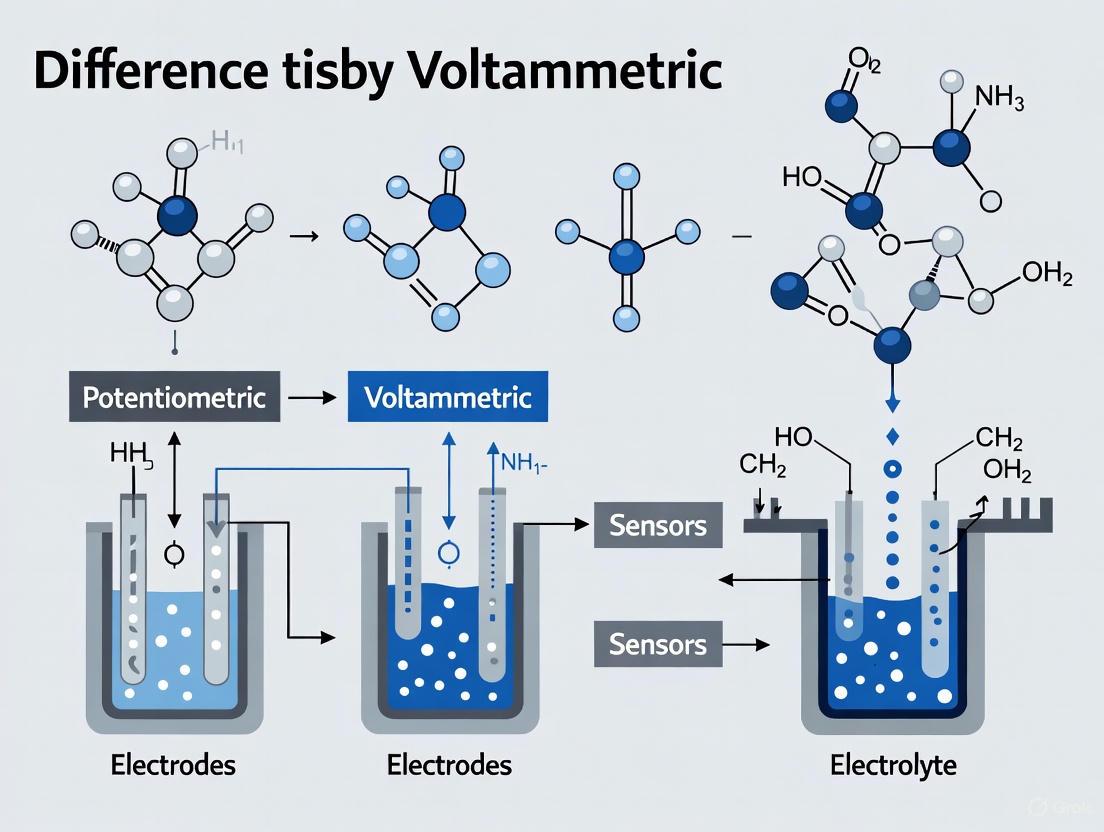
This article provides a systematic comparison of potentiometric and voltammetric sensors, two cornerstone techniques in electrochemical analysis.
Potentiometric vs. Voltammetric Sensors: A Comprehensive Guide for Biomedical Research and Drug Development
Abstract
This article provides a systematic comparison of potentiometric and voltammetric sensors, two cornerstone techniques in electrochemical analysis. Tailored for researchers, scientists, and drug development professionals, it details their fundamental operating principles, distinct methodological approaches, and key applications in detecting drugs of abuse, biomarkers, and metal ions. The content explores current challenges such as fouling, selectivity, and stability, and offers optimization strategies leveraging nanomaterials and advanced fabrication. A direct comparative analysis validates the suitability of each sensor type for specific biomedical tasks, from point-of-care diagnostics to environmental monitoring, concluding with an outlook on future trends including AI integration and wearable technology.
Core Principles: Understanding How Potentiometric and Voltammetric Sensors Work
Electrochemical sensors are powerful analytical tools that transduce chemical information into a measurable electrical signal. Research and development in this field are largely divided into two principal methodologies: those that measure potential and those that measure current. Potentiometric sensors determine the analytical concentration of a component by measuring the electrical potential (voltage) of an electrode when no current is flowing. In contrast, voltammetric sensors function by applying a time-dependent potential to an electrochemical cell and measuring the resulting current that flows from the redox reactions of the analyte. This fundamental distinction—measuring a system's potential at equilibrium versus perturbing the system with a potential and measuring the faradaic current it produces—defines their respective theoretical foundations, experimental designs, and application landscapes. This guide details the core principles, methodologies, and tools that differentiate these two families of sensors, providing a framework for their selective application in scientific research, particularly in drug development and biomedical analysis.
Core Principles and Theoretical Foundations
The operational principles of potentiometric and voltammetric sensors stem from different branches of electrochemistry, leading to distinct signal outputs and theoretical models.
The Potentiometric Principle: Equilibrium Potential Measurement
Potentiometry involves measuring the potential of an electrochemical cell under static conditions where no current—or only a negligible current—flows. This ensures the system remains at equilibrium and the composition of the analyte is unchanged [1]. The measured potential is compared against a reference electrode with a known, fixed potential [2]. The relationship between the measured potential and the activity of the target ion is described by the Nernst equation [3] [1]:
E = E° + (RT/zF) ln(a_i)
Here, E is the measured potential, E° is the standard potential, R is the gas constant, T is the temperature, z is the ion's charge, F is the Faraday constant, and a_i is the activity of the primary ion [3]. For solutions with multiple ions, the potential is influenced by interfering ions, which is modeled by the Nikolskii-Eisenman equation, extending the Nernstian response to account for selectivity coefficients [3].
Voltammetry is a dynamic technique that studies current as a function of an applied potential [4]. A time-dependent potential excitation signal is applied to a working electrode, driving the oxidation or reduction of electroactive species. The resulting current, generated from these faradaic reactions, is measured to produce a voltammogram (a plot of current vs. potential) [5] [4]. The current is proportional to the concentration of the analyte and is governed by the kinetics of electron transfer and the rate of mass transport (diffusion) of the analyte to the electrode surface [6] [7]. Unlike the equilibrium state in potentiometry, voltammetric measurements are characterized by the consumption of the analyte at the electrode surface [6]. The current response can be modeled using the Butler-Volmer equation, which relates current density to overpotential, and Fick's laws of diffusion, which describe the mass transport of species to the electrode [4].
The table below summarizes the fundamental differences between the two sensing paradigms.
Table 1: Fundamental Comparison of Potentiometric and Voltammetric Principles
| Feature | Potentiometric Sensors | Voltammetric Sensors |
|---|---|---|
| Measured Quantity | Potential (Voltage, V) | Current (Amperes, A) |
| Current Flow | Virtually zero (no net current) | Measured and fundamental to the technique |
| System State | Equilibrium (static) | Non-equilibrium (dynamic) |
| Governing Equation | Nernst Equation | Butler-Volmer Equation, Fick's Laws |
| Analyte Consumption | Negligible [6] | Yes, via redox reactions [6] |
| Primary Output | Single potential reading | Voltammogram (current vs. potential plot) |
| Information Provided | Ion activity (logarithmic relationship) | Analytic concentration, redox potentials, reaction kinetics |
Experimental Protocols and Methodologies
The translation of theoretical principles into practical measurement requires distinct experimental setups and procedures.
The Potentiometric Measurement Protocol
A typical potentiometric setup uses a two-electrode system: an ion-selective electrode (ISE) as the working electrode and a reference electrode (e.g., Ag/AgCl) [3] [1]. The experimental workflow is as follows:
- Sensor Preparation: The ion-selective electrode is fabricated by embedding a selective ionophore or active material within a polymer membrane. For example, a Cu(II)-selective sensor can be made by modifying a carbon paste electrode with a Schiff base ligand [8].
- Calibration: The sensor is immersed in a series of standard solutions with known analyte concentrations. The potential is measured for each solution, and a calibration curve of
Evs.log(a_i)is constructed. The slope should be close to the theoretical Nernstian value (e.g., ~59.2/z mV/decade at 25°C) [8]. - Sample Measurement: The calibrated sensor is immersed in the sample solution, and the stable potential is recorded. The analyte concentration is determined from the calibration curve.
- Data Analysis: The potential reading is converted to activity or concentration using the Nernst equation. Selectivity coefficients are determined using methods like the separate solution method (SSM) or fixed interference method (FIM) to quantify susceptibility to interfering ions [8].
The Voltammetric Measurement Protocol
Voltammetry employs a three-electrode system controlled by a potentiostat. The system consists of a working electrode (e.g., gold, carbon), a counter/auxiliary electrode (e.g., platinum wire), and a reference electrode (e.g., Ag/AgCl) [5] [4] [7]. A general protocol is:
- Electrode Preparation: The working electrode is cleaned and often modified (e.g., with nanomaterials or polymers) to enhance sensitivity and selectivity [7]. The electrolyte solution contains an inert supporting electrolyte to minimize solution resistance [4].
- Application of Potential Waveform: The potentiostat applies a specific potential waveform to the working electrode versus the reference electrode. Common techniques include:
- Current Measurement: The current flowing between the working and counter electrodes is measured as a function of the applied potential or time.
- Data Analysis: The resulting voltammogram is analyzed. Peak currents are used for quantitative analysis (concentration), while peak potentials provide qualitative information about the analyte's identity and redox properties [4].
The following diagram illustrates the fundamental operational difference between the two electrochemical setups.
Diagram 1: Workflow comparison of potentiometric and voltammetric sensing.
The Scientist's Toolkit: Essential Research Reagents and Materials
The experimental protocols for potentiometry and voltammetry require specific materials and reagents, the choice of which is critical for sensor performance.
Table 2: Essential Research Reagents and Materials for Sensor Development
| Item | Function/Description | Primary Application Area |
|---|---|---|
| Ionophores (e.g., Crown ethers, Schiff bases) | Selective molecular recognition elements embedded in polymeric membranes to bind target ions. | Potentiometry [6] [8] |
| Polymer Membranes (e.g., PVC) | The matrix that hosts the ionophore, plasticizer, and ion exchanger, forming the sensing layer of the electrode. | Potentiometry [6] [8] |
| Plasticizers (e.g., o-NPOE, DOP) | Incorporated into polymer membranes to provide flexibility and influence the dielectric constant and ion partitioning. | Potentiometry [6] [8] |
| Working Electrodes (e.g., Gold, Glassy Carbon, Pt) | The electrode at which the redox reaction of interest occurs. Material choice depends on the required potential window and catalytic properties. | Voltammetry [6] [5] [7] |
| Reference Electrodes (e.g., Ag/AgCl, SCE) | Provide a stable, known reference potential against which the working electrode's potential is measured or controlled. | Potentiometry & Voltammetry [5] [7] [1] |
| Supporting Electrolyte (e.g., KCl, phosphate buffer) | Added in high concentration to the analyte solution to carry current and minimize resistive drop (iR drop). | Voltammetry [4] [7] |
| Potentiostat | The electronic instrument that controls the potential between working and reference electrodes and measures the current between working and counter electrodes. | Voltammetry [4] [7] |
| Electrode Modifiers (e.g., CNTs, nanoparticles) | Used to functionalize electrode surfaces to increase surface area, enhance electron transfer kinetics, and impart selectivity. | Voltammetry [7] |
Advanced Considerations and Research Applications
Selectivity and Interference Management
Managing selectivity is a central challenge in both techniques, addressed through different mechanisms.
- Potentiometric Selectivity: Achieved primarily through the molecular recognition capability of the ionophore within the membrane. A key research goal is developing novel ionophores with high selectivity for specific ions, such as dopamine over ascorbic acid, leveraging their different charge states [6]. Performance is quantified by the selectivity coefficient (
K); a smallerKindicates better discrimination against an interfering ion [3]. - Voltammetric Selectivity: Can be achieved through several strategies: (1) exploiting the distinct redox potentials of analytes; (2) modifying the working electrode with catalytic coatings or permselective films that preferentially facilitate the reaction of the target analyte; and (3) using advanced pulse techniques like DPV that minimize background capacitive currents [6] [7].
Application in Biomedical and Pharmaceutical Research
The distinct attributes of each technique make them suitable for different application niches in drug development.
- Potentiometric Applications: Their non-consumptive nature and logarithmic response make them ideal for continuous monitoring of ionic species (e.g., pH, K⁺, Na⁺) in physiological fluids [3]. They are also widely used in pharmaceutical analysis for the direct determination of drug ions in formulations, as demonstrated by the sensitive and selective determination of Cu(II) in multivitamin samples [8].
- Voltammetric Applications: The technique is exceptionally powerful for detecting and quantifying electroactive neurotransmitters like dopamine, serotonin, and norepinephrine, often in combination with modified microelectrodes [6]. Its high sensitivity and ability to perform simultaneous multi-analyte detection (e.g., dopamine, ascorbic acid, uric acid) make it a cornerstone of neurochemical research and drug metabolism studies [6] [9]. The development of voltammetric electronic tongues (sensor arrays with chemometrics) further enhances its capability for complex sample analysis [9].
Quantitative Performance Comparison
The table below provides a condensed comparison of typical sensor performance metrics, illustrating the trade-offs between the two techniques.
Table 3: Typical Performance Metrics for Potentiometric and Voltammetric Sensors
| Performance Metric | Potentiometric Sensors | Voltammetric Sensors |
|---|---|---|
| Detection Limit | ~10⁻⁸ M (highly dependent on ionophore) [6] [8] | Can reach 10⁻⁹ M and lower [6] |
| Sample Volume | Suitable for small volumes (e.g., novel flow-through cells) [6] | Can be miniaturized for small volumes (e.g., 200 µL) [6] |
| Stirring Dependence | Generally independent of stirring. | Can be highly dependent; diffusion limitations can hinder unstirred measurements [6] |
| Response Time | Fast (e.g., ~15 seconds) [8] | Varies with technique; can be very fast (ms for amperometry). |
| Lifetime / Stability | Can be months for solid-contact electrodes [8] | Limited by electrode fouling; often requires surface renewal. |
The fundamental difference between potentiometric and voltammetric sensors lies in their core measurement principle: the former measures a system's potential at equilibrium without analyte consumption, while the latter measures the current generated by dynamically perturbing the system and consuming analyte. This distinction dictates their theoretical models, experimental designs, and optimal applications. Potentiometry excels in the direct, continuous monitoring of ions using ion-selective membranes, whereas voltammetry offers superior sensitivity and multi-analyte capability for detecting electroactive species. Future research will continue to bridge the gap between these paradigms, focusing on developing novel materials like nanomaterials and selective ionophores, creating miniaturized and integrated sensor arrays for electronic tongues, and improving in vivo and point-of-care diagnostic devices. A deep understanding of these fundamental differences empowers researchers and drug development professionals to select and optimize the most appropriate electrochemical tool for their specific analytical challenge.
Potentiometric sensors represent a fundamental class of electrochemical devices that measure the accumulation of electrical charge at an electrode-electrolyte interface without significant current flow. These sensors operate on the principle of zero-current potential measurement, where the voltage between a working electrode and a reference electrode is monitored under conditions of essentially no current flow [10]. This measurement approach distinguishes potentiometric sensors from other electrochemical techniques like voltammetry, which involve applying potentials and measuring resulting currents. The core function of potentiometric sensors is to relate the measured potential to the activity (or concentration) of a specific analyte in solution, making them invaluable across numerous scientific and industrial fields, including clinical diagnostics, environmental monitoring, and pharmaceutical research [3].
The historical development of potentiometric sensors spans more than a century, beginning with the pioneering work on glass pH electrodes. The fundamental principle was established by Walther Nernst in 1889, with the equation that now bears his name providing the theoretical foundation for all potentiometric measurements [11]. Throughout the 20th century, technological advancements led to the development of diverse membrane materials and selective recognition elements, dramatically expanding the range of detectable ions and molecules. The relatively recent achievement of true trace-level analysis at sub-nanomolar concentrations has further amplified their importance in modern analytical chemistry, enabling applications that were previously impossible with traditional potentiometric approaches [12].
Fundamental Operating Principles
The Zero-Current Condition and Potential Formation
The operational core of potentiometric sensors lies in maintaining a zero-current condition while measuring the potential difference between two electrodes: an indicator (working) electrode and a reference electrode [10]. Under these equilibrium conditions, the electrical potential that develops across a selective membrane is directly related to the activity of the target ion in solution. This potential arises from the selective partitioning of ions between the sample solution and the membrane phase, creating a charge separation at the interface [11]. The reference electrode maintains a constant and well-defined potential, providing a stable reference point against which changes in the indicator electrode's potential can be measured. This arrangement ensures that any recorded potential changes are attributable solely to variations in the target analyte concentration at the indicator electrode.
The ion-selective membrane serves as the primary recognition element in this system, designed to selectively interact with the target ion while excluding interfering species. When the target ion partitions into the membrane phase, it creates a galvanic potential difference that reflects the ion's activity in the sample solution. The magnitude of this potential is governed by the thermodynamic energy required to transfer ions between the aqueous and membrane phases, following the principles of electrochemical equilibrium [11]. This carefully controlled interface enables highly specific detection of target analytes even in complex sample matrices.
The Nernst Equation and Sensor Response
The theoretical foundation for potentiometric sensor response is described by the Nernst equation, which relates the measured electromotive force (EMF) to the activity of the target ion in solution [10] [12]. The fundamental Nernst equation for a potentiometric cell is expressed as:
EMF = K + (RT/zF)ln(aI)
Where:
- EMF represents the measured electromotive force (potential at zero current)
- K is a constant potential contribution that includes standard potentials and junction potentials
- R is the universal gas constant (8.314 J·K⁻¹·mol⁻¹)
- T is the absolute temperature in Kelvin
- z is the charge number of the target ion
- F is the Faraday constant (96,500 C·mol⁻¹)
- aI is the activity of the primary ion I [10] [12]
At 25°C, for a monovalent ion (z = 1), the term RT/zF simplifies to approximately 59.2 mV per decade of activity change, while for divalent ions (z = 2), it becomes approximately 29.6 mV per decade [12]. This logarithmic relationship means that potentiometric sensors exhibit a linear response to the logarithm of ion activity, making them particularly useful for measuring concentrations across broad dynamic ranges, often spanning several orders of magnitude.
Table 1: Nernstian Response Slopes at Different Temperatures
| Ion Charge | 25°C (mV/decade) | 37°C (mV/decade) |
|---|---|---|
| +1 | 59.2 | 61.5 |
| +2 | 29.6 | 30.8 |
| -1 | -59.2 | -61.5 |
| -2 | -29.6 | -30.8 |
In real-world applications where multiple ions are present, the Nikolsky-Eisenman equation provides a more comprehensive description of the sensor response by accounting for interference from other ions [10]:
EMF = K + (RT/zF)ln[aI + ΣKijpot(aj)zI/zj]
Where Kijpot represents the potentiometric selectivity coefficient, which quantifies the sensor's preference for the primary ion (I) over interfering ions (j) [10]. This extended model enables more accurate predictions of sensor behavior in complex samples containing multiple potentially interfering species.
Comparative Analysis: Potentiometric vs. Voltammetric Sensors
Understanding the fundamental differences between potentiometric and voltammetric sensors is crucial for selecting the appropriate analytical technique for specific applications. While both belong to the broader category of electrochemical sensors, their operating principles, measurement techniques, and information outputs differ significantly.
Potentiometric sensors operate at zero current, measuring the equilibrium potential that develops across a selective membrane in response to specific ion activities [10]. This potential measurement occurs without significant electrochemical reaction or analyte consumption at the electrode surface. In contrast, voltammetric sensors operate by applying a controlled potential waveform and measuring the resulting current generated from oxidation or reduction reactions of electroactive species at the electrode surface [12]. This fundamental operational difference leads to distinct advantages and limitations for each technique.
Table 2: Comparison of Potentiometric and Voltammetric Sensors
| Parameter | Potentiometric Sensors | Voltammetric Sensors |
|---|---|---|
| Measured Quantity | Potential (voltage) at zero current | Current at applied potential |
| Analytical Output | Ion activity (free concentration) | Concentration of electroactive species |
| Detection Limit | Typically 10⁻⁸ – 10⁻¹¹ M [12] | Typically 10⁻⁸ – 10⁻¹² M |
| Selectivity Source | Ionophore-based membrane selectivity | Potential window and electrode kinetics |
| Sample Consumption | Minimal to none | Analyte consumption during measurement |
| Information Obtained | Free ion activity, speciation information | Labile fraction, electrochemical availability |
| Key Applications | pH sensing, ion-selective measurements, electronic tongues | Trace metal analysis, neurotransmitter detection, antioxidant capacity |
The choice between these techniques ultimately depends on the specific analytical question. Potentiometry provides unique information about ion activities and free concentrations, which is particularly valuable for understanding bioavailability and speciation in complex samples [12]. Voltammetry, on the other hand, offers information about chemically labile species and those with sufficient electrochemical turnover rates, making it suitable for different applications such as trace metal analysis or detection of organic molecules [12].
Sensor Architecture and Key Components
Membrane Types and Materials
The ion-selective membrane serves as the heart of a potentiometric sensor, determining its selectivity, sensitivity, and overall performance characteristics. Several distinct membrane architectures have been developed, each with unique properties and applications:
Polymeric Membranes: These consist of a plastic polymer matrix, typically poly(vinyl chloride) (PVC), saturated with a plasticizer to create a hydrophobic environment. The membrane is doped with two crucial components: an ionophore (ion receptor) that provides selectivity for the target ion, and an ion exchanger that facilitates charge transport within the membrane [12]. The extensive synthetic versatility of ionophores makes polymeric membranes highly tunable for specific applications, with modern designs achieving detection limits down to 10⁻¹¹ M for certain ions [12].
Glass Membranes: Primarily used for pH sensing and measurements of monovalent cations like Na⁺, glass membranes offer excellent chemical stability and reproducibility. The sensing mechanism involves ion exchange at the glass surface, where the composition of the glass matrix determines its selectivity profile [12]. While less chemically versatile than polymeric membranes, glass electrodes remain the gold standard for pH measurement due to their exceptional reliability and well-characterized behavior.
Solid-State Membranes: These comprise insoluble inorganic salts, typically silver sulfide or similar compounds, which provide conductivity through ionic mobility within the crystal lattice [12]. Solid-state membranes are particularly valuable for detecting anions like chloride, bromide, and iodide, as well as heavy metal ions such as lead and cadmium. Their robust nature makes them suitable for harsh environmental and industrial applications.
Chalcogenide Glasses: These specialized glass materials, containing elements from group 16 of the periodic table (particularly selenium or tellurium), extend the range of detectable ions to include heavy metals [3]. Their unique composition enables measurements in aggressive media where conventional glass membranes would deteriorate.
Reference Electrodes and Inner Contacts
The reference electrode constitutes a critical component in any potentiometric sensor, providing a stable, reproducible potential against which the indicator electrode's potential is measured. A conventional reference electrode consists of an internal element (such as Ag/AgCl) immersed in a solution of fixed composition (typically KCl) that contacts the sample through a liquid junction [13]. This liquid junction must permit minimal ionic contact while preventing mixing of the reference electrolyte with the sample solution.
Recent advancements have focused on developing solid-contact reference systems to facilitate sensor miniaturization and simplify manufacturing. These systems eliminate the internal solution, instead relying on stable redox couples or capacitive materials to maintain a constant potential [3]. Common approaches include using conducting polymers like polypyrrole or poly(3,4-ethylenedioxythiophene) (PEDOT), which provide reproducible potential by establishing well-defined redox equilibria at the electrode-membrane interface [3].
Advanced Experimental Protocols and Methodologies
Fabrication of Polymeric Membrane Ion-Selective Electrodes
The construction of high-performance polymeric membrane electrodes requires meticulous attention to material selection and fabrication protocols. A standard methodology involves the following steps:
Membrane Composition Optimization: Prepare a membrane cocktail containing 1-2% ionophore (selective receptor), 0.5-1% ionic sites (typically lipophilic salt), 30-33% poly(vinyl chloride) polymer matrix, and the remainder a suitable plasticizer such as o-nitrophenyl octyl ether (o-NPOE) or bis(2-ethylhexyl) sebacate [3]. The specific ratio must be optimized for each ionophore-analyte pair to achieve optimal selectivity and detection limits.
Sensor Assembly: For conventional liquid-contact electrodes, the membrane cocktail is dissolved in tetrahydrofuran (THF) and cast into a glass ring placed on a glass slide. After THF evaporation (typically 24 hours), a flexible membrane disk is obtained. This disk is mounted in an electrode body and filled with an internal filling solution containing the primary ion at a fixed concentration (typically 10⁻³ M) along with any necessary conditioning agents [12].
Conditioning and Activation: Before initial use, the assembled electrode must be conditioned in a solution of the primary ion (typically 10⁻³ M) for at least 24 hours to establish stable phase boundary potentials and hydrate the membrane. For solid-contact electrodes, additional electrochemical activation might be required to stabilize the conducting polymer layer.
Calibration Protocol: Perform calibration by measuring the EMF response in a series of standard solutions with known activities of the primary ion, typically covering a concentration range from 10⁻⁷ M to 10⁻¹ M. Solutions should be stirred consistently and allowed to reach stable potential readings (drift < 0.1 mV/min) before recording values. Temperature should be maintained constant (±0.5°C) throughout calibration.
Trace-Level Analysis with Controlled Inner Solutions
Achieving sub-nanomolar detection limits requires specialized approaches to minimize ion fluxes that degrade performance at trace concentrations. The following advanced protocol has proven effective for ultra-trace analysis:
Inner Solution Optimization: Incorporate chelating agents such as ethylenediaminetetraacetic acid (EDTA) or nitrilotriacetic acid (NTA) in the inner filling solution to buffer the activity of the primary ion at extremely low levels [12]. For calcium sensors, EDTA-containing inner solutions have enabled detection limits as low as 10⁻¹¹ M [12]. Alternatively, ion-exchange resins can be included in the inner solution to maintain precisely controlled ion activities.
Sample Conditioning: For measurements in complex matrices, consider adding an ionic strength adjuster (ISA) to both standards and samples to maintain constant ionic strength and mask potential interferents. The ISA composition must be optimized for each specific application to avoid affecting the free ion activity being measured.
Kinetic Discrimination Techniques: Implement specialized measurement protocols such as timed potentiometry, where the initial potential reading (within the first 10-30 seconds of sample exposure) is used rather than the equilibrium potential. This approach can minimize the effects of slow ion fluxes that otherwise degrade detection limits.
Flow-Cell Operation: For continuous monitoring applications, implement a flow-through cell design with precisely controlled hydrodynamic conditions. This approach minimizes diffusion layer effects and provides consistent sample presentation to the sensor surface, enhancing measurement reproducibility.
Diagram 1: Operational principle of potentiometric sensor showing ion partitioning and potential development under zero-current conditions.
The Scientist's Toolkit: Essential Research Reagents and Materials
Successful implementation of potentiometric sensor technology requires careful selection of specialized materials and reagents. The following table details essential components for developing and utilizing these analytical tools:
Table 3: Essential Research Reagents and Materials for Potentiometric Sensor Development
| Component | Function | Examples & Specifications |
|---|---|---|
| Ionophores | Selective molecular recognition elements that bind target ions | Valinomycin (K⁺), nonactin (NH₄⁺), calcium ionophore II (Ca²⁺), custom synthetic compounds |
| Ion Exchangers | Lipophilic salts that facilitate ion transport within the membrane | Potassium tetrakis(4-chlorophenyl)borate, sodium tetraphenylborate derivatives |
| Polymer Matrices | Structural support for the sensing membrane | High-molecular-weight PVC, polyurethane, silicone rubber |
| Plasticizers | Provide membrane fluidity and influence dielectric constant | o-NPOE, DOS, DBP; selected based on polarity and compatibility with ionophore |
| Inner Solution Additives | Control primary ion activity in reference compartment | EDTA, NTA for ion buffering; ion-exchange resins for activity control [12] |
| Membrane Solvents | Dissolve membrane components for casting | Tetrahydrofuran, cyclohexanone; high purity with low water content |
| Reference Electrode Components | Provide stable reference potential | Ag/AgCl elements, KCl electrolytes, ceramic frits for liquid junction |
| Solid Contact Materials | Enable miniaturized sensors without internal solution | Conducting polymers (PEDOT, polypyrrole), redox polymers, carbon nanomaterials [3] |
Current Limitations and Future Perspectives
Despite significant advances, potentiometric sensors face several challenges that continue to drive research and development efforts. The primary limitations include temperature sensitivity, potential drift over extended operation, and interference from complex sample matrices [10]. Additionally, the rigorous definition of detection limits unique to potentiometry (based on the intersection of linear response regions) can lead to confusion when comparing performance with other analytical techniques [12].
Future developments are likely to focus on several key areas. Nanomaterial integration promises to enhance sensitivity and lower detection limits further through increased surface area and unique electronic properties [3]. Multi-sensor arrays, often called "electronic tongues," combine multiple potentiometric sensors with different selectivity patterns and pattern recognition algorithms to analyze complex mixtures [10]. Miniaturization and lab-on-a-chip integration will enable point-of-care testing and environmental field monitoring through microfabrication technologies [3] [14]. Finally, the development of continuous monitoring systems for in vivo and real-time environmental applications represents a frontier where potentiometric sensors offer distinct advantages due to their non-destructive nature and ability to provide information about biologically relevant free ion activities [12].
The ongoing convergence of materials science, nanotechnology, and data analytics continues to expand the capabilities and applications of potentiometric sensors. As these devices evolve toward greater sensitivity, selectivity, and reliability, they will undoubtedly play an increasingly important role in addressing analytical challenges across healthcare, environmental science, and industrial process control.
Electrochemical sensors are powerful tools for detecting and quantifying chemical species, primarily categorized into potentiometric and voltammetric sensors. While potentiometric sensors measure the potential difference between electrodes at zero current to determine ion activity, voltammetric sensors operate on a fundamentally different principle: they apply a varying potential and measure the resulting current from redox reactions [3] [15]. This key operational difference makes voltammetry exceptionally suitable for quantifying a wide range of electroactive species, from metal ions to organic molecules and biomarkers.
The versatility, sensitivity, and ability to provide rich qualitative information about reaction mechanisms have established voltammetric sensors as a cornerstone technique in fields including clinical diagnostics, environmental monitoring, pharmaceutical analysis, and food safety [16] [17]. This guide provides an in-depth examination of the operation, methodology, and application of voltammetric sensors, contextualized within the broader landscape of electrochemical sensing research.
Fundamental Principles of Voltammetric Operation
Core Operational Mechanism
In voltammetry, a controlled, time-varying potential is applied to a working electrode in an electrochemical cell relative to a reference electrode. The resulting current flowing between the working electrode and a counter electrode is measured [16] [18]. This current is a direct consequence of oxidation and reduction (redox) reactions of analytes at the working electrode surface. When the applied potential reaches a sufficient value to drive the electron transfer for a specific species, the resulting Faradaic current increases, peaks, and then decays as the analyte near the electrode surface is consumed and the reaction becomes limited by mass transport [16].
The relationship between current and applied potential during a voltammetric sweep produces a characteristic signature called a voltammogram. The position of current peaks on the potential axis (E_p) provides qualitative identification of the analyte, while the magnitude of the peak current (i_p) is quantitatively proportional to its concentration [18].
Contrasting Potentiometric and Voltammetric Modes
The fundamental differences between these two primary electrochemical sensing techniques are summarized in the table below.
Table 1: Fundamental Comparison of Potentiometric and Voltammetric Sensors
| Feature | Potentiometric Sensors | Voltammetric Sensors |
|---|---|---|
| Measured Quantity | Potential (Voltage) at zero current [3] [2] | Current as a function of applied potential [18] |
| Signal Origin | Difference in ion activity across a selective membrane [19] | Current from redox reactions of the analyte [16] |
| Analytical Output | Logarithm of ion activity (Nernstian response) [3] | Peak current proportional to concentration [18] |
| Analyte Consumption | Virtually zero [6] | Yes, analyte is oxidized/reduced during measurement [6] |
| Key Advantage | High selectivity for specific ions; no analyte consumption [19] [6] | High sensitivity; rich mechanistic and multi-analyte information [16] [17] |
| Key Disadvantage | Generally lower sensitivity; responds only to free ions [3] | Analyte consumption can hinder small-volume measurements [6] |
Diagram 1: Operational Workflow Comparison
Key Voltammetric Techniques and Methodologies
Common Voltammetric Methods
Several voltammetric techniques are employed, each with distinct potential waveforms and information outputs.
Table 2: Common Voltammetric Techniques and Their Characteristics
| Technique | Potential Waveform | Key Outputs | Primary Applications |
|---|---|---|---|
| Cyclic Voltammetry (CV) | Linear sweep reversed at vertex potential [16] | Redox potentials, reaction reversibility, kinetics [16] | Mechanism elucidation, sensor characterization [16] |
| Linear Sweep Voltammetry (LSV) | Linear sweep in one direction [18] | Peak potential and current for quantification | Determination of analytes with known redox behavior [18] |
| Differential Pulse Voltammetry (DPV) | Pulses superimposed on a slow linear baseline [18] | Peak current with minimized capacitive current | High-sensitivity detection of trace analytes [6] [17] |
| Square Wave Voltammetry (SWV) | Square wave superimposed on a staircase ramp [18] | High, fast peak current signals | Rapid, sensitive quantitative analysis [18] |
| Chronoamperometry (CA) | Potential step to a fixed value [18] | Current decay over time (i vs. t) |
Diffusion coefficient calculation, kinetics studies [18] |
Interpretation of the Voltammogram
The cyclic voltammogram is a rich source of information. For a reversible redox couple:
- The formal redox potential (E°') is approximated by the midpoint between the anodic (
E_pa) and cathodic (E_pc) peak potentials [16]. - The separation between peak potentials (ΔE_p) is about 59/n mV for a reversible, diffusion-controlled system with fast electron transfer. Larger values indicate slower electron transfer kinetics [16] [18].
- The peak current (i_p) for a reversible system is described by the Randles-Ševčík equation:
i_p = (2.69 × 10^5) * n^(3/2) * A * D^(1/2) * C * v^(1/2)wherei_pis the peak current (A),nis the number of electrons,Ais the electrode area (cm²),Dis the diffusion coefficient (cm²/s),Cis the concentration (mol/cm³), andvis the scan rate (V/s) [16].
Experimental Protocol: Developing a Voltammetric Sensor
The following detailed methodology outlines the development and characterization of a composite-modified voltammetric sensor for nitrite detection, based on a recent study [17].
Sensor Fabrication and Modification
Objective: To fabricate a high-performance voltammetric sensor for nitrite detection using a composite of gold nanorods (AuNRs), multi-walled carbon nanotubes (MWCNTs), and the conductive polymer PEDOT:PSS.
Materials and Reagents:
- Glassy Carbon Electrode (GCE): 3 mm diameter, as the base electrode substrate.
- Gold(III) chloride trihydrate (HAuCl₄·3H₂O): Precursor for synthesizing gold nanorods.
- Cetyltrimethylammonium bromide (CTAB): Surfactant and stabilizing agent for AuNR growth.
- Multi-walled carbon nanotubes (MWCNTs): To enhance the electroactive surface area and conductivity.
- PEDOT:PSS dispersion: Conductive polymer for forming a stable, conductive composite film.
- Sodium nitrite (NaNO₂): Analytic standard for calibration and testing.
- Phosphate buffer saline (PBS), 0.1 M (pH 7.4): Supporting electrolyte.
Procedure:
- Synthesis of Gold Nanorods (AuNRs): Prepare AuNRs via a seed-mediated growth method. Briefly, a seed solution is first prepared by reducing HAuCl₄ with ice-cold NaBH₄ in a CTAB solution. This seed solution is then added to a growth solution containing HAuCl₄, CTAB, and a small amount of AgNO₃ (to direct anisotropic growth), followed by the reducing agent ascorbic acid. The mixture is left undisturbed for several hours for AuNR formation, characterized by a visible color change and a distinct longitudinal plasmon band via UV-Vis spectroscopy [17].
- Electrode Pre-treatment: Polish the bare GCE with 0.05 μm alumina slurry on a microcloth to a mirror finish. Rinse thoroughly with deionized water and then with ethanol. Dry under a stream of nitrogen gas [17].
- Composite Modification: a. Prepare a dispersion of MWCNTs in a mixture of PEDOT:PSS and water. b. Mix this dispersion with the synthesized AuNR solution. c. Deposit a fixed volume (e.g., 5 μL) of the AuNRs/MWCNT/PEDOT:PSS composite ink onto the pre-treated GCE surface. d. Allow the modified electrode (denoted as AuNRs/MWCNT/PEDOT:PSS/GCE) to dry at room temperature [17].
Electrochemical Characterization and Nitrite Sensing
Apparatus: PalmSens Emstat 3 potentiostat with a standard three-electrode system: the modified GCE as the working electrode, an Ag/AgCl reference electrode, and a platinum wire counter electrode [17].
Procedure:
- Electrochemical Characterization: Characterize the modified electrode using Cyclic Voltammetry (CV) and Electrochemical Impedance Spectroscopy (EIS) in a 5 mM
[Fe(CN)₆]³⁻/⁴⁻redox probe dissolved in 0.1 M KCl. Compare the voltammetric response and charge transfer resistance with the unmodified GCE to confirm enhanced electroactive surface area and improved electron transfer kinetics [17]. - Nitrite Calibration: Using the modified electrode, perform voltammetric measurements (e.g., Linear Sweep Voltammetry or Amperometry) in a standard PBS electrolyte spiked with increasing concentrations of sodium nitrite.
- For LSV, sweep the potential in the positive direction (e.g., from +0.6 V to +1.2 V vs. Ag/AgCl) at a fixed scan rate (e.g., 50 mV/s).
- Observe the oxidation peak current for nitrite, which will increase linearly with concentration.
- Data Analysis:
- Plot the nitrite oxidation peak current against the analyte concentration to construct a calibration curve.
- Determine the sensor's linear dynamic range, sensitivity (slope of the calibration curve), and limit of detection (LOD), typically calculated as
3.3 × σ/S, where σ is the standard deviation of the blank response and S is the sensitivity [17].
Diagram 2: Sensor Fabrication and Experiment Workflow
The Scientist's Toolkit: Essential Research Reagents and Materials
The performance of a voltammetric sensor is critically dependent on the materials used in its construction. The following table details key components and their functions in modern sensor design, exemplified by the nitrite sensor case study [17] and general practice.
Table 3: Essential Research Reagents and Materials for Voltammetric Sensor Development
| Material/Reagent | Function in the Sensor | Example from Protocol |
|---|---|---|
| Glassy Carbon (GC) | A versatile, conductive, and inert substrate for the working electrode. Provides a wide potential window and low background current. | Underlying base for the AuNRs/MWCNT/PEDOT:PSS composite [17]. |
| Gold Nanorods (AuNRs) | Nanomaterials that provide high surface area, good biocompatibility, and electrocatalytic properties, lowering overpotential for target reactions. | Enhances electrocatalytic oxidation of nitrite, improving sensitivity [17]. |
| Multi-walled Carbon Nanotubes (MWCNTs) | Carbon nanomaterials that drastically increase the electroactive surface area and facilitate electron transfer between the analyte and the electrode. | In the composite, provides high surface area and conductivity, leading to a higher electroactive area (0.151 cm²) [17]. |
| Conductive Polymer (PEDOT:PSS) | A polymer that provides a stable, conductive matrix, helps bind nanomaterials, and can improve selectivity and antifouling properties. | Forms a stable composite with AuNRs and MWCNTs, enhancing conductivity and film stability [17]. |
| Supporting Electrolyte (e.g., PBS) | Carries the ionic current, minimizes ohmic drop (iR drop), and controls the pH and ionic strength of the solution, which can affect redox potentials. | 0.1 M Phosphate Buffer Saline (PBS, pH 7.4) provides a stable and physiologically relevant medium for nitrite detection [17]. |
| Internal Redox Probe (e.g., [Fe(CN)₆]³⁻/⁴⁻) | A well-understood, reversible redox couple used to characterize the electroactive area and electron transfer kinetics of an unmodified or modified electrode. | Used in K₄Fe(CN)₆ solution to electrochemically characterize the modified electrode before nitrite sensing [17]. |
Performance and Applications in Research
Quantitative Sensor Performance
The AuNRs/MWCNT/PEDOT:PSS/GCE sensor for nitrite demonstrates the high performance achievable with modern voltammetric designs [17]:
- Linear Dynamic Range: 0.2 – 100 μM
- Limit of Detection (LOD): 0.08 μM
- Sensitivity: 0.0634 μA μM⁻¹ cm⁻²
This performance is superior to a similar sensor using electrochemically reduced graphene oxide (ErGO) instead of MWCNTs, which had an LOD of 0.2 μM and a sensitivity of 0.0451 μA μM⁻¹ cm⁻², highlighting the impact of material choice [17].
Addressing Limitations and Research Frontiers
Despite their power, voltammetric sensors face challenges that are active areas of research. A key issue is analyte consumption, which can be a fundamental limitation for measurements in small sample volumes or at very low concentrations [6]. This contrasts with potentiometric sensors, which cause virtually zero analyte consumption [6]. Furthermore, slow diffusion of the analyte to the electrode surface can limit the response, particularly in unstirred solutions [6].
Research is focused on overcoming these limitations through:
- Microelectrode and Microelectrode Arrays: These devices enhance mass transport via radial diffusion, reducing dependence on stirring and improving detection limits [6].
- Advanced Nanomaterials: As seen in the protocol, composites using CNTs, graphene, metal nanoparticles, and conductive polymers are being explored to increase surface area, enhance electrocatalysis, and improve selectivity [19] [17].
- Miniaturization and Portability: The integration of sensors with portable potentiostats and microfluidic systems enables point-of-care and in-field analysis [19] [17].
Voltammetric sensors, which operate on the principle of measuring current from a varying potential, are indispensable tools in the analytical scientist's arsenal. Their operational paradigm stands in clear contrast to potentiometric sensors, offering distinct advantages in sensitivity and the ability to probe reaction mechanisms, albeit with considerations such as analyte consumption. The ongoing integration of novel nanomaterials and the strategic design of electrode interfaces, as demonstrated in the nitrite sensor case study, continue to push the boundaries of voltammetric performance. As research advances, the development of more selective, stable, and user-friendly voltammetric sensors will further solidify their role in addressing complex analytical challenges across healthcare, environmental science, and industrial quality control.
Electrochemical sensors are powerful analytical tools that convert chemical information into a measurable electrical signal. Among these, potentiometric and voltammetric sensors represent two foundational approaches, each with distinct operating principles, instrumentation requirements, and applications, particularly in pharmaceutical and biomedical research. Potentiometric sensors measure the potential (voltage) across an electrochemical cell under conditions of zero current flow, relating this potential to the activity (or concentration) of a target ion via the Nernst equation [3] [12]. In contrast, voltammetric sensors apply a varying potential to an electrochemical cell and measure the resulting current response, which is proportional to the concentration of an electroactive analyte [7]. This fundamental difference in the measured quantity—potential versus current—dictates every aspect of their design, from electrode configuration and instrumentation to experimental protocol and data interpretation. The choice between these techniques is not merely a matter of preference but must be guided by the specific analytical question, required detection limits, sample volume, and the nature of the matrix [6] [12]. This guide provides an in-depth technical comparison of their essential components and setups, framed within the context of sensor research and development.
Core Principles and Theoretical Foundations
Potentiometric Sensing
Potentiometry is a zero-current technique that measures the equilibrium potential difference between two electrodes [20] [19]. The core of this method is the Nernst equation, which describes the ideal response of an ion-selective electrode (ISE):
$$E = E^\circ + \frac{RT}{zF}\ln(a_i)$$
Here, E is the measured potential ( electromotive force, EMF), E° is the standard potential, R is the gas constant, T is the absolute temperature, z is the charge of the ion, F is the Faraday constant, and a_i is the activity of the primary ion, I [3] [12]. A key advantage of potentiometry is its unique ability to directly measure the free ion activity, which is often the biologically relevant parameter in bioavailability and speciation studies, rather than the total concentration [12]. In complex samples containing multiple ions, the potential is a composite signal described by the Nikolsky-Eisenman equation, which accounts for contributions from interfering ions (J) via selectivity coefficients ($k^{pot}_{ij}$) [3]. Potentiometric sensors are particularly valued for their high selectivity, portability, and compatibility with colored or turbid samples, making them suitable for direct analysis in complex matrices like biological fluids [19].
Voltammetric Sensing
Voltammetry encompasses a family of techniques where the current at a working electrode is measured as a function of an applied potential that is swept over a range [7]. The resulting plot of current versus potential is called a voltammogram. The current signal is fundamentally governed by the redox reactions of the analyte at the electrode surface and the rate at which the analyte is transported to the electrode (mass transport) via diffusion, migration, and convection [7]. Unlike potentiometry, voltammetry is a dynamic technique that consumes a small amount of the analyte during measurement. Different voltammetric techniques use specific potential waveforms, each offering distinct advantages:
- Cyclic Voltammetry (CV): The potential is swept linearly back and forth between two set limits. It is primarily used for mechanistic studies, identifying formal potentials, and determining the reversibility of redox reactions [7].
- Differential Pulse Voltammetry (DPV): Small potential pulses are superimposed on a linear baseline. The current is measured before the pulse and at the end of the pulse, and the difference is plotted. This enhances sensitivity and resolution, making it ideal for trace analysis [7].
- Square Wave Voltammetry (SWV): A square wave is superimposed on a staircase ramp. It is a fast and highly sensitive technique that efficiently minimizes background (capacitive) current [7].
- Anodic Stripping Voltammetry (ASV): This is a two-step technique used for trace metal analysis. The metal is first electroplated (pre-concentrated) onto the electrode at a negative potential. Subsequently, the deposited metals are oxidized (stripped) back into solution by sweeping the potential in the anodic direction, yielding a sharp, sensitive current peak [21].
Table 1: Comparative Overview of Potentiometric and Voltammetric Sensor Fundamentals
| Feature | Potentiometric Sensors | Voltammetric Sensors |
|---|---|---|
| Measured Quantity | Potential (Voltage, EMF) | Current |
| Governing Equation | Nernst Equation | Relationship between current, concentration, and applied potential |
| Analyte Consumption | Virtually zero | Yes |
| Primary Analytical Output | Ion activity (free concentration) | Total concentration of electroactive species |
| Key Performance Parameters | Slope, Limit of Detection (LOD), Selectivity Coefficient ($k^{pot}$) | Peak Current/Potential, Sensitivity, LOD, Linear Range |
| Sample Volume Suitability | Excellent for small volumes (no analyte depletion) [6] | Can be challenging in small volumes due to analyte consumption [6] |
| Information on Speciation | Directly measures free, bioavailable ions [12] | Measures labile, electrochemically available species [12] |
Electrode Configurations and Instrumentation
The fundamental difference in what is being measured—potential versus current—directly dictates the required electrode configurations and instrumental setups.
Electrode Configurations
The number and role of electrodes used in a measurement are critical for isolating the desired signal.
The diagram above illustrates the three primary electrode configurations. A Two-Electrode setup is simple but measures the entire cell voltage, including the potential drop across the counter electrode and solution resistance. It is suitable for energy devices like batteries or systems with very low currents where the counter electrode potential is stable [22]. A Three-Electrode setup is the most common configuration for both potentiometry and voltammetry. It introduces a dedicated Reference Electrode, which is positioned to sense the potential near the working electrode surface without passing current. This crucial separation allows for the precise control and measurement of the working electrode potential, independent of changes at the counter electrode [22]. A Four-Electrode setup decouples the current-carrying and potential-sensing functions for both the working and counter electrodes. It is specialized for measuring the resistive drop across a solution or a membrane and is not typically used for standard analyte sensing [22].
Component Roles and Materials
Each electrode in a setup has a specific function and is constructed from materials chosen to optimize performance.
Table 2: Electrode Functions and Common Materials
| Electrode | Primary Function | Common Materials & Examples |
|---|---|---|
| Working Electrode (WE) | Site of the electrochemical reaction of interest. | Voltammetry: Glassy Carbon (GC), Gold, Platinum, Carbon Paste [7].Potentiometry: Ion-Selective Membrane (ISM) [3] [19]. |
| Reference Electrode (RE) | Provides a stable, known, and constant reference potential for the working electrode. | Ag/AgCl, Saturated Calomel Electrode (SCE) [7] [22]. Must be well-poised and have minimal current flow. |
| Counter Electrode (Auxiliary Electrode) | Completes the electrical circuit, allowing current to flow. | Inert materials like Platinum wire, graphite [22]. |
| Ion-Selective Membrane (ISM) | The sensing component in a potentiometric sensor; selectively binds the target ion. | Polymer membrane (e.g., PVC) plasticized and doped with Ionophore (receptor) and Ion-Exchanger [3] [12]. |
Instrumentation: The Potentiostat
For voltammetric techniques and advanced potentiometric measurements, a potentiostat is the central control instrument. A modern potentiostat is fundamentally a four-probe device [22]:
- Working (W) Lead: Carries the current to/from the Working Electrode.
- Counter (C) Lead: Carries the current to/from the Counter Electrode.
- Working Sense (WS) Lead: Measures the potential at the Working Electrode.
- Reference (R) Lead: Measures the potential at the Reference Electrode.
These four internal leads are connected in different ways to achieve the two- or three-electrode setups described. The potentiostat's primary function is to maintain a desired potential between the Working Sense and Reference leads (i.e., the working electrode's potential) by sourcing or sinking the required current through the Working and Counter leads [22].
Experimental Protocols and Methodologies
Protocol for Fabricating a Solid-Contact Potentiometric Sensor
Solid-contact ion-selective electrodes (SC-ISEs) are a modern advancement that replaces the traditional inner filling solution with a solid ion-to-electron transducer layer, enabling easier miniaturization and robustness [19].
- Solid-Contact Preparation: A transducer layer is deposited on a conductive substrate (e.g., Glassy Carbon Electrode). Common materials include conducting polymers (e.g., PEDOT, polyaniline) or carbon-based nanomaterials (e.g., graphene oxide, carbon nanotubes) to provide a stable capacitive interface [21] [19].
- Membrane Cocktail Preparation: The ion-selective membrane is typically composed of:
- Polymer Matrix: Polyvinyl chloride (PVC).
- Plasticizer: e.g., Dioctyl sebacate (DOS) or 2-Nitrophenyl octyl ether (oNPOE), which provides mobility for ion exchange.
- Ionophore: A selective receptor for the target ion (e.g., crown ether for K⁺).
- Ion Exchanger: A lipophilic salt (e.g., potassium tetrakis(4-chlorophenyl)borate). These components are dissolved in a volatile solvent like tetrahydrofuran (THF) [3] [21].
- Membrane Deposition: The cocktail is drop-cast onto the solid-contact layer and allowed to evaporate, forming a uniform polymeric membrane [21].
- Conditioning and Calibration: The sensor is conditioned in a solution containing the target ion to establish a stable interface. It is then calibrated in standard solutions of known activity, and the potential is plotted against the logarithm of the activity to obtain a calibration curve [12].
Protocol for a Voltammetric Sensing Experiment (e.g., ASV for Cd²⁺)
Anodic Stripping Voltammetry (ASV) is a highly sensitive technique for trace metal analysis, as demonstrated for Cd²⁺ detection [21].
- Electrode Modification (Optional but common): The working electrode (e.g., Glassy Carbon) is modified to enhance sensitivity and selectivity. For example, it can be coated with an Ion-Imprinted Polymer (IIP) and graphene oxide (GO). The GO boosts conductivity and surface area, while the IIP creates selective cavities for the target ion [21].
- Pre-concentration/Deposition Step: The modified electrode is immersed in the sample solution, and a constant negative potential (e.g., -1.2 V vs. Ag/AgCl) is applied for a fixed time (e.g., 60-120 seconds) with stirring. This reduces Cd²⁺ ions to Cd(0), which are deposited onto the electrode surface.
- Equilibration Step: Stirring is stopped, and the solution is allowed to become quiescent for a short period (e.g., 15 seconds).
- Stripping Step: The potential is swept in an anodic (positive) direction using a sensitive technique like Differential Pulse Voltammetry (DPV). As the potential reaches the oxidation potential of Cd(0), the metal is stripped back into solution as Cd²⁺, generating a characteristic current peak.
- Quantification: The height (or area) of the stripping peak is proportional to the concentration of Cd²⁺ in the original sample. A calibration curve is constructed using standard solutions [21].
Key Research Reagent Solutions
Table 3: Essential Reagents in Electrochemical Sensor Development
| Reagent/Category | Function | Example Uses |
|---|---|---|
| Ionophores | Selective molecular receptors that bind the target ion within the sensor membrane. | Crown ethers for K⁺ or dopamine [6]; custom-synthesized heterocyclic compounds for Cd²⁺ [21]. |
| Ion Exchangers | Lipophilic salts that facilitate ion exchange and establish the baseline potential in the membrane. | Potassium tetrakis(4-chlorophenyl)borate (KClTPB) [3] [6]. |
| Polymer Matrices & Plasticizers | Form the bulk of the sensing membrane, providing a host for active components and determining ion mobility. | PVC matrix with oNPOE or DOS plasticizer [3] [21]. |
| Conducting Polymers / Nanomaterials | Act as solid-contact transducers in SC-ISEs or modify electrodes to enhance signal in voltammetry. | PEDOT, polyaniline; Graphene Oxide (GO), carbon nanotubes [21] [19]. |
| Supporting Electrolytes | Provide ionic strength and minimize migration current in voltammetric experiments. | Inert salts like KCl, KNO₃, or phosphate buffers [7]. |
Performance Comparison and Application Context
Analytical Figures of Merit
A direct comparison of performance highlights the inherent trade-offs between the two techniques.
Table 4: Quantitative Performance Comparison (Based on Literature Examples)
| Parameter | Potentiometric Sensors | Voltammetric Sensors |
|---|---|---|
| Typical LOD (General) | ~10⁻⁸ – 10⁻¹¹ M (for ions) [12] | Can reach 10⁻¹² M or lower, especially with stripping methods [21] |
| Reported Example: Cd²⁺ | 6.3 × 10⁻¹⁰ M [21] | 7 × 10⁻¹⁴ M (using ASV) [21] |
| Selectivity | Governed by ionophore; intrinsic selectivity for cations over anions (e.g., dopamine vs. ascorbate) [6] | Governed by applied potential and surface modification; can suffer from overlapping signals of species with similar redox potentials. |
| Response Time | Fast (seconds) [19] | Can be slower due to pre-concentration steps in ASV [21] |
| Impact on Small Sample Volumes | Minimal; virtually no analyte consumption is ideal for small volumes [6] | Critical; analyte consumption can deplete the sample and hinder low-concentration measurements [6] |
Selecting the Appropriate Technique
The choice between potentiometry and voltammetry is dictated by the specific analytical problem.
Choose Potentiometry When:
- The analyte is an ion, and you need to know its free, biologically active concentration [12].
- The sample volume is very small, and analyte consumption must be avoided [6].
- The sample is colored or turbid.
- The application requires simple, portable, and potentially wearable devices for continuous monitoring (e.g., electrolyte sensing in sweat) [19].
- The primary interferents are of the opposite charge to your analyte (e.g., measuring a cationic neurotransmitter like dopamine in the presence of anionic ascorbic acid) [6].
Choose Voltammetry When:
- Extremely low detection limits are required, down to the picomolar or femtomolar range [21].
- The analyte is electroactive.
- Speciation information on labile metal complexes is needed [12].
- Multiple analytes with distinct redox potentials need to be detected simultaneously.
- The analysis requires information on reaction kinetics and mechanisms (e.g., via Cyclic Voltammetry).
Potentiometric and voltammetric sensors, while both rooted in electrochemistry, are distinguished by their fundamental operating principles, leading to vastly different electrode setups, instrumentation, and application landscapes. Potentiometry excels as a passive, zero-current technique for direct ion activity measurement, offering unique insights into chemical speciation and bioavailability with minimal sample disturbance. Voltammetry, as an active technique, provides unparalleled sensitivity for trace analysis of electroactive species, albeit with consumption of the analyte. The decision framework for researchers and drug development professionals is clear: the choice is not about which technique is superior, but about which is the most appropriate tool for the specific biological question, sample matrix, and required detection level. Future trends, including the integration of novel nanomaterials, 3D printing for sensor fabrication, and the development of robust solid-contact designs, promise to further enhance the capabilities and expand the applications of both these powerful electrochemical toolkits [19] [14].
Interpreting Voltammograms and Potential Readings
Electrochemical sensors represent a cornerstone of modern analytical chemistry, providing powerful tools for detecting diverse analytes across pharmaceutical, environmental, and clinical domains. Within this field, potentiometric and voltammetric sensors constitute two fundamental yet distinct approaches with unique operational principles, output signals, and interpretation frameworks. Potentiometry measures the potential difference between electrodes at near-zero current, providing a direct readout of ion activity [19]. In contrast, voltammetry applies a potential waveform to measure the resulting current response, revealing information about electroactive species concentration, kinetics, and reaction mechanisms [23]. This guide provides an in-depth technical examination of both techniques, focusing on the core skill of interpreting their characteristic output signals—potential readings and voltammograms—within the context of drug development research where understanding these differences informs appropriate sensor selection and data analysis.
Theoretical Foundations and Working Principles
Potentiometric Sensors: Equilibrium Potential Measurements
Potentiometric sensors operate on the principle of measuring an equilibrium potential across an ion-selective membrane. The measured potential (E) follows the Nernst equation, which for an ion of charge z+ is:
E = E⁰ + (RT/zF)ln(a)
where E⁰ is the standard potential, R is the gas constant, T is absolute temperature, F is Faraday's constant, and a is the ion activity [19]. In clinical and pharmaceutical applications, this relationship enables precise determination of ion concentrations in biological fluids. The key advantage of potentiometry lies in its simplicity and power efficiency, as it measures potential at negligible current flow, making it less vulnerable to interferent effects and ohmic drop problems compared to voltammetric techniques [19].
Modern potentiometric sensors have evolved into two primary architectures: liquid-contact ion-selective electrodes and solid-contact ion-selective electrodes. The solid-contact configuration eliminates the internal filling solution, replacing it with an ion-to-electron transducer layer, which enables easier miniaturization, enhanced portability, and improved stability in complex matrices [19]. Recent advancements incorporate nanomaterials and conducting polymers as transducers, significantly improving electron transfer kinetics, sensitivity, and response times [19].
Voltammetric Sensors: Dynamic Current Measurements
Voltammetric sensors operate on a fundamentally different principle, applying a controlled potential waveform to a working electrode and measuring the resulting current generated by the oxidation or reduction of electroactive species. The current response provides quantitative and qualitative information about the analyte. Unlike potentiometry, voltammetry is a dynamic technique where current flows freely, and the system is deliberately driven from equilibrium to generate the analytical signal [23].
Several voltammetric techniques are employed in analytical applications, each with distinctive characteristics:
- Cyclic Voltammetry (CV): Applies a linear potential scan that reverses direction at a set switching potential, generating a current-potential profile that reveals redox potential and reaction reversibility [23].
- Differential Pulse Voltammetry (DPV): Uses small amplitude potential pulses superimposed on a linear ramp, measuring current differences to enhance sensitivity and minimize charging current contributions [24].
- Chronoamperometry (CA): Measures current continuously while maintaining a constant applied potential, producing current-time data where current increments often correlate with target concentration [23].
Table 1: Comparison of Voltammetric Techniques
| Technique | Excitation Signal | Measured Response | Key Applications | Advantages |
|---|---|---|---|---|
| Cyclic Voltammetry (CV) | Linear potential scan with reversal | Current vs. Potential | Mechanism study, redox potential determination | Reveals reaction reversibility & kinetics |
| Differential Pulse Voltammetry (DPV) | Pulse waveform on linear ramp | Difference current vs. Potential | Trace analysis, complex matrices | High sensitivity, minimized charging current |
| Chronoamperometry (CA) | Constant potential | Current vs. Time | Diffusion studies, biosensing | Simple interpretation, quantitative analysis |
Experimental Protocols and Methodologies
Fabrication of Solid-Contact Potentiometric Sensors
The development of robust solid-contact ion-selective electrodes (SC-ISEs) follows a meticulous fabrication protocol to ensure stable potential readings:
Materials and Reagents: Glassy carbon or gold electrode substrates; ion-selective membrane components (ionophore, lipophilic salt, polymer matrix); solid-contact materials (conducting polymers like PEDOT, carbon nanomaterials, or nanocomposites); plasticizers such as 2-nitrophenyl octyl ether; tetrahydrofuran or other volatile solvents for membrane casting [19].
Step-by-Step Procedure:
- Electrode Pretreatment: Polish the substrate electrode with increasingly fine alumina suspensions (e.g., 1.0, 0.3, and 0.05 µm) to create a uniform surface. Clean ultrasonically in deionized water and ethanol [19].
- Solid-Contact Deposition: Apply the transducer layer (e.g., conducting polymer via electropolymerization or carbon nanomaterial dispersion via drop-casting) to the polished electrode surface. Dry under controlled conditions [19].
- Ion-Selective Membrane Application: Prepare membrane cocktail by dissolving ion-selective components (1-2% ionophore, 0.5-1% lipophilic salt, 30-35% polymer matrix, remainder plasticizer) in volatile solvent. Drop-cast onto solid-contact layer and allow solvent evaporation overnight [19].
- Conditioning and Calibration: Condition fabricated sensor in solution containing target ion (typically 0.1-1.0 mM) for 12-24 hours. Perform calibration with standard solutions of known concentrations while measuring potential versus reference electrode [19].
Developing Fouling-Resistant Voltammetric Sensors
For drug detection applications, electrode fouling presents a significant challenge. The following protocol details the fabrication of fouling-resistant voltammetric sensors for detecting challenging analytes like xylazine in street drug mixtures [24]:
Materials and Reagents: Glassy carbon working electrode; Ag/AgCl reference electrode; platinum counter electrode; carboxylic-acid functionalized multi-walled carbon nanotubes (COOH-MWCNT); β-cyclodextrin (β-CD); polyurethane membranes (e.g., Hydrothane HPU or Tecoflex TPU); target analytes (xylazine, fentanyl) [24].
Step-by-Step Modification Procedure:
- Electrode Pretreatment: Polish glassy carbon electrode with 0.05 µm alumina slurry on microcloth. Rinse thoroughly with deionized water and dry [24].
- Nanomaterial Deposition: Sonicate COOH-MWCNTs in ethanol to create homogeneous dispersion (1 mg/mL). Deposit 5-10 µL onto electrode surface and dry under infrared lamp [24].
- Recognition Layer Formation: Prepare β-cyclodextrin solution (5 mM in water) and deposit onto CNT-modified electrode. The cyclodextrin provides host-guest interactions for enhanced selectivity [24].
- Protective Membrane Application: Apply polyurethane membrane (e.g., 2% w/v in THF) as outer layer to impart fouling resistance while allowing analyte diffusion [24].
- Electrochemical Characterization: Perform differential pulse voltammetry measurements in phosphate buffer (pH 7.4) with increasing xylazine concentrations. Parameters: pulse amplitude 50 mV, pulse width 50 ms, step height 4 mV [24].
Measurement Setup and Data Acquisition
Potentiometric Measurements:
- Utilize a high-impedance potentiometer to measure potential between ion-selective electrode and reference electrode with minimal current draw [19].
- Record potential values once stable (drift < 0.1 mV/min) across a series of standard solutions.
- Maintain constant temperature and stirring conditions throughout measurements [19].
Voltammetric Measurements:
- Employ a potentiostat with three-electrode configuration: working, reference, and counter electrodes [23].
- For cyclic voltammetry, apply scan rates typically between 10-500 mV/s depending on system kinetics.
- For differential pulse voltammetry, optimize parameters (pulse amplitude, width, and frequency) for maximum signal-to-noise ratio [24].
Interpretation of Sensor Outputs
Analyzing Potential Readings from Potentiometric Sensors
Interpreting potentiometric data requires understanding the Nernstian response and its deviations. A calibration curve plotting measured potential versus logarithm of ion activity should yield a linear relationship with slope接近the theoretical Nernstian value (59.2/z mV/decade at 25°C) [19].
Key interpretation parameters include:
- Slope: Deviation from theoretical Nernstian slope may indicate non-ideal behavior, incomplete selectivity, or membrane issues.
- Linear Range: The concentration span over which the sensor maintains Nernstian response.
- Detection Limit: Determined from the intersection of extrapolated linear ranges or as concentration where signal-to-noise ratio equals 3.
- Selectivity Coefficients: Quantified using separate solution or mixed solution methods to evaluate interference susceptibility [19].
In biomedical applications, potential readings must be correlated with clinical parameters. For example, electrolyte imbalance detection requires understanding that dysnatremia and hypernatremia are prevalent electrolyte disorders where potentiometric sensors provide crucial monitoring capabilities [19].
Interpreting Voltammograms: Features and Artifacts
Voltammogram interpretation extracts qualitative and quantitative information from current-potential profiles:
Cyclic Voltammetry Interpretation:
- Peak Separation: ΔEp = Epa - Epc > 59/n mV indicates quasi-reversible systems; approaching 59/n mV suggests Nernstian behavior.
- Peak Current Ratio: Ipa/Ipc ≈ 1 for reversible systems; deviations indicate follow-up chemistry or adsorption.
- Peak Current Dependence: ip ∝ ν¹/² indicates diffusion-controlled processes; ip ∝ ν suggests surface-confined species [23].
Differential Pulse Voltammetry Interpretation:
- Peak potential corresponds to formal potential of redox reaction.
- Peak height proportional to analyte concentration.
- Peak width relates to electron transfer kinetics [24].
Table 2: Critical Output Features in Potentiometric and Voltammetric Sensors
| Parameter | Potentiometric Sensors | Voltammetric Sensors |
|---|---|---|
| Primary Signal | Potential (mV) | Current (µA, nA) |
| Quantitative Relationship | Logarithmic (Nernst equation) | Linear (Cottrell, Randles-Sevcik equations) |
| Key Output Features | Slope, linear range, detection limit, selectivity coefficients | Peak potential, peak current, peak separation, half-wave potential |
| Common Artifacts | Drift, junction potential, conditioning history | Charging current, adsorption fouling, uncompensated resistance |
| Data Interpretation Focus | Calibration curve linearity, response time, selectivity | Peak identification, mechanism elucidation, concentration determination |
Troubleshooting Voltammetric Artifacts:
- Distorted Baselines: May indicate high solution resistance or capacitive charging effects.
- Peak Broadening: Suggests slow electron transfer kinetics or heterogeneous binding.
- Signal Drift: Often results from electrode fouling, particularly in complex matrices like biological fluids [24].
- Irreproducible Peaks: May indicate need for electrode renewal or inconsistent surface modification [23].
Advanced interpretation incorporates machine learning approaches, where voltammetric data serves as multidimensional input for pattern recognition algorithms to identify antibiotics in complex samples like milk [23].
Advanced Applications in Drug Development and Biomedical Research
Therapeutic Drug Monitoring (TDM)
Potentiometric sensors enable therapeutic drug monitoring for pharmaceuticals with narrow therapeutic indices, allowing precise measurement of drug concentrations in biofluids and correlation with pharmacological activity [19]. This application is particularly valuable when drugs exhibit high inter-individual pharmacokinetic variability [19]. Similarly, voltammetric sensors provide alternative approaches for drugs with electroactive moieties, with fouling-resistant designs offering robust performance in complex biological matrices [24].
Detection of Illicit Drug Adulterants
The opioid crisis has highlighted the need for rapid detection of dangerous drug adulterants like xylazine in street drug mixtures. Voltammetric sensors with fouling resistance can detect xylazine in the presence of fentanyl and other stimulants, serving as fast-screening tools to protect drug users, first responders, and forensic investigators [24]. These sensors demonstrate sensitivity at 950 µA/mM·cm² with limits of detection around 5 ppm, achieving detection even in complex beverage matrices with percent recoveries ranging from 80-108% [24].
Continuous Monitoring with Wearable Platforms
The convergence of potentiometric and voltammetric principles with wearable technology enables continuous monitoring of biomarkers, electrolytes, and pharmaceuticals [19]. Wearable potentiometric sensors allow for non-invasive tracking of ionic species in biological fluids, while voltammetric approaches integrated with multi-sensor platforms provide comprehensive physiological profiling in clinical trials [25].
Research Reagent Solutions and Materials
Table 3: Essential Research Reagents for Electrochemical Sensor Development
| Reagent/Material | Function/Application | Examples/Specifications |
|---|---|---|
| Ionophores | Target recognition in ISEs | Valinomycin (K⁺), nonactin (NH₄⁺), custom ionophores |
| Lipophilic Salts | Membrane permselectivity control | KTpClPB, NaTFPB; typically 0.5-1% in membrane |
| Polymer Matrices | ISE membrane scaffolding | PVC, polyurethanes (HPU, TPU), silicone rubber |
| Conducting Polymers | Solid-contact transduction | PEDOT, polyaniline, poly(3-octylthiophene) |
| Carbon Nanomaterials | Signal enhancement & transduction | COOH-MWCNT, graphene, mesoporous carbon |
| Cyclodextrins | Molecular recognition elements | β-cyclodextrin for host-guest chemistry |
| Polyurethane Membranes | Fouling resistance | Hydrothane HPU, Tecoflex TPU (2% w/v in THF) |
| Reference Electrode Systems | Stable potential reference | Ag/AgCl with KCl electrolyte, solid-state alternatives |
Visual Guide to Sensor Operation and Data Interpretation
Electrochemical Sensor Classification and Output Signals
Voltammetric Experimental Workflow and Analysis
The interpretation of voltammograms and potential readings represents a fundamental skill set for researchers engaged in sensor development and application. Potentiometric sensors provide direct, Nernstian-based quantification of ionic activities with power efficiency and relative simplicity, while voltammetric techniques offer rich multidimensional data on electroactive species with mechanistic insights through dynamic current measurements. The continuing evolution of both approaches—through nanomaterials integration, fouling-resistant designs, and solid-contact architectures—expands their capabilities for addressing complex analytical challenges in pharmaceutical research and clinical applications. As these technologies converge with wearable platforms and advanced data analysis methods, their complementary strengths will further enable comprehensive biochemical monitoring in both controlled laboratory and real-world settings.
Techniques and Real-World Applications in Biomedical and Forensic Analysis
Electrochemical sensors are powerful analytical tools that convert chemical information into a measurable electrical signal. They are broadly categorized based on their transduction principle, with potentiometric and voltammetric sensors representing two fundamental approaches [26]. While voltammetric (and amperometric) sensors measure the current resulting from electrochemical reactions at a specific applied potential, potentiometric sensors operate by measuring the potential difference between two electrodes under conditions of negligible current flow [19] [27]. This key operational distinction leads to differences in sensitivity, selectivity, power requirements, and suitability for miniaturization and continuous monitoring.
This guide focuses on two pivotal potentiometric techniques: Ion-Selective Electrodes (ISEs) and Field-Effect Transistor (FET)-based sensors. ISEs represent the largest and most mature group of chemical sensors [26], while FET-based sensors leverage advancements in semiconductor technology to offer superior miniaturization and signal amplification. Within the context of sensor research, the choice between potentiometry and voltammetry often hinges on the application: potentiometry excels in direct, continuous ion activity measurement with low power consumption, whereas voltammetry is often preferred for detecting electroactive species that undergo redox reactions, offering high sensitivity and the ability to detect multiple analytes simultaneously.
Fundamental Principles of Potentiometry
The core principle of potentiometry is the measurement of an equilibrium potential across an ion-selective membrane, which develops when the membrane selectively interacts with a target ion in the sample solution [27]. This potential is measured against a stable reference electrode that maintains a constant potential, completing the electrochemical cell [26] [19]. The entire measurement is performed with negligible current flow, preserving the equilibrium at the membrane-solution interface.
The relationship between the measured potential and the activity of the target ion is quantitatively described by the Nernst equation [28] [27]:
E = E⁰ + (RT/zF) ln(a_i)
where:
Eis the measured electrode potential (V)E⁰is the standard electrode potential (V)Ris the universal gas constant (8.314 J·mol⁻¹·K⁻¹)Tis the absolute temperature (K)zis the charge of the ionFis the Faraday constant (96,485 C·mol⁻¹)a_iis the activity of the target ion
For a monovalent ion (z=1) at 25°C, the equation simplifies to a change of 59.2 mV per tenfold change in ion activity, a value known as the Nernstian slope [27]. A key advantage of potentiometry is its insensitivity to electrode size, which facilitates miniaturization without sacrificing fundamental sensitivity [19].
Ion-Selective Electrodes (ISEs)
Working Principle and Configuration
An Ion-Selective Electrode (ISE) is a membrane-based potentiometric sensor that generates a potential signal in response to the activity of a specific ion in solution [28]. The fundamental setup comprises an ISE and a reference electrode immersed in the analyte solution and connected to a high-impedance voltmeter [26] [27]. The ISE itself consists of an ion-selective membrane (ISM), which is the heart of the sensor, an internal filling solution containing a fixed concentration of the target ion, and an internal reference electrode [19] [28].
The potential difference (E_cell) measured across the cell is a function of the potential across the ion-selective membrane (E_m), which is governed by the difference in the target ion's activity between the sample and the internal solution [28]. The membrane is designed to be selectively permeable to the target ion, creating a boundary potential that follows the Nernst equation [27].
Key Components and Materials
The performance of an ISE is critically dependent on its components, particularly the membrane.
Table 1: Key Components of Ion-Selective Electrodes
| Component | Description | Function | Common Materials & Examples |
|---|---|---|---|
| Ion-Selective Membrane | A barrier that selectively interacts with the target ion [28]. | Generates the potential signal proportional to ion activity [27]. | Glass (e.g., for H⁺, Na⁺) [28]; Crystalline (e.g., LaF₃ for F⁻) [26] [28] [27]; Polymer (PVC with ionophores for K⁺, Ca²⁺) [28] [27]. |
| Ionophore | A selective ion-recognition molecule housed within the membrane [29]. | Binds the target ion, imparting high selectivity over interfering ions [19]. | Valinomycin for K⁺; various Schiff bases for heavy metals (e.g., for Cu²⁺) [8]. |
| Reference Electrode | An electrode with a stable, well-defined potential [26] [27]. | Provides a constant reference potential for the measurement [19]. | Ag/AgCl electrode with concentrated KCl filling solution [28]. |
ISE Performance and Characterization
The effectiveness of an ISE is evaluated through several key performance metrics [27]:
- Selectivity: The ability to respond to the primary ion in the presence of interfering ions, quantified by the selectivity coefficient (
K_ij). A smallerK_ijindicates better selectivity [27]. - Sensitivity: The change in potential per decade change in ion activity, ideally approaching the Nernstian slope (59.2/z mV/decade) [27].
- Detection Limit: The lowest ion activity that can be reliably detected, often in the micromolar to nanomolar range for modern ISEs [29] [8].
- Response Time: The time required to reach a stable potential after a change in concentration, which can range from seconds to minutes [8] [27].
Advancements: From Macro to Micro and Solid Contacts
A significant trend in ISE development is the move from conventional liquid-contact (LC-ISEs) to solid-contact ISEs (SC-ISEs) [19] [30]. LC-ISEs use an internal filling solution, which can lead to issues like evaporation and pressure sensitivity, limiting miniaturization and long-term stability [19] [30].
SC-ISEs eliminate the internal solution by incorporating a solid-contact (SC) layer between the ion-selective membrane and the underlying electron conductor [19]. This layer acts as an ion-to-electron transducer, converting the ionic signal from the membrane into an electronic signal read by the instrument [19] [30]. Common transducer materials include:
- Conducting Polymers (CPs): Such as poly(3,4-ethylenedioxythiophene) (PEDOT) and polyaniline (PANI), which operate via a redox capacitance mechanism [30].
- Carbon-based Nanomaterials: Like carbon nanotubes, graphene, and porous carbons, which function based on a high electric-double-layer capacitance [19] [30] [31].
SC-ISEs offer superior miniaturization, mechanical robustness, and are ideally suited for wearable and point-of-care applications [19] [30] [31].
Diagram 1: ISE Signal Transduction Pathway
Field-Effect Transistor (FET) Based Potentiometric Sensors
Working Principle: From MOSFET to ISFET
Field-Effect Transistor (FET)-based sensors merge the principles of traditional ISEs with the signal amplification capabilities of semiconductor technology. A standard Metal-Oxide-Semiconductor FET (MOSFET) has three terminals: source (S), drain (D), and gate (G). The current flowing between the source and drain (I_D) is controlled by the voltage applied to the gate (V_G).
An Ion-Sensitive Field-Effect Transistor (ISFET) replaces the metal gate with a solution and a reference electrode [32]. The ionic concentration at the surface of the gate insulator (e.g., SiO₂, Si₃N₄, or metal oxides like ZnO/TiO₂) modulates the gate potential, thereby controlling the source-drain current [32]. This change in I_D serves as the analytical signal, which is proportional to the logarithm of the target ion's activity, similar to an ISE but with intrinsic signal amplification due to the transistor architecture [33].
Extended Gate Field-Effect Transistors (ExG-FETs)
A variation of the ISFET is the Extended Gate Field-Effect Transistor (ExG-FET). In this configuration, the ion-sensitive membrane is physically separated from the transistor channel, forming a remote "extended gate" that connects to the conventional FET [33]. This design offers several advantages, including better protection of the sensitive transistor from the chemical environment and greater flexibility in the design and material of the sensing surface [33]. The ExG-OFET (Organic FET) described in the search results, for instance, enables highly sensitive Ca²⁺ detection on a flexible platform [33].
Table 2: Comparison of ISE and FET-based Potentiometric Sensors
| Feature | Ion-Selective Electrode (ISE) | FET-based Sensor (e.g., ISFET, ExG-FET) |
|---|---|---|
| Signal Type | Potential (Voltage, V) [26] [27] | Current (A) or threshold voltage shift [33] [32] |
| Signal Amplification | No intrinsic amplification; requires high-impedance voltmeter [26] | Intrinsic amplification via transistor action [33] |
| Miniaturization & Integration | Good with SC-ISEs; challenging for mass production of arrays [19] | Excellent; inherently compatible with microelectronics and large-scale integration [32] |
| Robustness | SC-ISEs are robust; sensitive to electrical noise [30] | ISFETs can be sensitive to the chemical environment; ExG-FETs offer better protection [33] |
| Example Performance | Cu²⁺ sensor: LOD = 5.0 × 10⁻⁸ mol/L [8] | Ca²⁺ ExG-OFET: sensitivity >60 mV/decade, LOD in low μM [33] |
| Na⁺/K⁺ wearable patch: drift <0.08 mV/h [31] | AFG2 ISFET: LOD = 4.610 nM [32] |
Experimental Protocols and Methodologies
Fabrication of a Solid-Contact Cu(II)-Selective Electrode
This protocol is adapted from the development of a graphite-based sensor for Cu(II) ion determination [8].
Synthesis of Schiff Base Ionophore:
- React m-phenylenediamine (129.4 mmol, 14 g) with 2-hydroxybenzaldehyde (129.4 mmol, 15.8 g) in ethanol as a solvent.
- Reflux the mixture with stirring for 3 hours.
- Isolate the yellowish-green solid product by filtration, wash with diethyl ether, recrystallize, and dry under vacuum. Characterize the final product (2-(((3-aminophenyl) imino) methyl) phenol) using FT-IR and 1H-NMR [8].
Preparation of Modified Carbon Paste Electrode (MCPE):
- In a mortar, thoroughly mix 250 mg of synthetic graphite powder (1–2 μm) with 5–20 mg of the synthesized Schiff base ionophore.
- Add 0.1 mL of a plasticizer (e.g., o-nitrophenyl octyl ether - o-NPOE) and mix until a homogeneous paste is formed.
- Pack the resulting paste into a Teflon electrode holder. Insert a stainless-steel rod or screw into the paste to establish electrical contact.
- Before use, condition the electrode by storing it in distilled water for 24 hours. Polish the surface on a piece of filter paper to create a fresh, shiny surface before each measurement [8].
Potentiometric Measurement:
- Use a double-junction Ag/AgCl reference electrode.
- Immerse both the fabricated MCPE and the reference electrode in the sample solution containing Cu(II) ions.
- Measure the potential difference using a high-impedance potentiometer. The concentration is determined by relating the measured potential to a pre-established calibration curve [8].
Fabrication of a ZnO/TiO₂ ISFET for Aflatoxin G2 Detection
This protocol summarizes the steps for creating a highly sensitive ISFET sensor [32].
Substrate Preparation and Oxidation:
- Clean a p-type silicon wafer with acetone and ethanol.
- Treat the wafer with RCA#1 cleaning solution (5:1:1 ratio of deionized water: H₂O₂: NH₄OH) at 80°C for 15 minutes.
- Transfer the wafer to an oxidation furnace at 1000°C under 1.5 bar of oxygen pressure for 90 minutes to grow a SiO₂ layer.
ZnO Nanorod Synthesis:
- Incubate the oxidized wafer in a 10 mM equimolar solution of hexamethylenetetramine (HTMA) and Zn(NO₃)₂·6H₂O.
- Heat the solution to 70°C in the dark for 24 hours to allow the hydrothermal growth of a ZnO nanorod layer.
- Perform annealing to stabilize the immobilized ZnO layer.
TiO₂ Sensing Layer Deposition:
- Wash the ZnO-modified wafer with ethanol and DI water.
- Prepare a TiO₂ precursor solution of 1% V/V titanium (IV) butoxide in DI water, adjusted to pH 1.5 with HCl.
- Incubate the Si/SiO₂/ZnO wafer in this precursor solution for 24 hours at 80°C in the dark to form a TiO₂ nanoparticle layer.
- Calcinate the sample at 350°C for 90 minutes to ensure crystallization.
Device Completion:
- Use photolithography and etching to create drain and source terminals on the p-type silicon wafer.
- Use a silver paste to create electrical contacts.
- Attach a plexiglass container to the gate area to hold the electrolyte during measurements [32].
Diagram 2: ISFET Fabrication Workflow
The Scientist's Toolkit: Essential Research Reagents and Materials
Table 3: Key Reagents and Materials for Potentiometric Sensor Research
| Item | Function/Application | Specific Examples |
|---|---|---|
| Ionophores | Selective ion recognition element within the membrane [29] [19]. | Valinomycin (for K⁺) [27]; Schiff bases (e.g., for Cu²⁺) [8]; crown ethers. |
| Membrane Matrix Polymers | Forms the bulk of the ion-selective membrane, housing the ionophore [31]. | Poly(vinyl chloride) (PVC) [8] [31]; block copolymers like SEBS (for improved hydrophobicity) [31]. |
| Plasticizers | Provides mobility to ions within the polymer membrane and influences dielectric constant [8]. | o-Nitrophenyl octyl ether (o-NPOE), Dioctyl phthalate (DOP), Bis(2-ethylhexyl) sebacate (DOS) [8]. |
| Solid-Contact Transducer Materials | Converts ionic signal to electronic signal in SC-ISEs; provides high capacitance and stability [19] [30]. | Conducting polymers (PEDOT, PANI) [30]; Carbon nanomaterials (LIG, CNTs) [30] [31]; MXenes [31]. |
| Semiconductor Substrates | Base for FET-based sensors; the channel where the field effect occurs [33] [32]. | p-type or n-type Silicon wafers; Organic semiconductors for flexible OFETs [33]. |
| Metal Oxide Sensing Layers | Gate material for ISFETs; interacts with the analyte to modulate gate potential [32]. | ZnO nanorods, TiO₂ nanoparticles, Ta₂O₅ [32]. |
Ion-Selective Electrodes and Field-Effect Transistor-based sensors are two powerful pillars of modern potentiometric sensing. While ISEs, particularly with solid-contact designs, offer a mature, versatile, and reliable platform for direct ion activity measurement, FET-based sensors bring the advantages of intrinsic signal amplification, excellent miniaturization, and easy integration with electronic readout systems.
The choice between these techniques—and the broader choice between potentiometric and voltammetric sensors—depends heavily on the analytical problem. Key considerations include the nature of the analyte (ionic vs. electroactive), required detection limit, need for portability or continuous monitoring, and the desired form factor (e.g., wearable patch [31] vs. implantable probe). Current research is pushing the boundaries of both technologies towards lower detection limits, higher selectivity, and greater integration into flexible, wearable, and point-of-care devices, solidifying their critical role in chemical sensing across biomedical, environmental, and industrial fields.
Voltammetric sensors are a class of electrochemical sensors that measure current as a function of an applied potential to quantify electroactive analytes. These techniques are prized for their high sensitivity, selectivity, and capacity for real-time detection, making them indispensable in modern analytical science [14]. Unlike potentiometric sensors, which measure potential at near-zero current to determine ion activity, voltammetric techniques operate by applying a controlled potential to drive redox reactions and measuring the resultant faradaic current, which is directly proportional to analyte concentration [19] [34]. This fundamental difference makes voltammetry particularly suited for trace-level detection of a diverse range of bioactive compounds, including neurotransmitters, pharmaceuticals, environmental pollutants, and food contaminants [35].
The operational principle of all voltammetric techniques hinges on a three-electrode system: a working electrode where the redox reaction of interest occurs, a reference electrode to maintain a stable potential reference, and a counter electrode to complete the circuit [35] [36]. The working electrode is often modified with nanomaterials to enhance its electrocatalytic properties, surface area, and electron transfer kinetics [35]. When the applied potential reaches the threshold for oxidation or reduction of the target analyte, a current peak is observed, the characteristics of which (position, height, shape) provide both qualitative and quantitative information [36] [37]. The versatility of voltammetry stems from the various waveforms that can be applied to the working electrode, leading to the distinct techniques discussed in this guide.
Core Voltammetric Techniques
Cyclic Voltammetry (CV)
Cyclic Voltammetry (CV) is arguably the most versatile and widely used voltammetric technique, particularly for initial exploratory studies of new electrochemical systems [36] [38]. In CV, the potential applied to the working electrode is scanned linearly with time between two set potential limits (the vertex potentials) before reversing direction, forming a cyclic triangular waveform [36] [37]. This forward and reverse scan allows for the monitoring of both the oxidation and subsequent reduction of an electroactive species within a single experiment [38].
The resulting plot of current versus potential, called a cyclic voltammogram, provides rich qualitative information about the thermodynamics (redox potentials) and kinetics (electron transfer rates) of the redox process, as well as the coupled chemical reactions [36]. For a reversible system, the peak separation between the anodic and cathodic peaks is approximately 57/n mV (where n is the number of electrons transferred), the peak current ratio is close to 1, and the peak currents are proportional to the square root of the scan rate [36] [37]. CV is extensively used to study reaction mechanisms, determine diffusion coefficients, and evaluate the stability of reaction intermediates [35] [36]. It is also the primary technique for characterizing the performance of modified electrodes, such as those coated with conductive polymers or nanomaterials [35] [39].
Linear Sweep Voltammetry (LSV)
Linear Sweep Voltammetry (LSV) is a fundamental technique where the applied potential is scanned linearly from a starting potential to an ending potential without reversing direction [36] [37]. It can be thought of as the first half of a CV experiment. As the potential is swept through the range where the analyte undergoes redox reaction, the current rises to a peak and then falls off as the diffusion layer expands, limiting the flux of analyte to the electrode surface [36].
The key parameters derived from an LSV voltammogram are the peak current (Ip) and the peak potential (Ep). The peak current is directly proportional to the concentration of the analyte, while the peak potential identifies the specific redox species [37]. LSV is often employed for quantitative analysis and for studying electrochemical processes where the reverse reaction is not of interest. It is particularly useful in applications such as determining the corrosion behavior of materials and evaluating the electrocatalytic activity of new materials for processes like oxygen reduction in fuel cells [36].
Differential Pulse Voltammetry (DPV)
Differential Pulse Voltammetry (DPV) is a highly sensitive pulse technique designed to minimize the non-faradaic charging current that can obscure the faradaic current from the redox event in other methods [35]. In DPV, a series of small amplitude potential pulses (typically 10-100 mV) are superimposed on a slowly changing linear baseline potential [35] [37]. The current is measured twice for each pulse—just before the pulse is applied and again at the end of the pulse. The difference between these two current measurements is plotted against the baseline potential [37].
This differential current measurement effectively cancels out the charging current, leading to a significantly improved signal-to-noise ratio and much lower detection limits compared to CV or LSV [35]. The resulting voltammogram features a peak-shaped response where the peak height is proportional to concentration. DPV is the technique of choice for the trace-level detection of bioactive compounds in complex matrices, such as neurotransmitters in biological fluids or heavy metals in environmental samples, where high sensitivity and resolution are required [35].
Square Wave Voltammetry (SWV)
Square Wave Voltammetry (SWV) is another pulse technique that offers exceptional speed, sensitivity, and effective background suppression [40] [35]. In SWV, a symmetrical square wave, composed of large-amplitude pulses, is superimposed on a staircase waveform. The current is sampled at the end of both the forward (anodic) and reverse (cathodic) pulses of each square wave cycle. The net current, calculated as the difference between the forward and reverse currents, is then plotted versus the staircase potential, producing a peak-shaped voltammogram [40].
The primary advantage of SWV is its speed; an entire voltammogram can be acquired in a matter of seconds. Furthermore, by measuring the reverse current, it can provide information about the reversibility of the electrode reaction. SWV is highly suitable for rapid, quantitative analysis and is widely used in real-time sensing and on-site monitoring applications, including clinical diagnostics and food safety [40] [35]. It is applicable for studying electron transfer rates within a broad range, approximately 5 to 120 s⁻¹ [40].
Comparative Analysis of Techniques
The selection of an appropriate voltammetric technique depends on the analytical goals, such as the need for mechanistic insight, detection sensitivity, analysis speed, or resolution in complex mixtures. [35]. The table below provides a structured comparison of the four core techniques based on key operational and performance characteristics.
Table 1: Comparative Overview of Common Voltammetric Techniques
| Technique | Excitation Signal | Key Measured Parameter | Primary Applications | Detection Limit | Key Advantages |
|---|---|---|---|---|---|
| Cyclic Voltammetry (CV) | Linear triangle wave | Current (I) vs. Potential (E) | Mechanism study, reversibility, kinetics, electrode characterization [35] [36] | ~µM | Rapid qualitative diagnosis, rich mechanistic information [36] [37] |
| Linear Sweep Voltammetry (LSV) | Linear ramp | Current (I) vs. Potential (E) | Quantitative analysis, electrocatalysis, corrosion studies [36] [37] | ~µM | Simplicity, useful for irreversible systems [37] |
| Differential Pulse Voltammetry (DPV) | Pulse on staircase | Differential Current (ΔI) vs. Base Potential (E) | Trace analysis in complex matrices (biofluids, environmental) [35] | ~nM - pM | Excellent sensitivity and resolution, minimized charging current [35] |
| Square Wave Voltammetry (SWV) | Square wave on staircase | Net Current (ΔI) vs. Base Potential (E) | Fast quantitative analysis, real-time/on-site monitoring [40] [35] | ~nM - pM | Very fast, high sensitivity, effective background rejection [40] [35] |
Table 2: Quantitative Performance Metrics for Bioactive Compound Detection
| Analyte | Technique | Electrode Modification | Linear Range | Reported Detection Limit |
|---|---|---|---|---|
| Dopamine | DPV | Graphene Oxide [35] | 0.1–100 µM | 5 nM [35] |
| Uric Acid | SWV | Polymer-Nanoparticle Composite [35] | Not Specified | "Picogram-level" [35] |
| Ascorbic Acid | DPV | Polymer-Nanoparticle Composite [35] | Not Specified | "Picogram-level" [35] |
| Cytochrome c | SWV | COOH-terminated alkanethiol [40] | N/A (kHET = 64.8 s⁻¹) [40] | N/A |
Experimental Protocols and Workflows
Generalized Electrode Preparation and Modification
The performance of a voltammetric sensor is critically dependent on the state and composition of the working electrode surface. A common procedure for fabricating nanomaterial-modified electrodes involves several key stages [35]:
- Pretreatment and Cleaning: The bare electrode (e.g., glassy carbon, gold) is polished successively with alumina slurries of decreasing particle size (e.g., 1.0, 0.3, and 0.05 µm) on a microcloth pad to a mirror finish. It is then rinsed thoroughly with deionized water and sonicated in water and/or ethanol to remove any adsorbed polishing material [35].
- Nanomaterial Dispersion: The modifying nanomaterial (e.g., graphene oxide, carbon nanotubes, metal nanoparticles) is dispersed in a suitable solvent (often water or dimethylformamide) at a specific concentration, typically via prolonged sonication to create a homogeneous suspension [35].
- Modification and Coating: A precise volume (e.g., 5–10 µL) of the nanomaterial dispersion is drop-cast onto the clean, dry electrode surface and allowed to dry under ambient conditions or with mild heating. This forms a uniform film. Alternatively, electrochemical deposition or in-situ polymerization can be used to create conductive polymer films like poly(3,4-ethylenedioxythiophene) (PEDOT) [30] [39].
Standardized Measurement Procedure
The following workflow outlines a typical voltammetric measurement using a modern potentiostat or SourceMeter instrument, consistent with the methodology described in the search results [38].
Step-by-Step Protocol:
- Electrode Connection: Configure the potentiostat with a three-electrode system. Connect the Force HI and Sense HI terminals to the Working Electrode (WE), the Sense LO terminal to the Reference Electrode (RE), and the Force LO terminal to the Counter Electrode (CE) [38]. This 4-terminal remote sense configuration compensates for voltage drops in the test leads.
- Measure Open Circuit Potential (Eₒc): With the cell in a quiescent state, measure the open circuit potential. This is the equilibrium potential of the working electrode in the solution without any applied external potential. This value can be used as a reference for setting the voltage vertices [38].
- Define Experimental Parameters:
- Voltage Vertices: Specify the initial (E1), switching (E2, E3), and final (E4) potentials for the sweep. These can be defined relative to the reference electrode or the measured Eₒc [38].
- Scan Rate: Select the rate at which the potential will be swept (e.g., from 1 mV/s to 3500 mV/s). The step size is automatically adjusted by the instrument based on the scan rate [38].
- Number of Cycles: For CV, specify the number of repetitive cycles (1 to 100) to assess electrode stability and reaction reproducibility [38].
- Current Range: Select an appropriate current measurement range to ensure accuracy without overranging the instrument [38].
- Execute Measurement: Initiate the potential sweep. The instrument applies the programmed waveform while measuring the resulting current. Data (current, voltage, time) is acquired at intervals defined by the user (e.g., points per second, seconds per point) and can be plotted in real-time [38].
- Data Analysis: Upon completion, analyze the resulting voltammogram. Determine key parameters such as anodic/cathodic peak potentials (Epa, Epc), peak currents (Ipa, Ipc), and half-wave potentials (E1/2). For quantitative analysis, construct a calibration curve by plotting peak current against analyte concentration [36] [37].
The Scientist's Toolkit: Essential Research Reagents and Materials
The development and application of advanced voltammetric sensors rely on a suite of specialized materials and reagents. The following table details key components used in the fabrication of high-performance sensors as highlighted in the search results.
Table 3: Essential Materials for Voltammetric Sensor Research
| Material/Reagent | Function/Description | Example Application |
|---|---|---|
| Carbon Nanostructures (CNTs, Graphene) [35] | Working electrode modifier; enhances conductivity, surface area, and electron transfer kinetics. | Graphene oxide used for highly sensitive neurotransmitter detection [35]. |
| Metal Nanoparticles (Au, Ag) [35] | Working electrode modifier; provides high electrocatalytic activity and biocompatibility. | Gold nanoparticles (AuNPs) enable precise detection of low-abundance compounds [35]. |
| Conducting Polymers (PEDOT, PANI, Polypyrrole) [30] [39] | Ion-to-electron transducer; forms stable, conductive films for sensing and charge storage. | PEDOT-PSS used in a highly stable calcium ion-selective sensor [39]. |
| Metal-Organic Frameworks (MOFs) [35] | Working electrode modifier; offers ultra-high surface area and tunable porosity for selective analyte recognition. | Used to enhance sensitivity, selectivity, and stability of sensors [35]. |
| Ionophores (e.g., BAPTA) [39] | Selective ion-recognition element; incorporated into membranes or polymers to bind specific ions. | BAPTA integrated into a conductive copolymer for selective Ca²⁺ detection [39]. |
| Electrolyte Solution (e.g., KCl, Phosphate Buffer) [36] | Provides conductive medium, controls ionic strength, and buffers pH for electrochemical cell stability. | Standard supporting electrolyte used in most voltammetric experiments [36] [37]. |
Contextualizing Voltammetry within Electrochemical Sensor Research
Understanding the distinction between voltammetric and potentiometric sensors is crucial for selecting the appropriate analytical tool for a given application. The core difference lies in the measured electrical signal and the operational conditions [19] [34].
Potentiometric sensors measure the potential difference between two electrodes (an indicator ion-selective electrode and a reference electrode) under conditions of negligible current flow [19] [34]. This potential is governed by the Nernst equation and relates logarithmically to the activity of a specific ion in solution. These sensors are prized for their simplicity, power efficiency, and selectivity for ions like H⁺, Ca²⁺, K⁺, and Na⁺ [19] [30]. They are extensively used in clinical blood gas/electrolyte analyzers, pH meters, and new wearable sensors for monitoring ions in sweat [19] [30]. A key advancement is the move from liquid-contact to solid-contact ion-selective electrodes (SC-ISEs), which use materials like conducting polymers or carbon nanomaterials as ion-to-electron transducers, enabling miniaturization and integration into flexible, wearable formats [19] [30].
In contrast, voltammetric sensors, as detailed in this guide, apply a potential to drive a redox reaction and measure the resulting current. This current is directly proportional to the concentration of the electroactive analyte [34]. Voltammetry generally offers higher sensitivity (down to picomolar levels) and the ability to simultaneously detect multiple analytes based on their distinct redox potentials [35]. However, it can be more susceptible to interference from other electroactive species in complex samples and often requires a more complex experimental setup.
The convergence of these two fields is a key trend in modern sensor research. For instance, voltammetric principles are being applied to characterize and improve solid-contact materials used in potentiometric SC-ISEs [30]. Furthermore, both sensor types are being advanced through the integration of nanomaterials, 3D printing for fabrication, and their incorporation into flexible, wearable platforms for continuous health monitoring [19] [14] [35]. The choice between potentiometry and voltammetry ultimately depends on the analyte of interest, the required sensitivity, the sample matrix, and the intended application.
Electroanalysis has emerged as a cornerstone of modern pharmaceutical research, providing powerful, sensitive, and cost-effective methods for drug detection in various matrices, including pharmaceutical preparations, biological fluids, and environmental samples [41]. These techniques are indispensable for quality control, therapeutic drug monitoring, and ensuring patient safety by detecting potentially harmful substance residues [42]. Among electrochemical methods, potentiometric and voltammetric sensors represent two fundamentally distinct yet complementary approaches for drug analysis, each with unique operational principles, instrumentation requirements, and application domains [41] [43].
The growing importance of these techniques is underscored by the critical need to detect antibiotic residues in food products, which pose significant risks for promoting antibiotic resistance in consumers, as well as for monitoring pharmaceutical compounds and illicit substances in biological samples for clinical and forensic applications [44] [42]. This technical guide provides an in-depth examination of both sensor technologies, framed within the context of advanced research for drug development professionals and analytical scientists.
Fundamental Principles and Comparative Analysis
Core Principles of Potentiometric Sensors
Potentiometric sensors function by measuring the potential (voltage) across an electrochemical cell under conditions of zero or negligible current flow [41] [43]. This measured potential develops at the interface between an ion-selective membrane and the sample solution, following the Nernst equation, which relates the potential to the logarithm of the target ion's activity [45]. The primary components include a working electrode with an ion-selective membrane and a reference electrode that maintains a constant potential [43]. These sensors are particularly valued for their high selectivity toward specific ions, simplicity, wide concentration range, and non-destructive analysis capabilities [43].
A key advancement in potentiometric drug detection involves the use of ion-selective electrodes (ISEs) with specialized ionophores that recognize specific drug molecules [45]. For instance, research on lidocaine hydrochloride detection has demonstrated the effectiveness of β-cyclodextrine (β-CD) and sodium tetraphenylborate (NaTPB) as electroactive materials in a carbon paste matrix, exhibiting near-Nernstian sensitivity with low detection limits [45]. Screen-printed potentiometric sensors have further enhanced field applicability through mass production of disposable electrodes with high reproducibility [45].
Core Principles of Voltammetric Sensors
Voltammetric sensors operate on a fundamentally different principle, applying a controlled potential waveform to an electrochemical cell and measuring the resulting current generated from oxidation or reduction reactions of electroactive species at the working electrode surface [46] [41]. The magnitude of this faradaic current is directly proportional to the concentration of the analyte, enabling highly sensitive quantification [46]. Various voltammetric techniques are employed, including cyclic voltammetry (CV), differential pulse voltammetry (DPV), and square wave voltammetry (SWV), each offering distinct advantages for specific analytical challenges [41].
Modern voltammetric sensors increasingly incorporate advanced nanomaterials and modification strategies to enhance sensitivity and selectivity. For example, molecularly imprinted polymers (MIPs) electropolymerized onto screen-printed gold electrodes have been developed for sensitive detection of tobramycin, achieving detection limits as low as 1.9 pg mL−1 [44]. Similarly, carbon paste electrodes modified with calcium oxide nanoparticles and electropolymerized D-alanine have demonstrated excellent performance for detecting linezolid antibiotic with a detection limit of 1.27 nM [47].
Comparative Analysis: Potentiometry vs. Voltammetry
Table 1: Fundamental Comparison Between Potentiometric and Voltammetric Sensors
| Parameter | Potentiometric Sensors | Voltammetric Sensors |
|---|---|---|
| Measured Quantity | Potential (voltage) under zero-current conditions [43] | Current as function of applied potential [46] |
| Detection Limit | Typically micromolar to nanomolar range [45] | Can reach picomolar or lower [44] [47] |
| Selectivity Mechanism | Ion-selective membranes, ionophores [45] | Electron transfer kinetics, surface modifications [44] |
| Sensitivity | Moderate, depends on membrane composition | Very high, enhanced by nanomaterials [42] |
| Dynamic Range | Broad (up to 5-6 orders of magnitude) [45] | Wide linear ranges possible [44] |
| Sample Consumption | Small volumes possible | Microliter volumes sufficient |
| Analysis Speed | Fast response (seconds to minutes) [42] | Rapid measurements (seconds) [42] |
| Technique Variants | Direct potentiometry, potentiometric titration [45] | CV, DPV, SWV, amperometry [41] |
Table 2: Application-Based Comparison for Drug Detection
| Application Aspect | Potentiometric Sensors | Voltammetric Sensors |
|---|---|---|
| Pharmaceutical Analysis | Quality control, active ingredient quantification [45] | Impurity detection, stability studies [41] |
| Biological Samples | Ionized drug forms in serum, urine [45] | Electroactive drugs and metabolites [42] |
| Food Safety | Limited application | Antibiotic residue detection (e.g., tobramycin) [44] |
| Environmental Monitoring | Ionic drug residues | Broad-spectrum drug contaminant screening [46] |
| Point-of-Care Devices | Simple instrumentation suitable for portable devices [45] | Miniaturized systems with advanced electronics [48] |
Experimental Protocols and Methodologies
Potentiometric Sensor Fabrication and Measurement
Sensor Fabrication Protocol (Carbon Paste Electrode):
- Material Preparation: Combine 500 mg pure graphite powder with 5-15 mg of 1:1 (w%) β-cyclodextrine (β-CD) and sodium tetraphenylborate (NaTPB) ionophore in a mortar [45].
- Plasticizer Addition: Add 0.2 mL of an appropriate plasticizer (e.g., DOP, TCP, DBP, DOS, or o-NPOE) and mix thoroughly until a homogeneous paste is formed [45].
- Electrode Assembly: Pack the modified paste into an electrode body and store in distilled water for 24 hours before initial use to ensure proper conditioning [45].
- Surface Renewal: Gently push the stainless-steel screw forward to expose a fresh carbon-paste surface and polish with filter paper to obtain a shiny new surface for each measurement [45].
Measurement Protocol:
- Calibration: Immerse the potentiometric sensor in conjunction with a reference electrode in a 25-mL beaker containing 2.0 mL acetate buffer solution (pH 5). Add 10 mL aliquots of standard drug solutions with concentrations ranging from 1×10⁻⁷ to 1×10⁻² mol L⁻¹ under continuous stirring [45].
- Potential Recording: Record the potential after stabilization to ±0.1 mV for each standard solution [45].
- Calibration Curve: Construct a calibration graph by plotting the recorded potentials as a function of -log[drug concentration] [45].
- Sample Analysis: Measure the potential of unknown samples under identical conditions and determine concentration from the calibration curve [45].
Voltammetric Sensor Fabrication and Measurement
Sensor Fabrication Protocol (Modified Carbon Paste Electrode):
- Nanomaterial Synthesis: Prepare calcium oxide nanoparticles (CaO-NPs) from eggshell waste as a low-cost precursor by calcination and appropriate processing [47].
- Electrode Matrix Preparation: Thoroughly grind a mixture of graphite powder and CaO-NPs in an agate mortar at a weight ratio of 60:15 (w/w%), followed by the addition of 0.25 g of molten paraffin wax as a binder [47].
- Electrode Assembly: Pack the homogeneous paste into an electrode body (e.g., insulin syringe) to form the working electrode [47].
- Surface Modification: Perform electropolymerization of D-alanine by immersing the electrode in a 1.12 mM D-alanine solution prepared in PBS (pH 7.4) and applying successive cyclic voltammetry scans in the potential range of -0.6 V to +2.0 V at a scan rate of 100 mV/s [47].
- Sensor Activation: Rinse the modified electrode thoroughly with double-distilled water to remove any physically adsorbed species before use [47].
Measurement Protocol (Differential Pulse Voltammetry):
- Experimental Setup: Use a three-electrode system comprising the modified working electrode, Ag/AgCl reference electrode, and platinum wire counter electrode [47].
- Parameter Optimization: Employ optimized DPV parameters typically including pulse amplitude of 50 mV, pulse width of 50 ms, and scan rate of 20 mV/s [47].
- Calibration: Record DPV responses for standard solutions of the target drug across a concentration range (e.g., 0.005–0.1 µM for linezolid) in appropriate supporting electrolyte [47].
- Peak Analysis: Measure the oxidation or reduction peak current and plot against concentration to establish a calibration curve [47].
- Sample Analysis: Apply the same procedure to unknown samples and determine concentration from the calibration curve [47].
Signaling Pathways and Experimental Workflows
Diagram 1: Potentiometric Sensor Working Principle
Diagram 2: Voltammetric Sensor Working Principle
Diagram 3: Integrated Drug Detection Workflow
The Scientist's Toolkit: Essential Research Reagents and Materials
Table 3: Key Research Reagent Solutions for Electrochemical Drug Sensors
| Reagent/Material | Function in Sensor Development | Example Applications |
|---|---|---|
| Carbon Paste | Electrode matrix providing conductive surface with easy modification [47] [45] | Base material for both potentiometric and voltammetric sensors [47] |
| Ionophores (e.g., β-cyclodextrin) | Selective molecular recognition elements in potentiometric membranes [45] | Lidocaine hydrochloride detection [45] |
| Plasticizers (e.g., DOP, TCP, o-NPOE) | Enhance membrane flexibility and influence selectivity coefficients [45] | Potentiometric sensor optimization [45] |
| Metal Oxide Nanoparticles (e.g., CaO-NPs) | Enhance electrocatalytic activity and electron transfer [47] | Linezolid detection in voltammetric sensors [47] |
| Conductive Polymers (e.g., polyaniline) | Enable molecular imprinting and enhance selectivity [44] | Tobramycin detection via MIP sensors [44] |
| Silver Nanoparticles (AgNPs) | Increase active surface area and facilitate electron transfer [44] | Sensitivity enhancement in voltammetric sensors [44] |
| Electropolymerized Films (e.g., PoDA) | Create functional layers for analyte accumulation [47] | Surface modification for enhanced sensitivity [47] |
| Screen-Printed Electrodes | Enable mass production of disposable, reproducible sensors [44] [45] | Portable and point-of-care drug detection devices [48] |
Advanced Applications and Future Directions
The application of potentiometric and voltammetric sensors extends across multiple domains of pharmaceutical analysis and illicit substance detection. Potentiometric sensors have demonstrated remarkable success in detecting local anesthetics like lidocaine hydrochloride in pharmaceutical preparations, serum, and urine samples with recovery rates validating their accuracy and precision [45]. These sensors excel in environments where specific ionized drug forms need to be monitored with minimal instrumentation.
Voltammetric sensors have shown exceptional capability in detecting antibiotic residues such as tobramycin in food products, achieving remarkably low detection limits of 1.9 pg mL−1 within a concentration range of 0.001–60 pg mL−1 [44]. The integration of voltammetric electronic tongue (VET) systems with chemometric methods like Principal Component Analysis (PCA) has further enhanced discrimination capabilities, successfully differentiating between contaminated and uncontaminated samples with PCA explaining 96.94% of variance in milk samples [44].
Future directions in the field point toward several promising developments. The integration of artificial intelligence and machine learning for data processing of complex voltammetric signals is gaining traction, with techniques like Support Vector Machine Discriminant Analysis (SVM-DA) and Partial Least Squares Discriminant Analysis (PLS-DA) showing improved classification abilities for pharmaceutical compounds [49]. The emergence of spectroelectrochemical methods (SEC) that combine spectroscopy with electrochemistry provides enhanced insights into redox properties, mechanisms, and molecular structures during drug analysis [50]. Additionally, the growing emphasis on miniaturization and point-of-care devices leverages screen-printing technology and wearable sensors for real-time therapeutic drug monitoring and on-site illicit substance detection [42] [48].
Potentiometric and voltammetric sensors represent two complementary pillars of modern electrochemical drug analysis, each with distinct advantages for specific applications. Potentiometry offers simplicity, selectivity for ionized drugs, and suitability for portable devices, while voltammetry provides superior sensitivity, broad applicability to electroactive compounds, and enhanced capabilities through advanced nanomaterials and modification strategies. The ongoing integration of novel materials, artificial intelligence, and miniaturized platforms continues to expand the boundaries of both techniques, promising more effective tools for pharmaceutical analysis, therapeutic monitoring, and public health protection. As research advances, the synergy between these approaches will undoubtedly yield increasingly sophisticated solutions to the evolving challenges in drug detection across diverse matrices and applications.
The accurate and timely detection of biomarkers is paramount in modern clinical diagnostics and therapeutic drug monitoring. Electrochemical biosensors have emerged as powerful analytical tools that combine the specificity of biological recognition elements with the sensitivity of electrochemical transducers. These devices are particularly valued for their high sensitivity, portability, cost-effectiveness, and capacity for miniaturization, making them ideal for point-of-care testing and continuous monitoring applications [51] [52]. Among the various electrochemical techniques, potentiometric and voltammetric sensors represent two fundamental approaches with distinct operating principles and application domains.
The significance of these sensing technologies is underscored by their growing application in detecting critical biomarkers. For cancer alone, electrochemical biosensors have been developed to detect proteins like prostate-specific antigen (PSA), carcinoembryonic antigen (CEA), cancer antigen 125 (CA 125), and alpha-fetoprotein (AFP), as well as various neurotransmitters and ions that serve as indicators of physiological and pathological states [53] [54] [55]. The integration of nanomaterials and advanced fabrication techniques like 3D printing has further enhanced the performance of these sensors, enabling detection limits as low as 0.5 fM for biomarkers such as miRNA and 10 cells for whole cancer cell detection [19] [55].
This technical guide provides an in-depth examination of potentiometric and voltammetric sensing platforms, detailing their fundamental principles, methodological considerations, and applications in biomarker detection within the context of advanced research and development.
Fundamental Principles: Potentiometric vs. Voltammetric Sensors
Potentiometric Sensors
Potentiometry is a well-established electrochemical technique that measures the potential difference between two electrodes under conditions of zero current flow [19]. This potential difference provides a direct and rapid readout of ion concentrations, making it particularly valuable for clinical, environmental, and pharmaceutical analysis [19].
Working Principle: Potentiometric sensors operate based on the development of a potential at an ion-selective membrane interface, which occurs due to selective ion recognition and exchange processes [19]. The measured potential follows the Nernst equation: [ E = E^0 + \frac{RT}{zF} \ln a ] where (E) is the measured potential, (E^0) is the standard potential, (R) is the gas constant, (T) is temperature, (z) is the ion charge, (F) is Faraday's constant, and (a) is the ion activity [19]. This relationship allows for direct quantification of target ion concentrations based on potential measurements.
Sensor Architecture: Modern potentiometric sensors predominantly utilize solid-contact ion-selective electrodes (SC-ISEs) that have evolved from traditional liquid-contact electrodes. SC-ISEs consist of an ion-selective membrane (ISM) and a solid-contact (SC) layer that replaces the inner-filling solution [19]. The SC layer functions as an ion-to-electron transducer, converting ionic signals from the ISM to electronic signals that can be measured as potential [19]. Various conducting polymers (e.g., polyaniline, poly(3-octylthiophene), poly(3,4-ethylenedioxythiophene)) and carbon-based materials (e.g., MXenes, multi-walled carbon nanotubes) have been successfully employed as transducers in SC-ISEs [19].
Voltammetric Sensors
Voltammetric sensors belong to a class of electrochemical sensors that measure current as a function of applied potential [35]. These sensors operate on the principle of monitoring redox reactions of electroactive species at the electrode-solution interface, with the resulting current being directly proportional to the concentration of the analyte [35].
Working Principle: Voltammetry involves applying a varying potential to an working electrode immersed in an electrolyte solution containing the target analyte. The analyte undergoes redox reactions at the electrode surface, generating a measurable current [35]. A three-electrode system is typically employed, consisting of a working electrode (where the redox reaction occurs), a reference electrode (maintaining a stable potential), and a counter electrode (completing the circuit) [35]. The relationship between applied potential and measured current provides quantitative and qualitative information about the analyte.
Technique Variants: Several voltammetric techniques are employed based on sensitivity requirements and analyte characteristics:
- Cyclic Voltammetry (CV): Involves linearly sweeping the potential in both forward and reverse directions while monitoring current [35]. CV provides insights into reaction reversibility, electron transfer kinetics, and diffusion coefficients [35].
- Differential Pulse Voltammetry (DPV): Applies small potential pulses on a linear baseline, measuring current differences to achieve lower detection limits and reduce background noise [35].
- Square Wave Voltammetry (SWV): Uses a square wave potential superimposed on a staircase waveform, offering high sensitivity and rapid analysis [35].
Comparative Analysis: Performance Characteristics and Applications
Table 1: Comparative Analysis of Potentiometric and Voltammetric Sensors
| Parameter | Potentiometric Sensors | Voltammetric Sensors |
|---|---|---|
| Measured Signal | Potential (voltage) at zero current [19] | Current as function of applied potential [35] |
| Detection Principle | Selective ion recognition at membrane interface [19] | Redox reaction of electroactive species [35] |
| Detection Limit | ~10⁻⁷ to 10⁻⁸ M for ions [8] | ~10⁻⁹ to 10⁻¹² M for biomarkers [35] |
| Selectivity Mechanism | Ion-selective membrane with specific ionophores [19] | Electrode modification with selective recognition elements [55] |
| Response Time | ~10-30 seconds [8] | Seconds to minutes depending on technique [35] |
| Key Applications | Electrolyte monitoring, environmental ions, pharmaceutical analysis [19] | Neurotransmitters, cancer biomarkers, drugs, hormones [54] [35] |
| Power Consumption | Very low (zero current measurement) [19] | Moderate to high (applied potential required) [35] |
| Miniaturization Potential | Excellent for wearable and implantable devices [19] | Good, but more complex electrode systems [35] |
Table 2: Target Biomarkers and Their Detection Platforms
| Biomarker Category | Specific Examples | Preferred Sensing Method | Typical Detection Range | Clinical Relevance |
|---|---|---|---|---|
| Neurotransmitters | Dopamine, Serotonin | Voltammetric (DPV, SWV) [35] | nM-μM range [35] | Neurological disorders, Parkinson's disease [35] |
| Cancer Proteins | PSA, CEA, CA 125 | Voltammetric immunosensors [54] [55] | fM-pM range [55] | Prostate, colorectal, ovarian cancer detection [54] |
| Electrolytes | K⁺, Na⁺, Ca²⁺, Cl⁻ | Potentiometric ISEs [19] | mM range [19] | Hydration status, kidney function, cardiac arrhythmias [19] |
| Heavy Metals | Cu²⁺, Pb²⁺, Hg²⁺ | Both methods (potentiometric ISEs, anodic stripping voltammetry) [8] | nM-μM range [8] | Environmental monitoring, toxicity assessment [8] |
| Pharmaceuticals | Antibiotics, narrow therapeutic index drugs | Potentiometric ISEs [19] | μM-mM range [19] | Therapeutic drug monitoring [19] |
Advanced Materials and Nanotechnology in Sensor Development
The integration of nanomaterials has revolutionized both potentiometric and voltammetric sensors by significantly enhancing their analytical performance. These materials provide increased surface area, improved electron transfer kinetics, and enhanced biocompatibility [51].
Nanomaterials in Potentiometric Sensors
In potentiometric sensors, nanomaterials serve as effective ion-to-electron transducers in solid-contact ISEs, addressing traditional challenges such as signal drift and water layer formation [19]. Recent advancements include:
- Carbon-based nanomaterials: Colloid-imprinted mesoporous carbon, graphene, and carbon nanotubes provide high electrical capacitance and hydrophobicity, enhancing potential stability [19].
- Conducting polymers: Poly(3,4-ethylenedioxythiophene) (PEDOT) and polypyrrole offer both ionic and electronic conductivity, facilitating efficient ion-to-electron transduction [19] [55].
- Nanocomposites: Hybrid materials such as MoS₂ nanoflowers filled with Fe₃O₄ nanoparticles create synergistic effects that prevent structural collapse and increase capacitance of the solid-contact layer [19]. Similarly, tubular gold nanoparticles with tetrathiafulvalene (Au-TTF) have been used for potassium ion detection with high capacitance and stability [19].
Nanomaterials in Voltammetric Sensors
Voltammetric sensors benefit from nanomaterials through enhanced electrocatalytic activity, increased surface area, and improved analyte recognition [35]. Key developments include:
- Carbon nanostructures: Graphene, graphene oxide, and carbon nanotubes enhance electron transfer rates and provide functional groups for biomolecule immobilization [35].
- Metal nanoparticles: Gold and silver nanoparticles exhibit high electrocatalytic activity and biocompatibility, enabling precise detection of low-abundance biomarkers [35].
- Metal-organic frameworks (MOFs): These porous materials offer exceptionally high surface areas and tunable pore sizes, improving sensor sensitivity and selectivity [35].
- Polymer-nanoparticle composites: Combinations of conducting polymers with nanoparticles have demonstrated superior performance in detecting uric acid, ascorbic acid, and neurotransmitters in biological fluids [35].
Table 3: Advanced Nanomaterials in Electrochemical Biosensors
| Nanomaterial Category | Specific Examples | Key Properties | Applications in Sensing |
|---|---|---|---|
| Carbon-based | Graphene, CNTs, mesoporous carbon | High conductivity, large surface area, functionalization capability [19] [35] | Signal amplification, biomarker immobilization, ion-to-electron transduction [19] [35] |
| Metal Nanoparticles | Au, Ag, Pt nanoparticles | Electrocatalytic activity, surface plasmon resonance, biocompatibility [35] [51] | Labeling, electrode modification, signal enhancement [35] [51] |
| Conducting Polymers | PEDOT, Ppy, polyaniline | Mixed ionic-electronic conductivity, biocompatibility, flexible structure [19] [55] | Solid-contact layers, molecular imprinting, anti-fouling coatings [19] [55] |
| Metal Oxides | TiO₂, ZnO, Fe₃O₄ | Catalytic properties, high isoelectric point, stability [35] | Electron transfer facilitation, biomarker capture [35] |
| Composite Materials | Polymer-nanoparticle, carbon-metal hybrids | Synergistic effects, tailored properties, multifunctionality [19] [35] | Enhanced sensitivity/stability, interference reduction [19] [35] |
Experimental Protocols for Sensor Development and Characterization
Fabrication of Potentiometric Sensors
Protocol 1: Carbon Paste Electrode (CPE) Modification for Cu(II) Detection [8]
Materials Preparation:
- Graphite powder (synthetic 1-2 μm)
- Schiff base ligand (2-(((3-aminophenyl)imino)methyl)phenol) as ionophore
- Plasticizer (o-nitrophenyl octyl ether, dioctyl phthalate, or tricresyl phosphate)
- Teflon electrode body with stainless steel screw contact
Electrode Fabrication:
- Mix 250 mg graphite powder with 5-20 mg ionophore and 0.1 mL plasticizer in a mortar
- Grind thoroughly until homogeneous paste is obtained
- Pack the modified paste into Teflon holder serving as electrode body
- Insert stainless steel rod into the holder center for electrical contact
- Condition the electrode by storing in distilled water for 24 hours before use
- Polish a fresh surface on filter paper before measurements
Measurement Protocol:
- Use double-junction Ag/AgCl reference electrode
- Measure potential difference using high-impedance voltmeter
- Prepare standard Cu(II) solutions in concentration range 1×10⁻⁷ to 1×10⁻¹ mol L⁻¹
- Record potential readings for each standard solution
- Construct calibration curve of potential vs. log[Cu²⁺]
Performance Characteristics [8]:
- Nernstian slope: 29.571 ± 0.8 mV/decade
- Detection limit: 5.0×10⁻⁸ mol L⁻¹
- Response time: ~15 seconds
- pH working range: 3.5-6.5
- Lifetime: 2 months
Fabrication of Voltammetric Sensors
Protocol 2: Nanomaterial-Modified Electrode for Bioactive Compound Detection [35]
Electrode Modification:
- Polish glassy carbon electrode (GCE) with alumina slurry (0.05 μm)
- Clean via sonication in ethanol and distilled water
- Prepare nanomaterial dispersion (e.g., graphene oxide, CNTs) in suitable solvent
- Deposit nanomaterial suspension onto GCE surface (drop-casting or electrodeposition)
- Dry under infrared lamp or nitrogen atmosphere
- For biosensing, immobilize recognition element (antibody, aptamer, enzyme) on modified surface
Electrochemical Characterization:
- Perform cyclic voltammetry in standard redox probe (e.g., 5 mM K₃[Fe(CN)₆] in 0.1 M KCl)
- Scan potential range: -0.2 to 0.6 V vs. Ag/AgCl
- Scan rate: 50 mV/s
- Evaluate electrode active area using Randles-Sevcik equation
Analytical Measurements:
- Select appropriate voltammetric technique based on target analyte:
- DPV: Parameters: pulse amplitude 50 mV, pulse width 50 ms, step height 4 mV
- SWV: Parameters: frequency 15 Hz, amplitude 25 mV, step height 4 mV
- Record voltammograms in analyte solutions of varying concentrations
- Plot calibration curve of peak current vs. concentration
- Select appropriate voltammetric technique based on target analyte:
The Scientist's Toolkit: Essential Research Reagents and Materials
Table 4: Essential Research Reagents and Materials for Biomarker Sensor Development
| Category | Specific Items | Function/Purpose | Example Applications |
|---|---|---|---|
| Electrode Materials | Glassy carbon, gold, platinum, screen-printed electrodes | Serve as transduction platform for electrochemical reactions [35] [8] | Baseline electrodes for modification; disposable sensors [35] [8] |
| Nanomaterials | Graphene oxide, carbon nanotubes, gold nanoparticles, MOFs | Enhance sensitivity, increase surface area, facilitate electron transfer [19] [35] | Signal amplification, biomarker capture, noise reduction [19] [35] |
| Recognition Elements | Ionophores, antibodies, aptamers, molecularly imprinted polymers | Provide selectivity for specific biomarkers through molecular recognition [19] [53] [55] | Target capture, interference exclusion, signal generation [19] [53] [55] |
| Membrane Components | PVC, plasticizers (o-NPOE, DOP), ion exchangers | Form selective membranes for potentiometric sensors [19] [8] | Ion-selective electrodes, reference electrodes [19] [8] |
| Electrochemical Cells | Reference electrodes (Ag/AgCl), counter electrodes (Pt wire), cells | Complete electrochemical circuit, provide stable reference potential [35] [8] | Three-electrode system for voltammetry; potential measurement in potentiometry [35] [8] |
| Buffer Systems | Phosphate buffer, acetate buffer, Tris-HCl | Maintain constant pH, provide ionic strength, support biomolecule stability [35] [55] | Diluent for standards, measurement medium, sample preparation [35] [55] |
Emerging Trends and Future Perspectives
The field of biomarker sensing continues to evolve with several promising trends shaping future research directions:
Advanced Manufacturing Techniques: 3D printing has emerged as a powerful tool for sensor fabrication, offering improved flexibility, precision in manufacturing ion-selective electrodes, and rapid prototyping that decreases optimization time [19]. This technology enables cost-effective production of customized sensor designs with complex geometries.
Wearable and Implantable Sensors: The development of wearable potentiometric sensors for continuous monitoring of biomarkers, electrolytes, and pharmaceuticals represents one of the most interesting applications [19]. These devices allow for non-invasive or minimally invasive monitoring of physiological parameters, enabling personalized healthcare and early disease detection.
Multiplexed Detection Platforms: There is growing emphasis on developing sensors capable of simultaneously detecting multiple biomarkers [55]. This approach is particularly valuable for cancer diagnosis, where measuring several biomarkers provides more accurate and reliable results than single-analyte detection [55].
Integration with Microfluidics: The combination of electrochemical sensors with microfluidic systems creates lab-on-a-chip platforms that offer advantages such as compact size, minimal sample consumption, shortened processing time, and improved sensitivity [56]. These systems are particularly promising for point-of-care testing applications.
Artificial Intelligence Integration: Machine learning and AI algorithms are being increasingly applied to enhance sensor performance through improved data analysis, signal processing, and pattern recognition [35] [56]. These technologies enable more accurate biomarker detection in complex biological samples and facilitate the development of intelligent sensing systems.
Nover Material Development: Research continues into advanced materials such as MXenes, polymer-inorganic hybrids, and novel nanocomposites that offer enhanced electrochemical properties, improved biocompatibility, and greater stability [19] [35]. These materials will further push the detection limits and application range of electrochemical sensors.
As these technologies mature, electrochemical biosensors are poised to become increasingly integrated into clinical practice, enabling rapid, accurate, and cost-effective biomarker analysis that can significantly improve disease diagnosis, treatment monitoring, and overall patient outcomes.
The persistent contamination of food and water by heavy metals presents a significant global public health risk. Metals such as lead (Pb²⁺), cadmium (Cd²⁺), mercury (Hg²⁺), and copper (Cu²⁺) can accumulate in biological systems, exhibiting high toxicity even at low concentrations and causing severe neurological, renal, and cardiovascular damage [57]. Detecting these contaminants requires analytical methods that are sensitive, selective, and suitable for field applications. Electrochemical sensors, particularly potentiometric and voltammetric sensors, have emerged as powerful tools for environmental and food safety monitoring [19] [57].
This technical guide provides an in-depth examination of these electrochemical sensing platforms, focusing on their operational principles, analytical capabilities, and practical applications in heavy metal detection. The content is structured to serve researchers and scientists engaged in sensor development, environmental monitoring, and public health protection, with an emphasis on the comparative strengths of potentiometric versus voltammetric approaches within a broader research context.
Fundamental Principles: Potentiometric vs. Voltammetric Sensors
Electrochemical sensors convert chemical information into an analytically useful electrical signal. Among these, potentiometric and voltammetric sensors represent two distinct yet complementary approaches.
Potentiometric Sensors
Potentiometric sensors measure the potential difference (voltage) between a working electrode and a reference electrode under conditions of zero current flow [3] [2]. The measured potential is related to the activity of the target ion by the Nernst equation:
E = E° + (RT/nF)ln(aᵢ)
where E is the measured potential, E° is the standard potential, R is the gas constant, T is temperature, n is the charge number of the ion, F is Faraday's constant, and aᵢ is the activity of the ion [19] [3]. For monovalent ions at 25°C, this translates to a slope of approximately 59.16 mV per decade change in concentration [58].
A key component of potentiometric sensors is the ion-selective electrode (ISE), which incorporates a membrane designed to interact selectively with the target ion [19] [58]. Early ISEs used liquid-contact configurations with internal filling solutions, but modern solid-contact ISEs (SC-ISEs) eliminate this requirement through ion-to-electron transducer layers based on conducting polymers or carbon-based nanomaterials, enabling easier miniaturization and enhanced stability [19].
Voltammetric Sensors
In contrast to potentiometry, voltammetry involves applying a time-dependent potential to an electrochemical cell and measuring the resulting current [5]. The resulting plot of current versus applied potential, called a voltammogram, provides quantitative and qualitative information about species involved in oxidation or reduction reactions [5].
Heavy metal analysis often uses anodic stripping voltammetry (ASV), a highly sensitive technique that involves two stages: (1) a preconcentration step where metal ions are electrochemically reduced and deposited onto the working electrode at a constant potential, and (2) a stripping step where the deposited metals are re-oxidized back into solution by scanning the potential in the positive direction [57] [8]. The resulting current peaks are proportional to the concentration of each metal species, with peak potentials providing identification.
Comparative Analysis: Key Technical Differences
Table 1: Fundamental comparison between potentiometric and voltammetric sensors for heavy metal detection.
| Parameter | Potentiometric Sensors | Voltammetric Sensors |
|---|---|---|
| Measured Quantity | Potential (voltage) | Current |
| Current Flow | Zero (equilibrium conditions) | Non-zero (controlled potential) |
| Fundamental Equation | Nernst equation | Butler-Volmer equation |
| Detection Limit | Typically µM to nM range [8] | Typically nM to pM range (enhanced via stripping) [57] |
| Selectivity Mechanism | Ion-selective membrane (ionophores) [19] | Potential control & electrode modification [57] |
| Multi-Ion Detection | Requires sensor array [3] | Possible in single experiment (via peak separation) [57] |
| Sample Volume | Can be very small | Requires specific volume |
| Analysis Speed | Rapid (seconds to minutes) [19] [8] | Slower (minutes, due to deposition step) |
| Skill Requirement | Lower, simpler operation | Higher, requires optimization |
Advanced Sensor Designs and Materials
Innovations in Potentiometric Sensors
Recent advances in potentiometric sensors focus on material science and fabrication technologies. Solid-contact ion-selective electrodes (SC-ISEs) represent a significant improvement over traditional liquid-contact designs, incorporating advanced transducing materials to enhance stability and performance [19].
Transducer Materials: Contemporary research explores various nanomaterials as solid-contact layers. Conducting polymers like poly(3,4-ethylenedioxythiophene) (PEDOT) and polyaniline provide excellent ion-to-electron transduction, while carbon-based materials such as colloid-imprinted mesoporous carbon, MXenes, and multi-walled carbon nanotubes offer high capacitance and stability [19]. Nanocomposites, such as MoS₂ nanoflowers filled with Fe₃O₄, create synergistic effects that enhance electron transfer kinetics, sensitivity, and response times [19].
Fabrication Technologies: Additive manufacturing (3D printing) has revolutionized sensor design, enabling customizable, low-cost, and rapid prototyping of potentiometric devices [58]. Techniques like fused deposition modeling (FDM) and stereolithography (SLA) allow production of electrode housings, solid contacts, reference electrodes, and integrated microfluidic systems [19] [58]. This facilitates the development of miniaturized, flexible sensors for point-of-care and environmental applications.
Innovations in Voltammetric Sensors
Voltammetric sensors for heavy metal detection have advanced significantly through novel electrode modifications and materials engineering.
Nanocomposite Electrodes: The development of the 5-BHAHS@NC/MnO₂ sensor exemplifies modern approaches, where nano-cellulose (NC) synthesized via green methods provides a sustainable, functional platform with high surface area and biocompatibility [57]. Immobilization of a specifically synthesized ionophore (5-BHAHS) and incorporation of MnO₂ nanoparticles creates a sensing material with enhanced electrochemical properties, enabling simultaneous detection of Hg²⁺, Cd²⁺, and Pb²⁺ with high sensitivity and selectivity [57].
Electrode Modifications: Carbon paste electrodes (CPEs) modified with selective ligands represent another important trend. For instance, a graphite-based sensor modified with a Schiff base ligand (2-(((3-aminophenyl)imino)methyl)phenol) demonstrated excellent selectivity for Cu(II) ions across a wide concentration range (10⁻⁷ to 10⁻¹ mol/L) with a Nernstian slope of 29.57 ± 0.8 mV/decade [8]. The modified CPE showed high reproducibility, fast response time (~15 s), and a two-month lifespan, making it suitable for real-sample analysis [8].
Experimental Protocols and Performance Evaluation
Protocol 1: Potentiometric Detection of Cu(II) Ions
Sensor Preparation: The carbon paste electrode is prepared by thoroughly mixing 250 mg of pure graphite powder with 5-20 mg of the Schiff base ligand (2-(((3-aminophenyl)imino)methyl)phenol) and 0.1 mL of plasticizer (e.g., o-nitrophenyl octyl ether) in a mortar [8]. The modified paste is stored in distilled water for 24 hours before being packed into a Teflon electrode holder. Electrical contact is established using a stainless-steel rod, and a fresh sensor surface is obtained by polishing on filter paper [8].
Measurement Procedure:
- Calibrate the sensor in standard Cu(II) solutions across the concentration range of 10⁻⁷ to 10⁻¹ mol/L.
- Measure the potential difference between the modified carbon paste electrode and a Ag/AgCl reference electrode using a high-impedance voltmeter.
- Immerse the sensor in the sample solution (water, digested food) under gentle stirring.
- Record the stable potential value and determine Cu(II) concentration from the calibration curve.
Performance Characteristics:
- Linear Range: 1 × 10⁻⁷ to 1 × 10⁻¹ mol/L [8]
- Detection Limit: 5.0 × 10⁻⁸ mol/L [8]
- Slope: 29.57 ± 0.8 mV/decade [8]
- Response Time: ~15 seconds [8]
- pH Working Range: 3.5 to 6.5 [8]
- Lifespan: >2 months [8]
Protocol 2: Voltammetric Detection of Multiple Heavy Metals
Sensor Preparation: The 5-BHAHS@NC/MnO₂ modified electrode is prepared by immobilizing the synthesized ionophore (E)-4-((5-bromo-2-hydroxybenzylidene)amino)-3-hydroxynaphthalene-1-sulfonic acid onto nano-cellulose along with MnO₂ nanoparticles [57]. This composite material is then deposited on a carbon paste electrode surface.
Measurement Procedure (Stripping Voltammetry):
- Preconcentration Step: Apply a constant negative potential (e.g., -1.2 V) to the working electrode in the sample solution under stirring for a fixed time (e.g., 120 s), reducing target metal ions (Hg²⁺, Cd²⁺, Pb²⁺) and depositing them onto the electrode surface as amalgams or elemental forms.
- Equilibration Step: Stop stirring and allow the solution to become quiescent for 15-30 seconds.
- Stripping Step: Scan the potential in the positive direction (e.g., from -1.2 V to +0.5 V) using square wave or differential pulse voltammetry.
- Measurement: Record the current peaks corresponding to the re-oxidation of each deposited metal.
- Quantification: Determine metal concentrations from peak currents using calibration curves.
Optimization Parameters:
- Accumulation Time: 120 s [57]
- Electrolyte pH: Optimized for specific application [57]
- Scan Rate: Optimized for sensitivity and resolution [57]
Performance Characteristics:
- Detection Limits: Hg²⁺ (0.12 µM), Cd²⁺ (0.12 µM), Pb²⁺ (0.03 µM) [57]
- Linear Range: Not specified in search results
- Applications Demonstrated: Tap water, wastewater, fish tissue samples [57]
Table 2: Analytical performance of featured sensors for heavy metal detection.
| Sensor Type | Target Analyte | Linear Range | Detection Limit | Real Sample Applications |
|---|---|---|---|---|
| Potentiometric (Schiff base-modified CPE) [8] | Cu²⁺ | 1×10⁻⁷ – 1×10⁻¹ M | 5.0×10⁻⁸ M | Vegetable foliar, water, pharmaceuticals |
| Voltammetric (5-BHAHS@NC/MnO₂) [57] | Hg²⁺, Cd²⁺, Pb²⁺ | Not specified | 0.12 µM (Hg²⁺, Cd²⁺), 0.03 µM (Pb²⁺) | Tap water, wastewater, fish samples |
| Multicolor Sensor Array [59] | 14 metal ions (Cu²⁺, Fe²⁺, etc.) | Not specified | Qualitative identification | Water, rice samples |
The Scientist's Toolkit: Essential Research Reagents and Materials
Table 3: Key reagents and materials for heavy metal sensor development and analysis.
| Reagent/Material | Function/Application | Examples/Notes |
|---|---|---|
| Ionophores | Selective target ion recognition in potentiometric sensors | Schiff bases [8], valinomycin (for K⁺) [58], synthetic compounds (5-BHAHS) [57] |
| Conductive Polymers | Ion-to-electron transduction in solid-contact ISEs | Polyaniline, PEDOT, polypyrrole [19] [58] |
| Carbon Materials | Electrode matrix; high surface area; capacitance | Graphite powder [8], multi-walled carbon nanotubes [19], nanocellulose [57] |
| Plasticizers | Create flexible membranes; control ionophore mobility | o-NPOE, DOP, TCP [8] |
| Nanoparticles | Enhance sensitivity, electron transfer, surface area | MnO₂ nanoparticles [57], metal nanoparticles [19] |
| Reference Electrodes | Provide stable reference potential | Ag/AgCl [8], solid-state reference electrodes |
Potentiometric and voltammetric sensors offer complementary approaches for heavy metal detection in environmental and food safety applications. Potentiometric sensors provide simplicity, rapid response, cost-effectiveness, and suitability for miniaturization and continuous monitoring, making them ideal for field-deployable applications [19] [58] [8]. Voltammetric techniques, particularly stripping voltammetry, offer superior sensitivity and the capability for simultaneous multi-analyte detection, making them valuable for trace-level analysis in complex matrices [57].
Future directions in heavy metal sensing include increased integration of nanomaterials to enhance sensitivity, development of multi-sensor arrays for comprehensive metal analysis [59], implementation of 3D printing for customized, low-cost sensor fabrication [58], and creation of wearable sensors for continuous environmental monitoring [19]. The choice between potentiometric and voltammetric approaches ultimately depends on the specific application requirements, including needed detection limits, required analysis speed, sample complexity, and available resources.
The field of diagnostic sensors is undergoing a revolutionary transformation, driven by converging advances in materials science, nanotechnology, and flexible electronics. This transformation is marked by the emergence of three interconnected formats: flexible, self-powered, and disposable diagnostic sensors. These innovations are fundamentally expanding the capabilities of electrochemical sensing platforms, particularly potentiometric and voltammetric sensors, enabling new applications in personalized medicine, remote health monitoring, and point-of-care testing.
Flexible sensors conform to biological surfaces, self-powered devices eliminate battery dependencies, and disposable sensors prevent cross-contamination while offering cost-effective solutions. The integration of these attributes is creating a new generation of diagnostic tools that combine continuous monitoring capabilities with unprecedented user comfort and convenience. This technical guide examines the fundamental principles, material innovations, fabrication methodologies, and experimental protocols underlying these emerging sensor formats, framed within the context of their application across potentiometric and voltammetric sensing platforms.
Technical Foundations: Potentiometric vs. Voltammetric Sensing
Table 1: Fundamental Comparison Between Potentiometric and Voltammetric Sensors
| Parameter | Potentiometric Sensors | Voltammetric Sensors |
|---|---|---|
| Measured Signal | Potential (voltage) at near-zero current [19] | Current as a function of applied potential [35] |
| Key Analytical Parameters | Ion activity, selectivity coefficients, detection limits | Electron transfer kinetics, diffusion coefficients, redox potentials [35] |
| Sensor Configuration | Two-electrode system (ISE and reference electrode) [19] | Three-electrode system (working, reference, and counter electrodes) [35] |
| Detection Mechanism | Selective ion recognition via ionophores/ionophores [30] | Electrochemical oxidation/reduction of analytes [35] |
| Primary Advantages | High selectivity for ions, simplicity, power efficiency, miniaturization capability [19] [60] | High sensitivity, multi-analyte detection capability, wide linear ranges [35] |
| Common Applications | Electrolyte monitoring (Na+, K+, Ca2+), environmental ion detection [19] [30] | Neurotransmitter detection, heavy metal analysis, antioxidant capacity [35] |
| Response Time | Seconds to minutes [19] | Milliseconds to seconds [35] |
| Emerging Formats | Wearable sweat sensors, paper-based potentiometric strips [19] [30] | 3D-printed electrodes, nanomaterial-modified wearable patches [35] |
The operational principles of potentiometric and voltammetric sensors dictate their respective applications in emerging sensor formats. Potentiometric sensors measure the potential difference between an ion-selective electrode (ISE) and a reference electrode under conditions of negligible current flow, providing direct information about ion activities [19]. This technique has recently evolved from conventional liquid-contact ISEs to solid-contact ISEs (SC-ISEs), which eliminate the internal filling solution through the incorporation of an ion-to-electron transducer layer [19] [30].
Voltammetric sensors, in contrast, apply a controlled potential to drive electrochemical reactions and measure the resulting current, which is proportional to analyte concentration [35]. Various voltammetric techniques offer distinct advantages: cyclic voltammetry (CV) for studying reaction mechanisms, differential pulse voltammetry (DPV) for enhanced sensitivity, and square wave voltammetry (SWV) for rapid detection [35]. The integration of nanomaterials has significantly advanced both sensing paradigms, enhancing sensitivity, selectivity, and stability while enabling miniaturization and flexibility.
Figure 1: Fundamental architecture of potentiometric and voltammetric sensing systems, highlighting their distinct electrode configurations and measurement principles.
Flexible Sensor Platforms
Materials and Fabrication Techniques
Flexible sensors leverage advanced materials and manufacturing processes to create conformable, stretchable, and robust sensing platforms. Key materials include:
- Polymeric Substrates: Polyimide, polyethylene terephthalate (PET), polydimethylsiloxane (PDMS), and eco-friendly paper substrates provide mechanical flexibility and environmental protection [19] [61].
- Conductive Elements: Metal nanowires (Ag, Cu), carbon nanotubes, graphene, and conducting polymers (PEDOT:PSS) form stretchable conductive traces that maintain electrical conductivity under deformation [61] [30].
- Advanced Nanocomposites: Hybrid materials such as MoS2 nanoflowers with Fe3O4 nanoparticles create solid-contact layers with enhanced capacitance and stability in potentiometric SC-ISEs [19].
Table 2: Emerging Manufacturing Technologies for Flexible Sensors
| Fabrication Technology | Key Advantages | Compatible Sensor Types | Resolution/Materials |
|---|---|---|---|
| 3D Printing | Rapid prototyping, design flexibility, multi-material capability [19] | Potentiometric, Voltammetric [19] [35] | ~50-200 μm; conductive polymers, nanocomposite inks [19] |
| Inkjet Printing | Pattern customization, roll-to-roll compatibility, low waste [62] | Potentiometric ISEs, voltammetric electrodes [19] | ~20-50 μm; nanoparticle inks, conducting polymers |
| Laser Ablation | High precision, maskless processing, scalability [62] | Graphene electrodes, microfluidic channels | ~10-20 μm; graphene, metal films |
| Screen Printing | High throughput, cost-effectiveness, thick films [35] | Disposable electrodes, biosensors [35] | ~50-100 μm; carbon, Ag/AgCl pastes |
Performance Characteristics of Flexible Sensors
Flexible sensors maintain operational stability under mechanical deformation, with recent studies demonstrating:
- Potentiometric Performance: Flexible SC-ISEs for K+ detection show potential drift < 10 μV/h over 8 days and Nernstian sensitivity (59.2 mV/decade) even when bent to 2 cm radius curves [30].
- Voltammetric Performance: CNT-modified flexible electrodes for dopamine detection maintain 95% peak current response after 500 bending cycles, with detection limits reaching 10 nM [35].
Self-Powered Sensing Technologies
Energy Harvesting Mechanisms
Self-powered sensors utilize ambient energy sources to enable autonomous operation, eliminating the need for external power sources or battery replacement. These mechanisms can be categorized by their energy source:
Table 3: Energy Harvesting Mechanisms for Self-Powered Sensors
| Energy Source | Transduction Mechanism | Power Output Range | Compatible Sensor Types |
|---|---|---|---|
| Light Energy | Photovoltaic (PV) effect [63] | 10 μW - 100 mW/cm² | Potentiometric, optical sensors |
| Thermal Energy | Thermoelectric effect [63] | 1 - 100 μW/°C cm² | Temperature, metabolic sensors |
| Mechanical Energy | Triboelectric effect [63] [64] | 0.1 - 10 mW/cm² | Motion, pressure, pulse sensors |
| Biochemical Energy | Biofuel cells [64] | 1 - 100 μW/cm² | Implantable, wearable biosensors |
Implementation Approaches
Self-powered sensing implementations vary based on the operational principle:
- Direct Conversion: The sensor itself generates electrical signals in response to analyte exposure without external power. For example, triboelectric nanogenerators (TENGs) can function as self-powered pressure sensors because the amount of triboelectricity generated depends on the magnitude of mechanical pressure input [63].
- Integrated Energy Harvesting: An energy harvester powers conventional sensing electronics. For instance, a photovoltaic cell can be combined with a gas-sensitive film whose light transmittance changes with gas concentration, creating a self-powered gas sensing system [63].
- Hybrid Approaches: Combining multiple energy harvesting mechanisms enhances reliability across varying environmental conditions. For example, integrating photovoltaic and thermoelectric generators enables continuous operation during both day and night [63].
Figure 2: Operational workflow of self-powered sensors, illustrating the conversion of ambient energy sources into electrical signals for sensor operation.
Disposable Diagnostic Sensors
Design Principles and Applications
Disposable medical sensors represent a growing segment of the diagnostic sensor market, projected to reach USD 71.36 billion by 2034 [65]. These single-use devices minimize cross-contamination risks, eliminate sterilization requirements, and offer cost-effective solutions for point-of-care testing.
Key application areas include:
- Continuous Glucose Monitoring (CGM): Disposable sensors provide real-time glucose readings for diabetes management, with devices typically replaced every 7-14 days [66] [65].
- Infection Control: Single-use sensors monitor temperature, humidity, and sterile conditions in surgical environments, reducing postoperative infection rates [66].
- Remote Patient Monitoring: Disposable wearable patches track vital signs (blood pressure, oxygen saturation) in home care settings, enabling management of chronic conditions like COPD and heart failure [66].
- Drug Delivery Monitoring: Disposable sensors integrated with IV lines monitor flow rates and detect occlusions or air bubbles, particularly valuable in pediatric and neonatal care [66].
Market Trends and Material Innovations
The disposable medical sensors market is characterized by several key trends:
- Biosensors Dominance: Biosensors represent the largest product segment (52% market share in 2024), driven by demand for rapid diagnostics [65].
- Strip Sensor Prevalence: Strip sensors hold the largest type segment (39% market share in 2024), widely used in blood glucose monitoring and disease diagnosis [65].
- Advanced Materials: Paper-based sensors incorporating nanocellulose and zinc oxide nanoparticles enable low-cost, environmentally friendly disposable sensors with integrated AI capabilities [65].
Experimental Protocols and Methodologies
Fabrication of Flexible Solid-Contact Potentiometric Sensors
Protocol 1: All-Solid-State Flexible Potentiometric Sensor
Objective: Fabricate a flexible potassium ion-selective electrode for sweat monitoring.
Materials:
- Flexible substrate (PET or polyimide)
- Conducting polymer (PEDOT:PSS dispersion)
- Carbon nanotube or graphene ink
- Potassium ionophore (valinomycin)
- Poly(vinyl chloride) (PVC) for membrane matrix
- Plasticizers (o-NPOE, DOS)
- Ionic additives (KTpCIPB)
Procedure:
- Electrode Patterning: Clean flexible substrate with oxygen plasma treatment (5 min, 100 W). Pattern electrode structures using screen printing or inkjet printing with carbon nanotube ink.
- Solid-Contact Deposition: Deposit PEDOT:PSS layer (~5 μm) via spin coating (3000 rpm, 60 s) followed by annealing (100°C, 15 min).
- Ion-Selective Membrane Formation: Prepare membrane cocktail containing PVC (33 wt%), plasticizer (65 wt%), ionophore (1 wt%), and ionic additive (1 wt%) in tetrahydrofuran (THF). Drop-cast 50 μL cocktail onto solid-contact layer and allow THF evaporation overnight.
- Conditioning: Soak prepared electrodes in 0.01 M KCl solution for 24 hours before use.
- Characterization: Perform potentiometric measurements against commercial reference electrode with standard KCl solutions (10^-6 to 10^-1 M) to determine slope, detection limit, and response time.
Quality Control: Ensure Nernstian response (56-59 mV/decade for K+), potential drift < 0.5 mV/h, and selectivity coefficients log K < -3.0 against interfering ions (Na+, Ca2+, Mg2+).
Development of Nanomaterial-Modified Voltammetric Sensors
Protocol 2: Nanocomposite-Modified Flexible Voltammetric Sensor
Objective: Create a flexible voltammetric sensor for simultaneous detection of dopamine, uric acid, and ascorbic acid.
Materials:
- Laser-induced graphene electrodes on polyimide
- Graphene oxide suspension (2 mg/mL)
- Gold nanoparticle solution (20 nm diameter)
- Nafion perfluorinated resin solution
- Phosphate buffer saline (PBS, 0.1 M, pH 7.4)
Procedure:
- Electrode Preparation: Fabricate three-electrode system (working, reference, counter) on polyimide substrate using laser-induced graphene process.
- Nanomaterial Modification: Drop-cast 10 μL graphene oxide suspension onto working electrode, dry at 60°C for 30 min. Electrodeposit gold nanoparticles by cycling potential from -0.8 to 0 V in gold nanoparticle solution at 50 mV/s for 20 cycles.
- Nafion Coating: Apply 5 μL of 0.5% Nafion solution to enhance selectivity, dry at room temperature for 2 hours.
- Electrochemical Activation: Activate modified electrode in 0.1 M PBS by cyclic voltammetry between -0.2 and 0.8 V at 100 mV/s until stable voltammogram obtained.
- Analytical Measurement: Employ differential pulse voltammetry with parameters: potential range -0.2 to 0.6 V, pulse amplitude 50 mV, pulse width 50 ms, step potential 4 mV.
Validation: Determine linear range (typically 1-100 μM for dopamine), detection limit (signal-to-noise ratio = 3), and reproducibility (RSD < 5% for n=5).
Construction of Self-Powered Triboelectric Sensor
Protocol 3: Self-Powered Pressure Sensor for Physiological Monitoring
Objective: Fabricate a triboelectric nanogenerator (TENG)-based self-powered pressure sensor for heart rate and pulse waveform monitoring.
Materials:
- Kapton film (50 μm thickness)
- Copper foil (25 μm thickness)
- PDMS (Sylgard 184)
- Silver nanowire dispersion
- Polyethylene terephthalate (PET) substrate
Procedure:
- Triboelectric Layer Fabrication: Spin-coat PDMS on Kapton film (1000 rpm, 60 s), cure at 80°C for 2 hours. Create microstructures on PDMS surface using sandpaper or etching techniques to enhance triboelectric effect.
- Electrode Preparation: Deposit copper foil on PET substrate as bottom electrode. Create top electrode by spray-coating silver nanowires on another PET substrate.
- Device Assembly: Assemble with spacer between triboelectric layers to create air gap. Ensure proper alignment of electrode areas (typically 2×2 cm²).
- Electrical Connection: Connect electrodes to measuring system with copper wires using silver paste for secure contact.
- Performance Characterization: Apply calibrated pressures (1-50 kPa) while measuring open-circuit voltage and short-circuit current. Correlate electrical output with applied pressure.
Calibration: Establish calibration curve between pressure and electrical output (voltage or current). Determine sensitivity (typically 0.1-1 V/kPa for TENG pressure sensors), response time, and durability (>10,000 cycles).
The Scientist's Toolkit: Essential Research Reagents and Materials
Table 4: Key Research Reagent Solutions for Emerging Sensor Development
| Material Category | Specific Examples | Function/Purpose | Compatible Sensor Types |
|---|---|---|---|
| Solid-Contact Materials | PEDOT:PSS, poly(3-octylthiophene), colloid-imprinted mesoporous carbon [19] [30] | Ion-to-electron transduction in SC-ISEs, potential stabilization | Potentiometric |
| Ionophores | Valinomycin (K+), bis(dichlorophenyl) oxalate (Ca2+), nonactin (NH4+) [30] | Selective ion recognition in ISEs, determines sensor selectivity | Potentiometric |
| Nanomaterials | Carbon nanotubes, graphene, MoS2 nanoflowers, gold nanoparticles [19] [35] | Enhanced sensitivity, increased surface area, improved electron transfer | Both potentiometric and voltammetric |
| Conducting Polymers | Polyaniline, polypyrrole, PEDOT [19] [30] | Flexible conductors, solid-contact materials, biocompatible interfaces | Both potentiometric and voltammetric |
| Polymer Matrices | PVC, polyurethane, silicone rubber [19] | ISM matrix, provides mechanical stability and ionophore hosting | Potentiometric |
| Flexible Substrates | PET, polyimide, PDMS, nanocellulose paper [19] [65] | Mechanical support, flexibility, stretchability | Both potentiometric and voltammetric |
| Energy Harvesting Materials | PVDF (piezoelectric), Bi2Te3 (thermoelectric), textile TENG materials [63] [64] | Power generation for self-powered operation | Self-powered sensors |
Comparative Performance Analysis
Table 5: Performance Metrics of Emerging Sensor Formats
| Sensor Format | Detection Limits | Response Time | Operational Lifetime | Key Applications |
|---|---|---|---|---|
| Flexible Potentiometric | 10^-6 - 10^-8 M for ions [30] | 10-30 seconds [19] | Days to weeks (continuous) [30] | Sweat electrolyte monitoring, wound healing assessment |
| Flexible Voltammetric | 10^-9 - 10^-12 M for biomarkers [35] | < 1 second [35] | Single-use to days | Neurotransmitter detection, inflammation markers |
| Self-Powered Physical | Varies by mechanism (e.g., 1 Pa for pressure) [63] | Milliseconds to seconds [63] | Months to years (maintenance-free) | Heart rate monitoring, human motion detection |
| Self-Powered Chemical | 10^-6 - 10^-9 M for analytes [64] | Seconds to minutes [64] | Days to weeks | Metabolite monitoring, environmental pollutants |
| Disposable Potentiometric Strips | 10^-5 - 10^-6 M for ions [65] | 30-60 seconds [65] | Single-use | Point-of-care testing, home diagnostics |
| Disposable Voltammetric Strips | 10^-8 - 10^-9 M for biomarkers [35] | < 30 seconds [35] | Single-use | Glucose testing, cardiac biomarker detection |
Future Perspectives and Research Directions
The convergence of flexible, self-powered, and disposable sensor technologies represents the future of diagnostic sensing, with several emerging trends shaping their development:
- Hybrid Energy Harvesting: Combining multiple energy harvesting mechanisms (e.g., triboelectric-piezoelectric-thermoelectric) will enhance reliability across varying environmental conditions [63].
- AI Integration: Machine learning algorithms are being integrated with sensor systems to improve data interpretation, enable adaptive recalibration, and enhance detection accuracy [35] [65].
- Multimodal Sensing: Next-generation platforms combine multiple sensing modalities (potentiometric, voltammetric, optical) on a single flexible substrate for comprehensive biomarker profiling [62].
- Sustainable Materials: Research focuses on eco-friendly materials like biodegradable polymers, paper-based substrates, and nontoxic nanomaterials to address electronic waste concerns [19] [65].
- Advanced Manufacturing: Additive manufacturing techniques (3D/4D printing) enable complex geometries, multi-material integration, and customized sensor architectures [19] [35].
The distinction between potentiometric and voltammetric sensors continues to blur in these emerging formats as researchers develop hybrid systems that leverage the advantages of both techniques. The ongoing miniaturization, material innovation, and integration of intelligent data processing capabilities will further establish these emerging sensor formats as indispensable tools in digital health, environmental monitoring, and personalized medicine.
Addressing Key Challenges and Enhancing Sensor Performance
In the fields of clinical diagnostics, environmental monitoring, and drug development, the accurate detection of specific analytes within complex matrices remains a fundamental challenge. Selectivity—a sensor's ability to distinguish the target analyte from interfering substances—is often the limiting factor in determining real-world applicability. This technical guide examines three powerful biological recognition elements—ionophores, aptamers, and enzymes—that provide robust solutions to selectivity challenges in electrochemical sensors.
The broader context of sensor research distinguishes between two primary electrochemical sensing methodologies: potentiometric and voltammetric approaches. Potentiometric sensors measure the potential difference between two electrodes under conditions of zero current flow, with the response typically following a logarithmic relationship to analyte activity as described by the Nernst equation [19] [3]. In contrast, voltammetric sensors apply a potential sweep or step and measure the resulting current, providing information about redox-active species and reaction kinetics [67]. Both approaches benefit from the integration of selective recognition elements, though the mechanism of signal transduction differs significantly.
This whitepaper provides an in-depth analysis of the molecular mechanisms, experimental protocols, and performance characteristics of sensors incorporating ionophores, aptamers, and enzymes, with particular emphasis on their application in pharmaceutical and biomedical research.
Ionophores: Selective Molecular Recognition for Ionic Analytes
Ionophores are lipophilic molecules that selectively bind to specific ions, facilitating their transport across organic membranes. These recognition elements form the molecular basis of ion-selective electrodes (ISEs), which represent one of the most well-established classes of chemical sensors [68] [67].
Molecular Mechanisms and Selectivity Principles
Ionophores operate through coordinated molecular interactions that create selective binding pockets for target ions. The complexation process involves:
- Ion-dipole interactions between the target ion and heteroatoms (e.g., oxygen, nitrogen) within the ionophore structure
- Structural preorganization of the ionophore to minimize reorganization energy upon ion binding
- Solvation energy optimization by replacing the ion's hydration shell with coordinating groups from the ionophore
The selectivity of ionophores is quantitatively described by the complex formation constant (β), which determines the relative binding affinity for primary versus interfering ions [68]. For example, valinomycin exhibits a logarithmic complex formation constant of 9.69 ± 0.25 for potassium ions with 1:1 stoichiometry, providing exceptional selectivity over sodium ions [68].
The potentiometric response of ionophore-based sensors follows the Nernst equation:
Where E is the measured potential, E° is the standard potential, R is the gas constant, T is temperature, n is the ion charge, F is Faraday's constant, and ai is the ion activity [3]. For voltammetric ion sensing with ISEs, the peak potential shifts in accordance with the Nernst equation while peak current remains largely independent of analyte concentration [67].
Experimental Protocol: Fabrication of Ionophore-Based Sensors
Materials Required:
- Polymer membrane matrix (e.g., PVC, polyurethane)
- Ionophore (e.g., valinomycin for K+, sodium ionophore X for Na+)
- Plasticizer (e.g., 2-nitrophenyl octyl ether)
- Ionic additive (e.g., potassium tetrakis(4-chlorophenyl)borate)
- Solvent (e.g., tetrahydrofuran)
- Electrode support (e.g., glassy carbon, gold, or solid-contact materials)
Procedure:
- Membrane Preparation: Combine 1-2% ionophore, 30-35% polymer matrix, 60-65% plasticizer, and 0.5-1% ionic additive by weight. Dissolve the mixture in an appropriate volatile solvent (e.g., 200-400 μL tetrahydrofuran per 100 mg membrane components) [68] [67].
- Electrode Fabrication: For solid-contact ISEs, apply the membrane solution directly to the transducer surface (e.g., conducting polymer, carbon-based materials) and allow solvent evaporation (typically 24 hours). For traditional ISEs with internal filling solution, assemble the electrode body with the membrane separating the sample from the internal solution [19] [67].
- Conditioning: Soak the prepared ISE in a solution containing the target ion (typically 0.01-0.1 M) for at least 12 hours before use to establish stable phase boundary potentials.
- Calibration: Measure the electrode potential in standard solutions of known activity covering the expected concentration range (e.g., 10⁻⁵ to 10⁻¹ M). Validate selectivity using the separate solution method or fixed interference method [68].
Research Reagent Solutions for Ionophore-Based Sensors
Table 1: Essential Research Reagents for Ionophore-Based Sensor Development
| Reagent | Function | Example Application |
|---|---|---|
| Valinomycin | Potassium ionophore | K+-selective electrodes for clinical analysis |
| Sodium Ionophore X | Sodium-selective ionophore | Na+ monitoring in biological fluids |
| Calcium Ionophore IV | Calcium-selective ionophore | Ca²+ detection with 1:3 complex stoichiometry |
| Lithium Ionophore VI | Lithium-selective ionophore | Li⁺ monitoring for therapeutic drug management |
| Potassium tetrakis(4-chlorophenyl)borate | Ionic additive | Controls membrane permselectivity |
| 2-Nitrophenyl octyl ether | Plasticizer | Provides optimal membrane fluidity |
| Poly(3-octylthiophene) | Solid-contact transducer | Ion-to-electron transduction in SC-ISEs |
| Polyvinyl chloride (PVC) | Polymer matrix | Standard membrane matrix material |
Aptamers: Nucleic Acid-Based Recognition Elements
Aptamers are single-stranded DNA or RNA oligonucleotides that bind to specific targets with high affinity and specificity, selected through Systematic Evolution of Ligands by Exponential Enrichment (SELEX) [69] [70]. These molecular recognition elements offer several advantages over antibodies, including superior stability, easier modification, and lower production costs [69].
Selection and Optimization Strategies
The SELEX process involves iterative cycles of selection and amplification to enrich aptamer sequences with high affinity for a specific target:
Diagram 1: SELEX Process for Aptamer Selection
Recent advances in SELEX technology have significantly improved screening efficiency:
- Capillary Electrophoresis SELEX (CE-SELEX): Separates bound and unbound sequences based on migration rates in an electric field, reducing selection time from months to days [69]
- Cell-SELEX: Enables selection of aptamers against native cell surface biomarkers without requiring prior knowledge of membrane composition [71]
- One-Round Pressure Controllable Selection (OPCS): Allows simultaneous screening against two target proteins with competitive pressure [69]
Post-SELEX optimization through aptamer truncation maintains binding specificity while reducing production costs and improving sensor performance [69]. Predictive computational models further streamline development by simulating aptamer-target interactions to identify minimal functional sequences [69].
Signal Transduction Mechanisms in Aptasensors
Aptamers integrate with various electrochemical sensing platforms through different transduction mechanisms:
Table 2: Electrochemical Aptasensing Signal Transduction Mechanisms
| Transduction Method | Principle | Advantages | Limitations |
|---|---|---|---|
| Electrochemical Impedance Spectroscopy (EIS) | Measures changes in charge transfer resistance (Rct) or double-layer capacitance (Cdl) upon target binding | Label-free detection; suitable for non-electroactive targets; high sensitivity | Susceptible to non-specific binding; complex data interpretation |
| Aptamer-Antibody Sandwich | Combines capture aptamer with detection antibody for signal amplification | Enhanced sensitivity; reduced background; wide dynamic range | Requires compatible antibody-antigen pairs; more complex fabrication |
| Voltammetric/Potentiometric | Monitors potential or current changes from redox labels or interfacial charge alterations | Direct detection; compatibility with miniaturization; low cost | May require signal amplification for low-abundance targets |
Experimental Protocol: Development of Electrochemical Aptasensors
Materials Required:
- Selected aptamer sequence (DNA or RNA)
- Electrode substrate (e.g., gold, glassy carbon, screen-printed electrodes)
- Chemical modifiers (e.g., thiol, amino, or biotin groups for immobilization)
- Electrochemical redox probes (e.g., methylene blue, ferricyanide)
- Blocking agents (e.g., bovine serum albumin, mercaptohexanol)
Procedure:
- Aptamer Preparation: Synthesize and purify aptamer sequences. Modify with appropriate functional groups (e.g., thiol for gold surfaces, biotin for streptavidin surfaces) to facilitate immobilization [70].
- Electrode Modification: Clean and pre-treat electrode surfaces. For gold electrodes, use piranha solution followed by electrochemical cleaning. For carbon surfaces, perform mechanical polishing and electrochemical activation [70].
- Aptamer Immobilization: Apply modified aptamer solution to electrode surface (typically 0.1-1 μM in appropriate buffer). Incubate for 2-24 hours depending on immobilization chemistry. Rinse thoroughly to remove unbound aptamers [72].
- Surface Blocking: Treat with blocking agent (e.g., 1-2 mM mercaptohexanol for thiolated aptamers on gold) to minimize non-specific binding. Incubate for 30-60 minutes [70].
- Sensor Characterization: Perform electrochemical characterization (EIS, CV, or SWV) in the presence of redox probes to verify aptamer immobilization and surface coverage.
- Target Detection: Incubate aptasensor with sample containing target analyte. Measure electrochemical response (current, potential, or impedance change) after binding event [72].
Enzymes: Biocatalytic Recognition Elements
Enzyme-based biosensors exploit the exceptional substrate specificity of biological catalysts for analyte recognition, coupled with the production of electroactive species that generate measurable signals [73] [74].
Generations of Enzyme-Based Biosensors
Enzyme biosensors are classified into generations based on their electron transfer mechanisms:
Diagram 2: Enzyme-Based Biosensor Generations
First-generation biosensors rely on the detection of natural co-substrates or products of enzymatic reactions, such as oxygen consumption or hydrogen peroxide production [74]. For oxidase enzymes, the reaction follows:
The generated H₂O₂ can be detected amperometrically at +0.7 V vs. Ag/AgCl [74].
Second-generation biosensors incorporate artificial mediators that shuttle electrons between the enzyme's active site and the electrode surface, operating at lower potentials that minimize interfering signals from other electroactive species [74]. The reaction scheme becomes:
Third-generation biosensors achieve direct electron transfer between the enzyme and electrode without mediators, though this approach remains challenging for many enzyme systems [74].
Experimental Protocol: Fabrication of Enzyme Biosensors
Materials Required:
- Purified enzyme (e.g., glucose oxidase, lactate oxidase)
- Electrode substrate (e.g., platinum, gold, carbon materials)
- Immobilization matrix (e.g., polymer membranes, hydrogels, sol-gels)
- Cross-linking agents (e.g., glutaraldehyde, BS³)
- Mediators (for second-generation biosensors)
- Membrane materials (e.g., Nafion, polyurethane) for interference rejection
Procedure:
- Electrode Preparation: Clean and characterize base electrode. For carbon electrodes, polish with alumina slurry and perform electrochemical activation in buffer. For metal electrodes, use chemical and electrochemical cleaning protocols [74].
- Enzyme Immobilization: Select appropriate immobilization method:
- Physical Entrapment: Mix enzyme with polymer solution (e.g., Nafion, chitosan) and cast on electrode surface
- Cross-linking: Prepare enzyme solution with cross-linking agent (e.g., 0.1-2% glutaraldehyde) and apply to electrode
- Covalent Attachment: Functionalize electrode surface with reactive groups (e.g., carbodiimide chemistry) for enzyme coupling [74]
- Membrane Application: Apply protective membrane (e.g., polyurethane, cellulose acetate) to minimize fouling and reject interfering species. Optimize thickness to balance protection and response time [74].
- Biosensor Characterization: Calibrate with standard solutions covering the expected concentration range. Determine sensitivity, linear range, detection limit, and selectivity against potential interferents. Evaluate operational stability under application conditions [74].
Comparative Analysis and Applications
Performance Comparison of Recognition Elements
Table 3: Comparative Analysis of Recognition Elements for Selective Sensors
| Parameter | Ionophores | Aptamers | Enzymes |
|---|---|---|---|
| Typical Targets | Ions (K⁺, Na⁺, Ca²⁺, Li⁺) | Proteins, small molecules, cells | Substrates, cofactors, inhibitors |
| Binding Affinity | Log β = 5-22 (varies by ionophore) | pM-nM (Kd for proteins) | KM = μM-mM (varies by enzyme) |
| Development Time | Weeks-months (synthesis & testing) | 2-8 weeks (SELEX process) | Days-weeks (purification & immobilization) |
| Stability | Excellent (stable for months) | Good (RNA susceptible to nucleases) | Moderate (dependent on conditions) |
| Temperature Sensitivity | Low | Moderate | High (activity dependent) |
| Modification Ease | Moderate (chemical synthesis) | High (chemical synthesis) | Low to moderate (genetic engineering) |
| Production Cost | Low to moderate | Low | Moderate to high |
Applications in Pharmaceutical and Clinical Research
The selection of appropriate recognition elements depends on the specific application requirements:
- Therapeutic Drug Monitoring: Ionophore-based sensors enable monitoring of lithium (using Lithium Ionophore VI) and other ionizable drugs with narrow therapeutic windows [19] [68]. Potentiometric sensors provide continuous measurement capabilities for critical care applications.
- Biomarker Detection: Aptamer-based sensors offer exceptional specificity for protein biomarkers (e.g., platelet-derived growth factor-BB) at clinically relevant concentrations (LOD as low as 18 pg mL⁻¹) [70] [72]. EIS-based aptasensors facilitate label-free detection in complex biological fluids.
- Metabolite Monitoring: Enzyme-based biosensors provide continuous monitoring of metabolites (e.g., glucose, lactate) in critical care and diabetic management [74]. Second-generation designs with artificial mediators minimize interference in undiluted blood samples.
- Environmental Monitoring: Aptamer-based sensors detect contaminants (e.g., bisphenol A) with high sensitivity (LOD 10⁻⁸ M) and specificity over structurally similar analogs [3].
Future Perspectives and Emerging Trends
The field of selective chemical sensors continues to evolve with several promising directions:
- Hybrid Recognition Systems: Combining multiple recognition elements (e.g., aptamer-antibody sandwiches) enhances sensitivity and specificity while expanding the range of detectable analytes [70] [71].
- Nanomaterial Integration: Incorporating nanomaterials (e.g., graphene, carbon nanotubes, metal nanoparticles) improves electron transfer kinetics, increases surface area, and enhances signal amplification [19] [72].
- Advanced Manufacturing: 3D printing technologies enable rapid prototyping of sensor platforms with improved design flexibility and manufacturing precision [19].
- Wearable and Implantable Platforms: Miniaturized sensors with wireless connectivity enable continuous monitoring in point-of-care and home settings [19] [71].
- Artificial Intelligence: Machine learning algorithms assist in data interpretation, sensor calibration, and predictive maintenance, improving reliability in complex sample matrices [72].
The convergence of these technologies with fundamental advances in recognition element design promises to address longstanding selectivity challenges across pharmaceutical development, clinical diagnostics, and environmental monitoring applications.
Electrochemical sensors are pivotal in modern analytical science, with potentiometric and voltammetric methods representing two foundational approaches. The core distinction lies in their operational principle: potentiometric sensors measure the potential difference at zero current, while voltammetric sensors measure the current resulting from an applied potential to drive redox reactions [75]. These techniques are fundamentally transformed by integrating nanomaterials, which enhance sensitivity, stability, and selectivity. Carbon nanotubes (CNTs), graphene, and metal nanoparticles (MNPs) offer exceptional properties—including high surface-to-volume ratios, excellent electrical conductivity, and catalytic activity—that directly address key limitations in sensor performance [76] [77] [78]. This technical guide examines how these nanomaterials advance both potentiometric and voltammetric sensing platforms, providing detailed methodologies and performance comparisons for research applications.
Nanomaterial Properties and Sensor Enhancement Mechanisms
Key Nanomaterials and Their Functional Attributes
Carbon Nanotubes (CNTs): CNTs are one-dimensional cylindrical structures with a graphene lattice, classified as single-walled (SWCNTs) or multi-walled (MWCNTs). Their utility in sensors stems from a high aspect ratio, quantum wire effects that facilitate ballistic electron transport, and a tunable band gap dependent on chiral vector (n, m) [79]. CNTs functionalized with carboxyl groups enable covalent biomolecule immobilization, while π-π stacking allows non-covalent adsorption of molecular probes, enhancing biosensor loading capacity [79].
Graphene: This two-dimensional honeycomb carbon lattice provides an exceptionally high surface area (theoretically ~2630 m²/g), enabling dense biomolecule immobilization [77]. Its high carrier mobility (~200,000 cm²/V·s) and low inherent noise facilitate direct electron transfer between enzymes and electrodes, which is critical for electrochemical biosensors [77] [80]. Graphene quantum dots (GQDs) offer additional advantages, including quantum confinement effects, edge functionalities for bioconjugation, and photoluminescence for optical sensing applications [77].
Metal Nanoparticles (MNPs): Noble metals (Au, Ag, Pt, Pd) in nanostructured form exhibit surface plasmon resonance, catalytic activity, and facilitated electron transfer [78]. MNPs function as "electron wires," allowing electrons to transfer between redox centers and electrode surfaces [78]. Their shape and size anisotropy (e.g., nanospheres, nanorods, nanowires) tune their optical and electrochemical properties. Bimetallic alloys and core-shell structures (e.g., Pd-Co, Au@Pt) often demonstrate synergistic effects, yielding superior performance compared to monometallic NPs [78].
Enhancement Mechanisms in Sensing Platforms
Table 1: Nanomaterial Enhancement Mechanisms in Electrochemical Sensors
| Nanomaterial | Primary Enhancement Mechanisms | Impact on Sensor Performance |
|---|---|---|
| Carbon Nanotubes | Increased surface area for biorecognition immobilization; Enhanced electron transfer kinetics; Quantum wire effect | Lower detection limits; Improved sensitivity and selectivity; Catalytic activity toward small molecules |
| Graphene | Ultra-large surface area; High electrical conductivity; Direct electron transfer to biomolecules | Significant signal amplification; Fast response time; High loading of biorecognition elements |
| Metal Nanoparticles | Catalytic activity toward redox reactions; Surface plasmon resonance; Electron wiring effect | Signal amplification; Lower overpotentials for reactions; Enhanced selectivity in complex matrices |
Nanomaterial Applications in Potentiometric vs. Voltammetric Sensors
Fundamental Operational Differences
The integration of nanomaterials manifests differently across potentiometric and voltammetric platforms due to their distinct operational principles. Potentiometric sensors measure the equilibrium potential across an ion-selective membrane, requiring high ionic selectivity and stable membrane potentials with minimal drift [6] [75]. Nanomaterials improve these sensors primarily by facilitating ion-to-electron transduction at the back-side of the membrane and reducing the ohmic resistance [6].
In contrast, voltammetric sensors rely on faradaic currents from electrochemical reactions, requiring efficient electron transfer, electrocatalysis, and minimized fouling [6] [75]. Nanomaterials serve as nanoscale electrodes that enhance mass transport, increase the electroactive surface area, and lower overpotentials for analyte oxidation/reduction [6] [78].
Dopamine Sensing: A Case Study
Research highlights the divergent paths for nanomaterial integration in these platforms. For potentiometric dopamine sensing, protonated dopamine cations are detected using ion-selective membranes. A study developed a novel flow-through tubular unit with membranes containing a cation exchanger and crown ether ionophore (DCH-18-6). This approach benefits from negligible analyte consumption, making it suitable for small sample volumes, and intrinsic selectivity against anionic interferences like ascorbic acid and uric acid [6].
For voltammetric dopamine sensing, oxidation currents are measured at electrodes. Miniature "barrel" type cells with bare Au or Pt electrodes achieved detection down to 10⁻⁷ M in 200 µL samples. However, data confirmed diffusion-limited oxidation, which can hinder unstirred measurements. This limitation was overcome using microelectrode arrays, which enhance radial diffusion [6]. Electrodes modified with CNTs, graphene, or MNPs can further improve performance by catalyzing dopamine oxidation, shifting the oxidation potential to less positive values, and minimizing surface fouling [6] [78].
Table 2: Performance Comparison of Nanomaterial-Based Dopamine Sensors
| Sensor Type | Nanomaterial | Detection Limit | Advantages | Limitations |
|---|---|---|---|---|
| Potentiometric | Ionophore-doped polymeric membrane | ~10⁻⁸ M | Minimal analyte consumption; Inherent rejection of anionic interferents | Requires highly selective ionophore; Slower response time |
| Voltammetric (Bare Electrode) | Bare Au/Pt in miniature cell | 10⁻⁷ M | Well-established protocols; Direct detection | Diffusion-limited current; Requires stirring |
| Voltammetric (Modified Electrode) | CNT, Graphene, or MNP arrays | <10⁻⁹ M | Very low detection limits; Catalytic activity; Resists fouling | Complex fabrication; Potential instability over long-term use |
Experimental Protocols and Methodologies
Synthesis of Carbon Nanotube-Based Electrodes
Objective: To fabricate a CNT-modified glassy carbon electrode (GCE) for voltammetric dopamine detection. Materials: Pristine SWCNTs or MWCNTs, N,N-Dimethylformamide (DMF), Glassy Carbon Electrode (3 mm diameter), alumina polishing slurry, phosphate buffer saline (PBS, 0.1 M, pH 7.4). Procedure:
- CNT Purification: Suspend 10 mg of CNTs in 20 mL of 6 M HNO₃. Reflux at 120°C for 6 hours to remove metallic impurities. Centrifuge, discard supernatant, and wash with deionized water until neutral pH. Dry under vacuum [79].
- CNT Dispersion: Disperse 1 mg of purified CNTs in 10 mL DMF. Sonicate using a probe sonicator (500 W, 20 kHz) for 30 minutes in an ice bath to achieve a stable, black dispersion.
- Electrode Pretreatment: Polish the GCE sequentially with 1.0, 0.3, and 0.05 µm alumina slurry on a microcloth. Rinse thoroughly with deionized water and ethanol. Perform electrochemical activation in 0.5 M H₂SO₄ via cyclic voltammetry (CV) from -0.2 to 1.0 V (vs. Ag/AgCl) until a stable CV is obtained [79].
- Electrode Modification: Pipette 5 µL of the CNT dispersion onto the pre-treated GCE surface. Allow to dry under an infrared lamp, forming a uniform CNT film. Validation: Characterize the modified electrode (CNT/GCE) in a 5 mM Fe(CN)₆³⁻/⁴⁻ solution using CV. A significant increase in peak current and a decrease in peak-to-peak separation (ΔEp) compared to bare GCE confirms successful modification and enhanced electron transfer kinetics [79].
Functionalization of Graphene for Biosensing
Objective: To functionalize graphene for a field-effect transistor (FET) biosensor for specific protein detection. Materials: CVD-grown graphene on SiO₂/Si substrate, 1-pyrenebutanoic acid succinimidyl ester (PBASE), NEA, target antibody, ethanol, dimethylformamide (DMF). Procedure:
- Graphene Surface Preparation: Clean the graphene FET chip by rinsing with acetone, isopropanol, and deionized water. Dry under a nitrogen stream.
- Linker Attachment: Incubate the graphene surface with 5 mM PBASE in DMF for 2 hours. PBASE anchors to graphene via π-π stacking, exposing NHS ester groups [77] [80].
- Bioreceptor Immobilization: Rinse the chip with DMF and ethanol to remove unbound PBASE. Incubate with 50 µg/mL of the target antibody in PBS (pH 8.5) for 1 hour. The amine groups on the antibody form stable amide bonds with the NHS esters.
- Surface Blocking: Treat the sensor with 1% BSA in PBS for 1 hour to block non-specific binding sites. Validation: Monitor the Dirac point shift of the graphene FET after each functionalization step. A consistent negative shift confirms successful attachment of PBASE and antibodies due to p-doping of graphene [77].
Development of a Gold Nanoparticle (AuNP)-based Immunosensor
Objective: To construct an amperometric immunosensor using AuNPs for signal amplification. Materials: Gold nanoparticles (20 nm diameter), screen-printed carbon electrode (SPCE), detection antibody, bovine serum albumin (BSA), H₂O₂, hydrazine. Procedure:
- Electrode Modification: Deposit 5 µL of AuNP colloidal solution onto the SPCE. Dry at room temperature.
- Antibody Conjugation: Incubate the AuNP/SPCE with 20 µL of detection antibody (10 µg/mL) for 12 hours at 4°C. AuNPs chemisorb antibodies via their cysteine residues or through electrostatic interactions [78].
- Blocking: Apply 20 µL of 1% BSA for 1 hour to block non-specific sites. Rinse with PBS.
- Amperometric Detection: Perform measurements in a stirred solution containing 0.1 M KCl and 2 mM H₂O₂. Apply a constant potential of +0.8 V (vs. Ag/AgCl reference on SPCE) and record the current. AuNPs catalyze H₂O₂ oxidation, and the current decrease upon antigen binding (due to steric hindrance) is proportional to the analyte concentration [78].
Table 3: The Scientist's Toolkit - Essential Reagents for Nanomaterial-Based Sensors
| Reagent / Material | Function | Example Use Case |
|---|---|---|
| Carboxylic Acid-functionalized CNTs | Provide carboxyl groups for covalent immobilization of biomolecules via EDC/NHS chemistry | Immobilization of enzymes (e.g., glucose oxidase) on electrode surfaces [79] |
| CVD-Grown Graphene | Provides a high-purity, continuous 2D conductive film for FET sensors | Fabrication of ultrasensitive biosensors for disease biomarker detection [77] [80] |
| Gold Nanoparticles (e.g., 20 nm) | Act as electron conductors and catalytic labels; facilitate antibody immobilization | Signal amplification in electrochemical immunosensors [78] |
| Nafion Perfluorinated Resin | Cation-exchange polymer used to coat electrodes, improving selectivity and stability | Selective detection of neurotransmitters (e.g., dopamine) in the presence of ascorbic acid [6] |
| Polyvinylidene Fluoride (PVDF) Membrane | Porous membrane used as a support for ion-selective components in potentiometric sensors | Solid-contact reference electrode or all-solid-state ion-selective electrode [6] |
| 1-Pyrenebutanoic Acid Succinimidyl Ester (PBASE) | π-π stacking linker molecule for non-covalent functionalization of graphene surfaces | Anchoring antibodies to graphene FET channels for biodetection [77] |
The integration of carbon nanotubes, graphene, and metal nanoparticles represents a paradigm shift in electrochemical sensor design, pushing the boundaries of sensitivity and stability for both potentiometric and voltammetric platforms. These nanomaterials directly address core challenges: diffusion limitations in voltammetry are mitigated by microelectrode arrays and enhanced mass transport, while selectivity and stability in potentiometry are improved through advanced membrane designs. Future development will focus on overcoming fabrication and scalability hurdles. Key areas include standardizing industrial-scale production of high-quality nanomaterials [79], developing robust integration techniques for wearable and point-of-care devices [81], and engineering multifunctional nanohybrids that combine the strengths of CNTs, graphene, and MNPs to achieve unprecedented analytical performance. As these challenges are met, nanomaterial-enabled sensors are poised to become indispensable tools across biomedical diagnostics, environmental monitoring, and pharmaceutical development.
Overcoming Electrode Fouling and Signal Drift in Complex Samples
Electrochemical sensors are powerful tools for analytical detection, but their performance in real-world samples is often compromised by two interconnected challenges: electrode fouling and signal drift. Fouling occurs when proteins, cells, or other macromolecules in a sample non-specifically adsorb to the electrode surface, blocking active sites and impeding electron transfer [82] [83]. This can lead to a continuous and often rapid decrease in signal output, a phenomenon known as signal drift [82]. For researchers choosing between potentiometric and voltammetric techniques, understanding the distinct nature of these challenges and their mitigation strategies is critical for developing reliable assays, particularly in biomedical and pharmaceutical applications like drug development [24].
Core Mechanisms: Fouling and Drift in Sensor Operation
Electrode Fouling
Electrode fouling is a surface-level process that severely degrades sensor performance. In complex biofluids like blood, fouling is primarily caused by the non-specific adsorption of proteins (e.g., human serum albumin, IgG, fibrinogen), lipids, and cells onto the electrode surface [83]. These interactions are often entropically favorable; hydrophobic electrode surfaces release water molecules from their solvation shells upon adsorbing hydrophobic components of proteins, making the process largely irreversible under mild conditions [83]. Fouling directly causes signal drift by:
- Physical blocking of electroactive sites, reducing the area available for electron transfer.
- Forming an insulating layer, increasing the electron transfer resistance.
- Altering the dynamics of the sensing element, such as reducing the rate at which a redox reporter can approach the electrode surface [82].
Signal Drift
Signal drift refers to the gradual change in a sensor's output signal over time, even when the target analyte concentration remains constant. While fouling is a major cause, drift can also originate from other mechanisms, including:
- Electrochemical Instability: Desorption of self-assembled monolayers (SAMs) from gold electrodes, particularly when electrochemical scanning occurs outside a narrow, stable potential window [82].
- Material Degradation: Irreversible reactions of the redox reporter molecule or enzymatic degradation of biological recognition elements like DNA aptamers [82].
- Environmental Factors: Fluctuations in temperature, power supply, and long-term aging of sensor components [84].
The accompanying diagram illustrates how these primary mechanisms contribute to the observed signal loss in electrochemical sensors.
Diagram: Primary mechanisms of electrode fouling and signal drift in complex samples. Fouling arises from physical blockage, while drift has multiple electrochemical and environmental origins. Both converge to degrade sensor signal.
Comparative Analysis: Potentiometric vs. Voltammetric Sensors
The fundamental differences in how potentiometric and voltammetric sensors operate make them susceptible to fouling and drift in distinct ways. The choice of technique thus directly influences the strategy for mitigating these issues.
Table 1: Comparison of Fouling and Drift in Potentiometric and Voltammetric Sensors
| Feature | Potentiometric Sensors | Voltammetric Sensors |
|---|---|---|
| Measured Signal | Potential (at zero current) [19] [20] | Current (as a function of applied potential) [35] |
| Primary Fouling Impact | Clogging of ion-selective membrane; alteration of membrane potential [19] | Physical blocking of electroactive surface; increased electron transfer resistance [82] [83] |
| Primary Drift Sources | Unstable reference electrode potential; water layer formation in solid-contact ISEs [19] [30] | Redox reporter degradation; desorption of surface monolayers (e.g., SAMs) [82] |
| Inherent Fouling Resistance | Higher; less sensitive to surface passivation as potential is measured at near-zero current [19] | Lower; reliant on electron transfer at the electrode surface, which fouling directly impedes [82] |
| Key Mitigation Strategies | Use of hydrophobic solid-contact layers (C/PEDOT); stable pseudo-reference electrodes [19] [30] | Nanostructured electrodes; anti-fouling coatings (zwitterionic, PEG); potential window optimization [24] [82] [85] |
Advanced Mitigation Strategies and Materials
Material-Based Anti-Fouling Strategies
Creating a physical or chemical barrier on the electrode surface is the most direct approach to prevent fouling.
- Hydrophilic Polymer Brushes and Hydrogels: Materials like poly(ethylene glycol) (PEG), zwitterionic polymers (e.g., poly-sulfobetaine methacrylate, SBMA), and hydrogels form a highly hydrated interface that is entropically unfavorable for protein adsorption [83] [85]. A zwitterionic SBMA@PDA coating was shown to enhance the antifouling properties of electrochemical aptamer-based (EAB) sensors, enabling stable drug monitoring in biological fluids [85].
- Nanostructured and Porous Materials: Nanomaterials like carbon nanotubes (CNTs), graphene, and porous gold act as diffusion filters. They allow small analyte molecules to reach the electrode surface while excluding larger fouling agents like proteins [83] [35]. For instance, a fouling-resistant xylazine sensor was developed using electrodes modified with carboxylic-acid functionalized multi-walled carbon nanotubes (COOH-MWCNT) layered with cyclodextrin and polyurethane membranes [24].
Interfacial and System Design Strategies
- Optimizing the Electrochemical Potential Window: For voltammetric sensors, signal drift due to desorption of alkanethiolate SAMs can be minimized by using a redox reporter (e.g., methylene blue) that operates within a narrow potential window where the SAM is stable (e.g., -0.4 V to -0.2 V) [82].
- Solid-Contact Ion-to-Electron Transducers: In potentiometry, replacing liquid inner filling solutions with solid-contact (SC) layers prevents evaporation and improves stability. Materials like conducting polymers (e.g., PEDOT) and carbon-based nanomaterials (CNTs, graphene) act as ion-to-electron transducers with high capacitance, reducing potential drift [19] [30].
- Rigorous Electrical Testing Protocols: For transistor-based biosensors (BioFETs), mitigating drift requires a stable electrical configuration and a testing methodology that relies on infrequent DC sweeps rather than continuous static measurements, which can exacerbate drift artifacts [86].
Experimental Protocols for Fouling-Resistant Sensor Development
Protocol: Fabrication of a Fouling-Resistant Voltammetric Sensor
This protocol is adapted from a study demonstrating a robust xylazine sensor for detecting the dangerous street drug "Tranq" [24].
1. Electrode Modification:
- Materials: Glassy carbon electrode (GCE), carboxylic-acid functionalized multi-walled carbon nanotubes (COOH-MWCNT), β-cyclodextrin (β-CD), hydrothane (HPU) or Tecoflex (TPU) polyurethane membranes [24].
- Procedure:
- Pretreatment: Sonicate COOH-MWCNTs in purified water for uniform dispersion.
- Nanomaterial Deposition: Drop-cast the COOH-MWCNT dispersion onto a polished GCE and allow to dry, forming a conductive network that enhances sensitivity.
- Selectivity Layer: Layer the electrode with β-CD, which harnesses host-guest interactions to enhance selectivity for the target analyte.
- Fouling-Resistant Membrane: Finally, coat the electrode with a polyurethane membrane (e.g., HPU or TPU). This semi-permeable membrane provides critical fouling resistance by acting as a size-exclusion barrier.
2. Electrochemical Detection:
- Technique: Use Differential Pulse Voltammetry (DPV) for sensitive quantification.
- Parameters: Apply small potential pulses on a linear baseline, measuring the current difference to minimize background capacitive current.
- Validation: Test the sensor in the presence of complex matrices (e.g., beverages, biological fluids) and common interferents like fentanyl and cocaine to confirm fouling resistance and selectivity [24].
Protocol: Mitigating Drift in Electrochemical Aptamer-Based (EAB) Sensors
This protocol is derived from a systematic study of the mechanisms underlying signal drift in EAB sensors [82].
1. Sensor Construction and Drift Analysis:
- Materials: Gold working electrode, thiolated and methylene blue (MB)-modified DNA or enzyme-resistant RNA sequence, whole blood at 37°C.
- Procedure:
- Immobilization: Form a self-assembled monolayer (SAM) by incubating a gold electrode with a thiolated, MB-modified DNA sequence.
- Drift Characterization: Interrogate the sensor in undiluted whole blood at 37°C using Square-Wave Voltammetry (SWV). A biphasic signal loss is typically observed: an initial exponential phase (driven by fouling) followed by a linear phase (driven by electrochemical degradation) [82].
- Mechanism Identification:
- To isolate biological fouling, perform the same experiment in a simple buffer like PBS. The exponential phase will be abolished, confirming its origin in blood components.
- To isolate electrochemical drift, use a narrow SWV potential window (e.g., -0.4 V to -0.2 V) that prevents reductive/oxidative desorption of the SAM. The linear drift phase will be significantly reduced [82].
2. Drift Remediation:
- Fouling Recovery Test: After deployment in blood, wash the electrode with a solubilizing agent like concentrated urea. Recovery of >80% of the initial signal confirms that fouling, not permanent degradation, was the primary cause of the initial signal loss [82].
- Reporter Positioning: For EAB sensors, the drift rate during the fouling phase is strongly dependent on the position of the redox reporter along the DNA chain. Optimizing this position can minimize the impact of fouling on electron transfer dynamics [82].
The following workflow summarizes the key steps for developing and validating a robust electrochemical sensor.
Diagram: Workflow for developing fouling and drift-resistant electrochemical sensors, from initial design to final validation.
The Scientist's Toolkit: Essential Research Reagents
Table 2: Key Reagents and Materials for Anti-Fouling Sensor Research
| Reagent/Material | Function in Research | Key Considerations |
|---|---|---|
| Poly(ethylene glycol) (PEG) & Zwitterionic Polymers (e.g., SBMA) | Form highly hydrated, anti-fouling surface coatings that resist non-specific protein adsorption [83] [85]. | SBMA@PDA coatings offer superior stability across varying pH, temperature, and mechanical stress [85]. |
| Carbon Nanotubes (CNTs) & Graphene | Provide high surface area, enhanced conductivity, and can act as a nanoscale diffusion barrier against fouling agents [24] [35]. | Functionalization (e.g., COOH-) improves dispersion and provides sites for further modification [24]. |
| Conducting Polymers (e.g., PEDOT, PANI) | Act as ion-to-electron transducers in solid-contact potentiometric sensors, eliminating unstable inner filling solutions and reducing drift [19] [30]. | Hydrophobicity is key to preventing water layer formation, a major source of potential drift. |
| Polyurethane Membranes (e.g., Hydrothane) | Serve as semi-permeable, fouling-resistant outer membranes that allow analyte diffusion while blocking larger interferents [24]. | Biocompatibility and mechanical stability are critical for long-term deployments. |
| β-Cyclodextrin (β-CD) | Imparts selectivity via host-guest chemistry, working in conjunction with anti-fouling layers for specific detection in complex matrices [24]. | |
| Gold Nanoparticles (AuNPs) & MXenes | Used in nanocomposites to enhance electrocatalytic activity, surface area, and signal stability in voltammetric and EAB sensors [85] [35]. | Often combined with polymer coatings to synergistically enhance performance. |
Successfully overcoming electrode fouling and signal drift requires a technique-specific approach grounded in an understanding of the underlying mechanisms. For voltammetric sensors, the focus must be on protecting the electroactive surface through advanced materials like zwitterionic polymers and nanostructured coatings, while carefully optimizing electrochemical protocols. For potentiometric sensors, the priority lies in stabilizing the reference potential and developing robust, hydrophobic solid-contact materials to prevent water layer formation. As the field advances, the integration of these strategies with rigorous, standardized testing methodologies will be paramount for translating laboratory sensors into reliable, real-world analytical tools for drug development, clinical diagnostics, and environmental monitoring.
Optimization of Electrode Materials and Surface Modification Techniques
The performance of electrochemical sensors is fundamentally governed by the properties of their electrode materials and the strategic engineering of their surfaces. Within the broader context of sensor research, a critical distinction exists between two primary families of electrochemical sensing techniques: potentiometry and voltammetry. Potentiometric sensors measure the potential difference between an indicator and a reference electrode at near-zero current, with the response following a logarithmic relationship with analyte activity as described by the Nernst equation [12] [87]. In contrast, voltammetric sensors apply a controlled potential waveform and measure the resulting current, which is proportional to the concentration of electroactive species undergoing oxidation or reduction [88] [89]. This foundational difference in operational principle dictates divergent requirements for electrode materials, modification strategies, and optimal applications. This technical guide provides an in-depth analysis of modern electrode materials and surface modification techniques, framed explicitly around optimizing performance for these two distinct sensor classes.
Fundamental Principles and Comparative Analysis
Core Operational Principles
The selection and modification of electrode materials are directly influenced by the intended sensing modality.
Potentiometric Sensors function by developing a potential at an ion-selective membrane (ISM) that is proportional to the logarithm of the target ion's activity. The ideal potentiometric sensor exhibits a stable, reproducible potential that adheres to the Nernstian equation, ( E = K + \frac{RT}{zF} \ln aI ), where ( E ) is the measured potential, ( K ) is a constant, ( R ) is the gas constant, ( T ) is temperature, ( z ) is the ion's charge, ( F ) is the Faraday constant, and ( aI ) is the ion activity [12] [87]. The key requirement is minimal current flow, making the stability of the membrane potential paramount. A significant advantage is their unique ability to measure the free, biologically active concentration of ions, which is crucial for speciation studies and assessing bioavailability [12].
Voltammetric Sensors operate by controlling the potential of a working electrode and monitoring the faradaic current generated from the oxidation or reduction of an analyte. Techniques range from linear sweep and cyclic voltammetry to pulsed methods like differential pulse and square wave voltammetry, which are designed to enhance sensitivity by minimizing capacitive currents [89]. The response is a peak current that is directly proportional to the concentration of the electroactive species. The key material requirements for voltammetric electrodes include high electrocatalytic activity, fast electron transfer kinetics, a wide potential window, and low background current [88] [89].
Comparative Sensor Characteristics
The table below summarizes the core differences between potentiometric and voltammetric sensors, which directly inform material optimization strategies.
Table 1: Fundamental Comparison Between Potentiometric and Voltammetric Sensors
| Characteristic | Potentiometric Sensors | Voltammetric Sensors |
|---|---|---|
| Measured Quantity | Potential (Voltage) at zero current | Current at controlled potential |
| Output Relationship | Logarithmic with analyte activity (Nernst equation) | Linear with analyte concentration (in ideal cases) |
| Sensitivity | Theoretically ( \frac{59.2}{z} ) mV/decade at 25°C | Can be extremely high (e.g., nM to pM levels with pulsed techniques) [89] |
| Detection Limit | Traditionally ~10⁻⁶ M, now advanced to sub-nanomolar (low ppt) levels [12] | Typically nanomolar (nM) to micromolar (µM) [90] |
| Measured Form of Analyte | Free (uncomplexed) ion activity | Concentration of electrochemically labile (available) species |
| Primary Material Goal | High ion-selectivity and stable membrane potential | High electrocatalysis and fast electron transfer |
The following diagram illustrates the core operational logic and key performance differentiators between these two sensor classes.
Electrode Materials and Modification Techniques
Base Electrode Materials
The choice of base material sets the foundation for sensor performance.
Carbon-Based Materials: These are versatile and widely used in both sensor types due to their relatively low cost, chemical inertness, and wide potential window. Glassy carbon (GC) is a preferred material for voltammetry due to its impermeability and stability over a wide potential range (approximately -1.5 V to +1.5 V) [90]. Carbon paste electrodes (CPEs), comprising graphite powder and a pasting liquid, are popular for their easily renewable surface and suitability for chemical modification, making them excellent for both potentiometric and voltammetric applications [8].
Metals: Noble metals like platinum and gold are excellent conductors and electrocatalysts, often used in voltammetry for reactions involving hydrogen evolution or oxygen reduction. Mercury, particularly in dropping or film electrodes, offers a high overpotential for hydrogen evolution, making it invaluable for voltammetric reduction of species like Zn²⁺ [88]. Copper and aluminum are also used, often requiring surface coatings for corrosion protection [91].
Surface Modification Methods
Surface modification is the deliberate alteration of an electrode's outer layer to enhance its properties for a specific application, such as improving sensitivity, selectivity, stability, and fouling resistance [90] [91]. The techniques can be broadly classified as follows.
Table 2: Common Electrode Surface Modification Techniques
| Method | Classification | Brief Description | Key Advantages & Disadvantages |
|---|---|---|---|
| Drop Casting | Physical | A droplet of modifier suspension is applied to the surface and dried [90]. | Advantage: Simple, fast, low-cost.Disadvantage: Risk of inhomogeneous "coffee-ring" coating [90]. |
| Spin Coating | Physical | The electrode is spun at high speed while a modifier solution is applied, forming a thin, uniform film [90]. | Advantage: Uniform, thin films.Disadvantage: Requires special equipment; material waste. |
| Electrodeposition | Electrochemical | A potential is applied to deposit metals (e.g., Au, Pt) or conductive polymers directly onto the electrode surface from a solution of precursors [90] [92]. | Advantage: Good control over film thickness and morphology; scalable.Disadvantage: Requires optimizing deposition parameters. |
| Chemical Vapor Deposition (CVD) | Chemical | Gaseous precursors react/decompose on the heated electrode surface to form a solid, high-purity film [91]. | Advantage: Precise control over film composition and thickness.Disadvantage: Complex equipment and process. |
The workflow for selecting and applying a modification strategy is depicted below.
Advanced Materials for Performance Enhancement
Nanomaterials: The integration of nanomaterials like carbon nanotubes (CNTs) and graphene has revolutionized electrode modification. CNTs attached to an electrode surface significantly increase the electroactive surface area, leading to improved sensitivity and lower detection limits in voltammetric sensing [92]. Porous gold nanostructures, created via electrochemical reduction, offer a similar benefit and can be combined with CNTs for synergistic performance enhancement [92].
Polymers and Gels: Host polymers like poly (vinylidene fluoride-co-hexafluoropropylene) (PVDF-HFP) are crucial components in gel polymer electrolytes (GPEs). These GPEs can be used to modify electrode surfaces in battery systems, providing high ionic conductivity and thermodynamic stability, which helps suppress detrimental side reactions like lithium dendrite formation [93]. For sensors, polymer membranes plasticized with specific solvents (e.g., o-nitrophenyl octyl ether - o-NPOE) form the core of potentiometric ion-selective electrodes, housing the selective ionophore [8].
Experimental Protocols and the Scientist's Toolkit
Detailed Protocol: Fabrication of a Potentiometric Carbon Paste Ion-Selective Electrode
This protocol outlines the steps for creating a modified carbon paste electrode (CPE) for selective Cu(II) detection, as exemplified in recent research [8].
- Synthesis of Ionophore (Schiff Base): Conduct a condensation reaction by refluxing a 1:1 molar ratio of m-phenylenediamine and 2-hydroxybenzaldehyde in ethanol as solvent for 3 hours. Cool the mixture, filter the resulting yellowish-green solid, and recrystallize it using diethyl ether. Dry the purified product under vacuum [8].
- Fabrication of Carbon Paste Mixture: In a mortar, thoroughly mix 250 mg of synthetic graphite powder (1–2 μm), 5–20 mg of the synthesized Schiff base ionophore, and 0.1 mL of a plasticizer (e.g., o-NPOE). The plasticizer is critical for creating the ion-selective membrane, influencing its dielectric constant and mobility of ions [8].
- Electrode Assembly: Pack the homogeneous modified carbon paste into a Teflon electrode body holder. Insert a stainless-steel rod or screw into the center of the paste to establish electrical contact.
- Conditioning and Surface Renewal: Condition the assembled electrode by storing it in distilled water for 24 hours before use. For subsequent measurements, renew the electrode surface by gently pushing the stainless-steel screw forward to extrude a small amount of paste and polishing the new surface on a clean filter paper to achieve a shiny, reproducible interface [8].
Detailed Protocol: Surface Modification with CNTs and Porous Gold Nanostructures
This protocol describes a two-step process to significantly enhance the surface area and performance of a voltammetric electrode [92].
- Carbon Nanotube (CNT) Deposition: Begin with a simple physical deposition of a CNT suspension onto the surface of the base electrode (e.g., glassy carbon). This can be achieved via drop-casting. The CNT layer provides a foundational scaffold with high conductivity and surface area.
- Electrodeposition of Porous Gold Nanostructures:
- Prepare an electrolyte bath containing a gold salt (e.g., HAuCl₄).
- Immerse the CNT-modified electrode (as the working electrode) into the bath along with a counter electrode (e.g., platinum wire) and a reference electrode (e.g., Ag/AgCl).
- Using a potentiostat, perform cyclic voltammetry (CV) by scanning the potential repeatedly over a predetermined range (e.g., from +0.2 V to -1.0 V and back, for 10-20 cycles). This electrochemical reduction process causes gold ions to deposit onto the CNT framework, forming nanoparticles with a porous structure.
- Remove the electrode and rinse it gently with deionized water. The resulting electrode, with a CNT/Au nanostructure composite, exhibits a vastly increased surface area and enhanced electrocatalytic properties [92].
The Scientist's Toolkit: Essential Research Reagents and Materials
Table 3: Essential Reagents and Materials for Electrode Modification
| Item | Function/Application | Representative Examples |
|---|---|---|
| Base Electrodes | Provides the conductive substrate for modification. | Glassy Carbon Electrode (GCE), Carbon Paste Electrode (CPE), Gold electrode, Platinum electrode [90] [8]. |
| Conductive Nanomaterials | Increase electroactive surface area and enhance electron transfer kinetics. | Carbon Nanotubes (CNTs), Graphene, Porous Gold Nanostructures [92]. |
| Host Polymers | Form the matrix for ion-selective membranes or gel polymer electrolytes; provide mechanical stability. | Poly (vinylidene fluoride-co-hexafluoropropylene) (PVDF-HFP) [93]. |
| Plasticizers | Impart plasticity and ion mobility in polymeric membranes for potentiometric sensors. | o-Nitrophenyl octyl ether (o-NPOE), Dioctyl phthalate (DOP), Tricresyl phosphate (TCP) [8]. |
| Ionophores | Provide selectivity in potentiometric sensors by selectively complexing with the target ion. | Schiff bases (e.g., 2-(((3-aminophenyl) imino) methyl) phenol), macrocyclic compounds [8]. |
| Electrocatalysts | Lower overpotential and increase reaction rate for specific redox processes in voltammetry. | Platinum nanoparticles, metal oxides (NiO, Co₃O₄), enzymes [91]. |
Application-Oriented Optimization and Future Perspectives
Optimization is highly specific to the target analyte and sensing technique. For a potentiometric sensor like the Cu(II)-selective electrode, optimization involves tuning the membrane composition: the type and amount of ionophore, the plasticizer (which affects the dielectric constant), and the polymer matrix. Key performance metrics include the Nernstian slope, detection limit, response time, and most critically, the selectivity coefficient against interfering ions [12] [8]. For voltammetric sensors, optimization focuses on enhancing the faradaic current signal. This is achieved by increasing the electroactive surface area with nanomaterials, employing electrocatalysts to sharpen the peak shape, and using pulsed voltammetric techniques like Square-Wave Voltammetry (SWV) to minimize the capacitive background current, thereby improving the signal-to-noise ratio and lowering the detection limit [89] [92].
Future advancements in electrode optimization will likely involve the development of increasingly sophisticated multi-functional nanocomposites and the refinement of fabrication techniques like atomic layer deposition (ALD) that offer atomic-scale control over modifying layers [91]. A growing emphasis on sustainability will also drive research into cost-effective, abundant, and environmentally friendly modifier materials, ensuring that high-performance electrochemical sensing can be deployed for widespread monitoring and diagnostic applications.
Strategies for Miniaturization, Shelf-Life Extension, and Real-World Deployment
The advancement of electrochemical sensors is pivotal for decentralized pharmaceutical monitoring, clinical diagnostics, and personalized healthcare. This technical guide delineates strategic approaches for miniaturizing potentiometric and voltammetric sensors, enhancing their operational shelf life, and ensuring robust real-world deployment. Within a broader thesis contrasting these sensor modalities, we examine how their fundamental operational principles—potentiometry measuring potential at zero current versus voltammetry measuring current from applied potential—dictate distinct optimization pathways. The document provides a structured framework incorporating material innovations, such as solid-contact ion-to-electron transducers and nanomaterial-modified interfaces, alongside advanced fabrication techniques like 3D printing and screen printing. It further offers standardized experimental protocols for characterizing sensor performance and outlines a strategic roadmap for transitioning laboratory prototypes into field-ready devices, addressing critical challenges in stability, reproducibility, and integration.
The strategic development of modern electrochemical sensors requires a fundamental understanding of the distinct operational principles and performance characteristics of potentiometric and voltammetric platforms. Potentiometric sensors measure the potential difference between an indicator electrode (Ion-Selective Electrode, ISE) and a reference electrode under conditions of negligible current flow; this potential is logarithmically related to the activity of the target ion via the Nernst equation [30] [94]. In contrast, voltammetric sensors apply a controlled potential waveform to a working electrode and measure the resulting faradaic current, which is directly proportional to the concentration of an electroactive analyte undergoing redox reactions [35] [95]. This core distinction dictates divergent paths in their miniaturization, stability enhancement, and deployment strategies.
The transition from conventional liquid-contact configurations to all-solid-state architectures is a critical, shared step in miniaturizing both sensor types. For potentiometric sensors, this eliminates the inner filling solution, which is prone to evaporation and causes instability, thereby hindering miniaturization and flexible integration [30] [19]. For voltammetric sensors, solid-state designs simplify the electrochemical cell, enabling compact, portable, and even wearable form factors [96] [35]. Despite this common goal, the specific material requirements and failure modes differ significantly, shaping the strategies discussed in this guide. The following sections will dissect these strategies, providing a comparative lens through which researchers can optimize sensor design for their specific application, whether it involves monitoring ionic species (e.g., electrolytes in sweat) or electroactive molecules (e.g., pharmaceuticals or biomarkers) [30] [95].
Miniaturization Strategies
Miniaturization is the cornerstone of developing portable, low-cost, and integrable sensor systems. The strategies, while converging on solid-state architectures, leverage distinct materials and fabrication techniques tailored to the sensing mechanism.
Core Material Innovations
Potentiometric Sensors
The central challenge in miniaturizing potentiometric sensors is establishing a stable, reproducible potential at the inner contact of the Ion-Selective Membrane (ISM). Solid-Contact (SC) materials, which act as ion-to-electron transducers, are the key innovation replacing the volatile inner filling solution [30] [19]. These materials must exhibit high capacitance and hydrophobicity to prevent the formation of a thin water layer, a primary cause of potential drift [30].
- Conducting Polymers (CPs): Materials like poly(3,4-ethylenedioxythiophene) (PEDOT) and polyaniline (PANI) function primarily via a redox capacitance mechanism. They undergo reversible oxidation/reduction, providing a stable thermodynamic potential and facilitating charge transfer between the electronic conductor and the ion-conducting ISM [30] [19].
- Carbon-based Nanomaterials: High-surface-area materials such as carbon nanotubes, graphene, and colloid-imprinted mesoporous carbon operate based on a double-layer capacitance mechanism. Their vast surface area provides a high electrochemical capacitance, which effectively buffers against potential changes, significantly enhancing signal stability [30] [19].
- Nanocomposites: Combining different classes of materials can yield synergistic effects. For instance, integrating carbon nanomaterials with conducting polymers or anchoring metal oxides like Fe₃O₄ within layered structures such as MoS₂ nanoflowers can simultaneously boost capacitance, improve adhesion, and prevent the collapse of nanostructures, leading to superior potential stability and lower drift [19].
Voltammetric Sensors
Miniaturization of voltammetric sensors focuses on enhancing the electrode's electrocatalytic activity, surface area, and electron transfer kinetics to amplify the faradaic current signal [35] [95].
- Carbon Nanostructures: Graphene, carbon nanotubes (CNTs), and their derivatives are widely used. They offer excellent electrical conductivity, high surface-to-volume ratio, and often possess intrinsic electrocatalytic properties that lower overpotentials and enhance the current response for target analytes [35].
- Metal and Metal Oxide Nanoparticles: Gold (AuNPs) and silver (AgNPs) nanoparticles provide high electrocatalytic activity and facilitate electron transfer. Metal oxides like titanium dioxide (TiO₂) and zinc oxide (ZnO) help reduce overpotentials and can improve sensor selectivity [35] [95].
- Advanced Nanocomposites and 2D Materials: Hybrid materials, such as MXenes (e.g., Ti₃C₂) decorated with nanoparticles (e.g., AgNPs), or metal-organic frameworks (MOFs), create tailored microenvironments that significantly boost sensitivity and selectivity. These composites can be designed with specific functionalities for pre-concentrating analytes or rejecting interferents [35] [95].
Advanced Fabrication and Design
- Flexible Substrates and Printability: The use of flexible polymers (e.g., PET, PI) and textiles as substrates enables the development of wearable sensors that conform to the skin or clothing. This is crucial for long-term physiological monitoring [30] [97]. Fabrication techniques like screen printing and inkjet printing allow for the mass production of disposable, low-cost electrode arrays on these flexible substrates [96] [95].
- Additive Manufacturing (3D Printing): 3D printing offers unparalleled flexibility in rapid prototyping of sensor architectures. It enables the fabrication of custom-shaped electrodes and the integration of fluidic channels for sample handling, facilitating the creation of compact, lab-on-a-chip devices for both potentiometric and voltammetric analysis [19].
- System-Level Integration: True miniaturization is achieved by co-integrating the sensor with other components. This includes embedding microfluidic channels for controlled sample delivery, which minimizes sample volume and reduces fouling [14], and developing self-powered systems using biofuel cells or energy harvesters, which are essential for autonomous operation in remote locations [96] [98].
Table 1: Key Material Innovations for Sensor Miniaturization
| Sensor Type | Material Class | Example Materials | Primary Function | Key Advantage |
|---|---|---|---|---|
| Potentiometric | Conducting Polymers | PEDOT, PANI, PPy | Redox Capacitance Transducer | Stable thermodynamic potential |
| Potentiometric | Carbon Nanomaterials | CNTs, Graphene, C-Mesoporous | Double-Layer Capacitance Transducer | High capacitance, drifts suppression |
| Potentiometric | Nanocomposites | MoS₂/Fe₃O₄, CP-Carbon hybrids | Synergistic Transducer | Enhanced stability & adhesion |
| Voltammetric | Carbon Nanostructures | Graphene, CNTs, LIG | Working Electrode Modifier | High surface area & conductivity |
| Voltammetric | Metal/Metal Oxide NPs | AuNPs, AgNPs, TiO₂, ZnO | Working Electrode Modifier | Electrocatalysis, signal amplification |
| Voltammetric | 2D Materials & MOFs | MXenes, Metal-Organic Frameworks | Working Electrode Modifier | Tunable chemistry & high sensitivity |
Shelf-Life and Stability Extension
Ensuring long-term stability and a extended shelf-life is a critical hurdle in translating research prototypes into commercially viable products.
Mitigating Primary Failure Modes
- Preventing the Aqueous Layer (Potentiometry): The formation of a thin water film between the ISM and the solid contact is a major cause of potential drift. This is mitigated by employing highly hydrophobic SC materials (e.g., certain carbon allotropes) and designing ISMs with carefully selected plasticizers and polymers that minimize water uptake [30].
- Combating Biofouling (Both Sensors): In complex biological matrices, proteins and cells can foul the electrode surface, degrading performance. Strategies include designing anti-fouling coatings using hydrophilic polymers (e.g., PEG), zwitterionic materials, or hydrogels that create a physical and energetic barrier against non-specific adsorption [96] [97].
- Reducing Sensor Drift (Potentiometry): Long-term potential drift is minimized by using SC materials with high redox or double-layer capacitance, which buffers against external perturbations. The chemical stability of all sensor components (conductor, transducer, membrane) is also paramount [30] [94].
- Mitigating Electrode Passivation (Voltammetry): The oxidation/reduction products of analytes can passivate the electrode surface. This is addressed by using nanomaterial coatings that resist adsorption or by applying electrochemical cleaning protocols (e.g., potential pulses) to regenerate the active surface between measurements [35] [95].
Material and Manufacturing Solutions
- Hydrophobic Nanomaterials: The integration of hydrophobic carbon nanomaterials (e.g., graphene) into the SC layer or as a barrier between the conductor and the ISM has proven highly effective in suppressing the aqueous layer formation, thereby drastically improving potentiometric sensor lifetime [30].
- Stable Membrane Formulations: For both sensor types, the long-term stability of the recognition layer is crucial. For ISMs, this involves using polymers and plasticizers with low water absorption and high chemical inertness. For voltammetric sensors, it entails stabilizing the nanomaterial modifiers on the electrode surface using binders or through covalent attachment to prevent leaching or aggregation [30] [95].
- Robust Encapsulation: A critical, often-overlooked aspect is the physical encapsulation of the sensor. This protects the delicate electroactive components from mechanical stress, humidity, and other environmental factors, directly impacting shelf-life. Flexible silicones and epoxies are commonly used for this purpose [97].
Real-World Deployment and Validation
Transitioning from a benchtop prototype to a field-deployable device requires rigorous validation and strategic integration.
Analytical and Clinical Validation Protocols
A standardized validation protocol is non-negotiable for establishing credibility.
- Calibration and Basic Figures of Merit: Determine the sensor's sensitivity (slope), linear dynamic range, limit of detection (LOD), and selectivity (via the separate solution method or fixed interference method for ISEs) [94]. For voltammetric sensors, assess reproducibility through repeated measurements of a standard solution.
- On-Body/Real-Matrix Testing: For wearable applications, perform tests under realistic conditions (e.g., during exercise for sweat sensors) [94]. Collect parallel samples (e.g., sweat, blood) and validate sensor readings against a gold-standard method like ion chromatography (IC) or inductively coupled plasma mass spectrometry (ICP-MS) to assess accuracy and correlation [94].
- Long-Term Stability Assessment: Monitor the sensor's signal output over hours to days for wearable devices, or over weeks for intermittent-use monitors, to quantify drift and operational lifespan [97].
Integration and Commercialization Pathways
- Reference Electrode Integration: A miniaturized, stable, solid-state reference electrode is crucial for reliable potentiometric measurements. Development efforts focus on planarized Ag/AgCl systems with polymer-based electrolytes that are resistant to sample variations [19].
- Data Acquisition and Connectivity: Integrate the sensor with low-power, miniaturized potentiostats (for voltammetry) or high-impedance potential meters (for potentiometry). Incorporate wireless communication modules (Bluetooth, NFC) for real-time data transmission to smartphones or cloud platforms, enabling remote monitoring and data analytics [96].
- Intelligent Data Processing: Employ chemometric tools (Principal Component Analysis - PCA, Partial Least Squares - PLS regression) and machine learning (Artificial Neural Networks - ANNs) to deconvolute signals from complex matrices, correct for drift, and improve the accuracy of quantitative analysis [96].
Table 2: Experimental Protocols for Sensor Validation
| Validation Stage | Key Parameters to Measure | Potentiometric Protocol | Voltammetric Protocol | Acceptance Criteria | |
|---|---|---|---|---|---|
| In-Lab Calibration | Sensitivity, LOD, Linearity | Calibrate in standard solutions from low to high concentration; plot EMF vs. log(a). | Perform DPV/CV in standard solutions; plot peak current vs. concentration. | Nernstian slope (~59/z mV), R² > 0.99, LOD in µM-nM range. | |
| Selectivity | Interference from other species | Fixed Interference Method (FIM) to determine Log Kᵖᵒₜ. | Measure signal of primary analyte in presence of common interferents. | Log Kᵖᵒₜ < -2.0 for key interferents. | <10% signal change from interferent. |
| Real-Sample Analysis | Accuracy, Correlation | Test in spiked biological fluid (sweat, serum). Compare to reference method (IC). | Test in spiked biological/environmental samples. Compare to HPLC/MS. | Strong correlation (R² > 0.95) with reference method. | |
| Stability & Drift | Signal deviation over time | Measure potential in constant concentration solution over 1-24 hours. | Measure peak current in standard solution repeatedly over time. | Potential drift < 0.1 mV/h; Current deviation < 5%. |
The Scientist's Toolkit: Essential Research Reagents and Materials
This section details critical materials and reagents for developing and characterizing miniaturized electrochemical sensors.
Table 3: Essential Research Reagent Solutions
| Item Name | Function/Application | Technical Specification & Rationale |
|---|---|---|
| PEDOT:PSS Dispersion | Ion-to-electron transducer for solid-contact ISEs. | High conductivity, optical transparency; provides stable redox capacitance. |
| Carbon Nanotube (CNT) Ink | Solid-contact layer or voltammetric electrode modifier. | High surface area & double-layer capacitance for ISEs; enhances electron transfer in voltammetry. |
| Screen-Printed Electrode (SPE) Arrays | Disposable, miniaturized sensor platform. | Integrated 3-electrode system on plastic; ideal for rapid prototyping & single-use apps. |
| Ion-Selective Membrane Cocktail | Sensing layer for potentiometric sensors. | Contains ionophore, ionic sites, polymer (e.g., PVC), & plasticizer; defines selectivity. |
| MXene (Ti₃C₂Tₓ) Suspension | 2D nanomaterial for voltammetric electrode modification. | Metallic conductivity & tunable surface chemistry for highly sensitive drug/biosensing. |
| Artificial Sweat/Serum | Validation in biologically relevant matrices. | Standardized matrix for calibrating & testing performance in physiological conditions. |
| Nafion Perfluorinated Resin | Anti-fouling coating & binder. | Cation-exchange polymer; repels biomacromolecules & stabilizes modifiers on electrodes. |
Experimental Workflow and Signaling Pathways
The following diagrams illustrate the core operational principles and a generalized experimental workflow for sensor development.
Diagram 1: Sensing Mechanism Comparison
Diagram 2: Sensor Development Workflow
This guide has outlined a comprehensive set of strategies for overcoming the primary challenges in electrochemical sensor development. The convergence of nanomaterial science, advanced manufacturing, and intelligent data processing is paving the way for a new generation of robust, deployable sensors. Future progress will likely be driven by several key trends: the development of universal, ultra-stable reference electrodes; the deeper integration of AI for predictive diagnostics and sensor recalibration; a stronger focus on sustainable and biodegradable materials to reduce environmental impact; and the creation of fully integrated, autonomous theranostic systems that can monitor and deliver therapy in a closed loop. By systematically applying the strategies of miniaturization, stability enhancement, and rigorous validation detailed herein, researchers can effectively bridge the gap between a promising laboratory result and a transformative real-world analytical tool.
Selecting the Right Tool: A Direct Comparison for Analytical Problems
The selection of an appropriate sensing technique is a critical decision in analytical chemistry, influencing the accuracy, efficiency, and cost-effectiveness of research and development, particularly in pharmaceutical and environmental monitoring. Electrochemical sensors, prized for their portability, rapid analysis, and sensitivity, are broadly categorized into two primary techniques: potentiometry and voltammetry. Potentiometric sensors measure the potential difference between a working electrode and a reference electrode at near-zero current, with the signal being proportional to the logarithm of the target ion's activity [99]. In contrast, voltammetric sensors apply a controlled potential waveform to an electrode and measure the resulting current, which is directly proportional to the concentration of the electroactive species [35]. This technical guide provides a side-by-side comparison of these two methodologies, focusing on the core performance parameters of sensitivity, selectivity, cost, and speed, to inform researchers and drug development professionals in their experimental design.
Core Principles and Comparative Performance
The fundamental operational differences between potentiometric and voltammetric sensors lead to distinct performance characteristics. The following table summarizes a direct comparison based on key analytical metrics.
Table 1: Comparative analysis of potentiometric and voltammetric sensors.
| Parameter | Potentiometric Sensors | Voltammetric Sensors |
|---|---|---|
| Fundamental Principle | Measurement of potential at zero current (Nernstian response) [99]. | Measurement of current as a function of applied potential [35]. |
| Sensitivity | Lower sensitivity, with typical detection limits in the nanomolar to micromolar range (e.g., 5.81×10⁻⁸ M for a Benzydamine HCl sensor) [99]. | Extremely high sensitivity, with detection limits often in the picomolar to nanomolar range (e.g., 1.9 pg mL⁻¹ for a Tobramycin sensor, 2.92 nM for a 2-Nitrophenol sensor) [100] [44]. |
| Selectivity | High selectivity for specific ions, achieved through ionophores in the membrane; susceptible to interference from ions of similar charge/size [8] [99]. | High selectivity from analyte-specific redox potentials; can be enhanced using modified electrodes (e.g., Molecularly Imprinted Polymers, nanomaterials) [100] [44]. |
| Cost | Very low-cost; utilizes inexpensive components like PVC membranes, plasticizers, and graphite [101] [8]. | Low to moderate cost; can involve more expensive modifiers (nanomaterials, polymers) and instrumentation for complex waveforms [101]. |
| Analysis Speed | Very fast response (e.g., ~15 seconds), suitable for real-time monitoring [8]. | Rapid analysis (seconds to minutes); speed depends on the technique (e.g., SWV is faster than CV) [100] [35]. |
| Key Strengths | Simplicity, portability, cost-effectiveness, and suitability for long-term, continuous ion monitoring [101] [99]. | Superior sensitivity and low detection limits, ability to detect multiple analytes simultaneously, and high adaptability through surface modification [14] [35]. |
Experimental Protocols in Practice
Potentiometric Sensor Development
A representative protocol for constructing a potentiometric ion-selective electrode (ISE) is detailed in studies on Benzydamine HCl (BNZ·HCl) and Cu(II) ion detection [8] [99].
1. Ion-Pair Complex Preparation: For the BNZ·HCl sensor, the ion-pair complex is formed by mixing 50 mL of a 10⁻² M BNZ·HCl solution with 50 mL of a 10⁻² M sodium tetraphenylborate (Na-TPB) solution. The resulting precipitate is filtered, washed with bi-distilled water, and air-dried for 24 hours [99].
2. Sensing Membrane Fabrication: The membrane is prepared by thoroughly mixing 10 mg of the ion-pair complex, 45 mg of polyvinyl chloride (PVC), and 45 mg of a plasticizer (e.g., Dioctyl phthalate, DOP) in a glass petri dish. The mixture is dissolved in 7 mL of tetrahydrofuran (THF) and left overnight for solvent evaporation, forming a master membrane of ~0.1 mm thickness [99].
3. Electrode Assembly and Conditioning: An 8-mm disc is cut from the master membrane and attached to a PVC electrode body using THF as an adhesive. The assembled sensor is conditioned by immersing it in a 10⁻² M solution of the target ion for several hours before use [99].
The potentiometric workflow is illustrated below, showing the transformation of raw materials into a functional sensor.
Voltammetric Sensor Development
A common voltammetric protocol involves modifying an electrode surface with nanomaterials and/or polymers to enhance sensitivity, as seen in the detection of 2-Nitrophenol (2-NP) and Tobramycin (TOB) [100] [44].
1. Electrode Pretreatment and Modification: A glassy carbon electrode (GCE) is typically polished with alumina slurry on a microcloth, followed by rinsing with distilled water and ethanol. For the 2-NP sensor, the GCE is modified via the electropolymerization of 2-amino nicotinamide (2-AN) by cycling the potential in a suitable range for a set number of cycles (e.g., 5 cycles) [100].
2. Sensor Optimization using Response Surface Methodology (RSM): To achieve maximum sensitivity, key square wave voltammetry (SWV) parameters—including pulse amplitude, frequency, and potential step—are optimized using an RSM experimental design. This statistical approach determines the optimum values for each parameter with a minimal number of experimental runs [100].
3. Measurement and Analysis: The electrochemical behavior of the analyte (e.g., 2-NP) is investigated using cyclic voltammetry (CV) and square wave voltammetry (SWV). The reduction or oxidation peak current is measured and used for quantitative determination. The sensor's performance is validated in real samples, such as tap and river water, to calculate recovery values [100].
The voltammetric process from electrode preparation to data analysis is outlined in the following workflow.
The Scientist's Toolkit: Essential Research Reagents and Materials
Successful development and deployment of electrochemical sensors require a suite of specialized materials. The following table catalogs key reagents and their functions in sensor fabrication.
Table 2: Essential research reagents and materials for sensor development.
| Material/Reagent | Function in Sensor Development | Example Use Case |
|---|---|---|
| Polyvinyl Chloride (PVC) | Serves as the polymer matrix for the sensing membrane in potentiometric electrodes [99]. | Primary structural component of ion-selective membranes. |
| Plasticizers (e.g., DOP, o-NPOE) | Incorporated into PVC membranes to impart flexibility and dissolve the ionophore/ion-pair complex [8] [99]. | Creates a homogeneous sensing film and influences selectivity. |
| Ion-Pair Complex | Acts as the recognition element in membrane-based potentiometric sensors, providing selectivity for the target ion [99]. | Formed between the target ion (e.g., BNZ⁺) and a lipophilic counterion (e.g., TPB⁻). |
| Tetrahydrofuran (THF) | A volatile solvent used to dissolve PVC, plasticizer, and ionophore for membrane casting [99]. | Enables the formation of a uniform, thin polymer membrane. |
| Nanomaterials (e.g., MWCNTs, AgNPs) | Enhance electron transfer kinetics, increase active surface area, and improve sensitivity in voltammetric sensors [35] [44]. | MWCNT-PANI composites for 4-AP detection; AgNPs in MIP sensors for TOB. |
| Molecularly Imprinted Polymer (MIP) | A synthetic polymer with cavities complementary to the target molecule, providing high selectivity in voltammetric sensors [44]. | Electropolymerized on an electrode surface for specific antibiotic detection. |
| Supporting Electrolyte (e.g., PBS, BR buffer) | Carries current in the electrochemical cell and controls the ionic strength and pH of the solution [100]. | Essential for all voltammetric measurements and for conditioning potentiometric sensors. |
The choice between potentiometric and voltammetric sensors is not a matter of superiority but of application-specific suitability. Potentiometric sensors are the ideal tool for direct, rapid, and low-cost monitoring of specific ionic activities, excelling in applications like wearable electrolyte sweat sensors [101] and quality control of pharmaceutical formulations [99]. Their primary advantages are simplicity and cost-effectiveness. Conversely, voltammetric sensors offer unparalleled sensitivity and the capability for multi-analyte detection, making them indispensable for tracing ultra-low levels of biomarkers [35], detecting hazardous environmental pollutants [100], and ensuring food safety by screening for antibiotic residues [44]. The ongoing integration of advanced materials like nanomaterials and MIPs, coupled with digital technologies and AI, is pushing the boundaries of both techniques, enabling the development of smarter, more autonomous analytical systems for researchers and drug development professionals [14] [102] [35].
In the field of electrochemical sensing, potentiometric and voltammetric techniques represent two foundational pillars, each with distinct operational principles and application domains. Framed within a broader thesis on sensor research, this whitepaper provides an in-depth technical comparison of these methods. Potentiometry measures the potential difference between two electrodes under conditions of zero current flow, providing a direct readout of ionic activity [19]. In contrast, voltammetry applies a potential waveform to a working electrode and measures the resulting current, which is proportional to the concentration of an electroactive analyte [35]. The evolution of these techniques, particularly through integration with nanomaterials and advanced manufacturing, is pushing the boundaries of sensitivity, selectivity, and portability, opening new frontiers in clinical, environmental, and pharmaceutical analysis [19] [30] [35]. This guide details their inherent strengths, limitations, and experimental protocols to inform researchers and drug development professionals.
Core Principles and Signal Transduction Mechanisms
Fundamental Operational Principles
The core distinction between these methods lies in their measured electrical signal and operational conditions.
Potentiometric Sensors function as passive probes, measuring the equilibrium potential across an ion-selective membrane. This potential, described by the Nernst equation (E = E⁰ + (RT/zF)ln(a)), is logarithmically related to the activity (a) of the target ion [103]. The key components are an Ion-Selective Electrode (ISE), which houses a membrane selective to the target ion, and a Reference Electrode, which maintains a stable, known potential [19]. The primary signal is the potential (EMF) developed at the membrane-sample interface, which is measured at negligible current flow. Modern research heavily focuses on replacing traditional liquid-contact ISEs with Solid-Contact ISEs, which eliminate the internal filling solution using ion-to-electron transducer materials like conducting polymers or carbon nanomaterials to enhance stability and facilitate miniaturization [19] [30].
Voltammetric Sensors, on the other hand, are active techniques that drive redox reactions. A time-varying potential is applied between the working and reference electrodes, and the resulting faradaic current from the oxidation or reduction of the analyte is measured [35]. This current is directly proportional to the concentration of the electroactive species. The system typically uses a three-electrode setup (working, counter, and reference electrodes) to precisely control the potential. The shape of the applied waveform (linear, pulse, square wave) defines the specific voltammetric technique and its analytical capabilities [35] [104].
Figure 1: Sensor Selection Workflow. A decision pathway for choosing between potentiometric and voltammetric methods based on the nature of the target analyte.
Comparative Analytical Characteristics
The fundamental differences in signal transduction confer unique performance profiles to each method, as summarized in the table below.
Table 1: Comparative Analytical Performance of Potentiometric and Voltammetric Sensors
| Analytical Characteristic | Potentiometric Sensors | Voltammetric Sensors |
|---|---|---|
| Measured Signal | Potential (mV) | Current (A, µA, nA) |
| Measured Quantity | Ionic Activity | Concentration |
| Response Relationship | Logarithmic (Nernstian) | Linear |
| Typical Detection Limit | ~10⁻⁷ to 10⁻¹¹ M [103] | ~10⁻⁸ to 10⁻¹² M [35] [104] |
| Selectivity Mechanism | Ion-Selective Membrane (Ionophore) | Applied Potential & Electrode Modifications |
| Suitability for Ions | Excellent | Good (must be electroactive) |
| Suitability for Molecules | Poor (unless using bio-recognition) | Excellent |
| Power Consumption | Very Low (zero current) | Moderate to High (requires applied potential) |
| Miniaturization Potential | Excellent (solid-contact ISEs) [19] | Excellent |
Advantages and Disadvantages: A Detailed Comparison
Inherent Strengths and Limitations
A critical understanding of each method's inherent pros and cons is essential for appropriate sensor selection and development.
Table 2: Core Advantages and Disadvantages of Potentiometric and Voltammetric Sensors
| Aspect | Potentiometric Sensors | Voltammetric Sensors |
|---|---|---|
| Key Advantages |
|
|
| Key Limitations |
|
|
Advanced Sensing Strategies and Material Innovations
Both techniques are being advanced through nanotechnology and material science.
Potentiometric Sensors leverage nanomaterials to enhance the solid-contact layer. Materials like colloid-imprinted mesoporous carbon, MXenes, and multi-walled carbon nanotubes are used as transducers to increase capacitance and prevent the formation of an unstable water layer, thereby improving potential stability [19]. Nanocomposites, such as MoS₂ nanoflowers filled with Fe₃O₄, create synergistic effects that boost electrochemical characteristics and sensor stability [19]. The primary mechanism for signal transduction in these advanced solid contacts can be based on redox capacitance (e.g., in conducting polymers) or electric-double-layer capacitance (e.g., in carbon nanomaterials) [19] [30].
Voltammetric Sensors utilize nanomaterials to enhance electrode performance. Carbon-based nanostructures (graphene, CNTs) increase surface area and electron transfer rates [35]. Metal nanoparticles (Au, Ag) provide high electrocatalytic activity, while metal-organic frameworks offer tunable porosity for pre-concentrating analytes, dramatically lowering detection limits [35] [104]. For example, a sensor with Fe-MOF/MXene composite achieved an LOD of 0.58 ng/L for As(III) [104].
Experimental Protocols and Research Toolkit
Key Experimental Methodologies
Protocol 1: Fabrication of a Solid-Contact Potentiometric Ion-Selective Electrode This protocol outlines the creation of a wearable potassium (K⁺) sensor [19] [30].
- Substrate Preparation: A flexible carbon or gold electrode is cleaned and functionalized (e.g., via oxygen plasma).
- Solid-Contact Deposition: A transducer layer is applied. This could be:
- Electropolymerization: A conducting polymer like Poly(3,4-ethylenedioxythiophene) is deposited by cycling the potential in a monomer solution.
- Drop-Casting: A dispersion of carbon nanotubes is cast onto the substrate and dried.
- Membrane Cocktail Preparation: A mixture is made containing:
- Polymer Matrix: PVC or polyurethane.
- Plasticizer: Bis(2-ethylhexyl) sebacate.
- Ionophore: Valinomycin for K⁺ selectivity.
- Ion-Exchanger: Potassium tetrakis(4-chlorophenyl)borate.
- Membrane Deposition: The cocktail is drop-cast onto the solid-contact layer and left to evaporate, forming a thin, selective membrane.
- Conditioning & Calibration: The electrode is soaked in a solution of the target ion before being calibrated in standard solutions.
Protocol 2: Square-Wave Anodic Stripping Voltammetry for Trace Lead Detection This protocol is for sensitive detection of Pb²⁺ in water samples [103] [104].
- Electrode Modification: A glassy carbon working electrode is polished and modified with a bismuth film by immersing in a solution containing Bi(III) ions and depositing at a negative potential.
- Preconcentration/Deposition: The modified electrode is placed in the stirred sample solution, and a negative potential is applied for 60-180 seconds. This reduces Pb²⁺ to Pb⁰, which alloys with the bismuth film.
- Equilibration: Stirring is stopped, and the solution is allowed to become quiescent for 15-30 seconds.
- Stripping Scan: A square-wave anodic potential scan is applied from a negative to a positive potential. This oxidizes the deposited Pb⁰ back to Pb²⁺, producing a characteristic current peak.
- Quantification: The peak current is measured and correlated to concentration via a calibration curve.
The Scientist's Toolkit: Essential Research Reagents and Materials
Table 3: Key Research Reagent Solutions and Materials for Sensor Development
| Item | Function/Description | Example Use Case |
|---|---|---|
| Ionophores | Neutral or charged molecular carriers that selectively bind to a target ion within the sensor membrane. | Valinomycin for K⁺-selective electrodes [19]. |
| Ion-Exchanger | Lipophilic salt added to the membrane to control ionic sites and improve selectivity & response time. | Potassium tetrakis(4-chlorophenyl)borate [19]. |
| Conducting Polymers | Polymers that conduct electricity and act as ion-to-electron transducers in solid-contact ISEs. | PEDOT, Polyaniline, Polypyrrole [19] [30]. |
| Carbon Nanomaterials | High-surface-area materials used to enhance capacitance in solid-contact ISEs or electrocatalysis in voltammetry. | CNTs, Graphene, Mesoporous Carbon [19] [35]. |
| Bismuth Film | An environmentally friendly alternative to mercury for the working electrode in stripping voltammetry. | Detection of trace heavy metals (Cd, Pb, Zn) [105] [104]. |
| Metal-Organic Frameworks | Porous crystalline materials that pre-concentrate analytes on the electrode surface. | Fe-MOF for arsenic sensing [104]. |
Potentiometric and voltammetric sensors offer complementary strengths for the modern researcher. The choice between them is dictated by the analytical problem: potentiometry excels in the direct, simple, and continuous monitoring of specific ionic activities, while voltammetry provides superior sensitivity and detailed information for electroactive species, particularly at trace levels. The convergence of these techniques with advancements in nanomaterials and flexible electronics is a key trend in sensor research, paving the way for sophisticated applications in point-of-care diagnostics, wearable health monitors, and environmental surveillance [19] [30] [35]. Future research will likely focus on overcoming inherent limitations, such as the long-term stability of reference electrodes and biofouling, and on integrating these sensors with digital platforms and AI for intelligent, real-time analysis.
The accurate detection of copper (II), or Cu(II), ions is critically important across diverse fields, including environmental monitoring, clinical diagnostics, and industrial process control. While copper is an essential trace element, its elevated concentrations can be toxic, necessitating reliable monitoring methods [106]. Electrochemical sensors, particularly potentiometric and voltammetric types, have emerged as powerful tools for this task. This case study focuses on the principles and application of a novel potentiometric sensor for Cu(II) detection. It is framed within a broader research thesis that investigates the fundamental operational differences and comparative advantages of potentiometric versus voltammetric sensors, providing a practical context for understanding these distinct electrochemical approaches.
Theoretical Background: Potentiometric vs. Voltammetric Sensing
Potentiometric and voltammetric sensors represent two fundamental branches of electrochemical sensing, each with distinct principles, operational procedures, and output information.
Potentiometric sensors operate under conditions of zero current, measuring the potential difference (electromotive force, EMF) that develops across an ion-selective membrane between a working electrode and a reference electrode [19]. This potential is logarithmically related to the activity (and thus concentration) of the target ion in the sample solution, as described by the Nernst equation. Their key advantages include simplicity, low power consumption, and suitability for miniaturization and continuous monitoring [19].
Voltammetric sensors, in contrast, operate by applying a controlled potential to an electrochemical cell and measuring the resulting current. Techniques like anodic stripping voltammetry (ASV) involve a preconcentration step where metal ions are electrodeposited onto the working electrode, followed by a stripping step that quantifies the metal [107]. This method is renowned for its exceptionally low detection limits.
The table below summarizes the core distinctions between these two sensing approaches for Cu(II) detection, based on examples from the provided search results.
Table 1: Comparison of Potentiometric and Voltammetric Sensors for Cu(II) Detection
| Feature | Potentiometric Sensors | Voltammetric Sensors |
|---|---|---|
| Measured Quantity | Potential (mV) | Current (µA or nA) |
| Primary Output | Ion activity | Concentration via redox current |
| Detection Limit | ~10-8 to 10-4 M [8] [108] | ~10-9 M [107] |
| Typical Linear Range | 1.0×10⁻⁷ to 1.0×10⁻¹ M [108] | 5×10⁻⁸ to 2×10⁻⁷ M [107] |
| Selectivity Source | Ionophore in membrane | Deposition potential & electrode modifier |
| Key Advantage | Simplicity, in-field use, power efficiency [19] | Ultra-high sensitivity |
| Example Technique | Open Circuit Potentiometry (OCP) [109] | Anodic Stripping Voltammetry (ASV) [107] |
Case Study: A Potentiometric Sensor for Cu(II)
Sensor Design and Working Principle
The featured potentiometric sensor is a solid-contact ion-selective electrode (SC-ISE). This design eliminates the internal filling solution found in traditional electrodes, replacing it with a solid-contact (SC) layer that acts as an ion-to-electron transducer, making the sensor more robust and suitable for miniaturization [19]. The core component is the ion-selective membrane (ISM), which is typically composed of a polymer matrix (like PVC) plasticized for ion mobility, a lipophilic salt to reduce membrane resistance, and, most critically, an ionophore.
The ionophore is a selective receptor molecule that complexes specifically with Cu(II) ions. In this case study, we consider a sensor utilizing a thiosemicarbazone derivative as the ionophore [108]. The sulfur and nitrogen atoms in its structure act as donor atoms, forming stable complexes with Cu(II) ions [108]. When the sensor is immersed in a sample solution, the selective binding of Cu(II) ions at the membrane-sample interface creates a stable potential that is measured against a reference potential.
The following diagram illustrates the signaling pathway and workflow for this potentiometric sensor.
Experimental Protocol
- Membrane Preparation: Thoroughly mix the following components in a mortar:
- 250 mg graphite powder (conductive substrate).
- 5-20 mg of the thiosemicarbazone-based ionophore (recognition element).
- 0.1 mL of a plasticizer (e.g., o-Nitrophenyl octyl ether - o-NPOE).
- Additives like lipophilic salt (e.g., KTpClPB) and PVC if a polymeric membrane is used.
- Electrode Assembly: Pack the resulting modified paste into a Teflon holder electrode body. Insert a stainless-steel rod or wire to establish electrical contact.
- Conditioning: Before first use and between measurements, condition the sensor in a solution containing Cu(II) ions (e.g., 1.0 × 10⁻³ M Cu(NO3)2) for at least 24 hours to establish a stable response.
- Calibration: Immerse the fabricated Cu(II)-sensor and a separate reference electrode (e.g., Ag/AgCl) in a series of standard Cu(II) solutions with known concentrations (e.g., from 1.0 × 10⁻⁷ M to 1.0 × 10⁻¹ M).
- Potential Measurement: For each standard solution, measure the stable potential (in mV) under zero-current conditions using a high-input impedance potentiometer.
- Plotting: Construct a calibration curve by plotting the measured potential against the logarithm of the Cu(II) concentration. The slope of the linear region should be close to the theoretical Nernstian slope (~29.5 mV/decade at 25°C).
- Sample Analysis: Measure the potential of the unknown sample under identical conditions. Determine the Cu(II) concentration from the calibration curve.
Performance and Validation
The performance of the described thiosemicarbazone-based sensor is benchmarked against another recent potentiometric sensor from the literature to illustrate typical performance metrics.
Table 2: Performance Comparison of Recent Potentiometric Cu(II) Sensors
| Performance Parameter | Thiosemicarbazone-Based Sensor [108] | Schiff Base-Based Sensor [8] |
|---|---|---|
| Ionophore | Thiosemicarbazone derivative | 2-(((3-aminophenyl)imino)methyl)phenol |
| Linear Range (mol/L) | 1.0 × 10⁻⁷ – 1.0 × 10⁻¹ | 1.0 × 10⁻⁷ – 1.0 × 10⁻¹ |
| Detection Limit (mol/L) | 9.57 × 10⁻⁸ | 5.0 × 10⁻⁸ |
| Nernstian Slope (mV/decade) | 28.7 ± 2.1 | 29.571 ± 0.8 |
| Response Time | < 10 seconds | ~15 seconds |
| pH Working Range | 6.0 – 10.0 | 3.5 – 6.5 |
| Lifespan | > 1 month | 2 months |
Validation in Real Samples: The accuracy and practical utility of such sensors are confirmed through recovery tests in real-world matrices. For instance, a graphite-based sensor was successfully used to determine Cu(II) in vegetable foliar and water samples, yielding results comparable to those from atomic absorption spectroscopy (AAS), with high recovery rates (e.g., 98.5% - 101.6%) confirming the method's reliability [8].
The Scientist's Toolkit: Essential Research Reagents and Materials
The following table details key materials required for the fabrication and operation of the potentiometric Cu(II) sensor described in this case study.
Table 3: Essential Research Reagents and Materials for Sensor Fabrication
| Material/Reagent | Function | Specific Examples |
|---|---|---|
| Ionophore | Selective molecular receptor for Cu(II) ion recognition. | Thiosemicarbazone derivative [108]; Schiff base ligand [8] |
| Polymer Matrix | Forms the bulk of the ion-selective membrane, hosting the other components. | Poly(vinyl chloride) - PVC [108] |
| Plasticizer | Imparts mobility to polymer chains and ions within the membrane, influencing selectivity and response time. | o-Nitrophenyl octyl ether (o-NPOE), Dioctyl phthalate (DOP) [8] |
| Lipophilic Salt | Reduces membrane electrical resistance and diminishes interference from lipophilic sample anions. | Potassium tetrakis(p-chlorophenyl)borate (KTpClPB) [108] |
| Conductive Substrate | Provides the electrical backbone for the solid-contact sensor. | Graphite powder [8], Gold (Au) layer [105] |
| Solid-Contact Material | Facilitates ion-to-electron transduction between the membrane and substrate. | Conducting polymers (e.g., PEDOT), carbon nanomaterials [19] |
This case study demonstrates that potentiometric sensors, particularly those employing advanced ionophores like thiosemicarbazone, are highly effective for the determination of Cu(II) ions. They offer an excellent combination of selectivity, sensitivity, rapid response, and operational simplicity. When contrasted with voltammetric techniques, the choice between the two hinges on the specific application requirements: voltammetry is superior for ultra-trace level detection, while potentiometry is ideal for decentralized, cost-effective, and continuous monitoring. The ongoing development of novel ionophores and solid-contact materials, as highlighted in recent literature, continues to push the boundaries of potentiometric sensor performance, ensuring their growing relevance in environmental, biomedical, and industrial analysis.
The rapid and precise detection of bioactive compounds is a critical requirement in modern healthcare, safety monitoring, and drug development. Within the landscape of electrochemical biosensors, two primary techniques have emerged as powerful analytical tools: potentiometric and voltammetric sensors. While both offer advantages over traditional methods like chromatography or mass spectrometry, they operate on fundamentally different principles and are suited to distinct applications. Potentiometric sensors function as a zero-current technique, measuring the potential difference across an ion-selective membrane when the analyte activity is measured under conditions of negligible current flow [19] [20]. Their key strengths lie in direct ion concentration measurement, high selectivity for specific ionic species, and excellent power efficiency [19].
In contrast, voltammetric sensors are characterized by applying a varying potential to an electrode and measuring the resulting current generated from the redox reactions of the target analyte [35]. This current-based measurement provides superior capability for detecting electroactive organic molecules, including neurotransmitters, antioxidants, and pharmaceuticals, which are central to this case study. The integration of nanomaterials has particularly transformed voltammetric sensors, granting them exceptional sensitivity, rapid response times, and the ability to perform trace-level detection of bioactive compounds in complex biological matrices [35]. This technical guide explores the transformative impact of nanomaterial-modified voltammetric sensors, providing a comprehensive resource for researchers and drug development professionals seeking to implement these advanced detection platforms.
Fundamental Principles and Comparative Sensor Analysis
Core Principles of Voltammetric Sensing
Voltammetric sensors operate on the fundamental principle of measuring current as a function of an applied potential to characterize or quantify an analyte [35]. The process occurs within a three-electrode system:
- Working Electrode: The active site for redox reactions, often modified with nanomaterials to enhance performance.
- Reference Electrode: Maintains a stable, known potential for accurate measurement.
- Counter Electrode: Completes the electrical circuit, allowing current to flow.
When a varying potential is applied, electroactive bioactive compounds undergo oxidation or reduction at the working electrode surface, generating a measurable current. The magnitude of this current is directly proportional to the analyte concentration, while the potential at which the redox event occurs provides a characteristic signature for the compound [35]. Various voltammetric techniques are employed based on sensitivity and resolution requirements, including Cyclic Voltammetry (CV) for studying reaction mechanisms, Differential Pulse Voltammetry (DPV) for trace-level detection, and Square Wave Voltammetry (SWV) for fast, sensitive analysis [35].
Comparative Analysis: Potentiometric vs. Voltammetric Sensors
Table 1: Technical comparison between potentiometric and voltammetric sensors.
| Feature | Potentiometric Sensors | Voltammetric Sensors |
|---|---|---|
| Measured Signal | Potential (Voltage) [20] | Current [35] |
| Operational Principle | Zero-current potential measurement across ion-selective membrane [19] | Current from redox reactions under applied potential [35] |
| Primary Output | Ion activity (logarithmic relationship) [19] | Analyte concentration (linear relationship) [35] |
| Key Strengths | High ion selectivity, low power consumption, suitable for continuous monitoring [19] | High sensitivity for organic molecules, multi-analyte detection, rich electrochemical data [35] |
| Typical Analytes | Ions (Na⁺, K⁺, Ca²⁺, Cl⁻) [19] | Neurotransmitters, antioxidants, pharmaceuticals, vitamins [35] |
| Detection Limits | Generally micromolar range [19] | Can reach picomolar-nanomolar range with nanomaterials [35] |
| Nanomaterial Role | Solid-contact ion-to-electron transduction, stability enhancement [19] | Electrocatalysis, increased surface area, enhanced electron transfer [35] |
This comparison underscores the complementary nature of these sensing platforms. While potentiometry excels in continuous ion monitoring, voltammetry offers superior capabilities for the sensitive, quantitative detection of a wide range of biologically relevant organic molecules.
Nanomaterial Enhancement Strategies
The integration of nanomaterials into voltammetric sensors addresses key limitations of conventional electrodes, primarily by enhancing sensitivity, selectivity, and stability. Nanomaterials contribute through several fundamental mechanisms:
- Increased Surface Area: Nanostructures provide a dramatically increased electroactive surface area, allowing for greater immobilization of analyte molecules and higher current signals [35].
- Enhanced Electron Transfer Kinetics: Materials like graphene and carbon nanotubes exhibit exceptional electrical conductivity, reducing overpotentials and accelerating electron transfer between the analyte and electrode surface [35].
- Electrocatalytic Activity: Metal nanoparticles such as gold and silver facilitate redox reactions of bioactive compounds, lowering the required overpotential and improving signal resolution [35].
- Prevention of Electrode Fouling: Nanocomposite coatings can create a selective barrier, reducing the non-specific adsorption of macromolecules from complex samples like blood serum, thereby improving sensor longevity and reproducibility [35].
Table 2: Key nanomaterial classes and their functional roles in voltammetric sensors.
| Nanomaterial Class | Key Examples | Primary Functions & Advantages |
|---|---|---|
| Carbon-Based Nanostructures | Graphene, Graphene Oxide (GO), Carbon Nanotubes (CNTs), Carbon Dots | High conductivity, large surface area, mechanical stability, promotes electron transfer [35]. |
| Metal Nanoparticles | Gold (AuNPs), Silver (AgNPs) | High electrocatalytic activity, biocompatibility, surface plasmon resonance, facile bioconjugation [35]. |
| Metal Oxide Nanoparticles | Titanium Dioxide (TiO₂), Zinc Oxide (ZnO) | Reduces overpotentials, increases electron transfer rates, photocatalytic properties [35]. |
| Nanocomposites | Polymer-nanoparticle hybrids, MXenes, MOFs | Synergistic effects; combines conductivity with selectivity and stability, reduces signal drift [35]. |
Experimental Protocols for Sensor Fabrication and Application
This section provides a detailed methodology for constructing and utilizing nanomaterial-modified voltammetric sensors, based on established practices in the field [35] [110].
Sensor Fabrication and Modification Protocol
Objective: To fabricate a nanomaterial-modified glassy carbon electrode (GCE) for the detection of bioactive compounds. Materials: Glassy carbon working electrode, Ag/AgCl reference electrode, Platinum wire counter electrode, Alumina polishing slurry, Nanomaterial (e.g., graphene oxide dispersion), Nafion solution, Phosphate Buffer Saline (PBS).
Step-by-Step Procedure:
- Electrode Polishing: Polish the mirror-like surface of the GCE sequentially with 1.0, 0.3, and 0.05 µm alumina slurry on a microcloth. Rinse thoroughly with deionized water between each polishing step and sonicate in ethanol and deionized water for 2 minutes each to remove adsorbed particles.
- Nanomaterial Dispersion Preparation: Prepare a homogeneous dispersion of the selected nanomaterial (e.g., 1 mg/mL graphene oxide) in a suitable solvent (e.g., DMF for CNTs, water for graphene oxide) using probe sonication for 30 minutes.
- Electrode Modification: Deposit a precise volume (e.g., 5-10 µL) of the nanomaterial dispersion onto the polished surface of the GCE. Allow the solvent to evaporate under an infrared lamp or at room temperature to form a uniform film.
- Membrane Stabilization (Optional): For enhanced stability in complex matrices, apply a thin overcoat of a Nafion membrane (e.g., 5 µL of 0.5% Nafion solution) and allow it to dry. This step is crucial for preventing fouling in biological fluids.
- Electrochemical Activation: Place the modified electrode in a standard three-electrode cell containing a supporting electrolyte (e.g., 0.1 M PBS, pH 7.4). Activate the sensor by performing multiple cycles of Cyclic Voltammetry (e.g., from -0.2 V to +0.6 V at 50 mV/s) until a stable voltammogram is obtained.
Analytical Measurement and Detection Protocol
Objective: To quantitatively detect a target bioactive compound, such as dopamine, in a buffer solution. Materials: Fabricated nanomaterial-modified GCE, Standard solutions of the target analyte, Electrolyte solution, Voltammetric analyzer.
Step-by-Step Procedure:
- System Setup: Configure the potentiostat with the three-electrode system: modified GCE (working), Ag/AgCl (reference), and Pt wire (counter), immersed in the electrolyte.
- Selection of Voltammetric Technique:
- For characterization and mechanism studies, use Cyclic Voltammetry (CV) with a typical scan rate of 50-100 mV/s.
- For high-sensitivity quantitative analysis with low detection limits, use Differential Pulse Voltammetry (DPV) or Square Wave Voltammetry (SWV). Optimized parameters for DPV may include a pulse amplitude of 50 mV and a pulse width of 50 ms.
- Calibration Curve Generation: Spike the electrolyte with increasing known concentrations of the target analyte. For each concentration, record the voltammogram. Measure the peak current for each concentration and plot it against the analyte concentration to generate a calibration curve.
- Sample Analysis: Introduce the unknown sample into the electrochemical cell. Record the voltammogram under the same optimized parameters. Determine the analyte concentration from the measured peak current using the established calibration curve.
Performance Data and Applications
The integration of advanced nanomaterials has enabled voltammetric sensors to achieve remarkable analytical performance for detecting key bioactive compounds.
Table 3: Performance metrics of nanomaterial-modified voltammetric sensors for key bioactive compounds.
| Target Analyte | Nanomaterial Used | Electrode Platform | Technique | Linear Range | Detection Limit | Application Context |
|---|---|---|---|---|---|---|
| Dopamine | Graphene Oxide | GCE | DPV | 0.1–100 µM | 5 nM | Neurological disorder diagnostics [35] |
| Uric Acid | Polymer-Nanoparticle Composite | GCE | SWV | 1–500 µM | 0.2 µM | Gout and cardiovascular risk monitoring [35] |
| Ascorbic Acid (Vitamin C) | AgNP-decorated MXene | SPCE | DPV | 10–1000 µM | 50 nM | Food quality and antioxidant status [35] |
| Serotonin | Gold Nanoparticles (AuNPs) | Carbon Paste | SWV | 0.05–10 µM | 20 nM | Depression and mental health screening [35] |
| Oral Cancer Biomarker (TNF-α) | Ti₃C₂ MXene-AgNPs/Hydrogel | Gold Electrode | EIS | 0.1 pg/mL–100 ng/mL | 0.1 pg/mL | Early cancer diagnostics [35] |
| Honey Heat Alteration | NADES-modified Electrolyte | GCE | Multi-sensor Array | N/A | N/A (Accuracy: 97%) | Food authenticity and safety [110] |
Key Application Domains
- Medical Diagnostics: These sensors enable rapid, point-of-care testing for disease biomarkers. For instance, simultaneous detection of dopamine, uric acid, and ascorbic acid in urine or serum provides crucial diagnostic information for Parkinson's disease, gout, and oxidative stress levels [35].
- Food Safety and Authenticity: Voltammetric electronic tongues, incorporating sensor arrays and machine learning, can detect spoilage, adulteration, and heat alteration in complex food matrices like honey, achieving high classification accuracy [110].
- Drug Development: The ability to sensitively and rapidly monitor pharmaceutical concentrations and their metabolites in biological fluids supports critical processes in drug discovery, pharmacokinetic studies, and therapeutic drug monitoring [35].
The Scientist's Toolkit: Essential Research Reagents and Materials
Table 4: Key research reagents and materials for developing nanomaterial-modified voltammetric sensors.
| Item Name | Specification / Example | Critical Function |
|---|---|---|
| Working Electrode | Glassy Carbon (GC), Gold (Au), Screen-Printed Carbon Electrodes (SPCEs) | Provides the electroactive surface for reaction; platform for nanomaterial modification. |
| Nanomaterial Modifiers | Graphene Oxide, Multi-Walled Carbon Nanotubes, Gold Nanoparticles | Enhances sensitivity, selectivity, and electron transfer kinetics. |
| Biopolymer Membrane | Nafion, Chitosan | Prevents fouling by blocking macromolecules; stabilizes the sensing interface. |
| Natural Deep Eutectic Solvents (NADES) | Choline Chloride-based mixtures | Customizable green solvent for electrolyte modification; enhances analyte selectivity and signal [110]. |
| Supporting Electrolyte | Phosphate Buffer Saline (PBS), Acetate Buffer | Conducts current and controls pH and ionic strength of the analytical solution. |
| Standard Analytic Solutions | Dopamine HCl, Uric Acid, Ascorbic Acid | Used for sensor calibration and validation of the analytical method. |
Signaling and Enhancement Mechanisms
The superior performance of nanomaterial-modified sensors arises from complex interactions and signal enhancement mechanisms at the nanoscale, which can be visualized as a multi-stage process.
Nanomaterial-modified voltammetric sensors represent a significant advancement in analytical chemistry, offering a powerful and versatile platform for the rapid detection of bioactive compounds. Their high sensitivity, selectivity, and adaptability make them indispensable tools for addressing complex challenges in clinical diagnostics, drug development, and food safety. As research progresses, key future directions are focused on enhancing their real-world applicability. These include the integration of artificial intelligence and machine learning for automated signal processing and sensor recalibration, the development of robust, multiplexed wearable formats for continuous physiological monitoring, and a strong push towards sustainable nanotechnology through green synthesis of nanomaterials and solvents [35] [110]. The convergence of these innovations with the fundamental principles of voltammetry is poised to further solidify the role of these sensors as transformative tools in public health and safety monitoring.
In the broader research context comparing potentiometric and voltammetric sensors, validating a new sensor's performance against established standard analytical techniques is a critical and mandatory step. Such correlation studies confirm the reliability and accuracy of new methods, providing confidence for their adoption in real-world applications, from environmental monitoring to pharmaceutical analysis [111]. While voltammetric sensors measure current as a function of an applied potential to determine analyte concentration, potentiometric sensors measure the potential difference between two electrodes at zero current to determine ionic activity [19] [5] [7]. This guide details the protocols and methodologies for correlating data from potentiometric sensors, particularly Ion-Selective Electrodes (ISEs), with standard techniques like Atomic Absorption Spectrometry (AAS) and High-Performance Liquid Chromatography (HPLC), providing a framework for rigorous method validation.
Fundamental Principles and the Need for Correlation
Potentiometric sensors operate on the principle of measuring an equilibrium potential across an ion-selective membrane. This potential, described by the Nernst or Nikolsky-Eisenman equation, relates to the logarithmic activity of the target ion in solution [3]. For a primary ion, ( I^{z+} ), the potential is given by: [ E = E^0 + \frac{RT}{zF} \ln(aI) ] Where ( E ) is the measured potential, ( E^0 ) is the standard potential, ( R ) is the gas constant, ( T ) is temperature, ( F ) is the Faraday constant, ( z ) is the charge on the ion, and ( aI ) is the activity of the ion [3].
However, this fundamental response must be empirically validated against standard methods for several reasons:
- Activity vs. Concentration: Potentiometry measures ion activity, which is related to but not identical to concentration. Correlation studies with AAS or HPLC, which typically measure total concentration, are necessary to establish a reliable calibration in real matrices [3].
- Matrix Effects: Complex samples (e.g., blood, soil, food) can contain interfering substances that affect the sensor's selectivity. Comparing sensor results with a standard method confirms the sensor's performance in a relevant matrix [19] [111].
- Demonstrating Fitness-for-Purpose: A strong correlation with a recognized standard technique is fundamental to proving that a new, often simpler and cheaper, potentiometric method is suitable for its intended use, such as quality control or clinical diagnostics [112] [113].
The following diagram illustrates the logical workflow for planning and executing a method correlation study.
Correlation with Atomic Absorption Spectrometry (AAS)
Context and Application
AAS is a well-established standard technique for determining the concentration of metal ions. It is highly sensitive and specific, making it an excellent reference method for validating potentiometric sensors designed to detect heavy metals like lead (Pb²⁺), copper (Cu²⁺), cadmium (Cd²⁺), and mercury (Hg²⁺) in environmental and biological samples [19] [111]. The correlation ensures that the simpler, often portable ISE provides comparable data to the laboratory-bound AAS instrument.
Experimental Protocol for Lead (Pb²⁺) Sensor Validation
A representative protocol for validating a solid-contact Pb²⁺-selective electrode against AAS is detailed below [111].
1. Sensor Fabrication:
- Substrate Preparation: Polish a glassy carbon (GC) electrode with alumina suspensions (e.g., 0.5, 0.3, and 0.05 μm), followed by ultrasonic cleaning in deionized water and ethanol.
- Solid-Contact Layer: Drop-cast 50 μL of a graphene (GR) suspension (1 mg/mL in deionized water) onto the GC electrode and dry at room temperature. This layer acts as the ion-to-electron transducer.
- Ion-Selective Membrane (ISM): Prepare a cocktail by dissolving lead ionophore IV (1.4 wt%), sodium tetrakis[3,5-bis(trifluoromethyl)phenyl]borate (NaTFPB, 0.6 wt%), plasticizer o-nitrophenyl octyl ether (o-NPOE, 63 wt%), and PVC (35 wt%) in tetrahydrofuran (THF). Drop-cast 20 μL of this cocktail onto the GR-modified electrode and allow the solvent to evaporate.
- Conditioning: Condition the fabricated electrode in a 10⁻³ M Pb(NO₃)₂ solution for 12 hours, followed by conditioning in a 10⁻⁹ M Pb(NO₃)₂ solution for 24 hours.
2. Sample Preparation and Analysis:
- Prepare a series of standard Pb²⁺ solutions in a relevant concentration range (e.g., 10⁻¹¹ to 10⁻³ M) using a suitable buffer to maintain constant ionic strength and pH.
- Measure each standard solution with the potentiometric sensor, recording the steady-state potential.
- Analyze the same set of standard solutions, or a set of real samples (e.g., contaminated water, soil extracts), using AAS according to its standard operational procedure.
3. Data Correlation:
- For the ISE, plot the measured potential (EMF) against the logarithm of the Pb²⁺ concentration to obtain a calibration curve. The linear range, slope (Nernstian response ~29.5 mV/decade for Pb²⁺), and detection limit are determined.
- The concentrations obtained from the ISE (calculated from the calibration curve) are plotted against the concentrations determined by AAS. A linear regression analysis (e.g., Passing-Bablok or Deming regression) is performed to assess the correlation.
Table 1: Performance comparison of a carbon-based solid-contact Pb²⁺-ISE against AAS reference. [111]
| Parameter | Graphene-based Pb²⁺-ISE | AAS (Typical) |
|---|---|---|
| Linear Range | 10⁻⁷ to 10⁻³ M | Wide dynamic range (ppm to ppb) |
| Detection Limit | 3.4 × 10⁻⁸ M | Sub-ppb levels possible |
| Slope (Sensitivity) | 26.8 mV/decade | N/A (Direct concentration readout) |
| Response Time | ~43 seconds | Several minutes per sample |
| Key Advantage | Portability, low cost, real-time analysis | High sensitivity and specificity |
The Scientist's Toolkit: Key Reagents for Pb²⁺-ISE Development
Table 2: Essential materials for fabricating a solid-contact ion-selective electrode. [111]
| Reagent/Material | Function | Example |
|---|---|---|
| Ionophore | Selective recognition element that binds the target ion. | Lead Ionophore IV |
| Ion-Exchanger | Imparts permselectivity and controls membrane polarity. | NaTFPB |
| Polymer Matrix | Provides a solid, inert support for the sensing components. | Poly(Vinyl Chloride) - PVC |
| Plasticizer | Creates a liquid-like environment within the PVC matrix for mobility of ions and ionophore. | o-Nitrophenyl octyl ether (o-NPOE) |
| Solid Contact | Transduces ionic signal to electronic signal; prevents water layer formation. | Graphene, Carbon Nanotubes, C₆₀ |
| Solvent | Dissolves membrane components for drop-casting. | Tetrahydrofuran (THF) |
Correlation with High-Performance Liquid Chromatography (HPLC)
Context and Application
HPLC is a versatile workhorse for separating and quantifying a vast range of non-volatile analytes, including pharmaceuticals, organic molecules, and biomolecules. Correlation with HPLC is crucial when validating potentiometric sensors for these types of analytes. A powerful application is using a potentiometric sensor as a detector within an HPLC system, combining the superior separation of HPLC with the selective and sensitive detection of potentiometry [113].
Experimental Protocol: Potentiometric Detection of Amino Acids in HPLC
A validated method for quantifying underivatized amino acids using an HPLC system coupled with a copper(II)-selective electrode demonstrates this correlation [113].
1. Potentiometric Detector Fabrication:
- Electrode Setup: A conventional liquid-contact PVC membrane ion-selective electrode for Cu²⁺ is used.
- Detection Principle: The mobile phase contains a low, constant concentration of Cu²⁺ ions. When amino acids (AAs) elute from the HPLC column, they form coordination complexes with Cu²⁺ ions at the electrode surface, changing the free Cu²⁺ activity. This change is detected as a potential shift by the ISE.
2. Chromatographic Conditions:
- Column: A reversed-phase C18 column (e.g., 150 mm × 4.6 mm, 5 μm).
- Mobile Phase: A mixture of water, acetonitrile, and a small amount of orthophosphoric acid (e.g., 68:32:0.2 v/v/v). The pH and ionic strength are optimized for effective separation of target AAs (e.g., Threonine, Leucine, Methionine, Phenylalanine, Histidine).
- Flow Rate: 0.8 mL/min.
- Detection: Potentiometric detection with the Cu²⁺-ISE versus a suitable reference electrode (e.g., Ag/AgCl).
3. Method Validation and Correlation:
- Validation of HPLC-Potentiometry: The method is validated by checking linearity, limits of detection (LOD) and quantification (LOQ), accuracy, and precision. For example, LODs for AAs using this technique can reach 5–250 nmol/L [113].
- Correlation with Standard HPLC Methods: The results (concentrations of AAs in real samples, such as solid beverages) obtained by the HPLC-potentiometry method are compared with those obtained by a reference method, typically HPLC with mass spectrometry (HPLC-MS). Good agreement between the two sets of data, demonstrated by a high correlation coefficient (e.g., >0.99) and a slope close to 1 in a regression plot, validates the potentiometric detection approach [113].
The workflow for this integrated approach is shown below.
Table 3: Comparison of AA analysis methods, showcasing the role of potentiometric detection. [113] [114]
| Parameter | HPLC with Potentiometric Detection | HPLC-MS/MS (Reference) | IEC with Post-column Derivatization |
|---|---|---|---|
| Detection Principle | Coordination with Cu²⁺ ions | Mass-to-charge ratio | Reaction with ninhydrin |
| Sample Prep | Minimal; no derivatization | Protein precipitation; no derivatization | Often requires complex cleanup |
| Derivatization | Not required | Not required | Required (post-column) |
| Analysis Time | Moderate | Fast (~18 min for 52 AAs) | Slow (2-3 hours) |
| Key Advantage | Avoids derivatization; cost-effective | High specificity and sensitivity | Robust; historical standard |
Statistical Analysis for Method Comparison
Simply plotting data from two methods is insufficient. Robust statistical analysis is required to objectively assess agreement.
- Linear Regression: A standard least-squares regression of the form y = mx + c (where y is the sensor result and x is the standard method result) is a starting point. The ideal outcome is a slope (m) close to 1, an intercept (c) close to 0, and a correlation coefficient (R²) close to 1.
- Bland-Altman Analysis: This is a more informative method for assessing agreement. It plots the difference between the two methods against their average for each sample. The mean difference (bias) and the limits of agreement (mean difference ± 1.96 standard deviations of the difference) are calculated. This reveals any concentration-dependent bias and the expected range of differences between the two methods.
Correlating data from potentiometric sensors with standard techniques like AAS and HPLC is a cornerstone of method validation in analytical chemistry. It bridges the gap between fundamental sensor research and practical application, providing the statistical evidence needed to trust a new method. Whether the sensor is used as a standalone device for on-site lead detection, validated against AAS, or integrated as a novel detector in an HPLC system for amino acid analysis, the principles of correlation remain the same: rigorous experimental design, parallel analysis of samples, and robust statistical evaluation. This process ensures that the advantages of potentiometric sensors—such as portability, low cost, and real-time capability—can be leveraged without compromising analytical accuracy and reliability.
Guidelines for Sensor Selection Based on Analyte, Sample Matrix, and Required Performance
The choice of an appropriate sensing technique is a critical first step in the design of any electrochemical analytical method. This guide provides a structured framework for researchers and drug development professionals to select between two foundational electrochemical techniques: potentiometry and voltammetry. The decision is contextualized within a broader research paradigm, emphasizing that the choice is not merely a matter of convenience but is fundamentally directed by the specific analytical question, the nature of the analyte, and the composition of the sample matrix [19] [12]. Potentiometry excels in the direct determination of ionic activity (free ion concentration), which is crucial for understanding bioavailability and speciation in complex biological and environmental samples [12]. In contrast, voltammetry is highly effective in measuring the concentration of electroactive species that undergo redox reactions, making it suitable for a wide range of organic molecules, biomarkers, and metals, even at trace levels [115] [35]. The following sections will delineate the core principles, performance parameters, and application domains of each technique to inform a rational sensor selection strategy.
Core Principles and Technical Differentiation
A fundamental understanding of the working principles of potentiometric and voltammetric sensors is essential for appreciating their respective strengths and limitations. The table below summarizes the key technical differentiators.
Table 1: Core Technical Principles of Potentiometric and Voltammetric Sensors
| Feature | Potentiometric Sensors | Voltammetric Sensors |
|---|---|---|
| Measured Signal | Potential (mV) at near-zero current [19] | Current (A or µA) as a function of applied potential [35] |
| Governs Response | Nernst Equation (logarithmic relationship with activity) [12] | Cottrell, Randles-Ševčík Equations (linear relationship with concentration) [35] |
| Primary Output | Ion activity (free ion concentration) [12] | Concentration of electroactive species [35] |
| Selectivity Source | Ionophore-mediated extraction into a membrane [19] | Applied potential & electrode surface modification [115] [35] |
| Key Advantage | Power-efficient, insensitive to miniaturization, direct activity measurement [19] | Very low detection limits, high sensitivity, multi-analyte detection capability [115] [116] |
Signaling Pathways and Workflows
The fundamental operational workflows for potentiometric and voltammetric analyses are distinct, as illustrated below.
Performance Parameter Comparison and Selection Guidelines
Sensor selection is guided by a set of performance criteria that must be evaluated against analytical requirements. The following table provides a comparative overview of key parameters.
Table 2: Performance Comparison and Application Domains
| Parameter | Potentiometric Sensors | Voltammetric Sensors |
|---|---|---|
| Typical LOD (General) | ~10-7 to 10-11 M (for ions) [12] | Nanomolar to picomolar levels [35] |
| Example LOD | Cu(II): 5.0 × 10⁻⁸ M [8] | Brilliant Blue FCF: 0.24 µg L⁻¹ (~4×10⁻¹⁰ M) [116] |
| Selectivity | High for target ion, but can be affected by interferents with similar properties; described by selectivity coefficient (KPot) [8] [117] | High selectivity achievable via applied potential, surface modification, and signal processing [115] [35] |
| Response Time | Fast (e.g., ~15 seconds for Cu(II) sensor [8]) | Very fast (seconds), depends on technique [35] |
| Sample Matrix | Suitable for colored/turbid solutions; sensitive to sample ionic strength and pH [19] [8] | Can be affected by fouling; often requires sample preparation or use of protective membranes [35] |
| Ideal For | Direct measurement of ion activity (e.g., K⁺, Na⁺, Ca²⁺, Cl⁻), therapeutic drug monitoring [19], pH, environmental ions (NH₄⁺, NO₃⁻) [19] | Trace analysis, organic molecules (e.g., drugs, antioxidants, neurotransmitters) [115] [35], simultaneous multi-analyte detection [115] |
The Impact of Sample Matrix
The sample matrix is a paramount consideration in sensor selection. Matrix effects refer to the combined influence of all sample components other than the analyte on the measurement, which can arise from chemical interactions or physical artifacts [118].
- Addressing Matrix Effects in Potentiometry: Potentiometric sensors measure the free ion activity, which is directly influenced by the sample's pH, presence of complexing agents, and ionic strength. For instance, a sensor's working pH range must be validated, as with a Cu(II) sensor that operates reliably between pH 3.5 and 6.5 [8].
- Addressing Matrix Effects in Voltammetry: Voltammetric signals can be suppressed or enhanced by other species adsorbing to the electrode surface or affecting the electron transfer kinetics. Strategies to mitigate this include using surfactants to modify the electrode-solution interface [115] and advanced chemometric approaches like Multivariate Curve Resolution–Alternating Least Squares (MCR-ALS) to match the calibration set to the unknown sample's matrix, thereby improving prediction accuracy [118].
Experimental Protocols for Sensor Development and Application
Detailed methodologies are crucial for the replication and validation of sensor research. Below are condensed protocols representative of current practices in potentiometric and voltammetric sensor development.
Protocol 1: Fabrication of a Potentiometric Sensor for an Active Pharmaceutical Ingredient (API)
This protocol, based on the development of a sensor for Hydroxychloroquine (HCQ), outlines a Quality-by-Design (QbD) approach for selective API determination in the presence of toxic impurities [117].
- 1. Sensor Design and Membrane Optimization: A custom experimental design (e.g., 16 different membrane recipes) is used to optimize the cocktail. Variables include the type of cation-exchanger (e.g., tetraphenylborate, TPB), ionophore (e.g., calix[8]arene for selectivity), and plasticizer (e.g., 2-nitrophenyl octyl ether, NPOE). The optimal composition was found to be PVC (32% w/w), cation exchanger (1% w/w), ionophore (2% w/w), and plasticizer (65% w/w) [117].
- 2. Electrode Preparation: A glassy carbon electrode (GCE) is first coated with a layer of polyaniline to create a solid-contact transducer. The optimized membrane cocktail is dissolved in tetrahydrofuran (THF), and a precise volume (e.g., 60 µL) is drop-cast onto the GCE surface and allowed to dry completely [117].
- 3. Sensor Conditioning and Calibration: The fabricated sensor is conditioned by immersing it in a standard solution of the target analyte (e.g., 1 × 10⁻² M HCQ) for one hour. Calibration is performed by measuring the potential in a series of standard solutions (e.g., from 1 × 10⁻⁷ M to 1 × 10⁻² M) and plotting the potential (mV) vs. the logarithm of the concentration [117].
- 4. Validation and Selectivity Testing: Sensor performance is validated according to IUPAC and ICH guidelines, determining the slope, LOD, LOQ, and response time. Selectivity against key interferents (e.g., starting material impurities) is critically assessed using the separate solution method to calculate potentiometric selectivity coefficients (KPot) [117].
Protocol 2: Modification of a Voltammetric Sensor for Simultaneous Determination of Phenolic Acids
This protocol details the creation of a modified electrode for the sensitive and simultaneous detection of ferulic acid and vanillin, showcasing the use of experimental design for optimization [115].
- 1. Electrode Modification: A glassy carbon (GC) electrode is polished to a mirror finish. The surface is then modified by the electrochemical deposition of a thin film of 2-aminonicotinic acid (2-ANA) using the cyclic voltammetry (CV) technique in a solution containing the monomer [115].
- 2. Optimization of Voltammetric Parameters: Critical parameters for the square-wave voltammetry (SWV) technique, including pulse height, step potential, and frequency, are systematically optimized using Response Surface Methodology (RSM). This statistical approach efficiently identifies the optimum conditions that maximize the peak current response for both analytes [115].
- 3. Analysis in Surfactant Media: The voltammetric determination is carried out in a Britton-Robinson (BR) buffer solution containing sodium dodecyl sulfate (SDS) as a surfactant. The surfactant amplifies the electrochemical signal by adsorbing to the electrode interface and facilitating the accumulation of the analytes [115].
- 4. Calibration and Measurement: Under the optimized SWV parameters and in surfactant media, the 2-ANA/GC electrode is used to record signals for standard solutions of the analytes. Individual or simultaneous calibration curves are constructed for ferulic acid and vanillin, allowing for their quantification in real samples like instant coffee and milk [115].
Essential Research Reagent Solutions and Materials
The following table catalogs key reagents and materials commonly employed in the development and application of advanced electrochemical sensors.
Table 3: Key Reagents and Materials for Sensor Development
| Reagent/Material | Function/Application | Example Use Case |
|---|---|---|
| Ionophores (e.g., Calix[n]arenes, Schiff bases) | Selective molecular recognition element in potentiometric membranes [8] [117] | A Schiff base (2-(((3-aminophenyl) imino) methyl) phenol) used for highly selective Cu(II) sensing [8]. |
| Ion-Exchangers (e.g., Tetraphenylborate, TPB) | Provides ionically conductive sites in the polymer membrane of potentiometric sensors [117] | Key component in the HCQ sensor membrane recipe [117]. |
| Plasticizers (e.g., NPOE, DBP) | Imparts flexibility and modulates the dielectric constant of the PVC membrane, influencing ionophore selectivity [8] [117] | o-Nitrophenyl octyl ether (NPOE) was a plasticizer used in optimized sensor membranes [8] [117]. |
| Conducting Polymers (e.g., Polyaniline, PEDOT) | Serves as a solid-contact ion-to-electron transducer in solid-contact ISEs, improving stability [19] | Used as a coating on GCE before membrane application to create a stable solid-contact electrode [117]. |
| Nanomaterials (e.g., Graphene, MWCNTs, Metal NPs) | Enhance electrocatalytic activity, increase surface area, and improve electron transfer kinetics in voltammetric sensors [35] | Used to modify electrode surfaces for sensitive detection of bioactive compounds and dyes [116] [35]. |
| Surfactants (e.g., Sodium Dodecyl Sulfate, SDS) | Modifies the electrode/solution interface to enhance signal and improve detection limits in voltammetry [115] | Added to the supporting electrolyte to amplify the voltammetric response of ferulic acid and vanillin [115]. |
The selection between potentiometric and voltammetric sensors is a strategic decision that hinges on the specific analytical goal. The core distinction lies in the nature of the measurement: potentiometry is the technique of choice for the direct determination of free ion activity, a critical parameter in bioavailability and speciation studies, particularly for clinical electrolytes and pharmaceutical ions [19] [12]. Voltammetry is unparalleled for the high-sensitivity quantification of electroactive species at trace levels, making it ideal for detecting organic molecules, drugs, food additives, and heavy metals [115] [116] [35]. Emerging trends such as the integration of nanomaterials [19] [35], 3D printing for sensor fabrication [19], and the use of advanced chemometrics for data processing [118] are pushing the boundaries of both techniques. By carefully considering the analyte, sample matrix, and required performance parameters outlined in this guide, researchers can make an informed and effective choice, ensuring robust and reliable data for their specific application in drug development and beyond.
Conclusion
Potentiometric and voltammetric sensors are powerful, complementary tools in the analytical scientist's arsenal. Potentiometry excels in simple, low-power, direct ion detection, while voltammetry offers superior sensitivity and rich mechanistic information for a wider range of electroactive species. The ongoing integration of nanomaterials, innovative biorecognition elements, and advanced manufacturing is pushing the boundaries of both technologies, leading to more sensitive, selective, and robust sensors. Future directions point toward the development of intelligent, integrated systems—combining these sensors with AI for data analysis, leveraging sustainable materials, and creating multifunctional, wearable platforms for real-time health monitoring and in-field diagnostics. This progression will undoubtedly accelerate discoveries in drug development and transform clinical and point-of-care testing.
References
- 1. 11.2: Potentiometric Methods [https://chem.libretexts.org/Bookshelves/Analytical_Chemistry/Analytical_Chemistry_2.1_(Harvey)/11%3A_Electrochemical_Methods/11.02%3A_Potentiometric_Methods]
- 2. Potentiometric sensor [https://en.wikipedia.org/wiki/Potentiometric_sensor]
- 3. Potentiometric Sensor - an overview [https://www.sciencedirect.com/topics/chemistry/potentiometric-sensor]
- 4. Voltammetry [https://en.wikipedia.org/wiki/Voltammetry]
- 5. 11.4: Voltammetric and Amperometric Methods [https://chem.libretexts.org/Bookshelves/Analytical_Chemistry/Analytical_Chemistry_2.1_(Harvey)/11%3A_Electrochemical_Methods/11.04%3A_Voltammetric_and_Amperometric_Methods]
- 6. Voltammetric vs. potentiometric sensing of dopamine [https://www.sciencedirect.com/science/article/abs/pii/S0925400514008624]
- 7. Voltammetric Sensors → Term [https://energy.sustainability-directory.com/term/voltammetric-sensors/]
- 8. Characterization of a simple potentiometric graphite based ... [https://www.nature.com/articles/s41598-025-25089-y]
- 9. Fundamentals and application of voltammetric electronic ... [https://www.sciencedirect.com/science/article/pii/S0165993622002485]
- 10. - an overview | ScienceDirect Topics Potentiometric Sensor [https://web.archive.org/web/20191215200615/https://www.sciencedirect.com/topics/chemistry/potentiometric-sensor]
- 11. | SpringerLink Potentiometric Sensors [https://link.springer.com/chapter/10.1007/b136378_6]
- 12. Potentiometric sensors for trace-level analysis - PMC [https://pmc.ncbi.nlm.nih.gov/articles/PMC1482835/]
- 13. .pptx potentiometric sensor [https://www.slideshare.net/slideshow/potentiometric-sensorpptx/258124870]
- 14. Electrochemical sensors: Types, applications, and the ... [https://www.sciencedirect.com/science/article/pii/S0956566324011060]
- 15. Potentiometric sensor – Knowledge and References [https://taylorandfrancis.com/knowledge/Engineering_and_technology/Industrial_engineering_%26_manufacturing/Potentiometric_sensor/]
- 16. Electrochemical Measurements : Cyclic Voltammetry [https://www.nanoscience.com/techniques/electrochemistry/electrochemical-measurements-cyclic-voltammetry/]
- 17. Comparison of the analytical performance of two different ... [https://pubs.rsc.org/en/content/articlehtml/2024/ra/d4ra04629c]
- 18. Amperometric and Voltammetric | Fiveable Sensors [https://fiveable.me/electrochemistry/unit-11/amperometric-voltammetric-sensors/study-guide/ayVg8igHu1OxLaj7]
- 19. New trends in potentiometric sensors: From design to ... [https://www.sciencedirect.com/science/article/abs/pii/S0039914025001092]
- 20. Electrochemical Sensors and Biosensors - PMC [https://pmc.ncbi.nlm.nih.gov/articles/PMC3264821/]
- 21. Selective and sensitive electrochemical sensors based on an ion... [https://pubs.rsc.org/en/content/articlehtml/2021/ra/d1ra05489a]
- 22. Two, Three and Four Electrode Experiments [https://www.gamry.com/application-notes/instrumentation/two-three-four-electrode-experiments/]
- 23. Strategies to Enrich Electrochemical Sensing Data with ... [https://www.mdpi.com/1424-8220/24/12/3855]
- 24. Fouling-Resistant Voltammetric Xylazine Sensors for ... [https://pmc.ncbi.nlm.nih.gov/articles/PMC11598047/]
- 25. Commonly Used Wearable Sensors in Clinical Trials [https://www.vivosense.com/commonly-used-wearable-sensors-in-clinical-trials/]
- 26. Electrochemistry Encyclopedia -- Electrochemical sensors [https://knowledge.electrochem.org/encycl/art-s02-sensor.htm]
- 27. and Ion-Selective Electrodes | Fiveable Potentiometric Sensors [https://fiveable.me/electrochemistry/unit-11/potentiometric-sensors-ion-selective-electrodes/study-guide/z1kAApXjhLa0pAag]
- 28. Understanding Ion Selective Electrodes (ISEs) and Their ... [https://sensorex.com/ion-selective-electrodes/?srsltid=AfmBOopc9tpssjX9Ihggi6QkKAzPhfmQjvHCysI_m24gynZPXgvQgHoe]
- 29. Ion-selective electrode-based sensors from the macro [https://www.sciencedirect.com/science/article/pii/S2666053924000742]
- 30. Next-Generation Potentiometric Sensors: A Review of ... [https://www.mdpi.com/2079-6374/15/1/51]
- 31. A highly stable and flexible ion-selective patch sensor for real ... [https://mnsl-journal.springeropen.com/articles/10.1186/s40486-025-00235-3]
- 32. Highly sensitive field-effect transistor sensor based on ZnO ... [https://www.nature.com/articles/s41598-025-19543-0]
- 33. Extended gate organic field effect transistor for calcium ion ... [https://www.sciencedirect.com/science/article/pii/S266605392500058X]
- 34. Advancements in Amperometric Sensor Technology [https://sensorex.com/?p=178145]
- 35. Voltammetric sensors modified with nanomaterials [https://link.springer.com/article/10.1007/s44373-025-00027-9]
- 36. Understanding linear sweep voltammetry and cyclic ... [https://www.metrohm.com/en/discover/blog/2025/lsv-and-cv-explained.html]
- 37. What is Voltammetry? Types and Applications [https://www.ossila.com/pages/voltammetry]
- 38. Performing Cyclic Voltammetry Measurements Using 2450- ... [https://www.tek.com/en/documents/application-note/performing-cyclic-voltammetry-measurements-using-2450-ec-or-2460-ec-electr]
- 39. BAPTA-based potentiometric polymer sensor - RSC Publishing [https://pubs.rsc.org/en/content/articlehtml/2025/tb/d4tb02586e]
- 40. Cyclic voltammetry, square wave voltammetry or ... [https://www.sciencedirect.com/science/article/pii/S2667160323000248]
- 41. Electroanalysis Advances in Pharmaceutical Sciences [https://www.mdpi.com/2673-4532/6/2/12]
- 42. Modern designs of electrochemical sensor for accurate ... [https://www.sciencedirect.com/science/article/abs/pii/S0254058425002342]
- 43. Understanding the Science Behind Electrochemical Sensors and Their... [https://www.linkedin.com/pulse/understanding-science-behind-electrochemical-sensors-applications-r-tmpac]
- 44. Electrochemical sensor based on molecularly imprinted polymer and... [https://pubs.rsc.org/en/content/articlehtml/2025/ra/d5ra03963k]
- 45. IJ Pharmaceutical Research [https://brieflands.com/journals/ijpr/articles/125007]
- 46. Carbon Materials in Voltammetry: An Overview of Versatile Platforms... [https://pmc.ncbi.nlm.nih.gov/articles/PMC12029611/]
- 47. A novel low –cost and sensitive for the sensor nano... voltammetric [https://bmcchem.biomedcentral.com/articles/10.1186/s13065-025-01663-3]
- 48. Biosensors and point-of-care testing devices | Micro and... | Fiveable [https://fiveable.me/micro-and-nano-electromechanical-systems/unit-9/biosensors-point-of-care-testing-devices/study-guide/A8Lt3075z6p17YIY]
- 49. Comparison of various data analysis techniques applied ... [https://www.sciencedirect.com/science/article/abs/pii/S0925400520316944]
- 50. Progress and future directions in determining drugs using ... [https://www.sciencedirect.com/science/article/pii/S2949771X25000180]
- 51. Critical overview on the application of sensors and biosensors for... [https://pmc.ncbi.nlm.nih.gov/articles/PMC7112812/]
- 52. Comprehensive analysis of electrochemical biosensors for ... [https://pubs.rsc.org/en/content/articlehtml/2024/ra/d4ra05972g]
- 53. Sensitive and selective detection of cancer biomarkers with ... [https://www.sciencedirect.com/science/article/pii/S2666831925000463]
- 54. Recent Progress in Biosensors for Detection of Tumor ... [https://pmc.ncbi.nlm.nih.gov/articles/PMC9658374/]
- 55. Conducting Polymers as Versatile Tools for the ... [https://www.mdpi.com/2079-6374/13/1/31]
- 56. Microfluidic biosensors for biomarker in body fluids: a key... detection [https://biomarkerres.biomedcentral.com/articles/10.1186/s40364-024-00697-4]
- 57. Highly selective detection of heavy metal ions in food and ... [https://www.sciencedirect.com/science/article/abs/pii/S1369703X25000336]
- 58. 3D Printing in the Design of Potentiometric Sensors [https://www.mdpi.com/1424-8220/25/16/4986]
- 59. Quantitative and qualitative analyses of metal ions in food ... [https://pubs.rsc.org/en/content/articlelanding/2023/ay/d2ay01771g]
- 60. Potentiometric sensors [https://www.sciencedirect.com/science/article/abs/pii/B9780323884310000090]
- 61. Flexible sensing electronics for digital health across the ... [https://www.sciencedirect.com/science/article/pii/S3050913025000890]
- 62. Wearable Sensors Market 2025-2035: Technologies, ... [https://www.idtechex.com/en/research-report/wearable-sensors-market-2025/1051]
- 63. Innovations in self-powered sensors utilizing light, thermal ... [https://www.sciencedirect.com/science/article/abs/pii/S221128552400795X]
- 64. Self-powered wearable sensing devices for digital health [https://pubs.rsc.org/en/content/articlelanding/2025/mh/d5mh00443h]
- 65. Disposable Medical Sensors Market Size 2025 To 2034 [https://www.precedenceresearch.com/disposable-medical-sensors-market]
- 66. Disposable Medical Device Sensor in the Real World [https://www.linkedin.com/pulse/disposable-medical-device-sensor-real-world-5-uses-youll-ued3f/]
- 67. Voltammetric Ion Sensing with Ionophore-Based ... [https://pmc.ncbi.nlm.nih.gov/articles/PMC9699433/]
- 68. Ion–ionophore interactions in polymeric membranes ... [https://www.sciencedirect.com/science/article/pii/S0925400522000703]
- 69. Recent Advances in the Optimization of Nucleic Acid ... [https://www.mdpi.com/2079-6374/15/10/641]
- 70. Application of Electrochemical Aptasensors toward Clinical ... [https://pmc.ncbi.nlm.nih.gov/articles/PMC6960919/]
- 71. Aptamer-based biosensors: from SELEX to biomedical ... [https://www.sciencedirect.com/science/article/pii/S0165993625002171]
- 72. Aptamer-based electrochemical biosensors: Signal ... [https://www.sciencedirect.com/science/article/pii/S2666053925000840]
- 73. Enzymes as Sensors [https://www.sciencedirect.com/science/article/abs/pii/S0076687917300411]
- 74. Enzyme Biosensors for Biomedical Applications: Strategies ... [https://www.mdpi.com/1424-8220/16/6/780]
- 75. 11.7: Chapter Summary and Key Terms [https://chem.libretexts.org/Bookshelves/Analytical_Chemistry/Analytical_Chemistry_2.1_(Harvey)/11%3A_Electrochemical_Methods/11.07%3A_Chapter_Summary_and_Key_Terms]
- 76. Carbon nanotube-based sensors and their application [https://www.sciencedirect.com/science/article/pii/B978012818392200010X]
- 77. Applications of Graphene-Based Materials in Sensors [https://pmc.ncbi.nlm.nih.gov/articles/PMC8880160/]
- 78. Noble metal nanoparticles in biosensors: recent studies ... [https://pmc.ncbi.nlm.nih.gov/articles/PMC5766271/]
- 79. Carbon Nanotube (CNT)-Based Biosensors - PMC [https://pmc.ncbi.nlm.nih.gov/articles/PMC8699144/]
- 80. Graphene sensors: introduction and market status [https://www.graphene-info.com/graphene-sensors]
- 81. A review on application of nanomaterials in flexible ... [https://www.sciencedirect.com/science/article/abs/pii/S2588842025000586]
- 82. Elucidating the Mechanisms Underlying the Signal Drift of ... [https://pmc.ncbi.nlm.nih.gov/articles/PMC12038169/]
- 83. Do not let electrode fouling be the enemy of bioanalysis [https://www.sciencedirect.com/science/article/abs/pii/S1567539423001160]
- 84. Sensor Drift: Causes, Mechanisms, and Effective ... [https://zeroinstrument.com/sensor-drift-causes-mechanisms-and-effective-compensation-methods/]
- 85. Antifouling zwitterionic coating enhances electrochemical ... [https://www.sciencedirect.com/science/article/pii/S1748013225002646]
- 86. Addressing Signal Drift and Screening for Detection of ... [https://pmc.ncbi.nlm.nih.gov/articles/PMC12327215/]
- 87. Potentiometry - an overview | ScienceDirect Topics [https://www.sciencedirect.com/topics/chemistry/potentiometry]
- 88. 11.4: Voltammetric Methods [https://chem.libretexts.org/Courses/Northeastern_University/CHEM_1000%3A_General_Chemistry/11%3A_Electrochemical_Methods/11.4%3A_Voltammetric_Methods]
- 89. Voltammetric Method - an overview [https://www.sciencedirect.com/topics/chemistry/voltammetric-method]
- 90. A brief review on methods and materials for electrode ... [https://link.springer.com/article/10.1007/s44373-024-00012-8]
- 91. Electrode Surface Modification → Term [https://energy.sustainability-directory.com/term/electrode-surface-modification/]
- 92. Enhancement of electrode performance through surface ... [https://pubmed.ncbi.nlm.nih.gov/34433151/]
- 93. The surface modification of electrode materials using gel ... [https://www.sciencedirect.com/science/article/abs/pii/S246860692200199X]
- 94. Wearable Potentiometric Sensors for Medical Applications [https://pmc.ncbi.nlm.nih.gov/articles/PMC6359219/]
- 95. Recent Advances in Electrochemical Sensors for the ... [https://www.mdpi.com/2079-6374/15/10/676]
- 96. Portable electrochemical sensing, chemometrics, and data- ... [https://www.sciencedirect.com/science/article/abs/pii/S0013468625021164]
- 97. Flexible Miniaturized Sensor Technologies for Long-Term ... [https://www.nature.com/articles/s41528-022-00146-y]
- 98. Miniaturized power-integrated and self-powered sensor ... [https://www.sciencedirect.com/science/article/pii/S2666053924000766]
- 99. Development of two ion-selective sensors for determining ... [https://pmc.ncbi.nlm.nih.gov/articles/PMC12455838/]
- 100. Optimization of voltammetric parameters and sensitive ... [https://www.sciencedirect.com/science/article/abs/pii/S2214714425012371]
- 101. Development of a low-cost flexible potentiometric detector ... [https://www.sciencedirect.com/science/article/pii/S2666053925000062]
- 102. Potentiometer Level Sensor Market Key Highlights, CAGR ... [https://www.linkedin.com/pulse/potentiometer-level-sensor-market-key-highlights-cagr-egyuf/]
- 103. Tracking Lead: Potentiometric Tools and Technologies for a ... [https://pmc.ncbi.nlm.nih.gov/articles/PMC12430502/]
- 104. Advancements in electrochemical sensingTechnology for ... [https://pmc.ncbi.nlm.nih.gov/articles/PMC11795542/]
- 105. Potentiometric and voltammetric polymer lab chip sensors for ... [https://pmc.ncbi.nlm.nih.gov/articles/PMC2991052/]
- 106. Recent Advances of Optical Sensors for Copper Ion ... [https://www.mdpi.com/2072-666X/13/8/1298]
- 107. Voltammetric detection of copper(II) at a carbon paste ... [https://www.sciencedirect.com/science/article/abs/pii/S0925400501006141]
- 108. Selective and fast potentiometric sensors based on thiosemicarbazone with low detection limit for the determination of Cu2+ ions - ScienceDirect [https://www.sciencedirect.com/science/article/abs/pii/S0026265X25002486]
- 109. Potentiometric sensor for copper (II) detection - Metrohm [https://metrohm-dropsens.com/products/electrodes/modified-screen-printed-electrodes/potentiometric-sensor-for-copper-ii-detection/]
- 110. NADES-modified voltammetric sensors and information ... [https://www.sciencedirect.com/science/article/abs/pii/S0956713522003371]
- 111. Performance Comparison of Solid Lead Ion Electrodes with ... [https://www.mdpi.com/1424-8220/21/5/1663]
- 112. Validation of an HPLC Assay Method for Routine QC ... [https://www.degruyterbrill.com/document/doi/10.1515/pthp-2018-0022/html?lang=en&srsltid=AfmBOoqrMHtLZ_9q6C88xf04nmfbF9IYdNoyq3jn0JOiv-hqvIaQkfuG]
- 113. Quantification of underivatized amino acids in solid ... [https://www.sciencedirect.com/science/article/abs/pii/S0021967323002121]
- 114. Direct liquid chromatography tandem mass spectrometry ... [https://www.sciencedirect.com/science/article/abs/pii/S0021967320303642]
- 115. Optimization of voltammetric parameters for sensitive and ... [https://www.sciencedirect.com/science/article/abs/pii/S0308814623023701]
- 116. A Reliable and Simple Voltammetric Method for Analysis of ... [https://pmc.ncbi.nlm.nih.gov/articles/PMC12567795/]
- 117. Quality-by-design ecofriendly potentiometric sensor for ... [https://www.nature.com/articles/s41598-024-53456-8]
- 118. Matrix Effect Assessment via Matrix Matching Strategy ... [https://www.sciencedirect.com/science/article/abs/pii/S0003267025010864]