Nanocomposite Materials in Potentiometric Sensors: Enhancing Performance for Biomedical and Pharmaceutical Applications
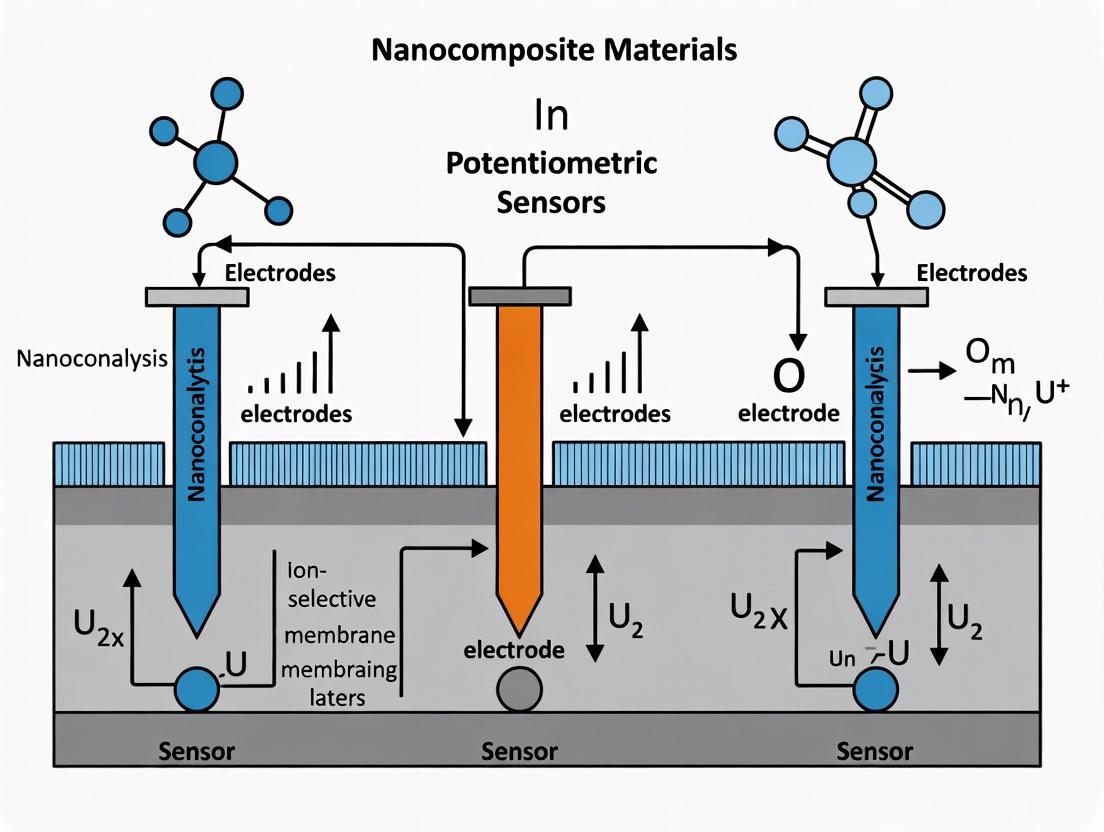
This article explores the transformative role of nanocomposite materials in advancing potentiometric sensor technology, a critical tool for researchers and drug development professionals.
Nanocomposite Materials in Potentiometric Sensors: Enhancing Performance for Biomedical and Pharmaceutical Applications
Abstract
This article explores the transformative role of nanocomposite materials in advancing potentiometric sensor technology, a critical tool for researchers and drug development professionals. It provides a foundational understanding of how materials like conductive polymers, carbon nanotubes, and metal oxide nanoparticles synergistically enhance sensor performance. The scope covers the design and fabrication of these sensors, their direct application in pharmaceutical analysis and clinical diagnostics, and strategies for optimizing their stability and selectivity. A critical evaluation of sensor validation and a comparative analysis of different nanocomposites are presented, offering a comprehensive guide for developing next-generation, reliable sensing platforms for therapeutic drug monitoring and biomarker detection.
The Building Blocks: Understanding Nanocomposites and Potentiometric Sensing Mechanisms
Potentiometric sensors are a well-established class of electrochemical devices that measure the accumulation of charge at a sensing membrane, translating it into a measurable potential signal for determining ionic species activity in solution [1]. These sensors have evolved from traditional liquid-contact configurations with internal filling solutions to advanced solid-contact designs that enable miniaturization, enhanced stability, and integration into wearable platforms [2] [1]. This progression has been significantly accelerated by the incorporation of nanocomposite materials, which provide unique properties including high conductivity, extensive surface areas, and improved electrochemical stability [3] [2]. The transition to solid-contact ion-selective electrodes (SC-ISEs) represents a paradigm shift in sensor design, overcoming limitations of conventional systems while opening new possibilities for point-of-care diagnostics, environmental monitoring, and continuous health tracking [4] [1].
Fundamental Principles of Potentiometric Sensing
Potentiometric sensors operate by measuring the potential difference between a working electrode (ion-selective electrode) and a reference electrode under conditions of zero current flow [1]. The core sensing component is the ion-selective membrane (ISM), which selectively interacts with target ions, generating a membrane potential described by the Nernst equation:
E = E⁰ + (RT/zF)ln(aᵢ)
where E is the measured potential, E⁰ is a constant, R is the gas constant, T is temperature, z is the ion charge, F is Faraday's constant, and aᵢ is the ion activity [4]. For monovalent ions at 25°C, this translates to a theoretical slope of approximately 59.16 mV per decade of concentration change [4].
The critical performance parameters for potentiometric sensors include:
- Sensitivity: The slope of the calibration curve (mV/decade)
- Detection Limit: The lowest measurable ion activity
- Selectivity: The ability to distinguish target ions from interferents
- Response Time: Time to reach a stable potential after sample exposure
- Stability: Signal drift over time [4] [5]
A unique aspect of potentiometric sensors is their ability to measure ion activity rather than total concentration, providing information about the biologically available form of ions in complex samples [5].
Evolution from Liquid-Contact to Solid-Contact Designs
Traditional Liquid-Contact ISEs
Conventional liquid-contact ion-selective electrodes feature an internal filling solution that connects the ion-selective membrane to an internal reference electrode [1]. This configuration, while providing stable potentials, suffers from several practical limitations including evaporation of the internal solution, sensitivity to pressure and orientation, challenges in miniaturization, and the potential for leakage [2] [1]. These constraints have driven the development of more robust solid-contact alternatives.
Solid-Contact ISEs: Design and Transduction Mechanisms
Solid-contact ISEs eliminate the internal solution by incorporating an ion-to-electron transducer layer between the electron-conducting substrate and the ion-selective membrane [2] [1]. This fundamental redesign enables miniaturization, mechanical robustness, and simplified fabrication. Two primary mechanisms facilitate ion-to-electron transduction in these systems:
Redox Capacitance Mechanism: Utilizes conducting polymers that undergo reversible oxidation/reduction, acting as a redox buffer to stabilize the potential [2].
Double Layer Capacitance Mechanism: Employs high-surface-area carbon nanomaterials that provide extensive capacitive interfaces for charge storage [2].
The historical development of SC-ISEs has progressed from early coated-wire electrodes to contemporary systems incorporating advanced nanocomposites, with key milestones including the introduction of conducting polymers in 1992 and the recent integration of carbon nanomaterials and nanocomposites [2] [1].
Nanocomposite Materials in Solid-Contact Potentiometric Sensors
Nanocomposite materials have emerged as transformative elements in solid-contact potentiometric sensors, synergistically combining the advantages of multiple material classes to overcome limitations of single-component systems.
Table 1: Key Nanocomposite Materials for Solid-Contact Potentiometric Sensors
| Material Composition | Key Properties | Demonstrated Applications | Performance Advantages |
|---|---|---|---|
| ZnO@PANI/Coal Nanocomposite | High surface area, enhanced charge transfer, cost-effective | Diltiazem drug sensor [6] | Detection limit of 5.0×10⁻⁷ M, fast response (≤10 s) |
| MWCNT-based Ionic Liquids | High hydrophobicity, ionic conductivity, prevents water layer | Hydrogen phosphate sensor [7] | Detection range 10⁻² to 10⁻⁶ M, enhanced selectivity |
| MXene-Polymer Composites | High conductivity, mechanical flexibility, tunable surface chemistry | Wearable ion sensors [1] | Excellent stability, compatibility with flexible substrates |
| MoS₂-Fe₃O₄ Nanoflowers | Layered structure, high capacitance, stabilized architecture | Solid-contact ion-to-electron transduction [1] | Prevents structural collapse, enhances electrochemical characteristics |
| Au-Tetrathiafulvalene Nanotubes | Redox activity, high capacitance, excellent conductivity | Potassium ion sensing [1] | High capacitance, great stability |
The integration of nanomaterials addresses critical challenges in solid-contact sensor design:
Preventing Water Layer Formation: Hydrophobic nanomaterials like carbon nanotubes and graphene create effective barriers against water penetration at the substrate/membrane interface, significantly improving potential stability [2] [8].
Enhancing Capacitance: High-surface-area nanomaterials provide extensive double-layer capacitance, buffering against potential drifts caused by changes in sample composition or environmental conditions [2].
Improving Selectivity: Functionalized nanomaterials can contribute to ion recognition through specific surface interactions, complementing the selectivity provided by traditional ionophores [7].
Experimental Protocols
Protocol 1: Fabrication of Nanocomposite-Based Solid-Contact Sensors
Materials Required:
- Screen-printed electrodes (SPEs) or glassy carbon electrodes
- Multi-walled carbon nanotubes (MWCNTs)
- Functional ionic liquids (e.g., thiacalix[4]arene derivatives) [7]
- Polyvinyl chloride (PVC) matrix
- Selective ionophore (e.g., calix[4]arene for Ag⁺ sensing) [8]
- Plasticizer (e.g., 2-nitrophenyl octyl ether, NPOE)
- Lipophilic additive (e.g., sodium tetraphenylborate, NaTPB)
- Tetrahydrofuran (THF) solvent
Step-by-Step Procedure:
Transducer Layer Preparation:
- Disperse 2 mg of MWCNTs in 1 mL of THF using ultrasonic agitation for 30 minutes
- Drop-cast 10 μL of the MWCNT suspension onto the working electrode surface
- Allow to dry under ambient conditions for 2 hours [8]
Ion-Selective Membrane Formulation:
Membrane Deposition:
- Drop-cast 20 μL of membrane cocktail over the MWCNT-modified electrode
- Allow solvent evaporation for 24 hours at room temperature
- Condition the sensor in 1.0 × 10⁻³ M target ion solution for 24 hours [8]
Protocol 2: Sensor Performance Characterization
Potential Measurement Methodology:
- Use high-impedance pH/mV meter (>1 GΩ input impedance)
- Employ double-junction Ag/AgCl reference electrode
- Maintain temperature at 25±0.2°C
- Stir solutions continuously during measurement [9] [8]
Calibration Procedure:
- Prepare standard solutions across concentration range (10⁻⁷ to 10⁻¹ M)
- Measure potential in order of increasing concentration
- Record stable potential values (±0.1 mV over 10 seconds)
- Plot potential vs. logarithm of concentration
- Determine slope, linear range, and detection limit from calibration curve [9]
Selectivity Assessment:
- Utilize separate solution method (SSM) or fixed interference method (FIM)
- Calculate selectivity coefficients (logKᵖᵒᵗ) using Nicolsky-Eisenman equation
- Test common interferents relevant to application domain [4]
Table 2: Performance Comparison of Nanocomposite-Enhanced Potentiometric Sensors
| Analyte | Sensor Design | Linear Range (M) | Detection Limit (M) | Response Time (s) | Stability |
|---|---|---|---|---|---|
| Iron (III) | Benzo-18-crown-6/PVC membrane [9] | 1.0×10⁻⁶ to 1.0×10⁻¹ | 8.0×10⁻⁷ | 12 | 10 weeks |
| Diltiazem | ZnO@PANI/Carbon nanocomposite [6] | 1.0×10⁻⁶ to 1.0×10⁻² | 5.0×10⁻⁷ | ≤10 | Excellent thermal stability |
| Hydrogen Phosphate | Ionic liquid/MWCNT [7] | 1.0×10⁻⁶ to 1.0×10⁻² | 2×10⁻⁷ to 1×10⁻⁶ | <30 | Unbiased selectivity |
| Silver Ions | Calix[4]arene/MWCNT [8] | 1.0×10⁻⁵ to 1.0×10⁻² | 4.1×10⁻⁶ | <15 | High stability, no water layer |
The Scientist's Toolkit: Essential Research Reagents and Materials
Table 3: Essential Research Reagents for Nanocomposite Potentiometric Sensor Development
| Material Category | Specific Examples | Function | Application Notes |
|---|---|---|---|
| Polymer Matrices | Polyvinyl chloride (PVC) | Provides structural integrity to sensing membrane | High molecular weight PVC preferred for mechanical stability [9] |
| Plasticizers | 2-Nitrophenyl octyl ether (o-NPOE), Dibutyl phthalate (DBP) | Lowers glass transition temperature, enhances ion mobility | o-NPOE preferred for higher dielectric constant applications [9] |
| Ionophores | Benzo-18-crown-6, Calix[4]arene, β-cyclodextrin | Selective target ion recognition | Crown ethers for cations; functionalized calixarenes for anions [9] [7] |
| Lipophilic Additives | Potassium tetrakis(4-chlorophenyl)borate (KTpClPB), NaTFPB | Optimizes membrane thermodynamics, reduces resistance | Critical for achieving low detection limits [9] [5] |
| Nanocomposite Materials | MWCNTs, ZnO@PANI, PEDOT:PSS | Ion-to-electron transduction, signal amplification | MWCNTs provide high hydrophobicity preventing water layer [2] [8] |
| Solvents | Tetrahydrofuran (THF), Cyclohexanone | Dissolves membrane components for deposition | High purity THF ensures uniform membrane formation [9] |
Advanced Applications and Future Perspectives
The integration of nanocomposite materials has enabled significant advances in potentiometric sensor applications across diverse fields:
Pharmaceutical Analysis: Nanocomposite-based sensors enable direct drug monitoring in complex formulations. For example, diltiazem detection using ZnO@PANI/coal nanocomposites demonstrates excellent recovery in pharmaceutical products and industrial water samples [6]. Similarly, silver sulfadiazine determination in wound healing creams showcases application to pharmaceutical quality control [8].
Environmental Monitoring: Trace-level detection of heavy metals including lead, copper, and cadmium has been achieved with nanocomposite-enhanced sensors, reaching detection limits in the sub-nanomolar range [5]. These sensors provide speciation information crucial for assessing metal bioavailability in environmental samples.
Wearable Healthcare: Solid-contact sensors with flexible nanocomposite transducers enable continuous monitoring of electrolytes (sodium, potassium, chloride) in sweat for athletic performance optimization and clinical diagnosis [2] [1]. The miniaturization potential of nanocomposite-based designs facilitates integration into patches, bands, and textile-based sensors.
Emerging Trends: Additive manufacturing (3D printing) techniques are being leveraged to produce customizable sensor architectures with nanocomposite materials [4] [1]. This approach enables rapid prototyping of sensors with complex geometries optimized for specific applications.
Future development directions include the creation of multi-analyte sensor arrays, the integration of machine learning for data analysis, and the advancement of biodegradable sensor platforms for environmentally sustainable monitoring.
The integration of nanocomposite materials represents a transformative advancement in the field of potentiometric sensors, enabling unprecedented performance through synergistic material properties. Potentiometry-based devices offer significant advantages including wide concentration range, short response time, low cost, low detection limit, high selectivity, and sensitivity, allowing their successful application in many fields such as food, environmental monitoring, medicine, pharmacy, industry, and agriculture [3]. The emergence of nanomaterial-based composites has further enhanced these capabilities by combining the unique attributes of constituent materials—conductive polymers, carbon nanomaterials, metal oxides, and two-dimensional compounds—to create sensing platforms with enhanced electrical properties, structural stability, and molecular recognition capabilities.
This paradigm shift from conventional ion-selective electrodes (ISEs) to solid-contact ISEs has been particularly impactful, addressing critical limitations of traditional sensors including evaporation of inner filling solutions, fragility to external pressure fluctuations, and osmotic pressure effects [2]. Nanocomposites serve as ideal solid-contact materials, functioning as efficient ion-to-electron transducers that stabilize potential measurements while providing the mechanical flexibility required for modern applications including wearable healthcare monitors and point-of-care diagnostic devices [2]. The synergistic interactions within these composite systems yield properties unattainable by individual components, establishing new frontiers in sensing technology through tailored material architectures at the nanoscale.
Fundamental Synergistic Mechanisms in Nanocomposite Sensors
Ion-to-Electron Transduction Pathways
Nanocomposites enhance potentiometric sensor performance through two primary ion-to-electron transduction mechanisms, both critically dependent on interfacial interactions between composite components. The first mechanism leverages redox capacitance from conducting polymers or molecular redox buffers, where the transduction occurs through reversible oxidation/reduction reactions at the electron conductor interface [2]. For cation-selective electrodes, this process can be represented as:
CP+ + B-(SC) + L(ISM) + M+(aq) + e-(C) ⇌ CP0(SC) + B-(ISM) + LM+(ISM) [2]
where C, SC, and ISM refer to the underlying conductor, solid-contact material, and ion-selective membrane, respectively; CP+B- represents the oxidized state of the conducting polymer; CP0 denotes the reduced state; M+ represents the analyte cation; and L and LM+ represent the ionophore and its complex with M+.
The second mechanism employs electric double-layer capacitance, particularly prominent in high-surface-area carbon nanomaterials, where charge separation at the electrode-electrolyte interface enables non-faradaic ion-to-electron transduction [2]. Nanocomposites optimize both pathways by creating extensive interfacial boundaries that facilitate rapid charge transfer while minimizing parasitic resistance, thereby enhancing sensor sensitivity and response time.
Interfacial Engineering and Nanoscale Effects
The enhanced performance of nanocomposite-based sensors stems from fundamental nanoscale phenomena and interfacial engineering strategies. High surface-to-volume ratios inherent to nanostructured materials promote greater interaction with target ions when incorporated into recognition layers [6]. Simultaneously, exceptional electrical properties—including high charge transfer rates and extraordinary electrical capacities generated at nanostructured material interfaces—prove crucial when these nanomaterials function as transducing constituents [6].
Interfacial surface energy between nanocomponents and polymer matrices critically determines composite behavior, influencing dispersion stability, polymer chain dynamics, and ultimately sensor performance [10]. For polymer nanocomposites (PNCs), the glass transition temperature (Tg)—a key indicator of polymer chain mobility—can be tuned by approximately 30°C even with minimal nanofiller loadings, directly impacting sensor stability and operational parameters [10]. Predictive models leveraging machine learning have identified nanoparticle volume fraction and interfacial surface energy as key descriptors governing these property modifications, enabling rational design of sensing composites with tailored characteristics [10].
Performance Comparison of Nanocomposite-Based Potentiometric Sensors
Table 1: Analytical Performance of Representative Nanocomposite-Based Sensors
| Nanocomposite Formulation | Target Analyte | Linear Range (M) | Detection Limit (M) | Response Time (s) | Key Advantages |
|---|---|---|---|---|---|
| ZnO@PANI/Coal [6] | Diltiazem | 1.0 × 10⁻⁶ – 1.0 × 10⁻² | 5.0 × 10⁻⁷ | ≤10 | Enhanced sensitivity, low-cost coal substrate |
| PdRuO₂/PVP [11] | Cr³⁺ | 1 × 10⁻⁶ – 1.0 × 10⁻¹ | 8.6 × 10⁻⁸ | - | High selectivity, year-long stability |
| TiO₂–CuO/PANI [12] | Vildagliptin | 1 × 10⁻² – 1 × 10⁻⁸ | 4.5 × 10⁻⁹ | 10 ± 1.3 | No water layer formation, 137-day lifespan |
| CB/PANI (90:10) [13] | pH | pH 3-8 | - | <60 | Super-Nernstian behavior (−74 ± 3 mV/pH) |
| MXene-based Composites [14] | Physical/Chemical stimuli | Variable | Strain (0.1%) | - | Mechanical flexibility, high conductivity |
Table 2: Material Components and Their Functional Roles in Nanocomposite Sensors
| Material Class | Example Materials | Primary Function | Synergistic Contribution |
|---|---|---|---|
| Conducting Polymers | Polyaniline (PANI), Polypyrrole (PPy), PEDOT [2] | Ion-to-electron transduction | Environmental stability, redox activity, mechanical flexibility |
| Carbon Nanomaterials | Carbon Black, Graphene, CNTs [13] | Electrical conductivity enhancement | High surface area, antifouling properties, catalytic behavior |
| Metal Oxide Nanoparticles | ZnO, TiO₂, CuO [15] [6] | Signal amplification, stability | Semiconductor properties, high surface-to-volume ratio |
| 2D Materials | MXenes (Ti₃C₂Tₓ) [14] | Multiple transduction mechanisms | Exceptional conductivity, surface reactivity, mechanical flexibility |
| Support Matrices | PVP, PVC, Coal [6] [11] | Structural integrity, dispersion | Processability, cost reduction, enhanced active site distribution |
Application Notes: Representative Experimental Case Studies
Case Study 1: ZnO@PANI/Coal Nanocomposite for Pharmaceutical Monitoring
The development of a potentiometric sensor for cardiovascular drug monitoring exemplifies the strategic advantage of nanocomposites for pharmaceutical applications. The ZnO-decorated polyaniline/coal nanocomposite (ZnO@PANI/C) successfully determined diltiazem (DTZ) with a detection limit of 5.0 × 10⁻⁷ M across a linear range of 1.0 × 10⁻⁶ to 1.0 × 10⁻² mol L⁻¹, achieving rapid response within 10 seconds [6]. The three-component system delivered complementary functionalities: coal provided an affordable, readily available substrate with abundant oxygenated functional groups; polyaniline contributed environmental stability and electrical conductivity; and ZnO nanoparticles enhanced charge carrier transfer performance at semiconductor-polymer interfaces [6]. This synergistic combination resulted in improved doping level stability within the composite structure while maintaining cost-effectiveness—a critical consideration for commercial sensor development.
The sensor demonstrated exceptional selectivity for diltiazem against structurally similar drugs and biologically important electrolytes (Na⁺, K⁺, Mg²⁺, Ca²⁺), enabling accurate determination in pharmaceutical products and industrial water samples [6]. This performance underscores how carefully designed nanocomposites can overcome traditional limitations of carbon paste sensors, particularly regarding detection sensitivity and operational stability in complex matrices.
Case Study 2: TiO₂–CuO/PANI Bimetallic Nanocomposite for Clinical Diagnostics
A bimetallic nanocomposite approach substantially enhanced sensor capabilities for diabetes medication monitoring. The TiO₂–CuO/PANI nanocomposite served as a transducer in a carbon paste electrode for vildagliptin determination, achieving remarkable sensitivity with a detection limit of 4.5 × 10⁻⁹ M across an extensive linear range (1 × 10⁻² to 1 × 10⁻⁸ M) with rapid response (10 ± 1.3 seconds) [12]. The bimetallic nanomaterials combined with PANI exhibited superior physical, chemical, and catalytic activity compared to single metal oxide nanomaterials, addressing fundamental stability challenges in solid-contact electrodes.
Critically, the sensor exhibited no potential drift due to elimination of the water layer between the carbon paste and metallic conductor, maintaining performance for 137 days without requiring surface renewal [12]. This exceptional stability—approximately 3-4 times longer than conventional PVC-based sensors—highlights how nanocomposite engineering can overcome one of the most persistent challenges in potentiometric sensing: the formation of unstable water layers that cause potential drift and measurement irreproducibility.
Case Study 3: CB/PANI Nanocomposite for Point-of-Care Medical Diagnostics
The integration of carbon black (CB) with polyaniline (PANI) produced a printed pH sensor with exceptional diagnostic capabilities for orthopedic infection detection [13]. The 90% CB - 10% PANI formulation achieved super-Nernstian sensitivity (-74 ± 3 mV/pH), exceeding theoretical limits while maintaining linear response across the clinically relevant pH range (3-8) with outstanding reproducibility (RSD% = 0.9%) [13]. This synergistic combination leveraged CB's exceptional dispersibility, antifouling properties, and electrocatalytic behavior to enhance PANI's inherent pH-sensitive conducting properties while overcoming its processability challenges.
The resulting sensor enabled rapid (<1 minute) point-of-care diagnosis of orthopedic infections through pH monitoring in synovial fluid, demonstrating how nanocomposite engineering can yield devices compatible with mass production while delivering superior analytical performance [13]. The enhanced dispersibility afforded by CB integration enabled automated drop-casting approaches compatible with scalable manufacturing—addressing a critical limitation in previous PANI-based sensors that required tedious synthesis procedures and exhibited longer stabilization times (>4 hours) [13].
Experimental Protocols
Protocol: Synthesis of ZnO@PANI/Coal Nanocomposite
Principle: This protocol describes the fabrication of a ternary nanocomposite through hydrothermal synthesis and chemical polymerization, yielding a material with enhanced charge transfer properties for pharmaceutical compound sensing [6].
Materials:
- Raw coal (bituminous, El-Maghara mine)
- Zinc nitrate hexahydrate (Zn(NO₃)₂·6H₂O)
- Aniline monomer
- Ammonium persulfate ((NH₄)₂S₂O₈)
- Hydrochloric acid (HCl, 0.5 M)
- Sodium hydroxide (NaOH, 1.0 M)
Procedure:
- Coal Substrate Preparation: Grind 5.0 g of raw coal to fine powder and disperse in 100.0 mL deionized water with vigorous stirring for 10 minutes to form homogeneous slurry.
- ZnO Decoration: Add 5.0 g zinc nitrate salt to coal slurry and stir for 15 minutes until complete dissolution. Treat mixture with NaOH solution (1.0 mol L⁻¹) under continuous stirring for 12 hours.
- Hydrothermal Processing: Recover decorated product by centrifugation (15 minutes at 300 rpm). Thermally treat sample under inert atmosphere at 350°C for 5 hours to obtain ZnO/coal composite (ZnO/C).
- PANI Integration: Dissolve aniline monomer (0.1 mol L⁻¹) in hydrochloric acid (0.5 mol L⁻¹) using sonication. Disperse 1.0 g ZnO/C particles homogenously within aniline solution.
- Polymerization: Initiate polymerization by adding ammonium persulfate oxidant dropwise with continuous stirring. Maintain reaction for 4 hours at room temperature.
- Product Recovery: Recover final ZnO@PANI/C nanocomposite by filtration, washing with methanol/water mixture, and drying at 60°C for 24 hours.
Quality Control: Characterize nanocomposite using XRD to confirm crystalline structure, FT-IR to verify chemical functionality, and SEM to assess morphological properties [6].
Protocol: Fabrication of Carbon Paste Electrodes with Nanocomposite Transducers
Principle: This protocol details the preparation of carbon paste electrodes incorporating nanocomposite materials as ion-to-electron transducers, enabling sensitive detection of target analytes in pharmaceutical and clinical samples [6] [12].
Materials:
- Graphite powder (spectroscopic grade, 1-2 μm)
- Nanocomposite transducer (e.g., ZnO@PANI/C, TiO₂–CuO/PANI)
- Plasticizer (DBP, DOP, DOS, or o-NPOE)
- Ionophore (β-cyclodextrin, 18-crown-6-ether)
- Lipophilic additive (NaTPB, KTCPB)
- Tetrahydrofuran (THF) solvent
- Copper wire conductors
Procedure:
- Membrane Formulation: Precisely weigh components to create 100 mg total mixture with the following typical composition:
- 2-5% ionophore (molecular recognition element)
- 3-8% nanocomposite transducer
- 1-2% lipophilic additive
- 45-55% graphite powder
- 30-40% plasticizer
Paste Homogenization: Transfer mixture to mortar and add 3 mL THF solvent. Mix thoroughly until homogeneous paste forms with putty-like consistency. For enhanced homogeneity, vortex mixture for 1-2 minutes.
Electrode Assembly: Pack prepared paste firmly into electrode body (typically 3-4 mm diameter cavity). Insert copper wire conductor to establish electrical contact, ensuring complete paste coverage of contact point.
Surface Polishing: Smooth electrode surface against weighing paper to create uniform sensing interface. For renewable surface electrodes, extrude small amount of paste (~0.5 mm) and polish.
Conditioning: Condition fabricated electrodes in target analyte solution (10⁻³ M) for 1 hour to establish stable potential baseline. For drug sensing, use appropriate buffer (e.g., Britton-Robinson buffer, pH 5).
Storage: Maintain conditioned electrodes in dark environment at room temperature when not in use to preserve sensitivity and stability.
Validation: Verify electrode performance by testing Nernstian slope, response time, detection limit, and selectivity against potential interferents according to IUPAC guidelines [12].
The Scientist's Toolkit: Essential Research Reagents and Materials
Table 3: Essential Research Reagents for Nanocomposite Sensor Development
| Reagent/Material | Function | Example Applications | Key Considerations |
|---|---|---|---|
| Polyaniline (PANI) | Conducting polymer transducer | pH sensing, drug detection [13] [12] | Environmental stability, doping-dependent conductivity |
| Carbon Black (CB) | Conductive nanofiller | Printed electrode fabrication [13] | High dispersibility, cost-effectiveness (€1/kg) |
| ZnO Nanoparticles | Semiconductor component | Drug sensing composites [6] | Non-toxicity, optoelectronic properties |
| MXenes (Ti₃C₂Tₓ) | 2D conductive material | Flexible sensors, wearables [14] | High conductivity (>20,000 cm⁻¹), processability |
| β-Cyclodextrin | Ionophore/molecular recognition | Pharmaceutical compound sensing [6] | Host-guest complexation, selectivity |
| 18-Crown-6-Ether | Ionophore | Vildagliptin sensing [12] | Cation selectivity, inclusion complex formation |
| Dibutyl Phthalate (DBP) | Plasticizer | Membrane mobility enhancement [6] | Lipophilicity, compatibility with polymer matrices |
| Sodium Tetraphenylborate (NaTPB) | Lipophilic additive | Charge balance in membranes [6] | Anion exclusion, potential stability |
Signaling Pathways and Experimental Workflows
Diagram 1: Ion-to-Electron Transduction Pathway in Nanocomposite Potentiometric Sensors
Diagram 2: Experimental Workflow for Nanocomposite Sensor Development
Potentiometric sensors represent a well-established class of analytical tools that measure the potential difference under zero-current conditions to determine the activity or concentration of target ions in solution. The core principle relies on the use of an ion-selective membrane (ISM) that generates a potential signal dependent on the activity of the target ion, as described by the Nernst equation [16]. Recent research has focused on transitioning from conventional liquid-contact electrodes to advanced solid-contact ion-selective electrodes (SC-ISEs), which eliminate the internal filling solution, thereby enhancing mechanical stability, enabling miniaturization, and facilitating integration into wearable devices [1] [2]. This evolution has been driven by the incorporation of innovative functional nanomaterials—specifically conducting polymers, carbon nanomaterials, and metal oxides—as critical components in the sensor architecture. These materials primarily function as ion-to-electron transducers in solid-contact layers, but also serve as sensing elements, selective recognition components, and performance-enhancing additives in nanocomposite formulations [16] [17] [18]. Their unique properties, including high electrical conductivity, extensive surface area, and tunable surface chemistry, have enabled the development of sensors with remarkable analytical performance, portability, and flexibility for clinical, environmental, and industrial monitoring applications.
Core Material Components and Their Properties
Conducting Polymers
Mechanism and Key Types: Conducting polymers (CPs) represent a cornerstone material class in solid-contact potentiometric sensors, primarily functioning through a redox capacitance mechanism to facilitate ion-to-electron transduction [2]. When used as a solid-contact layer, CPs are typically sandwiched between the electron-conducting substrate (e.g., metal, carbon) and the ion-selective membrane. Their unique conjugated molecular structure allows them to exhibit mixed ionic and electronic conductivity, enabling efficient conversion between ionic signals from the membrane and electronic signals for measurement [16]. The transduction mechanism for a cation-selective electrode involves the reversible oxidation and reduction of the polymer backbone, coupled with ion exchange at the interface with the ion-selective membrane [2]. Common conducting polymers utilized in potentiometric sensors include polypyrrole (PPy), polyaniline (PANI), polythiophene (PTh), and poly(3,4-ethylenedioxythiophene) (PEDOT), each offering distinct advantages in terms of conductivity, stability, and ease of deposition [16] [19] [20].
Table 1: Key Conducting Polymers in Potentiometric Sensors
| Polymer | Key Properties | Primary Functions | Deposition Methods |
|---|---|---|---|
| Polypyrrole (PPy) | Low oxidation potential, good biocompatibility, moderate conductivity | Ion-to-electron transducer, solid-contact layer | Electropolymerization, drop-casting |
| Polyaniline (PANI) | Inexpensive monomer, good environmental stability, multiple oxidation states | Solid-contact layer, sensing element for pH | Chemical polymerization, electrochemical deposition |
| PEDOT | High optical transparency, excellent stability, good conductivity | Ion-to-electron transducer, component in wearable sensors | Electropolymerization, solution processing (PEDOT:PSS) |
| Poly(3-octylthiophene) (POT) | High hydrophobicity, good electrical properties | Solid-contact layer to prevent water layer formation | Drop-casting from solution |
Synthesis and Fabrication: Conducting polymers can be synthesized through either chemical or electrochemical oxidation polymerization methods [19]. Chemical polymerization utilizes oxidizing agents such as ferric salts (FeCl₃, Fe(ClO₄)₃) and allows for large-scale production, while electrochemical polymerization enables precise control over film thickness and direct deposition onto electrode surfaces. Nanostructured conducting polymers with controlled morphologies (e.g., nanotubes, nanofibers, nanospheres) can be fabricated using template-assisted synthesis (solid-phase or molecular templates) or template-free methods, resulting in enhanced surface area and improved sensor performance due to faster ion transport and higher interaction with analytes [19].
Carbon Nanomaterials
Types and Characteristics: Carbon nanomaterials constitute another major category of transducer materials in solid-contact ISEs, operating primarily through an electric-double-layer capacitance mechanism due to their exceptionally high surface area [21] [2]. This class includes diverse structures such as graphene, carbon nanotubes (CNTs), carbon nanohorns, carbon black, fullerenes, and nanodiamonds, each exhibiting unique electrical, mechanical, and chemical properties derived from their distinct carbon hybridization states and structural configurations [21]. Graphene, a single layer of sp²-hybridized carbon atoms arranged in a honeycomb lattice, offers high carrier mobility, excellent electrical conductivity, and large specific surface area [21]. Carbon nanotubes, both single-walled and multi-walled, provide high electrical conductivity, mechanical strength, and a tubular structure conducive to ion transport and hosting other nanomaterials [21].
Table 2: Carbon Nanomaterials in Potentiometric Sensors
| Material | Structure | Key Properties | Sensor Applications |
|---|---|---|---|
| Graphene | 2D honeycomb lattice | High surface area (~2630 m²/g), excellent electrical conductivity, flexibility | Solid-contact layer, transducer in flexible and wearable sensors |
| Carbon Nanotubes (CNTs) | Cylindrical nanotubes | High aspect ratio, metallic or semiconducting, high conductivity | Composite material in solid-contact layers and paste electrodes |
| Carbon Black | Nanoparticulate carbon | High surface area, low-cost, good electrical conductivity | Additive to enhance conductivity in composite sensing materials |
| Fullerenes | Spherical carbon molecules | Good electron acceptability, functionalization capability | Component in self-assembled monolayers and redox buffers |
| Carbon Nanodiamonds | sp³ hybridized carbon core | Excellent biocompatibility, tunable surface chemistry | Sensing layer for biomolecules and in biomedical applications |
Functionalization and Applications: The performance of carbon nanomaterials in sensing applications is often enhanced through chemical functionalization, which can improve their dispersibility, compatibility with polymer matrices, and selective interaction with target analytes [21]. Functionalization strategies include covalent modification (e.g., oxidation to introduce carboxylic acid groups) and non-covalent approaches (e.g., π-π stacking with aromatic compounds) [21]. In potentiometric sensors, carbon nanomaterials are frequently incorporated as the solid-contact layer between the electrode substrate and the ion-selective membrane, where their high double-layer capacitance contributes to excellent potential stability and prevents the formation of an undesirable water layer, especially when combined with hydrophobic polymers or treatments [18] [2].
Metal Oxides
Properties and Mechanisms: Metal oxide nanoparticles have emerged as versatile functional materials in potentiometric sensors, serving roles as solid-contact layers, sensing materials, and paste components [17] [18]. Their utility stems from remarkable properties including high electrical capacity, mixed ion-electron conductivity, thermal and chemical stability, and tunable surface chemistry [17]. The transduction mechanism of metal oxides in potentiometric sensors is primarily based on redox reactions involving proton and electron exchange. For instance, ruthenium oxide (RuO₂) undergoes reversible redox reactions in the presence of hydrogen ions according to the equation: RuO₂ + xH⁺ + xe⁻ RuO₂₋ₓ(OH)ₓ, where 0 ≤ x ≤ 2 [17]. This mechanism enables efficient ion-to-electron transduction and can extend beyond protons to other cations such as potassium ions [17].
Table 3: Metal Oxides in Potentiometric Sensors
| Metal Oxide | Key Properties | Primary Sensor Applications | Performance Characteristics |
|---|---|---|---|
| RuO₂ | High redox capacitance, good electrical conductivity, stability | pH sensing layer, solid-contact layer | Near-Nernstian response (55-59 mV/pH), wide pH range |
| IrO₂ | High redox sensitivity, catalytic activity | pH sensing layer, solid-contact transducer | Near-Nernstian response, durable sensing layer |
| TiO₂ | Photocatalytic properties, high surface area | pH sensing material, component in composites | Moderate pH sensitivity, enhanced in nanocomposites |
| Co₃O₄ | Mixed valence states, catalytic properties | Component in nanocomposite sensing layers | Cd²⁺ detection with 27.5 mV/decade sensitivity [22] |
| Ta₂O₅ | High chemical stability, insulating properties | Sensing layer in commercial pH sensors | Excellent long-term stability, Nernstian response |
Implementation in Sensor Architectures: Metal oxides can be implemented in various sensor configurations, including as the primary sensing material in screen-printed pH electrodes, as solid-contact layers between the electrode substrate and ion-selective membrane, or as functional components in composite electrode pastes [17] [18]. Nanostructured metal oxides, with their high surface-to-volume ratio, are particularly effective as they enhance sensitivity, selectivity, and catalytic activity. Interestingly, despite the typically hydrophilic nature of many metal oxides (with low wetting angles), certain oxides like ruthenium oxide have been shown to resist the formation of detrimental water layers between the ion-selective membrane and the electrode substrate, possibly due to specific surface reactions and strong adhesion to the membrane [17].
Experimental Protocols and Methodologies
Protocol 1: Fabrication of Solid-Contact ISE with Conducting Polymer Transducer
Objective: To construct an all-solid-state ion-selective electrode utilizing a conducting polymer (PEDOT) as the ion-to-electron transducer layer for potassium ion detection.
Materials and Reagents:
- Glassy carbon electrode (GCE, 3 mm diameter) as substrate
- 3,4-ethylenedioxythiophene (EDOT) monomer
- Lithium perchlorate (LiClO₄) as electrolyte for electropolymerization
- Poly(vinyl chloride) (PVC) as polymer matrix
- Potassium ionophore (valinomycin)
- Plasticizer (e.g., 2-nitrophenyl octyl ether)
- Ionic sites (e.g., potassium tetrakis(4-chlorophenyl)borate)
- Tetrahydrofuran (THF) as solvent for membrane solution
- Standard potassium chloride solutions for calibration
Procedure:
- Electrode Pretreatment: Polish the glassy carbon electrode surface with successive grades of alumina slurry (1.0, 0.3, and 0.05 μm) on a microcloth. Rinse thoroughly with deionized water and ethanol, then dry under nitrogen stream.
- Electropolymerization of PEDOT: Prepare a solution containing 0.01 M EDOT monomer and 0.1 M LiClO₄ in acetonitrile. Transfer the solution to an electrochemical cell with the GCE as working electrode, Ag/AgCl reference electrode, and platinum counter electrode. Perform potentiostatic electrodeposition by applying a constant potential of +1.0 V vs. Ag/AgCl for 100 seconds to form a uniform PEDOT film on the GCE surface. Rinse the modified electrode with acetonitrile and dry at room temperature.
- Ion-Selective Membrane Preparation: Prepare the membrane cocktail by dissolving the following components in 1.5 mL THF: 33 mg PVC (32.7%), 66 mg plasticizer (65.3%), 1.0 mg potassium ionophore (1.0%), and 0.5 mg ionic additive (0.5%). Mix thoroughly using a magnetic stirrer until complete dissolution is achieved.
- Membrane Deposition: Drop-cast 50 μL of the membrane cocktail onto the PEDOT-modified GCE surface. Allow the THF to evaporate slowly at room temperature for 24 hours to form a homogeneous ion-selective membrane with approximate thickness of 200 μm.
- Conditioning and Storage: Condition the finished electrode in 0.01 M KCl solution for 24 hours before use. Store in the same solution when not in use.
Diagram 1: SC-ISE Fabrication Workflow
Protocol 2: Development of Nanocomposite-based Sensor for Cd²⁺ Detection
Objective: To synthesize a CoS₂-CoO/poly-O-aminobenzenethiol (POABT) nanocomposite and employ it as a sensing material for potentiometric detection of cadmium ions [22].
Materials and Reagents:
- Cobalt chloride (CoCl₂·6H₂O)
- Thiourea as sulfur source
- O-aminobenzenethiol monomer
- Ammonium persulfate as oxidizing agent for polymerization
- Ethanol and deionized water as solvents
- Cadmium standard solutions for calibration
- Interfering ion solutions (Zn²⁺, Ca²⁺, Ni²⁺, Al³⁺, K⁺, Mg²⁺) for selectivity testing
Procedure:
- Synthesis of CoS₂-CoO Nanostructures: Dissolve 2.0 mmol CoCl₂·6H₂O and 8.0 mmol thiourea in 40 mL of deionized water under magnetic stirring. Transfer the solution to a 50 mL Teflon-lined autoclave and heat at 180°C for 12 hours. Allow the system to cool naturally to room temperature. Collect the resulting precipitate by centrifugation, wash with ethanol and deionized water several times, and dry at 60°C under vacuum for 6 hours.
- Preparation of CoS₂-CoO/POABT Nanocomposite: Dissolve 0.1 g of the synthesized CoS₂-CoO powder and 0.2 mL of O-aminobenzenethiol monomer in 20 mL of ethanol. Add 10 mL of 0.1 M ammonium persulfate solution dropwise under constant stirring to initiate polymerization. Continue stirring for 12 hours at room temperature. Collect the resulting nanocomposite by filtration, wash thoroughly with ethanol, and dry at 50°C for 24 hours. Characterize the material using SEM, TEM, and XRD to confirm the formation of open-spherical nanostructures with walls approximately 25 nm thick surrounding cavities of about 40 nm diameter [22].
- Electrode Modification: Prepare a homogeneous ink by dispersing 5 mg of the CoS₂-CoO/POABT nanocomposite in 1 mL of ethanol with 30 minutes of ultrasonication. Drop-cast 10 μL of this suspension onto a pre-polished glassy carbon electrode and allow to dry at room temperature. Repeat this process 3 times to achieve an adequate film thickness.
- Potentiometric Measurements: Condition the modified electrode in a 10⁻³ M Cd²⁺ solution for 1 hour before measurements. Perform potentiometric measurements in Cd²⁺ solutions with concentrations ranging from 10⁻⁵ to 10⁻¹ M. Maintain constant stirring during measurements and record the potential values once stable (typically after 30-60 seconds per measurement).
- Selectivity Testing: Evaluate the sensor's selectivity by measuring the potential response in solutions containing potential interfering ions (Zn²⁺, Ca²⁺, Ni²⁺, Al³⁺, K⁺, Mg²⁺) separately at a fixed concentration of 10⁻³ M. Calculate the potentiometric selectivity coefficients using the separate solution method.
Performance Validation: The developed sensor should exhibit a potentiometric slope of approximately 27.5 mV per decade for Cd²⁺ concentrations ranging from 10⁻⁵ to 10⁻¹ M, with a detection limit of 4 × 10⁻⁶ M. The sensor should maintain its accuracy in the presence of potential interfering ions and demonstrate reliability when tested with natural environmental samples [22].
The Scientist's Toolkit: Essential Research Reagents and Materials
Table 4: Essential Research Reagents for Nanocomposite Potentiometric Sensors
| Reagent/Material | Function | Example Applications | Key Considerations |
|---|---|---|---|
| Poly(vinyl chloride) (PVC) | Polymer matrix for ion-selective membranes | Membrane substrate in ISEs | Compatibility with plasticizers, mechanical stability |
| Ionophores (e.g., valinomycin) | Selective recognition of target ions | Potassium-selective electrodes | Selectivity coefficient, lipophilicity, stability constant |
| Plasticizers (e.g., 2-nitrophenyl octyl ether) | Provide mobility to ionophores in membrane | PVC-based ISMs | Polarity, molecular size, leaching resistance |
| Ionic additives (e.g., KTpClPB) | Establish permselectivity in membrane | Cation-selective electrodes | Lipophilicity, matching with ionophore charge |
| EDOT monomer | Precursor for conducting polymer PEDOT | Solid-contact transducer layer | Purity, polymerization conditions |
| Carbon nanotubes | High surface area transducer material | Solid-contact layer in SC-ISEs | Functionalization, dispersion quality |
| Graphene oxide | 2D nanomaterial for composite sensors | Transducer, mechanical reinforcement | Degree of oxidation, reduction method |
| Metal oxide nanoparticles (e.g., RuO₂) | Redox-active transducer material | Solid-contact layer, pH sensing | Particle size, crystalline structure |
| Tetrahydrofuran (THF) | Solvent for membrane preparation | Membrane cocktail preparation | Purity, evaporation rate control |
Signaling Mechanisms and Transduction Pathways
The exceptional performance of nanocomposite-based potentiometric sensors arises from sophisticated signaling mechanisms that enable efficient conversion between ionic and electronic signals. Understanding these pathways is essential for rational sensor design and optimization.
Redox Capacitance Mechanism: Conducting polymers and certain metal oxides function primarily through a redox capacitance mechanism [16] [2]. In this pathway, the solid-contact material undergoes reversible oxidation and reduction at the interface with the electron-conducting substrate, while simultaneously exchanging ions with the ion-selective membrane. For a conducting polymer-based cation-selective electrode, the transduction can follow two possible pathways depending on whether the doping anion (B⁻) from the polymer or the anionic site (R⁻) from the membrane crosses the interface [2]. The overall reaction can be represented as: CP⁺ + B⁻(SC) + L(ISM) + M⁺(aq) + e⁻(C) ⇌ CP⁰(SC) + B⁻(ISM) + LM⁺(ISM) where CP⁺B⁻ represents the oxidized conducting polymer, CP⁰ denotes the reduced polymer, M⁺ is the target cation, L is the ionophore, and LM⁺ is the ionophore-cation complex [2].
Double-Layer Capacitance Mechanism: Carbon-based nanomaterials operate predominantly through an electric-double-layer capacitance mechanism [2]. These materials accumulate charge at the electrode-electrolyte interface through non-Faradaic processes, creating an electrical double layer that stores energy. The high surface area of nanostructured carbon materials (e.g., graphene, carbon nanotubes) results in significantly enhanced double-layer capacitance compared to conventional materials, leading to improved potential stability and reduced drift [21] [18]. This mechanism does not involve electron transfer across the interface but rather electrostatic attraction and organization of ions at the interface.
Diagram 2: Signal Transduction Mechanisms
Mixed Transduction in Nanocomposites: Advanced sensor designs often incorporate hybrid materials that exploit both mechanisms simultaneously [1] [18]. For example, a nanocomposite containing carbon nanotubes with dispersed metal oxide nanoparticles benefits from the double-layer capacitance of the carbon framework while gaining additional redox capacitance from the metal oxide components. Similarly, conducting polymer-carbon hybrids exhibit synergistic effects that enhance overall transducer performance, resulting in sensors with improved stability, lower detection limits, and faster response times [1].
The integration of conducting polymers, carbon nanomaterials, and metal oxides as core components in potentiometric sensors has revolutionized the field of ion-selective electrodes. These materials have enabled the development of all-solid-state sensors with performance characteristics that rival or surpass conventional liquid-contact electrodes while offering additional advantages in terms of miniaturization, flexibility, and integration into wearable platforms [1] [2]. The distinct yet complementary transduction mechanisms—redox capacitance in conducting polymers and metal oxides, and double-layer capacitance in carbon nanomaterials—provide multiple pathways for efficient ion-to-electron transduction, allowing sensor designers to select materials optimized for specific applications and operating conditions.
Future research directions will likely focus on further refining nanomaterial synthesis and functionalization techniques to enhance sensor selectivity and stability, developing multi-analyte detection platforms through array-based approaches and advanced data processing, and creating fully integrated wearable sensor systems for continuous health monitoring and point-of-care diagnostics [1] [2]. As understanding of the fundamental interfacial processes in these nanocomposite systems deepens, and as fabrication techniques become more sophisticated and accessible, potentiometric sensors based on these advanced materials will continue to expand their impact across diverse fields including clinical diagnostics, environmental monitoring, industrial process control, and personalized medicine.
In the development of modern solid-contact ion-selective electrodes (SC-ISEs), particularly those incorporating nanocomposite materials, the ion-to-electron transduction layer is a critical component that determines overall sensor performance. This layer facilitates the conversion between ionic conductivity in the sample solution and electronic conductivity in the electrode. Two primary mechanisms govern this transduction process: the redox capacitance mechanism and the electric-double-layer (EDL) capacitance mechanism [2]. The choice between these mechanisms significantly impacts key sensor parameters including potential stability, sensitivity, and susceptibility to environmental interferences such as oxygen, light, and pH fluctuations [1] [2]. For researchers working with nanocomposite materials in potentiometric sensors, understanding the distinction between these mechanisms is fundamental to designing sensors with optimized performance for specific applications, including pharmaceutical analysis and clinical diagnostics.
Mechanism Comparison and Material Selection
The fundamental difference between these transduction mechanisms lies in their operational principles. The redox capacitance mechanism relies on reversible faradaic processes involving oxidation and reduction of the transducer material, while the electric-double-layer capacitance mechanism operates through non-faradaic ion adsorption at the electrode-electrolyte interface, forming a capacitive electrical double layer [2]. Each mechanism offers distinct advantages and limitations, making them suitable for different applications and material systems.
Table 1: Comparative Analysis of Transduction Mechanisms
| Characteristic | Redox Capacitance Mechanism | Electric-Double-Layer Capacitance Mechanism |
|---|---|---|
| Fundamental Principle | Reversible Faradaic redox reactions | Non-Faradaic ion adsorption at interfaces |
| Primary Materials | Conducting polymers (PEDOT, PANI, PPy) [2] [23] | Carbon nanomaterials (graphene, MWCNTs, DWCNTs) [24] [25] |
| Typical Capacitance Range | Medium to High | High to Very High (e.g., 383.4 µF for graphene) [24] |
| Potential Stability | Good, but susceptible to redox interferences | Excellent, with drifts as low as 2.6 µV/s [24] |
| Response to O₂, CO₂, Light | Often sensitive [2] | Generally insensitive |
| Key Advantage | High, well-defined capacitance per volume | Exceptional hydrophobicity reduces water layer formation |
| Ion-to-Electron Coupling | Efficient through reversible redox reactions | Efficient through high surface area EDL formation |
Table 2: Performance Comparison of Transducer Materials
| Transducer Material | Mechanism | Reported Capacitance | Potential Drift | Target Ion |
|---|---|---|---|---|
| Graphene [24] | EDL | 383.4 ± 36.0 µF | 2.6 ± 0.3 µV s⁻¹ | Li⁺ |
| PEDOT [2] | Redox | Medium-High | ~10 µV/h (up to 8 days) | Various |
| Polyaniline (PANI) [26] | Redox | N.R. | Acceptable for sulfite detection | SO₃²⁻ |
| MWCNTs [26] | EDL | N.R. | Acceptable for sulfite detection | SO₃²⁻ |
| DWCNTs in PEDOT/PPy [25] | Mixed | Improved | ~1.5 mV/day | NO₃⁻ |
Transducer Selection Guide for Nanocomposite Applications
For researchers designing nanocomposite-based potentiometric sensors, selection guidance depends on application requirements:
- High-Stability Environmental Monitoring: Electric-double-layer capacitors using graphene or MWCNTs are ideal for long-term deployment with minimal drift [24] [26].
- Biomedical Sensing Applications: Redox capacitor materials like PEDOT or functionalized PANI offer sufficient stability for most clinical measurements [2] [23].
- Advanced Nanocomposite Strategies: Combining both mechanisms creates synergistic effects, such as DWCNTs embedded in PEDOT or PPy matrices, yielding improved transduction with temporal drifts as low as 1.5 mV/day [25].
Experimental Protocols
Protocol 1: Fabrication of Graphene-Based EDL Transducers for Lithium Sensing
This protocol details the creation of a high-performance EDL transducer for lithium detection, achieving a capacitance of 383.4 µF and potential drift of 2.6 µV/s [24].
Materials Required:
- Screen-printed electrodes (SPEs)
- Graphene dispersion (commercially available graphene-modified SPEs)
- Lithium ion-selective membrane components: ionophore, plasticizer, polymer matrix
- Tetrahydrofuran (THF) for membrane solution preparation
Procedure:
- Electrode Preparation: Use commercially available graphene-modified screen-printed electrodes. Alternatively, deposit graphene dispersion onto SPEs and dry.
- Membrane Formulation: Prepare the ion-selective membrane mixture containing:
- Lithium ionophore (selective for Li⁺)
- Plasticizer (e.g., o-NPOE)
- Polyvinyl chloride (PVC) or similar polymer matrix
- Lipophilic additive (e.g., KTFBP)
- Membrane Deposition: Drop-cast the membrane solution onto the graphene transducer surface using a precise micro-syringe.
- Conditioning: Soak the prepared sensor in Li⁺ solution (e.g., 10⁻³ M) for at least 2 hours, then in a dilute Li⁺ solution (10⁻⁸ M) for 48 hours before use.
- Validation: Perform chronopotentiometric measurements to determine capacitance and potential drift.
Troubleshooting Tips:
- Inconsistent potential readings may indicate incomplete conditioning.
- High noise levels may suggest poor contact between membrane and transducer.
Protocol 2: Development of Redox Capacitive Biosensor for H₂O₂ Detection
This protocol outlines the creation of an ultrasensitive chiral-dependent redox capacitive biosensor for hydrogen peroxide detection, achieving detection limits of 21.8 aM [27].
Materials Required:
- Gold interdigitated electrodes (IDEs)
- L-cysteine and D-cysteine enantiomers
- Glutathione (GSH)
- Copper ions (Cu²⁺)
- Hydrogen peroxide solutions for calibration
Procedure:
- Nanoparticle Synthesis: Synthesize Cu-Cys-GSH nanoparticles by self-assembly of cysteine and glutathione with copper ions.
- Chiral Investigation: Prepare separate batches with L- and D-cysteine enantiomers to compare performance.
- Electrode Modification: Deposit the synthesized nanoparticles onto gold IDEs.
- Fenton-like Reaction Setup: The detection mechanism leverages a Fenton-like reaction where H₂O₂ interacts with Cu-Cys-GSH nanoparticles to generate hydroxyl radicals through redox cycling between Cu²⁺ and Cu⁺ ions.
- Capacitance Measurement: Measure changes in surface charge and dielectric properties using capacitive sensing.
- Calibration: Expose the sensor to H₂O₂ standards from 1.0 fM to 1.0 pM to establish a calibration curve.
Performance Validation:
- Test sensor with real samples (milk, saliva) to determine recovery rates.
- Compare L- and D-cysteine configurations, with Cu-L-Cys-GSH typically showing superior performance.
Protocol 3: Integrating DWCNT Transducers for Nitrate Sensing
This protocol describes the implementation of double-walled carbon nanotubes in a mixed-mechanism transducer for nitrate detection in environmental samples [25].
Materials Required:
- Fluoropolysiloxane (FPSX) polymer
- Tetradodecylammonium nitrate (TDDAN) ion exchanger
- Double-walled carbon nanotubes (DWCNTs)
- PEDOT or polypyrrole (PPy) polymers
- Tetrahydrofuran (THF) for solution preparation
Procedure:
- Transducer Matrix Preparation: Create a composite by embedding DWCNTs in either PEDOT or PPy polymers via electropolymerization.
- Ion-Selective Membrane Formulation: Mix FPSX polymer with TDDAN ion exchanger and ionic additive (KTFBP) in THF.
- Electrode Assembly: Deposit the DWCNT-based transducing layer onto platinum electrodes, followed by drop-casting the FPSX-based ion-selective membrane.
- Sensor Conditioning: Condition the assembled sensor in nitrate solution before use.
- Performance Testing: Evaluate sensor sensitivity (typically ~55 mV/pNO₃ for range 1-5), selectivity against interferents (Cl⁻, HCO₃⁻, SO₄²⁻), and temporal drift.
Application Note:
- This sensor configuration demonstrates relatively stable measurements with low temporal drifts (~1.5 mV/day) over several days, though long-term stability may require further optimization.
The Scientist's Toolkit: Essential Research Reagents
Table 3: Key Research Reagent Solutions for Transducer Development
| Reagent/Material | Function/Application | Examples/Notes |
|---|---|---|
| Conducting Polymers | Redox capacitance transduction | PEDOT, PANI, PPy - functionalization enhances properties [23] |
| Carbon Nanomaterials | EDL capacitance transduction | Graphene, MWCNTs, DWCNTs - high surface area, hydrophobicity [24] [25] |
| Ion-Selective Membranes | Target recognition | PVC or FPSX matrix with ionophore/ion exchanger [26] [25] |
| Plasticizers | Membrane mobility | o-NPOE, other phthalates - ensure proper membrane function [26] |
| Lipophilic Salts | Membrane permselectivity | KTFBP, TDMAC - reduce membrane resistance [26] [25] |
| Nanocomposites | Enhanced transduction | Combined redox/EDL mechanisms (e.g., DWCNTs in PEDOT) [25] |
Conceptual Framework and Signaling Pathways
The following diagram illustrates the fundamental signaling pathways and material interactions in both transduction mechanisms, highlighting the critical role of nanocomposite materials in facilitating ion-to-electron conversion.
Diagram 1: Ion-to-Electron Transduction Pathways in Nanocomposite-Based Sensors. This workflow illustrates the two parallel mechanisms for converting ionic signals from the sample to electronic signals in the electrode, facilitated by different nanomaterial classes.
The strategic selection between redox capacitance and electric-double-layer capacitance mechanisms provides a critical design parameter for advanced potentiometric sensors. For researchers focusing on nanocomposite materials, understanding these mechanisms enables the rational design of transducers with tailored properties. Redox capacitance offers well-defined, efficient charge transfer through faradaic processes, while EDL capacitance provides exceptional stability through physical ion adsorption at high-surface-area interfaces. The emerging trend of combining both mechanisms in sophisticated nanocomposites represents the most promising path forward, leveraging the advantages of both approaches to create next-generation sensors with enhanced performance for pharmaceutical, clinical, and environmental monitoring applications.
The Critical Role of Solid-Contact Layers in Enhancing Sensor Stability
Solid-contact (SC) layers represent a foundational advancement in the design of modern potentiometric sensors, particularly all-solid-state ion-selective electrodes (SC-ISEs). These layers, positioned between the ion-selective membrane (ISM) and the electron-conducting substrate, directly address the critical limitations of traditional liquid-contact electrodes, which suffer from evaporation of internal filling solution, sensitivity to pressure and temperature changes, and challenges in miniaturization [2] [28]. The transition to solid-contact configurations has enabled the development of robust, portable, and maintenance-free sensors essential for wearable monitoring, point-of-care diagnostics, and environmental field analysis [1].
Within the context of nanocomposite materials research, solid-contact layers have evolved from simple conducting polymers to sophisticated multi-material composites. These advanced nanocomposites synergistically combine properties from their constituents—such as high electrical capacitance, enhanced hydrophobicity, and excellent ion-to-electron transduction—to achieve unprecedented sensor stability and performance [29] [30]. This document details the materials, mechanisms, and methodologies underpinning these critical components, providing researchers with the application notes and protocols necessary to leverage their full potential in potentiometric sensor design.
Key Materials and Mechanisms in Solid-Contact Layers
Material Classes and Transduction Mechanisms
The performance of a solid-contact layer is fundamentally determined by its material composition, which dictates the primary mechanism of ion-to-electron transduction. These mechanisms can be broadly categorized into two types, each associated with specific material classes.
Redox Capacitance Mechanism: This mechanism relies on reversible redox reactions occurring within the solid-contact material to facilitate charge transfer. Conducting polymers (CPs) are the most prominent materials in this category. When used in a cation-selective electrode, for example, the overall reaction can be represented as:
CP+ + B-(SC) + L(ISM) + M+(aq) + e-(C) ⇌ CP0(SC) + B-(ISM) + LM+(ISM)[2]. Common conducting polymers include Polypyrrole (PPy), Poly(3-octylthiophene) (POT), and Poly(3,4-ethylenedioxythiophene) (PEDOT) [2] [1]. Their efficacy stems from their mixed ionic and electronic conductivity, which enables efficient ion-to-electron transduction and can yield potential drifts as low as 10 µV/h over several days [2].Electric-Double Layer (EDL) Capacitance Mechanism: This mechanism depends on the electrostatic separation of charge at the interface between the solid-contact material and the ion-selective membrane, forming an electric double layer. It does not involve Faradaic processes. Carbon-based nanomaterials and some metal oxides are key materials here, valued for their exceptionally high surface-to-volume ratios that lead to high electrical capacitance [2] [30]. This category includes materials like carbon nanotubes (CNTs), graphene, electrospun carbon nanofibers (eCNF), and ruthenium dioxide (RuO2) [30] [31].
The emergence of nanocomposites marks a significant evolution, as they combine materials from both categories to create solid contacts with superior properties. For instance, combining carbon nanotubes with a conducting polymer merges the high double-layer capacitance of the CNTs with the efficient redox capacitance of the polymer, resulting in a synergistic enhancement of total capacitance and signal stability [29].
Quantitative Performance of Different Solid-Contact Materials
The table below summarizes key performance metrics for various advanced solid-contact materials reported in recent literature, illustrating the impact of material choice on sensor capabilities.
Table 1: Performance Comparison of Selected Nanocomposite Solid-Contact Materials
| Solid-Contact Material | Target Ion | Electrical Capacitance | Detection Limit (M) | Potential Drift | Key Advantage | Source |
|---|---|---|---|---|---|---|
| eCNF/CNT[HD]-NiCo | K+ | 330 µF | 10^-6.3^ | N/S | Widest linear range (10^-6^ – 10^-1^ M) | [31] |
| eCNF/CNT[HD]-Co | K+ | N/S | N/S | 20 µV/h | Best potential reversibility & drift | [31] |
| NT + RuO2 | K+ | 14 mF | 10^-6^ | N/S | Highest electrical capacitance | [30] |
| GR + RuO2 | K+ | ~5.5 mF | 10^-6^ | N/S | Balanced performance | [30] |
| CB + RuO2 | K+ | ~5.5 mF | 10^-6^ | N/S | Low-cost material | [30] |
| PANI Nanoparticles | Letrozole (Drug) | N/S | 10^-8^ | N/S | High sensitivity for pharmaceutical analysis | [32] |
| Polypyrrole-based SC | Nitrate (NO₃⁻) | N/S | N/S | Minimal drift over 3 months | Superior long-term stability, ±3 mg/L reproducibility | [33] |
Abbreviations: N/S: Not Specified in the source; eCNF: electrospun carbon nanofibers; CNT[HD]: High-density carbon nanotubes; NiCo/Co: Nickel-Cobalt/Cobalt nanoparticles; NT: Carbon Nanotubes; GR: Graphene; CB: Carbon Black; RuO2: Ruthenium Dioxide; PANI: Polyaniline.
Experimental Protocols for Fabrication and Characterization
This section provides detailed methodologies for creating and evaluating solid-contact ion-selective electrodes, with a focus on reproducible fabrication and rigorous electrochemical validation.
Protocol 1: Fabrication of Nanocomposite Solid-Contact ISEs via Drop Casting
Application: This protocol is suitable for fabricating research-grade SC-ISEs with a variety of nanocomposite layers, including carbon-based and metal oxide composites [30] [31]. It is ideal for initial performance testing and parameter optimization.
Materials & Reagents:
- Conductive Substrate: Glassy carbon disc (GCD) electrode.
- Polishing Supplies: Alumina powder (e.g., 0.3 µm and 0.05 µm), polishing cloth.
- Solvents: Dimethylformamide (DMF), Tetrahydrofuran (THF), Methanol.
- Nanocomposite Dispersion: e.g., Carbon Nanotubes (NT) and Ruthenium Dioxide (RuO2) dispersed in DMF (3 mg/mL RuO2 + 4 mg/mL NT) [30].
- Ion-Selective Membrane (ISM) Cocktail: Components dissolved in THF. For a potassium ISM:
- 1.10% (w/w) Valinomycin (ionophore)
- 0.25% (w/w) Potassium tetrakis(4-chlorophenyl)borate (KTpClPB, lipophilic salt)
- 65.65% (w/w) 2-Nitrophenyl octyl ether (o-NPOE, plasticizer)
- 33.00% (w/w) Poly(vinyl chloride) (PVC, polymer matrix) [30].
Procedure:
- Substrate Preparation: Polish the glassy carbon disc electrode sequentially with 0.3 µm and 0.05 µm alumina slurry on a polishing cloth. Rinse thoroughly with distilled water after each polishing step.
- Ultrasonic Cleaning: Sonicate the polished electrode in distilled water for 1 minute, followed by methanol for 1 minute, to remove any residual alumina particles. Dry the electrode in air at room temperature.
- Nanocomposite Layer Deposition:
- Disperse the nanocomposite solution (e.g., NT+RuO2 in DMF) using an ultrasonic homogenizer for 5 minutes immediately before use to ensure homogeneity.
- Using a micropipette, deposit 15 µL of the dispersion directly onto the center of the dry GCD surface [30].
- Allow the solvent (DMF) to evaporate completely, either at room temperature or in an oven at elevated temperature (e.g., 40-50°C), forming a uniform solid-contact layer.
- Ion-Selective Membrane Deposition:
- Conditioning: Before the first measurement, condition the finished SC-ISE by soaking in a solution of the primary ion (e.g., 0.01 M KCl for a potassium sensor) for at least 12 hours (overnight) to establish a stable potential [31].
Protocol 2: Electrochemical Characterization of SC-ISE Performance
Application: To quantitatively evaluate the analytical and electrical performance of fabricated SC-ISEs, determining key parameters such as detection limit, linear range, potential stability, and electrical capacitance.
Materials & Equipment:
- Fabricated SC-ISE (as from Protocol 1).
- Reference Electrode (e.g., Ag/AgCl with 3 M KCl bridge).
- Potentiostat (capable of EMF, Chronopotentiometry, and Electrochemical Impedance Spectroscopy measurements).
- Standard solutions of the target ion (e.g., KCl solutions from 10⁻¹ M to 10⁻⁸ M).
- Magnetic stirrer.
Procedure:
- Potentiometric Calibration:
- Immerse the SC-ISE and the reference electrode in a series of standard solutions, typically from low to high concentration (10⁻⁸ M to 10⁻¹ M).
- Under gentle stirring, record the stable potential (EMF) reading at each concentration after it stabilizes (typically 1-3 minutes per solution).
- Data Analysis: Plot the measured EMF (mV) versus the logarithm of the ion activity (log a_K+). The linear range, slope (mV/decade), and lower detection limit (determined by the intersection of the two linear segments of the calibration curve) can be derived from this plot [31].
Chronopotentiometry (CP):
- Place the SC-ISE and reference electrode in a 0.01 M solution of the primary ion.
- Apply a constant current pulse (e.g., +1 nA or -1 nA) for a short duration (e.g., 60 s) and record the potential transient over time.
- Data Analysis: The potential drift (dE/dt) is calculated from the linear portion of the chronopotentiogram. The electrical capacitance (C) of the electrode is then calculated using the formula:
C = i / (dE/dt), whereiis the applied current [29] [31]. High capacitance values (e.g., in mF range) indicate better potential stability.
Water Layer Test:
- Perform a potentiometric calibration of the SC-ISE in the primary ion solution (e.g., 0.01 M KCl).
- Transfer the electrode to a solution of a interfering ion (e.g., 0.01 M NaCl) for a period (e.g., 1 hour), then return it to the primary ion solution.
- Data Analysis: Monitor the potential in the primary ion solution before and after exposure to the interfering ion. A stable potential with no significant drifts or shifts indicates the absence of a detrimental water layer between the SC layer and the ISM, a key marker of a well-constructed sensor [30].
Signaling Pathways and Experimental Workflows
The following diagrams illustrate the core operational principle of solid-contact ISEs and a generalized workflow for their development and validation.
Ion-to-Electron Transduction Mechanisms in SC-ISEs
This diagram visualizes the two primary transduction mechanisms that operate in solid-contact layers, explaining how an ionic signal is converted into an electronic signal that can be measured by the instrument.
Title: Ion-to-Electron Transduction Mechanisms in Solid-Contact ISEs
SC-ISE Development and Validation Workflow
This flowchart outlines the key stages in the research, development, and analytical validation of a solid-contact ion-selective electrode, from initial design to application in real samples.
Title: SC-ISE Development and Validation Workflow
The Scientist's Toolkit: Essential Research Reagents and Materials
The table below catalogs key materials and reagents critical for the fabrication and performance of solid-contact layers in potentiometric sensors.
Table 2: Essential Research Reagents for Solid-Contact ISEs
| Reagent/Material | Function | Specific Examples & Notes |
|---|---|---|
| Conducting Polymers (CPs) | Ion-to-electron transducer (Redox Capacitance). | PPy, PEDOT, PANI. Can be deposited via electropolymerization or drop-casting. Provide stable potential but may be susceptible to water layer formation if not sufficiently hydrophobic [2] [32]. |
| Carbon Nanotubes (CNTs) | Ion-to-electron transducer (EDL Capacitance). | Multi-walled CNTs (MWCNTs). High surface area, excellent conductivity, and high hydrophobicity. Often used in composites to boost capacitance [30] [31]. |
| Graphene (GR) | Ion-to-electron transducer (EDL Capacitance). | Single-layer graphene, reduced graphene oxide. Provides a large specific surface area and fast electron transfer. Hydrophobic character helps prevent water layer formation [32] [30]. |
| Metal Oxide Nanoparticles | Ion-to-electron transducer (High redox/EDL capacitance). | Ruthenium Dioxide (RuO2). Characterized by high electrical capacity and mixed electronic-ionic transduction. Ideal for high-performance composite layers [30] [34]. |
| Ionophore | Selective target ion recognition in ISM. | Valinomycin (for K+). Determines sensor selectivity. Should be highly selective and hydrophobic to prevent leaching [30] [28]. |
| Lipophilic Salt | Ion exchanger in ISM; imposes permselectivity. | KTpClPB, NaTFPB. Reduces membrane resistance and minimizes interference from sample anions (for cation-selective sensors) [30] [28]. |
| Polymer Matrix | Structural backbone of the ISM. | Poly(vinyl chloride) (PVC). Provides mechanical stability to the membrane. Other matrices include acrylic esters and polyurethane [32] [28]. |
| Plasticizer | Provides fluidity and dissolves membrane components. | o-NPOE, DOS. Ensures high mobility of ions and ionophores within the ISM. Its polarity can influence sensor selectivity [32] [28]. |
From Fabrication to Real-World Impact: Sensor Design and Biomedical Applications
The integration of nanocomposite materials represents a paradigm shift in the development of potentiometric sensors, enabling enhanced sensitivity, selectivity, and stability for clinical, environmental, and pharmaceutical applications. These advanced materials combine the unique properties of nanomaterials with the versatility of polymer matrices, creating synergistic effects that significantly improve sensor performance. This document details standardized protocols and application notes for incorporating nanocomposites into sensor architectures, providing researchers and drug development professionals with reproducible methodologies for fabricating next-generation sensing platforms. Within the broader context of nanocomposite materials research for potentiometric sensors, the focus herein is on the practical synthesis and integration techniques that translate theoretical material advantages into functional analytical devices.
The evolution from conventional liquid-contact ion-selective electrodes (LC-ISEs) to solid-contact ISEs (SC-ISEs) has been particularly transformative, addressing limitations of mechanical instability, evaporation risks, and miniaturization challenges [1] [2]. Nanocomposites serve as ideal ion-to-electron transducers in these solid-contact configurations, facilitating signal conversion through either redox capacitance or electric-double-layer capacitance mechanisms [1] [2]. This protocol collection covers the integration of diverse nanomaterials—including carbon-based structures, metal oxides, and conducting polymers—into robust sensing platforms suitable for applications ranging from therapeutic drug monitoring to environmental water analysis.
Nanocomposite Materials for Sensor Applications
Material Classes and Properties
Table 1: Key Nanocomposite Components and Their Functions in Potentiometric Sensors
| Material Class | Example Materials | Key Properties | Primary Function in Sensor |
|---|---|---|---|
| Carbon Nanomaterials | Multi-walled carbon nanotubes (MWCNTs), graphene, mesoporous carbon | High conductivity, large surface area, electron transfer capability | Ion-to-electron transduction, signal amplification, stability enhancement |
| Metal Oxide Nanoparticles | ZnO, Al₂O₃, CuO, Fe₃O₄ | High stability, catalytic activity, semiconductor properties | Signal enhancement, structural support, catalytic activity |
| Conducting Polymers | Polyaniline (PANI), PEDOT, polypyrrole (PPy) | Mixed ionic/electronic conduction, redox activity | Ion-to-electron transduction, signal stability, matrix formation |
| Hybrid Nanocomposites | ZnO@PANI/C, MWCNT/chitosan, Al₂O₃/PVC | Synergistic properties, tailored functionality | Enhanced sensitivity, stability, and selectivity through material combination |
Performance Metrics of Nanocomposite-Modified Sensors
Table 2: Performance Comparison of Nanocomposite-Modified Sensors from Recent Literature
| Sensor Type | Nanocomposite Used | Target Analyte | Linear Range (mol L⁻¹) | Detection Limit (mol L⁻¹) | Application Reference |
|---|---|---|---|---|---|
| Coated Wire Electrode | NBP-PM-Al₂O₃NPs | Nalbuphine HCl | 1.0×10⁻⁸ – 1.0×10⁻² | 4.8×10⁻⁹ | Pharmaceutical analysis [35] |
| Coated Wire Electrode | NBP-PM-CuONPs | Nalbuphine HCl | 1.0×10⁻⁹ – 1.0×10⁻² | 5.0×10⁻¹⁰ | Pharmaceutical analysis [35] |
| Carbon Paste Sensor | ZnO@PANI/C | Diltiazem | 1.0×10⁻⁶ – 1.0×10⁻² | 5.0×10⁻⁷ | Pharmaceutical analysis [6] |
| Wearable Sensor | PEDOT/MWCNT | electrolytes (K⁺, Na⁺) | 10⁻⁵ – 10⁻¹ | ~10⁻⁵ | Sweat analysis [2] |
Experimental Protocols
Protocol 1: Green Synthesis of Metal Oxide Nanoparticles for Sensor Modification
This protocol describes the environmentally friendly synthesis of metal oxide nanoparticles using plant extracts, adapted from methods reported for Al₂O₃ and CuO nanoparticles [35].
Reagents and Equipment
- Metal salt precursors (aluminum nitrate nonahydrate or copper nitrate trihydrate)
- Plant material (Salvia officinalis leaves)
- Sodium hydroxide (1.0 mol L⁻¹)
- Deionized water
- Heating mantle with magnetic stirrer
- Centrifuge
- Fisherbrand grade 55 filter paper (pore size 3 μm)
- Drying oven
Step-by-Step Procedure
Plant Extract Preparation:
- Clean and dry Salvia officinalis leaves, then pulverize into fine powder.
- Boil 10 g of dried leaf powder in 500 mL Milli-Q water at 100°C for 30 minutes.
- Filter the cooled extract through grade 55 filter paper and store at 4°C for immediate use.
Nanoparticle Synthesis:
- Mix 50 mL of metal salt solution (1.0 mol L⁻¹ in Milli-Q water) with 100 mL of plant extract.
- Heat the mixture at 80°C for 30 minutes with constant agitation.
- Add sodium hydroxide solution (1.0 mol L⁻¹) dropwise over 30 minutes until precipitation is complete.
- Centrifuge the precipitates at 2500 rpm for 5 minutes and filter through grade 55 filter paper.
- Wash precipitates repeatedly with deionized water to remove excess sodium hydroxide.
- Air-dry the nanoparticles at 60°C for 12 hours.
- Grind the dried nanoparticles in a mortar to prevent agglomeration.
- Store in airtight containers at room temperature.
Characterization:
- Confirm morphology and size distribution using scanning electron microscopy (SEM).
- Analyze chemical composition via X-ray diffraction (XRD) and Fourier-transform infrared (FT-IR) spectroscopy.
Critical Notes
- The bioactive constituents in the plant extract (phenolic compounds, flavonoids, terpenoids) serve as reducing, capping, and stabilizing agents during nanoparticle formation [35].
- Maintaining precise temperature control during synthesis ensures uniform particle size distribution.
- Thorough washing is essential to remove residual reactants that could interfere with sensor performance.
Protocol 2: Fabrication of Nanocomposite-Modified Carbon Paste Sensor
This protocol details the preparation of a carbon paste sensor modified with ZnO-decorated polyaniline/coal nanocomposite for pharmaceutical analysis, based on successful diltiazem detection methodologies [6].
Reagents and Equipment
- Spectroscopic graphite powder (1–2 mm)
- ZnO@PANI/C nanocomposite (synthesized as in Protocol 3.3)
- Plasticizer (dibutyl phthalate, dioctyl phthalate, or dioctyl sebacate)
- Ionophore (β-cyclodextrin)
- Lipophilic additive (sodium tetraphenylborate, NaTPB)
- Tetrahydrofuran (THF)
- Mortar and pestle
- Electrode body (e.g., 1 mL plastic syringe)
Step-by-Step Procedure
Nanocomposite Preparation:
- Prepare ZnO@PANI/C nanocomposite according to Protocol 3.3.
Carbon Paste Formulation:
- Thoroughly mix 50 mg graphite powder, 10 mg ZnO@PANI/C nanocomposite, 2 mg β-cyclodextrin (ionophore), and 1 mg NaTPB in a mortar.
- Add 25 μL dibutyl phthalate plasticizer dropwise while mixing.
- Continue mixing until a homogeneous paste is obtained.
- If necessary, add minimal THF (10-20 μL) to achieve uniform consistency.
Electrode Assembly:
- Pack the prepared carbon paste into the cavity of an electrode body (e.g., 1 mL plastic syringe).
- Compact the paste firmly to ensure electrical continuity.
- Insert a copper wire as the electrical contact.
- Polish the sensor surface on weighing paper to obtain a smooth, shiny finish.
Conditioning and Storage:
- Condition the assembled sensor by soaking in 1.0×10⁻³ mol L⁻¹ solution of the target analyte for 24 hours.
- Store conditioned sensors in dry conditions at room temperature when not in use.
Critical Notes
- The ratio of nanocomposite to graphite powder should be optimized for each application (typically 15-20% w/w) [6].
- Uniform mixing is critical for achieving reproducible sensor responses.
- Sensor-to-sensor reproducibility should be verified by testing multiple electrodes from the same batch.
Protocol 3: Synthesis of ZnO-Decorated Polyaniline/Coal Nanocomposite (ZnO@PANI/C)
This protocol describes the preparation of a hybrid nanocomposite material that leverages the synergistic properties of coal, polyaniline, and zinc oxide for enhanced sensor performance [6].
Reagents and Equipment
- Bituminous coal (low to medium grade)
- Zinc nitrate hexahydrate
- Aniline monomer
- Hydrochloric acid (0.5 mol L⁻¹)
- Ammonium persulfate
- Sodium hydroxide (1.0 mol L⁻¹)
- Hydrothermal synthesis apparatus
- Centrifuge
- Muffle furnace
Step-by-Step Procedure
Coal Substrate Preparation:
- Grind raw coal to fine powder using a ball mill.
- Disperse 5.0 g of ground coal in 100.0 mL deionized water with vigorous stirring for 10 minutes to form a homogeneous slurry.
ZnO Decoration:
- Add 5.0 g zinc nitrate hexahydrate to the coal slurry and stir for 15 minutes.
- Treat the mixture with NaOH solution (1.0 mol L⁻¹) under continuous stirring for 12 hours.
- Recover the product by centrifugation at 3000 rpm for 15 minutes.
- Thermally treat the sample under inert atmosphere at 350°C for 5 hours to obtain ZnO/C composite.
Polyaniline Integration:
- Dissolve aniline monomer (0.1 mol L⁻¹) in hydrochloric acid (0.5 mol L⁻¹) using sonication.
- Disperse 1.0 g of ZnO/C composite in the aniline solution.
- Add ammonium persulfate (oxidizing agent) dropwise with constant stirring.
- Maintain the reaction for 6 hours until complete polymerization is achieved.
- Recover the final ZnO@PANI/C nanocomposite by centrifugation, washing, and drying at 60°C.
Critical Notes
- Natural coal serves as an affordable, readily available substrate with numerous active oxygenated chemical groups that facilitate functionalization [6].
- The integration of ZnO with polyaniline enhances charge carrier transfer at the semiconductor-polymer interfaces.
- Material characterization should include XRD, FT-IR, and SEM to confirm successful nanocomposite formation.
Integration Workflows and Sensor Architectures
Nanocomposite Integration Pathway
Solid-Contact Sensor Architecture
The Scientist's Toolkit: Essential Research Reagents and Materials
Table 3: Key Research Reagent Solutions for Nanocomposite Sensor Fabrication
| Reagent/Material | Function | Example Application | Technical Notes |
|---|---|---|---|
| Polyvinyl Chloride (PVC) | Polymer matrix for ion-selective membranes | Membrane formation in coated-wire electrodes | Use high molecular weight grade (99.0% purity); combines with plasticizers |
| Plasticizers (DBP, DOP, DOS) | Provide flexibility and mobility in polymer membranes | Carbon paste and membrane sensors | Select based on hydrophobicity and compatibility with ionophore |
| Ionophores (β-cyclodextrin, crown ethers) | Selective target ion recognition | Molecular recognition in pharmaceutical sensors | Structure determines selectivity; incorporate at 1-3% w/w in membrane |
| Lipophilic Additives (NaTPB) | Charge balance in ion-selective membranes | All solid-contact ISEs | Prevents undesired ion flux; typically used at 0.5-1% w/w |
| Conducting Polymers (PANI, PEDOT) | Ion-to-electron transduction | Solid-contact layer in SC-ISEs | Can be applied via drop-casting or electrochemical polymerization |
| Carbon Nanomaterials | High surface area transduction | Signal amplification in carbon paste sensors | Functionalization may be required to improve dispersion in polymer matrices |
| Metal Oxide Nanoparticles | Signal enhancement and stability | Nanocomposite-modified sensors | Green synthesis methods reduce environmental impact [35] |
| Tetrahydrofuran (THF) | Solvent for membrane casting | Membrane preparation | Use anhydrous grade; evaporates completely from final sensor |
Applications and Performance Validation
Pharmaceutical Analysis
Nanocomposite-modified sensors have demonstrated exceptional performance in pharmaceutical analysis, particularly for drugs with narrow therapeutic indices. The integration of metal oxide nanoparticles such as Al₂O₃ and CuO in sensor membranes has enabled the detection of nalbuphine HCl at concentrations as low as 5.0×10⁻¹⁰ mol L⁻¹, with recovery rates exceeding 99% in commercial formulations [35]. Similarly, ZnO-decorated polyaniline/coal nanocomposites have facilitated diltiazem detection in pharmaceutical products and industrial water samples with high accuracy [6]. These sensors offer distinct advantages over conventional analytical techniques including minimal sample preparation, suitability for colored and turbid solutions, and compatibility with miniaturized systems for point-of-care testing.
Validation of pharmaceutical sensors should follow ICH guidelines, assessing linearity, accuracy, precision, specificity, and robustness. The modified carbon paste sensor for diltiazem detection demonstrated a Nernstian slope of 59.2 mV/decade across a linear range of 1.0×10⁻⁶ to 1.0×10⁻² mol L⁻¹, with fast response time (≤10 s) and excellent selectivity against interfering ions and structurally similar compounds [6].
Clinical and Wearable Applications
The transition to wearable potentiometric sensors represents one of the most significant applications of nanocomposite materials, enabling continuous monitoring of electrolytes and biomarkers in biological fluids [1] [2]. Nanomaterials play a pivotal role in these platforms, providing the high conductivity, surface-to-volume ratios, and mechanical flexibility required for integration into clothing or direct skin contact. Wearable sensors based on nanocomposite solid contacts have been successfully deployed for monitoring sodium, potassium, calcium, magnesium, ammonium, and chloride ions in sweat, providing real-time assessment of athletic performance and early detection of dehydration, fatigue, and muscle spasms [2].
These applications leverage the fundamental advantages of solid-contact ISEs, including compact size, ease of maintenance, operational simplicity, and cost-effectiveness. The incorporation of conducting polymers and carbon-based nanomaterials as ion-to-electron transducers has been particularly important for achieving the potential stability required for prolonged monitoring applications [2].
Environmental Monitoring
Nanocomposite-modified sensors have shown considerable promise for environmental water quality monitoring, particularly for detecting pesticides, nitrate, nitrite, phosphorus, and heavy metal contaminants [36]. The functionalization of electrode surfaces with nanocomposites enhances sensitivity and selectivity toward these environmental contaminants while providing robustness for field deployment. For example, sensors modified with carbon nanotubes and metallic nanostructures have demonstrated capability for detecting pesticides at concentrations below the EU regulatory limit of 0.1 μg/L [36].
The development of stable, reproducible, and cost-effective electrochemical sensors for in-situ, online, and on-site water quality monitoring represents an important application of nanocomposite technology. These sensors offer advantages over traditional analytical methods through their portability, rapid response, and ability to provide continuous monitoring data for environmental protection and regulatory compliance.
The field of nanotechnology is revolutionizing diverse scientific domains, including the development of advanced potentiometric sensors. Conventional nanoparticle (NP) synthesis methods are often energy-intensive and involve environmentally hazardous chemicals [37]. This has fuelled a significant shift toward sustainable, biogenic approaches, with plant-mediated NP synthesis emerging as a promising alternative [37]. Leveraging the rich diversity of phytochemicals found in plants, this green synthesis method offers a sustainable, cost-effective, and eco-friendly route to nanoparticle production. For potentiometric sensor research, which increasingly relies on nanomaterials to enhance the performance of solid-contact ion-selective electrodes (SC-ISEs), green synthesized nanoparticles provide a pathway to more sustainable and biocompatible sensing platforms [1] [2]. These nanomaterials, characterized by their high conductivity and ultra-high surface areas, are pivotal in improving electron transfer kinetics, sensitivity, selectivity, and response times in SC-ISEs [1]. This protocol outlines detailed methodologies for the green synthesis of nanoparticles using plant extracts, their characterization, and subsequent application in nanocomposite-based potentiometric sensors.
Reagents and Materials
Table 1: Essential Research Reagents and Materials for Plant-Mediated Nanoparticle Synthesis
| Reagent/Material | Specification/Purity | Function in Synthesis |
|---|---|---|
| Plant Material | Leaves, roots, or bark; dried and powdered | Source of reducing agents (e.g., flavonoids, polyphenols) and stabilizing capping agents. |
| Metal Precursor | Silver nitrate (AgNO₃), Chloroauric acid (HAuCl₄), etc. | High-purity (≥99%) source of metal ions for reduction to metallic nanoparticles. |
| Deionized Water | HPLC grade or higher; resistance ≥18 MΩ·cm | Solvent for preparing plant extracts and reaction mixtures; prevents contamination. |
| Ethanol/Methanol | Analytical grade | Extraction solvent for polar phytochemicals from plant material. |
| Dialysis Membrane | Molecular weight cut-off (MWCO) 12-14 kDa | Purification of synthesized nanoparticles from unreacted precursors and small organics. |
| Ultrafiltration Device | e.g., 100 kDa MWCO | Alternative purification method for concentrating nanoparticle dispersions. |
Protocol: Green Synthesis of Gold Nanoparticles (AuNPs) usingCymbopogon citratus(Lemongrass) Leaf Extract
This protocol provides a specific, reproducible method for synthesizing stable gold nanoparticles, suitable for creating conductive nanocomposites for solid-contact layers in potentiometric sensors [2].
Preparation of Plant Extract
- Weighing: Accurately weigh 10 g of dried, finely powdered lemongrass leaves.
- Extraction: Add the plant material to 100 mL of deionized water in a 250 mL Erlenmeyer flask.
- Heating: Heat the mixture at 60°C for 30 minutes in a water bath with continuous stirring (200 rpm).
- Filtration: Filter the resulting extract through Whatman No. 1 filter paper to remove particulate matter.
- Storage: Store the clear filtrate (plant extract) at 4°C for a maximum of one week.
Synthesis of AuNPs
- Precursor Solution: Prepare a 1 mM aqueous solution of chloroauric acid (HAuCl₄) in deionized water.
- Reaction Mixture: In a 500 mL reaction vessel, combine 95 mL of the 1 mM HAuCl₄ solution with 5 mL of the prepared lemongrass leaf extract. The final volume ratio is 19:1 (precursor-to-extract).
- Incubation: Incubate the reaction mixture at room temperature (25°C) under constant stirring (150 rpm) for 45 minutes.
- Observation: Monitor the color change of the solution from pale yellow to a characteristic ruby red, indicating the formation of AuNPs.
- Purification: Purify the synthesized AuNPs by dialyzing against deionized water for 24 hours or by ultrafiltration to remove unreacted phytochemicals and ions.
- Characterization: Proceed with characterization using UV-Vis, FTIR, and TEM.
Experimental Workflow Visualization
Characterization of Green Synthesized Nanoparticles
Table 2: Standard Characterization Techniques for Green Synthesized Nanoparticles
| Technique | Key Parameters Measured | Protocol Summary | Expected Outcome for AuNPs |
|---|---|---|---|
| UV-Vis Spectroscopy | Surface Plasmon Resonance (SPR) | Scan absorbance from 300-800 nm using a quartz cuvette. | A strong SPR peak between 520-550 nm. |
| Fourier-Transform Infrared (FTIR) Spectroscopy | Functional groups of capping agents | Analyze dried NP pellet in KBr matrix (range 500-4000 cm⁻¹). | Peaks for O-H, C=O, and C-O groups from phytochemicals. |
| Transmission Electron Microscopy (TEM) | Size, morphology, and size distribution | Deposit a drop of diluted NP solution on a carbon-coated copper grid. | Spherical, monodisperse particles with size <50 nm. |
| X-ray Diffraction (XRD) | Crystalline structure and phase | Scan from 20° to 80° (2θ) with Cu Kα radiation. | Characteristic (111), (200), (220) Bragg peaks for FCC gold. |
| Dynamic Light Scattering (DLS) | Hydrodynamic size and Zeta Potential | Measure colloidal dispersion at 25°C with a fixed angle. | Low polydispersity index (PDI <0.3) and negative zeta potential. |
Application in Potentiometric Sensors: Protocol for Nanocomposite-Modified Electrode
The synthesized nanoparticles can be incorporated into solid-contact layers to enhance the performance of ion-selective electrodes (ISEs) [1] [2]. Below is a protocol for fabricating a K⁺-selective electrode using a green-synthesized AuNP/PEDOT nanocomposite.
Preparation of Nanocomposite Solid-Contact Layer
- Electrode Substrate Preparation: Clean a glassy carbon electrode (3 mm diameter) sequentially with 0.3 and 0.05 µm alumina slurry, followed by sonication in deionized water and ethanol.
- Nanocomposite Dispersion: Prepare a dispersion containing 1 mg/mL of the synthesized AuNPs and 5 mM EDOT monomer in deionized water.
- Electrodeposition: Using a standard three-electrode system, electrodeposit the PEDOT-AuNP nanocomposite onto the glassy carbon electrode via chronoamperometry at +1.0 V (vs. Ag/AgCl) for 200 seconds.
Preparation and Deposition of Ion-Selective Membrane (ISM)
- ISM Cocktail: Prepare a cocktail containing:
- 1.0 wt% Potassium ionophore (e.g., Valinomycin)
- 0.5 wt% Cation exchanger (e.g., KTpClPB)
- 65.0 wt% Plasticizer (e.g., o-NPOE)
- 33.5 wt% PVC polymer
- Dissolve all components in 2 mL of fresh tetrahydrofuran (THF).
- Membrane Deposition: Drop-cast 80 µL of the ISM cocktail directly onto the surface of the solid-contact (AuNP/PEDOT) layer.
- Solvent Evaporation: Allow the THF to evaporate slowly at room temperature for 24 hours to form a uniform membrane.
Sensor Function and Testing Visualization
Sensor Calibration and Performance Testing
- Calibration: Condition the fabricated sensor in a 0.01 M KCl solution for 12 hours. Measure the electromotive force (EMF) in a series of standard KCl solutions (e.g., 10⁻⁷ to 10⁻¹ M) using a high-impedance data acquisition system.
- Selectivity Testing: Determine the potentiometric selectivity coefficients (( K^{pot}_{K+,J+} )) for interfering ions (e.g., Na⁺, Mg²⁺, Ca²⁺) using the Separate Solution Method (SSM) or Fixed Interference Method (FIM).
- Stability Assessment: Monitor the potential drift (µV/hour) over 24-48 hours of continuous operation in a buffered solution.
Troubleshooting and Optimization
Table 3: Troubleshooting Guide for Common Synthesis and Sensor Issues
| Problem | Possible Cause | Suggested Solution |
|---|---|---|
| No nanoparticle formation | Low concentration of reducing agents in extract. | Increase plant extract concentration or try a different plant source. |
| Broad size distribution | Non-uniform reduction rate. | Optimize reaction temperature and stirring speed; filter extract twice. |
| NP Aggregation | Inefficient capping by phytochemicals. | Adjust the pH of the reaction mixture; increase the extract-to-precursor ratio. |
| High sensor potential drift | Unstable solid-contact layer or water layer formation. | Ensure hydrophobic, high-capacitance nanomaterials (e.g., MoS₂/Fe₃O₄ [1]) are used in the SC layer. |
| Sluggish sensor response | Slow ion transport in the membrane. | Optimize plasticizer type and content in the ISM; ensure membrane thickness is appropriate. |
The integration of nanocomposite materials into potentiometric sensors represents a transformative advancement in the field of wearable clinical diagnostics. These materials address critical challenges in continuous sweat monitoring by enhancing sensitivity, stability, and selectivity while enabling miniaturization and mechanical flexibility. Sweat electrolyte analysis provides valuable insights into physiological states, with applications ranging from athletic performance optimization to diagnosis of conditions like cystic fibrosis and electrolyte imbalance disorders. Traditional analytical techniques for sweat analysis, such as ion chromatography, require laboratory equipment and lack capacity for real-time monitoring, creating a diagnostic gap that wearable potentiometric sensors are now filling [38].
Nanocomposites, which combine nanomaterials with distinct properties, have emerged as essential components in modern potentiometric sensors. Their unique characteristics—including high surface area-to-volume ratios, enhanced electrical conductivity, and tunable surface chemistry—directly improve sensor performance. Conducting polymers, carbon-based nanomaterials, and metal oxides work synergistically in composite structures to facilitate efficient ion-to-electron transduction, minimize potential drift, and resist biofouling [2]. This application note details how these advanced materials are enabling reliable, continuous monitoring of electrolytes and biomarkers in sweat, with specific protocols for sensor fabrication, validation, and implementation in clinical settings.
Technical Specifications and Performance Metrics of Nanocomposite-Based Sensors
The performance of wearable potentiometric sensors for sweat analysis is critically dependent on the nanocomposite materials used in their construction. The table below summarizes key performance metrics achieved by various sensor configurations reported in recent literature:
Table 1: Performance metrics of nanocomposite-based potentiometric sensors for sweat analysis
| Target Analyte | Nanocomposite Material | Sensitivity | Linear Range | Response Time | Stability | Reference |
|---|---|---|---|---|---|---|
| Na+ | Na₀.₄₄MnO₂ | 59.7 ± 0.8 mV/decade | 10⁻⁵ to 10⁻¹ M | < 30 seconds | > 13 hours | [39] |
| K+ | K₂Co[Fe(CN)₆] | 57.8 ± 0.9 mV/decade | 10⁻⁵ to 10⁻¹ M | < 30 seconds | > 13 hours | [39] |
| pH | Polyaniline (PANI) | 54.7 ± 0.6 mV/pH | pH 3-8 | < 30 seconds | > 13 hours | [39] |
| pH | CB/PANI (90:10) | -74 ± 3 mV/pH | pH 3-8 | < 1 minute | > 1 month | [13] |
| Surfactants | Pt@MWCNT-DHBI | 59.1 mV/decade | 2×10⁻⁶ to 10⁻² M | Not specified | Not specified | [40] |
| Multiple ions | MWCNTs/Fe-Co doped TNTs | 58.8 ± 0.2 mV/decade | 10⁻⁹ to 10⁻² M | Not specified | 25 weeks | [41] |
These performance characteristics demonstrate that nanocomposite-based sensors meet or exceed the requirements for clinical sweat analysis. The enhanced sensitivity, often showing super-Nernstian behavior (greater than theoretical Nernstian response), enables detection of subtle physiological changes. The extended linear ranges cover clinically relevant concentration levels for sweat electrolytes (typically 10-100 mM for Na⁺ and 1-10 mM for K⁺), while the rapid response times support real-time monitoring during dynamic changes in sweat composition [42] [39].
Table 2: Clinical relevance of key electrolytes and biomarkers in sweat
| Biomarker | Normal Sweat Range | Clinical Significance | Related Conditions |
|---|---|---|---|
| Sodium (Na⁺) | 10-100 mM | Hydration status, electrolyte balance | Cystic fibrosis, hyponatremia, dehydration |
| Potassium (K⁺) | 1-10 mM | Muscle function, electrolyte balance | Hypokalemia, muscle fatigue, cardiac arrhythmias |
| Chloride (Cl⁻) | 10-100 mM | Primary diagnostic marker | Cystic fibrosis |
| pH | 4.5-7.0 | Skin health, infection status | Dermatitis, fungal infections, cystic fibrosis |
| Lactate | 5-20 mM | Metabolic stress, exercise intensity | Tissue ischemia, metabolic disorders |
| Calcium (Ca²⁺) | 0.1-10 mM | Metabolic processes | Myeloma, renal failure, hyperparathyroidism |
Experimental Protocols for Sensor Fabrication and Validation
Protocol 1: Fabrication of Flexible Potentiometric Sensors Using Nanocomposite Materials
Principle: This protocol describes the fabrication of a flexible, wireless potentiometric sensor for simultaneous detection of Na⁺, K⁺, and pH in sweat using nanocomposite sensing materials. The approach integrates sputtered electrode arrays with paper-based microfluidics for efficient sweat collection and transport [39].
Materials:
- Flexible polyester substrate
- Conductive ink (carbon or silver/silver chloride)
- Sensing nanocomposites: Na₀.₄₄MnO₂ (for Na⁺), K₂Co[Fe(CN)₆] (for K⁺), polyaniline (for pH)
- Polyvinyl butyral (PVB) for reference electrode
- Whatman grade 2 filter paper for microfluidics
- PCB microcontroller with Wi-Fi capability (ESP32)
- 3.7-V lithium rechargeable battery
- Potentiometric instrumentation
Procedure:
Electrode Fabrication:
- Define electrode patterns on flexible polyester substrate using sputtering technique
- Apply conductive carbon ink to form working and counter electrodes
- Modify working electrodes with specific nanocomposites:
- Drop-cast Na₀.₄₄MnO₂ dispersion for Na⁺ sensor
- Drop-cast K₂Co[Fe(CN)₆] dispersion for K⁺ sensor
- Drop-cast polyaniline dispersion for pH sensor
- Cure at 60°C for 2 hours to ensure adhesion
Reference Electrode Preparation:
- Formulate reference membrane cocktail containing PVB and NaCl
- Drop-cast onto designated reference electrode area
- Allow to dry at room temperature for 12 hours
Microfluidic Integration:
- Cut Whatman filter paper into appropriate channel dimensions (typically 0.5-1 mm width)
- Assemble paper microfluidic channels onto electrode platform
- Secure with non-conductive adhesive tape, ensuring contact with all sensing electrodes
Electronic Integration:
- Connect electrode platforms to miniature PCB
- Integrate Wi-Fi-enabled microcontroller for signal processing and transmission
- Connect 3.7-V lithium rechargeable battery for power
Encapsulation:
- Encapsulate entire assembly except sensor surfaces and microfluidic inlets
- Use 3D-printed housing to protect electronic components
Quality Control:
- Verify electrode conductivity using multimeter
- Confirm uniform nanocomposite coating using optical microscopy
- Test wireless connectivity and signal transmission to smartphone application
Protocol 2: Synthesis of MWCNT-Based Nanocomposite for Enhanced Sensor Performance
Principle: This protocol details the synthesis of multi-walled carbon nanotubes/Fe-Co doped titanate nanotubes (MWCNTs/Fe-Co doped TNTs) nanocomposite for enhanced potentiometric sensor performance. The composite structure synergistically combines the high conductivity of MWCNTs with the ion-exchange properties of doped TNTs, resulting in improved charge transfer, sensitivity, and selectivity [41].
Materials:
- MWCNTs (purity >95%)
- TiO₂ powder (anatase phase, <100 nm particle size)
- Cobalt (II) sulfate heptahydrate
- Iron (II) sulfate heptahydrate
- Sodium hydroxide (pellet, 99%)
- Sulfuric acid (95-98%)
- Nitric acid (70%)
- Ethanol (absolute)
- Deionized water
Procedure:
MWCNT Functionalization:
- Add 500 mg MWCNTs to 20 mL acid mixture (HNO₃:H₂SO₄, 1:3 v/v)
- Heat at 50°C under reflux for 210 minutes with constant stirring
- Cool to room temperature, then filter through Buchner funnel
- Rinse with copious deionized water until neutral pH
- Dry at 80°C for 24 hours and store in desiccator
Titanate Nanotube Synthesis:
- Prepare aqueous solution of 5 g TiO₂ powder in 250 mL of 10 M NaOH
- Stir continuously for 1 hour to form homogeneous suspension
- Transfer to Teflon-lined stainless-steel autoclave
- Heat treat at 160°C for 23 hours to produce sodium titanate nanotubes
- Cool to room temperature, wash with distilled water, and dry at 80°C for 24 hours
Fe-Co Doping Process:
- Suspend 1 g sodium titanate powder in 150 mL mixed cobalt/ferrous sulfate solution (3:7 weight ratio)
- Sonicate mixture (20 kHz) for 30 minutes
- Filter, wash with distilled water to neutral pH, and dry at 80°C for 2 hours
Nanocomposite Formation:
- Combine functionalized MWCNTs and Fe-Co doped TNTs in 1:1 mass ratio
- Disperse in ethanol and deionized water (1:1 v/v)
- Sonicate for 60 minutes to ensure homogeneous mixing
- Separate by filtration and dry at 80°C overnight
Characterization:
- Analyze morphology using High-Resolution Transmission Electron Microscopy (HRTEM)
- Confirm crystal structure using X-Ray Diffraction (XRD)
- Evaluate surface chemistry using X-Ray Photoelectron Spectroscopy (XPS)
- Assess electrical properties using Electrochemical Impedance Spectroscopy (EIS)
The Scientist's Toolkit: Essential Research Reagent Solutions
Table 3: Essential materials and reagents for nanocomposite-based potentiometric sensor development
| Category | Specific Materials | Function | Key Properties |
|---|---|---|---|
| Nanocomposite Components | MWCNTs, SWCNTs, Graphene | Enhanced conductivity, surface area | High aspect ratio, electrical conductivity, mechanical strength |
| Polyaniline (PANI), PEDOT, Polypyrrole | Ion-to-electron transduction, pH sensitivity | Redox activity, proton doping capability, environmental stability | |
| Metal Oxides (TiO₂, Na₀.₄₄MnO₂, IrOx) | Ion recognition, sensing mechanism | Cation exchange capacity, structural stability, selectivity | |
| Prussian Blue Analogues (K₂Co[Fe(CN)₆]) | Ion recognition, structural framework | Alkali metal incorporation, reversible ion exchange | |
| Sensor Fabrication Materials | Plasticizers (DBP, DOS, DOA) | Membrane flexibility, mobility | High molecular weight, low volatility, compatibility with polymers |
| Polymer Matrices (PVC, PVB) | Structural support, membrane formation | Mechanical stability, chemical resistance, processability | |
| Ion Exchangers (NaTPB) | Charge neutrality, ion transport | Lipophilicity, ion-pairing capability | |
| Characterization Tools | Electrochemical Impedance Spectroscopy | Interface characterization, charge transfer analysis | Non-destructive, quantitative parameters |
| HRTEM, SEM | Morphological analysis, distribution assessment | Nanoscale resolution, elemental mapping capability | |
| XRD, XPS | Crystallinity, elemental composition, oxidation states | Structural information, surface chemistry analysis |
Implementation in Clinical Settings and Data Interpretation
On-Body Deployment and Measurement Protocol
Sensor Calibration:
- Perform 3-point calibration using standard solutions before on-body application
- For Na⁺ sensors: Use 10⁻³ M, 10⁻² M, and 10⁻¹ M NaCl solutions
- For K⁺ sensors: Use 10⁻³ M, 10⁻² M, and 10⁻¹ M KCl solutions
- For pH sensors: Use pH 4, 7, and 10 buffer solutions
- Record potential values and verify Nernstian slope (59.16 mV/decade for monovalent ions at 25°C)
On-Body Application:
- Clean application site (typically forearm or forehead) with alcohol wipe
- Apply sensor patch firmly to ensure proper contact with skin
- Initiate sweat stimulation through exercise or pilocarpine iontophoresis if necessary
- Activate wireless data transmission to smartphone application
- Monitor real-time data stream for stabilization (typically 5-10 minutes)
Data Acquisition:
- Collect potential measurements at 30-second intervals
- Record simultaneous reference measurements (if available) for validation
- Monitor skin temperature for potential temperature compensation
- Track exercise intensity or other physiological parameters for correlation
Data Analysis and Clinical Interpretation
Signal Processing:
- Convert potential measurements to concentration values using Nernst equation: E = E⁰ + (RT/zF) ln(a) where E is measured potential, E⁰ is standard potential, R is gas constant, T is temperature, z is ion charge, F is Faraday constant, and a is ion activity
- Apply temperature correction based on simultaneous temperature measurements
- Implement drift correction algorithms if measurement duration exceeds 1 hour
Clinical Correlation:
- Compare measured values with established reference ranges (Table 2)
- Identify trends and abnormal patterns in electrolyte concentrations
- Correlate with patient symptoms and clinical presentation
- For cystic fibrosis screening: Chloride concentration >60 mM is considered positive
- For hydration monitoring: Rapid increase in sodium concentration indicates dehydration
Troubleshooting and Technical Considerations
Common Issues and Solutions:
Signal Drift:
- Cause: Water layer formation between ion-selective membrane and solid contact
- Solution: Implement more hydrophobic nanocomposite materials; use conducting polymers with reduced water uptake
Reduced Sensitivity:
- Cause: Inhomogeneous nanocomposite distribution or membrane degradation
- Solution: Optimize dispersion protocols; verify nanocomposite concentration; check membrane integrity
Slow Response Time:
- Cause: Poor sweat sampling or thickened diffusion layer
- Solution: Improve microfluidic design; ensure proper skin contact; verify membrane thickness
Interference Effects:
- Cause: Cross-sensitivity to interfering ions with similar characteristics
- Solution: Incorporate more selective ionophores; use optimized membrane compositions with appropriate additives
Validation Protocols:
- Compare sensor results with standard reference methods (ion chromatography, ICP-MS)
- Assess inter-sensor reproducibility using coefficient of variation (<5% acceptable)
- Evaluate accuracy through spike recovery experiments (85-115% recovery acceptable)
- Test stability under various environmental conditions (temperature, humidity)
The integration of nanocomposite materials into wearable potentiometric sensors has substantially advanced the capability for continuous sweat electrolyte monitoring in clinical diagnostics. These protocols provide researchers with detailed methodologies for sensor development, validation, and implementation, supporting the growing field of personalized healthcare through non-invasive biomarker monitoring.
Nanocomposite-Based Potentiometric Sensors for the Sensitive Detection of Nalbuphine and Diltiazem
The accurate and sensitive monitoring of pharmaceutical drugs is a critical requirement in modern healthcare, impacting areas from quality control in production to therapeutic drug monitoring in clinical settings. Potentiometric sensors have emerged as a powerful analytical technique for this purpose, offering advantages of rapid response, cost-effectiveness, and ease of use [1]. The integration of nanocomposite materials as transducing layers in solid-contact ion-selective electrodes (SC-ISEs) has significantly enhanced the performance of these sensors, leading to superior stability, sensitivity, and lower detection limits [2]. This application note details the development, characterization, and implementation of two distinct nanocomposite-based potentiometric sensors for the detection of the analgesic nalbuphine and the cardiovascular drug diltiazem. The protocols herein are framed within a broader research thesis exploring the structure-function relationship of nanocomposites in potentiometric sensing.
Sensor Fabrication and Signaling Principles
Sensing Platform Design
The advanced performance of the described sensors originates from a carefully engineered multi-layered architecture that replaces conventional liquid-contact systems. This solid-contact design mitigates issues such as potential drift and the formation of water layers, which are common drawbacks of traditional electrodes [2] [43]. The core of this innovation is the use of a nanocomposite material that acts as an efficient ion-to-electron transducer, situated between the electron-conducting substrate and the ion-selective membrane.
The signaling mechanism is primarily governed by two interrelated concepts: redox capacitance and double-layer capacitance [2]. In the redox capacitance mechanism, conducting polymers within the nanocomposite undergo a reversible oxidation/reduction reaction, effectively converting the ionic signal from the membrane into an electronic signal read by the underlying conductor. Simultaneously, nanomaterials with high surface areas, such as carbon nanotubes, contribute through the electric-double-layer capacitance mechanism, where charge separation at the interface provides additional charge storage and transduction capacity [1] [2]. This synergistic effect results in a stable, reproducible, and sensitive potential reading.
Signaling Pathway and Workflow
The following diagram illustrates the layered architecture of a screen-printed potentiometric sensor and the subsequent signal transduction pathway for drug detection.
Diagram 1: Sensor architecture and signal transduction pathway.
Application Note 1: Nalbuphine Detection
Sensor Fabrication Protocol
Principle: A screen-printed electrode (SPE) is modified with a carboxylated multi-walled carbon nanotube/polyaniline (f-MWCNTs/PANI) nanocomposite transducer and a molecularly imprinted polymer (MIP) for highly selective nalbuphine detection [43].
Materials:
- f-MWCNTs: Functionalized multi-walled carbon nanotubes.
- Aniline monomer: For in-situ polymerization of PANI.
- Nalbuphine hydrochloride (NAL): Target analyte and template molecule.
- Methacrylic acid (MAA): Functional monomer.
- Ethylene glycol dimethacrylate (EGDMA): Cross-linker.
- Azobisisobutyronitrile (AIBN): Polymerization initiator.
- Polyvinyl chloride (PVC): Membrane matrix.
- o-Nitrophenyl octyl ether (o-NPOE): Plasticizer.
- Screen-printed carbon electrode: Platform for sensor fabrication.
Procedure:
- Synthesis of MIP Beads:
- Dissolve the template molecule (NAL, 1 mmol) and functional monomer (MAA, 4 mmol) in a porogenic solvent (acetonitrile, 10 mL). Pre-polymerize for 1 hour.
- Add cross-linker (EGDMA, 20 mmol) and initiator (AIBN, 0.1 mmol). Purge the mixture with nitrogen gas for 5 minutes to remove oxygen.
- Carry out thermal polymerization in a water bath at 60 °C for 24 hours.
- Wash the resulting polymer blocks thoroughly with methanol:acetic acid (9:1 v/v) to remove the template molecules until no NAL is detected by UV-Vis. Finally, wash with methanol and dry under vacuum at 50 °C [43].
Preparation of f-MWCNTs/PANI Nanocomposite:
- Electropolymerize aniline onto the surface of the f-MWCNTs that have been drop-casted onto the SPE. This can be achieved using cyclic voltammetry (e.g., 15 cycles between -0.2 and 1.0 V vs. Ag/AgCl at a scan rate of 50 mV/s) in an acidic solution containing aniline monomers [43].
Sensor Assembly:
- Prepare the ion-selective membrane cocktail by dissolving the prepared MIP beads (1.0 wt%), PVC (32.5 wt%), plasticizer o-NPOE (65.0 wt%), and additive NaTPB (1.5 wt%) in tetrahydrofuran (THF).
- Drop-cast the membrane cocktail (e.g., 100 μL) directly onto the f-MWCNTs/PANI-modified SPE surface.
- Allow the THF to evaporate slowly at room temperature overnight to form a solid, homogeneous sensing membrane [43].
Analytical Performance and Validation
The fabricated NAL sensor was extensively characterized, demonstrating high sensitivity and selectivity suitable for pharmaceutical and clinical analysis [43].
Table 1: Performance characteristics of the nalbuphine sensor.
| Parameter | Result |
|---|---|
| Linear Range | 2.4 × 10⁻⁷ to 5.0 × 10⁻² mol/L |
| Slope | 60.3 ± 1.2 mV/decade |
| Detection Limit (LOD) | 1.1 × 10⁻⁷ mol/L (0.04 μg/mL) |
| Response Time | < 20 seconds |
| Working pH Range | 3.0 - 8.0 |
| Potential Drift | Low (as measured by chronopotentiometry) |
Application to Real Samples:
- Pharmaceuticals: The sensor was successfully applied to determine NAL in commercial injection formulations, showing excellent recovery data (98.5 - 101.2%).
- Biological Fluids: The sensor reliably quantified NAL in human plasma and urine samples, with recovery rates of 96.0 - 101.5% and 97.5 - 102.0%, respectively, demonstrating its utility for therapeutic drug monitoring and overdose diagnosis [43].
Application Note 2: Diltiazem Detection
Sensor Fabrication Protocol
Principle: A carbon paste sensor (CPS) is modified with a ZnO-decorated polyaniline/coal nanocomposite (ZnO@PANI/C) and uses β-cyclodextrin (β-CD) as an ionophore for the potentiometric determination of diltiazem [44] [6].
Materials:
- ZnO@PANI/C Nanocomposite: Synthesized via hydrothermal and in-situ polymerization routes.
- β-Cyclodextrin (β-CD): Ionophore for selective DTZ complexation.
- Sodium tetraphenylborate (NaTPB): Lipophilic anionic additive.
- Dibutyl phthalate (DBP): Plasticizer.
- Graphite powder: Conductive backbone of the carbon paste.
- Diltiazem hydrochloride: Target analyte.
Procedure:
- Synthesis of ZnO@PANI/C Nanocomposite:
- ZnO/C Composite: Disperse ground coal in deionized water. Add zinc nitrate salt and stir. Precipitate ZnO by treating with NaOH solution (1.0 M) under continuous stirring for 12 hours. Recover the product by centrifugation and calcine at 350 °C under an inert atmosphere [6].
- Integration with PANI: Dissolve aniline monomer (0.1 M) in HCl (0.5 M). Disperse the synthetic ZnO/C particles (1.0 g) into the aniline solution. Add an ammonium persulphate solution (as an oxidant) dropwise with constant stirring to initiate polymerization. Continue stirring for 4 hours, then filter, wash, and dry the resulting ZnO@PANI/C nanocomposite [6].
- Sensor Assembly (Carbon Paste Preparation):
- Thoroughly mix the following components in a mortar and pestle: graphite powder (50.0 mg), ZnO@PANI/C nanocomposite (5.0 mg), ionophore β-CD (2.0 mg), and additive NaTPB (1.0 mg).
- Add the plasticizer DBP (40.0 μL) and mix until a homogeneous paste is formed.
- Pack the resulting paste firmly into a suitable electrode body (e.g., a Teflon sleeve). The electrical contact is established by inserting a copper wire into the back of the paste.
- Before use, condition the sensor by soaking in a 1.0 × 10⁻³ M DTZ solution for several hours. The sensor surface can be regenerated by polishing on a smooth paper [44] [6].
Analytical Performance and Validation
The DTZ sensor exhibited a Nernstian response, a very low detection limit, and was effectively applied to various sample matrices [44] [6].
Table 2: Performance characteristics of the diltiazem sensor.
| Parameter | Result |
|---|---|
| Linear Range | 1.0 × 10⁻⁶ to 1.0 × 10⁻² mol/L |
| Slope | Nernstian (Theoretical: ~59.2 mV/decade for monovalent cation) |
| Detection Limit (LOD) | 5.0 × 10⁻⁷ mol/L |
| Response Time | ≤ 10 seconds |
| Working pH Range | 3.0 - 7.0 |
| Selectivity | Excellent against Na⁺, K⁺, Mg²⁺, Ca²⁺, and similar drugs |
Application to Real Samples:
- Pharmaceuticals: The sensor was used to determine DTZ in its pure form and commercial pharmaceutical tablets (e.g., ALTIAZEM) with excellent recovery.
- Environmental and Biological Samples: The method was successfully applied to industrial wastewater and spiked urine samples, confirming the sensor's robustness and applicability in complex matrices [44] [6].
The Scientist's Toolkit: Essential Research Reagents
The following table catalogues the key reagents and materials central to the fabrication of the nanocomposite-based potentiometric sensors described in this note.
Table 3: Key research reagents and their functions in sensor development.
| Reagent/Material | Function in Sensor Fabrication |
|---|---|
| Carboxylated MWCNTs | Provides high surface area and electrical conductivity; backbone of the nanocomposite transducer in the NAL sensor [43]. |
| Polyaniline (PANI) | Conducting polymer that enhances charge transduction via its redox capacitance; component in both NAL and DTZ sensors [2] [43]. |
| Molecularly Imprinted Polymer (MIP) | Synthetic recognition element in the NAL sensor's membrane; provides high selectivity by creating cavities complementary to the target molecule [43]. |
| β-Cyclodextrin (β-CD) | Ionophore in the DTZ sensor; forms host-guest inclusion complexes with the diltiazem molecule, enabling selective recognition [44]. |
| ZnO@PANI/C Nanocomposite | Multifunctional material in the DTZ sensor; acts as a transducing layer and enhances electrochemical performance and stability [44] [6]. |
| Sodium Tetraphenylborate (NaTPB) | Lipophilic anionic additive in the sensing membrane; improves ion-exchange efficiency and permselectivity [44] [43]. |
| Dibutyl Phthalate (DBP) | Plasticizer for PVC-based and carbon paste membranes; provides proper membrane fluidity and solubility for active components [6]. |
The application notes presented herein demonstrate the potent synergy between sophisticated nanocomposite materials and potentiometric sensing. The f-MWCNTs/PANI transducer for nalbuphine and the ZnO@PANI/C nanocomposite for diltiazem both exemplify how material science breakthroughs directly translate into analytical performance gains, including lower detection limits, faster response times, and enhanced stability. These protocols provide a reliable framework for researchers and professionals in drug development and pharmaceutical analysis to implement these sensitive detection methods. The continued exploration of novel nanomaterials and their integration into sensing platforms holds the promise of further revolutionizing therapeutic drug monitoring, quality control, and diagnostic procedures.
The persistent accumulation of heavy metals in environmental and food systems presents a grave global concern due to their carcinogenicity, bioaccumulative nature, and severe health impacts even at trace concentrations [45]. Anthropogenic activities including industrial processes, agricultural runoff, mining, and improper waste disposal have significantly increased heavy metal pollution in water systems, soil, and the food chain [45]. Traditional analytical methods for heavy metal detection, while effective, suffer from limitations including high cost, laborious procedures, requirement for advanced operational skills, and lack of portability for real-time monitoring [46] [47]. In response to these challenges, electrochemical sensors based on nanocomposite materials have emerged as promising alternatives, offering robustness, selectivity, sensitivity, and real-time measurement capabilities [46]. This application note details the advances in nanocomposite-based potentiometric sensors within the broader context of developing reliable analytical platforms for environmental and food safety monitoring, with particular emphasis on experimental protocols and performance characteristics for detecting heavy metal pollutants.
Performance Characteristics of Nanocomposite-Based Sensors
Table 1: Performance Metrics of Nanocomposite-Based Electrochemical Sensors for Heavy Metal Detection
| Nanomaterial Platform | Target Analyte | Detection Limit | Linear Range | Selectivity Characteristics | Reference |
|---|---|---|---|---|---|
| MoS₂-based composites | Cd²⁺, Pb²⁺, Cu²⁺, Hg²⁺ | Low ppb range | Not specified | Enhanced selectivity through composite engineering | [48] |
| Polymer nanocomposites | Heavy metal ions | Varies with composition | Wide range | Improved selectivity vs. traditional polymers | [46] |
| Nanostructured sensors | As, Cd, Cr, Pb, Ur | Trace level | Wastewater matrices | Good selectivity in complex matrices | [49] |
| Potentiometric ion-selective electrodes | Heavy metals | Sub-micromolar | Environmental concentrations | Challenged by interfering ions | [47] |
The performance of nanocomposite-based sensors is substantially enhanced through strategic material design. MoS₂-based composites leverage their layered structure, tunable bandgap, and abundant edge active sites to achieve high sensitivity in the low parts-per-billion range for heavy metal ions including cadmium, lead, copper, and mercury [48]. Similarly, polymer nanocomposites incorporating graphene, carbon nanotubes, or metal/metal oxide nanoparticles demonstrate improved electrical conductivity, enhanced surface area, and better electrocatalytic activity compared to their individual components or traditional polymers [46]. These synergistic effects enable lower detection limits, wider linear ranges, and improved selectivity in complex environmental and food matrices.
Experimental Protocols
Sensor Fabrication and Modification
Synthesis of MoS₂-Based Nanocomposites
Protocol: Hydrothermal Synthesis of MoS₂ Nanocomposites
- Objective: To prepare MoS₂-based nanocomposite materials for electrode modification in heavy metal detection.
- Principle: This bottom-up approach directly synthesizes MoS₂ nanostructures through chemical reactions under elevated temperature and pressure, allowing control over crystal phase and morphology [48].
Materials:
- Molybdenum source (e.g., sodium molybdate dihydrate, Na₂MoO₄·2H₂O)
- Sulfur source (e.g., thiourea, CH₄N₂S)
- Dopant/precursor materials (e.g., graphene oxide, metal salts)
- Deionized water
- Reducing agents (e.g., hydrazine hydrate for 1T phase stabilization)
- Hydrothermal autoclave reactor
- Centrifuge
- Freeze dryer or vacuum oven
Procedure:
- Dissolve stoichiometric amounts of molybdenum source (e.g., 1-5 mmol) and sulfur source (typically 2-10 times molar excess) in 30-70 mL deionized water.
- Add appropriate amounts of dopant precursors (e.g., graphene oxide dispersion, metal salt solutions) with continuous stirring for 30-60 minutes.
- Adjust pH to optimal range (typically 4-7) using dilute HCl or NaOH solutions.
- Transfer the homogeneous mixture to a Teflon-lined stainless-steel autoclave, filling to 70-80% capacity.
- Heat the autoclave to 180-220°C and maintain for 12-24 hours in a laboratory oven.
- Allow natural cooling to room temperature.
- Collect the precipitate by centrifugation at 8000-12000 rpm for 10 minutes.
- Wash sequentially with deionized water and ethanol 3-5 times to remove impurities.
- Dry the product in a vacuum oven at 50-60°C for 12 hours or via freeze-drying.
- Characterize the resulting nanocomposite using XRD, Raman spectroscopy, TEM, and XPS to confirm crystal phase, morphology, and composition [48].
Preparation of Polymer Nanocomposites
Protocol: In-Situ Polymerization for Polymer Nanocomposites
- Objective: To synthesize polymer nanocomposites with dispersed nanofillers for enhanced electrochemical sensing performance.
- Principle: This method involves dispersing nanofillers in monomer solution followed by polymerization, promoting homogeneous distribution and strong interfacial interactions [46].
Materials:
- Monomer (e.g., pyrrole, aniline, or other conductive polymers)
- Nanofillers (e.g., graphene, carbon nanotubes, metal/metal oxide nanoparticles)
- Solvent (water or organic solvent compatible with monomer)
- Initiator (chemical initiator or electrochemical setup)
- Surfactant/dispersing agent (if needed)
- Ultrasonic bath/probe sonicator
Procedure:
- Disperse nanofillers (0.5-5 wt%) in solvent using probe sonication for 30-60 minutes to achieve homogeneous dispersion.
- Add monomer to the nanofiller dispersion with continuous stirring.
- Add initiator (if using chemical polymerization) and maintain temperature at optimal range for polymerization.
- Continue reaction for 2-12 hours with constant stirring.
- Filter or centrifuge the resulting nanocomposite.
- Wash repeatedly with solvent to remove unreacted monomer and oligomers.
- Dry under vacuum at 40-60°C for 24 hours.
- Characterize using FTIR, SEM, TEM, and conductivity measurements [46].
Electrode Modification
Protocol: Drop-Casting Electrode Modification
- Objective: To create a uniform nanocomposite film on electrode surface for electrochemical sensing.
- Principle: A well-dispersed suspension of nanocomposite material is applied to the electrode surface and dried, forming a stable sensing layer.
Materials:
- Bare electrode (glassy carbon, gold, or screen-printed electrode)
- Nanocomposite material (synthesized as above)
- Dispersion solvent (e.g., ethanol, water, DMF, NMP)
- Nafion solution (0.1-0.5% for binder)
- Polishing supplies (alumina powder, polishing cloth)
- Micropipette
Procedure:
- Polish bare electrode sequentially with 1.0, 0.3, and 0.05 μm alumina slurry on microcloth.
- Rinse thoroughly with deionized water and dry under nitrogen stream.
- Prepare nanocomposite ink by dispersing 1-5 mg of nanocomposite material in 1 mL solvent with 10-50 μL Nafion solution.
- Sonicate the ink for 30-60 minutes to achieve homogeneous dispersion.
- Using a micropipette, deposit 2-10 μL of the ink onto the electrode surface.
- Allow to dry under ambient conditions or under infrared lamp.
- Repeat if multiple layers are desired, drying between applications.
- Store modified electrode in dry conditions or electrolyte solution as appropriate [46] [48].
Electrochemical Detection Protocol
Protocol: Anodic Stripping Voltammetry for Heavy Metal Detection
- Objective: To quantitatively detect trace heavy metal ions in environmental or food samples using nanocomposite-modified electrodes.
- Principle: Heavy metal ions are electrochemically reduced and pre-concentrated onto the electrode surface, then oxidized during an anodic potential sweep, producing current signals proportional to concentration.
Materials:
- Nanocomposite-modified working electrode
- Reference electrode (Ag/AgCl)
- Counter electrode (platinum wire)
- Electrochemical workstation
- Supporting electrolyte (e.g., acetate buffer, pH 4.5-5.5)
- Standard heavy metal solutions
- Sample solutions (filtered if necessary)
- Nitrogen gas for deaeration
Procedure:
- Place modified working electrode, reference electrode, and counter electrode in electrochemical cell containing supporting electrolyte.
- Add appropriate volume of sample or standard solution to the cell.
- Purge with nitrogen gas for 300-600 seconds to remove dissolved oxygen.
- Pre-concentration step: Apply deposition potential (-1.2 to -0.8 V vs. Ag/AgCl) for 60-300 seconds with stirring.
- Equilibration step: Stop stirring and allow solution to equilibrate for 10-30 seconds.
- Stripping step: Apply positive potential sweep from deposition potential to +0.2 V using differential pulse, square wave, or linear sweep voltammetry.
- Record current response and identify oxidation peaks for target heavy metals.
- Calibrate using standard additions or external calibration curve.
- Regenerate electrode surface between measurements by applying cleaning potential or polishing as needed [46] [45].
Visualized Workflows and Mechanisms
Sensor Fabrication and Detection Workflow
Heavy Metal Detection Mechanism
The Scientist's Toolkit: Research Reagent Solutions
Table 2: Essential Research Reagents and Materials for Nanocomposite-Based Heavy Metal Detection
| Reagent/Material | Function/Application | Examples/Specifications |
|---|---|---|
| Molybdenum Precursors | Source for MoS₂ synthesis | Sodium molybdate (Na₂MoO₄·2H₂O), ammonium molybdate |
| Sulfur Sources | Sulfur precursor for MoS₂ | Thiourea, thioacetamide, L-cysteine |
| Conductive Polymers | Matrix for nanocomposites | Polypyrrole, polyaniline, PEDOT:PSS |
| Carbon Nanomaterials | Conductive nanofillers | Graphene oxide, carbon nanotubes, reduced graphene oxide |
| Metal/Metal Oxide Nanoparticles | Electrocatalytic enhancers | Gold nanoparticles, titanium dioxide, iron oxide |
| Ionophores | Selective recognition elements | Ionophores specific to Pb²⁺, Cd²⁺, Hg²⁺ for potentiometric sensors |
| Polymer Matrices | Membrane for ion-selective electrodes | PVC, polyurethane for potentiometric sensors [47] |
| Supporting Electrolytes | Electrochemical medium | Acetate buffer (pH 4.5-5.5), nitric acid, KCl |
| Standard Solutions | Calibration and validation | Certified reference materials for heavy metals (Pb, Cd, Hg, As) |
Challenges and Future Perspectives
Despite significant advances, nanocomposite-based potentiometric sensors face several challenges in practical environmental and food safety applications. Real-world matrices introduce complexities including interfering ions, fouling agents, and variable pH conditions that can compromise sensor performance and reliability [47]. The translation of laboratory-developed sensors to commercial applications requires addressing issues of long-term stability, reproducibility in manufacturing, and validation under real-world conditions [50]. Future research directions should focus on developing efficient, low-cost synthesis methods, enhancing interference resistance through microfluidic and biomimetic recognition technologies, optimizing composite designs, and establishing structure-property relationship models using machine learning [48]. Integration with IoT platforms enables real-time environmental monitoring across diverse areas, supporting the development of intelligent sensing networks for proactive environmental and food safety management [50].
Navigating Challenges: Strategies for Enhancing Sensor Performance and Durability
Combating Potential Drift and The Aqueous Layer Problem
In solid-contact ion-selective electrodes (SC-ISEs), the aqueous layer problem represents a fundamental challenge to achieving reliable, long-term measurements. This phenomenon occurs when a thin aqueous layer forms between the ion-selective membrane (ISM) and the underlying solid-contact transducer material, creating an uncontrolled ionic environment that leads to potential drift, signal instability, and irreproducibility in potentiometric measurements [2] [51]. The presence of this water layer enables ion fluxes between the membrane and substrate, destabilizing the phase boundary potential that serves as the primary signal in potentiometric sensing [2].
Nanocomposite materials have emerged as a transformative solution to these interfacial challenges, offering engineered properties that simultaneously address multiple aspects of the problem. By integrating nanoscale fillers such as carbon nanotubes (CNTs), graphene, ruthenium dioxide (RuO₂), and metal-organic framework (MOF)-derived carbons within polymeric or inorganic matrices, researchers can create solid-contact layers with tailored hydrophobicity, high electrical capacitance, and optimal ion-to-electron transduction capabilities [30] [52] [51]. These advanced materials form the foundation for next-generation SC-ISEs capable of maintaining stable potentials over extended operational periods, even in complex biological environments like sweat, blood, and urine [2] [53].
The Aqueous Layer Formation Mechanism and Its Consequences
The formation of an aqueous layer at the ISM/solid-contact interface initiates through water uptake from the sample solution into the typically hydrophobic ion-selective membrane. Despite the membrane's inherent hydrophobicity, prolonged exposure to aqueous environments inevitably leads to gradual water penetration through microscopic defects or along filler-polymer boundaries [2]. Once water molecules reach the ISM/solid-contact interface, they accumulate, forming a thin but continuous aqueous layer that establishes an unintended ionic pathway between the membrane and the underlying electrode.
This aqueous layer fundamentally compromises the sensor's operating principle by introducing a separate ionic environment with its own potential-determining processes. The consequences manifest in several critical performance failures:
- Potential Drift: The aqueous layer creates a secondary electrochemical system that responds to changes in sample composition, leading to slow, continuous potential changes over time rather than stable, sample-dependent potentials [2].
- Increased Response Time: Ion exchange between the aqueous layer and the bulk sample solution introduces additional kinetic barriers, slowing the sensor's response to changing analyte concentrations [2] [51].
- Reduced Selectivity: The aqueous layer can become a reservoir for interfering ions, diminishing the effectiveness of the ionophore-based selectivity inherent to the ISM [2].
- Signal Hysteresis: During concentration changes, the aqueous layer composition lags behind the bulk solution, creating history-dependent signals that complicate calibration and interpretation [51].
The thermodynamic driving force for aqueous layer formation stems from the incompatibility between the hydrophobic ISM and the hydrophilic nature of many solid-contact materials. Conventional conducting polymers and carbon-based materials often contain polar functional groups or metallic impurities that attract water molecules, initiating layer formation [2] [53]. Once established, this layer expands through osmotic pressure differences between the internal aqueous phase and the external sample solution, further accelerating performance degradation.
Nanocomposite-Based Solutions
Material Strategies and Mechanisms
Nanocomposites combat the aqueous layer problem through multiple synergistic mechanisms that target both the prevention of water layer formation and the stabilization of the electrical potential. The integration of nanoscale fillers within polymer matrices creates complex, multi-functional materials with tailored properties that address the fundamental causes of potential drift.
Hydrophobic Nanocomposites utilize high-aspect-ratio nanofillers to create extremely tortuous pathways that significantly slow water vapor transmission through the composite material. For example, vermiculite (VMT) nanoclay-based multilayer films demonstrate water vapor transmission rates as low as 720.9 mg m⁻² day⁻¹ at 500 nm thickness, effectively blocking water penetration to the critical ISM/electrode interface [54]. The exceptional barrier performance stems from the perfectly aligned, high-aspect-ratio platelet structure (VMT platelets: ~1.1 μm diameter) that creates extensive, maze-like diffusion paths for water molecules [54]. Similarly, montmorillonite (MMT) nanoclay composites provide substantial barrier enhancement, though with slightly reduced effectiveness due to their smaller platelet diameter (10-1000 nm) [54].
High-Capacitance Nanocomposites address potential drift through enhanced charge storage capacity, which buffers against minor charge fluctuations at the sensing interface. Ruthenium dioxide-carbon nanomaterial composites exemplify this approach, with electrical capacitance values ranging from approximately 5.5 mF for graphene+RuO₂ and carbon black+RuO₂ composites, up to 14 mF for carbon nanotube+RuO₂ systems [30]. This massive capacitance arises from the combined pseudocapacitive contribution of RuO₂ and the electric double-layer capacitance of the carbon nanomaterials, creating a charge reservoir that stabilizes the potential against minor current fluctuations or ionic fluxes [30].
Three-Dimensionally Structured Nanocomposites create hierarchical architectures that simultaneously provide multiple protective mechanisms. The MXene/PVDF-LIG@TiO₂ system demonstrates this principle, combining the high electrical conductivity of MXene, hydrophobicity of PVDF, large surface area of laser-induced graphene, and interfacial stability of TiO₂ nanoparticles within a single, integrated structure [53]. This carefully engineered material achieves an exceptional potential drift of just 0.04 mV/h for Na⁺ detection, representing nearly two orders of magnitude improvement over conventional SC-ISEs [53].
Table 1: Performance Characteristics of Nanocomposite Materials for Aqueous Layer Prevention
| Material System | Key Properties | Hydrophobicity (Contact Angle) | Capacitance | Potential Drift | Reference |
|---|---|---|---|---|---|
| RuO₂-CNT Nanocomposite | High electrical capacity, mixed electronic-ionic transduction | 100° | 14 mF | Not specified | [30] |
| MXene/PVDF-LIG@TiO₂ | Hierarchical porous structure, high surface area | High (specific value not provided) | Not specified | 0.04 mV/h (Na⁺) | [53] |
| MOF-Derived Core-Shell NPC | Large surface area, high double-layer capacitance | Not specified | Not specified | 0.05 mV/h | [51] |
| PVC-SEBS Membrane | Enhanced hydrophobicity, mechanical strength | Not specified | Not specified | <0.04 mV/h | [53] |
| VMT-PEI Bilayer Film | Highly aligned platelet structure | Not specified | Not specified | Not specified | [54] |
Transduction Mechanisms in Nanocomposite SC-ISEs
The fundamental mechanism by which nanocomposites stabilize the potential in SC-ISEs depends on their dominant charge storage mechanism. Redox-capacitive transduction occurs in materials like conducting polymers (PEDOT, polypyrrole) and metal oxides (RuO₂), where ion-electron transfer involves reversible oxidation/reduction reactions at the solid-contact/ISM interface [2]. For cation-selective electrodes, this process can be represented as: CP⁺ + B⁻(SC) + L(ISM) + M⁺(aq) + e⁻(C) ⇌ CP⁰(SC) + B⁻(ISM) + LM⁺(ISM) [2]
In contrast, electric double-layer capacitive transduction dominates in carbon-based nanomaterials (CNTs, graphene, MOF-derived carbons), where charge separation occurs at the electrode/electrolyte interface without Faradaic reactions [2] [51]. The massive surface area of these nanomaterials (e.g., CNTs with large surface-to-volume ratio) creates substantial double-layer capacitance that buffers against potential fluctuations [30] [55].
Many advanced nanocomposites combine both mechanisms, leveraging the advantages of each approach. For instance, the RuO₂-carbon nanomaterial systems exhibit both the pseudocapacitive behavior of RuO₂ and the double-layer capacitance of carbon nanomaterials, resulting in exceptionally high total capacitance and outstanding potential stability [30].
Experimental Protocols
Fabrication of MOF-Derived Core-Shell Nanoporous Carbon (CS-NPC) SC-ISEs
Principle: Metal-organic framework (MOF)-derived nanoporous carbon (NPC) materials combine extremely high surface area with tunable porosity and excellent electrical conductivity, making them ideal solid-contact materials for combating the aqueous layer problem through high double-layer capacitance and optimal ion-to-electron transduction [51].
Materials:
- Zinc nitrate hexahydrate (Zn(NO₃)₂·6H₂O)
- Cobalt nitrate hexahydrate (Co(NO₃)₂·6H₂O)
- 2-methylimidazole (Melm)
- Methanol (anhydrous)
- Polyvinyl chloride (PVC)
- Polystyrene-block-(ethylene-butylene)-block-polystyrene (SEBS)
- Ionophore (e.g., sodium ionophore X for Na⁺-ISEs)
- Plasticizer (e.g., dioctyl sebacate, DOS)
- Tetrahydrofuran (THF)
- Laser-induced graphene (LIG) electrodes
Procedure:
- ZIF-8 Crystal Synthesis: Dissolve zinc nitrate hexahydrate in methanol (Solution 1). Separately dissolve 2-methylimidazole in methanol (Solution 2). Combine both solutions and stir at room temperature for 24 hours. Centrifuge the resulting ZIF-8 crystals and wash with methanol [51].
- Core-Shell ZIF-8@ZIF-67 Synthesis: Sonicate ZIF-8 crystals in methanol, then add cobalt nitrate hexahydrate solution. Transfer to an autoclave and heat at 100°C to form ZIF-8@ZIF-67 core-shell crystals [51].
- Carbonization: Place ZIF-8@ZIF-67 crystals in a tube furnace and calcine at 900°C under inert atmosphere to convert to core-shell nanoporous carbon (CS-NPC) [51].
- Electrode Preparation: Drop-cast CS-NPC dispersion onto LIG electrodes and dry at 60°C for 12 hours [51].
- Membrane Preparation: Prepare ISM cocktail containing PVC, SEBS copolymer (30:30 wt%), ionophore, plasticizer, and lipophilic salt in THF. Drop-cast onto CS-NPC-modified electrodes and allow THF to evaporate slowly [51].
- Conditioning: Condition the finished SC-ISEs in 0.1 M NaCl solution for 24 hours before use [51].
Validation: Successful fabrication yields Na⁺-ISEs with sensitivity of 57.4 mV/decade, high selectivity (no discernible response to interfering ions), and potential drift of just 0.05 mV/h during 20,000s stability testing [51].
Fabrication of MXene/PVDF-LIG@TiO₂ Flexible Patch Sensors
Principle: This approach creates a multifunctional nanocomposite electrode combining the high conductivity of MXene, hydrophobicity of PVDF, and structural benefits of laser-induced graphene with TiO₂ nanoparticles, providing simultaneous aqueous layer prevention and enhanced potential stability [53].
Materials:
- Ti₃AlC₂ MAX phase powder
- Hydrochloric acid (HCl, 12 M)
- Hydrofluoric acid (HF, 49%)
- Poly(vinylidene fluoride) (PVDF) powder
- Acetone and N,N-dimethylformamide (DMF)
- CO₂ laser system
- Polyethylene terephthalate (PET) substrate
- Ion-selective membrane components (as in Protocol 4.1)
Procedure:
- MXene Synthesis: Etch Al from Ti₃AlC₂ using HCl/HF mixture (12 mL HCl, 2 mL HF, 6 mL DI water) at 35°C for 24 hours with stirring. Wash repeatedly with DI water by centrifugation until supernatant reaches pH ~6. Collect multilayer MXene sediment [53].
- Electrospinning Solution Preparation: Disperse multilayer MXene powder in acetone/DMF (7:5 v/v) to achieve 2.1 wt% concentration. Probe sonicate (40 W, 15 min) for uniform exfoliation. Add PVDF powder (12 wt% of total solution mass) and stir at 55°C for 2 hours at 600 rpm [53].
- Electrospinning: Electrospin through 21-gauge needle at 18 kV, 2.0 mL/h flow rate, and 12 cm tip-to-collector distance. Collect nanofibers on aluminum foil, dry at 50°C for 3 hours, detach using isopropyl alcohol, and dry again [53].
- Laser-Induced Graphene Formation: Pattern LIG electrodes directly on MXene@PVDF nanofiber mat using CO₂ laser with optimized parameters (power, speed, resolution) to simultaneously convert PVDF to graphene and oxidize MXene surface to TiO₂ nanoparticles [53].
- Membrane Deposition: Drop-cast PVC-SEBS based ion-selective membranes onto LIG@TiO₂ electrodes for Na⁺ and K⁺ detection [53].
- Sensor Assembly: Integrate working electrodes with reference electrode on flexible PET substrate using double-sided tape for skin conformity [53].
Validation: The fabricated sensors demonstrate near-Nernstian sensitivities (48.8 mV/decade for Na⁺, 50.5 mV/decade for K⁺), potential drift <0.04 mV/h, and accurate performance in real sweat monitoring during physical activity [53].
Table 2: Key Research Reagent Solutions for Nanocomposite SC-ISE Fabrication
| Material Category | Specific Examples | Function in Combating Aqueous Layer | Key Properties |
|---|---|---|---|
| Carbon Nanomaterials | CNTs, Graphene, Carbon Black [30] [55] | High double-layer capacitance, hydrophobicity | Large surface area, electrical conductivity, chemical stability |
| Metal Oxides | RuO₂, TiO₂ [30] [53] | Pseudocapacitance, structural reinforcement | High electrical capacity, mixed electronic-ionic transduction |
| MOF-Derived Carbons | ZIF-8, ZIF-67, Core-shell NPC [51] | Enhanced ion-electron transfer, high surface area | Tunable porosity, large surface area, high double-layer capacitance |
| Nanoclays | Vermiculite (VMT), Montmorillonite (MMT) [54] | Moisture barrier through tortuous pathways | High aspect ratio platelets, alignment capability |
| Polymers | PVC-SEBS, PVDF, PEI [54] [53] | Hydrophobicity, mechanical strength, flexibility | Water repellence, membrane integrity, skin conformity |
| MXenes | Ti₃C₂Tₓ [53] | High conductivity, framework for composite | Metallic conductivity, surface functionality, flexibility |
Visualization of Nanocomposite Strategies
Aqueous Layer Formation and Prevention Mechanisms
Aqueous Layer Problem and Nanocomposite Solutions - This diagram illustrates the sequence of events leading to the aqueous layer problem and the corresponding nanocomposite-based solutions that prevent potential drift through multiple synergistic mechanisms.
Nanocomposite SC-ISE Fabrication Workflow
SC-ISE Fabrication Workflow - This workflow outlines the key steps in fabricating nanocomposite-based solid-contact ion-selective electrodes, from material selection through validation of the final sensor performance.
The strategic implementation of nanocomposite materials represents a paradigm shift in addressing the longstanding challenges of potential drift and aqueous layer formation in solid-contact ion-selective electrodes. Through tailored material properties including enhanced hydrophobicity, high electrical capacitance, and optimized interfacial architecture, modern nanocomposites simultaneously target multiple aspects of the aqueous layer problem. The experimental protocols and material systems detailed in this application note provide researchers with practical methodologies for developing next-generation potentiometric sensors capable of maintaining signal stability over extended operational periods in real-world applications.
The continuing evolution of nanomaterial science promises further advancements in this field, with emerging materials such as MXene composites, MOF-derived carbons, and multifunctional hybrid systems offering increasingly sophisticated solutions to interfacial challenges. As these technologies mature, they will enable the development of robust, reliable potentiometric sensors for continuous monitoring in clinical diagnostics, environmental sensing, and industrial process control, ultimately fulfilling the potential of solid-contact ISEs as mainstream analytical tools.
The pursuit of enhanced selectivity represents a central challenge in the advancement of potentiometric sensors. Selectivity—a sensor's ability to respond to a primary ion in the presence of interfering ions—is paramount for reliable measurements in complex biological and environmental matrices. The synergistic combination of ionophores (ion-recognition molecules) and nanocomposite matrices (solid materials with nanoscale components) has emerged as a powerful strategy to overcome this challenge [1] [2]. This protocol details the principles and methods for fabricating and characterizing potentiometric sensors that leverage this interplay, providing a framework for researchers developing next-generation analytical devices.
The foundational principle of an ion-selective electrode (ISE) is the selective complexation of a target ion at a membrane interface, generating a measurable potential difference. Traditional polymeric membranes, while successful, often face limitations in mechanical robustness, long-term stability, and ultimate selectivity [56] [57]. The integration of functional nanomaterials into the ion-selective membrane (ISM) or as a solid-contact (SC) layer addresses these limitations by providing enhanced conductivity, increased hydrophobicity to prevent water layer formation, and a high capacitance that ensures potential stability [2]. Furthermore, the nanocomposite matrix itself can be engineered to contribute additional selective binding sites or to control the diffusional properties of the membrane, thereby cooperatively improving the selectivity imparted by the ionophore [57] [58].
The following sections provide a detailed experimental roadmap for creating and validating such sensors, from material preparation to analytical performance assessment, with a specific focus on a potassium-selective sensor as a model system.
Experimental Protocols
Synthesis of PVC-Functionalized Silica Nanoparticles for Nanocomposite Membranes
This protocol describes the synthesis of a key nanocomposite component where poly(vinyl chloride) (PVC) is covalently grafted onto silica nanoparticles to enhance the mechanical and electrochemical properties of the sensing membrane [57].
- Principle: Covalent functionalization of silica nanoparticles with PVC chains improves the compatibility between the inorganic nanomaterial and the polymeric PVC matrix of the ISM. This enhances nanoparticle dispersion, reduces phase separation, and creates a more homogeneous membrane with superior mechanical hardness and reduced signal drift [57].
- Materials:
- Fused silica nanoparticles (7 nm)
- Carboxylated PVC (1.8% carboxyl basis)
- High molecular weight PVC (Mw ~80,000)
- N-(3-Dimethylaminopropyl)-N′-ethylcarbodiimide (EDC)
- N-Hydroxysuccinimide (NHS)
- Tetrahydrofuran (THF), anhydrous
- Distilled water
- Equipment: Magnetic stirrer, vortex mixer, laboratory oven, centrifuge, analytical balance.
- Procedure:
- Activation: Disperse 200 mg of carboxylated PVC in 20 mL of anhydrous THF. Add a molar excess of EDC and NHS cross-linkers (e.g., 15-fold molar excess relative to carboxyl groups) to activate the carboxylic acid moieties. Stir the reaction mixture at room temperature for 1 hour.
- Grafting: Add 200 mg of silica nanoparticles to the activated PVC solution. Sonicate the mixture to achieve a homogeneous dispersion.
- Reaction: Stir the reaction mixture vigorously at 600 rpm for 4-6 hours at room temperature to allow amide bond formation between the activated PVC and amine groups on the silica nanoparticle surface.
- Purification: Centrifuge the reaction mixture at high speed (e.g., 10,000 rpm for 15 minutes) to separate the PVC-functionalized silica nanoparticles from the solvent and unreacted reagents.
- Washing: Re-disperse the pellet in fresh THF and repeat the centrifugation/washing cycle three times to ensure complete removal of by-products.
- Drying: Dry the final product in a vacuum oven at 50°C for 12 hours. The resulting solid can be ground into a fine powder for membrane incorporation.
Fabrication of a Nanocomposite-Based Solid-Contact K⁺-Selective Electrode
This is a core protocol for constructing a robust, all-solid-state potentiometric sensor for potassium ions, incorporating a nanocomposite membrane and a solid-contact layer.
- Principle: Solid-contact ISEs (SC-ISEs) replace the traditional inner filling solution with a conductive layer that acts as an ion-to-electron transducer. Using a nanocomposite membrane significantly improves mechanical robustness and reduces plasticizer leaching, which is critical for wearable or implantable applications [57] [2].
- Materials:
- Ion-selective membrane components: Valinomycin (K⁺ ionophore), Potassium tetrakis(4-chlorophenyl)borate (KTpClPB, ion exchanger), bis(2-ethylhexyl) sebacate (DOS, plasticizer), High molecular weight PVC, PVC-functionalized silica nanoparticles (from Protocol 2.1), Tetrahydrofuran (THF).
- Solid-contact layer components: Poly(3,4-ethylenedioxythiophene) (PEDOT) dispersion, Carbon nanotubes (e.g., multi-walled carbon nanotubes, MWCNTs), or other conductive polymer/carbon nanomaterial.
- Electrode substrates: Glassy carbon electrode (GCE), or screen-printed electrode (SPE).
- Equipment: Potentiostat, Vortex mixer, Micro-syringes, Desiccator.
- Procedure:
- Substrate Preparation: Polish the GCE (if using) with successive grades of alumina slurry (e.g., 1.0, 0.3, and 0.05 µm) on a micro-cloth. Ricate thoroughly with distilled water and dry.
- Solid-Contact Deposition: Deposit the transducer layer onto the clean electrode substrate.
- Option A (Conducting Polymer): Drop-cast 20 µL of a PEDOT suspension and allow it to dry under ambient conditions [2].
- Option B (Carbon Nanomaterial): Drop-cast 20 µL of a well-dispersed MWCNT suspension in THF/DMF and dry.
- Nanocomposite Membrane Cocktail Preparation: Prepare the ISM cocktail with the following composition by mass:
- 1.0% Valinomycin
- 0.5% KTpClPB
- 30.0% PVC
- 63.5% DOS
- 5.0% PVC-functionalized silica nanoparticles Dissolve these components in 2 mL of THF and vortex vigorously until a homogeneous solution is obtained.
- Membrane Deposition: Drop-cast 50 µL of the membrane cocktail directly onto the solid-contact layer. Allow the THF to evaporate slowly overnight in a desiccator to form a uniform, dry membrane.
- Conditioning: Condition the fabricated sensor in a 0.01 M KCl solution for at least 12 hours before use to establish a stable equilibrium at the membrane-sample interface.
Potentiometric Sensor Performance Characterization
A standardized set of experiments to evaluate the analytical performance of the fabricated sensor.
- Principle: Comprehensive characterization validates the sensor's suitability for real-world applications by quantifying its sensitivity, selectivity, limit of detection, and stability [11] [59].
- Equipment: High-input impedance potentiometer, Double-junction Ag/AgCl reference electrode, Magnetic stirrer.
- Procedure:
- Calibration and Sensitivity:
- Prepare a series of standard KCl solutions with concentrations ranging from 10⁻⁷ M to 10⁻¹ M in a background of 0.05 M MgCl₂ to maintain constant ionic strength.
- Immerse the conditioned sensor and the reference electrode in each solution from low to high concentration under gentle stirring.
- Record the stable potential reading for each solution.
- Plot the measured potential (E, mV) vs. the logarithm of K⁺ activity (log aK⁺). The slope of the linear portion should be close to the theoretical Nernstian value (59.16 mV/decade at 25°C).
- Selectivity Coefficient Determination:
- Use the Separate Solution Method (SSM): Measure the potential of the sensor in a 0.01 M solution of the primary ion (K⁺) and separately in a 0.01 M solution of an interfering ion (e.g., Na⁺, Ca²⁺, Mg²⁺).
- Calculate the potentiometric selectivity coefficient (log KK⁺,J^pot) using the appropriate Nicolsky-Eisenman equation. A more negative value indicates superior selectivity for K⁺ over the interferent.
- Response Time:
- Record the potential change over time after rapidly transferring the sensor from a low-concentration K⁺ solution (e.g., 10⁻⁴ M) to a high-concentration solution (e.g., 10⁻² M).
- Report the time taken to reach 95% of the final steady-state potential (t_95%).
- Stability and Drift:
- Continuously measure the potential of the sensor in a constant-concentration K⁺ solution (e.g., 0.01 M KCl) over a period of several hours or days.
- The potential drift is calculated as the change in potential per hour (µV/h). High-performance sensors exhibit drifts as low as 1-10 µV/h [57].
- Calibration and Sensitivity:
Data Presentation and Analysis
Performance Comparison of Nanocomposite-Based Sensors
Table 1: Comparative analytical performance of different nanocomposite-based potentiometric sensors reported in the literature.
| Target Ion | Nanocomposite Matrix / Ionophore | Linear Range (M) | Slope (mV/decade) | Limit of Detection (M) | Key Advantage | Citation |
|---|---|---|---|---|---|---|
| K⁺ | PVC-Silica NPs / Valinomycin | 10⁻⁵ – 10⁻¹ | 59.2 | ~10⁻⁵.⁵ | Extreme signal drift (1.3 µV h⁻¹) & high hardness | [57] |
| Cr³⁺ | PdRuO₂/PVP Nanomaterial | 10⁻⁶ – 10⁻¹ | ~19 (for +3 ion) | 8.6 × 10⁻⁸ | High selectivity in wide pH range (2.0-8.0) | [11] |
| CO₃²⁻ | Various Polymers / Carbonate Ionophores | Varies by ionophore | ~28 (for -2 ion) | ~10⁻⁵.⁵ | Detection in complex seawater matrix | [59] |
The Scientist's Toolkit: Essential Research Reagents and Materials
Table 2: Key materials and their functions in developing ionophore-nanocomposite sensors.
| Material Category | Example | Function in the Sensor | Key Consideration |
|---|---|---|---|
| Ionophore | Valinomycin | Selective recognition and binding of the target ion (K⁺) | Potential cytotoxicity must be evaluated for bio-applications [56]. |
| Nanocomposite Filler | PVC-functionalized Silica Nanoparticles | Increases mechanical hardness, reduces signal drift, improves stability [57]. | Degree of PVC grafting impacts dispersion and performance. |
| Solid-Contact Material | PEDOT; Carbon Nanotubes | Transduces ionic signal to electronic current; high capacitance stabilizes potential [2]. | Hydrophobicity is critical to prevent water layer formation. |
| Polymer Matrix | Poly(vinyl chloride) - PVC | Forms the bulk of the sensing membrane, hosting all other components. | Classical PVC plasticized with DOS/O-NPOE is common, but leaching is a concern [56]. |
| Plasticizer | bis(2-ethylhexyl) sebacate (DOS) | Imparts mobility to ions within the membrane and provides flexibility. | "Green" plasticizers are being explored to improve biocompatibility [56]. |
| Ion Exchanger | KTpClPB | Ensures permselectivity of the membrane and reduces ohmic resistance. | Typically used at a concentration lower than the ionophore. |
Visualization of Concepts and Workflows
Ion-to-Electron Transduction Mechanisms
The following diagram illustrates the two primary mechanisms by which solid-contact materials convert an ionic signal from the membrane into an electronic signal read by the instrument.
Experimental Workflow for Sensor Fabrication & Testing
This flowchart outlines the end-to-end experimental procedure for creating and validating a nanocomposite-based potentiometric sensor.
In the field of potentiometric sensing, maintaining a stable and accurate response across varying temperatures is a significant challenge for researchers and developers. Temperature fluctuations can induce signal drift, alter the sensitivity of the ion-selective membrane, and compromise the overall reliability of measurements, particularly in long-term or field-based applications such as environmental monitoring and pharmaceutical drug analysis [1]. The integration of nanocomposite materials as solid-contact (SC) layers in ion-selective electrodes (ISEs) has emerged as a pivotal strategy to mitigate these thermal instabilities. These advanced materials, which often combine conducting polymers with carbon-based nanostructures or other nanomaterials, enhance the thermal robustness of sensors by providing a stable ion-to-electron transduction interface with high capacitance and improved electrical properties [1]. This application note, framed within a broader thesis on nanocomposites in potentiometric sensor research, details the mechanisms, performance data, and experimental protocols for leveraging nanocomposites to achieve temperature-resistant sensor responses, providing actionable methodologies for scientists and drug development professionals.
The Role of Nanocomposites in Enhancing Thermal Stability
Solid-contact ion-selective electrodes (SC-ISEs) represent a significant advancement over traditional liquid-contact ISEs, primarily due to their ease of miniaturization, portability, and enhanced stability in complex matrices [1]. The core of their stability lies in the solid-contact layer, which acts as an ion-to-electron transducer. When this layer is composed of nanocomposites, the sensor's ability to withstand temperature variations is markedly improved.
Nanocomposites, such as those combining conducting polymers (e.g., poly(3-octylthiophene-2,5-diyl), polypyrrole) with carbon-based nanomaterials (e.g., carbon nanotubes, MoS₂ nanoflowers) or MXenes, exhibit a synergistic effect that stabilizes the sensor's electrochemical potential [1]. The fundamental mechanisms through which nanocomposites confer temperature resistance include:
- High Capacitance and Redox Buffering: Nanocomposites with high electrical double-layer capacitance or redox capacitance can effectively buffer against minor changes in the potential difference caused by temperature-induced variations in ion activity or mobility. For instance, a study highlighted a solid-contact system using poly(3-octylthiophene-2,5-diyl) and molybdenum disulfide nanocomposites, which showed superior performance and stability [1].
- Stabilized Transducer Interface: The nanocomposite layer minimizes the formation of undesirable water layers at the substrate/membrane interface, a phenomenon that can be exacerbated by temperature cycling, leading to potential drift [33] [1]. The three-dimensional structure and tailored chemistry of nanocomposites provide a more stable and hydrophobic contact.
- Enhanced Electrical Conductivity and Thermal Properties: The incorporation of highly conductive nanomaterials like doped graphene or carbon nanotubes ensures efficient charge transfer and can improve the thermal conductivity of the sensing layer, allowing for more rapid equilibration to ambient temperature changes and reducing thermal gradients within the sensor [60] [14].
Table 1: Key Nanocomposite Components and Their Roles in Thermal Stabilization
| Nanocomposite Component | Primary Function | Impact on Temperature Resistance |
|---|---|---|
| Conducting Polymers (e.g., PEDOT, Polypyrrole) [1] | Ion-to-electron transduction; Provides redox capacitance | Buffers potential drift caused by temperature-dependent ionic activity changes |
| Carbon Nanotubes/Graphene [1] [60] | Enhances electrical conductivity and surface area | Improves charge dissipation and reduces electrical noise under thermal stress |
| Doped Graphene Oxides (e.g., N,S-co-doped) [60] | Tunes electronic properties and defect structures | Confers exceptional thermal sensitivity and stability (e.g., TCR of −0.233%/°C) |
| Molybdenum Disulfide (MoS₂) Nanoflowers [1] | Increases capacitance and structural stability | Prevents structural collapse and maintains interfacial stability during temperature cycles |
| MXenes (e.g., Ti₃C₂Tₓ) [14] | Provides high conductivity and surface reactivity | Ensures consistent performance in flexible sensors subjected to dynamic thermal environments |
Performance Data and Comparative Analysis
Evaluating the performance of nanocomposite-based sensors under thermal stress is critical for assessing their viability in real-world applications. Key metrics include the temperature coefficient of resistance (TCR), long-term potential drift under temperature cycling, and sensitivity retention.
Recent research on a potentiometric nitrate sensor utilizing an electropolymerized polypyrrole solid contact demonstrated superior stability, with minimal, nearly parallel shifts between calibration regression lines over a period of up to three months, indicating robust performance against ambient temperature variations encountered during storage and operation [33]. Furthermore, studies on flexible temperature sensors based on sulfur and nitrogen co-doped laser-reduced graphene oxide (LRSNGO) have revealed a TCR of −0.233%/°C, which is approximately 117% higher than that of pristine laser-reduced graphene oxide sensors [60]. This enhanced TCR signifies a more responsive and stable sensor, with a fast response time of 3.5 seconds and excellent mechanical stability, making it suitable for wearable healthcare monitoring where skin temperature fluctuations are common.
Table 2: Quantitative Performance Comparison of Nanocomposite-Based Sensors
| Sensor Type / Material | Key Temperature-Related Performance Metric | Reported Value | Reference |
|---|---|---|---|
| Nitrate ISE (Polypyrrole solid contact) [33] | Long-term signal stability (duration) | Minimal drift over 3 months | [33] |
| Reproducibility in real samples | ± 3 mg/L (in drinking water) | [33] | |
| Flexible Temp. Sensor (N,S-co-doped LRGO) [60] | Temperature Coefficient of Resistance (TCR) | −0.233 %/°C | [60] |
| Response Time | 3.5 s | [60] | |
| Enhancement vs. Pristine Sensor | ~117% higher TCR | [60] | |
| Potentiometric Sensor (POT-MoS₂ Nanocomposite) [1] | Capacitance & Signal Stability | High capacitance, reduced drift | [1] |
Experimental Protocols
This section provides a detailed methodology for fabricating and characterizing a nanocomposite-based solid-contact potentiometric sensor, with a focus on evaluating its temperature resistance.
Fabrication of a Nanocomposite-Based Solid-Contact Sensor
Objective: To prepare a screen-printed graphite electrode modified with a polypyrrole-MoS₂ nanocomposite solid contact and an ion-selective membrane for the detection of nitrate ions [33] [1].
Materials:
- Screen-printed graphite electrodes (e.g., DRP-110, Metrohm)
- Pyrrole monomer (≥98%)
- Sodium nitrate (NaNO₃, for electropolymerization)
- Molybdenum disulfide (MoS₂) nanocomposite dispersion
- Ion-selective membrane components: TDMA-based ionophore, poly(vinyl chloride) (PVC), plasticizer (e.g., o-nitrophenyl octyl ether - o-NPOE), and lipophilic salt (e.g., potassium tetrakis(4-chlorophenyl)borate) [33]
- Tetrahydrofuran (THF) (anhydrous, for membrane solution)
Procedure:
- Electrode Pretreatment: Clean the screen-printed graphite working electrode by cycling its potential in a 0.5 M H₂SO₄ solution from -0.5 V to +1.0 V (vs. Ag/AgCl) at a scan rate of 100 mV/s for 20 cycles. Rinse thoroughly with deionized water and dry under a stream of nitrogen [33].
- Electropolymerization of Polypyrrole Nanocomposite:
- Prepare an electropolymerization solution containing 0.1 M pyrrole and 5-10 mg/mL of dispersed MoS₂ nanocomposite in a 0.1 M NaNO₃ supporting electrolyte.
- Using a standard three-electrode system (pretreated electrode as working electrode, Ag/AgCl as reference, and platinum wire as counter), perform cyclic voltammetry by scanning the potential between -0.5 V and +0.9 V for 15-20 cycles at a scan rate of 50 mV/s.
- A adherent black film of polypyrrole-MoS₂ nanocomposite will form on the working electrode surface.
- Rinse the modified electrode with deionized water and allow it to dry in air [33].
- Ion-Selective Membrane (ISM) Coating:
- Prepare the membrane cocktail by dissolving the following components in 1.5 mL of THF: 1.0 wt% TDMA ionophore, 0.5 wt% lipophilic salt, 32.5 wt% PVC, and 66.0 wt% plasticizer.
- Using a micro-pipette, deposit 50-100 µL of the membrane cocktail onto the surface of the polypyrrole-MoS₂ modified electrode.
- Allow the THF to evaporate slowly at room temperature for 24 hours to form a homogeneous, dry ISM [33].
Protocol for Evaluating Temperature Resistance
Objective: To assess the stability of the sensor's standard potential (E°) and slope (sensitivity) over a defined temperature range.
Materials:
- Potentiometric setup (high-input impedance mV meter, data acquisition software)
- Thermostated water bath or climate chamber (for precise temperature control)
- Reference electrode (e.g., double-junction Ag/AgCl)
- Standard nitrate solutions (e.g., 10⁻⁵ M to 10⁻¹ M, prepared in a background ionic strength adjusted with NaCl)
Procedure:
- Conditioning: Condition the newly fabricated sensor and the reference electrode in a 0.01 M NaNO₃ solution for at least 24 hours before the first use [33].
- Calibration at Different Temperatures:
- Place the sensor and reference electrode in a thermostated cell containing a stirring standard solution.
- Set the temperature to a starting point (e.g., 15°C). Allow the system to thermally equilibrate for 15-20 minutes.
- Measure the potential (EMF) of the sensor in a series of standard nitrate solutions (from lowest to highest concentration). Record the potential once a stable reading is obtained (e.g., drift < 0.1 mV/min).
- Repeat the calibration procedure at other temperatures (e.g., 20°C, 25°C, 30°C, 35°C).
- Data Analysis:
- For each temperature, plot the measured EMF (mV) against the logarithm of the nitrate activity (log a_NO₃⁻). Perform linear regression to obtain the calibration slope and intercept.
- Plot the standard potential (E°, derived from the intercept) as a function of temperature. The temperature coefficient of the standard potential (dE°/dT) can be calculated from the slope of this plot. A lower absolute value indicates better temperature resistance.
- Analyze the variation of the calibration slope with temperature. A stable slope across the temperature range confirms maintained sensitivity.
The Scientist's Toolkit: Essential Research Reagents and Materials
Table 3: Key Research Reagent Solutions for Nanocomposite Sensor Fabrication
| Reagent/Material | Function/Application | Example Supplier / Purity |
|---|---|---|
| Poly(3-octylthiophene-2,5-diyl) (POT) | Conducting polymer for ion-to-electron transduction; provides redox capacitance [1] | Sigma-Aldrich, >99% |
| Molybdenum Disulfide (MoS₂) Nanoflowers | Nanomaterial to form nanocomposites; increases capacitance and structural stability [1] | Nanocomposix, 99% |
| TDMA-based Nitrate Ionophore | Selective recognition element for nitrate ions in the membrane [33] | e.g., Tridodecylmethylammonium nitrate, Sigma-Aldrich |
| o-Nitrophenyl Octyl Ether (o-NPOE) | Plasticizer for the ion-selective membrane; provides low polarity and influences dielectric constant [33] | Fluka, >99% |
| Poly(vinyl chloride) (PVC) | Polymer matrix for the ion-selective membrane [33] | Sigma-Aldrich, high molecular weight |
| Screen-printed Graphite Electrodes | Disposable, planar substrate for sensor fabrication [33] | e.g., Metrohm DropSens |
| Sulfur and Nitrogen co-doped Graphene Oxide | Active material for highly sensitive and stable temperature sensing layers [60] | Prepared in-lab via laser reduction of GO/thiourea mixture |
Schematic Workflow and Functional Diagrams
The following diagrams, generated using Graphviz DOT language, illustrate the experimental workflow for sensor fabrication and the functional mechanism of a nanocomposite-stabilized sensor.
Diagram 1: Sensor Fabrication and Testing Workflow. This flowchart outlines the key steps involved in creating and validating a temperature-resistant nanocomposite-based sensor.
Diagram 2: Sensor Structure and Stabilization Mechanism. This diagram visualizes the layered architecture of a nanocomposite-based solid-contact ISE and illustrates how the nanocomposite layer counters the destabilizing effects of temperature fluctuations.
Material Degradation and Strategies for Long-Term Sensor Stability
The integration of nanocomposite materials has significantly advanced the performance of potentiometric sensors, enhancing their sensitivity, selectivity, and overall functionality [61]. However, the long-term stability of these sensors is critically challenged by the material degradation of their core components, including the ion-selective membrane, solid-contact transducer, and the nanocomposite materials themselves [2]. Understanding these degradation pathways and developing robust mitigation strategies is paramount for the deployment of reliable sensors in clinical diagnostics, therapeutic drug monitoring, and environmental monitoring [1]. This application note details the primary degradation mechanisms and provides validated protocols to enhance sensor longevity, specifically framed within the context of nanocomposite-based potentiometric sensors.
Degradation Mechanisms in Potentiometric Sensors
The long-term stability of potentiometric sensors is compromised by several material-level degradation processes. A comprehensive understanding of these mechanisms is the first step toward developing effective countermeasures.
Table 1: Primary Degradation Mechanisms and Their Impact on Sensor Performance
| Degradation Mechanism | Components Affected | Impact on Sensor Performance | Underlying Cause |
|---|---|---|---|
| Water Layer Formation [2] | Solid-Contact/ISM Interface | Potential drift, poor reproducibility, shortened lifetime | Hydrophilicity of underlying materials; moisture penetration |
| Aqueous Layer Formation [2] | Solid-Contact/ISM Interface | Significant potential drift, unstable output | Formation of a thin aqueous film between the ion-selective membrane (ISM) and the solid-contact layer |
| Ionophore Leaching [4] | Ion-Selective Membrane (ISM) | Reduced sensitivity, loss of selectivity, signal drift | Physical dissolution of the ionophore from the polymer matrix into the sample solution |
| Transducer Oxidation/Corrosion [2] | Solid-Contact Transducer | Signal drift, increased impedance, complete failure | Reaction of the transducer material (e.g., conductive polymer) with oxygen or other chemical species |
| Nanocomposite Delamination [62] | Nanocomposite Sensing Layer | Complete sensor failure, loss of signal | Poor adhesion between the functional nanomaterial and the substrate or subsequent layers |
| Mechanical Stress [2] | Entire Sensor Structure | Cracking of layers, loss of electrical connectivity | Bending, stretching, or compression in wearable/flexible applications |
The formation of an aqueous layer between the ion-selective membrane and the solid contact is a particularly critical failure mode. This layer creates an unstable secondary interface, leading to significant potential drift and poor reproducibility [2]. Furthermore, the leaching of ionophores and other membrane components into the sample solution gradually depletes the sensor's active elements, leading to a continuous decline in sensitivity and selectivity over time [4]. For sensors incorporating nanocomposites, interfacial delamination and the degradation of the nanomaterial's functional properties under operational conditions (e.g., redox cycling, pH variations) pose additional significant challenges to long-term stability [62].
Stabilization Strategies and Material Solutions
To counter these degradation pathways, researchers have developed several advanced material and design strategies focused on enhancing the interfacial stability and chemical resilience of sensor components.
Table 2: Stabilization Strategies for Long-Term Sensor Stability
| Strategy | Key Materials | Function | Reported Improvement |
|---|---|---|---|
| Advanced Solid Contacts [2] [62] | PEDOT:PSS/Graphene, MoS₂ Nanoflowers, Poly(3-octylthiophene) | High capacitance transduction, redox buffering, hydrophobicity | Drift < 0.1 mV over 14 days [62] |
| Protective Barrier Layers [62] | Nafion | Selective cation transport; prevents water/inhibitor ingress | 2-week operational stability in sweat [62] |
| Cross-linking & Matrix Stabilization [63] | Covalently cross-linked SPAES polymers | Reduces polymer swelling and ionophore leaching | Enhanced physical and chemical stability [63] |
| Hydrophobic Nanocomposites [64] | Gelatin-Graphene Nanocomposites | Limits water uptake and penetration into sensitive layers | Stable performance over 2 years [64] |
The use of advanced solid-contact materials is a cornerstone of modern stable sensor design. Materials such as PEDOT:PSS/graphene nanocomposites act as superior ion-to-electron transducers, offering high redox capacitance and an expanded electroactive surface area, which collectively contribute to a more stable potential reading [2] [62]. Incorporating a protective Nafion layer atop the sensor has proven highly effective in mitigating sensor degradation. This layer facilitates selective cation transport while acting as a barrier against water and other interfering species, thereby preserving the integrity of the underlying sensitive components [62]. Finally, strategies like covalent cross-linking of polymer matrices and the use of inherently hydrophobic nanocomposites directly address the root causes of swelling, leaching, and water layer formation, significantly extending the functional lifespan of the sensor [63] [64].
Experimental Protocols for Stability Assessment
To ensure the reliability of sensor performance data, standardized protocols for assessing long-term stability are essential. The following sections provide detailed methodologies.
Protocol: Continuous Operational Stability Test
This protocol evaluates the potential drift of a sensor during continuous exposure to a test solution, simulating extended operational use [33] [62].
- Sensor Preparation: Condition the fabricated solid-contact ion-selective electrodes by soaking in a 0.01 M solution of the primary ion for a minimum of 12 hours.
- Experimental Setup: Immerse the sensor and a high-quality reference electrode (e.g., Ag/AgCl) in a stirred 0.01 M solution of the primary ion. Maintain a constant temperature using a water bath or environmental chamber (e.g., 25 ± 0.5 °C).
- Data Acquisition: Connect the electrodes to a high-impedance data acquisition system. Measure the potential at regular intervals (e.g., every 10 seconds) against the reference electrode for a minimum duration of 24 to 72 hours.
- Data Analysis: Plot the measured potential versus time. Calculate the potential drift as the slope of a linear regression of the potential-time plot (typically reported in µV/h or mV/h). A lower drift rate indicates superior stability.
Protocol: Long-Term Storage Stability & Reproducibility
This test assesses the sensor's ability to retain its performance characteristics over time and after periods of storage, which is critical for commercial viability [33].
- Initial Calibration: Perform a full calibration curve (e.g., from 10⁻⁵ M to 10⁻¹ M) for the sensor in its pristine state. Record the slope, linear range, and standard potential (E⁰).
- Storage Conditions:
- Dry Storage: Store a batch of sensors in a sealed container with a desiccant at room temperature.
- Wet Storage: Store another batch of sensors immersed in a dilute electrolyte solution (e.g., 0.001 M NaCl) or conditioned state.
- Periodic Re-testing: At predetermined intervals (e.g., 1 week, 1 month, 3 months), retrieve sensors from both storage conditions.
- Re-condition stored sensors by soaking in a 0.01 M primary ion solution for 1-2 hours.
- Perform a new calibration curve.
- Data Analysis:
- Stability: Compare the calibration parameters (slope, E⁰) to the initial values. Minimal and parallel shifts in the regression lines indicate excellent stability [33].
- Reproducibility: Calculate the reproducibility (e.g., as ± standard deviation in concentration) from multiple sensors tested at the same time point. A reproducibility of ± 3 mg/L for nitrate in drinking water has been demonstrated with stable sensors [33].
Stability Assessment Workflow
Protocol: Accelerated Stress Testing
This protocol uses harsh but controlled conditions to rapidly screen material stability and predict long-term performance [63].
- Stress Factor Selection: Choose a relevant stress factor:
- Temperature Cycling: Cycle the sensor between two extreme temperatures (e.g., 10°C and 40°C) with a defined ramp and hold time.
- Potential Cycling: Apply a cyclic potential to the sensor to simulate electrochemical aging.
- Extreme pH/Solvent Exposure: Expose the sensor to solutions of high or low pH, or complex matrices like undiluted serum.
- Stress Application: Subject the sensor to the chosen stressor for a fixed number of cycles or duration.
- Performance Monitoring: After each stress cycle (or set of cycles), rinse the sensor and perform a calibration curve in standard solutions to monitor changes in performance (slope, detection limit, selectivity).
- Failure Analysis: Use techniques like electrochemical impedance spectroscopy (EIS) or scanning electron microscopy (SEM) post-testing to identify the physical or chemical mode of failure (e.g., membrane cracking, delamination).
The Scientist's Toolkit: Essential Research Reagents & Materials
Table 3: Key Materials for Fabricating Stable Nanocomposite Potentiometric Sensors
| Material Category | Example Materials | Function in Sensor | Key Property for Stability |
|---|---|---|---|
| Solid-Contact Transducers [2] [62] | PEDOT:PSS/Graphene, Poly(3-octylthiophene) (POT), Polypyrrole (PPy) | Ion-to-electron transduction; replaces inner filling solution | High capacitance, hydrophobicity, redox activity |
| Ion-Selective Membranes [4] | PVC, Plasticizers (e.g., DOS), Valinomycin (K⁺ ionophore), TDMA (NO₃⁻ ionophore) | Selective recognition of target ion | Low swelling, high retention of ionophore/exchanger |
| Stabilizing Additives [63] [62] | Nafion, Covalent cross-linkers (e.g., for SPAES) | Protective barrier; enhances mechanical integrity of matrix | Selective permeability; strong cross-linking density |
| Nanocomposite Fillers [64] [61] | Graphene, Carbon Nanotubes (CNTs), MoS₂ | Enhance conductivity, surface area, and mechanical strength | Good dispersion, strong interfacial adhesion, inertness |
| Substrates & Electrodes [33] [62] | Screen-printed carbon/gold, Flexible PET/PI, Laser-induced graphene (LIG) | Mechanical support and electrical connection | Flexibility, chemical resistance, good adhesion for layers |
Achieving long-term stability in nanocomposite-based potentiometric sensors requires a multi-faceted approach that addresses material degradation at its source. The synergistic combination of high-performance solid contacts like PEDOT:PSS/graphene, protective barrier layers such as Nafion, and inherently stable polymer matrices forms the foundation of durable sensor design. The experimental protocols outlined herein for assessing operational, storage, and accelerated stability provide a critical framework for researchers to validate their sensor designs rigorously. By adopting these material strategies and standardized testing methodologies, the path toward commercializing robust, reliable, and long-lasting potentiometric sensors for demanding applications in healthcare and environmental monitoring becomes significantly clearer.
Optimizing Nanomaterial Loading to Balance Sensitivity and Conductivity
In the development of high-performance potentiometric sensors, the integration of nanomaterials as solid-contact (SC) ion-to-electron transducers represents a pivotal advancement. These nanomaterials bridge the ion-selective membrane (ISM) and the underlying electrode conductor, converting ionic activity into a measurable electrical potential [1] [2]. The core challenge lies in optimizing the loading of these nanomaterials within the sensor's architecture to simultaneously maximize two key parameters: sensitivity (the ability to produce a significant signal change per unit concentration of analyte) and conductivity (the efficient transduction of this signal with minimal resistance and drift) [1] [14].
This protocol details a systematic methodology for optimizing nanomaterial loading in solid-contact ion-selective electrodes (SC-ISEs), framed within a broader research context on nanocomposites for sensing. It provides a step-by-step guide for researchers to identify the critical nanomaterial concentration—the percolation threshold—that yields an optimal conductive network without compromising the mechanical stability or electrochemical performance of the sensing layer [2] [14].
Background and Significance
The Role of Solid-Contact Layers
Traditional liquid-contact ISEs face limitations such as evaporation of the inner filling solution and poor suitability for miniaturization and wearable applications [1] [2]. Solid-contact ISEs address these issues by replacing the inner solution with a solid-contact layer, which must function as an efficient ion-to-electron transducer [2]. The performance of this layer is crucial for the sensor's potential stability, reproducibility, and shelf-life [1].
Nanomaterials as Superior Transducers
Nanomaterials, including carbon nanotubes, graphene, MXenes, and metal nanoparticles, offer exceptional properties for this role, such as high electrical conductivity and ultra-high surface areas [1] [14]. Their high surface-to-volume ratio leads to a large double-layer capacitance, which effectively buffers against unwanted potential drifts [2]. Furthermore, the creation of nanocomposites can produce a synergistic effect, enhancing electron transfer kinetics, sensitivity, selectivity, and response times beyond what is achievable with individual components [1].
Table 1: Common Nanomaterial Classes Used in Solid-Contact ISEs
| Nanomaterial Class | Example Materials | Key Properties | Influence on Sensor Performance |
|---|---|---|---|
| Carbon-Based | Carbon nanotubes, Graphene, Mesoporous carbon | High conductivity, Chemical stability, Large specific surface area | Enhances capacitance, reduces potential drift, improves signal stability [1] [2] |
| MXenes | Ti₃C₂Tₓ | Excellent electrical conductivity (>20,000 S/cm), Hydrophilicity, Tunable surface chemistry | Boosts sensitivity and rapid ion transport; requires stability control [1] [14] |
| Conducting Polymers | PEDOT, PANI, Polypyrrole | Mixed ionic/electronic conduction, Redox capacitance | Facilitates ion-to-electron transduction via redox mechanisms [2] [65] |
| Metal & Metal Oxide | Gold nanoparticles, Fe₃O₄, CuO | Catalytic activity, High conductivity | Can be used in composites to stabilize structure and increase capacitance [1] [66] |
Experimental Design and Workflow
The optimization process is an iterative cycle of formulation, fabrication, and characterization. The following workflow outlines the key stages for systematically determining the optimal nanomaterial loading.
Diagram 1: Nanomaterial loading optimization workflow.
Detailed Protocols
Protocol 1: Formulation of Nanomaterial-Polymer Dispersions
This protocol describes the preparation of nanocomposite dispersions with a range of nanomaterial loadings.
- Objective: To prepare a series of homogeneous dispersions for electrode coating, with nanomaterial concentrations spanning from below to above the anticipated percolation threshold.
- Materials:
- Primary Nanomaterial (e.g., Ti₃C₂Tₓ MXene dispersion, 5 mg/mL in water) [14].
- Polymer Matrix (e.g., Poly(vinyl chloride) - PVC, or insulating polymer like TPU for flexible substrates) [2] [14].
- Solvent (e.g., Tetrahydrofuran - THF, suitable for dissolving the polymer).
- Plasticizer (e.g., 2-Nitrophenyl octyl ether - NPOE, if required by the ISM formulation).
- Procedure:
- Prepare Polymer Solution: Dissolve 1 g of PVC in 50 mL of THF by magnetic stirring for 1 hour to create a 2% (w/v) stock solution.
- Create Master Dispersion: For the highest loading target (e.g., 10 wt%), add the calculated volume of nanomaterial dispersion to 10 mL of the PVC stock solution. For MXenes or carbon nanotubes, probe sonicate the mixture in an ice bath for 30 minutes (5 sec pulse on, 5 sec pulse off) to achieve a homogeneous dispersion.
- Serial Dilution: Perform serial dilutions of the master dispersion using the pure PVC stock solution to create a series of dispersions with nanomaterial loadings of, for example, 0.5, 1.0, 2.0, 5.0, and 10.0 wt% relative to the polymer solid content.
- Stability Check: Let the dispersions stand for 2 hours. Do not use any that show visible aggregation or sedimentation.
Protocol 2: Fabrication of Solid-Contact ISEs
This protocol covers the deposition of the solid-contact layer and the subsequent ion-selective membrane.
- Objective: To fabricate reproducible working electrodes with a nanocomposite solid-contact layer and a functional ion-selective membrane.
- Materials:
- Electrode Substrates (e.g., Glassy carbon electrodes, 3 mm diameter, or screen-printed gold electrodes).
- Nanocomposite Dispersions (from Protocol 1).
- ISM Cocktail: Ionophore (e.g., BAPTA for Ca²⁺), ionic sites (e.g., KTpCIPB), polymer matrix (PVC), and plasticizer (NPOE) dissolved in THF [65].
- Procedure:
- Substrate Preparation: Polish glassy carbon electrodes sequentially with 1.0, 0.3, and 0.05 µm alumina slurry on a microcloth. Ruminate thoroughly with deionized water and dry under a nitrogen stream.
- Solid-Contact Deposition: Using a micropipette, deposit 5 µL of the nanocomposite dispersion onto the pre-treated electrode surface. Allow the solvent to evaporate at room temperature for 1 hour, forming a uniform solid-contact film. Repeat if a thicker layer is desired.
- ISM Coating: Prepare the ISM cocktail according to your target ion (e.g., for Ca²⁺: 1 mg BAPTA-based ionophore, 0.5 mg KTpCIPB, 33 mg PVC, 66 mg NPOE in 1.5 mL THF) [65]. Drop-cast 50 µL of this cocktail onto the dried solid-contact layer.
- Curing: Cover the electrode with a glass vial and let it cure overnight at room temperature to form a uniform, stable membrane.
- Conditioning: Before measurement, condition the finished SC-ISE in a 0.01 M solution of the primary ion (e.g., CaCl₂) for at least 12 hours.
Protocol 3: Electrochemical Characterization for Optimization
This protocol outlines the key experiments to evaluate the performance of the fabricated SC-ISEs and identify the optimal loading.
- Objective: To quantitatively assess the conductivity, capacitance, and stability of SC-ISEs with different nanomaterial loadings.
- Instrumentation: Potentiostat/Galvanostat with a standard three-electrode setup (SC-ISE as working electrode, Ag/AgCl reference electrode, Pt wire counter electrode).
- Procedure:
- Electrochemical Impedance Spectroscopy (EIS):
- Parameters: Apply a 10 mV sinusoidal perturbation over a frequency range of 100 kHz to 0.1 Hz at the open-circuit potential.
- Analysis: Fit the resulting Nyquist plots to a suitable equivalent circuit. The charge transfer resistance (Rₜ) value, represented by the diameter of the semicircle, is inversely related to the interfacial conductivity. The optimal loading is indicated by a sharp drop in Rₜ, signifying the formation of a continuous conductive network [66].
- Chronopotentiometry:
- Parameters: Apply a constant current pulse (e.g., ±1 nA for 60 s) and record the potential transient.
- Analysis: Calculate the capacitance (C) of the solid-contact layer using the formula C = i / (dE/dt), where i is the current and dE/dt is the slope of the potential change. A higher capacitance correlates with better potential stability and is a key indicator of optimal loading [2].
- Potentiometric Water Layer Test:
- Parameters: Immerse the SC-ISE in a sample of low ion concentration (e.g., 0.01 M) and then transfer it to a sample of high ion concentration (e.g., 0.1 M) of the primary ion, monitoring the potential over time.
- Analysis: A stable potential with minimal drift (< 10 µV/h) and no severe spikes upon sample switching indicates the absence of a detrimental water layer, a common failure mode for which a hydrophobic, optimally loaded solid contact is the remedy [2].
- Electrochemical Impedance Spectroscopy (EIS):
Data Analysis and Interpretation
The data collected from the characterization protocols should be compiled to identify trends and the optimal loading.
Table 2: Key Performance Metrics vs. Nanomaterial Loading (Hypothetical Data for MXene/PVC Composite)
| Nanomaterial Loading (wt%) | Charge Transfer Resistance, Rₜ (kΩ) | Layer Capacitance (mF) | Potential Drift (µV/h) | Slope (mV/decade) | Interpretation |
|---|---|---|---|---|---|
| 0.0 | >1000 | < 0.01 | > 100 | Non-Nernstian | Poor, insulating behavior. |
| 0.5 | ~500 | ~0.05 | ~80 | ~45 | Below percolation threshold. |
| 1.0 | ~50 | ~0.5 | ~30 | ~55 | Near percolation threshold. |
| 2.0 | ~5 | ~5.0 | < 10 | ~59.2 | Optimal loading. High conductivity, high capacitance, Nernstian response. |
| 5.0 | ~2 | ~4.5 | ~15 | ~58.5 | Slight aggregation may begin, reducing effective surface area. |
| 10.0 | ~1 | ~3.0 | ~50 | ~57.0 | Overloading; nanomaterial aggregation compromises membrane adhesion and stability. |
The "S"-shaped curve of conductivity versus loading will reveal the percolation threshold, typically between 1-3 wt% for many 2D nanomaterials [14]. The goal is to operate just above this threshold. The loading that delivers the highest layer capacitance (from chronopotentiometry) combined with a low Rct (from EIS) and minimal potential drift should be selected as the optimal formulation.
The Scientist's Toolkit: Essential Research Reagents and Materials
Table 3: Key Reagents and Materials for Nanocomposite SC-ISE Development
| Item Name | Function / Role in Optimization | Example / Notes |
|---|---|---|
| 2D MXene Dispersions | High-conductivity solid-contact material; provides high surface area for capacitance [14]. | Ti₃C₂Tₓ aqueous dispersion (5 mg/mL). Monitor for oxidative degradation. |
| Conducting Polymer Monomers | Forms redox-capacitive solid-contact layer via electrochemical polymerization [2] [65]. | 3,4-Ethylenedioxythiophene (EDOT); 2,2'-Bithiophene (BT). |
| Ionophores | Provides selectivity for the target ion in the ISM [1] [65]. | BAPTA for Ca²⁺; Valinomycin for K⁺. |
| Ionic Additive (Lipophilic Salt) | Introduces permselectivity and reduces membrane resistance in the ISM [65]. | Potassium tetrakis(4-chlorophenyl)borate (KTpCIPB). |
| Polymer Matrix | Forms the backbone of the ISM and can host the nanomaterial in the solid-contact layer [65]. | High-molecular-weight Poly(vinyl chloride) (PVC). |
| Plasticizer | Provides fluidity and lowers the glass transition temperature of the polymer ISM [65]. | 2-Nitrophenyl octyl ether (NPOE); Dioctyl sebacate (DOS). |
| Tetrahydrofuran (THF) | Common solvent for dissolving PVC, ionophores, and plasticizers to form the ISM cocktail. | Anhydrous grade is recommended for reproducible membrane formation. |
Troubleshooting and Notes
- Aggregation at High Loadings: If data indicates performance degradation at higher concentrations (e.g., >5 wt%), consider using surfactants or surface functionalization to improve nanomaterial dispersion, though this may affect hydrophobicity [14].
- High Potential Drift: This is often linked to insufficient capacitance or the formation of a water layer. Ensure the solid-contact layer is sufficiently hydrophobic and that the nanomaterial loading is at or above the optimal level to maximize capacitance [2].
- Non-Nernstian Response: A sub-ideal slope can indicate issues with the ISM itself (e.g., incorrect ionophore or ionic site concentration) or poor adhesion between the ISM and the solid-contact layer. Revisit Protocol 2 steps for ISM formulation and curing [65].
This application note provides a validated experimental framework for optimizing nanomaterial loading in potentiometric sensors. By systematically varying the concentration of the conductive filler and rigorously characterizing the electrochemical output, researchers can precisely identify the formulation that balances high sensitivity and robust conductivity. This optimization is a critical step in the development of reliable, high-performance nanocomposite-based sensors for advanced applications in clinical diagnostics, environmental monitoring, and wearable health technology.
Benchmarking Success: Validation Protocols and Comparative Material Analysis
The integration of nanocomposite materials into potentiometric sensor design has markedly enhanced the ability to precisely define and optimize critical analytical figures of merit, including detection limit, sensitivity, and linear range. These parameters are foundational to sensor performance, determining the reliability of data in applications ranging from clinical diagnostics to environmental monitoring [1] [67]. Modern potentiometric sensors, particularly solid-contact ion-selective electrodes (SC-ISEs), leverage the unique properties of nanocomposites—such as high surface area, enhanced electrical conductivity, and tailored catalytic activity—to achieve performance that rivals traditional analytical techniques [1] [68]. This document provides a detailed framework for establishing these essential figures of merit within the context of advanced nanocomposite-based potentiometric sensors, supported by experimental protocols and data from contemporary research.
Defining the Core Figures of Merit
The analytical performance of a sensor is quantitatively assessed through its figures of merit. The definitions below are critical for validating any potentiometric sensor [67].
- Limit of Detection (LOD): The lowest concentration of an analyte that can be reliably distinguished from a blank sample. It is derived from the intersection of the two linear segments of the calibration curve—one representing the baseline noise and the other the sensor's responsive region [69] [68].
- Sensitivity: This is represented by the slope of the analytical calibration curve within its linear range. In potentiometry, a near-Nernstian slope is the target, ideally approaching the theoretical value predicted by the Nernst equation (approximately 59.2 mV/decade for a monovalent ion at 25°C). A higher sensitivity (i.e., a steeper slope) indicates a larger change in potential for a given change in analyte concentration [1] [68] [67].
- Linear Range: The concentration interval over which the sensor's response (measured potential) changes linearly with the logarithm of the analyte's activity. A broad linear range is essential for analyzing samples with varying concentrations without requiring dilution or pre-treatment [69] [68].
The following workflow outlines the logical process for establishing and evaluating these figures of merit during sensor development.
Performance of Nanocomposite-Based Potentiometric Sensors
The integration of nanomaterials has enabled a significant leap in sensor performance. The table below summarizes the figures of merit reported in recent studies for sensors detecting different ions.
Table 1: Analytical Performance of Recent Nanocomposite-Based Potentiometric Sensors
| Target Ion | Sensor Material/Design | Linear Range (mol L⁻¹) | Sensitivity (mV/decade) | Detection Limit (mol L⁻¹) | Ref. |
|---|---|---|---|---|---|
| Cu(II) | Graphite CPE with Schiff base ionophore | 1.0 × 10⁻⁷ – 1.0 × 10⁻¹ | 29.57 ± 0.8 | 5.0 × 10⁻⁸ | [69] |
| Pb(II) | SC-ISE with nanomaterials/ionic liquids | 1.0 × 10⁻¹⁰ – 1.0 × 10⁻² | ~28 - 31 | 1.0 × 10⁻¹⁰ | [68] [70] |
| K⁺ | PCB-based SCISE with Mesoporous Carbon Black | Not specified (Wide range) | 56.6 | Not specified | [71] |
| NO₃⁻ | PCB-based SCISE with Mesoporous Carbon Black | Not specified (Wide range) | -57.4 | Not specified | [71] |
Abbreviations: CPE: Carbon Paste Electrode; SC-ISE: Solid-Contact Ion-Selective Electrode; PCB: Printed Circuit Board.
Experimental Protocol for Characterizing Figures of Merit
This protocol details the procedure for fabricating a nanocomposite-based carbon paste electrode (CPE) and determining its figures of merit, based on methodologies from recent literature [69] [71].
Research Reagent Solutions and Materials
Table 2: Essential Materials for Sensor Fabrication
| Item Name | Function/Description | Example from Literature |
|---|---|---|
| Graphite Powder | Conductive matrix for the electrode body. | Synthetic 1–2 μm graphite powder [69]. |
| Schiff Base / Ionophore | Selective recognition element for the target ion. | 2-(((3-aminophenyl) imino) methyl) phenol [69]. |
| Plasticizer | Imparts flexibility and influences ionophore mobility and dielectric constant of the sensing membrane. | o-Nitrophenyl octyl ether (o-NPOE) [69] [71]. |
| Polymeric Matrix (e.g., PVC) | Binds all components together to form a robust, homogeneous sensing membrane. | Polyvinyl chloride (PVC), high molecular weight [71]. |
| Ion-Exchanger | Introduces ionic sites into the membrane to improve response and selectivity. | Potassium tetrakis(4-chlorophenyl)borate (KTPB) [71]. |
| Solid Contact Material | Acts as an ion-to-electron transducer in solid-contact electrodes, replacing the inner filling solution. | Mesoporous Carbon Black (MCB) [71]. |
| Tetrahydrofuran (THF) | Volatile solvent for dissolving membrane components to create a uniform cocktail. | Used for dissolving PVC, ionophore, and plasticizer [71]. |
Step-by-Step Procedure
Part A: Sensor Fabrication (Modified Carbon Paste Electrode)
- Mixing: In an agate mortar, thoroughly mix 250 mg of graphite powder, 5–20 mg of the synthesized ionophore (e.g., the Schiff base ligand), and 0.1 mL of plasticizer (e.g., o-NPOE) until a homogeneous, waxy paste is formed [69].
- Aging: Pack the paste into a suitable electrode holder (e.g., a Teflon body) and allow it to condition in distilled water for 24 hours before use. This stabilizes the electrode surface [69].
- Surface Renewal: Create a fresh, shiny surface before measurements by gently polishing the electrode tip on a piece of filter paper [69].
Part B: Potentiometric Measurement and Calibration
- Experimental Setup: Assemble a potentiometric cell comprising the fabricated working electrode and an appropriate reference electrode (e.g., double-junction Ag/AgCl). Connect the electrodes to a high-input impedance potentiometer or voltmeter [69] [71].
- Calibration Curve:
- Prepare a series of standard solutions of the primary ion (e.g., Cu²⁺) across a broad concentration range (e.g., from 1 × 10⁻⁸ M to 1 × 10⁻¹ M) using serial dilution.
- Immerse the sensor pair in each standard solution under constant stirring. Record the stable potential reading (in millivolts) for each concentration.
- Measure solutions from the lowest to the highest concentration.
- Data Analysis:
- Plotting: Plot the recorded potential (E, in mV) against the logarithm of the primary ion activity (log aᵢ). Activity can be approximated by concentration for this purpose.
- Determine Sensitivity: Perform linear regression on the linear portion of the plot. The slope of the fitted line is the sensitivity of the sensor (mV/decade) [69].
- Establish Linear Range: Identify the concentration range over which the potential response remains linear (typically characterized by a correlation coefficient, R² > 0.99).
- Calculate LOD: Extend the linear segments of the baseline and the responsive region of the calibration curve. The concentration corresponding to the point of intersection of these two extrapolated lines is the experimental detection limit [69].
The following diagram summarizes the data analysis workflow to extract the figures of merit from the calibration data.
The rigorous establishment of detection limit, sensitivity, and linear range is paramount for validating the performance of potentiometric sensors incorporating nanocomposite materials. The protocols and data presented herein provide a standardized framework for researchers to characterize and report these critical figures of merit, thereby ensuring the reliability and comparability of sensor data across scientific studies. The continued advancement of nanomaterial science promises to further push the boundaries of these analytical parameters, enabling the development of next-generation sensors for highly sensitive and selective detection in complex matrices.
The advancement of potentiometric sensors is intrinsically linked to the development of novel sensing materials. Nanocomposites have emerged as a cornerstone in this field, offering enhanced performance by combining the synergistic properties of multiple constituents. This application note provides a comparative analysis of three pivotal material classes—conducting polymers (CPs), carbon nanotubes (CNTs), and metal oxides (MOs)—within the context of nanocomposite-based potentiometric sensors. We detail their fundamental characteristics, performance metrics, and provide standardized protocols for their evaluation, serving as a practical guide for researchers and scientists in sensor development and drug discovery.
Material Properties and Sensing Mechanisms
The performance of a sensing material is governed by its intrinsic properties and its interaction with target analytes. The following table summarizes the key properties of these three material classes.
Table 1: Comparative Properties of Sensing Material Classes
| Property | Conducting Polymers (CPs) | Carbon Nanotubes (CNTs) | Metal Oxides (MOs) |
|---|---|---|---|
| Typical Conductivity Range | Low to Moderate (10⁻³ to 10² S/m) [72] | High (10² to 10⁵ S/m) [72] | Moderate to Low (10⁻² to 10⁰ S/m) [72] |
| Specific Surface Area | Moderate (50-100 m²/g) [72] | Very High (>1000 m²/g) [72] | Moderate (10-50 m²/g) [72] |
| Mechanical Properties | Flexible but often low to moderate strength [72] | Exceptional (Young’s modulus ~1 TPa) [72] | Brittle [72] |
| Primary Sensing Mechanism | Redox reaction, ion exchange, chain conformational change [73] [19] | Charge transfer, surface adsorption, piezoresistive effect [72] | Charge carrier concentration change via surface reactions with oxygen species [74] |
| Advantages | Tunable conductivity, biocompatibility, room temperature operation, facile synthesis [75] [73] [19] | High surface area, excellent conductivity & mechanical strength, fast electron transfer [76] [77] [72] | High thermal/chemical stability, high sensitivity, fast response [78] [74] |
| Limitations | Lower stability, sensitivity to humidity/VOCs [75] [19] | Poor intrinsic selectivity, aggregation, batch-to-batch variability [72] | High operating temperature, poor selectivity, power consumption [79] [74] |
The sensing mechanisms are distinct for each material class. In conducting polymers, the interaction with analytes—often through redox reactions, ion adsorption/desorption, or conformational changes in the polymer chain—directly modulates their electrical conductivity [19]. Carbon nanotubes experience changes in their electrical properties due to charge transfer or capacitive coupling upon adsorption of gas or ionic species onto their extensive surface [72]. For metal oxides, the mechanism involves the modulation of electron depletion layers upon interaction with atmospheric oxygen and subsequent reaction with target gases, leading to a measurable change in electrical resistance [74].
Performance Comparison in Sensing Applications
The quantitative performance of these materials varies significantly based on their composition, structure, and operational conditions. The table below consolidates key sensor performance metrics.
Table 2: Comparative Sensor Performance Metrics
| Parameter | Conducting Polymers | Carbon Nanotubes | Metal Oxides |
|---|---|---|---|
| Typical Operating Temperature | Room Temperature [75] [79] | Room Temperature [72] | High (200-600°C) [78] [79] [74] |
| Detection Range (for CO₂ example) | N/A | N/A | 10 - 1000 ppm [78] |
| Response Time | Seconds [19] | Rapid (seconds to minutes) [72] | Fast (seconds) [78] |
| Sensitivity | High for specific biomolecules [73] | Very High (down to ppb/ppt levels) [72] | High [78] [74] |
| Selectivity | Moderate, can be tuned with functionalization [75] [19] | Poor intrinsic selectivity, requires functionalization [72] | Relatively poor, often enhanced with catalysts [74] |
| Stability | Moderate (can degrade over time) [75] [19] | High chemical stability [77] | High long-term stability [78] |
Experimental Protocols for Sensor Fabrication and Testing
Protocol: Fabrication of a Conducting Polymer-Based Potentiometric Sensor
This protocol outlines the electrochemical polymerization of polypyrrole (PPy) for sensor fabrication [19].
- Substrate Preparation: Clean a gold or ITO-coated glass substrate (working electrode) sequentially in acetone, ethanol, and deionized water under ultrasonication for 15 minutes each. Dry under a stream of nitrogen gas.
- Electrolyte Preparation: Prepare a 0.1 M aqueous solution of pyrrole monomer. Add a supporting electrolyte, such as 0.1 M potassium chloride (KCl), and a doping agent (e.g., polystyrene sulfonate (PSS) if preparing PEDOT:PSS).
- Electrochemical Deposition: Assemble a standard three-electrode cell with the cleaned substrate as the working electrode, a platinum wire as the counter electrode, and an Ag/AgCl reference electrode. Use a potentiostat to apply a constant potential of 0.7-0.9 V vs. Ag/AgCl for 100-300 seconds to deposit a thin, adherent PPy film.
- Post-treatment: Carefully remove the coated substrate from the electrolyte and rinse thoroughly with deionized water to remove any unreacted monomer or oligomers. Allow the sensor to dry at ambient temperature in a desiccator.
Protocol: Synthesis of Metal-Organic Framework (MOF)-Derived Metal Oxide Sensors
This protocol describes the synthesis of MOF-derived metal oxides for room-temperature gas sensing [79].
- MOF Synthesis (Solvothermal Method): Dissolve a metal salt (e.g., Zn(NO₃)₂·6H₂O) and an organic linker (e.g., 2-methylimidazole) in a suitable solvent (e.g., methanol). Combine the solutions and stir vigorously for 30 minutes. Transfer the mixture to a Teflon-lined autoclave and heat at 120°C for 24 hours.
- Product Recovery: After the reaction, allow the autoclave to cool naturally to room temperature. Collect the resulting MOF crystals (e.g., ZIF-8) by centrifugation, and wash several times with the parent solvent. Dry the product in an oven at 80°C overnight.
- Calcination to Metal Oxide: Place the dried MOF powder in a ceramic boat and calcine in a muffle furnace under an air atmosphere. Use a programmed heating ramp (e.g., 2°C/min) to a target temperature (e.g., 500°C for ZnO) and hold for 2-4 hours. This process converts the MOF into a porous metal oxide while preserving its framework morphology.
- Sensor Fabrication: Prepare an ink by dispersing the MOF-derived metal oxide powder in a mixture of isopropyl alcohol and deionized water (with a few drops of Nafion as a binder) under sonication. Drop-cast the ink onto an interdigitated electrode (IDE) and allow it to dry slowly at room temperature.
Protocol: Functionalization of Carbon Nanotubes for Enhanced Selectivity
This protocol covers the non-covalent functionalization of SWCNTs for biosensing applications [77] [72].
- CNT Purification and Dispersion: Pristine SWCNTs are often purified with acid treatment to remove metal catalysts. Dispense 5 mg of purified SWCNTs into 10 mL of a 1% w/v aqueous solution of sodium dodecyl sulfate (SDS). Sonicate the mixture using a probe sonicator on ice for 30 minutes (1-second pulse on, 1-second pulse off) to exfoliate individual nanotubes and create a stable, black dispersion.
- Non-covalent Functionalization: Add the desired biorecognition element (e.g., a single-stranded DNA (ssDNA) oligonucleotide or a specific antibody) to the CNT dispersion at a molar ratio optimized for surface coverage. Incubate the mixture with gentle stirring for 1-2 hours at room temperature to allow for π-π stacking and hydrophobic interactions between the biomolecules and the CNT sidewalls.
- Removal of Excess Reagents: Separate the functionalized CNTs from unbound biomolecules and excess SDS via centrifugation or membrane filtration. Re-disperse the functionalized CNT pellet in a suitable buffer solution (e.g., phosphate-buffered saline, PBS) to the desired concentration for sensor fabrication.
- Sensor Integration: The functionalized CNT dispersion can be drop-cast or spin-coated onto a transducer substrate, such as an IDE or a flexible polymer, to create the active sensing layer.
The Scientist's Toolkit: Key Research Reagent Solutions
Table 3: Essential Materials for Nanocomposite Sensor Research
| Reagent/Material | Function/Application | Example & Notes |
|---|---|---|
| PEDOT:PSS | A stable, water-processable conducting polymer used for transparent electrodes and flexible sensors. | Often modified with dimethyl sulfoxide (DMSO) or ionic liquids to enhance conductivity [73] [80]. |
| Single-Walled Carbon Nanotubes (SWCNTs) | The 1D nanomaterial provides high surface area and excellent electrical properties for transduction. | Require purification and functionalization to mitigate bundling and improve selectivity [77] [72]. |
| MOF Templates (e.g., ZIF-8, MIL-100) | Precursors for creating highly porous metal oxides with controlled morphologies. | Annealing converts MOFs to metal oxides, preserving high surface area for enhanced gas sensing at room temperature [79]. |
| Noble Metal Catalysts (Pt, Pd, Au) | Surface modifiers to enhance sensitivity and selectivity of metal oxide sensors. | Dispersed as nanoparticles on the metal oxide surface to catalyze specific reactions [74]. |
| Ionic Liquids | Additives to improve the electrochemical window, stability, and conductivity of polymer films. | Used as electrolytes or incorporated into PEDOT:PSS to boost conductivity and flexibility [80]. |
| Functionalization Agents (ssDNA, PEG, Specific Antibodies) | Impart molecular recognition capabilities to nanomaterials like CNTs for biosensing. | Enable selective detection of specific viruses (e.g., SARS-CoV-2) or biomolecules [73] [77]. |
Workflow and Logical Relationships
The following diagram illustrates the strategic decision-making workflow for selecting and developing a sensor material based on application requirements.
Sensor Material Selection Workflow
Conducting polymers, carbon nanotubes, and metal oxides each offer a unique portfolio of advantages and limitations for potentiometric sensors. The future of high-performance sensing lies not in using these materials in isolation, but in their intelligent integration into nanocomposites. Combining CPs' processability with CNTs' conductivity, or MOs' sensitivity with CPs' room-temperature operation, can create synergistic effects that overcome individual drawbacks. The protocols and analysis provided here serve as a foundation for researchers to design and fabricate the next generation of sophisticated, application-specific sensors for advanced research and drug development.
The integration of hybrid nanocomposites represents a transformative advancement in the development of potentiometric sensors, significantly enhancing their analytical performance for clinical and pharmaceutical applications. Potentiometry, an established electrochemical technique, measures the potential difference between two electrodes to provide direct, rapid readouts of ion concentrations, making it invaluable across medical, environmental, and industrial fields [1]. Recent innovations focus on solid-contact ion-selective electrodes (SC-ISEs), which eliminate liquid components to improve miniaturization, stability, and portability [1] [2]. Hybrid nanocomposites, which combine materials like graphene, carbon nanotubes, metal nanoparticles, and conducting polymers, create synergistic effects that boost sensor sensitivity, selectivity, and durability [1] [81] [82]. This article details experimental protocols and application notes for two case studies, demonstrating the superior performance of these advanced materials in pharmaceutical and biomedical analysis.
Case Study 1: Ultrasensitive Clomipramine HCl Sensor
Background and Objective
Clomipramine HCl (CLP.HCl) is a widely prescribed antidepressant requiring precise therapeutic drug monitoring due to its narrow therapeutic index. Conventional detection methods, such as HPLC, lack the rapidity and cost-effectiveness needed for point-of-care testing. This study developed a potentiometric carbon paste electrode (CPE) modified with a hybrid nanocomposite to enable ultrasensitive CLP.HCl detection in pharmaceutical formulations [81].
Experimental Protocol
Reagent Preparation
- Ion-Association Complex: CLP.HCl and ammonium reineckate were combined to form the ion-pair complex, serving as the ionophore.
- Nanocomposite Preparation:
- Montmorillonite-Polyaniline Nanofibers (MT-PANI-NFs): Synthesized via chemical oxidative polymerization of aniline in the presence of montmorillonite sheets. The product was filtered, washed, dedoped, and dried.
- Graphene Sheets: Commercially sourced or prepared via chemical reduction of graphene oxide.
- Tricresyl Phosphate (TCP): Used as a plasticizing pasting liquid.
- Sensor Paste Formulation: The final paste was prepared by thoroughly mixing MT-PANI-NFs, TCP, and graphene in an optimized ratio of 2.69:30.11:67.20 (% wt/wt) [81].
Electrode Fabrication
- Mixing: Combine the nanocomposite materials with the ion-association complex in the specified ratio.
- Homogenization: Grind the mixture into a homogeneous paste using a mortar and pestle.
- Packing: Pack the paste firmly into a Teflon sleeve (3 mm internal diameter), leaving a 2 mm depth at the top.
- Electrical Contact: Insert a copper wire into the paste to establish electrical connectivity.
- Conditioning: Soak the electrode in a 1.0 × 10⁻² M CLP.HCl solution for 24 hours, then store dry at room temperature [81].
Potentiometric Measurements
- Calibration: Immerse the sensor and a reference electrode (e.g., Ag/AgCl) in CLP.HCl standard solutions (e.g., 1.0 × 10⁻⁷ to 1.0 × 10⁻² M). Measure the potential after stabilization.
- Sample Analysis: For pharmaceutical formulations (e.g., tablets), dissolve powdered samples in distilled water. Use the standard addition method or direct potentiometry to determine CLP.HCl concentration [81].
- Validation: Compare results with those obtained from HPLC to ensure accuracy.
Key Results and Performance
The sensor demonstrated a Nernstian slope of 59.0 ± 0.1 mV/decade across a wide linear range of 1.0 × 10⁻⁵ to 1.0 × 10⁻² mol/L, with a detection limit of 5.0 × 10⁻⁶ mol/L. It exhibited a fast response time of 4 seconds, high thermal stability, and pH independence between 3.5 and 8.5. The graphene-based nanocomposite significantly enhanced conductivity and signal stability compared to graphite-based sensors [81].
Diagram 1: CLP.HCl Sensor Fabrication and Analysis Workflow
Case Study 2: Enhanced Hyoscine Butylbromide Sensor
Background and Objective
Hyoscine butylbromide (HYBB) is an antispasmodic drug where therapeutic monitoring requires sensitive and selective detection. This study developed a nanocomposite-modified carbon paste electrode using multi-walled carbon nanotubes (MWCNTs) and TiO₂ nanoparticles to improve performance over traditional PVC membrane sensors [82].
Experimental Protocol
Reagent Preparation
- Ion-Exchange Site: Prepare the ammonium reineckate-hyoscine ion association complex as the active sensing material.
- Nanocomposite Components:
- Multi-Walled Carbon Nanotubes (MWCNTs): Functionalize via acid treatment to introduce surface groups.
- TiO₂ Nanoparticles: Use commercially available anatase-phase nanoparticles.
- Pasting Liquid: 2-Nitrophenyloctyl ether served as the solvent mediator.
- Sensor Paste Formulation: Optimize ratios of MWCNTs, TiO₂ nanoparticles, ion association complex, and pasting liquid through experimental testing [82].
Electrode Fabrication
- Functionalization: Purify and functionalize MWCNTs with carboxylic groups using nitric acid/sulfuric acid treatment.
- Mixing: Combine functionalized MWCNTs, TiO₂ nanoparticles, ion association complex, and pasting liquid.
- Homogenization: Grind the mixture into a uniform, viscous paste.
- Packing and Contact: Pack the paste into an electrode body and insert a copper wire for electrical contact.
- Conditioning: Condition the electrode in a HYBB solution before use [82].
Potentiometric Measurements and Impedance Spectroscopy
- Calibration: Record potential values in HYBB standard solutions to construct a calibration curve.
- Sample Analysis: Apply the sensor to pharmaceutical formulations and biological samples using direct potentiometry.
- Impedance Spectroscopy: Perform electrochemical impedance spectroscopy (EIS) to characterize conductivity and charge transfer properties [82].
Key Results and Performance
The MWCNT-TiO₂ nanocomposite sensor demonstrated a wider linear range, lower detection limit, and higher Nernstian slope compared to a conventional PVC membrane sensor. EIS confirmed enhanced conductivity and faster charge transfer at the electrode interface. The sensor exhibited excellent selectivity for HYBB, minimal potential drift, and successful application in complex matrices [82].
Comparative Performance Analysis
Table 1: Performance Comparison of Hybrid Nanocomposite Potentiometric Sensors
| Sensor Parameter | CLP.HCl Graphene Sensor [81] | HYBB MWCNT-TiO₂ Sensor [82] | Traditional PVC Sensor |
|---|---|---|---|
| Linear Range (mol/L) | 1.0×10⁻⁵ – 1.0×10⁻² | Wider range than PVC | Limited range |
| Detection Limit (mol/L) | 5.0×10⁻⁶ | Lower than PVC | Higher |
| Slope (mV/decade) | 59.0 ± 0.1 | Improved Nernstian slope | Sub-Nernstian |
| Response Time | 4 seconds | Faster response | Slower (>30 s) |
| pH Independence | 3.5 – 8.5 | Wide pH range | Narrower range |
| Thermal Stability | High | High | Moderate |
| Lifetime | Extended | Extended | Shorter |
Table 2: Research Reagent Solutions for Nanocomposite Sensor Fabrication
| Reagent/Material | Function in Sensor | Example Application |
|---|---|---|
| Graphene Sheets | High conductivity transducer; enhances electron transfer | CLP.HCl sensor [81] |
| MWCNTs | Increase surface area and conductivity; improve signal stability | HYBB sensor [82] |
| TiO₂ Nanoparticles | Provide catalytic properties; enhance mechanical stability | HYBB sensor [82] |
| Montmorillonite-PANI Nanofibers | Offer high surface area and ion-exchange capacity | CLP.HCl sensor [81] |
| Tricresyl Phosphate (TCP) | Plasticizer/pasting liquid; provides proper membrane plasticity | CLP.HCl sensor [81] |
| 2-Nitrophenyloctyl Ether | Pasting liquid; mediates ion transfer | HYBB sensor [82] |
| Ion-Association Complex | Acts as ionophore; provides selectivity for target analyte | Both sensors [81] [82] |
| Conducting Polymers (PANI, PEDOT) | Serve as ion-to-electron transducers; stabilize potential | Solid-contact ISEs [1] [2] |
Mechanism of Performance Enhancement
Hybrid nanocomposites enhance potentiometric sensor performance through several interconnected mechanisms. The combination of materials with complementary properties creates synergistic effects that significantly improve sensor characteristics.
Diagram 2: Nanocomposite Enhancement Mechanisms in Potentiometric Sensors
The superior performance stems from multiple factors: Enhanced conductivity provided by graphene and MWCNTs facilitates efficient electron transfer, leading to faster response times and lower detection limits. The large surface area of nanomaterials like MT-PANI-NFs and functionalized MWCNTs increases ion-to-electron transduction sites, improving sensitivity and signal stability. Synergistic effects between components, such as the prevention of structural collapse in MoS₂ nanoflowers filled with Fe₃O₄, create stable architectures with high capacitance [1]. Additionally, nanocomposites enable improved ion-to-electron transduction through both redox capacitance (conducting polymers) and electric-double-layer capacitance (carbon nanomaterials) mechanisms [1] [2].
Hybrid nanocomposites have unequivocally demonstrated superior performance in potentiometric sensors, as evidenced by the case studies presented. The integration of nanomaterials such as graphene, MWCNTs, TiO₂ nanoparticles, and conducting polymers creates synergistic effects that significantly enhance analytical parameters including sensitivity, detection limit, response time, and operational stability. These advancements enable precise monitoring of pharmaceutical compounds like CLP.HCl and HYBB in complex matrices, supporting critical applications in therapeutic drug monitoring and quality control. Future research directions should focus on developing novel nanomaterial combinations, expanding into wearable sensor platforms [1] [2], and establishing standardized fabrication protocols to accelerate the translation of these advanced sensors from research laboratories to clinical and industrial implementation.
The integration of nanocomposite materials into potentiometric sensors represents a significant advancement in electrochemical sensing, particularly for the analysis of active pharmaceutical ingredients (APIs) in complex matrices. These sensors, which transduce chemical information into an electrical potential under conditions of zero current, offer a powerful tool for therapeutic drug monitoring and quality control due to their cost-effectiveness, portability, and operational simplicity [2] [83]. The unique properties of nanomaterials—such as high surface-to-volume ratios, enhanced electrical conductivity, and tunable surface chemistry—can drastically improve sensor performance. These properties lead to lower detection limits, increased sensitivity, and greater selectivity, which are critical for accurately quantifying drugs in challenging environments like biological fluids (serum, urine) and pharmaceutical formulations [84] [2]. This application note details the validation and application of such sensors, providing structured protocols for researchers and scientists in drug development.
Application Data in Complex Matrices
The following tables summarize the performance of recently developed nanocomposite-based potentiometric sensors for the determination of various pharmaceuticals in complex matrices.
Table 1: Performance of Nanocomposite-Based Sensors for Pharmaceutical Analysis
| Active Compound | Sensor Type / Material | Linear Range (M) | Detection Limit (M) | Application Matrices |
|---|---|---|---|---|
| Cytarabine [85] | MIP-based PVC Membrane ISE | 1.0 × 10⁻⁶ – 1.0 × 10⁻³ | 5.5 × 10⁻⁷ | Pharmaceutical formulations, Spiked biological fluids |
| Diltiazem [6] | β-CD/ZnO@PANI/C Carbon Paste Sensor | 1.0 × 10⁻⁶ – 1.0 × 10⁻² | 5.0 × 10⁻⁷ | Pure drug, Pharmaceutical products, Industrial water |
| Lidocaine HCl [86] | β-CD/NaTPB Modified CPE & SPE | 1.0 × 10⁻⁷ – 1.0 × 10⁻² | ~1.0 × 10⁻⁷ | Pharmaceutical gels/ointments, Human serum, Urine |
| Lead (Pb²⁺) [70] | Various Solid-Contact ISEs | 1.0 × 10⁻¹⁰ – 1.0 × 10⁻² | ~1.0 × 10⁻¹⁰ | Water, Environmental samples |
Table 2: Validation Parameters for Reported Sensors
| Analyte | Accuracy (Recovery %) | Precision (RSD %) | Selectivity Features | Reference |
|---|---|---|---|---|
| Cytarabine [85] | High (exact values in source) | Verified (within/between-day) | Enhanced selectivity from MIP receptors | [85] |
| Diltiazem [6] | Excellent recovery data | N/S | Selectivity over structurally similar drugs and blood electrolytes (Na⁺, K⁺, Mg²⁺, Ca²⁺) | [6] |
| Lidocaine HCl [86] | N/S | N/S | Excellent selectivity over charge-dense cations and endogenous ions | [86] |
| Milnacipran [87] | 99.28 – 101.79% | ≤ 2.32% | High selectivity in presence of common interferents | [87] |
Experimental Protocols
Fabrication of a Molecularly Imprinted Polymer (MIP) Based Sensor for Cytarabine
This protocol details the construction of a selective potentiometric sensor for the antileukemia drug cytarabine, based on a biomimetic MIP receptor [85].
Synthesis of Cytarabine-Imprinted Polymers (MIPs)
- Polymerization Mixture: In a 25 mL glass-capped bottle, combine 0.5 mmol of cytarabine hydrochloride (template), 1.5 mmol of methacrylic acid (MAA, functional monomer), 1.5 mmol of ethylene glycol dimethacrylate (EGDMA, crosslinker), and 50.0 mg of benzoyl peroxide (BPO, initiator) in 10 mL of acetonitrile.
- Sonication and De-gassing: Sonicate the mixture for 15 minutes to achieve homogenization. Purge the solution with dry nitrogen (N₂) gas for 15 minutes to remove dissolved oxygen, which can inhibit polymerization.
- Thermal Polymerization: Close the bottle tightly and place it in an oil bath at 70 °C for 18 hours to allow for complete polymerization.
- Washing and Template Removal: Wash the resulting MIP beads with methanol to remove unreacted species. To remove the template molecules, perform Soxhlet extraction using a mixture of acetic acid and methanol (2:8, v/v). Monitor the eluate spectrophotometrically at 277.5 nm until no absorbance from cytarabine is detected, confirming complete template removal.
- Drying: Dry the extracted MIP beads at ambient temperature.
Sensor Fabrication and Measurement
- Membrane Casting: Thoroughly mix 8.8 mg of the synthesized MIP beads, 66.5 mg of PVC, 127 mg of the plasticizer o-nitrophenyl octyl ether (o-NPOE), and 2.2 mg of the lipophilic salt potassium tetrakis(3,5-bis(trifluoromethyl)phenyl)borate (KTFPB) in 3 mL of tetrahydrofuran (THF). Pour this mixture into a 3-cm diameter petri dish and allow the THF to evaporate slowly at room temperature, forming a plastic membrane.
- Electrode Assembly: Section the membrane with a cork borer (10 mm diameter) and glue it to a PVC tube (~3 cm length) using THF. Fill the tube body with an internal solution of 10⁻³ M cytarabine hydrochloride.
- Calibration and Measurement: Immerse the sensor and a double-junction Ag/AgCl reference electrode in standard cytarabine solutions (10⁻⁶ to 10⁻³ M, prepared in a 30 mM acetate buffer at pH 3.5). Record the potential after stabilization to ± 0.1 mV. Plot the potential versus the logarithm of cytarabine concentration to obtain a calibration curve for quantifying unknown samples.
Sensor Validation in Biological Fluids and Pharmaceutical Dosages
This protocol outlines the key steps for validating sensor performance in real-world matrices [85] [86].
Preparation of Biological Samples
- Human Serum: Vortex mix 0.25 mL of whole blood sample with 0.5 mL of acetonitrile to precipitate proteins. Centrifuge the mixture and transfer the clear supernatant to a clean tube containing acetate buffer (pH 5) for analysis [86].
- Human Urine: Hydrolyze 0.2 mL of urine sample. Add 35 μL of 0.1 M sodium phosphate buffer (pH 4) and heat at 50 °C for 1 hour. After cooling to room temperature, the sample is ready for analysis [86].
Preparation of Pharmaceutical Dosage Forms
- For ointments or gels containing the API, mix a portion equivalent to about one dose with 25 mL of distilled water.
- Stir the mixture for 15 minutes at room temperature, then filter.
- Dilute the filtrate to an appropriate volume (e.g., 100 mL) with distilled water for subsequent potentiometric analysis [86].
The Scientist's Toolkit: Key Research Reagent Solutions
Table 3: Essential Materials for Nanocomposite Potentiometric Sensor Development
| Reagent / Material | Function / Role | Example Use Case |
|---|---|---|
| Functional Monomer (e.g., MAA) | Binds to the template molecule via non-covalent interactions during MIP synthesis. | Creating selective recognition cavities in MIPs for cytarabine [85]. |
| Crosslinker (e.g., EGDMA) | Creates a rigid, porous polymer network that stabilizes the imprinted cavities. | Providing structural stability to MIP beads and PVC sensor membranes [85]. |
| Plasticizer (e.g., o-NPOE, DOP) | Imparts flexibility and solubility to the polymer membrane; influences ionophore mobility and dielectric constant. | Optimizing the working range and response time of PVC-based ISEs [85] [86]. |
| Ion-to-Electron Transducer (e.g., PANI, PEDOT) | Facilitates charge transfer between the ion-selective membrane and the solid-contact electrode substrate. | Enabling stable, drif-free solid-contact ISEs (SC-ISEs) for wearable applications [2]. |
| Lipophilic Salt (e.g., KTFPB) | Minimizes membrane resistance and reduces the interference from sample anions (improves selectivity). | Enhancing the selectivity of cation-selective membranes [85]. |
| Ionophore (e.g., β-Cyclodextrin) | Provides selective binding for the target ion or molecule via host-guest chemistry. | Selective detection of diltiazem and lidocaine [6] [86]. |
Workflow and Signaling Diagrams
Sensor Development Workflow
Potentiometric Signaling Pathway
The International Council for Harmonisation (ICH) guidelines provide the foundational global standard for ensuring the quality, safety, and efficacy of pharmaceuticals, thereby underpinning regulatory approvals across jurisdictions [88]. For researchers developing advanced analytical technologies, such as potentiometric sensors based on nanocomposite materials, adherence to these guidelines is not merely a regulatory formality but a critical framework that ensures data integrity, reliability, and translational relevance. The integration of nanocomposite materials into potentiometric sensors represents a significant advancement in electrochemical sensing, offering enhanced sensitivity, selectivity, and stability for applications ranging from therapeutic drug monitoring (TDM) to continuous health monitoring [1] [2]. Operating on the principle of measuring the potential difference across an ion-selective membrane under conditions of negligible current, potentiometric sensors are uniquely suited for miniaturization and integration into wearable or point-of-care devices [1]. This document outlines detailed application notes and experimental protocols, framed within the specific context of nanocomposite-based solid-contact ion-selective electrodes (SC-ISEs), to guide researchers in aligning their developmental workflows with the rigorous demands of ICH guidelines for eventual regulatory success.
ICH Framework for Sensor Development and Validation
Adherence to ICH guidelines ensures that the data generated from novel sensor platforms is robust, reproducible, and reliable for making critical decisions in drug development and clinical diagnostics. The following table summarizes the core ICH categories and their relevance to the development of nanocomposite-based potentiometric sensors.
Table 1: Key ICH Guideline Categories and Their Application to Potentiometric Sensor Research
| ICH Category | Relevant Guideline Codes (Examples) | Primary Focus | Application to Nanocomposite Potentiometric Sensors |
|---|---|---|---|
| Quality Guidelines | Q1 (Stability), Q2 (Analytical Validation) | Product quality, analytical procedure validation, stability testing [88] | Validation of sensor performance (accuracy, precision, LOD, LOQ); evaluation of sensor shelf-life and signal drift over time [89]. |
| Safety Guidelines | S7 (Pharmacology Studies) | Non-clinical safety evaluation, toxicology [88] [90] | Biocompatibility assessment of nanomaterials and sensor components for in-vivo or implantable applications. |
| Efficacy Guidelines | E6 (Good Clinical Practice - GCP) | Ethical and scientific quality of clinical trials [88] [90] | Design and conduct of clinical studies for sensor performance verification in human biological fluids (e.g., sweat, blood). |
| Multidisciplinary | M3, M7 | Cross-cutting topics (e.g., impurities) [88] | Assessment of potential leachables from nanocomposite membranes or transducer layers. |
The Role of ICH Quality Guidelines (Q-Series)
The ICH Quality guidelines are paramount for establishing the analytical validity of a potentiometric sensor. Guideline Q2(R1): Validation of Analytical Procedures provides a framework for assessing key performance metrics of a sensor [88]. This includes determining the limit of detection (LOD) and quantification (LOQ), linearity (Nernstian slope), accuracy, precision (repeatability and intermediate precision), selectivity (via the potentiometric selectivity coefficient), and range [89]. For instance, an experimentally designed sensor for bromate detection demonstrated adherence to these principles by reporting a slope of -63.54 mV/decade and a low detection limit [89]. Furthermore, Q1: Stability guides the assessment of sensor shelf-life and operational stability, a critical factor for solid-contact ISEs where potential drift must be minimized. Recent advancements using nanocomposite solid contacts, such as MoS₂ nanoflowers filled with Fe₃O₄ or tubular gold nanoparticles, have shown improved signal stability and high capacitance, directly contributing to meeting these quality requirements [1].
Experimental Protocols: Sensor Fabrication and Validation
This section provides a detailed, step-by-step protocol for fabricating a nanocomposite-based solid-contact ISE and validating its performance in accordance with ICH Q2 principles.
Protocol: Fabrication of a Nanocomposite-Based Solid-Contact Ion-Selective Electrode (SC-ISE)
Principle: This protocol describes the construction of a solid-contact potentiometric sensor where a nanocomposite material acts as an ion-to-electron transducer, eliminating the need for an internal filling solution and enhancing stability [1] [2]. The transducer is coated with a polymeric ion-selective membrane (ISM).
Materials and Reagents:
- Electrode Substrate: Glassy carbon electrode, screen-printed electrode, or flexible gold/FTO substrate for wearable devices.
- Nanocomposite Material: e.g., PEDOT:PSS with incorporated graphene oxide, carbon nanotubes, or MoS₂/Fe₃O₄ hybrid materials [1] [2].
- Ion-Selective Membrane Components:
- Polymer Matrix: High-molecular-weight Poly(vinyl chloride) (PVC).
- Plasticizer: e.g., 2-Nitrophenyl octyl ether (o-NPOE), Dioctyl sebacate (DOS).
- Ionophore: Species-selective molecule (e.g., valinomycin for K⁺).
- Ionic Additive: Lipophilic salt (e.g., Potassium tetrakis(4-chlorophenyl)borate (KTpClPB)).
- Solvents: Tetrahydrofuran (THF), Cyclohexanone.
Procedure:
- Substrate Pretreatment: Clean and polish the electrode substrate according to standard electrochemical procedures (e.g., polish glassy carbon with 0.05 µm alumina slurry, rinse thoroughly with deionized water, and dry).
- Transducer Layer Deposition:
- Prepare a stable dispersion of the nanocomposite material in a suitable solvent (e.g., water/ethanol for PEDOT:PSS-based composites).
- Deposit the nanocomposite onto the substrate surface using a method such as drop-casting (e.g., 5-10 µL) or electropolymerization for conducting polymers.
- Allow the transducer layer to dry completely under ambient conditions or in an oven at a controlled temperature (e.g., 40-50°C).
- Ion-Selective Membrane (ISM) Cocktail Preparation:
- Weigh the following components into a glass vial to form a typical membrane cocktail:
- Polymer Matrix (PVC): 30 - 33 mg (~33 wt%)
- Plasticizer (o-NPOE): 60 - 66 mg (~66 wt%)
- Ionophore: 1 - 5 mg (1-2 wt%)
- Ionic Additive (KTpClPB): 0.5 - 2 mg (0.5-1 wt%)
- Add 1-2 mL of THF to the vial and cap it. Vortex until all components are fully dissolved, forming a homogeneous cocktail.
- Weigh the following components into a glass vial to form a typical membrane cocktail:
- Membrane Deposition:
- Using a micropipette, deposit a precise volume (e.g., 50-100 µL) of the ISM cocktail directly onto the solid-contact transducer layer.
- Allow the sensor to rest horizontally in a fume hood for several hours or overnight to let the THF evaporate slowly, forming a uniform, solid polymeric membrane.
- Conditioning and Equilibration:
- Before first use and between measurements, condition the sensor by soaking it in a solution containing the primary ion (e.g., 0.01 M KCl for a K⁺-ISE) for at least 1-2 hours to establish a stable potential.
Protocol: Validation of Sensor Performance per ICH Q2
Principle: This protocol outlines the key experiments required to validate the performance of the fabricated SC-ISE, aligning with the principles of ICH Q2 for analytical procedure validation [88] [89].
Experimental Setup:
- Potentiometric Measurement System: High-input impedance potentiometer/data acquisition system.
- Reference Electrode: Double-junction Ag/AgCl reference electrode.
- Measurement Cell: 20-50 mL beaker containing stirred standard or sample solutions at constant temperature (e.g., 25±1°C).
Procedure and Key Performance Metrics:
- Calibration Curve, Linearity, and Range:
- Procedure: Measure the electromotive force (EMF) of the SC-ISE in a series of standard solutions of the primary ion across a defined concentration range (e.g., 10⁻¹ to 10⁻⁶ M). Plot EMF (mV) vs. log(activity). Perform linear regression.
- Key Metrics:
- Nernstian Slope: Ideal is ±59.16 mV/decade for monovalent ions at 25°C. Experimental slopes of -63.54 mV/decade, as reported in some studies, are acceptable [89].
- Linear Range: The concentration range over which the linear response (R² > 0.999) is maintained.
- Limit of Detection (LOD): Calculated from the intersection of the two linear segments of the calibration curve (at low concentrations) or as 3×SD of the blank/slope.
Selectivity:
- Procedure: Use the Modified Separate Solution Method (MSSM). Measure the potential in a fixed concentration of the primary ion (e.g., 0.01 M) and then in the same concentration of an interfering ion. Calculate the potentiometric selectivity coefficient (log Kᵖₒₜₐ,ⱼ).
- Key Metric: log Kᵖₒₜₐ,ⱼ << 0, indicating high selectivity for the primary ion over interferents.
Response Time:
- Procedure: Record the potential change over time after rapidly changing the solution from a low to a high concentration (e.g., 10-fold increase). Report the time required to reach 90% or 95% of the final steady-state potential.
- Key Metric: A fast response time (e.g., < 30 seconds) is desirable for real-time monitoring.
Accuracy and Precision:
- Procedure: Analyze spiked real-world samples (e.g., serum, sweat, pharmaceutical formulation) with known added concentrations of the analyte. Compare the measured concentration with the known value.
- Key Metrics:
- Accuracy: Reported as % Recovery (Measured Concentration / Known Concentration × 100%). Target 95-105%.
- Precision: Reported as relative standard deviation (RSD%) of replicate measurements (n ≥ 3).
Stability and Drift:
- Procedure: Monitor the potential of the SC-ISE in a constant concentration solution over an extended period (e.g., several hours to days).
- Key Metric: Potential Drift, calculated as µV/hour. Low drift (< 100 µV/h) indicates a stable solid-contact interface, a key advantage of using high-capacitance nanocomposites [1] [2].
The Scientist's Toolkit: Essential Materials for Nanocomposite SC-ISEs
Table 2: Key Research Reagent Solutions for Nanocomposite Potentiometric Sensor Development
| Item Category | Specific Example | Function/Purpose |
|---|---|---|
| Transducer Materials | Poly(3,4-ethylenedioxythiophene):Polystyrene sulfonate (PEDOT:PSS) | Conducting polymer providing redox capacitance-based ion-to-electron transduction [2]. |
| Carbon Nanotubes (CNTs) | High-surface-area carbon nanomaterial providing electric-double-layer capacitance for signal stability [1] [2]. | |
| MoS₂/Fe₃O₄ Nanoflowers | Nanocomposite that prevents structural collapse and increases capacitance of the solid-contact layer [1]. | |
| Membrane Components | Ionophore (e.g., Valinomycin) | Selective molecular recognition element for the target ion (e.g., K⁺) within the ISM [2]. |
| Plasticizer (e.g., o-NPOE) | Imparts mobility to membrane components and modulates the dielectric constant of the ISM [89]. | |
| Ionic Additive (e.g., KTpClPB) | Lipophilic salt that reduces membrane resistance and improves selectivity by controlling ion-exchange sites [2]. | |
| Polymer Matrix | Poly(Vinyl Chloride) (PVC) | The most common inert polymer used to form the bulk of the ion-selective membrane [89]. |
| Solvent | Tetrahydrofuran (THF) | Volatile solvent used to dissolve all ISM components for uniform membrane deposition via drop-casting [89]. |
The convergence of innovative materials science with rigorous regulatory science is essential for the successful translation of research-grade sensors into clinically and commercially viable diagnostic tools. The development of nanocomposite-based potentiometric sensors, with their inherent advantages of miniaturization, continuous monitoring, and high selectivity, represents a frontier in analytical chemistry [1] [2]. By systematically adhering to the frameworks provided by the ICH guidelines—particularly the Quality (Q) series for analytical validation, the Efficacy (E) series for clinical evaluation, and the Safety (S) series for biocompatibility—researchers can generate the high-quality, reliable data necessary to satisfy regulatory authorities like the FDA and EMA [88] [90]. This document provides a foundational protocol for sensor fabrication and validation, demonstrating how ICH principles can be pragmatically integrated into the daily research workflow. Ultimately, a proactive and thorough adherence to these standards from the earliest stages of sensor design not only ensures regulatory compliance but also significantly accelerates the path from the laboratory bench to impactful real-world applications in pharmaceutical analysis and personalized medicine.
Conclusion
The integration of nanocomposite materials marks a pivotal advancement in potentiometric sensor technology, directly addressing the needs of modern biomedical and pharmaceutical research. By combining the unique properties of diverse nanomaterials, these sensors achieve unprecedented levels of sensitivity, stability, and selectivity. The future of this field lies in the continued development of robust, disposable, and wearable sensor platforms that leverage these composites for real-time, point-of-care diagnostic applications. Key directions include the exploration of novel materials like MXenes, the refinement of green synthesis methods, and the seamless integration of these sensors into connected health monitoring systems. This progress will undoubtedly accelerate personalized medicine by enabling precise therapeutic drug monitoring and early disease detection, ultimately improving patient outcomes.
References
- 1. New trends in potentiometric sensors: From design to ... [https://www.sciencedirect.com/science/article/abs/pii/S0039914025001092]
- 2. Next-Generation Potentiometric Sensors: A Review of ... [https://www.mdpi.com/2079-6374/15/1/51]
- 3. Recent advances in nanoparticle–based potentiometric ... [https://www.sciencedirect.com/science/article/pii/S2773045X23000420]
- 4. 3D Printing in the Design of Potentiometric Sensors [https://www.mdpi.com/1424-8220/25/16/4986]
- 5. Potentiometric sensors for trace-level analysis - PMC [https://pmc.ncbi.nlm.nih.gov/articles/PMC1482835/]
- 6. A novel potentiometric sensor based on ZnO decorated ... [https://pmc.ncbi.nlm.nih.gov/articles/PMC10683044/]
- 7. Solid Contact Potentiometric Sensors Based on a New ... [https://www.frontiersin.org/journals/chemistry/articles/10.3389/fchem.2018.00594/full]
- 8. Solid-contact ion-selective electrode for the determination ... [https://pmc.ncbi.nlm.nih.gov/articles/PMC12180174/]
- 9. Potentiometric sensor for iron (III) quantitative determination [https://bmcchem.biomedcentral.com/articles/10.1186/s13065-019-0648-x]
- 10. A Case Study of NanoMine Database [https://pmc.ncbi.nlm.nih.gov/articles/PMC10275499/]
- 11. PdRuO2/PVP nanomaterial as a highly selective, stable, ... [https://pmc.ncbi.nlm.nih.gov/articles/PMC11258173/]
- 12. Utilization of a TiO2–CuO Bimetallic/Polyaniline ... [https://www.mdpi.com/2073-4360/15/19/3991]
- 13. Highly sensitive printed pH sensor using CB/PANI ... [https://www.sciencedirect.com/science/article/abs/pii/S095656632500867X]
- 14. Progress towards efficient MXene sensors [https://www.nature.com/articles/s43246-025-00907-y]
- 15. Recent Progress on Potentiometric Sensor Applications ... [https://pubmed.ncbi.nlm.nih.gov/38593048/]
- 16. Developments in the Field of Conducting and Non-conducting Polymer Based Potentiometric Membrane Sensors for Ions Over the Past Decade - PMC [https://pmc.ncbi.nlm.nih.gov/articles/PMC3673421/]
- 17. Metal Oxide Nanoparticles in Potentiometric Sensors [https://encyclopedia.pub/entry/51886]
- 18. Application of Metal Oxide Nanoparticles in the Field ... [https://www.mdpi.com/2077-0375/13/11/876]
- 19. Current Trends in Sensors Based on Conducting Polymer Nanomaterials - PMC [https://pmc.ncbi.nlm.nih.gov/articles/PMC5304658/]
- 20. Conducting polymers in electronic chemical sensors | Nature Materials [https://www.nature.com/articles/nmat768]
- 21. Carbon Nanomaterials: Synthesis, Functionalization and ... [https://pmc.ncbi.nlm.nih.gov/articles/PMC8069879/]
- 22. Developing a potentiometric for Cd2+ detection using... sensor [https://link.springer.com/article/10.1007/s10854-025-14740-z]
- 23. Conducting polymer functionalization in search of advanced materials... [https://pmc.ncbi.nlm.nih.gov/articles/PMC11321474/]
- 24. Critical assessment of different ion-to-electron transducers ... [https://www.sciencedirect.com/science/article/pii/S0026265X25015498]
- 25. Study of Ion-to-Electron Transducing Layers for the ... [https://www.mdpi.com/1424-8220/24/18/5994]
- 26. Integrated all-solid-state sulfite sensors modified with two different... [https://pubs.rsc.org/en/content/articlehtml/2021/ra/d0ra09903a]
- 27. Chiral-Dependent Redox Capacitive Biosensor Using Cu ... [https://pubmed.ncbi.nlm.nih.gov/40422054/]
- 28. Recent Developments and Challenges in Solid-Contact Ion ... [https://www.mdpi.com/1424-8220/24/13/4289]
- 29. Ion-Selective Electrodes with Solid Contact Based on ... [https://www.mdpi.com/1424-8220/23/13/5839]
- 30. High Capacity Nanocomposite Layers Based on ... [https://pmc.ncbi.nlm.nih.gov/articles/PMC7963164/]
- 31. Hierarchical Nanocomposites Electrospun Carbon ... [https://pmc.ncbi.nlm.nih.gov/articles/PMC9319259/]
- 32. A comparative study of green solid contact ion selective ... [https://www.nature.com/articles/s41598-023-47240-3]
- 33. Stability and reproducibility study for the development of ... [https://www.sciencedirect.com/science/article/pii/S2666831925001572]
- 34. Recent Progress on Potentiometric Sensor Applications ... [https://www.bohrium.com/paper-details/recent-progress-on-potentiometric-sensor-applications-based-on-nanoscale-metal-oxides-a-comprehensive-review/985357742132690945-3392]
- 35. Construction of novel potentiometric sensors modified with ... [https://pmc.ncbi.nlm.nih.gov/articles/PMC10550502/]
- 36. A Review of Nanocomposite-Modified Electrochemical ... [https://www.mdpi.com/1424-8220/21/12/4131]
- 37. Harnessing plant extracts for green nanoparticle synthesis [https://www.sciencedirect.com/science/article/pii/S2589234725001241]
- 38. Wearable Potentiometric Sensors for Medical Applications [https://www.mdpi.com/1424-8220/19/2/363]
- 39. Wireless wearable potentiometric sensor for simultaneous ... [https://www.nature.com/articles/s41598-024-62236-3]
- 40. Surfactant Potentiometric with a Pt-Doped Acid-Activated... Sensor [https://pmc.ncbi.nlm.nih.gov/articles/PMC11054714/]
- 41. Preparation and characterization of novel MWCNTs/Fe-Co doped TNTs... [https://www.nature.com/articles/s41598-020-65592-y?error=cookies_not_supported&code=47ba4695-86b4-4831-8022-22b33b55b52d]
- 42. Wearable and flexible electrochemical sensors for sweat ... [https://www.nature.com/articles/s41378-022-00443-6]
- 43. A novel screen-printed potentiometric electrode with ... [https://www.sciencedirect.com/science/article/abs/pii/S0003267022008108]
- 44. A novel potentiometric sensor based on ZnO decorated ... [https://pubs.rsc.org/en/content/articlelanding/2023/ra/d3ra06849h]
- 45. Nanomaterials for the removal and detection of heavy metals [https://pubs.rsc.org/en/content/articlehtml/2025/en/d4en01041h]
- 46. Recent Developments in Polymer Nanocomposite-Based ... [https://pmc.ncbi.nlm.nih.gov/articles/PMC8943708/]
- 47. Reliable environmental trace heavy metal analysis with ... [https://www.sciencedirect.com/science/article/abs/pii/S0269749121014640]
- 48. MoS2-Based Composites for Electrochemical Detection of ... [https://pmc.ncbi.nlm.nih.gov/articles/PMC12609012/]
- 49. Breakthroughs in nanostructured-based chemical sensors ... [https://www.sciencedirect.com/science/article/pii/S2666831924000687]
- 50. Printed Sensors for Environmental Monitoring [https://www.mdpi.com/2227-9040/13/8/285]
- 51. MOFs-derived nanoporous carbon incorporated 3D porous ... [https://www.spiedigitallibrary.org/conference-proceedings-of-spie/13437/134371Z/MOFs-derived-nanoporous-carbon-incorporated-3D-porous-graphenes-based-patch/10.1117/12.3052471.full]
- 52. State-of-the-art nanocomposites: Tailoring material ... [https://www.sciencedirect.com/science/article/abs/pii/S3050475925007328]
- 53. A highly stable and flexible ion-selective patch sensor for real ... [https://mnsl-journal.springeropen.com/articles/10.1186/s40486-025-00235-3]
- 54. Tailorability of moisture barrier and mechanical performance ... [https://pubs.rsc.org/en/content/articlehtml/2025/lp/d5lp00265f]
- 55. Novel Carbon Nanotube-Based Potentiometric Sensor for ... [https://www.sciencedirect.com/science/article/pii/S0925400525013243]
- 56. Towards biocompatible potentiometric sensors [https://www.sciencedirect.com/science/article/abs/pii/S2451910325001206]
- 57. Highly selective and robust nanocomposite-based sensors ... [https://www.sciencedirect.com/science/article/abs/pii/S2352940721000731]
- 58. Nanocomposites for Multifunctional Sensors [https://www.mdpi.com/2079-4991/15/1/34]
- 59. Recent developments in ionophore-based potentiometric ... [https://pubs.rsc.org/en/content/articlehtml/2024/sd/d3sd00232b]
- 60. High-performance flexible temperature sensor based on ... [https://link.springer.com/article/10.1007/s42247-025-01226-1]
- 61. Advanced Functional Materials, Surface Modification ... [https://www.intechopen.com/chapters/1223369]
- 62. Wireless Flexible Potentiometric Microsensors for ... [https://pmc.ncbi.nlm.nih.gov/articles/PMC12203469/]
- 63. Degradation mechanisms, long-term durability challenges ... [https://www.sciencedirect.com/science/article/abs/pii/S1572665724006908]
- 64. Regeneration and Long-Term Stability of a Low-Power Eco ... [https://pmc.ncbi.nlm.nih.gov/articles/PMC10856540/]
- 65. BAPTA-based potentiometric polymer sensor - RSC Publishing [https://pubs.rsc.org/en/content/articlehtml/2025/tb/d4tb02586e]
- 66. Electrochemical and Nanomaterial‐Based Strategies for ... [https://pmc.ncbi.nlm.nih.gov/articles/PMC12598812/]
- 67. Critical overview on the application of sensors and biosensors ... [https://pmc.ncbi.nlm.nih.gov/articles/PMC7112812/]
- 68. Tracking Lead: Potentiometric Tools and Technologies for ... [https://www.mdpi.com/1420-3049/30/17/3492]
- 69. Characterization of a simple potentiometric graphite based ... [https://www.nature.com/articles/s41598-025-25089-y]
- 70. Tracking Lead: Potentiometric Tools and Technologies for a ... [https://pmc.ncbi.nlm.nih.gov/articles/PMC12430502/]
- 71. Potentiometric Sensor System with Self-Calibration for ... [https://www.mdpi.com/2227-9040/11/1/48]
- 72. Unlocking the Future: Carbon Nanotubes as Pioneers in ... [https://www.mdpi.com/2227-9040/13/7/225]
- 73. Conducting polymer-based electrochemical sensors [https://www.sciencedirect.com/science/article/pii/S2666831924001097]
- 74. Metal Oxide Gas Sensors: Sensitivity and Influencing Factors [https://pmc.ncbi.nlm.nih.gov/articles/PMC3264469/]
- 75. A review of composite conducting polymer-based sensors ... [https://www.sciencedirect.com/science/article/pii/S2666053923000061]
- 76. Developments in conducting polymer-, metal oxide-, and ... [https://pubs.rsc.org/en/content/articlehtml/2024/ra/d3ra08312h]
- 77. Carbon Nanotube (CNT)-Based Biosensors - PMC [https://pmc.ncbi.nlm.nih.gov/articles/PMC8699144/]
- 78. A review of nanostructured carbon dioxide sensors based ... [https://www.sciencedirect.com/science/article/pii/S2590123025017037]
- 79. Room temperature gas sensors based on MOF-derived ... [https://www.sciencedirect.com/science/article/abs/pii/S2773012325002675]
- 80. How Scientists Are Making Conducting Polymers Both ... [https://www.linkedin.com/pulse/how-scientists-making-conducting-polymers-both-smarter-greener-hbg5f]
- 81. Based Graphene Hybrid for Ultrasensitive... Nanocomposite Sensor [https://www.bohrium.com/paper-details/hybrid-nanocomposite-based-graphene-sensor-for-ultrasensitive-clomipramine-hcl-detection/811938806683926528-3549]
- 82. Improvement in performance of a hyoscine butylbromide... [https://link.springer.com/article/10.1007/s11581-014-1078-3]
- 83. Nanomaterial-Based Electrochemical Sensors for the ... [https://www.mdpi.com/2227-9040/12/11/234]
- 84. An Overview on Quantum Dot-based Nanocomposites for ... [https://pmc.ncbi.nlm.nih.gov/articles/PMC8653673/]
- 85. Validation of a Novel Potentiometric Method Based on ... [https://pmc.ncbi.nlm.nih.gov/articles/PMC7361695/]
- 86. IJ Pharmaceutical Research [https://brieflands.com/journals/ijpr/articles/125007]
- 87. Uranine-doped ZIF-8 nanocomposites: A novel sensor for ... [https://www.sciencedirect.com/science/article/abs/pii/S0026265X25015747]
- 88. An Overview of ICH Guidelines [https://kivo.io/news/an-overview-of-ich-guidelines]
- 89. Experimentally designed potentiometric sensor for green ... [https://pubmed.ncbi.nlm.nih.gov/36463604/]
- 90. ICH Guidelines Simplified: Everything Researchers Need ... [https://ccrps.org/clinical-research-blog/ich-guidelines-simplified-everything-researchers-need-to-know]