Microelectrodes in Voltammetry: Principles and Advances for Enhanced Sensitivity in Biomedical Research
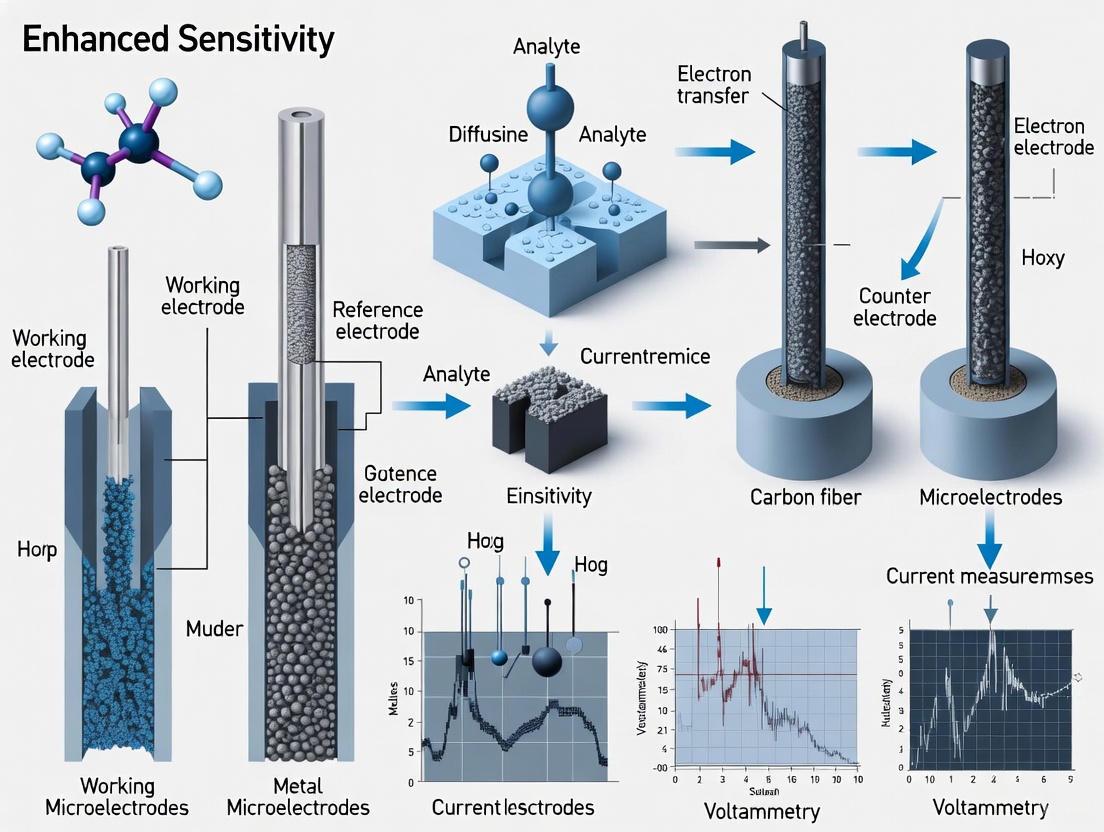
This article explores the pivotal role of microelectrodes in advancing voltammetric sensitivity for biomedical applications.
Microelectrodes in Voltammetry: Principles and Advances for Enhanced Sensitivity in Biomedical Research
Abstract
This article explores the pivotal role of microelectrodes in advancing voltammetric sensitivity for biomedical applications. It covers the foundational principles that give microelectrodes their superior performance, including enhanced mass transport and reduced iR drop. The article details methodological innovations such as fast-scan cyclic voltammetry (FSCV) and specific applications in neurotransmitter monitoring and disease diagnosis. It also addresses key challenges like biofouling and outlines optimization strategies through electrode design and material modifications like carbon coatings and surface roughening. Finally, it provides a comparative analysis of different electrode materials and geometries, validating their performance for researchers and drug development professionals seeking to implement these high-sensitivity tools.
Why Size Matters: The Fundamental Principles of Microelectrodes for High-Sensitivity Detection
Microelectrodes are a foundational tool in modern electroanalysis, characterized by their small physical dimensions, which confer significant advantages over conventional macroelectrodes. Within the context of voltammetry, their defining feature is the ability to enhance measurement sensitivity dramatically, enabling the detection of analytes at trace and ultratrace concentrations. This document delineates the key characteristics and standardized dimensional scales of microelectrodes, providing a framework for their application in sensitive voltammetric research, particularly in pharmaceutical and environmental analysis.
Defining Characteristics and Dimensional Scales
The performance of a microelectrode is governed by its physical and electrochemical properties. The table below summarizes the core defining characteristics and typical dimensional scales encountered in research and commercial applications.
Table 1: Key Characteristics and Dimensional Scales of Microelectrodes
| Characteristic | Definition & Significance | Typical Scale / Range | Impact on Voltammetric Performance |
|---|---|---|---|
| Critical Dimension | The smallest dimension (e.g., diameter of a disk, width of a band) that defines the electrode's active area. [1] | Ultramicroelectrodes (UMEs): < 25 µm [1]Microelectrodes: ~1 µm to ~100 µm [2] | Enables radial (hemispherical) diffusion, leading to enhanced mass transport, steady-state currents, and high signal-to-noise ratios. [1] |
| Geometric Surface Area (GSA) | The two-dimensional area of the electrode's electroactive surface. | 20 µm² to ~2000 µm² (for planar circular electrodes) [1] | Smaller GSA reduces capacitive currents, improving sensitivity in low-concentration detection. [3] [4] |
| Electrode Impedance | The total opposition to current flow, comprising charge-transfer and solution resistance. | 0.1 MΩ to 5 MΩ (highly dependent on material and GSA) [2] | Lower impedance minimizes signal distortion and thermal noise, crucial for high-fidelity neural recording and low-concentration voltammetry. [5] [6] |
| Diffusion Profile | The pattern of analyte mass transport to the electrode surface. | Macroelectrodes: Linear diffusion.Microelectrodes: Radial/hemispherical diffusion. [1] | Hemispherical diffusion provides a steady flux of analyte, yielding sigmoidal, steady-state voltammograms ideal for quantitative analysis. [1] |
Table 2: Common Microelectrode Materials and Their Applications in Voltammetry
| Material | Key Properties | Common Voltammetric Applications | Example from Literature |
|---|---|---|---|
| Carbon Fiber | Biocompatible, low-cost, excellent spatiotemporal resolution, diameters ~7-10 µm. [7] | Neurotransmitter detection (e.g., dopamine, serotonin) using Fast-Scan Cyclic Voltammetry (FSCV). [7] [8] | Measuring tryptophan dynamics with improved sensitivity and selectivity. [8] |
| Bismuth (Solid) | Environmentally friendly alternative to mercury, low toxicity. [3] | Anodic Stripping Voltammetry (ASV) for heavy metal ions (e.g., Pb(II)) in environmental waters. [3] | Determination of Pb(II) with a detection limit of 3.4 × 10⁻¹¹ mol L⁻¹ using a 25 µm solid bismuth microelectrode. [3] |
| Lead (Solid) | Facile fabrication, renewable surface. [4] | Adsorption Stripping Voltammetry (AdSV) for organic pharmaceuticals. [4] | Determination of sildenafil citrate in pharmaceuticals using a 25 µm solid lead microelectrode. [4] |
| Sputtered Iridium Oxide (SIROF) | High charge storage capacity, excellent for stimulation and recording. [1] | Neural stimulation and recording; less common in classic voltammetry but used in electrochemical biosensing. | Used on microelectrodes as small as 20 µm² for effective charge injection. [1] |
| Gold & Platinum | High conductivity, biocompatible, easily functionalized. [9] | Biosensing, DNA detection, and fundamental electrochemical studies. [10] [9] | Microfabricated gold microelectrodes for sensitive detection of Mycobacterium tuberculosis DNA. [10] |
Experimental Protocol: Determination of Pb(II) using a Solid Bismuth Microelectrode
The following protocol details a specific application of a solid bismuth microelectrode (SBiµE) for the ultrasensitive detection of lead ions, demonstrating the practical implementation of the principles outlined above. [3]
Research Reagent Solutions
Table 3: Essential Materials and Reagents
| Item | Function / Description |
|---|---|
| Solid Bismuth Microelectrode (SBiµE) | Working electrode (Ø = 25 µm). Environmentally friendly alternative to mercury electrodes. [3] |
| Acetate Buffer (1 mol L⁻¹, pH 3.4) | Supporting electrolyte. Provides a consistent ionic strength and pH for the electrochemical reaction. [3] |
| Pb(II) Standard Solution | Primary analyte. A 1 g L⁻¹ stock solution is diluted daily to prepare working standards. [3] |
| Ag/AgCl Reference Electrode | Provides a stable and known reference potential for the electrochemical cell. [3] |
| Platinum Counter Electrode | Completes the electrical circuit in the three-electrode setup, carrying the current. [3] |
| Autolab PGSTAT 10 Analyzer | Potentiostat/Galvanostat used to control the potential and measure the resulting current. [3] |
Step-by-Step Procedure
- Electrode Preparation: On each day of measurement, polish the SBiµE on 2500-grit silicon carbide paper. Rise thoroughly with triply distilled water and place it in an ultrasonic bath for 30 seconds to remove any residual polishing material. [3]
- Solution Preparation: Prepare the sample or standard solutions in a 0.1 mol L⁻¹ acetate buffer (pH 3.4). For a calibration curve, use Pb(II) standards in the concentration range of 1 × 10⁻¹⁰ to 3 × 10⁻⁸ mol L⁻¹. [3]
- Instrumental Setup: Configure the potentiostat for Differential Pulse Anodic Stripping Voltammetry (DPASV). Set up the conventional three-electrode cell with the SBiµE as the working electrode, Ag/AgCl as the reference, and a platinum wire as the counter electrode. [3]
- Activation & Accumulation (Pre-concentration):
- Stripping & Measurement:
- After the accumulation time, stop the stirring and allow the solution to become quiescent for 10 seconds.
- Initiate the differential pulse stripping scan from -1.4 V towards more positive potentials. The deposited lead is oxidized back to Pb(II), generating a characteristic current peak. The peak current is proportional to the concentration of Pb(II) in the solution. [3]
- Data Analysis: Measure the height of the stripping peak for each standard and sample. Construct a calibration curve by plotting peak current versus Pb(II) concentration. Use this curve to determine the unknown concentration of Pb(II) in environmental water samples. [3]
Logical Workflow and Signaling Pathway
The diagram below illustrates the experimental and conceptual pathway for enhancing sensitivity using a microelectrode in this voltammetric protocol.
In electrochemical sensing and voltammetry, mass transport—the process by which analyte molecules move from the bulk solution to the electrode surface—fundamentally dictates the sensitivity, response time, and overall performance of the measurement. Unlike conventional macroelectrodes, where mass transport is dominated by linear, planar diffusion, microelectrodes (with at least one critical dimension in the micrometer range) enable a unique hemispherical diffusion profile [11]. This diffusion geometry arises because the size of the electrode becomes comparable to the diffusion layer thickness, allowing molecules to converge on the active surface from all directions in a hemispherical space [11] [12].
This shift from planar to hemispherical diffusion is not merely geometrical; it confers significant analytical advantages. It leads to enhanced mass transport rates, rapidly established steady-state signals, reduced interference from uncompensated resistance (iR drop), and dramatically lower capacitive currents [11] [12]. These properties are crucial for applications demanding high spatial and temporal resolution, such as in vivo neurochemical monitoring [13] and the study of rapid reaction kinetics [12]. This application note details the underlying principles, experimental protocols, and key applications of hemispherical diffusion, providing researchers with the tools to leverage this mechanism for enhanced sensitivity in voltammetric research.
Theoretical Foundations and Advantages
Comparative Diffusion Profiles
The core difference between macroelectrodes and microelectrodes lies in their respective diffusion fields, which directly shape their voltammetric output.
- Planar Diffusion at Macroelectrodes: At traditional macroelectrodes (e.g., with a diameter of 3 mm), the diffusion field is semi-infinite and linear perpendicular to the planar electrode surface [11]. During a voltammetric scan, the current rises as electroactive species near the surface are oxidized or reduced but subsequently peaks and falls as the reaction becomes limited by the rate at which fresh species can diffuse through the depleted layer. This results in the characteristic peak current seen in cyclic voltammograms [11].
- Hemispherical Diffusion at Microelectrodes: When the electrode radius is sufficiently small (typically ≤ 25 μm) [12], the diffusion layer can expand radially outward in three dimensions, forming a hemisphere. This geometry provides a much larger flux of analyte to the electrode surface because diffusion can occur from a larger volume of solution. In a voltammetric experiment, this manifests as a rise to a steady-state limiting current instead of a transient peak, creating a sigmoidal-shaped voltammogram [11] [12].
Quantitative Advantages
The hemispherical diffusion field at microelectrodes leads to several quantifiable benefits critical for advanced sensing, especially in resistive media and for fast kinetics.
Table 1: Quantitative Advantages of Microelectrodes vs. Macroelectrodes
| Parameter | Macroelectrode (Planar Diffusion) | Microelectrode (Hemispherical Diffusion) | Impact on Sensing |
|---|---|---|---|
| Current Magnitude | Peak currents on the order of mA (e.g., ±1.5 mA) [11] | Steady-state currents on the order of nA (e.g., ±50 nA) [11] | Enables operation in highly resistive environments; minimizes overall power requirements. |
| Ohmic Drop (iR Drop) | Significant, can distort voltammograms [11] | Greatly reduced or eliminated [11] | Allows for experiments in low-ionic-strength solvents (e.g., nonpolar solvents, supercritical fluids) without supporting electrolyte. |
| Signal-to-Noise (S/N) | Lower due to higher capacitive currents | Higher due to lower capacitive currents and steady-state signal [11] [13] | Improves detection limits, crucial for tracing low-concentration analytes in complex matrices. |
| Mass Transport Rate | Lower, planar diffusion leads to depletion | Enhanced, convergent diffusion sustains flux [12] | Enables the study of fast electron transfer kinetics and short-lived intermediate species. |
| Steady-State Achievement | Not achieved under typical scan rates | Achieved almost instantly, leading to sigmoidal CVs [12] | Simplifies quantitative analysis as current is directly proportional to concentration. |
The steady-state limiting current ((i{lim})) at a disk microelectrode is described by the equation: [ i{lim} = 4nFDCr ] where (n) is the number of electrons, (F) is the Faraday constant, (D) is the diffusion coefficient, (C) is the bulk concentration, and (r) is the radius of the microelectrode [12]. This relationship highlights the direct proportionality between the current and the electrode radius, contrasting with the area-dependent (radius squared) peak current at macroelectrodes.
Experimental Protocols
Protocol 1: Fabrication of a Gold Disk Microelectrode (Au DME)
This protocol outlines the fabrication of a gold disk microelectrode suitable for voltammetric studies leveraging hemispherical diffusion [13].
Research Reagent Solutions & Essential Materials
Table 2: Key Materials for Microelectrode Fabrication and Characterization
| Item | Function/Description | Example/Specification |
|---|---|---|
| Gold Microwire | Serves as the electroactive sensing material. | Diameter ~10-25 μm, defines the electrode radius. |
| Borosilicate Glass Capillary | Provides the insulating sheath. | - |
| Laser Puller | Creates a sealed glass capillary containing the microwire. | - |
| Polishing Setup | Creates a smooth, flush disk electrode surface. | Alumina suspension (e.g., 0.05 μm) [12]. |
| Electrochemical Workstation | For electrode characterization and experiments. | Potentiostat with pA/nA current resolution. |
| Ferrocene Methanol Solution | Redox mediator for electrochemical characterization. | 0.5 mM in supporting electrolyte [14]. |
| α-Methyl Ferrocene Methanol | Alternative redox mediator for steady-state validation. | - |
Step-by-Step Procedure
- Sealing the Wire: Insert a segment of gold microwire into a borosilicate glass capillary. Use a laser-assisted pipette puller to heat and pull the capillary, creating a vacuum-tight seal around the wire.
- Polishing to Disk Geometry: Secure the pulled capillary in a holder and carefully polish the tip on a microcloth with successively finer alumina slurries (e.g., starting with 1.0 μm and finishing with 0.05 μm) until a smooth, flat, and flush disk surface is obtained under microscopic inspection. The final polish with 0.05 μm alumina is critical for a clean, reproducible electroactive surface [12].
- Electrochemical Characterization: Characterize the fabricated Au DME electrochemically to confirm its size and proper function.
- Submerge the electrode in a solution containing a well-defined redox couple (e.g., 0.5 mM ferrocene methanol or 1 mM potassium ferrocyanide in 0.1 M KCl).
- Perform cyclic voltammetry at a slow scan rate (e.g., 10-50 mV/s).
- A well-fabricated microelectrode will exhibit a sigmoidal voltammogram. The steady-state limiting current ((i{lim})) can be used to calculate the electrode's electroactive radius ((r)) using the equation: (r = i{lim} / (4nFDC)).
Protocol 2: Investigating Oxygen Reduction Reaction (ORR) Intermediates using a Gold Ultramicroelectrode (UME)
This protocol utilizes the enhanced mass transport of a UME combined with Rapid Scan Cyclic Voltammetry (RSCV) to capture and quantify transient reaction intermediates [12].
Research Reagent Solutions & Essential Materials
- Gold UME: Commercially available or fabricated, with a diameter of 25 μm [12].
- Potassium Hydroxide (KOH): Provides the alkaline electrolyte (0.5 M).
- Gases: High-purity O₂ and N₂ for saturating and deaerating the solution.
- Potentiostat: Capable of high-speed voltammetry (RSCV).
Step-by-Step Procedure
- Electrode Preparation: Polish the Au UME sequentially with emery papers (e.g., mesh 1200, 1600) and finally with a 0.05 μm alumina suspension. Rinse thoroughly with ultrapure water [12].
- Cell Setup: Use a standard three-electrode cell with the Au UME as the working electrode, a graphite rod as the counter electrode, and an Ag/AgCl (sat. KCl) reference electrode. Ensure the cell is airtight, fitted with ports for gas bubbling (N₂ and O₂).
- Steady-State Validation: Fill the cell with N₂-saturated 0.5 M KOH. Record a cyclic voltammogram of a known redox species (e.g., α-methyl ferrocene methanol) at a slow scan rate to confirm a sigmoidal response and determine the experimental radius of the UME.
- RSCV Measurement of ORR: Replace the solution with O₂-saturated 0.5 M KOH. Perform RSCV over a potential window from open circuit potential to a sufficiently negative potential (e.g., -0.8 V vs. Ag/AgCl) and back, across a range of scan rates (e.g., 0.1 to 10 V/s).
- Data Analysis: At high scan rates, the voltammograms will show distinct peaks (C1, C2 for reduction, A1 for oxidation) corresponding to the sequential reduction of O₂ to peroxide (HO₂⁻) and further to hydroxide (OH⁻), and the re-oxidation of the peroxide intermediate [12]. Integrate the peak areas to quantify the charge associated with each process, enabling the determination of formation rates for these transient species.
Diagram 1: RSCV-UME Experimental Workflow
The Scientist's Toolkit: Key Reagents and Materials
Table 3: Essential Research Reagent Solutions for Microelectrode Studies
| Category/Item | Specific Example | Function in Experiment |
|---|---|---|
| Redox Mediators | Potassium ferri/ferrocyanide (K₃[Fe(CN)₆]/K₄[Fe(CN)₆]) [11] | A classic, reversible redox couple for characterizing electrode performance and surface area. |
| Redox Mediators | Ferrocene methanol / α-Methyl ferrocene methanol [14] [12] | A stable, one-electron transfer mediator with pH-independent formal potential, ideal for UME characterization. |
| Supporting Electrolytes | Potassium Chloride (KCl), Sodium Hydroxide (NaOH) [11] | Provides ionic conductivity, minimizes ohmic drop, and defines the electrochemical window and pH. |
| Target Analytes | Dopamine (DA) [13] | A key neurochemical; its oxidation current is used as an analytical signal in aptasensors. |
| Target Analytes | Oxygen (O₂) [12] | A fundamental reactant in ORR studies; used to probe reaction mechanisms and intermediates. |
| Recognition Elements | Anti-DA specific aptamer [13] | A molecular recognition element that confers selectivity when immobilized on a microelectrode surface. |
| Electrode Materials | Gold (Au) disk microelectrode [13] | A common, versatile electrode material that can be easily modified with thiol-based chemistries. |
| Cleaning & Polishing | Alumina suspension (0.05 μm) [12] | Used for fine polishing to achieve a mirror-finish, electrochemically clean electrode surface. |
Applications in Advanced Research
The unique properties of microelectrodes under hemispherical diffusion have enabled breakthroughs across multiple fields.
- In Vivo Neurochemical Monitoring: The small size and enhanced mass transport of microelectrodes make them ideal for implantable sensors. For example, a gold disk microelectrode with a radius of 2 μm, functionalized with a dopamine-specific aptamer, has been used for the label-free detection of dopamine in brain slices with high spatial resolution and a low detection limit of 0.11 μM [13]. The small currents and minimal iR drop are essential for functioning in the resistive brain environment.
- Interrogation of Reaction Mechanisms: The RSCV-UME combination is a powerful methodology for studying complex electrocatalytic reactions like the Oxygen Reduction Reaction (ORR). On a gold UME, this approach has identified and allowed for the quantification of the peroxide anion (HO₂⁻) intermediate, providing key insights into the reaction pathway and kinetics that are difficult to obtain with larger electrodes [12].
- Electrochemiluminescence (ECL) Imaging: Microelectrode arrays (MEAs) are used in ECL microscopy to visualize electrochemical reactions. The diffusion of reactive intermediates (e.g., TPrA• radicals in the Ru(bpy)₃²⁺/TPrA system) away from each microelectrode creates a well-defined ECL-emitting layer. The thickness of this layer is directly influenced by the hemispherical diffusion field and can be tuned by the electrode material and reactant concentration [14].
Visualization of Core Concepts
The following diagram illustrates the fundamental differences in diffusion profiles and their resultant voltammetric signatures, which are central to understanding microelectrode superiority.
Diagram 2: Diffusion Profiles and Resulting Voltammetric Output
In the field of electrochemical sensing, particularly for neurochemical monitoring and biomedical applications, the transition from macroelectrodes to microelectrodes represents a significant technological advancement. Microelectrodes, defined as electrodes with at least one critical dimension on the scale of microns (typically ≤ 25 μm), offer fundamental electrochemical benefits that enable enhanced sensing capabilities [15]. These advantages are particularly evident in two key performance parameters: the reduction of iR drop (ohmic drop) and the improvement of signal-to-noise ratio (SNR). The iR drop refers to the voltage loss that occurs due to the inherent resistance of the electrolyte, electrode material, and electrical connections within an electrochemical system [7]. This phenomenon can lead to distorted electrochemical signals, particularly at high scan rates where fast electron transfer kinetics are required. Simultaneously, the improved SNR of microelectrodes allows for the detection of lower analyte concentrations—a critical requirement for measuring physiologically relevant neurotransmitter levels. This application note explores the theoretical foundation, experimental evidence, and practical protocols underlying these advantages, providing researchers with a comprehensive resource for implementing microelectrode-based sensing in voltammetry applications.
Fundamental Principles
The iR Drop Phenomenon and its Minimization in Microelectrodes
In electrochemical systems, the iR drop is an undesirable voltage loss that occurs between the working and reference electrodes due to the electrical resistance (R) of the electrolyte solution and the current flow (i) [7]. This effect can significantly distort voltammetric measurements by causing peak broadening, shifting peak potentials, and reducing measurement accuracy, especially in poorly conducting media or at high current densities [15]. The magnitude of iR drop is directly proportional to both the current flowing through the system and the solution resistance.
Microelectrodes fundamentally minimize iR drop through their reduced dimensions and the resulting hemispherical diffusion profile. As electrode size decreases, the current passing through the electrode decreases proportionally to r² (where r is the electrode radius), while the resistance increases only proportionally to 1/r. This relationship leads to a net reduction in iR drop, which scales with the electrode radius [15]. This advantage becomes particularly crucial in biomedical sensing applications where measurements are often performed in low-ionic-strength solutions or when using fast scan rates, such as in Fast-Scan Cyclic Voltammetry (FSCV) where scan rates of 400 V/s are common [16].
Signal-to-Noise Ratio Enhancement Mechanisms
The signal-to-noise ratio (SNR) represents the ratio of the desired analytical signal to the background noise, determining the detection limit and measurement precision of an electrochemical sensor. Microelectrodes enhance SNR through several interconnected mechanisms. Their small dimensions result in a reduced RC constant (the product of resistance and capacitance), which enables faster response times and measurement of rapid chemical processes [15]. This is particularly valuable for monitoring neurotransmitter dynamics, which occur on sub-second timescales.
Additionally, the enhanced mass transport to microelectrode surfaces—governed by hemispherical (3D) diffusion rather than linear (1D) planar diffusion—results in higher steady-state currents relative to background charging currents [12]. The smaller surface area of microelectrodes also generates significantly lower capacitive charging currents, which constitute a major source of background noise in voltammetric measurements [15]. These combined effects enable microelectrodes to achieve lower detection limits, with carbon fiber microelectrodes (CFMEs) successfully detecting neurotransmitters at nanomolar concentrations relevant to physiological monitoring [17].
Table 1: Comparative Electrode Properties and Their Impact on iR Drop and SNR
| Property | Macroelectrode | Microelectrode | Impact on Performance |
|---|---|---|---|
| Critical Dimension | Millimeters (mm) | Micrometers (μm) | Fundamental size difference enabling microelectrode advantages |
| Diffusion Profile | Linear (planar) diffusion | Hemispherical (3D) diffusion | Enhanced mass transport, steady-state currents [12] |
| Current Level | High (proportional to r²) | Low (proportional to r²) | Reduced iR drop [15] |
| Capacitive Current | High | Low | Improved signal-to-noise ratio [15] |
| RC Time Constant | Large | Small | Faster response times, measurement of faster processes [15] |
| iR Drop | Significant | Minimal | Accurate potential control, especially in low ionic strength media [15] |
| Spatial Resolution | Low (bulk measurements) | High (localized measurements) | Targeted sensing in complex environments (e.g., brain tissue) |
Experimental Evidence and Performance Data
Quantitative Performance Comparison
Recent studies directly comparing microelectrode and macroelectrode performance demonstrate clear advantages of miniaturized sensing platforms. Carbon fiber microelectrodes (CFMEs), typically 7-30 μm in diameter, have shown exceptional performance in neurotransmitter detection, with their small diameter minimizing tissue damage while providing high conductivity and excellent biocompatibility [18] [16]. When comparing 30 μm bare CFMEs to conventional 7 μm CFMEs, the larger microelectrodes exhibited a 2.7-fold higher sensitivity in vitro (33.3 ± 5.9 pA/μm² versus 12.2 ± 4.9 pA/μm²) [16]. This enhanced sensitivity directly results from the improved mass transport and reduced iR drop at microelectrode surfaces.
The geometric configuration of microelectrodes further influences their performance. Cone-shaped 30 μm CFMEs, created through electrochemical etching, demonstrated a 3.7-fold improvement in in vivo dopamine signals compared to conventional cylindrical CFMEs [16]. This design mitigates insertion-induced tissue damage while maintaining the electrochemical advantages of microelectrodes, resulting in both enhanced signal quality and improved biocompatibility. The reduced iR drop in these miniaturized platforms enables clear discrimination of Faradaic currents from background charging, which is particularly valuable for detecting low neurotransmitter concentrations amidst complex biological matrices.
Table 2: Performance Characteristics of Different Carbon Fiber Microelectrode (CFME) Designs
| Electrode Type | Diameter | Sensitivity (in vitro) | In Vivo Dopamine Signal | Key Advantages |
|---|---|---|---|---|
| Standard CFME | 7 μm | 12.2 ± 4.9 pA/μm² [16] | 24.6 ± 8.5 nA [16] | Minimal tissue damage, comparable to neuron size [16] |
| Bare CFME | 30 μm | 33.3 ± 5.9 pA/μm² [16] | 12.9 ± 8.1 nA [16] | Enhanced mechanical robustness, higher sensitivity |
| Cone-Shaped CFME | 30 μm (base) | Not specified | 47.5 ± 19.8 nA [16] | Superior in vivo performance, reduced tissue damage, enhanced longevity |
Advanced Microelectrode Platforms
Recent innovations in microelectrode design have further leveraged the advantages of reduced iR drop and improved SNR. Carbon-coated microelectrodes (CCMs) created through electroplating and mild annealing of graphene-based coatings demonstrate exceptional performance characteristics, with dopamine sensitivity (125.5 nA/μM) significantly outperforming commercial carbon fiber electrodes (15.5 nA/μM) while maintaining a low detection limit of 5 nM [17]. This enhanced sensitivity stems from the large specific surface area of the carbon coating combined with the inherent electrochemical advantages of microelectrodes.
The scalability of microelectrode arrays represents another significant advancement, with researchers successfully fabricating monolithic 100-channel CCM arrays that maintain uniform electrochemical performance across all channels [17]. This scalability enables high spatial resolution mapping of neurochemical activity while preserving the beneficial iR drop and SNR characteristics of individual microelectrodes. The compatibility of these arrays with standard microfabrication processes further enhances their utility for both research and potential clinical applications.
Experimental Protocols
Protocol 1: Fabrication of Carbon Fiber Microelectrodes (CFMEs)
This protocol details the standard procedure for fabricating carbon fiber microelectrodes for neurotransmitter detection [16].
Materials and Equipment
- Carbon fiber (e.g., AS4 for 7 μm CFMEs; available from World Precision Instruments for 30 μm CFMEs)
- Glass capillaries for insulation
- Capillary puller
- Epoxy resin
- Scalpel or precision cutting tool
- FSCV system (e.g., National Instruments USB-6363 with custom LabVIEW software)
- Tris buffer (15 mM Trizma phosphate, 3.25 mM KCl, 140 mM NaCl, 1.2 mM CaCl₂, 1.25 mM NaH₂PO₄, 1.2 mM MgCl₂, and 2.0 mM Na₂SO₄, pH adjusted to 7.4)
Step-by-Step Procedure
- Fiber Preparation: Aspirate a single carbon fiber into a glass capillary.
- Pulling: Use a capillary puller to heat and pull the glass capillary, creating a sealed insulation around the carbon fiber with a tapered tip.
- Trimming: Using a scalpel, carefully trim the exposed carbon fiber to a final length of approximately 100 μm.
- Connection: Secure the pulled capillary to a suitable electrical connector using conductive epoxy or metal alloy, ensuring stable electrical contact with the carbon fiber.
- Insulation Check: Verify the integrity of the glass insulation under microscope to prevent current leakage.
- Electrochemical Preconditioning: Before first use, precondition the CFME using FSCV with a 1.5 V sweep (−0.4 V to 1.5 V at 400 V/s, 30 Hz) followed by application of the standard FSCV waveform (−0.4 V to 1.3 V sweep; 10 Hz) until a stable background current is achieved.
Quality Control
- Examine electrode tip under microscope for proper sealing and fiber exposure.
- Perform cyclic voltammetry in a standard dopamine solution (e.g., 1 μM) to verify sensitivity and response characteristics.
- Electrodes should demonstrate stable background currents with minimal noise before experimental use.
Protocol 2: Electrochemical Etching for Cone-Shaped CFMEs
This protocol describes the electrochemical etching method to create cone-shaped CFME tips, which improve penetration and reduce tissue damage during in vivo implantation [16].
Materials and Equipment
- Fabricated 30 μm CFME (from Protocol 1)
- Direct current power supply
- Linear actuator system
- Tris buffer (as prepared in Protocol 1)
- Electrochemical cell
Step-by-Step Procedure
- Setup Configuration: Mount the CFME vertically on a linear actuator positioned above an electrochemical cell containing Tris buffer.
- Initial Immersion: Lower the CFME until approximately 1 mm of the carbon fiber is submerged in the Tris buffer.
- Voltage Application: Apply a direct current voltage of 10 V to the submerged carbon fiber segment.
- Actuator Movement: After 20 seconds of electrolysis, activate the linear actuator to move the electrode upward at a constant speed (approximately 5-10 μm/s).
- Etching Process: Continue the voltage application during upward movement, which gradually exposes the carbon fiber to air while the submerged portion continues etching, forming the cone shape.
- Process Termination: Stop the voltage and retract the electrode once the desired cone height (100-120 μm) is achieved.
- Rinsing: Rinse the etched CFME thoroughly with deionized water to remove buffer residues.
Quality Control
- Verify cone geometry and dimensions under microscope.
- Test mechanical integrity through gentle manipulation.
- Validate electrochemical performance following Preconditioning steps in Protocol 1.
Protocol 3: Electrochemical Activation and Regeneration in Deionized Water
This protocol describes a simple method to activate and regenerate carbon fiber microelectrodes using only deionized water, restoring electrochemical performance for contaminated or fouled electrodes [19].
Materials and Equipment
- Deionized water
- Potentiostat
- Standard three-electrode cell
- Phosphate buffered saline (PBS) for testing
Step-by-Step Procedure
- Setup: Place the CFME as working electrode in an electrochemical cell containing only deionized water.
- Potential Application: Apply a constant potential of 1.75 V for 26.13 minutes.
- Rinsing: After treatment, rinse the electrode thoroughly with deionized water.
- Testing: Validate regeneration by measuring the differential pulse voltammetry (DPV) response in a standard dopamine solution (1.0 × 10⁻⁷ to 1.0 × 10⁻⁴ mol/L).
Quality Control
- Regenerated electrodes should show a linear DPV response to dopamine (R² = 0.9961) with a detection limit of 3.1 × 10⁻⁸ mol/L [19].
- Electrodes should demonstrate stable responses across multiple measurements.
Visualization of Concepts and Workflows
Electrode Dimension Effects on Diffusion and Current
CFME Fabrication and Etching Workflow
The Scientist's Toolkit: Essential Research Reagents and Materials
Table 3: Key Research Reagent Solutions for Microelectrode Fabrication and Testing
| Material/Reagent | Function/Application | Specifications/Notes |
|---|---|---|
| Carbon Fiber | Electrode sensing material | AS4 for 7 μm CFMEs (Hexcel); 30 μm available from World Precision Instruments [16] |
| Tris Buffer | Electrochemical testing medium | 15 mM Trizma phosphate, 3.25 mM KCl, 140 mM NaCl, 1.2 mM CaCl₂, 1.25 mM NaH₂PO₄, 1.2 mM MgCl₂, 2.0 mM Na₂SO₄, pH 7.4 [16] |
| Dopamine HCl | Primary analyte for validation | Prepare 1 mM stock in Tris buffer with 50 μM perchloric acid; dilute to experimental concentrations [16] |
| Graphene Oxide Dispersion | Carbon coating precursor | For CCM fabrication; enables room temperature electroplating [17] |
| Phosphate Buffered Saline (PBS) | Stability testing medium | For evaluating electrochemical stability of coated electrodes [17] |
| Deionized Water | Electrode regeneration | Electrochemical activation at 1.75 V for 26.13 minutes restores performance [19] |
| Glutaraldehyde | Enzyme immobilization | Cross-linking agent for biosensor fabrication with BSA matrix [20] |
| Bovine Serum Albumin (BSA) | Enzyme stabilization matrix | Protein matrix for immobilizing glutamate oxidase and GABASE enzymes [20] |
Microelectrodes are indispensable tools in modern electroanalytical chemistry, particularly in voltammetry for enhanced sensitivity research. The selection of electrode material—platinum, gold, or carbon-based systems—profoundly influences key performance parameters including sensitivity, selectivity, stability, and fouling resistance. Each material offers distinct electrochemical properties that make it suitable for specific applications, from neurochemical monitoring to environmental analysis. This application note provides a comprehensive comparison of these essential electrode materials, summarizing quantitative performance data and detailing standardized experimental protocols to guide researchers and drug development professionals in selecting and implementing the most appropriate microelectrode systems for their specific analytical challenges.
Comparative Material Properties and Applications
Table 1: Key Characteristics of Microelectrode Materials
| Material | Key Advantages | Optimal Applications | Limitations |
|---|---|---|---|
| Platinum (Pt) | Excellent electrocatalytic activity, high conductivity, corrosion resistance [20] | H₂O₂ detection for enzymatic biosensors (GABA, Glutamate) [20] | Surface fouling, expensive, requires activation/cleaning protocols [20] |
| Gold (Au) | Ease of functionalization, well-defined self-assembled monolayers, good conductivity [13] | Label-free aptasensors, dopamine detection with molecular recognition elements [13] | Softer metal, potential for oxide formation |
| Carbon-Based Systems | Wide potential window, biocompatibility, rich surface chemistry, resistance to fouling [7] [21] | Neurotransmitter sensing (dopamine, serotonin), FSCV, long-term implantation [7] [21] [22] | Batch-to-batch variability (CFMEs), complex fabrication for advanced forms [7] |
Table 2: Quantitative Performance Comparison for Neurotransmitter Detection
| Material & Type | Analyte | Sensitivity | Limit of Detection (LOD) | Linear Range | Reference |
|---|---|---|---|---|---|
| Pt (Roughened) | GABA | 45 ± 4.4 nA μM⁻¹ cm⁻² | 1.60 ± 0.13 nM | Not specified | [20] |
| Pt (Roughened) | Glutamate | 1,510 ± 47.0 nA μM⁻¹ cm⁻² | 12.70 ± 1.73 nM | Not specified | [20] |
| Carbon-Coated (CCM) | Dopamine | 125.5 nA/μM | 5 nM | 50 nM to 1 μM | [22] |
| Glassy Carbon (GC-MEA) | Dopamine & Serotonin | Reliable FSCV performance confirmed | Not specified | Not specified | [21] |
| Gold Disk (Aptasensor) | Dopamine | Not specified | 0.11 μM | 0.5 to 27 μM | [13] |
Material-Specific Application Notes
Platinum Microelectrodes
Platinum microelectrodes are valued for their exceptional electrocatalytic properties, particularly in the detection of hydrogen peroxide, which is a critical byproduct in enzymatic biosensors for non-electroactive neurotransmitters like GABA and glutamate [20]. Their high conductivity and corrosion resistance make them ideal for demanding biological environments. Performance is highly dependent on surface condition, necessitating activation procedures. Electrochemical roughening (ECR) using square wave pulses has been shown to significantly enhance sensitivity by creating unique surface morphologies and pore geometries that facilitate H₂O₂ adsorption and electron transfer [20].
Gold Microelectrodes
Gold microelectrodes excel in applications requiring precise surface functionalization, such as label-free electrochemical aptasensors [13]. Their well-established chemistry for forming self-assembled monolayers allows for the immobilization of specific molecular recognition elements like DNA aptamers. This enables highly selective detection of target analytes, as the recognition event brings the analyte close to the electrode surface, facilitating its oxidation or reduction. Fabrication of gold disk microelectrodes with radii as small as 1.25-4 μm provides high spatial resolution for studying neurochemical dynamics in complex biological tissues like brain slices [13].
Carbon-Based Microelectrodes
Carbon-based systems represent the most diverse family of electrode materials, encompassing carbon fiber microelectrodes (CFMEs), glassy carbon (GC), and innovative carbon-coated microelectrodes (CCMs). They are characterized by a wide electrochemical working window, excellent biocompatibility, and resistance to fouling [7] [21]. Recent advances include "all"-glassy carbon microelectrode arrays (MEAs), where both electrodes and interconnects are made from a homogeneous GC layer, eliminating adhesion issues between dissimilar materials and enhancing long-term electrochemical durability [21]. Carbon-coated microelectrodes, created via a low-temperature process involving electroplating and mild annealing, offer high sensitivity, scalability (up to 100 channels), and easy integration with standard microfabrication processes [22].
Detailed Experimental Protocols
Protocol: Electrochemical Roughening of Platinum Microelectrodes
Purpose: To significantly enhance the sensitivity of Pt microelectrodes for H₂O₂ and neurotransmitter detection by creating a structured, porous surface [20].
Materials:
- Phosphate Buffered Saline (PBS), 0.1 M, pH 7.4
- Commercially available Pt MEAs (e.g., R1-Pt MEA from CenMET)
- Potentiostat/Galvanostat with function generator capability
Procedure:
- Initial Cleaning: Clean the Pt microelectrode surface by cycling the potential in 0.5 M H₂SO₄ between -0.2 V and +1.0 V (vs. Ag/AgCl) at a scan rate of 100 mV/s for 20-30 cycles.
- Roughening Setup: Place the electrode in 0.1 M PBS. Connect the Pt working electrode, a Pt wire counter electrode, and an Ag/AgCl reference electrode to the potentiostat.
- Apply Roughening Pulses: Apply a symmetric square wave potential with the following parameters:
- Upper Vertex Potential: +1.4 V (vs. Ag/AgCl)
- Lower Vertex Potential: -0.25 V (vs. Ag/AgCl)
- Frequency: Systematically vary between 150 Hz and 6,000 Hz. Optimal H₂O₂ sensitivity is typically observed at frequencies of 250 Hz and 2,500 Hz [20].
- Duration: 30 seconds.
- Post-Treatment Validation: Characterize the roughened surface using Scanning Electron Microscopy (SEM) to confirm the formation of porous structures and use Cyclic Voltammetry (CV) in a standard redox probe like 1 mM Potassium Ferricyanide to verify increased electroactive surface area.
Protocol: Activation and Regeneration of Carbon Fiber Microelectrodes (CFMEs) in Deionized Water
Purpose: To restore the electrochemical performance of passivated or fouled CFMEs without the use of additional electrolytes [19].
Materials:
- High purity deionized water (resistivity ≥18 MΩ·cm)
- CFMEs
- Potentiostat
Procedure:
- Setup: Immerse the fouled/inactivated CFME and the necessary reference and counter electrodes in a cell containing pure deionized water.
- Apply Activation Potential: Hold the CFME at a constant potential of +1.75 V (vs. Ag/AgCl) for a duration of 26.13 minutes [19].
- Characterize Regenerated Surface: After activation, characterize the electrode using Differential Pulse Voltammetry (DPV) or CV. The regenerated CFME should show a linear response (R² > 0.996) to dopamine in the concentration range of 0.1 μM to 100 μM, with a limit of detection as low as 31 nM [19]. The mechanism is attributed to the introduction of oxygen-containing functional groups that regenerate the electrochemically active surface.
Protocol: Fabrication of Carbon-Coated Microelectrodes (CCMs)
Purpose: To transform conventional gold microelectrodes into highly sensitive and stable carbon-based sensors for neurotransmitter detection via a scalable, low-temperature process [22].
Materials:
- Fabricated gold microelectrodes (on Si or Kapton substrates)
- Aqueous Graphene Oxide (GO) dispersion
- Nitrogen (N₂) environment oven or tube furnace
- Potentiostat for electrodeposition
- Photoresist and developer for confinement patterning
Procedure:
- Surface Preparation: Clean the gold microelectrode surface with standard solvents (acetone, isopropanol) and dry with N₂.
- Electroplating (Optional with Confinement): Use potentiostatic deposition to reduce the GO dispersion onto the gold surface, forming a ~100 nm thick carbon coating. To maintain high spatial resolution, a photoresist (PR) confinement method can be used prior to deposition, with lift-off performed afterward [22].
- Stabilization Annealing: Anneal the coated electrode at 250 °C for 1 hour in an N₂ environment. Note: This mild annealing step is critical, as it drastically improves electrochemical stability by reducing the interlayer spacing of the carbon coating (from 4.0 Å to 3.7 Å) and decreasing oxygen content, which prevents water/ion infiltration [22].
- Quality Control: Validate the CCMs using CV to confirm a wide electrochemical window (-0.6 V to +1.5 V) and the absence of the gold oxidation peak at +1.2 V. Test sensitivity to dopamine, which for a 60×60 μm² CCM should be approximately 125.5 nA/μM [22].
Experimental Workflows and Material Relationships
The Scientist's Toolkit: Essential Research Reagents and Materials
Table 3: Key Research Reagents and Materials for Microelectrode Applications
| Item | Function/Application | Example Usage |
|---|---|---|
| SU-8 Photoresist | A negative epoxy-based photoresist used as a precursor for fabricating glassy carbon (GC) structures via pyrolysis [21]. | Spin-coated, patterned, and then pyrolyzed at high temperatures (e.g., 900°C) under inert gas to create GC microelectrodes and interconnects [21]. |
| Graphene Oxide (GO) Dispersion | Used for electroplating carbon coatings onto metal microelectrodes at room temperature [22]. | Electrodeposited on gold microelectrodes and annealed at 250°C to form stable, high-sensitivity carbon-coated microelectrodes (CCMs) for dopamine sensing [22]. |
| Anti-Dopamine Aptamer | A single-stranded DNA molecule that acts as a molecular recognition element, binding to dopamine with high specificity [13]. | Self-assembled on the surface of gold disk microelectrodes to create label-free electrochemical aptasensors for selective dopamine detection [13]. |
| Enzyme Cocktail (GOx, GABASE) | Biological recognition elements for detecting non-electroactive neurotransmitters like glutamate and GABA [20]. | Co-immobilized with a BSA/glutaraldehyde matrix on Pt microelectrodes. Enzymes convert the target neurotransmitter to H₂O₂, which is electrochemically detected [20]. |
| Bovine Serum Albumin (BSA) & Glutaraldehyde | Used to create a cross-linked protein matrix for immobilizing enzymes on electrode surfaces [20]. | Mixed with enzymes (e.g., Glutamate Oxidase) and applied to the electrode surface, where glutaraldehyde cross-links the proteins, forming a stable hydrogel film [20]. |
Voltammetric techniques are indispensable in modern analytical science, providing powerful means to probe electrochemical reactions. This article details the core principles, applications, and protocols for three pivotal techniques: Amperometry, Fast-Scan Cyclic Voltammetry (FSCV), and Cyclic Voltammetry (CV). Framed within microelectrode research for enhanced sensitivity, these methods enable real-time, high-resolution measurement of dynamic processes in complex environments from pharmaceutical formulations to the living brain [23] [24]. The development of carbon-based microelectrodes has been instrumental in pushing the detection limits of these techniques, allowing for the quantification of neurochemicals at nanomolar concentrations with sub-second temporal resolution [17] [25].
Amperometry (A-SECM) involves holding the working electrode at a constant potential and measuring the resulting current from the oxidation or reduction of an analyte. It provides excellent temporal resolution but offers limited chemical information, making it ideal for monitoring concentration changes of a single, known species [26] [24]. In Scanning Electrochemical Microscopy (SECM), the amperometric mode is used to map surface topography and reactivity by recording a single current value at each point in a raster scan [26].
Cyclic Voltammetry (CV) employs a linear potential sweep that reverses direction at a set switching potential. The resulting cyclic voltammogram provides rich qualitative information on the thermodynamics and kinetics of redox processes, making it a cornerstone for fundamental electrochemical characterization [27].
Fast-Scan Cyclic Voltammetry (FSCV) is a variant of CV that uses exceptionally high scan rates (typically 100–1000 V/s). This speed enables the acquisition of a full voltammogram within tens of milliseconds, allowing for the real-time tracking of rapid chemical events, such as neurotransmitter release [24] [28] [29]. A key aspect of FSCV is background subtraction, which isolates the small Faradaic current of the analyte from the much larger background charging current, yielding a characteristic "signature" for the detected molecule [28] [29].
The table below summarizes the key characteristics and applications of these techniques.
Table 1: Comparative Analysis of Core Voltammetric Techniques
| Feature | Amperometry | Cyclic Voltammetry (CV) | Fast-Scan Cyclic Voltammetry (FSCV) |
|---|---|---|---|
| Principle | Constant potential; measures current from redox reaction [24]. | Linear potential sweep reversed at a vertex; measures current [27]. | High-rate triangular potential waveform; measures current with background subtraction [28] [29]. |
| Primary Application | Single-analyte sensing, SECM feedback imaging, monitoring exocytosis [26] [24]. | Qualitative analysis of redox mechanisms, reaction kinetics, and thermodynamics [27]. | Real-time monitoring of rapid neurotransmitter dynamics in vivo [24] [28]. |
| Temporal Resolution | Highest (electronic sampling rate, <1 ms) [24] [28]. | Low (scan typically over seconds) [27]. | High (typically 100 ms per voltammogram) [28]. |
| Sensitivity (LOD for Dopamine) | Low (25-100 nM) [28]. | Varies with system. | High (~10 nM) [28]. |
| Selectivity | Low; responds to all species oxidized/reduced at the applied potential [24] [28]. | Moderate; based on formal potential of the redox couple [27]. | Highest; based on the unique shape of the background-subtracted cyclic voltammogram [28] [29]. |
| Data Output | Current vs. time trace [26]. | Current vs. potential plot (voltammogram) [27]. | 3D data (current vs. potential vs. time), represented as 2D false color plots [28]. |
Experimental Protocols
Protocol: FSCV for In Vivo Dopamine Sensing
This protocol describes the setup and execution of FSCV using a carbon-fiber microelectrode (CFME) for monitoring dopamine dynamics in the brain of an anesthetized rodent [24] [28] [29].
Workflow Overview:
Step-by-Step Procedure:
- Electrode Preparation: Fabricate a cylindrical CFME by sealing a single carbon fiber (Ø 7–10 µm) in a pulled glass capillary. The fiber should be trimmed to extend 50–100 µm beyond the glass insulation [25] [28].
- Electrochemical Pre-treatment (Optional): Condition the CFME by applying the FSCV waveform (e.g., -0.4 V to +1.3 V vs. Ag/AgCl, 400 V/s) in a blank pH 7.4 buffer solution for 20-30 minutes until the background current stabilizes. This process creates oxygen-containing functional groups that enhance dopamine adsorption and sensitivity [28].
- System Setup: Connect the CFME as the working electrode, an Ag/AgCl wire as a reference electrode, and a stainless-steel wire placed in contact with tissue as the auxiliary electrode. Configure the potentiostat with the "dopamine waveform" parameters:
- In Vivo Implantation: Anesthetize the animal and secure it in a stereotaxic frame. Perform a craniotomy and implant the CFME into the target brain region (e.g., striatum) using stereotaxic coordinates.
- Data Acquisition: Begin FSCV recording. The software will continuously apply the triangular waveform, record the total current, and perform background subtraction. Data is typically visualized as a false color plot, where the color intensity represents the current at a given potential and time [28].
- Electrical Stimulation (Optional): To evoke dopamine release, insert a stimulating electrode into the dopamine pathway (e.g., medial forebrain bundle) and deliver a brief, biphasic electrical pulse train (e.g., 60 pulses, 60 Hz, 2 ms pulse width) [24].
- Post-experiment Calibration: Upon completion of the in vivo experiment, remove the CFME and calibrate its sensitivity by recording FSCV responses in a standard solution of known dopamine concentrations (e.g., 0.5 µM, 1.0 µM) in PBS at pH 7.4.
Protocol: Voltammetric SECM (V-SECM) for Multi-Analyte Imaging
This protocol uses FSCV at each point of an SECM scan to create spatially resolved maps of multiple chemical species simultaneously, as demonstrated for the ECE reaction of acetaminophen [26].
Workflow Overview:
Step-by-Step Procedure:
- Tip and Substrate Preparation: Fabricate a Pt or Au disk ultramicroelectrode (10–100 µm diameter) as the SECM tip by sealing a metal wire in soft glass and polishing to a mirror finish [26]. Prepare the substrate of interest (e.g., another microelectrode for generating reactant and product species).
- Cell Setup and Positioning: Fill the electrochemical cell with an electrolyte solution containing a mediator (e.g., 1 mM DMPPD or acetaminophen). Mount the tip and substrate on the SECM stage. Approach the tip to within a few tip diameters of the substrate surface using a precision positioning system.
- Define Scan Parameters: Using the SECM control software, define a two-dimensional raster grid over the area to be scanned. Set the step size (e.g., 5-20 µm) and dwell time at each point.
- V-SECM Scan Execution: Initiate the scan. At each grid point, the system pauses and executes a single, rapid FSCV scan (e.g., 300 V/s from -0.2 V to +0.8 V vs. Ag/AgCl). The entire cyclic voltammogram is saved, rather than a single current value [26].
- Data Analysis and Imaging: After the scan, process the four-dimensional data set (current, potential, x-position, y-position). To create a concentration map for a specific analyte, extract the current at its characteristic oxidation or reduction potential from the voltammogram at every pixel. For example, in the acetaminophen (APAP) ECE reaction, distinct maps can be generated for APAP, its hydroquinone (HQ) intermediate, and the benzoquinone (BQ) product [26].
The Scientist's Toolkit: Key Reagents and Materials
The performance of voltammetric techniques is highly dependent on the materials and reagents used. The table below lists essential components for experiments in enhanced sensitivity research.
Table 2: Key Research Reagent Solutions and Materials
| Item Name | Function/Application | Technical Notes |
|---|---|---|
| Carbon Fiber Microelectrode (CFME) [25] [28] | Primary sensor for FSCV; its small size and carbon surface enable high spatiotemporal resolution and analyte adsorption. | Typically 7-10 µm diameter; made from polyacrylonitrile (PAN)-based fibers for faster electron transfer kinetics [25]. |
| Carbon-Coated Microelectrode (CCM) [17] | A novel, scalable alternative to CFMEs; graphene-based coating on a gold electrode provides high stability and sensitivity. | Offers high yield and uniformity for array fabrication; demonstrated dopamine LOD of 5 nM [17]. |
| MWCNT-Modified Diamond Electrode [30] | A hybrid microsensor combining the wide potential window of diamond with the high surface area and electrocatalytic properties of carbon nanotubes. | Enhances sensitivity and selectivity; enables distinct detection of dopamine and serotonin in mixtures [30]. |
| N,N-dimethyl-1,4-phenylenediamine (DMPPD) [26] | A redox mediator used in SECM feedback mode experiments to characterize surface reactivity and topography. | Undergoes a 2e-, 1H+ oxidation at the electrode; serves as a stable mediator species [26]. |
| Fast-Scan Cyclic Voltammetry Waveform [28] [29] | The applied potential profile that defines the selectivity and sensitivity of FSCV for a given analyte. | The classic "dopamine waveform" is -0.4 V to +1.3 V at 400 V/s. Parameters are optimized for other analytes like serotonin [28]. |
| Phosphate Buffered Saline (PBS), pH 7.4 [30] | A standard physiological buffer used for electrode calibration, in vitro testing, and as a base for artificial cerebrospinal fluid (aCSF). | Provides a stable ionic strength and pH, mimicking the biological environment. |
Advanced Material and Method Development
The pursuit of enhanced sensitivity has driven innovation in electrode materials and fabrication techniques. Carbon-coated microelectrodes (CCMs) represent a significant advancement, where a graphene-based coating is electroplated onto a gold microelectrode and stabilized with mild annealing. This process creates a dense, stable carbon surface with interlayer spacing of 3.7 Å, which resists water/ion infiltration and enables high-performance FSCV sensing of monoamines with a limit of detection of 5 nM for dopamine [17]. A major advantage of CCMs is their scalability, allowing for the fabrication of high-density, uniform arrays with up to 100 channels, which is challenging with traditional carbon fibers [17].
Other advanced materials include hybrid multiwall carbon nanotube (MWCNT) films on boron-doped diamond. The nanotubes dramatically increase the electroactive surface area and provide abundant adsorption sites, leading to a greater than 125-fold improvement in sensitivity for dopamine compared to the unmodified diamond surface [30]. Polymer coatings, such as Nafion, are also routinely applied to confer selectivity by repelling anionic interferents like ascorbic acid, which is present in the brain at much higher concentrations than target neurotransmitters [30] [28].
Method development has also focused on waveform optimization. Simply extending the holding potential to more negative values or the switching potential to more positive values can significantly enhance sensitivity for cationic and neutral molecules, respectively, by modulating analyte adsorption [28]. Furthermore, developing novel waveform shapes is crucial for expanding FSCV to new neurochemicals like serotonin, adenosine, and histamine, while also mitigating electrode fouling, a common challenge with certain analytes [28].
From Bench to Bedside: Methodologies and Real-World Applications in Neurochemistry and Diagnostics
Real-time monitoring of neurotransmitters is crucial for advancing our understanding of brain function, neurological disorders, and the development of novel therapeutics. The ability to track dynamic changes in dopamine (DA), serotonin (5-HT), and glutamate (Glu) concentrations with high temporal and spatial resolution provides invaluable insights into neurochemical processes underlying behavior, cognition, and disease states. Traditional methods like microdialysis, while valuable, offer poor temporal resolution (typically 5-15 minutes) due to the time required for sample collection and analysis [31]. This limitation has driven the development of advanced electrochemical sensing platforms, particularly those employing microelectrodes, which enable monitoring on a sub-second timescale commensurate with neuronal signaling events [32] [33].
The integration of microelectrodes with voltammetric techniques represents a significant breakthrough in neurochemical sensing. These platforms leverage the unique properties of carbon-based materials, including high biocompatibility, excellent electrochemical performance, and minimal tissue disruption [7]. Recent innovations in material science, electrode design, and surface functionalization have substantially enhanced the sensitivity, selectivity, and multiplexing capabilities of these devices, allowing researchers to simultaneously monitor multiple neurotransmitters in complex biological environments [34] [35]. This application note details standardized protocols and methodologies for real-time monitoring of DA, 5-HT, and Glu using microelectrode-based platforms, with particular emphasis on their application within microelectrode voltammetry research.
Detection Technologies and Performance Metrics
Electrochemical Sensing Platforms
Carbon Fiber Microelectrodes (CFMEs) are constructed from carbon fibers (∼7–10 microns in diameter) insulated in pulled glass capillaries [7]. Their microscale dimensions cause minimal tissue damage, making them ideal for in vivo applications. CFMEs fabricated from polyacrylonitrile (PAN)-based precursors offer faster electron transfer kinetics and lower background currents, while pitch-based fibers exhibit higher conductivity suitable for detecting analytes with larger oxidation currents [7].
Glassy Carbon (GC) Microelectrodes are lithographically patterned on flexible polymer substrates, forming robust arrays for simultaneous multi-site detection [35]. GC surfaces are rich in electrochemically active functional groups, exhibit good adsorption characteristics, and possess antifouling properties, enabling stable and repeatable detection of electroactive neurotransmitters at concentrations as low as 10 nM [35].
Enzyme-Linked Biosensors are essential for detecting non-electroactive neurotransmitters like glutamate. These sensors employ oxidase enzymes (e.g., glutamate oxidase) immobilized on electrode surfaces. The enzyme catalyzes the conversion of the target neurotransmitter to an electroactive byproduct (typically hydrogen peroxide, H₂O₂), which is then detected amperometrically or voltammetrically [33] [35].
Electrochemical Techniques
Fast-Scan Cyclic Voltammetry (FSCV) applies a rapid triangular waveform (typically 400 V/s) to the working electrode, generating background-subtracted cyclic voltammograms that serve as electrochemical fingerprints for identifying electroactive analytes like DA and 5-HT [33]. FSCV offers sub-second temporal resolution, making it ideal for tracking transient neurotransmitter release events [35].
Fixed Potential Amperometry (FPA) maintains a constant potential sufficient to oxidize the target analyte. FPA provides superior temporal resolution compared to FSCV and is particularly advantageous when coupled with enzyme-linked biosensors for monitoring non-electroactive species [33]. The simplified data output (current versus time) facilitates real-time analysis.
Table 1: Performance Comparison of Neurotransmitter Detection Methods
| Method | Temporal Resolution | Spatial Resolution | Key Neurotransmitters | Detection Limit | Key Advantages |
|---|---|---|---|---|---|
| Microdialysis with HPLC | 5-15 minutes | Limited by probe size (~mm) | DA, 5-HT, Glu, others | ~1.0 µM for Glu [31] | Broad analyte panel, established methodology |
| CFME with FSCV | Sub-second (ms) | Micrometer scale | DA, 5-HT (electroactive) | ~10 nM for DA [7] | Excellent temporal resolution, identification via voltammogram |
| Enzyme-Linked FPA | ~1 second | Micrometer scale | Glu, Adenosine (non-electroactive) | Nanomolar range [33] [35] | Detects non-electroactive analytes, good temporal resolution |
| SWCNT Sensor | Sub-second to seconds | Micrometer scale | DA, 5-HT | Nanomolar in cell culture [34] | Selective in complex media, biocompatible |
Table 2: Quantitative Detection Limits for Key Neurotransmitters
| Neurotransmitter | Detection Method | Sensor Type | Reported Detection Limit | Linear Range | Test Environment |
|---|---|---|---|---|---|
| Dopamine (DA) | FSCV | Carbon Fiber Microelectrode | Not explicitly quantified in results | Not specified | In vivo (rat striatum) [33] |
| Dopamine (DA) | Electrochemical | Single-Walled Carbon Nanotube (SWCNT) | Nanomolar | Not specified | In vitro (cell culture medium) [34] |
| Serotonin (5-HT) | Electrochemical | Single-Walled Carbon Nanotube (SWCNT) | Nanomolar | Not specified | In vitro (cell culture medium) [34] |
| Glutamate (Glu) | FPA / Amperometry | Glutamate Oxidase Biosensor | Not explicitly quantified in results | Not specified | In vivo (pig cortex) [33] |
| Glutamate (Glu) | FSCV | GluOx-functionalized GC Microelectrode | 10 nM | Not specified | In vitro [35] |
Experimental Protocols
Protocol 1: Fabrication of Carbon Fiber Microelectrodes (CFMEs)
Principle: CFMEs are constructed by sealing a single carbon fiber within a glass capillary, providing an exposed carbon surface for electrochemical detection with minimal tissue damage [7].
Materials:
- Polyacrylonitrile (PAN)-based carbon fibers (e.g., T-650, ~7 μm diameter) [7]
- Glass capillaries (e.g., borosilicate)
- Capillary puller
- Epoxy resin (high-insulation resistance)
- Syringe and needle for fiber aspiration
- Microscope
Procedure:
- Capillary Pulling: Pull glass capillaries using a capillary puller to create two tapered shanks.
- Fiber Aspiration: Aspirate a single carbon fiber into the pulled capillary using a syringe and needle under microscopic guidance [7].
- Sealing: Apply a small amount of epoxy resin to the back end of the capillary to secure the carbon fiber in place and ensure electrical insulation. Allow to cure completely.
- Cutting: Carefully trim the protruding carbon fiber to expose a clean, disc-shaped electrode surface at the tip.
- Electrical Connection: Back-fill the capillary with a conductive material (e.g., graphite paste or silver paint) and insert a wire to establish an electrical connection to the carbon fiber.
- Quality Control: Inspect the final CFME under a microscope to ensure proper sealing and a clean, unobstructed electrode surface. Perform electrochemical characterization in a standard solution (e.g., dopamine in PBS) to verify performance.
Protocol 2: Functionalization of Microelectrodes for Glutamate Detection
Principle: Non-electroactive glutamate is detected indirectly by immobilizing glutamate oxidase (GluOx) on the electrode surface. GluOx catalyzes the conversion of glutamate to α-ketoglutarate, producing H₂O₂, which is electrochemically oxidized and detected [35].
Materials:
- Fabricated GC or Pt microelectrodes [35]
- L-Glutamate Oxidase (GluOx) enzyme
- Cross-linker solution (e.g., containing glutaraldehyde or other cross-linking agents)
- Bovine Serum Albumin (BSA)
- Phosphate Buffered Saline (PBS), pH 7.4
- Selectively permeable membrane (e.g., Nafion or m-phenylenediamine) to block interferents [33]
Procedure:
- Surface Preparation: Clean and activate the microelectrode surface according to standard protocols (e.g., plasma etching for GC electrodes) [35].
- Enzyme Matrix Preparation: Prepare an enzyme immobilization matrix by mixing GluOx with BSA (as a stabilizer) in a cross-linker solution such as glutaraldehyde [35].
- Drop Casting: Apply a small, controlled volume of the enzyme matrix onto the microelectrode surface using a micro-pipette under a microscope.
- Curing: Allow the enzyme layer to cure and cross-link, typically at room temperature or 4°C for a specified period.
- Membrane Coating (Optional): Apply a selective permeable membrane (e.g., Nafion) via dip-coating or drop-casting to enhance selectivity by excluding anionic interferents like ascorbic acid [33].
- Calibration: Calibrate the functionalized biosensor in standard glutamate solutions of known concentrations in PBS (e.g., 0-100 μM) to establish sensitivity and linear range.
Protocol 3: In Vivo Real-Time Monitoring in Rodent Brain
Principle: This protocol describes the simultaneous measurement of electrically evoked neurotransmitter release in an anesthetized rodent model using a wireless electrochemical system like the Wireless Instantaneous Neurotransmitter Concentration System (WINCS) [33].
Materials:
- WINCS or similar FSCV/FPA-capable potentiostat [33]
- Fabricated CFME (for DA) or enzyme-linked biosensor (for Glu)
- Ag/AgCl reference electrode
- Stereotaxic apparatus
- Anesthetized rat (e.g., with urethane)
- Stimulating electrode (for Deep Brain Stimulation - DBS)
- Data acquisition software (e.g., custom LABVIEW or MATLAB scripts)
Procedure:
- Animal Preparation: Anesthetize the rodent and secure it in a stereotaxic frame. Maintain body temperature throughout the procedure.
- Stereotaxic Surgery: Perform a craniotomy at the coordinates for the target brain region (e.g., striatum for DA, thalamus for adenosine, cortex for Glu).
- Electrode Implantation: Implant the CFME or biosensor into the target region. Place the stimulating electrode in the afferent pathway (e.g., Medial Forebrain Bundle for DA release in striatum). Implant the Ag/AgCl reference electrode in the contralateral brain hemisphere or subcutaneous tissue [33].
- System Setup: Connect the working and reference electrodes to the WINCS potentiostat. For FSCV of DA, apply a triangular waveform (-0.4 V to +1.3 V and back, 400 V/s, 10 Hz). For FPA of Glu, apply a fixed potential of +0.6 V vs. Ag/AgCl [33].
- Stimulation & Recording: Initiate electrical stimulation (e.g., DBS parameters: 60-150 Hz, 100-200 μA, 100-200 μs pulse width) while simultaneously recording the electrochemical signal.
- Data Analysis: For FSCV, use background subtraction to visualize the cyclic voltammogram and confirm DA identity by its characteristic oxidation/reduction peaks. For FPA, analyze the current-time trace to quantify Glu concentration changes.
- Histology: Upon experiment completion, perfuse the animal and verify electrode placement histologically.
The Scientist's Toolkit: Essential Research Reagents and Materials
Table 3: Key Research Reagent Solutions for Neurotransmitter Monitoring
| Item Name | Function / Application | Key Characteristics | Example Use Case |
|---|---|---|---|
| Carbon Fiber Microelectrode (CFME) | Working electrode for in vivo detection of electroactive neurotransmitters (DA, 5-HT). | ~7 µm diameter, minimal tissue damage, fast electron transfer kinetics [7]. | Real-time monitoring of electrically evoked dopamine release in rat striatum using FSCV [33]. |
| Glassy Carbon (GC) Microelectrode | Lithographically patterned working electrode for array-based sensing. | Mechanically robust, patternable, rich in surface functional groups, anti-fouling properties [35]. | Fabrication of multi-electrode probes for simultaneous detection of multiple neurotransmitters in vitro [35]. |
| Glutamate Oxidase (GluOx) Enzyme | Biological recognition element for glutamate biosensors. | Catalyzes conversion of glutamate to α-ketoglutarate and H₂O₂ [35]. | Functionalization of GC or Pt microelectrodes to enable indirect electrochemical detection of glutamate [35]. |
| Selective Permeable Membrane (e.g., Nafion) | Coating to enhance biosensor selectivity. | Cation exchanger; excludes anionic interferents (e.g., ascorbic acid) [33]. | Coating on glutamate biosensors to improve signal accuracy in complex biological fluids [33]. |
| WINCS (Wireless Instantaneous Neurotransmitter Concentration System) | Wireless potentiostat for FSCV and FPA. | Battery-powered, Bluetooth telemetry, compliant with medical device standards [33]. | Intraoperative neurochemical monitoring during deep brain stimulation in animal models [33]. |
| Single-Walled Carbon Nanotube (SWCNT) Sensor | Working electrode for enhanced sensitivity and selectivity. | High surface area, biocompatible, capable of operating in complex media [34]. | Real-time detection of nanomolar dopamine and serotonin directly from cell culture medium [34]. |
Detection Pathways and Data Interpretation
Understanding the distinct electrochemical pathways for different neurotransmitters is crucial for sensor design and data interpretation.
Pathway Explanation:
- Direct Detection (Dopamine/Serotonin): Electroactive neurotransmitters like dopamine are detected directly at the electrode surface. Upon applying a sufficient potential, dopamine is oxidized to dopamine-o-quinone, releasing electrons that generate a measurable oxidation current. The characteristic redox potentials revealed in a cyclic voltammogram serve as a fingerprint for analyte identification [7] [33].
- Enzyme-Mediated Indirect Detection (Glutamate): Glutamate is not electroactive. Biosensors use immobilized glutamate oxidase (GluOx) to catalyze its reaction with oxygen and water, producing α-ketoglutarate and hydrogen peroxide (H₂O₂). The H₂O₂ is then oxidized at the electrode surface (at a fixed potential of ~+0.6 V vs. Ag/AgCl), generating a current proportional to the original glutamate concentration [33] [35]. This two-step process enables real-time monitoring of this critical excitatory neurotransmitter.
The protocols and methodologies outlined herein provide a robust framework for implementing real-time neurotransmitter monitoring in both basic research and drug development contexts. The integration of advanced microelectrode platforms with sophisticated electrochemical techniques like FSCV and FPA has fundamentally transformed our capacity to observe neurochemical dynamics at unprecedented resolution. These tools are indispensable for elucidating the mechanisms of neurological diseases, screening novel therapeutic compounds, and advancing the development of closed-loop neuromodulation systems. As material science and sensor engineering continue to progress, future developments will likely focus on enhancing the multiplexing capabilities, long-term stability, and clinical applicability of these powerful monitoring platforms.
In Vivo Fast-Scan Cyclic Voltammetry (FSCV) in Behaving Animals
Fast-scan cyclic voltammetry (FSCV) has emerged as a premier electrochemical technique for the real-time detection of neurochemical dynamics in the brains of awake, behaving subjects. This method enables the measurement of sub-second, phasic changes in electroactive neurotransmitters with unparalleled temporal and spatial resolution, providing critical insights into the neurochemical underpinnings of behavior, learning, and motivation [36]. The technique's exceptional sensitivity (in the nanomolar range) and millisecond temporal resolution make it uniquely suited for capturing the rapid dopamine transients that are implicated in reward processing, goal-directed behavior, and motor control [36] [37].
The core of this methodology relies on carbon-fiber microelectrodes (CFMEs), which are biologically compatible, cause minimal tissue damage, and possess excellent electrochemical properties for neurotransmitter detection [38]. Recent innovations in microelectrode design and material science have been central to enhancing the sensitivity and functionality of FSCV. Developments such as cone-shaped electrode geometries [18], carbon nanotube coatings [7] [38], and novel surface treatments [38] are pushing the boundaries of what is measurable, allowing researchers to probe neurochemical signaling with increasing precision and for extended durations. These advancements frame FSCV within the broader context of microelectrode research aimed at achieving enhanced sensitivity and chronic stability for both basic neuroscience and clinical applications [7] [39] [18].
Principles and Advancements in FSCV Microelectrodes
Fundamental Mechanism of FSCV
FSCV operates by applying a rapid, triangular waveform (e.g., from –0.4 V to +1.3 V and back at 400 V/s) to a carbon-fiber working electrode implanted in the brain [36] [18]. This potential sweep oxidizes and reduces electroactive neurotransmitters, such as dopamine, that are present in the extracellular space. The resulting current is measured, producing a cyclic voltammogram that serves as an electrochemical fingerprint, allowing for both the identification and quantification of the specific neurochemical [39] [37]. A key feature of FSCV is background subtraction, which removes the relatively stable charging current to reveal the faradaic current of the analyte, enabling the detection of nanomolar concentration changes against a complex biological background [38].
Microelectrode Design for Enhanced Sensitivity
The performance of FSCV is intrinsically linked to the physical and chemical properties of the microelectrode. Continuous research focuses on optimizing these properties to improve sensitivity, selectivity, and longevity.
Table 1: Carbon-Fiber Microelectrode Designs and Performance Characteristics
| Electrode Type | Diameter | Key Features | Sensitivity (In Vitro) | In Vivo Dopamine Signal | Key Advantages | Limitations |
|---|---|---|---|---|---|---|
| Standard CFME [18] | 7 µm | Standard construction; PAN-based fiber | 12.2 ± 4.9 pA/µm² | 24.6 ± 8.1 nA | Minimal tissue damage; good biocompatibility | Limited mechanical durability; prone to breakage |
| Bare CFME [18] | 30 µm | Larger diameter; increased surface area | 33.3 ± 5.9 pA/µm² | 12.9 ± 8.1 nA | High mechanical strength; enhanced in vitro sensitivity | Significant tissue damage; reduced in vivo signal |
| Cone-Shaped CFME [18] | 30 µm (base) | Electrochemically etched tip | Information Not Specified | 47.5 ± 19.8 nA | Superior in vivo signal; reduced glial activation; 4.7x longer lifespan | Complex fabrication process |
| Flame-Etched CFME [38] | ~7 µm | Increased surface roughness | Increased current per unit area | Effective for single-pulse detection | Increased sensitivity; decreased pH sensitivity | - |
| CNT-Coated CFME [38] | ~7 µm | Coated with carbon nanotubes | Enhanced for serotonin and dopamine | Enabled simultaneous dopamine/serotonin detection | Reduced fouling; improved sensitivity and selectivity | Coating stability over time |
Beyond geometric innovations, surface treatments and modifications are crucial for enhancing electrode performance. Coatings like Nafion (an anionic polymer) or covalent modification with 4-sulfobenzene improve selectivity for catecholamines like dopamine by repelling common anionic interferents such as ascorbic acid [38]. Incorporating carbon nanotubes (CNTs) onto the electrode surface increases the effective surface area and electron transfer rates, which enhances sensitivity and reduces biofouling, a common challenge where proteins and other biomolecules adsorb to the electrode and diminish its function [7] [38]. These advancements in microelectrode technology directly contribute to the core thesis of developing more sensitive and robust tools for neurochemical sensing.
Experimental Protocol: In Vivo FSCV in Behaving Rats
The following protocol details the setup and execution of an FSCV experiment to measure phasic dopamine release in the nucleus accumbens of an awake, behaving rat. This procedure is adapted from established methodologies [36] and incorporates considerations for modern equipment.
Strategic Planning and Surgical Preparation
Strategic Planning: FSCV is ideal for measuring phasic neurotransmitter changes over seconds, not tonic changes over minutes or hours [36]. Experimental designs should favor within-session manipulations. Animals require training to a behavioral criterion before surgery, with post-recovery retraining sessions.
Materials (The Scientist's Toolkit):
Table 2: Key Research Reagent Solutions and Materials
| Item | Function/Description | Example Details |
|---|---|---|
| Carbon Fiber [36] | The conductive core of the working electrode. | 7 µm diameter, PAN-based (e.g., Goodfellow Corporation, #C005722). |
| Borosilicate Glass Capillary [36] | Insulation for the carbon fiber. | 0.6 mm OD × 0.4 mm ID, 10 cm length. |
| Vertical Microelectrode Puller [36] | Fabricates the glass-insulated carbon fiber electrode. | Narishige PE-22. |
| Silver/Silver Chloride (Ag/AgCl) Wire [36] | Stable reference electrode. | 0.5 mm diameter. |
| Guide Cannula [36] | Implanted guide for acutely inserting the CFME into the brain. | (e.g., BASi, #MD-2251). |
| Bipolar Stimulating Electrode [36] | For electrically evoking neurotransmitter release. | Twisted stainless steel (e.g., Plastics One, #MS303T/2-B/SPC). |
| FSCV Potentiostat [36] | Applies waveform and measures current. | EI-400 biopotentiostat (Cypress Systems) or custom. |
| Headstage [36] | Amplifies the current from the CFME. | Low-pass-filtered amplifier/current-to-voltage converter. |
| Data Acquisition Card [36] | Digitizes the analog signal. | 16-bit, 333 kHz Multifunction I/O card (e.g., National Instruments PCI-6052E). |
| Demon Voltammetry Software [37] | Open-source software for data acquisition and analysis. | - |
Fabrication of Carbon-Fiber Microelectrodes (CFMEs):
- Pull Glass Capillary: Use a vertical puller to create two tapered glass pipettes from a single borosilicate capillary tube.
- Insert Carbon Fiber: Aspirate a single carbon fiber (∼7 µm diameter) into one pipette until it protrudes from the tip.
- Seal and Trim: Secure the fiber at the broad end using a non-conductive epoxy. Under a microscope, use a scalpel to trim the exposed carbon fiber to a length of 50-100 µm.
- Back-Fill and Connect: Back-fill the capillary with a conductive material (e.g., carbon paste or silver print) and insert a bare wire to establish an electrical connection.
- Insulate: Use heat-shrink tubing to insulate the connection points [36].
Surgical Implantation:
- Anesthetize and Secure: Anesthetize a rat (e.g., Sprague Dawley) and secure it in a stereotaxic frame.
- Implant Guide Cannula: Drill a craniotomy above the target region (e.g., nucleus accumbens: AP +1.3 mm, ML ±1.3 mm from bregma). Implant and secure a guide cannula, ensuring it sits ∼2 mm above the target site.
- Implant Reference Electrode: Implant an Ag/AgCl reference wire in the contralateral hemisphere.
- Implant Stimulating Electrode (if used): For evoked release, implant a bipolar stimulating electrode in the dopamine pathway (e.g., ventral tegmental area or medial forebrain bundle).
- Secure Assembly: Anchor all components to the skull using surgical screws and dental acrylic [36].
In Vivo Recording Session
After a 5-10 day recovery period, the animal can be used in recording sessions.
- System Setup: Connect the potentiostat, headstage, and data acquisition system. Initialize the software (e.g., Demon Voltammetry or custom LabVIEW).
- Insert CFME: Carefully insert a freshly fabricated CFME through the guide cannula into the target brain region, using a micromanipulator.
- Electrode Conditioning: Apply the FSCV waveform (e.g., –0.4 V to +1.3 V at 400 V/s, 10 Hz) for at least 30 minutes to allow the electrode capacitance to stabilize [36].
- Waveform Application: Begin continuous FSCV scanning. The triangular waveform is applied at a high frequency (e.g., 10 Hz), generating a continuous data stream.
- Evoking and Recording Release:
- Electrical Stimulation: Apply a brief, controlled electrical stimulus (e.g., 24-60 pulses at 60 Hz, 200 µs pulse width, ±0.1-0.65 mA) via the implanted bipolar electrode to evoke dopamine release [36].
- Behavioral Events: In a behaving animal, dopamine transients will be time-locked to specific behavioral events (e.g., lever presses, reward delivery).
- Data Validation: Adhere to the "Five Golden Rules" for in vivo validation where possible: identify the electrochemical signature, confirm chemical identity, anatomically validate the recording site, validate kinetics, and use pharmacological challenges [39].
Data Analysis and Interpretation
- Background Subtraction: Process the raw data by subtracting the background current to reveal the faradaic current of the analyte.
- Signal Identification: Create a color plot (current vs. applied potential vs. time) to visualize the release event. The specific pattern of oxidation and reduction peaks in the cyclic voltammogram confirms the chemical identity (e.g., dopamine oxidation peak at ~+0.6 V vs. Ag/AgCl) [38].
- Kinetic Modeling: Fit the resulting dopamine concentration trace to a Michaelis-Menten-based kinetic model to extract key parameters such as release magnitude ([DA]max) and reuptake rate (Vmax) [37].
The experimental workflow and the neurotransmitter signaling pathway studied using this protocol are summarized in the diagrams below.
Diagram 1: In Vivo FSCV Experimental Workflow. This chart outlines the key stages of a typical FSCV experiment in a behaving animal, from initial preparation to data analysis.
Diagram 2: Dopamine Signaling Pathway Measured by FSCV. This diagram illustrates the neural process from stimulus to detection, highlighting the phasic dopamine signaling that FSCV is designed to capture.
Key Technical Parameters and Compositions
Successful execution of FSCV requires precise control over electrochemical and stimulation parameters. The tables below summarize critical settings and solution compositions.
Table 3: Standard FSCV and Stimulation Parameters for Dopamine Detection
| Parameter | Typical Setting | Function/Purpose |
|---|---|---|
| Waveform Scan Rate [39] [18] | 400 V/s | Balances temporal resolution and signal-to-noise ratio. |
| Waveform Range [36] [18] | -0.4 V to +1.3 V (vs. Ag/AgCl) | Scans through dopamine oxidation (~+0.6 V) and reduction potentials. |
| Scan Frequency [36] [18] | 10 Hz | Provides a measurement every 100 ms, capturing rapid transients. |
| Electrical Stimulation [36] | 24-60 pulses, 60 Hz, 200 µs, ±0.1-0.65 mA | Evokes phasic dopamine release from terminal fields. |
| Pulse Count (for kinetics) [40] | Single pulse (1p) | Used to study fundamental release and reuptake kinetics. |
Table 4: Composition of Artificial Cerebrospinal Fluid (aCSF) and Cutting Solution
| Solution | Composition | Purpose |
|---|---|---|
| Bicarbonate-buffered aCSF(for recording) [40] | 130 mM NaCl, 25 mM NaHCO₃, 2.5 mM KCl, 1.25 mM NaH₂PO₄, 2.5 mM CaCl₂, 2 mM MgCl₂, 10 mM Glucose. | Maintains physiological pH and ion balance during recording. Must be continuously oxygenated with 95% O₂/5% CO₂. |
| High Mg²⁺ Cutting Solution(for slice preparation) [40] | 85 mM NaCl, 65 mM Sucrose, 25 mM NaHCO₃, 25 mM KCl, 2.46 mM MgCl₂, 0.5 mM CaCl₂, 1.25 mM NaH₂PO₄, 10 mM Glucose. | High Mg²⁺/low Ca²⁺ suppresses synaptic activity and excitotoxicity during brain slicing. |
In vivo FSCV in behaving animals stands as a powerful technique that provides a direct window into the dynamic neurochemical landscape of the brain. Its unparalleled temporal resolution allows researchers to correlate sub-second dopamine transients with discrete behavioral events, fundamentally advancing our understanding of the neural basis of behavior. The continued refinement of microelectrode technology—through improved geometries, novel materials, and advanced surface chemistries—remains the driving force behind enhancing the sensitivity, selectivity, and longevity of these measurements. As these tools evolve, they pave the way not only for deeper basic science insights but also for the translation of FSCV into clinical settings, such as intraoperative monitoring during deep brain stimulation surgery, holding promise for future diagnostics and closed-loop therapeutic interventions [41] [39] [18].
Non-electroactive neurotransmitters, such as gamma-aminobutyric acid (GABA) and glutamate (GLU), play critical roles in maintaining the excitatory-inhibitory (E/I) balance in the central nervous system. Their detection requires the use of enzymatic biosensors, which transduce the concentration of the target analyte into a measurable electrical signal via an enzymatic reaction. These biosensors typically employ microelectrode arrays (MEAs) that offer high spatial (a few tens of microns) and temporal (sub-second) resolution, enabling real-time monitoring of rapid neurochemical fluctuations in vivo [20].
The fundamental principle involves the immobilization of specific oxidase enzymes onto the surface of a transducer electrode, often platinum (Pt) due to its excellent electrocatalytic activity and high electrical conductivity. For glutamate detection, glutamate oxidase (GOx) catalyzes the conversion of GLU into hydrogen peroxide (H₂O₂). Similarly, for GABA detection, a dual-enzyme system comprising GABA aminotransferase (GABASE) and GOx is used. GABASE facilitates the breakdown of GABA into glutamate, which is subsequently converted by GOx into H₂O₂. The resulting H₂O₂ is then oxidized at the surface of the Pt microelectrode (typically held at +0.7 V vs. Ag/AgCl), generating an amperometric current that is directly proportional to the concentrations of GABA or GLU [20]. This indirect detection method provides a robust and selective means to quantify these crucial, yet inherently non-electroactive, neurochemicals.
Research Reagent Solutions and Essential Materials
The following table details the key reagents and materials essential for the fabrication and operation of enzymatic biosensors for GABA and glutamate detection.
Table 1: Essential Research Reagents and Materials for Biosensor Fabrication
| Item Name | Function / Role | Specific Example / Note |
|---|---|---|
| Platinum Microelectrode Array (MEA) | Serves as the transducer. Its surface oxidizes H₂O₂, generating the measurable current signal. | Commercial R1-Pt MEA (e.g., CenMET). Features four Pt recording sites (150 μm × 50 μm) on a ceramic substrate [20]. |
| Glutamate Oxidase (GOx) | Primary enzyme for glutamate detection. Converts glutamate to α-ketoglutarate and H₂O₂. | Immobilized on the Pt MEA for GLU biosensors and as part of the enzyme system for GABA biosensors [20]. |
| GABA Aminotransferase (GABASE) | Key enzyme for GABA detection. Works in tandem with GOx to metabolize GABA. | Used with GOx in a dual-enzyme system immobilized on the Pt MEA for GABA biosensors [20]. |
| Enzyme Immobilization Matrix | Cross-links and stabilizes enzymes on the electrode surface. | A mixture of Bovine Serum Albumin (BSA) and glutaraldehyde [20]. |
| Electrochemical Roughening (ECR) Solution | Medium for applying electrical pulses to activate and roughen the Pt surface. | Typically an electrolyte solution like sulfuric acid or phosphate buffer, used with square wave pulses [20]. |
| Phosphate Buffered Saline (PBS) | Standard buffer for electrochemical testing and calibration. | Provides a stable ionic strength and pH environment for in vitro experiments. |
| Hydrogen Peroxide (H₂O₂) | Key chemical for biosensor calibration. | The direct detection molecule; sensor sensitivity is first established using H₂O₂ standards [20]. |
Experimental Protocol: Fabrication and Calibration
This protocol details the process for creating high-sensitivity enzymatic biosensors, incorporating a critical surface enhancement step.
Microelectrode Surface Activation and Roughening
The initial sensitivity of the biosensor is paramount, as some sensitivity loss occurs post-implantation. Electrochemical roughening (ECR) significantly enhances the initial performance [20].
- Setup: Place the Pt MEA in an electrochemical cell containing a suitable electrolyte solution (e.g., 0.1 M H₂SO₄ or PBS) with standard Ag/AgCl and platinum wire as reference and counter electrodes, respectively.
- Roughening: Apply a square wave potential waveform to the Pt working electrode. A typical protocol uses pulses alternating between +1.4 V and -0.25 V.
- Frequency Optimization: Systematically vary the pulse frequency. Research indicates that specific frequencies (e.g., 250 Hz and 2,500 Hz) create unique pore geometries on the Pt surface that maximize H₂O₂ adsorption and electrocatalysis, leading to the highest sensitivity [20].
- Characterization: Post-roughening, characterize the electrode using Cyclic Voltammetry (CV) and Electrochemical Impedance Spectroscopy (EIS) to confirm increased electroactive surface area and enhanced electron transfer kinetics.
Enzyme Immobilization
- Enzyme Solution Preparation:
- For Glutamate Biosensor: Prepare a solution containing glutamate oxidase (GOx), BSA, and glutaraldehyde in PBS.
- For GABA Biosensor: Prepare a solution containing both GABA aminotransferase (GABASE) and glutamate oxidase (GOx), along with BSA and glutaraldehyde in PBS [20].
- Coating: Apply a small, precise volume (e.g., 0.5 µL) of the enzyme solution onto the active surface of the ECR-treated Pt microelectrode.
- Curing: Allow the enzyme layer to cross-link and cure at room temperature or 4°C for several hours to form a stable, functional biofilm.
Biosensor Calibration
- Amperometry Setup: Place the biosensor in a stirred PBS solution at 37°C. Apply a constant potential of +0.7 V (vs. Ag/AgCl) to the working electrode.
- H₂O₂ Calibration: First, calibrate the sensor's response by successively adding known aliquots of H₂O₂ standard solution into the PBS while recording the steady-state oxidation current. This establishes the baseline sensitivity for the detection signal.
- Analyte Calibration: Following H₂O₂ calibration, successively add known concentrations of the target analyte (GABA or glutamate) to the solution.
- Data Analysis: Plot the steady-state current response against the concentration of GABA or glutamate. Perform linear regression on the data points to determine the sensor's sensitivity (nA/μM) and the limit of detection (LOD), typically calculated as 3 times the standard deviation of the noise divided by the sensitivity.
Performance Data and Comparison
The following tables summarize the quantitative performance metrics achievable with state-of-the-art enzymatic biosensors, particularly those utilizing electrochemically roughened Pt microelectrodes.
Table 2: Performance Metrics for GABA and Glutamate Biosensors
| Analyte | Sensitivity (nA μM⁻¹ cm⁻²) | Limit of Detection (LOD) | Temporal Resolution | Key Enzyme(s) |
|---|---|---|---|---|
| GABA | 45 ± 4.4 nA μM⁻¹ cm⁻² [20] | 1.60 ± 0.13 nM [20] | Sub-second [20] | GABASE & GOx |
| Glutamate | 1,510 ± 47.0 nA μM⁻¹ cm⁻² [20] | 12.70 ± 1.73 nM [20] | Sub-second to seconds [42] [20] | GOx |
Table 3: Comparison of Electrode Surface Activation Techniques
| Activation Technique | Impact on Sensitivity | Key Characteristics |
|---|---|---|
| Alcohol Cleaning | Baseline / Low | Basic cleaning; removes organic contaminants with minimal surface modification. |
| Electrochemical Cleaning (ECC) | Moderate | Cleans surface via potential cycling; increases electroactive area through mild restructuring [20]. |
| Electrochemical Roughening (ECR) | High / Highest | Creates a robust, homogeneous porous surface. Enhances conductivity, electron transfer, and electrocatalysis. Pulse frequency is a critical parameter [20]. |
Application Notes and Troubleshooting
Critical Parameters for Optimal Performance
- Electrochemical Roughening (ECR): This is a critical step for achieving high sensitivity. The frequency of the square wave pulses is a key parameter, with low (250 Hz) and high (2,500 Hz) frequencies shown to create optimal pore geometries for H₂O₂ adsorption. Do not treat ECR as a one-size-fits-all step; systematic optimization is required [20].
- Enzyme Immobilization Consistency: The stability and activity of the immobilized enzyme layer directly govern biosensor lifetime and reproducibility. Ensure precise and consistent preparation of the BSA/glutaraldehyde enzyme matrix during coating.
- Interference Management: While the enzymatic system provides selectivity, the applied potential of +0.7 V can oxidize other endogenous electroactive species (e.g., ascorbic acid). The use of permselective membrane coatings (e.g., Nafion) over the enzyme layer is recommended to mitigate these interference effects.
- In Vivo Considerations: For in vivo implantation, note that a decline in sensitivity is typically observed within the first few days post-surgery due to surface biofouling and the inflammatory response. Therefore, starting with a sensor of the highest possible initial sensitivity is crucial for obtaining usable data over extended periods [20].
Advanced Signal Pathway for GABA Detection
The detection of GABA involves a multi-step enzymatic cascade, as visualized below.
Microelectrodes, particularly carbon-based sensors, have become indispensable tools in neuroscience research and drug development due to their exceptional spatiotemporal resolution and sensitivity for detecting neurotransmitters in vivo. The integration of advanced nanomaterials and optimized electrochemical techniques has significantly enhanced their performance, enabling precise measurement of neurochemical dynamics in real-time [7]. These technological advances provide critical insights into the pathophysiology of neurological and neuropsychiatric disorders, facilitating the development of novel therapeutic strategies.
This application note details the use of microelectrode-based voltammetry for studying Parkinson's disease, addiction, and depression. We present specific experimental protocols, key performance data, and practical resources to support researchers in implementing these methodologies in both clinical and preclinical contexts.
The Scientist's Toolkit: Essential Research Reagents and Materials
The table below catalogues essential materials and reagents commonly used in the fabrication and application of microelectrodes for neurotransmitter sensing.
Table 1: Key Research Reagent Solutions for Microelectrode-Based Neurotransmitter Sensing
| Item Name | Function/Description | Key Applications |
|---|---|---|
| Carbon Fiber Microelectrodes (CFMEs) [7] | Sensing element; ~7-10 µm diameter for minimal tissue damage, high biocompatibility. | In vivo detection of dopamine, serotonin, and other electroactive neurochemicals. |
| Graphene Oxide (GO) [43] [17] | Nanomaterial coating; enhances electrode surface area and sensitivity. | Used in PEDOT/GO coatings and carbon-coated microelectrodes (CCMs). |
| Poly(3,4-ethylene dioxythiophene) (PEDOT) [43] | Conductive polymer; improves charge transfer and stability when electrodeposited on electrodes. | Forming PEDOT/GO composite coatings to boost dopamine sensitivity. |
| Cobalt Phthalocyanine (CoPC) [44] | Redox mediator; catalyzes electrochemical reactions for specific analytes. | Detection of biomarkers like cysteine in electrochemical paper-based analytical devices (ePADs). |
| Agarose Gel [45] | Anti-fouling layer; protects electrode surface from contamination in complex samples. | Extending electrode stability and functional lifetime in environmental and biological media. |
| Fast-Scan Cyclic Voltammetry (FSCV) [7] [46] | Primary electrochemical technique; offers millisecond temporal resolution and analyte identification. | Measuring phasic (rapid) neurotransmitter release in behaving animals. |
Microelectrode Technology and Performance
Recent innovations in carbon microelectrode (CME) design have focused on improving sensitivity, selectivity, and stability. Key developments include the incorporation of nanomaterials like graphene and carbon nanotubes, advanced fabrication methods such as chemical vapor deposition, and sophisticated surface modifications with conductive polymers [7].
Table 2: Performance Comparison of Advanced Carbon Microelectrodes for Dopamine Detection
| Electrode Type | Modification/Technique | Sensitivity | Limit of Detection (LOD) | Key Advantage |
|---|---|---|---|---|
| Carbon-Coated Microelectrode (CCM) [17] | Electroplated graphene oxide coating with mild annealing (250°C). | 125.5 nA/μM | 5 nM | High yield, uniformity in array fabrication, and stable baseline. |
| Carbon Fiber Microelectrode (CFME) [43] | PEDOT/Graphene Oxide coating (25s electrodeposition). | 880% increase vs. bare CFE | 50% decrease vs. bare CFE | Excellent balance of high sensitivity and maintained electrode kinetics. |
| Carbon Fiber Microelectrode (CFME) [46] | Steered FSCV waveform with specialized preamplifier. | Not Specified | 0.17 nM (170 pM) | Exceptional low LOD for measuring spontaneous neurotransmitter release. |
| Commercial Carbon Fiber Electrode (CFE) [17] | Standard silica-encapsulated carbon fiber. | 15.5 nA/μM | Not Specified | Baseline for performance comparison; well-established in vivo use. |
Application Notes & Experimental Protocols
In Vivo Dopamine Detection in Rodent Models
This protocol is fundamental for studying neurotransmission in disorders like Parkinson's disease and addiction [43] [17].
Diagram: In Vivo Dopamine Sensing Workflow
Detailed Experimental Procedure
- Step 1: Electrode Preparation. Use either a commercial Carbon Fiber Microelectrode (CFE) or a fabricated Carbon-Coated Microelectrode (CCM) [17]. For PEDOT/GO modification, prepare an aqueous solution containing 0.1 mg/mL graphene oxide and 10 mM EDOT monomer. Perform electrodeposition on a bare CFE using chronoamperometry at a constant potential of 1.2 V for 25 seconds to achieve an optimal coating thickness [43].
- Step 2: Surgical Implantation. Anesthetize the rodent (rat or mouse) and secure it in a stereotaxic frame. Using established stereotaxic coordinates, implant the prepared microelectrode into the brain region of interest (e.g., the dorsal striatum for dopamine measurements). Place a reference electrode (e.g., Ag/AgCl) in contact with the brain surface or cerebrospinal fluid [43].
- Step 3: FSCV Measurement. Connect the electrodes to a potentiostat. Apply a continuous triangular waveform, scanning from -0.4 V to +1.3 V and back at a rate of 400 V/s, with a repetition rate of 10 Hz. The applied potential is held at -0.4 V between scans [46].
- Step 4: Dopamine Release Evocation. To elicit dopamine release, insert a stimulating electrode into the medial forebrain bundle. Apply a biphasic electrical stimulus (e.g., 60 pulses at 60 Hz, 300 μA).
- Step 5: Data Acquisition and Processing. Record the total current. Subtract the non-Faradaic background current to isolate the Faradaic current resulting from dopamine oxidation. The oxidation peak for dopamine typically occurs around 0.6 V [46]. Convert the peak oxidation current to dopamine concentration using a pre-established calibration curve.
Protocol for Alpha-Synuclein Detection for Parkinson's Diagnosis
Electrochemical biosensors for the Parkinson's disease biomarker alpha-synuclein (α-syn) show great promise for early diagnosis [47].
Diagram: α-Synuclein Immunosensor Setup
Detailed Experimental Procedure
- Step 1: Sensor Fabrication. Prepare an immunosensor platform by modifying a graphene-based electrode with gold nanoparticles (AuNPs) to enhance the electrochemical activity and surface area for antibody immobilization [47].
- Step 2: Antibody Immobilization. Functionalize the AuNP/graphene electrode surface by incubating it with a solution containing specific anti-α-synuclein antibodies. These antibodies will serve as the capture probe for the target protein.
- Step 3: Sample Incubation and Binding. Introduce a diluted sample of human plasma or serum onto the functionalized sensor surface. Allow time for the α-synuclein in the sample to bind to the immobilized antibodies, forming an immunocomplex on the electrode.
- Step 4: Electrochemical Measurement. After washing away unbound material, perform an electrochemical measurement such as electrochemical impedance spectroscopy (EIS) or voltammetry. The binding of the protein impedes electron transfer, leading to a measurable change in the signal that is proportional to the α-syn concentration.
- Step 5: Data Analysis. Quantify the concentration of α-synuclein in the sample by comparing the electrochemical signal to a standard calibration curve. This specific platform has demonstrated a lower limit of quantification (LLOQ) of 4 ng/mL in human plasma [47].
Enhanced Sensitivity with Steered FSCV
The "steered FSCV" technique dramatically improves the limit of detection for neurotransmitters, which is crucial for measuring low, spontaneous release events relevant to depression and addiction research [46].
Diagram: Waveform Steering Technique Logic
Detailed Experimental Procedure
- Step 1: System Setup. Use a conventional FSCV setup with a carbon fiber microelectrode and a potentiostat capable of dynamic waveform control.
- Step 2: Waveform Optimization Algorithm. Input an initial waveform (e.g., the standard triangular waveform). The algorithm compares the resulting voltammogram to a desired shape—specifically, one with a flattened background current in the voltage region near the dopamine oxidation peak (~0.6 V). The difference (D~N~) is calculated, and the input waveform is automatically adjusted by a small weighting factor (typically between 0.001 and 0.005). This iterative process continues until the measured voltammogram matches the desired "flat" shape, which usually takes less than 10 seconds [46].
- Step 3: Signal Amplification. Once the steered waveform is optimized, use a custom low-noise preamplifier to selectively amplify only the Faradaic oxidation current from dopamine. This is feasible because the non-Faradaic background current in the critical region is now flat.
- Step 4: Measurement and Analysis. Apply the optimized steered waveform for in vitro or in vivo measurements. This technique has been shown to lower the limit of detection for dopamine to 0.17 nM, a 32-fold improvement over conventional FSCV [46].
Data Analysis and Interpretation
Key Signaling Pathways and Neurotransmitter Dynamics
Understanding the neurochemical basis of these disorders is vital for interpreting data from microelectrode studies.
Diagram: Key Neurotransmitter Pathways in Disease
Effective data analysis relies on correlating real-time electrochemical measurements with known neurochemical pathways. In Parkinson's disease, the primary pathology is the profound loss of dopaminergic neurons in the substantia nigra, leading to a measurable decrease in striatal dopamine. Microelectrodes can track this deficit and the response to therapeutic interventions [7] [47]. In the context of addiction, the mesolimbic dopamine pathway, which is central to reward processing, becomes dysregulated. FSCV with microelectrodes can detect the potentiated dopamine release in the ventral striatum (nucleus accumbens) in response to drugs of abuse [43]. For depression, the monoamine hypothesis implicates imbalances in serotonin, dopamine, and norepinephrine. Advanced biosensors are being developed to simultaneously track these neurotransmitters and related biomarkers like brain-derived neurotrophic factor (BDNF) to provide a more comprehensive biochemical profile of the disorder and treatment efficacy [48].
The application of carbon microelectrodes (CMEs) in voltammetry, a cornerstone of modern neuroscience for monitoring neurotransmitters, holds immense and largely untapped potential for environmental science. The exceptional sensitivity, selectivity, and spatiotemporal resolution of CMEs, honed for detecting nanomolar concentrations of analytes in the complex brain environment, can be directly leveraged to address critical challenges in environmental monitoring [25] [49]. This application note details how these advanced sensing platforms can be transitioned to the environmental sector, with a specific focus on analyzing biofilms for monitoring contaminants like lead in municipal water systems [50] and microplastics in urban rivers [51]. We provide a structured overview of sensor performance, detailed experimental protocols, and visualization of key workflows to equip researchers with the tools to extend CME technology beyond its traditional neurological boundaries.
Performance Metrics of Advanced Carbon Microelectrodes
The development of novel carbon-based sensors has yielded significant improvements in key electrochemical performance indicators. The table below summarizes the quantitative performance of two advanced CME types relevant to environmental sensing, compared to a conventional commercial carbon fiber electrode (CFE).
Table 1: Performance Comparison of Carbon Microelectrodes
| Electrode Type | Key Characteristic | Analyte | Sensitivity | Limit of Detection (LOD) | Stability & Scalability |
|---|---|---|---|---|---|
| Carbon-Coated Microelectrode (CCM) [17] | ~100 nm graphene-based coating on gold, mild annealing (250°C) | Dopamine | 125.5 nA/μM | 5 nM | Stable Rct & Cdl; 100-channel arrays demonstrated. |
| Carbon Fiber Microelectrode (CFME) [25] | PAN-based carbon fiber (∼7 μm Ø) in pulled glass capillary | Dopamine | ~15.5 nA/μM (inferred) | Not Specified | Established in vivo use; single-cell resolution. |
| Commercial CFE [17] | Silica-encapsulated carbon fiber | Dopamine | 15.5 nA/μM | Not Specified | Brittle, challenging to scale and integrate. |
Application in Environmental Biofilm Analysis
Biofilms as Environmental Biomonitors
Biofilms, complex microbial communities encased in an extracellular polymeric substance (EPS) matrix, are ubiquitous in natural and engineered water systems [52] [53]. Their inherent capacity to accumulate and concentrate diverse pollutants, including heavy metals and microplastics, makes them ideal, integrative biomonitors for assessing environmental contamination over time [51] [50]. Unlike grab samples of water, which provide a momentary snapshot, biofilms reflect the time-integrated pollution history of a water body.
Detecting Lead Exposure in Municipal Water
A recent study demonstrated that municipal water biofilms undergo significant structural and community shifts when exposed to lead (Pb), and these shifts persist even after the lead source is removed [50]. This finding suggests that analyzing biofilms can serve as a "memory" of past contamination events. Key taxa identified as biomarkers for Pb exposure provide a target for developing specific biosensing strategies.
Experimental Protocol: Investigating Lead-Exposed Biofilms
- Objective: To cultivate and analyze municipal water biofilms for assessing past lead exposure.
- Materials:
- Pipe Loop Reactors: Constructed from relevant plastics (e.g., PEX-A, HDPE) to simulate premise plumbing [50].
- Inoculum: Natural microbial consortia from municipal water.
- Exposure Regimen: Expose biofilms to varying Pb concentrations (e.g., 0, 5, and 500 µg L⁻¹) for 4-8 weeks, followed by a 4-week period with lead-free water [50].
- Methodology:
- Biofilm Development: Continuously flow municipal water through the pipe loops to establish mature biofilms under controlled shear stress.
- Controlled Lead Exposure: Introduce lead into the system at defined concentrations and durations.
- Community Analysis:
- Sample Collection: Harvest biofilm samples from the pipe surfaces at defined time points (e.g., pre-exposure, during exposure, post-removal).
- DNA Extraction & Metabarcoding: Extract total genomic DNA and perform high-throughput sequencing (e.g., 16S rRNA gene sequencing) to characterize the microbial community structure [50].
- Biomarker Identification: Use statistical analyses to identify specific microbial taxa whose abundance correlates with Pb exposure history.
Accumulation of Microplastics in Riverine Biofilms
Biofilms formed on submerged surfaces in urban rivers have been shown to act as a sink for microplastics (MPs) [51]. The sticky EPS matrix effectively traps plastic particles, leading to accumulation levels that can provide a more comprehensive picture of MP pollution than water or sediment sampling alone.
Experimental Protocol: Monitoring Microplastics via Biofilm Analysis
- Objective: To use biofilm as a matrix for monitoring microplastic pollution in urban rivers.
- Materials:
- Sampling Substrates: Artificial substrates (e.g., glass slides, plastic strips) or natural stones.
- Filtration Setup, FTIR Microscope.
- Methodology:
- Field Deployment: Deploy substrates in the target river for a sufficient period (weeks to months) to allow for natural biofilm colonization [51].
- Sample Collection: Collect the substrates and gently scrape off the biofilm biomass.
- Digestion & Separation: Digest the organic biofilm material using a mild oxidizing agent (e.g., H₂O₂) to isolate microplastics.
- Identification & Quantification:
- Visual Counting: Use microscopy for an initial count and size-classification of particles.
- Chemical Identification: Employ Fourier-Transform Infrared (FTIR) spectroscopy to confirm the polymer type of the suspected microplastics [51].
Advanced Sensing and Imaging Workflows
Integrating CMEs into environmental biofilm analysis requires coupling them with optimized measurement techniques and high-resolution imaging for validation and fundamental insight.
Machine-Learning-Guided Voltammetry
The design of voltammetry waveforms for specific analytes in complex mixtures has traditionally relied on heuristic approaches. Bayesian optimization provides a powerful, data-driven alternative for discovering highly sensitive and selective pulse waveforms.
High-Resolution Biofilm Imaging
Understanding the microstructure of biofilms and their interaction with pollutants and sensors is crucial. Automated large-area Atomic Force Microscopy (AFM) overcomes the limitations of traditional imaging techniques.
Experimental Protocol: Large-Area AFM for Biofilm Analysis
- Objective: To characterize the nanoscale structure and mechanical properties of biofilms over millimeter-scale areas.
- Materials:
- AFM System with large-range piezoelectric scanner and automated stage.
- Biofilm Samples grown on appropriate substrates (e.g., PFOTS-treated glass) [53].
- Methodology:
- Sample Preparation: Grow biofilms for defined time periods. Gently rinse to remove unattached cells and air-dry if necessary for high-resolution topographical imaging [53].
- Automated Large-Area Scanning: Define a large area (mm²) for the AFM to scan automatically, collecting multiple contiguous high-resolution images.
- Image Stitching & Analysis: Use machine learning algorithms to stitch individual images seamlessly and segment the data to extract quantitative parameters (e.g., cell count, confluency, cell orientation, flagella presence) [53].
The Scientist's Toolkit: Research Reagent Solutions
Table 2: Essential Materials for Environmental Biofilm and Sensor Research
| Item | Function/Description | Application Example |
|---|---|---|
| Pipe Loop Reactors (PEX-A/HDPE) | Simulates premise plumbing for controlled biofilm development under flow. | Studying biofilm-heavy metal interactions in drinking water systems [50]. |
| Synthetic CF Sputum Media | Mimics the chemical environment of specific niches (e.g., cystic fibrosis lungs). | Developing clinically relevant biofilm models for environmental pathogen study [54]. |
| Graphene Oxide Dispersion | Precursor for electroplating carbon coatings on microelectrodes. | Fabricating high-sensitivity, scalable CCMs [17]. |
| Bayesian Optimization Software | Machine learning workflow for designing analyte-specific voltammetry waveforms. | Optimizing pulse waveforms for detecting specific environmental contaminants [55]. |
| Automated AFM with ML Stitching | Enables high-resolution nanoscale imaging over large (mm) biofilm areas. | Visualizing biofilm microstructure, cellular orientation, and appendages like flagella [53]. |
The convergence of advanced carbon microelectrode technology, machine-learning-optimized electroanalysis, and high-resolution imaging presents a transformative opportunity for environmental science. By adopting CMEs and the detailed protocols outlined herein, researchers can achieve unprecedented sensitivity and specificity in monitoring critical environmental threats like heavy metal contamination and microplastic pollution through biofilm analysis. This expansion of voltammetry from neuroscience to environmental application paves the way for the development of more accurate, predictive, and high-throughput environmental monitoring systems.
Tuberculosis (TB), caused by Mycobacterium tuberculosis (Mtb), remains a major global health challenge, with early and accurate diagnosis being a critical factor in disease control [56]. Electrochemical DNA biosensors, particularly those leveraging the enhanced sensitivity of microelectrodes and advanced voltammetric techniques, have emerged as powerful tools for detecting pathogen-specific DNA sequences directly from clinical samples such as sputum and urine [10] [57]. These biosensors translate the biological event of DNA hybridization into a quantifiable electrical signal, offering a pathway to rapid, cost-effective, and highly sensitive point-of-care diagnostics [58]. This application note details the protocols and key findings for detecting Mtb-specific DNA sequences, focusing on the insertion element IS6110, and frames these advancements within the broader research on microelectrodes for enhanced sensitivity in voltammetry.
Performance of TB DNA Biosensors: A Comparative Analysis
The performance of different electrochemical biosensor configurations for detecting Mtb DNA is summarized in the table below. Key metrics include the detection technique, target, and achieved limit of detection (LOD), which highlight the progress in sensor sensitivity.
Table 1: Performance Comparison of Electrochemical Biosensors for M. tuberculosis DNA Detection
| Sensor Platform/Electrode Type | Detection Technique | Target | Linear Range | Limit of Detection (LOD) | Sample Matrix | Citation |
|---|---|---|---|---|---|---|
| Microfabricated Microelectrode | Square Wave Voltammetry (SWV) | DNA sequences | Not Specified | Enhanced sensitivity vs. macroelectrodes | Not Specified | [10] |
| AuNP-modified Screen-Printed Electrode (SPE) | Differential Pulse Voltammetry (DPV) | IS6110 DNA | 2–10 nM | 1.91 nM | Purified DNA & raw sputum | [58] |
| FTO-Glass Electrode | Cyclic Voltammetry (CV) | IS6110 DNA | Not Specified | 16 fM (sputum), 1 fM (urine) | Sputum from TB patients, spiked urine | [57] |
| CRISPR-Cas12a on Gold Electrode | Square Wave Voltammetry (SWV) | IS6110 DNA | Not Specified | 14.5 nM | Not Specified | [59] |
Experimental Protocol: Detection of Mtb DNA using AuNP-Modified Screen-Printed Electrodes
This protocol is adapted from a study that demonstrated direct detection from raw sputum samples using disposable, mass-producible screen-printed electrodes (SPEs) modified with gold nanoparticles (AuNPs) for signal amplification [58].
Research Reagent Solutions
Table 2: Essential Materials and Reagents
| Item | Function/Description |
|---|---|
| Carbon Screen-Printed Electrodes (CSPEs) | Disposable transducer platform; enables mass production and low-sample volume analysis. |
| Hydrogen Tetrachloroaurate (HAuCl₄) | Source for electrodepositing gold nanoparticles (AuNPs) onto the carbon working electrode. |
| Thiol-modified ssDNA Probe | Recognition element; designed to be complementary to the IS6110 target sequence. |
| Dithiothreitol (DTT) | Reducing agent used to activate the thiol-modified ssDNA probe by cleaving disulfide bonds. |
| 6-Mercapto-1-Hexanol (MCH) | Backfiller molecule; creates a well-oriented SAM, blocks non-specific binding sites. |
| Potassium Ferricyanide (K₃[Fe(CN)₆]) | Redox mediator used in CV and DPV to monitor the hybridization event. |
| Phosphate Buffered Saline (PBS) | Electrolyte solution for electrochemical measurements. |
Step-by-Step Procedure
Part A: Electrode Modification and Probe Immobilization
- AuNP Electrodeposition: Perform cyclic voltammetry (CV) by cycling the potential of the carbon SPE from -1.4 V to 0 V (vs. Ag/AgCl reference) at a scan rate of 50 mV/s for 6 cycles in a solution of 6 mM HAuCl₄ and 0.1 M KCl. This electrodeposits AuNPs onto the working electrode surface.
- ssDNA Probe Reduction and Immobilization: Reduce the thiol-modified ssDNA probe (e.g., 1 mg) using a 2% triethylamine solution with 50 mM DTT for 10-15 minutes at room temperature. Precipitate and wash the reduced probe to remove DTT. Resuspend the pellet in TE buffer.
- Self-Assembled Monolayer (SAM) Formation: Incubate the AuNP-modified SPE with 4 µL of the reduced ssDNA probe solution for 1 hour. This allows the thiol groups to form covalent Au-S bonds, immobilizing the probe.
- Surface Blocking: To passivate unmodified gold surfaces and ensure proper probe orientation, incubate the electrode with 1 mM 6-Mercapto-1-Hexanol (MCH) for 45 minutes.
Part B: Sample Preparation and DNA Hybridization
- DNA Extraction from Sputum: Decontaminate raw sputum samples using the NALC-NaOH method. Extract genomic DNA using a commercial kit, which typically involves lysis with lysozyme and proteinase K, followed by binding, washing, and elution from a spin column.
- DNA Amplification (Optional): Amplify the IS6110 target region using a thermal cycler with specific forward and reverse primers to increase the target concentration if necessary.
Part C: Electrochemical Measurement and Detection
- Hybridization: Incubate the probe-functionalized SPE with the extracted or amplified DNA sample for a defined period to allow for target-probe hybridization.
- Voltammetric Measurement: Perform measurements in a solution containing a redox mediator (e.g., 5 mM [Fe(CN)₆]³⁻/⁴⁻ in PBS).
- Use Cyclic Voltammetry (CV) with a potential window of -0.2 V to 0.6 V (vs. Ag/AgCl) at a scan rate of 50 mV/s for initial characterization.
- Use Differential Pulse Voltammetry (DPV) with a potential range of -0.2 V to 0.6 V, modulation amplitude of 0.05 V, and a step potential of 0.005 V for quantitative analysis of the hybridization event.
- Data Analysis: The current from the redox mediator decreases upon successful DNA hybridization due to increased electrostatic repulsion and steric hindrance. The percentage decrease in the DPV peak current is correlated to the target DNA concentration.
Advanced Method: CRISPR-Cas12a-Based Electrochemical Detection
A more recent approach utilizes the trans-cleavage activity of the CRISPR-Cas12a system for highly specific detection [59].
Workflow Visualization
The following diagram illustrates the key steps and signaling mechanism of the CRISPR-Cas12a based biosensor.
Step-by-Step Procedure
- Fabricate the Biosensor: Immobilize a non-specific, single-stranded DNA (e.g., a poly-T sequence) labeled with an amine-reactive phenazine ethosulfate (PES) redox probe onto a gold electrode surface.
- Assemble the CRISPR Complex: Pre-complex the Cas12a enzyme with a guide RNA (crRNA) that is specific to the Mtb IS6110 DNA target.
- Apply Sample and Incubate: Introduce the sample containing the target DNA to the electrode surface where the CRISPR-Cas12a complex is present. If the target DNA is present, it binds to the Cas12a-crRNA complex, activating the enzyme's "trans-cleavage" activity.
- Signal Transduction: The activated Cas12a non-specifically cleaves the nearby PES-labeled ssDNA reporter molecules on the electrode surface. This cleavage releases the redox tags, leading to a measurable decrease in the electrochemical current.
- Measurement: After a 60-minute incubation, use Square Wave Voltammetry (SWV) to measure the reduction in current, which is proportional to the target DNA concentration.
The Scientist's Toolkit: Core Reagents for Microelectrode-based DNA Biosensing
Table 3: Key Reagent Solutions for DNA Biosensor Development
| Category / Reagent | Specific Example | Critical Function in the Assay |
|---|---|---|
| Electrode Platform | Screen-Printed Electrodes (SPE) | Low-cost, disposable, mass-producible substrate ideal for point-of-care devices. |
| Gold Microelectrodes | Excellent conductivity and facile functionalization via thiol-gold chemistry. | |
| Carbon Microelectrodes (CME) | High biocompatibility, wide electrochemical window, and minimal tissue damage for in vivo applications [7]. | |
| Signal Amplification | Gold Nanoparticles (AuNPs) | Increase effective surface area and conductivity; enable dense probe immobilization. |
| Carbon Nanotubes (CNTs) | Enhance electron transfer rates and sensor sensitivity due to high surface area and conductivity [7]. | |
| Biological Recognition | ssDNA Probe (IS6110) | The primary biorecognition element that confers specificity for Mtb detection. |
| CRISPR-Cas12a/crRNA | Provides exceptional specificity and signal amplification via trans-cleavage activity [59]. | |
| Surface Chemistry | Thiol-modified DNA | Forms a stable self-assembled monolayer on gold surfaces via Au-S bonds. |
| 6-Mercapto-1-Hexanol (MCH) | Creates a well-ordered monolayer, minimizes non-specific adsorption, and improves hybridization efficiency. | |
| Detection Method | Square Wave Voltammetry (SWV) | Highly sensitive electrochemical technique that effectively minimizes charging current [10]. |
| Differential Pulse Voltammetry (DPV) | A pulse technique that offers high sensitivity for quantifying low concentrations of DNA. |
Maximizing Performance: Strategies to Overcome Fouling, Enhance Sensitivity, and Ensure Stability
Biofouling presents a significant challenge in electrochemical sensing, particularly for implantable microelectrodes used in voltammetry. This phenomenon, characterized by the non-specific adsorption of proteins, cells, and other biological materials, severely compromises sensor performance by reducing sensitivity, altering selectivity, and shortening functional lifespan [60]. For research relying on precise neurotransmitter detection or therapeutic drug monitoring, biofouling-induced signal drift and passivation are critical barriers to reliable data acquisition [61]. This Application Note details advanced surface modification strategies and polymer coating protocols designed to enhance the durability and analytical performance of microelectrodes in complex biological environments, directly supporting thesis research on sensitivity enhancement in voltammetry.
Surface Modification & Regeneration Protocols
Electrochemical Regeneration of Carbon Fiber Microelectrodes in Deionized Water
Carbon fiber microelectrodes (CFMEs) are widely used in neurochemical sensing but are susceptible to fouling from irreversible adsorption of species. This protocol describes an effective method for their regeneration in deionized water, restoring electrochemical activity without chemical additives [19].
- Principle: Electrochemical treatment in deionized water modifies the carbon fiber surface by introducing oxygen-containing functional groups, regenerating the electrochemically active area. This process also physically renews the surface by removing adsorbed foulants [19] [62].
Materials:
- Deionized water (resistivity ≥18 MΩ·cm)
- Standard three-electrode electrochemical cell
- Potentiostat
- Phosphate Buffered Saline (PBS): 140 mM NaCl, 3 mM KCl, 10 mM NaH₂PO₄, pH 7.4
- Dopamine stock solution (1 mM in 0.1 M HClO₄)
Step-by-Step Procedure:
- Setup: Place the fouled/inactivated CFME as the working electrode in a cell containing only deionized water. Complete the cell with a suitable counter electrode (e.g., Pt wire) and reference electrode (e.g., Ag/AgCl).
- Potentiostatic Activation: Apply a constant potential of +1.75 V vs. Ag/AgCl to the CFME for 26.13 minutes [19].
- Rinsing: Carefully remove the CFME from the cell and rinse thoroughly with deionized water.
- Performance Validation: Transfer the regenerated CFME to a standard dopamine solution in PBS. Using Differential Pulse Voltammetry (DPV), characterize the sensor response. A successfully regenerated electrode should show a linear calibration (R² > 0.996) for dopamine in the range of 0.1 to 100 µM, with a detection limit of approximately 31 nM [19].
Troubleshooting Notes:
- Ensure the deionized water is high-purity to avoid unintended electrochemical reactions.
- If sensitivity remains low, verify the stability of the applied potential and consider repeating the activation cycle.
- Post-regeneration, test the electrode in a standard solution to confirm the restoration of its voltammetric signature before use in complex samples.
Continuous Surface Renewal via Fast-Scan Cyclic Voltammetry (FSCV)
For experiments employing FSCV, the measurement waveform itself can be engineered to continuously renew the electrode surface, mitigating fouling during the experiment [62].
- Principle: Repeated, high-frequency voltage sweeps to extended anodic potentials cause mild oxidative etching of the carbon surface. This continuously regenerates fresh, electrochemically active carbon and desorbs fouling agents [62].
- Protocol:
- Waveform Application: Instead of a standard waveform (e.g., -0.4 V to +1.0 V), apply an "extended" triangular waveform from -0.4 V to +1.3 V (vs. Ag/AgCl) at a scan rate of 400 V/s [62].
- Frequency and Duration: This waveform is typically repeated at 60 Hz throughout the experimental measurement period [62].
- Advantages: This method is performed in situ, requiring no interruption of the experiment for offline electrode regeneration. It is particularly effective against fouling from catecholamine metabolites and polymeric by-products [62].
The following workflow illustrates the decision path for selecting and applying these surface regeneration strategies in a research setting.
Advanced Polymer Coating Applications
Polymer coatings provide a physical and chemical barrier against biofouling. The protocols below are optimized for microelectrodes used in voltammetric sensing.
pH-Activated Dissolvable Polymeric Coatings for Delayed Sensor Activation
This coating is designed to protect the electrode during the initial, intense phase of the foreign body response post-implantation, activating only when the local environment stabilizes [60].
- Principle: A pH-sensitive polymer (e.g., Eudragit S100) dissolves at a specific pH threshold (pH > 7.0), physically shielding the electrode during implantation and then dissolving to expose the active sensing surface after a predetermined delay [60].
Materials:
- Eudragit S100 polymer (MW ~125 kDa)
- Isopropanol (anhydrous)
- Microelectrode (e.g., Au-SPE or CFME)
- Spin coater or micro-pipette
Coating Procedure:
- Polymer Solution Preparation: Dissolve Eudragit S100 powder in isopropanol to prepare coating solutions. Test different concentrations (e.g., 8%, 16%, 32% w/v) to control coating thickness and dissolution time [60].
- Electrode Coating: For drop-casting, pipette 10 µL of the polymer solution onto the clean, functionalized electrode surface [60].
- Drying and Curing: Allow the solvent to evaporate at room temperature or under controlled temperature to form a uniform, solid film. Thicker, denser coatings, achieved with higher polymer concentration or specific curing temperatures, provide longer delay times [60].
Application Notes: This strategy is ideal for short-term implantable sensors where the most aggressive biofouling occurs immediately post-implantation. The delay allows the sensor to become active in a more stable biological milieu [60].
Zwitterionic Polymer Coating for Enhanced Antifouling in Complex Fluids
Zwitterionic polymers create a strong hydration layer via electrostatic interactions, forming a physical barrier that resists non-specific protein adsorption [63].
- Principle: Polymers like poly-sulfobetaine methacrylate (SBMA) possess both positive and negative charges, leading to intense hydration. This bound water layer prevents foulants from adhering to the underlying electrode surface [63].
Coating Procedure (SBMA@PDA):
- Surface Priming: First, deposit a polydopamine (PDA) layer on the electrode. PDA adheres to virtually any surface and provides a versatile platform for secondary reactions.
- Zwitterionic Grafting: Graft the SBMA polymer onto the PDA-coated surface. This can be achieved through chemical coupling or in-situ polymerization.
- Curing and Validation: The resulting SBMA@PDA coating should be cured and then validated for its stability against pH, temperature, and mechanical stress [63].
Performance: Such coatings have demonstrated superior antifouling properties in complex fluids like serum and artificial interstitial fluid, enabling sensitive detection of target analytes like vancomycin with minimal signal drift [63].
Table 1: Comparison of Antifouling Coating Strategies for Microelectrodes
| Coating Strategy | Mechanism of Action | Key Materials | Typical Application | Advantages | Limitations |
|---|---|---|---|---|---|
| pH-Dissolvable Coating [60] | Physical barrier that dissolves at target pH | Eudragit S100 | Short-term implantable sensors | Delayed activation avoids initial fouling burst | One-time use; coating dissolution is irreversible |
| Zwitterionic Coating [63] | Forms a super-hydrophilic hydration barrier | SBMA, PDA, AuNPs/MXene composites | Sensors in protein-rich fluids (blood, ISF) | Continuous protection; high stability | Complex coating process may require optimization |
| Conductive Polymer Blends [60] | Selective membrane & fouling resistance | PEDOT, PEG, Nafion | Neurotransmitter detection (e.g., Dopamine) | Can enhance selectivity and antifouling | Conductivity and stability may vary with formulation |
The Scientist's Toolkit: Research Reagent Solutions
Table 2: Essential Materials for Anti-Biofouling Microelectrode Research
| Reagent/Material | Function/Description | Example Application |
|---|---|---|
| Eudragit S100 [60] | pH-responsive polymer dissolving at pH > 7.0 | Creating a dissolvable protective layer on implantable sensors for delayed activation. |
| Poly(SBMA) [63] | Zwitterionic polymer forming a strong hydration layer. | Crafting highly fouling-resistant, hydrophilic coatings for sensors in complex biofluids. |
| Nafion [60] [61] | Cation-exchange polymer membrane; can delay reference electrode polarization. | Selective detection of cationic neurotransmitters (e.g., dopamine); protecting reference electrodes. |
| Polydopamine (PDA) [63] | Universal adhesive primer for surface modification. | Providing a substrate for subsequent grafting of antifouling polymers like SBMA. |
| Carbon Fiber (T-650) [62] | Primary sensing material for microelectrode fabrication. | Constructing the working electrode for in vivo voltammetry of neurotransmitters. |
| PEDOT:PEG [60] | Conductive polymer blend combining conductivity with fouling resistance. | Modifying electrode surfaces to lower impedance and reduce non-specific protein adsorption. |
The efficacy of the described protocols is quantified through standard electrochemical metrics, as summarized in the table below.
Table 3: Quantitative Performance Metrics of Described Methods
| Method | Key Performance Metric | Result | Experimental Conditions |
|---|---|---|---|
| DI Water Regeneration [19] | Dopamine LOD | 3.1 × 10⁻⁸ mol/L | DPV in PBS |
| Linearity (R²) | 0.9961 | 1.0 × 10⁻⁷ to 1.0 × 10⁻⁴ mol/L | |
| FSCV Renewal [62] | Waveform Parameters | -0.4 V to +1.3 V, 400 V/s, 60 Hz | Continuous in-situ measurement |
| Zwitterionic Coating [63] | Analyte | Vancomycin | Detection in artificial ISF |
| Key Outcome | High sensitivity & low signal noise | Robust to pH, temperature, and mechanical stress |
The following diagram synthesizes the multi-faceted problem of biofouling and the corresponding strategic solutions detailed in this note, connecting the mechanisms to the implemented protocols.
The performance of electrochemical sensors and biosensors is critically dependent on the properties of the electrode surface. Electrode surface activation through electrochemical roughening and cleaning techniques has emerged as a powerful strategy to enhance sensitivity, stability, and overall performance of microelectrodes in voltammetric applications [20]. These pretreatment methods modify the electrode's physical and chemical properties, creating optimized surfaces for detecting neurotransmitters, pharmaceuticals, and environmental contaminants [20] [3] [64].
Within the broader context of microelectrode research for enhanced sensitivity, surface activation addresses key challenges including signal deterioration from electrode fouling, limited electroactive area, and poor electron transfer kinetics [20] [65]. This application note provides detailed protocols and technical background on electrochemical roughening and cleaning techniques, enabling researchers to implement these critical pretreatment methods effectively.
Electrochemical Roughening Techniques
Electrochemical roughening (ECR) enhances electrode performance by creating micro/nanoscale surface features that increase electroactive area and improve electron transfer kinetics. The following sections detail specific ECR approaches for different electrode materials.
Platinum Microelectrode Roughening for Neurotransmitter Detection
ECR of platinum microelectrodes significantly enhances sensitivity for neurotransmitter detection by creating porous surfaces with optimized pore geometries [20].
Table 1: ECR Parameters and Performance Outcomes for Pt Microelectrodes
| ECR Parameter | Value/Range | Impact on Performance | Optimal Outcome |
|---|---|---|---|
| Waveform | Square Wave | Induces dissolution/redeposition of Pt | Creates homogeneous porous surface |
| Frequency Range | 150-6,000 Hz | Determines pore geometry and morphology | Low (250 Hz) and high (2,500 Hz) frequencies most effective |
| Potentials | +1.4 V, -0.25 V | Drives oxidation and reduction cycles | Forms robust porous structure |
| H₂O₂ Sensitivity | - | Directly related to pore geometry | 6,810 ± 124 nA μM⁻¹ cm⁻² (highest reported) |
| GABA Sensitivity | - | Dependent on surface morphology | 45 ± 4.4 nA μM⁻¹ cm⁻² |
| Glutamate Sensitivity | - | Enhanced by specific pore structures | 1,510 ± 47.0 nA μM⁻¹ cm⁻² |
The mechanism of sensitivity enhancement stems from the creation of specific surface morphologies where pore geometry and facile platinum kinetics—rather than merely increased electroactive area—drive improved electrocatalytic activity [20]. ECR-treated surfaces exhibit heterogeneous pores with partially smooth regions between pores, with catalytic activity primarily occurring in the pore walls rather than flat regions.
Protocol: Electrochemical Roughening of Platinum Microelectrodes
Required Materials:
- Potentiostat/Galvanostat
- Platinum microelectrode (e.g., 150 μm × 50 μm Pt MEA)
- Standard three-electrode cell setup
- Aqueous electrolyte solution
Procedure:
- Electrode Preparation: Clean electrode surface with distilled water and ethanol. Ensure electrode is free of visible contaminants.
- Setup Configuration: Place Pt working electrode, reference electrode (Ag/AgCl), and counter electrode (Pt wire) in electrolyte solution.
- ECR Parameter Setting: Configure potentiostat with square wave parameters:
- High potential: +1.4 V
- Low potential: -0.25 V
- Frequency: 250 Hz or 2,500 Hz (optimal for H₂O₂ sensitivity)
- Treatment duration: 5-15 minutes
- ECR Process Initiation: Apply square wave potential cycling for predetermined duration.
- Post-Treatment Cleaning: Rinse thoroughly with distilled water to remove loose particles.
- Validation: Characterize surface morphology via SEM and electrochemical activity via CV in standard solutions.
Technical Notes:
- Frequency selection critically determines final pore geometry and sensitivity outcomes.
- Optimal ECR parameters may require empirical determination for specific electrode geometries.
- Post-ECR electrochemical cleaning may be necessary to remove surface impurities.
Nanoporous Gold for Sensor Miniaturization
Nanoporous gold structures created via electrochemical alloying/dealloying enable significant sensor miniaturization while maintaining signal strength [66].
Protocol: Nanoporous Gold Fabrication via Zn Alloying/Dealloying
Required Materials:
- Gold wire working electrode (75-200 μm diameter)
- Zinc foil counter/reference electrodes
- 1.5 M ZnCl₂ in anhydrous ethylene glycol
- 5 M HCl solution
- 50 mM H₂SO₄ solution
- Heating apparatus (115°C mineral oil bath)
Procedure:
- Solution Preparation: Dissolve 1.5 M ZnCl₂ in anhydrous ethylene glycol with heating (115°C) and vortexing until fully dissolved.
- Electrochemical Setup:
- Place ZnCl₂/ethylene glycol solution in electrochemical cell
- Cover with 0.5 cm mineral oil layer to prevent evaporation
- Maintain temperature at 115°C using mineral oil bath
- Alloying Process:
- Perform cyclic voltammetry scans from 0.8 V to 1.8 V at 0.01 V s⁻¹
- Repeat for 10 cycles to form Au-Zn alloy
- Initial Dealloying:
- Transfer electrode to 5 M HCl with stirring for 15 minutes
- This removes bulk zinc from the alloy
- Electrochemical Dealloying:
- Transfer to 50 mM H₂SO₄
- Perform CV scans between 0 V and 1.8 V at 0.1 V s⁻¹
- Continue until reduction peaks stabilize (5-15 scans)
- Surface Area Validation: Calculate surface area enhancement using gold oxide reduction charge (400 μC cm⁻² reference)
This approach achieves up to 100-fold surface area enhancement, enabling a 6-fold reduction in sensor size while maintaining signal strength for in vivo applications [66].
Surface Roughening of Graphene Oxide Microelectrodes
Argon plasma treatment creates nanoscale crevices on graphene oxide microfibers, enhancing dopamine detection sensitivity through momentary analyte trapping [67].
Protocol: Argon Plasma Treatment of Graphene Oxide Microfibers
Required Materials:
- Graphene oxide disk microelectrodes
- RIE plasma etcher (13.56 MHz RF generator)
- High-purity argon gas
Procedure:
- Electrode Preparation: Polish GO microelectrodes at 45° angle using diamond abrasive plate.
- Plasma Chamber Setup:
- Place electrodes in plasma etcher chamber
- Set argon flow rate: 100 sccm
- Plasma Treatment:
- Apply 100 W RF power for 60 seconds
- Monitor plasma uniformity visually
- Post-Treatment Validation:
- Characterize surface roughness via microscopy (target: 33.4 ± 2.3 nm crevice depth)
- Evaluate dopamine sensitivity via FSCV
Optimal treatment creates crevices with high edge plane character that enhance dopamine interfacial interactions and improve electron transfer rates [67].
Electrochemical Cleaning Methods
Electrochemical cleaning removes surface contaminants, regenerates active surfaces, and prepares electrodes for further functionalization.
Gold Electrode Regeneration Protocol
This two-step method effectively regenerates gold electrodes while preserving surface integrity for reuse [65].
Protocol: Two-Step Gold Electrode Cleaning
Required Materials:
- 0.5 M NaOH solution
- 50 mM H₂SO₄ solution
- Potassium ferricyanide (K₃Fe(CN)₆) solution
- Standard three-electrode cell setup
Procedure:
- Step 1: Alkaline Cleaning
- Immerse electrode in 0.5 M NaOH
- Perform CV scans between -1.0 V and -1.6 V at 1 V s⁻¹
- Continue for 300 cycles
- Rinse thoroughly with deionized water
Step 2: Acidic Cleaning
- Transfer electrode to 50 mM H₂SO₄
- Record 5 cyclic voltammograms between 0 V and 1.8 V at 0.1 V s⁻¹
- Rinse with deionized water
Optional: Ferricyanide Treatment
- For heavily contaminated electrodes, use K₃Fe(CN)₆ solution
- Additional CV cycling to remove persistent contaminants
This approach enables five regeneration cycles without significant performance degradation, maintaining reproducibility for immunosensing and cytosensing applications [65].
Mechanical Polishing Methods
Mechanical polishing provides physical surface regeneration for severely contaminated or damaged electrodes [68].
Table 2: Electrode Polishing Methods and Applications
| Polishing Level | Abrasive Materials | Procedure Duration | Typical Applications |
|---|---|---|---|
| Routine Cleaning | 0.05 μm alumina slurry on microcloth | 5-10 minutes | Daily maintenance, gentle contaminant removal |
| Periodic Cleaning | 0.3 μm alumina → 0.05 μm alumina | 15-20 minutes | Weekly maintenance, moderate contamination |
| Aggressive Cleaning | 5 μm alumina → 0.3 μm → 0.05 μm alumina | 30-45 minutes | Visible contamination, adsorbed species |
| Complete Re-polish | 600 grit SiC paper → alumina sequence | 60+ minutes | Major surface damage (removes 250-500 μm material) |
Protocol: Standard Electrode Polishing Procedure
Required Materials:
- Alumina slurries (5 μm, 0.3 μm, 0.05 μm)
- Silicon carbide abrasive paper (600 grit)
- Microfiber and nylon polishing cloths
- Glass or polymer polishing surface
Procedure:
- Surface Preparation: Affix appropriate polishing cloth to flat surface.
- Slurry Application: Apply small volume (∼3 mm spot) of alumina slurry to cloth.
- Polishing Motion: Polish electrode using figure-8 pattern while gently rotating.
- Sequential Polishing: Progress from coarser to finer abrasives as needed.
- Ultrasonic Cleaning: Rinse electrode in distilled water ultrasonication bath for 1-5 minutes.
- Validation: Check electrode response in standard solutions.
Technical Notes:
- Use dedicated areas of polishing pads for each abrasive grade to prevent cross-contamination.
- Complete re-polishing significantly reduces electrode lifetime and should be reserved for severely damaged surfaces.
- For ChangeDisk electrodes, remove inserts for individual polishing using specialized tools [68].
The Scientist's Toolkit: Essential Research Reagents
Table 3: Key Reagents for Electrode Surface Activation
| Reagent/Material | Application | Function | Example Use |
|---|---|---|---|
| Alumina Slurries (0.05, 0.3, 5 μm) | Mechanical polishing | Abrasive surface material removal | Routine electrode maintenance [68] |
| Sulfuric Acid (50 mM) | Electrochemical cleaning | Oxidative contaminant removal | Gold electrode regeneration [65] |
| Sodium Hydroxide (0.5 M) | Electrochemical cleaning | Alkaline contaminant removal | Initial cleaning step for gold surfaces [65] |
| Zinc Chloride in ethylene glycol | Nanoporous gold fabrication | Alloying component for dealloying | Creating high surface area gold [66] |
| Potassium Ferricyanide | Electrochemical cleaning | Oxidative desorption | Complementary cleaning for gold surfaces [65] |
| Platinum Microelectrodes | Electrochemical roughening | Substrate for ECR treatment | Neurotransmitter biosensors [20] |
| Argon Gas (high purity) | Plasma treatment | Inert gas for physical roughening | GO microfiber surface modification [67] |
Experimental Workflows and Signaling Pathways
The following diagrams illustrate key experimental workflows and conceptual frameworks for electrode surface activation techniques.
Electrode Surface Activation Decision Pathway
Sensitivity Enhancement Mechanism
Electrochemical roughening and cleaning techniques provide powerful methods for enhancing microelectrode performance in voltammetric applications. The protocols detailed in this application note enable researchers to implement these methods effectively, creating optimized electrode surfaces with enhanced sensitivity and stability. Proper surface activation is particularly critical for neurotransmitter detection, pharmaceutical analysis, and environmental monitoring where detection sensitivity and sensor longevity are paramount. By selecting appropriate techniques based on electrode material and application requirements, researchers can achieve significant improvements in sensor performance for both in vitro and in vivo applications.
Application Notes
The integration of carbon nanotubes (CNTs), graphene, and metal nanoparticles into microelectrode systems significantly enhances the performance of voltammetric sensors for neurochemical and biological detection. These nanomaterials improve sensitivity, selectivity, and stability by increasing the electroactive surface area, facilitating faster electron transfer kinetics, and enabling specific functionalization.
Table 1: Performance Comparison of Nanomaterial-Modified Microelectrodes
| Nanomaterial | Target Analyte | Enhancement Factor / Performance Notes | Key Characteristics |
|---|---|---|---|
| Gold Nanoparticle (AuNP)-modified Carbon-Fiber [69] | Adenosine triphosphate (ATP) | 4.1 ± 1.0-fold increase in oxidative current | Improved electrocatalysis, enhanced adsorption strength and surface coverage. |
| Platinum Nanoparticle (PtNP)-modified Carbon-Fiber [69] | Adenosine triphosphate (ATP) | 3.5 ± 0.3-fold increase in oxidative current | Promoted electrocatalytic conversion of ATP oxidation products. |
| CNT Yarn Microelectrode [70] | Dopamine | Current density: 290 ± 65 pA/µm² | Well-aligned, high-purity CNTs; abundant oxygen functional groups; fast electron transfer. |
| PEI/CNT Fiber Microelectrode [70] | Dopamine | Independent of waveform frequency (thin-layer cell) | Corrugated surface with crevices for analyte trapping; slower temporal response. |
| CA/CNT Fiber Microelectrode [70] | Dopamine | High selectivity over uric acid and ascorbic acid | Smooth surface; negatively charged surface. |
Table 2: Key Properties and Functions of Integrated Nanomaterials
| Material | Primary Function in Microelectrode | Impact on Sensor Performance |
|---|---|---|
| Carbon Nanotubes (CNTs) [71] [72] | High surface-area-to-volume ratio; excellent electrical conductivity. | Increases sensitivity and electron transfer rates; minimizes electrode fouling. |
| Graphene [71] | Lightweight 2D conductor; large surface-to-volume ratio. | Enhances electrocatalytic activity and electroconductivity; improves long-term stability [73]. |
| Metal Nanoparticles (Au, Pt) [69] | Unique catalytic and electronic properties; high surface energy. | Improves electrocatalytic conversion of analytes; enhances adsorption strength and sensitivity. |
Experimental Protocols
Protocol: Electrodeposition of Metal Nanoparticles on Carbon-Fiber Microelectrodes
This protocol details the modification of carbon-fiber microelectrodes (CFMEs) with gold (Au) or platinum (Pt) nanoparticles to enhance the detection of purines like ATP [69].
Research Reagent Solutions
| Reagent / Material | Function / Application |
|---|---|
| Chloroauric Acid (HAuCl₄) or Potassium Hexachloroplatinate (K₂PtCl₆) | Metal precursor solution for electrodeposition. |
| Cylindrical Carbon-Fiber Microelectrodes (T650, ~7µm diameter) | Electrode substrate for modification and sensing. |
| Tris Buffer (pH 7.4) | Electrochemical testing buffer for flow injection analysis. |
| Ag/AgCl Reference Electrode | Reference electrode for maintaining a stable potential during electrodeposition and measurement. |
Procedure:
- Electrode Preparation: Fabricate cylindrical carbon-fiber microelectrodes by aspirating a single carbon fiber into a glass capillary tube and pulling it to a fine tip. Trim the fiber to expose 50–100 µm length [69].
- Cleaning: Clean the electrode surface with isopropyl alcohol (IPA) and water, then allow it to dry [69].
- Electrodeposition:
- Post-processing: Rinse the modified electrode thoroughly with deionized water to remove any residual metal salts [69].
- Validation: Characterize the modified electrode using Fast-Scan Cyclic Voltammetry (FSCV) in a flow injection system with a target analyte (e.g., ATP) to confirm enhanced sensitivity [69].
Diagram 1: Metal nanoparticle electrodeposition workflow.
Protocol: Fabrication and Use of CNT Fiber Microelectrodes
This protocol covers the preparation of microelectrodes from different types of carbon nanotube (CNT) fibers, which serve as excellent sensing materials for neurotransmitters [70].
Procedure:
- CNT Fiber Production: CNT fibers can be produced via several methods:
- Wet Spinning (PEI/CNT): Disperse SWCNTs in water with a surfactant and pump the suspension into a coagulating bath of polyethylenimine (PEI) in methanol. Collect, purify, and dry the formed fiber [70].
- Acid Spinning (CA/CNT): Dissolve CNTs in chlorosulfonic acid to form a liquid crystal dope. Extrude this dope into an acetone bath to remove the acid, resulting in a neat CNT fiber [70].
- Solid-State Spinning (CNT Yarn): Draw a yarn directly from a vertically aligned forest of CNTs [70].
- Microelectrode Fabrication:
- Pull a glass capillary to create a micropipette with a tip opening of approximately 50 µm [70].
- Insert a 1-2 cm long piece of the CNT fiber (typically 15-25 µm in diameter) into the capillary [70].
- Secure the fiber by back-filling the capillary with an epoxy resin (e.g., Epon Resin 828). Cure the epoxy overnight at room temperature, followed by heating at 100°C and 150°C [70].
- Polishing: Polish the tip of the electrode vertically on a fine diamond abrasive plate to create a clean, flat, disk-shaped electroactive surface [70].
- Electrochemical Testing: Use Fast-Scan Cyclic Voltammetry (FSCV) to characterize the electrode's performance. A typical waveform for dopamine detection scans from -0.4 V to 1.45 V and back at 400 V/s [25] [70].
Diagram 2: CNT fiber microelectrode fabrication process.
Within the broader scope of research on microelectrodes in voltammetry for enhanced sensitivity, the strategic optimization of electrode geometry presents a significant avenue for improving sensor performance. Ultramicroelectrodes (UMEs) and interdigitated array electrodes (IDEs) are two pivotal architectures in this pursuit. UMEs, characterized by at least one dimension being microscopic, reduce diffusion layer thickness, thereby decreasing charging currents and Ohmic drop, which permits operation in high-resistance media and enhances signal-to-noise ratios. IDEs, consisting of paired, closely spaced microelectrode bands, harness redox cycling effects where species generated at one electrode are collected at the adjacent one, dramatically increasing mass transfer rates and Faradaic currents. This application note details the principles, optimized parameters, and protocols for employing these geometries to achieve superior sensitivity in voltammetric detection of analytes such as ammonia nitrogen and heavy metals, which is critical for drug development professionals and scientists requiring high-fidelity electrochemical data.
Core Principles and Geometric Optimization
The enhanced performance of UMEs and IDEs stems from their ability to distort and amplify diffusion fields. The key to unlocking their full potential lies in the precise optimization of their physical dimensions.
Quantitative Impact of Geometric Parameters
Extensive simulation and experimental studies, particularly in the context of ammonia nitrogen detection using Pt-based ultramicro interdigitated array electrodes (UIAEs), have quantified the impact of two primary geometric factors: the spacing-to-width ratio and the absolute width of the electrode fingers [74].
Table 1: Impact of Geometric Parameters on UIAE Performance
| Geometric Parameter | Effect on Diffusion Regime | Electrochemical Consequence | Observed Outcome for Ammonia Nitrogen Detection [74] |
|---|---|---|---|
| Spacing-to-Width Ratio | A smaller ratio intensifies the generation-collection effect, enhancing redox cycling. | Higher mass transfer rate, increased steady-state current. | Stronger redox cycling led to a higher response current and better determination performance. |
| Electrode Width | A smaller width strengthens the edge effect, making nonlinear (radial/hemispherical) diffusion dominant over linear diffusion. | Easier reach of steady-state, higher current density. | Smaller electrode widths resulted in a higher response current and improved sensitivity. |
The synergy of these effects means that an IDE with a small spacing-to-width ratio and a small absolute electrode width will exhibit the most significant signal enhancement. For instance, a study on 3D pyrolytic carbon IDEs demonstrated that structures with smaller dimensions exhibited UME-like behavior, characterized by a sigmoidal-shaped cyclic voltammogram and a 2-fold higher peak current compared to their 2D counterparts [75].
Experimental Protocols
Protocol 1: Fabrication of Ultramicro Interdigitated Array Electrode (UIAE) Chips using MEMS Technology
This protocol outlines the procedure for fabricating UIAE chips with tailored geometries, a foundational step for geometry optimization studies [74].
Research Reagent Solutions & Essential Materials
Table 2: Key Materials for UIAE Fabrication and Testing
| Item Name | Function/Description | Application Context |
|---|---|---|
| p-Type Silicon Wafer | Serves as the primary substrate for the electrode chip. | Provides a robust, flat, and semiconductor-compatible base. |
| Silicon Oxide (SiO₂) & Silicon Nitride (Si₃N₄) | Layers deposited as an insulating substrate. | Electrically isolates the subsequent metal layers from the silicon base. |
| Platinum (Pt) Target | Source for sputtering to form the conductive electrode layer. | Pt is chosen for its excellent conductivity, electrochemical stability, and catalytic properties (e.g., for ammonia electro-oxidation). |
| Potassium Ferri-/Ferrocyanide | Reversible redox couple ([Fe(CN)₆]³⁻/⁴⁻). | Standard benchmark for characterizing electrode performance and diffusion regimes. |
| Ammonium Sulfate | Source of ammonia nitrogen (NH₄⁺). | Target analyte for sensor performance evaluation. |
| Phosphate Buffer Saline (PBS) | Electrolyte solution for maintaining stable pH. | Provides a consistent ionic environment for electrochemical testing. |
Workflow Description: The fabrication process begins with substrate preparation, where a silicon wafer is cleaned and coated with insulating layers of silicon oxide and silicon nitride. A photolithography step defines the interdigitated electrode pattern using a mask aligner and photoresist. The electrode material, platinum, is deposited via sputtering, followed by a lift-off process to remove excess metal and reveal the final UIAE structure. The fabricated chip is then packaged and connected to an electrochemical workstation for performance validation using standard redox probes before analytical application.
Protocol 2: Electrochemical Characterization and Ammonia Nitrogen Detection
This protocol describes how to characterize the fabricated UIAE and utilize it for the quantitative detection of ammonia nitrogen in water [74].
Workflow Description: The process begins with electrode characterization using cyclic voltammetry in a standard ferri/ferrocyanide solution to assess the generation-collection effect. For ammonia nitrogen detection, the UIAE is immersed in a sample solution with a supporting electrolyte. Chromoamperometry is performed at a fixed oxidizing potential, where the resulting current is proportional to the ammonia concentration. The current response is measured, and the concentration is determined from a pre-established calibration curve.
Application-Specific Performance Data
The efficacy of geometry-optimized electrodes is demonstrated by their performance in real-world analytical applications.
Table 3: Performance of Geometry-Optimized Electrodes in Analytical Applications
| Electrode Type / Material | Target Analyte | Key Performance Metrics | Reference |
|---|---|---|---|
| Pt UIAE (Optimized) | Ammonia Nitrogen | Linear Range: 0.15 - 2.0 mg/L (as N)Sensitivity: 0.4181 μA·L·mg⁻¹Key Feature: Long lifetime, good anti-interference | [74] |
| Platinum-based IDE | Copper (Cu²⁺) | Limit of Detection (LOD): 0.8 μg/L (with acidification)LOD: 5 μg/L (with on-chip pH control)Key Feature: Reagent-free in situ monitoring | [76] |
| Graphene-Au IDE | EEG/ECG Signals | Contact Impedance: 207 kΩ at 200 PaResponse Time: 412 nsLong-term Stability: Stable performance over 700 bending cycles | [77] |
| 3D Pyrolytic Carbon IDE | General Performance | Current Output: 2-fold higher peak currents vs. 2D IDEDiffusion Regime: UME-like behavior (sigmoidal CV) | [75] |
The data unequivocally shows that geometric optimization is a powerful tool for advancing voltammetric sensitivity. The move from standard macro-electrodes to UMEs and IDEs fundamentally alters the mass transport regime, leading to higher currents, lower detection limits, and faster response times [75] [74]. The ability to fine-tune parameters like the spacing-to-width ratio and electrode width allows researchers to custom-design sensors for specific analytical challenges, whether it's detecting trace heavy metals in environmental samples [76] or achieving stable, long-term physiological monitoring [77]. For drug development professionals, the integration of these optimized electrodes into biosensing platforms promises enhanced detection of biomolecules, from small molecules to proteins, which is crucial for high-throughput screening and diagnostic applications [78]. The continued evolution of these geometries, including the development of complex 3D structures [75], will further push the boundaries of sensitivity and open new possibilities in analytical science.
In the field of neurochemical sensing, carbon-based microelectrodes are pivotal tools for the real-time monitoring of neurotransmitters, which are essential for understanding brain function and treating neurological disorders [25]. A significant challenge with these sensors is maintaining electrochemical stability under physiological conditions. This application note details how mild annealing serves as a critical post-processing step to stabilize carbon coatings, such as graphene-based layers, on microelectrodes. By transforming the material's structure, this process enhances performance for high-sensitivity voltammetry, enabling scalable and multiplexed brain interfacing for both research and clinical applications [17].
Structural Transformation Through Annealing
The stabilization of the carbon coating is achieved through specific structural changes induced by mild thermal annealing. The table below summarizes the key material properties that are altered during this process.
Table 1: Structural Changes in Graphene-Based Carbon Coating Induced by Mild Annealing (250°C, 1h, N₂ Atmosphere)
| Material Property | As-Deposited Coating | Post-Annealing Coating | Impact on Electrochemical Stability |
|---|---|---|---|
| Interlayer Spacing (XRD) | 4.0 Å | 3.7 Å | Reduced spacing impedes water/ion infiltration, stabilizing electrical properties [17]. |
| Oxygen Content (XPS) | 15.9% | 8.7% | A more hydrophobic surface reduces coating susceptibility to hydration [17]. |
| Electrochemical Stability (Rct change over 1 day in PBS) | > 2 orders of magnitude drop | Minor reduction | The interface remains stable, comparable to commercial carbon fiber electrodes [17]. |
The mechanism of stabilization can be understood as a transition from a porous, hydrophilic structure to a dense, hydrophobic barrier. In the as-deposited state, the larger interlayer spacing and higher oxygen content facilitate the infiltration of water and ions from the electrolyte. This infiltration drastically increases the effective charge transfer area, reducing the charge transfer resistance (Rct) and leading to an unstable electrochemical baseline [17]. Annealing densifies the coating by reducing the interlayer spacing and removing hydrophilic oxygen groups, thereby creating a barrier highly resistant to water and ion penetration, which ensures long-term stability.
Figure 1: Structural transformation of carbon coating during mild annealing, leading to a stabilized electrochemical interface.
Performance Metrics in Neurotransmitter Sensing
The enhanced structural stability of annealed carbon-coated microelectrodes (CCMs) translates directly into superior performance in neurotransmitter detection, particularly using fast-scan cyclic voltammetry (FSCV). The following table quantifies the sensing capabilities for dopamine, a key neurotransmitter.
Table 2: Dopamine Sensing Performance of Annealed Carbon-Coated Microelectrodes (CCMs)
| Performance Parameter | Result for Annealed CCM | Comparative Performance vs. Commercial CFE |
|---|---|---|
| Detection Limit | 5 nM (3x baseline s.d.) [17] | Not specified in search results |
| Sensitivity | 125.5 nA/μM [17] | ~8x higher (Commercial CFE: 15.5 nA/μM) [17] |
| Linear Response Range | 50 nM to 1 μM [17] | Covers physiologically relevant concentrations [17] |
| Electrochemical Window | -0.6 V to 1.5 V (wide, no oxidation peak) [17] | Superior to gold microelectrodes (oxidation peak at 1.2 V) [17] |
This high sensitivity is attributed to the coating's large specific surface area and the presence of residual oxide groups and edge states that facilitate electron transfer [17]. Furthermore, the stability afforded by annealing enables the fabrication of highly uniform large-scale arrays, such as 100-channel CCM grids, achieving 100% yield and consistent electrochemical characteristics across all sensors [17]. This scalability is crucial for high-resolution spatial mapping of neurochemical activity.
Experimental Protocol: Carbon Coating and Stabilization
This protocol describes the process for creating stabilized carbon-coated microelectrodes (CCMs) on gold microelectrodes via electroplating and mild annealing.
Materials and Equipment
Table 3: Research Reagent Solutions and Essential Materials
| Item | Function/Description | Specifications/Notes |
|---|---|---|
| Gold Microelectrodes | Conductive substrate | Fabricated using standard micro/nanofabrication processes [17]. |
| Graphene Oxide (GO) Dispersion | Carbon coating precursor | Aqueous dispersion; chosen for water dispersibility and large specific area [17]. |
| Potentiostat | Electroplating instrument | For applying potentiostatic deposition during electroplating [17]. |
| Tube Furnace / Annealing Oven | Thermal treatment | Must provide a controlled N₂ atmosphere during annealing [17]. |
| Photoresist (PR) | Spatial confinement | Used to restrict carbon deposition to the active electrode area via a lift-off process [17]. |
| Phosphate-Buffered Saline (PBS) | Stability testing electrolyte | For evaluating electrochemical stability during soaking [17]. |
Step-by-Step Procedure
Figure 2: Experimental workflow for fabricating and validating stabilized carbon-coated microelectrodes.
Part A: Electroplating of Carbon Coating
- Substrate Preparation: Begin with a standard gold microelectrode. For high spatial resolution, pattern a photoresist (PR) layer to define a window that confines the carbon deposition to the active electrode area [17].
- Electroplating Setup: Place the electrode in an electrochemical cell with the graphene oxide (GO) aqueous dispersion as the electrolyte.
- Deposition: Use a potentiostat to perform potentiostatic deposition via the electrochemical reduction of GO. Detailed parameters (e.g., applied potential, duration) should be optimized based on the specific GO dispersion and desired coating thickness (~100 nm) [17].
- Lift-off: Remove the photoresist to reveal a clean, precisely defined carbon-coated microelectrode [17].
Part B: Mild Annealing for Stabilization
- Transfer: Place the as-deposited CCM into a tube furnace.
- Environment Purge: Purge the furnace chamber with nitrogen gas (N₂) to create an inert atmosphere.
- Thermal Treatment: Heat the sample to 250°C and maintain this temperature for 1 hour [17].
- Cool Down: Allow the sample to cool to room temperature under a continuous N₂ flow.
Part C: Validation and Quality Control
- Stability Soaking Test: Soak the annealed CCM in phosphate-buffered saline (PBS). Monitor the charge transfer resistance (Rct) and double-layer capacitance (Cdl) over time (e.g., 1 day) using electrochemical impedance spectroscopy (EIS). A stable Rct and Cdl indicate successful stabilization [17].
- Performance Calibration: Characterize the CCM using fast-scan cyclic voltammetry (FSCV). Generate a calibration curve in aCSF with dopamine standards (e.g., 50 nM to 1 μM) to confirm sensitivity, limit of detection, and linear response [17].
Application in Dual-Modal Neural Sensing
The stability and performance of annealed CCMs enable their integration into advanced neural interfaces. A key application is the development of dual-modal neural probes that combine neurotransmitter sensing with electrophysiological recording on a single, monolithic device [17].
This integration allows researchers to investigate the intricate relationships between different signaling modalities in the brain. For instance, using such a probe, studies have demonstrated a strong sub-second-level correlation between dopamine fluctuations in the ventral striatum and high gamma oscillation power in the brains of awake rats, particularly in response to addictive drugs [17]. This capability to capture concurrent chemical and electrical signals paves the way for a more comprehensive understanding of brain circuits in health and disease.
Fast-scan cyclic voltammetry (FSCV) is a powerful electrochemical technique for monitoring subsecond neurotransmitter dynamics in vivo, playing a pivotal role in neuroscience research and drug development [24]. The core principle involves applying a rapid, repeating triangular waveform to a carbon-fiber microelectrode, enabling the detection of oxidizable neurochemicals like dopamine and serotonin through their characteristic redox reactions [37]. The design of the applied waveform—including its potential window, scan rate, and shape—directly influences the technique's sensitivity, selectivity, and temporal resolution [79] [25].
Traditionally, waveform development has relied on historic performers and heuristic, "guess-and-check" approaches [55]. However, the emergence of machine-learning-guided design represents a paradigm shift, enabling the systematic exploration of intractably large waveform parameter spaces to discover optimized solutions for specific analytes or multi-analyte detection [55]. This document details the principles and protocols for such optimization, framed within the broader context of enhancing microelectrode sensitivity.
Current Waveform Designs and Their Limitations
Conventional FSCV waveforms were established decades ago and remain largely unchanged for specific analytes.
Table 1: Traditional FSCV Waveforms for Neurotransmitter Detection
| Analyte | Waveform Shape | Key Parameters (Typical) | Limitations |
|---|---|---|---|
| Dopamine | Triangular | Scan Rate: 400 V/s, Ehold: -0.4 V, Eswitch: +1.3 V [24] [79] | Co-detection with other analytes like serotonin is challenging [55]. |
| Serotonin | N-shape (Sawtooth) | Scan Rate: 1000 V/s, Modified holding potentials [55] | Susceptible to electrode fouling due to irreversible oxidation byproducts [55]. |
While these traditional waveforms are effective, they lack generalizable design principles. Modifying parameters like switching potential can renew the electrode surface and enhance detection, but the prohibitively large combinatorial space of possible waveforms has hindered systematic improvement [55] [79]. This limitation is particularly acute for challenging analytes like serotonin, which exists at low concentrations alongside interferents with similar redox profiles [55].
Advanced Optimization: A Machine-Learning Guided Workflow
To overcome the limitations of traditional approaches, a machine-learning-guided workflow called SeroOpt has been developed, casting waveform development as a black-box optimization problem [55].
The SeroOpt Workflow
This workflow employs Bayesian optimization to iteratively and adaptively hone rapid pulse voltammetry (RPV) waveforms. The process is as follows [55]:
The algorithm uses a probabilistic surrogate model (e.g., a Gaussian process) to approximate the unknown function linking waveform design to sensor performance. An acquisition function then uses the model's predictions to intelligently propose the next waveform to test, balancing exploration of uncertain regions and exploitation of known promising areas [55]. This approach has been shown to outperform both random and human-guided waveform designs, discovering optimized waveforms with logic that reflects domain knowledge [55].
Protocol: Implementing Bayesian Optimization for Waveform Design
Objective: To discover an RPV waveform optimized for the selective detection of serotonin. Materials: Carbon-fiber microelectrode, potentiostat, flow injection system with standard analyte solutions (e.g., serotonin, dopamine in artificial cerebrospinal fluid), computer with SeroOpt software [55].
- Software Setup: Download and install the open-source SeroOpt and SeroML packages from
github.com/csmova/SeroOptandgithub.com/csmova/SeroML[55]. - Define Search Space: Parameterize the rapid-pulse waveform. Key variables include:
- Step potentials (e.g., -0.4 V to +1.4 V)
- Step lengths/durations (e.g., 0.1 ms to 10 ms)
- Number and order of steps [55]
- Define Objective Function: The optimization goal must be quantifiable. A common metric is the root-mean-square error (RMSE) of prediction accuracy against known concentrations in training data. The objective is to minimize this RMSE [55].
- Run Optimization Loop:
- The algorithm proposes an initial set of waveform parameters.
- Test the proposed waveform experimentally. Use FSCV to record current-time (
i-t) data in response to standard solutions of the target analyte(s). - Analyze the
i-tdata using a regression model (e.g., Partial Least Squares Regression - PLSR) to predict concentrations and calculate the RMSE performance metric. - Feed the (waveform, performance) data pair back to the SeroOpt algorithm.
- The algorithm updates its surrogate model and proposes a new, better waveform for the next iteration.
- Validation: Once the optimization loop converges (e.g., performance plateaus), validate the final, machine-derived waveform in a separate set of experiments with unknown samples and complex matrices.
Key Experimental Parameters and Material Considerations
Successful waveform optimization requires careful attention to experimental parameters and materials. The table below summarizes key reagents and materials used in this field.
Table 2: Research Reagent Solutions and Essential Materials
| Item Name | Function/Application | Key Considerations |
|---|---|---|
| Carbon-Fiber Microelectrode (CFME) | Working electrode for neurotransmitter detection. | Precursor material (PAN vs. pitch-based) affects electron transfer kinetics and background current [25] [7]. |
| Artificial Cerebrospinal Fluid (ACSF) | Physiological buffer for ex vivo and in vivo experiments. | Mimics the ionic composition of brain extracellular fluid; must be oxygenated [37]. |
| Demon Voltammetry Software | Open-source software for FSCV data acquisition and analysis. | Provides an accessible platform for waveform application and data modeling [37]. |
| Bayesian Optimization Algorithm (SeroOpt) | Machine-learning workflow for waveform design. | Navigates intractable search spaces; requires defining an objective function [55]. |
| Polymer Coatings (e.g., Nafion) | Electrode modification to enhance selectivity. | Cation-exchange coatings can repel negatively charged interferents like ascorbic acid [79] [25]. |
| Nanomaterials (e.g., CNTs, Graphene) | Electrode modification to enhance sensitivity. | Increase surface area and electron transfer rates, lowering the limit of detection [25] [7]. |
The Scientist's Toolkit: Critical Parameters for Optimization
The relationships between key experimental factors are complex. The following diagram outlines the logical flow from parameter adjustment to final sensor performance.
Key Parameter Adjustments and Their Impacts:
- Switching Potential (
E_switch): Increasing the anodic limit (e.g., from +1.0 V to +1.3 V) can renew the electrode surface by oxidizing contaminants, which is crucial for detecting fouling-prone analytes like serotonin [55] [79]. - Scan Rate: Higher scan rates (e.g., 1000 V/s for serotonin) improve temporal resolution but increase capacitive background currents. The optimal rate balances speed with a acceptable signal-to-noise ratio [55] [79].
- Holding Potential (
E_hold): This parameter influences the electrode's initial state and can be tuned to control adsorption of analytes and mitigate fouling between scans [79]. - Electrode Material: The choice of carbon fiber precursor (e.g., PAN-based fibers offer faster electron transfer kinetics) and modifications with carbon nanotubes significantly enhance sensitivity and electron transfer rates [25] [7].
The move from heuristic waveform design to a principled, data-driven paradigm marks a significant advancement in FSCV. Machine-learning-guided optimization, particularly through Bayesian workflows like SeroOpt, provides a powerful and generalizable framework for developing fit-for-purpose electroanalytical tools [55]. This approach accelerates the creation of highly sensitive and selective sensors, directly contributing to the broader thesis of enhancing microelectrode performance. These improvements will enable neuroscientists and drug development professionals to unravel more complex neurochemical dynamics with greater precision, advancing our understanding of brain function and dysfunction.
Benchmarking Success: A Comparative Analysis of Electrode Materials, Designs, and Validation Protocols
Microelectrodes are indispensable tools in modern electroanalysis, enabling high-resolution measurements in complex biological and environmental matrices. The selection of electrode material is a critical determinant of sensor performance, directly influencing sensitivity, selectivity, and longevity. Carbon fiber, platinum, and gold represent three premier materials with distinct electrochemical properties and application profiles. This application note provides a systematic comparison of these materials, supported by recent experimental data and detailed protocols, to guide researchers in selecting optimal microelectrode platforms for voltammetric applications requiring enhanced sensitivity. The comparative analysis is framed within the broader context of advancing microelectrode technology for precise neurochemical monitoring and environmental detection.
Performance Comparison and Material Properties
Table 1: Quantitative Performance Comparison of Microelectrode Materials
| Performance Parameter | Carbon Fiber Microelectrodes (CFMEs) | Platinum Microelectrodes | Gold Microelectrodes |
|---|---|---|---|
| Typical Dopamine Sensitivity | 12.2 ± 4.9 pA/µm² (7 µm); 33.3 ± 5.9 pA/µm² (30 µm) [18] | N/A | N/A |
| GABA Sensitivity | N/A | 45 ± 4.4 nA µM⁻¹ cm⁻² [20] | N/A |
| Glutamate Sensitivity | N/A | 1,510 ± 47.0 nA µM⁻¹ cm⁻² [20] | N/A |
| Limit of Detection (GABA) | N/A | 1.60 ± 0.13 nM [20] | N/A |
| Limit of Detection (Glutamate) | N/A | 12.70 ± 1.73 nM [20] | N/A |
| Limit of Detection (Cu²⁺) | N/A | N/A | 0.043 nM [80] |
| Mechanical Longevity | 4.7-fold lifespan increase with cone-shaped design [18] | High inherent robustness [81] | High inherent robustness [80] |
| Key Advantages | Excellent catecholamine sensitivity, biocompatibility, renewable surface [18] [25] | Superior electrocatalytic activity for H₂O₂, high conductivity, ideal for enzymatic biosensors [20] [82] | Excellent anti-biofouling properties, superior for heavy metal detection [80] |
| Primary Limitations | Mechanical fragility of smaller diameters, surface fouling [18] [19] | Passivation, biofouling, potential cytotoxic effects from nanoparticles [18] [81] | Less suitable for some organic molecules, requires surface modification for specificity [80] |
Table 2: Material Selection Guide for Target Analytes
| Target Analytic | Recommended Microelectrode | Rationale |
|---|---|---|
| Dopamine & Catecholamines | Carbon Fiber | High sensitivity due to surface oxide groups that enhance cation adsorption [18] [16]. |
| GABA & Glutamate | Platinum | Superior electrocatalytic activity for H₂O₂, the detection signal in enzymatic biosensors for these neurotransmitters [20]. |
| Labile Copper (Cu²⁺) | Gold (with Nafion/LGL membrane) | Excellent sensitivity and anti-biofouling capability in complex aqueous environments [80]. |
| Heavy Metals (e.g., Pb²⁺) | Bismuth-based | Not a core material in this showdown, but noted as the preferred environmentally-friendly alternative to mercury electrodes for heavy metal detection [83]. |
| Chronic Implantation | Cone-Shaped Carbon Fiber | Optimal balance of enhanced longevity, signal strength, and biocompatibility with reduced glial activation [18]. |
Experimental Protocols
Protocol 1: Fabrication and Etching of Cone-Shaped Carbon Fiber Microelectrodes
This protocol details the creation of 30 µm cone-shaped CFMEs, which demonstrate improved longevity and reduced tissue damage for chronic in vivo neurotransmitter monitoring [18].
- Key Application: Long-term in vivo dopamine sensing using Fast-Scan Cyclic Voltammetry (FSCV).
- Principle: Increasing carbon fiber diameter enhances mechanical robustness and sensitivity, while electrochemical etching into a cone shape minimizes insertion-induced tissue damage and glial activation [18] [16].
Materials:
- Carbon Fiber: 30 µm diameter carbon fiber (World Precision Instruments).
- Insulation: Glass capillaries.
- Etching Solution: Tris buffer (pH 7.4).
- Equipment: Homemade electrochemical etching system with a linear actuator, DC power supply, micromanipulator.
Procedure:
- Fabricate a standard CFME: Aspirate a single 30 µm carbon fiber into a glass capillary and pull it to a fine tip using a capillary puller. Trim the exposed fiber to a length of ~100 µm with a scalpel [18].
- Set up the etching system: Submerge the tip of the CFME (approximately 1 mm) into the Tris buffer solution. Connect the CFME as the working electrode in a two-electrode system with a large counter electrode [18].
- Perform electrochemical etching:
- Apply a constant DC voltage of 10 V.
- Simultaneously, activate the linear actuator to withdraw the electrode vertically from the solution at a constant, controlled speed.
- Continue the etching process for 20 seconds. The combination of electrolysis and controlled withdrawal shapes the fiber into a cone [18].
- Control the geometry: Adjust the actuator speed to achieve a final cone height between 100 and 120 µm [18].
- Pre-conditioning: Before use, precondition the cone-shaped CFME using a standard FSCV waveform (e.g., -0.4 V to 1.5 V at 400 V/s, 30 Hz) to ensure a stable electrochemical response [18].
Protocol 2: Electrodeposition of Nanoporous Platinum for Enhanced Sensitivity
This protocol describes the creation of a uniform nanoporous platinum layer on microelectrodes to enhance the signal-to-noise ratio and sensitivity, particularly for enzymatic biosensors [81] [20].
- Key Application: High-sensitivity detection of non-electroactive neurotransmitters like GABA and glutamate via enzymatic (H₂O₂) sensing.
- Principle: Chronoamperometric deposition of platinum creates a nanoporous structure that dramatically increases the electroactive surface area, lowering impedance and enhancing electrocatalytic activity [81].
Materials:
- Electrode: Platinum microelectrode (e.g., 30 µm diameter).
- Plating Solution: Solution containing platinum ions (e.g., chloroplatinic acid). Note: Lead-free formulations improve biocompatibility [81].
- Equipment: Potentiostat, three-electrode cell (Ag/AgCl reference electrode, Pt counter electrode).
Procedure:
- Clean the electrode: Thoroughly clean the platinum microelectrode surface using standard solvents and/or electrochemical cleaning methods (e.g., cycling in sulfuric acid) [20].
- Set up for electrodeposition: Place the microelectrode in the platinum ion-containing solution within a standard three-electrode cell.
- Perform chronoamperometric deposition:
- Apply a constant potential of -0.4 V (vs. Ag/AgCl) for a defined duration. Note: The optimal deposition time must be determined empirically for each electrode size and geometry to achieve a uniform layer without excessive edge effects [81].
- Using a constant potential instead of a constant current leads to more reproducible and uniform deposits with minimal detrimental edge protrusions [81].
- Characterize the deposit: Use Scanning Electron Microscopy (SEM) to confirm a uniform, nanoporous morphology with minimal edge effects, which is critical for both performance and biocompatibility [81].
Protocol 3: Functionalization of Gold Microelectrodes with a Double-Layer Membrane
This protocol outlines the modification of a gold microelectrode (µ-GE) with a dual-layer membrane for the ultrasensitive and anti-fouling detection of labile copper in complex waters [80].
- Key Application: Determination of natural labile copper in seawater and algae culture mediums.
- Principle: A Nafion inner layer pre-concentrates Cu²⁺ via cation exchange, while an agarose gel (LGL) outer layer acts as a physical anti-fouling barrier against microorganisms and particulates [80].
Materials:
- Electrode: Gold microelectrode (µ-GE).
- Polymer Solution: Nafion ion-exchange polymer.
- Gel Solution: Low Gelling Temperature Agarose (LGL).
- Equipment: Micropipette, environmental chamber.
Procedure:
- Prepare the gold surface: Clean the gold microelectrode following standard protocols (e.g., piranha treatment or electrochemical polishing).
- Apply the Nafion layer: Deposit a small, controlled volume of Nafion solution onto the microelectrode surface and allow it to dry, forming a stable cation-exchange film.
- Apply the LGL anti-fouling layer: Subsequently, coat the Nafion-modified electrode with a layer of LGL agarose gel. This forms the second, protective membrane framework.
- Cure and condition: Allow the double-layer membrane to stabilize fully before use. The synergistic effect of the two layers provides enhanced sensitivity and exceptional anti-fouling capability [80].
Workflow and Decision Pathway
The following diagram illustrates the logical decision process for selecting the optimal microelectrode material and strategy based on research goals and analyte properties.
The Scientist's Toolkit: Essential Research Reagents and Materials
Table 3: Key Reagent Solutions for Microelectrode Fabrication and Application
| Reagent/Material | Function/Application | Notes |
|---|---|---|
| Nafion Polymer | Cation-exchange membrane; enhances sensitivity for cationic analytes (e.g., Cu²⁺, DA) and provides chemical stability [80]. | Used in the functionalization of both carbon fiber and gold microelectrodes [18] [80]. |
| Low Gelling Temperature (LGL) Agarose | Forms an anti-fouling hydrogel membrane; prevents contamination by biomolecules and microorganisms in complex samples [80]. | Critical for environmental applications with gold microelectrodes [80]. |
| Tris Buffer | Electrochemical etching solution and stable electrolyte for in vitro characterization [18]. | Provides electrochemical stability, though artificial cerebrospinal fluid (aCSF) is more biologically relevant [18]. |
| Chloroplatinic Acid | Source of platinum ions for the electrodeposition of nanoporous platinum black layers [81]. | Lead-free deposition protocols are recommended to ensure biocompatibility [81]. |
| Glutamate Oxidase (GOx) & GABASE | Enzymes for biosensor functionality; immobilized on Pt MEAs to detect glutamate and GABA, respectively [20]. | Enzymes convert the target neurotransmitter into H₂O₂, which is detected amperometrically [20]. |
| Deionized Water | Electrolyte for electrochemical activation and regeneration of carbon fiber microelectrodes [19]. | Provides a simple, clean method to restore electrode sensitivity by renewing the carbon surface and introducing oxygen-containing groups [19]. |
The advancement of microelectrode technology has become a cornerstone in modern voltammetric research, particularly for applications requiring high sensitivity and rapid temporal resolution, such as neurochemical monitoring and clinical diagnostics. This document provides a detailed comparative analysis of key performance metrics—sensitivity, limit of detection (LOD), and temporal resolution—across prominent microelectrode platforms. It further outlines standardized experimental protocols for their evaluation, grounded in the context of a broader thesis on microelectrodes in voltammetry for enhanced sensitivity research. The content is structured to serve researchers, scientists, and drug development professionals in selecting and characterizing the optimal sensor technology for their specific applications, from fundamental neuroscience to the development of novel therapeutics.
Performance Metrics of Microelectrode Platforms
The following tables summarize the key quantitative performance metrics for various microelectrode technologies, as reported in recent literature. These metrics are crucial for selecting the appropriate sensor for specific experimental needs, whether for detecting low-concentration neurotransmitters or capturing rapid neurochemical transients.
Table 1: Performance Metrics for Neurotransmitter Detection
| Neurotransmitter | Sensor Technology | Sensitivity | Limit of Detection (LOD) | Temporal Resolution | Citation |
|---|---|---|---|---|---|
| GABA | ECR Pt MEA | 45 ± 4.4 nA μM⁻¹ cm⁻² | 1.60 ± 0.13 nM | Sub-second (Amperometry) | [20] |
| Glutamate (GLU) | ECR Pt MEA | 1,510 ± 47.0 nA μM⁻¹ cm⁻² | 12.70 ± 1.73 nM | Sub-second (Amperometry) | [20] |
| Hydrogen Peroxide (H₂O₂) | ECR Pt MEA | 6,810 ± 124 nA μM⁻¹ cm⁻² | - | - | [20] |
| Dopamine (DA) | Carbon-Coated Microelectrode (CCM) | 125.5 nA/μM | 5 nM | Sub-second (FSCV) | [17] |
| Dopamine (DA) | Commercial Carbon Fiber Electrode (CFE) | 15.5 nA/μM | - | Sub-second (FSCV) | [17] |
Table 2: Material and Physical Sensor Properties
| Sensor Property | Platinum MEA (ECR-treated) | Carbon-Coated Microelectrode (CCM) | Carbon Fiber Microelectrode (CFME) |
|---|---|---|---|
| Electrode Material | Platinum | Graphene-based carbon on gold | Carbon fiber |
| Key Fabrication Step | Electrochemical roughening | Electrodeposition & mild annealing (250°C) | Glass capillary insulation |
| Typical Size | 150 μm × 50 μm (site) | 60 μm × 60 μm (site) | ∼7–10 μm diameter |
| Primary Advantages | High sensitivity for H₂O₂, Excellent for enzymatic biosensors | High scalability, Wide electrochemical window, Integration with recording sites | Ultrasmall dimensions, Minimal tissue damage |
Experimental Protocols
This section details standardized methodologies for the fabrication, modification, and performance characterization of microelectrodes, enabling reproducibility and direct comparison across research studies.
Protocol: Electrochemical Roughening of Platinum Microelectrodes
This protocol describes the surface activation of Pt MEAs to enhance sensitivity for enzymatic biosensors, such as those detecting GABA and glutamate [20].
- Sensor Preparation: Use a commercial Pt MEA. Clean the electrode surface with isopropyl alcohol to remove organic contaminants.
- Electrochemical Setup: Place the Pt MEA in a standard three-electrode electrochemical cell with a non-reactive phosphate buffer saline (PBS) electrolyte.
- Roughening Procedure: Apply a square wave potential to the working electrode with a peak potential of +1.4 V and a trough of -0.25 V (vs. Ag/AgCl reference).
- Frequency Optimization: Systematically vary the frequency of the square wave between 150 Hz and 6,000 Hz. Note that optimal H₂O₂ sensitivity is typically achieved at specific low (250 Hz) and high (2,500 Hz) frequencies, which create distinct pore geometries.
- Validation: Characterize the modified surface using Scanning Electron Microscopy (SEM) and Electrochemical Impedance Spectroscopy (EIS) to confirm the formation of a roughened, porous morphology and improved electrical conductivity.
Protocol: Fabrication of Carbon-Coated Microelectrodes (CCMs)
This protocol outlines a two-step process for creating stable, high-performance carbon sensors on standard gold microelectrodes, suitable for FSCV detection of monoamines like dopamine [17].
- Substrate Preparation: Begin with a fabricated gold microelectrode array on a silicon or flexible Kapton substrate.
- Electroplating: a. Utilize an aqueous dispersion of Graphene Oxide (GO) as the precursor. b. Perform potentiostatic deposition via electrochemical reduction to coat the gold surfaces with a graphene-based carbon layer approximately 100 nm thick.
- Stabilization Annealing: a. Transfer the electroplated device to an inert atmosphere (N₂) furnace. b. Anneal at a mild temperature of 250°C for 1 hour. This critical step drastically improves electrochemical stability by reducing interlayer spacing and oxygen content, making the coating resistant to water/ion infiltration.
- Post-Processing: Use standard photoresist lift-off techniques to achieve high spatial resolution and define the final electrode geometry.
Protocol: Characterizing Sensitivity and LOD using FSCV/Amperometry
This standard protocol is used to determine the sensitivity and limit of detection for a given sensor and analyte [20] [17].
- Calibration Solution Preparation: Prepare a series of standard solutions with known concentrations of the target analyte (e.g., dopamine, GABA) in a relevant buffer (e.g., PBS, artificial cerebrospinal fluid).
- Electrochemical Measurement:
- For Fast-Scan Cyclic Voltammetry (FSCV): Apply a rapid triangular waveform (e.g., -0.6 V to +1.5 V and back, at 400 V/s) and record the background-subtracted faradaic current at the analyte's characteristic oxidation potential.
- For Amperometry: Apply a constant potential (e.g., +0.7 V vs. Ag/AgCl for H₂O₂ detection) and record the steady-state current.
- Data Analysis: a. Plot the peak oxidation current (for FSCV) or steady-state current (for Amperometry) against the analyte concentration. b. Perform linear regression on the data. The slope of the resulting calibration curve represents the sensitivity. c. Calculate the Limit of Detection (LOD) using the formula: LOD = 3 × σ / S, where σ is the standard deviation of the blank signal (or y-intercept residuals) and S is the sensitivity of the calibration curve.
Workflow and Signaling Pathway Visualizations
The following diagrams illustrate the core experimental and conceptual frameworks for microelectrode research.
Microelectrode Enhancement and Sensing Workflow
Enzymatic Biosensor Signaling Pathway
This diagram details the mechanism of enzymatic biosensors for detecting non-electroactive neurotransmitters like GABA and Glutamate [20].
The Scientist's Toolkit: Research Reagent Solutions
This table lists essential materials and their functions for the fabrication and operation of high-performance microelectrodes as discussed in this document.
Table 3: Essential Research Reagents and Materials
| Item | Function / Application | Key Characteristics |
|---|---|---|
| Platinum Microelectrode Array (MEA) | Base platform for enzymatic biosensors; can be electrochemically roughened. | High electrocatalytic activity, excellent conductivity, biocompatibility [20]. |
| Carbon Fiber | Core material for CFMEs; provides a microscale sensing surface. | ∼7–10 μm diameter, excellent physicochemical properties, minimal tissue damage [25]. |
| Graphene Oxide (GO) Dispersion | Precursor for electroplating carbon coatings on gold microelectrodes. | Forms stable aqueous dispersions, large specific surface area, tunable properties [17]. |
| Glutamate Oxidase (GOx) | Key enzyme for biosensors; converts Glutamate to H₂O₂. | Enables detection of non-electroactive glutamate; used in combination with GABASE for GABA [20]. |
| GABA Aminotransferase (GABASE) | Key enzyme for GABA biosensors; works with GOx in a coupled reaction. | Facilitates the breakdown of GABA into glutamate as an intermediate step [20]. |
| Bovine Serum Albumin (BSA) & Glutaraldehyde | Matrix for enzyme immobilization on electrode surfaces. | Cross-links and stabilizes enzymes, preventing leaching while allowing substrate access [20]. |
| Phosphate Buffered Saline (PBS) | Standard electrolyte for electrochemical testing and calibration. | Provides a stable, physiologically relevant ionic environment for measurements. |
Within the field of neurotechnology and drug development, carbon fiber microelectrodes (CFMEs) used with Fast-Scan Cyclic Voltammetry (FSCV) are indispensable tools for real-time neurotransmitter detection [18] [16]. A significant challenge, however, lies in the frequent discrepancy observed between an electrode's performance in controlled in vitro laboratory settings and its actual functionality within the complex biological milieu of a living organism (in vivo) [18]. This application note details the causes of this performance gap, provides a validation framework to bridge it, and presents experimental protocols to ensure that in vitro calibration reliably predicts in vivo performance, with a specific focus on dopamine sensing. This is critical for developing reliable chronic monitoring systems and closed-loop neuromodulation devices [18] [17].
The Performance Gap: In Vitro vs. In Vivo Environments
Electrode performance is traditionally first characterized in vitro using a controlled buffer solution like Tris buffer or artificial cerebrospinal fluid (aCSF) [18] [16]. While this provides an excellent baseline for sensitivity and electrochemical stability, it fails to capture critical challenges encountered in vivo.
- Tissue Damage and Foreign Body Response: Inserting a microelectrode into brain tissue triggers an immediate inflammatory response. Microglia and astrocytes become activated, leading to the formation of a glial scar that can insulate the electrode from its target analytes [84]. This response is exacerbated by larger electrode diameters, which cause more significant tissue displacement [18].
- Biofouling: Proteins and other biomolecules in the extracellular space can adsorb onto the electrode surface, a process known as biofouling. This can passivate the electrode, reducing its sensitivity and temporal resolution by blocking adsorption sites crucial for FSCV detection of catecholamines like dopamine [18] [17].
- Mechanical Stress and Failure: The mechanical properties of the electrode itself are tested in vivo. Conventional small-diameter CFMEs (e.g., 7 µm) can suffer from limited mechanical durability, while larger, stiffer electrodes may cause more tissue damage during chronic implantation, creating a complex design trade-off [18].
The following diagram illustrates the core logical workflow for validating microelectrode performance, connecting the stages from initial testing to final validation.
Quantitative Performance Comparison
The impact of the in vivo environment and electrode design on performance can be substantial, as shown by recent studies comparing different carbon fiber microelectrodes.
Table 1: In Vitro vs. In Vivo Performance of Different CFME Designs for Dopamine Detection
| Electrode Type | In Vitro Sensitivity (pA/µm²) | In Vivo Dopamine Signal (nA) | Key Finding |
|---|---|---|---|
| 7 µm CFME (Conventional) | 12.2 ± 4.9 [18] | 24.6 ± 8.5 [18] | Baseline standard, minimal tissue damage but limited durability. |
| 30 µm Bare CFME | 33.3 ± 5.9 [18] | 12.9 ± 8.1 [18] | Higher in vitro sensitivity, but 48% signal reduction in vivo due to tissue damage. |
| 30 µm Cone-Shaped CFME | Data not explicitly stated, but designed for robustness. | 47.5 ± 19.8 [18] | 3.7-fold in vivo signal improvement vs. 30µm bare; reduces insertion damage. |
| Carbon-Coated Microelectrode (CCM) | 125.5 nA/µM (vs. 15.5 for commercial CFE) [17] | Validated sub-second DA detection in rodents [17] | High sensitivity, scalable fabrication, stable interface after mild annealing. |
Table 2: Key Characteristics and Validation Outcomes for Different Electrode Types
| Electrode Type | Mechanical Durability | Biocompatibility / Tissue Response | Best Suited Application |
|---|---|---|---|
| 7 µm CFME | Low (Lifespan baseline) [18] | High (Minimal tissue damage) [18] | Acute studies where minimal tissue disruption is critical. |
| 30 µm Bare CFME | High | Low (Significant glial activation) [18] | Not recommended for chronic use. |
| 30 µm Cone-Shaped CFME | Very High (4.7x lifespan) [18] | Improved (Reduced Iba1/GFAP markers) [18] | Chronic monitoring and long-term implantation studies. |
| Carbon-Coated Microelectrode (CCM) | High (Stable coating) [17] | High (Validated in vivo) [17] | High-density arrays and multimodal (electrical/chemical) sensing. |
Experimental Protocols for Validation
A robust validation protocol must systematically move from controlled environments to the complex in vivo setting.
Protocol 1: In Vitro Calibration of Microelectrode Sensitivity
Objective: To establish baseline electrochemical performance and sensitivity of fabricated microelectrodes in a controlled, physiologically-relevant buffer system [18] [16].
Materials:
- Fabricated Microelectrodes: CFMEs (7 µm or 30 µm) or CCMs.
- Electrochemical Setup: Potentiostat, FSCV-capable interface (e.g., National Instruments hardware) with custom LabVIEW or similar software [18].
- Buffer Solution: Tris buffer (15 mM Trizma phosphate, 3.25 mM KCl, 140 mM NaCl, 1.2 mM CaCl₂, 1.25 mM NaH₂PO₄, 1.2 mM MgCl₂, 2.0 mM Na₂SO₄, pH 7.4) or artificial cerebrospinal fluid (aCSF) [18] [16].
- Analytes: Dopamine hydrochloride dissolved in Tris buffer with 50 µM perchloric acid to create a 1 mM stock, serially diluted to working concentrations (e.g., 50 nM to 1 µM) [18].
Procedure:
- Preconditioning: Subject the microelectrode to a 1.5 V FSCV sweep (-0.4 to 1.5 V at 400 V/s, 30 Hz) in clean Tris buffer to establish a stable electrochemical surface [18].
- FSCV Parameters: Switch to a standard dopamine detection waveform (-0.4 to 1.3 V sweep at 400 V/s, 10 Hz repetition rate) [18].
- Background Subtraction: Record the background current in the buffer solution.
- Dopamine Addition: Add known concentrations of dopamine (e.g., 0.05, 0.1, 0.5, 1.0 µM) to the stirred buffer solution.
- Data Acquisition & Analysis: For each addition, record the FSCV data. Use custom MATLAB scripts to apply filtering and background subtraction. Plot the peak current (at the characteristic dopamine oxidation potential) against concentration to generate a calibration curve and calculate sensitivity (nA/µM or pA/µm²) [18] [17].
Protocol 2: In Vivo Validation of Dopamine Detection
Objective: To assess the electrode's performance in detecting electrically-evoked or behaviorally-relevant dopamine transients in the brain of an anesthetized or awake rodent [18] [17].
Materials:
- Animal Model: Rats or mice, anesthetized or freely behaving.
- Stereotaxic Apparatus: For precise electrode implantation.
- In Vivo FSCV Setup: Potentiostat, head-mounted amplifiers, and data acquisition system compatible with in vivo use.
- Stimulation Electrode: Bipolar stimulating electrode (e.g., from Plastics One).
- Surgical Supplies: Sterile instruments, bone screws, dental acrylic.
Procedure:
- Surgery: Anesthetize the animal and secure it in a stereotaxic frame. Perform a craniotomy above the target region (e.g., ventral striatum).
- Electrode Implantation: Stereotactically lower the CFME/CCM and the stimulating electrode into the target brain region (e.g., CFME in nucleus accumbens, stimulating electrode in the medial forebrain bundle).
- FSCV Recording: Begin continuous FSCV recording using the standard waveform.
- Electrical Stimulation: Deliver a train of electrical pulses (e.g., 60 Hz, 2 ms pulse width, 1-2 s duration) to the dopamine axons to evoke dopamine release.
- Data Analysis: Identify dopamine transients by their characteristic cyclic voltammogram "horseshoe" shape. Measure the peak amplitude (nA) of the evoked release. Compare the signal-to-noise ratio (SNR) to in vitro measurements [18].
- Biocompatibility Assessment (Post-hoc): After the experiment, perfuse the animal and perform immunofluorescence analysis of brain tissue around the implant tract using markers for microglia (Iba1) and astrocytes (GFAP) to quantify the foreign body response [18].
Protocol 3: Assessing Electrode Longevity and Durability
Objective: To evaluate the mechanical and electrochemical stability of the electrode under conditions mimicking chronic use.
Materials: In-house Voltammetry Instrument for Neurochemical Applications (VINA) system or equivalent for simultaneous multi-electrode testing [18].
Procedure:
- In Vitro Erosion Test: Submerge electrodes in a flowing or stirred ionic solution (e.g., PBS). Apply a continuous, aggressive FSCV waveform (e.g., -0.4 to 1.5 V at 400 V/s, 60 Hz) [18].
- Monitoring: Periodically check the electrode's sensitivity to a standard dopamine concentration and its baseline current.
- Endpoint: The test concludes when the electrode fractures or its sensitivity degrades below a usable threshold (e.g., 50% of initial). The lifespan is reported as a fold-increase compared to a standard 7 µm CFME [18].
The Scientist's Toolkit: Essential Research Reagents and Materials
Table 3: Key Reagents and Materials for Microelectrode Fabrication and Validation
| Item | Function / Application | Example / Specification |
|---|---|---|
| Carbon Fiber | Core sensing material for CFMEs. | AS4 carbon fiber (Hexcel) for 7 µm; WPI source for 30 µm [18]. |
| Graphene Oxide Dispersion | Precursor for carbon coating on CCMs. | Aqueous dispersion for electroplating [17]. |
| Tris Buffer / aCSF | In vitro calibration and electrochemical etching. | Mimics physiological pH and ionic strength [18] [16]. |
| Dopamine Hydrochloride | Primary analyte for sensitivity testing. | Prepare 1 mM stock in Tris buffer with 50 µM perchloric acid [18]. |
| Primary Antibodies | Post-validation histology to assess biocompatibility. | Anti-Iba1 (microglia), Anti-GFAP (astrocytes) [18] [84]. |
| Platinum-Iridium Wire | For fabrication of stimulation electrodes or robust metal electrodes. | 75 µm diameter, insulated with polyimide [84]. |
| Potentiostat with FSCV | Core instrument for electrochemical measurements. | Systems capable of high-speed scans (400 V/s) [18]. |
Bridging the gap between in vitro calibration and in vivo performance is non-negotiable for the development of reliable neurochemical sensors. A systematic validation strategy that incorporates in vitro sensitivity checks, in vivo signal verification, and rigorous assessments of biocompatibility and longevity is essential. As demonstrated, electrode geometry—such as a cone-shaped tip—and advanced materials like stabilized carbon coatings are highly effective strategies for mitigating the challenges of the in vivo environment. By adopting these comprehensive validation protocols, researchers can accelerate the development of robust microelectrodes for advanced neuroscience research and next-generation clinical neuromodulation devices.
The advancement of neurochemical sensing and electrophysiology is critically dependent on the development of high-performance microelectrode arrays (MEAs). For applications in voltammetry, particularly in the detection of neurotransmitters like dopamine with enhanced sensitivity, the scalable fabrication of MEAs with high yield and excellent uniformity across channels is paramount [17] [7]. These parameters directly influence the reliability, signal-to-noise ratio, and overall data quality obtained from complex biological systems. Recent innovations in material science and microfabrication have led to significant breakthroughs. This document provides application notes and detailed protocols centered on these advances, offering researchers and drug development professionals a framework for assessing and achieving high-yield, uniform MEAs for voltammetric applications.
Key Fabrication Metrics for Scalable MEAs
The transition from single, hand-fabricated electrodes to large-scale, monolithic arrays introduces the critical challenge of maintaining performance consistency across all channels. The table below summarizes key quantitative benchmarks for scalability, yield, and uniformity from recent state-of-the-art devices.
Table 1: Fabrication Yield and Electrochemical Performance of Scalable Microelectrode Arrays
| Array Type / Material | Channel Count | Reported Fabrication Yield | Key Uniformity Metrics | Electrode Size / Pitch | Reference |
|---|---|---|---|---|---|
| Carbon-Coated Microelectrodes (CCM) on Si/Kapton | 100 (10x10 grid) | Up to 100% (visual inspection) | Wide, uniform electrochemical window (-0.6 V to 1.5 V) across all channels; consistent impedance distribution. | 60 x 60 µm² / 530 µm | [17] |
| Thin-Film Cortical µECoG Array (Version 1) | 529 | >93% (functional yield) | Electrode impedance dependent on surface area: 20µm: 802 ± 30 kΩ, 380µm: 8.25 ± 0.65 kΩ. | 20, 50, 100, 200 µm / 300 µm | [85] |
| Thin-Film Cortical µECoG Array (Version 2) | 1,024 | 91% (functional yield) | Uniform 50 µm recording electrodes; impedance stable pre-/post-implantation. | 50 µm (recording) / 400 µm | [85] |
Featured Experimental Protocol: Fabrication and Validation of Large-Scale Carbon-Coated Microelectrode (CCM) Arrays
This protocol details the process for creating scalable, high-performance carbon-coated microelectrode arrays, as exemplified by recent work achieving 100-channel arrays with high yield and uniformity for neurotransmitter sensing [17].
Background and Principle
This method transforms standard gold microelectrodes into high-sensitivity carbon sensors for fast-scan cyclic voltammetry (FSCV). The core innovation is a low-temperature carbon coating and stabilization process that is fully compatible with standard micro/nanofabrication materials used in neural interfaces [17]. The protocol overcomes traditional limitations of carbon fiber electrodes (brittleness, difficult scaling) and high-temperature carbonization methods, enabling the creation of highly uniform, monolithic arrays.
Materials and Reagents
Table 2: Research Reagent Solutions for CCM Fabrication
| Item | Function / Explanation |
|---|---|
| Gold Microelectrodes | The foundational conductor, fabricated on silicon or flexible Kapton substrates using standard lithography. |
| Graphene Oxide (GO) Dispersion | Aqueous precursor for the carbon coating; provides dispersibility, large specific surface area, and tunable properties. |
| Phosphate-Buffered Saline (PBS) | Electrolyte used for electrochemical deposition and for stability testing of the coated electrodes. |
| Inert Gas (N₂) | Environment for the mild annealing process, preventing oxidation and promoting structural ordering. |
| Photoresist | Used in a confinement method to restrict carbon deposition to the electrode sites, preserving spatial resolution. |
Step-by-Step Procedure
Substrate Preparation: Begin with a fabricated MEA containing gold microelectrode sites. Ensure the substrate (silicon or Kapton) is clean and the electrode surfaces are free of contamination.
Electroplating of Carbon Coating: a. Setup: Use a standard potentiostatic setup with the gold MEA as the working electrode, a platinum counter electrode, and a reference electrode (e.g., Ag/AgCl). b. Deposition: Immerse the array in an aqueous dispersion of graphene oxide (GO) micro-flakes. c. Process: Perform electrochemical reduction by applying a constant potential to deposit a ~100 nm thick carbon coating onto the gold microelectrodes. This is a room-temperature process [17]. d. Patterning: Utilize a photoresist (PR) confinement method. Pattern PR to open windows at the electrode sites before deposition. After electroplating, perform a PR lift-off to remove excess carbon from the insulating areas, ensuring high spatial resolution and preventing short circuits [17].
Mild Annealing for Stabilization: a. Transfer: Place the carbon-coated array in an annealing furnace. b. Process: Anneal at 250 °C for 1 hour under an N₂ atmosphere [17]. c. Significance: This step is critical for electrochemical stability. It densifies the carbon coating (reducing interlayer spacing from 4.0 Å to 3.7 Å) and reduces the oxygen content (from 15.9% to 8.7%), resulting in a more hydrophobic and ion-impermeable structure [17].
Electrochemical Validation and Performance Testing: a. Cyclic Voltammetry (CV): Characterize the electrochemical window of multiple randomly selected electrodes across the array. A uniform, wide window from -0.6 V to 1.5 V (vs. Ag/AgCl) without gold oxidation peaks indicates successful coating [17]. b. Impedance Spectroscopy: Measure impedance and phase across all channels to assess uniformity. Equivalent circuit modeling can be used to track stability parameters like charge transfer resistance (Rct) and double-layer capacitance (Cdl) over time in PBS [17]. c. FSCV Calibration: Test sensitivity and limit of detection (LOD) for dopamine in a standard flow injection analysis system. A linear response from 50 nM to 1 µM and a low LOD (e.g., ~5 nM) confirm high performance [17].
Workflow and Signaling Pathway
The following diagram illustrates the fabrication workflow and the underlying material transformation that enables high-yield CCM arrays.
Additional Scalable MEA Platforms and Implantation Considerations
Beyond the CCM platform, other MEA technologies have demonstrated high scalability.
High-Density Thin-Film µECoG Arrays: These non-penetrating cortical surface electrodes represent a highly scalable platform for recording. A modular system of 1,024-channel conformable thin-film microelectrodes has been developed for minimally invasive implantation, showing functional yields over 91% [85]. The design trade-offs for such high-density arrays involve balancing electrode size, inter-electrode pitch, and impedance to optimize spatial resolution and manufacturing reliability [85] [5].
Microwire and Flexible MEAs: Traditional microwire arrays offer customizability for acute and chronic recordings, with materials like platinum-iridium and platinum recommended for their excellent biocompatibility and stability [9]. Recent progress incorporates carbon fibers and carbon nanotubes, which offer low impedance, high mechanical flexibility, and miniaturized size, facilitating scalability and reduced tissue immune response [9].
Implantation Techniques for Scalable Arrays: The shift towards high-channel-count, flexible MEAs introduces the challenge of surgical implantation. "Cranial micro-slit" techniques have been developed as a minimally invasive alternative to craniotomy, allowing for the delivery of high-density arrays through sub-millimeter incisions, which is crucial for the practical clinical translation of these scalable devices [85].
The pursuit of enhanced sensitivity in voltammetric research using microelectrodes is inextricably linked to solving the challenges of scalability, yield, and uniformity. The protocols and data summarized here demonstrate that through innovative material choices, such as stabilized carbon coatings, and advanced microfabrication processes, it is now feasible to produce MEAs with channel counts exceeding 100 and functional yields above 90%. Consistent electrochemical performance across all channels in such large-scale arrays is a key indicator of success. Adhering to detailed material processing protocols, especially the critical stabilization annealing step for carbon-based coatings, and implementing rigorous electrochemical validation are essential for any research or development program aiming to leverage the power of scalable MEAs for advanced neurochemical sensing and drug development.
In the field of electrochemical sensing, particularly for applications in neuroscience and drug development, the performance of microelectrodes is paramount. The pursuit of enhanced sensitivity and longevity in voltammetric detection of neurotransmitters like dopamine requires rigorous and validated characterization methods. This application note provides detailed protocols for using Electrochemical Impedance Spectroscopy (EIS), Scanning Electron Microscopy (SEM), and Cyclic Voltammetry (CV) to quantitatively assess the physical and electrochemical properties of microelectrodes. Framed within a broader thesis on microelectrode development, these protocols are designed to provide researchers with standardized methodologies for evaluating novel electrode designs, such as the recently developed 30 µm cone-shaped carbon fiber microelectrodes (CFMEs) and carbon-coated microelectrodes (CCMs), which have demonstrated significant improvements in sensitivity and chronic stability [18] [16] [17]. The integration of these characterization techniques enables a comprehensive understanding of structure-function relationships, from the nanoscale morphology of the electrode surface to its macroscopic electrochemical performance in biologically relevant environments.
Experimental Protocols & Workflows
Electrochemical Impedance Spectroscopy (EIS) for Interface Characterization
Purpose: EIS is a non-destructive technique used to analyze the kinetic and interfacial processes of electrochemical systems, providing critical information about charge transfer resistance, double-layer capacitance, and diffusion processes [86]. For microelectrode characterization, EIS is invaluable for assessing the stability and quality of electrode coatings and the electroactive surface area.
Detailed Protocol:
- Equipment Setup: Use a potentiostat equipped with an impedance module. A standard three-electrode system is employed: the microelectrode as the working electrode, an Ag/AgCl reference electrode, and a platinum counter electrode.
- Electrolyte Preparation: Prepare a 20 mM potassium ferri/ferrocyanide, [Fe(CN)6]3−/4−, solution in a suitable buffer (e.g., phosphate-buffered saline) to provide a redox probe [86].
- Measurement Parameters:
- Data Acquisition: Acquire impedance data at a minimum of 10 points per decade of frequency. Each measurement should be repeated multiple times (e.g., n=10) to ensure statistical robustness [86].
- Data Fitting and Analysis:
- Fit the obtained EIS spectra to an appropriate equivalent circuit model (ECM) using a global heuristic optimization framework to avoid subjective errors [86].
- A typical ECM for a coated electrode is the Randles circuit, which includes solution resistance (Rs), charge transfer resistance (Rct), constant phase element (CPE, representing double-layer capacitance), and Warburg element (W, for diffusion) [86] [17].
- Monitor key parameters like Rct and Cdl over time or across different electrode batches to assess coating stability and reproducibility [17].
Scanning Electron Microscopy (SEM) for Morphological Analysis
Purpose: SEM provides high-resolution imaging of the electrode surface morphology, allowing researchers to verify the integrity of coatings, measure critical dimensions (e.g., diameter, cone shape), and identify potential defects that could impact electrochemical performance [88] [89].
Detailed Protocol:
- Sample Preparation:
- Cleaning: Ensure electrodes are clean and free of organic contaminants.
- Mounting: Secure the microelectrode on an aluminum stub using conductive carbon tape to ensure electrical contact.
- Coating: For non-conductive samples (e.g., bare carbon fibers), sputter-coat the surface with a thin layer (5-10 nm) of gold or platinum to prevent charging and improve image quality [89].
- Microscope Setup:
- Vacuum: Evacuate the sample chamber to high vacuum (typically better than 10^-5 mbar).
- Accelerating Voltage: Set the accelerating voltage between 5-15 kV as a starting point. Lower voltages can reduce charging and sample damage.
- Detector Selection:
- Imaging and Analysis:
- Capture images at various magnifications (e.g., 500x to 50,000x) to assess both the overall electrode geometry and the fine surface texture of the coating.
- For cone-shaped CFMEs, use SEM to verify the cone angle, tip sharpness, and uniformity of the etch [18] [16].
- For carbon-coated microelectrodes (CCMs), use high-resolution SEM or Transmission Electron Microscopy (TEM) to measure coating thickness and observe the layered structure [17].
Cyclic Voltammetry (CV) and Fast-Scan Cyclic Voltammetry (FSCV) for Functional Assessment
Purpose: CV is used to characterize the redox behavior and electrochemical window of an electrode. FSCV, a high-speed variant, is the standard technique for in vivo detection of rapid neurotransmitter dynamics, such as dopamine transients. It assesses the electrode's sensitivity, selectivity, and temporal response [18] [17].
Detailed Protocol for FSCV Dopamine Detection:
- Electrode Preconditioning: Before detection, precondition CFMEs using a 1.5 V FSCV sweep (−0.4 V to 1.5 V at 400 V/s, 30 Hz) in a clean, analyte-free buffer solution [16].
- Standard FSCV Parameters for Dopamine:
- In Vitro Calibration:
- Prepare a stock solution of 1 mM dopamine in Tris buffer (pH 7.4) and serially dilute it to concentrations ranging from 50 nM to 1 µM [16] [17].
- Immerse the electrode in the buffer solution and perform FSCV while adding known concentrations of dopamine.
- Record the Faradaic current at the peak oxidation potential for dopamine (typically around +0.6 V to +0.8 V vs. Ag/AgCl).
- Data Analysis:
- Process the data using background subtraction to isolate the Faradaic current from the capacitive background current.
- Plot the peak oxidation current against dopamine concentration to generate a calibration curve.
- Calculate sensitivity (nA/µM), limit of detection (LOD, typically 3x the standard deviation of the baseline noise), and linearity (R²) [17].
The following workflow diagram illustrates the sequential application of these three characterization techniques for microelectrode validation.
Data Presentation and Analysis
The following tables consolidate key performance metrics from recent studies on advanced microelectrodes, providing a benchmark for researchers.
Table 1: Electrochemical Performance Metrics for Microelectrodes
| Electrode Type | Sensitivity (nA/μM) | Limit of Detection (nM) | Linear Range (μM) | Charge Transfer Resistance, Rct (kΩ) | Reference |
|---|---|---|---|---|---|
| 7 µm Bare CFME | 12.2 ± 4.9 pA/µm² | ~10-50 | 0.05 - 1 | Not Specified | [18] [16] |
| 30 µm Cone-Shaped CFME | 47.5 ± 19.8 nA (in vivo signal) | Not Specified | Not Specified | Not Specified | [18] [16] |
| Carbon-Coated Microelectrode (CCM) | 125.5 | 5 | 0.05 - 1 | Stable post-annealing | [17] |
| Commercial CFE | 15.5 | >5 | 0.05 - 1 | Stable | [17] |
Table 2: EIS Parameters for Detecting Physical Changes in Energy Materials*
| Stimulus | Sensitive EIS Parameter | Critical Frequency Range | Application Note | Reference | ||
|---|---|---|---|---|---|---|
| Acceleration Shocks | Real Impedance (Re) | 97.66 Hz - 976.56 Hz | Highly sensitive to mechanical stress in LIBs | [87] | ||
| Local Mechanical Deformations | Z | , Re, Min Phase Angle | 1.09 Hz - 976.56 Hz | Detects internal short circuits and structural damage in LIBs | [87] | |
| Coating Stability (General) | Charge Transfer Resistance (Rct) | Full Spectrum (e.g., 0.1 Hz - 100 kHz) | A stable Rct indicates a non-degraded, ion-impermeable coating | [17] |
Note: While derived from battery studies, the sensitivity of EIS to mechanical deformation is highly relevant for assessing the mechanical robustness of microelectrode coatings and their resilience during implantation [87].
Essential Research Reagent Solutions
Table 3: Key Reagents and Materials for Microelectrode Characterization
| Item | Function/Description | Example Application |
|---|---|---|
| Potassium Ferri/Ferrocyanide ([Fe(CN)₆]³⁻/⁴⁻) | Reversible redox probe for evaluating electron transfer kinetics and active surface area via EIS and CV. | Baseline characterization of any new electrode material [86]. |
| Dopamine Hydrochloride | Primary analyte for neurotransmitter sensing; used for in vitro calibration of sensitivity and selectivity. | FSCV calibration for neuroscience applications [18] [16] [17]. |
| Tris Buffer (pH 7.4) | Electrochemical buffer providing stable pH and ionic strength for in vitro experiments. | FSCV dopamine detection and calibration [18] [16]. |
| Phosphate Buffered Saline (PBS) | Biologically relevant saline solution for testing electrode stability and biofouling. | Long-term stability soaking tests for coatings [17]. |
| Graphene Oxide (GO) Dispersion | Precursor for electrodepositing carbon coatings on conventional metal microelectrodes. | Fabrication of Carbon-Coated Microelectrodes (CCMs) [17]. |
| Perchloric Acid | Acidifying agent added to dopamine stock solutions to prevent oxidation during storage. | Preparation of stable dopamine stock solutions [16]. |
Integrated Data Interpretation and Signaling Pathways
The ultimate goal of multi-technique characterization is to form a coherent picture of how physical structure dictates electrochemical function. The characterization data feeds into a logical decision process for sensor validation, which can be conceptualized as a signaling pathway for performance evaluation, as shown in the diagram below.
Interpretation Guide:
- A well-formed, dense coating observed via SEM (e.g., the annealed CCM with 3.7 Å interlayer spacing) should correlate with a high and stable charge transfer resistance (Rct) in EIS, indicating resistance to water/ion infiltration [17]. A low or unstable Rct suggests a porous or defective coating.
- A low and stable Rct for a known redox probe like [Fe(CN)6]3−/4− is a prerequisite for high sensitivity in FSCV, as it indicates facile electron transfer kinetics [86] [17].
- High sensitivity and low LOD for dopamine in vitro, as measured by FSCV, are predictive of strong in vivo performance, provided the electrode geometry (e.g., cone-shape) minimizes tissue damage [18] [16].
- Discrepancies in this logical pathway (e.g., good morphology but poor electrochemistry) point to issues not visible in SEM, such as chemical contamination or improper surface functionalization.
The synergistic application of EIS, SEM, and CV/FSCV provides an indispensable toolkit for the development and validation of advanced microelectrodes. The protocols and data interpretation frameworks outlined in this application note empower researchers to move beyond qualitative assessments to a quantitative, multi-parameter validation of electrode performance. By systematically correlating nanoscale structure (SEM) with interfacial properties (EIS) and functional output (CV/FSCV), scientists can rationally design and optimize microelectrodes with enhanced sensitivity, stability, and biocompatibility. This rigorous approach is critical for advancing the frontiers of voltammetry, enabling more reliable chronic neuromonitoring, and accelerating drug discovery by providing high-fidelity data on neurochemical dynamics.
Conclusion
The integration of microelectrodes in voltammetry represents a cornerstone of modern bioanalytical chemistry, providing unprecedented sensitivity and spatiotemporal resolution for monitoring neurochemical dynamics and other biological processes. Key advancements in material science, such as stabilized carbon coatings and electrochemically roughened platinum, combined with optimized geometries and operational techniques, have consistently pushed the limits of detection into the nanomolar and sub-second regime. Future directions point toward the development of highly scalable, multifunctional neural probes that seamlessly integrate neurotransmitter sensing with electrophysiological recording, paving the way for a more comprehensive understanding of brain function and faster development of therapeutics for neurological and neuropsychiatric disorders. The continued refinement of these tools promises to unlock new frontiers in both fundamental neuroscience and clinical diagnostics.
References
- 1. Electrochemical characteristics of ultramicro-dimensioned ... [https://pmc.ncbi.nlm.nih.gov/articles/PMC7376958/]
- 2. Metal Microelectrodes Basics [https://www.wpiinc.com/blog/post/metal-microelectrodes-basics?srsltid=AfmBOopHvuf2CXHuy5l9PElgmxR21cniCABgQN2miyH0SzfiCWQ31hUI]
- 3. A Super-Sensitive Voltammetric Procedure for the ... [https://www.mdpi.com/1996-1944/18/21/5022]
- 4. Rapid and sensitive determination of sildenafil citrate by ... [https://www.sciencedirect.com/science/article/abs/pii/S1572665725000736]
- 5. Advances in large-scale electrophysiology with high-density ... [https://pubs.rsc.org/en/content/articlehtml/2025/lc/d5lc00058k]
- 6. Three dimensional microelectrodes enable high signal and ... [https://www.nature.com/articles/s41598-021-01528-4]
- 7. Carbon microelectrodes for the measurement of ... [https://pmc.ncbi.nlm.nih.gov/articles/PMC12010108/]
- 8. Measuring tryptophan dynamics using fast scan cyclic ... [https://pubs.rsc.org/en/content/articlelanding/2023/ra/d3ra04551j]
- 9. Design, Fabrication, and Implantation of Invasive ... [https://pmc.ncbi.nlm.nih.gov/articles/PMC11340637/]
- 10. Biologically modified microelectrode sensors provide ... [https://www.sciencedirect.com/science/article/pii/S2666053920300059]
- 11. Electrochemistry of microelectrodes: a comparison with ... [https://www.metrohm.com/en/applications/application-notes/autolab-applikationen-anautolab/an-ec-030.html]
- 12. Rapid Scan Cyclic Voltammetry (RSCV) investigation of ... [https://link.springer.com/article/10.1007/s44373-025-00034-w]
- 13. Gold disk microelectrode-coupled label-free electrochemical ... [https://pubs.rsc.org/en/content/articlehtml/2025/an/d5an00511f]
- 14. Singling Out the Electrochemiluminescence Profile in ... [https://pmc.ncbi.nlm.nih.gov/articles/PMC12308587/]
- 15. Developments in microscale and nanoscale sensors for ... [https://www.sciencedirect.com/science/article/abs/pii/S2451910320300375]
- 16. Improved longevity and in vivo performance of ... [https://pmc.ncbi.nlm.nih.gov/articles/PMC12411426/]
- 17. Stabilized carbon coating on microelectrodes for scalable ... [https://www.nature.com/articles/s41467-025-58388-z]
- 18. Improved longevity and in vivo performance of ... [https://www.frontiersin.org/journals/bioengineering-and-biotechnology/articles/10.3389/fbioe.2025.1579380/full]
- 19. Electrochemical surface modification and regeneration of ... [https://www.sciencedirect.com/science/article/pii/S1872204025000416]
- 20. Enhancing the sensitivity of gamma-aminobutyric acid and ... [https://www.frontiersin.org/journals/neuroscience/articles/10.3389/fnins.2025.1679591/full]
- 21. Advancing glassy carbon microelectrode arrays for ... [https://pmc.ncbi.nlm.nih.gov/articles/PMC12492495/]
- 22. Stabilized carbon coating on microelectrodes for scalable and ... [https://pmc.ncbi.nlm.nih.gov/articles/PMC11977211/]
- 23. Electroanalysis Advances in Pharmaceutical Sciences [https://www.mdpi.com/2673-4532/6/2/12]
- 24. Applying a Fast-Scan Cyclic Voltammetry to Explore ... [https://pmc.ncbi.nlm.nih.gov/articles/PMC9100021/]
- 25. Carbon microelectrodes for the measurement of ... [https://www.frontiersin.org/journals/bioengineering-and-biotechnology/articles/10.3389/fbioe.2025.1569508/full]
- 26. Fast-scan cyclic voltammetry–scanning electrochemical ... [https://www.sciencedirect.com/science/article/abs/pii/S0022072807000836]
- 27. Cyclic Voltammetry Basic Principles, Theory & Setup [https://www.ossila.com/pages/cyclic-voltammetry]
- 28. Recent Advances in Fast-Scan Cyclic Voltammetry - PMC [https://pmc.ncbi.nlm.nih.gov/articles/PMC7028521/]
- 29. Fast-scan cyclic voltammetry [https://en.wikipedia.org/wiki/Fast-scan_cyclic_voltammetry]
- 30. Detection of neurochemicals with enhanced sensitivity and ... [https://pmc.ncbi.nlm.nih.gov/articles/PMC7289503/]
- 31. An Update of the Classical and Novel Methods Used for Measuring Fast Neurotransmitters During Normal and Brain Altered Function - PMC [https://pmc.ncbi.nlm.nih.gov/articles/PMC4428024/]
- 32. Real-time in vivo detection techniques for neurotransmitters: a review - Analyst (RSC Publishing) [https://pubs.rsc.org/en/content/articlelanding/2020/an/d0an01175d]
- 33. Wireless Instantaneous Neurotransmitter Concentration System–based amperometric detection of dopamine, adenosine, and glutamate for intraoperative neurochemical monitoring - PMC [https://pmc.ncbi.nlm.nih.gov/articles/PMC2814519/]
- 34. Real-time selective detection of dopamine and serotonin at ... [https://www.sciencedirect.com/science/article/pii/S0956566323005213]
- 35. Indirect Voltammetry Detection of Non-Electroactive ... [https://www.mdpi.com/2311-5629/10/3/68]
- 36. Sampling phasic dopamine signaling with fast-scan cyclic ... [https://pmc.ncbi.nlm.nih.gov/articles/PMC4311885/]
- 37. Measurement of Dopamine Using Fast Scan Cyclic ... [https://en.bio-protocol.org/en/bpdetail?id=2473&type=0]
- 38. Carbon-Fiber Microelectrodes for In Vivo Applications - PMC [https://pmc.ncbi.nlm.nih.gov/articles/PMC2684111/]
- 39. Defining a Path Toward the Use of Fast-Scan Cyclic ... [https://pmc.ncbi.nlm.nih.gov/articles/PMC8633532/]
- 40. Fast-scan cyclic voltammetry to assess dopamine release ... [https://www.protocols.io/view/fast-scan-cyclic-voltammetry-to-assess-dopamine-re-dw967h9e.html]
- 41. UNC Researchers Publish Groundbreaking Protocol for ... [https://www.med.unc.edu/neurology/unc-researchers-brain-imaging-electrochemical-recording-publication/]
- 42. Exploration and advances in enzymatic electrochemical ... [https://www.sciencedirect.com/science/article/abs/pii/S1567539425002646]
- 43. Enhanced dopamine detection sensitivity by PEDOT ... [https://www.sciencedirect.com/science/article/abs/pii/S0956566316305140]
- 44. Construction and electrochemical characterization of ... [https://pmc.ncbi.nlm.nih.gov/articles/PMC3759157/]
- 45. Improved Microelectrode Array Electrode Design for Heavy ... [https://www.mdpi.com/2227-9040/12/4/51]
- 46. Enhanced Dopamine Sensitivity Using Steered Fast-Scan ... [https://pmc.ncbi.nlm.nih.gov/articles/PMC8675016/]
- 47. Electrochemical biosensors in early detection of Parkinson ... [https://www.sciencedirect.com/science/article/abs/pii/S000989812402254X]
- 48. Electrochemical biosensors for depression: Diagnosis and ... [https://www.sciencedirect.com/science/article/abs/pii/S0009898124023441]
- 49. Carbon microelectrodes for the measurement of ... - PubMed [https://pubmed.ncbi.nlm.nih.gov/40260016/]
- 50. Candidate biomarkers of lead-exposed municipal water ... [https://pubmed.ncbi.nlm.nih.gov/41051245/]
- 51. a new perspective for monitoring microplastics in urban rivers [https://www.rbciamb.com.br/Publicacoes_RBCIAMB/article/view/2333]
- 52. Biofilms: structure, resistance mechanism, emerging control ... [https://pubs.rsc.org/en/content/articlehtml/2025/pm/d5pm00094g]
- 53. Analysis of biofilm assembly by large area automated AFM [https://www.nature.com/articles/s41522-025-00704-y]
- 54. Application Notes | Biofilm [https://symcel.com/application-notes/tag/biofilm]
- 55. Machine-learning-guided design of electroanalytical pulse ... [https://pubs.rsc.org/en/content/articlehtml/2025/dd/d5dd00005j]
- 56. Biosensors; nanomaterial-based methods in diagnosing of ... [https://pmc.ncbi.nlm.nih.gov/articles/PMC10787265/]
- 57. An electrochemical biosensor for the detection of ... [https://journals.plos.org/plosone/article?id=10.1371/journal.pone.0241067]
- 58. Tuberculosis detection from raw sputum samples using Au- ... [https://pmc.ncbi.nlm.nih.gov/articles/PMC9720118/]
- 59. An electrochemical biosensor for the detection of ... [https://www.sciencedirect.com/science/article/pii/S2405844024167850]
- 60. pH-Activated Dissolvable Polymeric Coatings to Reduce ... [https://pmc.ncbi.nlm.nih.gov/articles/PMC10298981/]
- 61. Mitigating the Effects of Electrode Biofouling-Induced ... [https://pmc.ncbi.nlm.nih.gov/articles/PMC8281608/]
- 62. Carbon Microelectrodes with a Renewable Surface - PMC [https://pmc.ncbi.nlm.nih.gov/articles/PMC2838506/]
- 63. Antifouling zwitterionic coating enhances electrochemical ... [https://www.sciencedirect.com/science/article/pii/S1748013225002646]
- 64. A voltammetric approach for the quantification of ... [https://www.nature.com/articles/s41598-025-03347-3]
- 65. Regenerative Strategy of Gold Electrodes for Long-Term ... [https://pmc.ncbi.nlm.nih.gov/articles/PMC9835648/]
- 66. Nanoporous Gold for the Miniaturization of In Vivo ... [https://pmc.ncbi.nlm.nih.gov/articles/PMC12045558/]
- 67. Surface roughened graphene oxide microfibers enhance ... [https://pmc.ncbi.nlm.nih.gov/articles/PMC11209849/]
- 68. Electrode Polishing Guide [https://pineresearch.com/support-article/electrode-polishing-guide/]
- 69. Metal Nanoparticle Modified Carbon-Fiber Microelectrodes ... Enhance [https://pmc.ncbi.nlm.nih.gov/articles/PMC9026253/]
- 70. Evaluation of Carbon Nanotube Fiber Microelectrodes for ... [https://pmc.ncbi.nlm.nih.gov/articles/PMC5380235/]
- 71. An Overview of Carbon Nanotubes and Graphene for ... [https://pmc.ncbi.nlm.nih.gov/articles/PMC6199032/]
- 72. Carbon Nanotube (CNT)-Based Biosensors [https://www.mdpi.com/2079-6374/11/12/486]
- 73. Review on applications of carbon nanomaterials for ... [https://www.sciencedirect.com/science/article/pii/S1878535220301568]
- 74. Ultramicro Interdigitated Array Electrode Chip with ... [https://www.mdpi.com/2072-666X/14/3/629]
- 75. Suspended highly 3D interdigitated carbon microelectrodes [https://www.sciencedirect.com/science/article/pii/S0008622321004528]
- 76. Platinum-Based Interdigitated Micro-Electrode Arrays for ... [https://pmc.ncbi.nlm.nih.gov/articles/PMC8161293/]
- 77. High-precision and fast-response Graphene-Au ... [https://www.sciencedirect.com/science/article/pii/S2468217925001698]
- 78. Aspects of Electrochemical Biosensors Using Affinity Assays [https://pmc.ncbi.nlm.nih.gov/articles/PMC11939962/]
- 79. Recent advances in fast - scan cyclic voltammetry [https://pubs.rsc.org/en/content/articlelanding/2020/an/c9an01925a]
- 80. Double-layer membrane framework-based gold ... [https://www.sciencedirect.com/science/article/pii/S0147651325003343]
- 81. Nanoporous platinum microelectrode arrays for neuroscience ... [https://pubs.rsc.org/en/content/articlehtml/2025/ra/d4ra08957j]
- 82. Recent advances in platinum nanoparticle-based ... [https://link.springer.com/article/10.1007/s44373-025-00047-5]
- 83. A Super-Sensitive Voltammetric Procedure for the ... [https://pmc.ncbi.nlm.nih.gov/articles/PMC12609752/]
- 84. In vitro biocompatibility evaluation of functional electrically ... [https://pmc.ncbi.nlm.nih.gov/articles/PMC10834782/]
- 85. Minimally invasive implantation of scalable high-density ... [https://www.nature.com/articles/s41551-025-01501-w]
- 86. Construction of an Electrochemical Impedance ... [https://pmc.ncbi.nlm.nih.gov/articles/PMC12467955/]
- 87. Sensitivity of electrochemical impedance parameters for ... [https://www.sciencedirect.com/science/article/pii/S0378775325011449]
- 88. Advancements in transmission and scanning electron ... [https://www.sciencedirect.com/science/article/abs/pii/S2352940725002483]
- 89. Scanning Electron Microscopy Techniques in the Analysis ... [https://www.mdpi.com/2076-3417/15/5/2634]