Method Validation in Titration: A Comprehensive Guide to Potentiometric vs. Volumetric Analysis for Pharmaceutical Scientists
This article provides a definitive guide for researchers and drug development professionals on validating potentiometric and volumetric titration methods.
Method Validation in Titration: A Comprehensive Guide to Potentiometric vs. Volumetric Analysis for Pharmaceutical Scientists
Abstract
This article provides a definitive guide for researchers and drug development professionals on validating potentiometric and volumetric titration methods. It covers foundational principles, practical applications, and troubleshooting strategies, with a focused comparison on validation parameters like accuracy, precision, and specificity as defined by ICH Q2(R1) and USP <1225>. The content synthesizes current methodologies and market trends to empower scientists in selecting and validating the optimal titration technique for ensuring product quality and regulatory compliance in biomedical and clinical research.
Core Principles: Understanding Titration Fundamentals and Industry Shifts
Titration is a fundamental quantitative analytical technique used to determine the concentration of an unknown substance in a solution. The core principle involves the gradual addition of a reagent, known as the titrant, from a burette to the sample solution, known as the analyte, until the chemical reaction between the two is complete [1]. The critical moment in any titration is identifying this completion point, termed the endpoint or equivalence point. The endpoint is the point at which the amount of titrant added is chemically equivalent to the amount of substance present in the sample [2]. The accuracy and precision of the entire analytical process hinge on the correct detection of this endpoint.
This article explores the defining characteristics of volumetric titration, with a specific focus on manual analysis and the principles of endpoint detection. It objectively compares this traditional method against the modern alternative of potentiometric titration, framing the discussion within the rigorous context of method validation required for research and drug development. By examining the underlying principles, experimental protocols, and validation data, scientists can make an informed choice regarding the most appropriate titration method for their specific application.
Core Principles of Volumetric Titration
Volumetric titration is characterized by its reliance on measuring the volume of a titrant of known concentration required to reach the endpoint. The foundation of this method is a stoichiometric reaction—one where the relationship between the reactants is known and definitive—such as acid-base, redox, precipitation, or complexation [2].
The central component of the volumetric method is the detection of the endpoint. In manual volumetric titration, this is most commonly achieved through the use of visual indicators. These indicators are substances added to the analyte that produce an observable physical change, typically a color change, at or very near the equivalence point [2]. The choice of indicator is paramount and depends entirely on the specific chemistry of the titration reaction.
- Acid-Base Titrations: Indicators for these titrations are weak acids or bases that change color within a specific pH range. For example, phenolphthalein changes from colorless to pink around pH 8.3, making it suitable for strong acid-strong base titrations. Methyl orange, which changes from yellow to red between pH 3.1 and 4.4, is used when a strong acid is titrated with a strong base [2].
- Redox Titrations: The indicators used are more specific to the reactants. Some change color after reacting with excess titrant (e.g., starch turning blue in the presence of iodine), while others change in response to the solution's electrode potential [2].
- Precipitation Titrations: In the Mohr method for chloride determination, potassium chromate is added to form a reddish-brown silver chromate precipitate once all chloride ions have reacted, signaling the endpoint [2].
- Complexometric Titrations: Ionochromic dyes, such as those used with EDTA titrations, form colored complexes with metal ions. The endpoint is marked by a sharp color change when the metal ion is fully complexed by the titrant and the dye is released [2].
The simplicity of this visual detection is both the greatest strength and the most significant weakness of manual volumetric titration, a point that will be elaborated on in the comparison with instrumental methods.
Potentiometric Titration: An Instrumental Alternative
In contrast to volumetric titration's visual cues, potentiometric titration employs an instrumental approach to endpoint detection. This technique measures the potential difference (voltage) between two electrodes—an indicator electrode and a reference electrode—immersed in the sample solution as the titrant is added [1] [2].
The potential of the indicator electrode changes in response to the concentration of a specific ion in the solution (e.g., H+ for acid-base reactions), while the reference electrode maintains a constant potential. The measured voltage does not change linearly but exhibits a sharp jump at the equivalence point. Instead of watching for a color change, the analyst plots the potential against the volume of titrant added, generating a characteristic S-shaped titration curve. The endpoint is precisely determined by locating the steepest point (the inflection point) of this curve [3].
This method offers an objective, numerical determination of the endpoint, eliminating the subjectivity of human color perception. It is versatile and can be applied to all types of titration reactions, provided a suitable electrode is selected [2].
Visualizing Potentiometric Endpoint Detection
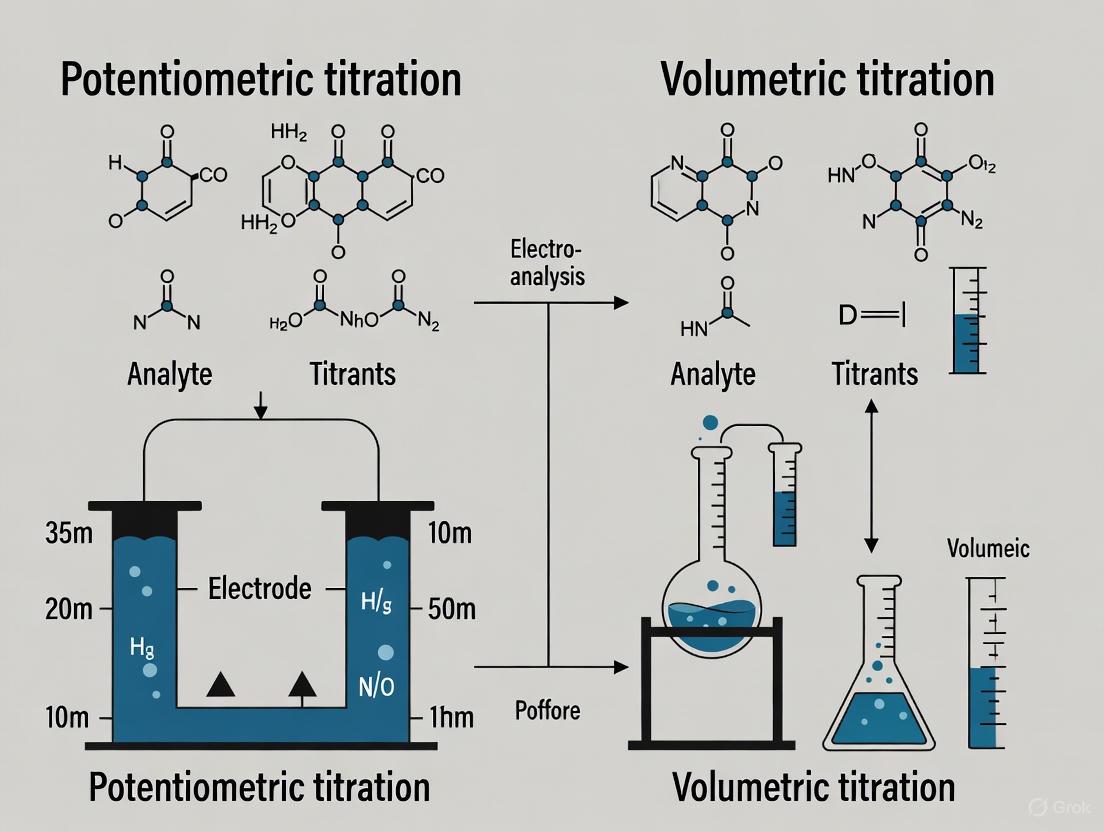
The following diagram illustrates the key difference in endpoint detection between manual and potentiometric titration, culminating in the generation of the titration curve.
Comparative Analysis: Volumetric vs. Potentiometric Titration
The choice between manual volumetric and potentiometric titration involves a careful trade-off between simplicity, cost, accuracy, and applicability. The following table provides a structured comparison based on key analytical figures of merit, synthesizing information from the search results.
Table 1: Comprehensive comparison of manual volumetric and potentiometric titration methods.
| Factor | Manual Volumetric Titration | Potentiometric Titration |
|---|---|---|
| Accuracy | High in well-controlled systems with a skilled analyst [1]. | Generally high accuracy and precision for clear aqueous samples; less subjective [1] [2]. |
| Precision | Lower precision; susceptible to human error in reading burettes and perceiving endpoints [2]. | Higher precision; automated systems reduce human variability [2] [4]. |
| Endpoint Detection | Visual observation of color change using chemical indicators [2]. | Instrumental measurement of potential change; endpoint is the inflection point on a titration curve [2] [3]. |
| Subjectivity | High; perception of color change varies between individuals [2] [3]. | Low; objective, numerical output [1]. |
| Sample Versatility | Limited to clear, colorless, or lightly colored samples; turbid or dark samples can obscure the endpoint [1] [5]. | High; effective for colored, turbid, and complex matrices where visual indicators fail [1] [2]. |
| Cost & Equipment | Low initial cost (burette, flasks, indicators) [1]. | Higher initial cost (pH meter, electrodes, potential for automation) [2]. |
| Automation Potential | Low; inherently manual and labor-intensive [1]. | High; easily integrated into automated titrators and continuous monitoring systems [1] [3]. |
| Skill Required | Requires trained analyst for precise technique and endpoint interpretation [1]. | Easier to perform; requires training on instrument operation and maintenance [1]. |
| Data Provided | Primarily the endpoint volume; no information on reaction progression [1]. | Full titration curve; provides data on buffering capacity and can identify multiple endpoints [1]. |
Supporting Experimental Data and Validation
The differences highlighted in Table 1 are substantiated by experimental data and validation protocols. For instance, a study on automating organic matter content detection reported that manual titration is prone to difficulties in determining the endpoint, especially with complex samples where local reactions can cause color reversion after stirring [6]. In contrast, the automated machine vision system achieved a titration error of less than 0.2 mL and showed no statistically significant difference from manual results at a 95% confidence level, demonstrating the potential for automation to match or exceed manual precision while improving consistency [6].
From a method validation perspective, key parameters such as accuracy, precision, and specificity are more readily demonstrated and documented with potentiometric systems. As per regulatory guidelines like USP <1225> and ICH Q2(R1), validation requires demonstrating that a method is unaffected by small variations in procedure or sample composition [4]. Potentiometry excels in specificity, as it can often distinguish between different components in a mixture. For example, in the titration of potassium bicarbonate with an impurity of potassium carbonate, potentiometry clearly showed two distinct endpoints, whereas a visual method might have seen a single, blurred color transition [4]. Furthermore, the precision of automated potentiometric titration is superior, as it eliminates the variability introduced by different analysts manually adding titrant and judging color changes [4].
Experimental Protocols and Research Toolkit
Key Experimental Protocol: Manual Acid-Base Titration
A typical protocol for a manual acid-base titration, using a strong base to titrate a strong acid, is outlined below.
- Solution Preparation: Prepare a standardized solution of sodium hydroxide (NaOH) as the titrant. Precisely measure a known volume of the unknown hydrochloric acid (HCl) solution into a clean Erlenmeyer flask.
- Indicator Addition: Add 2-3 drops of phenolphthalein indicator to the acid solution in the flask. The solution will remain colorless.
- Titration: Fill a clean burette with the standardized NaOH solution. Record the initial burette reading. While continuously swirling the flask, slowly add the NaOH solution from the burette to the acid.
- Endpoint Detection: As titration proceeds, a faint pink color may appear where the titrant enters the solution but will disappear upon swirling. Continue adding titrant drop by drop until a faint pink color persists throughout the solution for at least 30 seconds. This is the visual endpoint.
- Calculation: Record the final burette reading. The difference between the initial and final readings is the volume of titrant used. Using the known concentration of the NaOH and the reaction stoichiometry (1:1 for HCl:NaOH), calculate the concentration of the HCl analyte.
The Scientist's Titration Toolkit
The following table details essential reagents, materials, and equipment used in titration laboratories.
Table 2: Key research reagents and essential materials for titration experiments.
| Item | Function / Application |
|---|---|
| Burette | A precision glassware with a stopcock for accurately dispensing variable volumes of titrant [2]. |
| Primary Standards | High-purity, stable compounds (e.g., potassium hydrogen phthalate) used to determine the exact concentration of the titrant solution [4]. |
| Visual Indicators | Chemical substances (e.g., phenolphthalein, methyl orange) that signal the endpoint via a color change [2]. |
| pH Electrode | A combined sensor used in potentiometric titrations to measure the potential related to the H+ ion concentration; essential for acid-base titrations [2] [3]. |
| Ion-Selective Electrodes (ISEs) | Used in potentiometric titrations to measure the potential of specific ions (e.g., chloride, calcium), enabling specific complexometric or precipitation titrations [2]. |
| Autotitrator | An automated instrument that controls titrant addition, records data (volume and potential), and calculates the endpoint, ensuring high precision and data integrity [4] [3]. |
Volumetric titration, defined by its reliance on volume measurement and visual endpoint detection, remains a cornerstone of analytical chemistry due to its simplicity and low cost. Its principles are foundational for understanding stoichiometry and analytical technique. However, within the rigorous framework of modern research and drug development, where method validation, data integrity, and precision are paramount, manual volumetric titration shows significant limitations.
The comparative analysis demonstrates that potentiometric titration offers superior precision, objectivity, and specificity, making it the more reliable and robust choice for validated methods. Its ability to handle complex samples, provide full titration curves, and integrate seamlessly into automated workflows aligns with the demands of high-throughput laboratories and stringent regulatory environments. While manual volumetric titration retains its value in educational settings and for simple, clear samples, the advancement toward instrumental endpoint detection represents the standard for critical scientific and industrial applications.
In the realm of analytical chemistry, titration methods represent a cornerstone for quantitative analysis, enabling researchers to determine the concentration of unknown substances with precision. Among these techniques, potentiometric titration has emerged as a sophisticated alternative to traditional volumetric titration, particularly in pharmaceutical and research applications where accuracy, reliability, and method validation are paramount. This analytical approach replaces visual indicator detection with electrochemical potential measurements, offering distinct advantages for complex sample matrices and method validation protocols.
While volumetric titration relies on visual color changes of chemical indicators to signal the titration endpoint, potentiometric titration measures the potential difference between two electrodes as a function of the added titrant volume. This fundamental difference in detection methodology creates significant implications for accuracy, applicability, and validation parameters in pharmaceutical analysis and research settings. As regulatory requirements for analytical method validation become increasingly stringent, understanding the comparative performance characteristics of these techniques is essential for scientists and drug development professionals.
Principles and Theoretical Framework
Fundamental Mechanism of Potentiometric Titration
Potentiometric titration operates on the principle of measuring the electrochemical potential of a solution during a titration process, rather than relying on visual indicators. This technique employs an electrochemical cell consisting of two electrodes—an indicator electrode and a reference electrode—immersed in the analyte solution [7] [8]. The reference electrode maintains a constant, known potential, while the indicator electrode responds to changes in the concentration (activity) of the ionic species involved in the titration reaction [9].
As titrant is added to the analyte solution, the concentration of the target species changes, altering the potential of the indicator electrode relative to the reference electrode. The relationship between potential and concentration is governed by the Nernst equation, which for a general reduction reaction (Ox + ne⁻ → Red) is expressed as:
[E = E^0 - \frac{RT}{nF} \ln\frac{[Red]}{[Ox]}]
Where E is the electrode potential, E⁰ is the standard electrode potential, R is the gas constant, T is temperature, n is the number of electrons transferred, F is Faraday's constant, and [Red] and [Ox] are the concentrations of the reduced and oxidized species, respectively [7]. This fundamental relationship enables precise monitoring of the titration progress and accurate endpoint determination.
Electrode Systems and Technology
The performance of potentiometric titration heavily depends on the electrode technology employed. The reference electrode, typically a silver/silver chloride (Ag/AgCl) electrode or calomel electrode, provides a stable reference potential against which changes are measured [9] [8]. The indicator electrode varies based on the application and may include glass membrane electrodes for pH measurements, metallic electrodes for redox titrations, or ion-selective electrodes for specific ions [7] [8].
In modern potentiometric systems, specialized electrodes have been developed for specific analytical applications. For pharmaceutical analysis, composite electrodes and solid-state membranes offer improved selectivity and reduced interference from sample matrix components. The continuous development of electrode technology has significantly expanded the applications of potentiometric titration in complex sample matrices encountered in pharmaceutical and biological research.
Comparative Analysis: Potentiometric vs. Volumetric Titration
Endpoint Detection Mechanisms
The fundamental distinction between potentiometric and volumetric titration lies in their endpoint detection methodologies. This difference significantly impacts their application scope, accuracy, and reliability in pharmaceutical analysis and research settings.
(Titration Endpoint Detection Mechanisms)
Performance Comparison in Pharmaceutical Analysis
Quantitative comparisons between potentiometric and volumetric titration methods reveal significant differences in analytical performance characteristics, particularly in pharmaceutical quality control applications.
Table 1: Method Performance Comparison for Zinc Pyrithione Quantification in Shampoo Samples
| Performance Parameter | Potentiometric Titration | Complexometric Volumetric Titration |
|---|---|---|
| Sensitivity (LOD) | 0.0038% | 0.0534% |
| Precision (RSD%) | <1% | <1% |
| Accuracy (% Recovery) | >99% | >99% |
| Sample Preparation | Minimal | Moderate |
| Analysis Time | Shorter | Longer |
| Automation Potential | High | Low |
Data adapted from validation study of zinc pyrithione quantification methods [10]
The enhanced sensitivity of potentiometric titration (approximately 14-fold lower detection limit) demonstrates its superior capability for quantifying low analyte concentrations, a critical requirement in pharmaceutical analysis where active ingredients may be present at low concentrations or where impurity profiling requires sensitive detection methods.
Applications Spectrum in Pharmaceutical Research
Both titration methods find applications across pharmaceutical research and quality control, but their relative advantages make them suitable for different analytical scenarios.
Table 2: Method Applications in Pharmaceutical Research and Analysis
| Application Area | Potentiometric Titration | Volumetric Titration |
|---|---|---|
| Acid-Base Titration | Excellent (especially for colored solutions) [8] | Good (clear solutions only) [11] |
| Redox Titration | Excellent (e.g., Fe²⁺ with KMnO₄) [9] [8] | Moderate (subjective endpoint) |
| Complexometric Titration | Excellent (metal ion quantification) [8] | Good (indicator dependent) [10] |
| Precipitation Titration | Excellent (e.g., chloride with AgNO₃) [8] | Moderate (indicator limitations) |
| Pharmaceutical Formulations | Excellent (direct analysis) [10] | Moderate (interference issues) |
| Biochemical Systems | Excellent (redox potential studies) [12] | Not applicable |
Experimental Protocols and Method Validation
Potentiometric Titration Protocol for Pharmaceutical Analysis
A validated potentiometric titration method for zinc pyrithione quantification in shampoo formulations exemplifies a robust pharmaceutical analysis protocol [10]:
Sample Preparation: Accurately weigh 6.3 g of shampoo sample and transfer to the titration cell. Add 50 mL of deionized water and 10 mL of fuming hydrochloric acid (37%).
Instrumentation Setup: Assemble the automatic titrator (Mettler Toledo T70) with a platinum indicator electrode (DMI 140-SC) and Ag/AgCl reference electrode. Ensure constant stirring throughout the titration process.
Titration Procedure: Titrate the sample with 0.05 M iodine solution using incremental additions. Monitor the potential change after each addition until equilibrium is established (typically 30 seconds between additions).
Endpoint Determination: Record the titration curve (potential vs. titrant volume). Determine the endpoint mathematically from the inflection point of the sigmoidal curve using the first or second derivative method.
Calculation: Calculate the zinc pyrithione concentration based on the titrant consumption at the endpoint and the known stoichiometry of the reaction.
Volumetric Titration Protocol for Comparative Analysis
The comparative volumetric method for the same analytical application follows a traditional approach [10]:
Sample Preparation: Weigh 6.0 g of shampoo sample and dilute with 50 mL of deionized water. Add 2.5 mL of hydrochloric acid with heating and gentle stirring for 10 minutes. Add 0.5 mL of hydrogen peroxide and cool the mixture.
pH Adjustment: Adjust the pH using ammonia solution and add 2.5 mL of ammonium chloride/ammonia buffer (pH = 10).
Indicator Addition: Add eriochrome black T indicator solution until a distinct violet color is observed.
Titration Procedure: Titrate with 0.01 M EDTA solution while continuously swirling the titration flask.
Endpoint Determination: Observe the color change from violet to blue, indicating the equivalence point. Record the volume of titrant consumed.
Calculation: Determine the zinc pyrithione concentration based on EDTA consumption and reaction stoichiometry.
Method Validation Parameters
For pharmaceutical applications, both methods must undergo comprehensive validation as per ICH and USP guidelines [10]. Key validation parameters include:
- Selectivity: Assessment of interference from placebo components and degradation products under stress conditions (photolysis, thermolysis, oxidation).
- Linearity: Evaluation across concentration ranges (typically 0.2-1.4% w/w for zinc pyrithione) with determination coefficients (R²) >0.99.
- Precision: Determination of repeatability (RSD% <1%) and intermediate precision through inter-day and inter-analyst studies.
- Accuracy: Recovery studies at multiple concentration levels with acceptable recovery rates (98-102%).
- Robustness: Evaluation of method resilience to deliberate variations in operational parameters (pH, temperature, sample weight, stirring time).
Advanced Applications and Specialized Techniques
Biochemical and Pharmaceutical Research Applications
Potentiometric titration finds specialized applications in biochemical and pharmaceutical research beyond routine quality control. The method is particularly valuable for determining reduction potentials of redox-active cofactors in proteins and enzymes, providing critical insights into electron transfer processes relevant to drug metabolism and therapeutic mechanisms [12].
In biopharmaceutical characterization, potentiometric titrations enable the study of metalloproteins and enzyme systems under various physiological conditions. These applications often combine potentiometric measurements with spectroscopic techniques such as electron paramagnetic resonance (EPR) to correlate electrochemical properties with structural features [12]. The ability to monitor redox states and protonation events in biological macromolecules makes this technique invaluable for understanding drug-receptor interactions and metabolic pathways.
Material Characterization and Polymer Analysis
In pharmaceutical material science, potentiometric titration provides critical data for biomaterial characterization. A prominent application involves determining the degree of deacetylation (DDA) in chitosan-based biomaterials, a key parameter influencing drug delivery system performance [12]. The protocol involves dissolving a known quantity of chitosan in a standard HCl solution and titrating against NaOH while monitoring pH changes. The inflection points in the titration curve correspond to specific protonation events, enabling calculation of amine content and DDA percentage using established equations [12].
Research Reagent Solutions and Essential Materials
Successful implementation of potentiometric titration methods requires specific reagents and instrumentation tailored to the analytical application.
Table 3: Essential Research Reagents and Equipment for Potentiometric Titration
| Item | Function/Application | Examples/Specifications |
|---|---|---|
| Reference Electrode | Provides stable reference potential for measurements | Ag/AgCl electrode, calomel electrode [9] [8] |
| Indicator Electrode | Responds to changes in analyte concentration during titration | Platinum electrode, glass pH electrode, ion-selective electrodes [8] |
| Redox Mediators | Facilitate electron transfer in biochemical systems | 1,2-naphthoquinone, methyl viologen, ruthenium complexes [12] |
| Titrant Solutions | Standardized solutions for analyte reaction | Iodine (0.05 M), EDTA (0.01 M), NaOH, HCl [10] |
| Buffer Systems | Maintain constant pH for specific applications | Phosphate buffer, ammonium chloride/ammonia buffer (pH 10) [10] |
| Automatic Titrator | Precise titrant delivery and potential measurement | Mettler Toledo T70 with endpoint detection algorithms [10] |
The comparative analysis of potentiometric and volumetric titration methods reveals a complex landscape where each technique occupies distinct niches in pharmaceutical research and quality control. Potentiometric titration offers superior sensitivity, objectivity, and automation capability, making it particularly valuable for complex sample matrices, low analyte concentrations, and method validation protocols requiring robust data integrity. The technique's independence from visual endpoint detection eliminates subjective interpretation, while continuous potential monitoring provides comprehensive reaction progress data beyond simple endpoint determination.
Volumetric titration maintains relevance in resource-limited settings and for applications where rapid analysis outweighs precision requirements. Its simplicity, lower equipment costs, and established history in pharmaceutical analysis ensure its continued utilization for routine quality control of formulations with favorable analytical characteristics. However, the limitations in analyzing colored or turbid solutions and the subjective nature of visual endpoint detection restrict its application in modern pharmaceutical research and regulatory submissions.
The selection between these analytical approaches ultimately depends on specific application requirements, regulatory expectations, available resources, and required data quality. For drug development professionals and researchers, understanding the comparative advantages, limitations, and validation parameters of both techniques enables informed method selection based on analytical science principles rather than tradition or convenience alone. As pharmaceutical analysis continues to advance toward increasingly automated and data-rich methodologies, potentiometric titration will likely assume greater prominence in the researcher's analytical toolkit, particularly for challenging applications requiring validated, robust analytical methods.
Titration remains a cornerstone analytical technique across pharmaceutical, chemical, and materials science industries. The methodology, however, is undergoing a significant transformation, shifting from traditional manual volumetric titration toward automated potentiometric systems. This evolution is driven by increasing demands for data integrity, reproducibility, and operational efficiency in research and quality control environments, particularly in highly regulated sectors like drug development [13] [1].
This guide objectively compares the performance of automated potentiometric titration with manual alternatives, framing the discussion within the broader context of method validation research. For scientists and drug development professionals, the choice between these systems impacts not only daily workflows but also the fundamental reliability of the data supporting critical decisions.
Performance Comparison: Automated Potentiometric vs. Manual Volumetric Titration
A direct comparison of key performance parameters reveals the operational and scientific advantages of automation.
Table 1: Systematic Performance Comparison of Titration Methods
| Performance Parameter | Automated Potentiometric Titration | Manual Volumetric Titration |
|---|---|---|
| Accuracy & Precision | High accuracy and precision; based on objective electrode data; precision dosing to 0.001 mL [13] [14] | Dependent on analyst skill; subjective visual endpoint detection; lower dosing precision [13] [1] |
| Repeatability (\% RSD) | Excellent (e.g., <1% RSD demonstrated in pharmaceutical validation) [15] | Variable; susceptible to inter-operator differences [13] |
| Data Traceability | Full automated data logging; customizable GLP reports; easy audit trails [13] [14] | Manual transcription prone to error; limited inherent traceability [13] |
| Sample & Reagent Consumption | Lower consumption due to smaller sample sizes and high dosing accuracy [13] | Larger sample sizes and titrant volumes often needed for reliable visual detection [13] |
| Analyst Time & Labor | Significantly reduced active bench time; walk-away operation [13] [16] | Labor-intensive; requires constant attention throughout the titration [1] [14] |
| Throughput | High, especially when integrated with autosamplers (e.g., 18+ samples per batch) [13] | Low to moderate, limited by analyst availability and speed [13] |
| Hazard Management | Reduced exposure to hazardous chemicals; enclosed reagent systems [16] [14] | Higher risk of exposure during manual handling and disposal [16] |
The quantitative data in Table 1 underscores a clear trend: automated potentiometric systems provide superior analytical robustness while creating a more efficient and safer laboratory environment.
Experimental Protocols and Validation Data
A Validated Method for Pharmaceutical Analysis
A 2022 study developed and validated a non-aqueous potentiometric titration method for quantifying Favipiravir in pharmaceutical dosage forms, showcasing the rigor achievable with automation [15].
- Methodology: The titration was performed using a standardized 0.1 N perchloric acid titrant in a non-aqueous medium. The potentiometric endpoint was detected automatically, eliminating the need for a visual indicator [15].
- Validation Data:
- Precision: The method was found to be precise with a percent relative standard deviation (\%RSD) of less than 1% (n=6).
- Linearity: It showed strict linearity (r² > 0.9999) across a range of 10% to 50% w/v of the target analyte weight.
- Accuracy: Percentage recovery was reported between 99.65% to 100.08%, confirming high accuracy.
- Ruggedness: The method was found rugged when checked by different analysts and using different lots of reagents [15].
This protocol exemplifies how automated potentiometric titration meets the stringent validation requirements of pharmaceutical development, providing a reliable foundation for quality control.
Core Workflow of a Potentiometric Titration
The fundamental principle of potentiometric titration involves measuring the potential between a reference electrode and an indicator electrode as a function of the added titrant volume [12] [9]. The endpoint is determined by identifying the inflection point in the potential-versus-volume curve, which corresponds to the equivalence point of the chemical reaction [13] [9].
Diagram 1: Potentiometric titration workflow.
The Scientist's Toolkit: Essential Research Reagent Solutions
Successful implementation and validation of titration methods rely on a set of essential reagents and materials.
Table 2: Key Reagents and Materials for Potentiometric Titration
| Item | Function & Importance |
|---|---|
| Indicator Electrode | Sensor (e.g., pH, ion-selective) that responds to the activity of the analyte/participating ion; the core of objective endpoint detection [13] [12]. |
| Reference Electrode | Provides a stable, fixed potential against which the indicator electrode's potential is measured [9]. |
| Standardized Titrant | A reagent of precisely known concentration; its purity and stability are critical for method accuracy [15] [14]. |
| Supporting Electrolyte | Maintains a constant ionic strength, minimizing activity coefficient changes and ensuring a stable potential response [9]. |
| Redox Mediators | Used in some redox titrations to facilitate electrical communication between the electrode and analyte, ensuring a well-defined endpoint [12]. |
| pH Buffers | Essential for electrode calibration and for titrations where the reaction is pH-dependent [1]. |
Visualizing the Automated Potentiometric System Workflow
Modern automated systems integrate several components to create a seamless, walk-away operation. The system's software controls the entire process, from dosing and data acquisition to endpoint calculation and report generation, ensuring unattended operation and full traceability [13] [17] [16].
Diagram 2: Automated titration system interaction.
The driving forces behind the shift to automated potentiometric systems are clear and compelling. The move is propelled by the intertwined needs for data integrity mandated by modern regulations, the demand for operational efficiency in competitive R&D environments, and the universal scientific pursuit of accurate and reproducible results. While manual volumetric titration retains a place in educational settings or applications where cost is the primary constraint, the evidence from performance comparisons and validation studies firmly positions automated potentiometric titration as the superior choice for research and drug development professionals. The initial capital investment is rapidly offset by savings in time, reagents, and the invaluable currency of reliable data [13] [16].
Market Landscape and Adoption Trends in Pharmaceutical and Biotechnology Sectors
In the highly regulated pharmaceutical and biotechnology industries, the precision and reliability of analytical methods are paramount for ensuring product quality, safety, and efficacy. Titration, a fundamental analytical technique for concentration determination, is primarily executed through volumetric and potentiometric methods. The choice between these methods significantly impacts data integrity, operational efficiency, and regulatory compliance. This guide provides an objective comparison of potentiometric and volumetric titration, framing the analysis within the broader context of method validation to support informed decision-making by researchers, scientists, and drug development professionals.
The global market for automated analytical instrumentation, including potentiometric titration systems, is poised for steady growth, projected to be valued at $261 million in 2025 with a Compound Annual Growth Rate (CAGR) of 2.5% [18]. The pharmaceutical and biotechnology sector constitutes the largest end-market segment, accounting for an estimated 35% of the total market [18]. This adoption is driven by stringent regulatory requirements and the critical need for precise, traceable results in quality control (QC) and research and development (R&D) [18].
Technical Comparison: Potentiometric vs. Volumetric Titration
The core distinction between these techniques lies in their endpoint detection mechanisms. Volumetric titration typically relies on a visual color change from an indicator, whereas potentiometric titration measures the change in electrical potential between two electrodes [2] [19].
Table 1: Fundamental Characteristics of Titration Methods
| Characteristic | Volumetric Titration | Potentiometric Titration |
|---|---|---|
| Core Principle | Measurement of reagent volume added to cause a visual color change at the endpoint [2]. | Measurement of electrical potential change between an indicator and a reference electrode to determine the endpoint [2] [12]. |
| Endpoint Detection | Visual observation of indicator color change [1] [2]. | Electrochemical sensor (e.g., platinum electrode) detecting a voltage shift [20] [2]. |
| Primary Output | Volume of titrant consumed [20]. | Titration curve (Potential vs. Titrant Volume) [2] [12]. |
| Automation Potential | Lower; available with specialized equipment [1]. | High; easily automated and integrated into continuous systems [1] [18] [19]. |
| Level of Subjectivity | High; prone to human error in color perception [1] [2]. | Low; objective, instrument-based measurement [1] [19]. |
Table 2: Performance Comparison for Pharmaceutical and Biotechnology Applications
| Performance Metric | Volumetric Titration | Potentiometric Titration |
|---|---|---|
| Accuracy & Precision | High in well-controlled systems, but variable due to subjectivity [1]. | Higher precision and accuracy; minimizes human error [1] [2] [19]. |
| Sample Versatility | Excellent for complex matrices (e.g., suspensions, high-color samples) where electrodes may foul [1]. | Ideal for clear aqueous solutions; performance can be affected by high-salt, oily, or viscous samples [1]. |
| Throughput & Labor | Labor-intensive and time-consuming, especially in manual mode [1] [21]. | High throughput with automation; minimal analyst involvement required [1] [18] [19]. |
| Data & Compliance | Manual data recording; less suitable for electronic data integrity requirements. | Compliance-ready data logging; sophisticated software for analysis and reporting aids in regulatory compliance [18]. |
| Cost-Effectiveness | Lower initial equipment cost; higher long-term labor and reagent costs [1] [2]. | Higher initial investment; lower per-sample cost and better ROI in high-volume or regulated environments [1] [18]. |
The Karl Fischer Method: A Specialized Case Study
Karl Fischer (KF) titration is the gold standard for specific water content determination, a critical parameter in pharmaceutical stability [20] [21]. This method exemplifies the volumetric vs. coulometric (an advanced potentiometric) dichotomy:
- Volumetric KF Titration: Uses a reagent with a known concentration of iodine. It is suitable for samples with water content ranging from 0.01% to 100% [20] [21].
- Coulometric KF Titration: Iodine is generated electrochemically within the cell. It offers unparalleled sensitivity for trace moisture, ideal for samples with water content from 1 ppm to 5% [20] [21].
The specificity of the KF reaction for water makes it superior to non-specific methods like loss-on-drying (LOD) [20] [21]. However, it can be susceptible to interference from certain functional groups, necessitating method optimization [21].
Experimental Protocols for Method Validation
A robust method validation is essential for establishing that a titration procedure is suitable for its intended use. The following protocols outline key experiments for comparing potentiometric and volumetric methods.
Protocol for Accuracy and Precision Determination
This experiment assesses the trueness (closeness to true value) and precision (repeatability) of each method.
- Objective: To determine the accuracy and precision of potentiometric and volumetric titration methods for the assay of a standard active pharmaceutical ingredient (API) solution.
- Materials:
- Standard solution of a known API (e.g., 0.1 M HCl)
- Titrant of known concentration (e.g., 0.1 M NaOH)
- Appropriate visual indicator (e.g., phenolphthalein for volumetric acid-base titration)
- Potentiometric titrator with pH electrode
- Burette, volumetric flasks, and pipettes
- Procedure:
- Prepare a standardized titrant solution and document its exact concentration.
- For the volumetric method, pipette a precise volume of the standard API solution into an Erlenmeyer flask. Add 2-3 drops of indicator. Titrate until the endpoint color change is observed and record the volume of titrant used. Repeat at least six times (n=6).
- For the potentiometric method, pipette the same volume of standard API into a beaker. Immerse the pH electrode. Start the automated titrator to add titrant while recording the pH and volume. The endpoint is determined from the inflection point of the resulting sigmoidal curve. Repeat at least six times (n=6).
- For both methods, calculate the measured concentration of the API for each replication.
- Data Analysis:
- Accuracy: Calculate the percent recovery for each replication:
(Measured Concentration / Known Concentration) * 100. Report the mean recovery. - Precision: Calculate the relative standard deviation (RSD) of the measured concentrations from the six replicates for each method.
- Accuracy: Calculate the percent recovery for each replication:
The potentiometric method is expected to yield a higher accuracy (mean recovery closer to 100%) and a significantly lower RSD, demonstrating superior precision and reduced operator subjectivity [2] [19].
Protocol for Robustness Testing with Complex Matrices
This experiment evaluates the method's performance when analyzing real-world, complex samples.
- Objective: To compare the ability of potentiometric and volumetric titration to accurately determine the analyte concentration in a complex, buffered pharmaceutical formulation.
- Materials:
- A formulated product (e.g., a buffered solution, a suspension, or a colored liquid).
- Appropriate titrant and indicators.
- Potentiometric titrator with a relevant electrode (pH, redox, etc.).
- Procedure:
- For the volumetric method, prepare and titrate the sample as described in Protocol 3.1. Note any challenges, such as difficulty observing the color change due to the sample's inherent color or turbidity.
- For the potentiometric method, perform the titration automatically. The system will generate a full titration curve.
- Data Analysis:
- Compare the clarity of the endpoint determination. For volumetric titration, note the subjectivity of the visual change.
- For potentiometric titration, inspect the titration curve. A well-defined, steep inflection point indicates a robust and precise endpoint, even in complex matrices [1] [12]. A distorted curve may indicate electrode fouling or slow reaction kinetics.
Volumetric titration may be preferred for specific challenging samples like highly colored solutions or suspensions where electrodes fail, while potentiometry excels at mapping complex buffering systems found in many formulations [1].
Workflow and System Configuration
The fundamental workflows for manual volumetric and automated potentiometric titration differ significantly, impacting labor, speed, and data handling. The diagrams below illustrate these logical processes.
Volumetric Titration Workflow
Automated Potentiometric Titration Workflow
Essential Research Reagent Solutions
The following table details key materials and reagents required for establishing and executing titration methods in a pharmaceutical R&D or QC setting.
Table 3: Key Reagents and Materials for Titration Methods
| Item | Function | Application Notes |
|---|---|---|
| Volumetric Titrant | A solution of known concentration (e.g., NaOH, HCl) that reacts with the analyte. | Requires regular standardization (titer determination) to ensure accuracy [20]. |
| Visual Indicators | Substances that change color at/near the endpoint (e.g., phenolphthalein, methyl orange). | Selection is critical and depends on the reaction type and expected endpoint pH [2]. |
| Potentiometric Electrode | Sensor pair (indicator + reference) that measures potential change in the solution. | Selection (pH, redox, ion-selective) depends on the titration reaction [2]. Requires regular calibration and maintenance [1]. |
| Karl Fischer Reagents | Specialized reagents (alcohol, SO₂, base, I₂) for water-specific determination [20]. | Volumetric: reagent with known water equivalence. Coulometric: reagent for iodine generation. May require methanol-free versions for ketones/aldehydes [21]. |
| Certified Reference Materials | Substances with certified purity/water content (e.g., disodium tartrate dihydrate). | Used for system suitability testing, method validation, and titrant standardization to ensure overall accuracy [21]. |
The choice between potentiometric and volumetric titration is not a matter of one being universally superior, but rather of selecting the right tool for the specific application. The experimental data and market trends consistently demonstrate that automated potentiometric titration offers significant advantages in precision, automation, cost-efficiency for high-volume labs, and data integrity, making it the growing standard for regulated pharmaceutical and biotechnology environments [1] [18] [19].
However, volumetric methods retain their value for specific scenarios, including labs with low initial budgets, the analysis of samples that interfere with electrodes, or when a simple, rapid test is sufficient. Furthermore, specialized volumetric methods like Karl Fischer titration remain indispensable for specific analyses like high-water content determination.
The ongoing innovation in automated titration systems, focused on enhanced software, miniaturization, and advanced sensors, will continue to solidify the role of objective, automated potentiometric systems in ensuring the quality, safety, and efficacy of future pharmaceuticals [18].
Practical Implementation: Selecting the Right Method for Your Application
In the rigorous framework of method validation for analytical techniques, selecting the appropriate titration method is a critical decision that directly impacts the accuracy, reproducibility, and efficiency of quantitative analysis. This guide provides an objective comparison between potentiometric titration and volumetric titration, focusing on their performance across diverse sample matrices—aqueous, complex, and viscous. The fundamental distinction lies in endpoint detection: potentiometric titration measures a change in electrical potential between an indicator electrode and a reference electrode, while volumetric titration relies on observing a visual change, such as a color shift, using a chemical indicator [22] [23]. Within pharmaceutical development and other precision-driven industries, this choice is not merely procedural but foundational to ensuring data integrity and regulatory compliance.
The selection of a titration method must be guided by the specific characteristics of the sample matrix. The following table summarizes the core performance attributes of each method against the key sample types, providing a high-level guide for method selection.
| Sample Matrix | Potentiometric Titration | Volumetric Titration |
|---|---|---|
| Aqueous Solutions | Excellent. Offers high accuracy and real-time monitoring for clear aqueous samples [1]. | Good. Suitable for routine analysis of simple aqueous solutions where a clear visual endpoint is attainable [1]. |
| Complex Matrices | Excellent. Ideal for colored, turbid, or opaque solutions where visual indicators fail. Effective for samples with multiple buffering agents [22] [1]. | Poor. Visual endpoint detection is compromised by sample color or turbidity, leading to subjective and inaccurate readings [22]. |
| Viscous Samples | Good. Effective, though may require sample preparation or electrode resistant to fouling. Successfully used for ointments and creams [24]. | Poor. Challenging due to hindered color uniformity and mixing efficiency, which can obscure the visual endpoint [1]. |
Detailed Performance Analysis and Experimental Data
Quantitative Performance Metrics
Beyond the qualitative matrix fit, the choice between methods is supported by quantifiable performance data. The following table consolidates key metrics from validation studies and comparative analyses.
| Performance Metric | Potentiometric Titration | Volumetric Titration | Supporting Data |
|---|---|---|---|
| General Precision (RSD%) | Typically < 1% [10] | Subject to higher variability | A study on ZnPT assay found RSD% below 1% for potentiometric method [10]. |
| Detection Sensitivity | Higher | Lower | In ZnPT assay, LOQ for potentiometric was 0.0038% vs. 0.0534% for volumetric [10]. |
| Analysis Time | Faster for automated systems; can be slower if potential stabilization is needed [23] | Generally fast, especially for manual routine analysis [23] | Automated potentiometric titration of APIs like sulfanilamide takes 3-5 minutes [24]. |
| Total Acidity in Wine (Aberrance) | Benchmark | 0.1 - 0.4 g L⁻¹ aberrance from potentiometric | A study on wine found aberrances in this range for volumetric vs. potentiometric results [25]. |
Case Studies and Experimental Protocols
Case Study 1: Assay of Zinc Pyrithione (ZnPT) in Shampoo
- Objective: To validate and compare complexometric (volumetric) and potentiometric titration methods for quantifying ZnPT in shampoo [10].
- Sample Matrix: Complex and viscous (shampoo).
- Potentiometric Protocol: 6.3 g of shampoo was weighed and transferred to the titration cell with 50 mL of water and 10 mL of fuming hydrochloric acid. The mixture was titrated with 0.05 M iodine solution using an automatic titrator. The endpoint was determined by a platinum electrode [10].
- Volumetric Protocol: 6.0 g of shampoo was diluted in 50 mL of water. Then, 2.5 mL of hydrochloric acid was added with heating and stirring for ten minutes. After pH adjustment with an ammonia solution and a buffer (pH=10), the sample was titrated with 0.01 M EDTA using eriochrome black T as an indicator. The endpoint was a color change from violet to blue [10].
- Results: The potentiometric method demonstrated superior sensitivity (Limit of Quantification of 0.0038% vs. 0.0534%) and precision (RSD < 1%) compared to the volumetric method, making it more reliable for quality control [10].
Case Study 2: Total Acidity in Wine
- Objective: To compare the determination of total acidity in wines using potentiometric and volumetric titration [25].
- Sample Matrix: Complex and colored (red, white, and rosé wines).
- Protocol: Thirty-seven wine samples were analyzed. Potentiometric titration was performed automatically with different titrant addition rates. The results were compared to those obtained by conventional volumetric titration with a color indicator [25].
- Results: The total acidity values depended on the method used. While a good correlation was found, significant aberrances of 0.1 to 0.4 g L⁻¹ were observed for some wines, highlighting the potential for error in the volumetric method when dealing with colored samples [25].
Method Selection Workflow
The decision-making process for selecting the appropriate titration method can be visualized as a logical pathway based on sample properties and analytical requirements. The following diagram outlines this workflow:
The Scientist's Toolkit: Essential Research Reagent Solutions
The successful execution of titration methods, whether for development or validation, relies on a set of key reagents and instruments. The following table details these essential materials and their functions.
| Tool Category | Specific Examples | Function in Titration |
|---|---|---|
| Electrodes | Glass pH Electrode, Platinum Electrode, Ion-Selective Electrodes, Reference Electrodes (e.g., Ag/AgCl) [22] [9] | Serves as the indicator electrode to measure potential change specific to the analyte (pH, redox species, ions) [22]. |
| Titrants | Sodium Hydroxide (NaOH), Hydrochloric Acid (HCl), Ethylenediaminetetraacetic Acid (EDTA), Sodium Thiosulfate, Iodine Solution [24] [10] | The standard solution of known concentration that reacts with the analyte. Choice depends on reaction type (acid-base, complexometric, redox) [24] [10]. |
| Chemical Indicators | Phenolphthalein, Eriochrome Black T, Starch [10] | Provides a visual color change at the endpoint in volumetric titration. Not used in potentiometric titration [23] [10]. |
| Buffers & Reagents | Ammonia Buffer (pH=10), Potassium Bromide (KBr), Hydrochloric Acid (HCl) [24] [10] | Adjusts pH for optimal reaction, acts as a catalyst, or aids in sample digestion and preparation [24] [10]. |
| Instrumentation | Automatic Titrator (e.g., Titrando), Potentiometer, Burette [22] [24] | Automates titrant addition and endpoint detection (potentiometric) or enables precise volume measurement (volumetric) [22] [24] [23]. |
In the highly regulated field of pharmaceutical analysis, the determination of active pharmaceutical ingredient (API) potency and purity is not merely a procedural step but a critical component of quality by design (QbD) initiatives and risk reduction in drug manufacturing [24]. Titration, one of the most economical, fastest, and most reliable analytical techniques, plays a fundamental role in this process, with current United States Pharmacopeia-National Formulary (USP-NF) monographs recommending titration for approximately 630 APIs and 110 excipients [24]. Within this landscape, a significant methodological shift is occurring: the transition from traditional volumetric titration using visual indicators to modern potentiometric titration with electrochemical endpoint detection. This guide provides an objective, data-driven comparison of these techniques within the specific context of drug potency and API analysis, framed by the rigorous demands of method validation in pharmaceutical settings.
The United States Pharmacopeia Chapter <541> now officially accepts automated titration as a modern titration method, defining an automated titrator as a "multifunctional processing unit that is able to perform the steps of a titration" [26]. This regulatory recognition underscores the scientific and practical evolution in titration methodologies, positioning potentiometric approaches as pharmaceutically relevant and compliant for quality control applications.
Fundamental Principles: A Technical Comparison
Core Mechanism and Endpoint Detection
The fundamental distinction between potentiometric and volumetric titration lies in their endpoint detection mechanisms, which directly impacts their application in pharmaceutical analysis.
Potentiometric Titration relies on measuring the electrical potential difference between two electrodes—an indicator electrode and a reference electrode—as the titrant is added to the analyte solution [22] [23]. The endpoint is determined by identifying the inflection point on a titration curve where the potential change is most rapid [22]. This method does not depend on visible color changes, making it particularly suitable for colored, turbid, or opaque solutions common in pharmaceutical formulations [22].
Volumetric Titration (also known as titrimetry) is based on measuring the volume of titrant required to react completely with the analyte, with the endpoint determined by observing a color change or the formation of a precipitate using chemical indicators [23]. This visual determination introduces a subjective element that can affect accuracy and reproducibility.
Table 1: Fundamental Comparison of Titration Techniques
| Attribute | Potentiometric Titration | Volumetric Titration |
|---|---|---|
| Measurement Basis | Potential difference (voltage) between electrodes [23] | Volume of reagent required [23] |
| Endpoint Detection | Monitoring potential change via indicator electrode [22] [23] | Visual observation of color change/precipitate [23] |
| Subjectivity | Objective, instrument-based | Subjective, operator-dependent |
| Solution Requirements | Suitable for colored/turbid solutions [22] | Requires clear solutions for visual detection |
Method Validation and Regulatory Compliance
From a method validation perspective, potentiometric titration offers traceable and documentable results, which aligns with the current Good Manufacturing Practice (cGMP) requirements and the FDA's QbD initiative [24]. Automated potentiometric systems can be 21 CFR Part 11 compliant, meeting all ALCOA+ (Attributable, Legible, Contemporaneous, Original, and Accurate) requirements for data integrity [26]. The validation of titration methods is crucial in pharmaceutical quality assurance, with suitability for an intended analytical purpose proven through validation in accordance with regulatory guidelines such as USP General Chapter <1225> [26].
Experimental Performance Data: Quantitative Comparison in Pharmaceutical Applications
Accuracy and Precision in API Assay
Comparative studies demonstrate the technical performance of both methods in quantifying pharmaceutical substances.
Microtitration Development for Early-Stage APIs: In drug discovery and early development, limited API material is available for analysis. Conventional potentiometric titration typically requires 1 mmol (~400-500 mg) of material for accurate quantitation [27]. A developed microtitration method using potentiometric detection requires only 5-10 mg of sample while maintaining accuracy comparable to conventional titration [27]. In validation studies, the %RSD values for calculated weight percent results from triplicate microtitrations were 0.6% and 0.5% for different analysts, with deviations from conventional titration within 1.0% [27]. This demonstrates that potentiometric methods can be successfully miniaturized for pharmaceutical applications with minimal material.
Comparative Study on Total Acidity Determination: Although not specific to pharmaceuticals, a comparative study on wine acidity determination provides insight into methodological performance. The research found that total acidity results depended on the methods used, with aberrances ranging from 0.1 to 0.4 g L⁻¹ between methods for some samples [25]. However, a good correlation between potentiometric and volumetric methods was observed, with potentiometric titration providing accurate results at a recommended titrant addition rate of 2 mL min⁻¹ [25].
Table 2: Accuracy Comparison of Conventional vs. Micro Potentiometric Titration for APIs
| API Compound | Sample Amount (Conventional) | Sample Amount (Micro) | Deviation |
|---|---|---|---|
| Compound A (Basic) | 444.2 mg | 5.2 mg | 0.9% [27] |
| Basic API 1 | ~500 mg | 3-7 mg | <1.1% [27] |
| Basic API 2 | ~500 mg | 3-7 mg | <1.1% [27] |
| Acidic API 1 | ~500 mg | 3-7 mg | <1.1% [27] |
| Acidic API 2 | ~500 mg | 3-7 mg | <1.1% [27] |
| Acidic API 3 | ~500 mg | 3-7 mg | <1.1% [27] |
Application-Specific Performance Data
Analysis of Sulfanilamide: The purity of sulfanilamide, used for treating vaginal yeast infections, can be determined in aqueous solution by automatic potentiometric titration using sodium nitrite as titrant [24]. With potassium bromide added as a catalyst and a Pt Titrode electrode, purity determination takes only 3-5 minutes with high accuracy [24].
Analysis of Ketoconazole: Due to its low solubility (<1 mg/mL), ketoconazole concentration is determined by non-aqueous acid-base potentiometric titration using perchloric acid as titrant and a Solvotrode easyClean electrode [24]. This method provides results in 3-5 minutes, demonstrating the adaptability of potentiometric titration to non-aqueous systems common in pharmaceutical analysis [24].
Excipient Analysis: Potentiometric titration is used for the characterization of excipients such as surfactants, edible oils, and lubricants [24]. For surfactants, specific electrodes are available for anionic, cationic, and nonionic types, replacing the classic manual Epton method with improved accuracy and repeatability [24].
Experimental Protocols and Workflows
Standard Potentiometric Titration Protocol for API Analysis
The following workflow represents a standardized approach for potentiometric titration of APIs:
Sample Preparation: Accurately weigh 5-500 mg of API (depending on whether micro or conventional titration is performed) and dissolve in appropriate solvent (aqueous or non-aqueous based on solubility) [24] [27].
Electrode Selection: Choose appropriate electrodes based on reaction type:
- Combined pH electrode with reference electrolyte (3 mol/L KCl) for water-soluble acidic/basic APIs [26]
- Combined pH electrodes with alcoholic reference electrolyte (e.g., Solvotrode) for water-insoluble weak acids/bases or organic solvents [26]
- Pt metal electrodes (e.g., Pt Titrode) for redox titrations [26] [24]
- Ag metal electrodes for precipitation titrations [26]
- Ion-selective electrodes for complexometric titrations [26]
Titration Parameters: For microtitration of early-development compounds: use 1 mL burette, microelectrode (3 mm diameter), and 0.01 N titrant [27]. For conventional titration: use 20 mL burette, standard electrode (12 mm diameter), and 0.1 N titrant [27].
Endpoint Detection: Employ dynamic equivalence point titration where the first derivative of the rate of change of the potential measured against the volume added determines the endpoints [27].
Volumetric Titration Protocol for Comparison
Sample Preparation: Similar dissolution process as potentiometric method but requires clear, colorless solutions for accurate visual detection.
Indicator Selection: Choose appropriate chemical indicator based on reaction type (e.g., phenolphthalein for acid-base titrations, starch for redox titrations) [26] [23].
Titration Procedure: Add titrant gradually while swirling the solution, observing color changes. The endpoint is determined when a persistent color change is observed [23].
Calculation: Determine titrant volume at endpoint and calculate concentration based on stoichiometry.
The Scientist's Toolkit: Essential Materials for Pharmaceutical Titration
Electrode Selection Guide
Table 3: Electrode Selection for Different Pharmaceutical Titration Applications
| Application Type | Recommended Electrode | Pharmaceutical Examples | Key Features |
|---|---|---|---|
| Aqueous Acid-Base Titration | Combined pH electrode with reference electrolyte c(KCl) = 3 mol/L [26] | Water-soluble acidic and basic APIs and excipients [26] | Standard aqueous applications |
| Non-Aqueous Acid-Base Titration | Combined pH electrodes with alcoholic reference electrolyte (e.g., LiCl in EtOH) [26] | Ketoconazole, caffeine; water-insoluble weak acids/bases [26] [24] | Solvent-resistant, specialized electrolytes |
| Redox Titration | Pt metal electrodes (e.g., combined Pt ring electrode, Pt Titrode) [26] | Captopril, paracetamol; antibiotic assays, peroxide value [26] | Inert electrode for electron transfer reactions |
| Precipitation Titration | Ag metal electrodes (e.g., combined Ag ring electrode) [26] | Dimenhydrinate; iodide in oral solutions [26] | Silver-based for halide determinations |
| Complexometric Titration | Ion-selective electrodes (e.g., combined calcium-selective electrode) [26] | Calcium succinate; metal salts in APIs [26] | Ion-specific membrane selectivity |
Instrumentation and Reagents
Automated Titrator: Multifunctional processing unit that performs titration steps automatically [26]. Modern systems offer 21 CFR Part 11 compliance for pharmaceutical applications [26].
Burettes: Precision dispensing systems—1 mL for microtitration [27], 20 mL for conventional titration [27].
Reference Standards: USP-grade reference materials for titrant standardization and system qualification [24].
Titrants: Standardized solutions (typically 0.1 N for conventional, 0.01 N for microtitration) including HCl, NaOH, perchloric acid, sodium nitrite, silver nitrate, and EDTA depending on application [24] [27].
Advantages and Limitations in Pharmaceutical Context
Advantages of Potentiometric Titration
Objective Detection: Removes subjectivity of visual color changes, providing reproducible results between analysts and laboratories [26] [23].
Application Range: Suitable for colored, turbid, or opaque solutions where visual indicators are ineffective [22].
Automation Capability: Fully automatable process from titrant addition to result calculation, reducing human error and increasing throughput [26] [24].
Multi-Parameter Data: Provides additional information such as pKa values and ionization states important for drug candidate selection [27].
Miniaturization Potential: Can be scaled down to microtitration for early development when API is scarce [27].
Limitations and Considerations
Equipment Cost: Requires specialized instruments including potentiometer and electrodes, which are more expensive than simple burettes [23].
Technical Expertise: Requires understanding of electrode selection, maintenance, and potential interpretation [22].
Interference Sensitivity: Presence of interfering substances can affect potential measurements [23].
Process Speed: Can be slower than volumetric titration as the potential difference needs to stabilize before endpoint determination [23].
Within the rigorous framework of pharmaceutical analysis and method validation, potentiometric titration emerges as a superior technique for API potency determination and quality control applications. The objective, automated nature of potentiometric methods, combined with their adaptability to various sample types (including colored solutions and non-aqueous systems) and miniaturization potential for early-stage development, positions them as the modern standard for pharmaceutical titration [22] [26] [24].
While volumetric titration retains value for simple, routine analyses with clear solutions and when equipment cost is a primary concern [23], the regulatory acceptance of automated titration [26], combined with the demands of current Good Manufacturing Practices and quality by design initiatives [24], makes potentiometric titration the recommended approach for drug potency and API analysis in modern pharmaceutical development and manufacturing environments. The method's ability to provide digitized, traceable results with minimal subjectivity aligns with the data integrity requirements of contemporary pharmaceutical quality systems, justifying its implementation despite higher initial equipment investment.
In pharmaceutical, chemical, and food manufacturing, the quality of raw materials is paramount for ensuring final product safety, efficacy, and consistency. Titration, a cornerstone analytical technique of quantitative analysis, is indispensable in raw material testing for determining the concentration of a specific analyte in a sample. It provides the high accuracy and reproducibility demanded by stringent quality control protocols and regulatory bodies. The choice between volumetric titration (using a visual indicator to detect the endpoint) and potentiometric titration (using electrodes to measure the endpoint) significantly impacts the reliability, efficiency, and cost-effectiveness of the analysis [1] [2]. This guide objectively compares these two methods within the critical context of method validation, providing researchers and drug development professionals with the data needed to select the appropriate technique for their raw material testing.
Volumetric vs. Potentiometric Titration: A Comparative Analysis
Volumetric titration is a traditional wet chemistry method where a titrant of known concentration is added to the analyte until a chemical reaction is complete, signaled by a color change from a visual indicator [1] [2]. In contrast, potentiometric titration employs an electrode system to measure the potential difference (voltage) in the solution throughout the titration. The resulting titration curve is plotted, and the equivalence point is precisely identified at its steepest section, eliminating subjective visual interpretation [2].
The following table summarizes the core differences between these two techniques, highlighting their performance in a quality control setting.
Table 1: Comprehensive comparison of volumetric and potentiometric titration for quality control
| Feature | Volumetric Titration | Potentiometric Titration |
|---|---|---|
| Basic Principle | Visual endpoint detection via color-changing indicator [2]. | Instrumental endpoint detection via potential measurement using electrodes [2]. |
| Accuracy & Precision | High accuracy in well-controlled systems; precision susceptible to human error in visual judgment [1] [2]. | High precision and accuracy; objective measurement pinpoints equivalence point more reliably [2]. |
| Sample Versatility | Excellent for complex matrices (buffered systems, colored/turbid samples) where electrodes may foul [1]. | Ideal for clear aqueous solutions; performance can be hampered by high-salt, oily, or viscous samples [1]. |
| Automation Potential | Low for manual methods; automated titrators exist but require specialized setup [1]. | Highly automatable; easily integrated into continuous monitoring systems and automated workflows [1] [4]. |
| Cost-Effectiveness | Lower initial equipment cost; higher long-term labor and reagent costs [1]. | Higher initial investment in equipment and electrodes; lower per-sample cost and labor in high-volume use [1]. |
| Ease of Use & Expertise | Requires significant analyst expertise for precise technique and endpoint interpretation [1]. | Easier to perform; requires training on electrode maintenance and calibration [1]. |
| Regulatory & Data Integrity | Manual data recording is prone to error; meets compendial requirements but with higher audit risk [28]. | Superior data integrity; automated systems provide electronic records, audit trails, and meet FDA 21 CFR Part 11 guidelines [4]. |
| Key Applications in Raw Material Testing | Quality control of raw materials with inherent color or turbidity; alkalinity/acidity testing where buffering capacity is informative [1]. | High-throughput QC of clear raw materials (acids, bases, salts); analysis where precise equivalence point detection is critical [1] [29]. |
Experimental Protocols for Method Validation
To ensure a titration method is suitable for its intended use in raw material testing, it must be rigorously validated. The following protocols outline key experiments to compare and validate volumetric and potentiometric methods, based on standards such as USP General Chapter <1225> and ICH Q2(R1) [4].
Protocol for Determining Accuracy and Precision
Objective: To assess the closeness of agreement between the measured value and the true value (accuracy) and the degree of scatter among the measured values (precision) [4].
Materials:
- Certified reference standard or raw material of known high purity (e.g., potassium hydrogen phthalate for acid-base titration) [30].
- Appropriately calibrated titrant (e.g., NaOH 0.1 mol/L).
- For Volumetric: Required visual indicator (e.g., phenolphthalein).
- For Potentiometric: Calibrated pH electrode and autotitrator.
Method:
- Sample Preparation: Accurately weigh six to nine portions of the reference standard across the concentration range of interest (e.g., 80%, 100%, 120% of the target test concentration) [4].
- Titration:
- Volumetric: Dissolve each sample in the appropriate solvent. Add the indicator and titrate manually until the first persistent color change. Record the titrant volume.
- Potentiometric: Dissolve each sample and titrate using an autotitrator. The instrument will record the titration curve and calculate the endpoint.
- Data Analysis:
- Calculate the recovered amount or concentration for each determination.
- Accuracy: Report as percent recovery, calculated as (Mean Measured Concentration / True Concentration) × 100%. The result should be close to 100% [4].
- Precision: Calculate the Relative Standard Deviation (RSD) of the multiple determinations. For repeatability, an RSD of less than 1% is typically expected [4].
Protocol for Assessing Linearity
Objective: To demonstrate that the analytical procedure produces results that are directly proportional to the concentration of the analyte in the sample [4].
Materials: As described in Section 3.1.
Method:
- Sample Preparation: Accurately weigh at least five different portions of the reference standard, covering a defined range (e.g., 50% to 150% of the expected sample weight) [4].
- Titration: Titrate each sample using the established method (volumetric or potentiometric).
- Data Analysis:
- Plot a graph of the titrant volume consumed (y-axis) against the sample mass (x-axis).
- Perform a linear regression analysis on the data.
- Report the coefficient of determination (R²). A value of R² > 0.999 is indicative of excellent linearity for titration, an absolute method [4].
Protocol for Establishing Specificity
Objective: To prove that the method can unequivocally assess the analyte in the presence of potential interferences like impurities, excipients, or degradation products [4].
Materials:
- Pure analyte raw material.
- Potential interferents expected in the raw material (e.g., potassium carbonate in potassium bicarbonate).
- Appropriate solvent.
Method:
- Sample Preparation:
- Prepare a sample of the pure analyte.
- Prepare a sample of the analyte with a known, significant amount of the interferent added.
- Titration: Titrate both samples using the potentiometric method.
- Data Analysis:
- Overlay the titration curves of the pure and the spiked sample.
- Specificity is demonstrated if the curve of the pure analyte shows a single, sharp endpoint, and the curve of the spiked sample either shows no shift in the primary endpoint or shows a distinct, separate endpoint for the interferent [4]. Volumetric methods often lack this diagnostic capability.
Essential Research Reagent Solutions and Materials
The following table details the key reagents and materials required for reliable titration in a quality control laboratory.
Table 2: Key reagents and materials for titration in quality control
| Item | Function & Importance | Application Notes |
|---|---|---|
| Primary Standards (e.g., KHP, TRIS) [30] | High-purity reference materials used for exact titrant standardization. Essential for accuracy. | Must be of high purity, stable, and non-hygroscopic. |
| Certified Titrants | Solutions of known concentration used as the reaction agent. | Concentration must be verified regularly via standardization; base titrants are susceptible to CO₂ absorption [30]. |
| Visual Indicators (e.g., phenolphthalein) [2] | Substances that change color at/near the endpoint in volumetric titration. | Selection is critical and depends on the reaction type and expected endpoint pH [2]. |
| Potentiometric Sensor (pH/ISE & Reference Electrode) [1] | Measures potential change to detect the equivalence point objectively. | Requires regular calibration, cleaning, and proper storage. Performance degrades over time [1] [31]. |
| Analytical Balance [30] | Precisely weighs samples and standards. | Readability of 0.1 mg or better is critical for minimizing weighing errors, especially with small sample masses [30]. |
| CO₂ Absorbent (e.g., Soda Lime) [30] | Protects alkaline titrants (e.g., NaOH) from atmospheric CO₂, which alters concentration. | Placed in a drying tube on the titrant reservoir; must be changed regularly. |
Workflow and Logical Diagrams
The diagrams below illustrate the logical workflow for method selection and the scientific principle of potentiometric detection.
Diagram 1: Titration Method Selection Workflow. This flowchart aids in selecting the appropriate titration technique based on sample characteristics and laboratory requirements.
Diagram 2: Principle of Potentiometric Endpoint Detection. This diagram visualizes the causal chain from titrant addition to the instrumental detection of the equivalence point, which eliminates subjective judgment.
In today's high-volume laboratory environments, the integration of automated titration systems represents a critical advancement in analytical efficiency and data quality. Despite the proven benefits of automation, approximately 60% of laboratories still rely on manual titration methods, primarily due to perceived lower initial costs and established protocols [32]. This comparison guide objectively evaluates the performance of automated titration systems against manual alternatives, focusing specifically on their application in high-throughput workflows and framing the analysis within broader research on method validation for potentiometric versus volumetric titration.
Automated titration systems have evolved significantly from their first introduction in the mid-1960s, offering increasingly sophisticated capabilities for precision dispensing, endpoint detection, and data integrity that substantially outperform manual methods [33]. For research and drug development professionals, the selection between automated and manual titration involves careful consideration of throughput requirements, regulatory compliance needs, and method validation imperatives that form the foundation of reliable analytical data.
Comparative Analysis: Automated vs. Manual Titration Performance
Throughput and Efficiency Metrics
The most significant advantage of automated titration systems in high-volume workflows is their dramatic impact on sample processing capacity and operational efficiency. Where manual titration requires constant technician attention for each sample, automated systems can process multiple samples unattended, fundamentally transforming laboratory productivity.
Table 1: Throughput and Efficiency Comparison
| Performance Metric | Manual Titration | Basic Automated Titration | Fully Automated Systems with Autosamplers |
|---|---|---|---|
| Samples per Batch | 1 | 1 | Up to 72 samples [34] |
| Operator Attention | Constant monitoring required | Minimal intervention | Unattended operation possible [34] |
| Data Recording | Manual transcription | Automatic digital recording | Integrated digital storage with audit trails [32] |
| Training Requirement | Advanced training needed | Minimal training required | Minimal training with intuitive interfaces [33] |
| Error Rate | Subjective endpoint determination | Objective electrochemical endpoint detection [32] | Consistent, reproducible detection algorithms |
Automated systems achieve these throughput advantages through precision dispensing mechanisms tested to ISO 8655 standards, electronic endpoint detection that eliminates human subjectivity, and integrated autosamplers that enable continuous operation [34] [32]. For high-volume laboratories, this translates to potentially processing an entire day's samples in a single automated run, freeing skilled technicians for more value-added activities.
Analytical Performance and Method Validation
Within the context of method validation research for potentiometric versus volumetric titration, automated systems demonstrate superior performance across critical validation parameters, including precision, accuracy, and specificity.
Table 2: Method Validation Parameters for Titration Techniques
| Validation Parameter | Manual Titration with Visual Detection | Automated Potentiometric Titration | Key Method Validation Considerations |
|---|---|---|---|
| Precision (CV) | Typically 1-5% (operator dependent) | 0.04%-0.46% demonstrated in disinfectant studies [35] | Repeatability, intermediate precision, reproducibility [4] |
| Accuracy (Recovery) | Variable based on technique | >95% recovery rates achieved [35] | Should be determined over entire concentration range [4] |
| Specificity | Limited to indicator selection | Ability to distinguish multiple endpoints in same sample [4] | Must demonstrate no interference from impurities or excipients [4] |
| Linearity | Manual assessment challenging | R² > 0.999 achievable across 80-120% of target concentration [4] | Should use 5+ different sample sizes for assessment [4] |
| Uncertainty | Higher contribution from visual detection | Extended uncertainty of 0.32g/L demonstrated [35] | Includes sample volume, standard solution, measurements [35] |
The precision advantages of automated potentiometric titration are particularly relevant for pharmaceutical applications where method validation requires demonstration of robustness and reproducibility. Automated systems achieve this through objective endpoint detection based on electrochemical measurements rather than subjective color interpretation, and microvolume dispensing capable of 0.001 mL increments [32]. This technical capability directly supports method validation requirements outlined in regulatory guidelines such as USP General Chapter <1225> and ICH Q2(R1) [4].
Experimental Protocols and System Integration
Standardized Automated Titration Protocol
The transition from manual to automated titration requires careful method development and validation to ensure data integrity and regulatory compliance. The following experimental protocol outlines a standardized approach for implementing automated titration in high-volume environments:
System Configuration and Calibration
- Select appropriate electrode based on analyte (e.g., composite platinum electrode for redox reactions, surfactant electrode for benzalkonium bromide) [35]
- Calibrate burette using certified weights and solutions to verify ISO 8655 compliance [33]
- Standardize titrant concentration using certified reference materials, with regular re-standardization to account for degradation [4] [33]
Sample Preparation and Processing
- For liquid chemical disinfectants: shake until uniform state, analyze with or without dilution [35]
- For solid chemical disinfectants: obtain 10x required amount, grind to powder, weigh appropriate amount for accurate determination [35]
- Maintain ambient conditions at 20°C-25°C with 45%-85% relative humidity [35]
Titration Execution and Data Collection
- Program titration method parameters including titration mode, control algorithms, and endpoint detection thresholds
- For precision assessment, conduct minimum of six independent determinations [35]
- For accuracy assessment, perform recovery studies at 80%, 100%, and 120% of target concentration with minimum of 2-3 determinations at each level [4]
- Transfer results automatically to database with complete audit trail and metadata
System Maintenance and Quality Control
- Perform small volume flush at start of each day to clear tubing and dispenser of bubbles [33]
- Rinse dispenser, stirrer, and electrode thoroughly after each titration to prevent cross-contamination [33]
- Maintain electrodes with regular fill solution replacement and proper storage conditions [33]
- Conduct periodic performance verification using certified reference materials
Automated Titration Workflow
The following diagram illustrates the integrated workflow for automated titration systems in high-volume laboratory environments, highlighting critical validation and quality control steps:
Essential Research Reagent Solutions
The implementation of validated automated titration methods requires careful selection and standardization of reagents and materials. The following table outlines essential research reagent solutions and their specific functions in automated titration workflows:
Table 3: Essential Research Reagent Solutions for Automated Titration
| Reagent/Material | Function/Purpose | Validation Considerations |
|---|---|---|
| Primary Standards | High purity reference for titrant standardization [4] | Must demonstrate high purity, low hygroscopicity, and high molecular weight [4] |
| Certified Titrants | Prepared solutions of known concentration for analyte reaction | Regular standardization required due to aging and degradation [4] |
| Electrode Fill Solutions | Maintain proper electrochemical function of sensors | Must be replaced regularly to ensure measurement accuracy [33] |
| Buffer Solutions | pH calibration and standardization for potentiometric methods | Certified buffers with traceable values for method validation |
| Matrix-Matched Controls | Quality control materials simulating sample composition | Used to verify method accuracy and detect matrix effects |
| Cleaning and Storage Solutions | Maintain electrode performance and longevity | Proper formulation critical to prevent sensor degradation [33] |
The selection of appropriate reagents directly impacts method validation parameters, particularly accuracy and precision. Primary standards must exhibit high purity, low hygroscopicity, and high molecular weight to minimize weighing errors during standardization [4]. Similarly, certified titrants require regular re-standardization to account for concentration changes due to aging, a process that can be automated in sophisticated titration systems [4] [33].
Implementation Guide for High-Volume Workflows
System Selection Criteria
Choosing the appropriate automated titration system for high-volume laboratories requires careful evaluation of both technical specifications and workflow integration capabilities:
- Throughput Capacity: Systems compatible with autosamplers can process up to 72 samples unattended, while basic automated units require manual sample loading [34]
- Method Flexibility: Advanced systems offer pre-installed standard titration applications including alkalinity, citric acid, and kjeldahl, with capacity for user-defined methods [34] [33]
- Data Integrity Features: Compliance-ready systems provide full audit trails, electronic signatures, and data protection meeting regulatory requirements [32]
- Multi-Parameter Capability: High-end systems such as the TitroLine 7800 can measure two different parameters simultaneously, further enhancing throughput [34]
- Integration Compatibility: Connectivity with laboratory information management systems (LIMS) and electronic laboratory notebooks (ELN) for seamless data transfer
Validation and Compliance Framework
Implementation of automated titration systems in regulated environments requires adherence to established validation frameworks:
Instrument Qualification
Method Validation
- Demonstrate accuracy through recovery studies across 80-120% of target concentration [4]
- Establish precision through repeatability (same analyst, same day) and intermediate precision (different days, different analysts) [4]
- Verify specificity by demonstrating no interference from expected impurities or matrix components [4]
- Confirm linearity across working range using minimum of five different sample sizes [4]
Ongoing Performance Verification
- Implement regular system suitability testing using certified reference materials
- Monitor precision and accuracy through statistical quality control charts
- Maintain complete documentation for regulatory audit readiness
The integration of automated titration systems into high-volume laboratory workflows represents a transformative advancement in analytical efficiency, data quality, and regulatory compliance. When evaluated against manual alternatives, automated systems demonstrate superior precision with coefficients of variation as low as 0.04% [35], significantly higher throughput with capacity for up to 72 unsupervised samples [34], and enhanced data integrity through automated recording and storage [32].
Within the context of method validation research for potentiometric versus volumetric titration, automated potentiometric methods provide objective endpoint detection, robust validation parameters, and excellent specificity through the ability to distinguish multiple endpoints in complex matrices [4]. For researchers, scientists, and drug development professionals operating in high-volume environments, the transition to automated titration represents not merely a convenience upgrade, but a fundamental enhancement of analytical capability that directly supports product quality and regulatory compliance.
As titration technology continues to evolve, emerging trends including AI-driven analytics, cloud-based data management, and enhanced automation capabilities promise to further transform laboratory workflows in the coming years [36]. Laboratories that strategically implement automated titration systems today position themselves to capitalize on these advancements while immediately benefiting from the substantial throughput and quality improvements that automated titration delivers.
Karl Fischer (KF) titration is a specialized analytical technique designed exclusively for the precise determination of water content in various samples. This method has become indispensable in the pharmaceutical industry, where moisture levels critically influence product stability, shelf life, and efficacy [37]. The presence of water can affect the chemical potency, crystalline structure, and microbial stability of active pharmaceutical ingredients (APIs) and final drug products. Consequently, accurate water determination is a mandatory aspect of quality control protocols in drug development and manufacturing. Karl Fischer titration serves this need by providing a highly specific and accurate means of quantifying water content, often surpassing the capabilities of general titration methods like potentiometric or volumetric titration for this specific parameter [38]. Within the broader thesis of method validation research for potentiometric versus volumetric titration, KF titration presents a unique case study. It is a volumetric technique that can be adapted with potentiometric detection, and its validation underscores the critical importance of selecting a method based on the specific analyte—water—rather than the general classification of the technique.
Fundamental Principles and Comparison of KF Titration Methods
The core principle of Karl Fischer titration is based on a chemical reaction involving iodine, where water reacts quantitatively with iodine and sulfur dioxide in the presence of a base and an alcohol [37]. The fundamental reaction is:
[ \ce{H2O + I2 + SO2 + 3RN + R'OH -> [RHN]SO4R' + 2[RHN]I} ]
where RN represents a base (e.g., imidazole) and R'OH is an alcohol (typically methanol). The reaction's specificity for water is the foundation of the method's accuracy. There are two primary techniques to execute this reaction: volumetric and coulometric titration, each suited to different moisture concentration ranges.
- Volumetric KF Titration: In this method, the iodine-containing titrant is added to the sample via a mechanically driven burette. The amount of water in the sample is calculated based on the volume of titrant consumed to reach the endpoint [37]. It is typically used for samples with a higher moisture content, ranging from 100 ppm to 100% [37].
- Coulometric KF Titration: This technique electrochemically generates the iodine directly within the titration cell. The water content is calculated based on the total charge (electricity) required to generate the iodine that reacts with the water, following Faraday's law [37]. This method is ideal for samples with very low moisture levels, in the range of 1 ppm to 5% [37].
The choice between these two methods is primarily guided by the expected water content of the sample, which directly impacts the accuracy and precision of the results. The following table provides a direct comparison of these two techniques.
Table 1: Comparison between Coulometric and Volumetric Karl Fischer Titration
| Parameter | Coulometric Titration | Volumetric Titration |
|---|---|---|
| Measurement Principle | Electrogenerated iodine from iodide in the solution [37] | Mechanically delivered iodine-containing titrant [37] |
| Measured Quantity | Amount of electricity (Coulombs) used [37] | Volume of reagent consumed [37] |
| Optimal Moisture Range | 1 ppm to 5% [37] | 100 ppm to 100% [37] |
| Best For | Trace-level moisture determination [37] | Macro-level moisture determination [37] |
| Sample Size | Smaller samples | Larger samples often required |
Endpoint Detection in KF Titration
The endpoint of the KF reaction—the moment when all water has been consumed and free iodine appears—can be detected either volumetrically (visually, via color change) or potentiometrically. The volumetric method relies on a visual color change, but this is subjective and prone to human error [11]. In modern automated KF titrators, potentiometric endpoint detection is standard. This method uses a double platinum pin electrode that measures a current (or potential) change. When free iodine is present at the endpoint, a measurable current flows between the pins. This objective, electronic detection significantly enhances accuracy and reproducibility compared to visual methods, eliminating subjectivity and providing a clear, precise endpoint [11] [2].
Method Validation for Karl Fischer Titration
For any analytical method used in pharmaceutical development, rigorous validation is required to ensure the reliability, accuracy, and consistency of results. Regulatory guidelines such as the United States Pharmacopeia (USP) General Chapter <1225> and ICH Q2(R1) define the key validation parameters [4]. The validation of a Karl Fischer titration method must address the following elements:
- Accuracy: Accuracy demonstrates the closeness of the test results to the true value. For KF titration, accuracy is determined by measuring the recovery of a known amount of water added to the sample matrix. This is often performed using a certified water standard, such as disodium tartrate dihydrate [4]. The recovery should typically be within 98-102%.
- Precision: Precision, expressed as standard deviation (SD) or relative standard deviation (RSD), assesses the agreement between a series of multiple measurements from the same homogeneous sample. It is evaluated at three levels [4]:
- Repeatability: Precision under the same operating conditions over a short time (e.g., six determinations of the same sample).
- Intermediate Precision: Precision within the same laboratory on different days, with different analysts, or different equipment.
- Reproducibility: Precision between different laboratories.
- Specificity: Specificity is the ability to unequivocally assess the analyte (water) in the presence of other components that may be expected to be present, such as excipients, degradation products, or impurities [4]. The KF reaction is highly specific for water. However, sample matrix effects must be investigated. For instance, samples that are strongly acidic or basic can interfere with the KF reagent, which functions best at pH 5-7. In such cases, buffers may be added to the solvent to negate these effects [37].
- Linearity and Range: Linearity is the method's ability to produce results that are directly proportional to the concentration of water in the sample. It is determined by analyzing samples with different known amounts of water across the specified range (e.g., 80-120% of the expected moisture content). A linear regression plot of the measured water content versus the actual water content should have a coefficient of determination (R²) typically not less than 0.995 [4].
- Robustness: Robustness evaluates the method's capacity to remain unaffected by small, deliberate variations in method parameters, such as titration speed, stirring rate, or the source and age of the KF reagents.
Table 2: Key Validation Parameters and Their Target Criteria for Karl Fischer Titration
| Validation Parameter | Experimental Approach | Target Acceptance Criteria |
|---|---|---|
| Accuracy | Spiked recovery study with a certified water standard | Recovery: 98-102% |
| Precision (Repeatability) | Six independent determinations of the same sample | RSD ≤ 3.0% |
| Linearity | Analysis of 5-6 samples with different moisture levels across the specified range | R² ≥ 0.995 |
| Specificity | Analysis in the presence of excipients and known impurities | No interference from the sample matrix |
| Range | The interval between the upper and lower concentration of analyte | Demonstrated accuracy, precision, and linearity within the specified moisture range |
The workflow below illustrates the logical relationship and sequence of the core activities in developing and validating a Karl Fischer method.
KF Method Development & Validation Workflow
Experimental Protocols and Advanced Applications
Standard Operating Procedure: Volumetric KF Titration for a Solid Pharmaceutical Sample
- Instrument and Reagent Preparation: Ensure the automated KF titrator is calibrated. Fill the burette with the appropriate volumetric KF reagent (comprising methanol, SO₂, I₂, and a base). For coulometric analysis, fill the anode and cathode compartments with the respective electrolytes [37].
- System Conditioning (Titration of Solvent): Add the chosen solvent (e.g., methanol or a commercial solvent mixture) to the titration vessel. Initiate a pre-titration to remove any residual moisture present in the solvent and the system.
- Titer Determination (for Volumetric only): Standardize the KF titrant by injecting a known amount of a certified water standard (e.g., disodium tartrate dihydrate) and performing a titration. The instrument uses this to calculate the exact concentration (titer) of the titrant [4].
- Sample Analysis: Weigh an appropriate amount of the solid sample (the mass depends on the expected water content) and introduce it into the titration vessel. Start the titration. The automated system will add the titrant and potentiometrically detect the endpoint. The result is displayed as water content in mg or as a percentage.
- Calculation: The instrument automatically calculates the water content based on the titer and titrant volume consumed (volumetric) or the total charge (coulometric).
Handling Challenging Samples
Some pharmaceutical samples may not be readily soluble in standard KF solvents or may release water slowly. For these challenging cases, specialized techniques are employed:
- KF Oven Technique: For samples that are insoluble, or that contain interfering substances, a KF oven can be used. The sample is heated in a separate oven, releasing the water vapor, which is then transported by a dry carrier gas (e.g., nitrogen or air) into the titration cell where it is quantified [37]. This is ideal for powders, tablets, and other solid dosage forms.
- Use of Co-Solvents: If a sample is not soluble in methanol, co-solvents like chloroform or hexane can be added to the titration cell to help dissolve the sample and facilitate the release of water [37].
The following diagram outlines the workflow for handling different sample types.
Sample Preparation Workflow
The Scientist's Toolkit: Essential Reagents and Materials
Successful and accurate Karl Fischer titration requires a set of specific reagents and instruments. The following table details the key components of a KF titration system.
Table 3: Essential Research Reagent Solutions and Materials for Karl Fischer Titration
| Item | Function | Key Considerations |
|---|---|---|
| Volumetric KF Reagent | Contains I₂, SO₂, and a base in a suitable alcohol; reacts directly with water [37]. | Reagent concentration and stability are critical for accuracy. Requires regular titer determination [4]. |
| Coulometric Anolyte | Electrolyte solution for the anode compartment where iodine is generated [37]. | Must be compatible with the sample matrix to prevent side reactions. |
| Methanol (or specialized solvent) | Primary solvent for the titration, dissolves the sample and participates in the reaction [37]. | Must be dry. Hydrated solvents will cause high blanks and inaccurate results. |
| KF Oven | Heats solid or difficult samples to release bound water without charring [37]. | Temperature and gas flow rate must be optimized for different sample types. |
| Double Platinum Pin Electrode | Potentiometrically detects the endpoint by sensing the presence of free iodine [37]. | Requires proper cleaning and maintenance to ensure sensitivity. |
| Certified Water Standard | A substance with a known, precise water content (e.g., disodium tartrate dihydrate) [4]. | Used for method validation and for determining the titer of volumetric reagents. |
Karl Fischer titration remains the gold standard for water determination in the pharmaceutical industry due to its specificity, accuracy, and wide dynamic range. The choice between coulometric and volumetric methods is a critical one, dictated by the sample's moisture content. Furthermore, the integration of potentiometric endpoint detection has significantly advanced the technique, providing objective and reproducible results that are superior to visual determination. As with any analytical procedure in a regulated environment, a robust method validation study—encompassing accuracy, precision, linearity, and specificity—is not just a regulatory formality but a fundamental requirement to ensure the integrity of data used to guarantee drug safety, quality, and efficacy. This focused validation framework for KF titration contributes valuable insights to the broader research on method validation, demonstrating how technique selection and validation protocols must be tailored to the specific analyte of interest.
Advanced Strategies: Overcoming Challenges and Enhancing Method Performance
In the realm of quantitative chemical analysis, method validation is paramount for ensuring reliable and reproducible results. This guide objectively compares the performance of classical volumetric titration with potentiometric titration, focusing on common pitfalls in the former related to subjectivity, indicator selection, and human error. Volumetric titration, a technique where a solution of known concentration is used to determine the concentration of an unknown solution until a reaction reaches its endpoint, is a cornerstone of analytical chemistry [39]. However, its reliance on visual cues and manual operation introduces specific vulnerabilities that can compromise data integrity. For researchers, scientists, and drug development professionals, understanding these limitations is crucial for selecting and validating analytical methods that ensure compliance and product quality.
Principles of Titration and the Rise of Potentiometry
Volumetric Titration
Volumetric titration, also known as titrimetric analysis, is based on a complete chemical reaction between the analyte and the titrant. The core principle involves the precise measurement of the volume of a standard solution (titrant) required to react completely with a measured volume of a solution containing the unknown compound (analyte) [39]. The critical moment is the detection of the endpoint, typically signaled by a visible color change in an indicator that is added to the analyte solution [39] [40]. This visual determination is the source of several inherent pitfalls.
Potentiometric Titration
Potentiometry is an electrochemical technique that measures the potential (voltage) between two electrodes immersed in the sample solution. In the context of titration, a potentiometric titrator uses a sensor (e.g., a glass pH electrode) to monitor the potential change throughout the titration process, automatically identifying the equivalence point—the point at which the amount of titrant added is chemically equivalent to the amount of analyte present [1]. This objective, data-driven approach eliminates the need for a visual indicator and provides a continuous stream of data, resulting in a full titration curve.
Analyzing Common Pitfalls in Volumetric Titration
The performance gap between volumetric and potentiometric methods becomes evident when examining key vulnerabilities in the traditional approach.
Subjectivity and Visual Perception
The reliance on human vision to detect an indicator's color change is a significant source of error and variability.
- Color Perception Variability: Individuals perceive colors and color intensity differently [41]. What one scientist identifies as a permanent endpoint color change, another might interpret as a temporary shift, leading to inconsistent volume readings and poor reproducibility across different analysts.
- Endpoint Misidentification: Indicators do not change color instantly. In acid-base titrations, the indicator may first lighten in color before changing completely, making the exact endpoint difficult to pinpoint [42]. This can lead to the gradual addition of excess titrant, overshooting the true endpoint and inflating the calculated concentration of the analyte.
Indicator Selection and Its Consequences
Choosing an inappropriate indicator is a systematic error that can lead to profoundly inaccurate results.
- Improper pH Range: The indicator must change color at a pH close to the equivalence point of the specific titration. For example, using phenolphthalein (which changes at pH ~8.3) for a titration where the equivalence point is at pH 5 would result in a vastly premature endpoint and a significant underestimation of the titrant volume required [41].
- Sample Interference: In colored or turbid samples, the visual color change of an indicator can be masked or extremely difficult to observe, making accurate endpoint detection nearly impossible [1]. This limits the versatility of volumetric titration for complex real-world samples.
Human Error and Technique
Manual titration is susceptible to a range of procedural errors that can be minimized with automation.
- Parallax Errors: Misreading the volume on a burette is common. Looking at the meniscus from an angle instead of at eye level will result in an incorrect volume reading (appearing higher from below, lower from above) [41] [42].
- Equipment Handling: Incorrect handling of equipment, such as not rinsing a burette or pipette with the solution it will contain, can alter the concentration of the solutions [39]. Furthermore, swirling the solution too vigorously can lead to loss of material, affecting results [42].
- Air Bubbles and Leaks: Air bubbles trapped in the burette tip can be released during the titration, leading to a false increase in the recorded volume of titrant used [41] [40]. A burette that has developed a leak in its stopcock will also deliver an inaccurate volume [42].
Other Systematic and Random Errors
- Temperature Variations: Solutions have specific coefficients of thermal expansion. A change in laboratory temperature can alter the volume of the solutions, introducing an error. For instance, a 5°C temperature increase can lead to a 0.7% volume error for some solvents [41].
- Concentration Errors: The accuracy of the entire titration depends on the known concentration of the titrant. Errors can arise from incorrect initial preparation, chemical decomposition, or evaporation of the titrant over time [41] [42]. For example, sodium hydroxide titrant can absorb atmospheric CO₂, forming carbonate and reducing its concentration if not regularly standardized [41].
Experimental Protocols and Data Comparison
Typical Volumetric Titration Workflow
The following diagram illustrates the standard workflow for a manual acid-base volumetric titration, highlighting steps where common errors can occur.
Key Experiment: Impact of Indicator Selection
A cited experiment demonstrates the criticality of indicator choice. In the titration of TRIS (tris(hydroxymethyl)aminomethane) with hydrochloric acid, using phenolphthalein as the indicator yields an endpoint at approximately pH 8.2, corresponding to a titrant volume of about 2 mL. However, the true equivalence point for this reaction is at a pH of approximately 5. Using a proper indicator like methyl red or methyl orange, which changes color around pH 5, gives the correct endpoint volume of about 8 mL [41]. This represents a 300% error in the measured titrant volume due to incorrect indicator selection alone.
Comparative Performance Data
The table below summarizes experimental data and characteristics comparing manual volumetric and potentiometric titration methods, drawing from documented errors and performance metrics.
Table 1: Quantitative and Qualitative Comparison of Titration Methods
| Performance Factor | Volumetric Titration | Potentiometric Titration | Experimental Context / Data Source |
|---|---|---|---|
| Typical Volume Error | ~±0.2 mL (combined error from burette, indicator, perception) [41] | Significantly lower; limited by sensor and dosing precision | Error arises from parallax, endpoint misidentification, and burette tolerance. |
| Burette Tolerance | ±0.02 mL (10 mL burette) to ±0.05 mL (50 mL burette) [41] | Not applicable (uses precision dosing system) | Using too large a burette for a small volume increases percentage error. |
| Impact of Wrong Indicator | High; can cause ~300% error in volume measurement [41] | None; endpoint detection is indicator-independent | As demonstrated in the TRIS/HCl titration experiment. |
| Analyst Subjectivity | High; color perception varies by individual [41] [42] | None; objective endpoint detection by sensor | Different users may identify the endpoint at different volumes. |
| Sample Versatility | Limited for colored/turbid solutions [1] | High; suitable for colored/turbid solutions [1] | Visual endpoint detection is impaired in non-clear samples. |
| Automation Potential | Low for manual; automated systems available but complex [1] | High; easily integrated into automated workflows [1] | Potentiometry is ideal for continuous monitoring and high-throughput labs. |
| Titrant Concentration Stability | Prone to error without regular titer determination (e.g., NaOH absorbs CO₂) [41] | Same chemical principle, but automated systems can track calibration | Regular standardization is crucial for both, but neglect is a common manual error. |
The Scientist's Toolkit: Essential Research Reagents and Materials
The table below details key reagents and equipment essential for conducting volumetric and potentiometric titrations, with notes on their function and methodological relevance.
Table 2: Essential Reagents and Materials for Titration Analysis
| Item | Function | Relevance & Method-Specific Notes |
|---|---|---|
| Burette | Precisely dispenses the titrant [39] [40]. | Volumetric: Critical; parallax and air bubbles are key errors [42].Potentiometric: Often part of an automated dosing unit. |
| Pipette | Measures a specific, precise volume of the analyte solution [39] [40]. | Essential for both methods to ensure accurate sample measurement. |
| pH Indicator | Changes color to visually signal the titration endpoint [39] [40]. | Volumetric: Core component; selection error is a major pitfall [41].Potentiometric: Not required. |
| pH Electrode | Sensor that measures the potential related to hydrogen ion activity [1]. | Volumetric: Not typically used.Potentiometric: Core component; requires regular calibration and maintenance [1]. |
| Standardized Titrant | A solution of known concentration used for the analysis [39] [40]. | Foundation of both methods. Concentration must be verified regularly via titer determination to avoid systematic error [41]. |
| Primary Standard | Ultra-pure compound used to prepare or verify the titrant concentration [39]. | Critical for the method validation of both techniques. |
| Erlenmeyer Flask | Holds the analyte during titration; designed for easy swirling [40]. | Used in both manual volumetric and some potentiometric titrations. |
| Autotitrator | Automated system that dispenses titrant and records data. | Volumetric: Can reduce human error but still may use indicators.Potentiometric: The standard setup; uses sensor data for endpoint detection [41] [1]. |
Within the framework of method validation, the choice between volumetric and potentiometric titration is clear when prioritizing objectivity, accuracy, and reproducibility. Classical volumetric titration is highly susceptible to pitfalls stemming from subjective visual perception, the critical and often flawed selection of indicators, and a variety of human and systematic errors in technique. These pitfalls can lead to significant inaccuracies, as demonstrated by experimental data showing potential errors of several hundred percent.
Potentiometric titration addresses these core weaknesses by replacing subjective visual judgment with objective electrochemical measurement. It eliminates indicator-related errors, is immune to sample color, and when automated, drastically reduces human intervention and its associated errors. For researchers and scientists in drug development and other regulated industries, potentiometric titration provides a more robust, reliable, and easily validated analytical method, ensuring data integrity and supporting compliance with rigorous quality standards.
In the context of method validation research comparing potentiometric to classical volumetric titration, proper electrode management emerges as a fundamental determinant of data reliability and method transferability. For researchers and drug development professionals, the choice between these techniques often hinges on accuracy, precision, and robustness requirements detailed in regulatory guidelines such as USP General Chapter <541> [26]. Potentiometric titration offers distinct advantages over visual volumetric methods through its objective endpoint detection and ability to handle colored or turbid samples [2] [43]. However, these advantages are wholly dependent on proper electrode management—a variable that does not equivalently impact traditional volumetric methods relying on visual indicators.
The integrity of potentiometric data during method validation depends on a triad of management practices: rigorous calibration protocols, preventive maintenance, and systematic fouling mitigation. These practices directly impact key validation parameters including accuracy, precision, and robustness. Electrode performance must be demonstrated as validated within the method, not assumed, making management protocols integral to the overall method validation strategy for potentiometric techniques [26].
Electrode Selection and Signaling Pathways
Electrode Selection by Application
The foundation of successful potentiometric titration begins with selecting the appropriate electrode for the specific reaction type and sample matrix. Different electrode materials and constructions yield optimal performance for specific titration chemistries routinely encountered in pharmaceutical analysis [26].
Table 1: Electrode Selection Guide for Common Pharmaceutical Titrations
| Titration Type | Analyte Examples | Recommended Electrode | Pharmaceutical Application Examples |
|---|---|---|---|
| Acid-Base (Aqueous) | Water-soluble acids/bases | Combined pH electrode with 3 mol/L KCl electrolyte [26] | Analysis of acidic/basic APIs and excipients |
| Acid-Base (Non-aqueous) | Water-insoluble weak acids/bases | Combined pH electrode with LiCl in ethanol [26] | Assay of APIs like Caffeine, Ketoconazole [26] |
| Redox | Captopril, Paracetamol | Pt metal electrode (e.g., combined Pt ring electrode) [26] | Antibiotic assays, peroxide value in fats/oils [26] |
| Precipitation | Chloride, Iodide | Ag metal electrode (e.g., combined Ag ring electrode) [26] | Chloride content in pharmaceutical products [26] |
| Complexometric | Calcium, various metal salts | Ion-selective electrode (e.g., Ca-selective) or Photometric sensor [26] | Calcium content (e.g., Calcium succinate) [26] |
Potentiometric Signal Generation Pathway
The following diagram illustrates the fundamental signaling pathway in potentiometric titration, from ion interaction in the sample solution to the final analytical readout. This process underpins the technique's superiority over visual methods in objective endpoint detection.
Experimental Protocols for Electrode Calibration and Performance Verification
Calibration Protocol for Potentiometric Electrodes
Regular calibration is essential to ensure the accuracy of potentiometric titrators. The following detailed protocol is adapted from standardized operating procedures used in quality control laboratories [44].
- Instrument Preparation: Switch ON the main power supply to the instrument and printer. Launch the instrument control software (e.g., "tiamo") and initialize the system [44].
- System Priming: Select the dosing device and access the preparation function. Execute a rinse cycle with the burette tip positioned over a waste beaker to remove any air bubbles from the fluid path [44].
- Volumetric Accuracy Check (Burette Calibration):
- In the software, navigate to
Tools>Manual Controland select the connected dosing device. - Set the device to dispense a fixed volume of 5-10 mL of distilled water into a tared beaker.
- Weigh the mass of the dispensed water and repeat this process five times.
- Calculate the dispensed volume using the known density of water (0.99602 g/mL) [44]:
- Dispensed Volume (mL) = (Mass of Beaker + Water - Tare Weight of Beaker) / 0.99602
- Calculate the relative error for each measurement [44]:
- Relative Error (%) = (Displayed Volume - Dispensed Volume) / Displayed Volume × 100
- Acceptance Criterion: The maximum relative error should be < 0.5% [44].
- In the software, navigate to
- Sensor (Electrode) Calibration: Calibrate the electrode using at least two standard buffer solutions that bracket the expected endpoint pH or potential. The frequency of this calibration should be determined by usage and the criticality of the measurements, performed at regular intervals or before important experiments [45].
Electrode Performance Verification Experiment
To objectively compare electrode performance against visual indicators, the following experimental protocol can be implemented, using a stainless-steel electrode as a case study as investigated in recent literature [43].
- Objective: To verify the Nernstian response and accuracy of a potentiometric electrode against a certified reference electrode and visual indicator.
- Materials:
- Test electrode (e.g., AISI 304 stainless steel laminar electrode [43] or standard glass electrode)
- Certified reference electrode (e.g., Orion Ag/AgCl [43])
- Thermo Scientific Orion Star A211 pH meter [43]
- Standardized HCl solution (0.0841 mol/L) and NaOH solution (0.0914 mol/L) [43]
- Visual indicator (e.g., Bromothymol blue [43])
- Method:
- Set up the electrochemical cell with the test indicator electrode and reference electrode immersed in the sample.
- Titrate 10 mL of standardized HCl with NaOH under stirring.
- For the visual method, add bromothymol blue indicator and titrate until the color changes from yellow to blue.
- For the potentiometric method, measure the potential after each addition of NaOH.
- Plot the titration curve (Potential vs. Volume) for both the test and reference electrodes.
- Identify the endpoint from the steepest section of the potentiometric curve and compare it to the visual endpoint.
- Expected Outcome: A Nernstian sensitivity of approximately 59.18 ± 0.37 mV/pH for a well-functioning stainless steel electrode [43]. The endpoints determined by the test electrode and reference electrode should coincide, validating its use for quantitative analysis.
Electrode Maintenance and Fouling Prevention
Comprehensive Maintenance Protocols
Systematic maintenance is critical for ensuring electrode longevity and data reliability, forming a key part of the robustness demonstration in method validation.
Table 2: Electrode Maintenance and Troubleshooting Guide
| Maintenance Activity | Protocol Details | Frequency |
|---|---|---|
| Routine Cleaning | General Deposits: Wipe glass membrane gently with a damp cloth.Grease/Oily Samples: Rinse with alcohol or detergent-containing water.Protein Fouling: Immerse in hydrochloric acid pepsin solution or diluted HCl (1 mol/L). Always rinse with distilled water afterwards [46]. | After each use [45] |
| Proper Storage | pH/Redox Electrodes: Store in recommended electrolyte solution (e.g., 3 mol/L KCl for pH electrodes) [46].ISE (Ion-Selective Electrodes): Store dry [46].General Rule: Keep in a dry, ventilated place, protected from dust [45]. | When not in use |
| Electrolyte Refill | Top up liquid electrolyte to prevent sample solution from being pressed into the electrode body, which can poison the reference system. Use the correct electrolyte type and concentration [46]. | Weekly or as needed [44] |
| Physical Inspection | Check for cracks in glass membranes, clogged junctions, or physical damage. | Before each use |
Fouling Prevention and Mitigation Workflow
Electrode fouling is a major source of error in potentiometric titration. The following workflow provides a systematic approach to prevent and address fouling, thereby ensuring the robustness of the analytical method.
Comparative Performance Data: Potentiometric vs. Volumetric Titration
The ultimate goal of rigorous electrode management is to unlock the full potential of potentiometric titration. The following data summarizes its performance advantages over traditional volumetric titration, which are critical points of comparison in method validation.
Table 3: Performance Comparison of Titration Methods
| Parameter | Potentiometric Titration | Visual Volumetric Titration |
|---|---|---|
| Accuracy & Precision | Higher precision, less subjective; Pinpoints equivalence point via curve analysis [2]. | Prone to human error in perceiving color changes; accuracy depends on analyst skill [2]. |
| Sample Versatility | Handles colored, turbid, oily samples, and suspensions without issue [43]. | Difficult or impossible with colored/turbid samples that mask color changes [1]. |
| Endpoint Detection | Objective, based on potential change; Full titration curve provides evaluation criteria [47]. | Subjective, based on visual color change; Uses only a single data point [2] [47]. |
| Automation Potential | Easily automated, reducing labor and increasing throughput [2] [26]. | Manual process is labor-intensive; automation is more complex [1]. |
| Operational Costs | Higher upfront instrument cost; Lower long-term cost per analysis for high volume [2] [1]. | Low initial setup cost; Higher long-term labor cost and reagent/indicator cost [2] [1]. |
| Data Provided | Complete titration curve for reaction monitoring and uncertainty assessment [47]. | Only a single volume-at-endpoint value is obtained [47]. |
The Scientist's Toolkit: Essential Reagents and Materials
The following toolkit details essential materials required for implementing the electrode management and titration protocols described in this guide.
Table 4: Essential Research Reagent Solutions and Materials
| Item | Specification/Concentration | Primary Function in Electrode Management |
|---|---|---|
| Potassium Chloride (KCl) Electrolyte | 3 mol/L solution [46] | Reference electrolyte for refilling and storing most pH and redox combination electrodes. |
| Lithium Chloride in Ethanol | 1.5 mol/L LiCl in EtOH [46] | Reference electrolyte for pH electrodes used in non-aqueous titrations. |
| Hydrochloric Acid Pepsin Solution | e.g., L 5104 [46] | Specialized cleaning solution for removing protein-based foulants from electrode membranes. |
| Buffer Solutions | Certified pH standards (e.g., pH 4.01, 7.00, 10.01) | For regular calibration of the electrode response and performance verification. |
| Abrasive Cleaning Slurry | Alumina or specific commercial powders | For mechanically cleaning metal sensor electrodes (e.g., Ag, Pt). Not for glass membranes [46]. |
| Molecular Sieves | - | Used in titration systems to absorb moisture, particularly important for maintaining reagents in non-aqueous titration [44]. |
Within the framework of method validation, comprehensive electrode management is not merely a maintenance task but a foundational component that defines the validity of potentiometric titration methods. The protocols for calibration, maintenance, and fouling prevention detailed in this guide provide a systematic approach to ensure data integrity. When these management practices are rigorously applied, potentiometric titration reliably demonstrates superior performance over volumetric methods in key validation parameters, particularly for complex pharmaceutical samples. This performance advantage, underpinned by robust electrode management, solidifies its value in drug development and quality control laboratories where result reliability is paramount.
For researchers and scientists in drug development, selecting the appropriate titration technique is critical for obtaining reliable analytical results, especially when dealing with complex sample matrices. This guide provides an objective comparison of potentiometric titration and volumetric titration for challenging samples, supported by experimental data and validation protocols.
Technique Comparison: Potentiometric vs. Volumetric Titration
The choice between potentiometric and volumetric titration depends heavily on sample characteristics. The table below summarizes their performance across key parameters relevant to complex matrices.
| Parameter | Potentiometric Titration | Volumetric Titration |
|---|---|---|
| Fundamental Principle | Measures potential change across an indicator electrode relative to a reference electrode [48]. | Uses visual color change of a chemical indicator to identify the titration endpoint [1]. |
| Best for Sample Type | Clear aqueous solutions, samples requiring continuous monitoring [1]. | Complex matrices: turbid, colored, viscous, or suspended solid samples [1]. |
| Endpoint Detection | Electrode potential measurement; objective and quantitative [48]. | Visual indicator color change; subjective and qualitative [1]. |
| Susceptibility to Matrix Effects | High interference from oily, viscous, or high-salt samples can foul electrodes [1]. | Low interference; effective with buffering components, mixed systems, and colored samples [1]. |
| Automation Potential | High; easily integrated into continuous monitoring and automated workflows [1]. | Available but requires specialized automated titrators and reagents [1]. |
| Key Advantage for Complex Matrices | Can distinguish multiple equivalence points in mixtures, e.g., quantifying an impurity alongside the primary analyte [4]. | Not reliant on electrode function; avoids challenges from particulates, color, or viscosity that plague electrodes [1]. |
Experimental Protocols for Method Validation
According to guidelines like USP General Chapter <1225> and ICH Q2(R1), validating a titration method for complex samples requires rigorous testing [4]. The following protocols are essential.
Specificity and Selectivity Testing
Objective: To demonstrate that the analytical procedure can accurately quantify the analyte in the presence of other components like excipients, impurities, or degradation products [4].
- Procedure for Potentiometric Titration:
- Prepare samples of the pure analyte.
- Prepare identical samples of the analyte, but intentionally add expected interfering substances (e.g., impurities, excipients).
- Perform potentiometric titration on both sample sets.
- Overlay the resulting titration curves. A specific method will show no shift in the primary analyte's equivalence point, or it will show a distinct second equivalence point for the interfering substance without affecting the first [4].
- Procedure for Volumetric Titration:
- The same sample preparation is required.
- The method's specificity relies on the chemical indicator's selectivity for the target analyte over interferents. The endpoint color change must be unequivocal despite the sample's color or turbidity [1].
- Supporting Experimental Data: A study on the titrimetric determination of potassium bicarbonate with HCl showed that potassium carbonate impurity caused a distinct first equivalence point. The second point represented the sum of both substances, confirming specificity [4].
Accuracy and Precision Determination
Objective: To establish the closeness of results to the true value (accuracy) and the agreement between a series of measurements (precision) [4].
- Procedure:
- Prepare a minimum of six to nine determinations at three different concentration levels (e.g., 80%, 100%, and 120% of the target sample weight).
- For accuracy, compare the measured value against a known reference standard or spiked recovery. The use of a primary standard with high purity, stability, and low hygroscopicity is critical for reliable accuracy assessment [4].
- For precision (repeatability), perform all analyses independently, including sample preparation, under the same conditions over a short time period [4].
- Data Analysis: Accuracy is often reported as percent recovery. Precision is expressed as standard deviation (SD) or relative standard deviation (RSD) [4].
Linearity Assessment
Objective: To verify that the method provides results that are directly proportional to the analyte concentration within a specified range [4].
- Procedure:
- Titrate at least five different sample sizes across the intended range (typically 80-120% of the target concentration).
- Plot a linear regression of the sample amount (x-axis) against the titrant volume consumed (y-axis).
- Calculate the coefficient of determination (R²) to assess linearity [4].
The Scientist's Toolkit: Key Reagent Solutions
The table below details essential materials and their functions for implementing these titration methods.
| Reagent/Material | Function | Key Consideration |
|---|---|---|
| Primary Standard | A high-purity reference substance used for accurate standardization of titrant concentration [4]. | Must have high purity, stability, low hygroscopicity, and high molecular weight to minimize weighing errors [4]. |
| Indicator Electrode | Sensor (e.g., glass, metal ion) that responds to changes in ion activity, enabling potentiometric endpoint detection [48]. | Requires regular calibration and cleaning; performance degrades with fouling from complex matrices [1]. |
| Reference Electrode | Provides a stable, known potential against which the indicator electrode's potential is measured (e.g., calomel, Ag/AgCl) [48]. | Stability is key. A salt bridge is often used to prevent analyte interference [48]. |
| Chemical Indicator | Provides a visual color change at the volumetric titration endpoint [1]. | Must be selected for a clear, unambiguous color change in the specific sample matrix, which can be difficult in colored/turbid samples [1]. |
Workflow for Titration Method Selection and Validation
The diagram below outlines a logical decision pathway for selecting and validating a titration method for complex samples.
Key Insights for Method Development
- Leverage Potentiometric Strengths: For clear samples, potentiometry offers real-time monitoring, objective data, and easier automation, making it ideal for high-throughput environments [1]. Its ability to resolve multiple endpoints is powerful for analyzing mixtures with impurities [4].
- Choose Volumetric for Robustness: When sample matrix interferes with electrodes, volumetric titration's independence from electronic sensors provides a more reliable and versatile solution [1].
- Implement a Hybrid Approach: Many laboratories use potentiometry for routine analysis of suitable samples and reserve volumetric titration for method development, validation studies, and the most complex matrices [1]. Adhering to standardized validation protocols ensures results are accurate, precise, and fit-for-purpose, which is non-negotiable in regulated drug development [4].
In the development of pharmaceutical products, ensuring data integrity is not merely a regulatory obligation but a scientific necessity. For researchers and drug development professionals, the choice of an analytical technique is a critical decision that impacts both data quality and regulatory compliance. This guide examines how automated titration systems, specifically potentiometric and volumetric methods, perform within the stringent frameworks of 21 CFR Part 11 and ALCOA+ principles [49] [50]. The U.S. Food and Drug Administration's 21 CFR Part 11 regulation sets criteria for electronic records and signatures to be considered trustworthy and reliable, while ALCOA+ provides a foundational framework for data integrity, ensuring data is Attributable, Legible, Contemporaneous, Original, and Accurate, with the "+" adding Complete, Consistent, Enduring, and Available [50]. Within method validation research, these frameworks ensure that analytical results derived from titration methods maintain integrity throughout their lifecycle. This objective comparison evaluates both techniques against compliance requirements and experimental performance metrics, providing scientific professionals with data-driven insights for method selection in regulated environments.
Understanding the Regulatory and Data Integrity Framework
Core Requirements of 21 CFR Part 11 for Automated Systems
21 CFR Part 11 establishes binding requirements for electronic records and signatures in FDA-regulated industries. For automated analytical systems like titrators, compliance involves several technical and procedural controls. Key requirements include system validation to ensure accuracy, reliability, and consistent performance; secure, computer-generated audit trails that are time-stamped and preserve previous entries; electronic signatures that are legally binding and traceable to individuals; access controls to restrict system functions to authorized personnel; and record retention policies ensuring data remains available throughout its required lifespan [51] [49] [52]. These requirements aim to prevent data fraud, ensure accountability, and support data integrity equivalent to traditional paper-based records [49]. For titration systems, this means the entire analytical process—from sample introduction and reagent dosing to endpoint detection and data recording—must occur within a validated, controlled electronic environment where all critical actions are automatically documented.
ALCOA+ Principles in Analytical Practice
The ALCOA+ framework translates data integrity concepts into practical requirements for analytical operations. Each principle carries specific implications for automated titration methods:
- Attributable: All data must be linked to the person generating it. In automated systems, this requires unique user logins and electronic signatures that document who performed the analysis, approved methods, or reviewed results [50].
- Legible & Accessible: Data must be readable and available for review throughout the retention period. Automated systems must maintain permanent records in human-readable format, even after system upgrades or changes [50].
- Contemporaneous: Records must be created at the time of the activity. Automated titration systems achieve this through real-time data capture and secure timestamps synchronized to authoritative time sources [52] [50].
- Original & Accurate: The system must preserve the first capture of data (source data) and ensure freedom from error. Automated audit trails preserve original results while documenting any subsequent changes with before-and-after values [52].
- Complete, Consistent, Enduring: All data including repeat analyses must be preserved in the expected sequence using permanent media. Automated systems should prevent data deletion and maintain chronological consistency through event sequencing [50].
The diagram below illustrates how these principles form an interconnected framework for data integrity:
Figure 1: ALCOA+ Framework for Data Integrity
GAMP 5 Approach for Compliant System Implementation
The GAMP 5 (Good Automated Manufacturing Practice) framework provides a risk-based methodology for implementing compliant computerized systems. For automated titration systems, GAMP 5 recommends a scalable validation approach based on system complexity and risk to product quality or patient safety [49]. This includes:
- Category 1 (Infrastructure Software): Operating systems and foundational software requiring standard installation and verification.
- Category 3 (Non-Configurable Software): Commercial off-the-shelf titration software with fixed functionality needing documented testing.
- Category 4 (Configurable Software): Titration systems with configurable methods and parameters requiring rigorous testing of configured workflows.
- Category 5 (Custom Applications): Custom-coded titration applications demanding full development life cycle documentation and testing [49].
This risk-based approach aligns with FDA's "least burdensome" principle, focusing validation efforts on systems and functions that directly impact data integrity and product quality [51] [49].
Experimental Comparison: Automated Titration Systems
Methodology for Comparative Validation
To objectively evaluate potentiometric versus volumetric titration systems, we established a validation protocol following ICH Q2(R1) and USP General Chapter <1225> guidelines [4] [10]. The study focused on quantifying zinc pyrithione (ZnPT) in antidandruff shampoo formulations, a common pharmaceutical/cosmetic ingredient requiring precise quantification for quality control.
Instrumentation and Materials:
- Potentiometric System: Mettler Toledo T70 automatic titrator with platinum electrode (DMI 140-SC)
- Volumetric System: Manual complexometric titration with eriochrome black T indicator
- Analyte: Zinc pyrithione secondary standard (Sigma Aldrich)
- Matrix: Three shampoo formulations (S1, S2, S3) with ZnPT concentrations ranging from 0.3-2.5% (typical for rinse-off products) [10]
Validation Parameters Assessed:
- Accuracy: Percent recovery at three concentration levels (0.2%, 0.8%, 1.4% w/w)
- Precision: Repeatability (RSD%, n=6) and intermediate precision (different analysts/days)
- Specificity: Ability to measure analyte in presence of excipients and degradation products
- Linearity: Coefficient of determination (R²) across 80-120% of target concentration
- Sensitivity: Limit of Detection (LOD) and Limit of Quantification (LOQ)
- Robustness: Resistance to deliberate variations in method parameters [10]
The experimental workflow below illustrates the comprehensive validation approach:
Figure 2: Method Validation Experimental Workflow
Comparative Experimental Data
The following table summarizes the quantitative results from the validation study comparing automated potentiometric titration with manual volumetric titration for zinc pyrithione quantification:
Table 1: Performance Comparison of Titration Methods for Zinc Pyrithione Analysis
| Validation Parameter | Automated Potentiometric Titration | Manual Volumetric Titration | Acceptance Criteria |
|---|---|---|---|
| Accuracy (Recovery %) | >99% | >99% | 98-102% |
| Precision (RSD%) | <1% | <1% | ≤2% |
| Linearity (R²) | 1.000 | 1.000 | ≥0.999 |
| Sensitivity (LOD) | 0.0013% | 0.0159% | - |
| Sensitivity (LOQ) | 0.0038% | 0.0534% | - |
| Specificity | No interference from matrix components | No interference from matrix components | No interference demonstrated |
| Robustness | Resistant to variations in pH, sample weight, stirring time | Sensitive to endpoint interpretation, analyst technique | Method withstands minor variations |
| Analysis Time | ~5 minutes per sample | ~15 minutes per sample | - |
The experimental data reveals that while both methods demonstrated excellent accuracy and precision, the automated potentiometric approach offered superior sensitivity with a Limit of Quantification (LOQ) of 0.0038% compared to 0.0534% for the manual method [10]. This enhanced sensitivity makes the automated system particularly valuable for analyzing low-concentration formulations. Additionally, the automated system significantly reduced analysis time by approximately 66%, from 15 minutes to 5 minutes per sample, enhancing laboratory efficiency [10].
Compliance Performance Assessment
Beyond analytical performance, we evaluated both approaches against 21 CFR Part 11 and ALCOA+ requirements:
Table 2: Compliance Assessment Against Regulatory Frameworks
| Compliance Feature | Automated Potentiometric Titration | Manual Volumetric Titration |
|---|---|---|
| Attributable | Unique electronic signatures for each analyst | Manual signatures on paper records |
| Legible | Digital results, no transcription errors | Handwritten records prone to interpretation issues |
| Contemporaneous | Automatic real-time data capture | Manual recording with time delays possible |
| Original | Electronic raw data files with metadata | Paper notebooks as original source |
| Accurate | Automated calculation eliminates math errors | Manual calculations susceptible to errors |
| Complete | All data including aborted runs preserved in audit trail | Selective recording possible, data may be omitted |
| Consistent | Standardized method execution across users | Variable technique between analysts |
| Enduring | Automated backups and secure storage | Paper records susceptible to damage/loss |
| Available | Immediate retrieval for review/audit | Physical search through notebooks required |
| Audit Trail | Comprehensive, automated change documentation | Manual log entries, if maintained at all |
| System Validation | Full validation with documented testing | Limited to analyst training records |
The automated potentiometric system demonstrated superior compliance capabilities, particularly in maintaining complete audit trails that automatically record all user actions with timestamps and electronic signatures [52]. This automated documentation directly supports data integrity by creating a chronological record that cannot be altered, even by system administrators [52]. In contrast, manual volumetric methods rely heavily on individual analyst diligence and are susceptible to both unintentional errors and intentional data manipulation, as evidenced by FDA warning letters citing incomplete raw data and undocumented repeat analyses [50].
Essential Research Reagent Solutions for Titration Methods
The reliability of titration methods depends on both instrumentation and the quality of reagents and materials. The following table details essential components for establishing validated titration methods:
Table 3: Essential Research Reagents and Materials for Titration Analysis
| Reagent/Material | Function in Analysis | Compliance Considerations |
|---|---|---|
| Primary Standards | High-purity reference materials for titrant standardization and accuracy verification | Must have certified purity, storage conditions, and expiration dates documented in Certificate of Analysis [4] [53] |
| Certified Titrants | Solutions of precisely known concentration for analyte quantification | Require standardization against primary standards; concentration must be verified at same temperature as analysis [4] |
| Buffer Solutions | Maintain constant pH for reactions dependent on specific pH ranges | pH sensitivity requires verification; prepared solutions need expiration dating and stability documentation [54] |
| Indicator Solutions | Visual endpoint detection in manual volumetric methods | Subject to analyst interpretation variability; may introduce subjectivity affecting data accuracy [10] |
| Sensor Electrodes | Potentiometric endpoint detection in automated systems | Require calibration, maintenance, and periodic performance verification [10] [54] |
| System Suitability Standards | Verify proper system operation before analytical runs | Must demonstrate injection precision, theoretical plates, tailing factor per method requirements [53] |
Proper management of these reagents is essential for maintaining method validity. Primary standards must exhibit high purity, low hygroscopicity, and high molecular weight to minimize weighing errors [4]. All reagents require documentation of preparation dates, expiration dating, and storage conditions to support data integrity throughout the method's lifecycle [53].
Implementation Strategy: Integrating Compliance with Analytical Operations
Computerized System Validation for Titration Platforms
Implementing a compliant automated titration system requires a structured validation approach following GAMP 5 principles. The process should include:
- User Requirements Specification (URS): Document analytical needs, compliance requirements, and operational constraints.
- Risk Assessment: Identify critical system functions impacting data integrity and product quality.
- Design Qualification (DQ): Verify vendor-selected system meets URS and compliance requirements.
- Installation Qualification (IQ): Document proper installation of hardware and software in operational environment.
- Operational Qualification (OQ): Verify system performs as intended throughout operating ranges.
- Performance Qualification (PQ): Demonstrate system consistently produces accurate results with actual samples [49].
This validation lifecycle should be documented in a Validation Master Plan establishing responsibilities, deliverables, and acceptance criteria. For configurable titration software (GAMP Category 4), particular attention should focus on testing configured methods, electronic signature implementation, and audit trail functionality [49].
Maintaining Continuous Compliance
Once validated, automated titration systems require ongoing controls to maintain compliance:
- Periodic Audit Trail Review: Quality unit must regularly review audit trails for unauthorized activities or anomalies [52] [50].
- Change Control Management: Document and validate all system changes, including software updates, method modifications, and hardware replacements [49].
- Access Security Management: Regularly review user access privileges, remove departed employees, and limit administrative rights [52].
- Data Backup and Archive: Implement verified procedures for regular data backup and long-term archival [51].
- Continuing Training: Ensure analysts understand both the operational aspects of the titration system and their data integrity responsibilities [50].
These maintenance activities should be formalized in Standard Operating Procedures (SOPs) covering system operation, security, data management, and business continuity.
This comparative analysis demonstrates that while both titration methodologies can generate scientifically valid results, automated potentiometric titration systems provide superior capabilities for maintaining data integrity and regulatory compliance. The automated approach delivers enhanced sensitivity, reproducibility, and efficiency while inherently supporting 21 CFR Part 11 and ALCOA+ requirements through electronic record-keeping, automated audit trails, and reduced human intervention [10].
For research and drug development professionals operating in regulated environments, investment in compliant automated titration systems with proper validation represents not only a regulatory necessity but also a strategic opportunity to enhance data quality and operational efficiency. The initial validation effort and system cost are balanced by reduced compliance risks, fewer investigative efforts due to data discrepancies, and more efficient laboratory operations.
As regulatory scrutiny of data integrity continues to intensify across pharmaceutical and biotechnology sectors, implementing robust, automated analytical systems with built-in compliance controls becomes increasingly essential for organizations committed to both scientific excellence and regulatory compliance.
For researchers and drug development professionals selecting a titration method, the choice between classical volumetric and instrumental potentiometric titration often centers on a trade-off between initial capital expenditure and long-term analytical performance and efficiency. This guide provides an objective comparison to inform that decision.
The following table summarizes the fundamental characteristics of each titration method.
| Feature | Volumetric Titration (Manual) | Potentiometric Titration |
|---|---|---|
| Core Principle | Visual detection of endpoint via color-changing indicator [2] | Measurement of potential difference between electrodes to detect the endpoint [2] [8] |
| Initial Equipment Cost | Low ($200 - $500 for basic glassware) [1] | Higher ($500 - $2,000 for a pH meter; electrodes $100 - $500) [1] |
| Automation Potential | Low for manual; available with specialized automated titrators ($5,000 - $25,000) [1] | High, easily integrated into automated systems and continuous monitoring platforms [2] [1] |
| Precision & Accuracy | High in well-controlled systems, but prone to subjective error [2] [1] | High precision and accuracy, less subjective [2] [8] [1] |
| Sample Versatility | Excellent for complex matrices (colored, turbid, suspensions) [1] | Ideal for clear aqueous solutions; performance can be affected by oily or high-viscosity samples [1] |
| Operational Labor | High (labor-intensive, requires skilled analyst) [1] | Low (minimal sample prep, easy operation after calibration) [8] [1] |
| Ongoing Costs | Recurring cost of indicators and titrants [2] | Electrode maintenance, calibration standards, and eventual electrode replacement [1] |
Detailed Cost-Benefit Breakdown
Initial Investment Analysis
The upfront cost disparity is the most immediate differentiator.
- Volumetric Titration requires a minimal initial investment in burettes, flasks, and chemical indicators [2] [1]. This makes it accessible for labs with budget constraints or low testing volumes.
- Potentiometric Titration demands a higher upfront investment in a potentiometer (pH meter) and appropriate electrodes (e.g., glass, ion-selective, or metal) [8] [1]. Automated potentiometric titrators represent a further significant capital outlay but eliminate manual operation [2].
Long-Term Operational Efficiency
Long-term efficiency and cost-per-analysis are where potentiometric titration often demonstrates its value.
- Labor Costs: Manual volumetric titration is highly labor-intensive and requires skilled analysts to minimize subjectivity, leading to high ongoing personnel costs [1]. Potentiometry reduces analyst time per sample and requires less specialized training, lowering long-term labor expenses [8].
- Throughput and Automation: Potentiometric systems are inherently easier to automate [2] [1]. Automated titrators can run continuously, dramatically increasing throughput and consistency while reducing labor, which is crucial for high-volume quality control labs in pharmaceuticals [1].
- Analytical Performance Costs: Volumetric methods are susceptible to human error in visual endpoint detection, which can lead to costly inaccuracies and need for re-testing [2] [1]. Potentiometry provides objective, digital results, minimizing this risk [8]. However, potentiometric electrodes require regular calibration, maintenance, and eventual replacement, adding recurring costs not present in volumetric methods [1] [55].
Experimental Protocols & Data
Experimental Workflow
The core procedural differences between the two methods are illustrated in the following workflow. Potentiometric titration incorporates an instrumental data acquisition loop that is absent in the manual volumetric process.
Key Experimental Data
Experimental data from a direct acid-base titration study highlights the performance parity achievable with a cost-effective potentiometric sensor.
Table 2: Experimental Titration Results for HCl with NaOH
| Parameter | Glass Electrode (Potentiometric) | Stainless Steel Electrode (Potentiometric) | Visual Indicator (Volumetric) |
|---|---|---|---|
| Endpoint / Equivalence Point | 9.25 mL [43] | 9.25 mL [43] | Detected by color change |
| Calculated HCl Concentration | 0.0845 mol/L [43] | 0.0845 mol/L [43] | Dependent on visual accuracy |
| Deviation from Standard | 0.0004 mol/L [43] | 0.0004 mol/L [43] | Potentially higher |
Source: Adapted from research using an AISI 304 stainless steel electrode, demonstrating a low-cost potentiometric alternative to a standard glass electrode [43].
The Scientist's Toolkit: Essential Research Reagents & Materials
Selecting the correct materials is critical for method validation and achieving reliable results.
Table 3: Essential Materials for Titration Methods
| Item | Function | Volumetric Application | Potentiometric Application |
|---|---|---|---|
| Burette | Dispenses titrant with high volume accuracy. | Critical for manual titrant addition. | Used in manual systems; often integrated into autotitrators. |
| Indicator Solution | Signals the endpoint via a color change. | Required (e.g., phenolphthalein, methyl orange) [2]. | Not required for endpoint detection. |
| Indicator Electrode | Senses changes in ion activity (e.g., H⁺). | Not used. | Critical component (e.g., glass pH electrode, metal ion-selective electrode) [2] [8]. |
| Reference Electrode | Provides a stable, constant potential reference. | Not used. | Required to complete the electrochemical cell (e.g., Ag/AgCl) [2] [43]. |
| Potentiometer (pH Meter) | Measures the potential difference between electrodes. | Not used. | Essential for reading the potential or pH [8]. |
| Standardized Titrant | A solution of known concentration that reacts with the analyte. | Required for both methods. | Required for both methods. |
Application Context in Drug Development
The choice between methods is often dictated by the specific application and sample properties.
- Potentiometric Titration is ideal for clear aqueous samples, routine high-throughput analysis, and situations requiring high accuracy and minimal subjectivity [8] [1]. Its ability to be easily automated makes it suitable for continuous process monitoring in pharmaceutical manufacturing [1].
- Volumetric Titration remains a powerful tool for analyzing complex matrices where electrodes may foul or fail, such as in colored, turbid, or viscous samples like certain pharmaceutical suspensions or food products [1]. It is also the default when capital for equipment is unavailable.
For ultimate method validation, a hybrid approach is common in many laboratories: using potentiometry for rapid, routine analysis and volumetric titration for validating methods or analyzing particularly challenging samples [1].
Validation & Comparative Analysis: Ensuring Regulatory Compliance and Data Integrity
In the pharmaceutical and food industries, manufacturing products of the highest quality is a mandatory requirement, necessitating analytical methods that are accurate, reproducible, and simple to execute [4]. Method validation provides the documented evidence that an analytical procedure is suitable for its intended purpose, ensuring the reliability of data critical for product quality assessment and regulatory compliance. For titration methods, this validation process is systematically guided by two cornerstone frameworks: the International Council for Harmonisation (ICH) guideline Q2(R1) and the United States Pharmacopeia (USP) general chapter <1225> [4] [56]. These frameworks harmonize, to a significant extent, defining the key analytical performance characteristics that must be evaluated.
This guide focuses on the application of these validation principles to two fundamental titration techniques: potentiometric titration and volumetric titration (often referring to manual methods using color-changing indicators). The core distinction lies in endpoint detection: potentiometric titration measures a potential difference between electrodes to pinpoint the equivalence point, while volumetric titration relies on the visual observation of a color change in an indicator [2] [11]. This difference in detection methodology fundamentally influences the validation data, performance, and suitability of each technique for regulated environments.
Core Validation Principles: ICH Q2(R1) and USP <1225>
ICH Q2(R1) and USP <1225> define the essential performance characteristics required for method validation. While largely harmonized, USP <1225> provides specific guidance for compendial methods and categorizes tests to clarify which validation parameters are required [56] [57]. Titration assays for the quantitation of major components typically fall under Category I, requiring validation for Accuracy, Precision, Specificity, Linearity, and Range [57]. The validation of these parameters demonstrates that a method is consistently fit for its intended use.
Key Validation Parameters and Their Definitions
The table below summarizes the critical validation characteristics as defined by ICH Q2(R1) and USP <1225>.
Table 1: Key Analytical Performance Characteristics for Method Validation
| Validation Parameter | Definition | Typical Validation Approach for Titration |
|---|---|---|
| Accuracy | The closeness of test results to the true value [56]. | Application to a reference standard of known purity, or recovery studies using spiked samples [4] [56]. |
| Precision | The degree of agreement among individual test results from multiple samplings of a homogeneous sample. Expressed as standard deviation (SD) or relative standard deviation (RSD) [56]. | Repeatability: Multiple determinations on the same sample by one analyst. Intermediate Precision: Different days, analysts, or equipment [4] [56]. |
| Specificity | The ability to assess the analyte unequivocally in the presence of components that may be expected to be present (e.g., impurities, excipients) [56]. | Demonstrating no interference from other components, either by no shift in the equivalence point or a clear separation of endpoints [4]. |
| Linearity | The ability of the method to obtain test results directly proportional to the analyte concentration within a given range [56]. | Titration of at least five different sample masses across the specified range (e.g., 80-120%) [4]. |
| Range | The interval between the upper and lower levels of analyte for which suitable levels of accuracy, linearity, and precision have been demonstrated [56]. | Defined by the linearity and accuracy studies, typically 80-120% of the test concentration for assays [4]. |
| Detection Limit | The lowest amount of analyte that can be detected, but not necessarily quantitated. | For titration, which is a major component assay, this is typically not required [57]. |
| Quantitation Limit | The lowest amount of analyte that can be quantitatively determined. | For titration, which is a major component assay, this is typically not required [57]. |
Comparative Experimental Framework: Potentiometric vs. Volumetric Titration
To objectively compare the performance of potentiometric and volumetric titration against validation criteria, a structured experimental approach is required. The following section outlines standardized protocols and presents expected data outcomes based on established principles.
Experimental Design and Reagent Solutions
A robust comparison involves validating the same titration reaction (e.g., acid-base, redox) using both potentiometric and volumetric methods. The experiment should be designed to evaluate all relevant validation parameters under identical conditions.
Table 2: Essential Research Reagent Solutions for Titration Validation Studies
| Item | Function in Validation | Application Example |
|---|---|---|
| Primary Standard | A substance of high purity and stability used to determine the exact concentration (standardization) of the titrant. Essential for establishing Accuracy [4]. | Potassium hydrogen phthalate (KHP) for standardizing sodium hydroxide (NaOH) titrant. |
| Color-Changing Indicator | A chemical compound that changes color at or near the endpoint in volumetric titration. Its selection is critical for minimizing bias [2]. | Phenolphthalein for strong acid-strong base titration; changes from colorless to pink. |
| Potentiometric Electrodes | A pair of electrodes (indicator and reference) that measure the potential difference in the solution to detect the equivalence point. Reduces subjectivity [2]. | Glass pH electrode and Ag/AgCl reference electrode for acid-base titrations. |
| Automated Titrator | An instrument that automates titrant addition, endpoint detection (potentiometric or thermometric), and data logging. Improves Precision and data integrity [4] [2]. | An autotitrator with a dosing unit and electrode interface. |
| Analyte Samples | The substance being analyzed. For validation, samples are prepared at different concentration levels and may be spiked with impurities [56]. | A drug substance of known purity, or a drug product spiked with known impurities for Specificity testing. |
Detailed Experimental Protocols
Protocol 1: Standardization of Titrant The titrant (e.g., 0.1 M NaOH) must be standardized before validation. Weigh an exact amount of primary standard (e.g., KHP) and dissolve in an appropriate solvent. For volumetric titration, add 2-3 drops of phenolphthalein indicator and titrate until a pale pink endpoint persists. For potentiometric titration, immerse the electrodes and titrate while monitoring the potential; the equivalence point is the volume at the steepest inflection of the potential-versus-volume curve. Perform a minimum of three independent determinations [4].
Protocol 2: Determining Accuracy and Precision (Repeatability) Prepare a homogeneous sample of the analyte (e.g., an API) at 100% of the test concentration. Using the standardized titrant and the validated method, perform a minimum of six independent assays [56]. For both potentiometric and volumetric methods, record the calculated content of analyte for each determination. Accuracy is calculated as the percentage recovery of the known amount. Precision is calculated as the Relative Standard Deviation (RSD) of the six results [4] [56].
Protocol 3: Establishing Linearity and Range Prepare at least five different sample masses of the analyte to cover the range of 80% to 120% of the nominal test concentration [4]. Titrate each sample using the standardized method. For both techniques, plot the consumed titrant volume against the sample mass (or amount of analyte). Perform a linear regression analysis. The Linearity is evaluated via the coefficient of determination (R²). The Range is confirmed if accuracy, precision, and linearity are acceptable across all levels [4].
Protocol 4: Demonstrating Specificity Spike the pure analyte sample with expected impurities or excipients (e.g., add 2% w/w of a degradation product to the API) [56]. Perform the titration using both methods. For volumetric titration, observe if the color change is obscured, occurs prematurely, or is delayed. For potentiometric titration, analyze the titration curve. A specific method will either show no shift in the main equivalence point or display a separate, distinct equivalence point for the interfering species [4].
Workflow Diagram for Titration Method Validation
The following diagram illustrates the logical workflow for validating a titration method, from foundational steps through the evaluation of key performance characteristics.
Data Comparison: Performance Under Validation
The following tables synthesize quantitative data and qualitative findings from the comparative validation of potentiometric and volumetric titration methods. This data highlights the performance differences critical for selection in a regulated laboratory.
Table 3: Quantitative Comparison of Key Validation Parameters
| Validation Parameter | Potentiometric Titration Performance | Volumetric Titration Performance |
|---|---|---|
| Accuracy (Recovery %) | Typically 99.5 - 100.5% [11] | Typically 98.5 - 101.5% (influenced by indicator choice) |
| Precision (RSD) | RSD < 0.5% (automated systems) [4] | RSD 0.5 - 1.5% (subject to human interpretation) [2] |
| Linearity (R²) | R² > 0.999 (excellent linearity across range) [4] | R² > 0.995 (good, but can be affected by endpoint issues) |
| Specificity | High (can resolve multiple endpoints; unaffected by color/turbidity) [4] [11] | Low to Moderate (susceptible to interference from colored/turbid samples) [11] |
| Range | Easily validated from 80-120% of target [4] | May have range limitations at extremes due to endpoint fade or obscurity |
Table 4: Operational and Compliance Comparison
| Aspect | Potentiometric Titration | Volumetric Titration |
|---|---|---|
| Endpoint Detection | Objective, instrumental measurement of potential jump [2] [11] | Subjective, visual detection of color change [2] |
| Data Integrity | High (automated data logging, audit trails) [4] | Lower (manual recording prone to transcription errors) |
| Upfront Cost | High (requires autotitrator and electrodes) [2] | Low (burette, flask, and indicators) [2] |
| Operating Cost & Labor | Lower over time (high throughput, reduced analyst time) [2] | Higher over time (labor-intensive, lower throughput) [2] |
| Suitability for GMP/GLP | Excellent (meets data integrity and robustness requirements) [4] | Conditional (requires extensive training and controls to be suitable) |
The application of the ICH Q2(R1) and USP <1225> validation framework provides a rigorous, data-driven approach for selecting and justifying titration methods. The experimental data and comparisons presented in this guide lead to clear, actionable recommendations for researchers and drug development professionals.
- For regulated environments (GMP/GLP) where accuracy, precision, and data integrity are paramount, potentiometric titration is the unequivocal recommendation. Its objective endpoint detection, superior specificity, and compatibility with automated systems make it the more robust and reliable technique, justifying the higher initial investment [4] [2].
- For educational settings, non-regulated quality control, or when analyzing a single, well-defined analyte without interferences, manual volumetric titration remains a viable and cost-effective option, provided that analysts are thoroughly trained and appropriate indicators are selected [2].
Ultimately, the choice between potentiometric and volumetric titration must be driven by the intended use of the method and a risk-based assessment. The validation data generated under the structured framework of ICH Q2(R1) and USP <1225> provides the definitive evidence required to ensure that the chosen method is fit for purpose and will reliably support the quality assessment of pharmaceutical products.
The selection of an analytical method is a critical decision in drug development and quality control, with significant implications for data integrity, regulatory compliance, and operational efficiency. Titration, as a fundamental quantitative analysis technique, exists in several forms: traditional manual titration, automated titration, and potentiometric titration. Each method offers distinct advantages and limitations in terms of accuracy, precision, and applicability within regulated laboratory environments [1] [58]. This comparative analysis examines these three methodological approaches within the broader context of method validation, providing researchers and scientists with evidence-based guidance for selecting the most appropriate technique for their specific analytical requirements. As regulatory agencies increasingly emphasize data integrity and method robustness, understanding the nuanced performance characteristics of each technique becomes essential for maintaining compliance while optimizing laboratory workflows [59] [58].
The evolution from manual to instrument-based titration methods represents a significant advancement in analytical chemistry, addressing longstanding challenges associated with subjective endpoint determination and manual data recording [58]. Automated and potentiometric techniques have emerged as solutions to these limitations, offering enhanced precision through electronic data capture and objective endpoint detection [4]. This analysis systematically evaluates the operational characteristics, validation parameters, and performance metrics of each method, providing a comprehensive framework for method selection in pharmaceutical research and development.
Manual Titration
Manual titration represents the classical approach to volumetric analysis, relying on visual indicator changes to determine the titration endpoint. This method requires the analyst to carefully add titrant from a burette while observing color changes in the solution that signal reaction completion [47]. The technique demands significant technical expertise, as the analyst must subjectively interpret color transitions while manually recording volume measurements from the burette scale [58]. The fundamental equipment for manual titration includes a burette with a typical resolution of 0.10 mL and tolerance of ±0.05 mL, visual indicators appropriate to the chemical reaction, and standard laboratory glassware [58]. Despite its simplicity and low initial costs, manual titration introduces several potential sources of error, including parallax error during volume reading, subjective endpoint interpretation, and transcription mistakes during data recording [1] [58].
Automated Titration
Automated titration systems mechanize the titrant addition process while utilizing sensor technology to detect endpoints objectively. These systems employ precision dosing units with significantly improved accuracy (as low as ±0.0001 mL) compared to manual burettes [58]. Automated titrators can be programmed to follow optimized titration curves, initially adding titrant rapidly before slowing the addition rate as the system approaches the anticipated endpoint to prevent overshooting [58]. This approach not only improves precision but also increases analysis throughput, particularly when integrated with autosamplers for sequential sample processing [60]. Modern automated titration systems often include sophisticated software for data management, enabling electronic capture of all method parameters and results with comprehensive audit trails that support regulatory compliance [4] [58]. The automation of both titrant addition and data recording substantially reduces human intervention, thereby minimizing associated errors while freeing analyst time for other tasks [60].
Potentiometric Titration
Potentiometric titration represents a specialized form of automated titration that utilizes electrochemical sensors rather than visual indicators to detect the titration endpoint [1]. This technique measures the voltage between two electrodes (typically a reference electrode and an ion-selective measurement electrode) immersed in the sample solution [1] [47]. As titrant is added, the system monitors potential changes, generating a complete titration curve that enables mathematical determination of the equivalence point based on the curve's inflection point [47]. This approach provides significant advantages for colored, turbid, or complex samples where visual endpoint detection would be challenging or impossible [1]. Potentiometric methods capture the entire titration curve rather than just a single endpoint, providing additional information about reaction progress, signal-to-noise ratio, and the presence of multiple endpoints that might indicate interfering substances or multiple analytes [47]. The technique requires regular electrode maintenance and calibration but offers superior objectivity and the potential for integration with advanced data analysis systems [1].
Figure 1: Method Selection Workflow and Key Characteristics
Experimental Protocols and Validation Parameters
Validation Framework for Titration Methods
Method validation provides documented evidence that an analytical procedure is suitable for its intended purpose, ensuring reliability and consistency of results [4] [59]. For titration methods in regulated environments, validation typically assesses specificity, accuracy, precision, linearity, range, and robustness following established guidelines such as ICH Q2(R1) and USP General Chapter <1225> [4]. The validation process confirms that the method consistently delivers results with the required quality attributes, establishing its fitness for purpose in pharmaceutical analysis, quality control, and regulatory submissions [59].
Specificity demonstrates the method's ability to unequivocally assess the analyte in the presence of potential interferents like impurities, excipients, or degradation products [4]. Experimental protocol involves comparing titration results from blank solutions (containing no analyte), placebo formulations (containing all components except analyte), and actual samples [61]. For potentiometric methods, specificity is confirmed when the equivalence point remains unshifted by added impurities, or when a separate equivalence point appears for interfering components [4].
Accuracy, representing the closeness of results to the true value, is typically established through recovery studies using spiked samples [59]. Experimental protocol involves preparing samples at three different concentration levels (80%, 100%, and 120% of target concentration) with multiple determinations at each level [61] [4]. Acceptance criteria generally require recoveries between 98-102% with %RSD not more than 2.0% [61].
Precision encompasses repeatability (same analyst, same equipment, short time period) and intermediate precision (different days, different analysts, different equipment) [4] [59]. Experimental protocol involves six independent assay preparations of a homogeneous sample [61]. For intermediate precision, a second set of six determinations is performed under varied conditions [61]. Acceptance criteria typically require %RSD ≤2.0% for both repeatability and intermediate precision [61].
Linearity demonstrates the method's ability to produce results directly proportional to analyte concentration within a specified range [4]. Experimental protocol involves analyzing at least five different sample sizes across the range of interest (typically 50-120% of target concentration) [61] [4]. The relationship between titrant consumption and analyte amount should yield a correlation coefficient (R²) not less than 0.99 [61].
Robustness evaluates the method's capacity to remain unaffected by small, deliberate variations in procedural parameters [59]. Experimental protocol involves testing the method while altering parameters such as pH (±0.2 units), temperature (±5°C), or solvent volume [59]. The method is considered robust if these variations do not significantly impact accuracy or precision [59].
Figure 2: Key Validation Parameters for Titration Methods
Detailed Experimental Protocol: Accuracy Determination
The determination of accuracy follows a standardized protocol to ensure consistent evaluation across different methods and laboratories [61]. The following procedure outlines the experimental approach for establishing method accuracy:
Sample Preparation: Prepare nine separate samples representing three different concentration levels (80%, 100%, and 120% of the target concentration) with three preparations at each level [61]. For pharmaceutical formulations, this typically involves spiking placebo material with known quantities of the analyte [61].
Analysis: Analyze each preparation according to the established titration procedure, whether manual, automated, or potentiometric [61]. For automated and potentiometric methods, ensure all instrument parameters are documented within the method file.
Calculation: Calculate the recovery percentage for each determination using the formula: Recovery (%) = (Measured Value / Theoretical Value) × 100.
Evaluation: Calculate the mean recovery and relative standard deviation (%RSD) for each concentration level. Acceptance criteria typically require recoveries between 98-102% with %RSD not more than 2.0% across all levels [61].
This protocol ensures comprehensive assessment of method accuracy across the validated range, providing statistical confidence in the method's performance [4].
Comparative Performance Analysis
Quantitative Comparison of Accuracy and Precision
The three titration methods demonstrate distinct performance characteristics in terms of accuracy, precision, and operational parameters. The following table summarizes key comparative data derived from experimental studies and manufacturer specifications:
Table 1: Performance Comparison of Titration Methods
| Parameter | Manual Titration | Automated Titration | Potentiometric Titration |
|---|---|---|---|
| Typical Accuracy | Moderate (±0.05-0.1 mL burette tolerance) [58] | High (±0.0001 mL dosing accuracy) [58] | Highest (Mathematical endpoint determination) [47] |
| Typical Precision (%RSD) | 0.5-2.0% [58] | 0.05-0.5% [58] | <0.05% (in optimized conditions) [58] |
| Endpoint Detection | Visual (Subjective) [58] | Sensor-based (Objective) [58] | Electrochemical (Mathematical) [47] |
| Data Recording | Manual transcription [58] | Electronic with audit trail [4] | Electronic with full curve data [47] |
| Sample Throughput | Low (Manual operation) | High (Automatic operation) [60] | Medium to High (Depends on automation) |
| Operator Dependency | High (Technique-sensitive) [58] | Low (Standardized methods) [58] | Lowest (Automated calculation) [47] |
| Initial Equipment Cost | Low ($200-500) [1] | High ($5,000-25,000) [1] | High ($500-2,000 for meter, $100-500 for electrode) [1] |
| Suitable Samples | Clear solutions with sharp endpoints [1] | Most samples, including turbid solutions [1] | Colored, turbid, or complex matrices [1] |
The data reveals a clear progression in performance from manual to automated to potentiometric methods. While manual titration offers the advantage of low initial cost and simplicity, it demonstrates significantly higher operator dependency and lower precision compared to instrument-based methods [1] [58]. Automated titration systems address these limitations through mechanical titrant delivery and objective endpoint detection, substantially improving precision and reducing human error [58]. Potentiometric titration extends these advantages further by providing complete titration curves and mathematical endpoint determination, enabling the highest levels of accuracy and precision, particularly for complex sample matrices [47].
Application-Specific Performance Considerations
The optimal titration method varies significantly depending on the sample characteristics and analytical requirements. For routine analysis of clear aqueous solutions with defined endpoints, manual titration may provide sufficient accuracy with minimal capital investment [1]. However, for regulated environments requiring data integrity and compliance, automated methods offer distinct advantages through electronic data capture and comprehensive audit trails [4] [58].
In pharmaceutical quality control, where accuracy and precision directly impact product quality and patient safety, automated and potentiometric methods demonstrate superior performance. Case studies involving compendial methods such as the potassium chloride assay from USP and JP have shown that potentiometric titration can achieve relative standard deviations of less than 0.05% and correlation coefficients exceeding 0.9999, meeting stringent validation requirements for pharmaceutical analysis [58].
For complex samples such as buffered pharmaceutical formulations, environmental waters with multiple buffering components, or colored/turbid solutions, potentiometric titration offers significant advantages through its ability to detect multiple endpoints and analyze samples where visual indicators would be ineffective [1] [47]. The complete titration curve provided by potentiometric methods additionally enables assessment of reaction progress, signal-to-noise ratio, and behavior before and after the equivalence point, providing richer data for method understanding and troubleshooting [47].
Essential Research Reagents and Materials
The execution of validated titration methods requires specific reagents and materials calibrated to appropriate standards. The following table details essential components for establishing reliable titration procedures in research and quality control environments:
Table 2: Essential Research Reagents and Materials for Titration Methods
| Reagent/Material | Function/Purpose | Quality Standards | Method Applicability |
|---|---|---|---|
| Primary Standards | Reference materials for titrant standardization and accuracy determination [4] | High purity, low hygroscopicity, known stoichiometry [4] | All methods (Critical for validation) |
| Visual Indicators | Signal endpoint through color change (e.g., phenolphthalein, methyl orange) [47] | Appropriate transition range for reaction [47] | Primarily manual titration |
| Potentiometric Electrodes | Detect potential change for endpoint determination [1] | Regular calibration and maintenance required [1] | Potentiometric titration |
| Certified Burettes | Precise titrant dispensing in manual methods [58] | Certified accuracy, typically ±0.05 mL tolerance [58] | Manual titration |
| Precision Dosing Units | Automated titrant delivery in instrument systems [58] | High accuracy (to ±0.0001 mL) [58] | Automated and potentiometric titration |
| Titration Vessels | Contain reaction mixture during analysis | Chemically inert, appropriate volume | All methods |
| Calibration Solutions | Standardize electrodes and verify system performance [1] | Traceable to national standards | Potentiometric and automated titration |
The selection of appropriate reagents and materials represents a critical factor in method performance, particularly for validated procedures in regulated environments. Primary standards with documented purity and stability form the foundation for method accuracy, while properly maintained electrodes and calibrated dosing systems ensure ongoing precision [4]. The migration from manual to instrument-based methods often involves shifting resource allocation from labor-intensive operations to reagent and consumable costs, with an overall improvement in data quality and operational efficiency [58].
Regulatory Considerations and Method Equivalency
The implementation of titration methods in pharmaceutical development requires careful consideration of regulatory requirements and compendial standards. Regulatory agencies provide specific guidance regarding the use of alternative methods to those prescribed in pharmacopeial monographs [58]. The United States Pharmacopeia (USP) explicitly addresses the use of potentiometric titration in section 6.20 of its General Notices, stating that "Automated and manual procedures employing the same basic chemistry are considered equivalent provided the automated system is properly qualified as being suitable to execute the compendial manual method and the analytical procedure is verified under the new equipment conditions" [58].
The Japanese Pharmacopeia (JP) contains a provision in section 14 of its general notices allowing for use of "alternative methods which give better accuracy and precision," providing regulatory flexibility for implementing improved titration methodologies [58]. In contrast, the European Pharmacopeia (Ph. Eur.) does not contain specific language allowing for such alternatives, necessitating a full method validation when implementing potentiometric methods in place of prescribed manual titrations [58].
These regulatory distinctions have practical implications for method implementation strategies. For USP and JP methods, a standard verification scope including specificity, repeatability, and linearity may suffice when transitioning from manual to potentiometric titration [58]. For Ph. Eur. methods, however, a full validation study demonstrating equivalent or superior performance compared to the manual method is typically required [58]. This validation generally includes assessments of precision, intermediate precision, linearity, accuracy, range, and robustness [58].
Case studies demonstrate successful method transitions within these regulatory frameworks. For example, in the conversion of the Ph. Eur. assay of sodium citrate from manual to potentiometric titration, a validation study demonstrated equivalent performance between the methods, justifying the transition based on improved objectivity, traceability, and potential for automation [58]. Similarly, the implementation of potentiometric methods for USP and JP potassium chloride assays achieved verification with relative standard deviations of less than 0.05% and correlation coefficients exceeding 0.9999, confirming compliance with compendial standards [58].
The comparative analysis of manual, automated, and potentiometric titration methods reveals a clear evolution in analytical capability, with each successive method addressing limitations of its predecessor. Manual titration, while accessible and low-cost, demonstrates significant limitations in subjectivity, precision, and data integrity for regulated environments [58]. Automated titration addresses these concerns through mechanical titrant delivery and objective endpoint detection, substantially improving precision and operational efficiency [60] [58]. Potentiometric titration extends these advantages further by providing complete titration curves and mathematical endpoint determination, enabling the highest levels of accuracy and particularly benefiting complex sample matrices [47].
The selection of an appropriate titration method requires careful consideration of analytical requirements, sample characteristics, and regulatory context. For routine analysis of simple samples with limited regulatory constraints, manual titration may provide a cost-effective solution. However, for pharmaceutical quality control and research applications requiring high accuracy, precision, and data integrity, automated and potentiometric methods offer significant advantages that typically justify their higher initial investment [58].
The trend toward instrument-based titration methods reflects broader movements in analytical chemistry toward automated systems with electronic data capture and comprehensive audit trails [4] [58]. As regulatory expectations for data integrity continue to intensify, the implementation of automated and potentiometric titration systems represents not merely a technical improvement but a strategic necessity for pharmaceutical laboratories maintaining compliance and competitiveness. Through appropriate method validation and verification, organizations can successfully implement these advanced titration technologies, achieving superior analytical performance while meeting rigorous regulatory standards.
Specificity is a critical parameter in analytical method validation, confirming that a method can accurately measure the analyte of interest in the presence of other components such as impurities, degradants, or matrix elements. In pharmaceutical analysis, this ensures the identity, potency, and purity of drug substances and products, directly impacting product safety and efficacy. This guide objectively compares the specificity offered by two principal titration techniques: modern potentiometric titration and traditional volumetric titration.
Potentiometric titration is an electrochemical technique that measures the potential (voltage) difference between two electrodes—an indicator electrode and a reference electrode—during the titration process, using this signal to detect the endpoint [22]. In contrast, classical volumetric titration relies on visual observation of a color change using a chemical indicator to determine the endpoint [1]. The core of this comparison lies in how each technique achieves specificity when faced with complex, real-world samples containing potential interferents.
Fundamental Principles Governing Specificity
Specificity in Potentiometric Titration
The specificity of potentiometric titration is fundamentally rooted in electrochemistry and the Nernst equation, which relates the electrochemical cell's potential to the concentration (activity) of the electroactive species in the solution [62]. This method does not rely on human vision but on detecting the inflection point in a potential-versus-volume curve.
- Endpoint Detection Mechanism: The indicator electrode, selective to the analyte or the titration reaction, responds to the change in the concentration of a specific ion. The reference electrode provides a stable, constant potential for comparison [22] [62]. The endpoint is identified as the steepest point in the titration curve, where a small addition of titrant causes a significant, measurable change in potential [22] [48].
- Inherent Resistance to Matrix Effects: This technique is highly suitable for analyzing colored, turbid, or opaque solutions where a visual color change would be impossible to observe [22] [1]. The electrode's response is based on ionic activity, making it less susceptible to interference from sample color or suspended particles that would obscure a visual endpoint.
Specificity in Volumetric Titration
The specificity of classical volumetric titration is intrinsically linked to the chemical properties of the indicator used.
- Endpoint Detection Mechanism: The method depends on the addition of a chemical indicator that undergoes a sharp, visible color change at or near the equivalence point of the titration [1]. The analyst must visually determine the point at which this color change occurs.
- Vulnerability to Interference: The primary limitation is its susceptibility to matrix effects. In colored or turbid samples, the indicator's color change can be masked, leading to an inaccurate or missed endpoint [1]. Furthermore, the indicator itself must be highly specific to the titration reaction; if it reacts with impurities or degradants, it can cause a premature or delayed color change, compromising accuracy [22].
Direct Comparison of Specificity Performance
The following table summarizes the key performance characteristics of each method regarding specificity, based on experimental and application data.
Table 1: Specificity Performance Comparison: Potentiometric vs. Volumetric Titration
| Characteristic | Potentiometric Titration | Volumetric Titration |
|---|---|---|
| Primary Endpoint Detection | Measurement of electrical potential change [22] | Visual observation of indicator color change [1] |
| Analysis of Colored/Turbid Solutions | Excellent (Unaffected by sample color or clarity) [22] [1] | Poor (Color change is masked) [1] |
| Objectivity of Measurement | High (Numerical data, minimal subjectivity) [1] | Low (Subject to analyst interpretation of color) [1] |
| Ability to Resolve Multiple Endpoints | Excellent (Can detect multiple inflection points on a single curve) [22] | Very Poor (Typically only one visual change is discernible) |
| Susceptibility to Chemical Interference | Lower (Relies on electrode selectivity) [63] | Higher (Indicator can react with non-target species) [22] |
| Ideal Application Scope | Complex matrices (e.g., biological fluids, environmental waters, colored pharmaceuticals) [63] [48] | Simple, clear aqueous solutions with well-defined reactions [1] |
Experimental data from environmental and clinical chemistry underscores this performance difference. For instance, potentiometric sensors are successfully used for the direct determination of ions like Na⁺, K⁺, and Ca²⁺ in complex biological fluids such as blood and urine, matrices that are often highly colored and contain numerous potential interferents [63]. This is achievable through the use of ion-selective electrodes (ISEs), whose membranes contain ionophores that provide high selectivity for the target ion over others [63]. In a controlled laboratory study comparing the two methods for analyzing a colored pharmaceutical solution, volumetric titration failed to produce a reliable endpoint due to the sample's deep color, whereas potentiometric titration provided a clear, unambiguous endpoint with high accuracy [1].
Experimental Protocols for Assessing Specificity
Key Experimental Workflow
The following diagram illustrates the general workflow for a titration experiment, highlighting the critical differences in endpoint detection between the two methods.
Diagram 1: Workflow comparing titration endpoint detection methods.
Detailed Potentiometric Titration Protocol
Title: Validating Specificity of a Potentiometric Assay for Active Pharmaceutical Ingredient (API) in the Presence of Known Degradants.
Objective: To demonstrate that the potentiometric method can accurately quantify the API without interference from specified degradants.
Materials and Reagents:
- API Standard (highly purified)
- Forced Degradation Samples (API stressed under acid, base, oxidative, and thermal conditions)
- Titrant (Standardized solution, e.g., 0.1 M Perchloric acid for a base)
- Titration Solvent (Appropriate non-aqueous or aqueous medium)
- Potentiometric Titrator equipped with a combination electrode (e.g., glass pH electrode or specific ion-selective electrode)
Procedure:
- Sample Preparation: Accurately weigh and dissolve the API standard and each forced degradation sample in the specified titration solvent.
- System Calibration: Calibrate the potentiometer and electrodes according to standard procedures. Ensure the titrant is standardized.
- Titration Execution:
- Transfer an aliquot of the test solution into the titration vessel.
- Immerse the electrodes and start the titration, with the instrument adding the titrant in small increments.
- The instrument automatically records the potential (E) after each titrant volume (V) addition.
- Endpoint Determination: After the titration, plot the titration curve (E vs. V). The equivalence point is determined by finding the volume at the maximum of the first derivative (ΔE/ΔV) or the zero-crossing of the second derivative (Δ²E/ΔV²) of the curve.
- Data Analysis: Calculate the API content in each sample from the equivalence point volume. The method is considered specific if the assay results for the degraded samples, when accounting for the known degraded fraction, match the assay of the pure API standard within acceptable validation criteria (e.g., ±2% of the known value). Furthermore, the titration curve for the degraded sample should show a single, clear inflection point corresponding to the API, with no significant additional inflection points from the degradants.
The Scientist's Toolkit: Essential Research Reagent Solutions
The reliability of titration, particularly for method validation, depends on the quality and appropriateness of the materials used. The following table lists key reagents and their critical functions.
Table 2: Key Research Reagent Solutions for Titration
| Item | Function in Experiment | Specificity & Validation Consideration |
|---|---|---|
| Ion-Selective Electrodes (ISEs) | Indicator electrode that selectively responds to the activity of a specific ion (e.g., Ca²⁺, K⁺, Cl⁻) [63]. | The ionophore in the membrane dictates selectivity. Selectivity coefficients must be evaluated against common interferents to validate specificity [63]. |
| Reference Electrode (e.g., Ag/AgCl) | Provides a stable, known reference potential against which the indicator electrode's potential is measured [22] [62]. | Critical for measurement stability. Junction potential must be stable; clogging can cause drift, affecting accuracy. |
| Standardized Titrants | A solution of precisely known concentration used to react with the analyte [1]. | Purity and accurate standardization are paramount. Impurities in the titrant can cause systematic errors and false endpoints. |
| High-Purity Analytical Standards | A highly purified form of the analyte used to validate the method's accuracy and specificity. | Serves as the benchmark. Any impurity in the standard itself will invalidate specificity and accuracy assessments. |
| Selective Chemical Indicators | Organic compounds that change color at or near the equivalence point of a specific reaction (e.g., phenolphthalein) [1]. | The indicator must be chosen for its specific pH or redox transition range and must not react with sample impurities. |
Advanced Concepts: The Mechanism of Selectivity in Potentiometry
The high degree of specificity in potentiometric titration is largely due to the ion-selective electrode. The following diagram details the working mechanism of a solid-contact ion-selective electrode (SC-ISE), a common type in modern sensors.
Diagram 2: Specificity mechanism of a solid-contact ion-selective electrode.
The mechanism involves three key steps that ensure specificity:
- Selective Recognition: The ion-selective membrane (ISM) contains a molecule called an ionophore that is specifically designed to bind with the target ion. This selective complexation at the sample-ISM interface creates a membrane potential that is highly specific to the activity of the target ion, even in the presence of other ions with similar properties [63].
- Ion-to-Electron Transduction: The solid-contact (SC) layer, which replaces traditional internal solutions, translates the ionic charge from the ISM into an electronic signal that can be measured. Materials like conducting polymers (e.g., PEDOT) or carbon nanomaterials are used for their high capacitance and stability, ensuring a stable potential signal [63].
- Signal Measurement: The translated electronic signal is conducted via the electrode lead to a high-impedance potentiometer, which measures the potential difference against the reference electrode without drawing significant current, thus not altering the solution's composition [62].
The choice between potentiometric and volumetric titration for validating an analytical method is decisive for ensuring specificity. As demonstrated, potentiometric titration provides superior specificity in the presence of impurities and degradants, especially when dealing with complex, non-ideal samples. Its objective, electrochemical endpoint detection, immunity to sample color and turbidity, and ability to utilize highly selective ion-selective electrodes make it the unequivocal choice for rigorous method validation in modern drug development and other demanding fields. While volumetric titration remains a valuable tool for simple, clear solutions, its reliance on visual indicators renders it inadequate for demonstrating specificity in complex matrices. For researchers and scientists requiring uncompromised data integrity and regulatory compliance, potentiometric titration is the definitive technical solution.
In pharmaceutical development, the validation of analytical methods is a regulatory requirement to ensure the reliability, accuracy, and consistency of test results. Among the various validation parameters, linearity and range are critical for demonstrating that an analytical procedure can obtain test results that are directly proportional to the concentration of the analyte within a specified range [64]. This guide provides a detailed comparison of how potentiometric titration and traditional volumetric titration perform in establishing linearity and range, providing experimental data to guide scientists in selecting the appropriate method for their specific application needs. The principles discussed are framed within the requirements of major regulatory guidelines, including the International Council for Harmonisation (ICH) Q2(R1) and the United States Pharmacopeia (USP) [10] [64].
Principles of Titration and Key Validation Parameters
Titration is a classic volumetric analysis technique used to determine the concentration of an analyte in a solution. The fundamental requirement for any titration method is a stoichiometric reaction that proceeds rapidly and unambiguously [47].
- Volumetric Titration: This traditional method relies on the visual detection of an endpoint, typically indicated by a color change in a chemical indicator. The volume of titrant consumed up to this endpoint is used to calculate the analyte concentration [1] [22].
- Potentiometric Titration: This instrumental method uses a pair of electrodes (an indicator electrode and a reference electrode) to measure the electrical potential across the analyte solution as the titrant is added. The endpoint is determined from the inflection point of a titration curve (potential vs. volume), which corresponds to the equivalence point [22] [47].
For method validation, linearity confirms that the method can produce results proportional to analyte concentration, while the range defines the interval between the upper and lower concentration levels for which linearity, accuracy, and precision have been demonstrated [64]. Other supporting parameters include:
- Sensitivity: Often expressed as the Limit of Detection (LOD) and Limit of Quantitation (LOQ), defining the smallest amount of analyte that can be detected or quantified, respectively [10].
- Precision: The degree of agreement among individual test results [10].
- Accuracy: The closeness of results to the true value [10].
Experimental Comparison: Protocol and Data Analysis
A direct comparison of the linearity and range performance of both methods can be illustrated using experimental data from a study validating the quantification of Zinc Pyrithione (ZnPT) in shampoo formulations [10].
Experimental Protocols
Protocol for Manual Complexometric (Volumetric) Titration [10]:
- Sample Preparation: Weigh 6.0 g of shampoo sample and dilute with 50 mL of water.
- Digestion: Add 2.5 mL of hydrochloric acid while heating and stirring gently for ten minutes.
- Oxidation: Add 0.5 mL of hydrogen peroxide, then cool the mixture.
- pH Adjustment: Adjust the pH using an ammonia solution and add 2.5 mL of buffer solution (pH = 10).
- Titration: Titrate with 0.01 M Ethylenediaminetetraacetic acid (EDTA) solution using eriochrome black T as an indicator.
- Endpoint Detection: The equivalence point is reached when the solution color changes from violet to blue.
Protocol for Potentiometric Titration [10]:
- Sample Preparation: Weigh 6.3 g of the shampoo sample and transfer it to the cell of an automatic titrator (e.g., Mettler Toledo T70) with 50 mL of water and 10 mL of fuming hydrochloric acid.
- Titration: Titrate the resulting mixture with a 0.05 M iodine solution.
- Endpoint Detection: The final point is automatically identified by a platinum electrode (e.g., Mettler Toledo DMI 140-SC), with constant stirring ensured throughout.
Linearity and Sensitivity Data
The following table summarizes the quantitative linearity and sensitivity data obtained from the ZnPT study for the two methods [10].
Table 1: Linearity and sensitivity data for ZnPT analysis in shampoo samples.
| Parameter | Potentiometric Titration | Volumetric Titration |
|---|---|---|
| Concentration Range | 0.2 to 1.4 w/w% | 0.2 to 1.4 w/w% |
| Regression Equation | y = 2.5202x + 0.0004 | y = 18.899x - 0.0011 |
| Determination Coefficient (R²) | 1 | 1 |
| Limit of Detection (LOD) | 0.0038% | 0.0534% |
| Limit of Quantitation (LOQ) | 0.0014% | 0.0159% |
Comparative Analysis: Performance and Applicability
The experimental data reveals a clear performance differential between the two techniques.
Analytical Performance
- Sensitivity: Potentiometric titration demonstrates a significantly higher sensitivity, with an LOD an order of magnitude lower than that of volumetric titration (0.0038% vs. 0.0534%) [10]. This makes it the superior choice for quantifying analytes at very low concentrations.
- Precision and Accuracy: Both methods can achieve high precision (RSD% < 1%) and accuracy (recovery > 99%) when properly executed [10]. However, the objectivity of potentiometric endpoint detection generally leads to higher reproducibility and eliminates the risk of human error in judging color changes [1] [47].
- Linearity: Both methods achieved a perfect determination coefficient (R² = 1) across the tested range for ZnPT, proving that either is capable of excellent linear response [10].
Operational Considerations
- Automation and Throughput: Potentiometric titrators are easily automated, facilitating high-throughput analysis, seamless data transfer to LIMS, and compliance with data integrity requirements (e.g., GLP, GMP) [65]. Manual volumetric titration is more labor-intensive and prone to subjective errors.
- Sample Versatility: Volumetric titration can be hampered by colored, turbid, or opaque samples that obscure visual endpoint detection [1] [22]. Potentiometry is unaffected by sample color and is ideal for such complex matrices [1] [22].
- Cost and Infrastructure: Manual volumetric titration requires a low initial investment for basic glassware but has higher long-term labor costs. Automated potentiometric systems have a higher upfront cost but offer lower cost per sample in high-volume settings and provide superior data management capabilities [1] [65].
The Scientist's Toolkit: Essential Research Reagent Solutions
The following table lists key reagents and materials required for executing the titration methods discussed.
Table 2: Key research reagents and their functions in titration methods.
| Reagent / Material | Function | Application in Titration |
|---|---|---|
| EDTA (0.01 M Solution) | Complexing agent | Forms stable, water-soluble complexes with metal ions (e.g., Zn²⁺) in complexometric titrations [10]. |
| Eriochrome Black T Indicator | Metallochromic indicator | Changes color from violet to blue at the endpoint of EDTA titrations [10]. |
| Iodine Solution (0.05 M) | Oxidizing titrant | Reacts quantitatively with the analyte in redox-based potentiometric titrations [10]. |
| Platinum Indicator Electrode | Sensor | Measures the change in electrochemical potential during a redox titration [10] [22]. |
| pH Buffer Solution | pH Control | Maintains a constant pH (e.g., pH 10) required for certain complexometric reactions [10]. |
| Hydrochloric Acid (HCl) | Digesting agent | Digests and breaks down the sample matrix to release the analyte for titration [10]. |
To aid in selecting the most appropriate method, the following workflow diagram outlines the key decision criteria.
Diagram 1: A workflow to guide the selection between potentiometric and volumetric titration methods.
The establishment of linearity and range is a cornerstone of analytical method validation. As the experimental data and comparison demonstrate, potentiometric titration generally offers superior performance in terms of sensitivity, objectivity, and automation potential, making it the preferred choice for modern laboratories, especially in regulated environments like pharmaceutical quality control [10] [65]. Its ability to generate a full titration curve provides a wealth of data for robustness assessment.
Conversely, volumetric titration remains a viable, cost-effective option for applications with high analyte concentrations, clear sample solutions, and where capital expenditure is a primary constraint. The choice between these two techniques should be guided by a careful consideration of the analytical requirements, sample characteristics, and operational needs, as outlined in the provided workflow.
In the field of quantitative chemical analysis, titration stands as a fundamental technique for determining the concentration of an unknown analyte. Two predominant methodologies—volumetric titration (often using visual indicators) and potentiometric titration (employing electrode-based measurement)—offer distinct approaches with unique advantages and limitations. This guide provides an objective, data-driven comparison tailored for researchers, scientists, and drug development professionals engaged in method validation. The selection between these techniques impacts not only the accuracy and precision of results but also factors into workflow efficiency, cost management, and regulatory compliance. Within a method validation framework, understanding the core operational, performance, and practical differences between these techniques is paramount for selecting the optimal analytical procedure for a given application, whether in pharmaceutical quality control, material analysis, or environmental testing.
Core Principles and Definitions
Volumetric Titration
Volumetric titration is a classic quantitative analytical method where a reagent of known concentration (titrant) is added to a solution of the analyte until the chemical reaction between them is complete [66]. The point of completion is known as the endpoint, which is typically signaled by a visual change, such as a color shift in an indicator dye [2]. The volume of titrant consumed is then used to calculate the concentration of the unknown analyte.
Potentiometric Titration
Potentiometric titration is an instrumental technique that measures the potential difference between two electrodes (an indicator electrode and a reference electrode) immersed in the analyte solution as the titrant is added [8]. Instead of relying on a visual cue, the equivalence point is determined by monitoring the change in electrochemical potential throughout the titration. A plot of potential versus titrant volume produces a characteristic curve, with the equivalence point identified at its most steep section [2] [8].
Direct Technique Comparison
The following table provides a systematic, head-to-head comparison of key validation parameters for volumetric and potentiometric titration, synthesizing data from experimental and application studies.
Table 1: Direct Comparison of Volumetric and Potentiometric Titration Techniques
| Validation Parameter | Volumetric Titration | Potentiometric Titration |
|---|---|---|
| Accuracy & Precision | High accuracy in well-controlled systems with ideal samples [1]. Precision is more susceptible to human error in endpoint interpretation [2] [67]. | High precision and accuracy due to objective, electronic measurement and clear graphical equivalence point determination [2] [8] [47]. |
| Detection Principle | Visual observation of a color change using chemical indicators (e.g., phenolphthalein, methyl orange) [2]. | Measurement of potential difference (mV) between electrodes; does not require a chemical indicator [8] [43]. |
| Sample Versatility | Effective for clear, aqueous solutions. Challenged by colored, turbid, or oily samples that obscure the visual endpoint [1]. | Superior for colored or turbid solutions [43]. Also applicable to samples with multiple buffering components where a single visual endpoint is insufficient [1]. |
| Automation Potential | Available with specialized automated titrators, but often remains a manual process [1] [47]. | Highly amenable to automation; easily integrated into continuous monitoring systems and high-throughput workflows, reducing labor [2] [1]. |
| Cost & Infrastructure | Low initial setup cost (burette, flask, reagents) [1]. Higher ongoing costs for indicators and labor [67]. | Higher initial investment for pH meter, electrodes, and potentiometric titrator [2] [1]. Lower long-term cost for high-volume use due to reduced labor and consumables [1]. |
| Speed & Throughput | Rapid for single, simple analyses [66]. Manual processing can be slow and limit overall throughput. | Faster for routine analysis and high-throughput labs, especially when automated [8] [1]. Provides rapid results for clear solutions. |
| Data Output | Single data point (endpoint volume) [47]. | Entire titration curve, providing information on reaction progress, multiple endpoints, and data for uncertainty analysis [47]. |
| Key Applications | Standardization of solutions, educational labs, quality control of simple matrices (e.g., acid strength) [66] [68]. | Analysis of complex matrices in pharmaceuticals, food, and environmental samples [8] [68]; determination of metal ions [8]; non-aqueous titrations [8]. |
Experimental Protocols & Data Interpretation
Detailed Methodology: Potentiometric Acid-Base Titration
This protocol outlines a standard procedure for determining the concentration of hydrochloric acid (HCl) with sodium hydroxide (NaOH) using a potentiometric setup, a common experiment in method validation studies [43].
Required Reagents and Solutions:
- Analyte: Hydrochloric acid (HCl) solution of unknown concentration.
- Titrant: Sodium hydroxide (NaOH) solution of precisely known concentration (e.g., 0.1 M), standardized against a primary standard.
- Electrolyte: Inert electrolyte such as potassium chloride (KCl) for the salt bridge, if required by the electrode setup [2].
Experimental Procedure:
- Electrode Setup & Calibration: Immerse the indicator electrode (e.g., a glass electrode or a studied alternative like a stainless steel electrode [43]) and the reference electrode (e.g., Ag/AgCl [43]) into a known volume of the HCl analyte. Connect the electrodes to a calibrated potentiometer (pH meter).
- Baseline Measurement: Before adding titrant, record the initial potential (or pH) of the solution with stirring.
- Titrant Addition and Data Logging: Add the NaOH titrant in small, incremental volumes. After each addition, allow the reaction to reach equilibrium (monitored by a stable potential reading) before recording the volume of titrant added and the corresponding potential (or pH).
- Equivalence Point Determination: Continue the addition and recording process until well past the region where a large jump in potential is observed. Plot the recorded potential (E) against the volume of titrant added (V) to generate a titration curve.
- Data Analysis: The equivalence point is identified as the volume at the steepest point of the titration curve, which can be found mathematically by calculating the first derivative (ΔE/ΔV) and locating its maximum [2] [8].
Detailed Methodology: Volumetric Acid-Base Titration with Visual Indicator
This protocol describes the manual titration of HCl with NaOH using phenolphthalein as an indicator, representing a classic volumetric approach [2].
Required Reagents and Solutions:
- Analyte: Hydrochloric acid (HCl) solution of unknown concentration.
- Titrant: Sodium hydroxide (NaOH) solution of precisely known concentration.
- Indicator: Phenolphthalein indicator solution (typically 1% in ethanol).
Experimental Procedure:
- Sample Preparation: Pipette a known volume of the HCl analyte into a clean conical flask.
- Indicator Addition: Add 2-3 drops of phenolphthalein indicator to the flask. The solution will remain colorless.
- Titration: Slowly add the NaOH titrant from a burette to the analyte solution with continuous swirling.
- Endpoint Detection: The endpoint is reached when the addition of a single drop of titrant causes the solution to change from colorless to a permanent faint pink color.
- Volume Recording & Calculation: Record the final volume of titrant used from the burette. Use the titrant's concentration and volume, along with the reaction stoichiometry, to calculate the concentration of the HCl analyte.
Workflow Visualization
The diagram below illustrates the core procedural differences and decision points in the two titration methods.
The Scientist's Toolkit: Essential Research Reagents and Materials
The choice of reagents and equipment is critical for robust method validation. The following table details key components required for both techniques, with specific considerations for advanced applications.
Table 2: Essential Research Reagent Solutions and Materials
| Item | Function/Role | Technique Specificity |
|---|---|---|
| Burette | Precise dispensing of titrant. | Core for both manual volumetric and automated potentiometric systems. Accuracy is paramount [47]. |
| Primary Standard | Used to determine the exact concentration (standardization) of the titrant solution with high accuracy. | Critical for both methods to ensure result traceability and accuracy (e.g., potassium hydrogen phthalate for base standardization) [43]. |
| Visual Indicators | Signals the endpoint via a color change. | Exclusive to volumetric method. Selection is critical (e.g., phenolphthalein for strong acid-strong base, methyl orange for strong acid-weak base) [2]. |
| Indicator Electrode | Senses changes in ion activity in the solution, generating a potential signal. | Core component of potentiometry. Type varies with application: glass electrode (pH), ion-selective electrode (specific ions), platinum electrode (redox) [2] [8]. |
| Reference Electrode | Provides a stable, constant potential against which the indicator electrode's potential is measured. | Core component of potentiometry. Common types include Ag/AgCl and calomel electrodes [2] [8]. |
| Potentiometer (pH Meter) | Measures the potential difference (mV) between the indicator and reference electrodes. | Exclusive to potentiometry. Requires regular calibration with standard buffer solutions [8] [1]. |
| Inert Electrolyte | Maintains ionic strength and facilitates current flow in the electrochemical cell, often via a salt bridge. | Primarily for potentiometry, especially with certain electrode configurations [2]. |
The direct comparison reveals that neither volumetric nor potentiometric titration is universally superior; rather, they serve complementary roles in a well-equipped laboratory. Volumetric titration remains a valuable, cost-effective tool for simple, high-quality analyses where visual endpoint detection is unambiguous, and initial capital expenditure is a primary concern. Conversely, potentiometric titration offers a more robust, objective, and automatable solution for complex samples, high-throughput environments, and applications demanding the highest level of precision and detailed reaction data.
For researchers and drug development professionals, the choice hinges on the specific requirements of the analytical procedure being validated. Parameters such as sample matrix complexity, required throughput, available budget, and data integrity needs must be carefully balanced. As the trend toward automation and data-rich analysis continues, potentiometric methods are increasingly becoming the standard in regulated and industrial settings. However, the principles and practices of volumetric titration continue to form the foundational bedrock of titrimetric analysis. A thorough understanding of both techniques, as provided in this comparison, empowers scientists to make an informed, technically justified selection for their method validation protocols.
Within pharmaceutical quality control (QC) laboratories, the choice of an analytical method is pivotal, balancing the need for precision and accuracy with operational efficiency and regulatory compliance. This case study objectively compares two principal techniques for the assay of potassium bicarbonate in a pharmaceutical formulation: traditional volumetric titration (often manual and indicator-based) and modern potentiometric titration (typically automated). Framed within a broader thesis on method validation, this analysis provides experimental data and validation protocols to guide researchers, scientists, and drug development professionals in selecting the optimal method for their specific application. The comparison is grounded in a practical method development and validation exercise for potassium bicarbonate, an active pharmaceutical ingredient (API) used in products like effervescent tablets and dietary supplements [69].
Methodologies and Experimental Protocols
Manual Volumetric Titration (Color-Change Indicator Method)
The traditional volumetric method relies on visual detection of a color change at the endpoint.
- Experimental Principle: This method is typically an acid-base titration. A sample of potassium bicarbonate (KHCO₃) is dissolved in water and titrated with a standardized hydrochloric acid (HCl) solution. The reaction proceeds as follows: KHCO₃ + HCl → KCl + H₂O + CO₂. A color-changing indicator, such as methyl orange (which changes from yellow to red between pH 3.1 and 4.4), is used to signal the endpoint of the reaction [2].
- Procedure:
- A precise weight of the potassium bicarbonate API is dissolved in carbonate-free deionized water.
- A few drops of the chosen indicator are added to the solution.
- The HCl titrant is gradually added from a burette while the solution is continuously swirled.
- The volume of HCl required to cause a permanent color change in the solution is recorded. This volume is used to calculate the purity and concentration of the potassium bicarbonate sample [2].
- Key Considerations: The accuracy of this method is highly dependent on the analyst's ability to perceive the color change consistently. The choice of indicator is critical and must align with the expected pH at the equivalence point. This method is simple and requires minimal equipment but is susceptible to subjective interpretation and human error [2].
Automated Potentiometric Titration
The modern potentiometric method replaces visual endpoint detection with electrochemical measurement.
- Experimental Principle: The same acid-base reaction is employed. However, instead of an indicator, the potential difference between two electrodes—an indicator electrode (e.g., a combined glass pH electrode) and a reference electrode—is measured as the titrant is added [7] [70]. The potential changes in response to the ion concentration in the solution. A plot of potential versus titrant volume produces a titration curve, and the equivalence point is identified as the steepest point on this curve's inflection [2].
- Procedure:
- The precisely weighed sample is dissolved in carbonate-free deionized water [69].
- The solution is stirred, and the electrodes are immersed in it.
- An automated titrator (e.g., an OMNIS Professional Titrator) adds the standardized HCl titrant in a controlled manner.
- The instrument continuously records the potential and, upon completion, uses software algorithms to pinpoint the equivalence point with high accuracy [69].
- Key Considerations: This method is objective and highly precise. It eliminates analyst bias and can be fully automated, which enhances throughput and data integrity. It is particularly advantageous for complex mixtures, such as those containing both potassium carbonate and bicarbonate, as it can distinguish between their two distinct equivalence points [69].
Experimental Workflow
The following diagram illustrates the logical sequence of steps for the two titration methods, highlighting the key differences in their workflows.
Comparative Performance Data and Validation
A rigorous validation study was conducted to compare the performance of both methods against the standards set in the USP General Chapter <1225> for analytical procedure validation [69] [71].
Table 1: Comparison of method performance based on USP <1225> validation criteria for potassium bicarbonate assay.
| Performance Characteristic | Manual Volumetric Titration (Typical Performance) | Automated Potentiometric Titration (Validated Results) | Validation Acceptance Criteria |
|---|---|---|---|
| Accuracy & Precision (Repeatability) | Prone to higher variability; depends on analyst skill. | 99.58% - 100.40% assayRSD (n=9): 0.15% - 0.43% [69] | Average assay: 100 ± 2.0% of reference valueRSD ≤ 1.0% [69] |
| Intermediate Precision (Ruggedness) | Results may vary significantly between analysts, days, or instruments. | RSD (n=18): 0.42% for KHCO₃ [69] | RSD of combined results ≤ 1.0% [69] |
| Specificity | Limited; may be interfered with by colored samples or similar compounds. | High; can distinguish between carbonate and bicarbonate in mixtures, confirmed by spiking studies [69]. | Method should be unaffected by the presence of expected impurities [53]. |
| Linearity | Can be acceptable with careful technique. | R² = 0.9999 over 50-150% of target sample weight [69]. | Correlation coefficient (R²) ≥ 0.999 [69] |
| Data Integrity & Compliance | Low; manual recording is prone to error and difficult to audit. | High; inherently supports 21 CFR Part 11 compliance through automated data capture and audit trails [69] [71]. | Data should be attributable, legible, contemporaneous, original, and accurate (ALCOA) [71]. |
Key Experimental Data and Interpretation
- Accuracy and Precision: The data in Table 1 demonstrates the superior precision of the automated potentiometric method. The remarkably low relative standard deviation (RSD) of 0.15% for potassium carbonate and 0.43% for potassium bicarbonate [69] far exceeds the typical performance of manual titration and comfortably meets the stringent USP requirement of ≤1.0% RSD. This high level of reproducibility is a direct result of automated titrant addition and objective endpoint detection, which removes human variability [2].
- Specificity: A critical advantage of the potentiometric method is its ability to accurately assay potassium bicarbonate even in the presence of its common impurity, potassium carbonate. The titration curve shows two distinct inflection points, allowing for the quantitative analysis of both species in a mixture. This was validated through spiking experiments, where adding potassium carbonate to a potassium bicarbonate sample resulted in a clear, earlier inflection point in the titration curve [69]. Manual titration with a single color-change indicator struggles to provide this level of specificity.
- Operational Efficiency: While not always a primary validation parameter, throughput is a practical concern in QC labs. Automated potentiometric systems, especially those equipped with sample robots, can process multiple samples in parallel without analyst intervention, freeing up valuable scientist time and increasing overall lab productivity [69].
The Scientist's Toolkit: Essential Materials and Reagents
The following table details the key reagents and equipment required for the potentiometric titration method, as featured in the validated case study.
Table 2: Key research reagent solutions and essential materials for the potentiometric titration of potassium bicarbonate.
| Item | Function / Role in the Experiment |
|---|---|
| Potassium Bicarbonate (API) | The analyte of interest; the substance to be quantified in the pharmaceutical formulation [69]. |
| Standardized Hydrochloric Acid (HCl) | The titrant; a solution of known concentration that reacts stoichiometrically with the potassium bicarbonate [69]. |
| Carbonate-Free Deionized Water | The solvent; used to dissolve the sample. Must be carbonate-free to prevent interference with the acid-base reaction [69]. |
| Combined pH Electrode (e.g., dEcotrode Plus) | The sensor; measures the potential change in the solution during titration. A combined electrode integrates the indicator and reference electrodes in one body [69] [2]. |
| Automated Titrator (e.g., OMNIS System) | The instrument; automates the precise addition of titrant, records potential (mV) versus volume data, and calculates the equivalence point [69] [71]. |
This case study provides compelling experimental evidence that automated potentiometric titration is a superior alternative to manual volumetric titration for the quality control of potassium bicarbonate in pharmaceutical formulations.
The validated potentiometric method demonstrates exceptional accuracy, precision, and specificity, meeting all validation requirements outlined in USP <1225> [69]. Its ability to distinguish between carbonate and bicarbonate in a mixture provides a level of analytical insight that manual methods cannot reliably offer. Furthermore, the automation inherent in this approach directly addresses modern regulatory demands for data integrity and compliance with standards like 21 CFR Part 11, as it eliminates manual transcription errors and provides a complete, electronic audit trail [69] [71].
While manual volumetric titration remains a simple and low-cost option for some applications, its susceptibility to human error and subjective interpretation makes it less suitable for a regulated pharmaceutical environment where results must be definitive and auditable [2]. Therefore, for researchers and drug development professionals prioritizing reliability, efficiency, and regulatory adherence, the investment in and validation of automated potentiometric titration is not just justified but recommended. This comparison strongly supports the broader thesis that modern electrochemical methods represent a significant advancement over classical volumetric techniques in pharmaceutical analysis.
Conclusion
The choice between potentiometric and volumetric titration is not a matter of which is universally superior, but which is optimally suited to specific analytical needs. Potentiometric titration, with its high precision, objectivity, and ease of automation, offers significant advantages for high-throughput laboratories and applications requiring stringent data integrity and regulatory compliance. Volumetric titration remains a valuable, cost-effective tool for simpler analyses and smaller-scale operations. The critical takeaway is that a well-designed validation strategy, grounded in understanding the core principles and comparative strengths of each method, is paramount for success in biomedical and clinical research. Future directions will likely see further integration of advanced sensors, sophisticated data management software, and AI-driven analytics, making automated titration systems even more indispensable for quality control and drug development.
References
- 1. Titration vs. Potentiometry: Which Method is Better for pH ... [https://www.labmanager.com/titration-vs-potentiometry-which-method-is-better-for-ph-analysis-33658]
- 2. Titration Methods: Manual vs. Potentiometric vs. ... [https://www.labcompare.com/10-Featured-Articles/594760-Titration-Methods-Manual-vs-Potentiometric-vs-Thermometric/]
- 3. Recognition of endpoints (EP) [https://www.metrohm.com/en/discover/blog/20-21/recognition-of-endpoints--ep-.html]
- 4. Validation of titration methods [https://www.metrohm.com/en/discover/blog/20-21/validation-of-titration-methods.html]
- 5. What's the Difference Between Volumetric and Conductivity ... [https://www.xrfscientific.com/whats-the-difference-between-volumetric-and-conductivity-titration/]
- 6. Automatic titration detection method of organic matter content ... [https://pmc.ncbi.nlm.nih.gov/articles/PMC12212985/]
- 7. 11.2: Potentiometric Methods [https://chem.libretexts.org/Bookshelves/Analytical_Chemistry/Analytical_Chemistry_2.1_(Harvey)/11%3A_Electrochemical_Methods/11.02%3A_Potentiometric_Methods]
- 8. Potentiometric Titration: Learn Definition, Types & ... [https://testbook.com/chemistry/potentiometric-titration]
- 9. 2: Potentiometric Titrations (Experiment) [https://chem.libretexts.org/Courses/University_of_California_Davis/Chem_4C_Lab%3A_General_Chemistry_for_Majors/Chem_4C%3A_Laboratory_Manual/05%3A_Potentiometric_Titrations_(Experiment)]
- 10. Development and Validation of a Complexometric ... [https://pmc.ncbi.nlm.nih.gov/articles/PMC7806387/]
- 11. What is the difference between potentiometric titration and ... [https://www.transformer-tester.com/info/what-is-the-difference-between-potentiometric-99581551.html]
- 12. Potentiometric Titration - an overview [https://www.sciencedirect.com/topics/chemistry/potentiometric-titration]
- 13. Top 5 Reasons Why You Should Move to Automated Titration [https://blog.hannainst.com/automated-titration-top-5]
- 14. Which is Better - Manual or Automated Titrations? [https://www.ysi.com/ysi-blog/water-blogged-blog/2020/01/which-is-better-manual-or-automated-titrations?srsltid=AfmBOoqy5o4wHT1fq80YXl0LnsSiVJPOAWX83iW3pgaw644zpY8qO6Fl]
- 15. A Validated Potentiometric Titration Method for Quantitative ... [https://www.ajrconline.org/AbstractView.aspx?PID=2022-15-1-7]
- 16. Save money by using automated titration systems [https://www.metrohm.com/en/discover/blog/20-21/save-money-by-using-automated-titration-systems.html]
- 17. The benefits of automating your titration applications [https://www.metrohm.com/en/service/webinar-center/titration-reproducibility-and-efficiency-with-automation.html]
- 18. Automatic Potentiometric Titration Systems Decade Long ... [https://www.archivemarketresearch.com/reports/automatic-potentiometric-titration-systems-191850]
- 19. Study of Potentiometric titration and volumetric method used to ... [https://jrps.shodhsagar.com/index.php/j/article/view/1367]
- 20. Coulometric vs Volumetric: An Expert's 2025 Guide to What is ... [https://www.oil-tester.com/da/coulometric-vs-volumetric-an-experts-2025-guide-to-what-is-the-karl-fischer-method-of-testing/]
- 21. Advantages and Limitations of Karl Fischer Titration [https://www.news-medical.net/life-sciences/Advantages-and-Limitations-of-Karl-Fischer-Titration.aspx]
- 22. Explained: Principles, Curve & Steps Potentiometric Titration [https://www.vedantu.com/chemistry/potentiometric-titration]
- 23. . Potentiometric - What's the... | This Titration . That vs Volumetric vs [https://thisvsthat.io/potentiometric-titration-vs-volumetric]
- 24. Assay by Potentiometric Titration in Pharmaceutical ... [https://blog.metrohmusa.com/assay-potentiometric-titration-pharmaceutical-production]
- 25. (PDF) Comparative Study of the Total Acidity Determination in Wine... [https://www.academia.edu/55973067/Comparative_Study_of_the_Total_Acidity_Determination_in_Wine_by_Potentiometric_and_Volumetric_Titration]
- 26. Understanding potentiometric titration: A vital technique in ... [https://www.metrohm.com/en/discover/blog/2025/titration-pharma-analysis.html]
- 27. Development of Potentiometric Microtitration for Early ... [https://www.americanpharmaceuticalreview.com/Featured-Articles/38370-Development-of-Potentiometric-Microtitration-for-Early-Chemistry-Development/]
- 28. Quality Control Measures for Titration Experiments [https://www.linkedin.com/advice/0/what-most-important-quality-control-measures-uefze]
- 29. Expanding the Toolbox of Simple, Cost-Efficient, and ... [https://pubmed.ncbi.nlm.nih.gov/41113147/]
- 30. How to get correct and reproducible results in titration [https://www.xylemanalytics.com/en/company/blog/blog/2022/09/how%20to%20get%20correct%20and%20reproducible%20results%20in%20titration]
- 31. Volumetric titration: A step-by-step guide to correct results [https://www.selectscience.net/article/volumetric-titration-a-step-by-step-guide-to-correct-results]
- 32. Which is Better - Manual or Automated Titrations? [https://www.ysi.com/ysi-blog/water-blogged-blog/2020/01/which-is-better-manual-or-automated-titrations?srsltid=AfmBOooLtmSTBXZeEYgiEp1E8VH7zCmHkBA5WtOsYbZpC3AmWIacJ4BW]
- 33. Embracing automated titration in the lab [https://www.selectscience.net/article/embracing-automated-titration-in-the-lab]
- 34. YSI: Titration Systems from Titration Experts [https://www.ysi.com/titration-family-overview?srsltid=AfmBOorqndB4EbLsnG2iaaVJnqN63uBxu5k20Y4vwdBbT1YMQ8ojm_bl]
- 35. Potentiometric titration for the high precision determination ... [https://pmc.ncbi.nlm.nih.gov/articles/PMC6128583/]
- 36. Top Titration Software Companies & How to Compare ... [https://www.linkedin.com/pulse/top-titration-software-companies-how-compare-them-rz9ic]
- 37. Guide to Potentiometric and Karl Fischer Titrators [https://www.labcompare.com/10-Featured-Articles/120402-Potentiometric-and-Karl-Fischer-Titrators/]
- 38. How is Titration Used in the Pharmaceutical Industry? [https://www.reagent.co.uk/blog/how-is-titration-used-in-the-pharmaceutical-industry/]
- 39. Class 12 Chemistry Volumetric Analysis Experiment [https://www.vedantu.com/cbse/class-12-chemistry-volumetric-analysis-experiment]
- 40. Calculation: Step-by-Step Process for Accuracy Titration [https://blog.jmscience.com/titration-calculation-step-by-step-process-for-accuracy/]
- 41. How to avoid titration errors in your lab [https://www.metrohm.com/en/discover/blog/2024/avoid-titration-errors.html]
- 42. In Errors Experiments Titration [https://www.sciencing.com/errors-titration-experiments-8557973/]
- 43. Acid-base potentiometric titration using a stainless steel ... [https://pmc.ncbi.nlm.nih.gov/articles/PMC10760551/]
- 44. SOP for Calibration of Potentiometric Titrator (Metrohm) [https://www.pharmaguideline.com/2011/02/sop-for-operation-and-calibration-of_15.html]
- 45. Maintenance and upkeep methods for automatic ... [https://www.electric-test.com/info/maintenance-and-upkeep-methods-for-automatic-p-100232049.html]
- 46. Maintenance and care of titration electrodes [https://www.xylemanalytics.com/en/company/blog/blog/2024/02/maintenance-and-care-of-titration-electrodes]
- 47. Titration Theory and Practice - A practical guide [https://www.xylemanalytics.com/en/company/blog/blog/2022/09/titration-theory-and-practice-a-practical-guide]
- 48. potentiometric titration [https://www.frontlifesciences.com/potentiometric-titration/]
- 49. Navigating 21 CFR Part 11 Compliance: Leveraging GAMP ... [https://blog.cloudbyz.com/resources/navigating-21-cfr-part-11-compliance-leveraging-gamp-5-and-alcoa-principles-for-robust-electronic-records-and-signatures-management]
- 50. Understanding ALCOA Principles and FDA & EU Data ... [https://www.orielstat.com/blog/understanding-alcoa-principles-and-fda-eu-data-integrity-principles-for-pharma/]
- 51. A comprehensive review of the best 21 CFR Part 11 ... [https://www.qualio.com/blog/best-21-cfr-part-11-compliant-software]
- 52. Automating Audit Trail Compliance for 21 CFR Part 11 & ... [https://intuitionlabs.ai/articles/audit-trails-21-cfr-part-11-annex-11-compliance]
- 53. NonClinical Dose Formulation Analysis Method Validation ... [https://pmc.ncbi.nlm.nih.gov/articles/PMC2976985/]
- 54. Volumetric Titration: A Step-by-Step Guide to Correct Results [https://www.sigmaaldrich.com/US/en/collections/webinars/volumetric-titration?srsltid=AfmBOopvl_lBEIUL-n1Fs4_NR0npKh99PsZRleaIMuxyCTh0KKG5naZT]
- 55. Give the advantages and disadvantages of potentiometric ... [https://www.vedantu.com/question-answer/give-the-advantages-and-disadvantages-of-class-11-chemistry-cbse-60d095e8b7697a43161e82c6]
- 56. <1225> VALIDATION OF COMPENDIAL METHODS [http://www.uspbpep.com/usp29/v29240/usp29nf24s0_c1225.html]
- 57. < USP > 1225 - BA Sciences Method Validation [https://www.basciences.com/services/services-by-category/analytical-chemistry-development-validation/pharmaceutical-method-validation/usp-method-validation/]
- 58. A More Modern and Robust Approach to Titration [https://www.americanpharmaceuticalreview.com/Featured-Articles/613573-Instrument-Based-Testing-A-More-Modern-and-Robust-Approach-to-Titration/]
- 59. Laboratory Validation ... - Zamann Pharma Support GmbH Method [https://zamann-pharma.com/2025/04/29/laboratory-validation-method-from-basics-to-best-practices/]
- 60. Auto Titrators in the Real World: 5 Uses You'll Actually See ... [https://www.linkedin.com/pulse/auto-titrators-real-world-5-uses-youll-actually-gu9oc/]
- 61. Analytical Method Protocol for Validation Titration Method [https://www.m-pharmaguide.com/2024/05/analytical-method-validation-protocol.html]
- 62. 11.2: Potentiometric Methods [https://chem.libretexts.org/Courses/BethuneCookman_University/B-CU%3A_CH-345_Quantitative_Analysis/Book%3A_Analytical_Chemistry_2.1_(Harvey)/11%3A_Electrochemical_Methods/11.02%3A_Potentiometric_Methods]
- 63. New trends in potentiometric sensors: From design to ... [https://www.sciencedirect.com/science/article/abs/pii/S0039914025001092]
- 64. White paper gives guidance for validation of titration methods [https://www.selectscience.net/article/white-paper-gives-guidance-for-validation-of-titration-methods]
- 65. Automatic Potentiometric With Touch Screen in the Real... Titrators [https://www.linkedin.com/pulse/automatic-potentiometric-titrators-touch-screen-real-1qmee]
- 66. A Brief Analysis Of Volumetric Analysis Titration [https://unacademy.com/content/upsc/study-material/chemistry/analysis-of-volumetric-analysis-titration/]
- 67. Advantages and disadvantages of volumetric titration [https://chrominfo.blogspot.com/2020/04/advantages-and-disadvantages-of_88.html]
- 68. Applications of Titrations - PASCO Blog [https://www.pasco.com/resources/blog/417?srsltid=AfmBOorhjYDahe2DtDC29psyS44C-pkZkiJgx22jjA3Zz65e17NIEz4D]
- 69. Assay of potassium carbonate and potassium bicarbonate [https://www.metrohm.com/en/applications/application-notes/aa-t-001-100/an-t-210.html]
- 70. Potentiometric titration [https://en.wikipedia.org/wiki/Potentiometric_titration]
- 71. USP Monograph Modernization: Chemical Medicines ... [https://www.selectscience.net/article/usp-monograph-modernization-chemical-medicines-assay-by-potentiometric-titration]