Electrode-Solution Interfacial Phenomena: Fundamentals, Methods, and Biomedical Applications
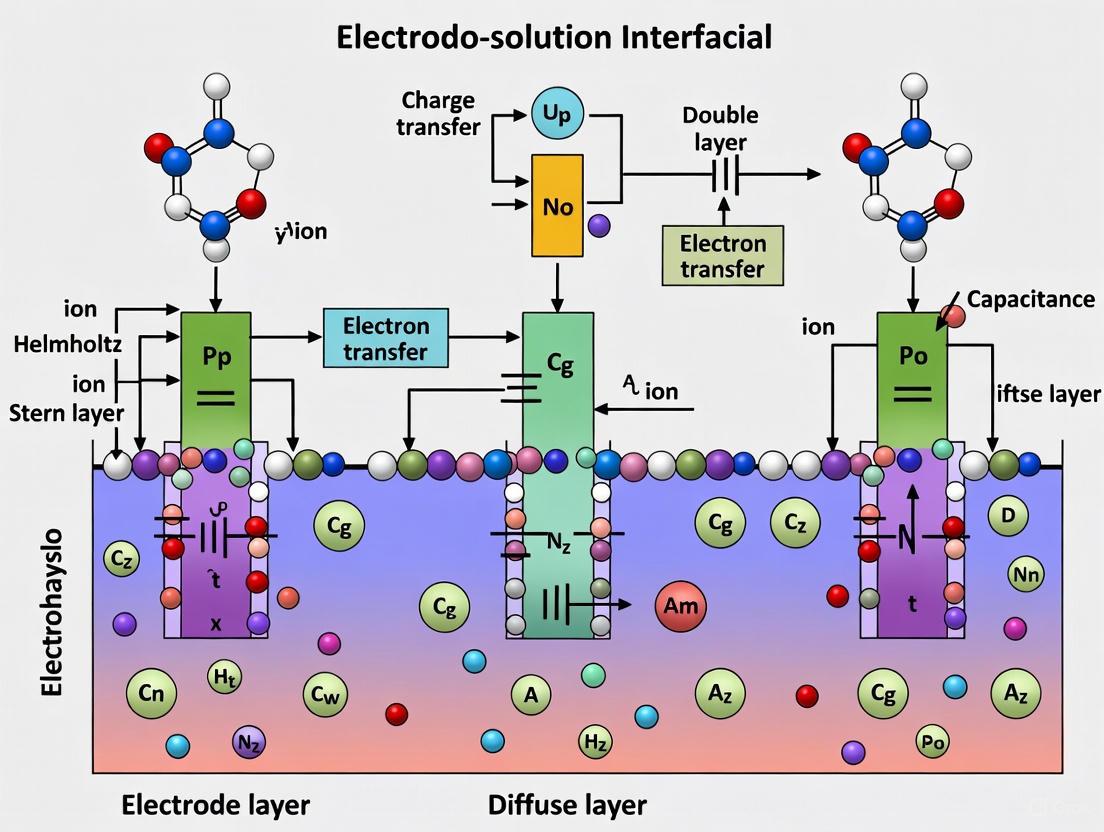
This article provides a comprehensive exploration of electrode-solution interfacial phenomena, a critical area governing processes in electrochemistry, biosensing, and drug development.
Electrode-Solution Interfacial Phenomena: Fundamentals, Methods, and Biomedical Applications
Abstract
This article provides a comprehensive exploration of electrode-solution interfacial phenomena, a critical area governing processes in electrochemistry, biosensing, and drug development. It begins by establishing the foundational principles of the electrical double layer and interfacial charging mechanisms. The scope then progresses to cover advanced methodological approaches, including both computational modeling and cutting-edge experimental techniques for in operando visualization. A dedicated section addresses common challenges and optimization strategies for interfacial performance and stability. Finally, the article synthesizes validation frameworks and comparative analyses of different interfacial systems. Tailored for researchers, scientists, and drug development professionals, this review connects fundamental interfacial science to practical applications in biomedical research and diagnostics.
Unraveling the Fundamentals: Core Principles of the Electrode-Solution Interface
The electrical double layer (EDL) is a fundamental concept in electrochemistry and surface science, describing the region of structured charges that forms at the interface between a solid surface and an adjacent liquid electrolyte. This interfacial structure is pivotal to numerous technological processes and biological systems, including energy storage devices like batteries and capacitors, electrocatalysis, biological cell membrane function, and lubrication systems [1] [2]. When a charged surface is immersed in an electrolyte, it attracts oppositely charged ions from the solution, creating two distinct charged regions: the charged surface itself and a counter-charged region in the liquid. The structure and dynamics of this EDL govern interfacial phenomena, controlling processes such as charge storage capacity, electron transfer rates, and colloidal stability [1]. Understanding the precise structure and potential distribution across this interface is therefore essential for advancing research in electrode-solution interfacial phenomena and for designing next-generation electrochemical devices.
Historical Development and Theoretical Models
The conceptual understanding of the EDL has evolved significantly over the past century, moving from simple capacitor models to increasingly sophisticated theories that account for atomic-scale structure and ion-ion interactions.
Classical EDL Models
The earliest EDL model was proposed by Helmholtz in 1879, who described the interface as a simple molecular capacitor consisting of a single layer of ions from the solution aligned rigidly at the electrode surface [2] [3]. This model presented a linear potential drop across a fixed distance but failed to account for the effects of ion concentration and thermal motion.
In the early 1900s, Gouy and Chapman independently developed a more realistic model by introducing the concept of a diffuse layer [3]. They recognized that ions in the electrolyte are not fixed but remain mobile, with their distribution governed by a balance between electrostatic attraction/repulsion and thermal motion. The Gouy-Chapman (GC) model successfully predicted that the potential decays exponentially from the electrode surface with a characteristic length scale known as the Debye length, which decreases with increasing electrolyte concentration [3]. However, this model treated ions as point charges without physical size, leading to unrealistic predictions at high potentials and concentrations.
Stern synthesized these approaches in 1920, combining the Helmholtz and Gouy-Chapman models to create the Gouy-Chapman-Stern (GCS) model [3]. This hybrid model divides the EDL into two regions: (1) an inner Stern layer (or Helmholtz layer) where ions are adsorbed directly onto the surface, and (2) an outer diffuse layer (or Gouy-Chapman layer) where ions are distributed statistically by electrostatic and thermal forces. The Stern layer accounts for the finite size of ions, while the diffuse layer captures the concentration dependence of the potential distribution.
Modern Theoretical Advances
Recent theoretical work has focused on developing more comprehensive models that accurately describe EDL behavior across diverse systems, from concentrated electrolytes to solid-state interfaces:
Density-Potential Functional Theory (DPFT): This approach hybridizes computational and conceptual methods, combining a parameterized quantum-mechanical treatment of electrons with a classical statistical treatment of charged particles in the solution phase. Unlike Kohn-Sham DFT, which requires calculating electronic orbitals, DPFT expresses the kinetic energy of electrons as an explicit functional of electron density, significantly reducing computational cost while maintaining physical accuracy [2].
Unified Core and Space Charge Model: For solid electrolytes, a recent framework simultaneously treats both the core layer and the space charge layer, incorporating variations in defect formation energy (DFE) and defect-defect interactions consistent with first-principles simulations. This model reveals that the core layer significantly impacts potential distribution and defect concentrations, substantially contributing to conductivity when the interfacial DFE is lower than the bulk DFE [4] [5].
Modified GCS Model for Water-in-Salt Electrolytes: For highly concentrated aqueous electrolytes, the classical GCS model has been adapted by incorporating ionicity (the ratio of experimental molar ionic conductivity to theoretical molar ionic conductivity) to calculate the Debye length. This modification accounts for ion pairing effects that become significant at high concentrations, accurately reproducing experimental trends in differential and EDL capacitance [3].
Table 1: Key Electrical Double Layer Models and Their Characteristics
| Model | Year | Key Features | Limitations |
|---|---|---|---|
| Helmholtz | 1879 | Rigid capacitor model; single ion layer; linear potential drop | Neglects ion mobility and concentration effects |
| Gouy-Chapman | 1910-1913 | Diffuse layer; ion distribution by electrostatics and thermal motion; Debye length | Treats ions as point charges; unrealistic at high potentials |
| Gouy-Chapman-Stern | 1920 | Combined Stern + diffuse layers; accounts for finite ion size | Does not fully capture atomic-scale structure or specific ion effects |
| Modern Approaches | 2000s | Atomistic simulations; density-functional theories; ion correlation effects | High computational cost; complex parameterization |
EDL Structure and Potential Distribution
The EDL structure encompasses several distinct regions, each with characteristic dimensions and physical properties that collectively determine the potential distribution across the interface.
Structural Components of the EDL
Inner Helmholtz Plane (IHP): This plane passes through the centers of specifically adsorbed ions that have lost their hydration shells and are in direct contact with the electrode surface. These ions are chemically bound to the surface.
Outer Helmholtz Plane (OHP): This plane passes through the centers of non-specifically adsorbed ions that remain fully solvated and are physically separated from the electrode by their hydration shells. The OHP conceptualizes the closest approach distance for solvated ions, typically located 0.3-0.8 nm from the surface [2].
Stern Layer: The region between the electrode surface and the OHP, containing both specifically and non-specifically adsorbed ions. The potential drops linearly across this layer.
Diffuse Layer: The region extending from the OHP into the bulk solution where ions are distributed according to a balance between electrostatic forces and thermal motion. The potential in this region decays approximately exponentially with distance from the electrode.
The following diagram illustrates the structure of the EDL and the corresponding potential distribution:
Potential Distribution Models
The potential distribution across the EDL varies significantly depending on the model applied:
- Helmholtz Model: Potential decreases linearly from the electrode surface to the Helmholtz plane.
- Gouy-Chapman Model: Potential decays exponentially from the electrode surface into the solution.
- Gouy-Chapman-Stern Model: Potential drops linearly across the Stern layer and exponentially through the diffuse layer.
The thickness of the diffuse layer is characterized by the Debye length (λ₉), which for a symmetric electrolyte is given by:
[ \lambdaD = \sqrt{\frac{\varepsilonr \varepsilon0 kB T}{2e^2 I}} ]
where εᵣ is the relative permittivity, ε₀ is the vacuum permittivity, k({}_{\text{B}}) is Boltzmann's constant, T is temperature, e is elementary charge, and I is ionic strength. In concentrated electrolytes, ion pairing reduces the effective concentration of charge carriers, requiring modification of the Debye length calculation using ionicity parameters [3].
Table 2: Key Parameters Governing EDL Structure and Potential Distribution
| Parameter | Symbol | Typical Range | Impact on EDL |
|---|---|---|---|
| Debye Length | λ₉ | ~1-100 nm | Determines diffuse layer thickness; decreases with concentration |
| Stern Layer Thickness | d | 0.3-0.8 nm | Distance of closest approach for solvated ions |
| Electrode Potential | E | System-dependent | Controls surface charge density and EDL structure |
| Ionic Strength | I | 1 mM - 10 M | Affects Debye length and EDL compression |
| Ionicity | α | 0-1 | Fraction of free ions; affects Debye length in concentrated electrolytes |
| Dielectric Constant | εᵣ | ~78 (water) | Medium polarity; affects electrostatic interactions |
Experimental Methodologies for EDL Investigation
Ultrafast Optical Spectroscopy
Recent advances have enabled direct observation of EDL formation dynamics using light-based techniques that circumvent the temporal limitations of electronic circuits [1].
Protocol: Ultrafast Laser Probing of EDL Dynamics at Aqueous Interfaces
- Sample Preparation: Prepare an aqueous electrolyte solution (e.g., acidified water generating H₃O⁺ ions) and contain it in a temperature-controlled vessel with a flat air-liquid interface.
- Perturbation Pulse: Apply an intense infrared laser pulse to the interface, which thermally perturbs the system by removing H₃O⁺ ions from the surface, disrupting the established EDL.
- Probe and Detection: After a precisely controlled time delay (femtoseconds to picoseconds), direct a second laser pulse (probe) at the interface and measure the reflected light intensity.
- Kinetic Monitoring: Repeat the measurement at varying time delays to monitor the relaxation of the perturbed system as ions move away from the interface to re-establish equilibrium.
- Data Analysis: Combine time-resolved reflectance data with computer simulations to quantify ion movement and validate theoretical models of EDL formation [1].
Electrochemical Impedance Spectroscopy (EIS)
EIS is a powerful method for characterizing the capacitive properties of the EDL across a range of frequencies.
Protocol: EDL Capacitance Measurement via EIS
- Cell Assembly: Configure a three-electrode system with the material of interest as working electrode, appropriate counter electrode, and stable reference electrode.
- Impedance Measurement: At open circuit potential, apply a small AC voltage amplitude (e.g., 10 mV) across a wide frequency range (typically 0.01 Hz to 100 kHz).
- Data Collection: Record the impedance (magnitude and phase) at each frequency.
- Analysis: Fit the resulting Nyquist or Bode plots to an equivalent circuit model containing a constant phase element (CPE) or capacitor representing the EDL. Extract the EDL capacitance values from the fit parameters [3].
Raman Spectroscopy for Ion Association Studies
Vibrational spectroscopy provides insights into ion pairing and solvation structures in bulk electrolytes and at interfaces.
Protocol: Raman Characterization of Ion Pairing in Water-in-Salt Electrolytes
- Sample Preparation: Prepare a series of electrolyte solutions across a concentration range (e.g., 0.5 to 20 mol kg⁻¹ for LiTFSI).
- Spectra Acquisition: Using a Raman spectrometer (e.g., Horiba LabRAM HR 800), acquire spectra of bulk solutions with appropriate laser wavelength and power settings.
- Spectral Analysis: Identify characteristic vibrational bands for free ions (e.g., TFSI⁻ S-N-S bending at ~740 cm⁻¹) and ion pairs (shifted bands). Deconvolute spectra to quantify relative proportions of free ions and ion pairs.
- Ionicity Calculation: Determine the ionicity parameter from conductivity measurements and use it to modify the Debye length calculation in EDL models [3].
Recent Research Advances and Applications
EDL in Solid Electrolytes
Recent unified EDL models for solid electrolytes simultaneously treat both the core layer and space charge layer, incorporating defect formation energy (DFE) variations and defect-defect interactions consistent with first-principles simulations. These models demonstrate that the core layer significantly impacts potential distribution and defect concentrations, substantially contributing to conductivity when the interfacial DFE is lower than the bulk DFE. This framework enables accurate predictions of capacitance and ionic conductivity essential for solid-state electrochemical devices [4] [5].
Water-in-Salt Electrolytes
For highly concentrated aqueous electrolytes (water-in-salt electrolytes), classical EDL models break down due to extensive ion pairing. Modified GCS models that incorporate ionicity to calculate the Debye length show a sharp decrease in Debye length as concentration increases from 1 to 10 mol kg⁻¹, followed by an increase due to ion pairing above 10 mol kg⁻¹. When applied to porous carbon electrodes, dividing the Debye length by the MacMullin number (ratio of tortuosity to porosity) allows estimation of ionic radii within pores and the extent of ion desolvation, revealing optimal concentrations for fast charging (5 mol kg⁻¹ LiTFSI) and highest energy density (10 mol kg⁻¹) [3].
Tribological Applications
The EDL plays a crucial role in tribology, where the repulsive forces between similarly charged surfaces in electrolyte solutions can support normal load and reduce friction. This effect is particularly important in achieving superlubricity (coefficient of friction < 0.01) in systems such as Si₃N₄ sliding in water, where a negatively charged silica layer forms on the friction pair. The EDL repulsive interaction mechanism has also been applied to explain superlubricity in phosphoric acid-lubricated ceramic contacts [2].
The Scientist's Toolkit: Essential Research Reagents and Materials
Table 3: Key Reagents and Materials for EDL Research
| Material/Reagent | Specifications | Research Function |
|---|---|---|
| Lithium Salts (LiTFSI) | High purity (>99.9%), anhydrous | Model electrolyte for water-in-salt studies; forms concentrated solutions |
| Aprotic Solvents | Acetonitrile, propylene carbonate | Low dielectric constant solvents for studying ion association |
| Aqueous Electrolytes | HCl, NaCl, CsCl solutions | Fundamental studies of EDL structure in biological systems |
| Porous Carbon Electrodes | Specific surface area >1500 m²/g, controlled pore size distribution | Investigating EDL formation in confinement |
| Solid Electrolytes | Ceramic oxides (LLZO), sulfides (LGPS) | Studying EDL at solid-solid interfaces |
| Reference Electrodes | Ag/AgCl, Hg/HgO, Li/Li⁺ | Potential control and measurement in three-electrode cells |
| Single Crystal Electrodes | Au(111), Pt(111), HOPG | Well-defined surfaces for fundamental EDL studies |
The electrical double layer represents a complex interfacial region whose structure and potential distribution govern critical processes in electrochemical energy storage, biological systems, and tribology. While classical models (Helmholtz, Gouy-Chapman, Stern) provide foundational concepts, recent advances in both theoretical modeling and experimental characterization have revealed the intricate details of EDL formation and dynamics across diverse systems. Modern approaches including density-potential functional theory, unified core-space charge models for solid electrolytes, and modified GCS models for concentrated electrolytes have significantly enhanced our ability to predict and optimize interfacial behavior for specific applications. The continued development of ultrafast spectroscopic techniques and computational methods promises to further unravel the complexities of the electrical double layer, enabling breakthroughs in electrode-solution interfacial phenomena research and the design of next-generation electrochemical devices.
Potential of Zero Charge (PZC) and Work Function
The Potential of Zero Charge (PZC) and the Work Function are two cornerstone concepts in the fundamental understanding of electrode-solution interfacial phenomena. The PZC is defined as the specific electrode potential at which there is no net electrical charge accumulated at the electrode-electrolyte interface [6] [7]. At this potential, the charge on the metal side of the electrical double layer is precisely zero. The work function (Φ), conversely, is a vacuum-based property defined as the minimum energy required to extract an electron from the bulk of a metal to a point in vacuum just outside the metal surface [7]. In electrochemical systems, these two properties are intrinsically linked, as the work function of the electrode material provides the fundamental reference point that determines the PZC in the absence of other interfacial interactions [7].
Understanding the relationship between PZC and work function is critical for rational design of electrocatalytic materials, particularly for energy conversion applications such as fuel cells and electrolyzers where platinum-group metals are extensively utilized [8] [7]. The interface structure at the atomic scale, including surface morphology and step densities, directly influences both the work function and the PZC through phenomena such as the Smoluchowski effect, where electron spillover at step sites creates surface dipoles that modify the interfacial electrostatics [8] [6]. This guide provides an in-depth technical examination of these interconnected concepts, detailing both theoretical foundations and practical experimental methodologies relevant to researchers investigating electrode-solution interfaces.
Theoretical Foundations and Physical Relationships
The Electronic Structure Perspective: Work Function and Surface Potential
The work function (Φ) of a metal surface represents a fundamental electronic property that is highly sensitive to atomic-level structure and composition. As illustrated in Figure 1, the work function is defined as the energy difference between the Fermi level (EF) of the metal and the vacuum energy level just outside the material surface [7]. This can be expressed as Φ = -EF - eχ, where χ represents the surface potential arising from the electron spillover at the metal-vacuum interface that creates a surface dipole [7]. Different crystallographic orientations exhibit distinct work functions due to variations in surface dipole; for platinum, Pt(111) exhibits a work function of 5.9 eV while Pt(100) measures 5.75 eV [7].
Table 1: Work Function Values for Different Platinum Surface Orientations
| Surface Orientation | Work Function (eV) | Key Structural Feature |
|---|---|---|
| Pt(111) | 5.9 | Close-packed, smooth |
| Pt(100) | 5.75 | More open structure |
| Stepped Surfaces | Intermediate values | Step-edge dipoles present |
The surface dipole (χ) emerges from the asymmetric electron distribution at the interface, where electrons spill over from the metal into the vacuum region, creating a charge separation layer typically on the order of a few angstroms thick [7]. This dipole layer is particularly pronounced at step edges and defect sites, where the electron density redistribution follows the Smoluchowski smoothing effect, resulting in localized surface dipoles that lower the overall work function compared to flat terraces [6].
The Electrochemical Perspective: Potential of Zero Charge
In the electrochemical environment, the Potential of Zero Charge (PZC) represents the equivalent concept to the work function, but transferred to the electrode-electrolyte interface [7]. At the PZC, the potential drop across the entire interface (Δφ) is governed solely by the dipole contributions, as there is no net electronic charge on the electrode surface [7]. The relationship between the work function and PZC can be conceptually expressed as E_PZC = Φ/e + δχ, where δχ represents the modification of the surface dipole due to the presence of the solvent and specifically the orientation of solvent dipoles at the interface [7].
For ideally polarizable electrodes without specific adsorption, the PZC can be directly determined from the minimum in the differential capacitance versus potential curve in dilute electrolyte solutions [6] [7]. However, for catalytically relevant metals like platinum that exhibit significant hydrogen and hydroxyl adsorption, the situation is considerably more complex. In these systems, it becomes essential to distinguish between the potential of zero free charge (pzfc), which relates to the true electronic excess charge on the metal, and the potential of zero total charge (pztc), which includes all charge that flows through the external circuit, including both capacitive and faradaic contributions [6]. Only the pzfc correlates directly with the electronic structure properties like work function, while the pztc is the parameter most readily accessible through conventional electrochemical measurements [6].
Interfacial Structure and Solvent Effects
The structure and composition of the electrode-electrolyte interface profoundly influence the relationship between work function and PZC. Water molecules at the interface adopt specific orientations and coordination patterns that contribute to the interfacial dipole. On platinum surfaces, water molecules can exist in several distinct motifs: (1) "Chemisorbed" water that lies nearly flat on the Pt surface with oxygen coordinated to the metal; (2) "H-down" water where one O-H bond points toward the surface, forming a weak covalent interaction with Pt; and (3) "Bridging" water that hydrogen-bonds to both the first and second hydration layers [8].
Advanced computational studies using ab initio molecular dynamics (AIMD) have revealed that water molecules directly contacting the Pt surface become partially charged and chemisorbed, thereby behaving more like ionic species than neutral dipoles [8]. This chemisorbed water layer contributes substantially to interfacial screening and differential capacitance, particularly around the PZC where the coverage of chemisorbed water correlates linearly with both metal capacitance and potential [8]. At higher potentials, this relationship breaks down due to water coverage saturation, while at lower potentials hydrogen adsorption becomes the dominant factor [8].
Experimental Methodologies and Protocols
Determining Work Function under Ultra-High Vacuum Conditions
The experimental determination of work function is typically conducted under ultra-high vacuum (UHV) conditions to eliminate surface contamination. The most direct method involves Kelvin Probe Force Microscopy (KPFM), which measures the contact potential difference between a reference tip and the sample surface. The experimental workflow involves:
- Sample Preparation: Single crystal surfaces are prepared through repeated cycles of argon ion sputtering and annealing to achieve well-defined surface structures.
- Surface Characterization: Low-energy electron diffraction (LEED) and scanning tunneling microscopy (STM) verify surface crystallography and absence of defects.
- Work Function Measurement: The Kelvin probe measures the contact potential difference between the sample and a reference tip of known work function, allowing absolute work function determination.
- Data Collection: Multiple measurements across different surface regions ensure statistical reliability and detect any spatial variations in work function.
This approach provides direct, quantitative work function values for different surface orientations and step densities, enabling correlation with electrochemical PZC measurements [6] [7].
Electrochemical Protocols for PZC Determination
CO Charge Displacement Method
For catalytically active metals like platinum that exhibit significant faradaic processes, the CO charge displacement method has emerged as the most reliable technique for determining the potential of zero total charge (pztc) [6]. The detailed experimental protocol is as follows:
- Electrode Preparation: A well-defined single crystal platinum electrode (e.g., Pt(111)) is prepared using the flame annealing technique developed by Clavilier [6], followed by cooling in ultrapure water saturated with an inert gas (Ar or N₂).
- Electrochemical Cell Setup: The electrode is transferred to an electrochemical cell containing deaerated electrolyte solution (typically 0.1M HClO₄ or HF) under controlled atmosphere to prevent oxygen contamination.
- Reference Electrode: A reversible hydrogen electrode (RHE) or saturated calomel electrode (SCE) is used as reference, with all potentials subsequently converted to the standard hydrogen electrode (SHE) scale.
- Potential Control: The working electrode is polarized to a specific potential (E*) within the electric double layer region (typically 0.3-0.5V vs. RHE for Pt(111)).
- CO Introduction: High-purity CO gas is introduced into the cell atmosphere while maintaining constant electrode potential.
- Charge Measurement: The charge flowing through the external circuit during CO adsorption is precisely measured via integration of the current transient.
- Data Analysis: The displaced charge (qdisp) is related to the initial interfacial charge (q(E*)) through the equation: qdisp = qCO - q(E*), where qCO represents the residual charge on the CO-covered surface [6].
- PZTC Determination: The experiment is repeated at different potentials, and the pztc is identified as the potential where q(E) = 0 after accounting for the small but non-zero q_CO value.
This method has been successfully applied to determine pztc values for Pt(111) in both acidic and alkaline environments [6].
Differential Capacitance Minimum Method
For electrodes without significant faradaic processes, the classic approach involves identifying the potential at which the differential capacitance reaches a minimum in dilute electrolyte solutions [6] [9]. The experimental workflow includes:
- Electrode Preparation: A renewable pencil lead electrode can be utilized, where a fresh surface is exposed using a cutting device immediately before measurement [9].
- Impedance Spectroscopy: Electrochemical impedance spectra are recorded across a wide potential range (typically -0.5V to +0.5V vs. reference) using a small AC perturbation (5-10 mV amplitude) across frequencies from 10 kHz to 0.1 Hz.
- Differential Capacitance Calculation: The double-layer capacitance (C_dl) is extracted from the impedance data at each potential, typically by fitting the data to an appropriate equivalent circuit model.
- PZC Identification: The PZC corresponds to the potential value at which the differential capacitance curve exhibits a minimum in dilute electrolytes where specific adsorption is absent [9].
This method is particularly suitable for carbon-based materials and noble metals like gold and silver that do not exhibit significant hydrogen adsorption [6] [9].
Advanced Computational Approaches
Modern computational methods provide atomistic insights into the relationship between work function and PZC. Ab initio molecular dynamics (AIMD) with explicit solvent molecules allows for realistic modeling of the electrode-electrolyte interface under controlled electrode potentials [8]. Key computational protocols include:
- System Setup: Construction of stepped Pt slab models incorporating (111) terraces with (111)×(111) and (111)×(100) step edges, solvated with explicit water molecules and ions [8].
- Potential Control: Implementation of the ion imbalance method to control electrode potential by introducing an imbalance in the number of ions in solution, allowing the electrode to charge in response [8].
- Potential Drop Calculation: Evaluation of the potential drop with respect to the electrostatic potential in the bulk electrolyte region [8].
- Electronic Structure Analysis: Calculation of local density of states, d-band centers, and charge distribution profiles across the interface.
- Water Structure Analysis: Identification of water orientation motifs and their potential-dependent coverage.
These computational approaches have revealed that step edges on platinum surfaces accumulate excess positive charge and exhibit locally elevated electrostatic potential, creating a greater barrier for electron accumulation compared to terraces [8]. This fundamental insight explains the experimentally observed shift in PZC with increasing step density and provides a mechanistic understanding of why step edges often demonstrate enhanced catalytic activity [8].
Research Tools and Materials
Table 2: Essential Research Reagents and Materials for PZC/Work Function Studies
| Item | Specification | Function/Application |
|---|---|---|
| Single Crystal Electrodes | Pt(111), Pt(100), Au(111) with various step densities | Well-defined surface structure for fundamental studies |
| Electrolyte Solutions | 0.1M HClO₄, 0.1M HF, ultrapure grade | Minimize specific adsorption; HF useful for AIMD simulations |
| Reference Electrodes | Reversible Hydrogen Electrode (RHE), Saturated Calomel | Potential referencing with known relationship to SHE |
| High-Purity Gases | Argon (99.999%), CO (99.99%), N₂ (99.999%) | Solution deaeration; CO charge displacement experiments |
| Renewable Electrodes | Pencil lead electrodes with cutting device | Fresh surfaces for each measurement; minimizes contamination |
| Computational Models | Stepped Pt slabs with (111)×(111) and (111)×(100) edges | Atomistic modeling of realistic nanostructured surfaces |
Interfacial Phenomena and Practical Implications
Surface Morphology Effects on Interfacial Properties
Surface nanostructuring profoundly influences both work function and PZC through the creation of localized electronic states and interfacial dipoles. Stepped platinum surfaces exhibit significantly different electrochemical behavior compared to atomically flat terraces [8]. Advanced AIMD simulations have revealed that:
- Step edges accumulate excess positive charge and exhibit locally elevated electrostatic potential, creating a greater barrier for electron accumulation compared to terraces [8].
- Water chemisorption saturates step edges even below the PZC, while terrace sites exhibit potential-dependent water coverage that primarily determines the differential capacitance near PZC [8].
- The d-band center shifts to higher energies at step edges, with sharper projected density of states that supports their role as active, positively charged catalytic centers [8].
These nanoscale variations in electronic structure and interfacial charging directly impact electrocatalytic activity. The electrostatic asymmetry between terraces and steps creates heterogeneous reaction environments that can selectively enhance certain electrochemical pathways while suppressing others [8].
Table 3: Effect of Surface Morphology on Interfacial Properties of Platinum
| Surface Feature | Effect on Work Function | Effect on PZC | Impact on Interfacial Water |
|---|---|---|---|
| Flat Terraces | Higher work function (5.9 eV for Pt(111)) | Higher PZC | Potential-dependent chemisorption |
| Step Edges | Lower work function due to Smoluchowski effect | Lower PZC | Permanent chemisorption saturation |
| (111)×(111) Steps | Intermediate reduction | Moderate PZC shift | Strong water anchoring sites |
| (111)×(100) Steps | Maximum reduction | Maximum PZC shift | Complex water ring structures |
Implications for Electrocatalysis and Sensor Design
The relationship between work function and PZC provides fundamental insights for rational design of electrocatalytic materials and electrochemical sensors. Key implications include:
Catalytic Activity Optimization: The lower PZC of step edges compared to terraces creates locally distinct electrostatic environments that influence adsorption energies of reactive intermediates. This explains why stepped surfaces often exhibit enhanced activity for reactions like hydrogen evolution/oxidation [8].
Interfacial pH Considerations: The potential difference across the interface relative to PZC governs the local proton activity, creating interfacial pH conditions that may differ significantly from the bulk solution [6]. This effect must be considered when designing sensors or catalytic systems operating near the PZC.
Nanostructuring Strategies: deliberate introduction of step edges and defects can optimize interfacial charging behavior to enhance selectivity for specific electrochemical reactions. The spatial distribution of charged sites creates heterogeneous reaction fields that can be engineered for improved performance [8].
Sensor Development: Understanding the PZC enables optimization of sensor operating potentials to minimize non-specific adsorption and background charging currents, thereby improving signal-to-noise ratios in analytical applications [9] [10].
The fundamental relationship between Potential of Zero Charge and Work Function provides a critical bridge between vacuum-based surface science and electrochemical interface phenomena. For platinum and other catalytically important metals, this relationship is modulated by surface morphology, solvent interactions, and specific adsorption processes. The experimental methodologies detailed in this guide, particularly the CO charge displacement technique for active metals and the differential capacitance approach for ideally polarizable interfaces, enable precise determination of the PZC under electrochemical conditions. Complementary computational approaches using AIMD provide atomistic insights into the potential-dependent structure of the electrical double layer and the nanoscale variations in interfacial electrostatics at terraces versus step edges.
This integrated understanding of how electronic structure (work function) manifests in electrochemical environments (PZC) establishes a predictive framework for rational design of advanced electrochemical interfaces. By controlling surface morphology to manipulate the relationship between work function and PZC, researchers can optimize interfacial charging behavior to enhance performance in diverse applications ranging from electrocatalytic energy conversion to electrochemical sensing and beyond.
Electrode-solution interfacial phenomena represent a critical frontier in modern electrochemical science, governing processes essential for energy conversion, storage, and material synthesis. The interface between a solid electrode and a liquid electrolyte serves as a dynamic region where complex charging mechanisms—including dissolution, hydration, and ion absorption—dictate system performance and efficiency. These processes occur within the electrical double layer, a nanoscale region where the organized arrangement of solvent molecules, ions, and electrode surfaces creates a unique environment with properties distinct from the bulk phases [11]. Understanding these mechanisms is paramount for advancing numerous technologies, including lithium-ion batteries, electrocatalytic systems, and carbon capture solutions.
The structure and behavior of interfacial water molecules form the foundation of these charging mechanisms. As highlighted in recent research, interfacial water serves not merely as a solvent but as an active participant in electrochemical processes, acting as a co-catalyst, regulator of reaction intermediates, and sometimes as an inducer of catalyst reconfiguration [11]. Its unique configurations—including dangling O–H water, dihedral coordinated water, and tetrahedral coordinated water—directly influence proton transfer, intermediate stabilization, and reaction kinetics. These molecular-level interactions ultimately determine macroscopic performance metrics in electrochemical devices [11].
This whitepaper examines the fundamental mechanisms of interfacial charging, with particular emphasis on dissolution, hydration, and ion absorption processes. By synthesizing recent experimental and computational advances, we aim to provide a comprehensive technical guide for researchers investigating electrode-solution interfaces across diverse applications.
Fundamental Mechanisms
Dissolution Mechanisms
Dissolution represents a critical interfacial charging mechanism wherein constituent ions transition from the solid electrode lattice into the adjacent solution phase. Recent single-ion level studies have revealed that dissolution is not a homogeneous process but exhibits strong ion-specific characteristics. For NaCl dissolution, experimental evidence demonstrates that anions (Cl⁻) dissolve preferentially over cations (Na⁺) due to their higher polarizability, which enables stronger interactions with water dipoles [12].
The dissolution process initiates when water molecules adsorb at under-coordinated sites on the crystal surface, particularly at atomic steps and defects. Through scanning tunneling microscopy (STM) experiments, researchers have observed that a single water molecule can selectively dissolve a single Cl⁻ ion from a NaCl surface when manipulated to step edges [12]. The mechanism proceeds through several distinct stages:
- Water Adsorption: A water molecule adsorbs preferentially near cationic sites (Na⁺) at interfacial steps, with an adsorption energy of approximately -750 meV—significantly stronger than adsorption on terraces (-385 meV) [12].
- Dipole-Induced Polarization: The water dipole moment polarizes the adjacent anion (Cl⁻), concentrating its electron cloud toward the water molecule.
- Bond Weakening: This polarization weakens the ionic bond between Na⁺ and Cl⁻ ions in the crystal lattice.
- Ion Release: The weakened ionic bond breaks, releasing the Cl⁻ ion into the solution phase.
This ion-specific dissolution mechanism underscores the critical role of polarizability differences between anions and cations in determining dissolution kinetics. The findings challenge classical dissolution models that treat anions and cations equivalently, providing instead a molecular-level picture of selective ion release driven by water-ion interactions [12].
Hydration Processes
Hydration encompasses the molecular-level interactions between water molecules and dissolved ions, forming solvation shells that significantly influence interfacial charge transfer. The structure and dynamics of these hydration shells dictate ion mobility, reactivity, and stability in electrochemical environments.
The CO₂ hydration reaction at air-water interfaces exemplifies the complex nature of interfacial hydration processes. Contrary to previous assumptions that interfacial reactions differ substantially from bulk processes, recent machine learning simulations reveal that CO₂ hydration follows a surface-mediated "in-and-out" mechanism [13]:
- Ingress: CO₂ molecules diffuse into the aqueous surface layer.
- Reaction: The dissolved CO₂ reacts with water to form carbonic acid (H₂CO₃) through a nucleophilic addition mechanism.
- Expulsion: The carbonic acid product is subsequently expelled from the solution phase.
This mechanism occurs within a surface layer that provides a bulk-like solvation environment, with similar coordination numbers and hydrogen-bonding patterns to fully solvated conditions [13]. The free energy profiles and barriers for interfacial CO₂ hydration are nearly identical to those in bulk water, suggesting that hydration reactions can proceed with comparable feasibility at interfaces and in bulk solution.
Similar principles govern ion hydration in battery electrolytes, where solvation structure directly impacts electrochemical performance. In aqueous zinc-ion batteries, for instance, the hydration shell of Zn²⁺ ions contains water molecules that actively participate in electrode processes. Modifying this solvation structure through electrolyte additives like tetrahydrofurfuryl alcohol (THFA) can displace coordinated water molecules, thereby suppressing detrimental side reactions and improving cycling stability [14].
Ion Absorption and Interfacial Charge Transfer
Ion absorption describes the process wherein ions from the solution phase are incorporated into the electrode surface or near-surface region, facilitating charge transfer across the interface. This process is fundamental to the operation of batteries, electrocatalytic systems, and numerous other electrochemical technologies.
In lithium-ion batteries, interfacial charge-transfer kinetics govern key performance metrics such as rate capability, cycling stability, and low-temperature operation. The Butler-Volmer equation traditionally describes these kinetics, relating current (I) to overpotential (η) through the exchange current (I₀) and charge transfer coefficient (α) [15]:
[I = I_0 \left( \exp\left(\frac{\alpha F}{RT}\eta\right) - \exp\left(-\frac{(1-\alpha)F}{RT}\eta\right) \right)]
Recent investigations have revealed that complex multi-step interfacial reactions in real battery systems can yield apparent transfer coefficients that deviate significantly from the theoretically expected value of α ≈ 0.5 for simple one-electron transfer reactions. For instance, LiFePO₄ electrodes exhibit an apparent α value of ~1.5, with the true charge-transfer coefficient approaching ~3 when accounting for non-uniform current distribution effects [15].
The ion absorption process is further influenced by the structure and composition of the electrode-electrolyte interface. In graphite anodes for lithium-ion batteries, the limited interlayer spacing (0.335 nm) constrains lithium-ion insertion, particularly under fast-charging conditions [16]. Strategic interface engineering through hard carbon coatings can enhance lithium-ion absorption kinetics by providing additional storage sites and reducing diffusion barriers, ultimately improving fast-charging performance [16].
Table 1: Key Parameters in Interfacial Charging Mechanisms
| Mechanism | Governing Factors | Characteristic Energy/Time Scales | Experimental Techniques |
|---|---|---|---|
| Dissolution | Ion polarizability, surface defects, water orientation, temperature | Adsorption energy: -385 to -750 meV [12] | Scanning Tunneling Microscopy (STM), Density Functional Theory (DFT) |
| Hydration | Ion size/charge, hydrogen bonding, solvent dipole moment, interface structure | Free energy barrier: ~22 kcal/mol for CO₂ hydration [13] | Machine Learning Potentials (MLPs), Ab Initio Molecular Dynamics (AIMD) |
| Ion Absorption | Applied potential, ion size, solvation energy, surface chemistry | Exchange current density: varies with material (e.g., LCO, LFP) [15] | Electrochemical Impedance Spectroscopy (EIS), Tafel analysis, Chronopotentiometry |
Experimental and Computational Methodologies
Single-Ion Dissolution Experiments
The investigation of dissolution mechanisms at the single-ion level requires sophisticated experimental approaches that combine atomic-scale imaging with precise manipulation capabilities. The following protocol, adapted from pioneering work on NaCl dissolution, provides a methodology for directly observing dissolution events [12]:
Materials and Equipment:
- Ultra-high vacuum (UHV) chamber with base pressure < 1×10⁻¹⁰ mbar
- Low-temperature scanning tunneling microscope (STM) capable of operating at 5-20 K
- Ag(100) single crystal substrate
- 1100 aluminum alloy foils (0.051-0.127 mm thickness)
- High-purity NaCl source for thermal evaporation
- Deuterium or tritium water sources to minimize vibrational interference
Sample Preparation:
- Clean the Ag(100) substrate through repeated cycles of Ar⁺ sputtering (1 keV, 15 μA, 30 min) and annealing (770 K, 30 min) until a sharp (1×1) low-energy electron diffraction pattern is observed.
- Deposit 2-3 monolayers of NaCl onto the clean Ag(100) surface by thermal evaporation from a Knudsen cell at 770 K.
- Introduce deuterated water (D₂O) onto the sample surface held at temperatures below 20 K to ensure individual water molecules remain isolated on the surface.
STM Manipulation and Imaging:
- Acquire high-resolution images of individual water molecules on NaCl terraces and steps using typical tunneling parameters (sample bias: 20-100 mV, tunneling current: 5-50 pA).
- Position the STM tip above a target water molecule at the step edge of a NaCl island.
- Approach the tip to a close distance (approximately 300 pm from the molecule) while reducing the sample bias below 450 mV to avoid excitation of vibrational modes.
- Drag the water molecule along desired crystallographic directions (<100> or <110>) while continuously recording tip height variations.
- Monitor for dissolution events characterized by the appearance of vacancy defects at step edges and corresponding changes in water molecule behavior.
Data Analysis:
- Analyze tip height traces during manipulation to extract frictional thresholds and interaction potentials.
- Correlate manipulation directions with dissolution probabilities.
- Calculate adsorption energies and interaction strengths from manipulation data and complementary DFT calculations.
This approach enables the direct observation of dissolution initiation at the single-ion level, providing unprecedented insight into the role of water-ion interactions in driving dissolution processes.
Machine Learning Potentials for Hydration Studies
The investigation of hydration mechanisms at interfaces benefits from advanced computational approaches that bridge accuracy and computational efficiency. Machine learning potentials (MLPs) trained on first-principles data have emerged as powerful tools for simulating complex interfacial reactions with ab initio-level accuracy. The following protocol outlines the development and application of MLPs for studying CO₂ hydration at air-water interfaces [13]:
Software and Computational Resources:
- Density functional theory (DFT) packages (VASP, Quantum ESPRESSO, or CP2K)
- MLP training frameworks (MACE, NequIP, or SchNet)
- Enhanced sampling libraries (PLUMED, SSAGES)
- High-performance computing cluster with GPU acceleration
Model Development Protocol:
- Dataset Generation:
- Perform ab initio molecular dynamics (AIMD) simulations of CO₂-water systems at various configurations (gas phase, bulk solution, interface).
- Extract diverse molecular structures representing reactant, transition, and product states.
- Include configurations with varying CO₂-water coordination environments and protonation states.
- Ensure comprehensive coverage of the relevant configurational space.
Model Training:
- Employ the MACE (Multi-Atomic Cluster Expansion) architecture, which combines atomic cluster expansion with message-passing neural networks.
- Train on energies and forces from DFT calculations using revPBE-D3, BLYP-D3, or random phase approximation (RPA) functionals.
- Implement a 80:10:10 training:validation:test split with temporal stratification to prevent data leakage.
- Utilize iterative active learning to refine the model in poorly sampled regions.
Validation and Testing:
- Calculate root-mean-square errors (RMSE) for energies (< 1 meV/atom) and forces (< 50 meV/Å) on test sets.
- Compare potential energy surfaces along key reaction coordinates with direct DFT calculations.
- Validate against experimental observables where available (reaction rates, spectroscopic data).
Simulation of Interfacial Hydration:
- Construct air-water interface systems with sufficient dimensions (typically > 1000 water molecules) to minimize finite-size effects.
- Perform well-tempered metadynamics simulations using collective variables that describe:
- C–O coordination number (sCO) to monitor nucleophilic attack
- Proton transfer coordinate to track acid-base chemistry
- Spatial position relative to the Gibbs dividing surface
- Extract free energy profiles and kinetic parameters from biased simulations using reweighting techniques.
- Analyze solute-solvent coordination, hydrogen bonding patterns, and solvent dynamics as functions of position relative to the interface.
This computational framework enables the investigation of hydration reactions with quantum-mechanical accuracy across extended time- and length-scales, providing molecular-level insights into interfacial reaction mechanisms.
Diagram 1: Machine Learning Potential Workflow for Hydration Studies
Electrochemical Kinetics Measurements
Quantifying interfacial charge-transfer kinetics is essential for understanding ion absorption processes in electrochemical systems. The following protocol outlines advanced electrochemical techniques for measuring charge-transfer kinetics at high current densities, as applied to lithium-ion battery materials [15]:
Materials and Equipment:
- Symmetric cell configuration with identical working and counter electrodes
- Precision potentiostat/galvanostat with high-current capability (>10 mA cm⁻²)
- Environmental chamber for temperature control (±0.1°C)
- Reference electrode (optional, for three-electrode measurements)
- Electrolyte with controlled moisture content (<10 ppm H₂O)
Cell Fabrication:
- Synthesize or procure high-quality active materials with well-defined morphology (e.g., single-crystal LiCoO₂ with ∼3 μm particle size).
- Prepare electrode slurry with active material, conductive carbon, and binder in appropriate ratios (e.g., 94:3:3 by weight).
- Coat electrodes onto current collectors with controlled mass loading (~10 mg cm⁻²).
- Assemble symmetric cells in an argon-filled glovebox with appropriate separators and electrolyte.
Electrochemical Techniques:
- Pseudo-Steady-State Extrapolation Chronopotentiometry (S3E-CP):
- Apply a series of constant current pulses with increasing magnitude (0.1 to 10 mA cm⁻²).
- Use pulse durations sufficient to reach voltage pseudo-plateaus (typically 10-60 seconds).
- Include sufficient relaxation time between pulses to restore equilibrium.
- Record the overpotential (η) at the end of each pulse.
- Plot η vs. log(I) and fit the linear Tafel region to extract I₀ and α.
Large-Amplitude Galvano Electrochemical Impedance Spectroscopy (LA-GEIS):
- Superimpose a small AC perturbation (≤ 10 mV) on a large DC current bias.
- Sweep frequency from high to low (e.g., 100 kHz to 10 mHz) at each DC current.
- Measure impedance spectra at multiple DC current densities spanning the linear and non-linear regimes.
- Extract differential charge-transfer resistance (R'ₜ) from the diameter of high-frequency semicircles.
Operando Galvano Electrochemical Impedance Spectroscopy (O-GEIS):
- Conduct LA-GEIS measurements during slow galvanostatic cycling.
- Acquire impedance spectra at regular state-of-charge intervals throughout charge/discharge cycles.
- Monitor changes in charge-transfer kinetics as a function of lithiation degree.
Data Analysis:
- Precisely compensate for ohmic resistance (RΩ) using current-interruption or high-frequency intercept methods.
- Fit charge-transfer resistance versus current density data to the modified Butler-Volmer equation: R'ₜ = (RT/(αFI₀)) × (exp(-αFη/RT) + ((1-α)/α)exp((1-α)Fη/RT))⁻¹
- Extract apparent α and I₀ values through non-linear regression.
- Account for non-uniform current distribution effects in porous electrodes.
This methodology enables accurate measurement of interfacial charge-transfer kinetics under operationally relevant conditions, providing crucial parameters for optimizing ion absorption processes in electrochemical devices.
Table 2: Key Research Reagents and Materials for Interfacial Studies
| Category | Specific Materials | Function/Application | Key Characteristics |
|---|---|---|---|
| Substrate Materials | Ag(100) single crystal, Highly Oriented Pyrolytic Graphite (HOPG) | Provides atomically flat surfaces for model interface studies | Defined crystallographic orientation, low surface roughness |
| Electrode Materials | Single-crystal LiCoO₂ (LCO), LiFePO₄ (LFP), Artificial graphite | Active materials for battery interface studies | Controlled morphology, well-defined electrochemistry |
| Salts & Electrolytes | Sodium chloride (NaCl), Zinc trifluoromethanesulfonate (Zn(OTf)₂), Lithium hexafluorophosphate (LiPF₆) | Ionic conductors for fundamental studies and applications | High purity, controlled water content, electrochemical stability |
| Additives & Modifiers | Tetrahydrofurfuryl alcohol (THFA), Phenol-formaldehyde resin, Glucose | Interface modification, solvation structure control | Selective adsorption, compatibility with electrochemistry |
| Characterization Tools | 1100 Aluminum alloy foils, Polyimide tape (Kapton), Chloroplatinic acid | Experimental components for specific techniques | Thermal/electrical properties, defined thickness |
Interfacial Structure-Property Relationships
The performance of electrochemical interfaces is governed by fundamental relationships between molecular-level structure and macroscopic properties. Understanding these relationships enables the rational design of interfaces with enhanced functionality.
Water Structure and Electrocatalytic Activity
The structure and orientation of interfacial water molecules profoundly influence electrocatalytic processes. Recent studies have identified specific water configurations that correlate with enhanced activity for reactions such as the hydrogen evolution reaction (HER) [11]. Dangling O–H water molecules—characterized by weak interactions between their O–H bonds and the catalyst surface—exhibit superior dissociation activity compared to other water configurations. This enhanced activity stems from reduced energy barriers for water dissociation and improved binding affinity for reactive intermediates [11].
The hydrogen bonding network of interfacial water further modulates electrocatalytic performance by influencing proton transfer kinetics. Well-connected hydrogen-bonded networks facilitate rapid proton transport through the Grotthuss mechanism, while disrupted networks can impede proton diffusion and increase overpotentials. These structure-activity relationships highlight the importance of characterizing and controlling interfacial water structure for optimizing electrocatalytic systems.
Solvation Structure and Interfacial Stability
In energy storage systems, the solvation structure of ions determines their interfacial behavior and the stability of electrode-electrolyte interfaces. In aqueous zinc-ion batteries, the hydration shell of Zn²⁺ ions contains water molecules that participate in parasitic reactions at the electrode surface, leading to capacity fade and poor cycling stability [14].
Strategic modification of the solvation structure through electrolyte additives can mitigate these issues. Tetrahydrofurfuryl alcohol (THFA), for example, preferentially adsorbs onto electrode surfaces, displacing interfacial water molecules and forming a protective layer that suppresses water-induced degradation [14]. Simultaneously, THFA interacts with Zn²⁺ ions, reducing the coordination number of active water molecules in the primary solvation shell. These dual effects significantly enhance interfacial stability and improve cycling performance, demonstrating how molecular-level control of solvation structure enables practical advances in electrochemical technology.
Surface Chemistry and Ion Absorption Kinetics
The chemical composition and morphology of electrode surfaces directly influence ion absorption kinetics and interfacial charge transfer. In graphite anodes for lithium-ion batteries, the limited interlayer spacing (0.335 nm) constrains lithium-ion insertion, particularly under fast-charging conditions [16]. This limitation becomes especially pronounced at high currents, where localized potential variations can drive lithium plating and dendrite formation.
Surface engineering through hard carbon coatings provides an effective strategy for enhancing ion absorption kinetics. Hybrid graphite anodes with hard carbon coatings exhibit approximately 8% higher reversible lithium content under fast-charging conditions, triple the exchange current density, and reduced Tafel slopes compared to unmodified graphite [16]. These improvements stem from the synergistic interaction between the coating and the underlying graphite, which provides additional lithium storage sites, reduces diffusion barriers, and mitigates electrode polarization. This example illustrates how tailored interface design can overcome intrinsic material limitations to achieve enhanced electrochemical performance.
Diagram 2: Interfacial Structure-Property Relationships
The investigation of interfacial charging mechanisms—dissolution, hydration, and ion absorption—reveals the profound complexity of electrode-solution interfaces. Through advanced experimental and computational techniques, researchers have uncovered fundamental principles governing these processes, from the single-ion dissolution events driven by water-ion interactions to the collective dynamics of solvation shells influencing interfacial charge transfer.
The structure and behavior of interfacial water emerge as a central theme across these mechanisms, serving not merely as a passive medium but as an active participant in electrochemical processes. Understanding and controlling water molecular configurations enables enhanced electrocatalytic activity and improved interface stability. Similarly, tailoring solvation structures and electrode surface properties allows for optimized ion absorption kinetics, directly impacting the performance of energy storage and conversion systems.
As research in this field advances, the integration of multi-scale techniques—from single-molecule manipulation to machine learning-assisted simulations—will continue to unravel the complexities of interfacial phenomena. These insights will guide the rational design of next-generation electrochemical technologies with enhanced efficiency, stability, and functionality, ultimately contributing to solutions for pressing global challenges in energy and sustainability.
The Critical Role of Interfacial Water Networks and Solvent Dynamics
The electrode–electrolyte interface constitutes the critical boundary where key electrochemical processes occur, governing the efficiency of energy conversion systems and catalytic reactions. A deep understanding of these interfaces requires the development of modelling protocols spanning from the local microscale to system-level macroscopic sizes, validated through comparison with high-quality experimental results [17]. Within this interface, water molecules form complex, dynamic networks that mediate proton transfer, influence reaction intermediate adsorption, and determine overall catalytic kinetics. Recent research has revealed that the unique properties of interfacial water molecules—including their distribution, orientation, hydrogen-bonding configuration, and interaction with solvated ions—exert profound effects on electrochemical processes ranging from hydrogen oxidation/evolution reactions to electrocatalytic hydrogenation [18]. The rigidity or flexibility of these water networks significantly impacts mass transport limitations, particularly in alkaline environments where additional energy is required for hydroxyl species to migrate from the electrolyte to the catalyst surface [19]. This technical guide examines the fundamental principles, experimental methodologies, and regulatory strategies for interfacial water networks within the broader context of electrode-solution interfacial phenomena research.
Quantitative Data on Interfacial Water Effects
The following tables summarize key quantitative findings from recent studies investigating interfacial water structure and its impact on electrochemical performance.
Table 1: Performance Enhancement Through Interfacial Water Regulation in Hydrogen Oxidation/Evolution Reactions
| Catalyst System | Modification Strategy | Performance Metric | Enhanced Value | Reference |
|---|---|---|---|---|
| Pt–Se-2 nanocatalyst | In situ Se leaching & surface Se decoration | Alkaline HOR intrinsic activity (j₀,s) | 0.552 mA cm⁻² | [19] |
| Pt–Se-2 nanocatalyst | In situ Se leaching & surface Se decoration | Alkaline HOR mass activity (jₖ,m @ 50 mV) | 1.084 mA μg⁻¹ | [19] |
| Cos-SO-Ru nanoclusters | Sulfo-oxygen bridging between Co and Ru sites | HOR/HER activity | Significantly higher than Cos-Ru | [20] |
Table 2: Hydration Free Energy Correlation with Surface Chemistry and Pattern
| Surface Chemistry | Pattern Type | Polar Group Fraction | Hydration Free Energy (kBT) | Hydrophobicity Trend |
|---|---|---|---|---|
| Methyl (nonpolar) | Homogeneous | 0.0 | Lowest | Most hydrophobic |
| Amine-functionalized | Separated | 0.4 | Intermediate | Moderate hydrophobicity |
| Amide-functionalized | Separated | 0.4 | Highest | Least hydrophobic |
| Amine-functionalized | Checkered | 0.4 | Differs from separated | Pattern-dependent |
| Hydroxyl-functionalized | Both | Varying | Non-additive with fraction | Cooperative effects |
Experimental Protocols for Interfacial Water Characterization
In Situ Surface-Enhanced Infrared Absorption Spectroscopy (SEIRAS)
Application: This technique was employed to investigate the structure of interfacial water molecules during the hydrogen oxidation reaction (HOR) on reconstructed Pt–Se catalysts [19].
Detailed Methodology:
- Prepare a thin catalyst film on a reflective substrate (typically gold or platinum)
- Mount the electrode in an electrochemical cell with a calcium fluoride (CaF₂) window that is IR-transparent
- Acquire background spectra at the controlled potential in an inert atmosphere
- Introduce H₂-saturated 0.1 M KOH electrolyte while maintaining potential control
- Collect spectra during linear sweep voltammetry cycles from 0.05 to 1.0 V vs. RHE
- Focus on the O-H stretching region (3000-3600 cm⁻¹) and H-O-H bending mode (~1640 cm⁻¹)
- Analyze spectral changes to determine water orientation and hydrogen-bonding strength
Key Findings: The accumulated electrons on surface-decorated Se atoms in Pt–Se catalysts induced regulation of the interfacial water structure, disrupting the rigid water network in the electric double-layer region and facilitating OH⁻ migration to the catalyst surface [19].
Hydration Free Energy Calculation via Molecular Dynamics
Application: This computational approach quantifies interfacial hydrophobicity by measuring the thermodynamic driving forces underlying hydrophobic assembly [21].
Detailed Methodology:
- Construct atomistic models of self-assembled monolayers (SAMs) with defined chemical compositions and patterns
- Perform Molecular Dynamics (MD) simulations using packages like GROMACS or NAMD with water models (e.g., TIP3P, SPC/E)
- Apply Enhanced Sampling techniques, specifically Indirect Umbrella Sampling (INDUS)
- Define a cuboidal cavity (2.0 × 2.0 × 0.3 nm³) near the SAM-water interface
- Calculate the hydration free energy (μν), or excess chemical potential, which reports on water density fluctuations
- Analyze a large dataset of SAMs (58 systems) with varying polar groups, compositions, and patterns
- Identify correlations between interfacial water structure features and hydration free energies
Key Findings: Only five specific features of interfacial water structure were required to accurately predict hydration free energies, with the probability of highly coordinated water structures identified as a unique signature of hydrophobicity [21].
In Situ Reconstruction and Phase Transition Monitoring
Application: Studying the dynamic evolution of PtSe₂ catalysts during activation for alkaline hydrogen oxidation reaction [19].
Detailed Methodology:
- Synthesize hexagonal close-packed PtSe₂ alloys via colloidal method with varying Pt:Se ratios
- Prepare rotating disk electrode with catalyst ink (catalyst + carbon support + Nafion binder)
- Perform linear sweep voltammetry (LSV) cycles in H₂-saturated 0.1 M KOH electrolyte
- Monitor current density evolution over multiple LSV sweeps until performance stabilizes
- Characterize intermediate phases using cyclic voltammetry to identify hydrogen underpotential desorption features
- Conduct ex situ X-ray diffraction at different activation stages to track phase transition from hcp to fcc
- Analyze composition changes via inductively coupled plasma atomic emission spectroscopy (ICP-AES)
- Perform post-mortem characterization using HAADF-STEM, EDX mapping, and XPS
Key Findings: The activation process involved dynamic Se leaching and phase transition, resulting in surface Se atom-modified face-centered-cubic Pt-based nanocatalysts with optimized interfacial water structure [19].
Signaling Pathways and Mechanisms of Interfacial Water Regulation
The following diagrams visualize the key mechanisms and experimental workflows for studying interfacial water networks in electrochemical systems.
Interfacial Water Regulation Mechanisms in Hydrogen Electrocatalysis
Experimental Workflow for Interfacial Water Studies
The Scientist's Toolkit: Research Reagent Solutions
Table 3: Essential Materials and Reagents for Interfacial Water Research
| Reagent/Material | Function/Application | Specific Example |
|---|---|---|
| PtSe₂ Alloys | Model catalyst system for studying reconstruction effects | Colloidally synthesized PtSex (x = 1.5, 2, 3) with hcp structure [19] |
| CoSO₄ | Source of cobalt and sulfo-oxygen bridges for bioinspired catalysts | Formation of Cos-SO-Ru atomic pairs via self-sulfidation process [20] |
| 4,4'-bipyridine | Organic ligand for constructing metal-organic precursors | Solvothermal preparation of cobalt-based nanoplates [20] |
| Oxygen-functionalized Carbon Black | Support material for anchoring metal nanoclusters | Provides surface functional groups to anchor metal ions via electrostatic interaction [20] |
| KOH Electrolyte | Alkaline medium for HOR/HER studies | 0.1 M KOH for evaluating catalyst performance in H₂-saturated conditions [19] |
| Self-Assembled Monolayers (SAMs) | Model interfaces with controlled chemistry and patterning | Alkanethiol SAMs with methyl, amine, amide, or hydroxyl end groups [21] |
| Ru Nanoclusters | Active component for hydrogen electrocatalysis | ~2 nm Ru nanoclusters on porous carbon support [20] |
The critical role of interfacial water networks in electrochemical systems represents a paradigm shift in how researchers approach catalyst design and optimization. Rather than focusing exclusively on the electronic structure of catalytic materials, the findings summarized in this technical guide demonstrate that deliberate regulation of interfacial water structure—through surface modification, electric field control, or bioinspired design—offers a powerful pathway to enhance reaction kinetics, particularly in challenging alkaline environments. The experimental protocols and characterization methods outlined herein provide researchers with a comprehensive toolkit for investigating these complex interfacial phenomena. As the field advances, the integration of multi-scale modeling with advanced in situ characterization techniques will further unravel the dynamic behavior of interfacial water, enabling the rational design of next-generation electrochemical systems for energy conversion and beyond.
Probing the Interface: Advanced Computational and Experimental Techniques
The electrode-solution interface is the critical region where key electrochemical processes—such as charge transfer, ion adsorption, and the formation of the solid-electrolyte interphase (SEI)—dictate the performance, efficiency, and longevity of energy storage devices [22] [23]. Understanding these complex, dynamic phenomena at the atomic scale is a formidable challenge for experimental techniques alone. Computational modeling, particularly through force-field (Classical) and ab initio molecular dynamics (AIMD), has become an indispensable tool for providing this atomistic insight [24] [25].
This technical guide delineates the core principles, methodologies, and applications of these simulation paradigms within the context of electrode-solution interfacial research. It further explores how emerging approaches, such as machine learning potentials (MLPs), are bridging the gap between the computational efficiency of classical methods and the quantum mechanical accuracy of ab initio approaches [22] [26].
Theoretical Foundations and Methodologies
Force-Field Molecular Dynamics (FF-MD)
Force-Field MD relies on pre-defined analytical potential functions to describe the interactions between atoms. The total energy of the system is typically calculated as a sum of bonded and non-bonded terms [25]:
[ E{\text{total}} = E{\text{bond}} + E{\text{angle}} + E{\text{torsion}} + E{\text{electrostatic}} + E{\text{van der Waals}} ]
The primary limitation of traditional FF-MD is its inability to model chemical reactions, as the bonding topology remains fixed. Reactive force fields (ReaxFF) overcome this by calculating bond order from interatomic distances, allowing for dynamic bond breaking and formation [24]. This is crucial for simulating processes like electrolyte decomposition and SEI formation [24].
Table 1: Key Force Fields for Interfacial Electrochemistry
| Force Field | Type | Key Features | Common Applications |
|---|---|---|---|
| Non-reactive (e.g., SPC/E) | Classical | Fixed point charges, fast computation, cannot model reactions [26] | Ion transport, solvation structure, electric double layer (EDL) formation [25] [27] |
| ReaxFF | Reactive | Dynamic bond orders, simulates chemical reactions, higher computational cost [24] | SEI evolution, electrolyte decomposition pathways, gas generation [24] |
Ab Initio Molecular Dynamics (AIMD)
AIMD eliminates the need for pre-defined force fields by calculating the interatomic forces on-the-fly using quantum mechanics, typically within the framework of Density Functional Theory (DFT) [25]. This allows for an explicit description of electronic structure, making it uniquely suited for studying catalytic reactions, electron transfer, and the formation and breaking of chemical bonds at interfaces [22] [25]. However, this quantum accuracy comes at a high computational cost, restricting the accessible time and length scales to typically a few hundred atoms and tens of picoseconds [22] [26].
The Machine Learning Bridge: Hybrid and Accelerated Workflows
To overcome the limitations of both pure FF-MD and AIMD, machine learning potentials (MLPs) have emerged as a powerful alternative. MLPs are trained on high-fidelity data from AIMD simulations and can then model atomic interactions with near-ab initio accuracy at a fraction of the computational cost [22] [26].
The HAML (Hybrid AIMD-MLP) scheme is a notable advancement, which iteratively couples AIMD and MLP-driven MD (MLP-MD) to achieve stable, long-timescale simulations of complex interface reactions [22]. In this scheme, AIMD provides accurate training data and guides the reaction pathway, while MLP-MD accelerates the simulation. The process uses an active learning strategy to ensure reliability, interrupting the MLP-MD if it ventures into poorly sampled regions of the configuration space [22]. This method has been shown to achieve speedups of over 10-20 times compared to standard AIMD while maintaining high accuracy [22].
Table 2: Performance Comparison of MD Methods for Interface Modeling
| Method | Accuracy | Typical Time Scale | Typical System Size | Ability to Model Reactions |
|---|---|---|---|---|
| Classical MD | Low to Medium | Nanoseconds to Microseconds | >100,000 atoms | No (except with ReaxFF) |
| AIMD | High (Quantum) | Picoseconds to <100ps | 100 - 1,000 atoms | Yes |
| MLP-MD / HAML | High (Near ab initio) | Nanoseconds [26] | 1,000 - 10,000 atoms | Yes |
Experimental Protocols for Key Simulations
Protocol 1: Simulating SEI Formation with ReaxFF MD
Objective: To model the electrochemical decomposition of electrolyte and the dynamic evolution of the solid-electrolyte interphase (SEI) on a lithium-metal anode [24].
System Setup:
- Construct a simulation box containing the Li-metal anode slab and electrolyte molecules (e.g., a mixture of fluorinated solvents like FEMC/FEC and LiPF₆ salt) [24].
- Apply periodic boundary conditions in all three dimensions.
Electrochemical Driving Force:
- Integrate the EChemDID (Electrochemical Dynamics with Implicit Degrees of freedom) method [24]. This applies an electrochemical potential bias between the anode and a hypothetical cathode, simulating the conditions of a operating battery.
Simulation Execution:
- Run the ReaxFF-MD simulation in an NVT ensemble (constant Number of atoms, Volume, and Temperature) using a package like LAMMPS.
- Maintain temperature at the target (e.g., 330 K) using a thermostat like Nosé-Hoover [24].
- Use a time step of 0.5 fs.
Data Analysis:
- Use tools like ReacNetGenerator to identify reaction pathways and products from the trajectory data [24].
- Track the formation of key SEI components (e.g., LiF) and gaseous byproducts (e.g., PF₃).
Protocol 2: Building a Machine Learning Potential with Active Learning
Objective: To develop a robust MLP for simulating a Pt(111)-water interface with ab initio accuracy over nanosecond timescales [26].
Initial Data Generation:
- Perform a short (20-30 ps) AIMD simulation of the interface using CP2K to generate an initial training set of ~50-100 atomic configurations, energies, and forces [26].
Active Learning Workflow:
- Training: Train an ensemble of MLPs (e.g., using DeePMD-kit) on the current dataset.
- Exploration: Run an MLP-MD simulation to sample new configurations.
- Screening: Calculate the maximum disagreement of forces predicted by the MLP ensemble for each new configuration. This identifies regions of the potential energy surface that are poorly sampled.
- Labeling: Select structures with high uncertainty and recompute their energies and forces with AIMD. Add them to the training dataset [26].
- Iterate the "Training-Exploration-Screening-Labeling" cycle until the majority (>99%) of sampled structures have low uncertainty [26].
Production Simulation:
- Use the finalized MLP to run a nanosecond-scale MLP-MD simulation of the interface with LAMMPS to investigate properties like the water structure and dynamics [26].
Workflow Visualization
The following diagram illustrates the integrated computational workflows for AIMD, MLP, and HAML simulations:
Table 3: Key Software and Datasets for Interfacial Modeling
| Name | Type | Function | Access |
|---|---|---|---|
| CP2K | Software | Performs AIMD simulations using a mixed Gaussian and plane-wave basis set approach [26]. | Open Source |
| LAMMPS | Software | A highly versatile MD simulator that can run Classical, ReaxFF, and MLP-MD simulations [24] [26]. | Open Source |
| DeePMD-kit | Software | Trains and runs MLPs within the Deep Potential framework [26]. | Open Source |
| DP-GEN | Software | An automated active learning platform for generating general-purpose MLPs [26]. | Open Source |
| ReacNetGenerator | Software | Analyzes reaction pathways and species from ReaxFF or AIMD trajectories [24]. | Open Source |
| ElectroFace | Dataset | A curated collection of AI-accelerated AIMD trajectories for various electrochemical interfaces (e.g., Pt, SnO₂, CoO with water) [26]. | Public Dataverse |
Force-field and ab initio molecular dynamics provide complementary and powerful capabilities for probing the complex phenomena at electrode-solution interfaces. While FF-MD is essential for sampling large systems and long timescales, AIMD delivers quantum-accurate insights into reactivity. The emergence of machine learning potentials and hybrid schemes like HAML is revolutionizing the field, enabling the simulation of previously intractable problems with both high efficiency and high fidelity. These advanced computational toolkits are paving the way for the rational design of next-generation electrochemical materials and devices, from more stable battery anodes to highly selective electrocatalysts.
In operando visualization represents a paradigm shift in electrochemical research, enabling the direct, real-time observation of dynamic processes at the electrode-solution interface. Traditional electrochemical techniques have provided limited temporal or spatial resolution of interfacial phenomena, particularly at the mesoscale where critical processes like ion diffusion and reaction kinetics occur. This methodology bridges a critical gap in understanding by allowing researchers to visualize and quantify electrochemical processes as they happen under realistic operational conditions, moving beyond post-mortem analysis to capture transient states and dynamic transformations [28].
The core significance of this approach lies in its application to electrode-solution interfacial phenomena, where it reveals the fundamental behaviors that govern electrochemical system performance. By visualizing processes at the mesoscale (typically spanning hundreds of nanometers to micrometers), researchers can directly observe the formation and evolution of structures like the Nernst diffusion layer, whose dynamics significantly influence mass transport, reaction rates, and overall electrochemical efficiency. This capability is particularly valuable for understanding complex systems in batteries, fuel cells, electrocatalysis, and electrochemical sensors, where interfacial processes determine device performance, longevity, and failure mechanisms [28].
Experimental Methodology
Core Experimental Setup
The foundational methodology for in operando visualization integrates a microfabricated electrochemical cell with a laser scanning confocal microscope (LSCM) to achieve high-resolution, fast-response imaging of interfacial processes. This combined setup enables precise spatial mapping of electrochemical phenomena while maintaining controlled potential/current conditions [28].
Microfabricated Electrochemical Cell Specifications:
- Function: Provides a controlled environment for electrochemical reactions while allowing optical access to the electrode-solution interface
- Key Features: Miniaturized electrodes, precise fluidic control, optical transparency
- Integration: Designed for compatibility with inverted microscope systems
Laser Scanning Confocal Microscope Specifications:
- Function: Enables optical sectioning and high-resolution imaging of the electrode-solution interface during electrochemical operation
- Temporal Resolution: Capable of capturing fast-response interfacial processes
- Spatial Resolution: Resolves mesoscale phenomena (typically sub-micrometer resolution)
- Detection Method: Fluorescence-based detection of ionic species or potential-sensitive probes
Detailed Experimental Protocol
Step 1: System Configuration and Calibration
- Assemble the microfabricated electrochemical cell with integrated working, counter, and reference electrodes
- Mount the cell on the confocal microscope stage and align for optimal optical path
- Calibrate the electrochemical potentiostat/galvanostat for precise potential/current control
- Validate optical resolution using standardized fluorescent markers or reference structures
Step 2: Electrolyte Preparation and Introduction
- Prepare electrolyte solutions with appropriate ionic composition and concentration
- Introduce potential-sensitive fluorescent probes or labeled ionic species for visualization
- Degas solutions to eliminate oxygen interference where necessary
- Pre-condition electrodes through potential cycling in blank electrolyte
Step 3: In Operando Data Acquisition
- Apply controlled electrochemical perturbations (potentiostatic, galvanostatic, or potentiodynamic)
- Simultaneously acquire confocal image sequences at predetermined temporal intervals
- Synchronize electrochemical data (current, potential) with optical data using hardware triggering
- Maintain environmental control (temperature, atmosphere) throughout experimentation
Step 4: Signal Processing and Image Analysis
- Apply background subtraction and flat-field correction to raw image data
- Implement temporal filtering to enhance signal-to-noise ratio
- Reconstruct 3D spatial-temporal maps from 2D image sequences
- Correlate optical signatures with electrochemical parameters
Table 1: Key Parameters for In Operando Visualization Experiments
| Parameter | Typical Range | Measurement Technique | Significance |
|---|---|---|---|
| Temporal Resolution | 10 ms - 1 s | Frame rate of LSCM acquisition | Determines ability to capture fast transient processes |
| Spatial Resolution | 200-500 nm | Optical diffraction limit of LSCM | Defines smallest observable features at interface |
| Potential Control Accuracy | ±1 mV | Potentiostat specifications | Ensures precise manipulation of interfacial driving force |
| Field of View | 50-200 μm | Microscope objective magnification | Balances spatial coverage with resolution |
| Ion Concentration Detection Limit | 1-10 μM | Fluorescence sensitivity of probe | Determines minimum detectable concentration changes |
Quantitative Results and Data Analysis
Nernst Diffusion Layer Characterization
The in operando visualization method enables direct quantification of the Nernst diffusion layer formation and evolution under applied potentials. Experimental data reveals the dynamic response of this critical interfacial region to electrochemical perturbations [28].
Table 2: Quantitative Analysis of Diffusion Layer Dynamics
| Parameter | Static Conditions | Pulsed Voltage Conditions | Measurement Method |
|---|---|---|---|
| Diffusion Layer Thickness | 50-200 μm | 20-100 μm | Fluorescence gradient analysis |
| Establishment Time | 1-10 s | 0.1-1 s | Temporal profile fitting |
| Ion Concentration Gradient | Linear decay | Oscillating profile | Concentration calibration curve |
| Response to Potential Step | Monotonic development | Accelerated formation | Time-constant analysis |
| Diffusion Coefficient | Standard values | 1.5-2× enhancement | Einstein-Stokes relation application |
Dynamic Manipulation Outcomes
The application of pulsed voltage waveforms dynamically perturbs the electrode-solution interface, promoting enhanced ion diffusion and altering interfacial processes. Quantitative analysis demonstrates significant improvements in mass transport characteristics through strategic potential manipulation [28].
Key Findings:
- Diffusion Enhancement: Pulsed voltage protocols increase effective diffusion coefficients by 1.5-2× compared to static conditions
- Interface Stabilization: Dynamic control suppresses irregular dendritic growth at electrode surfaces
- Response Acceleration: Interfacial restructuring occurs 5-10× faster under pulsed excitation compared to DC conditions
- Spatial Homogenization: Potential pulsing promotes more uniform ion distribution across the electrode surface
Visualization and Workflow Diagrams
Experimental Setup Configuration
Interfacial Process Visualization Workflow
Mesoscale Ion Dynamics at Electrode Interface
Research Toolkit: Essential Materials and Reagents
Table 3: Research Reagent Solutions for In Operando Visualization
| Material/Reagent | Function/Purpose | Specifications/Notes |
|---|---|---|
| Microfabricated Electrochemical Cell | Provides controlled environment for simultaneous electrochemical and optical measurements | Custom-designed for confocal microscopy compatibility; features transparent electrodes and precise fluid control [28] |
| Laser Scanning Confocal Microscope (LSCM) | Enables high-resolution optical sectioning of electrode-solution interface | Requires fast temporal resolution (>10 fps) and sub-micrometer spatial resolution [28] |
| Potential-Sensitive Fluorescent Probes | Visualizes potential distribution and changes at the interface | Selection based on electrochemical window compatibility and fast response kinetics [28] |
| Ionic Species with Fluorescent Labels | Tracks specific ion transport and distribution dynamics | Covalently tagged ions (Li⁺, Na⁺, H⁺) with appropriate fluorophores for concentration mapping [28] |
| Potentiostat/Galvanostat System | Provides precise potential/current control during visualization | Requires low-noise operation and synchronization capability with optical acquisition [28] |
| Electrode Materials | Serves as working surfaces for electrochemical reactions | Typical materials: gold, platinum, glassy carbon; may require specific surface functionalization [28] |
| Supporting Electrolyte Solutions | Provides ionic conductivity while minimizing migration effects | Typically inert salts (KCl, NaClO₄) at controlled concentrations and purity grades [28] |
Technical Applications and Implications
The in operando visualization methodology provides transformative capabilities for investigating electrode-solution interfacial phenomena across multiple domains of electrochemical research. In energy storage systems, this approach enables direct observation of ion intercalation dynamics, solid-electrolyte interface (SEI) formation, and dendritic growth mechanisms in lithium-ion and beyond-lithium batteries. The ability to visualize these processes at the mesoscale under operational conditions provides critical insights for developing safer, longer-lasting energy storage technologies with enhanced power and energy densities [28].
For electrocatalysis research, this technique reveals the dynamic restructuring of catalyst surfaces, reaction intermediate distributions, and local pH gradients that govern catalytic activity and selectivity. By correlating electrochemical performance with directly observed interfacial processes, researchers can establish structure-function relationships that guide the rational design of advanced catalytic materials. The methodology also finds significant application in electrochemical sensor development, where it elucidates mass transport limitations, surface binding kinetics, and signal generation mechanisms that determine sensor sensitivity, response time, and detection limits [28].
The dynamic manipulation capabilities demonstrated through pulsed voltage excitation represent a particularly significant advancement, suggesting that strategic waveform design can actively control interfacial processes to enhance performance metrics. This approach could enable unprecedented control over electrochemical systems, potentially leading to technologies with adaptive interfaces that self-optimize based on operational conditions [28].
Wide-Field Optical Electrochemical Microscopy for Spatial-Temporal Resolution
The solid–liquid interface is a critical entity across numerous scientific disciplines, governing fundamental processes in electrocatalysis, energy storage, and biological interactions. The electrical charge that develops at this interface exerts profound influence on surface dynamics and interactions, yet its direct characterization with high spatiotemporal resolution remains a persistent challenge. Wide-field optical electrochemical microscopy (WOEM) has emerged as a powerful solution, enabling direct visualization of surface electrical charge and electrochemical processes across wide areas with diffraction-limited spatial resolution and millisecond temporal resolution. This technique is revolutionizing our ability to characterize electrode-solution interfacial phenomena by providing large-area (millimeter scale), direct visualization of surface chemistry and time-dependent changes due to chemical reactions at surfaces [29].
Traditional methods for characterizing electrical properties at interfaces face significant limitations. Scanning probe techniques such as Kelvin Probe Force Microscopy and scanning ion conductance microscopy generally offer low imaging rates of approximately 1 μm²/s and are often restricted to specific solvent environments [29]. In contrast, WOEM achieves imaging rates of approximately 10⁶ μm²/s—roughly a million times faster than cantilever-based techniques—while maintaining compatibility with diverse electrolytes and experimental conditions [29]. This exceptional capability enables researchers to capture non-repeatable electrochemical processes and monitor transient interfacial phenomena that were previously inaccessible to conventional characterization methods.
Fundamental Principles and Theoretical Framework
Core Measurement Principle
WOEM operates on the fundamental principle of visualizing the spatial distribution of charged species near electrode surfaces through their interactions with light-emitting probe molecules. The technique relies on optical visualization of the electrical repulsion between diffusing charged probe molecules and the unknown surface to be characterized [29]. When introduced into the fluid phase adjacent to an electrode surface, these probe molecules distribute according to the local electrostatic environment, effectively mapping the surface charge distribution with optical resolution.
The theoretical foundation derives from the Boltzmann distribution governing probe molecule concentration near charged surfaces. The concentration of probe molecules at any point in the solution is given by:
[ cp(r,z) = c{p,0} e^{-U(r,z)/k_B T} ]
where (c{p,0}) is the bulk concentration of the probe molecule, and (U(r,z) = q{\text{eff}} \phi(r,z)) represents the local electrostatic energy of a probe molecule with effective charge (q_{\text{eff}}) in an electrical potential (\phi(r,z)) [29]. The measured local optical intensity at any location is proportional to the integrated probe concentration along the optical path, enabling quantitative determination of surface charge properties through analysis of intensity distributions.
Spatial Resolution and Field of View Considerations
The spatial resolution of WOEM is fundamentally limited by the diffraction limit of optical microscopy, typically ranging from 200-400 nm depending on the numerical aperture of the objective lens and the wavelength of emission [30]. Recent advancements have pushed these limits further through the implementation of structured illumination techniques. In structured illumination microscopy (SIM), the resolution can be enhanced up to twice the diffraction limit by employing illumination patterns with specific spatial distributions to excite sample fluorescence [30] [31].
The wide-field capability of WOEM enables simultaneous imaging over millimeter-scale areas while maintaining micrometer-scale resolution [29]. This expansive field of view is particularly valuable for capturing heterogeneous electrochemical processes across electrode surfaces, where spatial variations in surface chemistry, defect distribution, or catalytic activity can significantly influence overall system performance. The combination of wide field imaging with high temporal resolution makes WOEM uniquely suited for capturing dynamic processes at electrode-solution interfaces across multiple spatial and temporal scales.
Instrumentation and System Configuration
Core Optical Components
A standard WOEM system built around a wide-field fluorescence microscope includes several key components:
- High-sensitivity camera: Electron-multiplying CCD (EMCCD) or scientific CMOS cameras capable of detecting weak fluorescence signals with high temporal resolution
- Objective lens: High numerical aperture (typically 0.7-1.4) objectives to maximize collection efficiency and spatial resolution
- Excitation source: Lasers or LEDs at wavelengths appropriate for exciting the chosen fluorescent probes
- Dichroic mirrors and filters: For separating excitation and emission light
- Environmental chamber: To control temperature, atmosphere, and prevent evaporation during prolonged experiments
Advanced System Configurations
Recent advancements in system design have significantly enhanced WOEM capabilities. The epi-illumination multi-camera array microscope (epi-MCAM) represents a particularly promising development for large-area imaging. This system contains multiple tightly packed and synchronized epi-illumination microscope units, each with unique CMOS image sensors, objective and tube lens pairs, and beamsplitter-equipped epi-illumination light paths [32]. Such systems can produce stitched images covering areas as large as 72 × 108 mm² while maintaining micrometer-scale resolution [32].
For enhanced temporal resolution, self-referencing wide-field pump-probe approaches integrate Parallel Rapid Imaging with Spectroscopic Mapping (PRISM) and spatial correlation methods to suppress noise by more than two orders of magnitude [33]. These systems utilize high-speed cameras operating at 20,000 frames per second, enabling acquisition of over one million pump-probe traces in under a second [33]. Such capabilities support high-throughput material screening and real-time monitoring of ultrafast electrochemical processes.
Structured Illumination Enhancements
Integration of structured illumination techniques significantly enhances WOEM capabilities. Structured illumination microscopy (SIM) employs illumination patterns with specific spatial distributions to excite sample fluorescence, effectively encoding high-frequency spatial information into lower-frequency moiré fringes that can pass through the optical system [30] [31]. Two primary approaches exist:
- Stripe-based SIM: Where illumination stripes are formed through interference or projection, with extended resolution achieved through Fourier-domain extension [30]
- Point-scanning-based SIM: Where illumination patterns are generated through projection of focal points or arrays, with extended resolution achieved through photon reassignment [30]
The implementation of these techniques has been revolutionized by high-speed optical modulators including spatial light modulators (SLMs), digital micromirror devices (DMDs), and galvanometer scanners (Galvos), which significantly enhance imaging speed, resolution, and modulation flexibility [30] [31].
Table 1: Key Optical Components for Wide-Field Optical Electrochemical Microscopy
| Component Category | Specific Examples | Performance Specifications | Primary Function in WOEM |
|---|---|---|---|
| Detection Cameras | EMCCD, sCMOS | 20,000 fps acquisition rate [33] | Capture weak fluorescence signals with high temporal resolution |
| Structured Illumination Modulators | DMDs, SLMs, Galvos | MHz pattern switching rates [30] | Generate precise illumination patterns for resolution enhancement |
| Objective Lenses | High-NA oil immersion, Water immersion | NA: 0.7-1.4 [30] | Maximize photon collection and spatial resolution |
| Multi-Camera Arrays | epi-MCAM | 24 cameras, 13 MP each [32] | Enable large FOV imaging without scanning |
Experimental Protocols and Methodologies
Sample Preparation and Probe Selection
The foundation of successful WOEM experiments lies in appropriate sample preparation and probe selection. For electrode characterization, surfaces must be meticulously cleaned and prepared to ensure reproducible initial conditions. Common substrates include ITO (indium tin oxide), gold, platinum, and carbon electrodes, each requiring specific cleaning protocols to remove organic contaminants and establish well-defined surface chemistry.
Probe molecule selection is critical and depends on the specific interfacial property under investigation. Key considerations include:
- Charge characteristics: The effective charge ((q_{\text{eff}})) of the probe molecule must be well-characterized and appropriate for the expected surface potentials. For weakly charged surfaces, singly or doubly charged organic fluorescent dyes typically suffice [29].
- Photophysical properties: Excitation and emission spectra should match available light sources and detection systems, with high quantum yield and photostability.
- Chemical compatibility: Probes must remain stable in the electrolyte solution and not participate in unwanted side reactions or adsorption processes.
- Concentration optimization: Typical concentrations range from 100 nM to 100 μM, balanced to provide sufficient signal while minimizing intermolecular interactions [29].
System Calibration and Validation
Before quantitative measurements, WOEM systems require careful calibration:
- Spatial calibration: Using graticules or reference samples with known feature sizes to establish pixel-to-distance relationships
- Intensity calibration: Characterizing camera response linearity and establishing quantitative relationships between fluorescence intensity and probe concentration
- Surface potential validation: Using reference samples with known surface charge characteristics to verify measurement accuracy
The convex lens-coverglass system provides a valuable validation method, creating a fluid-filled gap of variable height between a convex lens and a flat substrate where at least one surface is coated with the material under investigation [29]. This configuration enables precise determination of electrical surface potentials through analysis of exclusion zones formed by charged probe molecules repelled from regions where confining surfaces are closer together [29].
Data Acquisition Workflow
The general workflow for WOEM experiments involves:
- System initialization: Stabilizing temperature, focusing the objective, and establishing initial imaging parameters
- Background acquisition: Capturing reference images without probe molecules or with illumination blocked
- Time-lapse acquisition: Recording image sequences during electrochemical processes or chemical reactions
- Multiparametric data collection: optionally varying illumination patterns, focal planes, or excitation wavelengths for enhanced information content
- Reference measurements: Simultaneously monitoring electrochemical parameters (potential, current) and environmental conditions
For dynamic processes requiring high temporal resolution, the PRISM method with self-referencing denoising can be implemented. This approach captures wide-field images including both sample and reference regions to establish spatiotemporal correlations for effective noise suppression without requiring separate reference detectors [33].
Diagram 1: WOEM Experimental Workflow. This diagram illustrates the comprehensive workflow for wide-field optical electrochemical microscopy experiments, from sample preparation to quantitative analysis.
Image Processing and Data Analysis
Raw WOEM data requires sophisticated processing to extract quantitative information. The general processing pipeline includes:
- Noise suppression: Implementing self-referencing techniques that exploit spatial correlations within the field of view to denoise and suppress laser intensity fluctuations [33]
- Flat-field correction: Compensating for non-uniform illumination and camera sensitivity variations
- Background subtraction: Removing autofluorescence and system background
- Image reconstruction: For structured illumination approaches, reconstructing super-resolution images from multiple raw frames with different illumination patterns [30]
- Quantitative analysis: Converting fluorescence intensity distributions to surface potential or charge density maps using appropriate physical models
For dynamic processes, additional analysis includes temporal correlation methods, exponential fitting of decay processes, and Fourier analysis of oscillatory signals [33].
Key Reagents and Materials
Table 2: Essential Research Reagents for Wide-Field Optical Electrochemical Microscopy
| Reagent Category | Specific Examples | Concentration Range | Primary Function |
|---|---|---|---|
| Fluorescent Probe Molecules | Rhodamine B, Fluorescein, Cyanine dyes | 100 nM - 100 μM [29] | Report on local electrostatic environment via concentration changes |
| Electrolyte Solutions | KCl, NaCl, buffer solutions | 1 mM - 100 mM | Control ionic strength and Debye length |
| Surface Modification Agents | SAMs (alkanethiols), polyelectrolytes | Varies by application | Modify surface chemistry and charge properties |
| Reference Electrodes | Ag/AgCl, Pt wire | N/A | Control and measure electrode potential |
| Substrate Materials | ITO, gold, silicon oxide | N/A | Provide well-defined surfaces for investigation |
Performance Metrics and Quantitative Capabilities
WOEM systems offer distinct performance advantages for interfacial characterization:
Table 3: Performance Metrics of Wide-Field Optical Electrochemical Microscopy
| Performance Parameter | Typical Range | Advanced Systems | Comparative Traditional Methods |
|---|---|---|---|
| Spatial Resolution | 200-400 nm (diffraction-limited) | ~85 nm (with SIM) [30] | 1-10 nm (AFM, SEM) |
| Temporal Resolution | Milliseconds to seconds | 50 ms per complete scan [33] | Seconds to minutes (scanning probes) |
| Field of View | Millimeters | 72 × 108 mm² (epi-MCAM) [32] | Micrometers to millimeters |
| Surface Potential Sensitivity | Millivolts | Sub-millivolt (with optimization) | Millivolts (KPFM) |
| Imaging Rate | ~10⁶ μm²/s [29] | >10⁶ spectra/second [33] | ~1 μm²/s (cantilever techniques) [29] |
The spatial resolution of WOEM can be enhanced through structured illumination techniques. In SIM, the resolution enhancement factor is theoretically 2× in linear mode, potentially further improved through nonlinear effects [30]. When applying oil-immersion objectives in total internal reflection fluorescence (TIRF) mode, resolutions of 85 nm can be achieved [30], bridging the gap between conventional optical microscopy and electron-based techniques while maintaining compatibility with liquid environments and dynamic measurements.
The temporal resolution of WOEM enables observation of rapid electrochemical processes including double-layer formation, adsorption/desorption kinetics, and heterogeneous electron transfer reactions. With high-speed cameras operating at 20,000 frames per second and advanced denoising schemes, acquisition of over one million spectra per second is possible [33], supporting real-time monitoring of non-repeatable ultrafast phenomena at electrode-solution interfaces.
Applications in Electrode-Solution Interfacial Research
Mapping Spatial Heterogeneity in Electrode Surfaces
WOEM enables direct visualization of spatial heterogeneity in surface chemistry and charge distribution across electrode surfaces. This capability is particularly valuable for characterizing polycrystalline electrodes, composite materials, and patterned surfaces where localized variations in electrochemical activity significantly influence overall performance. Studies have demonstrated the ability to resolve spatial heterogeneities in chemical composition and charge over large areas with diffraction-limited resolution [29], providing insights into structure-function relationships that govern electrochemical behavior.
Monitoring Dynamic Electrochemical Processes
The combination of high temporal resolution and wide-field capability makes WOEM ideal for capturing dynamic processes at electrode-solution interfaces. Key applications include:
- Potential-dependent adsorption/desorption: Visualizing the spatial distribution and kinetics of molecular adsorption processes in response to potential changes
- Electrochemical reaction monitoring: Tracking local reaction rates and surface coverage during faradaic processes
- Double-layer dynamics: Observing changes in the electrical double layer structure in response to potential steps or sweeps
- Phase formation and transformation: Monitoring nucleation and growth processes during electrodeposition or phase transformation reactions
The technique's millisecond time resolution enables direct observation of chemically triggered surface charge changes [29], providing unprecedented insight into the dynamics of interfacial processes.
Characterizing Modified Electrodes and Complex Systems
WOEM provides valuable capabilities for characterizing chemically modified electrodes, including those with polymer films, self-assembled monolayers, or composite materials. The technique can determine isoelectric points of materials and properties of ionizable chemical groups [29], enabling rational design of modified electrodes for specific applications. Additionally, WOEM can be applied to complex systems such as nanoparticles, colloids, and biological interfaces, where traditional electrochemical methods provide only ensemble-averaged information.
Diagram 2: WOEM Application Areas. This diagram illustrates the primary application areas for wide-field optical electrochemical microscopy in electrode-solution interfacial research.
Future Perspectives and Emerging Directions
The future development of WOEM is likely to focus on several key areas:
- Integration with complementary techniques: Combining WOEM with scanning probe methods, spectroscopic techniques, and conventional electrochemical measurements to provide multimodal characterization capabilities
- Advanced computational methods: Implementing machine learning approaches for image analysis, noise suppression, and data interpretation to enhance information extraction from complex datasets
- High-throughput applications: Leveraging the wide-field capability for rapid screening of electrode materials and conditions in energy storage, catalysis, and sensor development
- Biological interface characterization: Expanding applications to complex biological systems including cell-electrode interactions, biofilm formation, and biomolecular processes at interfaces
The ongoing development of structured illumination techniques, particularly nonlinear SIM approaches that can achieve resolution beyond the 2× enhancement factor of linear SIM [30], will further bridge the gap between optical and electron microscopy for interfacial characterization. Additionally, the integration of multi-plane imaging, correlative light and electron microscopy, and label-free imaging modalities promises to expand the utility of WOEM for comprehensive interfacial analysis [31].
As these technical advancements continue, WOEM is poised to become an increasingly powerful tool for unraveling the complex dynamics of electrode-solution interfaces, with broad implications for fundamental electrochemistry, materials design, and technological applications across energy, sensing, and biomedical domains.
The study of reactions at the electrode-solution interface represents a critical frontier in analytical chemistry, materials science, and drug development. These interfacial phenomena govern processes ranging from electrocatalysis and energy storage to pharmaceutical synthesis and biomarker detection. Quantitative analysis at these interfaces provides invaluable insights into reaction kinetics, mechanisms, and by-product formation that are essential for optimizing electrochemical systems and ensuring product safety. The complex nature of the electrode-solution interface—where electrical double layers, mass transport limitations, and surface interactions converge—demands sophisticated analytical approaches that can operate within this confined region while providing precise quantitative data.
This technical guide examines advanced methodologies for monitoring interfacial reactions and their associated by-products, with particular emphasis on techniques capable of operating within the unique constraints of interfacial regions. The content is framed within a broader research context aimed at understanding fundamental electrode-solution interfacial phenomena, with practical applications spanning from energy storage to pharmaceutical development. We present both established and emerging technologies that enable researchers to obtain quantitative data from these critical regions, along with experimental protocols and analytical frameworks for interpreting results within specific research contexts.
Theoretical Foundations of Interfacial Monitoring
Interfacial reactions occur in a specialized region where molecules undergo structural and electronic transformations facilitated by the electrode surface. The quantitative monitoring of these processes requires understanding both the electrochemical aspects of electron transfer and the chemical aspects of bond formation/cleavage. Traditional approaches often struggle with the spatial confinement of the interface and the rapid timescales of interfacial processes. However, recent methodological advances have enabled unprecedented access to these phenomena.
The interfacial reaction-diffusion model provides a fundamental theoretical framework where reactants must first reach the interface, undergo rapid surface reactions, and then diffuse back into the bulk solution [34]. In this model, the overall reaction acceleration observed in confined systems depends on efficient diffusion to ensure a significant fraction of reagents undergo rapid surface reactions. This is particularly important in larger droplets or extended interfaces where diffusion limitations can significantly hinder reaction rates. The model predicts that electromigration techniques can enhance reaction rates by overcoming these diffusion limitations, ensuring immediate acceleration at the air-liquid interface [34].
Quantitative analysis must account for the two kinetically distinct regions in interfacial systems: the interface itself and the interior (which behaves similarly to bulk solution) [34]. While the surface region constitutes only a small fraction of the entire system (approximately 1 nm thick in aqueous systems), it is where the most significant chemical transformations occur. This spatial separation of reactivity creates analytical challenges that require specialized approaches to selectively monitor the interface without significant contribution from bulk processes.
Analytical Techniques for Interfacial Reaction Monitoring
Electrochemical Methods
Electrochemical techniques provide direct approaches for monitoring interfacial reactions by measuring current responses resulting from electron transfer events. The Pt-interfacial-reaction-based detection method exemplifies this approach, where a Pt working electrode serves as both a reaction surface and detection probe [35]. In this configuration, dissolved species undergo electrochemical oxidation or reduction at the electrode surface, generating a current response proportional to their concentration.
This method establishes a linear relationship between the amount of analyte that reacts on the electrode surface and its theoretical concentration in the solution, adhering to Henry's Law principles [35]. By applying an appropriate potential to the Pt working electrode, dissolved species undergo electrochemical oxidation, producing a detectable current signal. The magnitude of this signal correlates directly with the concentration of the target analyte at the interface, enabling quantitative analysis of interfacial reactions.
A key advantage of electrochemical approaches is their ability to differentiate between interfacial and bulk processes through controlled potential application. Selective monitoring of interfacial reactions is achieved by applying potentials that drive specific redox reactions only at the electrode surface, while species in the bulk solution remain unaffected if mass transport is limited. This selective activation makes electrochemical methods particularly valuable for quantifying reaction kinetics and mechanisms specifically at the interface.
Mass Spectrometry-Based Approaches
Mass spectrometry provides a complementary approach to electrochemical methods, enabling identification and quantification of reaction products and by-products with high specificity and sensitivity. Several mass spectrometry techniques have been adapted for interfacial reaction monitoring:
Multiple Reaction Monitoring Mass Spectrometry (MRM-MS) represents a targeted approach that analyzes pre-defined sets of analytes with high specificity and sensitivity [36]. This technique uses stable isotope-labeled standards to control for sample-specific ionization effects, including ion suppression and presence of interferences that affect quantitation [36]. The implementation of standards ensures reproducibility across different laboratories and timepoints, making MRM-MS particularly valuable for quantitative studies requiring high precision.
Limited Proteolysis coupled with Mass Spectrometry (LiP-MS) has emerged as a powerful technique for detecting protein structural changes and drug-protein interactions on a proteome-wide scale [37]. This method involves controlled proteolytic digestion of cellular lysates using a broad-specificity protease, creating cleavage sites that reflect the structural states of proteins. The relative abundance of peptides generated after limited proteolysis serves as the quantitative measure of protein structural changes, making accurate peptide quantification by mass spectrometry crucial for interfacial studies involving biomolecules.
Data-Independent Acquisition (DIA) and Tandem Mass Tag (TMT) approaches provide alternative quantification strategies for interfacial reaction monitoring. Recent benchmarking studies indicate that while TMT labeling enables quantification of more peptides and proteins with lower coefficients of variation, DIA-MS exhibits greater accuracy in identifying true targets and stronger dose-response correlation in peptides of protein targets [37]. The choice between these approaches depends on specific experimental requirements, with TMT offering greater depth of analysis and DIA providing more accurate quantification.
Table 1: Comparison of Mass Spectrometry Techniques for Interfacial Reaction Monitoring
| Technique | Key Principle | Quantification Approach | Best Applications |
|---|---|---|---|
| MRM-MS | Targeted analysis of predefined transitions | Stable isotope-labeled standards | High-precision quantification of specific analytes |
| LiP-MS | Limited proteolysis reveals structural changes | Label-free or isobaric labeling | Protein structural changes, drug-target interactions |
| DIA-MS | Parallel fragmentation of all ions in range | Spectral library matching | Untargeted discovery of reaction products |
| TMT | Isobaric labeling multiplexing | Reporter ion quantification | High-throughput comparative analysis |
Specialized Interfacial Reactors
Advanced reactor designs have been developed specifically to enhance monitoring capabilities for interfacial reactions. The large orifice theta interfacial microreactor employs electromigration to deliver reactants directly to the surface of a chemical solution contained within an 80 μm diameter theta capillary [34]. This approach enhances reaction rates by overcoming diffusion limitations and ensuring immediate acceleration at the air-liquid interface.
Unlike conventional theta capillaries with small orifices (approximately 10 μm or less), which are used for rapidly mixing solutions in electrospray ionization prior to MS analysis, theta capillaries with larger orifices (80 μm in diameter) facilitate the formation of an expansive interface in the electrode barrel [34]. This configuration enables distinctive benefits of thin film electromigration from one barrel to the electrode barrel, which differs from electroosmosis observed in traditional smaller theta capillaries. This system has been successfully applied to Pd electrocatalysis, electro-oxidative C–H/N–H coupling, and multi-level lipid derivatization.
A significant advantage of this approach is the ability to selectively control product formation in competing reactions by controlling thin film electromigration—a feature unattainable in traditional single-barrel or bulk reactions [34]. This enables researchers not only to monitor interfacial reactions but also to manipulate them, providing insights into reaction mechanisms and pathways that would be difficult to obtain otherwise.
Experimental Protocols
Electrochemical Detection of Dissolved Hydrogen
The detection of dissolved hydrogen at electrode interfaces serves as a representative protocol for electrochemical monitoring of interfacial reactions [35]:
Materials and Equipment:
- Potentiostat (e.g., CH Instrument 760E)
- Platinum working electrode (active surface area of 0.17 cm²)
- Carbon rod counter electrode
- Ag/AgCl reference electrode
- Argon gas (99.999%) for deaeration
- Potassium chloride electrolyte solution
Procedure:
- Prepare the electrochemical cell with the three-electrode configuration in potassium chloride solution.
- Deaerated the solution with argon gas for 20 minutes to remove dissolved oxygen.
- Apply an appropriate potential to the Pt working electrode to enable hydrogen oxidation.
- Introduce hydrogen-producing samples (e.g., palladium hydride) to the solution.
- Monitor the current response resulting from hydrogen oxidation at the electrode interface.
- Quantify hydrogen concentration using a pre-established calibration curve relating current magnitude to concentration.
Validation:
- Establish a linear relationship between current response and theoretical concentration of dissolved H₂.
- Verify adherence to Henry's Law principles at relevant concentration ranges.
- Determine the lower limit of detection and quantitative range for the specific experimental setup.
This protocol enables quantitative detection of trace H₂ released from materials in aqueous solutions, with applications in hydrogen storage research, medical applications of hydrogen-releasing agents, and monitoring of electrocatalytic hydrogen evolution reactions [35].
Interfacial Microreactor for Accelerated Reactions
The large orifice theta interfacial microreactor provides a specialized platform for studying accelerated interfacial reactions [34]:
Materials and Equipment:
- Theta capillaries (OD: 1.5 mm, ID: 1.02 mm)
- Micropipette puller (e.g., Sutter Instruments P-1000)
- High-voltage power supply (capable of 2-4 kV)
- Mass spectrometer (e.g., Orbitrap Velos Pro or LTQ XL)
- Palladium or platinum wire electrodes (0.2-0.5 mm diameter)
Theta Capillary Fabrication:
- Use World Precision Instrument Septum Theta capillaries.
- Pull theta tip capillary using parameters: heat = 550, pull = 0, velocity = 5, time = 250, pressure = 250, and ramp = 520.
- Verify orifice size of approximately 80 μm.
Reaction Monitoring Procedure:
- Load reactant solutions into appropriate capillary barrels.
- Apply DC voltage (2.5-3 kV for Orbitrap systems, 2.5-4 kV for LTQ systems) to the electrode.
- Position capillary 15-20 mm from the MS inlet.
- Initiate reaction through electromigration at the interface.
- Monitor reaction progress via mass spectrometry over appropriate timeframes (7-16 minutes depending on system).
- Use tandem mass spectrometry (CID) with normalized collision energy of 20-35 arbitrary units for product verification.
Applications:
- Pd electrocatalysis reactions
- Electro-oxidative C–H/N–H coupling
- Multi-level lipid derivatization
- Competitive reaction studies with selective product formation
Quantitative MRM-MS Assay Development
For comprehensive monitoring of reaction products and by-products, MRM-MS assays provide highly quantitative approaches [36]:
Assay Development Workflow:
- Protein/Peptide Identification: Perform untargeted MS analysis on pooled samples to identify detectable proteins and peptides in each sample type.
- Target Selection: Select protein and peptide targets for assay development based on biological relevance and detectability.
- Standard Synthesis: Synthesize stable isotope-labeled heavy and unlabeled light peptide standards for selected targets.
- Assay Optimization: Experimentally determine optimal acquisition parameters including dominant precursor charge state, most intense fragment ions, and optimal instrument collision energy.
- Assay Validation:
- Generate peptide response curves to determine lower limit of quantitation (LLOQ) and linear range.
- Define linear range as concentrations where mean peak area ratio is within ±20% of expected concentration.
- Set LLOQ as the lowest concentration within linear range with coefficient of variation <20%.
- Assess repeatability using five independently prepared samples analyzed on five different days.
Implementation:
- Group validated assays into panels for specific sample types.
- Measure sample protein concentrations using stable isotope-labeled standards.
- Analyze data using appropriate statistical methods for strain- and sex-specific differences in protein expression.
This protocol has been successfully applied to develop 7184 quantitative MRM-MS assays measuring 2118 unique proteins across 20 mouse organs and tissues [36], demonstrating its scalability for comprehensive reaction monitoring.
Data Analysis and Interpretation
Reaction Network Analysis
Chemical reaction networks provide powerful frameworks for interpreting complex interfacial reaction data. In these networks, nodes represent reactants, intermediates, and products, while edges denote the reactions connecting these species [38]. Network theory applications enable researchers to identify key intermediates controlling reaction pathways and determine efficient routes between specific reactants and products.
Centrality analysis represents a particularly valuable approach for identifying key intermediates that play pivotal roles in controlling reaction pathways [38]. Several centrality metrics provide complementary information:
- Degree centrality: Measures the number of connections a node has
- Betweenness centrality: Identifies nodes that act as bridges between different parts of the network
- Closeness centrality: Indicates how quickly a node can reach other nodes in the network
- Eigenvector and Katz centrality: Identify nodes connected to other well-connected nodes
Shortest path analysis facilitates identification of the most efficient routes between specific reactants and products, providing insights into reaction efficiency and selectivity [38]. Adapted versions of Dijkstra's algorithm can identify optimal pathways through complex reaction networks while respecting constraints such as directed edges and specific node requirements.
Table 2: Key Analytical Metrics for Reaction Network Analysis
| Metric Category | Specific Metrics | Interpretation in Reaction Context |
|---|---|---|
| Centrality Measures | Degree, Betweenness, Closeness, Eigenvector, Katz, PageRank | Identifies key intermediates controlling reaction flow |
| Path Analysis | Shortest path, Path efficiency, Alternative routes | Reveals most efficient reaction pathways |
| Clustering | Greedy, Louvain, Girvan-Newman, Label propagation | Groups related reactions and intermediates |
| Global Network | Density, Diameter, Connectivity | Characterizes overall reaction complexity |
ReactionCode Format for Reaction Representation
The ReactionCode format provides a standardized approach for encoding and decoding reactions into multi-layer machine readable codes [39]. This open-source format aggregates reactants and products into a condensed graph of reaction (CGR), enabling efficient reaction searching, classification, and analysis.
The ReactionCode structure organizes reaction information into three blocks:
- Reaction Center: Contains atoms undergoing changes in bond status
- Atoms Around Reaction Center: Atoms that remain in the product
- Leaving Atoms: Atoms around the reaction center that leave (if any)
Each layer contains a main sub-layer with depth, atom code, connection table, and atom stoichiometry information, plus optional sub-layers describing stereochemistry, charges, and isotope information [39]. This comprehensive yet structured representation enables precise description of interfacial reactions in a machine-readable format suitable for computational analysis and database organization.
The Scientist's Toolkit: Essential Research Reagents and Materials
Successful monitoring of interfacial reactions requires specialized materials and reagents optimized for specific analytical techniques. The following table compiles essential components for establishing effective interfacial reaction monitoring workflows:
Table 3: Essential Research Reagents and Materials for Interfacial Reaction Monitoring
| Category | Specific Items | Function/Application |
|---|---|---|
| Electrochemical Systems | Platinum wire/disk electrodes, Ag/AgCl reference electrodes, Carbon rod counter electrodes, Potassium chloride electrolyte | Three-electrode configuration for interfacial reaction monitoring and detection |
| MS Standards & Reagents | Stable isotope-labeled peptide standards, TMTpro multiplex reagents, Trypsin/Lysyl endopeptidase, Sodium deoxycholate (DOC) | Protein quantification, Sample preparation, Peptide standardization |
| Interfacial Reactors | Theta capillaries (80 μm orifice), Palladium/platinum electrodes, High-voltage power supplies, Micro-pipette pullers | Specialized platforms for accelerated interfacial reactions |
| Solvents & Buffers | Anhydrous acetonitrile, Ammonium bicarbonate, HPLC-grade water, LiP buffer (Hepes pH 7.5, KCl, MgCl₂) | Sample preparation, Chromatographic separation, Reaction media |
| Software & Analysis | D3.js for network visualization, NetworkX for graph analysis, MRM assay development tools, PeptidePicker software | Data analysis, Network visualization, Assay design |
Visualization of Interfacial Reaction Monitoring Workflows
The following diagrams illustrate key workflows and relationships in interfacial reaction monitoring, created using DOT language with specified color palette and contrast requirements:
Diagram 1: Interfacial Reaction Monitoring Concept
Diagram 2: Chemical Reaction Network with By-Products
Quantitative analysis of interfacial reactions and by-products represents an essential capability across multiple scientific disciplines, from fundamental electrochemistry to applied drug development. The techniques and methodologies outlined in this guide—from electrochemical detection and specialized interfacial reactors to advanced mass spectrometry approaches—provide researchers with powerful tools for interrogating these complex systems.
The continued advancement of interfacial reaction monitoring will likely focus on enhancing spatial and temporal resolution, improving detection sensitivity for low-abundance species, and developing more sophisticated computational tools for data interpretation. Integration of multiple complementary techniques appears particularly promising for obtaining comprehensive understanding of interfacial processes. As these methodologies evolve, they will undoubtedly yield new insights into the fundamental nature of electrode-solution interfaces and enable more efficient optimization of processes dependent on interfacial phenomena.
Enhancing Performance: Troubleshooting Instability and Optimizing Interface Design
Addressing Spatially Heterogeneous Electron Transfer and Charging
Spatially heterogeneous electron transfer and charging are fundamental processes governing the efficiency and selectivity of electrochemical systems at the electrode-solution interface. Within the broader context of electrode-solution interfacial phenomena research, understanding and controlling these processes at the nanoscale is crucial for advancing technologies ranging from electrocatalysis to bioelectrochemical systems. This technical guide examines the origins of spatial heterogeneity in electron transfer processes, explores advanced characterization techniques for probing these phenomena, and provides detailed experimental methodologies for their quantification and control. The insights presented herein are particularly relevant for researchers developing heterogeneous catalysts, designing nano-bio hybrid systems, and engineering interfaces for pharmaceutical applications, where localized charge transfer dynamics directly determine system performance and functionality.
Fundamental Principles of Heterogeneous Electron Transfer
Origins of Spatial Heterogeneity
Spatial heterogeneity in electron transfer arises from variations in atomic-scale structure and composition at electrified interfaces. In heterogeneous catalysts, charge redistribution occurs non-uniformly, with the highest charge density gradients typically observed at nanoparticle perimeters and defect sites [40]. Experimental evidence confirms that negatively charged Au nanoparticles supported on SrTiO₃ exhibit a positive charge region extending approximately 2 nm into the support material from the particle edge, creating a heterogeneous charge distribution that significantly influences catalytic activity [40].
At biological interfaces, heterogeneity manifests through variations in electron acceptor density and multiple parallel electron transfer pathways with distinct kinetics. Studies of quantum dot-microbe interfaces reveal two statistically significant distributions of electron transfer rates: a faster pathway (k̄ET₁ = 1.5 × 10⁹ s⁻¹) with lower acceptor density (N̄a₁ = 0.03) and a slower pathway (k̄ET₂ = 4.1 × 10⁸ s⁻¹) with higher acceptor density (N̄a₂ = 0.18) [41]. These distributions correspond to indirect and direct electron transfer mechanisms respectively, operating simultaneously across the interface.
Interfacial Water Structure and Charge Transfer
The structure and dynamics of interfacial water molecules significantly influence electron transfer processes through their effects on proton transfer kinetics, intermediate stabilization, and solvation shell dynamics. Four distinct structural types of interfacial water have been identified: dangling O-H water, dihedral coordinated water, tetrahedral coordinated water, and hydrated ions [11]. The configuration of these water structures, particularly dangling O-H water molecules with weak interactions between their O-H bonds and catalyst surfaces, facilitates proton transfer through breaking and reformation of O-H bonds, thereby promoting reactant activation and conversion [11].
The hydrogen bonding network and molecular orientation of interfacial water undergo dynamic reorganization in response to applied potentials, local pH, and surface charge characteristics, creating additional heterogeneity in electron transfer pathways [11]. This water-mediated proton transfer represents a critical coupling mechanism that influences the overall kinetics of electrochemical reactions where proton-coupled electron transfer (PCET) mechanisms operate.
Advanced Characterization Techniques
Spatially Resolved Charge Transfer Measurement
Cutting-edge characterization techniques now enable direct mapping of charge transfer phenomena at nanometer length scales. The table below summarizes four advanced methods for probing spatially heterogeneous electron transfer:
| Technique | Spatial Resolution | Measured Parameters | Applicable Systems |
|---|---|---|---|
| 4D-STEM [40] | Atomic-scale (structure), ~1-2 nm (charge) | Charge density distribution, Electric fields | Metal nanoparticles on oxide supports |
| FLIM [41] | Diffraction-limited (~200-300 nm) | Electron transfer rates, Acceptor density | Quantum dot-microbe interfaces |
| DFT Calculations [40] | Atomic-scale | Charge transfer magnitude, Interface bonding | Well-defined model systems |
| Scanned Probe Microscopy [40] | Atomic-scale (2D materials) | Local work function, Charge state | 2D materials, Single adatoms |
Four-dimensional scanning transmission electron microscopy (4D-STEM) has emerged as a particularly powerful technique for correlating atomic-scale structure with charge distribution in three-dimensional catalyst nanoparticles. This method involves acquiring a full diffraction pattern at each probe position, enabling calculation of the center of mass (CoM) of the electron beam intensity, which measures momentum transfer from the specimen and contains information about internal electric fields [40]. By applying Gauss's law to the measured electric fields, researchers can generate projected charge density maps showing heterogeneous charge distribution around individual nanoparticles with ~1-2 nm resolution [40].
Fluorescence lifetime imaging microscopy (FLIM) with two-photon excitation provides complementary capabilities for mapping electron transfer dynamics at biological interfaces. This technique measures the photoluminescence decay dynamics of photoexcited quantum dots, which are quenched by electron transfer to adjacent microbial acceptors [41]. Spatial mapping of fluorescence lifetimes enables quantification of localized electron transfer rates and variations in charge acceptor concentrations across heterogeneous biological interfaces.
Experimental Workflow for 4D-STEM Charge Mapping
The following diagram illustrates the integrated experimental and computational workflow for characterizing spatially heterogeneous charge transfer using 4D-STEM:
Key Research Reagents and Materials
The table below outlines essential research reagents and materials for investigating spatially heterogeneous electron transfer:
| Material/Reagent | Function/Purpose | Example Application |
|---|---|---|
| SrTiO₃ (001) substrate [40] | Well-defined oxide support with controllable terminations | Model support for Au nanoparticle catalysts |
| Oleate-capped CdSe QDs [41] | Photosensitizer with tunable optoelectronic properties | Electron donor in quantum dot-microbe hybrids |
| BF₄ surface ligands [41] | Short, polar ligands replacing insulating oleate | Enhancing electronic coupling at QD-microbe interface |
| Shewanella oneidensis [41] | Model electroactive microbe with characterized pathways | Biological electron acceptor in bio-hybrid systems |
| Menaquinones [42] | Membrane-soluble electron carriers | Mediating intracellular electron transport |
| c-type cytochromes [42] | Heme-containing redox proteins | Transmembrane electron transport in bacteria |
Experimental Protocols
4D-STEM for Nanoscale Charge Transfer Mapping
This protocol enables direct measurement of charge transfer between metal nanoparticles and oxide supports with ~1-2 nm spatial resolution [40].
Sample Preparation
- Support Preparation: Use single-crystal SrTiO₃ (001) substrates with either SrO- or TiO₂-terminated surfaces. Terminations can be controlled by buffered HF etching and annealing at 950°C in oxygen for 1 hour [40].
- Nanoparticle Deposition: Deposit Au nanoparticles approximately 2-10 nm in diameter via physical vapor deposition or colloidal synthesis and deposition methods. For colloidal deposition, suspend nanoparticles in toluene and drop-cast onto support, followed by annealing at 300°C in air for 30 minutes to remove organic contaminants [40].
Data Acquisition
- Microscope Settings: Use a probe-corrected STEM operated at 200-300 kV with a convergence semi-angle of 20-30 mrad. Ensure beam current stability to minimize drift during 4D-STEM acquisition.
- 4D-STEM Parameters: Acquire diffraction patterns with a pixelated detector at each probe position with a sampling of 0.2-0.5 Å/pixel. Use a dwell time of 1-10 ms per pattern, depending on beam current and sample stability.
- Data Size Management: For a 512 × 512 spatial map with 128 × 128 pixel diffraction patterns, the total dataset size will be approximately 32 GB. Implement binary compression and pre-scan region selection to manage data storage requirements [40].
Data Processing
- Center of Mass Calculation: Compute the CoM shift for each diffraction pattern using custom scripts (Python or MATLAB). The CoM shift in the x and y directions is given by: where I(i,j) is the intensity at pixel (i,j) [40].
- Long-Range Field Isolation: Apply a Gaussian filter with σ = 4 Å (approximately the STO lattice spacing) to the raw CoM maps to isolate long-range fields from atomic-scale variations.
- Charge Density Calculation: Compute the divergence of the filtered CoM map (dCoM) to obtain the projected charge density using the relationship: where ε₀ is the vacuum permittivity [40].
FLIM for Quantum Dot-Microbe Electron Transfer
This protocol quantifies electron transfer rates and acceptor densities at quantum dot-microbe interfaces with single-cell resolution [41].
Sample Preparation
- Quantum Dot Film Preparation: Synthesize CdSe quantum dots with first excitonic peak at 610 nm using standard hot-injection methods. Replace native oleate ligands with BF₄ ligands via biphasic ligand exchange. Deposit approximately monolayer QD films on glass substrates by spin-coating at 2000 rpm for 60 seconds [41].
- Microbe Culture and Adhesion: Grow Shewanella oneidensis MR-1 anaerobically in LB medium supplemented with 20 mM fumarate at 30°C to mid-log phase (OD₆₀₀ = 0.4-0.6). Wash cells twice in anaerobic PBS and deposit onto QD films by drop-casting (10⁸ cells/mL concentration). Allow adhesion for 30 minutes in anaerobic conditions [41].
FLIM Measurements
- Microscope Setup: Use a multiphoton microscope with tunable Ti:sapphire laser (excitation at 870 nm), 60× water-immersion objective (NA ≥ 1.2), and time-correlated single-photon counting (TCSPC) module.
- Data Acquisition: Acquire fluorescence lifetime images with 256 × 256 pixels at 2-5 μs/pixel dwell time. Collect minimum 10³ photons at each pixel for adequate lifetime fitting. Maintain sample in anaerobic chamber during measurement to preserve physiological conditions [41].
- Lifetime Analysis: Fit fluorescence decay curves at each pixel to a biexponential model: where τ₁ and τ₂ represent the fast and slow lifetime components, and A₁ and A₂ their respective amplitudes [41].
Electron Transfer Parameter Extraction
- Rate Calculation: Calculate electron transfer rates from lifetime quenching using: where τ is the measured lifetime with microbe present and τ₀ is the reference QD lifetime without microbe [41].
- Acceptor Density Estimation: Determine apparent electron acceptor density per QD using amplitude-weighted lifetime changes and known QD film density, assuming a Poisson distribution of acceptors [41].
Interfacial Electron Transfer Pathways
The following diagram illustrates the complex electron transfer pathways at heterogeneous interfaces, highlighting both direct and indirect mechanisms:
Modulation and Control Strategies
Interface Engineering for Charge Transfer Control
Strategic interface engineering enables precise control over electron transfer direction and magnitude in heterogeneous systems. Experimental studies demonstrate that post-synthesis treatments can invert the overall direction of charge transfer in Au-STO catalyst systems [40]. For instance, reducing treatments that create oxygen vacancies in the STO support facilitate electron transfer from the support to Au nanoparticles, while oxidizing treatments promote reverse charge transfer. This control directly correlates with altered catalytic activity for reactions such as CO oxidation, demonstrating the functional significance of controlled charge transfer [40].
In biological hybrid systems, surface ligand engineering provides a powerful approach to modulate electronic coupling at quantum dot-microbe interfaces. Replacing native insulating oleate ligands (approximately 2 nm length) with shorter, polar BF₄ ligands significantly enhances electron transfer rates by reducing the electron tunneling distance [41]. This ligand exchange strategy can increase electron transfer rates by approximately two orders of magnitude, enabling efficient light-driven metabolic processes in bio-hybrid systems.
Interfacial Water Structure Manipulation
Deliberate manipulation of interfacial water represents an emerging strategy for modulating proton-coupled electron transfer processes. The molecular orientation and hydrogen bonding network of interfacial water can be controlled through surface chemistry modifications and applied potential, significantly impacting reaction pathways in electrocatalytic systems [11]. Specifically, enhancing the population of dangling O-H water molecules at catalyst surfaces reduces the energy barrier for water dissociation and strengthens the binding affinity for reactive intermediates, thereby enhancing hydrogen evolution reaction performance [11].
Data Analysis and Interpretation
Quantitative Analysis of Heterogeneous Transfer
Analysis of spatially heterogeneous electron transfer requires specialized statistical approaches to account for multiple parallel pathways and non-uniform acceptor distributions. For FLIM data, global analysis of lifetime distributions across multiple cells reveals distinct electron transfer mechanisms operating simultaneously [41]. The presence of bimodal lifetime distributions indicates heterogeneous acceptor densities or multiple binding configurations that must be deconvoluted for accurate kinetic parameter extraction.
In 4D-STEM charge mapping, quantitative analysis involves correlating charge density profiles with specific structural features observed in simultaneous HAADF-STEM imaging. Charge density line profiles extracted perpendicular to nanoparticle perimeters typically show an exponential decay with characteristic length scales of 1-2 nm, consistent with screening lengths in oxide supports [40]. Statistical analysis of multiple nanoparticles reveals correlations between charge transfer magnitude and specific interfacial configurations, such as the presence of oxygen vacancies or specific termination planes.
Correlation with Functional Properties
Establishing structure-function relationships requires correlating spatially resolved charge transfer measurements with catalytic or biological activity assessments. For Au-STO catalysts, DFT calculations reveal that while the net charge on Au nanoparticles is negative, individual Au atoms at the particle-support interface can become positively charged when in close proximity to support oxygen atoms [40]. These localized positive regions at the particle perimeter coincide with sites of enhanced catalytic activity for CO oxidation, highlighting the importance of nanoscale charge heterogeneity in determining catalytic performance.
In quantum dot-microbe systems, spatial mapping of electron transfer rates reveals an expanded microbial electron uptake area approximately 7 times larger than the geometric cell footprint, attributable to conductive outer membrane extensions and soluble redox mediators [41]. This extended electron uptake capacity has significant implications for designing efficient bio-hybrid systems, as it demonstrates that productive electron transfer can occur beyond immediate cell-QD contact points.
Mitigating Unwanted Side Reactions and Solid Electrolyte Interphase (SEI) Formation
In electrochemical energy storage systems, the electrode-electrolyte interface is a critical region where performance and longevity are ultimately determined. Unwanted side reactions and the unregulated formation of the Solid Electrolyte Interphase (SEI) represent fundamental challenges that directly impact Coulombic efficiency, cycling stability, and safety. These interfacial phenomena are particularly problematic in next-generation batteries, including those utilizing lithium metal anodes, silicon-based materials, and aqueous zinc chemistry, where thermodynamic instability drives continuous electrolyte decomposition and electrode degradation [43]. The SEI, while essential for passivating the electrode surface, often forms with heterogeneous composition and morphology, leading to mechanical failure during cycling and increased impedance that diminishes power characteristics [43]. Within the broader context of electrode-solution interfacial phenomena research, understanding and controlling these processes requires a multidisciplinary approach spanning materials science, electrochemistry, and interface engineering. This technical guide provides a comprehensive examination of the formation mechanisms, mitigation strategies, and advanced characterization techniques essential for controlling interfacial behavior in advanced electrochemical systems.
Formation Mechanisms and Structural Models
Thermodynamic and Kinetic Drivers
The formation of SEI layers is fundamentally driven by thermodynamic instability at the electrode-electrolyte interface. This instability arises when the Fermi level (EF) of the electrode exceeds the lowest unoccupied molecular orbital (LUMO) energy level of electrolyte components, creating a driving force for electrolyte reduction [43]. During initial cycling, this energy mismatch triggers reductive decomposition of electrolyte salts (e.g., LiPF₆, LiFSI) and solvent molecules (e.g., ethylene carbonate, ethyl methyl carbonate) on the anode surface [43]. The resulting nucleation and growth processes lead to the formation of a passivating layer that ideally conducts ions while blocking electrons.
Kinetic factors further influence SEI evolution, including:
- Competitive reduction pathways between different electrolyte components
- Transport limitations of reactive species through the growing SEI
- Surface morphology and crystallography of the electrode
- Localized concentration gradients at the interface
These competing factors create complex precipitation kinetics that determine the ultimate composition, structure, and properties of the SEI [43].
Multilayer Architecture Models
Advanced characterization and theoretical simulation studies have revealed that SEI typically exhibits a bilayer structure with distinct compositional gradients:
Table: SEI Bilayer Structural Components
| Layer | Primary Composition | Morphology | Functional Properties |
|---|---|---|---|
| Inner Layer | Inorganic compounds (Li₂O, LiF, Li₂CO₃) | Dense, compact | Electronic insulator, provides mechanical stability |
| Outer Layer | Organic compounds (alkyl lithium carbonate polymers) | Porous, permeable | Allows ion transport, some elasticity |
The inner inorganic layer forms directly on the electrode surface through irreversible reduction reactions, while the outer organic layer results from subsequent reaction pathways and polymerization processes [43]. This structural organization arises from competition between different reduction mechanisms and the relative solubility of various decomposition products.
Mitigation Strategies and Performance Optimization
Electrolyte Engineering and Additive Design
Strategic electrolyte formulation represents the most direct approach for controlling interfacial reactions. Key advancement areas include:
High Concentration Electrolytes (HCE) alter the solvation structure of lithium ions by increasing salt concentration, which promotes anion participation in the solvation sheath. This results in the formation of contact ion pairs (CIPs) and anion aggregates (AGGs) that preferentially decompose during reduction to produce SEI films rich in inorganic components such as LiF and Li₂O [43]. These dense, highly conductive interfaces significantly enhance battery performance.
Tailored Additive Systems specifically designed to address interface instability:
- Fluoroethylene carbonate (FEC) preferentially reduces to form a robust, LiF-rich SEI that suppresses binder decomposition in dry-processed electrodes [44]
- Optimal FEC concentration (typically 2-10 wt%) balances anode protection against potential cathode degradation from HF formation [44]
- Dual-salt systems with competitive reduction characteristics guide more favorable SEI composition [43]
Table: Electrolyte Additives for Interface Control
| Additive | Optimal Concentration | Primary Function | Application System |
|---|---|---|---|
| Fluoroethylene Carbonate (FEC) | 2-10 wt% | Forms LiF-rich SEI, suppresses binder decomposition | Si-anodes, dry-processed electrodes [44] |
| Lithium Nitrate (LiNO₃) | 1-5 wt% | Modifies SEI composition, suppresses dendrites | Lithium metal, zinc-ion systems |
| High Concentration Salts | >3M | Alters solvation structure, promotes inorganic SEI | Lithium metal batteries [43] |
Zincophilic Interface Engineering for Aqueous Systems
Aqueous zinc-ion batteries face distinct interfacial challenges, including dendrite growth, hydrogen evolution reaction (HER), and corrosion reactions. These parasitic processes collectively reduce Coulombic efficiency and cycle life [45]. Interface engineering through three-dimensional zincophilic hosts has demonstrated exceptional effectiveness:
Bismuth-coated Cu foam achieves:
- Ultralow nucleation overpotential (4 mV at 1 mA cm⁻²)
- High Coulombic efficiency (99.5% at 10 mA cm⁻²)
- Extended lifespan (1000 cycles) [45]
The mechanism involves creating surfaces with highly negative adsorption energy for Zn atoms, which induces strong interactions during Zn deposition. This zincophilic modification lowers the activation energy for desolvation between Zn²⁺ and H₂O molecules and reduces the energy barrier for Zn nucleation [45]. The resulting uniform deposition morphology suppresses dendrite formation and minimizes side reactions.
Electrode Structure and Surface Modification
Controlling electrode architecture and surface chemistry provides additional avenues for mitigating unwanted interfacial reactions:
Three-Dimensional Current Collectors with high surface area reduce localized electric fields, minimize volume changes during operation, and provide abundant nucleation sites [45]. However, the increased electrode-electrolyte contact area in 3D structures can exacerbate side reactions without proper surface modification.
Artificial SEI Layers pre-formed on electrode surfaces can overcome the limitations of naturally formed SEI. Ideal artificial interphases should exhibit:
- High ionic conductivity
- Electronic insulation
- Mechanical robustness to accommodate volume changes
- Chemical stability against electrolyte components
Advanced Experimental Protocols and Characterization
In Situ/Operando Characterization Methods
Real-time monitoring of interfacial phenomena provides unprecedented insights into SEI formation and evolution:
Surface Plasmon Resonance (SPR) Imaging enables in-situ, label-free monitoring of bubble generation and dynamic evolution during electrochemical processes through bottom-positioned detection [46]. The experimental setup includes:
- Optical system: Laser source, polarizer, and CCD detector
- Sensor chip: Au working electrode with optional surface modifications
- Flow cell: Electrochemical cell with controlled electrolyte flow
- EC electrodes: Reference and counter electrodes integrated with SPR [46]
Protocol for EC-SPR Bubble Monitoring:
- Prepare Au working electrode with hydrophilic/hydrophobic modifications using oxygen plasma treatment or TMCS coating
- Assemble three-electrode system in flow cell positioned on SPR stage
- Apply constant current or potential while recording SPR images
- Analyze intensity changes to track bubble nucleation, growth, and detachment
- Correlate SPR signals with simultaneous electrochemical measurements [46]
Cryogenic Electron Microscopy (cryo-EM) preserves native SEI structure by maintaining cryogenic temperatures during imaging, preventing beam damage and component evaporation [43]. Sample preparation involves:
- Rapid transfer from electrochemical cell to cryo-workstation
- Cryo-focused ion beam (cryo-FIB) milling for cross-section preparation
- Low-dose imaging at low temperatures (<-170°C)
Interfacial Water Behavior Analysis
In aqueous systems, understanding and controlling interfacial water is crucial for suppressing HER and corrosion:
Basic Property Characterization:
- Structural types: Identifying dangling O-H water, tetrahedral coordinated water, and hydrated ions
- Hydrogen bonding networks: Mapping reorganization dynamics under potential control
- Molecular orientation: Determining alignment relative to electrode surface [11]
Experimental Approaches:
- Vibrational spectroscopy (SFG, SHG) probes water orientation and hydrogen bonding
- X-ray photoelectron spectroscopy identifies chemical composition of interphases
- Contact angle measurements quantify wettability and its relationship to bubble adhesion [46]
The Scientist's Toolkit: Research Reagent Solutions
Table: Essential Materials for Interfacial Phenomena Research
| Reagent/Material | Function/Application | Key Characteristics |
|---|---|---|
| Fluoroethylene Carbonate (FEC) | SEI-forming additive | Forms LiF-rich interphase, suppresses binder decomposition [44] |
| Bismuth Nitrate Pentahydrate | Zincophilic coating precursor | Forms Bi layer on 3D current collectors for Zn deposition [45] |
| Polytetrafluoroethylene (PTFE) | Binder for dry electrode processing | Fibrillates under shear forces, requires stabilization [44] |
| Trimethylchlorosilane (TMCS) | Hydrophobic surface modification | Creates aerophilic sites for bubble detachment studies [46] |
| Chloroplatinic Acid | Platinum electrodeposition precursor | Creates catalytic surfaces for HER studies [46] |
| Graphene Oxide (GO) | Conductive framework material | Enhances electron transfer, provides functional groups for modification [46] |
| LiFSI Salt | High concentration electrolytes | Promotes anion-derived inorganic SEI components [43] |
Visualization of Interfacial Phenomena and Experimental Approaches
SEI Formation and Mitigation Pathways
SEI Formation and Mitigation Pathways illustrates the complex interplay between thermodynamic drivers, SEI formation mechanisms, and targeted mitigation approaches in electrochemical systems.
Integrated EC-SPR Experimental Workflow
Integrated EC-SPR Experimental Workflow details the combination of electrochemical measurements with surface plasmon resonance imaging for real-time monitoring of interfacial bubble behavior during electrochemical reactions.
Mitigating unwanted side reactions and controlling SEI formation requires a comprehensive understanding of interfacial phenomena across multiple length and time scales. The most effective strategies combine electrolyte engineering, interface modification, and advanced characterization to address the fundamental thermodynamic and kinetic challenges at electrode-electrolyte interfaces. Promising research directions include the development of multi-functional additive systems that simultaneously address anode and cathode instability, smart interfaces with self-healing capabilities, and computational screening methods for accelerated discovery of optimal electrolyte formulations. As battery technologies evolve toward higher energy densities and new chemistry platforms, precise control of interfacial processes will remain essential for achieving the durability and safety required for widespread commercial implementation. The insights and methodologies outlined in this technical guide provide a foundation for advancing these critical aspects of electrochemical energy storage.
The performance of electrochemical devices, from capacitors to electrolyzers, is fundamentally governed by processes occurring at the electrode-electrolyte interface. This dynamic region, often only molecules thick, serves as the critical junction where charge transfer, mass transport, and surface interactions collectively determine system efficiency and functionality. Within this context, three parameters emerge as powerful optimization levers: electrode area ratio, surface roughness, and ion concentration. These interconnected factors dictate interfacial energetics, wetting behavior, charge distribution, and bubble dynamics across diverse applications including energy storage, industrial electrolysis, and sensor technology.
This technical guide examines the governing principles and experimental evidence for each optimization lever, framing them within the broader research landscape of electrode-solution interfacial phenomena. By synthesizing recent scientific findings, we provide researchers with a structured framework for systematically designing and characterizing electrochemical interfaces for enhanced performance.
Electrode Area Ratio Optimization
Fundamental Principles and Asymmetric Design
The electrode area ratio (A~Q~ = A~anode~/A~cathode~) represents a critical design parameter for managing interfacial conditions in electrochemical systems. Research demonstrates that asymmetric electrode configurations, where the anode surface area significantly exceeds the cathode area, effectively mitigate detrimental interfacial pH gradients that develop during operation [47]. In alkaline electrolysis, for instance, hydroxyl ion (OH⁻) consumption at the anode during the oxygen evolution reaction (OER) creates a localized acidic region immediately adjacent to the electrode surface, extending 1–10 μm into the reaction diffusion layer [47]. This pH shift adversely affects reaction kinetics, promotes parasitic side reactions, and increases energy consumption through elevated concentration overpotential (η~C~) [47].
The underlying mechanism leverages current density distribution: a larger anode surface area reduces the local current density (j = i/A) for a fixed total current, thereby decreasing the rate of electroactive species consumption at the interface and delaying the onset of detrimental pH changes [47]. This principle can be implemented either through geometric design (physical electrode sizing) or through material selection (utilizing porous metallic foams with high specific surface area) [47].
Quantitative Performance Benefits
Experimental studies using polycrystalline Pt electrodes in alkaline media have quantified the impact of electrode area ratio on system performance. The table below summarizes key findings from chronopotentiometry measurements:
Table 1: Impact of Electrode Area Ratio on Alkaline Electrolysis Performance [47]
| Area Ratio (A~anode~/A~cathode~) | Relative Cell Potential | Energy Efficiency Improvement | Key Observation |
|---|---|---|---|
| 1:1 (Symmetric) | Baseline | Reference | Significant interfacial pH change |
| 5:1 (Asymmetric) | Reduced | Moderate improvement | Delayed interfacial pH transition |
| 10:1 (Asymmetric) | Significantly reduced | Substantial improvement | Mitigated concentration overpotential |
These findings confirm that increasing the anode-to-cathode area ratio directly enhances energy efficiency by stabilizing the interfacial environment. The improvement manifests across both low (<20 mA cm⁻²) and high (200–400 mA cm⁻²) current density regimes, demonstrating the scalability of this approach [47].
Experimental Protocol: Electrode Area Ratio Optimization
Objective: Determine the optimal electrode area ratio for minimizing overpotential in a two-electrode electrochemical cell.
Materials:
- Potentiostat/Galvanostat
- Platinum foil electrodes (≥99.9% purity)
- Aqueous KOH electrolyte (1.0 M)
- Electrochemical cell with reference electrode port
- Precision calipers for electrode area verification
Method:
- Electrode Preparation: Cut Pt electrodes to achieve target area ratios (e.g., 1:1, 2:1, 5:1, 10:1 anode-to-cathode). Polish electrodes sequentially with 1.0, 0.3, and 0.05 μm alumina slurry. Perform electrochemical cleaning via cyclic voltammetry in 0.5 M H₂SO₄ (e.g., 50 cycles between -0.2 and 1.2 V vs. Ag/AgCl at 100 mV/s) [47] [48].
- Cell Assembly: Mount electrodes in cell with fixed inter-electrode distance (e.g., 10 mm). Fill with degassed 1.0 M KOH. Connect reference electrode (e.g., RHE) positioned equidistant from working and counter electrodes.
- Electrochemical Testing: Perform chronopotentiometry measurements at fixed current densities relevant to application (e.g., 10, 50, 100, 200 mA cm⁻² based on cathode area). Record steady-state cell potential for each area ratio.
- Data Analysis: Plot cell potential versus area ratio for each current density. The optimal ratio corresponds to the point where further increases yield negligible potential reduction, indicating minimized concentration overpotential [47].
Surface Roughness Engineering
Wettability and Interfacial Interactions
Surface roughness profoundly influences interfacial phenomena through its dramatic effect on surface wettability and solid-liquid contact area. The relationship between surface roughness and contact angle is formally described by established wetting models. The Wenzel model states that surface roughness amplifies the intrinsic wettability of a material: hydrophilic surfaces (θ < 90°) become more hydrophilic, while hydrophobic surfaces (θ > 90°) become more hydrophobic with increasing roughness [49] [50]. This relationship is quantified by the equation:
cos θ~A~ = r cos θ
where θ~A~ is the apparent contact angle on the rough surface, θ is the intrinsic contact angle on a smooth surface of the same material, and r is the surface roughness factor (ratio of actual to projected surface area) [50].
For heterogeneous surfaces with air entrapment in asperities, the Cassie-Baxter model applies, describing a composite interface that can lead to extreme hydrophobicity even on intrinsically moderately hydrophobic materials [50]. The transition between these states depends on surface geometry, fluid properties, and external pressure.
Functional Impact on Electrochemical Performance
Surface roughness directly influences electrochemical performance through multiple mechanisms:
- Increased Electrochemically Active Surface Area (ECSA): Rough surfaces provide more sites for electrochemical reactions, effectively lowering the local current density at a fixed applied current. Laser-structured nickel electrodes with periodic patterns (spatial periods of 6-30 μm) demonstrated up to a 12-fold increase in ECSA compared to non-structured electrodes [51].
- Enhanced Bubble Detachment: Controlled surface roughness significantly affects gas bubble behavior during electrolysis. Studies on hydrogen evolution reaction (HER) show that surface roughness interacts with Marangoni forces to determine bubble detachment size and frequency [48]. When Marangoni forces act toward the electrode, rougher surfaces promote detachment of smaller bubbles, reducing surface blockage.
- Interfacial Charging Behavior: Research on electrode-coated silicon nitride in aqueous solutions reveals that surface roughness in the range of 0.1–0.2 μm optimizes interfacial charging performance, likely due to balanced active area and minimized defect-induced charge trapping [52].
Table 2: Optimal Surface Roughness Ranges for Different Applications
| Application | Optimal Roughness Range | Primary Benefit | Reference |
|---|---|---|---|
| Self-sensing friction pairs | 0.1–0.2 μm | Enhanced interfacial charging performance | [52] |
| Laser-structured Ni OER electrodes | 6–30 μm spatial period | 12× ECSA increase, reduced overpotential | [51] |
| Capacitive deionization electrodes | Nanoscale features | Improved wettability and ion access | [49] |
| Coarse particle flotation | R~q~: 1.9–3.9 μm | Modified bubble attachment/detachment forces | [53] |
Experimental Protocol: Surface Roughness Characterization and Modification
Objective: Create and characterize surfaces with controlled roughness to evaluate electrochemical performance.
Materials:
- Polishing stations with SiC papers (various grit sizes: 80, 320, 800, 1200)
- Surface profilometer or atomic force microscope (AFM)
- Goniometer for contact angle measurements
- Laser interference patterning system (for advanced structuring)
- Electrochemical workstation
Method:
- Surface Preparation: Prepare substrate surfaces (e.g., metal foils) using sequential grinding/polishing with different grit SiC papers (80 to 1200 grit) to create roughness gradients. For advanced applications, use Direct Laser Interference Patterning (DLIP) to create periodic structures with controlled spatial period (Λ) and aspect ratio [51].
- Roughness Characterization: Measure surface topography using 3D optical microscopy or AFM. Calculate roughness parameters (R~a~ - arithmetic average, R~q~ - root mean square). For glass beads etched with HF, R~q~ values increased from 1.9 ± 0.1 μm to 3.9 ± 0.4 μm with longer etching times [53].
- Wettability Assessment: Perform contact angle measurements with relevant liquids (e.g., water, electrolyte). Deposit 5 μL droplets and measure static and dynamic contact angles. Surfaces with complete liquid penetration into uniform protrusions exhibit Wenzel state wetting, while those with air entrapment show Cassie-Baxter behavior [53] [50].
- Electrochemical Testing: Evaluate rough surfaces using cyclic voltammetry to determine ECSA and chronoamperometry to assess bubble evolution characteristics. For OER on Ni, laser-structured electrodes achieved ≈164 mV lower overpotential at 100 mA cm⁻² compared to non-structured references [51].
Ion Concentration Management
Interfacial Structure and Charge Distribution
Ion concentration in the electrolyte fundamentally governs interfacial phenomena through its influence on the electrical double layer (EDL) structure, interfacial tension, and ion transport kinetics. The zeta potential (ζ), a key parameter characterizing the electrokinetic potential at the slipping plane, exhibits strong dependence on ion concentration, type, and valence [52] [54]. Research on electrode-coated silicon nitride demonstrates that the interfacial charging mechanism arises from combined effects of metallic electrode dissolution and the ceramic substrate's hydration, both modulated by surrounding ion concentration [52].
Molecular dynamics simulations of methane-brine systems reveal that increasing ion concentration significantly alters interfacial water structure and molecular ordering. At high salt concentrations (>20 wt%), ions progressively penetrate the interface, disrupting water molecule orientation and increasing interfacial thickness [54]. Multivalent ions (Ca²⁺, Mg²⁺) exert particularly strong effects due to their enhanced charge density and ability to polarize adjacent water molecules more effectively than monovalent ions (Na⁺, K⁺) at equivalent concentrations [54].
Functional Consequences for System Performance
The practical implications of ion concentration management include:
- Interfacial Tension Modulation: In gas-brine systems, interfacial tension (IFT) increases with rising ion concentration, with multivalent cations (Mg²⁺, Ca²⁺) producing stronger effects than monovalent cations (Na⁺, K⁺) at equivalent molar concentrations [54]. This has direct implications for capillary phenomena in porous media and bubble detachment processes.
- Bubble Dynamics Management: Electrolyte composition directly influences gas bubble behavior through Marangoni effects. Concentration-induced surface tension gradients create convective flows along bubble interfaces, generating Marangoni forces that significantly impact bubble detachment size and frequency during hydrogen evolution [48].
- Capacitive Deionization Optimization: In CDI systems, optimal ion concentration balances adequate ionic conductivity with minimized diffusion layer thickness. Overly concentrated electrolytes can lead to insufficient ion removal, while overly dilute solutions exhibit high solution resistance [49].
Table 3: Ion Concentration Effects on Interfacial Properties
| System | Concentration Effect | Impact on Interfacial Property | Reference |
|---|---|---|---|
| Methane-brine interface | Increase from 0.5 M to 4.5 M NaCl | IFT increase from ~66 mN/m to ~73 mN/m | [54] |
| Multivalent ions (Mg²⁺, Ca²⁺) vs. Na⁺ | Enhanced IFT increase at equivalent molarity | [54] | |
| H₂ bubble detachment in HER | Variation of H₂SO₄ concentration | Altered Marangoni force direction and bubble size | [48] |
| Electrode-coated Si₃N₄ | Moderate hydrated ions | Optimal zeta potential for interfacial charging | [52] |
| Capacitive deionization | Blind pursuit of over-wetting | Potential counterproductive effects on salt adsorption | [49] |
Experimental Protocol: Zeta Potential and Interfacial Tension Measurements
Objective: Characterize the effect of ion concentration and valence on interfacial electrokinetic properties.
Materials:
- Zeta potential analyzer with appropriate cell for solid substrates
- Molecular dynamics simulation software (e.g., GROMACS) [54]
- High-precision salts (NaCl, KCl, CaCl₂, MgCl₂)
- Goniometer/tensiometer for interfacial tension measurements
- Temperature-controlled environmental chamber
Method:
- Sample Preparation: Prepare electrolyte solutions across relevant concentration ranges (e.g., 0.1-4.0 M for monovalent salts, 0.01-1.0 M for multivalent salts). Use high-purity water (18.2 MΩ·cm) and degas solutions before measurement.
- Zeta Potential Measurements: For solid-electrolyte interfaces, use electrokinetic analysis (streaming potential/current) to determine zeta potential. For electrode-coated silicon nitride, comprehensive investigation of effects of electrode area ratio, surface roughness, and liquid ion concentration on zeta potential reveals interfacial charging mechanisms [52].
- Molecular Dynamics Simulations: Employ MD to investigate molecular-scale phenomena. Use validated force fields (e.g., OPLS-AA for organics, SPC/E for water). Simulate systems with 3000-5000 water molecules and appropriate ion counts. Run simulations for sufficient time to achieve equilibrium (typically 20-50 ns). Analyze density profiles, hydrogen bonding, and orientation parameters [54].
- Data Analysis: Correlate ion concentration with measured interfacial properties. For methane-brine systems, IFT increases linearly with molality at moderate concentrations, with deviation from linearity at high concentrations (>3.0 mol/kg) [54].
Integrated Optimization and Synergistic Effects
Interparameter Relationships and Trade-offs
The optimization levers of area ratio, surface roughness, and ion concentration do not operate in isolation but exhibit complex interactions that must be considered for holistic interface design. Surface roughness, for instance, directly influences the effective electrochemical area, thereby interacting with current density distributions similarly to geometric area ratio modifications. Research demonstrates that electrode morphology and electrolyte composition collectively determine gas bubble detachment behavior during HER, with surface roughness effects becoming particularly pronounced when Marangoni forces act toward the electrode [48].
Similarly, ion concentration affects the Debye length and EDL structure, thereby influencing how surface roughness manifests its effects on wettability and interfacial charge distribution. In capacitive deionization, optimal performance requires balancing electrode hydrophilicity (influenced by roughness) with ion concentration to avoid counterproductive ion adsorption/repulsion dynamics during the charging process [49].
The Scientist's Toolkit: Essential Research Reagents and Materials
Table 4: Key Research Materials for Interfacial Phenomena Investigation
| Material/Reagent | Specification | Primary Function | Application Example |
|---|---|---|---|
| Platinum Electrodes | Polycrystalline, ≥99.9% purity | Well-defined electroactive area, stability in acid/alkaline media | Electrode area ratio studies [47] |
| Silicon Carbide Papers | 80-4000 grit range | Controlled surface roughness generation | Wettability studies [53] [55] |
| Hydrofluoric Acid (HF) | Electronic grade, low ppm metals | Controlled etching for nano-roughness | Glass surface modification [53] |
| CAB-O-SIL Fumed Silica | TS610 (LSA), TS622 (MSA) | Model rough particles for interface studies | Particle monolayer formation [56] |
| Alkaline Electrolytes | KOH, semiconductor grade | High conductivity, minimal impurity effects | Water electrolysis studies [47] [51] |
| DLIP System | Picosecond laser, λ=1064 nm | Precision surface patterning | Electrode structuring [51] |
The systematic optimization of electrode area ratio, surface roughness, and ion concentration provides powerful strategies for controlling electrode-solution interfacial phenomena across diverse applications. As demonstrated through experimental evidence and theoretical frameworks, these parameters collectively govern charge distribution, mass transport, wetting behavior, and bubble dynamics at electrochemical interfaces. The optimal configuration remains application-dependent, requiring careful consideration of performance objectives and operational constraints. Future research directions should focus on high-fidelity multiscale modeling of interface phenomena, advanced in situ characterization techniques, and machine learning-assisted optimization of these parameters for next-generation electrochemical devices. By adopting the integrated experimental protocols and characterization methods outlined in this guide, researchers can accelerate the development of optimized interfacial systems with enhanced efficiency, stability, and functionality.
Electrolyte engineering represents a pivotal frontier in advancing electrochemical energy storage technologies. As the primary ionic conductor within batteries, the electrolyte's formulation directly governs critical performance metrics, including energy density, cycle life, and safety, by dictating the stability of the electrode-solution interface [57]. The intrinsic properties of the electrolyte—such as its ionic conductivity, electrochemical stability window, and solvation structure—profoundly influence the formation and evolution of the solid electrolyte interphase (SEI) on the anode and the cathode electrolyte interphase (CEI) on the cathode [58] [59]. These interphases act as critical passivation layers, determining the long-term reversibility of metal plating/stripping or ion intercalation reactions and mitigating parasitic degradation processes [60] [59].
The formulation of an electrolyte is fundamentally an exercise in strategic trade-offs. Enhancing one property, such as low-temperature performance by reducing viscosity, often comes at the expense of another, like high-temperature stability or increased impedance [61]. This guide delves into the core principles of electrolyte formulation, focusing on strategies designed to optimize interfacial stability across a spectrum of battery chemistries. By examining the composition-performance relationships of solvents, salts, and additives, and by detailing advanced experimental and computational characterization techniques, this work provides a structured framework for designing next-generation electrolytes that can meet the demanding requirements of modern energy storage systems within the broader context of electrode-solution interfacial phenomena research.
Core Electrolyte Functions and Key Challenges
The electrolyte in a battery system performs several essential functions that extend beyond mere ion transport. Its properties are foundational to the device's operational window, efficiency, and safety.
- Ionic Conduction: The electrolyte must possess high ionic conductivity to facilitate rapid ion movement between electrodes, minimizing internal resistance and polarization losses during charge and discharge. This is quantified by the ionic conductivity (σ, typically measured in mS/cm) and the cation transference number (t⁺), which indicates the fraction of current carried by the working ion [57] [62].
- Electrochemical Stability: The electrochemical stability window (ESW) defines the voltage range within which the electrolyte does not undergo significant decomposition. A wide ESW is crucial for pairing with high-voltage cathode materials to achieve high energy density [57] [62].
- Interfacial Compatibility: The electrolyte must be thermodynamically stable and kinetically compatible with both electrodes to promote the formation of stable, ionically conductive but electronically insulating interphases (SEI/CEI). These layers prevent continuous electrolyte breakdown and consume active lithium or electrolyte inventory [58] [59].
- Thermal and Safety Performance: The electrolyte should exhibit low flammability or non-flammability and maintain chemical stability across a wide temperature range to prevent thermal runaway—a self-accelerating exothermic process that can lead to fire or explosion [60].
The pursuit of higher energy density often forces a direct confrontation with safety, creating a core challenge in electrolyte design. The use of high-capacity anodes like lithium metal (theoretical capacity: 3860 mAh/g) or silicon (theoretical capacity: 4200 mAh/g) and high-voltage cathodes (e.g., NCM811) pushes electrolytes beyond their thermodynamic stability limits, leading to uncontrolled side reactions, dendrite growth, and increased risk of thermal runaway [60] [62]. Furthermore, the dissolution of reactive intermediates, as seen with lithium polysulfides (LiPSs) in Li-S batteries, creates a "shuttle effect" that corrodes the anode and degrades cycle life [59]. These challenges underscore the necessity for precise electrolyte engineering to manipulate solvation structures and interfacial chemistry, thereby decoupling these interdependencies to achieve both high performance and robust stability [63].
Electrolyte Formulation Components and Their Functions
An electrolyte formulation is a multi-component system where each constituent plays a specific role, and their synergistic interactions define the overall system behavior.
Solvents and Solvent Systems
Solvents form the bulk of liquid electrolytes and are primarily responsible for dissolving the ionic salt. Their properties dictate the solvation energy, viscosity, and thermodynamic stability of the electrolyte.
Table 1: Common Solvent Types and Their Characteristics in Battery Electrolytes
| Solvent Type | Example Compounds | Key Properties | Impact on Electrolyte Performance |
|---|---|---|---|
| Cyclic Carbonates | Ethylene Carbonate (EC), Propylene Carbonate (PC) | High dielectric constant, high viscosity, strong Li-salt dissociation ability | Promotes formation of stable SEI on graphite anodes; contributes to high ionic conductivity but can increase overall viscosity [61]. |
| Linear Carbonates | Diethyl Carbonate (DEC), Dimethyl Carbonate (DMC) | Low viscosity, moderate dielectric constant | Used as co-solvents to reduce overall electrolyte viscosity, improving wettability and rate capability [61]. |
| Ether-Based Solvents | 1,3-Dioxolane (DOL), 1,2-Dimethoxyethane (DME) | Low viscosity, high donor number (DN) | Excellent for Li-S batteries, as they solvate LiPSs and support sulfur redox kinetics; however, they are chemically less stable at high voltages [59]. |
| Fluorinated Solvents | Fluorinated Ethylene Carbonate (FEC), Hydrofluoroethers (HFE) | Low surface energy, high oxidation stability, low DN | Enhances oxidation stability for high-voltage cathodes; FEC is a common additive for promoting stable, inorganic-rich SEI layers [62] [61]. |
| Sulfones and Nitriles | Sulfolane, Acetonitrile (ACN) | Very high dielectric constant, high anodic stability | Used in high-voltage electrolyte formulations to extend the ESW; however, they often have high melting points and viscosity [57]. |
| Aqueous Solvent | Water (H₂O) | High ionic conductivity (~70 mS/cm), non-flammable, low cost | Inherently safe; however, has a narrow thermodynamic stability window (~1.23 V) which leads to hydrogen evolution reactions (HER) at the anode [63]. |
The choice of solvent is often guided by its donor number (DN) and dielectric constant (ε). Solvents with high DN (e.g., DMSO) strongly coordinate with cations, stabilizing charged species like LiPSs but potentially increasing desolvation barriers. Solvents with high ε (e.g., sulfolane) effectively dissociate ion pairs, increasing the number of free charge carriers [59]. Modern electrolyte design frequently employs multi-solvent systems to balance these properties. For instance, a typical LIB electrolyte may combine high-ε EC for good salt dissociation with low-viscosity DMC for enhanced transport [61].
Salts and Ionic Conductors
The salt provides the mobile ions essential for charge transport. The anion selection influences the solvation structure, interphase composition, and stability.
- Lithium Salts: LiPF₆ is the industry standard due to its good balance of conductivity and Al current collector passivation, but it suffers from moisture sensitivity and thermal degradation. Alternatives like LiFSI and LiTFSI offer superior thermal stability and conductivity but can corrode Al at high voltages [57] [62].
- Salts for Other Chemistries: In potassium-ion batteries (KIBs), salts like KFSI and KTFSI are explored due to their weaker Lewis acidity, which leads to reduced Stokes' radii and lower desolvation energies, enhancing rate capability [58]. For aqueous zinc-ion batteries (AZIBs), ZnSO₄ is a benchmark salt, while Zn(OTf)₂ and ZnCl₂ can modulate the solvation structure of Zn²⁺ to reduce desolvation energy and suppress dendrites [63].
- Concentration Effects: Moving from conventional (~1 M) to high-concentration or "water-in-salt" electrolytes can dramatically alter the solvation structure. With fewer free solvent molecules, the prevalence of contact ion pairs (CIP) and aggregates (AGG) increases, which can lead to the formation of more inorganic, stable interphases and significantly widen the ESW, particularly in aqueous systems [63] [62].
Functional Additives
Additives are compounds used in small quantities (typically < 5% by weight) to perform specific interfacial functions without drastically altering the bulk electrolyte properties. Their use is one of the most cost-effective electrolyte engineering strategies.
- SEI/CEI Formers: Compounds like Fluoroethylene Carbonate (FEC) and Vinylene Carbonate (VC) preferentially reduce at the anode or oxidize at the cathode before the base solvents, forming a robust and protective interphase. FEC-derived SEIs are often rich in LiF, which enhances mechanical strength and suppresses dendrite growth [62] [59].
- Flame Retardants: Phosphates (e.g., trimethyl phosphate) and fluorinated phosphates can be added to impart non-flammability to organic electrolytes. The challenge is to avoid compromising ionic conductivity or increasing impedance [60].
- Redox Mediators (RMs): In Li-S and Zn-S batteries, species like iodine (I₂) can act as electrocatalysts, shuttling electrons between the electrode and solid insulating species (e.g., Li₂S or ZnS), thereby improving their oxidation kinetics and reducing polarization [63].
- Acid Scavengers and H₂O Scavengers: Additives like vinylene carbonate can also neutralize trace HF in LIB electrolytes, while molecular sieves can remove water, preventing hydrolysis of sensitive salts like LiPF₆ [57].
Table 2: Key Functional Additives and Their Mechanisms
| Additive | Primary Function | Mechanism of Action | Typical Battery System |
|---|---|---|---|
| Fluoroethylene Carbonate (FEC) | Anode SEI Former | Preferentially reduces to form a dense, LiF-rich interface that suppresses dendrite growth and minimizes further electrolyte decomposition. | Li-ion, Si Anodes [62] |
| LiNO₃ | Dual-Function for Li-S | Oxidizes at the anode to form a protective passivation layer that mitigates polysulfide shuttle; can also influence cathode reactions. | Lithium-Sulfur [59] |
| Trimethyl Phosphate | Flame Retardant | Interrupts the free radical chain reaction of solvent combustion in the gas phase, increasing flash point and suppressing flames. | Li-ion (Safety) [60] |
| Thiourea (TU) | Cathode Interface Stabilizer | Forms a protective CEI on the sulfur cathode, inhibiting parasitic reactions and active material dissolution. | Aqueous Zn-S [63] |
Application-Specific Electrolyte Engineering Strategies
The optimal electrolyte formulation is highly dependent on the specific battery chemistry and its dominant failure mechanisms.
Lithium-Ion and Lithium Metal Batteries
The primary goals are stabilizing high-voltage cathodes (> 4.3 V vs. Li/Li⁺) and enabling reversible lithium metal plating/stripping.
- High-Voltage Stability: Strategies include using high-voltage stable solvents (e.g., sulfolane, fluorinated carbonates) and additives that form a robust CEI to shield the electrolyte from the cathode's strong oxidative environment [57] [62].
- Lithium Metal Anodes: A key challenge is suppressing dendrite growth. Approaches include:
- High-Concentration Electrolytes: Promote anion-derived SEI and increase Li⁺ transference number [62].
- Localized High-Concentration Electrolytes: Achieved by diluting a high-concentration electrolyte with inert solvents (e.g., hydrofluoroethers), maintaining the desired solvation structure while improving wettability and reducing cost [62].
- Lithium Nitrate (LiNO₃) Additive: Synergistically improves SEI quality in ether-based electrolytes for Li metal and Li-S systems [59].
Lithium-Sulfur (Li-S) Batteries
Electrolyte design in Li-S systems centers on controlling lithium polysulfide (LiPS) solvation to balance reaction kinetics and shuttle effect.
- Highly Solvating Electrolytes (HSEs): Use high-DN solvents (e.g., DMSO, DMF) that fully dissolve LiPSs, facilitating high sulfur utilization and fast kinetics. The drawback is severe shuttle effect, which requires robust anode protection and host materials [59].
- Sparingly Solvating Electrolytes (SSEs): Use low-DN solvents (e.g., hydrofluoroethers, toluene) to limit LiPSs dissolution, thereby intrinsically suppressing the shuttle effect. The trade-off is increased polarization and slower reaction kinetics, often necessitating electrocatalysts [59].
- Weakly Solvating Electrolytes (WSEs): Represent a middle ground, aiming for moderate LiPSs solubility to maintain acceptable kinetics while minimizing shuttle. This is achieved by tuning solvent DN and electrolyte concentration [59].
Aqueous Battery Systems (e.g., Zinc-Ion)
Aqueous electrolytes are attractive for safety and cost but face challenges of a narrow voltage window and metal anode corrosion.
- Zinc Salt Optimization: Anions like OTf⁻ and Cl⁻ can regulate the Zn²⁺ solvation structure, reducing the desolvation energy barrier. Halides like Br⁻ can further influence sulfide solubility and deposition morphology [63].
- "Water-in-Salt" Electrolytes (WISE): Using a very high salt concentration (e.g., 20-30 m) drastically reduces free water molecules, expanding the ESW to beyond 3.0 V and suppressing HER and Zn dendrite formation [63] [62].
- Co-solvent Engineering: Adding organic co-solvents (e.g., dimethyl carbonate) to aqueous electrolytes can decrease water activity, improve Zn²⁺ transport, and enhance the interfacial wettability of electrodes like sulfur [63].
Experimental and Computational Methodologies
A multi-scale toolkit is essential for developing and characterizing advanced electrolytes.
Core Experimental Protocols
Electrolyte Formulation and Cell Assembly
- Procedure: In an argon-filled glovebox (H₂O, O₂ < 0.1 ppm), prepare the electrolyte by dissolving the predetermined molar ratio of anhydrous salt into a mixture of purified solvents. Add functional additives as required. The formulated electrolyte is then introduced into a coin cell (e.g., CR2032) or pouch cell containing the electrodes and separator [63] [59].
- Key Materials: Anhydrous battery-grade salts (e.g., LiPF₆, ZnSO₄), ultra-dry solvents, Celgard or glass fiber separators, and working electrodes (e.g., Li metal foil, graphite, sulfur composite cathodes).
Electrochemical Stability Window (ESW) Determination
- Method: Linear Sweep Voltammetry (LSV) or Cyclic Voltammetry (CV).
- Protocol: Using a 2-electrode cell with an inert working electrode (e.g., Pt or stainless steel) and a Li metal reference/counter electrode. The potential is swept from the open-circuit voltage to an upper limit (e.g., 6 V vs. Li/Li⁺ for anodic stability) and a lower limit (e.g., 0 V vs. Li/Li⁺ for cathodic stability) at a slow scan rate (e.g., 0.1-1 mV/s). The current is monitored, and the onset of a significant, sustained increase in current is identified as the decomposition potential [62].
Ionic Conductivity Measurement
- Method: Electrochemical Impedance Spectroscopy (EIS).
- Protocol: The electrolyte is placed in a symmetric cell with two blocking electrodes (e.g., stainless steel). An AC impedance spectrum is measured over a frequency range (e.g., 1 MHz to 0.1 Hz) with a small amplitude (e.g., 10 mV). The bulk resistance (R₆) is identified from the high-frequency intercept on the real axis of the Nyquist plot. The ionic conductivity (σ) is calculated as σ = L / (R₆ * A), where L is the distance between electrodes and A is the contact area [57].
Cycling Performance and Coulombic Efficiency Test
- Method: Galvanostatic Charge-Discharge Cycling.
- Protocol: Cells are cycled between predefined voltage limits at a constant current (e.g., C/2 rate) using a battery cycler. The specific capacity, capacity retention, and Coulombic efficiency (ratio of discharge to charge capacity) are tracked over hundreds of cycles to assess long-term interfacial stability [63].
Characterization of Interphases (SEI/CEI)
- Ex-Situ Analysis: After cycling, cells are disassembled in the glovebox. The electrodes are rinsed with a mild solvent (e.g., DMC) to remove residual salt and electrolyte, then analyzed using:
- X-ray Photoelectron Spectroscopy (XPS): To determine the elemental composition and chemical states of the interphase components (e.g., LiF, Li₂O, LiₓPOyFz, polymers) [60] [59].
- Fourier-Transform Infrared Spectroscopy (FTIR) and Scanning Electron Microscopy (SEM): To identify organic functional groups and visualize the surface morphology and dendrite formation, respectively [63].
The Scientist's Toolkit: Essential Research Reagents
Table 3: Key Reagents and Materials for Electrolyte Research
| Reagent/Material | Function/Application | Key Consideration |
|---|---|---|
| Anhydrous Solvents (EC, PC, DMC, DEC, DOL, DME) | Base solvents for non-aqueous electrolytes. | Must be battery-grade with water content < 10-20 ppm. Stored over molecular sieves in a glovebox antechamber. |
| Lithium Salts (LiPF₆, LiTFSI, LiFSI) | Source of Li⁺ ions in Li-based batteries. | LiPF₆ is hygroscopic and thermally unstable; LiFSI/LiTFSI are more stable but corrosive to Al at high voltage. |
| Fluoroethylene Carbonate (FEC) | SEI-forming additive for anodes. | Promotes formation of a LiF-rich, stable SEI; crucial for silicon and lithium metal anodes. |
| Lithium Nitrate (LiNO₃) | Multi-functional additive for Li-S and Li metal systems. | Passivates the lithium anode surface against polysulfides and promotes a more protective SEI. |
| Ionic Liquids (e.g., Pyr₁₄TFSI) | Co-solvent or base electrolyte for enhanced thermal and electrochemical stability. | High viscosity and cost can be limiting factors. |
| Solid-State Electrolytes (e.g., LLZO, Li₃PS₄) | Replace liquid for enhanced safety in solid-state batteries. | LLZO requires high-temperature sintering; Li₃PS₄ is sensitive to moisture (requires <1 ppm H₂O). |
| Inert Atmosphere Glovebox | Essential for handling air-sensitive materials (salts, electrodes). | Must maintain H₂O and O₂ levels below 0.1 ppm for reliable research. |
Computational and AI-Driven Approaches
Computational methods are increasingly vital for accelerating electrolyte discovery and understanding interfacial phenomena at the molecular level.
- Molecular Dynamics (MD) Simulations: Used to model the solvation structure of ions (e.g., Li⁺, Zn²⁺, K⁺) in different solvent environments, predicting properties like coordination number, ion pairing, and diffusion coefficients [11] [64].
- Density Functional Theory (DFT) Calculations: Employed to calculate the Highest Occupied Molecular Orbital (HOMO) and Lowest Unoccupied Molecular Orbital (LUMO) energies of solvent and additive molecules, providing insights into their relative oxidation and reduction stability [62].
- Machine Learning (ML) and AI-Driven Screening: ML models, such as support vector machines (SVM) and multilayer perceptrons (MLP), are trained on existing datasets to predict key electrolyte properties (e.g., ionic conductivity, interfacial tension) and screen vast molecular libraries for promising new solvent or salt candidates, dramatically reducing the experimental trial-and-error loop [62] [64].
Electrolyte Design Workflow
The field of electrolyte engineering is rapidly evolving, driven by the dual demands of higher energy density and enhanced safety. Key future directions include the development of multi-functional electrolyte systems that intelligently combine the benefits of various strategies—such as high-concentration solvation structures, functional additives, and stable solvent blends—to simultaneously address challenges at both anode and cathode interfaces [58] [60]. The integration of artificial intelligence and machine learning into the electrolyte design pipeline promises to accelerate the discovery of novel solvent and salt molecules by predicting their properties and performance before synthesis, moving from a trial-and-error approach to a predictive science [62] [64].
For specific battery technologies, the pursuit of practically viable solid-state electrolytes continues, with a focus on mitigating interfacial resistance and brittleness in ceramic electrolytes (e.g., LLZO) and improving the environmental stability of sulfide electrolytes through composite designs [65] [62]. In aqueous systems, research will focus on further expanding the ESW and developing kinetically selective interphases that allow the use of high-capacity metallic anodes like zinc without concomitant water reduction [63]. Finally, the principles of sustainability and circularity are becoming increasingly important, guiding the development of electrolytes based on abundant elements and biodegradable or less hazardous components [62].
In conclusion, electrolyte formulation engineering is a sophisticated discipline centered on balancing trade-offs to achieve optimal interfacial stability. By understanding the fundamental roles of each component and leveraging a growing suite of experimental and computational tools, researchers can design tailored electrolyte systems that suppress parasitic reactions, promote stable interphases, and enable the next generation of high-performance, safe energy storage devices. The continued refinement of these strategies is paramount to unlocking the full potential of advanced battery chemistries within the complex landscape of electrode-solution interfacial phenomena.
Validation and Comparison: Assessing Interfacial Systems and Models
Understanding electrode–electrolyte interfaces requires sophisticated modelling protocols that span from the local microscale to system-level macroscopic sizes, all of which must be validated through comparison with high-quality experimental results [17]. Charge density-potential curves represent a critical methodology for quantifying interfacial phenomena, providing a direct bridge between computational predictions and experimental observations. These curves characterize the relationship between the electrical potential at the electrode-electrolyte interface and the corresponding charge distribution, enabling researchers to decode complex interfacial processes including ion adsorption, solvent orientation, and electron transfer reactions. The validation of these curves sits at the heart of reliable electrochemical interface research, particularly for applications in energy storage systems and electrocatalysis where interfacial properties dictate device performance and longevity.
Within the broader context of electrode-solution interfacial phenomena research, significant challenges emerge from the need to rationalize interfacial reactions both qualitatively and quantitatively [66]. The solid-electrolyte interphase (SEI) formation in lithium metal batteries exemplifies this complexity, where continuous decomposition processes lead to capacity fading through lithium inventory loss. Similarly, in fundamental studies of electrified interfaces, accurate determination of ion adsorption free energies remains challenging without careful parameterization of computational models [67]. This technical guide addresses these challenges by providing a comprehensive framework for validating charge density-potential curves through integrated computational and experimental approaches.
Core Principles and Theoretical Framework
Fundamental Interfacial Phenomena
Electrochemical interfaces represent dynamic regions where electrode and electrolyte meet, exhibiting properties that differ substantially from bulk environments [67]. The electrode-solution interface governs critical processes including charge transfer reactions, ion adsorption/desorption, and the formation of complex interfacial structures such as the electric double layer. In battery systems, these interfaces undergo continuous evolution—for instance, in lithium metal batteries, the repeated rupture and reformation of the solid-electrolyte interphase (SEI) during stripping/plating cycles leads to accumulated residual SEIs that consume active lithium inventory [66]. Understanding these phenomena requires multiscale approaches that connect molecular-level interactions to macroscopic observables.
The concept of charge density-potential relationships emerges from the fundamental need to quantify how electrical potential governs charge distribution at interfaces. Computational models seeking to predict these relationships must account for specific ion effects, solvent organization, and electronic structure variations under applied potentials. Experimental validation provides the crucial link to reality, ensuring that computational approximations accurately capture true interfacial behavior. Recent advances have demonstrated that electrolyte formulations can be optimized through quantitative monitoring of various nanoscale-driven processes, including reduction and oxidation pathways of lithium salts and organic solvents, formation of SEI species, gas generation, and cross-talk processes between electrodes [66].
Computational Chemistry Foundations
Computational approaches for modeling electrochemical interfaces range from ab initio methods to classical molecular dynamics, each with distinct trade-offs between accuracy and computational efficiency. Ab initio molecular dynamics (AIMD) captures polarization, charge transfer effects, and chemical reactions with minimal parametrization but suffers from limited system sizes and timescales [67]. Classical molecular dynamics (MD) enables simulation of larger systems over longer timescales but may lack accuracy in describing metallic behavior, charge transfer events, and specific adsorption phenomena without careful parameterization.
The accuracy of classical MD simulations heavily depends on force field parameters, particularly Lennard-Jones parameters for ion-metal interactions, where standard mixing rules can lead to qualitatively incorrect descriptions [67]. The Lorentz-Berthelot mixing rules (geometric mean for ε and arithmetic mean for σ) and geometric mixing rules (geometric mean for both ε and σ) each have limitations that must be addressed through explicit parameterization against benchmark data. Machine-learned interatomic potentials (MLIPs) represent a promising middle ground, offering near-DFT accuracy with computational speeds comparable to classical MD, making them particularly valuable for enhanced sampling techniques in electrochemical interface studies [67].
Experimental Methodologies and Protocols
Electrochemical Cell Assembly and Testing
Validating charge density-potential curves requires carefully controlled electrochemical cells with well-defined interfaces. For lithium metal battery studies, a standardized protocol involves assembling single-layer stack (SLS) pouch cells with specific configurations:
- Cell Configuration: Cu||NMC811 or Li||NMC811 architecture
- Electrolyte Composition: Non-aqueous solutions such as LiFSI–1.2DME–3TTE (lithium bis(fluorosulfonyl)imide in dimethoxyethane and 1,1,2,2-tetrafluoroethyl-2,2,3,3-tetrafluoropropyl ether with 1:1.2:3 molar ratio) [66]
- Electrolyte Quantity: Lean conditions (approximately 2.1 g Ah−1)
- Active Material Loading: 17.1 mg cm−2 for NMC811 positive electrode
- Lithium Electrode: 20 μm thickness for Li||NMC811 configuration
- Cycling Protocol: 0.2 C (28 mA) charge / 1 C (140 mA) discharge rates at 25°C
Cell testing should include regular discharge capacity measurements, deep discharge cycles to assess lithium stripping kinetics, and monitoring of coulombic efficiency throughout cycling. Capacity retention metrics should be tracked over hundreds of cycles (e.g., 483 cycles) to evaluate long-term interface stability [66].
Advanced Characterization Techniques
Multiple analytical techniques must be combined to quantitatively monitor nanoscale-driven processes at electrochemical interfaces:
Table 1: Advanced Characterization Techniques for Interfacial Analysis
| Technique | Application | Key Measurements | Protocol Details |
|---|---|---|---|
| Titration-Differential Electrochemical Mass Spectrometry (T-DEMS) | Quantifies consumption of active Li, formation of LiH and Li2CO3 | - Active Li loss- 'Dead' Li formation- LiH and Li2CO3 accumulation | Implement with different titrants; combine with equation (1) to determine equivalent capacity of Li in residual SEIs [66] |
| Extraction-Gas & Ion Chromatography (E-G&IC) | Monitors electrolyte consumption | - LiFSI salt decomposition- Organic solvent consumption- Salt-derived inorganic species | Quantifies irreversible mass loss of electrolyte components during cycling [66] |
| Cryogenic Transmission Electron Microscopy (cryo-TEM) | Solid-electrolyte interphase characterization | - SEI morphology- Chemical species distribution | Combined with electron-energy-loss spectroscopy (EELS) for compositional analysis [66] |
| Fourier Transform Infrared Spectroscopy (FT-IR) | Chemical identification in SEI | - Functional groups- Chemical bonding environments | Identifies presence of LiH and Li2CO3> species in residual SEIs [66] |
| Ionic Scattering Factors (iSFAC) Modelling | Experimental determination of partial atomic charges | - Partial charge distribution- Bond polarity assessment | Based on crystal structure analysis with 3D electron diffraction; refines scattering factors along with coordinates and displacement parameters [68] |
The experimental workflow for comprehensive interface analysis follows a systematic progression from cell cycling to post-mortem analysis:
Computational Modeling Approaches
Free Energy Calculation Methods
Accurate computation of charge density-potential relationships requires precise determination of ion adsorption free energies at electrified interfaces. Enhanced sampling molecular dynamics with both classical force fields and machine-learned interatomic potentials (MLIPs) provides a robust framework for these calculations:
- Metadynamics: Efficiently explores free energy surfaces and identifies minimum energy pathways for ion adsorption
- Umbrella Sampling: Calculates potential of mean force along carefully chosen reaction coordinates
- Force Field Parameterization: Critical for classical MD; requires tuning cross-term Lennard-Jones parameters to control adsorption energetics rather than relying solely on standard mixing rules [67]
- MLIP Integration: Machine-learned interatomic potentials serve as validation surrogates for ab initio models, offering near-DFT accuracy with computational efficiency
Specific protocols for Na+, Cl-, and F- ions at the Au(111)-water interface demonstrate that proper parameterization yields strong specific adsorption for chloride, weak adsorption for fluoride, and no specific adsorption for sodium, in agreement with experimental and theoretical expectations [67]. The free energy profiles obtained from these molecular simulations can be directly integrated into continuum models of the electric double layer to predict macroscopic observables.
Integrating Molecular and Continuum Models
Bridging molecular-scale simulations with continuum models enables prediction of system-level properties including interfacial ion populations, potential of zero charge, and differential capacitance. The integration workflow involves:
- Free Energy Extraction: Calculating adsorption free energies from molecular dynamics simulations
- Continuum Model Parameterization: Incorporating molecular-scale information into modified Poisson-Boltzmann equations or density functional theory
- Experimental Comparison: Validating predicted charge density-potential curves against experimental measurements
- Iterative Refinement: Adjusting computational parameters to improve agreement with experimental data
This multiscale approach reveals how specific ion adsorption substantially alters interfacial properties that cannot be captured by continuum models alone [67].
Data Integration and Validation Protocols
Quantitative Comparison Framework
Validating computational models requires systematic comparison between predicted and measured interfacial properties. The table below outlines key parameters for validation:
Table 2: Key Parameters for Validating Charge Density-Potential Models
| Validation Parameter | Experimental Measurement | Computational Prediction | Validation Metric |
|---|---|---|---|
| Active Li Consumption | T-DEMS quantification of Li loss equivalent capacity | Prediction of SEI formation and 'dead' Li generation | Capacity deviation <5% over 100 cycles [66] |
| Electrolyte Decomposition | E-G&IC measurement of LiFSI and solvent consumption | Computational prediction of reduction/oxidation pathways | Mass loss correlation R² >0.9 [66] |
| Ion Adsorption Free Energy | Inference from potential of zero charge shifts | Direct calculation from enhanced sampling MD | Mean absolute error <1 kT [67] |
| Partial Atomic Charges | iSFAC modelling from electron diffraction | DFT or MLIP charge assignment | Pearson correlation >0.8 [68] |
| Interfacial Capacitance | Electrochemical impedance spectroscopy | Continuum model predictions with molecular inputs | Relative error <10% across potential range [67] |
Research Reagent Solutions and Materials
Table 3: Essential Research Reagents and Materials for Interfacial Studies
| Material/Reagent | Function/Application | Specifications | Experimental Role |
|---|---|---|---|
| Lithium bis(fluorosulfonyl)imide (LiFSI) | Lithium salt for non-aqueous electrolytes | High purity (>99.9%), minimized water content | Primary lithium ion source; dominates interfacial reactions [66] |
| Dimethoxyethane (DME) | Ether-based organic solvent | Anhydrous (<10 ppm H2O), electrochemical grade | Solvates Li+ ions; participates in solvation structure [66] |
| 1,1,2,2-Tetrafluoroethyl-2,2,3,3-tetrafluoropropyl ether (TTE) | Hydrofluoroether diluent | Battery grade, low water content | Forms weakly solvating electrolytes; reduces viscosity [66] |
| NMC811 (LiNi0.8Mn0.1Co0.1O2) | High-energy cathode material | High active material loading (17.1 mg cm−2) | Positive electrode; provides active lithium source [66] |
| Gold (Au(111)) | Model electrode surface | Single crystal facet, epitaxial quality | Well-defined surface for fundamental ion adsorption studies [67] |
Interfacial Reaction Pathways and Analysis
The complex network of reactions at electrode-electrolyte interfaces involves multiple simultaneous processes that can be quantified through combined computational and experimental approaches:
Quantitative analysis of these interfacial reactions reveals that LiFSI salt decomposition dominates the consumption process, with nearly 60% mass loss after 100 cycles compared to only 16% for DME solvent [66]. This preferential salt decomposition leads to lithium ion depletion during cell discharge, ultimately causing battery failure. The distribution of active lithium consumption occurs primarily through residual SEI formation rather than 'dead' lithium generation, highlighting the critical importance of designing electrolytes with maximized salt content without compromising dynamic viscosity and bulk ionic conductivity.
The validation of charge density-potential curves through integrated computational and experimental approaches provides a powerful framework for understanding and designing advanced electrochemical interfaces. The methodologies outlined in this technical guide—combining advanced characterization techniques, carefully parameterized computational models, and systematic validation protocols—enable researchers to bridge the gap between molecular-scale interactions and macroscopic performance metrics. As electrochemical systems continue to evolve for energy storage, conversion, and sensing applications, the rigorous validation of interfacial models will remain essential for rational design and optimization.
Future developments in this field will likely focus on increasing temporal and spatial resolution of interfacial measurements, enhancing the accuracy of machine-learned interatomic potentials for complex electrolyte compositions, and developing more sophisticated multiscale modeling frameworks that seamlessly connect quantum mechanical calculations to device-level performance predictions. Through continued refinement of these validation approaches, researchers will unlock new opportunities for controlling interfacial phenomena in diverse electrochemical systems.
Comparative Analysis of Solvent Systems and Their Reduction Pathways
The interface between an electrode and a solution is a dynamic region where complex physicochemical processes dictate the efficiency and selectivity of electrochemical systems. Understanding solvent behavior at this interface is critical for advancing technologies ranging from pharmaceutical crystallization to energy storage. Traditional solvent selection criteria, often based on bulk properties like dielectric constant, fail to capture the localized, time-resolved interactions that govern interfacial phenomena [69]. This analysis examines solvent systems and their reduction pathways through the lens of dynamic solvation fields, providing a framework for predicting and optimizing solvent behavior in advanced applications. The focus on reduction pathways is particularly relevant for systems where electron transfer at the electrode-solution interface determines functional outcomes, such as in lithium-ion batteries operating under extreme conditions [70] or pharmaceutical crystallization processes requiring precise control over solubility and nucleation [71].
Theoretical Framework: From Bulk Properties to Dynamic Solvation Fields
The conventional approach to solvent selection relies on macroscopic descriptors such as dielectric constant, donor number, and polarity scales. While these parameters provide valuable initial screening, they reduce complex, fluctuating environments to static averages, limiting their predictive power for interfacial processes [69]. The dynamic solvation field paradigm represents a conceptual shift that treats solvents as fluctuating environments characterized by evolving local structure, electric fields, and time-dependent response functions.
In electrochemical systems, this perspective is crucial for understanding how solvent reorganization energy affects charge transfer kinetics. When a solute undergoes reduction or oxidation at an electrode interface, the surrounding solvent molecules must reorient to stabilize the new charge distribution. The dynamics of this reorganization process significantly influence the activation barrier for electron transfer. Recent advances in ultrafast spectroscopy and machine-learned potentials have revealed that localized, time-resolved solvent interactions actively steer reactivity rather than passively responding to solute changes [69].
For electrode-solution interfaces, this framework helps explain why solvents with similar bulk properties can exhibit dramatically different behaviors in electrochemical applications. The fluctuating nature of solvation fields means that instantaneous solvent configurations, rather than time-averaged structures, often determine reduction pathway selectivity and efficiency.
Solvent Systems in Pharmaceutical Applications
Data-Driven Solvent Selection Platforms
In pharmaceutical development, solvent selection for crystallization processes impacts both product quality and environmental sustainability. The SolECOs platform represents a data-driven approach to sustainable solvent selection, integrating predictive modeling with comprehensive sustainability assessment [71]. This platform utilizes a extensive solubility database containing 1,186 active pharmaceutical ingredients (APIs) and 30 solvents, with over 30,000 solubility data points enabling robust machine learning model development.
The platform employs multiple machine learning architectures tailored to different aspects of solubility prediction:
- Polynomial Regression Model-based Multi-Task Learning Network (PRMMT): Designed with shared layers to accommodate varying design requirements
- Point-Adjusted Prediction Network (PAPN): Predicts solubility at specific temperature points
- Modified Jouyban-Acree-based Neural Network (MJANN): Specifically handles complexities of binary solvent system design
Sustainability assessment within SolECOs incorporates both midpoint and endpoint life cycle impact indicators using the ReCiPe 2016 framework alongside industrial benchmarks such as the GSK sustainable solvent framework. This multidimensional ranking allows researchers to balance solubility optimization with environmental considerations [71].
Experimental and Modeling Approaches for Solubility Prediction
Accurate solubility prediction remains challenging due to significant experimental variability, with inter-laboratory measurements typically varying by 0.5-1.0 log units [72]. This aleatoric uncertainty represents the practical limit for prediction model accuracy. Recent advances in data-driven models have approached this limit through architectures adapted from FASTPROP and CHEMPROP, which ingest two molecular structures and temperature to regress solubility directly [72].
For binary solvent systems, the Jouyban-Acree model has demonstrated particular effectiveness. In the purification of artemisinin (ARTE) from Artemisia anna L. toluene extract, the Jouyban-Acree model provided the most accurate prediction of solubility in binary mixtures of toluene with n-heptane or ethanol across temperatures from 278.15 K to 313.15 K [73]. The study revealed n-heptane as an effective antisolvent while ethanol acted as a cosolvent, highlighting how reduction pathway optimization depends on precise solvent system characterization.
Table 1: Key Solvent Properties for Pharmaceutical Applications
| Solvent | Solvent Type | Key Applications | Sustainability Considerations |
|---|---|---|---|
| Toluene | Aromatic hydrocarbon | API extraction, crystallization | Volatile organic compound (VOC), requires careful management |
| n-Heptane | Aliphatic hydrocarbon | Antisolvent crystallization | Lower environmental impact than aromatic alternatives |
| Ethanol | Polar protic solvent | Cosolvent, green alternative | Biobased production possible, favorable environmental profile |
| Ethyl Acetate | Ester | Medium polarity crystallization | Generally recognized as safe (GRAS) status where applicable |
| Dichloromethane | Chlorinated solvent | High solubility applications | Significant toxicity and environmental concerns |
Solvent Behavior in Energy Storage Systems
Electrolyte Challenges in Extreme Conditions
Lithium-ion batteries (LIBs) represent a critical application where solvent reduction pathways directly determine system performance and safety. At low temperatures, conventional carbonate-based electrolytes like ethylene carbonate (EC) face significant challenges due to increased viscosity, decreased ionic conductivity, and eventual solidification [70]. With EC comprising 30-50% of commercial electrolytes and possessing a melting point of 36°C, these mixtures often freeze around -20°C, severely limiting ion transport and leading to performance degradation [70].
The fundamental operation of LIBs relies on reversible intercalation and deintercalation of lithium ions between electrodes. During charging, Li⁺ ions extract from the cathode material, diffuse through the electrolyte, and intercalate into the anode. At reduced temperatures, multiple processes simultaneously degrade performance: (1) bulk ionic conductivity decreases, limiting ion transport between electrodes; (2) interfacial charge transfer resistance increases, slowing electrochemical redox reactions; and (3) solid-state diffusion of lithium ions into electrode materials becomes sluggish [70]. These coupled effects reduce capacity by limiting charge storage and transfer capabilities.
Tailored Electrolyte Formulations
Recent breakthroughs in low-temperature LIB technology have demonstrated operation at temperatures as low as -100°C through innovative electrode-electrolyte combinations [70]. The development of high-entropy electrolyte formulations represents a promising approach to maintaining ionic conductivity and interfacial stability under extreme conditions. These advanced systems address the critical challenges of lithium plating and dendrite formation that occur when sluggish lithium-ion kinetics favor reduction on the anode surface rather than intercalation.
The solid electrolyte interphase (SEI) that forms on the anode surface plays a crucial role in determining reduction pathways. At reduced temperatures, conventional SEI layers become more resistive, further limiting lithium-ion transport. Studies have shown that SEI formation at lower temperatures results in an unstable and thickened interphase that increases charge-transfer resistance, making lithiation and delithiation processes significantly less efficient [70]. This highlights the importance of controlling reduction pathways to form stable, conductive interphases.
Table 2: Electrolyte Components and Their Reduction Characteristics
| Electrolyte Component | Function | Reduction Potential | Low-Temperature Performance |
|---|---|---|---|
| Ethylene Carbonate (EC) | High dielectric constant solvent | Forms stable SEI on graphite | Poor (high melting point 36°C) |
| Propylene Carbonate (PC) | Low melting point cosolvent | Poor SEI formation, co-intercalation | Good (melting point -49°C) |
| Diethyl Carbonate (DEC) | Low viscosity cosolvent | Contributes to SEI formation | Moderate (melting point -43°C) |
| Lithium Hexafluorophosphate (LiPF₆) | Conducting salt | Electrochemical stability ~5V vs Li/Li⁺ | Poor (thermal decomposition) |
| Fluoroethylene Carbonate (FEC) | Additive | Preferentially reduces to form stable SEI | Moderate (viscosity increase) |
Experimental Methodologies for Solvent System Characterization
Solubility Measurement Protocols
Accurate solubility determination forms the foundation for understanding solvent-solute interactions. The following protocol outlines a standardized approach for measuring solubility in binary solvent systems:
Sample Preparation: Prepare saturated solutions by adding excess solute to the solvent system in sealed vessels. Maintain constant agitation using magnetic stirrers for a minimum of 24 hours to ensure equilibrium attainment.
Temperature Control: Utilize precision thermostatic baths capable of maintaining temperature within ±0.1 K across the range of interest (typically 278.15 K to 323.15 K). Allow sufficient time for temperature equilibration after each adjustment.
Sampling and Analysis: Withdraw clear supernatant liquid using pre-warmed syringes with membrane filters to prevent solid carryover. Analyze solute concentration using appropriate methods such as HPLC, UV-Vis spectroscopy, or gravimetric analysis after solvent evaporation.
Data Validation: Perform triplicate measurements at each temperature point. Include standard reference materials to verify method accuracy and precision.
For binary solvent systems, the Jouyban-Acree model provides an effective framework for correlating solubility with temperature and composition. The model requires a minimum of ten experimental data points for reliable parametrization [73].
Electrochemical Characterization Techniques
Evaluating reduction pathways in electrolyte systems requires specialized electrochemical methods:
Linear Sweep Voltammetry (LSV): Determines the electrochemical stability window of solvent systems by scanning potential in the cathodic direction at rates of 1-5 mV/s. The breakdown current indicates reduction onset.
Electrochemical Impedance Spectroscopy (EIS): Characterizes interfacial charge transfer resistance and SEI formation quality across temperature ranges. Typical frequency range: 100 kHz to 10 mHz with 10 mV amplitude.
Cycling Tests: Evaluate reduction pathway stability through repeated charge-discharge cycles at various rates (C-rates). Conduct at multiple temperatures to assess temperature dependence.
Post-Mortem Analysis: Examine electrode surfaces after cycling using techniques including SEM, XPS, and FTIR to characterize reduction products and SEI composition.
Diagram 1: Solubility determination workflow for solvent systems.
Computational Approaches for Solvent System Design
Machine Learning for Solubility Prediction
Data-driven approaches have dramatically advanced solubility prediction capabilities. The FASTSOLV model, derived from the FASTPROP architecture and trained on the BigSolDB dataset, represents the state-of-the-art in organic solubility prediction [72]. This model demonstrates particular strength in extrapolation to unseen solutes, achieving 2-3 times better accuracy than previous approaches while operating up to two orders of magnitude faster.
The model architecture processes two molecular structures (solute and solvent) along with temperature information to directly regress log S values. Training employs rigorous solute-based splitting to ensure evaluation reflects real discovery contexts where solubility predictions are needed for novel compounds. Performance has approached the aleatoric limit of 0.5-1 log S, suggesting further improvements require higher-quality experimental datasets rather than refined algorithms [72].
Thermodynamic Modeling Frameworks
For binary solvent systems, thermodynamic models provide valuable insights into reduction pathways and phase behavior:
PC-SAFT (Perturbed-Chain Statistical Associating Fluid Theory): This equation of state model can predict solubility with varying levels of experimental input. The purely predictive PC-SAFT approach (with kij = 0) shows the largest deviation from experimental data, while incorporating fitted binary interaction parameters based on at least four experimental points significantly improves accuracy [73].
Modified Jouyban-Acree Model: This empirical model demonstrates superior accuracy in correlating solubility in binary solvent mixtures across temperature ranges. Its parametrization requires approximately ten experimental data points but provides reliable interpolation within the characterized composition and temperature space [73].
Diagram 2: Machine learning workflow for solubility prediction.
The Scientist's Toolkit: Essential Research Reagents and Materials
Table 3: Key Research Reagents for Solvent System Characterization
| Reagent/Material | Function | Application Context |
|---|---|---|
| Artemisinin (ARTE) | Model compound for solubility studies | Natural product purification, antimalarial drug development [73] |
| Paracetamol | Model API for crystallization studies | Pharmaceutical solvent screening [71] |
| Ethylene Carbonate | High dielectric constant electrolyte solvent | Lithium-ion battery formulations [70] |
| Lithium Hexafluorophosphate | Conducting salt for non-aqueous systems | Electrolyte preparation for energy storage [70] |
| n-Heptane | Antisolvent for crystallization | Pharmaceutical purification processes [73] |
| Toluene | Aromatic solvent for extraction | Natural product isolation [73] |
| BigSolDB Dataset | Training data for solubility models | Machine learning model development [72] |
| ReCiPe 2016 Framework | Life cycle impact assessment method | Sustainability evaluation of solvent systems [71] |
The comparative analysis of solvent systems and their reduction pathways reveals a complex interplay between molecular interactions, thermodynamic driving forces, and kinetic barriers that collectively determine functional outcomes across applications. The paradigm of dynamic solvation fields provides a unifying framework that transcends traditional bulk property descriptions, enabling more accurate prediction and control of interfacial phenomena.
In pharmaceutical applications, data-driven platforms like SolECOs integrate machine learning with sustainability assessment to guide solvent selection, while advanced thermodynamic models accurately predict solubility in binary solvent systems. For energy storage, tailored electrolyte formulations address the challenges of extreme condition operation by controlling reduction pathways to form stable interfacial layers. Experimental and computational methodologies continue to evolve toward the aleatoric limits of measurement uncertainty, with machine learning approaches now approaching practical boundaries of prediction accuracy.
Future advances will require continued development of multidimensional assessment frameworks that simultaneously address solubility, electrochemical stability, environmental impact, and economic viability. The integration of real-time process analytics with predictive models promises to enable adaptive solvent system design, further optimizing reduction pathways for specific applications across pharmaceutical development and energy storage technologies.
Within the broader context of electrode-solution interfacial phenomena research, the performance of interfacial coatings is a critical determinant in the functionality and longevity of advanced materials systems. This whitepaper employs silicon nitride (Si₃N₄) as a case study to establish comprehensive benchmarking criteria for evaluating interfacial coating performance. As a advanced ceramic material, silicon nitride exhibits exceptional thermal stability, high mechanical strength, and tunable surface chemistry, making it an ideal model system for investigating fundamental interfacial interactions in diverse environments ranging from aqueous lubrication systems to next-generation energy storage devices [52] [74]. The methodologies and metrics established herein provide researchers with a standardized framework for quantitative comparison of interfacial performance across material systems and applications.
Silicon nitride's value as a benchmark material stems from its multifunctional interfacial characteristics. In aqueous environments, its surface charging behavior directly influences triboelectric signal generation and lubrication performance, while in battery systems, it forms ion-conductive interfaces that enhance stability [52] [74]. This duality makes it particularly useful for understanding broader electrode-solution phenomena. By establishing standardized testing protocols and characterization methods specifically for silicon nitride interfaces, this research enables cross-comparison of performance metrics that are essential for rational design of advanced material systems in both mechanical and electrochemical applications.
Fundamental Interfacial Phenomena in Silicon Nitride Systems
Interfacial Charging Mechanisms in Aqueous Environments
The interfacial charging behavior of electrode-coated silicon nitride in aqueous solutions originates from the combined effects of metallic electrode dissolution and the hydration effect of the Si₃N₄ substrate [52]. This complex interplay governs the resultant zeta potential, which serves as a key quantitative metric for benchmarking performance. The charging mechanism can be fundamentally understood through two primary processes: specific ion absorption at the ceramic substrate interface and charge conduction behavior through the electrode layers.
When silicon nitride interfaces with aqueous solutions, the formation of an electrical double layer creates measurable electrokinetic potentials that directly influence performance in practical applications. Research demonstrates that samples with convergent profiles along fluid flow directions exhibit greater absolute zeta potential values compared to divergent configurations, with a documented negative correlation between zeta potential magnitude and convergent slope [52]. This geometric dependency highlights the critical importance of interfacial design in optimizing performance for specific applications such as seals or bearings where hydrostatic or hydrodynamic effects dominate.
Artificial Interphase Formation in Electrochemical Systems
In lithium metal battery systems, silicon nitride undergoes transformative interfacial reactions that create artificial solid-electrolyte interphase (ASEI) layers. The fundamental reaction proceeds as: Si₃N₄ + 12Li → 4Li₃N + 3Si, generating lithium nitride (Li₃N) domains within the interface [74]. This in-situ formation of Li₃N creates an electrochemically stable, ionically conductive, and mechanically robust interphase that suppresses dendritic lithium formation while maintaining efficient interfacial charge transport.
The performance of this artificial interphase demonstrates strong dependency on processing parameters. Characterization reveals that non-rinsed 1 wt% nano-Si₃N4 coatings yield dense, uniform layers dominated by Li₃N, while rinsed samples exhibit dispersed nanoparticles with intermittent agglomeration [74]. This structural difference manifests directly in electrochemical performance, with the continuous Li₃N-rich interphase significantly enhancing cycling stability compared to heterogeneous interfaces.
Experimental Methodologies for Interfacial Characterization
Preparation of Electrode-Coated Silicon Nitride Composites
The standardized protocol for fabricating electrode-coated silicon nitride composites involves sequential surface engineering and deposition processes. Substrates are first prepared via laser machining to achieve specific surface geometries and roughness profiles, followed by magnetron sputtering to deposit uniform electrode layers [52]. Critical preparation parameters include:
- Surface Roughness Control: Precision machining to achieve optimal roughness values between 0.1-0.2 μm
- Electrode Patterning: Design of electrode configurations with controlled area ratios
- Interface Engineering: Optimization of adhesion between ceramic substrates and metallic electrodes
Surface characterization through profilometry and electron microscopy is essential at each fabrication stage to verify interface quality and consistency before electrochemical testing.
Zeta Potential Measurement in Aqueous Solutions
Zeta potential quantification provides direct measurement of interfacial charging performance under controlled hydrodynamic conditions. The experimental methodology involves:
- Sample Mounting: Secure installation of electrode-coated Si₃N4 composites in flow cell apparatus
- Solution Preparation: Aqueous solutions with varying ion concentrations (0.1-100 mM)
- Flow Control: Precise regulation of fluid velocity through test section
- Potential Measurement: Detection of streaming potential via embedded electrodes
- Data Analysis: Calculation of zeta potential using Helmholtz-Smoluchowski equation with surface conductivity correction
This methodology enables systematic investigation of electrode area ratio, surface roughness, and ion concentration effects on interfacial charging behavior [52].
Nano-Silicon Nitride Coating for Battery Interfaces
The formation of artificial solid-electrolyte interphases on lithium metal anodes follows a precise drop-casting procedure:
- Material Preparation: Nano-sized silicon nitride powder (<50 nm, spherical) dispersed in dimethyl carbonate (DMC) at concentrations of 0.2 wt% and 1 wt% with continuous stirring for 24 hours [74]
- Substrate Preparation: Lithium metal disks (99.9%) manually rolled to achieve glossy surface and punched into ½-inch diameters
- Coating Application: Precise application of 125 μL homogenized Si₃N₄/DMC suspension via drop-casting onto lithium substrates
- Drying Process: Controlled evaporation at 60°C for 24 hours to form uniform coatings
- Post-treatment: Comparative evaluation of rinsed (gentle DMC rinsing) versus non-rinsed samples to assess coating adhesion effects
This protocol generates reproducible interfaces for electrochemical performance benchmarking [74].
Electrochemical Performance Characterization
Standardized electrochemical evaluation employs symmetric cell configurations with comprehensive testing protocols:
- Cell Assembly: CR2032 coin cells assembled in argon-filled glove box with Celgard 2400 separators and 80 μL electrolyte (1 M LiPF₆ in EC:DEC 1:1) [74]
- Impedance Spectroscopy: EIS measurements from 1 MHz to 100 mHz with 10 mV amplitude to determine charge-transfer resistance
- Cycling Tests: Galvanostatic cycling at ±1 mA cm⁻² with one-hour intervals between charge and discharge
- Post-test Analysis: SEM and XRD characterization of interfacial morphology and composition after cycling
This multi-faceted characterization approach provides quantitative metrics for interfacial stability and charge transfer efficiency.
Figure 1: Experimental workflow for benchmarking silicon nitride interfacial coatings, showing parallel paths for aqueous and electrochemical characterization.
Quantitative Benchmarking Data
Performance Metrics for Aqueous Interfaces
Systematic investigation of electrode-coated silicon nitride in aqueous environments has identified optimal parameters for interfacial charging performance. The following table summarizes key quantitative relationships established through controlled experimentation:
Table 1: Benchmark performance metrics for silicon nitride interfaces in aqueous environments [52]
| Parameter | Optimal Value | Performance Impact | Testing Conditions |
|---|---|---|---|
| Electrode area ratio | 40% | Maximum zeta potential magnitude | DI water, 25°C |
| Surface roughness | 0.1-0.2 μm | Enhanced interfacial charging | Ra measured by profilometry |
| Convergent channel slope | Steeper slopes (negative correlation) | Higher absolute zeta potential | Flow velocity 0.1-1.0 m/s |
| Ion concentration | Moderate (specific optimum varies) | Balanced double layer formation | 0.1-100 mM NaCl |
The observed optimal electrode area ratio of 40% represents a balance between charge injection capability and ceramic surface hydration effects. Similarly, the identified surface roughness range maximizes effective surface area while minimizing turbulent flow disturbances that can compromise measurement accuracy [52].
Electrochemical Performance Benchmarks
In battery applications, silicon nitride interfaces demonstrate quantifiable performance advantages through standardized electrochemical testing:
Table 2: Electrochemical performance benchmarks for nano-silicon nitride modified interfaces [74]
| Performance Metric | Untreated Lithium | 0.2 wt% Si₃N₄ (Rinsed) | 1.0 wt% Si₃N₄ (Non-rinsed) | Test Conditions |
|---|---|---|---|---|
| Cycle life (hours) | 280 | 650 | 1375 | Symmetric cell, 1 mA cm⁻² |
| Charge-transfer resistance | High | Moderate | Low (stable) | EIS, 1 MHz-100 mHz |
| Interphase composition | Native SEI | Mixed Li₃N/Si | Li₃N dominated | XRD analysis |
| Coating uniformity | N/A | Partial coverage | Dense and continuous | SEM characterization |
The exceptional cycle life of 1375 hours for the non-rinsed 1 wt% Si₃N₄ coating represents a 391% improvement over untreated lithium, demonstrating the profound impact of optimized interfacial engineering on electrochemical stability [74]. This performance enhancement directly correlates with the formation of a continuous Li₃N-rich interphase that simultaneously provides mechanical robustness and high ionic conductivity.
The Scientist's Toolkit: Essential Research Materials
Table 3: Essential research reagents and materials for silicon nitride interfacial studies
| Material/Reagent | Specifications | Function/Application | Source Example |
|---|---|---|---|
| Silicon nitride powder | <50 nm, spherical morphology | Formation of artificial SEI layers | Sigma-Aldrich [74] |
| Dimethyl carbonate (DMC) | Anhydrous, ≥99% | Solvent for nanoparticle dispersion | Sigma-Aldrich [74] |
| Lithium metal foil | 99.9% purity, half-inch disks | Substrate for electrochemical testing | Thermo Fisher Scientific [74] |
| Lithium hexafluorophosphate | 1 M in EC:DEC (1:1) | Standard electrolyte formulation | Sigma-Aldrich [74] |
| Celgard 2400 separator | 25 μm thickness | Cell component isolation | Commercial source [74] |
| Silicon nitride substrates | Laser machined, polished | Base material for electrode coating | Custom fabrication [52] |
| Sputtering targets | High purity (Au, Pt, etc.) | Electrode deposition | Various suppliers [52] |
This curated toolkit enables researchers to replicate standardized testing protocols and ensures consistency in benchmarking data across different laboratories and research initiatives.
Computational Modeling Approaches
Advanced computational methods provide complementary tools for predicting interfacial behavior and optimizing coating performance. Current modeling techniques encompass multiple scales:
- Molecular Dynamics (MD): Atomistic simulation of interface formation and ion transport mechanisms [75]
- Cohesive Zone Models (CZM): Prediction of interface delamination and failure progression [75]
- Boundary Element Method (BEM): Analysis of interfacial stress distributions [75]
- Extended Finite Element Method (XFEM): Simulation of crack propagation along interfaces [75]
These computational approaches enable researchers to probe interfacial phenomena that are experimentally challenging to measure directly, providing valuable insights for designing optimized coating architectures before undertaking complex synthesis procedures.
Figure 2: Silicon nitride interfacial mechanisms in different environments, showing parallel pathways leading to enhanced performance metrics.
This benchmarking study establishes silicon nitride as a versatile model system for understanding fundamental electrode-solution interfacial phenomena. The standardized methodologies and quantitative performance metrics presented provide researchers with a rigorous framework for evaluating interfacial coating performance across diverse applications. The identified optimal parameters—including 40% electrode area ratio, 0.1-0.2 μm surface roughness, and convergent flow geometries for aqueous systems, along with non-rinsed 1 wt% nano-Si₃N₄ coatings for battery interfaces—represent concrete design criteria for optimizing interfacial performance.
Future research directions should focus on expanding these benchmarking protocols to encompass more complex multi-physics environments, including extreme temperature and pressure conditions. Additionally, the development of standardized accelerated testing methods for predicting long-term interfacial stability will significantly advance the field. By establishing these comprehensive benchmarking criteria, this work provides a foundation for systematic improvement of interfacial coatings across multiple engineering disciplines, from tribology to energy storage and beyond.
Evaluating the Impact of Solution Resistance Distribution on Kinetic Measurements
The electrode-solution interface represents a critical boundary where charge transfer processes dictate the efficiency and mechanism of electrochemical systems. In this context, solution resistance distribution emerges as a pivotal factor that can significantly distort the accurate measurement of electrochemical kinetics. Electrocatalytic reactions constitute a multiphase process of charge transfer at the electrode/electrolyte interface, centering on electrochemical kinetics, Faraday efficiency, and energy conversion [76]. Comprehensive understanding of these processes requires establishing advanced characterization techniques to investigate the complex interfacial region where molecular structuring, ionic interactions, and charge transfer phenomena converge.
The study of interfacial water structure and ion distribution at charged interfaces provides fundamental groundwork for clear understanding of electrochemical process mechanisms [76]. In most application scenarios, water represents the most important constituent at the electrode/electrolyte interface, with its complex structure and orientation, hydrogen bonding network, and anionic and cationic hydration creating dynamically changing environments during reaction processes. These interfacial water molecules profoundly influence electrochemical reaction rates, though the precise mechanisms remain poorly understood due to experimental challenges [76]. The physicochemical properties of water at the electrode/electrolyte interface establish the foundational behavior for all subsequent electrochemical processes, making accurate characterization of this region essential for meaningful kinetic measurements.
The Critical Role of Solution Resistance in Electrochemical Systems
Fundamental Concept of Solution Resistance Distribution
Solution resistance distribution refers to the spatial variation of ionic conductivity within the electrochemical cell, particularly in the proximity of the electrode-electrolyte interface. This distribution creates a non-uniform potential field that directly influences the measured kinetic parameters. The resistance between the working and reference electrodes introduces an ohmic drop (iR drop) that causes a discrepancy between the applied potential and the actual potential at the working electrode surface, fundamentally distorting kinetic measurements [77].
In practical electrochemical systems, solution resistance manifests not as a single discrete value but as a complex distribution influenced by factors including electrode geometry, electrolyte concentration, interfacial structuring, and operational conditions. This distribution becomes particularly significant in systems with non-planar electrodes or in high-resistance electrolytes where the traditional assumption of uniform current distribution fails. The problem exacerbates in advanced electrochemical systems such as porous electrodes for energy applications or microelectrode arrays for sensing, where the three-dimensional nature of current flow creates complex resistance distributions that must be properly accounted for in kinetic analysis [78].
Impact on Kinetic Parameter Accuracy
The distribution of solution resistance directly impacts the accuracy of essential kinetic parameters. The ohmic drop causes an underestimation of the actual overpotential applied at the working electrode, leading to incorrect Tafel slopes, exchange current densities, and charge transfer coefficients. This miscalculation becomes particularly problematic when studying fast electrochemical reactions where high current densities amplify the ohmic drop effect. Furthermore, the non-uniform resistance distribution across an electrode surface creates localized variations in the actual overpotential, complicating the interpretation of averaged measurements and masking the true kinetic behavior [77].
In systems with significant resistance distribution, the actual potential gradient driving the electrochemical reaction varies spatially across the electrode surface, leading to inaccurate mechanistic interpretations. For the hydrogen evolution reaction (HER) in alkaline water electrolysis, the cathode exhibits higher high-frequency resistance (HFR) compared to the anode, a phenomenon not fully explained but potentially influenced by variations in OH⁻ concentration, increased contact resistance at the electrode-electrolyte interface, and local ion depletion caused by hydrogen nanobubble formation [77]. These variations significantly impact the measured kinetics and must be properly characterized for accurate interpretation.
Experimental Characterization Techniques
Advanced Interfacial Probing Methodologies
Characterizing the electrode-solution interface presents significant challenges due to the complex, dynamic nature of interfacial phenomena. Current advanced characterization techniques for studying interfacial water and resistance distribution can be categorized into several main approaches [76]:
Table 1: Advanced Characterization Techniques for Interfacial Analysis
| Technique Category | Specific Methods | Key Capabilities | Limitations |
|---|---|---|---|
| Scanning Probe Microscopy (SPM) | Scanning Tunneling Microscopy (STM), Atomic Force Microscopy (AFM) | High spatial resolution surface imaging, local electronic properties | Often requires ultra-high vacuum conditions, limited to model systems |
| Surface Energy Dispersive Spectroscopy | X-ray/electron scattering | Surface properties of adsorbates on different materials | Limited application for solid-liquid interfaces |
| Optical Spectroscopy | IRAS, Raman scattering, Nonlinear optical methods | Penetrates water layer, causes less damage than electron-based methods | Struggles to capture interface signals without bulk solution interference |
| Surface-Enhanced Techniques | SERS, SEIRAS | Signal enhancement from surface by 8-10 orders of magnitude | Requires specific surface properties for enhancement |
| Electrochemical Impedance Spectroscopy | EIS with distribution of relaxation times (DRT) | Decoupling of various resistance contributions in complex systems | Interpretation challenges in distributed systems |
The primary challenges in interfacial characterization include: (a) obtaining accurate interfacial information without contamination from bulk signals; (b) weak interactions among water molecules and between water and surfaces that are several orders of magnitude weaker than chemical bonding; (c) destructive effects of detection beams (X-ray, ion beam, electron beam, laser); and (d) difficulties applying conventional surface analysis techniques due to high saturated vapor pressure and viscosity of water [76].
Reference Electrode Integration Strategies
Proper placement of the reference electrode represents a critical factor in accurate solution resistance compensation. Recent innovations in reference electrode integration have enabled more precise potential measurements in complex electrochemical systems. In alkaline water electrolysis systems, researchers have adopted an extended-strip-based reference electrode approach using a Zirfon diaphragm gasket combined with an external electrolyte bath [77]. This configuration enables continuous electrolyte flow through an extended diaphragm strip, maintaining hydration and ensuring consistent ion conduction throughout operation, thereby providing a stable reference potential for accurate kinetic measurements.
A dual-instrumentation configuration combining an interfaced potentiostat with an auxiliary electrometer enables simultaneous, independent monitoring of anode and cathode behavior during operation [77]. This setup provides high-resolution insight into individual electrode performance under realistic conditions, allowing for precise discrimination between cathode and anode contributions to the overall cell potential. The experimental configuration incorporates a potentiostat equipped with a booster for application and measurement of cell voltage or current, while an auxiliary electrometer independently measures the potential and current of both electrodes, enabling accurate compensation of solution resistance effects [77].
Quantitative Analysis of Resistance Effects
Measurement and Compensation Techniques
Accurate quantification and compensation of solution resistance represents a fundamental requirement for reliable kinetic measurements. Electrochemical impedance spectroscopy (EIS) serves as the primary technique for determining solution resistance, typically identified as the high-frequency real-axis intercept in Nyquist plots. The distribution of relaxation times (DRT) analysis further enhances the ability to deconvolute various resistance contributions in complex systems, providing insights into the distributed nature of solution resistance in practical electrochemical devices [77].
Table 2: Solution Resistance Quantification and Compensation Methods
| Method | Principle | Application Context | Advantages | Limitations |
|---|---|---|---|---|
| Current Interruption | Instantaneous current cessation and potential measurement | Fast transient systems, battery testing | Direct measurement, no frequency analysis needed | Requires specialized equipment, challenging for fast kinetics |
| Electrochemical Impedance Spectroscopy (EIS) | High-frequency real-axis intercept | Broad applicability, standard technique | Provides complete system characterization, distinguishes processes | Assumes linearity, time-consuming for full spectra |
| Positive Feedback | Electronic compensation during experiment | Real-time compensation in cyclic voltammetry | Instantaneous compensation, maintains experimental workflow | Risk of oscillation, requires careful calibration |
| Reference Electrode Positioning | Proximity to working electrode | All electrochemical measurements | Reduces uncompensated resistance physically | Geometric constraints, potential field distortion |
Implementation of high-frequency resistance (HFR) corrections using EIS data above 1 kHz effectively compensates for interfacial and solution resistances, including those from the reference electrode setup itself [77]. In practical AWE systems, reproducibility tests show minimal deviations at low currents, while variations up to 50 mV at high currents have been attributed to bubble management issues, which can be effectively mitigated by proper HFR corrections [77].
Case Study: Alkaline Water Electrolysis
In alkaline water electrolysis (AWE) systems, detailed electrochemical analysis comparing cathode and anode behavior reveals consistently greater overpotential for the cathode (HER) than for the anode (OER) across all current densities [77]. Notably, the cathode exhibits higher HFR, potentially influenced by variations in OH⁻ concentration, increased contact resistance at the electrode-electrolyte interface, and local ion depletion caused by hydrogen nanobubble formation. Optimal ionic conductivity occurs at 30 wt% KOH, and deviations from this concentration can reduce ion mobility, contributing to the observed resistance distribution [77].
Nyquist plots and distribution of relaxation times (DRT) spectra for both electrodes at low (0.08 A cm⁻²) and high (1.0 A cm⁻²) current densities reveal a significantly larger semicircle in the cathode's Nyquist plot, indicating higher charge transfer resistance (0.95 vs. 0.27 Ω cm²) [77]. This is consistent with the dominant DRT peak in the kinetic frequency region, highlighting how solution resistance distribution and interfacial phenomena significantly impact the measured kinetics in practical electrochemical systems.
Experimental Protocols for Resistance Distribution Analysis
Reference Electrode Integration Method
The following protocol details the procedure for integrating a reference electrode in a zero-gap electrochemical cell for accurate potential measurement and resistance compensation, adapted from advanced electrolysis research [77]:
Cell Configuration: Utilize an open-type Zirfon diaphragm gasket in combination with an external electrolyte bath to establish an ion channel between the electrochemical cell and the reference electrode.
Reference Electrode Preparation: Employ a customized Hg/HgO electrode filled with 30% KOH solution, calibrated for RHE conversion using RDE techniques. Ensure stable potential by maintaining consistent electrolyte concentration and temperature.
Diaphragm Extension: Extend a section of the Zirfon diaphragm and modify the gasket to enable the extended strip to protrude from the cell into an external electrolyte bath of identical concentration, ensuring stable and accurate potential measurements.
Instrumentation Setup: Implement a dual-instrumentation configuration combining a potentiostat equipped with a booster with an auxiliary electrometer to enable simultaneous, independent monitoring of anode and cathode behavior during operation.
Validation Procedure: Compare polarization curves and electrochemical impedance spectroscopy (EIS) data for the full cell with individual electrode measurements to validate the setup. Apply high-frequency resistance (HFR) corrections using EIS data above 1 kHz to compensate for interfacial and solution resistances.
This configuration enables continuous electrolyte flow through an extended diaphragm strip, maintaining hydration and ensuring consistent ion conduction throughout operation, which is critical for stable potential measurements and accurate solution resistance compensation [77].
Electrochemical Impedance Spectroscopy with DRT Analysis
The distribution of relaxation times (DRT) method provides enhanced resolution of various resistance contributions in complex electrochemical systems:
Measurement Parameters: Acquire impedance spectra over a frequency range of 10 mHz to 1 MHz with appropriate amplitude (typically 10 mV) to ensure linear response while maintaining sufficient signal-to-noise ratio.
DRT Calculation: Implement Fourier transform-based algorithms or regularized regression methods to calculate the distribution of relaxation times from the impedance data, enabling deconvolution of various electrochemical processes with overlapping time constants.
Peak Deconvolution: Identify characteristic peaks in the DRT spectrum corresponding to specific electrochemical processes: solution resistance (high-frequency peak), charge transfer resistance (mid-frequency peaks), and mass transport limitations (low-frequency peaks).
Resistance Quantification: Integrate peak areas in the DRT spectrum to quantify the contribution of each resistance component to the overall cell impedance, providing insights into the distributed nature of solution resistance in the electrochemical system.
Operando Analysis: Perform DRT analysis at different current densities to track changes in resistance distribution with operating conditions, particularly noting shifts in dominant resistance contributions as current density increases.
This protocol enables researchers to discriminate between various resistance contributions in complex electrochemical systems, providing crucial insights into how solution resistance distribution impacts measured kinetic parameters [77].
Research Reagent Solutions for Interfacial Studies
Table 3: Essential Research Reagents for Electrode-Solution Interfacial Studies
| Reagent/Category | Specific Examples | Function/Application | Technical Considerations |
|---|---|---|---|
| Electrolyte Solutions | 30% KOH, LiClO₄ in propylene carbonate | Provides ionic conductivity, establishes interfacial environment | Concentration affects ionic conductivity and interfacial structure |
| Diaphragm Materials | Zirfon diaphragm | Separates compartments while allowing ion transport | Thickness affects ohmic resistance (220 μm vs. standard) |
| Electrode Materials | Nickel foam, nickel mesh, liquid Ga substrates | Working electrode substrates with varying surface areas | Surface area and morphology significantly impact current distribution |
| Reference Electrodes | Hg/HgO (alkaline), Ag/AgCl (aqueous), Customized Hg/HgO with 30% KOH | Provides stable potential reference for accurate measurement | Proper configuration critical for minimizing uncompensated resistance |
| Catalyst Materials | Nickel-based catalysts, non-precious metal catalysts | Enhance reaction kinetics, reduce overpotential | Catalyst layer introduces additional interfacial complexity |
| Characterization Enhancers | Surface-enhanced Raman spectroscopy (SERS) substrates | Amplify interfacial signals for spectroscopic characterization | Enable detection of molecular-scale interfacial structure |
The selection of appropriate research reagents fundamentally influences the interfacial phenomena under investigation. For instance, using a thinner 220 μm diaphragm reduces ohmic resistance for both cathode and anode, improving ion transport efficiency and leading to enhanced performance, particularly in the intermediate current density range where ion transport limitations become significant [77]. Similarly, when comparing nickel mesh to nickel foam electrodes, performance differences are observed mostly for the anode, with reduced surface area of the mesh limiting reaction sites and impacting electrochemical activity [77]. These variations in material selection directly impact the distribution of solution resistance and must be carefully considered in experimental design.
Mitigation Strategies for Resistance Distribution Effects
Experimental Design Considerations
Strategic experimental design significantly reduces the impact of solution resistance distribution on kinetic measurements:
Electrode Geometry Optimization: Utilize planar, well-defined electrode geometries with uniform current distribution characteristics to minimize complex resistance distributions. For porous electrodes, implement thickness gradients or hierarchical structures to create more uniform current distribution.
Reference Electrode Placement: Position the reference electrode as close as physically possible to the working electrode surface while maintaining geometric stability. Utilize Luggin-Haber capillaries or integrated reference systems to minimize uncompensated resistance while avoiding disturbance of the primary current distribution.
Electrolyte Composition Control: Maintain optimal electrolyte concentration (e.g., 30 wt% KOH for alkaline systems) throughout experimentation to ensure consistent ionic conductivity and minimize resistance variations due to concentration changes [77].
Temperature Management: Implement precise temperature control to maintain consistent solution resistance, as conductivity exhibits significant temperature dependence in most electrolyte systems.
These design considerations directly address the fundamental challenges in interfacial characterization, including obtaining accurate interfacial information without bulk solution interference and managing the weak interactions that dominate interfacial phenomena [76].
Advanced Compensation Algorithms
Modern electrochemical instrumentation and analysis software enable implementation of sophisticated compensation algorithms:
Dynamic iR Compensation: Implement real-time compensation based on high-frequency resistance measurements periodically updated during potentiodynamic or galvanostatic experiments.
Multi-frequency Correction Algorithms: Apply frequency-dependent compensation based on full impedance characterization at different operating conditions, accounting for the distributed nature of solution resistance.
Finite Element Modeling: Incorporate computational models of the electrochemical cell to predict and correct for non-uniform resistance distributions based on cell geometry and electrolyte properties.
Machine Learning Approaches: Utilize pattern recognition algorithms trained on model systems to identify and correct for characteristic resistance distribution artifacts in experimental data.
These advanced compensation strategies are particularly valuable when studying complex interfacial phenomena such as those occurring during Li electrodeposition on both liquid and solid Ga cathodes in propylene carbonate containing LiClO₄, where interfacial flow phenomena induced by differences in interfacial tension can significantly impact the measured response [78].
Visualization of Experimental Concepts and Relationships
Diagram 1: Interrelationship between Solution Resistance and Kinetic Measurements
Diagram 2: Experimental Workflow for Resistance Distribution Analysis
Conclusion
The study of electrode-solution interfacial phenomena reveals a complex landscape where fundamental principles directly dictate practical performance. Key takeaways include the paramount importance of the potential of zero charge, the dynamic and often heterogeneous nature of interfacial charging, and the critical role of solvent and ion behavior. The convergence of advanced computational models with high-resolution experimental techniques provides an unprecedented ability to probe and understand these interfaces. For biomedical and clinical research, these insights pave the way for the rational design of next-generation biosensors with enhanced sensitivity, improved drug delivery systems through optimized bioadhesion, and more reliable diagnostic platforms. Future directions should focus on achieving real-time, atomic-scale visualization of biomedical-relevant interfaces and tailoring interfacial properties to control specific biological interactions, ultimately bridging the gap between electrochemical science and advanced therapeutic applications.
References
- 1. Electric Double Layer [https://www.mpip-mainz.mpg.de/pm2025-08]
- 2. sciencedirect.com/topics/chemistry/ electric - double - layer [https://www.sciencedirect.com/topics/chemistry/electric-double-layer]
- 3. A novel approach to describe the electric double layer ... [https://pubs.rsc.org/en/content/articlehtml/2025/ta/d5ta00596e]
- 4. A unified and consistent electrical double layer model for ... [https://pubs.rsc.org/en/content/articlelanding/2025/ta/d5ta01732g]
- 5. A unified and consistent electrical double layer model for ... [https://arxiv.org/abs/2412.17750]
- 6. Towards the understanding of the interfacial pH scale at Pt ... [https://www.sciencedirect.com/science/article/abs/pii/S0013468615000894]
- 7. Understanding electrochemical interfaces through comparing ... [https://pubs.rsc.org/en/content/articlehtml/2024/sc/d4sc00746h]
- 8. Surface Morphology Controls Charge Storage at the ... [https://arxiv.org/html/2510.12176v1]
- 9. Measurement of potential of zero charge at a renewable ... [https://www.sciencedirect.com/science/article/pii/S1572665724008324]
- 10. Electrochemical Impedance Spectroscopy in the ... [https://www.mdpi.com/1420-3049/27/5/1497]
- 11. key roles of interfacial water in electrocatalysis - RSC Publishing [https://pubs.rsc.org/en/content/articlehtml/2025/ey/d5ey00161g]
- 12. Controlled dissolution of a single ion from a salt interface [https://www.nature.com/articles/s41467-024-46704-y]
- 13. CO2 hydration at the air–water interface: A surface-mediated ... [https://pmc.ncbi.nlm.nih.gov/articles/PMC12402993/]
- 14. Regulating interfacial water structure to suppress ... [https://www.sciencedirect.com/science/article/pii/S0021979725025901]
- 15. Equations and electrochemical methods for measuring the ... [https://www.sciencedirect.com/science/article/abs/pii/S0013468625002385]
- 16. Interface optimization mechanism and quantitative analysis ... [https://www.sciencedirect.com/science/article/abs/pii/S0021979724022112]
- 17. Understanding electrochemical interfaces through ... [https://www.sciencedirect.com/science/article/pii/S2041652024005479]
- 18. Interfacial water regulation for water-participating ... [https://www.sciencedirect.com/science/article/abs/pii/S2451929425001238?via%3Dihub]
- 19. Dynamic surface reconstruction engineers interfacial water ... [https://pubs.rsc.org/en/content/articlehtml/2025/sc/d4sc08139k]
- 20. Bioinspired Sulfo oxygen bridges optimize interfacial structure... water [https://www.nature.com/articles/s41467-025-61871-2?error=cookies_not_supported&code=c401e731-6916-450b-9669-e87b5bfb18b5]
- 21. Structural features of interfacial water predict the ... [https://pmc.ncbi.nlm.nih.gov/articles/PMC9891380/]
- 22. Machine-learning-accelerated mechanistic exploration of ... [https://www.nature.com/articles/s41524-025-01747-7]
- 23. Understanding electrochemical interfaces through ... [https://pmc.ncbi.nlm.nih.gov/articles/PMC11077530/]
- 24. Atomistic insights into dynamic evolution of solid electrolyte ... [https://www.sciencedirect.com/science/article/abs/pii/S2095495625006187]
- 25. Investigating water structure and dynamics at metal ... [https://www.sciencedirect.com/science/article/abs/pii/S2451910324001662]
- 26. An artificial intelligence accelerated ab initio molecular ... [https://www.nature.com/articles/s41597-025-05338-5]
- 27. Multiscale molecular dynamics and electrochemical ... [https://www.sciencedirect.com/science/article/abs/pii/S2352152X25014628]
- 28. In Operando Visualization and Dynamic Manipulation of ... [https://pubmed.ncbi.nlm.nih.gov/35727890/]
- 29. Wide-field optical imaging of electrical charge and ... [https://pmc.ncbi.nlm.nih.gov/articles/PMC9894211/]
- 30. High-spatiotemporal-resolution structured illumination ... [https://www.spiedigitallibrary.org/journals/photonics-insights/volume-4/issue-1/R01/High-spatiotemporal-resolution-structured-illumination-microscopy--principles-instrumentation-and/10.3788/PI.2025.R01.full]
- 31. High-spatiotemporal-resolution structured illumination ... [https://nbic.pku.edu.cn/en/Achievements/0d778327377b4e72b1ed1fde6380c69a.htm]
- 32. Wide-Field Reflective Imaging with an Epi-Illumination ... [https://arxiv.org/html/2510.14238v1]
- 33. Self-referencing ultrafast wide-field pump-probe microscopy [https://www.nature.com/articles/s41467-025-64680-9]
- 34. Interfacial electromigration for accelerated reactions - PMC [https://pmc.ncbi.nlm.nih.gov/articles/PMC12345598/]
- 35. The Pt-interfacial-reaction-based quantitative detection of ... [https://www.sciencedirect.com/science/article/abs/pii/S2468023023008726]
- 36. Multiple reaction monitoring assays for large-scale ... [https://www.nature.com/articles/s42003-023-05687-0]
- 37. Benchmarking of Quantitative Proteomics Workflows for ... [https://pmc.ncbi.nlm.nih.gov/articles/PMC12022698/]
- 38. Web-based graphical user interface for visualizing and ... [https://pubs.rsc.org/en/content/articlehtml/2025/re/d5re00170f]
- 39. ReactionCode: format for reaction searching, analysis ... - PMC [https://pmc.ncbi.nlm.nih.gov/articles/PMC7713369/]
- 40. Measuring and directing charge transfer in heterogenous ... [https://www.nature.com/articles/s41467-022-30923-2]
- 41. Spatially resolved charge-transfer kinetics at the quantum ... [https://pmc.ncbi.nlm.nih.gov/articles/PMC11962476/]
- 42. Engineering Biological Electron Transfer and Redox ... [https://pmc.ncbi.nlm.nih.gov/articles/PMC8380940/]
- 43. Formation Mechanisms of Solid Electrolyte Interphase and ... [https://www.sciencedirect.com/science/article/abs/pii/S2468606925003326]
- 44. Tailored electrolyte additive design for suppressing ... [https://pubs.rsc.org/en/content/articlehtml/2025/eb/d5eb00100e]
- 45. Suppression of side reactions on Zn metal anode by Bi ... [https://www.sciencedirect.com/science/article/abs/pii/S016943322500786X]
- 46. Efficient hydrogen evolution electrode and in-situ ... [https://www.sciencedirect.com/science/article/abs/pii/S1385894725091296]
- 47. Optimizing energy consumption considering interfacial pH ... [https://www.sciencedirect.com/science/article/abs/pii/S0360319925002526]
- 48. Combined effects of electrode morphology and electrolyte ... [https://pubs.rsc.org/en/content/articlehtml/2025/nr/d5nr00234f]
- 49. A mini-review about overcoming challenges in hydrophilicity [https://www.sciencedirect.com/science/article/abs/pii/S1383586624029502]
- 50. Quantifying the impact of surface roughness on contact angle ... [https://pmc.ncbi.nlm.nih.gov/articles/PMC12075657/]
- 51. Boosting Electrode Performance and Bubble Management ... [https://pmc.ncbi.nlm.nih.gov/articles/PMC11826882/]
- 52. Interfacial charging performances of electrode coated ... [https://www.sciopen.com/article/10.26599/FRICT.2025.9441057]
- 53. Exploring the influence of surface roughness on ... [https://www.sciencedirect.com/science/article/abs/pii/S0892687524005557]
- 54. Effect of ion concentration and multivalence on methane ... [https://www.sciencedirect.com/science/article/pii/S0016236119310099]
- 55. Effects of surface roughness on interfacial dynamic ... [https://www.sciencedirect.com/science/article/abs/pii/S1005030221004874]
- 56. Influence of Surface Roughness on Interfacial Properties ... [https://www.mdpi.com/2504-5377/8/2/17]
- 57. Next-generation electrolytes for advanced battery systems [https://www.sciencedirect.com/science/article/abs/pii/S2352152X25020274]
- 58. The Premise and Promise of Electrolyte Manipulation and ... [https://www.sciencedirect.com/science/article/abs/pii/S2405829725007202]
- 59. Recent advances in electrolyte design for optimized lithium ... [https://www.oaepublish.com/articles/energymater.2025.31]
- 60. Innovations in non-flammable and flame-retardant electrolytes ... [https://pubs.rsc.org/en/content/articlehtml/2025/cc/d5cc01203a]
- 61. What Is Electrolyte Formulation Engineering? [https://www.wiltsonenergy.com/What-Is-Electrolyte-Formulation-Engineering-Balancing-Trade-Offs-and-Functional-Design-in-Lithium-Ion-Batteries.html]
- 62. Electrolyte design strategies for next-generation ... [https://link.springer.com/article/10.1007/s42247-025-01284-5]
- 63. Electrolyte engineering strategies for aqueous Zn-S batteries [https://www.nature.com/articles/s43246-025-00935-8]
- 64. Predicting the interfacial tension of CO2 and NaCl aqueous ... [https://www.nature.com/articles/s41598-025-10274-w]
- 65. Emerging processing guidelines for solid electrolytes in the ... [https://pubs.rsc.org/en/content/articlehtml/2025/cs/d5cs00358j]
- 66. Application-driven design of non-aqueous electrolyte ... [https://www.nature.com/articles/s41565-025-01935-y]
- 67. Deriving effective electrode-ion interactions from free ... [https://arxiv.org/html/2507.23031v1]
- 68. Experimental determination of partial charges with electron ... [https://www.nature.com/articles/s41586-025-09405-0]
- 69. Dynamic solvation fields: a paradigm shift in solvent effects on ... [https://pubs.rsc.org/en/content/articlehtml/2025/cp/d5cp02863a]
- 70. Tailored Li-ion battery electrodes and electrolytes for ... [https://www.nature.com/articles/s42004-025-01564-5]
- 71. SolECOs : a data-driven platform for sustainable and ... [https://pubs.rsc.org/en/content/articlehtml/2025/gc/d5gc04176g]
- 72. Data-driven organic solubility prediction at the limit of ... [https://www.nature.com/articles/s41467-025-62717-7]
- 73. Experimental and model-based approach to evaluate ... [https://www.sciencedirect.com/science/article/pii/S0928098724001386]
- 74. Enhancing lithium metal batteries with a nano-silicon nitride ... [https://pubs.rsc.org/en/content/articlehtml/2025/ra/d5ra05077d]
- 75. Computational analysis of the interfacial debonding in ... [https://link.springer.com/article/10.1007/s42114-024-01038-7]
- 76. Experimental characterization technique to probe ... [https://www.sciencedirect.com/science/article/abs/pii/S002195172400068X]
- 77. Decoupling electrode kinetics to elucidate reaction ... [https://pubs.rsc.org/en/content/articlehtml/2025/ee/d5ee03044g]
- 78. Interfacial phenomena associated with Li electrodeposition ... [https://www.sciencedirect.com/science/article/pii/S1388248119300025]