Electrochemical Immunosensors vs. ELISA: A 2025 Comparative Analysis for Diagnostic and Drug Development Applications
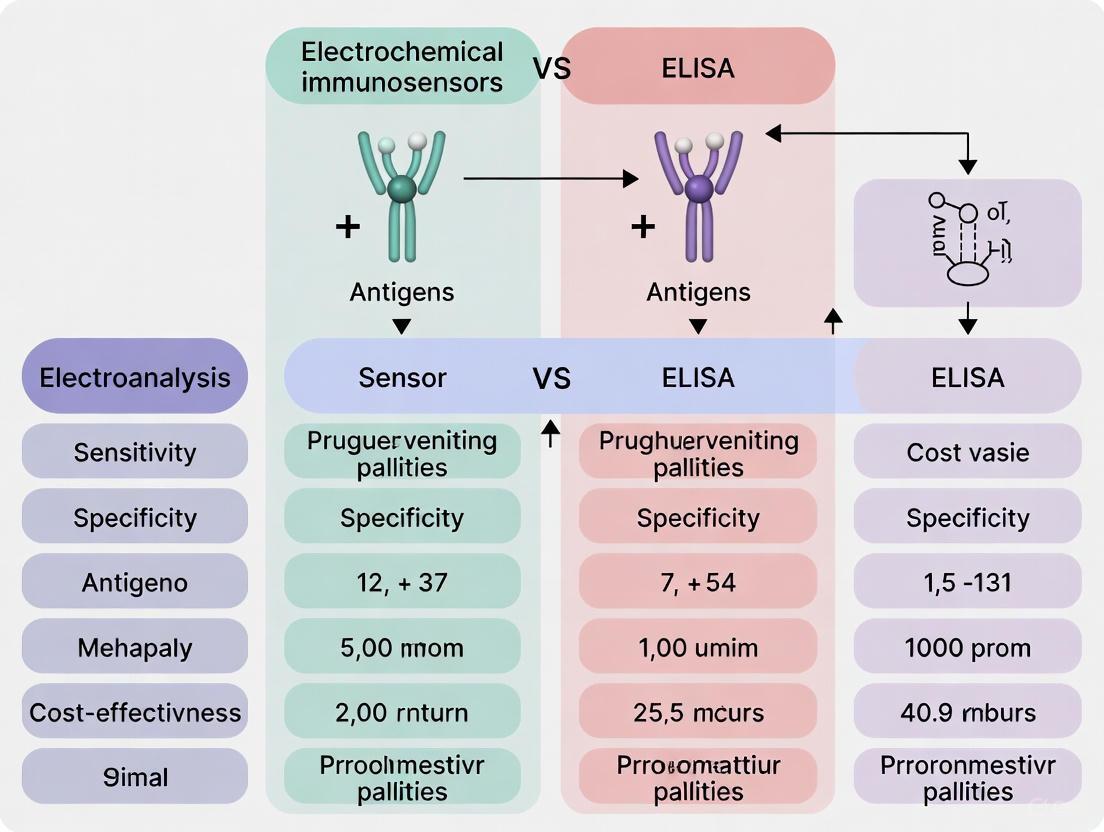
This article provides a comprehensive comparative analysis for researchers, scientists, and drug development professionals evaluating electrochemical immunosensors and Enzyme-Linked Immunosorbent Assay (ELISA).
Electrochemical Immunosensors vs. ELISA: A 2025 Comparative Analysis for Diagnostic and Drug Development Applications
Abstract
This article provides a comprehensive comparative analysis for researchers, scientists, and drug development professionals evaluating electrochemical immunosensors and Enzyme-Linked Immunosorbent Assay (ELISA). It explores the foundational principles of both technologies, examines current methodological advances and real-world applications in biomarker detection and cancer diagnostics, details practical troubleshooting and optimization strategies, and presents a rigorous validation framework. By synthesizing the latest research and performance data, this analysis aims to inform strategic decisions in assay selection, method development, and the adoption of next-generation diagnostic platforms for biomedical research and clinical practice.
Core Principles and Technological Evolution of Immunoassays
The enzyme-linked immunosorbent assay (ELISA) and electrochemical immunosensors represent two pivotal technologies in analytical biochemistry, both leveraging the exquisite specificity of antibody-antigen interactions but diverging fundamentally in their signal transduction mechanisms. First described by Engvall and Perlmann in 1971, ELISA was developed as a safer alternative to radioimmunoassays, substituting radioactive labels with enzymes that produce measurable color changes [1] [2]. This technology revolutionized biomedical research and clinical diagnostics by enabling sensitive, plate-based detection of proteins, hormones, antibodies, and other biomolecules in liquid samples [3] [2].
Electrochemical immunosensors, emerging from advances in biosensor technology, represent a more recent integration of immunology and electrochemistry. These devices employ antibodies as capture agents on electrode surfaces, transducing specific antibody-antigen binding events into quantifiable electrical signals such as changes in current, potential, or impedance [4] [5] [6]. The convergence of nanotechnology, biotechnology, and electrochemistry has propelled the development of these immunosensors, particularly for point-of-care diagnostics where speed, sensitivity, and portability are paramount [6] [7].
Both platforms share a common biochemical foundation—the specific molecular recognition between antibody and antigen—yet their operational principles, instrumentation requirements, and application landscapes differ significantly. This review provides a comprehensive comparative analysis of these two powerful analytical platforms, examining their technical bases, performance characteristics, and suitability for various research and diagnostic applications.
Technical Foundations and Signal Transduction Mechanisms
The Biochemical Basis of ELISA
ELISA operates as a heterogeneous assay, requiring the immobilization of either antigen or antibody to a solid surface, typically a polystyrene microtiter plate [3] [1]. The fundamental process involves several core steps: coating with antigen or antibody, blocking with irrelevant proteins to prevent nonspecific binding, incubation with detection antibodies, and finally, enzymatic signal generation [3] [1]. The most crucial element is the highly specific antibody-antigen interaction, which provides the assay's selectivity [3].
Several ELISA formats have been developed to address different analytical needs. In direct ELISA, an enzyme-conjugated primary antibody binds directly to the immobilized antigen, offering simplicity but limited signal amplification [3] [1]. Indirect ELISA introduces a secondary enzyme-conjugated antibody that recognizes the primary antibody, providing significant signal amplification and flexibility [1]. The sandwich ELISA, frequently used for complex samples, captures the target antigen between two specific antibodies—a capture antibody immobilized on the plate and a detection antibody in solution—offering enhanced specificity and sensitivity [3] [1]. For small molecules with single epitopes, competitive ELISA formats are employed, where sample antigens compete with labeled references for limited antibody binding sites [3] [1].
Signal generation in traditional ELISA is typically colorimetric, utilizing enzymes such as horseradish peroxidase (HRP) or alkaline phosphatase (AP) that convert substrates into colored products [1] [2]. The intensity of the color change, measured spectrophotometrically, is proportional to the amount of analyte in the sample [2]. More recent developments have introduced fluorogenic, electrochemiluminescent, and quantitative PCR reporters to create quantifiable signals, though these variants are not strictly "enzyme-linked" [2].
The Biochemical Basis of Electrochemical Immunosensors
Electrochemical immunosensors merge immunochemical recognition with electrochemical transduction, creating devices where antibody-antigen binding produces a measurable electrical signal [5] [6]. The fundamental working principle involves the specific immunochemical recognition between antibodies immobilized on a transducer surface and target antigens, generating an electrochemical signal that varies with analyte concentration [5].
These immunosensors can be categorized as label-free or label-based systems. Label-free electrochemical immunosensors detect the direct binding of antigen to antibody on the electrode surface, which modifies the electrode interface properties, hindering charge transfer and increasing impedance [6] [7]. This change can be measured without secondary labels, simplifying the assay procedure [8]. Label-based systems, particularly sandwich-type immunosensors, use a labeled secondary antibody to form an immunocomplex on the electrode surface [7] [8]. The labels, often enzymes or nanomaterials, catalyze reactions that produce electroactive species, amplifying the detection signal [4].
The electrochemical detection techniques employed include amperometry (measuring current at fixed potential), voltammetry (measuring current while varying potential), potentiometry (measuring potential at zero current), and electrochemical impedance spectroscopy (measuring impedance across a frequency range) [6] [7]. The integration of nanomaterials—including gold nanoparticles, carbon nanotubes, graphene, and quantum dots—has significantly enhanced sensor performance by providing large surface areas for antibody immobilization, excellent electrical conductivity, and catalytic properties for signal amplification [4] [7].
Experimental Protocols and Methodologies
Standardized ELISA Protocol for Protein Detection
A typical sandwich ELISA protocol for detecting a specific protein antigen involves multiple precise steps executed in microtiter plates [3] [1]. The process begins with plate coating, where capture antibodies specific to the target protein are diluted in carbonate-bicarbonate buffer (pH 9.4) or phosphate-buffered saline (PBS, pH 7.4) at concentrations typically ranging from 2-10 μg/mL, then added to wells and incubated for several hours to overnight at 4-37°C [3] [1]. Following coating, plates are washed with PBS containing a mild detergent (e.g., Tween-20) to remove unbound antibodies.
The blocking step is crucial to prevent nonspecific binding; wells are incubated with blocking agents such as bovine serum albumin (BSA), casein, or ovalbumin for at least 1-2 hours at room temperature [3] [1]. After blocking, samples and standards are added to wells and incubated for 90 minutes at 37°C, allowing target antigens to bind specifically to capture antibodies [1]. Plates are then washed thoroughly to remove unbound materials.
For detection, a primary detection antibody (if not directly conjugated) or an enzyme-conjugated secondary antibody is added and incubated for 1-2 hours at room temperature [1]. Common enzyme-antibody conjugates include horseradish peroxidase (HRP) or alkaline phosphatase (AP). After final washes, enzyme substrate is added: for HRP, hydrogen peroxide with chromogens like TMB (3,3',5,5'-tetramethylbenzidine) that produce a blue color; for AP, pNPP (p-nitrophenyl phosphate) that yields a yellow product [1]. The reaction is stopped after 15-30 minutes, and absorbance is measured spectrophotometrically. Quantitative analysis involves comparing sample absorbance to a standard curve generated from serial dilutions of known antigen concentrations [1].
Electrochemical Immunosensor Fabrication and Measurement
The development of electrochemical immunosensors focuses on optimizing electrode modification and antibody immobilization to maximize sensitivity and specificity [5] [9]. The process typically begins with electrode preparation, where screen-printed carbon electrodes (SPCEs) or other electrode materials are modified with functional nanomaterials to enhance surface area and electron transfer properties [4] [9]. For instance, graphene oxide (GO) provides numerous oxygen-containing functional groups that facilitate subsequent bioconjugation [9].
Antibody immobilization employs various strategies to orient antibodies effectively on the electrode surface. Physical adsorption represents the simplest approach, relying on non-covalent interactions, but may lead to random orientation and denaturation [8]. Covalent binding using cross-linkers like EDC (1-ethyl-3-(3-dimethylaminopropyl)carbodiimide) and NHS (N-hydroxysuccinimide) creates stable amide bonds between antibody carboxyl groups and amine-functionalized electrode surfaces [9] [8]. Affinity-based methods utilizing biotin-streptavidin interactions or Protein A/G provide controlled orientation by binding the Fc region of antibodies, preserving antigen-binding sites [8].
For measurement, the modified electrode is incubated with sample solution containing target antigen, then washed to remove unbound components [9]. In sandwich formats, an enzyme-labeled secondary antibody is applied. Electrochemical measurement occurs in buffer solution containing redox mediators such as potassium ferricyanide/ferrocyanide [Fe(CN)₆³⁻/⁴⁻] [9]. Techniques like cyclic voltammetry (CV) applies a potential sweep from -0.5V to 0.9V at 100 mV/s, while electrochemical impedance spectroscopy (EIS) measures impedance changes at the electrode interface [9]. The signal change correlates with antigen concentration, quantified against a standard curve.
Performance Comparison: Experimental Data and Analytical Metrics
Direct comparative studies and application-specific validation provide robust data for evaluating the performance of ELISA versus electrochemical immunosensors across multiple parameters.
Sensitivity and Detection Limits
Electrochemical immunosensors consistently demonstrate superior sensitivity, often achieving detection limits several orders of magnitude lower than conventional ELISA. A comparative study of electro-chemiluminescence (ECLIA) technology—an advanced electrochemical approach—with traditional ELISA revealed that the ECLIA-based multiplex assay provided a wider linear range, enabling single-dilution measurements without the need for serial dilutions typically required in ELISA [10]. In practical applications, researchers developed a functionalized graphene oxide–antibody conjugate-based electrochemical immunosensor for detecting Opisthorchis viverrini antigen in urine, achieving a remarkably low detection limit of 0.08 ng mL⁻¹ in standard buffer and 1.50 ng mL⁻¹ in urine samples, with a broad linear range of 0.2–200 μg mL⁻¹ [9]. This sensitivity exceeds that reported for traditional ELISA formats for the same analyte.
The enhanced sensitivity of electrochemical platforms stems from multiple factors: the efficient electron transfer capabilities of nanomaterial-modified electrodes, significant signal amplification through enzymatic or nanomaterial labels, and reduced background interference from biological matrices [4] [7]. For instance, incorporating gold nanoparticles (Au NPs) and carbon nanotubes (MWCNTs) in immunosensors has enabled detection of prostate-specific antigen (PSA) at concentrations as low as 30 fg/mL, far surpassing conventional ELISA sensitivity [4].
Multiplexing Capability and Sample Volume Requirements
Multiplex assays represent a significant advantage for electrochemical platforms, particularly ECLIA technology, which allows simultaneous detection of multiple analytes in a single well. Research demonstrates that ECLIA permits multiplexing of up to ten different antigens in a single assay well, providing substantial practical benefits by reducing sample volume requirements and experimental time [10]. This capability is particularly valuable for profiling complex serological responses or conducting immunoprofiling studies where sample volume is limited.
Traditional ELISA is fundamentally a single-plex assay, though multiple analytes can be measured by splitting samples across different wells. However, this approach increases sample volume requirements, reagent consumption, and hands-on time. The fundamental limitation stems from ELISA's dependence on colorimetric detection, where spectral overlap between different chromogens constrains multiplexing capabilities [10] [2].
Practical Performance Parameters
Table 1: Comprehensive Performance Comparison Between ELISA and Electrochemical Immunosensors
| Parameter | Traditional ELISA | Electrochemical Immunosensors |
|---|---|---|
| Detection Limit | ~pg-mg mL⁻¹ range [1] | ~fg-pg mL⁻¹ range [4] [9] |
| Assay Time | 4-6 hours (including incubation steps) [1] | 15-60 minutes (rapid detection) [6] [9] |
| Sample Volume | 50-100 μL per well [10] | <50 μL (significantly reduced requirements) [10] [9] |
| Multiplexing Capacity | Limited to single-plex per well [10] | Up to 10-plex in single well (ECLIA platform) [10] |
| Throughput | High (96 or 384-well plates) [3] | Medium (limited by electrode arrays) [4] |
| Linearity | Limited dynamic range, often requires sample dilution [10] | Wide linear range, enables single-dilution measurements [10] [9] |
| Reproducibility | CV <10-15% (well-established protocols) [3] | CV <10% (with proper electrode modification) [9] |
| Equipment Cost | Moderate (plate reader required) [3] | Low to moderate (portable potentiostats available) [6] |
Real-World Application Data
Comparative studies in specific diagnostic applications highlight the performance differences between these platforms. In a malaria serology study comparing ECLIA with traditional ELISA, the ECLIA platform demonstrated good agreement with ELISA while providing a wider linear range that permitted single-dilution measurements without the need for serial dilutions [10]. The study also found no significant antigenic competition when simultaneously testing closely related antigens, confirming the robustness of multiplexed ECLIA for informing cross-reactivities of serological responses [10].
For the detection of OV antigen in urine, the electrochemical immunosensor demonstrated 93% sensitivity and 69% specificity compared to traditional ELISA, and 92% sensitivity and 90% specificity compared to a commercial Rapid Diagnostic Test kit [9]. The highest AUC of 0.950 with 96% sensitivity and 90% specificity was obtained when compared with combined ELISA and RDT results, without requiring sample pre-treatment steps [9].
Essential Research Reagent Solutions
Successful implementation of both ELISA and electrochemical immunosensor platforms depends on critical reagents and materials that ensure assay specificity, sensitivity, and reproducibility.
Table 2: Key Research Reagents and Materials for Immunoassay Development
| Reagent/Material | Function | Application in Both Platforms |
|---|---|---|
| Capture Antibodies | Specifically binds target analyte; immobilized on solid surface | Critical for both ELISA plate coating and electrode functionalization [3] [9] |
| Detection Antibodies | Binds to captured analyte; often enzyme-conjugated for signal generation | HRP or AP conjugates for ELISA; various labels for electrochemical detection [1] [7] |
| Blocking Agents (BSA, casein) | Prevents nonspecific binding to uncoated surfaces | Essential for reducing background in both platforms [3] [9] |
| Cross-linking Reagents (EDC, NHS) | Facilitates covalent attachment of antibodies to surfaces | Used for oriented antibody immobilization in both plate-based and electrode-based systems [9] [8] |
| Enzyme-Substrate Systems (HRP/TMB, AP/pNPP) | Generates detectable signal (colorimetric, electrochemical) | Core detection chemistry for ELISA; also used in labeled electrochemical sensors [1] [7] |
| Nanomaterials (graphene oxide, Au NPs, CNTs) | Enhances surface area, electron transfer, and antibody loading | Particularly crucial for electrode modification in immunosensors [4] [9] |
| Redox Mediators ([Fe(CN)₆]³⁻/⁴⁻) | Facilitates electron transfer in electrochemical systems | Essential for electrochemical detection in immunosensors [9] |
For electrochemical immunosensors specifically, the choice of electrode material and modification strategy significantly impacts performance. Screen-printed carbon electrodes (SPCEs) have gained popularity due to their disposability, reproducibility, and ease of modification [9]. Functional nanomaterials including graphene oxide (GO), gold nanoparticles (Au NPs), and carbon nanotubes (CNTs) provide enhanced conductivity and larger surface areas for antibody immobilization [4] [7] [9]. These materials address the inherent challenge of protein biomolecules, whose active centers are surrounded by peptide matrices that hinder charge transfer, by facilitating long-range electron transfer and increasing charge transfer rates at the electrode interface [7].
ELISA and electrochemical immunosensors represent complementary technologies with distinct advantages for different application contexts. ELISA remains the established workhorse for high-throughput, standardized laboratory testing, offering robustness, reproducibility, and widespread acceptance in clinical and research settings [3] [1]. Its limitations in sensitivity, multiplexing capability, and sample volume requirements are addressed by electrochemical immunosensors, which provide superior sensitivity, rapid detection, potential for miniaturization, and point-of-care applicability [6] [7] [9].
The ongoing integration of advanced nanomaterials and microfluidic systems with electrochemical platforms promises to further enhance their capabilities, potentially enabling simultaneous detection of multiple biomarkers with minimal sample volumes [4] [7]. For research and drug development professionals, the choice between these platforms depends on specific application requirements: ELISA for standardized, high-throughput screening versus electrochemical immunosensors for sensitive, rapid detection with portable instrumentation.
Future developments will likely focus on increasing the multiplexing capacity of both platforms, enhancing reproducibility through standardized fabrication protocols, and reducing costs for widespread implementation. As these technologies continue to evolve, their complementary strengths will ensure both remain essential tools in the analytical biochemistry toolkit, enabling researchers to address increasingly complex biological questions and diagnostic challenges.
The Enzyme-Linked Immunosorbent Assay (ELISA) is a fundamental tool in research, food testing, and diagnostics, used to quantitatively detect antigens like viruses, toxins, or other foreign substances [11] [12]. As a cornerstone of immunoassay technology, its reliability has established it as a standard comparison point for emerging methods, including electrochemical immunosensors [13]. The core principle of ELISA relies on the specific binding of an antibody to its target antigen, with an enzyme-linked antibody producing a measurable signal, most often a color change, which is then detected by a microplate reader [12] [14].
This guide provides a comparative analysis of manual and automated ELISA protocols, detailing the workflow, key reagents, and instrumentation. This foundation is crucial for researchers performing a comparative analysis of ELISA against emerging electrochemical biosensors, which are gaining attention for their potential for rapid, sensitive, and portable detection of pathogens like SARS-CoV-2 [13].
Major Types of ELISA and Their Mechanisms
There are three primary types of ELISA, each with distinct mechanisms and applications. Understanding these differences is key to selecting the appropriate format for a specific experimental need.
Table 1: Comparison of Major ELISA Types
| Type of ELISA | Basic Principle | Key Advantages | Key Disadvantages | Best Suited For |
|---|---|---|---|---|
| Sandwich ELISA [12] [14] | A capture antibody is bound to the well, which specifically "captures" the target antigen from the sample. A second detection antibody is then used to detect the bound antigen. | High specificity because two antibodies are required. Effective for complex samples (e.g., blood, cell lysates) as the capture antibody isolates the specific antigen. | Requires antibody "matched pairs" that recognize different parts of the antigen. Typically requires monoclonal antibodies, which can be expensive. | Detecting antigens of low or unknown concentration in a complex mixture. |
| Indirect ELISA [14] | The antigen is directly adsorbed to the well. A primary antibody binds to the antigen, and is then detected by an enzyme-conjugated secondary antibody. | Flexible; the same enzyme-conjugated secondary antibody can be used with various primary antibodies. Often used to determine optimal antibody dilutions. | Potential for high background because all proteins in the sample non-specifically bind to the well. Less sensitive for antigens in complex mixtures. | Determining the titer or effective concentration of an antibody in a sample. |
| Competitive ELISA [14] | The sample antigen and a known, labeled antigen compete for a limited number of antibody binding sites. The signal is inversely proportional to the amount of antigen in the sample. | Highly sensitive for small antigens that have only a single antibody binding site. Does not require matched antibody pairs. | The inverse relationship between signal and concentration can be counter-intuitive. Can be more complex to design and optimize. | Measuring small antigens or haptens that cannot be bound by two antibodies simultaneously. |
The Core ELISA Workflow: A Step-by-Step Guide
The sandwich ELISA is one of the most common and specific types. The workflow below illustrates its key steps, which form the basis for both manual and automated protocols.
Diagram 1: Step-by-step workflow of a Sandwich ELISA assay.
Detailed Experimental Protocol for a Manual Sandwich ELISA
The following protocol, applicable to a 96-well microplate, can be scaled for 384-well formats with appropriate liquid handling adjustments [12] [14].
- Plate Coating: Pipette a solution of the capture antibody into each well of a microplate. The antibody will adsorb to the plastic surface through hydrophobic interactions. Incubate the plate, typically for several hours at room temperature or overnight at 4°C, to ensure efficient binding [12] [14].
- Washing and Blocking: After incubation, aspirate the solution from the wells and wash the plate 2-3 times with a wash buffer (usually PBS or Tris-based with a mild detergent like Tween-20) to remove any unbound antibody. Add a blocking buffer (e.g., 1-5% BSA or casein in PBS) to all wells and incubate. This step coats any remaining protein-binding sites on the plastic to prevent non-specific binding of other reagents later, which would cause high background signal [14].
- Sample and Standard Addition: Prepare a dilution series of a known standard antigen to generate a standard curve. Dilute unknown samples in an appropriate buffer. Aspirate the blocking buffer, wash the plate, and add the standards and samples to their designated wells. Incubate to allow the target antigen to bind to the immobilized capture antibody [12] [14].
- Detection Antibody Incubation: Wash the plate thoroughly to remove unbound antigen and other sample components. Add the enzyme-conjugated detection antibody to each well. This antibody binds to a different epitope on the captured antigen, forming a "sandwich." Incubate as per protocol [12] [14].
- Signal Development: After a final, thorough wash to remove any unbound detection antibody, add the enzyme substrate solution to the wells. Common enzymes are Horseradish Peroxidase (HRP) or Alkaline Phosphatase (AP), which convert their respective substrates (e.g., TMB for HRP) into a colored, fluorescent, or luminescent product. The reaction is stopped after a fixed time with a stop solution (e.g., acid for TMB) [15] [12].
- Plate Reading and Analysis: Immediately read the plate using a microplate reader set to the appropriate wavelength (e.g., 450nm for TMB). The reader outputs optical density (OD) values. Use the values from the standard curve to generate a regression curve (often 4- or 5-parameter logistic) and interpolate the concentration of antigen in the unknown samples [12].
Manual vs. Automated ELISA: A Comparative Analysis
The decision to automate the ELISA workflow is driven by factors such as throughput requirements, need for reproducibility, and labor resource allocation.
Table 2: Performance and Practical Comparison: Manual vs. Automated ELISA
| Parameter | Manual ELISA | Automated ELISA Workstation |
|---|---|---|
| Throughput | Low (a few plates per day) [11] | Medium to High (multiple plates per day, unattended) [11] [16] |
| Typical Hands-On Time | High (operator present for all steps) [11] | Low (operator is freed for other tasks) [11] |
| Reproducibility & Data Traceability | Subject to user variation, especially in washing and timing [11] | High; automated barcode scanning and logging ensures comprehensive traceability [11] [16] |
| Initial Investment Cost | Low (requires only basic pipettes and a reader/washer) [12] | High (significant capital cost for the system) [11] |
| Operational Cost & Maintenance | Low (no specialized maintenance) | Higher (requires ongoing maintenance and service) [11] |
| Experimental Flexibility | High (easy to adjust or troubleshoot protocols) | Low to Moderate; limited by system programming and hardware [11] |
| Best For | Low-budget labs, low-throughput labs, or assays in development requiring frequent modification. | Laboratories processing many samples daily, requiring high reproducibility, and operating under regulatory standards (e.g., GxP) [11] [16]. |
Types of Automated ELISA Systems
Automation is not a one-size-fits-all solution. Systems are categorized by their capabilities and throughput [11]:
- Low-Throughput Systems: These are compact workstations, often processing a single plate. They are an affordable entry point for labs moving from manual processing to basic automation and save valuable bench space [11].
- Medium- to High-Throughput Systems: These instruments can hold 2 to 16 plates and often include integrated sample handling (e.g., barcode reading, sample dilution). They are designed for labs with a high daily sample load. Some high-throughput labs may opt for multiple low-throughput instruments running in parallel for workflow flexibility and redundancy [11].
The Scientist's Toolkit: Essential Reagents and Equipment
A successful ELISA relies on a suite of specialized reagents and instruments.
Table 3: Key Research Reagent Solutions and Equipment for ELISA
| Item | Function / Description | Example Products / Components |
|---|---|---|
| Coated Microplates | 96- or 384-well plates that serve as the solid phase for antibody and antigen binding. | "ELISA plates" included in many kits [12]. |
| Capture & Detection Antibodies | The critical "matched pair" that provides specificity in a sandwich ELISA. | Monoclonal antibody pairs are typically required [14]. |
| Blocking Buffer | A protein-rich solution (e.g., BSA, casein) used to prevent non-specific binding. | Easy-to-use blocking buffers and reagents [15]. |
| Enzyme Substrates | Chemicals converted by the detection antibody's enzyme (HRP/AP) to produce a detectable signal. | TMB (colorimetric), other colorimetric, chemiluminescent, and fluorescent substrates [15]. |
| Wash Buffer | A buffered solution with detergent to remove unbound material without disrupting specific interactions. | PBS or Tris-based buffers with Tween-20. |
| Microplate Washer | An automated instrument that performs consistent and reproducible aspiration and dispensing of wash buffer. | AquaMax Microplate Washer, MultiWash+ Washer [12]. |
| Microplate Reader | An instrument that measures the signal (absorbance, fluorescence, or luminescence) from each well. | SpectraMax ABS Plus Absorbance Reader [12]. |
| Analysis Software | Software that converts raw optical density data into quantitative results using a standard curve. | SoftMax Pro Software [12]. |
ELISA in Context: Comparison with Electrochemical Immunosensors
In the broader thesis of comparative analysis, ELISA serves as the established, conventional benchmark against which newer methods like electrochemical immunosensors are evaluated. A 2022 review highlights this direct comparison, noting that while conventional methods like PCR and ELISA are the gold standard, they require specialized equipment, hours of processing, and trained staff [13].
Electrochemical biosensors are an advanced electroanalytical approach that offers significant potential advantages for detecting targets like the SARS-CoV-2 virus. They are characterized by their inherent sensitivity, selectivity, rapid response, and potential for portable, moderate-cost apparatus [13]. However, the review also notes that progress in their development has been modest, and they have not yet displaced conventional methods for widespread routine use. The choice between a traditional ELISA and an emerging electrochemical immunosensor depends on the application's specific needs for speed, cost, portability, and the established validation of the ELISA platform.
Modern diagnostics and therapeutic monitoring increasingly depend on the rapid, sensitive, and specific detection of protein biomarkers. For decades, the enzyme-linked immunosorbent assay (ELISA) has served as the gold standard technique for protein quantification in clinical and research laboratories [17] [18]. Conventional ELISA operates on the principle of immunorecognition, where an antibody-antigen-antibody sandwich complex is formed and detected through an enzyme-mediated colorimetric, chemiluminescent, or fluorescent signal [18]. While ELISA provides highly reproducible and specific quantitative data, it suffers from several inherent limitations: lengthy and laborious procedures requiring multiple incubation and washing steps, necessity for centralized laboratory equipment, relatively high sample volume requirements, and detection limits that are often inadequate for measuring ultra-low abundance biomarkers present in the early stages of disease [17] [18].
Electrochemical immunosensors have emerged as powerful alternatives that combine the specificity of immunological recognition with the sensitivity and practicality of electrochemical detection [19] [20]. These integrated analytical devices merge immunorecognition with electrochemical transduction techniques, where the formation of immunocomplexes on an electrode surface induces measurable alterations in electrical properties such as current, impedance, or capacitance [19]. The operational principle relies on immobilizing antibodies on electrode surfaces to facilitate specific target capture, with the subsequent immunoreaction generating quantifiable signals primarily through redox reactions occurring at the electrode-solution interface [19] [21]. A significant advancement in this field has been the integration of nanoscale materials, which impart exceptional properties including high surface-to-volume ratios for increased biomolecular loading, enhanced electrocatalytic activity, and improved electron transfer kinetics [19] [21]. This review provides a comprehensive comparative analysis of electrochemical immunosensor architectures against traditional ELISA, focusing on signal transduction mechanisms, nanomaterial integration strategies, and performance metrics relevant to researchers and drug development professionals.
Performance Comparison: Electrochemical Immunosensors vs. Traditional ELISA
The analytical performance of electrochemical immunosensors demonstrates significant advantages over traditional ELISA across multiple parameters, particularly in sensitivity, detection limit, and operational efficiency. Table 1 summarizes a direct comparison of key performance metrics based on recent experimental studies.
Table 1: Performance Comparison Between Electrochemical Immunosensors and Traditional ELISA
| Analyte/Biomarker | Detection Method | Linear Detection Range | Limit of Detection (LOD) | Analysis Time | Reference |
|---|---|---|---|---|---|
| Carcinoembryonic Antigen (CEA) | Electrochemical Immunosensor (γ.MnO₂-CS/AuNPs/SA) | 10 fg/mL - 0.1 µg/mL | 9.57 fg/mL | Not specified | [17] |
| Carcinoembryonic Antigen (CEA) | Conventional ELISA | Not specified | Not specified | Lengthy (multiple hours) | [17] |
| SARS-CoV-2 S-protein | Electrochemical Immunosensor (IgY/Cys/SPGE) | 10 - 1000 ng/mL | 6.2 ng/mL | ~1 hour incubation | [22] |
| SARS-CoV-2 S-protein | Conventional ELISA | 500 - 4000 ng/mL | 235 ng/mL | Lengthy (multiple hours) | [22] |
| Transforming Growth Factor Alpha (TGF-α) | Electrochemical Immunosensor (AuNPs/SPE) | 1 - 1000 pg/mL | 0.35 pg/mL | Not specified | [23] |
| Sesame Allergens (Ses i 4) | Electrochemical Immunosensor (AuNPs-PEI-MWCNTs) | 50 - 800 ng/L | 0.616 ng/L | Not specified | [24] |
| Sesame Allergens (Ses i 5) | Electrochemical Immunosensor (AuNPs-PEI-MWCNTs) | 50 - 800 ng/L | 0.307 ng/L | Not specified | [24] |
| Interleukin-6 (IL-6) | Electrochemical Immunosensor (AuNPs/Thionine) | 10⁻² - 10² ng/mL | 1.85 pg/mL | Not specified | [25] |
| Creatine Kinase (CK) | Electrochemical Immunosensor (AuNPs) | Not specified | Not specified | 45 minutes incubation | [26] |
The data reveal consistently superior sensitivity and lower detection limits for electrochemical immunosensing platforms across diverse analyte classes, including cancer biomarkers, viral proteins, food allergens, and inflammatory cytokines. For CEA detection, a critical cancer biomarker, the electrochemical immunosensor achieved an extraordinary detection limit of 9.57 fg/mL, significantly surpassing conventional ELISA capabilities [17]. Similarly, for SARS-CoV-2 S-protein detection, the electrochemical platform demonstrated approximately 38-fold greater sensitivity compared to ELISA (LOD of 6.2 ng/mL versus 235 ng/mL) [22]. This enhanced sensitivity enables detection of trace-level analytes in complex biological matrices, which is crucial for early disease diagnosis when biomarker concentrations are minimal.
Beyond sensitivity, electrochemical immunosensors offer substantial practical advantages. They require significantly smaller sample volumes, with some platforms successfully detecting biomarkers in just 1.0 μL of human serum [20]. The analysis time is markedly reduced due to simplified procedures with fewer washing and incubation steps, and the compatibility with miniaturized, portable instrumentation facilitates point-of-care testing and decentralized diagnostics [20] [21]. Furthermore, the manufacturing process for electrochemical immunosensors is relatively simple and cost-effective, using less expensive materials and equipment compared to the optical readers required for traditional ELISA [22].
Fundamental Architectures: Signal Transduction Mechanisms in Electrochemical Immunosensing
Electrochemical immunosensors employ various signal transduction mechanisms, which can be broadly classified into label-free and label-based detection strategies, each with distinct operational principles and performance characteristics.
Label-Free Electrochemical Immunosensors
Label-free formats represent the most direct approach, where the analytical signal is generated directly upon the formation of an antigen-antibody immunocomplex on the electrode surface without secondary recognition elements [20] [17]. The immunocomplex formation alters the electrochemical properties of the electrode-solution interface, which can be monitored through various techniques:
- Voltammetric Detection: Measures current while the potential is scanned, utilizing techniques such as cyclic voltammetry (CV), differential pulse voltammetry (DPV), and square wave voltammetry (SWV) [20] [21]. These methods typically employ dissolved redox mediators like [Fe(CN)₆]³⁻/⁴⁻ or [Ru(NH₃)₆]³⁺, whose electron transfer kinetics are impeded by the formation of insulating immunocomplex layers [21]. The resulting decrease in current signal is proportional to the target analyte concentration.
- Impedimetric Detection: Utilizes electrochemical impedance spectroscopy (EIS) to measure changes in the electron transfer resistance at the electrode interface following immunocomplex formation [20] [26]. This method directly quantifies the blocking effect of antigen-antibody binding on the interfacial charge transfer, providing a highly sensitive detection mechanism without requiring electroactive labels.
- Potentiometric Detection: Monitors the equilibrium potential shift of the working electrode versus a reference electrode, which occurs due to charged functionality accumulation from analytes or the blocking effect of immunoreaction on ionic flux [20] [21].
Label-free architectures offer simplified assay procedures with fewer steps and reagents, making them particularly attractive for rapid diagnostics. However, they may exhibit lower sensitivity compared to label-based systems, especially for small molecule targets that produce minimal steric hindrance effects.
Label-Based Electrochemical Immunosensors
Label-based strategies employ signal tags conjugated to detection antibodies to amplify and report the immunoreaction, analogous to conventional ELISA but with electrochemical readout [20] [18]. These systems typically employ sandwich-type configurations where the target analyte is captured between a surface-immobilized capture antibody and a labeled detection antibody. Common signal amplification elements include:
- Enzymatic Labels: Enzymes such as horseradish peroxidase (HRP) or alkaline phosphatase (ALP) are conjugated to detection antibodies and catalyze the conversion of electroinactive substrates to electroactive products, generating amplified signals [18]. A notable advancement is the tyramide signal amplification system, where HRP catalyzes the deposition of numerous electroactive tyramide derivatives near the immunocomplex, dramatically enhancing sensitivity [19].
- Nanomaterial Tags: Nanocarriers including metallic nanoparticles, quantum dots, and enzymatic nanocrystals serve as versatile signal tags that can be loaded with numerous electroactive molecules or catalysts, providing substantial signal amplification through high tag-to-antibody ratios [19] [21].
- Redox Probes: Electroactive molecules such as thionine, methylene blue, or ferrocene derivatives are directly conjugated to detection antibodies and generate faradaic currents upon electrochemical interrogation [21] [25].
Label-based architectures generally provide superior sensitivity and detection limits compared to label-free systems but require more complex assay development and additional optimization steps for conjugation and washing.
The workflow diagram below illustrates the fundamental operational principles and key differences between these two primary electrochemical immunosensor architectures:
Nanomaterial Integration Strategies for Signal Amplification
The exceptional performance of modern electrochemical immunosensors is largely enabled by the strategic integration of nanoscale materials that enhance both biorecognition efficiency and signal transduction. These nanomaterials function through multiple mechanisms: providing high surface areas for increased antibody loading, facilitating electron transfer between biomolecules and electrodes, and serving as versatile platforms for signal amplification tags [19] [21].
Metallic Nanoparticles
Gold nanoparticles (AuNPs) represent the most widely utilized nanomaterial in electrochemical immunosensing due to their excellent electrical conductivity, high surface-to-volume ratios, ideal biocompatibility, and well-established surface chemistry for biomolecular conjugation [26] [23] [25]. AuNPs enhance sensor performance through multiple mechanisms:
- Surface Area Enhancement: AuNPs provide dramatically increased surface area for antibody immobilization while maintaining minimal volumetric footprint. For instance, a TGF-α immunosensor utilizing AuNP-modified screen-printed electrodes achieved an exceptional detection limit of 0.35 pg/mL, which was attributed to the high antibody loading capacity afforded by the nanostructured interface [23].
- Electron Transfer Facilitation: AuNPs act as efficient electron transfer bridges between the biomolecular recognition layer and the underlying electrode surface. In a creatine kinase (CK) cardiac marker sensor, AuNPs significantly enhanced electron transfer rates, yielding a sensitivity of 152.6 Ω/(ng/mL) [26].
- Composite Formation: AuNPs are frequently combined with other nanomaterials and electroactive molecules to create synergistic effects. For example, a composite of AuNPs and thionine (a redox mediator) was used to develop an IL-6 sensor for subarachnoid hemorrhage detection, where the AuNPs provided both immobilization matrix and conductivity enhancement while thionine enabled efficient electron shuttling [25].
Carbon-Based Nanomaterials
Carbon nanomaterials including carbon nanotubes (CNTs), graphene (GR), graphene oxide (GO), and reduced graphene oxide (RGO) contribute exceptional electrical conductivity, mechanical strength, and abundant surface functional groups that facilitate effective biomolecular conjugation [19] [24]. Their application in immunosensors includes:
- Multi-Walled Carbon Nanotubes (MWCNTs): In a sesame allergen sensor, MWCNTs were incorporated with AuNPs and polyethyleneimine (PEI) to form a highly conductive nanocomposite that enhanced the catalytic current of the oxygen reduction reaction, enabling detection limits of 0.616 ng/L and 0.307 ng/L for Ses i 4 and Ses i 5 allergens, respectively [24].
- Graphene Derivatives: Graphene-based materials provide atomically thin two-dimensional platforms with extraordinary electrical properties. When functionalized with appropriate chemical groups, they enable dense antibody packing while maintaining efficient charge transport to the electrode surface [19] [21].
Advanced Porous Frameworks and Nanocomposites
Emerging porous nanomaterials such as metal-organic frameworks (MOFs) and covalent organic frameworks (COFs) represent promising yet underexplored materials for electrochemical immunosensing [19]. These frameworks feature ultrahigh surface areas, tunable porosity, and modular functionalization, enabling high-capacity probe loading, selective molecular transport, and enhanced electrochemical reactivity. Composite structures that combine multiple nanomaterials have demonstrated particularly impressive performance by synergizing the advantageous properties of individual components [19] [24].
The strategic integration of these nanomaterials has enabled the development of immunosensors with attomolar to femtomolar detection limits, significantly surpassing the capabilities of conventional ELISA and opening new possibilities for early disease diagnosis and ultra-trace analyte detection [19].
Experimental Protocols: Methodologies for Immunosensor Development and Characterization
The development of high-performance electrochemical immunosensors requires meticulous optimization of multiple experimental parameters. This section details representative methodologies from recent studies that have demonstrated exceptional analytical performance.
Carcinoembryonic Antigen (CEA) Immunosensor Based on γ.MnO₂-CS/AuNPs/SA Nanocomposite
A highly sensitive label-free electrochemical immunosensor for CEA detection was developed using a nanocomposite of gamma-manganese dioxide/chitosan (γ.MnO₂-CS), gold nanoparticles (AuNPs), and sodium alginate (SA) [17]:
- Electrode Modification: Glassy carbon electrode (GCE) was sequentially modified with SA, AuNPs, and γ.MnO₂-CS nanocomposite using a layer-by-layer assembly method. The γ.MnO₂-CS composite was synthesized by reacting potassium permanganate with chitosan in ethanol/water mixture, followed by filtration and drying.
- Antibody Immobilization: Anti-CEA antibodies were immobilized onto the modified electrode surface through the vacant orbitals of MnO₂, which served as anchoring sites.
- Electrochemical Measurement: CEA quantification was performed using differential pulse voltammetry (DPV) in the presence of [Fe(CN)₆]³⁻/⁴⁻ redox probe. The formation of CEA antibody-CEA antigen complexes on the electrode surface caused a decrease in the oxidation peak current, which was proportional to the CEA concentration.
- Optimization Parameters: The experimental conditions including pH, antibody concentration, and incubation time were systematically optimized to achieve maximum sensitivity. The sensor exhibited a wide linear range from 10 fg/mL to 0.1 µg/mL with an exceptionally low detection limit of 9.57 fg/mL.
SARS-CoV-2 S-protein Immunosensor Based on IgY Antibodies and Cysteamine SAMs
A label-free electrochemical platform was developed for SARS-CoV-2 S-protein detection using IgY antibodies immobilized on cysteamine self-assembled monolayers (SAMs) [22]:
- Electrode Modification: Screen-printed gold electrodes (SPGE) were modified with cysteamine SAMs by incubating with 0.1 M cysteamine solution for 18 hours at 25°C. SAM formation was characterized by Fourier-Transform Infrared Spectroscopy (FTIR) and contact angle measurements.
- Antibody Immobilization: IgY-type S-protein antibodies were activated with EDC/NHS chemistry and subsequently immobilized onto the cysteamine-modified electrodes through stable amide bonding. Non-specific binding sites were blocked with BSA.
- Electrochemical Detection: S-protein detection was performed using differential pulse voltammetry (DPV) in [Fe(CN)₆]³⁻/⁴⁻ solution. The electron transfer resistance increased proportionally with S-protein concentration due to the insulating effect of immunocomplex formation.
- Performance Metrics: The immunosensor showed a linear range from 10 to 1000 ng/mL with a detection limit of 6.2 ng/mL, significantly outperforming a conventional ELISA conducted with the same antibodies (LOD = 235 ng/mL). The sensor demonstrated excellent specificity with negligible response to SARS-CoV-2 N-protein.
TGF-α Immunosensor Based on AuNP-Modified Screen-Printed Electrodes
A highly sensitive electrochemical immunosensor for Transforming Growth Factor Alpha (TGF-α) was developed using gold nanoparticle-modified screen-printed electrodes [23]:
- Platform Fabrication: Screen-printed electrodes were modified with AuNPs to enhance electron transfer and provide high surface area for antibody binding.
- Antibody Immobilization: Monoclonal anti-TGF-α antibodies were immobilized via EDC/NHS chemistry onto the AuNP-modified electrode surface, ensuring oriented binding and preserved bioactivity.
- Characterization Techniques: Gold nanomaterials were characterized by UV-Vis spectroscopy, FTIR, Dynamic Light Scattering (DLS), and Transmission Electron Microscopy (TEM). Electrode modifications were monitored using cyclic voltammetry (CV) and X-ray photoelectron spectroscopy (XPS).
- Analytical Performance: Under optimized conditions, the sensor demonstrated a wide linear detection range of 1-1000 pg/mL, with an ultra-low detection limit of 0.35 pg/mL and high sensitivity of 0.051 mA·mL·pg⁻¹. The immunosensor showed minimal interference from other serum proteins and retained approximately 98% of its initial response after one week of storage at 4°C.
The experimental workflow for developing and characterizing nanomaterial-enhanced electrochemical immunosensors is systematically illustrated below:
The Scientist's Toolkit: Essential Research Reagents and Materials
The development and implementation of high-performance electrochemical immunosensors requires carefully selected materials and reagents that collectively determine analytical performance. Table 2 catalogizes essential components and their specific functions in sensor fabrication and operation.
Table 2: Essential Research Reagents and Materials for Electrochemical Immunosensor Development
| Category | Specific Examples | Function in Immunosensor | Experimental Notes |
|---|---|---|---|
| Nanomaterials | Gold nanoparticles (AuNPs) [26] [23] [25] | Enhance conductivity, increase surface area for antibody immobilization, facilitate electron transfer | Synthesized by chemical reduction of HAuCl₄ with citrate; characterized by UV-Vis, TEM, DLS |
| Carbon nanotubes (CNTs) [19] [24] | Improve electrical conductivity, provide structural framework | Often functionalized with carboxyl groups for better biomolecule conjugation | |
| Graphene derivatives [19] [21] | Offer high conductivity and large surface area | Graphene oxide (GO) provides functional groups for bioconjugation | |
| Metal-organic frameworks (MOFs) [19] | Provide ultrahigh surface areas, tunable porosity | Emerging materials with potential for high biomolecular loading | |
| Surface Chemistry Reagents | Cysteamine (Cys) [22] | Forms self-assembled monolayers (SAMs) on gold surfaces | Enables oriented antibody immobilization through amine-reactive chemistry |
| EDC/NHS chemistry [23] [22] | Activates carboxyl groups for covalent antibody immobilization | Standard carbodiimide crosslinking chemistry for stable conjugations | |
| Polyethyleneimine (PEI) [24] | Stabilizes carbon nanotubes, enhances AuNP binding | Water-soluble polyelectrolyte that prevents nanomaterial aggregation | |
| Biorecognition Elements | Capture antibodies [17] [23] [22] | Specifically bind target antigens | Monoclonal antibodies preferred for specificity; orientation crucial for activity |
| Detection antibodies [18] | Generate measurable signal upon antigen binding | Often conjugated with enzymes, nanoparticles, or redox probes | |
| Staphylococcal Protein A (SPA) [24] | Facilitates oriented antibody immobilization via Fc region binding | Preserves antibody binding capacity by proper orientation | |
| Blocking Agents | Bovine Serum Albumin (BSA) [17] [22] | Reduces non-specific binding on sensor surface | Standard concentration typically 0.1-1% in buffer |
| Casein [18] | Alternative blocking protein for reducing background | Effective for various immunoassay formats | |
| Electrochemical Mediators | [Fe(CN)₆]³⁻/⁴⁻ [17] [21] [22] | Common redox probe for label-free detection | Sensitive to interfacial changes upon immunocomplex formation |
| Thionine [25] | Electroactive molecule with good reversibility | Often used in composite structures with AuNPs | |
| Methylene Blue [21] | Redox-active label for signal generation | Can be incorporated into nanocarriers for amplification |
This toolkit provides researchers with essential components for developing electrochemical immunosensing platforms. The strategic selection and combination of these materials enables the customization of sensor properties for specific applications and performance requirements.
Electrochemical immunosensor architecture has evolved into a sophisticated interdisciplinary field that integrates immunology, electrochemistry, and materials science to create analytical platforms with exceptional performance characteristics. The comparative analysis presented in this review demonstrates that modern electrochemical immunosensors consistently surpass traditional ELISA in critical metrics including sensitivity, detection limit, analysis time, and sample volume requirements. The strategic integration of nanomaterials—particularly gold nanoparticles, carbon nanomaterials, and emerging porous frameworks—has been instrumental in achieving these advancements by enhancing both biorecognition efficiency and signal transduction.
Future developments in electrochemical immunosensing are likely to focus on several key areas. Multiplexed detection capabilities will enable simultaneous quantification of multiple biomarkers from a single sample, providing more comprehensive diagnostic information [20]. The integration of microfluidic technologies will facilitate automated sample processing and analysis, further enhancing reproducibility and ease of use [19]. Advanced nanomaterials such as covalent organic frameworks (COFs) and metal-organic frameworks (MOFs) represent promising yet underexplored materials that could push detection limits toward single-molecule resolution [19]. Additionally, the development of reusable immunosensor interfaces [20] and the application of artificial intelligence for sensor design and data analysis [19] will contribute to more robust and intelligent sensing platforms.
As these technologies mature and transition from research laboratories to commercial applications, electrochemical immunosensors are poised to transform diagnostic paradigms across healthcare, environmental monitoring, and food safety. Their ability to provide rapid, sensitive, and specific detection of target analytes in complex matrices aligns perfectly with the growing demand for decentralized testing and personalized medicine. By overcoming the limitations of conventional ELISA while maintaining the advantages of immunological specificity, electrochemical immunosensor architectures represent the next evolutionary step in analytical biotechnology.
Historical Trajectory and Key Drivers of Innovation in Both Fields
The fields of Enzyme-Linked Immunosorbent Assay (ELISA) and electrochemical immunosensors represent two evolutionary paths in biomolecular detection, each with distinct historical trajectories and innovation drivers. Since its initial description by Engvall and Perlmann in 1971, ELISA has remained the benchmark technique for analyte detection, combining immune interactions between antigens and antibodies with enzyme catalysis [27]. For decades, conventional ELISA offered high sensitivity but suffered from significant limitations, including expensive reagent consumption, costly microplate readers, and lengthy incubation times [27]. The early 21st century witnessed a pivotal moment in this historical trajectory with the emergence of paper-based ELISA (p-ELISA), introduced by Cheng et al. in 2010, which aimed to replicate conventional ELISA on a paper platform, requiring significantly smaller reagent volumes and enabling analysis with cell phone cameras or office scanners [27].
Concurrently, electrochemical immunosensors have emerged as a transformative technology, gaining substantial attention due to their simplicity, selectivity, and sensitivity in clinical analysis [28]. These devices integrate biological recognition components with physicochemical transducers, converting biological interactions into measurable electrical signals [17] [13]. The historical development of electrochemical immunosensors has been driven by advancements in nanotechnology and materials science, particularly the incorporation of nano-sized materials that have significantly enhanced sensitivity, stability, and electrical properties of electrochemical-based biosensing probes [17]. This comparative analysis examines the historical trajectory and key innovation drivers in both fields, providing researchers with a comprehensive understanding of their relative advantages and applications.
Historical Trajectory and Evolutionary Pathways
ELISA: From Conventional to Paper-Based Platforms
The evolution of ELISA technology represents a continuous drive toward accessibility and practicality without sacrificing the fundamental principles that established it as a gold standard. Traditional ELISA, while highly sensitive, typically requires larger sample volumes (50–200 μL) and produces substantial non-biodegradable waste, with the standard 96-well plate format necessitating higher reagent volumes to ensure accuracy and consistency [27]. The significant paradigm shift began in 2007 with Whitesides' publication on creating hydrophobic barriers on paper using photoresist, which laid the groundwork for paper-based assays [27]. This innovation culminated in 2010 with Cheng et al.'s introduction of p-ELISA, employing a 96-microzone paper plate with hydrophobic barriers created via photolithography [27]. The unique 3D structure of cellulose fibers in the test zone enhanced reaction rates, significantly reducing required sample volumes to as low as 3 μL and substantially lowering costs [27].
The historical progression of ELISA has been marked by several key innovations. Fabrication methods have evolved from initial photolithography techniques to include wax printing, inkjet etching, and flexographic printing, each contributing to more efficient and scalable production [27]. Device designs have progressed from simple 96-well plates to advanced platforms including paper-based microfluidic chips, 96-well plate hybrids, and paper switches, addressing specific challenges associated with traditional ELISA such as the need for bulky equipment and lengthy assay times [27]. Detection strategies have expanded from conventional colorimetric assays to encompass chemiluminescent, electrochemical, and fluorescence detection methods, enhancing sensitivity and expanding application possibilities [27]. The publication trend for p-ELISA shows remarkable growth, with a PubMed search yielding 1,679 papers published between 2010 and 2023, and a Web of Science search showing 4,747 papers during the same period, indicating rapidly increasing research interest [27].
Electrochemical Immunosensors: From Concept to Clinical Implementation
The development of electrochemical immunosensors represents a more recent but rapidly accelerating field driven by the convergence of multiple technological disciplines. Electrochemical biosensors have gained significant attention because of their inherent strengths such as sensitivity, selectivity, rapid response, portable apparatus, and moderate cost [13]. Early electrochemical sensors employed basic electrode systems with limited sensitivity, but the incorporation of nanotechnology and advanced materials science marked a turning point in their capabilities [17].
The historical progression of electrochemical immunosensors reveals several critical innovation phases. Early systems relied on physisorption approaches for antibody immobilization, yielding limited sensitivity, as evidenced by a cardiac troponin I sensor with an LOD of 309 pg/mL [29]. The introduction of advanced crosslinkers like sulfo-LC-SPDP to control antibody immobilization represented a significant advancement, improving sensitivity to an LOD of 109 pg/mL for the same cardiac marker [29]. Nanomaterial integration has been perhaps the most transformative development, with materials including metal nanoparticles, carbon-based materials, and metal-organic frameworks providing three-dimensional (3D) surfaces that expand binding surface area for biorecognition probes and optimize signal transduction mechanisms [30]. Sophisticated surface engineering strategies have emerged, employing layer-by-layer assembly methods incorporating materials such as sodium alginate, gold nanoparticles, and gamma-manganese dioxide/chitosan to enhance functional surface area and electrode conductivity [17].
The evolution of detection methodologies has progressed from simple voltammetric techniques to advanced approaches including sandwich-type configurations using peptide probes and dual signal amplification systems, enabling ultrasensitive detection of targets like SARS-CoV-2 spike protein with an LOD of 0.074 pg/mL [31]. The expansion into point-of-care applications has accelerated recently, with developments such as a sepsis diagnostic platform capable of detecting multiple biomarkers in 10 minutes using only 10 μL sample volume [32].
Figure 1: Historical Trajectory of ELISA and Electrochemical Immunosensors
Key Drivers of Innovation
Technological and Materials Advancements
The progression of both ELISA and electrochemical immunosensor technologies has been propelled by distinct but occasionally overlapping innovation drivers. For ELISA, the primary impetus has been the democratization of diagnostics through simple, low-cost, user-friendly testing at the point of need, offering potential solutions for critical global health challenges [27]. The World Health Organization's ASSURED criteria (Affordable, Sensitive, Specific, User-friendly, Rapid and robust, Equipment-free, and Deliverable to end users), later updated to REASSURED to incorporate real-time connectivity and simplified sample collection, have significantly influenced diagnostic development, particularly for resource-constrained settings [27].
The innovation landscape for electrochemical immunosensors has been dominated by nanotechnology and materials science advancements. The incorporation of nano-sized materials has dramatically enhanced sensitivity, stability, and electrical properties of electrochemical-based biosensing probes [17]. Particularly impactful has been the development of three-dimensional (3D) structured materials that expand the binding surface area for biorecognition probes and optimize signal transduction mechanisms [30]. Various probes have been utilized in biosensor technologies, including oligonucleotides, antibodies, peptides, and glycans, each offering distinct advantages in terms of binding efficiency and signal amplification [30]. These probes significantly enhance sensor performance when immobilized on advanced 3D structures such as graphene, hydrogel, and porous silica [30].
Surface modification techniques have evolved substantially, including spin coating, dip coating, electrodeposition, and layer-by-layer assembly [30]. Spin coating forms uniform thin layers useful for high-sensitivity sensors, while dip coating offers straightforward deposition onto 3D surfaces [30]. Electrodeposition precisely places conductive materials like gold nanoparticles on 3D scaffolds, and layer-by-layer assembly enables controlled fabrication of multi-layered structures [30]. The integration of biomaterials with complementary properties has emerged as a powerful strategy, such as composites of sodium alginate, gold nanoparticles, and gamma-manganese dioxide/chitosan that enhance functional surface area and electrode conductivity [17].
Application Requirements and Market Demands
Application-specific requirements have served as powerful innovation drivers across both technologies. The COVID-19 pandemic dramatically accelerated development in both fields, highlighting the demand for rapid, cost-effective, and scalable diagnostic solutions [27] [31]. While the peak of COVID-19 infection has passed, the virus has not disappeared, with SARS-CoV-2 showing long-term coexistence with humans and continuous mutation into new variants, maintaining the need for sensitive detection platforms [31].
Point-of-care testing requirements have driven innovations focused on portability, rapid results, and operational simplicity. Conventional laboratory-based processes face drawbacks including tedious sample preparation, expensive instrument costs, and the requirement for skilled operators [13]. This has created increasing market demand for detection methods that are quick, simple, sensitive, and inexpensive [13]. Electrochemical sensors meet these requirements by employing electrochemical perturbation techniques to provide quantitative or semi-quantitative information on analytes of interest [13].
The need for ultrasensitive detection in complex matrices has driven the development of sophisticated signal amplification strategies. For electrochemical immunosensors, this has included dual signal amplification systems combining conductive nanocomposites with molecular amplification, such as MoS₂@AuNPs and M13 phage recombinant systems that enable detection limits as low as 0.074 pg/mL for SARS-CoV-2 spike protein [31]. For ELISA platforms, innovations have focused on enhancing colorimetric signals through enzymatic amplification while maintaining the simplicity of paper-based platforms [27].
Multiplexing capabilities have emerged as a significant driver, particularly for complex conditions requiring measurement of multiple biomarkers. Sepsis diagnosis, for instance, relies on assessment of multiple biomarkers, and conventional methods require time-consuming series of tests [32]. This has driven the development of platforms capable of dual and rapid detection of multiple sepsis biomarkers, such as a point-of-care device utilizing electrochemical immunosensors for detecting Procalcitonin, Interleukin-6, C-reactive protein, and lipopolysaccharide simultaneously [32].
Performance Comparison and Experimental Data
Analytical Performance Metrics
The comparative performance between advanced ELISA formats and electrochemical immunosensors can be quantitatively assessed across multiple parameters, as summarized in Table 1. The data compiled from recent research publications demonstrates distinct advantages and trade-offs between the two technological approaches.
Table 1: Performance Comparison of ELISA and Electrochemical Immunosensors
| Analyte | Detection Method | Linear Range | Limit of Detection (LOD) | Incubation/Assay Time | Sample Volume |
|---|---|---|---|---|---|
| Cardiac Troponin I | p-ELISA (Physisorption) | Not specified | 309 pg/mL [29] | Not specified | Not specified |
| Cardiac Troponin I | Amperometric Immunosensor (Chemisorption) | Extends beyond ELISA range (8000-125 pg/mL) [29] | 109 pg/mL [29] | Not specified | Not specified |
| Autologous SOX2 Antibody | Conventional ELISA | Not specified | Not specified | Not specified | Not specified |
| Autologous SOX2 Antibody | Electrochemical Immunosensor (MWCNT-modified SPE) | 0.005-0.1 ng/mL [28] | 0.001 ng/mL [28] | Not specified | Not specified |
| Carcinoembryonic Antigen (CEA) | Conventional Immunoassays (ELISA, CLIA, RIA) | Not specified | Not specified | Time-consuming: multiple washing steps, labor-intensive [17] | Not specified |
| Carcinoembryonic Antigen (CEA) | Label-free Electrochemical Immunosensor | 10 fg/mL - 0.1 μg/mL [17] | 9.57 fg/mL [17] | Not specified | Not specified |
| SARS-CoV-2 Spike Protein | Conventional ELISA | Not specified | Limited sensitivity [31] | Not specified | Not specified |
| SARS-CoV-2 Spike Protein | Sandwich Amperometric Immunosensor | 0.1-5000 pg/mL [31] | 0.074 pg/mL [31] | Not specified | Not specified |
| Sepsis Biomarkers (IL-6, PCT, CRP) | Conventional ELISA | Not specified | Not specified | 4-5 hours [32] | Higher volumes required |
| Sepsis Biomarkers (IL-6, PCT, CRP) | Electrochemical Immunosensor Platform | Not specified | IL-6: 3.4 pg/mL; PCT: 4.36 pg/mL; CRP: 5.9 pg/mL [32] | 10 minutes [32] | 10 μL [32] |
| IL-6 in SAH | Conventional ELISA | Not specified | Not specified | Not specified | Not specified |
| IL-6 in SAH | Label-free Electrochemical Immunosensor | 10⁻² - 10² ng/mL [25] | 1.85 pg/mL [25] | Not specified | Not specified |
The data reveals several key trends. Electrochemical immunosensors consistently demonstrate superior sensitivity, with detection limits often orders of magnitude lower than conventional ELISA methods. The analysis time for electrochemical platforms is significantly reduced, with sepsis biomarker detection completed in 10 minutes compared to 4-5 hours for conventional ELISA [32]. Sample volume requirements are substantially lower for electrochemical platforms, with some systems requiring only 10 μL compared to standard ELISA volumes of 50-200 μL [27] [32].
Experimental Protocols and Methodologies
Paper-Based ELISA Protocol
The p-ELISA protocol aims to replicate conventional ELISA performed in commercial 96-well plates while leveraging the advantages of paper substrates [27]. The process begins with device fabrication, where hydrophobic barriers are created on paper using methods such as photolithography, wax printing, or inkjet printing to define hydrophilic reaction zones [27]. The paper substrate is then activated through surface modification to enhance protein binding capacity, often involving chemical treatments or nanoparticle deposition [27].
The assay procedure follows these key steps: capture antibody immobilization onto the paper fiber network, blocking with agents like bovine serum albumin (BSA) to prevent non-specific binding, sample application and antigen capture, detection antibody conjugation with enzyme labels (typically horseradish peroxidase, HRP), and enzymatic substrate addition for signal generation [27]. Signal detection employs Digital Image Colorimetry (DIC), where color intensity is captured and analyzed with image processing software using a smartphone camera or scanner [27]. The unique 3D structure of cellulose fibers enhances reaction rates, significantly reducing incubation times compared to conventional ELISA [27].
Electrochemical Immunosensor Fabrication and Operation
The construction of electrochemical immunosensors follows more varied protocols depending on the specific detection strategy and transducer design. A representative protocol for a label-free electrochemical immunosensor begins with electrode modification, typically involving sequential deposition of nanocomposite materials [17]. For instance, a glassy carbon electrode (GCE) might be modified using a layer-by-layer assembly method incorporating sodium alginate, gold nanoparticles, and gamma-manganese dioxide/chitosan nanocomposite to enhance functional surface area and conductivity [17].
The key fabrication steps include: electrode surface cleaning and pretreatment, nanocomposite suspension preparation and deposition, capture antibody immobilization through physical adsorption or chemical crosslinking, blocking of non-specific binding sites with BSA or similar agents, and electrochemical characterization of the modified surface using techniques like cyclic voltammetry (CV) and electrochemical impedance spectroscopy (EIS) [17].
For operation, the protocol involves: sample application and incubation for antigen-antibody complex formation, washing to remove unbound materials, electrochemical measurement using techniques such as differential pulse voltammetry (DPV) or chronoamperometry, and signal quantification based on current variations resulting from immunocomplex formation [29] [17]. In sandwich-type configurations, additional steps include application of detection antibodies with enzyme labels and introduction of enzymatic substrates for signal amplification [31].
Figure 2: Comparative Workflows of Paper-Based ELISA and Electrochemical Immunosensors
The Scientist's Toolkit: Essential Research Reagents and Materials
The advancement and implementation of both ELISA and electrochemical immunosensor technologies rely on specialized materials and reagents that enable their distinctive functionalities. Table 2 summarizes key components from recent research publications, highlighting their specific functions in experimental protocols.
Table 2: Essential Research Reagents and Materials
| Material/Reagent | Function | Application Examples |
|---|---|---|
| Paper Substrates | Provides hydrophilic reaction zones with 3D cellulose fiber network that enhances reaction rates [27] | p-ELISA devices with hydrophobic barriers created via photolithography or wax printing [27] |
| Gold Nanoparticles (AuNPs) | Enhances electrical conductivity, provides stable biomolecule immobilization through Au-S bonds, improves electron transfer [17] [25] | Electrode modification in electrochemical immunosensors; composite formation with thionine for signal enhancement [25] |
| Crosslinkers (sulfo-LC-SPDP, EDC/NHS) | Controls antibody immobilization orientation and density, improves antigen binding capacity and assay sensitivity [29] [28] | Enhanced chemisorption approaches for cardiac troponin I sensors; SOX2 protein immobilization on electrode surfaces [29] [28] |
| Nanocomposites (γ-MnO₂-CS, MoS₂@AuNPs) | Increases functional surface area, enhances electrode conductivity, improves sensitivity through synergistic effects [17] [31] | Layer-by-layer assembly on glassy carbon electrodes; conductive platforms for peptide-based SARS-CoV-2 sensors [17] [31] |
| Peptide Probes | Alternative recognition elements to antibodies; offer advantages of lower cost, smaller size, better stability, and reduced steric hindrance [31] | Dual-peptide sandwich assays for SARS-CoV-2 detection; specific binding to viral spike protein [31] |
| Recombinant Proteins | Highly specific biorecognition elements with consistent quality and binding properties; enable standardized diagnostic assays [33] | Lbk39 protein for leishmaniasis diagnosis; SOX2 antigen for lung cancer antibody detection [28] [33] |
| Enzyme Conjugates (HRP-labeled antibodies) | Catalyzes substrate conversion for signal generation in both colorimetric (ELISA) and electrochemical detection systems [27] [31] | TMB oxidation in p-ELISA; electrochemical reduction of H₂O₂ in amperometric immunosensors [27] [31] |
| Screen-Printed Electrodes | Disposable electrode platforms enabling mass production, miniaturization, and point-of-care applications [28] [33] | MWCNT-modified electrodes for SOX2 detection; unmodified carbon electrodes for leishmaniasis diagnosis [28] [33] |
| 3D Structured Materials | Expands binding surface area for biorecognition probes, optimizes signal transduction mechanisms, enhances sensitivity [30] | Graphene oxide structures, hydrogels, porous silica for influenza virus detection [30] |
The selection of appropriate materials and reagents is critical for optimizing assay performance. For ELISA platforms, the paper substrate characteristics significantly influence fluidic control and reaction efficiency [27]. For electrochemical immunosensors, the nanocomposite materials determine electron transfer kinetics and signal amplification capabilities [17] [31]. The trend toward peptide probes and recombinant proteins reflects the drive for more stable, cost-effective, and reproducible alternatives to traditional antibodies [31] [33].
The historical trajectories of ELISA and electrochemical immunosensors reveal distinct but complementary innovation pathways driven by shared goals of improved sensitivity, accessibility, and practical utility. ELISA technology has evolved from conventional plate-based formats toward paper-based platforms that maintain analytical performance while dramatically reducing cost and complexity [27]. Electrochemical immunosensors have emerged from basic electrode systems to sophisticated devices incorporating advanced nanomaterials and signal amplification strategies [17] [31].
The key innovation drivers for both fields include the continuous demand for point-of-care testing, requirements for ultrasensitive detection in complex matrices, and the need for multiplexed analysis capabilities [13] [32]. Technological advancements in nanotechnology, materials science, and fabrication methods have enabled both platforms to overcome previous limitations and expand their application scope [27] [30].
Performance comparisons demonstrate that electrochemical immunosensors generally offer superior sensitivity, faster analysis times, and lower sample volume requirements compared to both conventional and paper-based ELISA formats [29] [17] [32]. However, paper-based ELISA maintains advantages in extreme resource-limited settings due to its minimal equipment requirements and potential for instrument-free operation [27].
Future research directions will likely focus on further integration of these technologies, development of multiplexed platforms for simultaneous detection of multiple biomarkers, enhanced stability for real-world applications, and reduced manufacturing complexity for global accessibility [27] [30]. The continued convergence of expertise from materials science, nanotechnology, molecular biology, and microengineering will undoubtedly yield increasingly sophisticated diagnostic platforms that build upon the historical foundations of both ELISA and electrochemical immunosensor technologies.
The Growing Demand for Rapid, Sensitive, and Point-of-Care Diagnostics
The field of medical diagnostics is undergoing a significant transformation, driven by the pressing need for analytical techniques that are not only highly sensitive and specific but also rapid, cost-effective, and suitable for use at the point of care (POC). Traditional laboratory-based methods, while reliable, often cannot meet the demands of modern healthcare for decentralized testing, rapid results, and personalized medicine. This comparative analysis examines two dominant immunoassay technologies: the established gold standard, Enzyme-Linked Immunosorbent Assay (ELISA), and the emerging, versatile platform of electrochemical immunosensors. The objective is to provide researchers, scientists, and drug development professionals with a clear, data-driven comparison of their performance characteristics, operational workflows, and suitability for various applications, particularly in resource-limited settings.
Enzyme-Linked Immunosorbent Assay (ELISA)
ELISA is a benchmark plate-based immunoassay technique that combines the specificity of antigen-antibody interactions with the catalytic power of enzymes for signal generation [27] [34]. It operates primarily in sandwich or competitive formats. In a typical sandwich ELISA, a capture antibody immobilized on a well plate binds the target antigen, which is then complexed with an enzyme-conjugated detection antibody. The addition of a substrate produces a colored reaction, the intensity of which is proportional to the analyte concentration and is measured optically [34] [35]. Despite its high sensitivity and specificity, conventional ELISA involves multiple incubation and washing steps, requires relatively large reagent volumes (50–200 µL), depends on expensive and bulky plate readers, and can take several hours to complete, limiting its use outside centralized laboratories [27] [36].
Electrochemical Immunosensors
Electrochemical immunosensors are affinity-based biosensors that integrate the immunochemical recognition event with an electrochemical transducer on a single platform [37]. The formation of the antigen-antibody immunocomplex on the electrode surface directly induces a measurable change in electrical properties. These changes are quantified using various electrochemical techniques, including:
- Amperometry: Measures current generated from redox reactions at a fixed potential.
- Voltammetry (e.g., Differential Pulse Voltammetry - DPV): Applies a potential sweep and measures resulting current.
- Electrochemical Impedance Spectroscopy (EIS): Measures electrical impedance changes at the electrode interface, enabling label-free detection [38] [37].
A key advancement in this field is the integration of functional nanomaterials—such as gold nanoparticles (AuNPs), graphene oxide, carbon nanotubes, and covalent organic frameworks (COFs)—which enhance electron transfer, provide high surface areas for antibody immobilization, and significantly amplify the electrochemical signal [39] [38] [17].
Comparative Performance Analysis: Quantitative Data
The following tables summarize key performance metrics for ELISA and electrochemical immunosensors, based on recent experimental studies.
Table 1: Comparative Performance of Immunosensors and ELISA for Various Biomarkers
| Target Analyte | Technology / Platform | Linear Detection Range | Limit of Detection (LOD) | Analysis Time | Reference |
|---|---|---|---|---|---|
| Carcinoembryonic Antigen (CEA) | Label-free immunosensor (γ.MnO₂-CS/AuNPs/SA) | 10 fg/mL – 0.1 µg/mL | 9.57 fg/mL | Not Specified | [17] |
| Glycan Antigen CA125 | "On-off" electrochemical immunosensor (COF-based) | 0.00027 – 100 U/mL | 0.089 mU/mL | Not Specified | [39] |
| Staphylococcal Enterotoxin B (SEB) | ML-enhanced electrochemical immunoassay | ng/mL – µg/mL | 1 ng/mL | ~2 minutes | [36] |
| General (Various) | Conventional ELISA | Varies by assay | Typically pM-nM | Several hours | [27] [36] |
Table 2: Overall Technology Comparison at a Glance
| Parameter | Electrochemical Immunosensors | Traditional ELISA |
|---|---|---|
| Sensitivity | Very High (fg/mL – pg/mL) [17] | High (pg/mL – ng/mL) |
| Specificity | High (depends on antibody affinity) [37] | High (depends on antibody affinity) [34] |
| Speed | Minutes to <1 hour [36] | Several hours [27] [36] |
| Sample Volume | Low (as low as 3 µL in paper-based) [27] | Higher (50-200 µL) [27] |
| Equipment Cost | Lower, portable potentiostats [37] | Higher, bulky plate readers [27] |
| Portability & POC Suitability | Excellent (miniaturizable, smartphone coupling) [34] [36] | Poor (lab-bound) |
| Multiplexing Potential | High (multiple electrodes, different antibodies) [35] | Moderate (different wells) |
| Ease of Automation | High (integrated with microfluidics) [34] | Low (manual steps) |
Detailed Experimental Protocols
Protocol: Fabrication of a Novel Electrochemical Immunosensor for CEA
This protocol is adapted from a recent study developing a label-free sensor for the carcinoembryonic antigen [17].
- Synthesis of Gamma-Manganese Dioxide/Chitosan (γ.MnO₂-CS) Nanocomposite: A solution of potassium permanganate (KMnO₄, 60 g/L) is slowly added to a mixture of 0.3 g chitosan dissolved in 4 mL ethanol and 2 mL water. The mixture is vigorously stirred for 8 hours at room temperature. The resulting precipitate is filtered, washed with distilled water, and dried at 60°C for 12 hours.
- Synthesis of Citrate-capped Gold Nanoparticles (AuNPs): A 50 mL solution of hydrogen tetrachloroaurate (HAuCl₄, 0.5 mM) is brought to a boil. Then, 5 mL of trisodium citrate (38.8 mM) is added under stirring. The solution color changes from yellow to wine red, indicating nanoparticle formation. The solution is stirred until the color stabilizes and then filtered.
- Electrode Modification (Layer-by-Layer Assembly):
- A clean Glassy Carbon Electrode (GCE) is first coated with a 2.5 mM solution of sodium alginate (SA).
- The AuNPs solution is then drop-casted onto the SA-modified GCE.
- Finally, a dispersion of the synthesized γ.MnO₂-CS nanocomposite is applied to the electrode surface.
- Antibody Immobilization: The anti-CEA antibody is immobilized onto the modified GCE surface, likely leveraging the vacant orbitals of MnO₂ and the biocompatible matrix provided by CS and SA. The surface is then treated with Bovine Serum Albumin (BSA) to block any non-specific binding sites.
- Electrochemical Measurement: The immunosenor's performance is evaluated using Cyclic Voltammetry (CV) and Differential Pulse Voltammetry (DPV) in a solution containing potassium ferricyanide (K₃[Fe(CN)₆]) as a redox probe. The formation of the antibody-CEA antigen complex on the electrode surface hinders electron transfer, causing a measurable decrease in the DPV current peak, which is used for quantification.
Protocol: Paper-Based ELISA (p-ELISA)
This protocol highlights the adaptation of traditional ELISA to a more portable, low-cost format [27].
- Device Fabrication: Hydrophobic barriers are patterned on filter paper using methods like wax printing or photolithography to create defined hydrophilic test zones.
- Assay Procedure: The assay workflow mirrors conventional sandwich ELISA but is miniaturized onto the paper platform:
- A capture antibody is immobilized within the hydrophilic test zone.
- A small volume of sample (as low as 3 µL) is added to the zone. Antigens in the sample bind to the capture antibodies.
- A solution containing an enzyme-labeled detection antibody is added, forming a sandwich complex.
- A washing step is performed by adding wash buffer, which wicks through the paper.
- A colorimetric enzyme substrate is added. The enzyme catalyzes a reaction that produces a visible color change in the test zone.
- Signal Readout: The color intensity in the test zone is quantified not with a bulky plate reader, but using a smartphone camera or a flatbed scanner, coupled with image processing software to determine the analyte concentration.
Visualizing Workflows and Signaling Pathways
The following diagrams illustrate the core operational principles and material architectures of the two technologies.
Electrochemical Immunosensor Workflow and Signal Transduction
Diagram 1: Electrochemical Immunosensor Workflow. The process involves modifying the electrode with nanomaterials for signal amplification, immobilizing antibodies, capturing the target antigen, and transducing the binding event into a quantifiable electronic signal via various techniques.
Principles of Traditional and Paper-Based ELISA
Diagram 2: ELISA and Paper-Based ELISA Workflow. Both traditional and paper-based ELISA follow a similar multi-step sandwich assay protocol. The key difference lies in the final readout method: traditional ELISA uses a laboratory plate reader, while p-ELISA utilizes portable devices like smartphones, making it suitable for point-of-care settings.
The Scientist's Toolkit: Essential Research Reagents and Materials
The performance and sensitivity of advanced diagnostic platforms are heavily dependent on the materials and reagents used in their construction. The following table details key components featured in the cited research.
Table 3: Key Research Reagent Solutions for Immunosensor Development
| Material/Reagent | Function in Assay Development | Application Example |
|---|---|---|
| Covalent Organic Frameworks (COFs) | Signal amplification; high-surface-area scaffold for antibody immobilization [39]. | CA125 detection; enhanced electron transfer and biomolecule loading [39]. |
| Gold Nanoparticles (AuNPs) | Improve conductivity; facilitate electron transfer; platform for biomolecule immobilization via Au–S bonds [39] [17]. | CEA sensor; electrode modifier enhancing signal sensitivity [17]. |
| Manganese Dioxide/Chitosan (γ.MnO₂-CS) | Biocompatible nanocomposite; provides 3D structure for biomolecule retention and enhanced surface area [17]. | CEA sensor; electrode modifier for antibody anchoring [17]. |
| Screen-Printed Electrodes (SPEs) | Disposable, low-cost, mass-producible electrodes for portable sensing devices [36]. | SEB detection; base transducer for electrochemical immunoassay [36]. |
| Electrochemical Signal Probes (e.g., [Fe(CN)₆]³⁻/⁴⁻) | Redox mediator; generates measurable current change upon immunocomplex formation [39] [36]. | CA125 and SEB detection; core redox couple for voltammetric measurements [39] [36]. |
| Magnetic Beads (MBs) | Solid support for immunoassays; enable efficient separation and concentration of analyte using a magnetic field [35]. | Various magnetoimmunosensors; simplify washing steps and improve assay efficiency [35]. |
The comparative analysis clearly demonstrates that electrochemical immunosensors hold significant advantages over traditional ELISA in terms of speed, sensitivity, cost-effectiveness, and suitability for point-of-care diagnostics. The integration of nanomaterials and novel frameworks like COFs has pushed the detection limits of immunosensors to remarkable levels, rivaling and often surpassing conventional methods [39] [17].
Future development in this field is moving towards greater integration and intelligence. Key trends include:
- The rise of Paper-Based ELISA (p-ELISA) as a cost-effective and portable bridge between traditional ELISA and fully electronic sensors, perfectly aligning with the WHO's ASSURED criteria for diagnostics [27].
- The integration of machine learning (ML) to analyze complex electrochemical data, mitigate noise from experimental variations, and achieve highly precise and robust quantitative measurements, as demonstrated in the detection of SEB [36].
- The development of multiplexed, wearable, and self-powered immunosensors that can continuously monitor multiple biomarkers, opening new frontiers in personalized medicine and decentralized healthcare [34] [38].
In conclusion, while ELISA remains a reliable and widely used laboratory technique, electrochemical immunosensors represent the vanguard of diagnostic technology. Their ongoing evolution, powered by innovations in nanotechnology and data science, is poised to revolutionize disease diagnosis, making rapid, sensitive, and accessible testing a reality across the globe.
Methodologies, Workflows, and Cutting-Edge Applications in Biomedicine
Within the demanding environment of modern drug discovery, the Enzyme-Linked Immunosorbent Assay (ELISA) remains a cornerstone technique for biomarker validation, drug screening, and immunogenicity testing due to its high sensitivity and versatility [40]. However, traditional manual ELISA protocols, characterized by multiple pipetting steps, washing cycles, and incubation periods, struggle to meet the need for high-throughput analysis, often creating significant bottlenecks and introducing human error that compromises data quality [40]. This comparative analysis examines two pivotal technological responses to these challenges: the evolution of automated ELISA workstations and the emergence of electrochemical immunosensors. The former enhances traditional ELISA through robotics and integration, while the latter seeks to transform the detection paradigm entirely. This guide provides a objective comparison of these technologies, underpinned by experimental data, to inform researchers and drug development professionals in their strategic decisions.
Core Technology Comparison: Automated ELISA vs. Electrochemical Immunosensors
The fundamental difference between these technologies lies in their detection principle. Automated ELISA workstations automate the steps of conventional optical ELISA—including pipetting, washing, incubation, and reading—but retain the core colorimetric or chemiluminescent detection method, where a signal is measured optically using a microplate reader [41] [42]. In contrast, electrochemical immunosensors translate the antibody-antigen binding event into an electrical signal (e.g., amperometric, voltammetric, or impedimetric), which is then quantified [6] [43]. This shift in detection principle is the source of both the advantages and the challenges associated with the newer technology.
Table 1: Core Technology Comparison at a Glance
| Feature | Automated ELISA Workstations | Electrochemical Immunosensors |
|---|---|---|
| Detection Principle | Optical (Absorbance/Chemiluminescence) | Electrochemical (e.g., Amperometry) |
| Throughput | High (Parallel processing of 96/384-well plates) [44] | Typically lower, but potential for multiplexing [6] |
| Assay Time | Several hours (includes incubation steps) [40] | Potentially faster detection (minutes after incubation) [25] |
| Sensitivity | High (Well-established and optimized) | Very High (e.g., LOD for IL-6: 1.85 pg/mL) [25] |
| Sample/Reagent Volume | Standard volumes (e.g., µL scale for plates) | Low volume potential (µL to nL scale) [43] |
| Ease of Automation | Fully automated, walk-away systems available [41] [45] | Automation is complex; primarily benchtop systems |
| Footprint | Moderate to Large (robotic arms, hotels, washers) | Small (potential for point-of-care devices) [6] |
| Data Reproducibility | High (CVs often <5% with automation) [42] | Can be high, but sensitive to electrode surface conditions [43] |
Performance Analysis: Key Experimental Data
A direct comparative study provides the most objective evidence for performance differences. The following data, drawn from a 2025 study, quantitatively compares a manual ELISA method with an automated immunoassay system (Ella) for measuring a clinically relevant biomarker.
Experimental Protocol: Galectin-3 Measurement in Breast Cancer
- Objective: To assess the difference in serum galectin-3 measurements between manual ELISA and the automated Ella instrument [46].
- Methods: Serum galectin-3 levels were analyzed from 95 breast cancer samples using both manual ELISA and the Ella instrument. Statistical analyses, including Shapiro-Wilk, Spearman’s correlation, Wilcoxon signed-rank, and regression analyses, were performed using JMP statistical software [46].
- Key Measured Parameters: Coefficient of variation (CV) for precision, correlation coefficient (r) for agreement, and mean difference between methods.
Table 2: Summary of Experimental Results: Manual ELISA vs. Automated Ella
| Performance Metric | Manual ELISA | Automated Ella System | Experimental Significance |
|---|---|---|---|
| Precision (CV) | Higher CV values | Significantly lower CV values [46] | Ella is more precise and reliable [46] |
| Correlation | - | Moderate correlation with manual ELISA (r = 0.49, p < 0.0001) [46] | Measurements are related but not identical |
| Mean Concentration | Higher readings | Significantly lower by a mean of -5.19 ng/mL (p < 0.0001) [46] | Systemic difference; methods not interchangeable |
| Trend in Difference | - | Difference increases as galectin-3 levels increase (p < 0.0001) [46] | Discrepancy is concentration-dependent |
This study underscores a critical finding for the field: while automation significantly improves precision, different analytical platforms can yield systematically different quantitative results. This necessitates careful consideration when comparing data across studies or transitioning from one platform to another.
The Automated ELISA Workstation: A Guide to Implementation
Automating an ELISA workflow is a journey that can be approached in stages, allowing laboratories to scale their capabilities according to need [41].
The Automation Journey
The progression of automation can be visualized as a multi-stage process that incrementally removes manual intervention.
Workcell Configurations and Vendors
Vendors offer solutions ranging from compact units to large, fully automated workcells. The choice depends on a lab's throughput requirements, available space, and budget.
Table 3: Representative Automated ELISA Workcell Configurations
| Workcell Scale | Typical Throughput | Key Components (Examples) | Target Use-Case |
|---|---|---|---|
| Small Footprint (e.g., Biosero) | 1-2 plates per day [44] | Robotic Arm (Precise PF400), Liquid Handler (Agilent Bravo), Plate Hotel [44] | Smaller labs with lower throughput or space constraints. |
| Medium Throughput (e.g., Molecular Devices) | 5-9 plates in parallel [41] | Robotic Arm, Liquid Handler, Plate Washer, Reader, Incubator [41] | Labs with moderate to high throughput needs and multiple assays. |
| High-Throughput (e.g., Biosero) | Up to 24 PCR plates per day [44] | Robotic Arm on Rail, Multiple Liquid Handlers, Large Plate Storage, Multiple Washers [44] | Facilities with the highest throughput demands (e.g., industrial-scale screening). |
| Integrated System (e.g., Tecan Freedom EVOlyzer) | Up to 20 concurrent assays [45] | Integrated liquid handling, incubation, washing, and reading in one platform [45] | Clinical environments needing full walk-away automation for standardized protocols. |
When selecting a vendor, leading companies in this space include Thermo Fisher Scientific, PerkinElmer, Roche Diagnostics, Tecan, and BioTek Instruments (now part of Agilent) [47]. The choice depends on specific needs: high-capacity systems for large volumes, compliance-focused systems for clinical labs, and flexible options for research facilities [47].
Electrochemical Immunosensors: The Emerging Disruptor
Electrochemical immunosensors represent a significant departure from plate-based optical detection, offering a promising alternative, particularly for point-of-care applications.
These sensors function by immobilizing a capture antibody on a working electrode's surface. The binding of the target antigen alters the electrochemical properties at the electrode-solution interface, which is measured as a change in current, potential, or impedance. Two primary formats are prevalent [6]:
- Label-Free Format: Directly measures the impedance change caused by the formation of the antibody-antigen complex.
- Sandwich-Type Format: Uses an enzyme-labeled detection antibody, similar to ELISA. The enzyme catalyzes a reaction with a substrate (e.g., TMB), producing an electroactive product that is measured, often with higher sensitivity [6] [43].
The core workflow for a sandwich-type electrochemical immunosensor is outlined below.
Key Experimental Data and Enhancement Strategies
Electrochemical immunosensors have demonstrated exceptional performance in research settings. For instance, a 2023 study developed a sensor for Interleukin-6 (IL-6) using a gold-thionine nanocomposite, achieving a wide linear range from 10⁻² to 10² ng/mL and a very low limit of detection (LOD) of 1.85 pg/mL, confirming high accuracy and sensitivity in real serum samples [25].
A major research focus is enhancing this sensitivity further. A 2024 study introduced a low-cost, plug-and-play fluidic chamber made from laser-cut PMMA that confines the detection media near the electrode surface. This simple addition, used during the final detection step, significantly boosted the signal for IL-6 detection, with a remarkable 7-fold increase in sensitivity in fresh human plasma compared to 5.8-fold in serum and 5.5-fold in buffer [43]. This highlights the potential of microfluidic strategies to overcome sensitivity challenges in complex biological samples.
The Scientist's Toolkit: Essential Research Reagents and Materials
The experimental protocols for both automated ELISA and electrochemical immunosensors rely on a foundation of specific reagents and materials.
Table 4: Essential Research Reagents and Materials
| Item | Function / Description | Example Use-Case |
|---|---|---|
| Commercial ELISA Kits | Pre-optimized assays with validated antibodies, standards, and buffers. | Robust, reproducible assays; ideal for automation transfer [42]. |
| Microplates (96/384-well) | Standard format for plate-based assays. | The substrate for all reactions in an automated ELISA workstation. |
| Gold Electrodes | Common working electrode; provides a stable, conductive surface. | The base transducer in many electrochemical immunosensors [43] [25]. |
| Nanomaterials (e.g., AuNPs) | Used to modify electrode surfaces. Increase surface area, conductivity, and antibody loading [25]. | Gold-thionine composites boost signal in IL-6 sensor [25]. |
| Electroactive Probes (e.g., TMB, Thionine) | Enzymatic substrates or redox molecules that generate the measurable current. | TMB is a common HRP substrate; Thionine acts as an electron mediator [43] [25]. |
| Specific Antibody Pairs | Matched capture and detection antibodies for the target analyte. | The core biorecognition element in both ELISA and immunosensors [46] [25]. |
| Blocking Agents (e.g., BSA) | Proteins used to coat unused binding sites on surfaces. | Prevents non-specific binding, reducing background noise [25]. |
The comparative analysis presented in this guide reveals a clear technological landscape. Automated ELISA workstations are a mature, robust solution for laboratories requiring high-throughput, reproducible quantification of biomarkers in drug discovery. They enhance a proven technology, offering significant improvements in precision and walk-away time over manual methods, as evidenced by the superior CV of the Ella system [46] [42].
In contrast, electrochemical immunosensors represent a disruptive innovation with compelling advantages in potential speed, sensitivity, and path to point-of-care use, as shown by the very low LOD for IL-6 [25]. However, they currently face challenges in standardization and integration into high-throughput, automated workflows.
The choice between these technologies is not a matter of one being universally superior. It is a strategic decision based on application needs. For centralized laboratories processing thousands of samples with established protocols, automated ELISA remains the workhorse. For applications demanding ultra-sensitive, rapid results at the point of need, or for novel biomarker discovery where existing ELISA kits are lacking, electrochemical immunosensors offer a powerful and promising alternative. The future of immunoassay in drug discovery will likely see the continued coexistence and complementary evolution of both these powerful technologies.
Electrochemical immunosensors represent a powerful class of analytical devices that combine the high specificity of immunological reactions with the sensitivity and simplicity of electrochemical transducers. Within this field, gold nanoparticles (AuNPs) and their nanocomposites have emerged as transformative materials that significantly enhance sensor performance. These nanomaterials facilitate electron transfer, provide substantial surface areas for biomolecule immobilization, and enable sophisticated signal amplification strategies. This guide provides a comparative analysis of AuNP-based electrochemical immunosensors against the conventional enzyme-linked immunosorbent assay (ELISA), offering researchers and drug development professionals a detailed examination of their respective performances, supported by experimental data and methodologies.
Table 1: Core Performance Comparison: AuNP-based Immunosensors vs. Traditional ELISA
| Parameter | Traditional ELISA | AuNP-Based Electrochemical Immunosensors |
|---|---|---|
| Typical Detection Limit | ~3 pg mL⁻¹ (for IL-6) [48] [49] | 0.02–10 pg mL⁻¹ (varies by target and design) [50] [48] |
| Analysis Time | Several hours [51] | Can be remarkably decreased [51] |
| Signal Amplification | Single enzyme label | AuNPs as carriers for multiple enzymes & redox probes [52] [50] |
| Sample Volume | Typically larger volumes (e.g., 50-100 µL) | As low as 1.0–10 µL [48] [20] |
| Sensitivity Enhancement | - | At least 5-fold increase reported [51] |
Performance Benchmarking: Quantitative Data Comparison
The integration of AuNPs into sensing interfaces directly addresses several limitations of standard immunoassays, primarily by dramatically improving sensitivity and reducing analysis time. The following table summarizes experimental performance data for various AuNP-based immunosensors reported in recent research, highlighting their capabilities for detecting clinically relevant biomarkers.
Table 2: Experimental Performance of Selected AuNP-Based Electrochemical Immunosensors
| Target Analyte | Sensor Platform | Detection Limit | Linear Range | Sample Matrix | Key Advantage |
|---|---|---|---|---|---|
| Creatine Kinase (CK) [26] | AuNPs | Information missing | Information missing | Human Serum | 152.6 Ω/(ng/mL) sensitivity; Recovery: 96.5–103.8% |
| P-glycoprotein (P-gp) [53] [54] | AuNPs/ERGO@CNT | 0.13 ng/mL | Information missing | Serum | Consistent with ELISA; One-step electrochemical co-reduction |
| Interleukin-6 (IL-6) [48] [49] | GSH-AuNPs | 10 pg mL⁻¹ | 20–4000 pg mL⁻¹ | Calf Serum (10 µL) | 3-fold better LOD than SWNT forest sensor |
| α-Fetoprotein (AFP) [50] | Ab₂-AuNPs-Glucoamylase | 0.02 ng/mL | 0.05–100 ng/mL | Human Serum | Uses glucose meter for detection; Recovery: 97.0–104% |
| Avian Reovirus (ARV) [55] | G-Chi-Au/PtNP | ~1 EID₅₀ mL⁻¹ (S/N=3) | 0–10⁵.⁸² EID₅₀ mL⁻¹ (CH method) | Information missing | Label-free; Broad linear range with CH immobilization |
Experimental Protocols: Methodologies for AuNP-Based Immunosensing
Fabrication of a GSH-AuNP Immunosensor for Cytokine Detection
The development of a glutathione-protected gold nanoparticle (GSH-AuNP) platform for the detection of interleukin-6 (IL-6) involves a structured, layer-by-layer assembly to ensure optimal performance and minimal non-specific binding [48] [49].
- Sensor Fabrication: A dense layer of 5 nm diameter GSH-AuNPs is first formed on a pyrolytic graphite (PG) disk electrode.
- Antibody Immobilization: The sensor surface is activated by spotting with a mixture of 400 mM EDC and 100 mM NHSS. After a 10-minute wash, the electrode is incubated for 3 hours with a solution of the primary anti-IL-6 antibody (0.67 nmol L⁻¹ or 100 µg mL⁻¹) in pH 7.2 phosphate buffer saline (PBS).
- Blocking: To minimize non-specific binding, the sensor is incubated for 1 hour with 1% Bovine Serum Albumin (BSA) in PBS buffer, followed by washing with a Tween-20 solution and pure PBS buffer.
- Antigen Detection and Signal Development:
- The immunosensor is incubated for 1 hour with a 10 µL drop of sample (e.g., serum containing IL-6).
- After washing, it is further incubated for 1 hour with a biotinylated secondary antibody (Ab₂).
- The final labeling step involves a 30-minute incubation with streptavidin-horseradish peroxidase (HRP), which binds to the biotin on Ab₂, providing 14-16 HRP labels per antibody for signal amplification.
- The amperometric signal is developed in an electrochemical cell containing PBS buffer and 1 mM hydroquinone mediator. Upon injection of 0.4 mM H₂O₂, the catalytic current is measured by rotating disk amperometry at -0.3 V vs. a saturated calomel electrode (SCE).
AuNP-Enhanced ELISA for Gliadin Detection
A key application of AuNPs is the enhancement of traditional ELISA, where they act as nano-carriers for signal amplification [51].
- Bioconjugate Preparation: AuNPs (20 nm) are functionalized with secondary antibodies (Ab) and horseradish peroxidase (HRP) via direct adsorption. The optimal molar ratio of HRP to Ab was determined to be 1:57 using design of experiments (DOE) techniques.
- Immunoassay Procedure:
- A standard sandwich ELISA format is followed, where the target antigen is captured between an immobilized primary antibody and the secondary antibody present on the AuNP probe.
- The AuNP-Ab-HRP probes are added to the microwell and allowed to bind.
- Signal Measurement: The enzymatic activity of the multiple HRP molecules loaded on a single AuNP is measured using a chromogenic substrate, producing a amplified colorimetric signal compared to a conventional ELISA where the secondary antibody carries only a few enzyme molecules.
The Scientist's Toolkit: Essential Research Reagents
The construction and operation of high-performance AuNP-based immunosensors rely on a specific set of reagents and materials. The following table details these key components and their critical functions in the experimental workflow.
Table 3: Essential Research Reagents for AuNP-Based Immunosensor Development
| Reagent / Material | Function and Importance |
|---|---|
| Gold Nanoparticles (AuNPs) | The core nanomaterial; provides a high-surface-area platform for biomolecule immobilization, enhances electron transfer, and serves as a carrier for multiple signal labels [52] [50]. |
| Capture & Detection Antibodies | Provide the immunosensor's specificity. The capture antibody is immobilized on the sensor, while the detection antibody (often biotinylated) binds to the captured analyte [48]. |
| Streptavidin-Horseradish Peroxidase (HRP) | An enzymatic label for signal amplification. Streptavidin binds strongly to biotinylated detection antibodies, and HRP catalyzes the conversion of substrates for electrochemical or colorimetric readout [48] [49]. |
| Bovine Serum Albumin (BSA) | A blocking agent used to cover any remaining bare surface on the sensor after antibody immobilization. This is critical for minimizing non-specific binding and reducing background signal [48] [55]. |
| Electrochemical Mediators (e.g., Hydroquinone) | Molecules that shuttle electrons between the enzyme's redox center and the electrode surface, enabling efficient and measurable amperometric signals [48]. |
| Cross-linkers (e.g., EDC/NHS, Glutaraldehyde) | Chemicals used to covalently and stably attach antibodies to the sensor surface or to nanocomposite materials, ensuring a robust and reusable immunosensor [55]. |
Signaling Pathways and Experimental Workflows
The superior performance of AuNP-based platforms stems from their sophisticated signaling mechanisms. The following diagrams, generated using DOT language, illustrate the core workflows and signal amplification strategies.
Comparative Sensing Mechanisms
This diagram contrasts the fundamental architecture and signal generation of a standard ELISA with an AuNP-enhanced electrochemical immunosensor.
AuNP Immunosensor Fabrication Workflow
This flowchart details the step-by-step experimental procedure for constructing and using a typical sandwich-type electrochemical immunosensor based on a GSH-AuNP platform.
The comprehensive data and methodologies presented in this guide underscore a clear trend in diagnostic sensing: AuNPs and their nanocomposites are pivotal in advancing electrochemical immunosensors beyond the capabilities of traditional ELISA. The documented enhancements in sensitivity, speed, and the ability to work with minimal sample volumes make AuNP-based platforms a powerful tool for researchers and clinicians. As the field progresses, the focus will likely shift towards further multiplexing, miniaturization for point-of-care use, and the exploration of novel nanocomposites, solidifying the role of these advanced sensing interfaces in the future of biomarker detection and personalized medicine.
The accurate and early detection of protein biomarkers such as Prostate-Specific Antigen (PSA) and Carcinoembryonic Antigen (CEA) is a cornerstone in the diagnosis and management of cancer. For decades, the gold standard for this detection has been the enzyme-linked immunosorbent assay (ELISA). However, the field of clinical diagnostics is witnessing a paradigm shift with the emergence of advanced electrochemical immunosensors, which offer a powerful alternative by marrying the high specificity of immunoassays with the exceptional sensitivity and practicality of electrochemical transducers [56]. This case study provides a comparative analysis of these two methodologies, framing the discussion within the broader thesis that electrochemical platforms present a viable, and often superior, alternative to conventional ELISA for the detection of cancer biomarkers, particularly in settings demanding rapid, sensitive, and cost-effective results.
While ELISA is a robust and widely adopted technique, it has inherent limitations, including multiple washing and incubation steps, the requirement for bulky instrumentation, and relatively high sample volumes [56]. In contrast, electrochemical immunosensors convert the specific binding event between an antibody and its target antigen (e.g., PSA or CEA) into a quantifiable electrical signal. This format allows for significant miniaturization, portability, and the potential for point-of-care testing [56]. The following sections will objectively compare the performance of recent, state-of-the-art electrochemical immunosensors for PSA and CEA against the backdrop of traditional ELISA, supported by experimental data, detailed protocols, and an analysis of the key reagents that underpin this advanced technology.
Experimental Protocols & Performance Comparison
Ultrasensitive PSA Detection: MXene Quantum Dot-Based Immunosensor
Experimental Protocol: The fabrication of this ultrasensitive immunosensor involves a multi-step process to create a highly efficient sensing interface on a glassy carbon electrode (GCE). The protocol begins with the synthesis of Ti₃C₂ MXene Quantum Dots (QDs) from Ti₃AlC₂ MAX phase powder via hydrofluoric acid (HF) etching, followed by intercalation with dimethyl sulfoxide (DMSO) and a hydrothermal treatment [57]. These QDs are then mixed with polyaniline (PANI) to form a PANI@Ti₃C₂ QDs composite, which is subsequently decorated with gold nanoparticles (AuNPs) to create the final platform, PANI@Ti₃C₂ QDs-Au NPs [57].
The capture antibody (Ab1) is immobilized on this nanocomposite-modified GCE. For detection, a sandwich immunoassay format is employed: the target PSA antigen is captured by Ab1, and then a secondary detection antibody (Ab2), which is conjugated to V₂C MXene QDs as signal-amplifying tags, is introduced [57]. The electron transfer efficiency provided by the MXene QDs significantly enhances the electrochemical signal. The quantitative detection of PSA is performed using differential pulse voltammetry (DPV), while the successful fabrication of the sensor is confirmed via cyclic voltammetry (CV) and electrochemical impedance spectroscopy (EIS) [57].
Performance Data: This sensor demonstrated a wide linear detection range for PSA from 2 fg mL⁻¹ to 2 pg mL⁻¹, with an exceptionally low limit of detection (LOD) of 0.61 fg mL⁻¹ [57]. It also exhibited high specificity for PSA against interfering proteins like alpha-fetoprotein (AFP) and human immunoglobulin G (IgG), and was successfully validated in human serum samples.
Label-Free CEA Detection: Biomaterial-Based Immunosensor
Experimental Protocol: This sensor utilizes a layer-by-layer assembly of biomaterials on a GCE to create a label-free platform. The electrode is first modified with a film of sodium alginate (SA). Subsequently, gold nanoparticles (AuNPs) are incorporated to enhance conductivity and provide a scaffold for biomolecule immobilization [17]. The final key layer is a nanocomposite of gamma-manganese dioxide and chitosan (γ-MnO₂-CS), which provides a large functional surface area and facilitates the stable immobilization of the anti-CEA antibodies [17].
The detection mechanism is label-free, meaning it directly monitors the change in electrochemical signal resulting from the formation of the antibody-antigen immunocomplex on the electrode surface. After exposing the modified electrode to a sample containing CEA, the binding event is quantified using Differential Pulse Voltammetry (DPV) by monitoring the change in current at the oxidation peak. The sensor's surface morphology and structural properties were thoroughly characterized using Field-Emission Scanning Electron Microscopy (FE-SEM), X-ray Diffraction (XRD), and Fourier-Transform Infrared (FTIR) spectroscopy [17].
Performance Data: The reported biosensor achieved a broad linear response to CEA concentrations ranging from 10 fg mL⁻¹ to 0.1 µg mL⁻¹. The LOD was calculated to be 9.57 fg mL⁻¹, with a limit of quantification (LOQ) of 31.6 fg mL⁻¹ [17]. This performance highlights its potential for detecting CEA at clinically relevant levels in human serum.
Conventional ELISA Protocol
For comparison, a standard sandwich ELISA for PSA or CEA typically involves the following steps [56]:
- A capture antibody is passively adsorbed onto the walls of a polystyrene microplate well.
- The well is washed and then blocked with a protein like Bovine Serum Albumin (BSA) to prevent non-specific binding.
- The sample containing the antigen (PSA or CEA) is added and binds to the capture antibody.
- After another wash, an enzyme-conjugated detection antibody (e.g., HRP-labeled) is added, forming a "sandwich" complex.
- A final wash step removes unbound detection antibody.
- A chromogenic substrate for the enzyme (e.g., TMB for HRP) is added, producing a colored product.
- The reaction is stopped, and the intensity of the color, which is proportional to the antigen concentration, is measured optically using a plate reader.
The LOD for commercial PSA ELISAs is typically in the ng mL⁻¹ range [58], which is several orders of magnitude less sensitive than the electrochemical immunosensors described above.
Comparative Performance Data
The table below summarizes the performance metrics of the featured electrochemical immunosensors and contrasts them with typical ELISA characteristics.
Table 1: Performance Comparison of PSA and CEA Detection Platforms
| Detection Platform | Biomarker | Linear Range | Limit of Detection (LOD) | Detection Technique |
|---|---|---|---|---|
| MXene QDs Immunosensor [57] | PSA | 2 fg mL⁻¹ – 2 pg mL⁻¹ | 0.61 fg mL⁻¹ | DPV |
| γ-MnO₂-CS Immunosensor [17] | CEA | 10 fg mL⁻¹ – 0.1 µg mL⁻¹ | 9.57 fg mL⁻¹ | DPV |
| Mesoporous Silica Immunosensor [59] | CEA | 0.01 ng mL⁻¹ – 100 ng mL⁻¹ | 6.3 pg mL⁻¹ | DPV |
| Graphene/Oxide-AuNP Biosensor [58] | PSA (Total) | Not Specified | 0.2 ng mL⁻¹ | EIS / CV |
| Typical ELISA [58] [56] | PSA / CEA | ng mL⁻¹ – µg mL⁻¹ | ~ ng mL⁻¹ | Optical Absorbance |
Analytical Workflow and Signaling Pathways
The fundamental operational principle of an electrochemical immunosensor can be visualized as a structured workflow, from surface modification to quantitative electrical readout. The following diagram illustrates the core signaling pathway and experimental sequence for a sandwich-type electrochemical immunosensor, as exemplified by the MXene QDs-based PSA sensor.
Diagram 1: Signaling workflow for a sandwich electrochemical immunosensor.
The logical relationship underpinning the sensor's function is based on a direct correlation between the target biomarker concentration and the measured electrochemical signal. In a sandwich format, the binding of the signal tag amplifies the current. In a label-free format, the formation of the insulating immunocomplex on the electrode surface causes a measurable decrease in current or an increase in impedance, which is inversely proportional to the analyte concentration [17] [56].
The Scientist's Toolkit: Key Research Reagent Solutions
The performance of advanced electrochemical immunosensors is critically dependent on the careful selection of materials and reagents. The table below details essential components and their functions in the development of these sophisticated analytical platforms.
Table 2: Essential Research Reagents for Electrochemical Immunosensor Development
| Reagent / Material | Function in Biosensor Fabrication | Experimental Example |
|---|---|---|
| MXene Quantum Dots (QDs) | Signal amplification tags; enhance electron transfer efficiency due to high conductivity and large surface area. [57] | Used as V₂C QDs labels on detection antibody for ultrasensitive PSA detection. [57] |
| Gold Nanoparticles (AuNPs) | Improve electron transfer kinetics; provide a stable surface for antibody immobilization via Au-S bonds or adsorption. [57] [17] [58] | Decorated on PANI@Ti₃C₂ QDs to form the base platform for antibody loading. [57] |
| Polyaniline (PANI) | Conductive polymer matrix that improves dispersion of nanomaterials and provides additional electroactive sites. [57] | Mixed with Ti₃C₂ MXene QDs to form a conductive composite. [57] |
| Chitosan (CS) & Sodium Alginate (SA) | Biocompatible polymers used to form 3D hydrogel matrices on electrodes, increasing surface area for biomolecule immobilization. [17] | Used in a γ-MnO₂-CS/AuNPs/SA composite for label-free CEA detection. [17] |
| Crosslinking Agents (EDC/NHS) | Activate carboxyl groups on surfaces for covalent immobilization of antibodies via their amine groups. [28] | Standard chemistry for attaching antibodies to electrode surfaces or specific nanomaterials. |
| Redox Probes ([Fe(CN)₆]³⁻/⁴⁻) | Provide a measurable electrochemical signal in solution; changes in their electron transfer rate are used to monitor binding events. [17] [59] [28] | Used as a standard probe in DPV and EIS measurements to characterize sensor fabrication and detect CEA. [17] [59] |
| Blocking Agents (BSA) | Passivate unoccupied binding sites on the electrode surface to minimize non-specific adsorption, improving specificity. [17] [59] [28] | Applied after antibody immobilization to block the sensor surface. [17] |
The comparative data and experimental details presented in this case study strongly support the thesis that electrochemical immunosensors represent a significant advancement over traditional ELISA for the detection of cancer biomarkers like PSA and CEA. The key differentiators are unequivocal: electrochemical platforms offer exponentially lower limits of detection (fg mL⁻¹ vs. ng mL⁻¹), broader dynamic ranges, and a foundation for rapid, miniaturized, and cost-effective diagnostic devices [57] [17] [56].
While ELISA remains a reliable workhorse in centralized laboratories, the future of clinical diagnostics, especially for early-stage cancer detection and point-of-care monitoring, is increasingly aligned with electrochemical sensing. The innovative use of nanomaterials like MXene QDs, AuNPs, and bespoke biomaterial composites is the driving force behind this performance leap. Future research trajectories should focus on the development of multiplexed electrochemical systems capable of simultaneously measuring panels of protein biomarkers to further improve the accuracy and reliability of cancer diagnostics [60].
Polycystic Ovary Syndrome (PCOS) is the most common endocrine disorder in reproductive-age women, affecting 5–15% of this population globally [61]. The clinical diagnosis of this complex syndrome remains challenging due to its heterogeneous presentation, which spans reproductive, metabolic, and psychological health domains [62]. A critical need exists for reliable, sensitive, and efficient diagnostic methods to accurately quantify the hormonal biomarkers central to PCOS identification and stratification. This case study provides a comparative analysis of two immunoassay technologies for PCOS biomarker detection: the conventional workhorse, Enzyme-Linked Immunosorbent Assay (ELISA), and an emerging advanced technology, electrochemical immunosensors. By objectively evaluating their performance characteristics, experimental protocols, and practical applicability, this analysis aims to inform researchers and drug development professionals in selecting optimal platforms for hormonal biomarker profiling in PCOS.
PCOS Diagnostic Criteria and Key Hormonal Biomarkers
The diagnosis of PCOS is currently based on established criteria that prioritize different combinations of key clinical features. The most widely used Rotterdam criteria (2003) requires the presence of at least two of the following three characteristics: hyperandrogenemia (clinical or biochemical), oligo/anovulation, and polycystic ovarian morphology observed via ultrasound [61] [62]. The accurate quantification of hormonal biomarkers is therefore fundamental to applying these diagnostic criteria.
Table 1: Key Hormonal Biomarkers for PCOS Diagnosis and Monitoring
| Biomarker Category | Specific Biomarker | Significance in PCOS | Typical Change in PCOS |
|---|---|---|---|
| Reproductive Hormones | Anti-Müllerian Hormone (AMH) | Reflects excess small antral follicles; may play a neuroactive role in pathogenesis [63] [64]. | Significantly elevated (approx. 3x higher) [61] |
| Luteinizing Hormone (LH) to Follicle-Stimulating Hormone (FSH) Ratio | Indicates dysregulation of the hypothalamic-pituitary-ovarian (HPO) axis [62]. | Ratio often increased to >2:1 [62] | |
| Androgens | Testosterone (Total & Free) | Direct measure of hyperandrogenemia, a core feature of PCOS [62]. | Elevated [62] |
| Free Androgen Index (FAI) | A calculated ratio of total testosterone to SHBG, serving as a surrogate for bioavailable androgens [61] [62]. | Significantly elevated [61] | |
| Metabolic Hormones/Binding Proteins | Sex Horm-Binding Globulin (SHBG) | Binds androgens, regulating their bioavailability; lower levels increase free androgen activity [62]. | Decreased [62] |
| Insulin | Key marker for the insulin resistance prevalent in a majority of PCOS cases [61]. | Often elevated (hyperinsulinemia) [61] |
Comparative Analysis: Electrochemical Immunosensors vs. ELISA
Fundamental Principles and Operational Strategies
A. Electrochemical Immunosensors Electrochemical immunosensors are affinity biosensors that combine the specificity of an antibody-antigen immunoreaction with the sensitivity of an electrochemical transducer [65]. The operational strategies can be classified as follows:
- Label-Free Detection: Quantifies the target antigen directly by measuring the change in electrochemical properties (e.g., current, impedance) at the electrode interface after the immunoreaction occurs. Techniques like Electrochemical Impedance Spectroscopy (EIS) are commonly used [65].
- Label-Based Detection: Uses a detection antibody conjugated to a label (e.g., enzyme, nanomaterial) for signal amplification in a sandwich or competitive format. Techniques such as Differential Pulse Voltammetry (DPV) and Square Wave Voltammetry (SWV) are frequently employed [65]. A significant advancement involves the use of nanomaterials (e.g., gold nanoparticles, carbon nanotubes, graphene) to enhance the electrode's surface area and conductivity, thereby improving the electron-transfer rate and lowering the detection limit [65].
B. Enzyme-Linked Immunosorbent Assay (ELISA) ELISA is a well-established plate-based immunological technique that detects antigen-antibody interactions using enzyme-labelled conjugates and chromogenic substrates [66]. The color change produced is measured spectrophotometrically. Common protocols include:
- Direct ELISA: A known, enzyme-linked antibody is used to directly detect an immobilized antigen [66].
- Indirect ELISA: A primary antibody binds the antigen, and a secondary, enzyme-linked antibody that recognizes the primary antibody is used for detection, amplifying the signal [66].
- Sandwich ELISA: The target antigen is "sandwiched" between a capture antibody on the plate and a detection antibody, which may be enzyme-linked directly or detected via a secondary enzyme-linked antibody. This is ideal for complex antigens [66].
- Competitive ELISA: Used for small molecules. The sample antigen and a labeled antigen compete for a limited number of antibody binding sites, leading to an inverse relationship between the signal and analyte concentration [66].
Performance Comparison and Experimental Data
The following table summarizes the comparative performance characteristics of electrochemical immunosensors and ELISA based on current technological capabilities.
Table 2: Performance Comparison: Electrochemical Immunosensors vs. ELISA
| Performance Characteristic | Electrochemical Immunosensors | Traditional ELISA |
|---|---|---|
| Detection Limit | Very low (sub-ng/mL to pg/mL range), enhanced by nanomaterials [65]. | Low (ng/mL to pg/mL range) [66]. |
| Sensitivity | High to very high, due to signal amplification strategies [65]. | High [66]. |
| Assay Time | Rapid (minutes to <1 hour) [13]. | Moderate to long (several hours) [66]. |
| Sample Volume | Low (microliters), suitable for microfluidic integration [65]. | Moderate (tens to hundreds of microliters) [66]. |
| Multiplexing Potential | High, through arrayed electrodes [65]. | Low, typically single-analyte per well. |
| Portability / POC Potential | High, compatible with miniaturized, portable readers [65] [13]. | Low, requires bulky plate readers and incubators. |
| Automation Potential | High, especially when integrated with microfluidics [65]. | Moderate, with robotic liquid handling systems. |
| Cost-effectiveness | Low cost per test and portable equipment [65]. | Moderate cost per test, equipment can be expensive. |
A study comparing commercial ELISA kits for corticosterone quantification highlights a critical challenge with immunoassays: different kits can yield significantly different absolute values for the same sample [67]. For instance, four commercial kits showed statistically different results, though correlations between them were high. This underscores that while ELISAs are excellent for determining relative differences within a study, their precision for absolute quantification can be variable, and consistency is crucial [67].
Experimental Protocols for Key Methodologies
Protocol for a Standard Sandwich ELISA
The following workflow outlines the general steps for a sandwich ELISA, a common format for detecting protein biomarkers like hormones [66] [68].
Detailed Procedure:
- Coating: A 96-well microplate is coated with a capture antibody specific to the target PCOS biomarker (e.g., AMH), diluted in a coating buffer. The plate is incubated (e.g., overnight at 4°C or 1-2 hours at 37°C), then washed with a PBS-based wash buffer to remove unbound antibody [66].
- Blocking: The plate is treated with a blocking buffer (e.g., 1% BSA in PBS) to cover any unsaturated binding sites on the plastic surface, thereby reducing nonspecific binding. Another wash step follows [66].
- Sample & Standard Incubation: Patient samples (serum/plasma) and a serial dilution of a known standard are added to the wells in duplicate or triplicate. The plate is incubated and washed, allowing the antigen to bind to the capture antibody [66] [68].
- Detection Antibody Incubation: A primary detection antibody specific to a different epitope on the target antigen is added. After incubation and washing, this forms the "sandwich" [66].
- Enzyme-Conjugate Incubation: An enzyme-conjugated secondary antibody (e.g., Horse Radish Peroxidase (HRP)-linked anti-species IgG) is added to bind the detection antibody. Another incubation and wash step removes excess conjugate [66].
- Signal Development: A chromogenic substrate for the enzyme (e.g., TMB for HRP) is added. The enzyme catalyzes a reaction that produces a colored product. The reaction is stopped after a defined period with an acidic solution (e.g., H₂SO₄), which changes the color and halts the reaction [66] [68].
- Data Acquisition and Analysis: The absorbance of each well is measured at a specific wavelength (e.g., 450 nm for TMB) using a microplate reader. A standard curve is generated by plotting the mean absorbance of the standards against their known concentrations. The concentration of antigen in the samples is determined by interpolating their absorbance values from the standard curve [68].
Protocol for a Nanomaterial-Enhanced Electrochemical Immunosensor
The following workflow details the fabrication and operation of a typical sandwich-type electrochemical immunosensor utilizing nanomaterials for signal amplification [65].
Detailed Procedure:
- Electrode Modification: The working electrode (e.g., glassy carbon, gold) is modified with nanomaterials to create a highly conductive and large-surface-area platform. This could involve drop-coating a dispersion of graphene oxide, carbon nanotubes, or pre-synthesized gold nanoparticles [65].
- Capture Antibody Immobilization: The capture antibody is immobilized onto the modified electrode surface. This can be achieved through physical adsorption, covalent bonding (e.g., using EDC-NHS chemistry), or specific affinity interactions (e.g., between protein A/G and the antibody's Fc region) [65].
- Blocking: The electrode is treated with a blocking agent (e.g., 1% BSA) to passivate any remaining active sites and prevent nonspecific binding of other proteins in subsequent steps [65].
- Antigen Incubation: The electrode is incubated with the sample solution containing the target PCOS biomarker. The antigen binds specifically to the capture antibody. The electrode is then gently rinsed to remove unbound material.
- Signal Probe Incubation: A detection antibody, which is conjugated to a signal-amplifying tag, is introduced. The tag can be:
- An enzyme (e.g., HRP), which catalyzes a reaction with a substrate to produce an electroactive product [65].
- Nanomaterials like gold nanoparticles (AuNPs) or redox-active nanoparticles, which can directly catalyze the reaction of an added electroactive mediator or be "dissolved" and measured via stripping voltammetry for extreme sensitivity [65].
- Electrochemical Detection: The electrode is transferred to an electrochemical cell containing a suitable buffer and, if needed, a redox mediator (e.g., [Fe(CN)₆]³⁻/⁴⁻). An electrochemical technique is applied:
- For label-free detection, Electrochemical Impedance Spectroscopy (EIS) can measure the increased electron-transfer resistance after antigen binding [65].
- For sandwich-type assays, Differential Pulse Voltammetry (DPV) or Amperometry is often used to measure the current generated by the enzymatic or nanocatalytic signal probe [65].
- Quantification: The magnitude of the electrochemical signal (current, impedance change) is proportional to the concentration of the target antigen in the sample. Quantification is achieved by comparison with a calibration curve constructed from standards [65].
The Scientist's Toolkit: Essential Research Reagents and Materials
Successful execution of immunoassays for PCOS biomarker profiling requires a suite of specialized reagents and materials. The following table lists key components for both ELISA and electrochemical immunosensor platforms.
Table 3: Essential Research Reagents and Materials for Immunoassays
| Item Category | Specific Examples | Function in the Assay |
|---|---|---|
| Solid Phase / Platform | 96-well microplates (polystyrene) [66] | Provides the solid support for immobilizing capture antibodies and conducting the assay in ELISA. |
| Screen-printed electrodes (SPE); Gold/GCE electrodes [65] | Serve as the transducer platform in electrochemical immunosensors. | |
| Recognition Elements | Monoclonal/Polyclonal Antibodies (Capture & Detection) [66] | Provide the high specificity for binding the target PCOS biomarker (antigen). |
| Signal Transduction Components | Enzyme Conjugates (HRP, ALP) [66] | Catalyze the conversion of a substrate into a detectable (colored/electroactive) product. |
| Chromogenic Substrates (TMB, pNPP) [66] | Produce a measurable color change upon enzyme action in ELISA. | |
| Redox Mediators ([Fe(CN)₆]³⁻/⁴⁻) [65] | Facilitate electron transfer in electrochemical detection. | |
| Nanomaterials (AuNPs, CNTs, Graphene) [65] | Amplify the electrochemical signal by enhancing conductivity and surface area. | |
| Buffer Solutions | Coating Buffer (Carbonate/Bicarbonate) [66] | Optimal pH environment for adsorbing capture antibodies to the solid phase. |
| Wash Buffer (PBS with Tween-20) [66] [68] | Removes unbound reagents while minimizing nonspecific binding. | |
| Blocking Buffer (BSA, Casein in PBS) [66] | Covers unsaturated binding sites to minimize nonspecific background signal. | |
| Key Instrumentation | Microplate Spectrophotometer (ELISA Reader) [66] [68] | Measures the optical density (absorbance) of each well in an ELISA. |
| Potentiostat/Galvanostat [65] | Applies potential and measures current in electrochemical experiments. |
This case study demonstrates a clear paradigm shift in the approach to hormonal biomarker profiling for PCOS. The traditional ELISA method remains a robust, well-validated, and widely used technology in clinical and research laboratories. However, the emergence of advanced electrochemical immunosensors offers compelling advantages in terms of speed, sensitivity, potential for miniaturization, and cost-effectiveness, making them strong candidates for point-of-care diagnostics and high-throughput screening [65] [13].
The choice between these technologies for PCOS research and diagnostics depends on the specific application requirements. For laboratories requiring absolute quantification with established protocols, ELISA is the current standard. For applications demanding rapid results, high sensitivity, portability, or multiplexing, electrochemical immunosensors represent the vanguard of analytical technology. Future developments in multiplexed nanomaterial-based platforms and their integration with microfluidics and digital systems are poised to further revolutionize personalized diagnostic strategies for complex endocrine disorders like PCOS.
The enzyme-linked immunosorbent assay (ELISA) has long been the workhorse technique for detecting and quantifying proteins, antibodies, and hormones in biological samples, relying on antigen-antibody interactions measured via enzyme-linked color change [66]. However, modern diagnostics and research—particularly in complex disease states like cancer, neurological disorders, and chronic inflammation—increasingly demand the simultaneous measurement of multiple biomarkers from limited sample volumes [69]. This necessity has driven the emergence of innovative platforms, primarily microfluidic immunosensors and multiplexed immunoassays, which offer transformative advantages in sensitivity, speed, and comprehensive profiling.
Microfluidic technology precisely controls fluids at the microscale within integrated, miniaturized devices, enabling rapid analyte mixing, reduced reagent consumption, and seamless integration with various detection systems [70]. Concurrently, multiplexed platforms allow researchers to measure dozens of analytes simultaneously from a single small-volume sample, providing a systems-level view of biological processes that is impossible with single-analyte ELISAs [71]. This guide provides a comparative analysis of these emerging formats against conventional ELISA, supported by experimental data and detailed methodologies to inform research and development decisions.
The following tables consolidate key performance metrics from recent studies, highlighting the capabilities of emerging platforms versus traditional ELISA.
Table 1: Comparative Analytical Performance for Single-Analyte Detection
| Platform / Target | Detection Principle | Limit of Detection | Linear Range | Sample Volume | Reference |
|---|---|---|---|---|---|
| Microfluidic Electrochemical (CEA) | Immunosensor / AuNPs-CNT | 0.97 ng/mL | Information Missing | Information Missing | [72] |
| Microfluidic Electrochemical (Ki67) | Immunosensor / AuNPs-CNT | 0.97 ng/mL | Information Missing | Information Missing | [72] |
| Microfluidic Electrochemical (PSA) | Immunosensor / CNF-GNP | 5 pg/mL | 0.01 - 50 ng/mL | Information Missing | [73] |
| Microfluidic Electrochemical (IL-8) | Immunosensor / Gold Foam | 87.6 fg/mL | Information Missing | Information Missing | [74] |
| Microfluidic Fluorescent (Anti-SARS-CoV-2 IgG) | Opti96 ELISA | N/A (Qualitative) | N/A | 5 µL | [75] |
| Conventional ELISA (PSA) | Colorimetric Immunoassay | ~0.1 ng/mL (Typical) | Varies by kit | 50-100 µL | [73] |
Table 2: Comparative Multiplexing and Operational Characteristics
| Platform / Technology | Multiplexing Capacity | Assay Time | Throughput | Key Advantages | Reference |
|---|---|---|---|---|---|
| Bead-based Multiplex (e.g., Luminex xMAP) | Up to 80 proteins | Similar to ELISA | High | Measures multiple analytes from a single 25-50 µL sample; broad dynamic range [71]. | |
| Microfluidic Electrochemical | 2+ biomarkers (demonstrated) | Minutes to <1 hour | Medium | Ultra-low detection limits (fg/mL); portability for POC use [74] [72]. | |
| Microfluidic Fluorescent (Opti96) | Single-plex | < 70 minutes | High | 50x increased surface-area-to-volume ratio; simplified, automated washing [75]. | |
| Simoa Bead-Based Array | Multiplex | N/A | High | Single-molecule sensitivity (fg/mL); automated analysis; 5-log dynamic range [69]. | |
| Conventional ELISA | Single-plex | ~4 hours | Medium | Well-established; highly reproducible; wide reagent availability [71] [66]. |
Experimental Protocols and Methodologies
Microfluidic Electrochemical Immunosensor for Cancer Biomarkers
A 2025 study detailed a microfluidic electrochemical immunosensor for simultaneously detecting carcinoembryonic antigen (CEA) and Ki67 in 3D tumor spheroids [72].
- Sensor Fabrication: The platform was fabricated using 3D printing and printed circuit board (PCB) techniques. The working electrode was modified with a nanocomposite of gold nanoparticles (AuNPs) and carbon nanotubes (CNTs) to enhance sensitivity and surface area.
- Immunoassay Procedure:
- The captured antibodies (anti-CEA and anti-Ki67) were immobilized on the modified electrode surfaces within the microfluidic channel.
- Sample solutions (containing CEA and Ki67 antigens) were introduced into the microfluidic device.
- After incubation and washing to remove unbound substances, a solution containing enzyme-labeled (e.g., horseradish peroxidase, HRP) detection antibodies was injected.
- An electrochemical substrate was added, and the current response was measured using Differential Pulse Voltammetry (DPV). The magnitude of the electrochemical signal is proportional to the concentration of the captured biomarker [72].
- Key Outcome: The platform successfully detected biomarker level changes following gene knockdown experiments, demonstrating its utility in therapeutic monitoring [72].
Microfluidic Microplate-Based Fluorescent ELISA
A 2024 study evaluated a microfluidic microplate-based fluorescent ELISA (Veri-Q opti) for detecting anti-SARS-CoV-2 IgG and IgM [75].
- Technology Core: The system uses a microfluidic microplate (Opti96), where capillary microchannels provide a 50% increase in surface area and a 50-fold increase in surface-area-to-volume ratio compared to conventional plates. This design reduces diffusion distances and accelerates assay kinetics [75].
- Assay Procedure:
- Capture antigens (nucleocapsid protein for IgG, RBD for IgM) are immobilized on the microchannel surfaces.
- A diluted serum sample (5 µL) is dispensed into the well and flows through the channel, where target antibodies bind to the immobilized antigens.
- Unbound substances are removed by a simple "flush" step, replacing multiple manual washes.
- An HRP-labeled secondary antibody is added, followed by a chemifluorescent substrate.
- After incubation, the relative fluorescence units (RFU) are read using a fluorescence plate reader. The result is reported as an antibody index (sample RFU/blank RFU) [75].
- Key Outcome: The assay showed a 94.1% sensitivity for IgG in samples collected 15-21 days after symptom onset, with a diagnostic specificity of 99.4%, performing comparably to conventional ELISAs but with a shorter runtime and minimal sample volume [75].
Bead-Based Multiplex Immunoassay
Bead-based or planar multiplex arrays represent a dominant format for high-throughput multi-analyte profiling [71] [69].
- Technology Core (Luminex xMAP): This technology uses color-coded magnetic or polystyrene beads, each set coated with a capture antibody specific to a unique target analyte. These bead sets are mixed and incubated with the sample [71].
- Assay Procedure:
- The sample is incubated with the mixture of capture bead sets.
- After washing, a biotinylated detection antibody is added to form a sandwich complex.
- Streptavidin-conjugated a fluorophore (e.g., R-phycoerythrin) is added.
- The mixture is passed through a detection instrument that uses a laser to identify each bead (and thus the analyte) and a second laser to quantify the bound fluorescence intensity [71].
- Key Outcome: Platforms like the Simoa bead array demonstrate superior sensitivity, detecting cytokines at fg/mL concentrations with a broad dynamic range, outperforming conventional ELISA for low-abundance biomarkers [69].
Workflow and Technology Visualization
The diagrams below illustrate the core operational workflows and technological principles of the platforms discussed.
Microfluidic Electrochemical Immunosensor Workflow
Bead-Based Multiplex Immunoassay Principle
The Scientist's Toolkit: Essential Research Reagents and Materials
The following table details key materials and reagents critical for developing and implementing these advanced immunosensing platforms.
Table 3: Essential Research Reagents and Materials for Advanced Immunosensors
| Item | Function/Description | Example Use Case |
|---|---|---|
| Gold Nanoparticles (AuNPs) | Enhance electroactive surface area and electron transfer in electrochemical sensors. | Electrode modification in electrochemical immunosensors [72] [73]. |
| Carbon Nanotubes (CNTs) / Carbon Nanofibers (CNFs) | Improve electrical conductivity and provide a high-surface-area scaffold for antibody immobilization. | CNF-decorated gold nanoporous structures for PSA detection [73]. |
| Plasmonic Nanoparticles (e.g., Gold Nanourchins) | Generate intense electromagnetic fields for enhanced spectroscopic signals (SERS, SE-FTIR). | Functionalized capture probes in label-free microfluidic nanosensors [70]. |
| Printed Circuit Boards (PCB) | Serve as a low-cost, customizable substrate for integrating electrodes and microfluidic channels. | Housing for plasmonic-active nanostructure films [70] and electrochemical sensor fabrication [72]. |
| Specific Antibody Pairs (Monoclonal/Polyclonal) | Recognition elements for capture and detection of target analytes with high specificity. | Immobilized capture antibody and enzyme-labeled detection antibody in all immunosensor formats [75] [72] [73]. |
| Enzyme Labels (e.g., HRP, ALP) | Catalyze a reaction with a substrate to generate a measurable (electro)chemical or fluorescent signal. | HRP-conjugated antibodies for signal generation in ELISA and electrochemical immunosensors [75] [73]. |
| Fluorophore-Conjugated Streptavidin (e.g., R-PE) | Binds to biotinylated detection antibodies, providing a strong fluorescent signal for quantification. | Reporter molecule in bead-based multiplex immunoassays like Luminex [71]. |
The comparative data and methodologies presented herein unequivocally demonstrate that microfluidic and multiplexed immunosensor platforms address critical limitations of conventional ELISA. They offer dramatic improvements in sensitivity—down to the fg/mL level—multiplexing capability, assay speed, and operational efficiency through reduced sample and reagent consumption. While ELISA remains a robust, well-understood, and reproducible method for single-analyte detection, the future of biomedical research and complex disease diagnostics lies in the integrated, multi-parametric insights provided by these emerging formats. The choice of platform should be guided by the specific application requirements: microfluidic electrochemical sensors for ultra-sensitive, portable point-of-care needs; bead-based multiplex arrays for high-throughput, comprehensive biomarker profiling from precious samples; and microfluidic ELISA for streamlining traditional assay steps without sacrificing performance.
Overcoming Technical Challenges: Optimization Strategies for Both Assays
For decades, the Enzyme-Linked Immunosorbent Assay (ELISA) has been a cornerstone technique in research and clinical diagnostics, prized for its ability to specifically quantify proteins, hormones, and antibodies in biological samples [66] [76] [77]. However, despite its widespread use, conventional ELISA is hampered by significant bottlenecks that can compromise data reliability and limit its application. These challenges include matrix effects from complex samples like plasma or serum that cause inaccurate readings, reagent variability between different kits and production lots leading to poor reproducibility, and a critical lack of standardization that impedes cross-study and cross-platform comparisons [66] [78].
In response to these limitations, innovative technologies have emerged. This guide provides a comparative analysis of two such approaches: advanced forms of digital ELISA (dELISA) and electrochemical immunosensors. We will objectively evaluate their performance against traditional ELISA, focusing on experimental data that highlights their potential to overcome these enduring challenges.
Technology Comparison at a Glance
The table below summarizes the key performance characteristics of traditional ELISA compared to the emerging technologies discussed in this guide.
| Technology | Key Principle | Reported Limit of Detection (LOD) | Assay Time | Susceptibility to Matrix Effects | Standardization & Reproducibility |
|---|---|---|---|---|---|
| Traditional Sandwich ELISA [66] [76] [77] | Antibody-antigen binding detected via enzyme-mediated color change in a 96-well plate. | ~18 pM (for cardiac Troponin I) [79] | Several hours (often 3-4 hours) [66] | High; requires sample purification or extensive dilution [80]. | Prone to high lot-to-lot variability [78]. |
| Evaporation-Driven Digital ELISA [79] | Femtoliter droplet evaporation enriches analyte at surface; single-molecule detection in a bead- and oil-free array. | 64 fM (for cardiac Troponin I, a >280-fold improvement) [79] | ~1.76 minutes (for equivalent binding) [79] | Maintained >86% recovery in diluted human plasma [79]. | Simplified fabrication without complex fluidics suggests better potential for consistency [79]. |
| Electrochemical Immunosensor [28] [25] | Antigen-antibody binding measured via electronic signal change (e.g., current) at a nanostructured electrode. | 1.85 pg/mL for IL-6 [25]; 0.001 ng/mL for anti-SOX2 antibody [28] | "Rapid" and "fast" [28] [25] (specific times not always given). | Consistent results in 100% serum; minimal biological interference [25]. | Not explicitly studied, but simplified design may reduce variability from enzymatic steps. |
Experimental Deep Dive: Protocols and Data
Advanced ELISA: Evaporation-Driven Digital Micro-Droplet Arrays
This innovative dELISA platform addresses the bottlenecks of sensitivity and time by replacing conventional magnetic beads and oil emulsions with a cyclic evaporation process [79].
Detailed Experimental Protocol [79]:
- Surface Coating: A micro-droplet array is coated with a capture antibody specific to the target protein (e.g., cardiac Troponin I).
- Sample Loading & Cyclic Evaporation: The sample is applied, and the platform undergoes rapid cycles (e.g., 300 cycles) of generating and evaporating ≈30-femtoliter droplets at the air-water interface.
- Analyte Enrichment: Each evaporation step concentrates the analyte at the antibody-functionalized surface, while the induced convection and shortened diffusion path drastically accelerate antigen-antibody binding.
- Detection: After enrichment, a standard enzymatic detection system (e.g., with HRP or ALP) is used, but the pre-concentration allows for single-molecule detection in a "digital" readout mode.
Supporting Experimental Data [79]:
- Sensitivity: Achieved an LOD of 64.23 fM for cardiac Troponin I, which is over 280 times more sensitive than the 96-well plate ELISA format.
- Speed: The binding that took 120 minutes with static incubation was completed in 1.76 minutes using the cyclic evaporation drive.
- Matrix Tolerance: When tested in diluted human plasma, the assay demonstrated a recovery rate of >86%, indicating minimal interference from the complex sample matrix.
The following diagram illustrates the core workflow and logic of this evaporation-driven dELISA:
Electrochemical Immunosensors for Protein Biomarkers
Electrochemical immunosensors replace optical detection with an electrochemical transducer, offering a direct, label-free, and highly sensitive measurement of the antigen-antibody binding event [28] [25].
Detailed Experimental Protocol (as used for IL-6 detection) [25]:
- Electrode Modification: A glassy carbon electrode is modified with a nanocomposite (e.g., Gold nanospheres and Thionine - AuNPs/THI) to create a high-surface-area, conductive platform.
- Antibody Immobilization: The capture antibody (e.g., anti-IL-6) is immobilized onto the modified electrode surface.
- Blocking: Bovine Serum Albumin (BSA) is used to block any remaining non-specific binding sites on the electrode.
- Sample Incubation: The sample (e.g., serum from SAH patients) is applied, allowing the target antigen to bind to the capture antibody.
- Electrochemical Measurement: The bound antigen directly alters the electrochemical properties of the sensor interface. This is measured using techniques like Differential Pulse Voltammetry (DPV) in a solution containing a redox probe (e.g., ([Fe(CN)_6]^{4-/3-})), without the need for an enzyme-conjugated secondary antibody.
Supporting Experimental Data:
- Sensitivity for IL-6: The developed immunosensor showed a wide linear range (10⁻² to 10² ng/mL) with an LOD of 1.85 pg/mL [25].
- Sensitivity for anti-SOX2: A separate immunosensor for a cancer biomarker achieved an exceptionally low LOD of 0.001 ng/mL (1 pg/mL) [28].
- Matrix Performance: The IL-6 immunosensor produced results consistent with ELISA when testing 100% serum samples, demonstrating robustness against biological interference [25].
- Direct Comparison to ELISA: The anti-SOX2 immunosensor was directly compared with ELISA, confirming its superior sensitivity and reliability [28].
The general architecture of a label-free electrochemical immunosensor is shown below:
The Scientist's Toolkit: Key Research Reagents and Materials
Successful implementation of these advanced assays requires specific materials. The table below details essential components for the featured experiments.
| Item | Function / Description | Featured Use Case |
|---|---|---|
| Matched Antibody Pair | A capture and detection antibody that bind to non-overlapping epitopes on the target antigen. | Critical for Sandwich and digital ELISA specificity [76] [81]. |
| Micro-Droplet Array Chip | A solid substrate with engineered micro-wells for femtoliter-scale droplet generation and evaporation. | Core component of the evaporation-driven dELISA platform [79]. |
| Screen-Printed or Glassy Carbon Electrode | The solid-phase transducer that forms the base of the electrochemical cell. | Working electrode in electrochemical immunosensors [28] [25]. |
| Gold Nanosphere (AuNP) Composite | A nanomaterial used to modify the electrode, enhancing surface area, conductivity, and antibody loading. | Used in the IL-6 immunosensor (with Thionine) to boost signal [25]. |
| Enzyme-Substrate System (e.g., HRP/TMB) | Generates a colored (chromogenic), fluorescent, or luminescent product for detection in ELISA. | Standard detection method in traditional and digital ELISA [66] [77]. |
| Electrochemical Redox Probe (e.g., ([Fe(CN)_6]^{4-/3-})) | A molecule that undergoes reversible oxidation/reduction, producing a current signal measured by the sensor. | Used in label-free immunosensors to probe surface changes upon binding [28] [25]. |
| Lipid Removal Cartridges (e.g., EMR-Lipid) | Solid-phase extraction cartridges designed to remove phospholipids and other matrix interferents from samples. | Can be used to clean up complex biota or serum extracts before analysis to mitigate matrix effects [80]. |
The experimental data clearly demonstrates that both evaporation-driven digital ELISA and electrochemical immunosensors present compelling alternatives to traditional ELISA by directly addressing its core bottlenecks. The digital ELISA platform offers a dramatic leap in sensitivity and speed while maintaining performance in complex matrices like plasma. Meanwhile, electrochemical immunosensors provide exceptional sensitivity, a simplified label-free operation, and proven reliability in 100% serum, making them strong candidates for point-of-care diagnostics.
The choice between these technologies for a specific application depends on the required sensitivity, available infrastructure, and the need for multiplexing. However, the evidence indicates that the ongoing evolution of immunoassay technology is steadily overcoming the limitations of matrix effects, reagent variability, and standardization that have long constrained researchers and clinicians.
The Enzyme-Linked Immunosorbent Assay (ELISA) remains a cornerstone technology in biomedical research and clinical diagnostics, providing a robust platform for detecting and quantifying peptides, proteins, antibodies, and hormones in biological fluids [66]. As research demands greater accuracy and reproducibility, systematic optimization of ELISA components—particularly blocking buffers—becomes paramount. Concurrently, electrochemical immunosensors are emerging as powerful alternatives, offering potential advantages in speed, sensitivity, and cost-effectiveness. This guide provides a comparative analysis of ELISA optimization strategies, grounded in experimental data, and contextualizes these findings within the broader landscape of immunoassay technologies, including electrochemical immunosensors.
The Critical Role of Blocking Buffers in ELISA Optimization
Blocking buffers are indispensable in ELISA to minimize nonspecific binding and background noise. They work by covering unoccupied sites on the solid phase after coating with antigen or antibody, preventing assay reactants from adhering to these surfaces [82]. The choice of blocker significantly influences diagnostic accuracy, yet no universal blocking reagent exists [83].
Comparative Performance of Blocking Buffers
A rigorous 2025 study systematically evaluated nine blocking solutions (four commercial and five laboratory-prepared) for an indirect ELISA detecting neurocysticercosis [83] [84]. The results provide critical data for evidence-based reagent selection.
Table 1: Performance Metrics of Various Blocking Buffers in Indirect ELISA
| Blocking Buffer | Type | Composition | Sensitivity (%) | Specificity (%) | AUC | Cost per Plate |
|---|---|---|---|---|---|---|
| B9 | In-Lab | 3% Casein | 100 | 100 | 1.000 | ~$0.14 |
| B8 | In-Lab | 3% BSA | 93.75 | 100 | 0.989 | ~$0.18 |
| B5 | In-Lab | 5% Skim Milk | 100 | 100 | 1.000 | ~$0.15 |
| B1 | Commercial | Hammarsten Casein | 100 | 100 | 1.000 | ~$7.15 |
| B2 | Commercial | Protein-Free | 84.6 | 100 | 0.957 | ~$3.50 |
| B3 | Commercial | Not Specified | 100 | 100 | 1.000 | ~$2.80 |
| B4 | Commercial | Not Specified | 100 | 100 | 1.000 | ~$2.10 |
The data reveals that the in-lab prepared 3% casein-based blocker (B9) delivered flawless diagnostic accuracy (100% sensitivity and specificity, AUC=1.000) while reducing costs by over 90% compared to commercial alternatives [83]. This demonstrates that well-formulated laboratory-prepared blockers can match or exceed commercial reagent performance while dramatically lowering expenses—a crucial consideration for resource-limited settings.
Scenario-Based Buffer Selection Guide
Different research applications require specific blocking buffer properties. The selection guide below matches blocker types to common experimental scenarios.
Table 2: Scenario-Based Blocking Buffer Selection Guide
| Research Scenario | Recommended Blocker Type | Rationale |
|---|---|---|
| Initial antibody-sandwich ELISA development | General Protein-Based Block Buffer | Provides reliable blocking for standard assay development [82] |
| Elevated non-specific background signals | Protein-Free Blocking Buffer | Reduces background by eliminating protein-based interactions [82] |
| Assays involving mammalian tissue samples | Non-Mammalian-Based Blocking Buffer | Minimizes cross-reactivity with mammalian sample components [82] |
| Assays using avidin-biotin amplification | Non-Mammalian-Based Blocking Buffer | Reduces non-specific binding associated with biotinylated reagents [82] |
| Phospho-protein detection | BSA-Based Blockers | Fewer cross-reactions; good alternative to non-fat milk blockers [85] |
Comprehensive Reagent Selection for ELISA
Beyond blocking buffers, numerous reagents contribute to optimal ELISA performance. The following toolkit outlines essential components and their functions.
Table 3: Research Reagent Solutions for ELISA
| Reagent/Category | Specific Examples | Function & Importance |
|---|---|---|
| Solid Phase | 96-well microplates (polystyrene, polyvinyl) | Provides surface for analyte immobilization through hydrophobic/electrostatic interactions [66] |
| Coating Buffers | Carbonate-Bicarbonate Buffer (pH 9.4), Phosphate Coating Buffer | Optimizes antigen or antibody binding to solid phase [85] |
| Detection Enzymes | Horseradish Peroxidase (HRP), Alkaline Phosphatase (AP) | Catalyzes substrate reaction for signal generation [66] |
| Enzyme Substrates | TMB (Tetramethylbenzidine), ABTS | Produces measurable color change upon enzyme catalysis [66] [85] |
| Wash Buffers | PBS with 0.05% Tween-20, Tris-Buffered Saline | Removes unbound reagents while maintaining assay integrity [66] [85] |
| Stop Solutions | HCl, H₂SO₄, NaOH | Terminates enzyme-substrate reaction at desired timepoint [66] |
| Sample Diluents | ELISA Assay Buffer (5X), ELISA/ELISPOT Diluent | Preserves analyte integrity while minimizing matrix effects [85] |
ELISA Workflow and Optimization Points
The following diagram illustrates the core ELISA workflow with key optimization points, particularly highlighting the critical blocking step:
Experimental Validation and Protocol Design
Robust validation ensures ELISA reliability. The following section outlines key performance parameters and detailed methodologies based on cited studies.
Essential Validation Parameters
- Accuracy/Recovery: Determined by spiking samples with known analyte concentrations; recovery of 80-120% is generally acceptable [86].
- Precision: Measured via intra-assay (within-run) and inter-assay (between-run) coefficients of variation (CV); CV ≤15% is typically acceptable [86] [87].
- Sensitivity: Includes both analytical sensitivity (limit of detection, LOD) and functional sensitivity (lower limit of quantification, LLOQ) [86].
- Specificity: Demonstrated through cross-reactivity testing with related proteins [87].
- Dilution Linearity: Recovery within ±20% of undiluted sample indicates minimal matrix effects [86].
Detailed Protocol: Blocking Buffer Comparison Study
The following methodology is adapted from the neurocysticercosis ELISA study that generated the performance data in Table 1 [83]:
Materials:
- Crude soluble extract of Cysticercus cellulosae as antigen
- 30 human serum samples (14 positive, 16 negative)
- Polystyrene 96-well microplates
- Nine blocking solutions (four commercial, five in-lab prepared)
- HRP-conjugated secondary antibody
- TMB substrate solution
- Stop solution (1M HCl or H₂SO₄)
- ELISA plate reader
Procedure:
- Plate Coating: Coat wells with 100μL/well of Cysticercus cellulosae antigen (2μg/mL) in carbonate-bicarbonate buffer (pH 9.4). Incubate overnight at 4°C.
- Washing: Wash plates three times with PBS containing 0.05% Tween-20 (PBST).
- Blocking: Add 200μL/well of each test blocking buffer. Incubate for 2 hours at room temperature.
- Washing: Repeat washing step as above.
- Sample Incubation: Add 100μL/well of human serum samples (diluted 1:100 in PBS). Incubate for 1 hour at 37°C.
- Washing: Repeat washing step.
- Secondary Antibody: Add 100μL/well of HRP-conjugated anti-human IgG (diluted per manufacturer's instructions). Incubate for 1 hour at 37°C.
- Washing: Repeat washing step.
- Substrate: Add 100μL/well of TMB substrate. Incubate for 15-30 minutes in the dark.
- Stop Reaction: Add 50μL/well of stop solution.
- Reading: Measure absorbance at 450nm within 30 minutes.
Data Analysis:
- Calculate sensitivity and specificity for each blocking buffer
- Generate ROC curves and determine AUC values
- Compare inter-assay CV for precision assessment
- Calculate cost per test for economic evaluation
Electrochemical Immunosensors vs. ELISA: A Comparative Analysis
Electrochemical immunosensors represent an emerging technology that combines the sensitivity of electrochemical analysis with the specificity of immunoassays. The following table compares their performance with traditional ELISA.
Table 4: Comparative Analysis: ELISA vs. Electrochemical Immunosensors
| Parameter | Traditional ELISA | Electrochemical Immunosensor |
|---|---|---|
| Detection Principle | Colorimetric/spectrophotometric | Current/impedance change |
| Typical Assay Time | 4-6 hours | Minutes to <1 hour |
| Sensitivity | High (e.g., pg/mL range) | Very high (e.g., 10 CFU/mL for Brucella abortus) [88] |
| Dynamic Range | ~2-3 log units | Wide (e.g., 10-10⁸ CFU/mL for Brucella) [88] |
| Sample Volume | 50-100μL | Often smaller (μL range) |
| Equipment Cost | Moderate (plate reader) | Variable (potentially lower) |
| Multiplexing Capability | Limited (separate wells) | Developing |
| Throughput | High (96-well format) | Typically lower |
| Applications | Broad (research, clinical) | Emerging (point-of-care, rapid testing) |
Case Study: Aflatoxin and Brucella Detection
Recent developments highlight the comparative advantages of each platform:
Electrochemical Immunosensor for Aflatoxins: A 2023 study developed an electrochemical immunosensor for total aflatoxins in pistachio samples, achieving a limit of detection of 0.066 μg/kg—well below European regulatory limits. The method demonstrated excellent correlation with LC-MS/MS reference methods while offering simpler, cheaper, and more rapid analysis [89].
ELISA for Brucella Detection: Traditional ELISA formats for Brucella abortus detection typically achieve detection limits of approximately 10³ cells/mL [88]. While robust and well-established, this sensitivity may be insufficient for early infection detection.
Electrochemical Alternative for Brucella: A 2024 label-free electrochemical immunosensor detected Brucella abortus across a wide linear range (10-10⁸ CFU/mL) with high accuracy (90-100% recovery rates), offering superior sensitivity for early diagnosis [88].
The following diagram illustrates the competitive assay principle often used in electrochemical immunosensors for small molecules:
Optimizing ELISA performance requires systematic evaluation of each component, with blocking buffer selection emerging as a critical factor influencing both accuracy and cost-effectiveness. The experimental data presented demonstrates that laboratory-prepared casein-based blockers can provide exceptional performance at a fraction of commercial reagent costs. When selecting ELISA kits and reagents, researchers should prioritize validation data including sensitivity, dynamic range, precision, and sample-specific recovery.
The comparative analysis with electrochemical immunosensors reveals a dynamic methodological landscape. While ELISA remains the gold standard for high-throughput, standardized protein quantification, electrochemical immunosensors offer compelling advantages for rapid testing, point-of-care applications, and detection scenarios requiring exceptional sensitivity. The choice between these platforms ultimately depends on specific research requirements, including throughput needs, sensitivity thresholds, available resources, and intended application contexts.
Electrochemical immunosensors have emerged as powerful analytical tools that combine the high specificity of immunoassays with the sensitivity and portability of electrochemical detection. This review provides a comparative analysis of performance between conventional ELISA and advanced electrochemical immunosensors, with a particular focus on how three-dimensional (3D) surface engineering and probe immobilization strategies enhance sensor capabilities. We examine recent developments in 3D structured materials including graphene foams, metal-organic frameworks, and nanocomposite materials that significantly improve sensor performance metrics. The experimental data compiled from recent studies demonstrates that electrochemical immunosensors employing 3D surface engineering consistently surpass traditional ELISA in detection limits, analysis time, and operational range, offering researchers and drug development professionals powerful alternatives for biomarker detection.
The accurate detection of protein biomarkers is fundamental to biomedical research, clinical diagnostics, and drug development. For decades, enzyme-linked immunosorbent assay (ELISA) has served as the gold standard for protein quantification due to its well-established protocols and reliable performance [25]. However, ELISA faces limitations including lengthy incubation times (typically 1-5 hours), relatively large sample volume requirements, and operational complexity that restricts point-of-care application [17]. These constraints have driven the development of electrochemical immunosensors as advanced alternatives that offer enhanced sensitivity, rapid analysis, and miniaturization potential.
Electrochemical immunosensors function by immobilizing biological recognition elements (typically antibodies) on an electrode surface, where subsequent antigen-antibody binding events generate measurable electrical signals [17]. The conversion of biological interactions into quantifiable electrochemical signals enables these devices to achieve exceptional sensitivity while maintaining the high specificity inherent to immunological reactions. Recent research has demonstrated that the performance of electrochemical immunosensors critically depends on two fundamental aspects: the efficiency of probe (antibody) immobilization and the structural architecture of the electrode surface [90].
This comparative analysis examines how three-dimensional (3D) surface engineering and advanced probe immobilization techniques have enabled electrochemical immunosensors to overcome the limitations of conventional ELISA. By systematically evaluating experimental data across multiple studies, we provide researchers with a comprehensive resource for selecting appropriate sensor configurations for specific applications, with particular emphasis on performance metrics that matter most in drug development and clinical research settings.
Comparative Performance Analysis: Electrochemical Immunosensors vs. ELISA
The transition from conventional ELISA to electrochemical immunosensors represents a significant advancement in detection technology. The performance differences between these platforms become particularly evident when examining key analytical parameters across multiple studies.
Table 1: Performance Comparison Between ELISA and Electrochemical Immunosensors for Various Biomarkers
| Biomarker | Detection Platform | Linear Range | Limit of Detection (LOD) | Analysis Time | Reference |
|---|---|---|---|---|---|
| Carcinoembryonic Antigen (CEA) | Traditional ELISA | 1-20 ng/mL | ~0.5 ng/mL | 2-3 hours | [17] |
| Carcinoembryonic Antigen (CEA) | 3D Graphene Foam Immunosensor | 0.1-750 ng/mL | 90 pg/mL | 30 minutes | [91] |
| CEA | γ.MnO₂-CS/AuNPs/SA Nanocomposite Immunosensor | 10 fg/mL - 0.1 μg/mL | 9.57 fg/mL | <1 hour | [17] |
| IL-6 (SAH biomarker) | Traditional ELISA | Not specified | ~1 ng/mL | >2 hours | [25] |
| IL-6 | AuNPs/Thionine Immunosensor | 0.01-100 ng/mL | 1.85 pg/mL | <30 minutes | [25] |
| SOX2 antibody | Traditional ELISA | 1-50 ng/mL | ~0.5 ng/mL | 3-4 hours | [28] |
| SOX2 antibody | MWCNT-modified Immunosensor | 0.005-0.1 ng/mL | 0.001 ng/mL | <1 hour | [28] |
| Tau-441 (Alzheimer's) | Traditional ELISA | Not specified | ~pg level | 2-3 hours | [92] |
| Tau-441 | COOH-Functionalized 3D Graphene | 1 fM - 1 nM | 0.14 fM | <30 minutes | [92] |
The data consistently demonstrates that electrochemical immunosensors outperform traditional ELISA across multiple metrics. The enhancement in detection limits is particularly striking, with improvements of 2-5 orders of magnitude observed across various biomarkers. This heightened sensitivity enables researchers to detect biomarkers at clinically relevant low concentrations that would be undetectable with conventional ELISA. Additionally, the significantly reduced analysis time – typically 30-60 minutes compared to 2-4 hours for ELISA – enables more rapid experimental throughput and potential for point-of-care applications.
The broader linear detection ranges of electrochemical immunosensors provide additional practical advantages for research applications. Where ELISA typically exhibits a limited dynamic range often requiring sample dilution, electrochemical platforms can frequently detect biomarkers across 4-6 orders of magnitude concentration, reducing the need for sample manipulation and potential dilution errors [17] [92]. This combination of sensitivity, speed, and operational range positions electrochemical immunosensors as superior tools for biomarker quantification in both research and clinical settings.
3D Surface Engineering Materials and Architectures
The enhanced performance of modern electrochemical immunosensors is largely attributable to strategic implementation of three-dimensional surface architectures that maximize the efficiency of probe immobilization and signal transduction.
Carbon-Based 3D Materials
Carbon-based nanomaterials have emerged as particularly versatile substrates for 3D immunosensor platforms due to their exceptional electrical conductivity, chemical stability, and biocompatibility.
Three-Dimensional Graphene Foam (3D-GF): CVD-grown 3D graphene foam creates a monolithic macroporous structure that provides an extensive surface area for antibody immobilization while facilitating efficient mass transport of analytes [91]. The material's interconnected conductive network ensures excellent electron transfer kinetics, while its structural stability supports robust sensor fabrication. When functionalized with polydopamine to improve hydrophilicity, 3D-GF immunosensors have demonstrated wide linear ranges (0.1-750 ng/mL for CEA) with low detection limits (90 pg/mL) [91].
COOH-Functionalized 3D Graphene: Commercial carboxyl-modified graphene foam preserves the intrinsic conductivity of graphene while introducing functional groups for biomolecule immobilization through π-π non-covalent interactions [92]. This approach minimizes the introduction of defects that typically compromise electronic properties when graphene is covalently functionalized. The resulting immunosensor achieved exceptional sensitivity for tau-441 detection (LOD: 0.14 fM) in both buffer and human serum [92].
Multi-Walled Carbon Nanotubes (MWCNTs): MWCNTs create highly conductive networks with large surface-to-volume ratios ideal for antibody immobilization [28] [88]. When deposited on electrode surfaces, MWCNTs form porous three-dimensional structures that enhance both binding capacity and electron transfer efficiency. MWCNT-modified screen-printed electrodes have enabled ultrasensitive detection of SOX2 antibodies with detection limits of 1 pg/mL [28].
Metallic and Hybrid Nanocomposites
Metallic nanoparticles and their composites with polymers and other materials provide additional strategies for enhancing immunosensor performance.
Gold Nanoparticles (AuNPs): AuNPs offer exceptional conductivity, high surface-to-volume ratios, and biocompatible surfaces for straightforward antibody conjugation through thiol chemistry or carbodiimide crosslinking [17] [25]. Their integration into three-dimensional electrode architectures significantly enhances electron transfer while providing abundant sites for probe immobilization. In CEA detection, AuNPs incorporated into γ.MnO₂-CS nanocomposites contributed to achieving femtogram-level detection limits [17].
Nanocomposite Materials: Hybrid materials that combine multiple nanomaterials leverage complementary properties to optimize sensor performance. A notable example incorporates sodium alginate (SA), gold nanoparticles (AuNPs), and gamma-manganese dioxide/chitosan (γ.MnO₂-CS) to create a hierarchical 3D structure [17]. In this configuration, SA provides a biodegradable matrix, AuNPs enhance conductivity, and the γ.MnO₂-CS composite offers both high surface area and catalytic properties, collectively enabling unprecedented sensitivity for CEA detection (LOD: 9.57 fg/mL) [17].
Table 2: Performance Comparison of Different 3D Surface Engineering Materials in Electrochemical Immunosensors
| 3D Material Platform | Target Analyte | Immobilization Strategy | Linear Range | LOD | Advantages |
|---|---|---|---|---|---|
| 3D Graphene Foam with polydopamine | Carcinoembryonic Antigen (CEA) | Lectin-mediated antibody immobilization | 0.1-750 ng/mL | 90 pg/mL | Macroporous structure, efficient mass transport, high conductivity [91] |
| COOH-functionalized 3D Graphene Foam | Tau-441 protein | EDC-NHS chemistry | 1 fM - 1 nM | 0.14 fM | Preserved conductivity, non-covalent functionalization, femtomolar sensitivity [92] |
| MWCNT-modified screen-printed electrode | SOX2 antibody | EDC-NHS chemistry | 0.005-0.1 ng/mL | 0.001 ng/mL | Low-cost platform, excellent conductivity, wide linear range [28] |
| γ.MnO₂-CS/AuNPs/SA Nanocomposite | Carcinoembryonic Antigen (CEA) | Layer-by-layer assembly | 10 fg/mL - 0.1 μg/mL | 9.57 fg/mL | Hierarchical 3D structure, enhanced surface area, catalytic properties [17] |
| AuNPs/Thionine composite | IL-6 | Drop-casting and physical adsorption | 0.01-100 ng/mL | 1.85 pg/mL | Good electrical conductivity, electrochemical reversibility, ideal biocompatibility [25] |
| MWCNTs-DA-AuNPs composite | Brucella abortus | Antibody adsorption | 10-10⁸ CFU/mL | ~10 CFU/mL | Good repeatability, stability, interference resistance [88] |
Probe Immobilization Strategies and Surface Functionalization
The method by which capture antibodies are immobilized on sensor surfaces critically determines immunosensor performance by influencing antibody orientation, stability, and accessibility. Advanced functionalization strategies have been developed to optimize these parameters.
Carbodiimide Crosslinking Chemistry
The EDC/NHS (1-ethyl-3-(3-dimethylaminopropyl)carbodiimide/N-hydroxysuccinimide) crosslinking reaction represents the most widely employed method for covalent antibody immobilization. This approach activates carboxyl groups on the electrode surface to form stable amide bonds with primary amines on antibody molecules [92]. The COOH-functionalized 3D graphene electrodes utilized this strategy to achieve exceptional tau-441 protein detection with femtomolar sensitivity [92]. Similarly, MWCNT-modified electrodes employed EDC/NHS chemistry to immobilize SOX2 proteins for autologous antibody detection at picogram per milliliter levels [28].
Lectin-Mediated Immobilization
As an alternative to direct covalent attachment, lectin-mediated immobilization employs the biospecific affinity between lectin proteins and sugar residues on antibody Fc regions. This approach promotes oriented antibody immobilization that enhances antigen binding capacity [91]. In 3D graphene foam functionalized with concanavalin A (Con A), antibodies were immobilized through their glycosylated regions, preserving antigen-binding sites for optimal target capture. This strategy contributed to a wide detection range (0.1-750 ng/mL) for CEA with minimal non-specific binding [91].
Polydopamine-Assisted Functionalization
Bioinspired polydopamine coatings offer a versatile platform for surface functionalization across diverse electrode materials [91]. The polymerization of dopamine under alkaline conditions creates adherent films that contain abundant functional groups for secondary conjugation reactions. This approach is particularly valuable for hydrophobic surfaces like graphene foam, where polydopamine not only improves hydrophilicity but also provides reactive handles for biomolecule attachment via Michael addition or Schiff base reactions [91].
Optimization of Functionalization Procedures
Recent research highlights the importance of systematically optimizing each step of surface functionalization to maximize immunosensor performance. As highlighted in a study focusing on immunosensor sensitivity, detailed analysis of intermediate functionalization stages using atomic force microscopy (AFM) and X-ray photoelectron spectroscopy (XPS) can identify suboptimal coverage and guide process improvements [90]. This systematic approach achieved 19% improvement in sensitivity and 16% reduction in detection limit for an IL-6 immunosensor by increasing the homogeneity and completeness of surface coverage at each functionalization step [90].
Diagram 1: Relationship between 3D materials, functionalization methods, immobilization strategies, and performance outcomes in electrochemical immunosensors. The interconnected approach demonstrates how material selection influences functionalization options, which subsequently determine available immobilization methods and ultimately affect sensor performance characteristics.
Experimental Protocols and Methodologies
To facilitate adoption of these advanced immunosensing platforms, we provide detailed methodological protocols for key experimental procedures drawn from the cited research.
Fabrication of 3D Graphene Foam-Based Immunosensor
The construction of a 3D graphene foam immunosensor for carcinoembryonic antigen (CEA) detection involves sequential surface modifications [91]:
Substrate Functionalization:
- Prepare a dopamine solution (2 mg/mL in 10 mM Tris-HCl buffer, pH 8.5)
- Immerse the 3D graphene foam electrode in the dopamine solution for 45 minutes with gentle agitation to facilitate polydopamine coating
- Rinse thoroughly with deionized water to remove unbound dopamine
Lectin Immobilization:
- Incubate the polydopamine-coated electrode with concanavalin A (Con A) solution (0.5 mg/mL in PBS) for 2 hours at room temperature
- Wash with PBS to remove physically adsorbed Con A
Antibody Immobilization:
- Apply HRP-labeled anti-CEA antibody solution (10 μg/mL in PBS) to the Con A-functionalized surface
- Incubate for 1 hour at room temperature to allow specific lectin-sugar protein interaction
- Rinse with PBS containing 0.05% Tween 20 to minimize non-specific binding
Blocking:
- Treat the electrode with 1% bovine serum albumin (BSA) solution for 30 minutes to block remaining reactive sites
- Rinse with PBS before electrochemical measurements
Nanocomposite-Based Immunosensor Fabrication
The development of a γ.MnO₂-CS/AuNPs/SA nanocomposite immunosensor for CEA detection employs layer-by-layer assembly [17]:
Nanocomposite Synthesis:
- Prepare γ.MnO₂-CS composite by slowly adding KMnO₄ solution (60 g/L) to a mixture of chitosan (0.3 g), ethanol (4 mL), and water (2 mL)
- Stir vigorously for 8 hours at room temperature
- Filter, wash with distilled water, and dry at 60°C for 12 hours
Electrode Modification:
- Polish glassy carbon electrode (GCE) with alumina slurry and rinse thoroughly
- Deposit sodium alginate (SA) layer by applying 2.5 mM SA solution and allowing to dry
- Functionalize with AuNPs by drop-casting 250 μM AuNPs solution
- Apply γ.MnO₂-CS nanocomposite dispersion (0.5 mg/mL in water) and allow to dry
Antibody Immobilization:
- Activate surface with EDC/NHS mixture (0.4 M EDC:0.1 M NHS in PBS, 1:1 ratio) for 1 hour
- Incubate with anti-CEA antibody solution (10 μg/mL) for 2 hours at 4°C
- Block with 1% BSA for 30 minutes
Electrochemical Measurement Protocols
Standard electrochemical techniques employed across multiple studies include:
Cyclic Voltammetry (CV):
- Parameters: Scan rate 50-100 mV/s, potential range -0.2 to 0.6 V (vs. Ag/AgCl)
- Purpose: Characterize electrode modification steps and electron transfer properties
Differential Pulse Voltammetry (DPV):
- Parameters: Pulse amplitude 50 mV, pulse width 50 ms, scan rate 10-20 mV/s
- Purpose: Quantitative detection due to superior sensitivity and resolution
Electrochemical Impedance Spectroscopy (EIS):
- Parameters: Frequency range 0.1-100,000 Hz, amplitude 5 mV
- Purpose: Monitor interfacial changes during biomolecular interactions
Diagram 2: Experimental workflow for developing 3D electrochemical immunosensors, highlighting key fabrication steps, characterization points, and optimization cycles essential for achieving high sensor performance.
The Scientist's Toolkit: Essential Research Reagents and Materials
Successful implementation of high-performance electrochemical immunosensors requires specific materials and reagents optimized for 3D surface engineering and probe immobilization.
Table 3: Essential Research Reagents and Materials for 3D Electrochemical Immunosensor Development
| Category | Specific Materials | Function/Purpose | Application Examples |
|---|---|---|---|
| 3D Electrode Materials | 3D Graphene Foam, Multi-walled Carbon Nanotubes (MWCNTs), Gold Nanoparticles (AuNPs) | Provide high surface area, enhance electron transfer, facilitate probe immobilization | CEA detection [91], SOX2 antibody sensing [28], IL-6 detection [25] |
| Functionalization Reagents | Dopamine hydrochloride, EDC (1-ethyl-3-(3-dimethylaminopropyl)carbodiimide), NHS (N-hydroxysuccinimide) | Activate surfaces for biomolecule attachment, introduce reactive functional groups | Tau-441 sensor [92], CEA sensor [17], SOX2 antibody detection [28] |
| Immobilization Elements | Concanavalin A (Con A), Protein A/G, specific capture antibodies | Enable oriented and efficient probe immobilization, enhance antigen binding capacity | CEA sensor with lectin mediation [91] |
| Blocking Agents | Bovine Serum Albumin (BSA), casein, synthetic blocking peptides | Minimize non-specific binding, improve signal-to-noise ratio | Brucella abortus detection [88], IL-6 sensor [25] |
| Electrochemical Probes | Potassium ferricyanide/ferrocyanide ([Fe(CN)₆]³⁻/⁴⁻), thionine, methylene blue | Generate electrochemical signals, act as redox mediators in detection | IL-6 sensor with thionine [25], various sensors with ferricyanide [28] [92] |
| Nanocomposite Components | Sodium alginate (SA), chitosan (CS), manganese dioxide (MnO₂) | Form hierarchical 3D structures, enhance surface area, provide functional groups | CEA sensor with γ.MnO₂-CS/SA [17] |
The strategic integration of three-dimensional surface engineering with optimized probe immobilization techniques has positioned electrochemical immunosensors as superior alternatives to conventional ELISA across virtually all performance metrics. The experimental data compiled in this review demonstrates consistent and substantial improvements in detection limits (ranging from femtogram to picogram levels), analytical range (typically 4-6 orders of magnitude), and analysis time (30-60 minutes compared to 2-4 hours for ELISA).
For researchers and drug development professionals, these advancements translate to practical benefits including reduced reagent consumption, enhanced detection capabilities for low-abundance biomarkers, and potential for point-of-care applications. The availability of diverse 3D material platforms – from graphene foams to metallic nanocomposites – provides flexibility in sensor design to match specific application requirements.
As research continues to refine these technologies, focusing on reproducibility, long-term stability, and multiplexing capabilities, electrochemical immunosensors employing 3D surface engineering are poised to become increasingly central in biomedical research, clinical diagnostics, and therapeutic development. The experimental protocols and material considerations outlined in this review provide a foundation for researchers to implement these advanced sensing platforms in their own work, potentially accelerating discovery and development across multiple domains of biomedical science.
Enhancing Biosensor Stability and Selectivity in Complex Biological Matrices
The accurate detection of specific biomarkers within complex biological matrices such as blood, serum, and plasma is paramount for clinical diagnostics, drug development, and biomedical research. Two predominant immunological techniques—electrochemical immunosensors and enzyme-linked immunosorbent assays (ELISA)—form the cornerstone of modern biomarker detection strategies. While both methods leverage the high specificity of antibody-antigen interactions, they diverge significantly in their operational principles, technical requirements, and performance characteristics in challenging biological environments [93] [66]. This comparative analysis examines the fundamental architectures, operational methodologies, and analytical performance of these two platforms, with particular emphasis on their stability and selectivity when handling complex real-world samples. Understanding these distinctions enables researchers to select optimal detection platforms for specific applications and guides future technological developments in clinical diagnostics.
Fundamental Principles and Methodologies
Electrochemical Immunosensors: Operational Framework
Electrochemical immunosensors represent a class of affinity biosensors where the immunochemical reaction occurs directly on the transducer surface, which converts the biological binding event into a quantifiable electrical signal [37]. These devices can be categorized based on their signal transduction mechanisms (amperometric, potentiometric, impedimetric, or conductometric) and their detection formats (label-free versus labeled) [93] [37].
Label-free electrochemical immunosensors detect the physical or chemical changes arising directly from immune complex formation without requiring secondary labels. These sensors typically monitor alterations in electrical properties such as charge transfer resistance or capacitance that occur when the target analyte binds to the capture antibody immobilized on the electrode surface [93] [17]. For instance, a novel label-free immunosensor for carcinoembryonic antigen (CEA) demonstrated exceptional performance by monitoring current variations at the oxidation peak resulting from antibody-antigen complex formation [17].
Labeled electrochemical immunosensors employ signal-generating tags (enzymes, metal nanoparticles, or electroactive compounds) attached to detection antibodies to amplify the sensing signal. The sandwich-type format is particularly common for protein biomarkers, where the target antigen is captured between a primary antibody immobilized on the electrode surface and a labeled secondary antibody, significantly enhancing detection specificity [94]. This approach has been successfully implemented for detecting lung cancer biomarkers, leveraging various signal amplification strategies to achieve ultra-sensitive detection [94].
A critical advancement in electrochemical immunosensing involves sophisticated electrode modification strategies to enhance stability and selectivity. Recent research demonstrates that nanocomposites incorporating materials such as gold nanoparticles (AuNPs), carbon nanotubes, graphene, gamma-manganese dioxide/chitosan (γ-MnO₂-CS), and sodium alginate (SA) significantly improve electrode conductivity, functional surface area, and biomolecule immobilization efficiency [93] [23] [17]. For example, one study reported a sensor constructed by immobilizing monoclonal antibodies onto a screen-printed electrode modified with gold nanoparticles via EDC/NHS chemistry, resulting in enhanced electron transfer and a high surface area for antibody binding [23].
ELISA: Foundational Methodology
The enzyme-linked immunosorbent assay (ELISA) operates on the principle of detecting antigen-antibody interactions using enzyme-labelled conjugates and substrates that generate measurable color changes [66]. Unlike immunosensors where immunocomplex formation and detection occur on the same platform, ELISA involves recognition processes that take place separately from the signal detection step [37]. The key components of a conventional ELISA system include a solid-phase matrix (typically 96-well microplates), enzyme-labeled antibody conjugates, chromogenic substrates, and wash buffers [66].
Several ELISA formats have been developed to address different analytical needs:
- Direct ELISA: Utilizes a single enzyme-linked antibody for detection, suitable for antibody detection [66].
- Indirect ELISA: Employs a primary antibody for antigen capture and an enzyme-linked secondary antibody for detection, enabling signal amplification [66].
- Competitive ELISA: Based on competition between sample antigens and labeled antigens for limited antibody binding sites, particularly useful for small molecules with single epitopes [66] [37].
- Sandwich ELISA: Uses capture and detection antibodies targeting different epitopes on the antigen, significantly improving specificity for complex samples [95].
The fundamental distinction between ELISA and electrochemical immunosensors lies in their transduction mechanisms—ELISA relies on optical measurement of colorimetric changes, while electrochemical immunosensors directly transduce binding events into electrical signals, facilitating miniaturization and potential point-of-care applications [37].
Comparative Analytical Performance
Sensitivity and Detection Limits
Electrochemical immunosensors have demonstrated remarkable sensitivity improvements through advanced nanomaterial integration and signal amplification strategies. The following table summarizes performance characteristics for various biomarkers detected using both platforms:
Table 1: Analytical Performance Comparison of Electrochemical Immunosensors and ELISA
| Detection Platform | Target Analyte | Linear Range | Limit of Detection (LOD) | Reference |
|---|---|---|---|---|
| Electrochemical Immunosensor | TGF-α | 1–1000 pg mL⁻¹ | 0.35 pg mL⁻¹ | [23] |
| Electrochemical Immunosensor | Carcinoembryonic Antigen (CEA) | 10 fg/mL to 0.1 µg/mL | 9.57 fg/mL | [17] |
| Electrochemical Immunosensor | Autologous SOX2 Antibody | 0.005–0.1 ng mL⁻¹ | 0.001 ng mL⁻¹ | [28] |
| ELISA (Typical commercial kits) | Various Proteins | Varies by target | ~pg–ng mL⁻¹ range | [66] [96] |
The extraordinary sensitivity of electrochemical immunosensors stems from strategic signal amplification approaches. For instance, one CEA immunosensor achieved a detection limit of 9.57 fg/mL by employing a layer-by-layer assembly of sodium alginate, gold nanoparticles, and gamma-manganese dioxide/chitosan nanocomposites to enhance functional surface area and electrode conductivity [17]. Similarly, a TGF-α immunosensor utilizing a low-dimensional gold nanomaterial-modified electrochemical platform reached a detection limit of 0.35 pg mL⁻¹ with high sensitivity (0.051 mA·mL·pg⁻¹) [23].
Selectivity in Complex Matrices
Both platforms face significant challenges in maintaining selectivity when analyzing complex biological samples due to potential non-specific binding and matrix effects.
Electrochemical immunosensors address selectivity concerns through multiple strategies:
- Advanced electrode modifications: Nanocomposite materials create more specific microenvironments that reduce non-specific adsorption [93] [17].
- Sophisticated surface chemistry: EDC/NHS coupling enables oriented antibody immobilization, preserving antigen-binding capacity [23] [28].
- Blocking agents: Bovine serum albumin (BSA) effectively covers residual binding sites on electrode surfaces [37] [28].
- Optimized measurement conditions: Buffer ionic strength adjustment minimizes molecular charge screening effects, enhancing recognition efficiency [95].
For example, one CEA immunosensor demonstrated negligible interference from other serum proteins, maintaining high specificity despite the complex sample matrix [17]. Another study highlighted that decreasing ionic strength in measurement buffers facilitated successful translation of sandwich approaches to impedimetric biosensors by reducing molecular charge screening effects [95].
ELISA platforms employ different selectivity mechanisms:
- Stringent washing protocols: Multiple wash steps remove unbound reagents and minimize non-specific interactions [66] [96].
- Optimized blocking buffers: Solutions containing proteins (BSA, casein) or surfactants prevent non-specific binding to well surfaces [66].
- Validation procedures: Cross-reactivity testing ensures antibody specificity against related molecules [96].
The sandwich ELISA format particularly enhances specificity through dual antibody recognition of different epitopes on the target antigen [95]. However, ELISA remains more vulnerable to matrix effects from colored samples that can interfere with optical detection [37].
Stability and Robustness
Stability encompasses both the shelf-life of the detection platform and its performance consistency under varying analytical conditions.
Electrochemical immunosensors demonstrate impressive stability profiles:
- A TGF-α immunosensor retained approximately 98% of its original response after storage at 4°C for one week [23].
- Nanomaterial-enhanced electrodes maintain functional integrity across multiple measurements, with some reports indicating stable performance through 15-20 assay cycles [93] [17].
- Screen-printed electrode platforms offer consistent batch-to-batch manufacturing, though long-term stability of biological recognition elements remains challenging [93].
ELISA systems exhibit well-established stability characteristics:
- Properly validated assays maintain precision with inter-assay coefficients of variation typically less than 10% [96].
- Commercial kits demonstrate excellent lot-to-lot consistency when manufactured under stringent quality control [96].
- Robustness testing confirms reliable performance despite minor variations in environmental conditions or reagent incubation times [96].
Both platforms require careful attention to sample handling, collection, and storage to maintain analyte integrity and ensure measurement accuracy [96].
Experimental Protocols and Methodologies
Electrochemical Immunosensor Fabrication and Measurement
Table 2: Key Research Reagent Solutions for Electrochemical Immunosensors
| Reagent/Material | Function | Example Application |
|---|---|---|
| Gold Nanoparticles (AuNPs) | Enhance electron transfer, provide high surface area for antibody immobilization | Electrode modification for TGF-α detection [23] |
| Sodium Alginate (SA) | Biocompatible matrix for biomolecule immobilization | Component of nanocomposite for CEA detection [17] |
| Gamma-Manganese Dioxide/Chitosan (γ-MnO₂-CS) | Increase surface area, improve electrochemical response | Electrode modification for enhanced sensitivity [17] |
| EDC/NHS Chemistry | Covalent antibody immobilization through carboxyl group activation | Stable attachment of antibodies to electrode surfaces [23] [28] |
| Bovine Serum Albumin (BSA) | Blocking agent to prevent non-specific binding | Surface blocking after antibody immobilization [37] [28] |
| Phosphate Buffered Saline (PBS) | Washing and dilution buffer | Maintain physiological pH and ionic strength [28] |
| Screen-Printed Electrodes (SPE) | Disposable, cost-effective sensing platforms | Base transducer for point-of-care devices [23] [28] |
A representative experimental workflow for electrochemical immunosensor development involves:
Electrode Modification: The glassy carbon or screen-printed electrode surface is modified with nanomaterials to enhance conductivity and surface area. For example, one study described the synthesis of γ-MnO₂-CS composite by slowly adding KMnO₄ solution to a mixture of chitosan, ethanol, and water, followed by vigorous stirring, filtration, and drying [17].
Antibody Immobilization: Capture antibodies are immobilized onto the modified electrode surface using covalent coupling strategies. The EDC/NHS chemistry is frequently employed to activate carboxyl groups for stable amide bond formation with antibody amine groups [23] [28].
Surface Blocking: Residual binding sites on the electrode are blocked with BSA or other blocking agents to prevent non-specific adsorption of non-target molecules in complex samples [37] [28].
Electrochemical Measurement: Target detection employs techniques such as cyclic voltammetry (CV), differential pulse voltammetry (DPV), or electrochemical impedance spectroscopy (EIS) using redox probes like [Fe(CN)₆]³⁻/⁴⁻ to transduce binding events into measurable signals [23] [17] [28].
Diagram 1: Electrochemical Immunosensor Fabrication and Measurement Workflow
ELISA Experimental Protocol
Standard ELISA procedures follow these essential steps:
Coating: The capture antibody or antigen is immobilized onto the well surfaces of a 96-well microplate through passive adsorption [66].
Blocking: Remaining protein-binding sites on the well surface are blocked with suitable blocking buffers to prevent non-specific binding in subsequent steps [66].
Sample Incubation: Test samples containing the target analyte are added to wells and allowed to bind to the immobilized capture molecules [66].
Detection Antibody Incubation: Enzyme-conjugated detection antibodies are added, forming immune complexes with captured antigens [66].
Signal Development: Enzyme substrates are added, producing measurable color changes proportional to the target analyte concentration [66].
Signal Measurement: The color intensity is quantified spectrophotometrically at specific wavelengths (typically 450 nm) [66].
Validation Procedures: Comprehensive validation includes precision assessment (intra-assay and inter-assay), sensitivity determination (lower limit of detection), specificity evaluation (cross-reactivity testing), linearity verification, accuracy assessment (spike-and-recovery), and robustness testing [96].
Diagram 2: Standard ELISA Experimental Workflow
Current Challenges and Future Perspectives
Limitations of Current Technologies
Despite significant advancements, both platforms face persistent challenges in clinical implementation:
Electrochemical immunosensors confront issues related to:
- Biomolecule Stability: Long-term stability of immobilized antibodies and enzymes under storage conditions remains suboptimal [93].
- Matrix Effects: Complex biological samples still cause interference, despite improved nanomaterials and blocking strategies [93] [97].
- Reproducibility: Batch-to-batch variations in electrode modification and antibody immobilization affect measurement consistency [93].
- Commercialization Hurdles: Regulatory approval pathways and scale-up manufacturing present significant barriers [93] [97].
ELISA platforms face limitations including:
- Time-Consuming Procedures: Multiple incubation and washing steps extend total analysis time [66] [37].
- Limited Multiplexing Capability: Conventional ELISA detects single analytes per well, restricting comprehensive biomarker profiling [94].
- Specialized Equipment Requirements: Spectrophotometric plate readers necessitate centralized laboratory settings [37].
- Potential False Results: Inadequate validation or matrix effects can generate false positives/negatives [96].
Emerging Trends and Future Directions
Innovative approaches are addressing these limitations and shaping future development:
Nanomaterial Integration: Advanced nanocomposites continue to enhance sensitivity and stability. For instance, metal-organic frameworks (MOFs), quantum dots, and two-dimensional nanomaterials offer unprecedented opportunities for signal amplification and improved bioreceptor immobilization [93] [94].
Multiplexed Detection Platforms: Simultaneous detection of multiple biomarkers significantly improves diagnostic accuracy. Recent research demonstrates promising approaches for lung cancer diagnosis through concurrent measurement of CEA, CYFRA21-1, NSE, and ProGRP [94].
Point-of-Care Adaptation: Miniaturization, microfluidic integration, and smartphone connectivity transform electrochemical immunosensors into viable point-of-care tools [93] [97]. Screen-printed electrodes facilitate disposable, cost-effective testing suitable for resource-limited settings [23] [28].
Artificial Intelligence Integration: Machine learning algorithms enhance data interpretation, improve assay reliability, and enable predictive diagnostics through pattern recognition in complex datasets [93].
Advanced Validation Protocols: Comprehensive validation procedures addressing specificity, precision, accuracy, and robustness continue to evolve, ensuring reliable performance across diverse applications and sample matrices [96].
Electrochemical immunosensors and ELISA represent complementary analytical platforms with distinct advantages for biomarker detection in complex biological matrices. Electrochemical immunosensors offer superior sensitivity, rapid analysis, miniaturization potential, and cost-effectiveness, making them ideal for emerging point-of-care applications. Conversely, ELISA provides well-established, robust, and standardized methodology suitable for high-throughput laboratory settings. The strategic integration of nanomaterials, sophisticated surface chemistry, and rigorous validation procedures significantly enhances both stability and selectivity for these platforms. Future advancements will likely focus on multiplexed detection capabilities, improved real-sample accuracy, and seamless integration with emerging digital health technologies, ultimately bridging the gap between laboratory innovation and clinical diagnostic applications.
Strategies for Scaling and Automating Electrochemical Immunosensor Production
The transition from laboratory innovation to industrial-scale production is a critical challenge for diagnostic technologies. This comparison guide provides an objective analysis of electrochemical immunosensors against the established benchmark of Enzyme-Linked Immunosorbent Assays (ELISAs), with a specific focus on scaling and automation potential. By synthesizing recent experimental data and market trends, we evaluate both platforms across key performance metrics, including sensitivity, detection limits, analysis time, and compatibility with automated workflows. The findings indicate that while ELISA maintains advantages in existing infrastructure and standardization, electrochemical immunosensors offer compelling benefits for decentralized testing and high-sensitivity applications, presenting distinct scaling pathways for diagnostic manufacturers and research institutions.
Immunoassays represent a cornerstone of modern diagnostics, with the global ELISA market demonstrating sustained growth, valued at USD 2.29 billion in 2025 and projected to reach USD 3.63 billion by 2033 [98]. Meanwhile, electrochemical immunosensors have emerged as a promising alternative, leveraging nanomaterials and advanced transduction mechanisms to achieve superior sensitivity and rapid results [4] [21]. The production scaling of these biosensing platforms necessitates careful consideration of material selection, manufacturing processes, and integration with automated systems. Next-generation ELISA platforms (ELISA 2.0) are incorporating digital detection, single-molecule sensing, and nanomaterials to overcome traditional limitations in multiplexing and sensitivity [99]. Concurrently, electrochemical immunosensors are evolving through innovative layer-by-layer modification strategies and nanomaterial functionalization to enhance signal amplification and reproducibility [100] [21]. This analysis systematically compares both technologies to inform strategic decisions in diagnostic development and production scaling.
Performance Comparison: Electrochemical Immunosensors vs. ELISA
Table 1: Overall Performance Comparison Between Electrochemical Immunosensors and ELISA
| Performance Parameter | Traditional ELISA | Next-Generation ELISA | Electrochemical Immunosensors |
|---|---|---|---|
| Typical Detection Limit | ng-pg/mL range | Sub-femtomolar levels [99] | fg/mL levels [17] [24] |
| Analysis Time | 2-5 hours | 1-3 hours [99] | Minutes to <30 minutes [24] |
| Multiplexing Capability | Limited | High (multiplex panels) [99] | Moderate (emerging) |
| Sample Volume | Microliters to milliliters | Reduced volumes [99] | Microliters or less |
| Automation Compatibility | High (established systems) | High (integrated automation) [99] | Developing (compatible with microfluidics) |
| Portability | Low (lab-based) | Moderate (evolving POC formats) | High (miniaturizable) [4] |
| Approx. Cost per Test | Low to moderate | Moderate to high | Varies (potentially low with scaling) |
Table 2: Experimental Performance Data from Recent Studies (2023-2025)
| Analyte | Platform | Linear Range | Detection Limit | Reference |
|---|---|---|---|---|
| Carcinoembryonic Antigen (CEA) | Label-free electrochemical immunosensor | 10 fg/mL - 0.1 µg/mL | 9.57 fg/mL | [17] |
| Sesame Allergens (Ses i 4 & 5) | Voltammetric immunosensor (AuNPs-PEI-MWCNTs) | 50-800 ng/L | 0.616 ng/L (Ses i 4), 0.307 ng/L (Ses i 5) | [24] |
| Avian Reovirus | Label-free electrochemical immunosensor | 0-10^5.82 EID50/mL (CH immobilization) | 10^0.46 EID50/mL | [55] |
| Conventional ELISA (Typical) | Various targets | Varies by target | ng-pg/mL range | [98] |
The comparative data reveals that electrochemical immunosensors consistently achieve significantly lower detection limits compared to conventional ELISA, often by several orders of magnitude, while substantially reducing analysis time. This performance advantage is particularly evident in recent studies from 2024-2025 that utilize advanced nanomaterials. The primary trade-off currently lies in the more established standardization and automation infrastructure for ELISA platforms, though electrochemical systems are rapidly advancing in these areas.
Key Experimental Protocols and Methodologies
Electrochemical Immunosensor Fabrication: Layer-by-Layer Electrode Modification
Recent studies demonstrate that controlled electrode modification is crucial for enhancing sensor performance and manufacturing reproducibility. The following protocol, adapted from recent work on CEA detection, illustrates a scalable manufacturing approach [17]:
Electrode Pretreatment: Polish glassy carbon electrodes (GCE, 2-3 mm diameter) with alumina slurry (0.05 µm) followed by sequential sonication in ethanol and deionized water. Dry at room temperature under nitrogen stream.
Nanocomposite Modification:
- Prepare sodium alginate (SA) solution (2.5 mM in phosphate buffer, pH 7.5)
- Deposit 5 µL SA solution onto GCE surface, dry at 37°C for 15 minutes
- Immerse in gold nanoparticle (AuNP, 250 µM) solution for 30 minutes for electrostatic adsorption
- Functionalize with γ-MnO₂-chitosan nanocomposite (2.5 mg/5 mL, sonicated 5-10 minutes) via drop-casting (5 µL)
Antibody Immobilization: Apply anti-CEA antibody (10 µg/mL in PBS, pH 7.4) to modified electrode surface. Incubate for 60 minutes at 37°C followed by washing with PBS to remove unbound antibodies.
Blocking: Treat electrode with 1% bovine serum albumin (BSA) for 30 minutes to minimize non-specific binding. Rinse with PBS before use.
This layer-by-layer assembly creates a structured interface that enhances electron transfer and provides a large surface area for biomarker capture, contributing to the exceptional detection limits observed in Table 2.
Antibody Immobilization Strategies: Comparative Analysis
A systematic comparison of immobilization chemistries demonstrates their significant impact on sensor performance and manufacturing consistency [55]:
Table 3: Comparison of Antibody Immobilization Methods for Immunosensors
| Immobilization Method | Mechanism | Advantages | Limitations | Linear Range (ARV Detection) |
|---|---|---|---|---|
| Cysteamine Hydrochloride (CH) | Self-assembled monolayers with oriented antibody binding | Broad linear range (0-10^5.82 EID50/mL), high stability | Multi-step process | 0-10^5.82 EID50/mL |
| Direct Incubation | Physical adsorption on nanomaterial surface | Simple procedure, minimal processing | Random orientation, potential denaturation | 0-10^4.82 EID50/mL |
| EDC/NHS Chemistry | Carboxyl-to-amine covalent coupling | Stable covalent linkage | Moderate linear range (0-10^3.82 EID50/mL) | 0-10^3.82 EID50/mL |
| Glutaraldehyde (Glu) | Cross-linking between amine groups | Strong covalent attachment | Most restricted linear range (0-10^3.82 EID50/mL) | 0-10^3.82 EID50/mL |
The data indicates that cysteamine hydrochloride immobilization yields a linear range 10-100 times broader than other methods, making it particularly suitable for sensors requiring wide dynamic range. For high-throughput production, the choice between methods represents a trade-off between performance complexity and manufacturing efficiency.
Signaling Mechanisms and Assay Workflows
The fundamental operational principles of electrochemical immunosensors differ significantly from ELISA, impacting their automation and scaling potential. The following diagrams illustrate these key differences:
The Scientist's Toolkit: Essential Research Reagents and Materials
Successful development and scaling of electrochemical immunosensors requires specific material systems and reagents optimized for consistent performance:
Table 4: Essential Research Reagents for Electrochemical Immunosensor Development
| Material/Reagent | Function | Example Applications | Scaling Considerations |
|---|---|---|---|
| Gold Nanoparticles (AuNPs) | Enhance electron transfer, increase surface area for antibody immobilization [4] [21] | CEA detection [17], Sesame allergens [24] | Synthesis reproducibility, functionalization consistency |
| Carbon Nanotubes (MWCNTs/SWCNTs) | Electrode scaffolding, high conductivity, large surface area [4] | Sesame allergen sensor [24], cytokine detection [4] | Dispersion stability, batch-to-batch uniformity |
| Graphene & Derivatives | Fast electron transfer, high thermal conductivity, mechanical flexibility [4] | CEA detection [4] | Production scalability, quality control |
| Chitosan | Biocompatible polymer for biomolecule immobilization, 3D matrix formation [17] | CEA sensor [17], avian reovirus detection [55] | Viscosity control, film formation consistency |
| Specific Antibodies | Biorecognition elements for target capture | All applications | Production scale-up, stability, lot-to-lot consistency |
| Electrochemical Mediators ([Fe(CN)₆]³⁻/⁴⁻, Thionine, Prussian Blue) | Facilitate electron transfer, amplify signals [21] | Label-free detection systems [21] | Stability, redox consistency |
The comparative analysis reveals distinct strategic pathways for scaling and automating electrochemical immunosensor production. Electrochemical platforms offer significant advantages in detection sensitivity, analysis speed, and potential for miniaturization, making them ideal for point-of-care testing and applications requiring ultra-low detection limits. The simplified workflows and direct transduction mechanisms reduce reagent requirements and operational complexity, potentially lowering costs at scale. However, challenges remain in standardizing nanomaterial synthesis, antibody immobilization protocols, and ensuring batch-to-batch consistency.
Meanwhile, ELISA systems benefit from established automation infrastructure, standardized protocols, and extensive validation data. Next-generation ELISA platforms are incorporating advanced detection methods and multiplexing capabilities to maintain market relevance. For researchers and developers, the choice between these technologies should consider application-specific requirements, existing manufacturing capabilities, and the intended diagnostic setting. Electrochemical immunosensors present particularly compelling opportunities for decentralized testing environments and applications where extreme sensitivity is paramount, while ELISA remains a robust solution for high-throughput laboratory settings. Future advancements in both platforms will likely focus on increasing multiplexing capabilities, enhancing automation compatibility, and further simplifying user workflows to expand diagnostic access.
Analytical Validation and Direct Performance Comparison
In the fields of clinical diagnostics, pharmaceutical development, and biomedical research, the reliability of analytical methods is paramount. The establishment of rigorous validation benchmarks—including Limit of Detection (LOD), Limit of Quantification (LOQ), specificity, and reproducibility—forms the cornerstone of method credibility and ensures that data generated is fit for its intended purpose. These parameters are particularly crucial when evaluating emerging technologies such as electrochemical immunosensors against established gold standards like Enzyme-Linked Immunosorbent Assay (ELISA). As noted in numerous regulatory guidelines, the absence of a universal validation protocol has led to varied approaches among researchers, highlighting the need for standardized comparison frameworks [101].
This guide provides an objective comparison of electrochemical immunosensors and traditional ELISA methods, focusing on these critical validation parameters. By presenting structured experimental data and standardized protocols, we aim to equip researchers with the necessary tools to conduct rigorous methodological comparisons and advance the development of reliable bioanalytical systems.
Core Validation Parameters: Definitions and Methodological Approaches
Limit of Detection (LOD) and Limit of Quantification (LOQ)
The Limit of Detection (LOD) represents the lowest concentration of an analyte that can be reliably distinguished from the analytical background noise, but not necessarily quantified as an exact value. Conversely, the Limit of Quantification (LOQ) is the lowest concentration at which the analyte can be quantified with acceptable precision and accuracy under stated method conditions [102] [103].
Multiple approaches exist for determining these critical limits:
- Signal-to-Noise Ratio: Typically 3:1 for LOD and 10:1 for LOQ [103].
- Calibration Curve Method: Utilizes the standard deviation of the response and the slope of the calibration curve according to the formulas:
- LOD = 3.3 × σ / S
- LOQ = 10 × σ / S where σ is the standard deviation of the response and S is the slope of the calibration curve [104].
- Statistical Methods: Based on the limit of blank (LoB) calculations:
- LoB = meanblank + 1.645(SDblank)
- LOD = LoB + 1.645(SD_low concentration sample) [102].
Specificity
Specificity refers to the ability of an analytical method to measure accurately and specifically the analyte of interest in the presence of other components that may be expected to be present in the sample matrix. This includes interference from active ingredients, excipients, impurities, and degradation products [103]. For immunosensors, specificity is primarily determined by the binding affinity and cross-reactivity profile of the antibody-antigen interaction. Modern specificity assessment often incorporates peak purity tests using photodiode-array detection or mass spectrometry to demonstrate that a peak's response is due to a single component with no co-elutions [103].
Reproducibility
Reproducibility expresses the precision of the method under different laboratory conditions, including different analysts, equipment, days, and reagent lots. It is typically documented through the relative standard deviation (RSD) or coefficient of variation (CV) of results obtained under these varying conditions [103]. The Clinical and Laboratory Standards Institute (CLSI) recommends that manufacturers establish performance parameters using two or more instruments and reagent lots to capture expected performance across the typical population of analyzers and reagents [102].
Comparative Analysis: Electrochemical Immunosensors vs. ELISA
Performance Benchmarking Data
Table 1: Direct Performance Comparison between Electrochemical Immunosensors and ELISA
| Parameter | Electrochemical Immunosensor | Traditional ELISA |
|---|---|---|
| Typical LOD | 0.001 ng/mL (SOX2 detection) [28] | 0.02 ng/mL (AFP detection) [50] |
| Typical LOQ | 0.004 ng/mL (SOX2 detection) [28] | Not explicitly stated |
| Linear Range | 0.005-0.1 ng/mL (SOX2) [28] | 0.05-100 ng/mL (AFP) [50] |
| Assay Time | Shorter (single incubation step) [35] | Longer (multiple washing and incubation steps) |
| Cost | Lower (minimal reagent usage) [35] | Higher (costly reagents and plates) |
| Adaptability to POC | High (amenable to miniaturization) [35] | Low (requires laboratory setting) |
Table 2: Reproducibility and Real-Sample Recovery Comparison
| Method | Analyte | Matrix | Recovery | Reproducibility (RSD) |
|---|---|---|---|---|
| Electrochemical Immunosensor | SOX2 antibody | Synthetic serum | Not explicitly stated | Not explicitly stated |
| Electrochemical ELISA | AFP | Human serum | 97.0%-104% [50] | Acceptable (exact value not stated) [50] |
Technology-Specific Advantages and Limitations
Electrochemical Immunosensors leverage the high specificity of antibody-antigen interactions coupled with electrochemical transducers. These systems offer superior sensitivity due to direct electronic detection of the binding event and the ability to employ signal amplification strategies using nanomaterials such as gold nanoparticles (AuNPs) and carbon nanotubes [28] [35]. Their inherent simplicity, cost-effectiveness, and rapid response make them particularly suitable for point-of-care testing [35].
Traditional ELISA methods, while well-established and widely validated, typically demonstrate higher detection limits and longer assay times due to multiple washing and incubation steps required. The detection relies on enzymatic colorimetric or fluorimetric reactions, which inherently limit sensitivity compared to direct electronic detection methods [35] [50]. However, ELISA remains the gold standard in many applications due to its established protocols and widespread acceptance in regulatory environments.
Experimental Protocols for Method Validation
Protocol for LOD and LOQ Determination via Calibration Curve
Prepare Calibration Standards: Create a minimum of five concentration levels covering the expected range of the assay, including concentrations near the expected limits [103].
Analyze Standards: Process each calibration standard through the entire analytical procedure with appropriate replication (minimum n=3 per level).
Perform Regression Analysis: Subject the data to linear regression analysis to obtain the slope (S) and standard error (σ) of the calibration curve.
Calculate LOD and LOQ: Apply the formulas:
- LOD = 3.3 × σ / S
- LOQ = 10 × σ / S [104]
Experimental Verification: Prepare and analyze multiple samples (n≥6) at the calculated LOD and LOQ concentrations to verify that they meet the required performance criteria for detection or quantification [104].
Protocol for Specificity Assessment
Sample Preparation: Prepare samples containing the target analyte at a concentration near the LOQ, along with potentially interfering substances that may be present in real samples.
Analysis: Process these samples through the complete analytical procedure.
Evaluate Interference: Compare the results to those obtained from pure analyte samples at the same concentration. The method should demonstrate less than ±20% bias in the presence of interferents [103].
Cross-Reactivity Testing: For immunosensors, test against structurally similar compounds to assess antibody cross-reactivity.
Peak Purity Assessment: For chromatographic methods, use photodiode-array or mass spectrometric detection to confirm peak homogeneity [103].
Protocol for Reproducibility Evaluation
Study Design: Implement an experimental design that incorporates variations including:
- Different analysts (at least two)
- Different instruments (where possible)
- Different days
- Different reagent lots [103]
Sample Analysis: Analyze quality control samples at low, medium, and high concentrations across these varying conditions.
Statistical Analysis: Calculate the relative standard deviation (RSD) across all conditions. For many bioanalytical methods, the RSD should not exceed 15% [103].
Data Reporting: Report the standard deviation, relative standard deviation, and confidence intervals for the results obtained.
Workflow and Signaling Pathways
The signaling mechanism in electrochemical immunosensors differs fundamentally from traditional ELISA. While ELISA relies on enzymatic amplification with colorimetric or fluorimetric detection, electrochemical immunosensors transduce the biological recognition event directly into an electrical signal through changes in current (amperometry), potential (potentiometry), or impedance (impedimetry) [35]. This direct transduction pathway eliminates several processing steps and contributes to the enhanced sensitivity observed in electrochemical platforms.
Essential Research Reagent Solutions
Table 3: Key Reagents and Materials for Immunosensor Development and Validation
| Reagent/Material | Function | Example Application |
|---|---|---|
| Capture Antibodies | Target analyte recognition and immobilization | SOX2 protein detection [28] |
| Detection Antibodies | Signal generation through labeling | Sandwich immunoassay formats [35] |
| Gold Nanoparticles (AuNPs) | Signal amplification and biomolecule conjugation | Carriers for multiple enzyme labels [50] |
| Carbon Nanotubes | Electrode modification to enhance surface area | MWCNT-modified screen-printed electrodes [28] |
| Enzyme Labels | Signal generation through catalytic activity | Glucoamylase, Horseradish Peroxidase [50] |
| Electrochemical Substrates | Generate measurable electrochemical signal | K₃[Fe(CN)₆] in buffer solutions [28] |
| Blocking Agents | Prevent non-specific binding | Bovine Serum Albumin (BSA) [28] |
| Cross-linking Chemicals | Immobilize biomolecules on sensor surface | EDC/NHS chemistry [28] |
The establishment of rigorous validation benchmarks is essential for the meaningful comparison of analytical platforms. As demonstrated in this comparison, electrochemical immunosensors show significant advantages over traditional ELISA in terms of sensitivity, with LOD values in the pg/mL range, streamlined workflows, and potential for point-of-care adaptation. However, both technologies, when properly validated using the protocols outlined herein, can provide reliable data for critical applications in pharmaceutical development and clinical diagnostics.
The choice between these technologies ultimately depends on the specific application requirements, with electrochemical immunosensors offering superior performance for applications demanding high sensitivity and rapid results, while ELISA remains a robust, well-established method for standard laboratory applications. Future developments will likely focus on further improving the reproducibility and multiplexing capabilities of electrochemical platforms while maintaining their sensitivity advantages.
Within clinical diagnostics and biomedical research, the selection of an appropriate detection platform is crucial for achieving accurate, timely, and cost-effective results. For decades, the enzyme-linked immunosorbent assay (ELISA) has been the established gold standard for protein biomarker detection. However, electrochemical immunosensors have emerged as a powerful alternative, promising enhanced performance [105] [106]. This guide provides a direct, data-driven comparison of these two technologies, focusing on the critical metrics of sensitivity, speed, and cost. The analysis is framed within a broader thesis on comparative method evaluation, providing researchers and drug development professionals with objective experimental data to inform their platform selection.
Quantitative Performance Metrics at a Glance
The following tables summarize key performance characteristics and cost-related factors for representative electrochemical immunosensors and ELISAs, based on recent experimental studies.
Table 1: Comparative Analytical Performance of Immunosensors and ELISAs
| Analyte | Platform | Linear Range | Limit of Detection (LOD) | Assay Time | Reference |
|---|---|---|---|---|---|
| SARS-CoV-2 | PGE-based Immunosensor | 0.2–2.5 × 10⁶ particles/μL | 1.21 × 10⁶ particles/μL | ~60 min (including 20 min incubation) | [105] |
| Carcinoembryonic Antigen (CEA) | Label-free Electrochemical Immunosensor | 10 fg/mL - 0.1 μg/mL | 9.57 fg/mL | Information Missing | [17] |
| BRCA-1 Protein | PGE/AuNPs/MoS₂ Immunosensor | 0.05 - 20 ng/mL | 0.04 ng/mL | ~40 min (estimated, 60% faster than ELISA) | [107] |
| Ochratoxin A (OTA) | Traditional ELISA (Monoclonal Antibody) | Not Specified | 1.5 pg/mL (IC₅₀: 34.8 pg/mL) | Several hours (typically 3-4 hours) | [108] |
| Interleukin-6 (IL-6) | Sandwich Electrochemical Immunosensor | 2 - 250 pg/mL | 0.78 pg/mL | "Quick" / "Rapid" (specific time not given) | [109] |
Table 2: Cost, Convenience, and Operational Characteristics
| Parameter | Electrochemical Immunosensors | Traditional ELISA |
|---|---|---|
| Equipment Needs | Portable potentiostats; screen-printed electrodes [106] [110] | Specialized equipment like microplate readers [27] |
| Assay Cost | Lower cost per test; cost-effective alternative [105] [109] | Higher cost due to significant reagent use and specialized plates [27] |
| Sample & Reagent Volume | Minimal requirements (e.g., microliter volumes) [105] [106] | Larger volumes (e.g., 50-200 μL per well) [27] |
| Throughput | Generally lower, suited for single or few tests | High, designed for 96-well plates |
| Ease of Use | User-friendly operation; suitable for point-of-care [106] [109] | Requires multiple washing and incubation steps; laboratory setting [111] |
Experimental Protocols and Methodologies
Electrochemical Immunosensor Workflow
The development and operation of a typical electrochemical immunosensor involve a multi-step process focused on electrode modification and signal transduction. The following diagram illustrates the core workflow for a sandwich-type electrochemical immunosensor.
A typical protocol, as used for SARS-CoV-2 detection, includes [105]:
- Electrode Preparation and Modification: Pencil graphite electrodes (PGEs) are polished and cleaned. The surface is then modified, for instance, through the electropolymerization of a monomer like 4-hydroxybenzoic acid (4-HBA) to create a stable polymeric layer. This is often followed by the deposition of conductive elements such as silver nanoparticles (AgNPs) to enhance signal transduction.
- Bioreceptor Immobilization: Specific capture antibodies (e.g., anti-SARS-CoV-2) are immobilized onto the modified electrode surface. This step is often optimized for concentration and incubation time (e.g., 1:250 dilution for 30 minutes).
- Surface Blocking: Remaining active sites on the electrode are blocked with a neutral protein like Bovine Serum Albumin (BSA, e.g., 0.01% for 10 minutes) to prevent non-specific binding.
- Sample Incubation and Detection: The sample is applied to the electrode. Antigen-antibody binding is typically measured using Electrochemical Impedance Spectroscopy (EIS), which monitors changes in charge transfer resistance (Rct). The assay can be optimized for a short response time (e.g., 20 minutes).
Traditional ELISA Protocol
The conventional ELISA protocol is a well-established but more labor-intensive procedure.
A standard indirect competitive ELISA (ic-ELISA) protocol for a target like Ochratoxin A involves [108]:
- Plate Coating: A 96-well plate is coated with an antigen-protein conjugate (e.g., OTA-OVA) in a carbonate-bicarbonate buffer.
- Blocking: The plate is blocked with a protein solution (e.g., BSA) to prevent non-specific binding.
- Competitive Incubation: Samples or standards containing the target analyte are mixed with a specific primary antibody (e.g., monoclonal anti-OTA antibody 8B10) and added to the wells. The target analyte and the immobilized conjugate compete for binding to the limited antibody sites.
- Washing: Multiple washing steps are performed after coating, blocking, and incubation to remove unbound materials.
- Signal Development: A secondary antibody conjugated to an enzyme (e.g., HRP-conjugated Rabbit anti-IgY) is added. After further washing, an enzyme substrate (e.g., TMB) is added, producing a color change.
- Detection: The reaction is stopped, and the optical density is measured with a microplate reader. The signal is inversely proportional to the amount of target analyte in the sample.
The Scientist's Toolkit: Key Research Reagents and Materials
The performance of both immunosensors and ELISAs is heavily dependent on the quality and selection of core materials. The following table details essential components and their functions in these assays.
Table 3: Essential Research Reagents and Materials for Immunoassay Development
| Reagent/Material | Function in Assay | Examples from Literature |
|---|---|---|
| Capture & Detection Antibodies | Core biorecognition elements that provide specificity by binding to the target analyte. | Monoclonal anti-OTA antibody (8B10) for ELISA [108]; Anti-SARS-CoV-2 and anti-IL-6 antibodies for immunosensors [105] [109]. |
| Electrode Substrates | The conductive platform for signal transduction in electrochemical sensors. | Pencil Graphite Electrodes (PGEs) [105] [107]; Screen-Printed Electrodes (SPEs) [106] [109]; Glassy Carbon Electrodes (GCE) [17]. |
| Nanomaterial Modifiers | Enhance electrode conductivity, increase surface area, and improve biomolecule immobilization. | Gold Nanoparticles (AuNPs) [110] [107]; Silver Nanoparticles (AgNPs) [105]; Biochar [109]; Molybdenum Disulfide (MoS₂) [107]. |
| Polymers & Matrices | Provide a biocompatible scaffold for stable antibody immobilization and can form hydrogel structures. | Chitosan (CS) [107]; Sodium Alginate (SA) [17]; Poly(4-hydroxybenzoic acid) films [105]. |
| Blocking Agents | Reduce non-specific binding by adsorbing to unused sites on the sensor or plate surface. | Bovine Serum Albumin (BSA) is universally used in both ELISAs and immunosensors [105] [108]. |
| Signal Reporting Systems | Generate a measurable signal (electrochemical or optical) upon target binding. | Enzymes like Horseradish Peroxidase (HRP) with TMB substrate in ELISA [108]; Direct redox probes like Ferricyanide in EIS [105]. |
The comparative data presented in this guide demonstrates a clear trade-off between established tradition and emerging innovation. Electrochemical immunosensors consistently show superior speed, lower operational costs, and remarkably high sensitivity, making them formidable candidates for point-of-care diagnostics and settings where rapid, cost-effective results are paramount [105] [109] [107]. In contrast, traditional ELISA maintains its position as a highly sensitive, robust, and high-throughput platform, ideal for well-equipped laboratories processing large numbers of samples [108] [27]. The choice between them is not a matter of which is universally better, but which is more appropriate for the specific application. Researchers must weigh the critical metrics of sensitivity, speed, cost, and throughput against their project's unique requirements. The ongoing development of paper-based ELISA formats and advanced nanomaterial-modified sensors promises to further blur these lines of distinction, driving the entire field toward more accessible, efficient, and powerful diagnostic solutions [27] [106].
The accurate and early detection of disease biomarkers is a cornerstone of modern clinical diagnostics and therapeutic development. For decades, the enzyme-linked immunosorbent assay (ELISA) has been the established standard for protein biomarker detection due to its robustness and specificity. However, the demand for greater sensitivity to detect ultralow biomarker concentrations is driving the development of advanced platforms, notably electrochemical immunosensors. This guide provides a comparative analysis of these technologies, presenting objective performance data and detailed experimental methodologies to highlight the significant sensitivity advantages of electrochemical platforms, which are now achieving femtogram-level detection—a scale critical for early disease diagnosis and monitoring [112] [37].
Performance Comparison at a Glance
The following table summarizes key performance metrics for electrochemical immunosensors and ELISA, as reported in recent studies.
Table 1: Comparative Analytical Performance of Immunoassays
| Analysis Platform | Target Analyte | Linear Detection Range | Limit of Detection (LoD) | Reference |
|---|---|---|---|---|
| Electrochemical Immunosensor (Sandwich) | Tomato Brown Rugose Fruit Virus (TBRFV) | 10 – 100,000 fg/mL | 1.06 fg/mL (60.57 aM) | [113] |
| Electrochemical Immunosensor (Direct) | Tomato Brown Rugose Fruit Virus (TBRFV) | 10 – 100,000 fg/mL | 1.14 fg/mL (65.14 aM) | [113] |
| Electrochemical Immunosensor (Sandwich) | Prostate-Specific Antigen (PSA) | 2 fg/mL – 2 pg/mL | 0.61 fg/mL | [57] |
| Single Molecule Array (Simoa) | Neurofilament Light Chain (NfL) | Not Specified | 0.062 ng/L (0.062 pg/mL) | [114] |
| High-Sensitivity ELISA (hsELISA) | Neurofilament Light Chain (NfL) | Not Specified | 0.40 ng/L (0.40 pg/mL) | [114] |
| Chemiluminescent Immunoassay (CLIA) | Neurofilament Light Chain (NfL) | Not Specified | 0.71 ng/L (0.71 pg/mL) | [114] |
| Competitive ELISA | SARS-CoV-2 RBD Antibodies | Qualitative (Inhibition %) | Qualitative | [115] |
Experimental Protocols and Workflows
Electrochemical Immunosensor Methodology
The ultrasensitive detection of targets like TBRFV and PSA relies on sophisticated sensor design and precise experimental procedures [113] [57].
Sensor Fabrication and Design:
- Electrode Engineering: A key step involves creating a nanoporous gold electrode. This is achieved by sequentially depositing thin layers of silver and gold onto a fluorine-doped tin oxide (FTO) substrate, followed by thermal annealing and a dealloying process in nitric acid. This results in a structure with a vastly increased electroactive surface area, enhancing signal capture [113].
- Surface Functionalization: The electrode is modified with a capture antibody. This often involves creating a self-assembled monolayer, which is then activated using reagents like EDC (1-ethyl-3-(3-dimethylaminopropyl) carbodiimide) and NHS (N-hydroxysuccinimide) to covalently immobilize the antibody [113] [37].
- Signal Amplification: For sandwich-style assays, a detection antibody is conjugated to a signal-amplifying label. Common labels include the enzyme horseradish peroxidase (HRP) or nanomaterials like MXene quantum dots decorated with gold nanoparticles. These labels significantly enhance the electrochemical signal, enabling ultra-low detection limits [113] [57].
Experimental Workflow and Detection: The following diagram illustrates the general workflow for a sandwich-type electrochemical immunosensor, integrating the key steps described above.
Figure 1: Workflow of a sandwich electrochemical immunosensor.
Electrochemical Measurement:
- After the immunocomplex forms, the electrode is placed in a solution containing an electrochemical substrate. For HRP, this is typically 3,3',5,5'-tetramethylbenzidine (TMB) with hydrogen peroxide (H₂O₂) [113].
- Techniques like Differential Pulse Voltammetry (DPV) or Cyclic Voltammetry (CV) are used to measure the resulting current, which is directly proportional to the amount of captured target antigen [113] [57].
ELISA Methodology
ELISA remains a widely used benchmark, and its protocol is well-established [115].
Experimental Workflow:
- Plate Coating: A microplate is coated with a capture antigen or antibody.
- Blocking: The plate is treated with a blocking agent (e.g., Bovine Serum Albumin (BSA)) to prevent non-specific binding of other proteins [37].
- Sample Incubation: The sample is added. If target antibodies (for indirect ELISA) or antigens (for sandwich ELISA) are present, they bind to the immobilized capture molecule.
- Detection Antibody Incubation: An enzyme-linked detection antibody is added, which binds to the target, forming a sandwich complex.
- Signal Development: A substrate solution is added, which the enzyme converts into a colored product.
- Signal Measurement: The reaction is stopped, and the intensity of the color is measured optically using a plate reader, reported as Optical Density (OD) [111] [115].
The Scientist's Toolkit: Essential Research Reagents
Successful implementation of these immunoassays depends on key reagents and materials. The table below details essential components for electrochemical and ELISA platforms.
Table 2: Key Reagents and Materials for Immunoassay Research
| Category | Reagent/Material | Function in the Assay | Example Use Case |
|---|---|---|---|
| Immobilization & Blocking | Bovine Serum Albumin (BSA) | Blocks non-specific binding sites on surfaces to reduce background signal. | Used in both ELISA and electrochemical immunosensors [57] [37]. |
| EDC/NHS Chemistry | Activates carboxyl groups on surfaces for covalent antibody immobilization. | Functionalizing electrode surfaces in immunosensors [113] [37]. | |
| Signal Generation & Amplification | Horseradish Peroxidase (HRP) | Enzyme label that catalyzes a substrate to produce a detectable signal. | Common label in both ELISA and electrochemical immunosensors [113] [111]. |
| Gold Nanoparticles (Au NPs) | Nanomaterial that enhances electron transfer and allows for antibody conjugation. | Used to amplify signal in electrochemical PSA sensor [57]. | |
| MXene Quantum Dots | Nanomaterial providing high conductivity and a large surface area for signal enhancement. | Served as signal tags in an ultrasensitive PSA immunosensor [57]. | |
| TMB/H₂O₂ Substrate | Chromogenic/electrochemical substrate for HRP enzyme. Produces color or a measurable current change. | Used for signal development in both platforms [113]. | |
| Critical Assay Components | Specific Antibodies (mAb/pAb) | Primary recognition elements that bind the target analyte with high specificity. | Monoclonal or polyclonal antibodies are used in all formats [113] [37]. |
| Recombinant Antigens | Purified proteins used for plate coating (ELISA) or as standards for assay calibration. | e.g., Recombinant TBRFV coat protein or SARS-CoV-2 RBD protein [113] [115]. |
Technology Selection and Underlying Principles
Comparative Advantages and Limitations
The choice between ELISA and electrochemical immunosensors involves trade-offs between sensitivity, cost, and operational complexity.
- Electrochemical Immunosensors excel where ultra-high sensitivity is required. Their use of nanomaterial-enhanced electrodes and catalytic labels allows for direct, amplified signal transduction at the electrode surface, enabling detection of biomarkers at concentrations far below the capabilities of standard ELISA [113] [57] [116]. While they offer potential for portability, challenges remain in electrode stability, material costs, and the need for standardized manufacturing [112] [116].
- ELISA is a mature, cost-effective technology ideal for high-throughput screening in centralized labs. Its limitations include relatively lower sensitivity and a detection mechanism that can be interfered with by colored samples or impurities [111] [37]. Newer versions like high-sensitivity ELISA narrow this gap but still fall short of the most advanced electrochemical platforms [114].
Fundamental Operational Principles
The core difference lies in the signal transduction mechanism. ELISA is an optical method, measuring color or light intensity change from an enzyme-substrate reaction, which has inherent limitations in sensitivity [111] [37]. In contrast, electrochemical immunosensors are electrochemical methods, measuring electrical currents resulting from catalytic reactions at the sensor surface. This approach, especially when combined with nanostructured materials, provides a much lower background and a more amplified signal, facilitating the detection of ultralow analyte levels [112] [37]. The following diagram visualizes the key components and signal pathways of an electrochemical immunosensor.
Figure 2: Signal transduction in an electrochemical immunosensor.
Enzyme-Linked Immunosorbent Assay (ELISA) and modern immunosensors represent two pivotal technologies in the detection and quantification of biomarkers for disease diagnosis, drug development, and biomedical research. While ELISA has long been the gold standard in laboratory settings, electrochemical immunosensors are emerging as powerful alternatives, particularly for point-of-care (POC) applications [66] [112]. This guide provides an objective comparison of these platforms, focusing on their throughput capabilities and suitability for specific application environments—high-throughput screening for ELISA versus rapid testing for immunosensors. The analysis draws on experimental data and validated methodologies to assist researchers, scientists, and drug development professionals in selecting the appropriate technology for their specific needs.
ELISA: A Established Laboratory Workhorse
ELISA is an immunological biochemical assay based on the principle of detecting antigen-antibody interaction coupled with an enzymatic reaction that generates a measurable signal, typically a color change [66]. The key components of a conventional ELISA include a solid-phase matrix (usually a 96-well microplate), a capture molecule (antigen or antibody), an enzyme-labelled conjugate, and a substrate that produces a colored product upon reaction with the enzyme [66]. The intensity of the generated color, measured spectrophotometrically, is proportional to the concentration of the analyte being detected [66].
Several ELISA formats have been developed to address different analytical needs:
- Direct ELISA: Uses a single enzyme-labeled antibody for detection, avoiding cross-reactivity but requiring labeled primary antibodies for each target [117].
- Indirect ELISA: Employs an unlabeled primary antibody and an enzyme-labeled secondary antibody, offering signal amplification and wider antibody selection [66] [117].
- Sandwich ELISA: Requires two antibodies that bind to different epitopes on the target antigen, providing high specificity and sensitivity, but requires the antigen to have multiple binding sites [117].
- Competitive ELISA: Based on the competition between sample antigen and labeled antigen for a limited amount of antibody, suitable for detecting small molecules [66] [117].
Immunosensors: The Rise of Rapid Detection
Electrochemical immunosensors are biosensing devices that combine immunological recognition with electrochemical transducers [112]. These devices use antibodies or antigens as biorecognition elements immobilized on an electrode surface. The formation of stable antigen-antibody complexes generates an electrical signal that is quantified to determine the target concentration [112]. The advantages of this approach include rapid detection, sensitivity, affordability, and low power consumption [112].
Two main categories of electrochemical immunosensors exist:
- Competitive Immunosensors: The target analyte competes with a labeled antigen for a limited number of antibody binding sites. The measured signal is inversely proportional to the analyte concentration [112].
- Noncompetitive Immunosensors (Sandwich-type): Involve the immunoconjugation of the target with two antibodies (capture and detection), forming a "sandwich" complex. The signal is directly proportional to the analyte concentration, offering higher specificity but generally applicable only to larger molecules [112].
Comparative Performance Analysis
Throughput, Speed, and Analytical Performance
The following table summarizes key performance characteristics of ELISA and electrochemical immunosensors based on experimental data from the literature:
Table 1: Performance Comparison of ELISA and Electrochemical Immunosensors
| Parameter | ELISA | Electrochemical Immunosensors |
|---|---|---|
| Assay Time | 2–5 hours [118] | ~30 minutes [118] to <50 minutes [50] |
| Throughput | High (96-well or 384-well plates) [66] | Typically lower, but adaptable to multiplexing [112] |
| Sensitivity | High (e.g., LOD for AFP: 0.02 ng/mL) [50] | Very high (e.g., LOD for total aflatoxins: 0.017 μg/L) [89] |
| Sample Volume | Microliter to milliliter range [66] | Often smaller volumes required [112] |
| Detection Method | Colorimetric (spectrophotometry) [119] [66] | Electrochemical (amperometry, voltammetry) [112] [50] |
| Automation Potential | High with robotic systems | High, integrated into compact devices [119] [112] |
Applications and Suitability
Table 2: Application Suitability and Technological Strengths
| Feature | ELISA | Electrochemical Immunosensors |
|---|---|---|
| Optimal Use Case | High-throughput screening in centralized labs [66] [120] | Rapid testing, point-of-care diagnosis [119] [112] |
| Example Detection | Dengue antibody IgG [119], hormones, cytokines [66] | α-fetoprotein [50], total aflatoxins [89], Alzheimer's biomarkers [112] |
| Resource Requirements | Requires plate washers, readers, trained personnel [66] | Portable, minimal user steps, potential for smartphone integration [119] |
| Multiplexing Capability | Limited (separate wells per analyte) [118] | Emerging potential for multi-analyte detection on a single chip [112] [121] |
Experimental Protocols and Methodologies
Standard Sandwich ELISA Protocol
The following workflow illustrates the key steps in a sandwich ELISA procedure, a common format for detecting protein biomarkers:
Key Steps Explained:
- Coating: A capture antibody specific to the target analyte is adsorbed onto the wells of a polystyrene microplate [66] [117].
- Blocking: The wells are treated with a blocking agent (e.g., bovine serum albumin or non-fat dry milk) to cover any remaining protein-binding sites on the plastic surface, minimizing nonspecific binding in subsequent steps [66] [118].
- Sample Incubation: The sample containing the analyte of interest is added. The analyte binds specifically to the immobilized capture antibody during incubation [66].
- Detection Antibody Incubation: A second antibody (detection antibody), also specific to the analyte but targeting a different epitope, is added, forming an "antibody-antigen-antibody" sandwich [117].
- Enzyme Conjugate Incubation: An enzyme-labeled secondary antibody (e.g., horseradish peroxidase or alkaline phosphatase conjugate) that recognizes the detection antibody is added [66].
- Signal Development: A chromogenic substrate for the enzyme is added. The enzyme converts the substrate into a colored product [66].
- Detection & Quantification: The reaction is stopped with an acid or base, and the absorbance of the solution in each well is measured using a microplate reader. The absorbance is proportional to the amount of captured analyte [66].
Between each step, the plate is typically washed with a buffer containing a mild detergent to remove unbound materials, which is critical for reducing background signal [66].
Electrochemical Immunosensor Protocol (Sandwich Format)
The workflow for a typical sandwich-type electrochemical immunosensor is as follows:
Key Steps Explained:
- Electrode Modification: The working electrode (e.g., screen-printed carbon or glassy carbon) is often modified with nanomaterials (e.g., gold nanoparticles, carbon nanotubes) or conductive polymers to increase the surface area and enhance electron transfer, thereby improving sensitivity [112] [121] [89].
- Capture Antibody Immobilization: The capture antibody is immobilized on the modified electrode surface through physical adsorption or covalent bonding [112].
- Blocking: Similar to ELISA, the electrode is treated with a blocking agent to prevent nonspecific adsorption of other proteins [89].
- Antigen Binding: The sample is applied, and the target antigen binds to the capture antibody.
- Detection Antibody Binding: A detection antibody, which is often labeled with an electroactive tag or an enzyme (e.g., glucose oxidase, horseradish peroxidase), binds to the captured antigen, forming the sandwich complex [112] [50].
- Electrochemical Measurement: The electrode is transferred to an electrochemical cell containing a suitable buffer, and a voltammetric (e.g., Differential Pulse Voltammetry) or amperometric technique is applied. The electrical signal (current or potential change) generated by the label is measured [50] [89].
- Quantification: The magnitude of the electrochemical signal is directly proportional to the concentration of the target analyte in the sample.
Washing steps are also crucial between incubations to remove unbound components [112].
Essential Research Reagent Solutions
Table 3: Key Materials and Reagents for Immunoassay Development
| Item | Function | Example Use |
|---|---|---|
| 96-well Microplates | Solid phase for analyte immobilization and reagent containment [66]. | Standard platform for ELISA assays. |
| Capture & Detection Antibodies | Form the core immunorecognition system for specific target binding [66] [117]. | Critical for both ELISA and immunosensor specificity. |
| Enzyme-Antibody Conjugates | Generate a measurable signal (colorimetric, electrochemical) proportional to the analyte [66] [50]. | HRP or ALP conjugates for ELISA; Glucoamylase or HRP conjugates for electrochemical sensors [50]. |
| Chromogenic Substrates | Enzymatically converted to a colored product for detection in ELISA [66]. | TMB (turns yellow/blue), PNPP for ELISA readout. |
| Screen-Printed Electrodes (SPEs) | Disposable, low-cost electrochemical transduction platform [50] [89]. | Base for many electrochemical immunosensors. |
| Signal Amplification Nanomaterials | Enhance the immobilization of biomolecules and amplify the detection signal [112] [50]. | Gold nanoparticles (AuNPs), carbon nanotubes, graphene used in immunosensors. |
| Blocking Buffers | Reduce nonspecific binding to the solid support, lowering background noise [66] [118]. | BSA, non-fat milk, or casein solutions in both ELISA and immunosensors. |
| Magnetic Nanoparticles | Facilitate efficient separation and concentration of the target from complex samples [112] [122]. | Used in advanced CLIA and some electrochemical immunosensors. |
ELISA and electrochemical immunosensors offer distinct advantages tailored to different diagnostic and research scenarios. ELISA remains the benchmark for high-throughput, multiplexed analysis in well-equipped laboratories, offering robustness, standardization, and the ability to process many samples simultaneously [66] [120]. In contrast, electrochemical immunosensors excel in settings requiring rapid results, portability, and potential for point-of-care testing, with superior sensitivity and faster turnaround times [119] [112] [89].
The choice between these technologies should be guided by the specific application requirements, including desired throughput, required sensitivity, available infrastructure, and the need for portability. Future developments in automation, multiplexing, and nanomaterial integration will continue to blur the lines between these platforms, further expanding their capabilities in biomedical research and clinical diagnostics.
The quantitative detection of biomarkers is fundamental to clinical diagnostics, disease monitoring, and biomedical research. For decades, the enzyme-linked immunosorbent assay (ELISA) has served as the established reference method for quantifying proteins, hormones, antibodies, and other biomarkers in complex biological samples due to its specificity, robustness, and widespread standardization [66]. However, the field of diagnostic testing is undergoing a significant transformation with the emergence of electrochemical immunosensors. These biosensors leverage the high specificity of antigen-antibody interactions coupled with electrochemical transducers, offering potential advantages such as rapid analysis, enhanced sensitivity, and point-of-care applicability [26] [17] [88].
A critical step in validating these novel biosensing platforms is demonstrating a strong correlation between their results and those obtained from established ELISA procedures. Such alignment ensures that the new methods provide clinically reliable and actionable data. This review conducts a comparative analysis of electrochemical immunosensors and traditional ELISA, synthesizing evidence from recent correlation studies to evaluate their analytical alignment across various biomarkers.
Fundamental Principles and Methodologies
The Established Standard: ELISA
ELISA is a plate-based biochemical assay that detects antigens or antibodies using enzyme-labelled conjugates and chromogenic substrates. The core principle involves the specific binding of an antibody to its target antigen, with the signal generated by an enzyme-substrate reaction that produces a measurable color change [66]. The intensity of this color, measured optically as absorbance, is proportional to the concentration of the analyte.
Common ELISA formats include:
- Direct ELISA: A labeled primary antibody is used to directly detect the immobilized antigen.
- Indirect ELISA: The immobilized antigen is detected in two stages: an unlabeled primary antibody binds to the target, followed by an enzyme-conjugated secondary antibody that binds to the primary.
- Competitive ELISA: Used for detecting small antigens; the sample antigen and a labeled antigen compete for a limited number of antibody binding sites [66].
Despite its reliability, ELISA can be time-consuming, involve multiple washing and incubation steps, and may have limited sensitivity for certain applications [17] [25].
The Emerging Contender: Electrochemical Immunosensors
Electrochemical immunosensors are biosensors that integrate an immunological recognition element (e.g., an antibody) with an electrochemical transducer. The formation of an antigen-antibody complex on the electrode surface alters its electrochemical properties, such as impedance or current, which can be measured with high sensitivity [17] [88].
A significant advancement in this field is the development of label-free electrochemical immunosensors. These devices directly measure the physical changes on the electrode surface upon antigen-antibody binding without the need for secondary enzymes or labels, simplifying the assay and reducing time and cost [88] [25]. A common detection method is electrochemical impedance spectroscopy (EIS), which monitors changes in electron transfer resistance upon the binding of the target analyte.
A key strategy to enhance sensor performance is surface modification with nanomaterials like gold nanoparticles (AuNPs) and carbon nanotubes. These materials provide a high surface area for antibody immobilization and improve electrical conductivity, leading to greater signal amplification and lower detection limits [26] [17] [88].
Figure 1: Comparative workflows for traditional ELISA and modern electrochemical immunosensors, highlighting the multi-step nature of ELISA versus the streamlined, direct detection of immunosensors.
Comparative Analytical Performance: Quantitative Data
The following table summarizes key performance metrics from recent studies that directly compared electrochemical immunosensors with ELISA for the detection of various clinically relevant biomarkers.
Table 1: Direct comparison of electrochemical immunosensor performance versus established ELISA methods.
| Target Analyte | Sensor Platform | Linear Range | Limit of Detection (LOD) | Correlation with ELISA (R² / Recovery) | Reference |
|---|---|---|---|---|---|
| Creatine Kinase (CK)(Cardiac Marker) | AuNPs-based Electrochemical Immunosensor | Not Specified | Not Specified | Accurate correlation with clinical samplesSerum recovery: 96.5% - 103.8% | [26] |
| Carcinoembryonic Antigen (CEA)(Cancer Biomarker) | γ.MnO₂-CS/AuNPs/SA modified GCE | 10 fg/mL - 0.1 µg/mL | 9.57 fg/mL | Results consistent with ELISASerum recovery: 96.5% - 103.8% | [17] |
| Brucella abortus(Bacterial Pathogen) | MWCNTs-DA-AuNPs Label-free Immunosensor | 10 - 10⁸ CFU/mL | Not Specified | Recovery: 90% - 100% | [88] |
| SARS-CoV-2 Spike Protein | IgY-based Impedimetric Immunosensor | 11.56 - 740 ng/mL | 5.65 pg/mL | Effective detection in clinical samples | [110] |
| Interleukin-6 (IL-6)(SAH Biomarker) | AuNPs-Thionine Immunosensor | 10⁻² - 10² ng/mL | 1.85 pg/mL | Consistent with ELISA in 100% serum | [25] |
The data consistently demonstrates that electrochemical immunosensors do not merely match ELISA's performance but often surpass it in key analytical metrics. The most significant improvements are observed in sensitivity, with detection limits extending to the femtogram (fg/mL) level [17], which is considerably lower than what conventional ELISA typically achieves. Furthermore, the wide dynamic range across multiple orders of magnitude, as seen in the detection of Brucella abortus [88], ensures that these sensors are applicable across a broad spectrum of analyte concentrations.
Crucially, the high recovery rates (e.g., 96.5%-103.8% [26] [17]) in spiked serum samples and the consistent results when testing clinical samples [25] provide strong evidence of the high accuracy and reliability of electrochemical immunosensors. This indicates a strong alignment with the reference ELISA method while offering superior performance.
Detailed Experimental Protocols for Correlation Studies
Standard ELISA Protocol
The following procedure, commonly used in the cited studies, outlines a generic indirect ELISA for antibody detection [123] [66]:
- Coating: A 96-well microplate is coated with a known antigen (e.g., 5 µg/mL in carbonate-bicarbonate buffer, pH 9.6) and incubated overnight at 4°C.
- Blocking: The plate is washed with PBS containing 0.05% Tween-20 (wash buffer) to remove unbound antigen. Non-specific binding sites are blocked with a blocking agent such as bovine serum albumin (BSA) or casein for 1-2 hours at room temperature.
- Sample Incubation: The plate is washed again, and the test sample (serum, plasma, etc.) is added. The plate is incubated for 1-2 hours, allowing specific antibodies to bind to the immobilized antigen.
- Conjugate Incubation: After washing, an enzyme-labeled secondary antibody (e.g., Horseradish Peroxidase (HRP)-conjugated anti-species Ig) is added and incubated for 1 hour.
- Signal Detection: The plate is washed thoroughly, and a chromogenic substrate (e.g., TMB for HRP) is added. Enzymatic action produces a color change.
- Stop and Read: The reaction is stopped with an acidic solution, and the absorbance is measured at a specific wavelength (e.g., 450 nm) using a microplate reader. The analyte concentration is determined by interpolating from a standard curve.
Fabrication of a Typical Nanomaterial-Based Electrochemical Immunosensor
The construction of the AuNPs-Thionine immunosensor for IL-6 detection, as described by Wang et al. [25], serves as a representative example:
- Synthesis of Nanomaterials: Gold nanoparticles (AuNPs) are synthesized by the chemical reduction of tetrachloroauric acid (HAuCl₄) using trisodium citrate as a reducing and stabilizing agent. The mixture is heated under reflux until a wine-red color indicates the formation of AuNPs.
- Electrode Modification: A glassy carbon electrode (GCE) is polished to a mirror finish with alumina slurry, followed by rinsing. The AuNPs solution is drop-cast onto the clean GCE surface and dried. Subsequently, thionine (THI), an electron mediator, is assembled onto the AuNPs/GCE.
- Antibody Immobilization: The capture antibody (e.g., anti-IL-6) is immobilized onto the modified electrode (AuNPs/THI/GCE) through physical adsorption or covalent coupling. The electrode is then treated with BSA to block any remaining non-specific sites.
- Electrochemical Measurement: The fabricated immunosensor is incubated with the sample containing the target analyte. The binding of the antigen to the immobilized antibody changes the interfacial properties of the electrode. This change is quantified directly using electrochemical techniques like EIS or differential pulse voltammetry (DPV) by measuring the corresponding shift in the electrochemical signal (e.g., current or impedance) in a redox probe solution such as [Fe(CN)₆]³⁻/⁴⁻.
Figure 2: The fabrication process of a typical nanomaterial-based electrochemical immunosensor and the principle of its signal generation. The binding of the target analyte creates a barrier on the electrode surface, leading to a measurable change in the electrochemical signal.
The Scientist's Toolkit: Essential Research Reagents and Materials
The development and execution of both ELISA and advanced immunosensors rely on a suite of specialized reagents and materials. The table below details key components and their functions.
Table 2: Essential reagents and materials for immunoassay development and execution.
| Category | Item | Primary Function | Examples / Notes |
|---|---|---|---|
| Core Immunoassay Components | Capture Antibody | Binds specifically to the target analyte | Monoclonal or polyclonal; defines specificity. |
| Antigen / Standard | Serves as the quantitative standard or coating agent | Used for calibration curves in ELISA [67]. | |
| Enzyme-Conjugated Secondary Antibody | Generates a detectable signal (ELISA) | HRP or Alkaline Phosphatase (ALP) conjugates [66]. | |
| Chromogenic Substrate | Produces color for optical detection (ELISA) | TMB (turns yellow), OPD (turns orange) [66]. | |
| Sensor-Specific Materials | Gold Nanoparticles (AuNPs) | Enhances electrode conductivity & surface area for antibody immobilization [26] [25]. | ~18-20 nm diameter, synthesized from HAuCl₄ [26] [25]. |
| Conductive Polymers / Dyes | Facilitates electron transfer; acts as an electrochemical probe | Thionine [25], Manganese Dioxide/Chitosan (γ.MnO₂-CS) [17]. | |
| Carbon Nanomaterials | Increases surface area and improves electron transfer kinetics | Multi-Walled Carbon Nanotubes (MWCNTs) [88]. | |
| General Lab Supplies | Microtiter Plates | Solid phase for assay immobilization | 96-well polystyrene plates [124] [66]. |
| Blocking Agents | Prevents non-specific binding to surfaces | Bovine Serum Albumin (BSA) [17] [88], casein, or non-fat milk. | |
| Buffer Systems | Provides a stable chemical environment for reactions | Phosphate Buffered Saline (PBS), Carbonate-Bicarbonate buffer (for coating) [66]. |
The collective evidence from recent correlation studies indicates a strong and convincing alignment between results obtained from modern electrochemical immunosensors and traditional ELISA. Electrochemical immunosensors consistently demonstrate performance that is equivalent to, and often superior to, ELISA, particularly in terms of sensitivity, detection limit, and analysis speed [17] [25]. The high recovery rates in serum and the successful application to clinical samples confirm their diagnostic reliability and accuracy [26] [88].
While ELISA remains the gold standard due to its long-standing history, robustness, and extensive validation, electrochemical immunosensors represent a significant technological evolution. Their label-free nature, minimal sample preparation, and potential for miniaturization make them powerful tools for the future of diagnostics, especially in settings requiring rapid turnaround and high sensitivity. For researchers and drug development professionals, these sensors offer a highly correlated yet more efficient alternative to ELISA for the quantitative analysis of biomarkers, paving the way for next-generation diagnostic applications.
Conclusion
The comparative analysis reveals that electrochemical immunosensors and ELISA are complementary technologies with distinct strategic advantages. Electrochemical immunosensors offer a compelling path forward for applications requiring extreme sensitivity, rapid results, and point-of-care deployment, as evidenced by their femtogram-level detection limits for biomarkers like PSA and CEA [citation:1][citation:2]. Conversely, automated ELISA remains a robust, high-throughput workhorse for centralized laboratories. The future of biomedical diagnostics lies in leveraging the strengths of each platform—adopting immunosensors for novel biomarker discovery and rapid diagnostics, while relying on optimized, automated ELISA for large-scale screening. Future advancements will be driven by the integration of AI, the development of multiplexed microfluidic systems [citation:6], and a focus on creating standardized, commercially viable biosensor platforms [citation:8] to bridge the gap from laboratory innovation to widespread clinical and research utility.
References
- 1. Enzyme Linked Immunosorbent Assay - StatPearls - NCBI - NIH [https://www.ncbi.nlm.nih.gov/books/NBK555922/]
- 2. elisa [https://en.wikipedia.org/wiki/ELISA]
- 3. ELISA Assay Technique | Thermo Fisher Scientific - US [https://www.thermofisher.com/us/en/home/life-science/protein-biology/protein-biology-learning-center/protein-biology-resource-library/pierce-protein-methods/overview-elisa.html]
- 4. Current Technologies of Electrochemical Immunosensors [https://pmc.ncbi.nlm.nih.gov/articles/PMC5796447/]
- 5. Principles of electrochemical sensing [https://www.summa.health/blogs/knowledge/principles-of-electrochemical-sensing]
- 6. Prospects and challenges of using electrochemical ... [https://pmc.ncbi.nlm.nih.gov/articles/PMC7934662/]
- 7. Electrochemical protein biosensors for disease marker ... [https://www.nature.com/articles/s41378-024-00700-w]
- 8. Electrochemical Immunosensor [https://www.creative-biolabs.com/drug-discovery/diagnostics/electrochemical-immunosensor.htm]
- 9. Functionalized graphene oxide–antibody conjugate-based... [https://pubs.rsc.org/en/content/articlehtml/2024/ma/d3ma01075a]
- 10. of Comparison with electro-chemiluminescence technology for... ELISA [https://pmc.ncbi.nlm.nih.gov/articles/PMC7165447/]
- 11. Automated ELISA Systems [https://www.berthold.com/en-us/bioanalytics/products/automated-elisa-systems/]
- 12. What is ELISA: Assay and Applications [https://www.moleculardevices.com/applications/enzyme-linked-immunosorbent-assay-elisa]
- 13. A comparison of conventional and advanced electroanalytical ... [https://pmc.ncbi.nlm.nih.gov/articles/PMC9270057/]
- 14. Theory and Types of ELISA Illustrated Assays [https://www.bio-techne.com/applications/immunoassays/antibody-conjugation-illustrated-assay]
- 15. General ELISA Protocols | Thermo Fisher Scientific - US [https://www.thermofisher.com/us/en/home/references/protocols/cell-and-tissue-analysis/elisa-protocol/general-elisa-protocol.html]
- 16. ELISA [https://automata.tech/assays-and-screening/elisa/]
- 17. A novel electrochemical immunosensor based on ... [https://www.nature.com/articles/s41598-025-09547-1]
- 18. Recent Advances in Enhancement Strategies for ... [https://pmc.ncbi.nlm.nih.gov/articles/PMC6069457/]
- 19. Multidimensional signal amplification architectures in ... [https://pubs.rsc.org/en/content/articlehtml/2025/ra/d5ra05209b?page=search]
- 20. Ultra-sensitive electrochemical immunosensors for ... [https://www.sciencedirect.com/science/article/abs/pii/S2451910324000851]
- 21. Recent Advances in Electrochemical Immunosensors with ... [https://pmc.ncbi.nlm.nih.gov/articles/PMC9855954/]
- 22. IgY antibodies/Cysteamine: simple and effective methodology ... [https://pmc.ncbi.nlm.nih.gov/articles/PMC12543363/]
- 23. Electrochemical Immunosensor Based on Screen-Printed ... [https://www.sciencedirect.com/science/article/pii/S2666831925001912]
- 24. Development of a Novel Electrochemical Immunosensor ... [https://www.mdpi.com/2304-8158/14/1/115]
- 25. Electrochemical immunosensor based on gold-thionine for ... [https://www.frontiersin.org/journals/bioengineering-and-biotechnology/articles/10.3389/fbioe.2023.1153987/full]
- 26. Electrochemical immunosensor based on gold ... [https://www.sciencedirect.com/science/article/pii/S1452398124003638]
- 27. Advances in paper-based ELISA techniques [https://www.sciencedirect.com/science/article/abs/pii/S016599362400606X]
- 28. Ultrasensitive electrochemical immunosensor system for ... [https://www.sciencedirect.com/science/article/abs/pii/S0731708524000323]
- 29. Cost-effective Amperometric Immunosensor for cardiac ... [https://www.sciencedirect.com/science/article/pii/S2214180424001077]
- 30. Electrochemical biosensors based on the 3D immobilization of ... [https://pubs.rsc.org/en/content/articlehtml/2025/ra/d5ra03744a]
- 31. Sensitive amperometric immunosensor for pathogen ... [https://www.sciencedirect.com/science/article/abs/pii/S000326702500409X]
- 32. A Rapid Electrochemical Immunosensor Platform for the ... [https://pubmed.ncbi.nlm.nih.gov/40920214/]
- 33. Electrochemical immunosensor construction using Lbk39 ... [https://pubmed.ncbi.nlm.nih.gov/40505915/]
- 34. New Trends in Antibody-Based Electrochemical Biosensors [https://www.sciencedirect.com/science/article/abs/pii/S0166526X17300284]
- 35. Electrochemical immunosensors: Critical survey of different ... [https://www.sciencedirect.com/science/article/abs/pii/S0165993615301023]
- 36. Artificial intelligence enhanced electrochemical ... [https://www.nature.com/articles/s41598-025-03930-8]
- 37. The Role of Electrochemical Immunosensors in Clinical ... [https://pmc.ncbi.nlm.nih.gov/articles/PMC6784381/]
- 38. Advances in aptamer-based electrochemical biosensors for ... [https://pubs.rsc.org/en/content/articlehtml/2025/nh/d5nh00368g]
- 39. An "on-off" electrochemical immunosensor for the detection ... [https://www.sciencedirect.com/science/article/abs/pii/S0039914025000797]
- 40. How ELISA Automation Systems Accelerate Drug ... [https://retisoft.com/how-elisa-automation-systems-accelerate-drug-discovery-workflows/]
- 41. Automation journey for high-throughput ELISA workflow [https://www.moleculardevices.com/lab-notes/microplate-readers/automation-journey-for-a-high-throughput-elisa-workflow]
- 42. For data reproducibility: automation of ELISA test kit ... [https://www.tecan.com/blog/data-reproducibility-automation-of-elisa-test-kit-protocols]
- 43. A plug-and-play, easy-to-manufacture fluidic accessory to ... [https://www.nature.com/articles/s41598-024-64852-5]
- 44. ELISA preparation automation solutions for accurate ... [https://biosero.com/applications/drug-discovery/elisa-preparation/]
- 45. Freedom EVOlyzer® - Effective ELISA automation from Tecan [https://lifesciences.tecan.com/freedom-evolyzer]
- 46. Comparative Analysis of Manual ELISA and Ella ... [https://pmc.ncbi.nlm.nih.gov/articles/PMC12523246/]
- 47. Top Automated ELISA Workstations Companies & How to ... [https://www.linkedin.com/pulse/top-automated-elisa-workstations-companies-how-compare-vmyxf/]
- 48. Electrochemical Immunosensors for Interleukin-6. ... [https://pmc.ncbi.nlm.nih.gov/articles/PMC2735272/]
- 49. Electrochemical immunosensors for interleukin-6. ... [https://www.sciencedirect.com/science/article/abs/pii/S1388248109001088]
- 50. Electrochemical Enzyme-Linked Immunosorbent Assay ... [https://pmc.ncbi.nlm.nih.gov/articles/PMC6270425/]
- 51. Comparison of four functionalization methods of gold ... [https://pmc.ncbi.nlm.nih.gov/articles/PMC5301989/]
- 52. Applications of gold nanoparticles in ELISA, PCR, and ... [https://www.sciencedirect.com/science/article/abs/pii/S0003267020308631]
- 53. Electrochemical immunosensor based on AuNPs/ERGO ... [https://www.sciencedirect.com/science/article/abs/pii/S0956566322010417]
- 54. Electrochemical immunosensor based on AuNPs/ERGO ... [https://pubmed.ncbi.nlm.nih.gov/36516634/]
- 55. Explore how immobilization strategies affected ... [https://www.nature.com/articles/s41598-022-26768-w]
- 56. A review of experimental aspects of electrochemical ... [https://www.sciencedirect.com/science/article/abs/pii/S0013468612009735]
- 57. Ultrasensitive electrochemical biosensor based on MXene ... [https://www.nature.com/articles/s41598-025-26754-y]
- 58. An electrochemical biosensor for prostate cancer biomarker ... [https://pmc.ncbi.nlm.nih.gov/articles/PMC6999480/]
- 59. Sensitive Electrochemical Detection of Carcinoembryonic ... [https://pmc.ncbi.nlm.nih.gov/articles/PMC10892148/]
- 60. Protein biomarker detection in prostate cancer [https://www.sciencedirect.com/science/article/pii/S2666053923000310]
- 61. Biomarkers in Polycystic Ovary Syndrome - PMC [https://pmc.ncbi.nlm.nih.gov/articles/PMC10569288/]
- 62. Diagnostic and prognostic biomarkers in Polycystic Ovary ... [https://www.sciencedirect.com/science/article/abs/pii/S0009898125003043]
- 63. Polycystic ovary syndrome in 2025-insights and innovations [https://pubmed.ncbi.nlm.nih.gov/40992713/]
- 64. Polycystic ovary syndrome in 2025—insights and innovations [https://www.sciencedirect.com/science/article/pii/S0015028225019223]
- 65. Recent Advances in Electrochemical Immunosensors with ... [https://www.mdpi.com/2079-6374/13/1/125]
- 66. An overview of ELISA: a review and update on best laboratory ... [https://pmc.ncbi.nlm.nih.gov/articles/PMC11808753/]
- 67. Comparison of commercial ELISA assays for quantification ... [https://www.nature.com/articles/s41598-017-06006-4]
- 68. Data analysis for ELISA [https://www.abcam.com/en-us/technical-resources/guides/elisa-guide/calculating-elisa-data]
- 69. Multiplex Assays vs ELISA in Complex Disease States [https://www.quanterix.com/what-you-need-to-know-about-multiplex-assays-vs-elisa-when-assessing-complex-disease-states/]
- 70. Microfluidic Nanosensor for Label-Free Multiplexed ... [https://pmc.ncbi.nlm.nih.gov/articles/PMC12654033/]
- 71. Guide to Multiplex Immunoassays: Multiplex ELISA and More [https://www.thermofisher.com/blog/life-in-the-lab/guide-to-multiplex-immunoassays-multiplex-elisa-and-more/]
- 72. A microfluidic electrochemical immunosensor for detection ... [https://www.sciencedirect.com/science/article/pii/S259000642500328X]
- 73. Microfluidic Platform Integrated with Carbon Nanofibers- ... [https://www.mdpi.com/2079-6374/13/3/390]
- 74. Multiplex on-chip immunosensor for advancing ... [https://ui.adsabs.harvard.edu/abs/2025SeAcB.44538604M/abstract]
- 75. Performance evaluation of microfluidic microplate-based ... [https://www.nature.com/articles/s41598-024-67977-9]
- 76. ELISA: The Complete Guide [https://www.antibodies.com/applications/elisa]
- 77. Overview of Enzyme-Linked Immunosorbent Assay (ELISA) [https://www.cellsignal.com/applications/elisa/elisa-educational?srsltid=AfmBOoozehnYqUtyW_VBNpsLUCcswiTsxBFYn7VmO8NYuaGf0-tnW9d7]
- 78. The Contingency of Reported sST2 Serum Concentrations ... [https://pmc.ncbi.nlm.nih.gov/articles/PMC12468627/]
- 79. Evaporation-driven digital ELISA with micro-droplet arrays ... [https://www.sciencedirect.com/science/article/pii/S0956566325009522]
- 80. Removing Disturbing Matrix Constituents from Biota Extracts ... [https://academic.oup.com/etc/article/40/10/2693/7734542]
- 81. Complete ELISA Guide: Get Reliable Results Every Time [https://www.assaygenie.com/complete-elisa-guide-get-reliable-results-every-time-expert-protocols/?srsltid=AfmBOorRs5qQeCwcGak-bLX-oC5IMEVXeHxMSwnhK69BxQU4k1MZZ4MP]
- 82. Choosing the Right Block Buffer [https://www.antibodiesinc.com/blogs/news/choosing-the-right-block-buffer?srsltid=AfmBOoon1pC30Mx0maO-9_uGmZROmkZ3A1c244iLzqUEhlP32cB_qxI7]
- 83. Validated cost-effective casein-based blocking buffers for ... [https://www.sciencedirect.com/science/article/abs/pii/S0732889325003566]
- 84. Validated cost-effective casein-based blocking buffers for ... [https://pubmed.ncbi.nlm.nih.gov/40752290/]
- 85. ELISA Buffers and Reagents [https://www.thermofisher.com/us/en/home/life-science/antibodies/immunoassays/elisa-kits/elisa-blocking-buffers-reagents.html]
- 86. How to select the right ELISA kit - Biomedica [https://www.bmgrp.com/how-to-select-the-right-elisa/]
- 87. A Researcher's Guide to Selecting the Right ELISA Kit [https://www.xlbiotec.com/blog/a-researchers-guide-to-selecting-the-right-elisa-kit/]
- 88. Label-free electrochemical immunosensor for rapid and ... [https://www.sciencedirect.com/science/article/abs/pii/S0026265X24020095]
- 89. Development, optimization and validation of an ... [https://www.sciencedirect.com/science/article/pii/S0956713523002591]
- 90. Strategy to optimize the surface functionalization of ... [https://www.sciencedirect.com/science/article/pii/S0169433225012449]
- 91. Three-dimensional electrochemical immunosensor for ... [https://www.sciencedirect.com/science/article/abs/pii/S0956566314008033]
- 92. Electrochemical Immunosensor Using COOH ... [https://www.mdpi.com/2079-6374/15/7/465]
- 93. Enhancing Sensitivity and Selectivity: Current Trends in ... [https://pmc.ncbi.nlm.nih.gov/articles/PMC11505628/]
- 94. Research progress of sandwich-type electrochemical ... [https://www.sciencedirect.com/science/article/abs/pii/S0026265X25029248]
- 95. The influence of charge on the translation of the sandwich ... [https://www.sciencedirect.com/science/article/abs/pii/S0021979724008671]
- 96. ELISA Assay Validation: Best Practices, Methods, and Key ... [https://www.nebiolab.com/elisa-assay-validation-guide/]
- 97. Electrochemical immunosensors targeting hormonal ... [https://www.sciencedirect.com/science/article/pii/S2590137025000846]
- 98. Enzyme-Linked Immunosorbent Assay (ELISA) Market Size ... [https://www.snsinsider.com/reports/enzyme-linked-immunosorbent-assay-market-8558]
- 99. Next-Generation ELISA (ELISA 2.0) Market Research ... [https://www.insightaceanalytic.com/report/next-generation-elisa-market/3241]
- 100. Layer-by-layer modification strategies for electrochemical ... [https://www.sciencedirect.com/science/article/pii/S2590137022001637]
- 101. Comparison of approaches for assessing detection and ... [https://www.nature.com/articles/s41598-024-83474-5]
- 102. Limit of Blank, Limit of Detection and Limit of Quantitation [https://pmc.ncbi.nlm.nih.gov/articles/PMC2556583/]
- 103. Analytical Method Validation: Back to Basics, Part II [https://www.chromatographyonline.com/view/analytical-method-validation-back-basics-part-ii]
- 104. Determining LOD and LOQ Based on the Calibration Curve [https://www.sepscience.com/hplc-solutions-126-chromatographic-measurements-part-5-determining-lod-and-loq-based-on-the-calibration-curve-6959]
- 105. Development and Optimization of a Cost-Effective ... [https://pmc.ncbi.nlm.nih.gov/articles/PMC11853419/]
- 106. Label-free electrochemical immunosensors: A practical guide [https://www.sciencedirect.com/science/article/abs/pii/S0165993624004321]
- 107. Ultrasensitive Analysis of BRCA-1 Based on Gold ... [https://www.mdpi.com/2079-6374/15/5/330]
- 108. An Extremely Highly Sensitive ELISA in pg mL−1 Level ... [https://pmc.ncbi.nlm.nih.gov/articles/PMC10420233/]
- 109. Label-free electrochemical immunosensor as a reliable ... [https://pmc.ncbi.nlm.nih.gov/articles/PMC10667553/]
- 110. The development of an electrochemical immunosensor ... [https://www.nature.com/articles/s41598-023-50501-w]
- 111. Comparing Other Immunoassay with Elisa [https://www.mybiosource.com/learn/comparing-other-immunoassay-with-elisa/]
- 112. The Applications of Electrochemical Immunosensors in ... [https://pmc.ncbi.nlm.nih.gov/articles/PMC10144570/]
- 113. Attomolar electrochemical direct and sandwich ... [https://pmc.ncbi.nlm.nih.gov/articles/PMC12211782/]
- 114. Comparison of Simoa, high‑sensitivity ELISA, and CLIA for ... [https://www.nature.com/articles/s41598-025-25926-0]
- 115. Comparison of Three Commercial ELISA Kits for Detection ... [https://www.mdpi.com/1999-4915/17/5/716]
- 116. Electrochemical immunosensors: Application to ... [https://www.sciencedirect.com/science/article/pii/S0165993624003273]
- 117. ELISA Advantages and Disadvantages [https://www.creative-diagnostics.com/ivd-materials/support/elisa-advantages-and-disadvantages.html]
- 118. A Rapid, Multiplexed, High-Throughput Flow-Through ... [https://www.mdpi.com/2075-4418/3/2/244]
- 119. A Colorimetric Enzyme-Linked Immunosorbent Assay ... [https://pubmed.ncbi.nlm.nih.gov/25993517/]
- 120. A high-throughput multi-species platform using Biolayer ... [https://www.sciencedirect.com/science/article/pii/S0022175925001802]
- 121. Recent advancements in novel electrochemical sensors for ... [https://www.sciencedirect.com/science/article/pii/S2949771X25000027]
- 122. Comparison of Elisa with other commonly used Immunoassa [https://www.mybiosource.com/learn/comparison-of-elisa-with-other-commonly-used-immunoassa/]
- 123. Comparative Analysis of Different ELISA Methods for the ... [https://www.mdpi.com/2306-7381/10/6/396]
- 124. ELISA-R: an R-based method for robust ELISA data analysis [https://pmc.ncbi.nlm.nih.gov/articles/PMC11479990/]