Combating Nonspecific Binding: Strategies and Innovations for High-Performance Electrochemical Biosensors
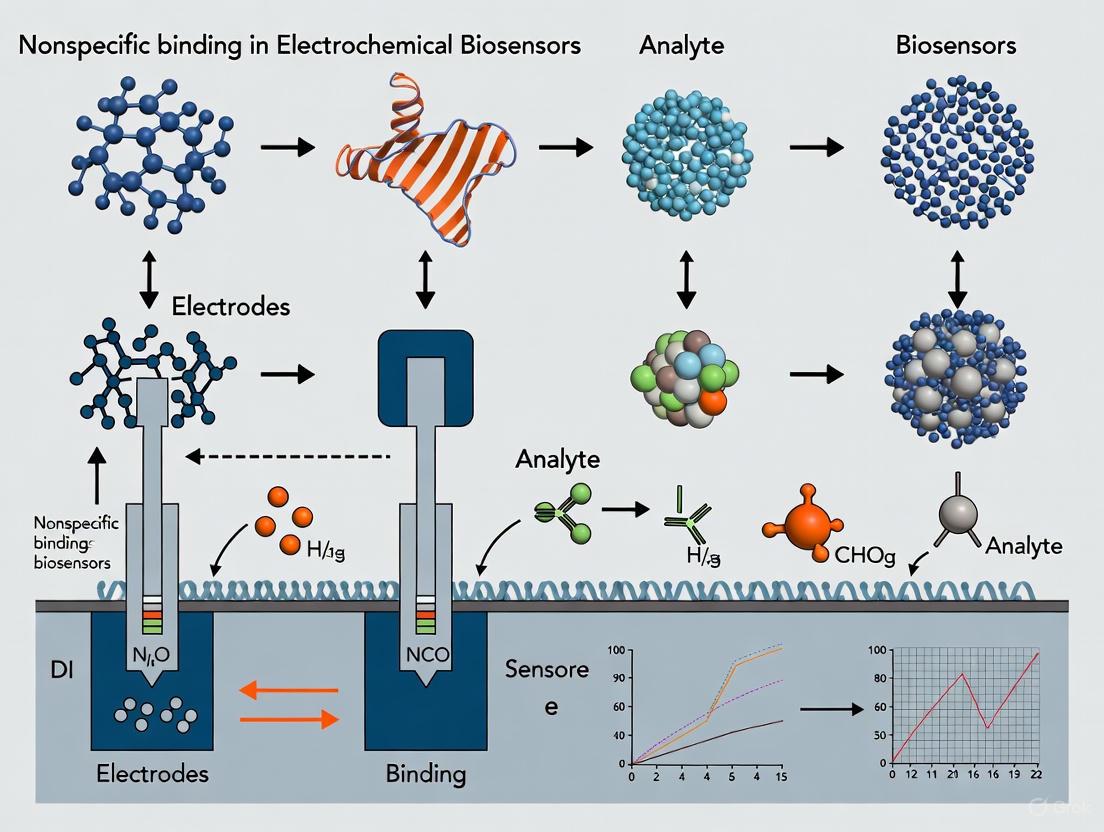
Nonspecific binding (NSB) remains a critical bottleneck that compromises the sensitivity, specificity, and reliability of electrochemical biosensors, particularly in complex biofluids.
Combating Nonspecific Binding: Strategies and Innovations for High-Performance Electrochemical Biosensors
Abstract
Nonspecific binding (NSB) remains a critical bottleneck that compromises the sensitivity, specificity, and reliability of electrochemical biosensors, particularly in complex biofluids. This article provides a comprehensive overview for researchers and drug development professionals, covering the foundational principles of NSB, from thermodynamic and intermolecular perspectives. It details a wide array of methodological solutions, including innovative antifouling coatings, surface modification techniques, and active removal methods. The content further delves into systematic troubleshooting and optimization protocols to overcome practical challenges, and concludes with advanced validation frameworks and comparative analyses with optical sensing platforms. By synthesizing the latest technological advances, this review serves as a strategic guide for developing robust electrochemical biosensors capable of accurate analysis in clinically relevant samples.
Understanding the Foe: The Fundamental Principles and Impact of Nonspecific Binding
Nonspecific binding (NSB) is a critical challenge in biosensing, particularly for electrochemical platforms designed to detect disease biomarkers or pathogenic bacteria in complex samples like blood, serum, or milk. Unlike specific binding, which occurs through defined molecular complementarity between a bioreceptor (e.g., antibody, aptamer) and its target analyte, nonspecific binding results from adventitious interactions between non-target sample components and the biosensor surface [1] [2]. In electrochemical biosensors, NSB leads to false-positive signals, reduced sensitivity, inaccurate readings, and ultimately unreliable data that can compromise diagnostic decisions [3] [4].
The fundamental distinction between these interaction types lies in their thermodynamic and intermolecular characteristics. Specific binding creates a stable, high-affinity complex with highly favorable free energy changes (large negative ΔG), forming a "deep energy well" [5]. In contrast, nonspecific interactions exhibit much weaker affinity with free energy changes near zero, creating only "shallow energy troughs" that allow for transient, promiscuous binding [5]. From an intermolecular perspective, while specific binding involves precise structural complementarity and multiple synchronized interactions, nonspecific adsorption occurs through generic forces including electrostatic interactions, hydrophobic effects, van der Waals forces, and hydrogen bonding [3] [6].
For researchers developing electrochemical biosensors, understanding and controlling NSB is paramount for achieving reliable performance in real-world applications, particularly for point-of-care testing where sample cleanup may be limited [2].
Fundamental Concepts: Thermodynamic and Intermolecular Perspectives
Thermodynamic Principles of Molecular Interactions
The binding interactions in biosensing systems are governed by the fundamental laws of thermodynamics, which determine the spontaneity and stability of molecular complexes.
Table 1: Thermodynamic Parameters Governing Molecular Interactions
| Parameter | Symbol | Definition | Role in Binding Interactions |
|---|---|---|---|
| Gibbs Free Energy | ΔG | Energy change determining reaction spontaneity | Negative values favor spontaneous binding; distinguishes high-affinity specific binding (very negative ΔG) from low-affinity NSB (ΔG near zero) |
| Enthalpy | ΔH | Heat change during bond formation/breakage | Negative values indicate favorable bond formation (hydrogen bonds, electrostatic interactions, van der Waals forces) |
| Entropy | ΔS | Measure of system disorder | Often unfavorable during binding due to reduced molecular freedom; can be favorable if ordered water molecules are released |
| Dissociation Constant | KD | Ratio of dissociation to association rates (koff/kon) | Lower values indicate stronger binding affinity; relates to ΔG through ΔG = RTln(KD) |
The overall binding affinity is quantified by the dissociation constant (KD), which relates to the Gibbs free energy through the equation ΔG = RTln(KD) [5]. Specific interactions typically exhibit very low KD values (nanomolar to picomolar range), while nonspecific binding displays much higher KD values (micromolar to millimolar), reflecting their transient nature [5].
The following diagram illustrates the energy landscape difference between specific and nonspecific binding:
Diagram: Energy landscape comparison between specific binding (deep energy well) and nonspecific binding (shallow energy trough).
Intermolecular Forces in Nonspecific Binding
NSB is mediated by several physicochemical forces that operate independently of biological recognition mechanisms:
Electrostatic Interactions: Coulombic attractions between oppositely charged groups on proteins and biosensor surfaces. These are particularly significant in low ionic strength solutions where charge screening is minimal [3] [6].
Hydrophobic Effects: Interactions between nonpolar regions on proteins and hydrophobic surfaces on electrodes. These are entropically driven by the release of ordered water molecules from hydrophobic interfaces [3] [7].
Van der Waals Forces: Weak, short-range attractions between all atoms and molecules that contribute to general adhesion phenomena [6].
Hydrogen Bonding: Dipole-dipole interactions between hydrogen bond donors and acceptors, common in biological systems [3].
In practical terms, NSB typically involves a combination of these forces rather than a single interaction type, making it challenging to predict and control through simple modifications [1].
Troubleshooting Guides
Diagnosing Nonspecific Binding in Electrochemical Biosensors
Problem: High Background Signal in Buffer-Only Controls
| Possible Cause | Diagnostic Experiments | Expected Results if Cause is Confirmed |
|---|---|---|
| Inadequate surface blocking | Test different blocking agents (BSA, casein, synthetic peptides) | Significant reduction in background current with effective blocker |
| Non-optimized electrode potential | Perform cyclic voltammetry in buffer to identify redox-free windows | Background signal decreases at certain potential ranges |
| Surface contamination | Characterize surface with SEM, AFM, or EIS | Visible contaminants or unusual surface morphology |
| Inappropriate electrolyte composition | Test different buffer ionic strengths and compositions | Background signal varies with ionic strength changes |
Experimental Protocol: Systematic Evaluation of Blocking Agents
- Prepare electrode surfaces with standard functionalization protocol
- Apply 100 μL of different blocking solutions (1% BSA, 1% casein, 0.1% zwitterionic peptide) to separate electrode replicates
- Incubate for 30-60 minutes at room temperature with gentle agitation
- Wash 3× with measurement buffer
- Measure background current in buffer solution using DPV or EIS
- Compare signals to identify most effective blocking agent [3] [8]
Problem: Signal Saturation at Low Analytic Concentrations
| Possible Cause | Diagnostic Experiments | Expected Results if Cause is Confirmed |
|---|---|---|
| Protein fouling on electrode surface | Measure signal decay over time in complex samples | Progressive signal deterioration with incubation time |
| Non-specific adsorption of detection molecules | Test detection reagents separately on functionalized surfaces | Signal generation even without target analyte present |
| Mass transport limitations due to fouling layer | Perform rotating disk electrode experiments | Signal becomes rotation rate-dependent at lower rates than expected |
Problem: Inconsistent Calibration Curves Between Buffer and Complex Matrices
| Possible Cause | Diagnostic Experiments | Expected Results if Cause is Confirmed |
|---|---|---|
| Matrix component interference | Spike recovery experiments in different matrices | Poor recovery rates (>120% or <80%) in complex matrices |
| Differential fouling across samples | Measure non-specific binding with labeled non-target proteins | Correlation between NSB level and signal suppression/enhancement |
| Proteolytic degradation of biorecognition elements | Incubate biosensor in matrix and measure binding capacity over time | Progressive loss of specific signal with pre-incubation time |
Strategies to Minimize Nonspecific Binding
Surface Modification Approaches
Table 2: Surface Modification Strategies to Reduce NSB
| Strategy | Mechanism | Application Protocol | Advantages/Limitations |
|---|---|---|---|
| Self-Assembled Monolayers (SAMs) | Creates ordered molecular layer that sterically hinders NSB | Incubate electrode in 1-10 mM thiol solution for 2-24 hours, then rinse | Excellent organization; limited stability under some conditions |
| Polyethylene Glycol (PEG) Coatings | Hydrated layer creates energy barrier for protein adsorption | Graft from surface or conjugate to functional groups | Highly effective; susceptible to oxidation |
| Zwitterionic Materials | Strong ionic solvation creates hydration layer resistant to protein adsorption | Form polymer brushes or self-assembled layers | Superior antifouling; may require complex synthesis |
| Hydrophilic Peptides | Neutral, hydrophilic surfaces minimize hydrophobic interactions | Synthesize peptides with specific sequences; immobilize via cysteine or other linkers | Customizable; cost may be prohibitive for large-scale use |
Experimental Protocol: Zwitterionic Peptide Coating for Antifouling
- Synthesize or purchase zwitterionic peptides (e.g., sequences with alternating glutamic acid (E) and lysine (K) residues such as CPPPPSESKSESKSESKPPPPC)
- Clean and activate electrode surface according to standard protocols
- Immobilize peptides via thiol-gold or other appropriate chemistry (1-100 μM peptide solution, 2-12 hours)
- Block remaining surfaces with low concentration of complementary blocker (e.g., 0.1% BSA)
- Validate coating with electrochemical impedance spectroscopy in ferricyanide/ferrocyanide solution
- Test antifouling performance in 10% serum or plasma using QCM or SPR if available [8]
Bioreceptor Optimization Approaches
Table 3: Bioreceptor Engineering Strategies to Reduce NSB
| Strategy | Mechanism | Protocol | Effectiveness |
|---|---|---|---|
| Aptamer Selection with Negative Selection | Counterselection against non-target components in sample matrix | Include matrix components during SELEX process | High - significantly reduces cross-reactivity |
| Antibody Affinity Purification | Removes low-affinity antibodies that contribute to NSB | Use antigen affinity column with stringent elution | Medium - improves specificity but does not address intrinsic NSB |
| Phosphorothioate-Modified Aptamers | Enhances stability and reduces non-specific interactions | Incorporate phosphorothioate groups during aptamer synthesis | High - reduces degradation and subsequent NSB from fragments [8] |
| Optimal Bioreceptor Density | Prevents steric crowding that promotes non-specific interactions | Titrate immobilization concentration; measure binding efficiency | Medium - optimization required for each system |
Experimental Protocol: Phosphorothioate Aptamer Modification
- Design aptamer sequence specific to target (e.g., SARS-CoV-2 RBD protein)
- Specify phosphorothioate modification at desired positions during synthesis (sulfur substitution at non-bridging oxygen in phosphate backbone)
- Purify using HPLC or PAGE
- Immobilize on electrode surface using standard thiol or amino chemistry
- Compare stability and specificity with unmodified aptamer in serum-containing buffers [8]
Frequently Asked Questions (FAQs)
Q1: Why does nonspecific binding remain a major challenge in electrochemical biosensors despite decades of research?
NSB persists as a critical bottleneck because it arises from fundamental physicochemical forces that are always present in biological systems. Unlike specific binding, which can be engineered through molecular design, NSB results from generic interactions (electrostatic, hydrophobic, van der Waals) that occur between any surfaces and proteins in close proximity [1]. The complexity of real biological samples (serum, blood, milk) containing thousands of different proteins, lipids, and other molecules creates countless opportunities for these nonspecific interactions. Furthermore, what works as an antifouling strategy for one surface or sample type may fail completely for another, requiring case-by-case optimization [2].
Q2: What are the most effective surface modifications to prevent NSB in complex samples like serum or blood?
Currently, the most effective approaches include:
- Zwitterionic materials: Surfaces containing mixed positive and negative charges that create a strong hydration layer through ionic solvation, providing exceptional resistance to protein adsorption [8] [6].
- Peptide-based coatings: Specifically designed sequences (e.g., EK repeats, arched-peptides) that combine hydrophilicity and electrical neutrality [8].
- Hybrid materials: Combinations of polymers, peptides, and hydrogels that provide both steric and hydration barriers [2].
Recent research demonstrates that arched-peptide structures can enhance stability against enzymatic degradation while maintaining excellent antifouling properties in serum [8].
Q3: How can I distinguish between specific signal and nonspecific binding in my electrochemical measurements?
Several approaches can help differentiate these signals:
- Kinetic analysis: Specific binding typically shows slower association/dissociation kinetics compared to nonspecific adsorption.
- Competition experiments: Add excess unlabeled specific ligand - specific signal should decrease while nonspecific remains.
- Surface plasmon resonance (SPR) coupling: Combined EC-SPR platforms can simultaneously measure mass adsorption (SPR) and electrochemical response, helping distinguish specific from nonspecific binding [2].
- Control surfaces: Use non-functionalized or blocked surfaces to measure pure nonspecific component.
Q4: What are the key characteristics of bioreceptors that minimize NSB?
Optimal bioreceptors exhibit:
- High specificity and affinity (low KD) for reduced cross-reactivity
- Stability against enzymatic degradation (e.g., phosphorothioate-modified aptamers) [8]
- Appropriate orientation when immobilized to present binding sites optimally
- Minimal hydrophobic or charged patches outside the binding site that could mediate nonspecific interactions
Q5: How do temperature and incubation time affect NSB in biosensing assays?
Both parameters significantly influence NSB through their effects on molecular kinetics:
- Temperature: Increasing temperature accelerates diffusion and association rates but may also increase dissociation of specific complexes if ΔH is unfavorable. Optimal temperature balances these effects [5].
- Incubation time: Longer incubations allow more time for specific binding to reach equilibrium but also increase opportunity for nonspecific adsorption. Typical specific binding reaches equilibrium faster than significant NSB accumulates [5].
The following diagram illustrates the experimental workflow for systematic evaluation and mitigation of NSB:
Diagram: Systematic workflow for diagnosing and mitigating nonspecific binding in biosensor development.
Research Reagent Solutions
Table 4: Essential Reagents for Managing Nonspecific Binding
| Reagent Category | Specific Examples | Function | Application Notes |
|---|---|---|---|
| Blocking Agents | BSA, casein, fish skin gelatin, synthetic peptides | Occupies non-specific binding sites on surface | Varying effectiveness depending on surface chemistry; test multiple options |
| Surface Modifiers | HS-(CH2)11-EG6-OH, zwitterionic thiols, silane-PEG | Forms antifouling self-assembled monolayers | Gold surfaces: thiol chemistry; Silicon/glass: silane chemistry |
| Polymeric Coatings | Polyethylene glycol (PEG), polycarboxybetaine, poly(sulfobetaine) | Creates hydrated physical barrier to protein adsorption | Grafting density critically impacts performance |
| Specialized Bioreceptors | Phosphorothioate-modified aptamers, nanobodies, affimers | Enhanced stability and specificity | Modified aptamers resist nuclease degradation [8] |
| Surfactants & Additives | Tween-20, CHAPS, Pluronic F-127 | Reduces hydrophobic interactions in assay buffers | Optimize concentration to avoid disrupting specific binding |
| Characterization Tools | Ferri/ferrocyanide, Ru(NH3)63+, enzyme substrates | Electrochemical probes for surface characterization | Use pre- and post-fouling to quantify NSB |
Table 5: Recommended Antifouling Peptide Sequences
| Peptide Sequence | Structure | Reported Performance | Immobilization Chemistry |
|---|---|---|---|
| CPPPPSESKSESKSESKPPPPC | Arched peptide with serine spacers | Superior stability against proteolysis and excellent antifouling in serum | Thiol-gold via terminal cysteines [8] |
| CGGGNEKNEKNEKNEK | Linear EK repeat sequence | Strong antifouling but susceptible to enzymatic degradation | Thiol-gold or amine-reactive |
| CGGGAEAKAEAKAEAK | Linear AEK repeat sequence | Moderate antifouling, better than single-component coatings | Thiol-gold or amine-reactive |
| CKDGPLGVRGLPGKC | Beta-sheet forming sequence | Context-dependent performance | Thiol-gold via terminal cysteines |
Nonspecific binding remains a fundamental challenge in electrochemical biosensor development, rooted in the basic thermodynamic and intermolecular forces that govern all molecular interactions in solution. The perspectives and troubleshooting guides presented here emphasize a systematic approach to diagnosing, understanding, and mitigating NSB through surface engineering, bioreceptor optimization, and assay condition refinement. As the field advances, integrating multiple strategies—such as combining zwitterionic coatings with stabilized phosphorothioate aptamers—appears most promising for achieving the level of specificity required for reliable biosensing in complex clinical and environmental samples. The experimental protocols and reagent solutions provided offer practical starting points for researchers confronting NSB challenges in their specific biosensor applications.
Fundamental FAQs: Understanding Nonspecific Interactions
Q1: What are the primary nonspecific forces that interfere with electrochemical biosensor performance?
Nonspecific interactions are generic physical forces that can cause unwanted binding in biosensors, unlike specific, lock-and-key biorecognition events. The major forces at play are [6]:
- Electrostatic Interactions: These occur between charged surfaces and charged molecules in the solution. Their strength is influenced by the solution's pH and ionic strength.
- Hydrophobic Interactions: These drive the association of non-polar surfaces and molecules in an aqueous environment to minimize disruptive interactions with water.
- van der Waals Forces: These are short-range, attractive forces between all atoms and molecules, arising from transient electric dipoles.
Q2: How do these forces lead to nonspecific binding (NSB) and inaccurate results?
In complex biological samples like serum, numerous proteins and other molecules can adsorb onto the sensor surface via these forces [9] [6]. This nonspecific binding creates a background signal or noise that is virtually indistinguishable from the specific signal of the target analyte in label-free biosensors. This leads to reduced sensitivity, poor accuracy, and false positives [9] [10].
Q3: What is the most common strategy to correct for nonspecific binding?
The most effective strategy is the use of a reference (negative control) channel paired with the specific capture probe channel [9]. The reference channel is functionalized with a non-interacting molecule, and its signal—which represents the NSB and bulk refractive index shifts—is subtracted from the active channel's signal to report the specific binding faithfully [9].
Q4: Which control probe is the best for reference subtraction?
There is no universal "best" control probe; the optimal choice must be determined on a case-by-case basis. For instance, while an isotype-matched control antibody is a tempting choice, a systematic study found that for an IL-17A assay, BSA scored highest (83%), while for a CRP assay, a rat IgG1 isotype control was optimal (95%) [9]. The best reference must be optimized for each specific assay and analyte [9].
Troubleshooting Guide: Diagnosing and Resolving NSB Issues
This guide helps diagnose common NSB problems and identifies corrective actions based on the source of the issue.
Table 1: Troubleshooting Nonspecific Binding in Biosensors
| Observed Problem | Potential Root Cause | Recommended Corrective Actions |
|---|---|---|
| High background signal in blank or control samples [9] [10] | Inadequate surface blocking; excessive positive or negative surface charge. | Implement a systematic blocking protocol (see Section 3). Optimize surface charge via chemical modification (e.g., SAMs, PEG) [10]. |
| Signal drift and unstable baseline during measurements [9] | NSB of matrix constituents (e.g., serum proteins) over time. | Incorporate and optimize a reference channel for real-time background subtraction [9]. Use zwitterionic polymer coatings to create a strong hydration layer [6]. |
| Poor assay sensitivity and high limit of detection [10] | Nonspecific proteins fouling the electrode surface, obscuring the specific signal. | Employ chemical surface modifications like diazonium salts or self-assembled monolayers (SAMs) to create a controlled, antifouling interface [10]. |
| Low signal-to-noise ratio | A combination of high NSB (noise) and/or low specific binding. | Test a panel of different negative control probes (e.g., BSA, isotype controls, cytochrome c) to identify the most effective reference for your specific assay [9]. |
Experimental Protocols: Mitigating Nonspecific Binding
Protocol 1: Optimization of Reference Control Probes
Objective: To systematically select the most effective negative control probe for accurate reference subtraction in a label-free biosensor assay [9].
Materials:
- Functionalized biosensor chip (e.g., Photonic Ring Resonator, electrochemical cell).
- Panel of candidate control proteins (e.g., BSA, mouse/rat IgG1 isotype controls, anti-FITC, cytochrome c).
- Capture antibody specific to your target analyte.
- Assay buffer and complex biological matrix (e.g., 1% FBS in EGM-2).
- Target analyte.
Methodology:
- Chip Functionalization: Immobilize the specific capture probe on the designated "active" sensors.
- Control Immobilization: Immobilize each candidate control protein from your panel on separate "reference" sensors at a density matched to the capture probe.
- Assay Run: Expose all sensors to a calibration series of the target analyte prepared in the complex biological matrix.
- Data Analysis: For each control protein, subtract its signal from the active sensor signal. Evaluate the resulting calibration curves based on linearity, accuracy, and selectivity.
- Scoring: Score the performance of each control (e.g., 0-100%). The control that yields the best analytical performance for your specific assay is the optimal choice [9].
Protocol 2: Surface Blocking with Polymer Brushes for Antifouling
Objective: To suppress NSB by coating the sensor surface with a non-fouling polymer brush layer.
Materials:
- Sensor substrate (e.g., gold, silicon, mica).
- Polymer solution (e.g., Zwitterionic bottlebrush polymer, Poly(ethylene glycol) (PEG), or Poly(oligo(ethylene glycol) methacrylate) (POEGMA)).
- Appropriate solvent (e.g., PBS, water).
- Functional chemistry for anchoring (e.g., thiols for gold, silanes for silica/glass).
Methodology:
- Surface Cleaning: Clean the sensor substrate thoroughly (e.g., UV-ozone, oxygen plasma).
- Polymer Grafting: Incubate the sensor with the polymer solution. This can be done by:
- "Grafting-to": Incubating the surface with pre-formed polymers that have anchoring groups.
- "Grafting-from": Using surface-initiated polymerization to grow polymer brushes directly from the substrate.
- Anchoring: Allow the polymers to anchor via specific (covalent) or strong nonspecific (electrostatic) interactions. Zwitterionic bottlebrushes, for example, can use positively charged groups to electrostatically bind to negative surfaces like mica and silica with high stability [6].
- Rinsing: Rinse the surface extensively with buffer and solvent to remove physisorbed polymer.
- Validation: Validate the coating's antifouling performance by exposing it to a high-concentration protein solution (e.g., serum). A successful coating will reduce protein adsorption to below 0.2 ng/cm² [6].
The following workflow summarizes the decision process for selecting an appropriate NSB mitigation strategy.
The Scientist's Toolkit: Key Reagents for Combating NSB
Table 2: Essential Research Reagents for Managing Nonspecific Interactions
| Reagent / Material | Primary Function | Key Characteristic |
|---|---|---|
| Bovine Serum Albumin (BSA) [9] | A common blocking agent used to passivate uncovered surface areas. | Inexpensive and widely available; performance as a control probe varies by assay [9]. |
| Isotype Control Antibodies [9] | A negative control antibody that matches the class and type of the capture antibody but lacks target specificity. | Controls for isotype-specific NSB; not always the top-performing control [9]. |
| Poly(ethylene glycol) (PEG) [10] | A polymer grafted to surfaces to create a steric and hydrative barrier against protein adsorption. | Provides a physical barrier that repels proteins via steric repulsion and water structuring [10]. |
| Zwitterionic Polymers [6] | Surface coatings with mixed positive and negative charges that bind water molecules strongly. | Creates a robust hydration layer via electrostatic interactions, leading to superior antifouling properties [6]. |
| Self-Assembled Monayers (SAMs) [10] | Ordered molecular assemblies that form on surfaces (e.g., thiols on gold) to create a controlled interface. | Allows precise tuning of surface chemistry, charge, and functionality to minimize NSB [10]. |
| Anti-FITC Antibody [9] | An antibody against a hapten (fluorescein) not typically found in biological samples. | Serves as an excellent negative control when the target is not FITC, due to its irrelevance [9]. |
In the development of electrochemical biosensors, nonspecific binding (NSB) presents a formidable challenge that directly compromises the reliability, accuracy, and clinical utility of these devices. NSB occurs when biomolecules interact with the sensor surface through means other than the intended specific biorecognition event. For researchers and scientists in drug development, understanding and mitigating the consequences of NSB—namely false positives, reduced sensitivity, and signal drift—is critical for advancing robust diagnostic tools. This guide provides targeted troubleshooting and foundational methodologies to address these specific performance issues within the broader research context of overcoming nonspecific binding.
Troubleshooting Guide: Core Problems and Solutions
The following table summarizes the primary sensor performance issues linked to nonspecific binding, their underlying causes, and proven corrective strategies.
Table 1: Troubleshooting Sensor Performance Issues Related to Nonspecific Binding
| Performance Issue | Root Cause | Recommended Solution | Key Experimental Considerations |
|---|---|---|---|
| False Positives/False Negatives | Attraction of antibodies to Fc receptors or interference from heterophilic antibodies (e.g., HAMA) [11]. | Use specialized commercial diluents or blocking agents (e.g., StabilGuard, MatrixGuard) to block matrix interferences [11]. | Include negative controls with no target or irrelevant molecules to identify and subtract NSB signal [12]. |
| Reduced Sensitivity & Specificity | Non-target analytes or the target itself binding to sites other than the capture molecule, obscuring the true signal [13]. | Employ polymer brush interfaces (e.g., POEGMA) to extend the Debye length and reduce biofouling [14]. | Optimize buffer composition, pH, ionic strength, and temperature. Use additives like detergents [12]. |
| Signal Drift | Slow diffusion of electrolytic ions into the sensing region, altering gate capacitance and threshold voltage over time [14]. | Implement a stable electrical testing configuration using infrequent DC sweeps instead of static measurements [14]. | Use a rigorous testing methodology that accounts for temporal effects separately from binding events [14]. |
| Long Response Time & Limited Sensitivity | Diffusion-limited mass transfer of the analyte to the sensor surface, especially at low concentrations [15]. | Apply active mass transfer methods like dielectrophoresis (DEP) to concentrate target analytes at the sensor surface [15]. | The DEP force is frequency-dependent; optimize the AC field frequency to achieve positive DEP for your target. |
Detailed Experimental Protocols
Protocol 1: Distinguishing Specific from Non-Specific Binding in Chemiresistive Sensors
This methodology, adapted from research on conducting polymer-based biosensors, provides a way to decouple specific and non-specific binding signals, which is fundamental for accurate data interpretation [13].
- Sensor Platform: An interpenetrating network (IPN) of poly (3,4-ethylenedioxyphene) (PEDOT) and poly (3-thiopheneethanol) (P3TE) vapor-phase polymerized onto a polypropylene–cellulose fabric [13].
- Receptor Immobilization: Covalently attach a capture molecule (e.g., Avidin) to the polymer-coated fabric using a linker molecule like (3-Glycidyloxypropyl)trimethoxysilane (GOPS).
- Blocking: Perform two subsequent washes in a 1:1 ratio of Bovine Serum Albumin (BSA) to phosphate buffer solution (PBS) to minimize protein adsorption onto unoccupied binding sites [13].
- Measurement:
- Submerge the functionalized sensor in PBS and measure the baseline electrical resistance.
- Introduce the analyte and monitor the percent change in resistance (ΔR%).
- Key Observation: Specific binding events (e.g., Biotin/Avidin) typically result in a negative ΔR%. In contrast, nonspecific binding events (e.g., Gliadin on an Avidin-coated sensor) often show a positive ΔR% [13].
- Data Analysis: Employ machine learning classifiers (e.g., random forest) on the resistance response data to automatically predict the presence of a specific target in a complex solution [13].
Protocol 2: Mitigating Signal Drift and Charge Screening in BioFETs
This protocol outlines strategies to overcome two major obstacles for biosensors operating in biologically relevant ionic strength solutions, such as 1X PBS [14].
- Sensor Platform: A carbon nanotube (CNT) thin-film transistor (TFT) functionalized with a non-fouling polymer brush layer.
- Debye Length Extension:
- Grow or immobilize a polymer layer like poly(oligo(ethylene glycol) methyl ether methacrylate) (POEGMA) above the CNT channel.
- This layer increases the sensing distance (Debye length) in high ionic strength solutions via the Donnan potential effect, allowing for the detection of large antibodies that would otherwise be screened [14].
- Antibody Printing: Inkjet-print capture antibodies (cAb) into the POEGMA layer.
- Drift Mitigation Strategy:
- Passivation: Ensure the device is properly encapsulated and passivated to minimize leakage currents.
- Stable Electrode: Use a stable pseudo-reference electrode (e.g., Palladium).
- Measurement Scheme: Avoid continuous static measurements. Instead, use infrequent DC sweeps to collect data points, which helps isolate the binding signal from low-frequency drift [14].
- Control Experiment: Always test a control device with no antibodies printed over the CNT channel within the same chip to confirm that the signal shift is due to specific binding and not drift or nonspecific adsorption [14].
Research Reagent Solutions Toolkit
The following table catalogs key reagents and their specific functions in combating nonspecific binding, as cited in the provided literature.
Table 2: Key Reagents for Mitigating Nonspecific Binding
| Reagent / Material | Function / Application | Specific Example (from search results) |
|---|---|---|
| Protein Blockers | Saturate unoccupied binding sites on the sensor surface to prevent nonspecific adsorption of proteins. | Bovine Serum Albumin (BSA), casein [12]. StabilGuard, StabilCoat, StabilBlock [11]. |
| Specialized Assay Diluents | Dilute samples in a matrix that itself blocks common interferents present in patient samples. | MatrixGuard (protein-containing) and Surmodics Assay Diluent (protein-free) [11]. |
| Non-Fouling Polymers | Form a hydration layer that resists protein adsorption and can extend the Debye length. | Poly(oligo(ethylene glycol) methyl ether methacrylate) (POEGMA) [14]. |
| Linker Chemistry | Covalently attach biorecognition elements (e.g., antibodies) to the sensor surface. | (3-Glycidyloxypropyl)trimethoxysilane (GOPS) [13]. |
| Redox Probes | Enable Faradaic impedance and voltammetric sensing; can be used in spectroelectrochemical detection. | A luminescent redox probe whose emission changes with oxidation state can lower the detection limit by 3 orders of magnitude [16]. |
Frequently Asked Questions (FAQs)
Q1: What are the most common sources of nonspecific binding in immunoassays? The leading contributor is the attraction of primary or secondary antibodies to Fc receptors (FcRs). Other significant sources include heterophilic antibodies (e.g., Human Anti-Mouse Antibodies or HAMA), rheumatoid factors, and interactions with unintended proteins that have similar epitopes [11].
Q2: How can I determine if my sensor signal is due to specific binding or just signal drift? The most critical step is to run a proper control experiment. This involves using a sensor that is identical in every way except it lacks the specific capture molecule. Any signal generated by the control device can be attributed to drift or nonspecific binding, allowing you to subtract this background from your experimental sensor [14]. Furthermore, kinetic analysis can help: specific interactions often show clear association and dissociation phases, while nonspecific binding may display rapid, non-saturable association and slower, less uniform dissociation [12].
Q3: Are there ways to actively improve the speed and sensitivity of my biosensor without changing its core chemistry? Yes, methods like dielectrophoresis (DEP) can be integrated. DEP uses an inhomogeneous AC electric field to actively concentrate target analytes (like proteins or cells) onto the sensitive area of the sensor surface. This actively enhances mass transfer, reducing assay time from hours to minutes and lowering the limit of detection by orders of magnitude [15].
Q4: My sensor works well in diluted buffer but fails in real samples like blood or serum. What can I do? This is a classic symptom of matrix effects and biofouling. To overcome this:
- Use a robust blocking agent: Incorporate commercial blockers or proteins like BSA.
- Employ specialized diluents: Formulations like MatrixGuard are designed to block interferents in complex matrices [11].
- Modify the surface with antifouling materials: Graft polymer brushes like POEGMA to create a bio-inert surface [14].
- Optimize sample preparation: Techniques like centrifugation or dialysis can remove some interferents [12].
Experimental Workflows and Signaling Pathways
The following diagrams illustrate key experimental workflows and the logical relationship between binding events and sensor outcomes, as discussed in the troubleshooting guides.
In the development of electrochemical biosensors, the interface where proteins meet a solid surface is a critical determinant of performance. Protein adsorption onto electrode surfaces is an intrinsic phenomenon that can either enable sensor function or lead to its failure through non-specific binding (NSB). NSB occurs when proteins adhere to surfaces through unintended interactions, compromising the sensitivity and specificity of biosensors designed for personalized healthcare, environmental monitoring, and therapeutic drug monitoring [17] [18]. A thorough understanding of how the physicochemical properties of both the protein and the surface govern this adsorption process is therefore essential for researchers and drug development professionals aiming to create reliable, high-performance diagnostic tools. This technical support center provides a foundational understanding, troubleshooting guidance, and detailed protocols to address these complex interfacial challenges.
Fundamental Mechanisms and Key Challenges
The Driving Forces of Protein Adsorption
Proteins are large amphiphatic molecules, making them intrinsically surface-active. The driving force for adsorption is a complex interplay of Coulombic forces, van der Waals forces, Lewis acid-base interactions, and hydrophobic interactions [19]. Entropic factors, such as the release of bound water molecules from the hydrophobic surface and the concomitant restructuring of the protein itself (conformational change), also contribute significantly to the overall free energy change, making adsorption often appear irreversible [19]. This complexity is the source of the "protein adsorption paradoxes" that complicate prediction and control.
The following diagram illustrates the key properties of proteins and surfaces that interact during the adsorption process, leading to various experimental consequences.
The Impact of Nanomaterial Morphology
The adsorption process is profoundly influenced by the morphological properties of the surface, especially when working with engineered nano- and microparticles for drug delivery or sensing. The formation of a "protein corona" on these particles endows them with a new biological identity, critically affecting their cellular uptake, biodistribution, and toxicity [20].
Table 1: Effect of Particle Morphology on Protein Adsorption
| Morphological Property | Effect on Protein Adsorption | Implications for Biosensor Design |
|---|---|---|
| Particle Size | The amount of protein adsorbed per unit surface area increases with particle size due to reduced steric effects on less curved surfaces [20]. | Larger electrode nanostructures may be more prone to NSB. Smaller nanoparticles can offer higher surface-area-to-volume ratios with less protein denaturation. |
| Particle Shape | The shape influences the composition of the protein corona. For example, rod-shaped silica particles adsorb a different protein profile compared to spherical particles [20]. | The geometry of nanostructures on an electrode should be optimized not just for surface area, but also for the type of proteins it attracts. |
| Surface Porosity | Mesoporous particles can entrap proteins within their pores, leading to a larger amount and potentially different composition of adsorbed proteins compared to solid particles [20]. | Porous electrode coatings can increase bioreceptor loading but may also increase NSB if not properly controlled. |
Troubleshooting Guide: FAQs on NSB and Sensor Performance
Q1: My electrochemical biosensor shows high background noise and poor sensitivity. I suspect NSB. What are the primary causes? A high background signal is a classic symptom of NSB. The causes can be traced to several interfacial properties:
- Surface Hydrophobicity: Hydrophobic surfaces (e.g., bare plastics or certain electrodes) strongly promote NSB of many serum proteins via hydrophobic interactions [19].
- Inadequate Surface Passivation: A lack of a effective blocking agent to cover unused binding sites on the electrode surface after immobilizing the bioreceptor (e.g., antibody, aptamer) is a common oversight.
- Electrostatic Interactions: Attractive forces between charged residues on non-target proteins and a charged surface can lead to NSB. This depends on the surface chemistry and the isoelectric points (pI) of the proteins in the sample [17] [19].
Q2: What are the most effective strategies to suppress NSB on my electrode surfaces? Suppressing NSB is a multi-faceted approach focused on surface engineering:
- Use of Low-Fouling Surface Coatings: Functionalize the electrode with materials that resist protein adsorption. The most common strategies include:
- Polyethylene Glycol (PEG) and its derivatives: PEG creates a hydrated, steric barrier that repels proteins [20].
- Zwitterionic Polymers: Surfaces modified with molecules like phosphorylcholine or sulfobetaine create a strong hydration layer via electrostatic interactions, providing excellent antifouling properties [20].
- Optimized Surface Blocking: After immobilizing your bioreceptor, incubate the sensor with a solution of an inert protein (e.g., Bovine Serum Albumin - BSA, casein) or a specialized commercial blocking buffer to passivate any remaining reactive sites.
- Surface Charge Control: Modifying the surface to be neutral or to have a charge that repels the majority of proteins in your sample buffer can minimize electrostatic-driven NSB [17].
Q3: How does the stability of my target protein influence its adsorption and the sensor's performance? The structural stability of a protein is a key factor. Proteins with low structural stability are more prone to unfolding upon adsorption to a surface [19]. This denaturation can have several negative consequences:
- It can increase the strength of adhesion, making the binding effectively irreversible.
- It can mask the epitope that your bioreceptor is designed to recognize, reducing the signal for your target analyte.
- It can create new, non-specific interaction sites, further exacerbating NSB.
Experimental Protocols for Studying and Controlling Adsorption
Protocol: Creating a Low-Fouling Surface with Zwitterionic Polymer Coating
Principle: Zwitterionic polymers possess both positive and negative charges, forming a dense hydration layer that is energetically unfavorable for proteins to displace, thereby resisting adsorption [20].
Materials:
- Surface Substrate: Gold electrode, screen-printed electrode (SPE), or glass slide.
- Zwitterionic Monomer: e.g., sulfobetaine methacrylate (SBMA) or carboxybetaine acrylamide (CBAA).
- Chemical Linker: Alkanethiol (for gold surfaces) or silane (for oxide surfaces).
- Initiation System: For polymerization (e.g., UV initiator or redox pair).
- Buffers: 10 mM HEPES, pH 7.4 or Phosphate Buffered Saline (PBS).
Procedure:
- Surface Cleaning: Clean the substrate thoroughly (e.g., oxygen plasma for gold/glass, ethanol rinse for SPEs).
- Linker Immobilization: Incubate the surface with a solution of a linker molecule (e.g., a thiol with a polymerization-initiating group for gold) to form a self-assembled monolayer (SAM).
- Surface-Initiated Polymerization: Place the modified substrate in a degassed aqueous solution containing the zwitterionic monomer and initiator. Allow the polymerization to proceed for 2-24 hours under controlled temperature.
- Rinsing and Characterization: Thoroughly rinse the modified surface with ultrapure water and buffer to remove physisorbed monomers/polymer. Characterize the coating using techniques like Electrochemical Impedance Spectroscopy (EIS) to confirm a significant increase in impedance, indicating a strong barrier to ion and protein penetration.
- Validation: Test the antifouling performance by exposing the surface to a complex solution like 10% fetal bovine serum (FBS) or undiluted plasma and using a technique like Quartz Crystal Microbalance with Dissipation (QCM-D) or EIS to quantify the mass or resistance change due to non-adsorbed proteins.
Protocol: Systematic Analysis of Protein Adsorption using SDS-PAGE
Principle: This protocol isolates the "hard" protein corona from particles and analyzes its composition based on molecular weight, helping to identify the major proteins causing NSB [20].
Materials:
- Nanoparticles (NPs) or microparticles (MPs) of interest.
- Protein Source: Human plasma, serum, or a defined protein mixture.
- Centrifugation Equipment (or magnetic separation for magnetic particles).
- SDS-PAGE Gel (4-20% gradient recommended).
- BCA or Bradford Protein Assay Kit.
- Staining Solution (e.g., Coomassie Brilliant Blue) and destaining solution.
Procedure:
- Corona Formation: Incubate your particles (e.g., 1 mg/mL) with the protein solution (e.g., 1 mL of 10% plasma in PBS) for 1 hour at 37°C with gentle agitation.
- Isolation of Hard Corona: Separate the protein-coated particles from the unbound protein by centrifugation (e.g., 21,000 x g, 30 minutes). Carefully remove the supernatant.
- Washing: Gently resuspend the pellet in clean PBS buffer and repeat the centrifugation step. Perform this wash 2-3 times to remove loosely associated ("soft" corona) proteins.
- Protein Elution: Resuspend the final pellet in 50 µL of SDS-PAGE loading buffer (containing SDS and β-mercaptoethanol). Heat at 95°C for 10 minutes to denature and elute the proteins from the particle surface.
- Analysis: Centrifuge the sample again to pellet the particles. Load the supernatant (containing the eluted proteins) onto the SDS-PAGE gel. Run the gel, stain it, and image the bands. The band pattern provides a fingerprint of the adsorbed proteins, which can be compared across different surface modifications to evaluate their effectiveness.
The following workflow diagram visualizes the key steps in this analytical protocol.
The Scientist's Toolkit: Essential Research Reagents & Materials
Table 2: Key Reagents for Investigating and Mitigating Protein Adsorption
| Reagent/Material | Function/Description | Key Application in Research |
|---|---|---|
| Alkanethiols | Molecules that form self-assembled monolayers (SAMs) on gold surfaces [19]. | Used to create well-defined, tunable model surfaces with specific terminal functional groups (e.g., -CH₃, -OH, -COOH, -EG) to study the effect of surface chemistry on protein adsorption. |
| Zwitterionic Monomers (e.g., SBMA, CBAA) | Building blocks for creating ultra-low fouling polymer brushes on surfaces [20]. | Grafted onto electrodes or nanoparticles to create a robust hydration layer that prevents NSB, crucial for sensors operating in complex biological fluids like blood or serum. |
| Polyethylene Glycol (PEG) | A polymer that forms a steric and hydrated barrier against protein approach [20]. | The historical "gold-standard" for surface passivation. Used as a coating or as a linker for bioreceptor immobilization to reduce NSB. |
| Bovine Serum Albumin (BSA) | An inert, low-cost protein used as a blocking agent [20]. | Added in high concentration after bioreceptor immobilization to adsorb to and passivate any remaining non-specific binding sites on the surface. |
| Atomic Force Microscopy (AFM) | A high-resolution technique for imaging surfaces and measuring interaction forces [19]. | Used to map the spatial distribution of adsorbed proteins and to measure the nanoscale forces between a protein-functionalized tip and a surface, quantifying adhesion. |
| Electrochemical Impedance Spectroscopy (EIS) | An electrochemical technique sensitive to surface modifications [18]. | Used to characterize the successful formation of antifouling layers and to monitor protein adsorption in real-time by tracking changes in charge transfer resistance (Rct). |
The Antifouling Toolbox: Physical, Chemical, and Active Mitigation Strategies
Nonspecific binding (NSB) remains a significant challenge in the development of robust electrochemical biosensors, particularly when dealing with complex biological samples such as blood, saliva, or plasma. Undesired adsorption of proteins, cells, or other biomolecules to the sensor surface can foul the electrode, leading to passivation, reduced sensitivity, poor signal-to-noise ratios, and unreliable analytical results [21]. Passive surface modification strategies, including the use of poly(ethylene glycol) (PEG), self-assembled monolayers (SAMs), and hydrogel coatings, form the first line of defense against fouling. This technical support center provides targeted troubleshooting guides and FAQs to help researchers effectively implement these critical antifouling technologies within their electrochemical biosensing projects.
Frequently Asked Questions (FAQs)
1. What are the primary mechanisms by which PEG, SAMs, and hydrogels prevent nonspecific binding?
- PEG: Creates a highly hydrated, steric barrier through its ethylene glycol units, which strongly bind water molecules. This hydration layer repels approaching biomolecules through an energetically unfavorable compression effect [21].
- SAMs: Form dense, ordered molecular layers on surfaces (often gold). By presenting uniform, chemically inert terminal groups (e.g., oligo(ethylene glycol)), they minimize hydrophobic and electrostatic interactions that drive nonspecific adsorption [21].
- Hydrogels: Possess a porous, three-dimensional, and inherently hydrophilic structure that minimizes interactions with fouling agents. Their high water content creates a physical and thermodynamic barrier to protein adsorption [22].
2. Beyond antifouling, what additional benefits can these modifications offer? These surfaces are not merely passive barriers. They can be functionalized to become bioactive:
- Bioreceptor Immobilization: Both hydrogels and SAMs can be engineered with functional groups (e.g., amines, carboxylic acids, thiols, epoxides) for the covalent attachment of antibodies, DNA probes, or enzymes [23] [24]. This specific immobilization often enhances the stability and activity of the bioreceptor compared to passive adsorption.
- Improved Analytical Performance: A well-designed antifouling layer can dramatically enhance the performance of a biosensor in complex media. For example, a zwitterionic polymer coating enabled the detection of SARS-CoV-2 in unfiltered 50% saliva and redox-labeled DNA in undiluted plasma, achieving a ~67% reduction in protein adsorption compared to bare gold [25].
3. My PEGylated sensor loses performance over time. What could be the cause? PEG is susceptible to oxidative degradation, especially in the presence of metal ions or at elevated temperatures, which can compromise its long-term antifouling stability [21]. Consider these alternatives:
- Zwitterionic Polymers: Materials like poly(carboxybetaine) or poly(sulfobetaine) form even stronger hydration layers via electrostatic interactions and are more resistant to oxidation, making them promising replacements for PEG [25] [21].
- Crosslinked Hydrogels: Forming a more stable, crosslinked network can improve the operational longevity of the coating.
4. How can I immobilize bioreceptors on these antifouling surfaces? Multiple strategies exist, and the choice depends on your substrate and bioreceptor:
- Covalent Immobilization: Surfaces can be activated with linkers like (3-aminopropyl)triethoxysilane (APTES) and glutaraldehyde, or EDC/NHS chemistry to create covalent bonds with proteins or amines on your bioreceptor [23].
- Streptavidin-Biotin: This is a highly specific and strong non-covalent interaction. The surface is modified with streptavidin (e.g., using GLYMO-silane), which then captures biotinylated antibodies or DNA probes with high efficiency and controlled orientation [23] [24].
- Thiol-Based Anchoring: For gold surfaces, bioreceptors can be directly modified with thiol groups (-SH) or adsorbed onto a pre-formed thiol SAM [23].
Troubleshooting Guide
Table 1: Common Problems and Solutions for Passive Surface Modifications
| Problem | Potential Causes | Recommended Solutions |
|---|---|---|
| High Background Signal (NSB) | Incomplete surface coverage; Low grafting density of polymer; Inadequate blocking. | Increase modification reaction time or concentration; Use a different blocking agent (e.g., casein, BSA); Switch to a more robust antifouling polymer like a zwitterionic type [21]. |
| Low Signal from Target Analyte | Antifouling layer is too thick/insulating; Bioreceptor denatured during immobilization; Steric hindrance from the coating. | Optimize the thickness of the modification layer; Use a conductive polymer matrix (e.g., PEDOT:PSS) [21]; Ensure immobilization chemistry is mild and preserves bioreceptor activity. |
| Poor Reproducibility | Inconsistent surface preparation; Non-uniform polymerization or SAM formation; Variability in bioreceptor immobilization. | Standardize protocols for surface cleaning and activation; Use controlled deposition techniques (e.g., dip-coating, microfluidic patterning); Implement quality control checks like contact angle measurement. |
| Coating Delamination or Instability | Weak adhesion to the substrate; Use of non-crosslinked polymers; Degradation of the coating material. | Employ a covalent anchoring strategy (e.g., silanization for oxides, thiols for gold); Introduce crosslinkers into hydrogels or polymer layers [22]; Test coating stability in your storage and running buffers. |
| Reduced Electron Transfer Rate | Formation of an insulating layer on the electrode surface. | Use thinner coatings; Incorporate conductive nanomaterials (e.g., carbon nanotubes, graphene, metal nanoparticles) into the hydrogel or polymer [26]; Employ redox mediators to shuttle electrons. |
This protocol details the incorporation of PEG-diacrylate into a galactose-based polyacrylate hydrogel to reduce NSB in sandwich immunoassays.
- Hydrogel Formation: Prepare the hydrogel mix containing the monomer, crosslinker (e.g., N,N'-methylene bis-acrylamide), and PEG-diacrylate.
- Casting: Cast the mixture as a thin film on a functionalized glass slide (e.g., silanized with 3-(trimethoxysilyl) propylmethacrylate) to enable covalent attachment.
- Polymerization: Initiate free-radical polymerization using ammonium persulfate (APS) and TEMED.
- Patterning: Use a poly(dimethyl)siloxane (PDMS) stamp with microchannels to pattern the hydrogel with capture antibodies.
- Antibody Immobilization: Introduce the capture antibody solution into the channels, allowing it to covalently crosslink within the hydrogel matrix (e.g., using BS³ crosslinker).
- Assay: Perform a standard sandwich immunoassay on the patterned hydrogel.
Quantitative Performance of Antifouling Modifications
Table 2: Summary of Experimental Data from Literature
| Modification Type | Material Details | Test Model / Analyte | Key Performance Metrics | Reference |
|---|---|---|---|---|
| Zwitterionic Polymer | Sulfobetaine-based copolymer, ~16 nm thick | Human serum albumin (HSA) in plasma; DNA; SARS-CoV-2 | • ~67% reduction in protein adsorption vs. bare gold• Only 5% signal decrease in 1% HSA (vs. 83% on bare gold)• LOD: 21 nM DNA in undiluted plasma | [25] |
| PEG-Modified Hydrogel | Galactose-polyacrylate with PEG-diacrylate | Staphylococcal enterotoxin B (SEB) | • 10-fold decrease in non-specific binding• 6-fold increase in specific signal• LOD: 1 ng/mL for SEB | [22] |
| Conductive Polymer Composite | PEGylated polyaniline (PANI/PEG) nanofibers | DNA (BRCA1 gene) in human serum | • Retained 92% of initial signal after exposure to serum• LOD: 0.0038 pM for target DNA | [21] |
Workflow and Decision Diagrams
Diagram 1: Decision workflow for selecting and implementing a passive surface modification strategy.
The Scientist's Toolkit: Essential Research Reagents
Table 3: Key Reagents for Surface Modification and Their Functions
| Reagent / Material | Function / Application | Key Characteristics |
|---|---|---|
| PEG-diacrylate | Crosslinkable PEG for hydrogel networks [22]. | Vinyl group allows incorporation into polymer backbone; enhances hydrophilicity and reduces NSB. |
| APTES (3-Aminopropyltriethoxysilane) | Silane coupling agent for oxide surfaces [23]. | Provides primary amine groups for subsequent covalent immobilization with crosslinkers. |
| GLYMO ((3-glycidyloxpropyl)trimethoxyl-silane) | Epoxy-functional silane for surface modification [24]. | Epoxy ring reacts with nucleophiles (e.g., amines, thiols) for stable immobilization of biomolecules. |
| BS³ (bis(sulfosuccinimidyl) suberate) | Homobifunctional NHS-ester crosslinker [22]. | Links primary amines (e.g., on antibodies to amine-functionalized surfaces); water-soluble. |
| EDC / NHS | Carbodiimide crosslinking chemistry [26]. | Activates carboxylic acid groups for covalent amide bond formation with amines. |
| Zwitterionic Monomer (e.g., sulfobetaine methacrylate) | Synthesis of zwitterionic polymer coatings [25]. | Confers superior antifouling via a strong electrostatic hydration layer; resistant to oxidation. |
| Streptavidin | Bridge for biotinylated bioreceptors [24]. | High-affinity binding to biotin; enables oriented and stable immobilization of capture probes. |
Frequently Asked Questions (FAQs)
Q1: Why are diazonium salts particularly useful for biosensor functionalization?
Diazonium salts are highly valued in biosensor development for several key reasons. They form extremely stable covalent bonds with a wide variety of surfaces, including metals, carbon, and glassy materials, which prevents the receptor layer from detaching during assays [27] [28]. Their chemistry is highly versatile, allowing for the grafting of a large choice of functional molecules, such as antibodies, drugs, or chemical tags [27]. Furthermore, the protocols are generally fast and user-friendly, and the initial grafting can be designed to create a reactive platform for subsequent attachment of more complex biomolecules via click chemistry or EDC coupling [27] [29].
Q2: How do polymer brushes help in reducing nonspecific binding (NSB)?
Polymer brushes, especially those made from polyethylene glycol (PEG) or similar "non-fouling" materials, create a dense, hydrophilic layer on the sensor surface [3]. This layer minimizes NSB through multiple mechanisms, including steric repulsion that physically blocks large proteins from approaching the surface, and the formation of a hydration shell that reduces hydrophobic interactions, a major driver of nonspecific protein adsorption [3]. This ensures that the analytical signal originates primarily from the specific interaction between the target analyte and the captured biorecognition element.
Q3: What are the common signs of nonspecific binding in my electrochemical biosensor experiment?
Nonspecific binding can manifest in several ways during your experiment. A high or non-uniform background signal is a primary indicator, often observed even in negative controls that should not produce a signal [3] [30]. You may also see poor reproducibility between replicates and a weak dynamic range between your signal and background, making it difficult to distinguish a true positive result from noise [30]. Inconsistent data from experiment to experiment can also point to underlying NSB issues [30].
Q4: My grafted polymer brush layer is unstable. What could be the cause?
Instability often originates from the initial attachment layer. If using diazonium chemistry, ensure that the electrografting or spontaneous grafting process was performed correctly, as this interface provides the robust covalent anchor for your polymer brushes [31] [32]. For polymerizations like Surface-Initiated Atom Transfer Radical Polymerization (SI-ATRP), the stability of the initiator layer, which is often grafted via diazonium chemistry, is critical [31]. Factors such as insufficient grafting time, improper initiator concentration, or the presence of oxygen during the polymerization can also lead to incomplete or unstable brush formation.
Troubleshooting Guides
Troubleshooting Nonspecific Binding (NSB)
Table: Strategies to Suppress Nonspecific Binding.
| Problem Indicator | Potential Cause | Solution | Supporting Protocol |
|---|---|---|---|
| High, uniform background [30] | Inadequate blocking of unmodified surface sites. | Increase blocking time and/or concentration of blocker (e.g., BSA, casein) [30]. Add non-ionic surfactants (e.g., 0.01-0.1% Tween-20) to wash buffers [3] [30]. | Incubate the sensor surface with a 1-5% BSA solution in PBS for at least 1 hour at room temperature following the immobilization of your biorecognition element. |
| High, variable background [3] | Charge-based interactions between analyte and surface. | Adjust the pH of your running buffer to be near the isoelectric point (pI) of the interfering protein [33]. Increase the ionic strength of the buffer (e.g., add 150-200 mM NaCl) to shield electrostatic interactions [33]. | Perform a buffer screen, testing different pH values and salt concentrations while using a negative control sample to measure NSB. |
| Unexpected signals in negative controls | Hydrophobic interactions. | Incorporate non-ionic surfactants like Tween-20 into your sample and running buffers [33]. Ensure your polymer brush layer (e.g., PEG-based) is dense and fully formed [3]. | Add Tween-20 to your buffers at a concentration of 0.05% (v/v). Note that high concentrations may disrupt some protein complexes. |
| Poor reproducibility between replicates [30] | Inconsistent washing or surface functionalization. | Standardize and increase the number/duration of wash steps [30]. Ensure thorough mixing of all solutions and uniform coating of the surface during functionalization steps [30]. | Implement an automated washer or a manual washing protocol with a fixed number of wash cycles and agitation. |
Troubleshooting Diazonium Salt Grafting and Polymer Brush Formation
Table: Common Issues in Surface Functionalization.
| Problem Indicator | Potential Cause | Solution | Supporting Protocol |
|---|---|---|---|
| No functionalization or weak signal | Unstable diazonium salt solution; insufficient initiation. | Use fresh diazonium salts prepared in acidic aqueous solution or acetonitrile. For electrochemical grafting, ensure applied potential is sufficiently negative [28] [31]. | For electrografting, perform cyclic voltammetry (5-10 cycles) between +0.5 V and -0.6 V vs. a reference electrode at a scan rate of 50 mV/s [31]. |
| Excessively thick or irregular organic layer | Over-reduction of diazonium salts leading to multilayer formation. | Limit electrografting time or number of cycles. Use chronoamperometry at a fixed potential instead of multiple scans to better control the grafting density [28]. | For a controlled monolayer, use a short chronoamperometry step (e.g., 5-60 seconds) at a fixed potential [28]. |
| Polymer brush does not grow | Inefficient initiator grafting; deactivation of catalyst. | Verify the initiator layer (e.g., by XPS). For eATRP, ensure the Cu(I)/Cu(II) catalyst is activated and oxygen is excluded from the polymerization mixture [31]. | For electrochemical ATRP (eATRP), apply a reducing potential to generate the active Cu(I) catalyst in situ from a Cu(II) precursor in the presence of monomer and ligand [31]. |
| Polymer brush layer is non-uniform | Non-uniform initiator layer or uneven current distribution during eATRP. | Ensure homogeneous mixing during polymerization. For electrochemical methods, use a well-positioned counter electrode to ensure a uniform potential field across the working electrode [31]. | Use a rotating disk electrode or constant stirring during the eATRP process to ensure uniform monomer concentration at the surface. |
The Scientist's Toolkit
Table: Key Research Reagent Solutions for Functionalization.
| Reagent / Material | Function / Role | Key Characteristic |
|---|---|---|
| 4-Carboxybenzenediazonium Tetrafluoroborate | Creates a reactive platform with surface-grafted carboxylic acid groups for subsequent bioconjugation. | Allows for covalent attachment of biomolecules via EDC/NHS coupling chemistry [27]. |
| Glycidyl Methacrylate (GMA) | Monomer used to create polymer brushes with reactive epoxy groups for post-functionalization. | The epoxy ring can be easily opened by nucleophiles like amines or iminodiacetic acid to introduce various functionalities [31]. |
| Polyethylene Glycol (PEG)-Diazonium | A diazonium salt terminated with a PEG chain to create a non-fouling brush layer directly. | Suppresses NSB by forming a hydrophilic, protein-repellent layer upon grafting [3]. |
| Cu(II)/2,2'-Bipyridine (Bpy) Complex | Catalyst system for Atom Transfer Radical Polymerization (ATRP). | Mediates a controlled/"living" radical polymerization, enabling the growth of well-defined polymer brushes from surfaces [31]. |
| Iminodiacetic Acid (IDA) | Chelating agent functionalized into polymer brushes for heavy metal ion sensing. | Forms complexes with metal ions like Pb²⁺, enabling the development of sensors for environmental monitoring [31]. |
Detailed Experimental Protocols
Protocol: Electrografting of Diazonium Salts to Create an Initiator Layer
Principle: This protocol uses electrochemical reduction to generate aryl radicals from a diazonium salt, which covalently bind to an electrode surface (e.g., glassy carbon, gold), creating a stable initiator layer for subsequent polymerization [28] [31].
Procedure:
- Preparation: Clean the electrode surface thoroughly (e.g., by polishing for carbon, piranha treatment for gold). Prepare a 1 mM solution of the initiator-functionalized diazonium salt (e.g., derived from 1-(4-aminophenyl)ethanol) in a 0.1 M supporting electrolyte like tetrabutylammonium tetrafluoroborate (NBu₄BF₄) in acetonitrile [31].
- Electrografting: Place the electrode in the diazonium solution within an electrochemical cell equipped with a counter electrode (e.g., Pt wire) and a reference electrode (e.g., Ag/AgCl). Using cyclic voltammetry, perform 5-10 scans between +0.3 V and -0.6 V at a scan rate of 50 mV/s. Alternatively, apply a fixed potential of -0.6 V via chronoamperometry for 60 seconds [31].
- Rinsing: After grafting, rinse the modified electrode copiously with acetonitrile and then with the solvent for the subsequent polymerization step to remove any physisorbed salts.
Protocol: Preparing Chelating Polymer Brushes via Electrochemically Mediated ATRP (eATRP)
Principle: This method grows poly(glycidyl methacrylate) brushes from an initiator-modified surface. The epoxy groups on the brush are then chemically opened and functionalized with iminodiacetic acid (IDA) to create a chelating surface for metal ion detection [31].
Procedure:
- Polymerization Mixture: Prepare a degassed solution containing the monomer glycidyl methacrylate (GMA, 2 mL), the ligand 2,2'-Bipyridine (Bpy, 0.5 g), and the catalyst Cu(II)Br₂ (20 mg) in a 4:1 (v/v) mixture of water and methanol [31].
- eATRP: Transfer the polymerization mixture to an electrochemical cell containing the initiator-modified electrode (from Protocol 4.1) as the working electrode. Apply a reducing potential (-0.55 V vs. Ag/AgCl) to generate the active Cu(I) catalyst from the Cu(II) precursor, thereby initiating the surface-controlled polymerization. Allow the reaction to proceed for a predetermined time to control brush length.
- Post-Functionalization: Immerse the poly(GMA)-modified electrode in a 1 M solution of iminodiacetic acid (IDA) adjusted to pH ~11. Heat at 60°C for 4 hours to ring-open the epoxy groups and attach the IDA chelators [31].
- Sensor Application: The resulting IGMA-modified electrode can be used for the determination of Pb²⁺ by differential pulse adsorptive anodic stripping voltammetry (DPASV) after accumulating the metal ion from solution [31].
Workflow and Signaling Diagrams
Functionalization Workflow
NSB Causes and Solutions
Core Principles: Combating Nonspecific Binding
Frequently Asked Questions
What is nonspecific binding (NSB) and why is it a critical issue in electrochemical biosensors? Nonspecific binding (NSB), also referred to as nonspecific adsorption (NSA) or biofouling, is the unwanted adsorption of molecules (e.g., proteins, other biomolecules) from a sample onto the biosensor's surface that is not related to the specific target analyte [3] [2] [34]. This phenomenon is a major barrier to the widespread adoption of reliable biosensors. NSB negatively impacts nearly all analytical characteristics of a biosensor by:
- Increasing Background Signal: Falsely elevated signals that are indistinguishable from specific binding, leading to false positives [2] [34].
- Reducing Sensitivity and Selectivity: The signal from fouling can mask the specific signal at low analyte concentrations, while adsorbed molecules can sterically block the bioreceptor's access to the target, potentially causing false negatives [2].
- Degrading Reproducibility and Accuracy: Uncontrolled fouling leads to variable results between sensor batches and experiments [34].
- Passivating the Electrode: Adsorbed layers can inhibit electron transfer at the electrode surface, degrading electrochemical performance [3].
What are the primary physical and chemical mechanisms driving NSB? NSB is primarily driven by physisorption, a process governed by a combination of weak intermolecular forces between the sensor surface and components in the sample matrix [3] [2] [34]. The main interactions include:
- Hydrophobic Interactions
- Electrostatic (Ionic) Interactions
- van der Waals Forces
- Hydrogen Bonding
The following diagram illustrates how these forces contribute to fouling and the multi-layered strategies required to counteract it.
Troubleshooting by Coating Type
This section addresses common challenges researchers face when working with specific advanced nanomaterials.
Graphene-Based Coatings
Problem: My graphene-coated electrode shows high background current and poor signal-to-noise ratio in complex media (e.g., serum). This is a classic sign of insufficient NSB protection. While graphene is an excellent conductor, its basal plane can still promote nonspecific adsorption.
Solution:
- Functionalize the Graphene: Use graphene derivatives like graphene oxide (GO) or reduced graphene oxide (rGO). The oxygen-containing functional groups (e.g., carboxyl, epoxy) improve hydrophilicity and provide sites for further covalent modification with antifouling molecules [35] [36].
- Coat with Antifouling Polymers: Graft hydrophilic polymers onto the graphene surface. Polyethylene glycol (PEG) and its derivatives (e.g., oligo(ethylene glycol), oEG) are the gold standard for creating a hydrated, neutral barrier that resists protein adsorption [3] [34].
- Form a Composite Hydrogel: Incorporate graphene into a hydrogel matrix (e.g., polyvinyl alcohol, chitosan). The hydrogel provides a highly hydrated 3D network that is intrinsically resistant to fouling while the graphene ensures electrical conductivity [36].
Problem: Inconsistent performance between graphene sensor batches. This often stems from variations in graphene quality, dispersion, or film formation.
Solution:
- Standardize Your Source: Use graphene from a reliable supplier and characterize each batch (e.g., via Raman spectroscopy, SEM) to ensure consistent quality [35].
- Optimize Deposition Protocol: Strictly control parameters during electrode modification, such as dispersion concentration, sonication time and power, volume dispensed, and drying temperature/time [37].
Metal Nanoparticle Coatings
Problem: Aggregation of metal nanoparticles (e.g., Au, Ag) during electrode modification. Aggregation reduces the effective surface area and creates an inhomogeneous surface, leading to unpredictable NSB and signal response.
Solution:
- Use Stabilizing Agents: During nanoparticle synthesis or deposition, use capping agents like citrate or tannic acid. These agents electrostatically or sterically stabilize the nanoparticles in suspension, preventing aggregation [38].
- Employ a Step-wise Immobilization Strategy: First, functionalize the electrode surface with a molecular anchor (e.g., a thiol-based self-assembled monolayer, SAM, on gold). Then, attach nanoparticles to this functionalized surface through specific interactions (e.g., via amine-carboxyl coupling), ensuring a more uniform distribution [39] [37].
Problem: Nanoparticle coating is electrochemically unstable under repeated cycling. Metal nanoparticles can detach, dissolve, or oxidize, compromising the sensor's longevity.
Solution:
- Enhance Attachment with a Binder: Mix nanoparticles with a conductive polymer (e.g., polypyrrole, PEDOT:PSS) or a biopolymer (e.g., chitosan) before deposition. This matrix physically entraps the nanoparticles and strengthens adhesion to the electrode [37] [38].
- Electrodeposition: Directly grow nanoparticles onto the electrode surface through electrochemical reduction of metal salts (e.g., HAuCl₄). This method creates a robust electrical and mechanical connection to the underlying electrode [37] [38].
Mesoporous Composite Coatings
Problem: Pore blockage in mesoporous coatings, hindering analyte diffusion. If pores are too small or the coating is too thick, biomolecules can become trapped, reducing accessibility and signal.
Solution:
- Tailor Pore Size to the Analyte: Select or synthesize mesoporous materials with a pore diameter significantly larger than your target analyte. For enzyme immobilization, a pore size >8 nm, as demonstrated with MCS@UiO-66-NH₂, is often necessary to accommodate the enzyme without denaturation and allow substrate/product diffusion [40] [41].
- Control Coating Thickness: Use deposition techniques that allow for precise control over the film thickness, such as spin-coating or layer-by-layer assembly, to create a thin, accessible mesoporous layer [41].
Problem: Poor electron transfer through thick mesoporous films. While mesoporous materials have high surface area, their inherent conductivity may be low, creating a barrier for electron transfer in electrochemical sensing.
Solution:
- Use Conductive Mesoporous Frameworks: Prioritize mesoporous carbons or composites of mesoporous metal-organic frameworks (MOFs) with conductive materials. For example, the MCS@UiO-66-NH₂ core-shell composite combines the large surface area and pore size of a mesoporous carbon sphere (MCS) with the structural properties of a MOF, resulting in good conductivity beneficial for electron transfer [40] [41].
- Incorporate Conductive Nanomaterials: Dope the mesoporous matrix with carbon nanotubes, graphene, or metal nanoparticles to create conductive percolation pathways throughout the film [41].
Experimental Protocols & Data Analysis
Detailed Protocol: Fabrication of a Lacasse-Based Biosensor Using a Mesoporous Composite
This protocol is adapted from a study detailing the development of a biosensor for tetracycline detection [40].
1. Synthesis of Mesoporous Carbon Sphere@UiO-66-NH₂ (MCS@UiO-66-NH₂) Core-Shell Composite:
- Synthesize Mesoporous Carbon Spheres (MCS): Use a hard-template or soft-template method. A common approach involves the hydrothermal carbonization of a carbon source (e.g., glucose) in the presence of a structure-directing agent (e.g., Pluronic F127).
- Grow UiO-66-NH₂ Shell: Disperse the synthesized MCS in a solution containing the MOF precursors (Zirconium chloride and 2-aminoterephthalic acid) in a solvent like DMF. Perform a solvothermal reaction (e.g., at 120°C for 24 hours) to crystallize the UiO-66-NH₂ shell around the MCS core.
- Wash and Dry: Centrifuge the resulting MCS@UiO-66-NH₂ composite, wash repeatedly with DMF and ethanol to remove unreacted precursors, and dry under vacuum.
2. Immobilization of Laccase (Lac) Enzyme:
- Prepare a suspension of MCS@UiO-66-NH₂ in a suitable buffer (e.g., phosphate buffer, pH 7.0).
- Add a concentrated solution of laccase to the suspension. The enzyme will diffuse into the large mesopores (>8 nm) of the composite.
- Incubate under gentle shaking for 12-24 hours at 4°C to allow for adsorption and stabilization of the enzyme within the pores.
- Centrifuge to collect the MCS@UiO-66-NH₂/Lac "complex enzyme" and rinse gently with buffer to remove loosely adsorbed enzyme.
3. Electrode Modification and Biosensor Assembly:
- Prepare a homogeneous ink by dispersing the MCS@UiO-66-NH₂/Lac complex in a mixture of water and a binder (e.g., Nafion).
- Deposit a precise volume (e.g., 5-10 µL) of the ink onto the surface of a polished glassy carbon electrode.
- Allow the electrode to dry at room temperature, forming a stable film.
Key Advantage of this Design: The mesoporous core-shell structure protects the embedded laccase from inactivation and denaturation, significantly enhancing the biosensor's operational stability and shelf-life compared to sensors made with free enzyme [40].
Quantitative Comparison of Nanomaterial Coatings
The table below summarizes key performance metrics for the three classes of nanomaterial coatings, based on data from the cited literature.
Table 1: Performance Comparison of Advanced Nanomaterial Coatings for Electrochemical Biosensors
| Coating Type | Key Advantages | Reported Sensitivity Enhancement | Reported LOD Improvement | Key Challenges |
|---|---|---|---|---|
| Graphene & Derivatives | High electrical conductivity, large specific surface area, ease of functionalization, mechanical flexibility [35] [36]. | High (Used in sensors for antibiotics, toxins, pathogens) [35]. | ~pg/mL to ng/mL range for various contaminants [35]. | Batch-to-batch consistency, potential for NSB without passivation [36] [34]. |
| Metal Nanoparticles (e.g., Au, Ag) | Excellent conductivity, catalytic properties, facile bioconjugation (e.g., via thiol chemistry), enhance electron transfer [39] [38]. | ~2x higher sensitivity for glucose compared to bare Au electrodes [38]. | Not explicitly quantified, but significantly lowers detection potential and amplifies signal [37]. | Aggregation, instability under potential cycling, can be costly [38]. |
| Mesoporous Composites (e.g., MCS@MOF) | Exceptionally high surface area, tunable pore size, confined environment protects bioreceptors, selective preconcentration of analytes [40] [41]. | Superior activity and stability of encapsulated enzymes [40]. | 8.94 × 10⁻⁷ mol L⁻¹ for tetracycline (with laccase) [40]. | Pore diffusion limitations, potentially lower conductivity, more complex synthesis [40] [41]. |
The Scientist's Toolkit: Essential Research Reagents
Table 2: Key Reagents for Developing Advanced Nanomaterial Coatings
| Reagent / Material | Function / Role in Biosensor Development |
|---|---|
| Graphene Oxide (GO) / Reduced GO | Conductive 2D Nanosheet: Provides a high-surface-area platform for immobilization; oxygen functional groups enable chemical grafting of antifouling layers and bioreceptors [35] [36]. |
| Gold Nanoparticles (AuNPs) | Signal Amplifier & Immobilization Matrix: Enhances electron transfer; surface can be functionalized with thiolated antibodies or DNA probes via Au-S chemistry [39] [37] [38]. |
| Polyethylene Glycol (PEG) | Antifouling Coating: Forms a hydrated, neutral brush-like layer on surfaces that minimizes protein adsorption via steric repulsion, a critical step for reducing NSB [3] [34]. |
| (3-Aminopropyl)triethoxysilane (APTES) | Coupling Agent: Used to introduce primary amine (-NH₂) groups onto oxide surfaces (e.g., ITO, SiO₂) for subsequent covalent attachment of bioreceptors or other molecules [39]. |
| N-Hydroxysuccinimide (NHS) / EDC | Crosslinking Chemistry: Activates carboxyl groups to form stable amide bonds with primary amines, used for covalent immobilization of proteins (antibodies, enzymes) onto functionalized surfaces [39] [37]. |
| Bovine Serum Albumin (BSA) | Blocking Agent: A passive physical method to reduce NSB by adsorbing to remaining vacant sites on the sensor surface after probe immobilization, preventing further nonspecific adsorption [34]. |
| Mesoporous Silica/Carbon | 3D Scaffold: High-surface-area support for immobilizing large amounts of bioreceptors (e.g., enzymes); porous structure can protect them from harsh environments [40] [41]. |
FAQ: Application in Complex Matrices
What are the most effective strategies for testing biosensor performance in complex samples like blood serum or milk? A robust testing protocol is essential for validating any biosensor intended for real-world use [2].
- Start with Buffer: First, establish a calibration curve and baseline performance (sensitivity, LOD) in a clean, ideal buffer system.
- Spike Recovery in Diluted Matrix: Spike a known concentration of your target analyte into a diluted sample of the complex matrix (e.g., 10% serum in buffer). Perform a recovery assay to check for matrix effects like signal suppression or enhancement. Acceptable recovery rates are typically 80-120%.
- Test in 100% Matrix: Once performance is validated in diluted matrix, progress to testing in 100% serum, milk, or other relevant fluid. This is the ultimate test of your coating's antifouling efficacy.
- Validate with a Gold-Standard Method: Compare your biosensor's results with those from an established reference method (e.g., ELISA, LC-MS) for the same sample to confirm accuracy.
Our biosensor works perfectly in buffer but fails in 100% serum due to fouling. What are our immediate troubleshooting steps? This is a common hurdle. Your action plan should be:
- Verify Your Blocking Step: Ensure you are using an effective blocking agent (e.g., BSA, casein, synthetic peptides) and that the incubation time and concentration are sufficient to cover all non-specific sites [34].
- Re-evaluate Your Antifouling Coating: Consider increasing the density or thickness of your antifouling layer (e.g., using a higher molecular weight PEG). Alternatively, explore more robust antifouling chemistries like zwitterionic polymers [2].
- Introduce a Surfactant: Add a small, non-interfering concentration of a surfactant (e.g., Tween 20) to your running and sample buffers. This can help disrupt weak hydrophobic interactions that cause fouling [2].
- Optimize Sample Preparation: If permissible for your application, a simple sample dilution or centrifugation step can significantly reduce the concentration of foulants (like lipids in milk) before analysis [2].
Core Concepts: Troubleshooting Active NSB Removal
What are active removal methods and how do they differ from passive blocking? Active removal methods dynamically remove non-specifically bound (NSB) molecules after they have adsorbed to a sensor surface, typically by generating physical forces (e.g., shear, acoustic streaming) to overpower the adhesive forces. This contrasts with passive methods, which aim to prevent adsorption by coating the surface with blocker proteins (e.g., BSA, casein) or chemical layers (e.g., PEG, zwitterionic materials) to create an inert boundary [34] [2]. Active methods are particularly valuable when passive coatings are incompatible with the sensor's function or when fouling occurs despite surface modifications.
What are the primary forces involved in NSB and its active removal? The adhesion of NSB molecules is primarily due to physisorption, driven by weak interactive forces including hydrophobic forces, ionic interactions, van der Waals forces, and hydrogen bonding [34] [2] [42]. Active removal works by generating forces that exceed these adhesive forces [42]:
- Adhesive Forces: van der Waals attraction and electrical double layer forces.
- Removal Forces:
- Direct SAW Force: Detaches particles directly via acoustic energy.
- Lift Force: A vertical force that prevents re-attachment.
- Drag Force: A tangential force that pushes detached molecules away from the fouled area [42].
Troubleshooting FAQ: Electromechanical and Hydrodynamic Methods
FAQ 1: My acoustic wave device is not effectively removing NSB. What could be wrong? Ineffective removal with Surface Acoustic Wave (SAW) devices can be due to several factors. Consult the troubleshooting table below for guidance.
Table 1: Troubleshooting Acoustic Wave (Electromechanical) NSB Removal
| Problem | Potential Cause | Suggested Solution |
|---|---|---|
| Low Removal Efficiency | Insufficient input power/pressure | Systematically increase the input power (RF signal) to the Interdigital Transducer (IDT) until removal is observed, ensuring you do not damage the device or denature sensitive bioreceptors [42]. |
| Inappropriate frequency | Optimize the SAW frequency. Higher frequencies (e.g., 100 MHz vs. 50 MHz) can generate stronger body forces and acoustic streaming for more efficient removal [42]. | |
| Device Heating | Excessive input power | Reduce the power level. High power (e.g., ~3.5 W) can generate significant heat, potentially leading to protein denaturation and loss of bioactivity [42]. |
| Specific Binding Disruption | Excessive removal force | Lower the input power, especially when using amplified RF signals. High power can disrupt not only NSB but also the specific antigen-antibody interactions you wish to preserve [42]. |
Experimental Protocol: Validating SAW-based NSB Removal The following methodology, adapted from research, provides a detailed workflow for evaluating SAW efficacy [42].
- Surface Patterning: Create a micropattern of immobilized antibodies (e.g., anti-IgG) on the sensor delay path using standard bioconjugation techniques to define sensing and non-sensing regions.
- Fouling Introduction: Expose the sensor surface to a solution containing the target antigen and a high concentration of an interfering protein (e.g., 1 mg/mL BSA or serum) to promote NSB.
- Baseline Measurement: Perform an initial measurement (e.g., fluorescence microscopy, QCM, SPR) to quantify the baseline level of bound material in both sensing and non-sensing areas.
- Rinse Step: Gently rinse the surface with buffer to remove loosely attached molecules. Measure again to assess the effectiveness of passive washing.
- SAW Application: Apply a Rayleigh-wave SAW signal to the substrate. For an ST-Quartz device, typical parameters might include a center frequency of 50-100 MHz and an optimized input voltage.
- Efficacy Assessment: Perform a final measurement to quantify the remaining bound material. Successful NSB removal will show a significant reduction in signal from non-sensing areas while preserving signal in antibody-patterned sensing areas.
The logical workflow for this experiment is outlined below.
FAQ 2: How can I implement a hydrodynamic removal method in my microfluidic biosensor? Hydrodynamic removal relies on pressure-driven flow within microchannels to generate shear forces that shear away weakly adhered biomolecules [34]. The key parameter is the wall shear stress, which must be optimized to remove NSB without detaching your specific bioreceptors or damaging the sensor surface.
FAQ 3: Active removal is disrupting my specific antigen-antibody bonds. How can I prevent this? This is a common challenge indicating that the removal force is too strong. The binding energy of specific biological interactions (e.g., antibody-antigen) is generally higher than that of NSB (physisorption). However, excessively powerful removal methods can overcome these specific bonds [42].
- Optimize Force Parameters: Systematically reduce the input power (for acoustic methods) or the flow rate/shear stress (for hydrodynamic methods) to find a level that removes weakly bound NSB but preserves stronger specific interactions.
- Employ Orthogonal Modes: Use a substrate like ST-Quartz that supports different acoustic wave modes. You can use a low-power, sensing-compatible mode (e.g., Shear-Horizontal SAW) for detection and a higher-power mode (Rayleigh SAW) for cleaning, on the same chip [42].
The Scientist's Toolkit: Key Reagents & Materials
Table 2: Essential Research Reagents for Active NSB Reduction Studies
| Reagent / Material | Function in NSB Research | Key Considerations |
|---|---|---|
| ST-Quartz Substrate | A piezoelectric substrate that supports propagation of both Rayleigh waves (for removal) and Shear-Horizontal (SH) waves (for sensing), enabling multifunctional "lab-on-a-chip" devices [42]. | Enables integration of NSB removal and sensing on a single platform. |
| Model Foulant Proteins | Used to experimentally simulate NSB in a controlled manner. Common examples include Bovine Serum Albumin (BSA), casein, and other milk proteins [34] [42]. | Allows for standardized testing and quantification of removal efficiency under different conditions. |
| Octet Kinetics Buffer | A commercially available buffer designed to minimize NSB in biosensor assays like BLI. Contains surfactants and other additives that reduce hydrophobic and electrostatic interactions [43]. | A ready-to-use solution for buffer optimization, saving time in assay development. |
| Pluronic Surfactants | Triblock copolymers (PEO-PPO-PEO) that can be adsorbed onto surfaces to create a hydrophilic, protein-resistant layer, often used in conjunction with active removal [44]. | Acts as a passive supplement to active cleaning, reducing the initial fouling load. |
| Self-Assembled Monolayer (SAM) Kits | Provide chemicals (e.g., alkanethiols) to form organized, dense monolayers on gold surfaces. SAMs with PEG or zwitterionic head groups are effective at resisting protein adsorption [34] [2]. | Creates a well-defined, low-fouling surface chemistry to test the limits of active removal methods. |
Advanced Protocol: A Design of Experiments (DOE) Approach to NSB
For systematic optimization, a Design of Experiments (DOE) approach is highly recommended. This involves screening multiple buffer conditions and physical parameters simultaneously to identify the optimal combination for minimizing NSB [43].
Objective: To identify the factors that most significantly reduce NSB in your specific biosensor assay. Factors to Investigate:
- Chemical Factors: Surfactant type and concentration, ionic strength, pH, blocking agent (e.g., BSA, casein).
- Physical Factors: Shear stress (flow rate), acoustic power, duration of cleaning cycle. Execution: Use software like MODDE to design the experiment matrix. The model will help you efficiently explore the factor space and identify significant interactions, ultimately providing a robust set of conditions for your assay [43].
The logical relationship between the core problem, its impacts, and the solutions is summarized in the following diagram.
FAQs: Core Concepts and Selection
Q1: What are the key advantages of nanobodies over traditional antibodies in electrochemical biosensors?
Nanobodies, which are single-domain antibody fragments derived from camelids, offer several key advantages:
- Small Size (~15 kDa): Allows for higher density immobilization on sensor surfaces, which can lead to greater signal gain [45].
- Enhanced Stability: They demonstrate superior stability and solubility compared to conventional antibodies [45].
- Production Efficiency: Their sequences can be transferred to bacterial expression systems for recombinant production, simplifying manufacturing and reducing costs compared to the complex process of monoclonal antibody production [45].
Q2: How do engineered aptamers achieve specificity for their targets?
Aptamers are single-stranded DNA or RNA oligonucleotides selected for their high affinity to specific targets [46]. Specificity is achieved through a combinatorial selection process called SELEX (Systematic Evolution of Ligands by EXponential enrichment) [46] [47]. This in vitro process mimics natural selection by iteratively screening a vast library of random oligonucleotide sequences against a target analyte. Sequences that bind the target are amplified, and after multiple rounds, this yields aptamers that recognize their target with high specificity, often through a binding-induced conformational change [45] [46].
Q3: Why are these novel bioreceptors particularly useful for addressing nonspecific binding (NSA)?
Nonspecific adsorption (NSA) is a major barrier for biosensors, as it leads to signal drift, false positives, and passivation of the sensing interface [2]. Nanobodies and aptamers help mitigate NSA through their small size and the ability to create highly controlled, dense surface layers. Furthermore, the surfaces to which they are attached can be co-functionalized with well-established antifouling molecules (e.g., polyethylene glycol - PEG, self-assembled monolayers) to create a background that effectively repels non-target molecules from the sample matrix [2] [47].
Troubleshooting Common Experimental Issues
Q1: My biosensor shows high background signal in complex samples like serum. What steps can I take to minimize fouling?
High background signal is a common symptom of nonspecific adsorption. You can address this by:
- Optimizing the Antifouling Layer: Ensure your self-assembled monolayer (SAM) or polymer coating is dense and well-organized. Incorporate known antifouling agents like 6-mercapto-1-hexanol (MCH) or other hydrophilic molecules into your surface chemistry [45].
- Supplementing the Sample Buffer: Add reagents like detergents (e.g., Tween 20) or carrier proteins (e.g., BSA) to the sample to block non-specific interactions in solution before they reach the sensor surface [2].
- Surface Regeneration: Implement a gentle regeneration step to remove weakly bound foulants without denaturing your primary bioreceptor. This is common in SPR and can be adapted for electrochemical systems [2].
Q2: I am experiencing poor reproducibility between sensor batches. Where should I focus my investigation?
Poor reproducibility often stems from inconsistencies during surface functionalization.
- Standardize Immobilization Chemistry: If using covalent attachment (e.g., with EDC/NHS chemistry), strictly control reaction times, temperature, and reagent concentrations [45] [46].
- Characterize Surface Density: Use complementary techniques like electrochemical impedance spectroscopy (EIS) or surface plasmon resonance (SPR) to quantitatively measure the surface density of your immobilized bioreceptors to ensure consistency [2] [47].
- Purify Bioreceptors: Ensure your nanobodies or aptamers are highly pure before immobilization. Contaminants can block active sites or contribute to uneven surfaces.
Q3: The sensitivity of my aptamer-based sensor is lower than expected. What strategies can improve signal response?
Low sensitivity can be improved through signal amplification and interface engineering.
- Integrate Functional Nanomaterials: Incorporate materials like gold nanoparticles (AuNPs), graphene oxide (GO), or carbon nanotubes (CNTs) onto your electrode. These materials enhance the electroactive surface area and facilitate electron transfer, significantly amplifying the signal [48] [47].
- Employ Redox Labels: Use an electrochemical assay that incorporates a redox label (e.g., methylene blue) attached to the aptamer. The binding-induced conformational change can alter the efficiency of electron transfer, producing a measurable signal shift [47].
- Check Aptamer Folding: Ensure your aptamer is properly folded by performing a thermal denaturation/annealing step before use. Incorrect folding can drastically reduce its affinity for the target.
Experimental Protocol: Comparative Functionalization for EIS Detection
The following protocol details the functionalization of gold electrodes with either a nanobody or an aptamer for the capacitive detection of Interleukin-6 (IL-6), based on a published study [45].
A. Surface Preparation
- Electrode Cleaning: Clean the gold thin-film electrode arrays using oxygen plasma treatment (0.7 mbar pressure, 50% power) for 5-10 minutes to remove organic contaminants and create a hydrophilic surface [45].
- Electrochemical Cleaning: Alternatively, clean by cycling the electrode potential in a solution of 0.5 M sulfuric acid to obtain a reproducible gold surface.
B. Nanobody-Based Sensor Fabrication
- SAM Formation: Incubate the clean gold electrodes overnight in an ethanol solution containing 1 mM 11-mercaptoundecanoic acid (MUA).
- Surface Activation: Rinse the electrodes with ethanol and water. Then, activate the terminal carboxylic acid groups of the SAM by incubating for 30 minutes in a fresh mixture of 40 mM EDC and 10 mM NHS in water. This forms an amine-reactive NHS ester.
- Nanobody Immobilization: Rinse off excess EDC/NHS and incubate the electrodes for 2 hours with a solution of the anti-IL-6 nanobody (e.g., 10-50 µg/mL in a suitable buffer like 10 mM PBS, pH 7.4).
- Surface Blocking: Quench any remaining active esters by treating the surface with 1 M ethanolamine (pH 8.5) for 20 minutes to deactivate unreacted sites and minimize nonspecific adsorption.
C. Aptamer-Based Sensor Fabrication
- Thiolated Aptamer Preparation: Reduce the disulfide bonds of a thiol-modified IL-6-specific aptamer using Tris-(2-carboxyethyl)phosphine (TCEP) and purify it.
- Co-Immobilization: Incubate the clean gold electrodes with a solution containing the thiolated aptamer and a spacer molecule, 6-mercapto-1-hexanol (MCH), for 16-24 hours. The MCH helps to create a well-ordered, upright orientation of the aptamer and passivates the gold surface.
- Rinsing: Thoroughly rinse the electrodes with buffer to remove physisorbed molecules.
D. Measurement
Perform capacitive electrochemical impedance spectroscopy (EIS) measurements in a non-faradaic mode (without a redox probe) in buffer or diluted human serum samples. The binding of IL-6 to the immobilized bioreceptor alters the electrical double layer at the electrode interface, which is detected as a change in capacitance.
Table 1: Comparative Analytical Performance of Bioreceptors for IL-6 Detection [45]
| Bioreceptor | Detection Method | Sample Matrix | Limit of Detection (LOD) | Key Advantage |
|---|---|---|---|---|
| Anti-IL-6 Nanobody (VHH) | Capacitive EIS | 10% Human Serum | Low pg/mL range | High stability, simple engineering |
| IL-6 Aptamer | Capacitive EIS | 10% Human Serum | Low pg/mL range | Easy chemical production, thermal stability |
Table 2: General Characteristics of Bioreceptor Classes [45] [46]
| Bioreceptor | Size | Production | Stability | Key Biosensor Characteristic |
|---|---|---|---|---|
| Traditional Antibody | ~150 kDa | Animal immunization (costly) | Moderate | High selectivity, but batch-to-batch variability |
| Nanobody (VHH) | ~15 kDa | Bacterial recombinant | High | Small size allows for high surface density |
| Aptamer | ~10-30 kDa | Chemical synthesis (SELEX) | High (thermal/chemical) | Synthetic, highly reproducible batches |
| Molecularly Imprinted Polymer (MIP) | N/A | Polymerization around template | Very High | Robust but can have limited binding site accessibility |
Experimental Workflow Visualization
The Scientist's Toolkit: Research Reagent Solutions
Table 3: Essential Reagents for Sensor Development with Novel Bioreceptors
| Reagent | Function | Example Use Case |
|---|---|---|
| Thiolated Aptamers | Covalent attachment to gold surfaces via Au-S bond. | Creating a stable, oriented aptamer monolayer on an electrode [45]. |
| 11-Mercaptoundecanoic acid (MUA) | Forms a carboxylic acid-terminated self-assembled monolayer (SAM) on gold. | Provides a surface for subsequent EDC/NHS coupling of nanobodies or other proteins [45]. |
| 6-Mercapto-1-hexanol (MCH) | A short-chain alkanethiol used as a spacer and passivating agent. | Co-immobilized with aptamers to minimize nonspecific adsorption and improve orientation [45]. |
| EDC / NHS Crosslinkers | Activates carboxylic acid groups to form amine-reactive esters. | Enables covalent conjugation between a surface (e.g., MUA SAM) and a bioreceptor (e.g., nanobody) [45]. |
| Gold Nanoparticles (AuNPs) | Nanomaterial for signal amplification and enhanced electron transfer. | Modified with aptamers or nanobodies and used to tag targets or decorate electrode surfaces [47]. |
| Tris(2-carboxyethyl)phosphine (TCEP) | A reducing agent that cleaves disulfide bonds without the need for purification. | Reducing disulfide bonds in thiol-modified oligonucleotides before surface immobilization [45]. |
From Theory to Practice: Systematic Optimization and Troubleshooting Protocols
Design of Experiments (DOE) for High-Throughput Condition Screening
Frequently Asked Questions (FAQs)
1. What is the primary impact of Non-Specific Binding (NSB) on biosensor data? NSB interferes with the accuracy of biosensor assays by masking true specific binding events, which leads to inaccurate calculations of critical kinetic parameters such as the association rate constant (ka), dissociation rate constant (kd), and equilibrium constant (KD) [43] [49]. In electrochemical immunosensors, NSB is a key factor that limits sensitivity [17].
2. How can a DOE approach save time and resources during assay development? A DOE approach systematically evaluates multiple factors and their interactions simultaneously. It uses statistical models to efficiently explore a vast experimental design space without the need to test every single possible combination of conditions. This method contrasts with the traditional "one-factor-at-a-time" (OFAT) approach, which is laborious and fails to account for synergistic component interactions [50]. For instance, one study optimized 43 medium components for a fed-batch process in a single, high-throughput experiment [50].
3. What are the common physicochemical causes of NSB? The main causes are charge-based interactions and hydrophobic interactions [49]. Proteins with a low isoelectric point (pI) are negatively charged at neutral pH and may bind to positively charged surfaces, while proteins with a high pI may exhibit NSB to negatively charged sensor surfaces. Hydrophobic patches on proteins or surfaces can also promote NSB [49].
4. When should I consider using a DOE approach for my biosensor development? A DOE approach is particularly valuable when:
- You need to optimize a multi-parameter system (e.g., buffer composition, blocking agents) [43].
- You are developing a new biosensor genetic circuit and want to efficiently sample complex sequence-function relationships [51].
- You are facing a challenging system with significant NSB that cannot be resolved with standard buffer conditions [49].
- Your goal is to build a predictive model for biosensor performance [51].
5. Can machine learning help distinguish specific binding from NSB? Yes, research on chemiresistive biosensors has demonstrated that machine learning classifiers, such as random forest, can analyze complex signal responses to predict the presence of a target analyte in a mixed-protein solution. One study achieved 75% accuracy in identifying specific binding events by analyzing the distinct electrical response patterns of specific versus non-specific binding [13].
Troubleshooting Guide: Mitigating Non-Specific Binding
Problem: High Background Signal Suggesting NSB
NSB can occur when the analyte binds to the sensor surface or immobilized ligand in a non-functional manner, or when other molecules in the sample matrix bind to the target [43] [49]. The following workflow provides a systematic approach to diagnose and mitigate NSB.
Step 1: Initial Assessment and Simple Changes
- Check Analyte Properties: Evaluate the isoelectric point (pI) and hydrophobicity of your analyte. A high pI may lead to NSB with negatively charged surfaces [49].
- Switch Sensor Chemistry: If using a streptavidin (SA) sensor and experiencing NSB, consider if the analyte has inherent affinity for SA (e.g., contains an RGD sequence like fibronectin) [49]. Switching to a different sensor type (e.g., anti-tag capture) can eliminate this.
- Swap Assay Orientation: Immobilize the "stickier" molecule and keep the other in solution to minimize NSB [49].
Step 2: Apply Standard Mitigation Strategies
Begin with well-established mitigators in your assay buffer. The table below summarizes common solutions.
Table 1: Common Reagents for Mitigating Non-Specific Binding
| Reagent Type | Example | Primary Mechanism of Action | Typical Working Concentration |
|---|---|---|---|
| Protein Blockers | Bovine Serum Albumin (BSA), Casein, Fish Gelatin | Coats surfaces to block hydrophobic, ionic, or electrostatic interactions [49]. | 0.1 - 1% (w/v) [49] |
| Non-ionic Detergents | TWEEN 20, Triton X-100 | Disrupts hydrophobic protein-protein and protein-surface interactions [17] [49]. | 0.01 - 0.1% (v/v) [49] |
| Zwitterionic Detergents | CHAPS | Effective at disrupting protein-protein interactions without introducing net charge [49]. | Varies by application |
| Salts | NaCl | Shields electrostatic and charge-based interactions by increasing ionic strength [49]. | 150 - 500 mM |
Step 3: Implement a Systematic DOE for Complex Problems
If initial fixes are insufficient, a structured DOE is the most efficient path forward [43] [49]. The following protocol is adapted from biosensor affinity characterization studies [49].
Protocol: DOE for Optimizing NSB Mitigation Buffers
1. Define Factors and Ranges:
- Select the mitigation factors you wish to test (e.g., concentration of BSA, TWEEN 20, NaCl, pH).
- Define a realistic range for each factor (e.g., BSA: 0.1% - 1%, TWEEN 20: 0.01% - 0.1%).
2. Generate Experimental Design:
- Use DOE software (e.g., MODDE, Design Expert) to create a design matrix. A screening design like a Plackett-Burman or a response surface methodology (RSM) design can efficiently explore the multi-dimensional space [50] [49].
- The software will output a list of experiments, each being a unique combination of your factors.
3. Execute High-Throughput Experiments:
- Use automated liquid handling systems to prepare the different buffer conditions in a microtiter plate (e.g., 96 or 384-well format) [50] [52].
- Run your binding assay against all conditions in parallel. In BLI, for example, each condition can correspond to an individual biosensor dip [49].
4. Measure Responses and Analyze Data:
- Key responses to measure include the signal from NSB (e.g., binding of analyte to a blank sensor), specific binding signal, and ligand loading efficiency [49].
- Input the results into the DOE software for analysis. The software will generate models and contour plots showing how each factor influences NSB and specific binding.
5. Identify and Verify Optimal Conditions:
- The model will predict the optimal buffer composition that minimizes NSB while preserving the specific signal.
- Prepare the predicted optimal buffer and run a verification experiment to confirm performance.
Research Reagent Solutions
The following table lists key materials used in developing and optimizing biosensors and high-throughput screens.
Table 2: Essential Research Reagents and Materials
| Item | Function/Description | Example Application |
|---|---|---|
| Screen-Printed Electrodes (SPEs) | Low-cost, portable electrode platforms often used as transducers [17]. | Base for electrochemical immunosensors (EIs) [17]. |
| Streptavidin Biosensors | Biosensor tips coated with streptavidin to capture biotinylated ligands [49]. | Common for kinetics studies in BLI platforms like the Octet [49]. |
| Octet Kinetics Buffer | A proprietary buffer containing BSA and TWEEN 20 designed to minimize NSB [49]. | A starting point and standard mitigator in BLI assays [49]. |
| Design of Experiments Software | Software for planning, designing, and analyzing multivariate experiments (e.g., MODDE, JMP) [49]. | Statistical design and analysis of screening assays; modeling biosensor performance [51] [49]. |
| High-Throughput Dispensing System | Automated, non-contact liquid handlers for low-volume accuracy in microplates (e.g., Dragonfly) [52]. | Enables rapid setup of complex DOE experiments in 96, 384, or 1536-well plates [52]. |
| Transcription Factor (TF) | A protein that binds to a specific DNA sequence and regulates transcription, often in response to a stimulus [53]. | The core recognition element in TF-based biosensors for metabolite detection [53]. |
Troubleshooting Guides
FAQ 1: How does the ionic strength of my buffer affect biosensor performance?
The ionic strength of your buffer is critical as it directly influences the Debye length—the effective distance over which an electric field can sense a charged target. A shorter Debye length can severely limit sensitivity, especially in physiological samples [54] [55].
- Problem: Low sensitivity or no signal when testing in high-ionic-strength solutions like blood, serum, or saliva.
- Cause: High ionic strength solutions (e.g., 1X PBS) compress the electrical double layer at the electrode surface, reducing the Debye length to ~0.7 nm. This is smaller than many protein targets (e.g., IgG antibodies are 5-10 nm), effectively shielding the charge you are trying to detect [55].
- Solutions:
- For R&D and Calibration: If possible, perform initial sensor characterization and calibration in low-ionic-strength buffers (e.g., 0.01X PBS) where the Debye length is longer ( ~7.4 nm), allowing for better sensitivity [55].
- For Physiological Samples: Consider advanced sensor designs that can overcome the Debye screening effect. Electric-double-layer (EDL) FETs have been demonstrated to detect proteins directly in 1X PBS and human serum without sample dilution by using a specialized measurement methodology [55].
- Alternative Approach: For capacitive biosensors, which are also affected by ionic strength, explore interface engineering and the use of specific electrode materials like boron-doped diamond (BDD) to enhance stability and reduce background interference [54].
FAQ 2: What buffer additives can I use to reduce nonspecific binding (NSB)?
Nonspecific binding, where analytes interact with surfaces other than the intended bioreceptor, is a major source of false positives and reduced accuracy. The optimal additive depends on the primary cause of NSB in your system [33].
- Problem: High background signal, inaccurate kinetic data, or low signal-to-noise ratio in assays like Surface Plasmon Resonance (SPR) or electrochemical biosensors.
- Cause: NSB is typically caused by hydrophobic or charge-based interactions between the analyte and the sensor surface [33].
- Solutions: The following table summarizes common additives and their applications.
Table 1: Common Buffer Additives to Mitigate Nonspecific Binding
| Additive | Typical Working Concentration | Mechanism of Action | Ideal for Counteracting | Key Considerations |
|---|---|---|---|---|
| Non-ionic Surfactants (e.g., Tween 20) | 0.01 - 0.1% (v/v) | Disrupts hydrophobic interactions by coating surfaces and analyte [33]. | Hydrophobic binding | Mild and widely applicable; can prevent analyte loss to tubing [33]. |
| Protein Blockers (e.g., BSA) | 0.1 - 1% (w/v) | A "blocker" protein that adsorbs to free sites on the sensor surface, shielding the analyte [33]. | Various protein-surface interactions | A common first step; ensures the surface is passivated [33]. |
| Salts (e.g., NaCl) | 150 - 200 mM | Shields charged groups on proteins and surfaces, reducing electrostatic interactions [33]. | Charge-based binding | High concentrations can affect protein activity or further reduce Debye length [33]. |
| Specialized Surfactants (e.g., Solutol HS15) | 0.01% (v/v) | Prevents NSB of highly lipophilic compounds to materials like plastics and dialysis membranes [56]. | NSB to labware for lipophilic drugs | Shown to not significantly bind to plasma proteins, thus not interfering with the binding equilibrium [56]. |
FAQ 3: My sensor shows erratic readings and slow response. Is this a buffer or electrode issue?
Erratic readings and slow response can stem from multiple sources, but buffer composition and electrode conditioning are common culprits.
- Problem: Sensor readings are unstable, drift over time, or take too long to stabilize.
- Causes & Solutions:
- Electrode Conditioning: Ion-selective electrodes (ISEs) and other electrochemical sensors often require proper conditioning before use. For PVC membrane-based ISEs, soaking in a calibration solution for 16-24 hours is recommended to allow the organic system to reach equilibrium with the aqueous solution [57].
- Buffer pH and Surface Charge: The pH of your running buffer dictates the charge of your biomolecules. If your analyte is positively charged at the working pH, it may non-specifically interact with a negatively charged sensor surface. Adjust the buffer pH to the isoelectric point (pI) of your analyte to neutralize its charge, or select a surface with a complementary charge [33].
- Reference Electrode Issues: In potentiometric systems, slow drift can be caused by depletion of electrolyte (e.g., KCl) or poisoning of the reference electrode with process solution. This increases the millivolt offset. Replace the reference electrode if the offset reaches ±30 mV or more [58].
Experimental Protocols
Detailed Methodology: Optimizing Buffer Conditions to Minimize NSB in SPR
This protocol outlines a systematic approach to identify and reduce nonspecific binding for Surface Plasmon Resonance experiments, which is also applicable to other optical and electrochemical biosensors [33].
1. Preliminary NSB Assessment
- Prepare the sensor chip by immobilizing your ligand as usual.
- Dilute your analyte in the standard running buffer.
- Inject the analyte over a blank, non-functionalized flow cell on the sensor chip. A significant response (Response Units, RU) on this blank surface indicates a high level of NSB that must be addressed before running actual experiments.
2. Additive Screening and Optimization
- Prepare a set of running buffers containing the additives listed in Table 1.
- For each condition, repeat the NSB assessment (Step 1) by injecting your analyte over the blank surface.
- Measure and compare the resulting RU for each buffer condition. The buffer that yields the lowest NSB signal without compromising the specific binding signal (tested on a functionalized flow cell) is the optimal choice.
- Note: Always consider the stability of your biomolecules. Extreme pH or additive concentrations could denature your protein [33].
3. Data Correction for Residual NSB
- If a low level of NSB persists but the specific signal is much greater, you can subtract the NSB signal (from the blank channel) from the specific binding signal (from the active channel) during data analysis [33].
Workflow: Buffer Optimization to Minimize Nonspecific Binding
The following diagram illustrates the logical workflow for the experimental protocol.
Mechanism: How Additives Reduce Nonspecific Binding
This diagram visualizes how different buffer additives work at the molecular level to prevent nonspecific interactions on the sensor surface.
The Scientist's Toolkit
Table 2: Essential Research Reagent Solutions for Buffer Optimization
| Reagent / Material | Function in Biosensor Research | Key Application Notes |
|---|---|---|
| BSA (Bovine Serum Albumin) | A generic blocking agent used to passivate sensor surfaces and prevent NSB by adsorbing to free binding sites [33]. | Typically used at 0.1-1% concentration. Ensure it is compatible with your bioreceptors and does not interact with the target. |
| Non-ionic Surfactants (Tween 20) | Mild detergents that disrupt hydrophobic interactions, reducing NSB to sensor surfaces and fluidic tubing [33]. | Effective at low concentrations (0.01-0.1%). A first-line additive for many assay systems. |
| Solutol HS15 | A non-ionic surfactant specifically effective at preventing NSB of highly lipophilic compounds to plastic and Teflon labware [56]. | Used at 0.01% v/v in equilibrium dialysis; shown to not significantly bind plasma proteins, preserving binding equilibria. |
| Ion-Selective Electrode (ISE) Calibration Solutions | Used to condition and calibrate ISE sensors, establishing a stable baseline and sensitivity (slope) for accurate measurement [57]. | Calibrating solutions should bracket the anticipated sample concentration and mirror its ionic background. |
| HCl Cleaning Solution (5-10%) | Used to clean pH and other electrodes to remove invisible films or coatings that cause slow response, drift, and measurement errors [58]. | Agitate for 1-2 minutes, rinse thoroughly with clean water, and recalibrate the sensor. |
Frequently Asked Questions (FAQs)
Q1: What is nonspecific adsorption (NSA) and why is it a critical issue in biosensing?
Nonspecific adsorption (NSA), or biofouling, refers to the unwanted accumulation of molecules (e.g., proteins, cells, lipids) from a sample onto the biosensor's surface. This is a primary barrier to the widespread adoption of biosensors [2]. NSA impacts nearly all analytical characteristics of a biosensor, leading to:
- False Positives & False Negatives: Non-specifically adsorbed molecules can mimic the specific signal or block the bioreceptor's ability to bind its target [2].
- Reduced Sensitivity & Accuracy: The fouling layer can inhibit electron transfer on electrochemical sensors and obscure the detection of the actual analyte [59] [2].
- Sensor Drift and Poor Stability: Progressive fouling over time causes signal degradation, making long-term or continuous monitoring unreliable [2].
Q2: What are the primary mechanisms behind NSA?
Fouling occurs through a combination of physical and chemical interactions between the complex sample matrix and the sensor surface. The main mechanisms involve [2]:
- Electrostatic interactions between charged surfaces and proteins.
- Hydrophobic interactions.
- Hydrogen bonding and other dipole-dipole interactions.
Q3: My sensor works perfectly in buffer but fails in 10% serum. What should I investigate first?
This is a common challenge. Your investigation should focus on:
- Verify Antifouling Coating Integrity: Ensure your coating forms a dense, complete layer. A surface coverage of over 80% is often essential for stable resistance against non-specific adsorption [60].
- Check Coating Stability: Confirm that your coating is stable in the specific ionic strength and pH of your test medium and does not degrade or desorb.
- Optimize Assay Protocol: Introduce washing steps with buffers containing mild surfactants to help remove weakly adsorbed components before signal readout [2].
Q4: Are there antifouling strategies that don't require coating the entire electrode?
Yes, emerging strategies separate the immunorecognition and signal readout platforms. A prominent method uses functionalized magnetic beads for the biological recognition step [59]. The recognition occurs on the bead surface, which is modified with antifouling materials. After binding and washing, the beads are brought to the clean electrode for signal measurement, thus preventing the electrode from ever contacting the complex sample [59].
Troubleshooting Guide: Common Experimental Issues
| Problem | Potential Causes | Recommended Solutions |
|---|---|---|
| High Background Signal | Incomplete surface coverage of antifouling layer; insufficient washing steps; electrostatic attraction between sensor surface and sample proteins. | Increase density of antifouling layer; optimize washing buffer (e.g., add mild surfactants); use charge-neutral zwitterionic materials to minimize electrostatic interactions [59] [2]. |
| Signal Drift Over Time | Gradual degradation or passivation of the sensor surface by fouling agents; instability of the antifouling coating itself. | Implement thicker, more robust coatings (e.g., micrometer-thick porous nanocomposites); use cross-linked materials for enhanced stability [60]. |
| Loss of Sensitivity | Antifouling layer is too thick or non-conductive, hindering electron transfer; fouling layer is blocking access to bioreceptors. | Use conductive antifouling materials (e.g., PEGylated conducting polymers, nanocomposites with gold nanowires) [59] [21] [60]. |
| Poor Reproducibility | Inconsistent coating application; variation in the thickness or density of the antifouling layer from sensor to sensor. | Switch to more precise and uniform coating deposition methods (e.g., nozzle-jet printing) instead of manual drop-casting [60]. |
Detailed Experimental Protocols
This section provides step-by-step methodologies for key experiments cited in antifouling research.
This protocol details the creation of a charged-matched supported lipid membrane over a protein A-functionalized gold surface, which demonstrated exceptional antifouling properties in undiluted human serum and plasma.
- Objective: To form an oriented and antifouling biosensing interface for the detection of targets in complex media.
Key Materials:
- Lipids: 1-palmitoyl-2-oleoyl-sn-glycero-3-phosphocholine (POPC), 1,2-dioleoyl-sn-glycero-3-ethylphosphocholine (EPC+), 1-palmitoyl-2-oleoyl-sn-glycero-3-phospho-(1'-rac-glycerol) (POPG−).
- Sensor Chip: BK-7 glass slide with a 2 nm chromium adhesion layer and a 50 nm gold layer.
- Functionalization Reagents: Thiolated protein A, 3-mercapto-1-propanol (MPO).
- Buffers: 1x Phosphate Buffered Saline (PBS), pH 7.4.
Experimental Workflow:
- Detailed Steps:
- Lipid Vesicle Preparation:
- Aliquot the desired molar ratios of lipid stocks (e.g., 100% EPC+ for optimal antifouling) from chloroform stocks into a glass vial.
- Dry the lipids under a gentle stream of nitrogen gas to form a thin film on the vial's interior.
- Place the vial in a vacuum desiccator overnight to remove all residual organic solvent.
- Resuspend the dried lipid film in 1x PBS to a final concentration of 1 mg mL⁻¹.
- Vortex the solution vigorously and bath-sonicate for 30 minutes.
- Extrude the suspension through a polycarbonate membrane filter (100 nm pore size) at least 21 times to create small, unilamellar vesicles of uniform size. Store vesicles at 4°C and use within a week.
- Gold Sensor Functionalization:
- Clean the gold-coated glass slides (fabricated via electron-beam evaporation) with oxygen plasma or piranha solution to clean and activate the surface. (Caution: Piranha is extremely hazardous.)
- Incubate the sensor chip with a 10 µg mL⁻¹ solution of thiolated protein A in PBS for 2 hours at room temperature. This allows the protein A to covalently attach to the gold via the thiol group.
- Rinse the chip with nanopure water and dry under nitrogen.
- Backfill the remaining gold surface by incubating with a 1 mM solution of 3-mercapto-1-propanol (MPO) in PBS for 1 hour. This creates a hydrophilic self-assembled monolayer (SAM) that minimizes nonspecific adsorption.
- Rinse and dry the chip before use or storage at 4°C.
- Lipid Membrane Deposition & Analysis:
- Mount the functionalized sensor chip in a Surface Plasmon Resonance (SPR) instrument with PBS as the running buffer.
- Inject the prepared lipid vesicle solution (1 mg mL⁻¹) over the sensor surface at a constant flow rate (e.g., 5 mL h⁻¹).
- Monitor the SPR angle shift, which will stabilize once the lipid bilayer is formed.
- To test antifouling efficacy, switch the buffer to undiluted human serum or plasma. After exposure, a mild buffer rinse should return the SPR signal to the baseline, indicating complete removal of nonspecifically bound components.
- Lipid Vesicle Preparation:
This protocol describes a method for creating a durable, micrometer-thick antifouling coating with enhanced sensitivity for electrochemical sensors.
- Objective: To apply a thick, porous, and conductive antifouling coating locally on the working electrode of a multiplexed sensor.
Key Materials:
- Matrix Components: Bovine Serum Albumin (BSA), Glutaraldehyde (GA, cross-linker).
- Conductive Material: Gold Nanowires (AuNWs).
- Emulsion Components: Hexadecane (oil phase), Phosphate Buffered Saline (PBS, water phase).
- Equipment: Ultrasonicator, Nozzle-jet printer.
Experimental Workflow:
- Detailed Steps:
- Emulsion Preparation:
- Prepare the water phase by dissolving BSA and dispersing AuNWs in PBS.
- Mix the water phase with hexadecane (oil phase).
- Sonicate the mixture for a precisely optimized time (e.g., 25 minutes) to form a stable oil-in-water emulsion with a narrow droplet size distribution (~325 nm). Monitor stability via dynamic light scattering (DLS) and zeta potential.
- Coating Deposition and Curing:
- Add glutaraldehyde to the emulsion immediately before printing to initiate protein cross-linking.
- Use a nozzle-jet printer to deposit the emulsion locally onto the working electrode(s) of a multiplexed electrochemical sensor. This precise deposition prevents coating the reference and counter electrodes, which is critical for sensor performance.
- Heat the printed sensor to complete the BSA cross-linking and evaporate the hexadecane oil. This process leaves behind a ~1 µm thick, porous nanocomposite coating with interconnected pores and embedded AuNWs.
- Validation:
- Test antifouling performance by exposing the coated sensor to complex biofluids (e.g., serum, nasopharyngeal secretions) for extended periods (e.g., one month) while monitoring electron transfer kinetics.
- Evaluate sensor sensitivity by comparing the signal for target biomolecules to sensors with thinner coatings.
- Emulsion Preparation:
Key Research Reagent Solutions
The following table summarizes critical materials used in advanced antifouling strategies, as featured in the protocols above.
| Research Reagent | Function in Antifouling Strategy | Key Considerations |
|---|---|---|
| Zwitterionic Lipids (e.g., EPC+) [61] | Forms a charge-matched hydration layer that repels proteins via steric and hydration forces. | Fine-tuning the interfacial charge is critical; 100% EPC+ content showed superior antifouling in serum. |
| Thiolated Protein A [61] | Provides oriented immobilization of antibody capture agents (via Fc region), improving assay sensitivity. | Can itself be a source of fouling; requires cloaking with an antifouling layer like a lipid membrane. |
| Poly(Ethylene Glycol) (PEG) [59] [21] | "Gold standard" polymer; forms a hydrated layer via hydrogen bonding that sterically repels biomolecules. | Susceptible to oxidative degradation; can increase impedance, reducing electrochemical sensitivity. |
| Zwitterionic Polymers (e.g., PSBMA, pCBMA) [59] [21] | Forms a strong hydration layer while being electrically neutral, minimizing electrostatic adsorption. | Often exhibits superior stability and antifouling performance compared to PEG. |
| Gold Nanowires (AuNWs) [60] | Embedded in porous coatings to provide electrical conductivity while maintaining antifouling properties. | Enables the use of thick, fouling-resistant coatings without sacrificing electrochemical sensitivity. |
| Cross-linked Albumin Matrix [60] | Creates a biocompatible, cross-linked protein network that resists further protein adsorption. | Serves as a scaffold for porous structures; when combined with conductive materials, enables sensitive detection. |
The table below consolidates performance data for various antifouling materials and strategies from recent research, providing a basis for comparison and selection.
| Antifouling Material / Strategy | Sensor Platform | Test Medium | Key Performance Metric | Result |
|---|---|---|---|---|
| Ethylphosphocholine (EPC+) Lipid Membrane [61] | SPR | Undiluted human serum & plasma | Nonspecific binding removal | Complete removal with mild buffer rinse; specific detection of IgG and cholera toxin. |
| PEGylated Polyaniline (PANI/PEG) Nanofibers [21] | Electrochemical (DNA sensor) | Undiluted human serum | Signal retention after serum incubation | Retained 92.17% of initial signal. |
| Thick Porous Nanocomposite (BSA/AuNWs) [60] | Electrochemical | Serum & nasopharyngeal secretions | Signal retention & sensitivity enhancement | Maintained electron transfer for >1 month; 3.75 to 17-fold sensitivity enhancement vs. thin coatings. |
| Magnetic Beads with PEG [59] | Electrochemical (h-IgG detection) | Serum | Limit of Detection (LOD) | Ultralow LOD of 6.31 ag mL⁻¹; effective separation of recognition and readout. |
| Poly(3,4-ethylenedioxythiophene)-poly(styrene sulfonate) (PEDOT:PSS) [21] | Electrochemical (gas sensor) | TCP vapor / cresol products | Signal retention after 20 measurements | 85% signal retained (vs. 30% for bare electrode). |
Addressing Electrode Fouling and Passivation for Long-Term Stability
FAQ: Understanding the Core Challenges
What are electrode fouling and passivation, and how do they differ? In electrochemical biosensors, electrode fouling (often called non-specific adsorption or NSA) refers to the undesirable, non-specific adherence of proteins, cells, or other biomolecules from a sample (e.g., blood, serum) onto the electrode surface. This physically blocks the surface and causes false-positive signals, reducing sensitivity and specificity [62] [63]. Electrode passivation, in contrast, is an intentional process. It involves applying a protective layer (an "insulating layer" or "passivation layer") to the electrode to prevent electrical shortcuts (leakage currents) in solution and protect the conductive elements from the analytical environment [64] [65]. While passivation is meant to stabilize the sensor, imperfections in this layer can contribute to fouling.
Why is long-term stability so difficult to achieve in complex biofluids like blood? Blood is a highly complex fluid. Its components, such as human serum albumin (~35-50 mg/mL), immunoglobulin G (~6-16 mg/mL), and fibrinogen (~2 mg/mL), are present in much higher concentrations than most target biomarkers. These proteins readily adsorb onto most electrode surfaces [63]. This adsorption is driven by:
- Hydrophobic Interactions: Most electrode surfaces are hydrophobic, and the hydrophobic cores of proteins favorably interact with them, leading to irreversible adsorption in aqueous environments [63].
- Electrostatic Forces: Charged residues on proteins can interact with charged electrode surfaces [3]. This non-specific adsorption leads to a continuous degradation of the sensor's performance, making long-term or continuous monitoring exceptionally challenging [66].
My sensor's signal drifts over time in solution. Is this a fouling or a passivation issue? Signal drift can be a symptom of both. It could be caused by fouling, where a layer of non-specifically adsorbed proteins gradually insulates the electrode [62]. Alternatively, it could be due to a passivation failure, where a poorly sealed electrode experiences increasing leakage currents or the passivation layer itself degrades, changing the electrochemical interface [64]. A systematic investigation is required to diagnose the root cause.
Troubleshooting Guide: Common Scenarios and Solutions
Table 1: Troubleshooting Common Scenarios
| Observed Problem | Potential Root Cause | Recommended Solutions & Validation Experiments |
|---|---|---|
| High Background Signal/Noise | 1. Inadequate passivation leading to solution leakage currents.2. Rapid non-specific adsorption of proteins. | 1. Implement a dual-layer passivation (e.g., SU-8 photoresist + HfO2 dielectric) [64].2. Apply an anti-fouling coating like PEG or use a porous electrode as a physical filter [63].Validate: Measure leakage current in PBS; test signal in blank serum. |
| Signal Loss Over Time (in storage) | Degradation of the self-assembled monolayer (SAM) or passivation layer in solution. | Use more stable anchoring chemistries, such as a flexible trihexylthiol anchor instead of a monothiol [67].Validate: Perform long-term stability cycling (e.g., 1000 CV cycles) or store in buffer and measure signal retention over weeks [67] [68]. |
| Signal Loss During Assay in Complex Media | Biofouling from matrix components (e.g., serum proteins) blocking the electrode surface. | Functionalize with anti-fouling peptides or hydrogels.Employ active removal methods like applying electromechanical or acoustic shear forces to desorb weakly bound molecules [62].Validate: Compare calibration curves in buffer vs. spiked complex media. |
| Poor Reproducibility Between Sensors | 1. Inconsistent passivation layer thickness or quality.2. Non-uniform electrodeposition of sensing films on microelectrodes. | 1. Optimize the passivation process to ensure uniform, pinhole-free layers. For microelectrodes, a thinner insulating layer can improve performance [65].2. Increase the electrode size (if design allows) to promote more uniform deposition of polymers like polyaniline (PANI) [65].Validate: Use SEM to inspect layer morphology and thickness; statistically analyze sensor-to-sensor signal variance [65] [68]. |
Experimental Protocol: Implementing a Dual-Layer Passivation Strategy
This protocol, adapted from a study on carbon nanotube BioFETs, details a highly effective method for achieving stable passivation [64].
- Objective: To apply a combined SU-8 photoresist and HfO2 dielectric passivation layer to significantly reduce leakage current and enhance device stability in ionic solutions.
- Materials:
- SU-8 TF 6000.5 photoresist (or equivalent)
- SU-8 Developer
- Hafnium (Hf) precursor for Atomic Layer Deposition (ALD)
- Oxygen source (e.g., water vapor) for ALD
- Spin coater
- UV mask aligner
- Hotplate
- Atomic Layer Deposition (ALD) system
- Methodology:
- SU-8 Passivation:
- Spin-coat SU-8 photoresist onto the fabricated sensor substrate (500 rpm for 5s, then 3000 rpm for 30s).
- Perform a soft bake on a hotplate according to the photoresist datasheet.
- Expose the wafer to UV light (e.g., 120 mJ/cm² for 9s) through a photomask designed to open contact pads and the sensing area.
- Perform a post-exposure bake (e.g., 1 minute on a hotplate).
- Develop the pattern in SU-8 developer, followed by rinsing in isopropyl alcohol and deionized water, then dry with N₂ gas [64].
- HfO₂ Dielectric Deposition:
- Load the substrate into an ALD system.
- Deposit a thin film of HfO₂ (e.g., 20-50 nm) using the Hf precursor and oxygen source at a suitable temperature (e.g., 150-250°C). The precise temperature and cycle number depend on the specific ALD tool and desired thickness [64].
- SU-8 Passivation:
- Expected Outcome: This combined strategy has been shown to achieve leakage currents as low as ~2 nA in phosphate-buffered saline, a device yield of ~90% on a wafer scale, and excellent long-term stability with less than 0.01% change in on-current over many testing cycles [64].
Experimental Protocol: Preventing Fouling with PEGylated Surfaces
This protocol outlines a common chemical strategy to suppress non-specific protein adsorption [3] [63].
- Objective: To functionalize a gold electrode surface with poly(ethylene glycol) (PEG) to create a hydrophilic, sterically repulsive layer that minimizes protein adsorption.
- Materials:
- Gold electrode
- Alkanethiol-terminated PEG (e.g., mPEG-SH, MW 2000-5000 Da)
- Absolute ethanol or other suitable solvent
- Phosphate Buffered Saline (PBS)
- Methodology:
- Electrode Cleaning: Clean the gold electrode thoroughly via plasma cleaning or piranha solution treatment (Note: Piranha solution is extremely dangerous and should be handled with extreme caution).
- SAM Formation: Prepare a 1 mM solution of mPEG-SH in ethanol.
- Incubation: Immerse the clean, dry gold electrode in the mPEG-SH solution for a minimum of 2 hours, preferably overnight, at room temperature.
- Rinsing: Remove the electrode from the solution and rinse it copiously with pure ethanol and then PBS to remove any physically adsorbed PEG-thiol.
- Drying: Gently dry the electrode under a stream of nitrogen or air.
- Validation: The success of the PEGylation can be validated by measuring the reduction in non-specific adsorption of a fluorescently labelled protein (e.g., albumin) using fluorescence microscopy or by comparing electrochemical signals in spiked serum vs. buffer.
The Scientist's Toolkit: Research Reagent Solutions
Table 2: Key Materials for Fouling and Passivation Management
| Material / Reagent | Function & Mechanism | Example Application |
|---|---|---|
| SU-8 Photoresist | Organic Passivation Layer: Provides electrical insulation and physical protection. Its performance can be enhanced when combined with a dielectric [64] [65]. | Used to define and protect contact leads and define the sensing window in microelectrode arrays [64]. |
| HfO₂ (Hafnium Oxide) | Dielectric Passivation Layer: A high-k dielectric deposited via ALD to form a dense, high-quality, pinhole-free insulating layer [64]. | Combined with SU-8 in a dual-layer strategy to achieve nA-level leakage currents in biosensors operating in ionic solutions [64]. |
| PEG (Polyethylene Glycol) | Anti-fouling Coating: Forms a hydrated, sterically repulsive layer that reduces the approach and adsorption of proteins through entropic exclusion [3] [63]. | Covalently grafted to gold electrodes via thiol chemistry or adsorbed onto other surfaces to minimize NSA in serum and blood [63]. |
| Trihexylthiol Anchors | Stable SAM Formation: Multi-thiol anchors (e.g., flexible Letsinger-type) form a more stable and robust self-assembled monolayer on gold compared to monothiols, improving sensor longevity [67]. | Used to anchor DNA probe sequences in electrochemical DNA sensors, retaining 75% of the original signal after 50 days of storage in buffer [67]. |
| Polyaniline (PANI) | Conductive Polymer & Sensing Layer: A pH-sensitive polymer that can be electrodeposited onto microelectrodes. Its deposition quality and sensor performance are influenced by the passivation layer structure [65]. | Used as a model material to study how insulation layer thickness and electrode size affect modification uniformity and sensor repeatability [65]. |
Diagram: Integrated Strategy for Stable Biosensing
The following diagram synthesizes the key concepts and strategies discussed into a cohesive workflow for developing stable electrochemical biosensors.
Integrating AI and Machine Learning for Material Screening and Signal Optimization
Frequently Asked Questions (FAQs)
FAQ 1: What is nonspecific adsorption (NSA) and how does it impact my electrochemical biosensor's performance?
Nonspecific adsorption (NSA), or biofouling, refers to the accumulation of unwanted molecules (e.g., proteins, cells) from a sample onto your biosensor's sensing interface. This is primarily driven by physical adsorption governed by hydrophobic interactions, electrostatic forces, van der Waals forces, and hydrogen bonding [3]. NSA critically impacts performance by:
- Causing false positives: The signal from non-specifically adsorbed molecules can mask or outweigh the signal from your specific target analyte [2].
- Causing false negatives: Fouling molecules can block your bioreceptor (e.g., antibody, aptamer), preventing the target analyte from binding. They can also passivate the electrode surface, degrading the electron transfer rate [3] [2].
- Reducing sensitivity and accuracy: Progressive fouling leads to signal drift and a degradation of the biosensor's coating over time, complicating signal interpretation and quantification [2].
FAQ 2: How can AI and Machine Learning help in selecting the best antifouling material for my specific experiment?
AI and ML can transform material screening from a slow, empirical process to a rapid, predictive one. They assist in:
- High-Throughput Screening: AI can manage and analyze data from the high-throughput screening of new antifouling materials, identifying promising candidates much faster than manual methods [2].
- Molecular Simulations: Machine learning can work in tandem with molecular simulations to predict how a new coating material will interact with complex sample matrices, forecasting its antifouling efficacy before lab synthesis [2].
- Data-Driven Optimization: By learning from existing datasets on material properties (e.g., conductivity, hydrophilicity, thickness) and their antifouling performance, ML models can recommend optimal material compositions for your specific sensor setup and sample type [2].
FAQ 3: My biosensor signal is unstable and shows a constant drift. Could this be related to NSA, and how can AI-assisted signal processing help?
Yes, a drifting signal is a classic symptom of progressing surface fouling over time [2]. While antifouling materials address the root cause, AI can help correct the output:
- Drift Correction Algorithms: AI algorithms can be trained to distinguish the specific signal pattern of your target analyte from the slow, non-specific signal drift caused by fouling.
- Signal Decomposition: Machine learning models can dissect the complex sensor signal into its components, isolating and subtracting the drift contribution to yield a stable, accurate reading for your analyte of interest. This is particularly useful for extending the functional life of biosensors in continuous monitoring applications [2].
Troubleshooting Guides
Issue 1: High Background Signal in Complex Samples
| Symptom | Probable Cause | Solution |
|---|---|---|
| High signal in negative controls/blank samples; poor signal-to-noise ratio in serum, blood, or milk. | Sample matrix components (e.g., proteins, fats) adsorbing to the sensing interface [2]. | 1. Apply an Antifouling Coating: Modify your electrode with a proven antifouling material like polyethylene glycol (PEG), oligo(ethylene glycol), or a peptide-based coating [3] [2]. 2. Optimize Sample Prep: Dilute the sample or use centrifugation/filtration to reduce complexity [2]. 3. Use a Blocking Buffer: Incubate the sensor with a solution of inert proteins (e.g., BSA) to block uncovered reactive sites [3]. |
Issue 2: Inconsistent Performance Between Sensor Batches
| Symptom | Probable Cause | Solution |
|---|---|---|
| Variable sensitivity and signal output when using different batches of the same modified sensor. | Inconsistent surface functionalization or coating application. | 1. Adopt a Universal Strategy: Implement a robust, reproducible functionalization method like Self-Assembled Monolayers (SAMs) or diazonium salt chemistry [3]. 2. Implement QC with ML: Use an ML model to analyze quality control data (e.g., from surface characterization) to predict and flag sensor batches that are outliers before use. |
Issue 3: Low Signal from Target Analyte
| Symptom | Probable Cause | Solution |
|---|---|---|
| Low signal even when the target analyte is present at a known concentration. | 1. Bioreceptor denaturation upon surface adsorption. 2. Incorrect antibody orientation, increasing steric hindrance [3]. 3. Passivation of the electrode surface by foulants [3] [2]. | 1. Optimize Immobilization: Use oriented immobilization strategies (e.g., via avidin-biotin or protein A/G) instead of random adsorption [3]. 2. Signal Amplification: Incorporate signal tags like enzyme-loaded nanoparticles (e.g., PtNP@ICP) [3]. 3. Review Coating Conductivity: Ensure your antifouling coating is sufficiently conductive to not hinder electron transfer, a key consideration for electrochemical detection [2]. |
Experimental Protocols
Protocol 1: Evaluating Antifouling Coating Efficacy
Aim: To quantitatively assess the performance of a new antifouling material in reducing NSA from a complex sample.
Materials:
- Coated and uncoated (control) electrodes.
- Complex sample (e.g., 10% fetal bovine serum, undiluted milk).
- Phosphate Buffered Saline (PBS).
- Electrochemical workstation.
Method:
- Baseline Measurement: Immerse both coated and uncoated electrodes in PBS. Perform electrochemical impedance spectroscopy (EIS) or measure the amperometric baseline current.
- Exposure to Foulants: Incubate both electrodes in the complex sample for a set time (e.g., 30 minutes) at room temperature with gentle agitation.
- Washing: Rinse the electrodes thoroughly with PBS to remove loosely bound molecules.
- Post-Exposure Measurement: Perform EIS or amperometry again in a clean PBS solution.
- Data Analysis:
- For EIS: The change in charge-transfer resistance ((R{ct})) is a key indicator. A smaller change in (R{ct}) for the coated electrode indicates better antifouling performance.
- For Amperometry: The percentage of signal recovery after washing indicates the level of reversible vs. irreversible fouling.
Protocol 2: AI-Assisted Signal Drift Correction
Aim: To implement a machine learning algorithm to correct for signal drift in real-time sensor data.
Materials:
- A time-series dataset of sensor signals from both calibration experiments and fouling experiments.
- Computing environment (e.g., Python with scikit-learn, TensorFlow).
Method:
- Data Collection & Labeling: Collect sensor data over an extended period in a fouling environment. Manually label data segments corresponding to baseline drift and specific analyte signals.
- Feature Engineering: Extract features from the raw signal, such as short-term variance, long-term trend slope, and frequency domain components.
- Model Training: Train a machine learning model (e.g., a regression model like Random Forest or a deep learning model like LSTM) to predict the drift component based on the extracted features.
- Integration & Validation: Integrate the trained model into your data processing pipeline to subtract the predicted drift from the live signal. Validate the model's performance with a separate, held-out dataset.
AI-Assisted Signal Drift Correction Workflow
The Scientist's Toolkit: Research Reagent Solutions
| Item | Function in Addressing NSA |
|---|---|
| Polyethylene Glycol (PEG) | A widely used polymer for antifouling coatings; forms a hydrated layer that sterically repels proteins [3]. |
| Self-Assembled Monolayers (SAMs) | Ordered molecular assemblies that create a dense, well-defined surface to minimize uncontrolled protein adsorption [3]. |
| Avidin/Biotin System | A high-affinity system used for oriented and stable immobilization of bioreceptors, reducing nonspecific orientation and denaturation [3]. |
| Bovine Serum Albumin (BSA) | A common "blocking" agent used to cover any remaining reactive sites on the sensor surface after functionalization [3]. |
| Diazonium Salts | Provide a robust method for chemically grafting a stable layer of functional groups onto electrode surfaces for further modification [3]. |
| Metal Nanoparticles (e.g., Au, Ag) | Can be used to modify electrode surfaces to enhance conductivity and provide a platform for attaching bioreceptors and antifouling molecules [3]. |
NSA Root Causes and Counteraction Strategies
Proving Performance: Validation Frameworks and Cross-Platform Comparisons
Successfully correlating the performance of novel electrochemical biosensors with established clinical assays like the Enzyme-Linked Immunosorbent Assay (ELISA) is a critical step in translational research. The sandwich ELISA remains one of the most widely used molecular diagnostic platforms due to its high sensitivity and selectivity [69]. This approach uses a primary antibody for selective capture of the target analyte and a secondary antibody for selective signal amplification [69]. However, researchers often encounter significant challenges when attempting to translate this well-established sandwich approach to label-free electronic biosensing platforms, primarily due to fundamental differences in their sensing mechanisms and susceptibility to matrix effects [69].
This technical support center addresses the specific experimental hurdles scientists face when validating electrochemical biosensors against gold standard methods, with particular emphasis on managing nonspecific binding—a pervasive issue that compromises analytical specificity and correlation coefficients. The following sections provide targeted troubleshooting guidance, detailed protocols, and reagent solutions to enhance the reliability of your benchmarking studies.
Troubleshooting FAQs
Q1: Why does my electrochemical biosensor show poor correlation with ELISA in complex matrices like whole blood?
- Problem: Whole blood is a highly complex matrix containing cellular components, proteins, lipids, and electroactive species that can interfere with biosensor measurements [70]. Nonspecific binding of non-target biomolecules to the sensor surface can produce false positive results, while the high viscosity can impede transport of the target biomarker to the electrode surface [70]. These matrix effects are typically minimized in ELISA through extensive sample washing and processing steps that are not always replicated in biosensor designs.
- Solution: Implement on-chip sample purification strategies to mitigate matrix complexity without requiring laboratory centrifugation.
- Filtration-based Plasma Separation: Integrate commercially available plasma separation membranes (e.g., Vivid GX membrane) at the sample inlet. These hydrophilic membranes trap blood cells and platelets, allowing plasma to flow through to the sensing electrode via capillary action with >99% separation efficiency [70].
- Surface Blocking Agents: Coat the electrode surface with blocking agents such as bovine serum albumin (BSA), casein, or specialized commercial blockers to reduce nonspecific binding of irrelevant proteins [70].
- Magnetic Bead Capture: Use antibody-functionalized magnetic beads (MBs) to capture the target analyte from the sample matrix before detection. This separates the biomarker from interfering substances and can concentrate it for enhanced signal detection [70].
Q2: Why is the signal from my sandwich assay approach unreliable on potentiometric biosensors?
- Problem: The sandwich assay, which works robustly in ELISA, fails on potentiometric platforms, particularly at biologically relevant ionic strengths [69].
- Solution: This failure is primarily due to the Debye screening effect. At high ionic strengths (e.g., 1x PBS), dissolved counterions screen the molecular charge of the target biomolecules, preventing their reliable detection. While decreasing the ionic strength of the measurement buffer from 1x PBS to 0.01x PBS can extend the Debye length and allow detection of the primary antibody and antigen, it often fails to reliably detect the secondary antibody [69]. Therefore, for sandwich-based approaches, it is recommended to transition to impedimetric biosensors, which can successfully implement the sandwich protocol at lower, yet still biologically relevant, ionic strengths [69].
Q3: How can I improve the sensitivity of my biosensor to match the detection limits of digital ELISA?
- Problem: Traditional electrochemical biosensors struggle to achieve the sub-femtomolar detection limits of advanced digital ELISA (dELISA) methods [71] [72].
- Solution: Incorporate sophisticated signal amplification strategies inspired by the most sensitive ELISA formats:
- Tyramide Signal Amplification (TSA): This method utilizes the catalytic activity of horseradish peroxidase (HRP) conjugated to a detection antibody to deposit numerous labeled tyramide molecules at the detection site. This creates a massive signal amplification, dramatically improving sensitivity [72].
- Enzyme-labeled Fluorescence (ELF): Use enzymatic substrates that generate precipitating fluorescent products at the site of enzyme conjugation, enabling high-sensitivity detection [72].
- Liposome Amplification: Employ dye-loaded thermosensitive liposomes conjugated to detection antibodies. When triggered (e.g., by temperature), they release thousands of dye molecules, resulting in a strong amplified signal [72].
Q4: My impedimetric biosensor shows unpredictable charge transfer resistance (Rct) changes during a sandwich assay. What is the cause?
- Problem: The measured charge transfer resistance (Rct) in faradaic impedimetric biosensors does not consistently increase with each layer of the sandwich assay, leading to difficulties in interpretation [69].
- Solution: The Rct is influenced by both the thickness of the immobilized biolayer and the charge of the biomolecules relative to the redox probe [69].
- If a negatively charged redox probe like
[Fe(CN)₆]³⁻/⁴⁻is used, the immobilization of a negatively charged protein layer will increase Rct due to electrostatic repulsion. - Conversely, immobilization of a positively charged layer will decrease Rct by attracting the redox probe.
- Action: Carefully consider the isoelectric point (pI) of your antibodies and target analyte relative to the buffer pH. You may need to switch to a positively charged redox probe (e.g.,
[Ru(NH₃)₆]³⁺) or adjust the ionic strength to modulate electrostatic interactions [69].
- If a negatively charged redox probe like
Quantitative Data Comparison
Table 1: Key Performance Metrics of Biosensing Platforms Versus ELISA
| Platform | Typical Limit of Detection (LOD) | Assay Time | Suitability for Complex Matrices | Key Limiting Factors |
|---|---|---|---|---|
| Traditional Sandwich ELISA [69] | pg/mL | Several hours | Moderate (requires sample prep) | Labor-intensive, requires trained personnel [69] |
| Digital ELISA (dELISA) [71] [72] | sub-femtomolar (<10⁻¹⁵ M) [72] | Moderate to long | High with sample processing | Complex instrumentation, cost |
| Potentiometric Biosensor [69] | Varies (ng-μg/mL) | Minutes | Low at high ionic strength | Debye screening effect [69] |
| Impedimetric Biosensor [69] [70] | ng/mL to pg/mL [70] | Minutes to 1 hour | High (with optimized buffer) | Redox probe choice, buffer ionic strength [69] |
| Affinity-Based Electrochemical Sensor (with on-chip purification) [70] | ~5 ng/mL (demonstrated for antibodies) [70] | < 1 hour | High for whole blood | Membrane integration, flow control |
Table 2: Impact of Buffer Ionic Strength on Biosensor Performance
| Biosensor Type | Performance in 1x PBS (High Ionic Strength) | Performance in 0.01x PBS (Low Ionic Strength) | Recommended Use for Sandwich Assays |
|---|---|---|---|
| Potentiometric | Fails to detect biomolecules due to Debye screening (Debye length ~0.7 nm) [69] | Can detect primary antibody and antigen, but unreliable for secondary antibody (Debye length ~7.4 nm) [69] | Not recommended |
| Impedimetric | Signal influenced by charge screening, may not reflect layer thickness accurately [69] | Successful translation of sandwich approach; allows charged redox probe transport via migration and diffusion [69] | Recommended |
Experimental Protocols
Protocol 1: Translating Sandwich ELISA to Impedimetric Biosensors
This protocol details the reliable translation of the sandwich immunoassay approach to faradaic impedimetric biosensors, accounting for charge-based effects [69].
Workflow Overview:
Materials:
- Gold or carbon working electrode
- 16-mercaptohexadecanoic acid (HS-(CH₂)₁₅COOH)
- 1-ethyl-3-(3-dimethylaminopropyl) carbodiimide (EDC) & N-hydroxysuccinimide (NHS)
- Phosphate-buffered saline (PBS)
- Primary antibody (specific to target antigen)
- Target antigen
- Secondary antibody (could be labeled for detection in ELISA)
- Ethanolamine
- Hexaammineruthenium(III) trichloride (Ru(NH₃)₆Cl₃) or Potassium Ferricyanide/Ferrocyanide (K₃Fe(CN)₆ / K₄Fe(CN)₆)
Step-by-Step Procedure:
- Sensor Surface Functionalization:
- Clean the working electrode according to standard protocols (e.g., electrochemical cycling for gold; polishing for carbon).
- Immerse the electrode in a 1 mM solution of HS-(CH₂)₁₅COOH in ethanol to form a self-assembled monolayer (SAM) overnight. This creates a carboxyl-terminated surface for biomolecule immobilization [69].
- Antibody Immobilization:
- Activate the carboxyl groups on the SAM by incubating with a fresh mixture of EDC (400 mM) and NHS (100 mM) for 15 minutes.
- Rinse the electrode with deionized water.
- Incubate the activated electrode with the primary antibody (e.g., 10 μg/mL in 0.01x PBS) for 1 hour. The low ionic strength buffer is crucial for effective immobilization and subsequent detection steps [69].
- Deactivate any remaining active esters by treating with 1 M ethanolamine (pH 8.5) for 10 minutes.
- Antigen Capture and Signal Amplification:
- Incubate the functionalized electrode with the sample containing the target antigen (diluted in 0.01x PBS) for 1 hour.
- Rinse thoroughly with 0.01x PBS to remove unbound antigen.
- Incubate with the specific secondary antibody (diluted in 0.01x PBS) for 1 hour to form the "sandwich" complex, followed by a final rinse [69].
- Electrochemical Impedance Spectroscopy (EIS) Measurement:
- Perform EIS in a solution containing your chosen redox probe (e.g., 5 mM Ru(NH₃)₆³⁺ in 0.01x PBS).
- Critical Parameter: The use of low ionic strength buffer (0.01x PBS) is essential. It reduces molecular charge screening, allowing the charged redox probe to penetrate the biomolecular layer via migration and diffusion, leading to a measurable and reproducible change in charge transfer resistance (Rct) that correlates with layer formation [69].
- Fit the resulting EIS spectra to a suitable equivalent circuit (e.g., Randles circuit) to extract the Rct value.
Protocol 2: On-Chip Plasma Separation for Whole Blood Analysis
This protocol describes integrating a plasma separation membrane into an electrochemical biosensor to enable analysis of whole blood samples without pre-processing [70].
Workflow Overview:
Materials:
- Microfluidic chip design (e.g., fabricated in PDMS, polyester, or acrylic)
- Commercial plasma separation membrane (e.g., Vivid GX Plasma Separation Membrane)
- Double-sided adhesive film
- Screen-printed or stencil-printed carbon electrode
- Capillary tubing or pump (if not relying on passive flow)
Step-by-Step Procedure:
- Device Assembly:
- Using a layer-by-layer approach, integrate the plasma separation membrane at the sample inlet port of your microfluidic chip.
- Directly downstream, assemble the microfluidic circuit (e.g., using patterned adhesive and film layers) that guides the filtered plasma to the detection chamber via capillary action [70].
- Place the working electrode within the detection chamber.
- Blood Analysis:
- Apply a drop of whole blood (typically <100 μL) to the sample inlet on the plasma separation membrane.
- The membrane filters out blood cells and platelets. Plasma is separated and wicked through the membrane passively via surface tension or actively via an applied pressure difference [70].
- The extracted plasma flows through the microfluidic channel and over the functionalized sensing electrode.
- Detect the target biomarker using your preferred electrochemical method (e.g., chronoamperometry, EIS) once the plasma reaches the detection zone.
The Scientist's Toolkit: Research Reagent Solutions
Table 3: Essential Reagents for Biosensor Development and Validation
| Item | Function/Benefit | Key Consideration |
|---|---|---|
| Vivid GX Plasma Separation Membrane [70] | On-chip separation of plasma from whole blood; >99% cell removal efficiency. | Enables direct use of whole blood without centrifugation. |
| Tyramide Signal Amplification (TSA) Kits [72] | Extreme signal amplification via HRP-catalyzed deposition of tyramide labels. | Can increase sensitivity to match or exceed digital ELISA. |
| Magnetic Beads (functionalized with antibodies) [70] | Capture and concentrate target analytes from complex samples; simplify washing steps. | Improves sensitivity and reduces matrix interference. |
| Low Ionic Strength Buffers (e.g., 0.01x PBS) [69] | Reduces Debye screening; enables reliable translation of sandwich assays to impedimetric biosensors. | Critical for systems sensitive to biomolecular charge. |
| Alternative Redox Probes (e.g., Ru(NH₃)₆³⁺) [69] | Positively charged probe to complement the negative charge of most proteins at physiological pH. | Selecting a probe with opposite charge to your biolayer can enhance signal-to-noise ratio. |
| Surface Blocking Agents (e.g., BSA, Casein) [70] | Coat electrode surface to minimize nonspecific binding of proteins. | Essential for maintaining specificity in complex matrices like blood plasma. |
Frequently Asked Questions (FAQs)
Q1: What are the most critical performance metrics for an electrochemical biosensor used in biofluids? The most critical performance metrics are Limit of Detection (LOD), Selectivity, and Reproducibility. The LOD defines the lowest concentration of an analyte that the sensor can reliably detect. Selectivity is the sensor's ability to respond only to the target analyte amidst other interfering substances commonly found in biofluids. Reproducibility refers to the precision of the sensor's output when measurements are repeated across multiple sensors or under similar conditions [73] [74].
Q2: Why is nonspecific binding (NSB) a major problem in biosensing? Nonspecific binding occurs when molecules other than the target analyte adhere to the sensor surface. This can mask true specific binding events, leading to inaccurate readings, false positives, reduced sensitivity, and ultimately, unreliable data. Tackling NSB is therefore a fundamental challenge in developing robust biosensors for complex media like biofluids [1] [43].
Q3: How can I improve the selectivity of my sensor and reduce nonspecific binding? Improving selectivity often involves careful engineering of the sensor surface chemistry. Effective strategies include:
- Surface Functionalization: Using chemical groups like carboxyl (–COOH) or methyl (–CH₃) on the sensor surface has been shown to significantly minimize NSB [75].
- Optimized Buffer Compositions: Using specialized buffers, such as kinetics buffer, can help reduce unwanted interactions [43].
- Systematic Screening: Employing a Design of Experiments (DOE) approach allows for efficient screening of multiple conditions (e.g., pH, ionic strength, additives) to identify the optimal parameters for mitigating NSB [43].
Q4: My sensor shows a good LOD in buffer but poor performance in blood serum. What could be wrong? This is a common issue typically caused by the matrix effect. Biofluids like blood serum are complex mixtures containing proteins, lipids, and other molecules that can foul the electrode surface or cause nonspecific binding, thereby reducing sensitivity and increasing noise. To address this, you should:
- Employ Surface Blocking: Use agents like BSA or specialized commercial blockers to passivate unused binding sites on the sensor surface.
- Enhance Specificity: Ensure your recognition element (antibody, aptamer, etc.) has high affinity and specificity for the target.
- Validate in Real Samples: Always test and validate your sensor's performance using the actual biofluid or a representative matrix during development [73] [1].
Q5: What is the difference between a potentiostat and a galvanostat? A potentiostat controls the voltage (potential) between the working and reference electrodes and measures the resulting current. It is the most common instrument for techniques like Cyclic Voltammetry (CV) and Amperometry. A galvanostat controls the current between the working and counter electrodes and measures the resulting voltage. Modern instruments, often called Electrochemical Workstations, can typically perform both functions [76].
Troubleshooting Guides
Troubleshooting Low Sensitivity & High Limit of Detection
| Symptom | Possible Cause | Solution |
|---|---|---|
| High background noise | Electrical interference; noisy instrumentation. | Ensure proper grounding of the instrument; use a Faraday cage; check connections and cables [76] [77]. |
| Low current response | Electrode fouling; degraded recognition element; inefficient electron transfer. | Clean and re-polish the electrode surface; check the stability and activity of immobilized biorecognition elements; consider using a redox mediator [77] [74]. |
| Poor performance in biofluids | Nonspecific binding (matrix effect). | Implement surface blocking strategies; dilute the sample if possible; use a more selective recognition element; functionalize the surface with –COOH or –CH₃ groups [1] [75]. |
Troubleshooting Poor Selectivity
| Symptom | Possible Cause | Solution |
|---|---|---|
| Signal from interferents | Sensor responds to molecules with similar redox potentials (e.g., ascorbic acid, uric acid). | Use a protective membrane (e.g., Nafion) to exclude interferents based on charge or size; employ a selectively permeable layer; choose an electrocatalyst with high specificity for your target [73] [78]. |
| Inaccurate measurements in mixtures | Nonspecific binding of non-target molecules to the sensor surface. | Optimize the surface chemistry to be repellent to non-target species; use a DOE approach to find the best buffer conditions to minimize NSB [43]. |
Troubleshooting Irreproducible Results
| Symptom | Possible Cause | Solution |
|---|---|---|
| High variation between sensors | Inconsistent electrode modification; uneven surface coating. | Standardize the modification protocol (e.g., drop-casting volume, incubation time); use automated dispensing systems; characterize surface uniformity with microscopy [73] [74]. |
| Signal drift over time | Instability of the biorecognition element or the modified layer. | Ensure stable immobilization of the recognition element (e.g., through covalent binding); test the storage stability of the sensor; use fresh reagents [74]. |
| Inconsistent replicate measurements | Unstable reference electrode; fluctuating temperature. | Check the condition of the reference electrode; use a fresh reference electrode if needed; perform experiments in a temperature-controlled environment [76] [77]. |
Experimental Protocols & Data
Protocol: Developing a MOF-Based Electrochemical Sensor for Acetaminophen in Biofluids
This protocol is adapted from a recent study on sensing acetaminophen (ACP) using a metal-organic framework (MOF) [73].
1. Synthesis of Cobalt Hexacyanoferrate-Iron Terephthalate MOF (CHCF-FMF):
- Sustainably synthesize the iron terephthalate MOF (FMF) from iron(III) chloride hexahydrate and terephthalic acid.
- Incorporate cobalt hexacyanoferrate (CHCF) into the FMF structure via an in-situ formation process to create the CHCF-FMF composite.
- Characterize the final composite using FTIR, XRD, and SEM with EDX analysis to confirm its structure and composition.
2. Electrode Modification:
- Polish a glassy carbon electrode (GCE) with alumina slurry to a mirror finish and clean it in an ultrasonic bath.
- Prepare a dispersion of the CHCF-FMF composite in a suitable solvent.
- Drop-cast a precise volume of the dispersion onto the surface of the GCE and allow it to dry, forming the CHCF-FMF/GCE modified electrode.
3. Voltammetric Investigation:
- Use an electrochemical workstation with a standard three-electrode system: CHCF-FMF/GCE as the working electrode, Ag/AgCl as reference, and a platinum wire as counter electrode.
- Perform cyclic voltammetry (CV) in a blank buffer to identify the redox couple (e.g., Co²⁺/³⁺ at ~0.51 V).
- Employ differential pulse voltammetry (DPV) for quantitative analysis due to its higher sensitivity.
4. Sensor Performance Evaluation:
- Limit of Detection: Measure the current response at increasing concentrations of ACP. Plot the calibration curve to determine the linear range, sensitivity, and LOD.
- Selectivity: Test the sensor's response to common interferents like ascorbic acid, dopamine, uric acid, and glucose to confirm no significant cross-reactivity.
- Reproducibility: Fabricate at least five independent electrodes and measure their response to a fixed ACP concentration. Calculate the relative standard deviation (RSD).
5. Real Sample Analysis:
- Spike known concentrations of ACP into biofluids (e.g., blood serum), pharmaceutical tablets, or environmental water samples.
- Use the standard addition method to determine the recovery rate, which should ideally be close to 100%.
Quantitative Performance Data from Literature
Table 1: Performance metrics of the CHCF-FMF/GCE sensor for acetaminophen (ACP) detection [73].
| Performance Metric | Reported Value | Experimental Details |
|---|---|---|
| Linear Detection Range | 0.05 to 7.37 mM | Concentration range where current response is linear with ACP concentration. |
| Sensitivity | 100.64 µA/mM/cm² | Current response normalized to concentration and electrode area. |
| Limit of Detection (LOD) | 13 µM | The lowest detectable concentration of ACP. |
| Reproducibility (RSD) | <5% (n=5) | Relative Standard Deviation of current response across five independently fabricated sensors. |
| Selectivity | No interference from dopamine, ascorbic acid, uric acid, etc. | Demonstrated against structurally similar and common electroactive interferents. |
| Recovery in Biofluids | 96.2% – 106.2% | Accuracy of detection in spiked blood serum and commercial tablet samples. |
Table 2: General performance benchmarks for biosensors in biofluids, compiled from multiple sources [73] [78] [74].
| Metric | Ideal Target | Challenges in Biofluids |
|---|---|---|
| Limit of Detection (LOD) | Sub-micromolar to nanomolar | Matrix effects can increase noise and raise the practical LOD. |
| Selectivity / Specificity | No response to interferents at physiological concentrations. | Nonspecific binding from proteins, lipids, and other small molecules. |
| Reproducibility (RSD) | <5% for sensor-to-sensor; <3% for repeated measurements. | Inconsistent surface modification and electrode fouling. |
| Stability | >90% signal retention over several weeks. | Degradation of biological recognition elements and modified layers. |
| Response Time | Seconds to a few minutes. | Dependent on diffusion and binding kinetics, can be slowed by fouling. |
The Scientist's Toolkit: Research Reagent Solutions
Table 3: Essential materials and reagents for developing electrochemical biosensors.
| Item | Function / Application | Example from Literature |
|---|---|---|
| Metal-Organic Frameworks (MOFs) | Porous electrocatalysts with high surface area and tunable active sites for sensitive detection. | Cobalt hexacyanoferrate decorated iron terephthalate (CHCF-FMF) for acetaminophen sensing [73]. |
| Enzymes (e.g., Glucose Oxidase) | Biological recognition elements that provide high specificity for the target analyte. | Used in the majority of commercial glucose biosensors [78] [74]. |
| Liposomes | Model nanoparticles for mechanistic studies of nonspecific binding to various surface chemistries [75]. | |
| Surface Blocking Agents (e.g., BSA, specialized commercial blockers) | Used to passivate unused binding sites on the sensor surface to minimize nonspecific adsorption. | Critical for achieving accurate measurements in complex samples like serum [1] [43]. |
| Kinetics Buffer | A specialized buffer formulation designed to minimize nonspecific interactions in affinity binding assays. | Octet Kinetics Buffer is mentioned as a mitigator for NSB in biosensor platforms [43]. |
| Carboxyl (–COOH) Terminated Surfaces | A surface chemistry that promotes hydrophilicity and can drastically reduce nonspecific binding. | Pairing –COOH on the sensor with –COOH on nanoparticles nearly eliminated NSB in SPR studies [75]. |
Visualization of Concepts and Workflows
Diagram 1: A logical workflow for troubleshooting biosensor performance issues related to LOD, selectivity, and reproducibility.
Diagram 2: The challenge of nonspecific binding and the role of surface engineering in promoting specific interactions and repelling interferents.
Nonspecific binding (NSB) refers to the undesirable adsorption of non-target molecules (such as proteins, lipids, or other cellular components) onto the sensor surface. This phenomenon is a critical challenge in both electrochemical and optical biosensing, as it can severely compromise assay performance by reducing signal-to-noise ratios, increasing background signals, and leading to false-positive results. Effectively managing NSB is therefore paramount for developing reliable and clinically translatable diagnostic tools [79] [80].
This technical support center provides targeted troubleshooting guides and FAQs to help researchers address the specific NSB challenges inherent in both electrochemical and optical biosensor platforms. The content is framed within the broader context of developing robust, user-centered biosensors suitable for point-of-care (POC) settings, aligning with the REASSURED criteria (Real-time connectivity, Ease of specimen collection, Affordable, Sensitive, Specific, User-friendly, Rapid and robust, Equipment-free, and Deliverable to end-users) [79].
Troubleshooting Guide: Common NSB Issues and Solutions
Frequently Asked Questions (FAQs)
Q1: My electrochemical biosensor shows high background current. Could NSB be the cause, and how can I confirm it? Yes, NSB is a common cause of elevated background. To confirm:
- Run a control experiment: Perform your standard assay procedure without the target analyte. A significant signal suggests NSB of matrix components.
- Characterize with EIS: Use Electrochemical Impedance Spectroscopy (EIS) in a solution containing a redox probe like
[Fe(CN)6]3−/4−. An increase in charge-transfer resistance (Rct) after exposing the sensor to a complex sample (e.g., serum, blood) indicates fouling on the electrode surface [81]. - Check signal stability: Monitor the open-circuit potential or baseline current over time in your sample buffer. Drift can indicate progressive fouling.
Q2: I observe a loss of optical signal intensity in my surface plasmon resonance (SPR) biosensor over time. Is this related to NSB? Potentially, yes. NSB can lead to a gradual drift in the baseline signal.
- Inspect the flow system: Ensure your sample delivery system (e.g., microfluidic channels) is not introducing contaminants.
- Analyze the sensorgram: A steady, slow increase in the baseline signal after sample injection is a classic indicator of NSB onto the sensing surface.
- Perform a regeneration test: Attempt to remove bound material with a regeneration buffer (e.g., mild acid or detergent). If the signal does not return to the original baseline, NSB has likely occurred.
Q3: What are the most effective surface chemistries to prevent NSB in complex samples like blood or serum? Several antifouling surface chemistries have proven effective:
- Hydrophilic Polymers: Poly(ethylene glycol) (PEG) and zwitterionic polymers are excellent at creating a hydration layer that resists protein adsorption [80].
- Negatively Charged Hydrogels: Nafion, a perfluorosulfonated ionomer, can repel negatively charged proteins in physiological solutions [80].
- Biomimetic Coatings: Membranes made from natural cell membranes or synthetic liposomes can mimic biological surfaces and reduce fouling [80].
Q4: How can I optimize my biorecognition element (e.g., antibody) immobilization to minimize NSB? The immobilization strategy is critical.
- Use oriented immobilization: Instead of random adsorption, use techniques that orient the binding site away from the surface, such as using Protein A/G or site-specific biotinylation.
- Control density: An excessively high density of capture probes can lead to steric hindrance and increased non-specific interactions. Optimization is required [82] [83].
- Employ a passivating layer: After immobilizing your bioreceptor, always "block" the remaining surface with an inert protein (e.g., BSA, casein) or a synthetic blocking agent.
NSB Management Strategies: Electrochemical vs. Optical Biosensors
Table 1: Comparative analysis of NSB challenges and mitigation strategies across biosensor platforms.
| Aspect | Electrochemical Biosensors | Optical Biosensors |
|---|---|---|
| Primary NSB Manifestation | Increased background current or altered charge-transfer resistance (Rct) [80] [81]. |
Baseline drift, reduced reflectance/fluorescence intensity, or altered refractive index [84]. |
| Key Mitigation Strategies | - Antifouling Membranes: Nafion, zwitterionic polymers, silica nanoporous membranes [80].- Nanostructured Surfaces: Mesoporous gold, nanoporous carbon to control molecular access [80].- Surface Charge: Using negatively charged layers to repel proteins [80]. | - Functional Layers: PEGylated surfaces, hydrogels, and zwitterionic polymer brushes [84].- Advanced Substrates: SERS substrates with specific surface chemistry to enhance signal over noise [85]. |
| Common Detection Modes | Amperometry, Voltammetry, Electrochemical Impedance Spectroscopy (EIS) [81] [82]. | Surface Plasmon Resonance (SPR), Surface-Enhanced Raman Spectroscopy (SERS), fluorescence, interferometry [85] [84]. |
| Advantages for NSB Control | EIS is highly sensitive to surface fouling, allowing for real-time monitoring of NSB [81]. | Label-free techniques like SPR can monitor NSB (baseline drift) in real-time during the experiment [84]. |
Experimental Protocols for NSB Characterization and Mitigation
Protocol: Assessing NSB on an Electrode Surface using EIS
This protocol is used to characterize the extent of surface fouling and the effectiveness of antifouling coatings on electrochemical biosensors.
1. Sensor Preparation:
- Prepare your working electrode (e.g., screen-printed gold or carbon electrode) according to your standard fabrication or modification protocol [82] [83].
- Apply the antifouling coating or biorecognition layer you wish to test.
2. Baseline EIS Measurement:
- Prepare a solution containing 5 mM
K3[Fe(CN)6]/K4[Fe(CN)6]in a neutral pH buffer like 1X PBS. - Immerse the sensor in the solution and run EIS.
- Typical Parameters: DC potential: Open Circuit Potential (OCP); AC amplitude: 10 mV; Frequency range: 0.1 Hz to 100,000 Hz.
- Fit the resulting Nyquist plot to a Randles equivalent circuit to obtain the baseline charge-transfer resistance (
Rct_baseline).
3. Challenge with Complex Sample:
- Incubate the sensor in the complex sample of interest (e.g., 10% serum, undiluted urine) for a set time (e.g., 30 minutes) at room temperature.
- Rinse the sensor gently with buffer to remove loosely adsorbed material.
4. Post-Challenge EIS Measurement:
- Perform EIS again in the same
[Fe(CN)6]3−/4−solution as in step 2. - Fit the data to obtain the new charge-transfer resistance (
Rct_post).
5. Data Analysis:
- Calculate the percentage change in
Rct:%ΔRct = [(Rct_post - Rct_baseline) / Rct_baseline] * 100. - A larger
%ΔRctindicates greater surface fouling. An effective antifouling coating will show a minimal change inRct.
Protocol: Applying a Zwitterionic Polymer Antifouling Coating
This is a general method for creating a non-fouling surface on a gold-coated sensor, applicable to both electrochemical and optical platforms (e.g., SPR chips).
Materials:
- Gold substrate (electrode or SPR chip)
- Piranha solution (Caution: Highly corrosive. Handle with extreme care.)
- Ethanol (absolute)
- Zwitterionic polymer (e.g., poly(sulfobetaine methacrylate) (PSBMA))
- Phosphate Buffered Saline (PBS), pH 7.4
Procedure:
- Surface Cleaning: Clean the gold substrate in freshly prepared piranha solution for 15 minutes. Rinse thoroughly with Milli-Q water and ethanol, then dry under a stream of nitrogen.
- Self-Assembled Monolayer (SAM) Formation: Immerse the clean gold substrate in a 1 mM solution of a thiol-terminated zwitterionic polymer in ethanol for 12-24 hours at room temperature.
- Rinsing: Remove the substrate from the solution and rinse it copiously with ethanol and Milli-Q water to remove physically adsorbed polymer.
- Curing: Dry the substrate under a gentle stream of nitrogen. For enhanced stability, the coating can be cured by heating at 60°C for 1 hour.
- Validation: The coated sensor is now ready for further functionalization (e.g., antibody immobilization) or can be directly validated for its antifouling performance using the EIS protocol above or by exposing it to a protein solution (e.g., 1 mg/mL BSA) and monitoring for adsorption [80].
The Scientist's Toolkit: Essential Reagents for NSB Management
Table 2: Key research reagents and materials for developing biosensors with low NSB.
| Reagent/Material | Function in NSB Management | Example Use Cases |
|---|---|---|
| Zwitterionic Polymers (e.g., PSBMA, PCBMA) | Forms a highly hydrophilic, charge-balanced surface that strongly binds water molecules, creating a physical and energetic barrier against protein adsorption [80]. | Coating for implantable microelectrodes for in vivo neurochemical sensing; surface modification of SPR chips [80]. |
| PEG-based Linkers | Acts as a molecular spacer and antifouling layer. The flexible chains exclude other molecules from the surface via steric repulsion. | Used in bioconjugation to immobilize antibodies in an oriented manner while reducing NSB. |
| Nafion | A perfluorosulfonated cation-exchange polymer that creates a negatively charged, non-fouling film. Effective at repelling proteins and interfering anions like uric and ascorbic acid in electrochemical sensors [80]. | Cast as a membrane on glucose sensors or neurotransmitter sensors to improve selectivity in biological fluids. |
| Screen-Printed Electrodes (SPEs) | Low-cost, disposable substrates that minimize cross-contamination. The surface chemistry of carbon or gold SPEs can be tailored with the above reagents to combat NSB [82]. | Ideal platform for developing single-use, POC electrochemical biosensors for clinical or environmental monitoring. |
| Nanostructured Materials (e.g., ZnO Nanorods, Mesoporous Gold) | Provides high surface area for probe immobilization and can be engineered with specific pore sizes to filter out large interfering molecules, thus reducing NSB [80] [83]. | ZnO nanorods grown on working electrodes to enhance antibody loading and provide a favorable environment for electron transfer while mitigating fouling [83]. |
Workflow and Signaling Diagrams
NSB Management Workflow - This diagram outlines the iterative process of developing a biosensor with minimal nonspecific binding, highlighting key steps like surface coating and blocking.
NSB Signaling Pathways - This diagram contrasts how a nonspecific binding event is transduced into a measurable signal in electrochemical versus optical biosensor platforms.
FAQs: Selecting a Biofluid and Troubleshooting Detection
Q1: What are the key advantages and challenges of using whole blood for biomarker detection?
Whole blood is a complex sample that provides a direct window into systemic health. A key advantage is the presence of biomarkers at their native, circulating concentrations. A major challenge, however, is the high potential for nonspecific binding from abundant blood proteins and cells, which can foul sensor surfaces and reduce accuracy [86] [87]. To address this, successful platforms often integrate an initial sample preparation step. For instance, one automated system used a membrane-based plasma filter to achieve over 99% separation of plasma from whole blood before the sample reached the electrochemical immunoassay, thereby minimizing interference [86].
Q2: How can I ensure the reliability of salivary biomarker measurements given the fluid's complexity?
Saliva is an attractive, non-invasive biofluid, but its composition is easily influenced by patient-specific factors. To ensure reliability, it is critical to control pre-analytical variables and account for potential confounders [88].
- Standardize Collection: Use the passive drool method and instruct participants to avoid eating, drinking, or oral hygiene products for at least one hour before collection [88].
- Characterize the Sample: Record qualitative and quantitative properties like visible blood contamination (a sign of periodontal disease), pH, and flow rate. These metrics are essential for the correct interpretation of biomarker data [88].
- Control for Modifiers: Quantify confounding substances such as cotinine (a marker of nicotine exposure) and transferrin (an indicator of blood contamination) in the salivary supernatant [88].
Q3: Why might a urinary biomarker sometimes be preferable to a serum biomarker?
Urine offers a completely non-invasive and easily accessible sample for disease monitoring. In certain conditions, urinary biomarkers can outperform their serum counterparts because they can provide a more direct reflection of processes in the urogenital system and kidney function [89]. Furthermore, urine contains concentrated metabolic byproducts. For example, the gut microbiome-generated compound Trimethylamine-N-oxide (TMAO), a potential biomarker for cardiovascular disease development, can be effectively measured in urine [90]. A key challenge is the risk of contamination during collection, which can be mitigated by using integrated microfluidic devices that minimize manual handling [90].
Q4: What are the primary strategies to improve the selectivity of an electrochemical biosensor against interfering compounds in complex biofluids?
In a complex environment like the brain, where molecules with similar redox potentials coexist, achieving high selectivity is paramount. Researchers employ several strategies [80]:
- Specific Recognition Elements: Immobilize enzymes, nucleic acid aptamers, or molecular probes on the sensor surface that selectively bind to the target analyte.
- Tailored Surface Chemistry: Use functionalized surfaces and nanomaterials like carbon nanotubes (CNT) or conducting polymers (CP) to physically or chemically separate the overlapping redox peaks of interfering substances.
- Advanced Electroanalytical Techniques: Employ techniques like fast-scan cyclic voltammetry (FSCV) or differential pulse voltammetry (DPV) that can better distinguish between molecules based on their electrochemical signatures.
Experimental Protocols from Key Case Studies
Protocol 1: Integrated Whole Blood-to-Answer Electrochemical Detection
This protocol is adapted from a fully integrated, automated platform for detecting interleukin-6 (IL-6) in whole blood [86].
- Blood Collection & Plasma Separation: Draw a blood sample using a commercial microneedle device. The sample is automatically driven through a membrane-based plasma filtration unit. Under characterized pressure conditions, this membrane achieves >99% efficiency in separating plasma from blood cells.
- Immunoassay Execution: The filtered plasma is introduced into a chamber containing a bead-based electrochemical immunoassay. The target biomarker (e.g., IL-6) is captured by immobilized antibodies on the bead surface.
- Washing & Signal Generation: Non-specifically bound materials are washed away. An electrochemical label (e.g., an enzyme conjugate) is introduced, which binds to the captured biomarker. Upon addition of an electrochemical substrate, a current is generated.
- Readout: The resulting electrochemical signal (e.g., amperometric current) is measured and is proportional to the concentration of the biomarker in the original sample.
Protocol 2: Standardized Saliva Collection and Processing for Biomarker Analysis
This protocol outlines the "passive drool" method and subsequent processing, which is critical for reproducible results in salivary bioscience [88].
- Participant Preparation: Instruct the participant to refrain from eating, drinking (except water), brushing teeth, or using mouthwash for at least one hour prior to collection. Have the participant rinse their mouth with water immediately before collection.
- Saliva Collection (Passive Drool): Provide the participant with a neutral-taste tube. Ask them to pool saliva in the mouth and then passively drool through a sterile straw directly into the pre-chilled collection tube. Avoid stimulating saliva flow. Collect for a defined period (e.g., 5-10 minutes).
- Initial Processing: Centrifuge the saliva sample to pellet cellular debris and other particulates. Carefully transfer the clear supernatant to a new tube for analysis.
- Sample Characterization: Record the sample's volume (to calculate flow rate), pH, and perform a visual assessment for any discoloration indicating blood contamination.
- Storage: Aliquot and immediately freeze the processed supernatant at -80°C for long-term storage.
Protocol 3: Two-Stage Purification and Detection of Biomarkers from Whole Blood
This case study demonstrates a label-free approach to overcome biofouling and nonspecific binding in whole blood [87].
- Purification Stage: A small volume (e.g., 10 µL) of whole blood is introduced into a microfluidic purification chip. This chip contains surfaces that capture multiple target biomarkers (e.g., cancer antigens) from the complex blood matrix.
- Washing: The chip is thoroughly washed with a purified buffer solution to remove non-specifically bound proteins, cells, and other interfering components. This step isolates the detector from the whole blood environment.
- Elution and Transfer: The captured biomarkers are released from the purification chip into a clean buffer. This process effectively pre-concentrates the analytes.
- Detection Stage: The purified and concentrated biomarkers in buffer are transferred to a highly sensitive, label-free nanosensor (e.g., a silicon nanoribbon detector) for specific and quantitative detection.
Performance Data from Biomarker Detection Case Studies
Table 1: Quantitative Performance of Biomarker Detection in Different Biofluids
| Biofluid | Target Biomarker | Detection Method | Key Performance Metric | Reference / Case Study |
|---|---|---|---|---|
| Whole Blood | Interleukin-6 (IL-6) | Integrated Electrochemical Immunoassay | Plasma filtration efficiency >99% | [86] |
| Whole Blood | Cancer Antigens | Nanoribbon Detector after Purification | Detection from 10 µL sample in <20 min | [87] |
| Saliva | Cortisol, Cytokines, Metabolites | Standardized Immunoassays | Non-invasive; requires control of pH, flow rate, and contaminants | [88] |
| Urine | Trimethylamine-N-oxide (TMAO) | Metabolomic Analysis (e.g., LC-MS) | Potential biomarker for Cardiovascular Disease (CVD) | [90] |
| Urine | 8-OHdG, 8-isoprostane | Biosensing & Microfluidics | Biomarkers for oxidative stress | [90] |
Table 2: Common Challenges and Material Solutions for Mitigating Nonspecific Binding
| Challenge | Material/Reagent Solution | Function | Relevant Biofluid |
|---|---|---|---|
| Protein Biofouling | Zwitterionic Polymers, Nafion, PEG | Forms a hydrophilic, antifouling barrier that resists non-specific protein adsorption. | Whole Blood, Saliva |
| Surface Passivation | Bovine Serum Albumin (BSA) | Blocks residual binding sites on the sensor surface and assay components. | All |
| Signal Enhancement | Carbon Nanotubes (CNT), Graphene Oxide | Increases electroactive surface area and electron transfer kinetics, improving sensitivity. | All |
| Complex Matrix | Membrane-based Filters, Microfluidic Purification Chips | Separates the biomarker from the complex sample matrix (e.g., blood cells, proteins) before detection. | Whole Blood |
| Low Abundance Targets | Pre-concentration Beads, Affinity Columns | Concentrates the target analyte from a large sample volume to improve detectability. | Urine, Saliva |
Workflow Visualization
Technical Support Center: FAQs & Troubleshooting Guides
This technical support center provides practical guidance for researchers addressing critical challenges in the development of electrochemical biosensors. The following FAQs and troubleshooting guides are framed within the context of mitigating nonspecific binding (NSB) to enhance sensor stability and reproducibility for successful regulatory approval and commercialization.
Frequently Asked Questions (FAQs)
1. How does nonspecific adsorption (NSA) impact my biosensor's analytical signal? Nonspecific adsorption refers to the accumulation of non-target molecules (e.g., proteins, cells) from a sample onto your biosensing interface. This fouling has several direct consequences:
- False Positives/Negatives: Adsorbed molecules can mimic the specific binding signal of your target analyte or block the bioreceptor's access to the analyte [2].
- Signal Drift & Passivation: The fouling layer can passivate the electrode surface, degrading the electron transfer rate and causing a continuous signal drift over time, which complicates data interpretation and quantification [3] [2].
- Reduced Sensitivity & Accuracy: A fouled surface loses its designed functionality, leading to a lower signal-to-noise ratio and poor accuracy, which directly impacts the ability to meet clinical performance standards [91] [2].
2. What are the primary strategies to suppress nonspecific binding on electrode surfaces? Strategies to combat NSB are broadly classified into physical and chemical surface modifications.
- Physical Modifications: Involve attaching molecules directly to the surface via physical interactions (e.g., hydrophobic, electrostatic). Examples include using blocking buffer solutions or forming complexes with particles like avidin [3].
- Chemical Modifications: These are more specific and involve covalent chemical reactions. Key strategies include [3] [2]:
- Polymer Coatings: Using polyethylene glycol (PEG), oligo(ethylene glycol) (oEG), or other polymers to create a hydrophilic, protein-repellent layer.
- Self-Assembled Monayers (SAMs): Forming ordered, dense molecular layers on the electrode surface to shield it from foulants.
- Nanostructured Materials: Employing carbon nanostructures or metal nanoparticles (e.g., Au, Ag) to modify surface properties.
- Advanced Antifouling Coatings: New peptides, cross-linked protein films, and hybrid materials are under development [2].
3. My biosensor lacks reproducibility. What are the key factors to investigate? Poor reproducibility often stems from inconsistencies in the biosensor's manufacturing and assembly. Focus on these areas:
- Electrode Production: Utilize Semiconductor Manufacturing Technology (SMT) for high consistency. Calibrate production settings to ensure an electrode thickness > 0.1 µm and a surface roughness < 0.3 µm to guarantee uniform conductivity and topography [91].
- Bioreceptor Immobilization: Inconsistent orientation or loading of antibodies or aptamers leads to variable performance. Employ a uniform immobilization strategy, such as using a streptavidin-biotin system with an optimized protein linker (e.g., a GW linker) to ensure proper orientation and stability [91].
- Signal Drift from Fouling: As NSA progresses unevenly across sensors, it introduces variability. Implementing robust antifouling coatings is essential for long-term signal stability [2].
4. What are the key regulatory benchmarks for a point-of-care (POC) biosensor? According to the Clinical and Laboratory Standards Institute (CLSI), biosensors intended for POC use must demonstrate exceptional performance, characterized by a coefficient of variation (CV) of less than 10% for reproducibility, accuracy, and stability [91]. Furthermore, the device must comply with the regulatory framework of the target market (US, EU, etc.), which involves a risk-based classification and a pathway that includes pre-market submission and post-market surveillance [92].
5. How can I experimentally evaluate the effectiveness of my antifouling coating? A comprehensive evaluation protocol is crucial. It is recommended to use a combination of methods to fully understand the coating's efficacy [2].
- Analyze Complex Samples: Test your biosensor in relevant complex matrices like undiluted serum, blood, or milk to simulate real-world conditions.
- Quantify Fouling: Use techniques like Surface Plasmon Resonance (SPR) or electrochemical impedance spectroscopy to directly measure the amount of non-specifically adsorbed material on the surface.
- Monitor Signal Degradation: Run long-term stability tests to observe signal drift and degradation, which are indicators of progressive fouling and coating failure [2].
Troubleshooting Guides
Issue: High Background Signal or Excessive Signal Drift
| Symptom | Possible Cause | Recommended Solution |
|---|---|---|
| High initial background in complex samples (e.g., serum). | Inadequate antifouling coating or incorrect surface passivation. | Implement a chemical antifouling strategy, such as forming a dense PEG or SAM layer on the electrode surface [3] [2]. |
| Signal continuously drifts upward or downward during measurement. | Progressive nonspecific adsorption of sample matrix components, leading to surface passivation. | Optimize your blocking step with a different blocking agent (e.g., BSA, casein) and ensure your antifouling coating is stable under operational conditions [2]. |
| Signal drift is more pronounced in one-shot sensors. | Inconsistency in the manufacturing of disposable electrode strips. | Calibrate your electrode production platform to ensure consistent surface roughness and thickness [91]. |
Issue: Poor Sensor-to-Sensor Reproducibility
| Symptom | Possible Cause | Recommended Solution |
|---|---|---|
| High variation in calibration curves between batches. | Inconsistent electrode surface properties (roughness, conductivity). | Adopt an SMT-produced electrode platform and control production settings to maintain thickness >0.1 µm and roughness <0.3 µm [91]. |
| Variable signal amplitude for the same analyte concentration. | Random orientation of immobilized bioreceptors (e.g., antibodies). | Use a site-directed immobilization approach. Employ a streptavidin-biotin system with a fused protein linker (e.g., GW linker) to control orientation and improve consistency [91]. |
| Reproducibility fails after storage (shelf-life instability). | Degradation of the biological recognition element or the antifouling coating over time. | Conduct stability studies under various storage conditions (temperature, humidity). Consider different stabilizing additives in your storage buffer [92]. |
Experimental Protocols & Methodologies
Protocol 1: Optimizing Electrode Surface for Reproducibility
This protocol is based on the methodology that achieved a CV of less than 10% for reproducibility [91].
Objective: To produce electrodes with consistent surface properties for label-free electrochemical biosensing. Key Materials:
- Semiconductor Manufacturing Technology (SMT) platform for electrode production.
- Materials for metal thin-film deposition (e.g., Gold, Platinum).
Procedure:
- Calibrate SMT Settings: Adjust the manufacturing parameters to precisely control electrode morphology.
- Control Thickness: Ensure the conductive metal thin-film layer is deposited to a thickness greater than 0.1 µm. This optimizes conductivity.
- Control Roughness: Calibrate the process to achieve a surface roughness less than 0.3 µm. This minimizes topological variations that cause inconsistent biomolecule loading.
- Quality Control: Use techniques like atomic force microscopy (AFM) and sheet resistance measurements to verify the thickness and roughness of each production batch.
Protocol 2: Evaluating Antifouling Coating Efficacy in Serum
This protocol outlines the workflow for assessing nonspecific adsorption, a critical step for ensuring biosensor accuracy [2].
Objective: To quantitatively evaluate the resistance of a modified biosensor surface to nonspecific adsorption from human serum. Key Materials:
- Functionalized biosensor.
- Undiluted human serum or other relevant biofluid (e.g., blood, milk).
- Phosphate Buffered Saline (PBS).
- Detection instrument (e.g., SPR, electrochemical workstation).
Procedure:
- Establish Baseline: Immerse the modified biosensor in a gentle running buffer (e.g., PBS) and record a stable baseline signal.
- Expose to Complex Matrix: Introduce the complex sample (e.g., 100% human serum) to the biosensor surface and incubate for a set period (e.g., 1 hour).
- Wash and Measure: Rinse the surface thoroughly with buffer to remove loosely bound molecules.
- Quantify Adsorption: Measure the final signal. In SPR, this is a change in resonance units (RU); in electrochemistry, this could be a change in charge transfer resistance or baseline current.
- Analyze Data: A smaller signal change indicates a more effective antifouling coating. Compare the signal from serum exposure to the signal generated by your specific target analyte to determine the signal-to-noise ratio.
The workflow for this evaluation can be summarized as follows:
Table: Key Performance Targets for POC Biosensors
| Performance Characteristic | Target Threshold | Measurement Standard |
|---|---|---|
| Reproducibility | Coefficient of Variation (CV) < 10% | CLSI EP05-A3 [91] |
| Accuracy | Coefficient of Variation (CV) < 10% | CLSI EP24-A2 [91] |
| Stability | Coefficient of Variation (CV) < 10% | CLSI EP25-A [91] |
| Electrode Thickness | > 0.1 µm | For consistent conductivity [91] |
| Surface Roughness | < 0.3 µm | For topographical consistency [91] |
The Scientist's Toolkit: Essential Research Reagent Solutions
| Item | Function & Rationale |
|---|---|
| Polyethylene Glycol (PEG) | A widely used polymer for antifouling coatings. It creates a hydrated, steric barrier that reduces protein adsorption via entropic exclusion [3] [2]. |
| Self-Assembled Monolayers (SAMs) | Ordered molecular assemblies (e.g., of alkanethiols on gold) that provide a dense, conformal shield against NSB and allow for controlled bioreceptor immobilization [3]. |
| Streptavidin/Biotin System | A high-affinity coupling system for immobilizing biotinylated bioreceptors. Using a GW linker fused to streptavidin can optimize orientation and flexibility, enhancing accuracy and stability [91]. |
| Metal Nanoparticles (e.g., Au, Ag) | Used to modify electrode surfaces, enhancing conductivity and providing a high-surface-area platform for immobilization, which can improve sensitivity [3]. |
| Blocking Buffers (BSA, Casein) | Solutions of non-interfering proteins used to passivate any remaining reactive sites on the sensor surface after bioreceptor immobilization, thus minimizing NSB [3]. |
Conclusion
The effective mitigation of nonspecific binding is no longer an insurmountable challenge but a manageable parameter in the design of electrochemical biosensors. A synergistic approach, combining foundational knowledge of interfacial interactions with advanced antifouling materials, systematic optimization, and robust validation, is key to unlocking the full potential of these devices. Future progress will be driven by the integration of smart, stimuli-responsive surfaces, the adoption of AI-driven design and data analysis, and a intensified focus on point-of-care applications. By continuing to innovate in these areas, next-generation electrochemical biosensors will achieve the requisite reliability and stability for transformative impacts in clinical diagnostics, personalized medicine, and drug development.
References
- 1. Nonspecific Binding-Fundamental Concepts and ... [https://pubmed.ncbi.nlm.nih.gov/34105942/]
- 2. Promising Solutions to Address the Non-Specific ... [https://www.mdpi.com/2227-9040/13/3/92]
- 3. Suppressing Non-Specific Binding of Proteins onto ... [https://pmc.ncbi.nlm.nih.gov/articles/PMC6468902/]
- 4. Bioreceptor modified electrochemical biosensors for the ... [https://pubs.rsc.org/en/content/articlehtml/2024/ra/d4ra04038d]
- 5. Integrating thermodynamics and molecular kinetics into ... [https://pmc.ncbi.nlm.nih.gov/articles/PMC12390805/]
- 6. Nonspecific interactions in biomedical applications [https://www.sciencedirect.com/science/article/abs/pii/S1359029419301001]
- 7. Nonspecific Binding: Main Factors of Occurrence and ... [https://dmpkservice.wuxiapptec.com/articles/44-nonspecific-binding-main-factors-of-occurrence-and-strategies/]
- 8. A Non-fouling and Highly Stable Electrochemical ... [https://www.sciencedirect.com/science/article/abs/pii/S0925400525011608]
- 9. Everything's under Control: Maximizing Biosensor ... [https://pmc.ncbi.nlm.nih.gov/articles/PMC11840803/]
- 10. Suppressing Non-Specific Binding of Proteins onto ... [https://www.mdpi.com/2079-6374/9/1/15]
- 11. Non-Specific Binding: What You Need to Know [https://shop.surmodics.com/non-specific-binding]
- 12. Understanding and Controlling Non-Specific Binding in ... [https://www.amerigoscientific.com/resource-understanding-and-controlling-non-specific-binding-in-spr-experiments.html?srsltid=AfmBOooJAlaoQUxnkParWwevu-nfN9d5hhny5BtaXoNwiy1T4S0-D2ys]
- 13. Isolating Specific vs. Non-Specific Binding Responses in ... [https://pmc.ncbi.nlm.nih.gov/articles/PMC8512428/]
- 14. Addressing Signal Drift and Screening for Detection of ... [https://pmc.ncbi.nlm.nih.gov/articles/PMC12327215/]
- 15. Dielectrophoresis: An Approach to Increase Sensitivity ... [https://www.mdpi.com/2079-6374/12/10/784]
- 16. Improving the sensitivity of electrochemical sensors ... [https://www.sciencedirect.com/science/article/abs/pii/S0925400518318719]
- 17. Suppressing Non-Specific Binding of Proteins onto ... [https://pubmed.ncbi.nlm.nih.gov/30669262/]
- 18. Electrochemical Biosensors: A Prospective Insight to ... [https://www.sciencedirect.com/science/article/abs/pii/S2451910325001358]
- 19. Protein adsorption on solid surfaces - PMC [https://pmc.ncbi.nlm.nih.gov/articles/PMC3262180/]
- 20. Protein Adsorption on Nano- and Microparticles [https://www.mdpi.com/2079-4991/15/13/1013]
- 21. Antifouling (Bio)materials for Electrochemical (Bio)sensing [https://www.mdpi.com/1422-0067/20/2/423]
- 22. Reduction of Non-Specific Protein Adsorption Using Poly ... [https://pmc.ncbi.nlm.nih.gov/articles/PMC3280768/]
- 23. Surface-modified CMOS biosensors [https://www.frontiersin.org/journals/bioengineering-and-biotechnology/articles/10.3389/fbioe.2024.1441430/full]
- 24. A Facile Surface Modification Strategy for Antibody ... [https://www.mdpi.com/2079-6374/15/4/211]
- 25. Zwitter-repel: An anti-fouling coating promoting ... [https://www.sciencedirect.com/science/article/pii/S1385894724050113]
- 26. : perspective on functional nanomaterials... Electrochemical biosensors [https://biomaterialsres.biomedcentral.com/articles/10.1186/s40824-019-0181-y]
- 27. Surface functionalization of nanomaterials by aryl ... [https://www.sciencedirect.com/science/article/abs/pii/S0001868621001202]
- 28. Grafting of Diazonium Salts on Surfaces [https://pmc.ncbi.nlm.nih.gov/articles/PMC7168266/]
- 29. Aryl Diazonium Chemistry for the Surface Functionalization ... [https://www.mdpi.com/2079-6374/6/1/8]
- 30. ELISA Troubleshooting Guide [https://www.bio-techne.com/resources/protocols-troubleshooting/elisa-troubleshooting]
- 31. Electrochemical mediated preparation of chelating polymer ... [https://www.sciencedirect.com/science/article/abs/pii/S0013468614005714]
- 32. Aryl diazonium salt surface chemistry and graft ... [https://www.sciencedirect.com/science/article/abs/pii/S0013468611016938]
- 33. 4 Ways to Reduce Non-Specific Binding in SPR Experiments [https://nicoyalife.com/blog/4-ways-reduce-non-specific-binding-spr/]
- 34. Non-Specific Adsorption Reduction Methods in Biosensing [https://pmc.ncbi.nlm.nih.gov/articles/PMC6603772/]
- 35. Recent advances and challenges in graphene-based ... [https://www.sciencedirect.com/science/article/abs/pii/S0003269725001046]
- 36. Innovations in graphene-based electrochemical biosensors in ... [https://pmc.ncbi.nlm.nih.gov/articles/PMC11982133/]
- 37. Customizable Fabrication Process for Flexible Carbon ... [https://www.mdpi.com/2227-9040/11/4/204]
- 38. Biosensors—Recent Advances and Future Challenges in ... [https://pmc.ncbi.nlm.nih.gov/articles/PMC7349852/]
- 39. Surface immobilization strategies for the development of ... [https://www.sciencedirect.com/science/article/abs/pii/S0956566323003822]
- 40. Fabrication and application of a novel electrochemical ... [https://pubs.rsc.org/en/content/articlelanding/2021/an/d0an02430a]
- 41. Mesoporous Materials: Synthesis and electrochemical ... [https://www.sciencedirect.com/science/article/pii/S1388248124001796]
- 42. Removal of Non-Specifically Bound Proteins Using ... [https://www.mdpi.com/1424-8220/22/11/4096]
- 43. Overcoming Non-Specific Binding in Biolayer ... [https://www.sartorius.com/en/products/biolayer-interferometry/bli-resources/overcoming-non-specific-binding-in-bli-article]
- 44. Methods for reducing biosensor membrane biofouling [https://www.sciencedirect.com/science/article/abs/pii/S0927776599001484]
- 45. Comparing nanobody and aptamer-based capacitive ... [https://pmc.ncbi.nlm.nih.gov/articles/PMC10684427/]
- 46. Guide to Selecting a Biorecognition Element for Biosensors [https://pmc.ncbi.nlm.nih.gov/articles/PMC6416154/]
- 47. Advances in aptamer-based electrochemical biosensors for ... [https://pubs.rsc.org/en/content/articlehtml/2025/nh/d5nh00368g]
- 48. Aptamer-based electrochemical biosensors: Signal ... [https://www.sciencedirect.com/science/article/pii/S2666053925000840]
- 49. Binding Specificity Challenges in Biosensor- Based Platforms [https://www.linkedin.com/pulse/binding-specificity-challenges-biosensor--ndqse]
- 50. A high-throughput media design approach for high ... [https://pmc.ncbi.nlm.nih.gov/articles/PMC4169041/]
- 51. Tuning the performance of a TphR-based terephthalate ... [https://www.sciencedirect.com/science/article/pii/S2214030124000191]
- 52. How to Make High Throughput Design of Experiments ... [https://www.synthace.com/blog/how-to-make-high-throughput-design-of-experiments-in-assay-development]
- 53. Effective use of biosensors for high-throughput library ... [https://pmc.ncbi.nlm.nih.gov/articles/PMC8788864/]
- 54. Capacitive Sensors for Label-Free Detection in High-Ionic ... [https://pmc.ncbi.nlm.nih.gov/articles/PMC12384789/]
- 55. Beyond the Debye length in high ionic strength solution [https://www.nature.com/articles/s41598-017-05426-6]
- 56. A Novel Method for Preventing Non-specific Binding in ... [https://www.sciencedirect.com/science/article/abs/pii/S0022354920307474]
- 57. Guide to Ion Selective | Troubleshooting | Support [https://www.turtletoughsensors.com/support/troubleshooting/guide-to-ise]
- 58. Successful pH Troubleshooting [https://www.yokogawa.com/us/library/resources/media-publications/succeed-at-ph-troubleshooting/]
- 59. Anti-Fouling Strategies of Electrochemical Sensors for ... [https://pmc.ncbi.nlm.nih.gov/articles/PMC10256055/]
- 60. Micrometer-thick and porous nanocomposite coating for ... [https://www.nature.com/articles/s41467-024-44822-1]
- 61. Antifouling Lipid Membranes over Protein A for Orientation ... [https://pmc.ncbi.nlm.nih.gov/articles/PMC7064185/]
- 62. Non-Specific Adsorption Reduction Methods in Biosensing [https://www.mdpi.com/1424-8220/19/11/2488]
- 63. Do not let electrode fouling be the enemy of bioanalysis [https://www.sciencedirect.com/science/article/abs/pii/S1567539423001160]
- 64. Passivation Strategies for Enhancing Solution-Gated ... [https://pmc.ncbi.nlm.nih.gov/articles/PMC9943062/]
- 65. Passivation strategies for enhancing sensitivity and ... [https://www.sciencedirect.com/science/article/abs/pii/S0039914024003254]
- 66. The challenge of long-term stability for nucleic acid-based ... [https://www.sciencedirect.com/science/article/pii/S2451910321002167]
- 67. Improving the Stability and Sensing of Electrochemical ... [https://pmc.ncbi.nlm.nih.gov/articles/PMC3956047/]
- 68. A Study of the Long-Term Electrochemical Stability of Thin- ... [https://www.mdpi.com/1996-1944/17/6/1352]
- 69. The influence of charge on the translation of the sandwich ... [https://www.sciencedirect.com/science/article/abs/pii/S0021979724008671]
- 70. Affinity-based electrochemical sensors for biomolecular detection in whole blood | Analytical and Bioanalytical Chemistry [https://link.springer.com/article/10.1007/s00216-023-04627-5]
- 71. ELISA-Based Biosensors [https://pubmed.ncbi.nlm.nih.gov/36795370/]
- 72. ELISA-Based Biosensors [https://link.springer.com/protocol/10.1007/978-1-0716-2903-1_16]
- 73. Electrochemical sensing of acetaminophen in biofluids, ... [https://www.sciencedirect.com/science/article/abs/pii/S0013468624004717]
- 74. Electrochemical Biosensors - Sensor Principles and ... [https://pmc.ncbi.nlm.nih.gov/articles/PMC3663003/]
- 75. Investigating non-specific binding to chemically ... [https://pubs.rsc.org/en/content/articlelanding/2016/an/c6an00820h]
- 76. FAQs | ScienceGears Electrochemistry & Spectroscopy ... [https://www.sciencegears.com.au/faq]
- 77. A guide to flawless electrochemical measurements [https://www.metrohm.com/en/products/electrochemistry/a-guide-to-flawless-electrochemical-measurements.html]
- 78. Recent Advancement in Biofluid-Based Glucose Sensors ... [https://www.mdpi.com/2079-4991/12/7/1082]
- 79. Maximising the translation potential of electrochemical ... biosensors [https://pubs.rsc.org/en/content/articlehtml/2025/cc/d5cc02322j]
- 80. Challenges and strategies faced in the electrochemical ... [https://www.sciencedirect.com/science/article/abs/pii/S0039914023006847]
- 81. sciencedirect.com/topics/engineering/ electrochemical - biosensors [https://www.sciencedirect.com/topics/engineering/electrochemical-biosensors]
- 82. Aspects of Electrochemical Using Affinity Assays - PMC Biosensors [https://pmc.ncbi.nlm.nih.gov/articles/PMC11939962/]
- 83. Controlling parameters and characteristics of ... [https://www.nature.com/articles/s41598-019-43680-y]
- 84. Optical Biosensors - Special Issue [https://www.mdpi.com/journal/sensors/special_issues/opticalbiosensors]
- 85. Biosensors, Volume 15, Issue 9 (September 2025) [https://www.mdpi.com/2079-6374/15/9]
- 86. A sample-to-answer electrochemical biosensor system for ... [https://pubs.rsc.org/en/content/articlelanding/2022/lc/d1lc00910a]
- 87. Label-free biomarker detection from whole blood - PubMed [https://pubmed.ncbi.nlm.nih.gov/20010825/]
- 88. Methodological Considerations in Saliva‐Based Biomarker ... [https://pmc.ncbi.nlm.nih.gov/articles/PMC12560811/]
- 89. Urine biomarkers can outperform serum ... [https://www.sciencedirect.com/science/article/pii/S2590280623000086]
- 90. Urinary Biomarkers and Point-of-Care Urinalysis Devices ... [https://pmc.ncbi.nlm.nih.gov/articles/PMC10135468/]
- 91. Improving the reproducibility, accuracy, and stability of an ... [https://www.sciencedirect.com/science/article/abs/pii/S0956566320301081]
- 92. Biosensors in wearable medical devices: Regulatory ... [https://www.sciencedirect.com/science/article/pii/S0003450925000380]