Assessing the Accuracy of Potentiometric Sensors in Clinical Samples: From Fundamental Principles to Advanced Applications
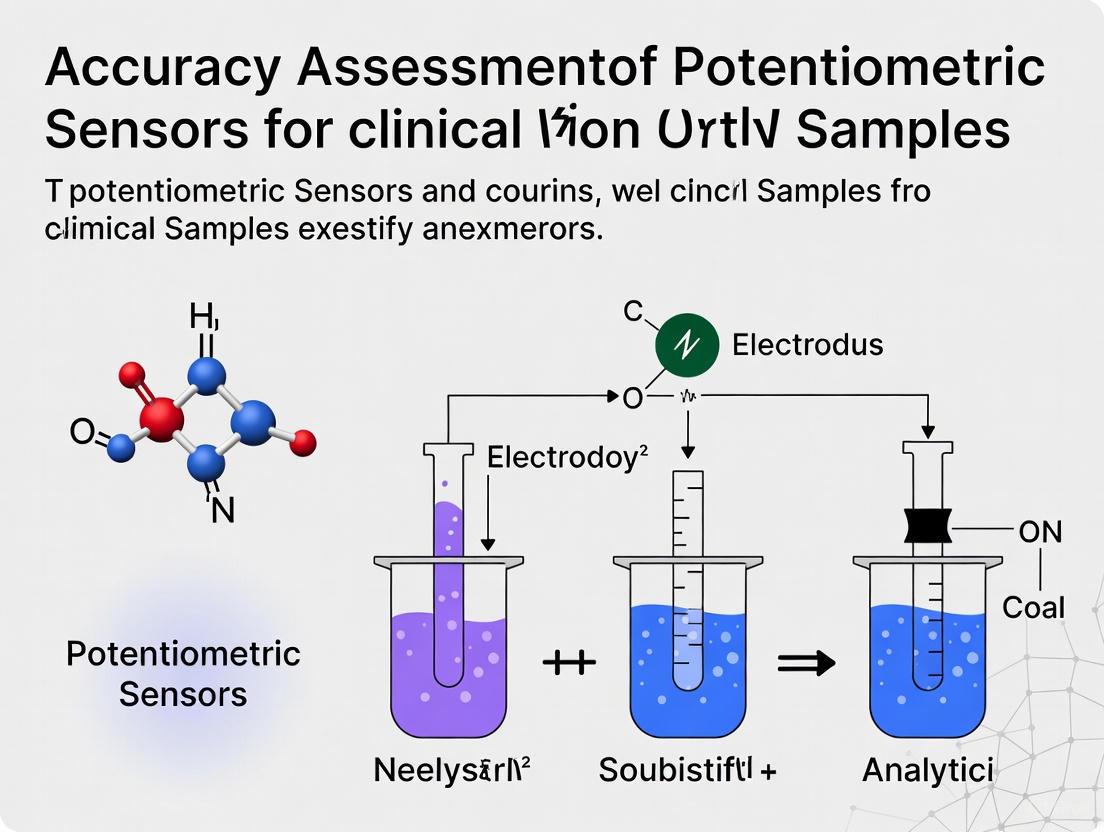
This article provides a comprehensive assessment of accuracy in potentiometric sensors for clinical analysis, a critical parameter for their adoption in biomedical research and therapeutic drug monitoring.
Assessing the Accuracy of Potentiometric Sensors in Clinical Samples: From Fundamental Principles to Advanced Applications
Abstract
This article provides a comprehensive assessment of accuracy in potentiometric sensors for clinical analysis, a critical parameter for their adoption in biomedical research and therapeutic drug monitoring. It explores the foundational principles of potentiometry, including the operation of ion-selective electrodes (ISEs) and solid-contact (SC-ISE) configurations that enhance stability and facilitate miniaturization. The scope covers diverse methodological applications, from wearable sweat sensors for electrolyte monitoring to the determination of pharmaceutical compounds and environmental toxins in biological fluids like serum, urine, and saliva. Furthermore, the article details common challenges such as signal drift and temperature sensitivity, alongside optimization strategies using advanced materials and quality-by-design approaches. Finally, it synthesizes established validation protocols and comparative analyses with gold-standard techniques, offering researchers a complete framework for developing and evaluating reliable potentiometric sensors for clinical use.
Potentiometric Sensing Fundamentals: Principles and Clinical Relevance
Core Principles of Potentiometry and the Nernst Equation
Potentiometry is a well-established electrochemical technique that measures the potential difference, or electromotive force (EMF), between two electrodes under conditions of zero current flow [1] [2]. This measurement provides a direct and rapid readout of ion activities (effective concentrations) in solution, making it a powerful tool for quantitative analysis across industrial, environmental, and clinical domains [2]. The method's versatility arises from its ability to selectively measure a wide variety of analytes using ion-selective electrodes (ISEs), with applications ranging from monitoring heavy metals in environmental samples to determining electrolyte concentrations in biological fluids [2] [3] [4].
The Nernst equation provides the fundamental theoretical framework that links the measured potential to the chemical activity of the target ion [1] [5]. Formulated by Walther Nernst, this thermodynamic relationship enables the calculation of reduction potential from standard electrode potential, temperature, and reactant activities [5]. For analytical chemists, the Nernst equation allows the relative activities of species in a redox reaction to be determined from the measured electrode potential and the standard reduction potential for the half-reaction [1]. In clinical and biomedical contexts, this principle has enabled the development of sophisticated sensors for monitoring electrolytes, pharmaceuticals, and biomarkers in complex biological matrices [2].
Theoretical Foundation: The Nernst Equation
Fundamental Formulations
The Nernst equation describes the relationship between the measured potential of an electrochemical cell and the activities of the chemical species undergoing reduction and oxidation. For a general redox half-reaction:
[ \text{Ox} + n\text{e}^- \rightleftharpoons \text{Red} ]
The Nernst equation takes the form:
[ E = E^0 - \frac{RT}{nF} \ln \frac{a{\text{Red}}}{a{\text{Ox}}} ]
where:
- (E) = electrode potential (V)
- (E^0) = standard electrode potential (V)
- (R) = universal gas constant (8.314 J·mol⁻¹·K⁻¹)
- (T) = absolute temperature (K)
- (n) = number of electrons transferred in the half-reaction
- (F) = Faraday constant (96,485 C·mol⁻¹)
- (a{\text{Red}}) and (a{\text{Ox}}) = activities of the reduced and oxidized species [1] [5]
At 25°C (298.15 K), and converting from natural logarithm to base-10 logarithm, the equation simplifies to:
[ E = E^0 - \frac{0.0592}{n} \log \frac{a{\text{Red}}}{a{\text{Ox}}} ]
This temperature-dependent factor (0.0592 V at 25°C) is crucial for accurate measurements in clinical applications where temperature may vary [1] [6].
Formal Potential and Practical Considerations
In practical applications, analyte activities are seldom known, and concentrations are typically used instead. This necessitates the use of the formal potential ((E^{0'})), which incorporates activity coefficients and provides a more practical relationship for analytical work:
[ E = E^{0'} - \frac{0.0592}{n} \log \frac{[\text{Red}]}{[\text{Ox}]} ]
The formal potential represents the reduction potential measured when the concentration ratio [Red]/[Ox] equals unity under specified solution conditions, effectively accounting for non-ideal behavior in real samples [5]. This adjustment is particularly important in clinical samples where complex matrices can significantly influence electrode response.
Figure 1: Fundamental principle of a potentiometric cell showing the key components and their relationships. The potential difference (EMF) measured between the ion-selective and reference electrodes relates to the target ion activity via the Nernst equation.
Potentiometric Sensor Design and Operational Principles
Sensor Architectures and Configurations
Potentiometric sensors are primarily classified based on their physical configuration and transduction mechanism:
Liquid-Contact Ion-Selective Electrodes (LC-ISEs) consist of an ion-selective membrane (ISM), internal filling solution, and internal reference electrode. The ISM contains ionophores that selectively recognize target ions, while the internal solution maintains a fixed concentration of the target ion. The internal reference electrode, typically Ag/AgCl, provides ion-to-electron transduction. Although well-established, LC-ISEs suffer from mechanical instability, potential leakage or evaporation of the internal solution, and challenges in miniaturization [2].
Solid-Contact Ion-Selective Electrodes (SC-ISEs) eliminate the internal solution by incorporating a solid-contact layer that acts as an ion-to-electron transducer. This configuration offers significant advantages including ease of miniaturization, enhanced portability, better stability, and improved performance in complex matrices. Common transducer materials include conducting polymers (polyaniline, PEDOT:PSS) and carbon-based materials (graphene, carbon nanotubes) [2]. Recent advances have focused on nanocomposite materials that combine multiple nanomaterials to enhance electron transfer kinetics, sensitivity, selectivity, and response times while reducing signal drift [2].
Response Mechanism and Key Performance Parameters
The operational principle of ISEs relies on the selective extraction of target ions into the membrane phase, generating a phase boundary potential described by the Nernst equation. The ionophore in the ISM specifically recognizes target ionic species in the sample, producing an input signal that is converted from ionic to electronic form at the ISM-transducer interface [2].
Critical performance parameters for potentiometric sensors include:
- Nernstian slope: The theoretical response is 59.16/z mV per decade of activity at 25°C, where z is the ion charge. Deviations from this ideal slope indicate non-ideal behavior or sensor malfunction.
- Detection limit: For potentiometric sensors, the lower detection limit is uniquely defined as the intersection of the two linear segments of the calibration curve - the Nernstian response region and the non-Nernstian baseline region [4].
- Selectivity: The sensor's ability to respond primarily to the target ion in the presence of interferents, quantified by selectivity coefficients.
- Response time: The time required to reach a stable potential after changes in sample composition, typically ranging from seconds to minutes depending on sensor design and measurement conditions.
Experimental Protocols for Sensor Characterization
Sensor Fabrication and Optimization
Carbon Paste Electrode Modification Protocol (adapted from [3]):
Objective: Develop a chemically modified carbon paste electrode for selective Cu(II) detection in clinical and environmental samples.
Materials and Reagents:
- Graphite powder (synthetic, 1-2 μm)
- Schiff base ligand: 2-(((3-aminophenyl)imino)methyl)phenol as ionophore
- Plasticizers: o-nitrophenyl octyl ether (o-NPOE), dioctyl phthalate (DOP), tricresyl phosphate (TCP)
- Tetrahydrofuran (THF) and cyclohexanone as solvents
- Target analyte: CuSO₄·5H₂O
- Interfering ions: Chloride salts of Mn²⁺, Cd²⁺, Zn²⁺, Ni²⁺, Ca²⁺, Mg²⁺, Pb²⁺
Procedure:
- Synthesize Schiff base ligand via condensation reaction of m-phenylenediamine and 2-hydroxybenzaldehyde in ethanol under reflux for 3 hours.
- Prepare carbon paste by thoroughly mixing 250 mg graphite powder, 5-20 mg ionophore, and 0.1 mL plasticizer in a mortar.
- Store the modified paste in distilled water for 24 hours before use.
- Pack the paste into a Teflon holder electrode body and establish electrical contact with a stainless-steel rod.
- Polish the electrode surface on filter paper to create a fresh, reproducible surface before measurements.
Characterization:
- Potentiometric calibration in Cu(II) solutions from 10⁻⁷ to 10⁻¹ M
- Selectivity assessment using separate solution method (SSM), fixed interference method (FIM), and matched potential method (MPM)
- Surface characterization using scanning electron microscopy (SEM) with energy dispersive X-ray (EDX) analysis
- Response time determination by monitoring potential stabilization after concentration changes
Analytical Validation in Complex Matrices
Real Sample Analysis Protocol:
Sample Preparation:
- Hairvogine multivitamin and Nutrifol vegetable foliar samples: Digest and dilute to appropriate concentration range
- Real water samples: Filter through 0.45 μm membrane and analyze directly or with standard addition
- Biological fluids: Dilute with appropriate buffer to maintain pH within working range (3.5-6.5)
Measurement Conditions:
- Use double-junction Ag/AgCl reference electrode with appropriate salt bridge
- Maintain constant temperature using thermostated cell
- Employ high-impedance potentiometer (>10¹² Ω) to prevent current draw
- Utilize automatic burette for standard addition methods
- Perform triplicate measurements for each sample
Validation:
- Compare results with reference method (atomic absorption spectroscopy)
- Calculate recovery percentages for spiked samples
- Determine precision via inter-day and intra-day relative standard deviations
- Assess accuracy using F- and t-tests for statistical significance
Comparative Performance Analysis of Potentiometric Sensors
Sensor Performance Metrics for Clinical Applications
Table 1: Performance comparison of representative potentiometric sensors for clinical and biomedical applications
| Analyte | Sensor Type | Linear Range (M) | Nernstian Slope (mV/decade) | Detection Limit (M) | Response Time (s) | Reference |
|---|---|---|---|---|---|---|
| Cu(II) | Graphite-Schiff base CPE | 1×10⁻⁷ - 1×10⁻¹ | 29.57 ± 0.8 | 5.0×10⁻⁸ | ~15 | [3] |
| Na⁺ | Solid-contact ISE | 10⁻¹ - 10⁻⁸ | Theoretical: 59.16 | ~3×10⁻⁸ | <30 | [7] |
| K⁺ | Solid-contact ISE | 10⁻⁴ - 5×10⁻³ | 134.0 (enhanced) | ~5×10⁻⁹ | <30 | [8] |
| pH | Binary-phase (PANI/IrOₓ) | 4-10 pH units | -69.1 (super-Nernstian) | - | <30 | [8] |
| Pb²⁺ | Polymeric membrane ISE | - | Theoretical: 29.58 | 8×10⁻¹¹ | - | [4] |
| Cd²⁺ | Polymeric membrane ISE | - | Theoretical: 29.58 | 1×10⁻¹⁰ | - | [4] |
Table 2: Comparison of sensor configurations for clinical monitoring
| Parameter | Liquid-Contact ISEs | Solid-Contact ISEs | Wearable Potentiometric Sensors |
|---|---|---|---|
| Miniaturization Potential | Limited | Excellent | Superior |
| Mechanical Stability | Moderate | Good | Excellent (flexible) |
| Signal Stability | Good (with maintenance) | Very good | Requires compensation algorithms |
| Lifetime | Limited by internal solution | Extended | Varies (typically weeks to months) |
| Clinical Application | Laboratory analysis | Point-of-care testing | Continuous monitoring |
| Temperature Sensitivity | Requires external control | Requires external control | Integrated compensation |
Advanced Sensor Technologies and Applications
Recent innovations in potentiometric sensor design have significantly expanded their clinical utility:
Wearable Potentiometric Microsensors integrate multiple sensing elements (pH, Na⁺, K⁺) with temperature compensation for real-time sweat analysis. These systems address temperature-induced measurement errors through dynamic compensation algorithms, crucial for accurate monitoring during physiological activities where skin temperature can vary significantly (8°C to 56°C) [8]. The incorporation of advanced ion-to-charge transducers like PEDOT:PSS/graphene enhances sensitivity through superior electron acceptor properties and expanded electroactive surface area, achieving slopes exceeding theoretical Nernstian values (96.1 mV/decade for Na⁺ vs. theoretical 59.2 mV/decade) [8].
3D-Printed and Paper-Based Sensors represent emerging trends that offer improved flexibility, rapid prototyping, and cost-effectiveness for point-of-care applications. 3D printing enables precise manufacturing of ISEs and decreases optimization time, while paper-based platforms provide versatile, disposable alternatives for in-field analysis [2].
Figure 2: Workflow for the development and validation of potentiometric sensors for clinical applications, showing the iterative process from design to real-sample analysis.
Essential Research Reagent Solutions
Table 3: Key research reagents and materials for potentiometric sensor development
| Reagent/Material | Function | Application Examples | Considerations |
|---|---|---|---|
| Ionophores (e.g., Schiff bases, crown ethers, calixarenes) | Selective target ion recognition | Cu(II) selective Schiff base: 2-(((3-aminophenyl)imino)methyl)phenol [3]; Na⁺ ionophore X: 4-tert-Butylcalix[4]arene-tetraacetic acid tetraethyl ester [7] | Selectivity, lipophilicity, complex stability |
| Polymer Matrices (e.g., PVC, silicone rubber) | Membrane structural support | High-molecular-weight poly(vinyl chloride) for Na⁺-selective membranes [7] | Compatibility with components, elasticity, durability |
| Plasticizers (e.g., o-NPOE, DOP, TCP) | Membrane flexibility and ionophore mobility | o-nitrophenyl octyl ether (o-NPOE) for Cu(II) sensors [3]; DOS, DBP for various ISEs | Polarity, viscosity, leaching resistance |
| Ion Exchangers (e.g., KClTPB, ETH 500) | Establish ionic conductivity in membrane | Potassium tetrakis-p-Cl-phenylborate (KClTPB) in Na⁺-selective membranes [7] | Lipophilicity, compatibility with ionophore |
| Transducer Materials (e.g., PEDOT:PSS, graphene, PANI) | Ion-to-electron signal conversion | PEDOT:PSS/graphene composite for enhanced sensitivity in wearable sensors [8] | Conductivity, capacitance, stability |
| Lipophilic Salts (e.g., ETH 500) | Reduce membrane resistance | Tetradodecylammonium tetrakis-p-Cl-phenylborate in Na⁺-selective membranes [7] | Charge, lipophilicity, mobility |
Potentiometric sensors based on the Nernst equation provide robust platforms for accurate determination of ionic species in clinical samples. The fundamental strength of this technique lies in its direct measurement of ion activities - the thermodynamically relevant parameter for biological systems [4]. When properly designed and validated, these sensors demonstrate performance comparable to established reference methods like atomic absorption spectroscopy, as evidenced by recovery studies in complex matrices including pharmaceutical products and biological fluids [3].
The accuracy of potentiometric measurements in clinical samples depends critically on several factors: appropriate sensor design with highly selective ionophores, careful optimization of membrane composition, thorough characterization of cross-sensitivity to interfering ions present in biological matrices, and implementation of temperature compensation strategies for applications involving temperature variations [2] [8]. Recent advances in solid-contact sensors, nanocomposite transducers, and wearable platforms with integrated temperature compensation have significantly enhanced the reliability of potentiometric measurements in real-world clinical scenarios [2] [8].
For researchers and drug development professionals, potentiometric sensors offer distinct advantages for clinical sample analysis, including minimal sample preparation, capability for continuous monitoring, compatibility with small sample volumes, and direct measurement of biologically relevant free ion concentrations rather than total content. These features, coupled with ongoing innovations in materials science and sensor design, ensure that potentiometry based on the Nernst equation will continue to be an indispensable tool for accurate chemical analysis in clinical research and diagnostic applications.
Ion-selective electrodes (ISEs) are potentiometric sensors that provide a rapid and cost-effective method for determining the activity of specific ions in a sample. The transition from traditional liquid-contact to modern all-solid-state designs represents a significant evolution in sensor technology, enabling new applications in clinical diagnostics, environmental monitoring, and pharmaceutical analysis. This comparison guide objectively examines the performance characteristics of both ISE architectures, with particular emphasis on their accuracy and reliability in the analysis of clinical samples. As the demand for point-of-care testing and continuous health monitoring grows, understanding the capabilities and limitations of these sensor designs becomes crucial for researchers and drug development professionals seeking to implement potentiometric sensing in their work.
Fundamental Principles and Evolution of ISE Designs
Operational Principle of Potentiometric Sensing
Potentiometric ion-selective sensors operate by measuring the potential difference between a working electrode (ion-selective electrode) and a reference electrode under zero-current conditions [2] [9]. This potential develops across an ion-selective membrane (ISM) that selectively interacts with target ions, generating an electrical potential described by the Nernst equation:
[E = E^0 + \frac{RT}{zF} \ln a]
Where (E) is the measured potential, (E^0) is the standard potential, (R) is the gas constant, (T) is temperature, (z) is the ion charge, (F) is the Faraday constant, and (a) is the ion activity [9]. For monovalent ions at 25°C, this equation yields a theoretical slope of approximately 59.16 mV per decade change in concentration, which serves as a benchmark for evaluating sensor performance [9].
The core component responsible for selectivity is the ion-selective membrane, which can be based on glass (commonly used for pH sensing), crystalline materials, or polymeric membranes (typically polyvinyl chloride - PVC) doped with selective ionophores [9]. The membrane composition is tailored for specific applications through the incorporation of plasticizers to control membrane viscosity and lipophilic additives to improve ion-exchange kinetics [9].
Historical Development and Design Evolution
The evolution of ISE designs began with liquid-contact electrodes, which featured an internal filling solution containing the target ion [2]. The first solid-contact electrodes, known as coated wire electrodes (CWEs), were developed by Cattrall and Freiser in 1971 and consisted of metal wires coated with an ion-selective polymer membrane [9]. A significant advancement came in the early 1990s when Lewenstam's team introduced conducting polymers, specifically polypyrrole (PPy), as an intermediate layer between the ion-selective membrane and the electrical conductor, markedly improving signal stability [9].
The development of all-solid-state ISEs (ASS-ISEs) accelerated with the discovery and application of various conductive materials, including carbon-based nanomaterials and advanced polymers [2] [9]. This evolution has been driven by the need for miniaturization, improved mechanical stability, and compatibility with wearable and point-of-care platforms [10] [9].
Figure 1: The historical evolution of ion-selective electrode designs from traditional liquid-contact to modern all-solid-state and wearable configurations.
Comparative Analysis: Liquid-Contact vs. All-Solid-State ISEs
Structural Design and Operational Characteristics
The fundamental distinction between liquid-contact and all-solid-state ISEs lies in their internal architecture and ion-to-electron transduction mechanism.
Liquid-contact ISEs (LC-ISEs) consist of an ion-selective membrane, an internal electrolyte solution (inner-filling solution), and an internal reference electrode (typically a Ag/AgCl wire) [2]. The internal solution contains a fixed concentration of the target ion, and the potentiometric signal arises from the difference in target ion activity between the external sample and this internal solution [2]. While this design provides stable reference potentials, it suffers from several limitations: mechanical instability due to the liquid component, potential for leakage or evaporation of the internal solution, limited shelf life, and difficulties in miniaturization [2].
All-solid-state ISEs (ASS-ISEs) replace the internal solution with a solid contact (SC) layer that serves as an ion-to-electron transducer [2]. This design eliminates the liquid junction, resulting in enhanced mechanical stability, easier miniaturization, reduced maintenance requirements, and improved portability [2] [9]. The solid contact layer converts ionic signals from the ion-selective membrane to electronic signals that can be measured as potential [2]. Various materials have been employed as transducers, including conducting polymers (polyaniline, poly(3-octylthiophene), poly(3,4-ethylenedioxythiophene)) and carbon-based materials (carbon nanotubes, graphene, mesoporous carbon) [2].
Figure 2: Structural comparison of liquid-contact and all-solid-state ISE designs, highlighting their fundamental architectural differences and their impact on performance characteristics.
Performance Metrics and Analytical Characteristics
Direct comparison of liquid-contact and all-solid-state ISEs reveals distinct advantages and limitations for each design across multiple performance parameters.
Table 1: Performance comparison of liquid-contact and all-solid-state ISEs
| Performance Parameter | Liquid-Contact ISEs | All-Solid-State ISEs | Clinical Implications |
|---|---|---|---|
| Response Time | 2-6 seconds for pharmaceuticals [11] | Seconds to minutes [10] | Rapid analysis suitable for point-of-care testing |
| Detection Limit | ~10⁻⁸ M for conventional designs [4] | Can reach pM level with modifications [11] | Trace analysis capability for biomarkers |
| Potential Drift | Minimal with stable internal solution | As low as 0.04-0.08 mV/h with advanced materials [10] | Long-term stability for continuous monitoring |
| Lifetime | 6 months reported for some designs [11] | Varies with solid-contact material | Determines recalibration frequency |
| Miniaturization Potential | Limited by internal solution requirements | Excellent [2] [9] | Enables wearable and implantable sensors |
| Mechanical Stability | Moderate (risk of solution leakage) | High [2] | Suitable for field applications and wearables |
| Sample Volume Requirements | Typically microliters to milliliters | Can work with microliter volumes [12] | Important for pediatric and small-volume samples |
The data demonstrates that while both designs can achieve excellent analytical performance, ASS-ISEs offer distinct advantages in miniaturization, mechanical stability, and compatibility with emerging applications like wearable monitoring. Liquid-contact designs continue to provide exceptional reference potential stability but face limitations in physical design flexibility.
Experimental Protocols for ISE Validation in Clinical Analysis
Sensor Fabrication Methodologies
Fabrication of Conventional PVC Membrane ISEs The traditional method for preparing liquid-contact PVC membrane ISEs involves several well-established steps. First, an ion-pair complex is formed by mixing equimolar solutions of the target ion and a counterion (e.g., tetraphenylborate for cations) [13]. The resulting precipitate is collected, washed, and dried. The sensing membrane is then prepared by thoroughly mixing plasticizer (e.g., dioctyl phthalate, 45 mg), PVC (45 mg), and the ion-pair complex (10 mg) in tetrahydrofuran (THF, 7 mL) [13]. This mixture is poured into a petri dish and allowed to evaporate slowly overnight, producing a master membrane approximately 0.1 mm thick. A disc of this membrane is affixed to a PVC electrode body using THF as an adhesive, and the assembled sensor is conditioned in a solution of the target ion before use [13].
Preparation of All-Solid-State ISEs For all-solid-state designs, the fabrication process incorporates additional steps to create the solid-contact layer. A common approach involves modifying electrode substrates (e.g., screen-printed carbon electrodes) with conductive materials before applying the ion-selective membrane [14]. For example, in the development of a sensor for benzydamine hydrochloride, a graphite substrate was coated with a membrane containing PVC, plasticizer, and ion-pair complex [13]. Advanced fabrication techniques include using laser-induced graphene (LIG) electrodes patterned onto MXene/PVDF nanofiber mats created through electrospinning followed by CO₂ laser carbonization [10]. These nanostructured materials provide high electrical conductivity, large electrochemical surface area, and enhanced hydrophobicity, contributing to reduced potential drift and improved signal stability [10].
Validation Methods for Clinical Accuracy Assessment
Robust validation against established reference methods is essential for demonstrating the reliability of ISEs for clinical applications. The following protocols represent current best practices:
Comparison with Gold Standard Techniques A comprehensive validation study should directly compare ISE results with those from established reference methods such as inductively coupled plasma-optical emission spectrometry (ICP-OES) [15]. This approach was effectively demonstrated in a study evaluating sweat sodium and potassium levels, where eight healthy male subjects provided exercise-induced sweat samples that were analyzed using both homemade ISEs and ICP-OES [15]. The protocol involved collecting 0.5 mL sweat samples every 5 minutes over 30 minutes during controlled exercise, with proper storage at 4°C before analysis to preserve sample integrity [15].
Statistical Analysis Methods Validation should include appropriate statistical methods to assess agreement between techniques. Paired t-tests and mean absolute relative difference (MARD) analysis, a method commonly used for evaluating glucometer performance, provide robust measures of analytical agreement [15]. Additional statistical measures should include linear regression analysis comparing ISE results with reference method values, calculation of correlation coefficients, and Bland-Altman analysis to assess bias across the measurement range.
Selectivity Testing Selectivity coefficients should be determined using the separate solution method or fixed interference method according to IUPAC guidelines [9]. This testing is particularly crucial for clinical samples containing multiple potentially interfering ions, such as Na⁺, K⁺, Ca²⁺, and Mg²⁺ in biological fluids.
Figure 3: Experimental workflow for validating ISE accuracy against reference analytical methods in clinical sample analysis.
Applications in Clinical and Pharmaceutical Analysis
Pharmaceutical Compound Detection
ISEs have gained significant prominence in pharmaceutical analysis due to their ability to provide rapid, cost-effective drug quantification with minimal sample preparation [11]. The inherent advantages of ISEs, including user-friendliness, low cost, short analysis time, good precision and accuracy, acceptable detection limits, broad linearity range, and selectivity make them promising candidates for pharmaceutical applications [11]. Notably, they often enable direct analysis of pharmaceutical compounds without pre-separation from complex matrices [11].
Specific applications include sensors for drugs such as diclofenac with response times of 2-3 seconds, and lidocaine hydrochloride with response times of 4-6 seconds and a remarkable 6-month lifespan [11]. A recent development for benzydamine hydrochloride (BNZ·HCl) demonstrated two ISE designs: a conventional PVC electrode and a coated graphite all solid-state ion-selective electrode [13]. Both sensors exhibited near-Nernstian responses with detection limits of 5.81 × 10⁻⁸ M and 7.41 × 10⁻⁸ M, respectively, and successfully determined BNZ·HCl in pharmaceutical cream and biological fluids without matrix interference [13].
Wearable Sensors for Health Monitoring
The transition to all-solid-state designs has enabled the development of wearable ISE platforms for non-invasive health monitoring. These sensors leverage sweat as an readily accessible biofluid containing electrolytes and metabolites that reflect physiological status [15] [10]. Recent innovations include a highly stable and flexible ion-selective patch sensor for real-time sweat Na⁺ and K⁺ monitoring [10]. This sensor employs a laser-induced graphene (LIG) electrode patterned onto a Ti₃C₂Tₓ-MXene/PVDF nanofiber mat, fabricated using electrospinning followed by CO₂ laser carbonization [10]. The resulting hybrid structure exhibits excellent electrical conductivity, high electrochemical surface area, and enhanced hydrophobicity, all contributing to reduced potential drift and improved signal stability [10].
These wearable sensors demonstrated near-Nernstian sensitivities of 48.8 mV/decade for Na⁺ and 50.5 mV/decade for K⁺ within physiologically relevant sweat concentration ranges (10-90 mM for Na⁺ and 1-10 mM for K⁺), along with excellent long-term stability with minimal potential drift (0.04 mV/h for Na⁺ and 0.08 mV/h for K⁺) [10]. Such performance characteristics make them suitable for monitoring physiological conditions including dehydration, electrolyte imbalance, and muscular function during physical activity [10].
Clinical Diagnostics and Therapeutic Drug Monitoring
ISEs play a crucial role in clinical diagnostics, particularly in the measurement of electrolyte concentrations in blood serum and other biological fluids [2]. Electrolyte abnormalities are frequent in hospitalized patients and associated with higher mortality and morbidity, with studies indicating that approximately 15% of hospitalized patients suffer from at least one electrolyte imbalance [2]. Even slight abnormalities can result in significant clinical consequences, including neurological problems such as seizures and cardiac arrhythmias [2].
Therapeutic drug monitoring (TDM) represents another significant application, particularly for pharmaceutical drugs with a narrow therapeutic index or those showing high inter-individual pharmacokinetic variability [2]. ISEs offer the potential for rapid, cost-effective monitoring of drug concentrations in biofluids, enabling personalized dosing regimens.
Table 2: Clinical applications of ISEs for biomarker and pharmaceutical compound detection
| Analyte Category | Specific Examples | Clinical Significance | ISE Performance |
|---|---|---|---|
| Electrolytes | Sodium, Potassium [2] [10] | Hydration status, electrolyte balance, nerve and muscle function | Near-Nernstian response (48.8-59.16 mV/decade) |
| Pharmaceuticals | Diclofenac, Lidocaine [11] | Pain management, anesthetic monitoring | Rapid response (2-6 seconds) |
| Anti-inflammatory Drugs | Benzydamine HCl [13] | Topical pain and inflammation treatment | Detection limits ~10⁻⁸ M |
| Chlorophenols | 2,4-Dichlorophenol [14] | Environmental toxin exposure assessment | LOD 0.13 µM with MIP integration |
Essential Research Reagent Solutions
Successful development and implementation of ISEs for clinical analysis requires specific materials and reagents tailored to the target application. The following table summarizes key components and their functions in ISE fabrication.
Table 3: Essential research reagents for ISE development and their functions
| Reagent Category | Specific Examples | Function in ISE Development |
|---|---|---|
| Polymer Matrices | Polyvinyl chloride (PVC) [13], Polystyrene-block-poly(ethylene-butylene)-block-polystyrene (SEBS) [10] | Provides structural support for the ion-selective membrane |
| Plasticizers | Dioctyl phthalate (DOP) [13], bis(2-ethylhexyl) sebacate (DOS) [15] [10] | Controls membrane viscosity and influences ionophore mobility |
| Ionophores | Valinomycin (for K⁺) [15], Sodium ionophore X [15] | Provides selective recognition of target ions |
| Lipophilic Additives | Sodium tetrakis[3,5-bis(trifluoromethyl)phenyl]borate (Na-TFPB) [15], Tetraphenylborate derivatives [13] | Enhances ion-exchange kinetics and reduces membrane resistance |
| Conductive Polymers | Poly(3,4-ethylenedioxythiophene) polystyrene sulfonate (PEDOT:PSS) [15], Polyaniline (PANI) [14] | Serves as ion-to-electron transducer in solid-contact designs |
| Nanomaterials | Carbon nanotubes, Graphene derivatives [2], MXenes [10] | Enhances conductivity and capacitance in solid-contact layers |
| Membrane Solvents | Tetrahydrofuran (THF) [13] [14] | Dissolves membrane components for uniform film formation |
Emerging Trends and Future Perspectives
Several innovative trends are shaping the future of ISE technology and its applications in clinical analysis:
Advanced Materials and Nanocomposites Research continues to explore novel materials that enhance ISE performance. Nanocomposites with synergistic effects are being developed to improve electron transfer kinetics, sensitivity, selectivity, and response times [2]. For example, composites of MoS₂ nanoflowers with Fe₃O₄ have been shown to stabilize structure and increase capacitance of the solid-contact layer [2]. Similarly, tubular gold nanoparticles with tetrathiafulvalene (Au-TTF) have been employed as solid-contact layers for potassium detection, demonstrating high capacitance and excellent stability [2].
Molecularly Imprinted Polymers (MIPs) The integration of molecularly imprinted polymers with ISEs has shown considerable success in organic compound detection [14]. These artificial receptors offer high selectivity, robustness, stability under extreme conditions, and reusability without significant deterioration [14]. For instance, MIP-based ISEs have been developed for detecting 2,4-dichlorophenol, showing high sensitivity over a linear range of 0.47 to 13 µM with a detection limit of 0.13 µM [14].
Additive Manufacturing and 3D Printing The integration of 3D printing technologies represents a significant advancement in ISE fabrication, enabling customizable, low-cost, and rapid prototyping of sensor components [9]. Techniques like fused deposition modeling (FDM) and stereolithography (SLA) allow production of electrode housings, solid contacts, reference electrodes, and microfluidic systems [9]. This approach facilitates the creation of smaller, flexibly shaped devices and the rapid production of working prototypes, accelerating sensor development and optimization cycles [9].
Wearable and Multiplexed Sensing Platforms The future of clinical ISE applications lies in the development of integrated wearable platforms that enable continuous, non-invasive monitoring of multiple biomarkers simultaneously [11] [10]. These systems combine SC-ISEs with wireless communication protocols like Bluetooth or NFC, allowing integration into epidermal patches, eyeglasses, watches, and other wearable form factors [11]. The ability to monitor physiological parameters in real-time during daily activities represents a paradigm shift from episodic to continuous health assessment.
The evolution from liquid-contact to all-solid-state designs has significantly expanded the analytical capabilities and application scope of ion-selective electrodes. While liquid-contact ISEs continue to offer excellent potential stability for benchtop applications, all-solid-state designs provide superior miniaturization potential, mechanical stability, and compatibility with emerging applications such as wearable sensors and point-of-care testing. For clinical researchers and drug development professionals, the choice between these designs should be guided by specific application requirements, including needed detection limits, sample volume constraints, stability requirements, and operational environment.
Validation against gold-standard analytical methods remains essential for establishing the reliability of ISEs for clinical analysis, with recent studies demonstrating excellent correlation with reference techniques like ICP-OES when proper fabrication and calibration protocols are followed. As materials science and fabrication technologies continue to advance, particularly through the integration of nanocomposites, molecularly imprinted polymers, and additive manufacturing, the performance and applicability of ISEs in clinical and pharmaceutical analysis will continue to expand, offering increasingly powerful tools for health monitoring and therapeutic development.
The accurate measurement of key clinical biomarkers—electrolytes, pharmaceuticals, and metabolites—is fundamental to modern healthcare, influencing diagnoses, treatment decisions, and therapeutic monitoring. Potentiometric sensors have emerged as a powerful technology for this purpose, offering the potential for rapid, decentralized analysis. This guide provides a comparative evaluation of the performance of various sensing methodologies for these targets, focusing on experimental data and standardized protocols to objectively assess their analytical accuracy. The context is a broader thesis on accuracy assessment of potentiometric sensors in clinical samples, providing researchers and drug development professionals with a critical resource for method selection and validation.
Comparative Analysis of Key Clinical Targets
The table below summarizes the primary clinical targets, their physiological roles, and the sensing technologies commonly employed for their detection.
Table 1: Key Clinical Targets and Sensing Technologies
| Target Category | Specific Analytes | Physiological & Clinical Relevance | Primary Sensing Modalities |
|---|---|---|---|
| Electrolytes | Sodium (Na⁺), Potassium (K⁺), Chloride (Cl⁻), Calcium (Ca²⁺) | Regulation of membrane potential, neurohormonal pathways, fluid and acid-base balance [16]; hydration status, cystic fibrosis diagnosis [17]. | Potentiometric Ion-Selective Electrodes (ISEs) [17] [18]; Blood Gas Analyzers (ABG) [16]. |
| Pharmaceuticals | Lithium, Trazodone [17]; Various drug classes (e.g., for Type 2 Diabetes) [19]. | Patient medical treatments requiring strict control of body levels [17]; comparative efficacy and safety assessment [19]. | Chromatographic techniques; Indirect comparison methodologies for efficacy [19]. |
| Metabolites | Lactate, Glucose, Uric Acid [20]; Amino Acids, Fatty Acids, Lipids [21]. | Markers for fitness level, tissue viability (lactate) [20]; biomarkers for cancers, diabetes, Alzheimer's disease [21]. | Amperometric Biosensors [20]; Mass Spectrometry (MS), Nuclear Magnetic Resonance (NMR) [21]. |
Performance Comparison of Analytical Methods
Electrolyte Sensing: Point-of-Care vs. Central Laboratory
The agreement between different analytical platforms for electrolyte measurement is critical for clinical decision-making. A study comparing arterial blood gas (ABG) analyzers (point-of-care) and auto-analyzers (AA) in a central laboratory setting revealed significant differences in performance.
Table 2: Comparative Analytical Performance of Sodium and Potassium Measurement [16]
| Analyte | Analysis Method | Mean Measured Level (mmol/L) | Statistical Significance (p-value) | Pearson’s Correlation Coefficient (r) | Bland-Altman 95% Limits of Agreement |
|---|---|---|---|---|---|
| Sodium (Na⁺) | Blood Gas Analyzer (ABG) | 136.1 ± 6.3 | p < 0.001 | 0.561 | -9.4 to 12.6 mmol/L |
| Auto-Analyzer (AA) | 137.8 ± 5.4 | ||||
| Potassium (K⁺) | Blood Gas Analyzer (ABG) | 3.4 ± 0.7 | p < 0.001 | 0.812 | -0.58 to 1.24 mmol/L |
| Auto-Analyzer (AA) | 3.8 ± 0.7 |
Experimental Protocol: The comparison study was conducted with 100 intensive care unit patients [16]. Paired blood samples were collected simultaneously from arterial catheters. One sample was drawn into a heparinized syringe and analyzed immediately on a Siemens Rapid Point 500 blood gas analyzer. The second sample was collected in a non-additive tube and sent to the central laboratory for analysis on an Abbott C 8000 Architect auto-analyzer within one hour. Statistical analysis included paired sample t-tests, Pearson's correlation, and Bland-Altman agreement analysis [16].
Key Findings: The results indicate that sodium levels measured by the two methods showed only a moderate correlation and unacceptably wide limits of agreement, suggesting they should not be used interchangeably [16]. In contrast, potassium levels, despite a statistically significant mean difference, showed strong correlation and clinically acceptable limits of agreement. This suggests that for potassium, ABG can be used for urgent decisions, with confirmation from the central laboratory [16].
Statistical Methods in Metabolomics Analysis
The analysis of high-dimensional metabolomics data presents unique challenges. A comparative study evaluated traditional and statistical learning methods to identify optimal approaches.
Table 3: Comparison of Statistical Methods for Analyzing Metabolomics Data [22]
| Statistical Method | Type | Key Strengths | Key Limitations | Optimal Use Case |
|---|---|---|---|---|
| False Discovery Rate (FDR) | Univariate | Simplicity; good performance with small sample sizes and binary outcomes [22]. | High false positive rate with large sample sizes due to metabolite intercorrelations [22]. | Targeted metabolomics with a limited number of metabolites [22]. |
| Bonferroni Correction | Univariate | Highly conservative control of Type I error [22]. | Low statistical power due to overly stringent correction [22]. | Preliminary studies requiring minimal false positives. |
| Least Absolute Shrinkage and Selection Operator (LASSO) | Sparse Multivariate | Performs variable selection; reduces false positives; handles correlated variables [22]. | Tuning parameter selection is critical [22]. | Nontargeted metabolomics where the number of metabolites (M) is large relative to subjects (N) [22]. |
| Sparse Partial Least Squares (SPLS) | Sparse Multivariate | High positive predictive value and low false positives; handles high-dimensional data well [22]. | Performance can degrade in very small sample sizes (N<100) [22]. | Nontargeted metabolomics with large sample sizes [22]. |
| Random Forest | Multivariate | Handles complex non-linear relationships [22]. | Does not naturally provide variable selection; "black box" nature [22]. | Exploratory analysis with complex data structures. |
Experimental Protocol: The comparison was conducted through extensive simulations and validation with real experimental data [22]. Metabolomics data were simulated for clinical studies with varying numbers of subjects (N), metabolites (M), and outcome types (continuous/binary). The performance of each statistical method was evaluated based on its ability to correctly identify metabolites pre-specified to be associated with an outcome, using metrics like positive predictive value (PPV) and false positive rate. The findings were then validated using a real nontargeted metabolomics dataset of 1933 metabolites from 2895 individuals [22].
Wearable Sensor Performance for Metabolites and Electrolytes
Wearable platforms represent a frontier in decentralized clinical monitoring. The following table summarizes data from a prototype "Lab-on-a-Glass" system for multiplexed sensing.
Table 4: Performance of a Wearable Eyeglasses-Based Sensor Platform [20]
| Target Analyte | Sensing Modality | Biological Fluid | Key Performance Metrics | Cross-talk Assessment |
|---|---|---|---|---|
| Lactate | Amperometric Biosensor | Sweat | Real-time monitoring demonstrated; sensor fabricated via screen-printing on PET substrate [20]. | No apparent cross-talk between lactate and potassium sensors during simultaneous operation [20]. |
| Potassium (K⁺) | Potentiometric Ion-Selective Electrode | Sweat | Real-time monitoring demonstrated; sensor fabricated via screen-printing on PET substrate [20]. | Potential signal independent of the applied potential of the lactate sensor [20]. |
Experimental Protocol: The eyeglasses platform was equipped with screen-printed sensors on flexible polyethylene terephthalate (PET) stickers attached to the nose bridge pads [20]. The lactate biosensor was fabricated by modifying a working electrode with lactate oxidase (LOx) and a chitosan layer. The potassium ion-selective electrode used a membrane containing valinomycin as the ionophore. The electronic system, integrated into the glasses' arms, controlled the transducers (amperometric for lactate, potentiometric for potassium) and enabled Bluetooth data transmission. On-body testing was performed with healthy subjects during physical activity to monitor real-time sweat lactate and potassium levels [20].
Essential Research Reagent Solutions
The following table details key materials and reagents used in the development and validation of sensors and analytical methods discussed in this guide.
Table 5: Key Research Reagents and Their Functions
| Reagent / Material | Function / Application | Reference |
|---|---|---|
| Valinomycin | Potassium ionophore I, used in the selective membrane of potentiometric K⁺ sensors. | [20] |
| Lactate Oxidase (LOx) | Enzyme used in amperometric biosensors for selective recognition and catalysis of lactate. | [20] |
| Poly(3,4-ethylenedioxythiophene) (PEDOT) | Conducting polymer used as an ion-to-electron transducer in solid-contact potentiometric sensors. | [18] |
| Chitosan | Biopolymer used as a permselective membrane in biosensors to prevent interferent access. | [20] |
| Potassium tetrakis(4-chlorophenyl) borate | Lipophilic additive that functions as an anionic site in cation-selective polymer membranes. | [20] |
| Prussian Blue | Electron transfer mediator used in amperometric biosensors, particularly for hydrogen peroxide detection. | [20] |
Workflow and Pathway Visualization
Accuracy Assessment Framework for Clinical Sensors
The following diagram illustrates a generalized workflow for assessing the accuracy of clinical sensing methods, integrating principles from the comparative studies cited in this guide.
Metabolomics Data Analysis Workflow
The analysis of metabolomics data, a key area for metabolite biomarker discovery, follows a multi-step bioinformatics process, as summarized below.
Potentiometric sensors are revolutionizing clinical diagnostics by translating complex laboratory analyses into simple, rapid, and affordable point-of-care tests. Their ability to provide direct, rapid readouts of ion concentrations makes them a powerful tool in diverse medical applications, from managing electrolyte imbalances to monitoring specific disease biomarkers. [2] This guide objectively compares the performance of these sensors against traditional analytical techniques, providing supporting experimental data and detailed methodologies for the research community.
Experimental Performance Data and Comparative Analysis
The following tables summarize experimental data from recent research, demonstrating how potentiometric sensors perform against standard methods in detecting key clinical analytes.
Table 1: Performance Comparison of Potentiometric Sensors for Key Clinical Analytes
| Target Analyte | Sensor Type / Solid Contact | Linear Response Range | Detection Limit | Response Time | Key Advantage for POC | Comparison to Standard Method |
|---|---|---|---|---|---|---|
| Sarcosine (Prostate Cancer Biomarker) | PANI-WO₃ Nanocomposite [23] | 10⁻⁷ - 10⁻¹² M | 9.95 × 10⁻¹³ M | Not Specified | Ultra-high sensitivity for low-abundance biomarker | N/A (Novel POC application) |
| Myoglobin (Cardiac Biomarker) | Molecularly Imprinted Polymer (MIP)/MWCNTs [24] | 5.0×10⁻⁸ to 1.0×10⁻⁴ M | 28 nM | Not Specified | High selectivity in complex serum matrix | Recovery of 93.0–103.3% in artificial serum |
| Calcium Ions (Ca²⁺) | BAPTA-based Conductive Copolymer [25] | 0.1 mM to 1 mM | Not Specified | Not Specified | Selective detection for inflammation monitoring | Nernstian slope (20 ± 0.3 mV/decade) confirmed |
| Copper Ions (Cu²⁺) | Graphite/Schiff Base Sensor [3] | 1×10⁻⁷ - 1×10⁻¹ M | 5.0 × 10⁻⁸ M | ~15 seconds | Applicable in real water and pharmaceutical samples | Results comparable to Atomic Absorption Spectroscopy (AAS) |
| Nitrate (NO₃⁻) | Electropolymerized Polypyrrole [26] | Not Specified | Not Specified | Not Specified | Reproducibility of ± 3 mg/L in drinking water | Effective for real-time, in-situ sensing |
Table 2: Core Advantages of Potentiometric Sensors vs. Centralized Lab Techniques
| Feature | Potentiometric Sensors (POC) | Centralized Lab Techniques (e.g., AAS, ICP, Chromatography) |
|---|---|---|
| Cost & Infrastructure | Low-cost; minimal equipment [27] [28] | High; requires expensive instruments and reagents [28] |
| Analysis Speed | Rapid (seconds to minutes) [2] [24] | Slow (hours to days), includes transport time [17] |
| Operational Complexity | Simple; minimal training needed [2] [17] | Complex; requires highly trained technicians [28] |
| Portability | High; suitable for wearable and disposable formats [2] [27] [17] | Low; confined to laboratory settings |
| Sample Volume | Low (microliters) [17] | Higher, typically milliliters |
| Clinical Utility | Enables real-time decision-making [17] | Results are delayed, impacting timely intervention [17] |
Detailed Experimental Protocols
To ensure reproducibility and provide insight into the data generation process, here are the detailed methodologies for two key experiments cited above.
This protocol describes the creation of a biomimetic antibody for a paper-based potentiometric sensor.
1. Sensor Fabrication
- Synthesis of Molecularly Imprinted Polymer (MIP): Carboxylated multi-walled carbon nanotubes (MWCNT–COOH) are suspended in deionized water and sonicated. The carboxyl groups are activated with a mixture of N-ethyl-N'-(3-dimethylaminopropyl) carbodiimide (EDAC) and N-hydroxysuccinimide (NHS) to facilitate binding. The target protein, myoglobin (Mb), is then attached to the activated surface. The resulting complex is treated with a solution of acrylamide (monomer), N,N-methylenebisacrylamide (cross-linker), and ammonium persulfate (initiator) to form a polymer network around the template myoglobin. Finally, the myoglobin template is removed, leaving behind cavities that are complementary in size, shape, and functional groups to the biomarker.
- Electrode Preparation: A paper substrate is rendered hydrophobic by treatment with fluorinated alkyl silane. A solid-state reference electrode (Ag/AgCl) is printed onto the paper. The prepared MIP-MWCNT composite is then integrated as the sensing element.
2. Potentiometric Measurement & Validation
- Calibration: The potential (mV) of the sensor is measured against a standard reference electrode in a series of myoglobin standard solutions with known concentrations (from 5.0 × 10⁻⁸ to 1.0 × 10⁻⁴ M) prepared in HEPES buffer (pH 4). A calibration curve of potential vs. log[myoglobin] is constructed.
- Selectivity Testing: The sensor's response to myoglobin is tested in the presence of potentially interfering substances found in serum, such as creatinine, uric acid, albumin, and glucose. The selectivity is quantified by calculating potentiometric selectivity coefficients using established methods.
- Real Sample Analysis: The sensor is used to analyze myoglobin in artificial serum samples. The accuracy is determined by calculating the percentage recovery of known amounts of myoglobin added to the serum matrix.
This protocol outlines the development of a highly sensitive, disposable sensor for a cancer biomarker.
1. Nanomaterial Synthesis and Sensor Fabrication
- Synthesis of Transducer Layer: Tungsten trioxide nanoparticles (WO₃ NPs) and polyaniline nanoparticles (PANI NPs) are synthesized. A PANI-WO₃ nanocomposite is prepared by combining them.
- Sensor Assembly: Screen-printed electrodes are used as a platform. The transducer materials (WO₃ NPs, PANI NPs, or PANI-WO₃ nanocomposite) are drop-casted onto the working electrode area and dried. An ion-selective membrane (ISM) specific to sarcosinium cation is then applied over the solid-contact transducer layer.
2. Sensor Characterization and Performance Evaluation
- Electrochemical Characterization: The sensors are characterized using Electrochemical Impedance Spectroscopy (EIS) to assess charge-transfer resistance and capacitance at the interfaces.
- Potentiometric Performance: Sensors are calibrated in sarcosine standard solutions. The linear range, Nernstian slope, and limit of detection (LOD) are determined. The potential drift is assessed using chronopotentiometry to evaluate long-term stability.
- Real Sample Application: The optimized sensor is used to measure sarcosine levels in human urine samples without any pre-treatment. The results are validated against standard methods to confirm accuracy.
The Scientist's Toolkit: Essential Research Reagents and Materials
This table lists key materials used in the featured experiments and explains their critical function in sensor performance.
Table 3: Key Research Reagent Solutions for Potentiometric Sensor Development
| Material / Reagent | Function in Potentiometric Sensors |
|---|---|
| Carboxylated MWCNTs [24] | Provide a high-surface-area scaffold for immobilizing recognition elements; enhance conductivity in solid-contact sensors. |
| Molecularly Imprinted Polymers (MIPs) [24] [28] | Serve as synthetic, stable, and cost-effective artificial antibodies for selectively binding target biomarkers (e.g., myoglobin). |
| Conducting Polymers (PANI, PEDOT, Polypyrrole) [2] [18] [26] | Act as ion-to-electron transducers in solid-contact ISEs, converting ionic signals to electronic signals, crucial for stability. |
| Nanocomposites (PANI-WO₃) [23] | Synergistically improve transducer properties, leading to higher capacitance, lower drift, and superior sensitivity. |
| Plasticizers (o-NPOE, DOP, TCP) [3] [25] | Incorporated into polymer membranes to provide mobility for ionophores and influence the selectivity and response time of the ISM. |
| Ionophores / Schiff Bases [3] [25] | The key recognition element within the ISM that selectively complexes with the target ion (e.g., Cu²⁺, Ca²⁺). |
| Screen-Printed Electrodes [23] [26] | Provide a low-cost, mass-producible, and disposable platform for building single-use or portable POC sensors. |
Principles and Workflows Visualized
The following diagrams illustrate the core operating principle of a solid-contact potentiometric sensor and a generalized experimental workflow for their development.
Diagram 1: Solid-Contact Potentiometric Sensor Mechanism
Diagram 2: Sensor Development and Validation Workflow
Experimental data confirms that potentiometric sensors meet the ASSURED criteria for ideal point-of-care diagnostics. Their simplicity, cost-effectiveness, and growing capabilities for sensitive and selective detection make them a formidable alternative to traditional, centralized laboratory methods. For researchers and drug development professionals, this technology offers a viable path to decentralize clinical testing, enabling faster diagnostic results and more personalized medical interventions.
Methodologies and Real-World Clinical Applications
Wearable sensors for continuous sweat analysis represent a paradigm shift in non-invasive health monitoring, offering real-time, dynamic insights into an individual's physiological state. These devices are particularly valuable for tracking ions and biomarkers directly from sweat, a readily accessible biofluid. Potentiometric sensors have emerged as a leading technology in this domain due to their high selectivity, sensitivity, and ability to provide continuous measurements without complex sample preparation [2]. Their relevance is underscored by the growing demand for decentralized clinical trials and remote patient monitoring, with the wearable sensors market forecast to reach US$7.2 billion by 2035 [29].
The accuracy assessment of these sensors against clinical gold standards is a critical research focus, forming the core thesis of this guide. This document provides a comparative analysis of the performance of various wearable sensing platforms, with detailed experimental data and methodologies to inform researchers, scientists, and drug development professionals.
Sensor Technologies and Operating Principles
Wearable sweat biosensors can be broadly categorized based on their structural and functional characteristics. Potentiometric sensors operate by measuring the potential difference between a working ion-selective electrode (ISE) and a reference electrode when negligible current is flowing [2]. The potential developed is described by the Nernst equation, which relates the measured potential to the logarithm of the target ion's activity [9]. A key advantage of potentiometry is its power efficiency and relative insensitivity to electrode size, enabling effective miniaturization for wearable applications [2].
Table 1: Classification of Sweat-Based Wearable Biosensors (SBWS)
| Sensor Type | Recognition Element | Measured Analytes | Key Advantages | Common Transduction Methods |
|---|---|---|---|---|
| Enzyme-based | Specific enzymes | Metabolites (e.g., Glucose, Lactate) | High specificity for substrates | Amperometric, Potentiometric |
| Antibody-based | Immunoglobulins | Proteins, Hormones | High affinity and specificity | Electrochemical, Optical |
| Aptamer-based | Single-stranded DNA/RNA | Ions, Small molecules, Proteins | Synthetic, high stability, modifiable | Electrochemical, Optical |
| Ion-sensitive Membrane | Ionophores | Electrolytes (e.g., Na⁺, K⁺, Cu²⁺) | Excellent ion selectivity, Nernstian response | Potentiometric |
Solid-contact ion-selective electrodes (SC-ISEs) represent the state-of-the-art for wearables, eliminating the internal filling solution of traditional ISEs. They use a solid-contact layer, often made from conducting polymers (e.g., poly(3,4-ethylenedioxythiophene)) or carbon-based nanomaterials (e.g., multi-walled carbon nanotubes, MXenes), to facilitate ion-to-electron transduction. This design enhances mechanical stability, simplifies miniaturization, and improves performance in complex matrices [2]. Recent innovations focus on using nanocomposites to further boost sensor stability, electron transfer kinetics, and signal-to-noise ratio [2].
The following diagram illustrates the fundamental signaling pathway and components of a typical solid-contact potentiometric sensor used for sweat analysis.
Comparative Performance Analysis of Sensor Platforms
Evaluating sensor performance requires a multi-faceted approach, examining key analytical parameters against established clinical methods. The data below summarizes the performance of different sensor types discussed in recent literature.
Table 2: Performance Comparison of Wearable Potentiometric Sensors for Select Analytes
| Target Analyte | Sensor Type / Design | Linear Range | Detection Limit | Sensitivity (Slope) | Selectivity Notes | Ref. |
|---|---|---|---|---|---|---|
| Cu(II) Ions | Graphite CPE modified with Schiff base | 1 × 10⁻⁷ – 1 × 10⁻¹ mol L⁻¹ | 5.0 × 10⁻⁸ mol L⁻¹ | 29.57 ± 0.8 mV/decade | High selectivity over Mn²⁺, Cd²⁺, Zn²⁺, etc. | [3] |
| Bisphenol A (BPA) | Graphite ISE modified with MWCNTs | 10,000 – 0.01 μmol·L⁻¹ | 1.04 × 10⁻⁷ μmol·L⁻¹ | Not Specified | Selective against phthalates, Pb²⁺, ZnO, saliva components | [30] |
| Sodium (Na⁺) | Typical Ion-Selective Membrane | Varies by ionophore | ~10⁻⁵ - 10⁻⁶ mol L⁻¹ | ~59.16 mV/decade (Theoretical) | High selectivity over K⁺, Ca²⁺, Mg²⁺ | [2] [9] |
| Potassium (K⁺) | Typical Ion-Selective Membrane (Valinomycin) | Varies by ionophore | ~10⁻⁵ - 10⁻⁶ mol L⁻¹ | ~59.16 mV/decade (Theoretical) | Excellent selectivity over Na⁺ | [2] [9] |
The accuracy of these sensors is often validated against standardized clinical techniques. For instance, the Cu(II) sensor's performance was benchmarked against Atomic Absorption Spectroscopy (AAS), showing no significant difference in results according to F- and t-test values, confirming its reliability for real-sample analysis [3]. Similarly, the BPA sensor was bioanalytically validated for application in complex saliva samples [30].
Experimental Protocols for Sensor Development and Validation
To ensure the reliability and accuracy of potentiometric sensors, a rigorous experimental workflow must be followed. The diagram and detailed protocols below outline the key stages from fabrication to validation.
Detailed Experimental Methodologies
Protocol 1: Fabrication of a Solid-Contact Carbon-Based Ion-Selective Electrode [3] [30] This protocol is adapted from procedures used to create sensors for Cu(II) and BPA.
- Reagent Preparation: The ion-selective membrane mixture is prepared by thoroughly blending 250 mg of graphite powder, 5–20 mg of the selective ionophore (e.g., a Schiff base for Cu(II)), and 0.1 mL of a plasticizer (e.g., o-nitrophenyl octyl ether - o-NPOE) in a mortar. For polymer-based membranes, 0.10 g PVC, 0.4 mL plasticizer, and 0.01 g of multi-walled carbon nanotubes (MWCNTs) as a solid-contact transducer are dissolved in 6.0 mL of tetrahydrofuran (THF) and sonicated until homogeneous [30].
- Electrode Assembly: The homogeneous paste is packed into a Teflon electrode holder. A stainless-steel rod or a copper wire inserted into the paste provides electrical contact. For coated electrodes, a graphite rod is dipped into the membrane mixture multiple times to build a layer >0.01 cm thick, then dried overnight at room temperature [30].
- Conditioning: Before first use, the sensor is dipped in a solution of the target ion (e.g., 1.0 × 10⁻² mol L⁻¹) for several hours to condition the membrane [30].
Protocol 2: Potentiometric Measurement and Calibration [3] [9]
- Measurement Setup: Potentiometric measurements are conducted using a high-impedance pH/mV meter. The fabricated working electrode is paired with a double-junction Ag|AgCl reference electrode.
- Calibration Procedure: The sensor pair is immersed in a series of standard solutions of the target analyte with concentrations typically spanning from 1.0 × 10⁻⁹ to 1.0 × 10⁻¹ mol L⁻¹. The solutions should be stirred consistently. The potential (EMF) is recorded once it stabilizes (e.g., < 1 mV drift per minute). A calibration curve is constructed by plotting the measured EMF (mV) against the logarithm of the analyte activity (-log[A]). The slope, linear range, and detection limit (calculated as the intersection of the two linear segments of the calibration curve) are determined from this plot [3].
Protocol 3: Validation in Clinical and Environmental Samples [3] [30]
- Sample Preparation: Real samples (e.g., sweat, saliva, water) may be used directly or after simple dilution with a buffer to maintain a constant pH and ionic strength. For recovery studies, samples are spiked with known quantities of the target analyte.
- Analysis: The analyte concentration in the sample is determined potentiometrically, either by direct reading from the calibration curve or via the standard addition method.
- Benchmarking: The same samples are analyzed using a reference method, such as Atomic Absorption Spectroscopy (AAS) or Inductively Coupled Plasma Mass Spectrometry (ICP-MS). The accuracy of the potentiometric sensor is evaluated by calculating the percentage recovery of spiked analytes and by performing statistical tests (e.g., student's t-test and F-test) to compare the results with the reference method, confirming no significant difference at a 95% confidence level [3].
The Scientist's Toolkit: Essential Research Reagents and Materials
The development and fabrication of high-performance potentiometric sensors rely on a specific set of materials and reagents. The following table details key components and their functions in a typical sensor setup.
Table 3: Essential Research Reagents and Materials for Potentiometric Sensor Fabrication
| Item Name | Function / Role | Specific Examples | |
|---|---|---|---|
| Ionophore | The key recognition element that selectively binds to the target ion, determining sensor selectivity. | Schiff bases (e.g., for Cu²⁺) [3], Valinomycin (for K⁺) [9] | |
| Polymer Matrix | Forms the bulk of the sensing membrane, hosting the ionophore and additives. | Polyvinyl Chloride (PVC) [30], Polyurethane [2] | |
| Plasticizer | Provides mobility to ionophores and ions within the membrane, influencing response time and lifespan. | o-Nitrophenyl octyl ether (o-NPOE), Dioctyl phthalate (DOP) [3] [30] | |
| Solid-Contact Material | Replaces internal solution; transduces ionic signal to electronic signal. Critical for stability. | Conducting Polymers (PEDOT), Multi-Walled Carbon Nanotubes (MWCNTs) [2] [30] | |
| Lipophilic Additive | Prevents co-ion extraction and reduces membrane resistance, improving selectivity and response. | Tetradodecylammonium tetrakis(4-chlorophenyl)borate (TDMAC) [9] | |
| Graphite/Substrate | Serves as the conductive electrode body supporting the membrane. | Graphite powder, Graphite rods [3] [30] | |
| Reference Electrode | Provides a stable, constant potential against which the working electrode's potential is measured. | Double-junction Ag | AgCl electrode [3] |
Wearable potentiometric sensors for sweat analysis have matured into robust platforms capable of accurate, continuous monitoring of ions and biomarkers outside clinical settings. The comparative data and experimental protocols presented in this guide demonstrate that these sensors can achieve performance comparable to gold-standard laboratory methods when properly designed and validated. Key to their accuracy is the meticulous selection of ionophores, the integration of advanced solid-contact materials like MWCNTs and conducting polymers to enhance signal stability, and rigorous benchmarking against reference techniques such as AAS.
Future developments in this field are focused on overcoming remaining challenges, including long-term signal drift in dynamic environments, biofouling, and the integration of multi-analyte sensing platforms. The convergence of advanced manufacturing like 3D printing [9], novel nanomaterials, and machine learning for data processing [31] is poised to further enhance the accuracy, reliability, and scope of wearable potentiometric sensors, solidifying their role in next-generation personalized healthcare and clinical research.
Therapeutic Drug Monitoring (TDM) for Narrow Therapeutic Index Pharmaceuticals
Therapeutic Drug Monitoring (TDM) represents a critical clinical tool for managing pharmaceuticals with a narrow therapeutic index (NTI), where the margin between effective and toxic concentrations is small [32] [33]. For NTI drugs, minor variations in plasma concentration can lead to therapeutic failure or severe adverse drug reactions, necessitating precise dosage individualization [33]. Traditional TDM relies on techniques like chromatography and immunoassays, which are often centralized and time-consuming [34] [35]. Emerging technologies, particularly potentiometric sensors, offer a promising alternative for rapid, decentralized, and continuous monitoring of drug levels [2] [34]. This guide objectively compares the performance of modern potentiometric sensors with established TDM analytical methods, providing a framework for their application in clinical and research settings focused on accuracy assessment in complex biological matrices.
The accurate quantification of NTI drugs in biological samples is foundational to effective TDM. Liquid Chromatography with tandem mass spectrometry (LC-MS/MS) is often considered the gold standard for TDM due to its high sensitivity and specificity, capable of simultaneously measuring a parent drug and its metabolites [35]. Immunoassays offer rapid, high-throughput analysis with simpler protocols but may suffer from cross-reactivity and lower specificity [34]. More recently, potentiometric sensors have emerged as a viable platform for TDM, leveraging their high selectivity, portability, and potential for real-time, continuous monitoring [2] [34].
The following table provides a structured, quantitative comparison of the core performance characteristics of these key analytical techniques.
Table 1: Performance Comparison of Major Analytical Techniques Used in TDM
| Analytical Technique | Sensitivity | Specificity | Throughput | Cost | Key Advantages | Primary Limitations |
|---|---|---|---|---|---|---|
| Potentiometric Sensors | Moderate to High [2] | High (with selective ionophores) [2] | High (Rapid response) [2] | Low (for disposable variants) [18] | Portability, real-time monitoring, miniaturization [2] [18] | Limited established panels for complex drugs, potential biofouling [2] |
| LC-MS/MS | Very High (ng/mL-pg/mL) [35] | Very High [35] | Moderate | Very High | Gold standard for specificity and multi-analyte panels [35] | Requires skilled operators, complex sample prep [35] |
| Immunoassays | Moderate | Moderate (Cross-reactivity issues) [34] | Very High | Moderate | High-throughput, ease of use, widely automated [34] | Lower specificity, limited multiplexing [34] |
The selection of an appropriate methodology must balance analytical performance with clinical need. Potentiometric sensors are particularly advantageous for scenarios requiring frequent monitoring or point-of-care decision-making, whereas LC-MS/MS remains indispensable for method development and confirmatory testing [34] [35].
Experimental Protocols for Potentiometric Sensor Development and Validation
The development of a reliable potentiometric sensor for TDM involves a meticulous fabrication and validation process. The following protocols detail the key stages, from electrode preparation to analytical characterization.
Fabrication of Solid-Contact Ion-Selective Electrodes (SC-ISEs)
A common and robust design for TDM sensors is the all-solid-state configuration, which eliminates the internal filling solution of traditional electrodes, enhancing mechanical stability and facilitating miniaturization [2] [18] [26].
- Substrate Preparation: Begin with a solid electron conductor, such as a screen-printed graphite electrode or a gold wire [18] [26]. Clean the substrate surface according to established protocols (e.g., polishing with alumina slurry for solid wires, or using as-received for screen-printed electrodes).
- Solid-Contact Layer Deposition: Apply an ion-to-electron transducer layer onto the substrate. This layer is critical for potential stability.
- Conducting Polymer-based Transducer: Electropolymerize a monomer like pyrrole to form a polypyrrole (PPy) layer. This is typically done by cycling the potential of the working electrode in a solution containing the monomer and a supporting electrolyte [26]. Alternatively, a solution of a ready-made polymer like poly(3-octylthiophene) (POT) can be drop-cast and allowed to dry [18].
- Nanomaterial-based Transducer: Disperse carbon nanomaterials (e.g., carbon nanotubes, MoS₂ nanoflowers) in a suitable solvent and deposit a precise volume onto the substrate via drop-casting or inkjet printing to form a high-capacitance layer [2] [18].
- Ion-Selective Membrane (ISM) Coating: Prepare a cocktail containing:
- Ionophore: A selective molecular receptor for the target drug ion (e.g., a neutral macrocyclic compound for an antibiotic).
- Ion-Exchanger: A lipophilic salt to establish permselectivity.
- Polymer Matrix: Typically poly(vinyl chloride) (PVC) or a silicone rubber.
- Plasticizer: To ensure membrane flexibility and ionophore mobility. The cocktail is then drop-cast onto the solid-contact layer and allowed to form a uniform film upon solvent evaporation [2] [26].
Analytical Performance Characterization
Once fabricated, the sensor's performance must be rigorously evaluated using the following standard procedures.
Calibration and Sensitivity:
- Immerse the newly fabricated SC-ISE and a separate reference electrode (e.g., Ag/AgCl) in a series of standard solutions of the target drug with increasing concentrations.
- Measure the equilibrium potential (electromotive force, EMF) for each solution using a high-impedance potentiometer.
- Plot the measured EMF (mV) against the logarithm of the drug ion's activity (or concentration). The slope of the linear portion of this plot should be close to the theoretical Nernstian value (~59.2 mV/decade for a monovalent cation), confirming correct sensor operation. The linear range defines the sensor's dynamic working range [2] [26].
Selectivity Assessment:
- The sensor's selectivity against interfering ions present in biological samples (e.g., Na⁺, K⁺, Ca²⁺) is determined using the Separate Solution Method (SSM) or the Fixed Interference Method (FIM).
- Calculate the potentiometric selectivity coefficient (log K). A highly negative value (e.g., < -5) indicates excellent selectivity for the primary ion over the interferent [2].
Stability and Reproducibility Evaluation:
- Potential Drift: Monitor the potential output in a fixed concentration solution over an extended period (hours to days). A low drift (e.g., < 10 µV/h) indicates a stable solid-contact layer and minimal water layer formation [18] [26].
- Long-term Stability: Perform repeated calibrations over days or weeks. Analyze the shifts in the calibration parameters (slope and intercept) to assess the sensor's shelf-life and operational lifetime. Studies have demonstrated sensors with minimal calibration shift after one month of dry storage [26].
- Reproducibility: Fabricate multiple sensors (n ≥ 3) following the same protocol and compare their calibration slopes and intercepts. A low coefficient of variation confirms the fabrication process's robustness [26].
The workflow below illustrates the logical sequence of sensor development and validation, from initial fabrication to final performance verification.
Sensor Development and Validation Workflow
The Scientist's Toolkit: Essential Reagents and Materials
The development and implementation of potentiometric sensors for TDM rely on a suite of specialized materials and reagents. The following table itemizes these key components and their critical functions within the sensor system.
Table 2: Key Research Reagent Solutions for Potentiometric TDM Sensors
| Item Name | Function / Role in Experiment |
|---|---|
| Ionophore | The molecular recognition element that selectively binds the target drug ion, dictating the sensor's primary selectivity [2] [18]. |
| Ion-to-Electron Transducer | A material layer (e.g., PEDOT, Polypyrrole, Carbon Nanotubes) that converts ionic signal from the membrane to an electronic signal readout, crucial for stability [2] [18] [26]. |
| Lipophilic Ion-Exchanger | A salt (e.g., NaTFPB) incorporated into the ISM to enforce thermodynamic permselectivity and reduce anion interference [2] [18]. |
| Polymer Matrix (e.g., PVC) | The structural backbone of the ion-selective membrane, holding all components and determining its mechanical properties [2] [26]. |
| Plasticizer | An organic solvent (e.g., DOS, o-NPOE) that provides mobility for the ionophore and ion exchanger within the polymer matrix [2]. |
| Biological Fluid Simulants | Solutions like artificial serum or sweat used to test sensor performance in a controlled matrix that mimics the real sample [18]. |
The accurate management of NTI pharmaceuticals remains a significant challenge in clinical practice. While established techniques like LC-MS/MS provide unparalleled specificity, the emergence of potentiometric sensors offers a compelling path toward decentralized, rapid, and cost-effective TDM. Experimental data confirms that modern solid-contact sensors with advanced materials can achieve the required sensitivity, selectivity, and stability for quantifying specific drugs in biological fluids. The continued development of robust, multi-analyte potentiometric arrays and their integration into wearable platforms holds the potential to revolutionize TDM by enabling closed-loop, personalized drug dosing, ultimately optimizing therapeutic outcomes for patients.
Detection of Specific Analytes in Serum, Urine, and Saliva
The accurate detection of specific analytes in serum, urine, and saliva is fundamental to clinical diagnostics, drug development, and personalized medicine. Electrochemical and optical biosensors have emerged as powerful tools for this purpose, enabling rapid, sensitive, and often decentralized measurement of key biomarkers. This guide provides an objective comparison of the performance of various sensing platforms, including potentiometric sensors, impedimetric sensors, and fluorescent sensor arrays, for the analysis of clinically relevant samples. The content is framed within the critical context of accuracy assessment, exploring how different transduction mechanisms and operational paradigms influence the reliability of data generated in complex biological matrices. For researchers and scientists engaged in method development, this comparison highlights the trade-offs between sensitivity, operational simplicity, and practical deployment in clinical and point-of-care settings.
Performance Comparison of Sensing Technologies
The analytical performance of a sensor is paramount for its clinical applicability. The following tables provide a comparative overview of the performance of different sensing technologies for detecting various analytes across biological fluids.
Table 1: Performance of Sensor Technologies by Analyte and Biological Fluid
| Analyte | Sensor Technology | Biological Fluid | Linear Range | Limit of Detection (LOD) | Key Performance Features | Citation |
|---|---|---|---|---|---|---|
| Creatinine | Fluorescent Sensor Array | Saliva | 10 nM – 10 mM | 10 nM | No sample pretreatment; uses machine learning for data processing. | [36] |
| Creatinine | Electrochemical (Non-enzymatic) | Urine | 0.10 – 6.5 mmol L⁻¹ | 43 μmol L⁻¹ | Utilizes a working electrode modified with graphene nanoplatelet. | [36] |
| Creatinine | Molecularly Imprinted Biosensor (MIB) | Human Serum, Urine | 1×10⁻¹ – 1×10⁹ pg mL⁻¹ | 0.17 fg mL⁻¹ | Exceptional sensitivity and broad dynamic range. | [36] |
| Ions (e.g., Na⁺, K⁺) | Potentiometric (SiNW FET) | Not Specified | Not Specified | Not Specified | Exquisite sensitivity but requires stringent measurement conditions. | [37] |
| Ions (e.g., Na⁺, K⁺) | Electrical Impedimetric (SiNW FET) | Not Specified | Not Specified | Not Specified | Improved LOD, sensing resolution, and dynamic range vs. potentiometric. | [37] |
| Glucose | Thin-Film Fluorescent Biosensor | Plasma, Urine | 0 – 40 mM | Not Specified | Rapid response time (2 min); uses enzyme glucose oxidase. | [38] |
| Urea | Thin-Film Fluorescent Biosensor | Plasma, Urine | 0 – 100 mM | Not Specified | Rapid response time (2 min); uses enzyme urease. | [38] |
| pH | Thin-Film Fluorescent Biosensor | Plasma, Urine | 4 – 9 | Not Specified | Very fast response time (30 seconds). | [38] |
Table 2: General Comparison of Sensor Technology Paradigms
| Technology / Paradigm | Sensitivity | Operational Complexity | Dynamic Range | Suitability for POC | Key Limitations | Citation |
|---|---|---|---|---|---|---|
| Potentiometric SiNW FET | Exquisite | High (stringent conditions) | Limited | Low | Requires high-precision readout units. | [37] |
| Electrical Impedimetric SiNW FET | High (Improved LOD) | Moderate (portable unit feasible) | Wide | High | Demonstrated for ultrasensitive cancer biomarker detection. | [37] |
| Wearable Potentiometric | Moderate | Low | Moderate (mM range) | High | Signal affected by temperature, adsorption, requires calibration. | [17] [39] |
| Fluorescent Sensor Array | Very High (nM LOD) | Low to Moderate | Very Wide | High | Requires a reader; data processing benefits from machine learning. | [36] |
| Thin-Film Fluorescent Biosensor | Moderate | Low | Moderate | High | Tied to enzyme stability and activity. | [38] |
Experimental Protocols for Key Methodologies
Fluorescent Sensor Array for Salivary Creatinine
This protocol details the procedure for creating and using a sensor array for the non-invasive detection of creatinine in saliva, as described by Santonocito et al. [36].
1. Principle: An array of multiple fluorescent synthetic probes, each with partial non-specific affinity for creatinine, is immobilized on a solid support. Interaction with creatinine produces a unique change in the fluorescence "fingerprint" of the entire array. This pattern is decoded using machine learning (Partial Least Squares, PLS) to identify and quantify creatinine, even in the presence of interferents in untreated saliva.
2. Materials and Reagents:
- Fluorescent Probes: A set of 20 different synthetic probes based on chromophores like BODIPY, rhodamine, and naphthalimide.
- Solid Support: Polyamide filter paper.
- Activation Equipment: UV/Ozone cleaner.
- Sample Collection: Commercially available swabs.
- Detection Instrument: Portable setup with an optical fiber detector (excitation at 366 nm) for acquiring high-resolution emission spectra.
3. Procedure:
- Array Fabrication:
- Activate the polyamide filter paper using UV/O₃ treatment to clean the surface and create active sites for probe adhesion.
- Spot 2 µL of each probe solution (1 mM in chloroform) onto defined locations on the activated solid support.
- Allow the solvent to evaporate completely at room temperature.
- Measurement:
- Acquire the initial fluorescence emission spectrum (I₀) for each probe on the array using the optical fiber detector.
- Apply the saliva sample (or a standard creatinine solution) to the entire array using a swab.
- Acquire the fluorescence emission spectrum (Iₛ) for each probe after sample application.
- Correct both I₀ and Iₛ readings by subtracting the signal from pure water (Iᵥ).
- Data Analysis:
- Calculate the fluorescence change for each probe.
- Input the data from all 20 probes into a pre-trained PLS model.
- The model outputs the creatinine concentration based on the unique fingerprint generated.
This workflow is summarized in the following diagram:
Thin-Film Fluorescent Biosensor for Metabolites and pH
This protocol outlines the development and use of enzyme-based thin-film biosensors for detecting glucose, urea, and pH in plasma and urine, suitable for a point-of-care device [38].
1. Principle: An agarose-based thin film is co-immobilized with specific enzymes (e.g., glucose oxidase, urease) and pH-sensitive fluorophores (FITC-dextran). The enzymatic reaction or the direct interaction of H⁺ ions with the fluorophore alters the fluorescence properties, which is measured either by a fiber-optic spectrometer (FOS) or a custom color sensor device (CSD).
2. Materials and Reagents:
- Polymer Matrix: Agarose (low EEO).
- Enzymes: Glucose oxidase (GOx) from Aspergillus niger; Urease from Jack bean.
- Fluorophores: Fluorescein isothiocyanate-dextran (FITC-dextran) as the pH indicator; Tris(2,2′-bipyridyl)dichlororuthenium(II) (Rubpy) as a reference dye.
- Device Components: Fiber-optic spectrometer or TCS3200 programmable color sensor module with an Arduino board for signal processing.
3. Procedure:
- Thin-Film Biosensor (TFB) Fabrication:
- Prepare an agarose solution in a suitable buffer.
- Mix the agarose with the enzymes (GOx for glucose, urease for urea) and the fluorophores (FITC-dextran, Rubpy).
- Cast the mixture into a thin film and allow it to solidify.
- Measurement with POC Device:
- Place the TFB in contact with the sample (plasma or urine).
- For the FOS-based device, measure the change in fluorescence intensity at the characteristic wavelength over a fixed time (e.g., 2 minutes for glucose/urea, 30 seconds for pH).
- For the CSD-based device, the color sensor measures the change in RGB (Red, Green, Blue) values corresponding to the fluorescence change.
- Data Analysis:
- The signal (intensity or RGB value) is correlated to analyte concentration using a pre-established calibration curve.
- The study validated the devices by calculating the average percent recovery of spiked analytes in biological samples.
The logical flow of this biosensing approach is shown below:
The Scientist's Toolkit: Key Research Reagent Solutions
Successful development and implementation of biosensors rely on a suite of specialized reagents and materials. The following table details essential components for the experiments cited in this guide.
Table 3: Essential Reagents and Materials for Biosensor Research
| Item | Function / Role | Example from Research Context |
|---|---|---|
| Ion-Selective Membranes (ISM) | The sensing element in potentiometric sensors; selectively binds target ions, generating a potential change. | Polymeric membranes used in wearable potentiometric sensors for ions like Na⁺ and K⁺ in sweat. [17] |
| Ion-to-Electron Transducer | A material placed between the ion-selective membrane and the electrode conductor to facilitate stable signal transduction in solid-contact sensors. | Critical for the performance of all-solid-state wearable potentiometric sensors. [17] |
| Fluorescent Probes / Fluorophores | Molecules that absorb light at a specific wavelength and emit light at a longer wavelength; their emission properties change upon interaction with the target analyte. | BODIPY, rhodamine, and naphthalimide derivatives used in the creatinine sensor array. FITC-dextran used in thin-film biosensors for pH. [36] [38] |
| Molecularly Imprinted Polymers (MIPs) | Synthetic polymers with cavities tailored to a specific template molecule, providing antibody-like recognition. | Used as synthetic recognition elements in biosensors for creatinine and other targets, offering high stability. [36] |
| Enzymes (Oxidases, Dehydrogenases, Urease) | Biological recognition elements that provide high specificity by catalyzing a reaction involving the target analyte. | Glucose oxidase and urease co-immobilized in thin-film biosensors for glucose and urea detection, respectively. [38] |
| All-Solid-State Electrode | A robust electrode configuration without an inner filling solution, enabling miniaturization and integration into wearable platforms. | The foundational configuration for modern wearable potentiometric sensors. [17] |
| Optical Fiber Detector | A portable and compact tool for acquiring high-resolution emission spectra, ideal for point-of-care applications. | Used to read the fluorescence signal from the sensor array without the need for a bulky lab spectrometer. [36] |
The landscape of biosensing for clinical analytes is diverse, with no single technology universally outperforming all others. The choice between potentiometric, impedimetric, and optical approaches involves a careful balance of performance needs and practical constraints. While potentiometric sensors like SiNW FETs offer high sensitivity, their operational complexity can be a barrier to widespread point-of-care use. Impedimetric approaches on the same platform can mitigate some of these issues, offering a more robust and portable solution without sacrificing performance. Meanwhile, advanced optical methods, particularly multi-analyte fluorescent sensor arrays, are pushing the boundaries of sensitivity and multiplexing, demonstrating that non-invasive saliva testing can achieve detection limits previously reserved for blood-based analysis. For researchers, the ongoing integration of these sensors with machine learning for data processing and the development of more stable synthetic receptors are critical areas of focus that will further enhance the accuracy and utility of these tools in real-world clinical and research applications.
The field of chemical sensing is undergoing a transformative shift with the emergence of novel manufacturing platforms that promise to decentralize and democratize clinical analysis. Potentiometric sensors, which transduce ion activity into a measurable electrical potential, have long been a cornerstone of clinical chemistry due to their selectivity, simplicity, and cost-effectiveness [2]. The evolution of these sensors from conventional laboratory-based electrodes with liquid contacts to advanced all-solid-state configurations has been a critical enabler for this progress, allowing for miniaturization, enhanced portability, and integration into wearable formats [17] [18]. Today, three platforms stand out for their potential to revolutionize point-of-care and continuous monitoring diagnostics: paper-based, 3D-printed, and flexible microsensors. These platforms leverage unique material properties and fabrication technologies to address longstanding challenges in clinical sensing, such as the need for rapid prototyping, cost-effective mass production, and conformable interfaces with the human body. This guide provides a comparative analysis of these three novel platforms, focusing on their performance in the accuracy assessment of clinical samples, supported by experimental data and detailed methodologies.
The following table summarizes the core characteristics, strengths, and limitations of each sensor platform, providing a foundation for understanding their suitability for different clinical applications.
Table 1: Comparative Analysis of Novel Potentiometric Sensor Platforms
| Feature | Paper-Based Sensors | 3D-Printed Sensors | Flexible/Wearable Sensors |
|---|---|---|---|
| Primary Materials | Cellulose paper, conductive inks (e.g., carbon, Ag/AgCl) [40] | Polymers (e.g., PLA, resins), nanocomposite filaments, conductive inks [9] | Elastomers (e.g., PDMS), conductive polymers (PANI, PEDOT), textiles [41] [42] |
| Key Fabrication Techniques | Inkjet printing, screen printing, wax patterning [40] | Fused Deposition Modeling (FDM), Stereolithography (SLA) [9] | Sputtering, stencil printing, transfer bonding, microfluidics integration [42] |
| Mechanism of Flexibility | Fibrous, porous, and lightweight structure of paper [40] | Use of flexible polymers; design depends on structure more than material property | Inherent flexibility of substrate and conductive materials (e.g., polymers, thin metals) |
| Typical Analyte(s) | pH, ions (Na⁺, K⁺), metabolites, heavy metals [2] [40] | pH, various ions (Ca²⁺, NO₃⁻), custom housings for electrodes [9] | Na⁺, K⁺, Cl⁻, Ca²⁺, pH in sweat, tears, saliva [17] [41] [42] |
| Key Advantages | Extremely low cost, biodegradable, capillary-driven fluidics, easy functionalization [40] | High customizability, rapid prototyping, integrated fluidic channels, multi-material printing [2] [9] | Conformability to skin/body, real-time continuous monitoring, comfort for the wearer [41] |
| Major Challenges | Limited long-term stability, susceptibility to environmental conditions, lower resolution [40] | Limited chemical resistance of some materials, potential need for post-processing, print-to-print variability [9] | Signal drift from water layer, biofouling, complex integration of electronics [17] [18] |
Quantitative performance data is essential for an objective comparison. The following table consolidates experimental results reported for each platform, highlighting key analytical figures of merit.
Table 2: Experimental Performance Data for Novel Potentiometric Sensors
| Sensor Platform | Target Analyte | Sensitivity (mV/decade) | Linear Range (M) | Detection Limit (M) | Response Time | Reference |
|---|---|---|---|---|---|---|
| Paper-Based | K⁺ | ~59.0 (Nernstian) | 10⁻⁵ - 10⁻¹ | ~10⁻⁵ | < 30 s | [2] |
| 3D-Printed | Ca²⁺ | ~28.5 (Nernstian) | 10⁻⁵ - 10⁻¹ | ~10⁻⁵.³ | < 30 s | [9] |
| Flexible/Wearable | Na⁺ (sweat) | 59.7 ± 0.8 | 10⁻⁴ - 10⁻¹ | ~10⁻⁴ | < 10 s | [42] |
| Flexible/Wearable | K⁺ (sweat) | 57.8 ± 0.9 | 10⁻⁴ - 10⁻¹ | ~10⁻⁴ | < 10 s | [42] |
| Flexible/Wearable | pH (sweat) | 54.7 ± 0.6 (mV/pH) | pH 4-8 | - | < 10 s | [42] |
Fundamental Principles and Signaling Pathways
Potentiometric sensors operate on the principle of measuring an equilibrium potential difference under zero-current conditions. For ion-selective electrodes (ISEs), this potential, developed across an ion-selective membrane (ISM), is governed by the Nernst equation: E = E⁰ + (RT/nF) ln(a), where E is the measured potential, E⁰ is a constant, R is the gas constant, T is temperature, n is the ion's charge, F is Faraday's constant, and a is the ion activity [17] [9]. A critical advancement for novel platforms has been the move to all-solid-state designs, which replace the traditional inner filling solution with a solid-contact (SC) layer. This layer acts as an ion-to-electron transducer, and its properties are paramount for sensor stability [18].
The signaling mechanism in these solid-contact ISEs can proceed via two primary pathways, as visualized below.
Solid Contact Ion-to-Electron Transduction
- Pathway A: Redox Capacitance: This mechanism is characteristic of conducting polymers (CPs) like PEDOT or PANI. The transduction involves a reversible redox reaction in the solid-contact material. For a cation
M⁺, the overall reaction can be summarized asCP⁺B⁻ + M⁺ + e⁻ ⇌ CP⁰ + B⁻(orM⁺complex) at the interfaces. The stability of the measured potential is directly linked to the constant activity of the two redox states of the polymer [18]. - Pathway B: Double-Layer Capacitance: This mechanism is typical for carbon-based nanomaterials like graphene or carbon nanotubes. These materials possess a high surface area, which gives rise to a large electric double-layer capacitance at the interface between the ion-selective membrane and the solid contact. Ion exchange between the membrane and the transducer leads to a change in the phase boundary potential, which is stabilized by the high capacitance, preventing charge separation and potential drift [2] [18].
Experimental Protocols for Clinical Validation
To ensure the accuracy of potentiometric sensors for clinical samples, rigorous experimental protocols must be followed. The following workflow outlines a standard methodology for characterizing and validating a novel wearable sweat sensor, as an example.
Workflow for Sensor Validation
Detailed Methodology for a Wearable Sweat Sensor
The following protocol elaborates on the key steps for developing and validating a flexible, wearable potentiometric sensor for simultaneous monitoring of Na⁺, K⁺, and pH in sweat [42].
Step 1: Sensor Fabrication & Solid-Contact Preparation
- Substrate Preparation: A flexible substrate, such as a thin sheet of polyethylene terephthalate (PET) or polyimide, is cleaned and prepared.
- Electrode Patterning: Conductive paths (e.g., for working and quasi-reference electrodes) are defined on the substrate using techniques like sputtering or stencil printing of gold or carbon inks.
- Deposition of Solid-Contact and Sensing Materials:
- For K⁺ sensing, a Prussian blue analogue,
K₂Co[Fe(CN)₆], is synthesized and deposited on the working electrode area. This material acts as both ion-to-electron transducer and ionophore [42]. - For Na⁺ sensing,
Na₀.₄₄MnO₂is used as the sensing material [42]. - For pH sensing, a layer of the conducting polymer polyaniline (PANI) is deposited, as its redox state is proton-dependent [42].
- For K⁺ sensing, a Prussian blue analogue,
- Reference Electrode: A quasi-reference electrode is prepared by coating a Ag/AgCl layer with a polyvinyl butyral (PVB) membrane containing NaCl [42].
- Microfluidic Integration: A paper strip or a manufactured microfluidic channel is embedded and sealed onto the sensor platform to guide sweat from the skin to the sensing electrodes reliably and prevent evaporation [42].
Step 2: Calibration and In-Vitro Characterization
- Calibration: The sensor is calibrated in standard solutions with known activities of the primary ions (e.g., 0.1 mM to 100 mM for Na⁺ and K⁺, and pH 4 to 8 for pH). The potential (EMF) is plotted against the logarithm of the ion activity, and the slope (sensitivity), linear range, and detection limit are calculated [42].
- Selectivity Assessment: The potentiometric selectivity coefficients (
K_{ij}^{pot}) are determined using the Separate Solution Method (SSM) or Fixed Interference Method (FIM), as per IUPAC guidelines. This evaluates the sensor's ability to measure the target ion in the presence of common interferents like Ca²⁺ or Mg²⁺ [9]. - Stability and Drift: The potential drift (µV/h) is measured over several hours (e.g., 13 hours) to assess the long-term stability of the solid contact [42].
Step 3: On-Body Validation with Clinical Samples
- Ethical Approval: The study must obtain approval from an institutional research ethics committee, and informed consent must be secured from all human participants [42].
- On-Body Deployment: The sensor is adhered to the skin (e.g., on the forearm or back) of a volunteer undergoing controlled exercise to induce sweating. A miniature printed circuit board (PCB) with a Wi-Fi module (e.g., ESP32) is connected to collect, process, and transmit data in real-time to a smartphone [42].
- Reference Method Analysis: Simultaneously, sweat is collected from the vicinity of the sensor via a sterile absorbent patch or microsampling device. The collected sweat is then analyzed using a gold-standard reference method, such as Inductively Coupled Plasma Mass Spectrometry (ICP-MS) for ions or a commercial pH meter [17] [42].
- Data Correlation and Accuracy Assessment: The ion concentrations/pH values obtained from the wearable sensor are plotted against the values from the reference method. Statistical analysis, including linear regression (e.g., calculating the slope, intercept, and correlation coefficient R²) and Bland-Altman analysis, is performed to validate the accuracy and clinical utility of the sensor [17].
The Scientist's Toolkit: Essential Research Reagents and Materials
Table 3: Key Research Reagent Solutions for Novel Potentiometric Sensors
| Item | Function / Role | Example Materials & Notes |
|---|---|---|
| Ion-Selective Membrane Components | Provides selectivity for the target ion. | Polymer Matrix: PVC, polyurethanes. Plasticizer: DOS, o-NPOE. Ionophore: Valinomycin (for K⁺), Na₀.₄₄MnO₂ (for Na⁺). Lipophilic Additive: KTpClPB [17] [42]. |
| Solid-Contact Transducer Materials | Converts ionic signal to electronic signal; critical for stability. | Conducting Polymers: PEDOT:PSS, PANI, PPy. Carbon Nanomaterials: Graphene, carbon nanotubes, mesoporous carbon. Prussian Blue Analogues: K₂Co[Fe(CN)₆] [2] [42] [18]. |
| Conductive Inks/Substrates | Forms the electrical conduits and flexible support. | Inks: Carbon, Ag/AgCl, Au nanoparticle inks. Flexible Substrates: PET, polyimide, textile, cellulose paper [40] [42] [43]. |
| 3D Printing Materials | Enables rapid prototyping of housings, fluidics, and electrodes. | FDM Filaments: PLA, ABS, flexible TPU. SLA Resins: (Meth)acrylate-based resins. Conductive Inks: Carbon-black doped composites [44] [9]. |
| Reference Electrode Components | Provides a stable, reproducible reference potential. | Electrode: Ag/AgCl layer. Membrane: PVB polymer doped with NaCl to fix Cl⁻ activity [42]. |
| Validation Reagents | For calibration and assessment of analytical performance. | Standard Solutions: Known concentrations of primary ion and interferents. Artificial Sweat/Saliva: Mimics the ionic composition of real biofluids for controlled testing [42]. |
The advent of paper-based, 3D-printed, and flexible platforms marks a significant leap forward in the design and application of potentiometric microsensors for clinical analysis. While all three platforms can achieve a Nernstian response—indicating fundamental thermodynamic reliability—they diverge in their paths to integration and practical use. Paper-based sensors offer an unparalleled low-cost and disposable format ideal for single-use diagnostic strips. 3D-printing provides unparalleled design freedom for custom fluidics and sensor housings, accelerating prototyping and enabling complex geometries. Flexible and wearable sensors stand out for their ability to enable continuous, real-time monitoring of dynamic physiological processes directly on the body.
The choice of platform is ultimately dictated by the specific clinical requirement: disposability and ultra-low cost (paper), customizability and rapid prototyping (3D-printing), or continuous physiological tracking (flexible/wearable). The ongoing research focus on developing more stable solid-contact materials, mitigating biofouling, and establishing standardized clinical validation protocols will be crucial for translating these promising novel platforms from research laboratories into routine clinical practice, ultimately paving the way for more personalized and decentralized healthcare.
Overcoming Accuracy Challenges: Drift, Selectivity, and Real-World Variables
Addressing Signal Drift and Ensuring Long-Term Stability
Signal drift, the gradual change in a sensor's output potential over time despite a constant analyte concentration, is a paramount obstacle in the long-term stability of potentiometric sensors [45]. In clinical and biomedical applications, where decisions are guided by trace-level determinations of ions and pharmaceuticals, this drift can severely compromise the accuracy and reliability of the measurements [2] [45]. The instability often stems from fundamental physicochemical processes occurring at the sensor's interfaces, such as water layer formation, leaching of membrane components, and inadequate ion-to-electron transduction [18] [46]. Overcoming these challenges is essential for the adoption of potentiometric sensors in continuous monitoring, point-of-care diagnostics, and therapeutic drug monitoring, particularly for pharmaceuticals with a narrow therapeutic index [2]. This guide provides a systematic comparison of the primary strategies—spanning materials science, sensor design, and data processing—that researchers are employing to mitigate signal drift and ensure long-term stability, thereby enabling trustworthy analyses in clinical samples.
Fundamental Drift Mechanisms and Stabilization Strategies
The quest for stability begins with a thorough understanding of the underlying mechanisms that cause potential drift. Two primary phenomena are responsible for the bulk of stability issues in solid-contact ion-selective electrodes (SC-ISEs).
Water Layer Formation: A critical failure mode for many SC-ISEs is the formation of a thin aqueous layer between the ion-selective membrane (ISM) and the underlying solid-contact transducer or conductor [25] [18]. This layer acts as an uncontrolled reservoir for ions, disrupting the established thermodynamic equilibrium and leading to a drifting potential as the composition of this layer changes [46]. The presence of this water layer is often a consequence of the membrane's insufficient hydrophobicity or poor adhesion to the transducer surface.
Transducer Redox Instability: The solid-contact layer must efficiently convert the ionic signal from the membrane into an electronic signal for the underlying conductor. When this transduction relies on a redox capacitance mechanism (as with many conducting polymers), the measured potential can become highly sensitive to dissolved oxygen, light, or redox-active species in the sample [2] [18]. Furthermore, a low redox capacitance of the transducer layer can lead to a high internal resistance, making the potential reading susceptible to external electrical interference and resulting in poor signal stability [18].
The following diagram illustrates the core components of a stable solid-contact ISE and the primary mechanisms that combat signal drift.
Comparative Analysis of Solid-Contact Transducer Materials
The solid-contact transducer is the cornerstone of a stable SC-ISE. Its primary function is to serve as an ion-to-electron transducer with a high hydrophobic and capacitive character to suppress the water layer and stabilize the potential [18]. Different classes of materials achieve this through distinct mechanisms, primarily categorized as redox capacitance (conducting polymers) and double-layer capacitance (carbon-based nanomaterials and their composites) [2] [18].
Table 1: Comparison of Solid-Contact Transducer Materials for Drift Control
| Material Class | Example Materials | Transduction Mechanism | Reported Potential Drift | Key Advantages | Notable Applications |
|---|---|---|---|---|---|
| Conducting Polymers | PEDOT:PSS [25], Polyaniline (PANI) [17] [18], Polypyrrole (PPy) [18] | Redox Capacitance | As low as ~10 µV/h over 8 days [18] | Well-established protocol, good adhesion, inherent mixed conductivity | pH sensing (PANI) [17], wearable sweat sensors [17] |
| Carbon Nanomaterials | Graphene (GR) [46], Multi-Walled Carbon Nanotubes (MWCNT) [2] [47] | Electric-Double-Layer Capacitance | — | Very high surface area, excellent hydrophobicity, chemical stability | Bupropion sensing with GR/Cobalt hexacyanoferrate [46] |
| Nanocomposites | GR/Cobalt hexacyanoferrate [46], Fe3O4-filled MoS2 [2] | Synergistic (Combined Mechanisms) | — | Superior capacitance and stability vs. single components, tunable properties | Mirabegron sensing with GNP [47] |
| Gold Nanoparticles (GNP) | Colloidal GNP (5 nm) [47] | Electric-Double-Layer Capacitance | — | High conductivity, easy deposition, good biocompatibility | — |
The performance of these transducers is highly dependent on their physical structure and chemical composition. For instance, a recent study directly compared Multi-Walled Carbon Nanotubes (MWCNT) and Gold Nanoparticles (GNP) as transducers in screen-printed potentiometric sensors for the drug Mirabegron. The GNP-based sensor demonstrated a better slope, superior potential stability, and a more rapid response compared to its MWCNT-based counterpart [47]. This highlights that material selection is application-specific, and empirical comparison is often necessary.
Advanced Sensor Designs and Fabrication Protocols
Beyond material choice, innovative sensor designs and fabrication methods are critical for mitigating drift. Two of the most promising approaches are the use of molecularly imprinted polymers (MIPs) for selectivity and 3D printing for reproducible, customizable fabrication.
Experimental Protocol: Fabrication of a Graphene-Cobalt Hexacyanoferrate MIP Sensor
The following protocol details the creation of a highly selective and stable sensor for the determination of Bupropion, which effectively addresses both drift and selectivity challenges [46].
Synthesis of Graphene-Cobalt Hexacyanoferrate (GCC) Composite:
- Disperse graphene nano-platelets in a 1% aqueous solution of Tween 80 using ultrasonication to create a homogeneous dispersion.
- Decorate the dispersed graphene with Cobalt Hexacyanoferrate (CoHCF) nanoparticles by mixing with cobalt chloride (CoCl₂) and potassium ferricyanide (K₃[Fe(CN)₆]).
- Centrifuge the resulting composite and wash it to remove excess surfactants and reactants.
Preparation of Molecularly Imprinted Polymer (MIP):
- Combine the template molecule (Bupropion) with the functional monomer (Methacrylic acid) and cross-linker (Ethylene glycol dimethacrylate) in a porogenic solvent (e.g., DMSO).
- Add an initiator (Azobisisobutyronitrile, AIBN) and initiate thermal polymerization.
- After polymerization, wash the resulting polymer thoroughly to remove the template molecules, thereby creating specific recognition cavities.
Sensor Assembly:
- Polish a glassy carbon electrode (GCE) to a mirror finish.
- Drop-cast the prepared GCC composite dispersion onto the GCE surface and allow it to dry, forming the solid-contact transducer layer.
- Prepare the ion-selective membrane by mixing the synthesized MIP, a suitable cationic exchanger (e.g., phosphomolybdic acid, PMA), PVC, and a plasticizer (o-NPOE) in tetrahydrofuran (THF).
- Finally, drop-cast the membrane cocktail onto the GCC-modified GCE and allow the THF to evaporate, forming the complete sensor.
This sensor demonstrated excellent stability, attributed to the high hydrophobicity and capacitance of the GCC layer which prevents water layer formation, and the selectivity of the MIP which reduces interference from similarly charged ions like Naltrexone [46].
The Role of 3D Printing and Alternative Configurations
3D Printing: Additive manufacturing techniques like fused deposition modeling (FDM) and stereolithography (SLA) are being used to produce entire sensors or key components with high precision and reproducibility. A fully 3D-printed solid-contact Na⁺-ISE demonstrated that print parameters like angle and thickness directly influence the transducer's hydrophobicity, which in turn dictates stability. The optimized sensor exhibited a low drift of ~20 µV per hour [48] [9]. This approach allows for the rapid prototyping of sensors with built-in stability features.
Potentiometric-OECT (pOECT): Traditional organic electrochemical transistors (OECTs) are unsuitable for potentiometry because the sensing gate electrode is not at open-circuit potential. A reconfiguration, known as the pOECT, decouples the sensing gate (held at open-circuit) from the gating gate (which applies the voltage). This setup maintains the sensing electrode under true thermodynamic equilibrium conditions, leading to significantly higher accuracy, response, and stability compared to conventional OECTs and even traditional 2-electrode setups [49].
Research Reagent Solutions for Stable Potentiometric Sensors
The following table lists key reagents and materials essential for developing potentiometric sensors with enhanced long-term stability, as evidenced by the cited research.
Table 2: Essential Research Reagents for Drift Mitigation
| Reagent/Material | Function in Sensor Design | Specific Role in Enhancing Stability |
|---|---|---|
| Poly(3,4-ethylenedioxythiophene):Polystyrene sulfonate (PEDOT:PSS) | Conducting Polymer Solid Contact | Acts as an ion-to-electron transducer via its redox capacitance, stabilizing the potential [25]. |
| Graphene (GR) Nano-platelets | Carbon-based Solid Contact | Provides high double-layer capacitance and hydrophobicity to prevent water layer formation [46]. |
| Gold Nanoparticles (GNP, 5 nm) | Nanomaterial Transducer | Offers high conductivity and a stable double-layer capacitance, as demonstrated in screen-printed sensors [47]. |
| Cobalt Hexacyanoferrate (CoHCF) | Nanomaterial for Composites | When combined with GR, forms a composite transducer with synergistic effects, enhancing charge transfer and stability [46]. |
| Molecularly Imprinted Polymer (MIP) | Selective Recognition Element | Provides high selectivity, reducing signal drift caused by interfering ions with similar charges and lipophilicity [46]. |
| Calix[6]arene | Ionophore | Selectively binds target ions (e.g., used in Mirabegron sensor). Computer-aided selection optimizes affinity, improving sensor robustness [47]. |
| 2-Nitrophenyl Octyl Ether (o-NPOE) | Plasticizer for Polymeric Membranes | Imparts mobility to membrane components for proper ion exchange and influences membrane hydrophobicity [47] [46]. |
| Polyvinyl Chloride (PVC) | Polymer Matrix for Membranes | Forms the structural backbone of the ion-selective membrane, housing the ionophore and other components [47] [46]. |
Addressing signal drift is a multi-faceted challenge that requires an integrated approach from material design to sensor configuration. The experimental data and protocols summarized in this guide show that no single solution is universally superior; rather, the choice of transducer material, the integration of selective elements like MIPs, and the adoption of advanced manufacturing or gating configurations must be tailored to the specific application. The trend is moving toward nanocomposite materials that combine the advantages of different transducer mechanisms, and toward intelligent designs like the pOECT that fundamentally respect the thermodynamic requirements of potentiometry. As these technologies mature, the long-term stability of potentiometric sensors will cease to be a primary bottleneck, unlocking their full potential for reliable, continuous monitoring in clinical diagnostics and personalized medicine.
Enhancing Selectivity Against Complex Matrix Interferences
The accurate quantification of specific ions in complex clinical samples such as blood, sweat, and urine represents a significant challenge in analytical chemistry and medical diagnostics. Potentiometric sensors, which transduce ion activity into a measurable electrical potential, have emerged as powerful tools for this purpose due to their simplicity, cost-effectiveness, and potential for miniaturization and continuous monitoring [2] [17]. However, their analytical utility in real-world biological matrices is often compromised by matrix effects—the phenomenon where co-existing ions and macromolecules interfere with the accurate measurement of the target analyte.
The core of this challenge lies in the fundamental working principle of potentiometric sensors, particularly ion-selective electrodes (ISEs). The measured potential (electromotive force, EMF) follows the Nikolskii-Eisenman equation, which describes the sensor's response not only to the primary ion of interest but also to interfering ions present in the sample [4]. In clinical samples, where ionic compositions are complex and variable, this can lead to significant analytical errors, misdiagnosis, or improper treatment decisions, especially for drugs with a narrow therapeutic index or critical electrolytes like sodium and potassium [2] [17].
This review provides a comprehensive comparison of strategies to enhance the selectivity of potentiometric sensors against complex matrix interferences. We objectively evaluate the performance of various sensor architectures and material innovations, supported by experimental data, to guide researchers and drug development professionals in selecting and optimizing sensor designs for specific clinical applications.
Fundamental Principles and Selectivity Challenges
Potentiometric sensors operate by measuring the potential difference between an ion-selective membrane (ISM) and a reference electrode under conditions of negligible current flow [2]. The ideal response is described by the Nernst equation, where the EMF is linearly proportional to the logarithm of the target ion's activity. However, in practice, the measured potential is influenced by all permeable ions, with the selectivity coefficient (K^pot_ij) quantifying the sensor's preference for the primary ion (i) over an interfering ion (j) [4].
The definition of the lower limit of detection (LOD) in potentiometry is unique and has important implications for measurements in complex matrices. The LOD is defined as the cross-section of the two linear parts of the response function, which differs from the standard definition (three times the standard deviation of noise) used in other analytical techniques [4]. This means that reported LOD values for potentiometric sensors are typically higher than their actual practical detection limits, and the presence of interferents can further elevate the operational LOD in biological samples.
Biological matrices introduce multiple challenges:
- Diverse Ion Competition: High concentrations of physiological ions (e.g., Na⁺, K⁺, Ca²⁺, Cl⁻) compete for binding sites in the ion-selective membrane [17].
- Protein Fouling: Macromolecules like proteins can adsorb to the sensor surface, potentially blocking ion access and altering membrane properties [17].
- Variable pH and Osmolarity: Physiological fluctuations can affect ion activities and membrane behavior [42].
- Sample Viscosity: Affects ion diffusion rates and sensor response times [2].
Comparative Analysis of Sensor Architectures and Materials
The evolution from traditional liquid-contact ISEs to advanced solid-contact designs represents a significant advancement in mitigating matrix interferences. The table below compares the key characteristics of different sensor architectures relevant to clinical applications.
Table 1: Performance Comparison of Potentiometric Sensor Architectures for Clinical Applications
| Sensor Architecture | Key Materials | Selectivity Mechanism | Advantages | Limitations | Reported Stability/Drift |
|---|---|---|---|---|---|
| Liquid-Contact ISEs | Traditional inner filling solution, PVC membranes, ionophores | Physical separation by inner solution, selective ionophores | Well-established, good reproducibility | Evaporation/leakage, pressure sensitivity, difficult miniaturization | Higher drift due to internal solution variability [2] |
| Solid-Contact ISEs with CPs | PEDOT, PANI, POT, polypyrrole [18] [50] | Redox capacitance mechanism, hydrophobic barrier | Miniaturization, no internal solution, better stability | Potential water layer formation, mechanical stress on flexible substrates | Potential drift as low as 10 µV/h over 8 days [18] |
| Solid-Contact ISEs with Carbon Nanomaterials | MWCNTs, graphene, mesoporous carbon [2] [50] | Electric-double-layer capacitance, high hydrophobicity | Ultra-high capacitance, excellent potential stability | Complex fabrication, potential agglomeration | Potential drift of 34.6 µV/s for MWCNT-based sensor [50] |
| Nanocomposite-Based SC-ISEs | CP-carbon hybrids, metal oxide-polymer composites [2] [18] | Synergistic capacitance enhancement, optimized interfaces | Enhanced sensitivity, reduced water layer | More complex optimization required | Improved stability over single-material transducers [2] |
| Wearable/Flexible Sensors | Polyimide substrates, screen-printed electrodes, hydrogels [17] [42] | Physical separation via microfluidics, sample conditioning | Real-time monitoring, minimal sample preprocessing | Biofouling in continuous use, variable sweat rates | Functionally stable for hours of exercise monitoring [42] |
Transduction Mechanism Comparison
The mechanism of ion-to-electron transduction fundamentally influences sensor stability and selectivity against interferences. Two primary mechanisms have been identified:
Redox Capacitance Mechanism: Employed by conducting polymers (e.g., PEDOT, PANI), where the transduction occurs through reversible oxidation/reduction reactions at the interface between the electron conductor and the conducting polymer [18]. For a cation-selective electrode, this can be represented as: CP⁺ + B⁻(SC) + L(ISM) + M⁺(aq) + e⁻(C) ⇌ CP⁰(SC) + B⁻(ISM) + LM⁺(ISM) [18]
Electric-Double-Layer Capacitance: Characteristic of carbon-based nanomaterials (e.g., MWCNTs, graphene), where the high surface area creates a large capacitance at the interface between the ion-selective membrane and the solid contact, effectively stabilizing the potential [18] [50].
A direct comparison of transduction materials for venlafaxine HCl detection revealed that MWCNT-based sensors exhibited superior electrochemical behavior with a near-Nernstian slope (56.1 ± 0.8 mV/decade) and lower potential drift (34.6 µV/s) compared to those using polyaniline or ferrocene [50]. This highlights the importance of material selection in optimizing sensor performance in complex matrices.
Analytical Performance in Biological Matrices
The true test of sensor selectivity is its performance in real or simulated biological samples. The following table summarizes experimental data from recent studies evaluating potentiometric sensors in various biofluids.
Table 2: Experimental Performance of Select Potentiometric Sensors in Biological Matrices
| Target Analyte | Sensor Design | Sample Matrix | Linear Range | Reported LOD | Key Interferents Studied | Selectivity Coefficients (log K^pot) |
|---|---|---|---|---|---|---|
| Venlafaxine [50] | SC-ISE with MWCNTs | Synthetic urine, dosage forms | 10⁻² – 10⁻⁷ M | 3.8 × 10⁻⁶ M | Urea, creatinine, uric acid, citrate, albumin | No significant interference from listed species |
| Na⁺, K⁺, pH [42] | Wearable sensor with Na₀.₄₄MnO₂, K₂Co[Fe(CN)₆], PANI | Human sweat | - | - | NH₄⁺, Ca²⁺, Mg²⁺, glucose, lactate | Na⁺ sensor: Selectivity sufficient for sweat analysis |
| K⁺ [4] | Polymeric membrane with resin in inner solution | Aqueous solutions | - | 5 × 10⁻⁹ M | Na⁺, Ca²⁺, Mg²⁺ | Not specified |
| Pb²⁺ [4] | Polymeric membrane with EDTA in inner solution | Environmental/water samples | - | 8 × 10⁻¹¹ M | Cu²⁺, Cd²⁺, Zn²⁺, Ca²⁺, Mg²⁺ | Not specified |
Experimental Protocols for Enhancing Selectivity
Fabrication of Solid-Contact Ion-Selective Electrodes
Materials and Reagents:
- High molecular weight poly(vinyl chloride) (PVC) as the polymer matrix [50]
- Plasticizers (e.g., 2-nitrophenyl octyl ether, o-NPOE) to provide mobility for ion exchange [50]
- Ionophores or ion carriers for specific analyte recognition [2] [42]
- Ion-exchangers (e.g., sodium tetraphenylborate, NaTPB) [50]
- Transducer materials: Conducting polymers (PEDOT, PANI) or carbon nanomaterials (MWCNTs) [18] [50]
- Tetrahydrofuran (THF) as solvent for membrane casting [50]
- Substrates: Screen-printed electrodes, flexible polyimide, or other solid supports [42]
Procedure:
- Transducer Layer Preparation: Deposit the solid-contact material (e.g., MWCNTs, PEDOT) onto the conductive substrate. This can be achieved by drop-casting a dispersion of the material or via electrochemical polymerization for conducting polymers [50] [42].
- Ion-Selective Membrane Formation: Prepare the membrane cocktail by dissolving PVC, plasticizer, ionophore, and ion-exchanger in THF. Typical compositions range from 1-3% total mass in THF [50].
- Membrane Deposition: Drop-cast the membrane cocktail onto the prepared transducer layer and allow the THF to evaporate slowly, forming a uniform film (typically 100-300 μm thick) [50].
- Conditioning: Soak the prepared sensor in a solution containing the target ion (e.g., 0.01 M KCl for K⁺ sensors) for several hours to establish a stable interface [50].
Selectivity Characterization Methods
Matched Potential Method (MPM) and Separate Solution Method (SSM): These are standardized protocols for determining potentiometric selectivity coefficients [4]. In SSM, the EMF responses to separate solutions of primary ion (i) and interfering ion (j) at the same activity are compared. In MPM, the change in potential caused by adding a specified amount of interfering ion to a reference solution is measured, and the activity of primary ion needed to produce the same potential change is determined.
Chronopotentiometry: This technique applies a constant current to the sensor and measures the potential transient, from which the capacitance and potential drift can be calculated. Higher capacitance values (often achieved with nanomaterials) correlate with better resistance to interfacial perturbations caused by interferents [50].
Electrochemical Impedance Spectroscopy (EIS): EIS measures the complex impedance of the sensor interface over a range of frequencies. It helps characterize the charge transfer resistance, double-layer capacitance, and bulk membrane resistance, all of which can be affected by interfering species [50].
Visualization of Sensor Architectures and Transduction Mechanisms
Diagram 1: Potentiometric Sensor Architectures
Diagram 2: Ion Recognition and Signal Transduction Pathways
The Scientist's Toolkit: Essential Materials for Enhanced Selectivity
Table 3: Key Research Reagent Solutions for Selective Potentiometric Sensors
| Material Category | Specific Examples | Function in Enhancing Selectivity | Application Notes |
|---|---|---|---|
| Ionophores | Valinomycin (K⁺), Na₀.₄₄MnO₂ (Na⁺), K₂Co[Fe(CN)₆] (K⁺) [42] | Molecular recognition elements that selectively complex with target ions | Critical for primary selectivity; choice depends on required selectivity pattern |
| Conducting Polymers | PEDOT, PANI, POT, polypyrrole [18] [50] | Ion-to-electron transducers via redox capacitance; can provide hydrophobic barrier | Reduce water layer formation; improve potential stability in variable matrices |
| Carbon Nanomaterials | MWCNTs, graphene, mesoporous carbon [2] [50] | Transducers with high double-layer capacitance; highly hydrophobic | Excellent for minimizing potential drift; high capacitance resists interfacial changes |
| Polymer Matrices | PVC, silicone rubber, polyurethanes [2] [50] | Support matrix for sensing components; controls diffusion coefficients | Affects response time and membrane integrity; influences biocompatibility |
| Plasticizers | o-NPOE, DOS, DOP [50] | Provide fluidity for ion exchange; influence dielectric constant | Affect ionophore mobility and selectivity; impact membrane hydrophobicity |
| Ion-Exchangers | NaTPB, KTFPB, lipophilic salts [50] | Provide permselectivity; counterions for ionophores | Essential for proper electrode function; influence selectivity and detection limit |
The enhancement of selectivity against complex matrix interferences remains a dynamic research frontier in potentiometric sensing. Our comparison demonstrates that while traditional liquid-contact ISEs provide a reliable benchmark, advanced solid-contact architectures utilizing nanomaterials and optimized conducting polymers offer superior performance for clinical applications. The strategic integration of high-capacitance transduction layers with highly selective ionophores represents the most promising approach for accurate measurements in biological samples.
Future directions should focus on developing novel ionophores with enhanced specificity, creating more robust antifouling surfaces, and integrating microfluidic sample handling systems to extend sensor lifetime in continuous monitoring applications. As these technologies mature, they will increasingly enable the precise, real-time biomarker monitoring necessary for personalized medicine and advanced drug development.
The pursuit of reliable and decentralized clinical diagnostics has positioned potentiometric sensors as a cornerstone of modern analytical chemistry. The performance of these sensors, particularly in the analysis of complex clinical samples such as blood, sweat, and urine, is fundamentally governed by the properties of the transducer material that converts a chemical signal into a measurable electrical potential. Among the myriad of materials investigated, conducting polymers (CPs) and carbon nanomaterials have emerged as the two leading material classes, each offering a distinct mechanism of action and set of advantages [18]. The transition from traditional liquid-contact to solid-contact ion-selective electrodes (SC-ISEs) has been pivotal for developing miniaturized, robust, and wearable potentiometric sensors, a transformation made possible by these advanced transducers [17] [2]. This guide provides an objective comparison of conducting polymer and carbon nanomaterial-based transducers, framing their performance within the critical context of accuracy assessment for clinical potentiometric sensing. It details experimental protocols, summarizes key performance data, and outlines the essential toolkit for researchers developing the next generation of diagnostic devices.
Fundamental Principles and Transducer Mechanisms
In solid-contact ion-selective electrodes (SC-ISEs), the transducer layer is interposed between the electron-conducting substrate (e.g., a metal or carbon electrode) and the ion-selective membrane (ISM). Its primary function is to facilitate the reversible conversion of ionic current from the ISM into an electronic current in the substrate, thereby stabilizing the electrical potential [18]. The mechanism by which this occurs differs significantly between conducting polymers and carbon nanomaterials, which has direct implications for sensor performance.
Transduction via Redox Capacitance (Conducting Polymers)
Conducting polymers such as PEDOT, polyaniline (PANI), and polypyrrole (PPy) function as transducers primarily through a redox capacitance mechanism [18]. These materials can exist in different oxidation states, and the transduction involves a reversible redox reaction at the interface with the electron-conducting substrate. For a cation-selective electrode, the overall reaction can be summarized as a coupled electron and ion transfer process [18]. The redox reaction provides a highly capacitive interface that effectively buffers against potential drifts, leading to excellent short-term stability. The specific reaction pathway can vary depending on whether the doping anion from the CP or the anionic site from the ISM is involved in the charge transfer, which can influence overall sensor performance [18].
Transduction via Double-Layer Capacitance (Carbon Nanomaterials)
Carbon nanomaterials, including carbon nanotubes (CNTs), graphene, and colloid-imprinted mesoporous carbon, operate primarily through an electric-double-layer (EDL) capacitance mechanism [2] [18]. These materials possess an exceptionally high surface area, which allows for the formation of a large capacitive double layer at the interface with the ion-selective membrane. This double layer acts as a physical capacitor, separating ionic and electronic charges and thus transducing the signal. The conduction in CNT-polymer composites, often used in transducers, follows percolation theory, where a radical increase in electrical conductivity occurs once a critical concentration (the percolation threshold) of CNTs is reached, forming a 3D conductive network [51] [52]. The high capacitance of these nanomaterials is crucial for stabilizing the potential and minimizing drifts caused by external interferences.
Table 1: Comparison of Fundamental Transducer Mechanisms.
| Feature | Conducting Polymers (Redox Capacitance) | Carbon Nanomaterials (Double-Layer Capacitance) |
|---|---|---|
| Primary Mechanism | Faradaic process (reversible redox reaction) | Non-faradaic process (ion adsorption at interface) |
| Key Material Property | Reversible electrochemistry, conductivity | Ultra-high specific surface area, electrical conductivity |
| Signal Stability Driver | Thermodynamic redox equilibrium | High interfacial capacitance |
| Ion-to-Electron Coupling | Involves transfer of doping anions/anionic sites | Physical charge separation at the double layer |
| Kinetics | Typically fast, governed by electron transfer rate | Very fast, governed by ion migration/adsorption |
The diagrams below illustrate the layered structure of a solid-contact ISE and the distinct transduction mechanisms.
SC-ISE Structure: The transducer is the critical layer between the substrate and the ion-selective membrane [17] [18].
Transducer Mechanisms: Contrasting the faradaic (conducting polymer) and non-faradaic (carbon nanomaterial) processes [18].
Performance Comparison in Clinical Sensing
The accuracy of potentiometric sensors in clinical samples is assessed through metrics including detection limit, sensitivity (slope), selectivity, potential drift, and long-term stability. The choice of transducer material profoundly impacts these parameters.
Analytical Performance Metrics
Clinical applications often require detection of biomarkers at trace levels in complex matrices. Both transducer classes have enabled significant advancements in lowering detection limits. Carbon nanomaterial-based transducers, for instance, have been used in sensors for ascorbic acid with a consistent sensitivity of -33.53 ± 2.57 mV/decade, covering physiological to pharmacological concentrations (10–200 μM and 0.2–1 mM) with exceptional selectivity against critical interferences like uric acid and lactate [53]. The high surface area and percolation networks in CNT composites contribute to this high performance and stability [51] [52]. Conducting polymers like PEDOT have demonstrated potential stability with a drift as low as 10 µV/h over eight days, reducing the need for frequent recalibration—a vital feature for implantable or continuous monitoring devices [18].
Table 2: Comparison of Sensor Performance with Different Transducers.
| Analyte | Transducer Material | Sensitivity (mV/decade) | Linear Range | Low Detection Limit (DL) | Key Clinical Application |
|---|---|---|---|---|---|
| Ascorbic Acid | Carbon Nanotubes (CNTs) [53] | -33.53 ± 2.57 | 10 μM - 1 mM | ~10 μM | Monitoring anti-tumor agent levels in serum, saliva, urine |
| Potassium (K⁺) | Conducting Polymer (PEDOT) [18] | ~59.2 (Nernstian) | Not Specified | Not Specified | Wearable sweat analysis for dehydration and fatigue |
| Lead (Pb²⁺) | Polymeric Membrane (Various SC) [4] | Nernstian | Not Specified | 8 × 10⁻¹¹ M | Trace-level speciation in drinking water |
| Calcium (Ca²⁺) | Polymeric Membrane (Various SC) [4] | Nernstian | Not Specified | ~10⁻¹¹ M | Physiological monitoring |
| Sodium (Na⁺) | Polymeric Membrane (Various SC) [4] | Nernstian | Not Specified | 3 × 10⁻⁸ M | Sweat analysis for hydration status |
Stability and Selectivity
Stability is paramount for clinical accuracy. A key failure mechanism in SC-ISEs is the formation of a water layer between the transducer and the ISM, which causes potential drift and selectivity deterioration [18]. Hydrophobic carbon nanomaterials (e.g., certain graphene derivatives or functionalized CNTs) exhibit superior performance in suppressing this water layer due to their innate hydrophobicity [18]. Conducting polymers can also demonstrate excellent stability if they are highly hydrophobic and possess a well-defined redox equilibrium. Selectivity, primarily determined by the ionophore in the ISM, can be compromised by transducer properties if the material itself is electroactive towards interfering species or if the water layer causes ion flux. The high capacitance of both material classes helps to minimize the influence of ambient light, oxygen, and CO₂, which are common sources of error [2] [18].
Experimental Protocols for Sensor Fabrication and Characterization
To ensure the accuracy and reproducibility of research, standardized protocols for fabricating and characterizing these transducer materials are essential.
Fabrication of Carbon Nanotube-Based Transducers
Aim: To deposit a uniform CNT-based solid-contact layer on an electrode substrate for use in a potentiometric sensor [53].
- Materials: Multi-walled or single-walled carbon nanotubes; solvent (e.g., dimethylformamide, ethanol); sonicator; substrate electrode (e.g., glassy carbon, gold, flexible PET).
- Procedure:
- CNT Dispersion: Disperse CNTs in a suitable solvent (e.g., 1 mg/mL) and sonicate for 30-60 minutes to achieve a homogeneous suspension.
- Deposition: Deposit the CNT dispersion onto the substrate electrode via drop-casting or electrodeposition.
- Drying: Allow the solvent to evaporate slowly at room temperature or under a mild infrared lamp to form a thin, uniform CNT film.
- ISM Coating: Prepare a traditional ion-selective membrane cocktail (polymer matrix, plasticizer, ionophore, ion-exchanger) in tetrahydrofuran (THF). Drop-cast the cocktail onto the CNT-modified electrode and allow the THF to evaporate, forming a robust ISM over the transducer.
Electropolymerization of Conducting Polymer Transducers
Aim: To electrochemically deposit a controlled and adherent film of a conducting polymer (e.g., PEDOT or PPy) on an electrode substrate [18] [54].
- Materials: Monomer (e.g., EDOT, pyrrole); supporting electrolyte (e.g., KCl, LiClO₄); solvent (water or acetonitrile); potentiostat/galvanostat; standard three-electrode cell.
- Procedure:
- Solution Preparation: Prepare an electrochemical polymerization solution containing the monomer (e.g., 0.01 M EDOT) and supporting electrolyte (e.g., 0.1 M LiClO₄).
- Electrode Setup: Place the working electrode (substrate), counter electrode (e.g., platinum wire), and reference electrode (e.g., Ag/AgCl) into the solution.
- Polymerization: Use a constant potential (potentiostatic) or constant current (galvanostatic) method to apply a oxidizing potential/current to the working electrode, initiating polymer film growth. The charge passed directly controls the film thickness.
- Rinsing and Drying: Carefully remove the electrode, rinse it with deionized water to remove residual monomer and electrolyte, and let it dry.
- ISM Coating: Apply the ISM cocktail as described in the CNT protocol.
Critical Characterization Experiments
To validate transducer performance and predict clinical accuracy, the following tests are mandatory:
- Chronopotentiometry: A small constant current is applied, and the potential change (∆E/∆t) is measured. A smaller potential drift indicates a higher capacitance and better resilience to external perturbations [18].
- Water Layer Test: The sensor is alternately immersed in solutions of the primary ion and a strongly interfering ion. A stable potential response indicates the absence of a detrimental water layer, while a drifting signal suggests its presence [18].
- Selectivity Coefficient Determination: The matched potential method or separate solution method is used to determine the logarithm of the selectivity coefficient (log K). A more negative value indicates superior selectivity for the primary ion over the interferent [4].
- Long-Term Potential Drift: The open-circuit potential is measured over hours or days in a constant background solution. A stable signal is critical for continuous monitoring applications [18].
The workflow below outlines the key stages from sensor fabrication to analytical validation.
Sensor Fabrication and Validation Workflow: Essential steps from transducer deposition to clinical validation [53] [18].
The Scientist's Toolkit: Essential Research Reagents and Materials
Successful development of advanced potentiometric sensors requires a carefully selected suite of materials. The following table details key reagents and their functions in constructing and optimizing conducting polymer and carbon nanomaterial-based transducers.
Table 3: Essential Research Reagents and Materials for Transducer Development.
| Item Name | Function/Application | Key Considerations |
|---|---|---|
| Carbon Nanotubes (CNTs) | Forms the conductive, high-surface-area transducer layer. | Aspect ratio, purity (%), functionalization (e.g., -COOH) influence percolation threshold and dispersion [51] [53]. |
| Conducting Polymer Monomers (EDOT, Pyrrole, Aniline) | Precursors for electrochemical or chemical polymerization of the transducer layer. | Purity, solubility, and oxidation potential affect film quality and conductivity [18] [54]. |
| High Surface Area Carbons (Graphene, C-mesoporous) | Alternative carbon transducers offering ultra-high capacitance. | Specific surface area and functionalization are critical for performance [2] [18]. |
| Ionophores | Provides selectivity for the target ion within the ISM. | Selectivity coefficient (log K), lipophilicity, and stability constant are paramount [17] [4]. |
| Lipophilic Ionic Exchanger (e.g., KTpClPB) | Ensures permselectivity and reduces membrane resistance in the ISM. | High lipophilicity prevents leaching from the membrane [4]. |
| Polymer Matrix (e.g., PVC, PU) | Forms the bulk of the ion-selective membrane, hosting other components. | Biocompatibility, elasticity, and compatibility with plasticizers are key [51] [17]. |
| Plasticizers (e.g., DOS, o-NPOE) | Imparts mobility to ions within the ISM and influences dielectric constant. | Lipophilicity and viscosity affect sensor lifetime and response time [4]. |
| Solid-Contact Substrates (e.g., Au, Glassy Carbon, flexible PET/Plastic) | Provides the electron-conducting base for transducer and ISM deposition. | Surface roughness, conductivity, and flexibility determine application fit [17] [18]. |
The objective comparison presented in this guide underscores that both conducting polymers and carbon nanomaterials are mature, high-performance transducer material classes capable of powering the next generation of accurate clinical potentiometric sensors. The choice between them is not a matter of superiority, but of strategic selection based on the specific clinical application requirements. Conducting polymers, with their well-defined redox capacitance, offer excellent potential stability and are well-suited for applications where robust, long-term performance under controlled conditions is needed. Carbon nanomaterials, leveraging their exceptional double-layer capacitance and inherent hydrophobicity, excel in suppressing the water layer and are often the material of choice for the most demanding applications requiring ultra-low detection limits and superior resistance to drift in complex biological fluids. The ongoing research into nanocomposites that synergistically combine CPs and CNTs promises to unlock further enhancements in capacitance, stability, and overall sensor accuracy. As the field progresses towards fully decentralized clinical diagnostics, the insights from this guide will aid researchers in selecting, fabricating, and validating the optimal transducer material to ensure the reliability of their potentiometric sensors.
Potentiometric sensors are indispensable tools in clinical chemistry and pharmaceutical development, providing direct measurement of ion activities in complex biological samples such as blood, sweat, and saliva [2] [17]. However, their accuracy is fundamentally governed by the effective management of two critical environmental variables: temperature and pH effects [55] [56]. The physiological relevance of these measurements is profound, as electrolyte abnormalities occur in approximately 15% of hospitalized patients, with dysnatremia alone affecting over 10% of studied subjects [2]. Similarly, slight pH variations in biological fluids can signal conditions ranging from cystic fibrosis to chronic wound infections [57]. This guide objectively compares current strategies for managing these variables, providing researchers with experimental protocols and performance data to optimize sensor implementation in clinical and drug development settings.
Temperature Compensation in Potentiometric Systems
Temperature influences every aspect of potentiometric measurement, from the equilibrium potentials at electrode interfaces to the diffusion potentials at liquid junctions. Sophisticated compensation strategies have evolved from simple mathematical corrections to advanced computational approaches.
Traditional and Emerging Compensation Methods
Table 1: Comparison of Temperature Compensation Methods for Potentiometric Sensors
| Method | Principle | Implementation Complexity | Typical Accuracy Gain | Best-Suited Applications |
|---|---|---|---|---|
| Isopotential Point Calibration | Uses a pH/temperature where potential is temperature-independent [55] | Low | 2-3 fold error reduction [55] | Laboratory pH measurements in controlled environments |
| Integrated Temperature Sensors | Real-time mathematical correction based on simultaneous temperature measurement | Medium | 5-10 fold error reduction | Field-deployable sensors and wearable devices |
| Machine Learning with Sensor Arrays | Uses ion-selective FET arrays and Deep Neural Networks to correct drift and cross-sensitivities [58] | High | 73% RMSE reduction over standard calibration [58] | Continuous monitoring in complex matrices (e.g., water quality, biological fluids) |
Commercial electrodes frequently exhibit non-linear temperature characteristics with isopotential pH values (pHiso) up to 2 pH units below the theoretical value of 7.0 [55]. Each unit that pHiso is lower than the value assumed by the meter introduces an error of approximately -0.0035 pH K⁻¹ [55]. Furthermore, the physical design of reference electrodes significantly impacts thermal equilibrium rates; some commercial designs require substantial time to reach thermal equilibrium, resulting in drifting EMF readings and variable temperature errors [55].
Advanced Computational Compensation
A groundbreaking approach utilizes ion-sensitive field-effect transistor (ISFET) arrays coupled with machine learning to simultaneously compensate for both temporal drift and cross-sensitivities [58]. In one implementation, researchers used arrays of H⁺, Na⁺, and K⁺ ISFETs with deep neural networks (DNNs) to predict pH values continuously over 90 days in real water quality assessment conditions [58]. This approach demonstrated a 73% reduction in root-mean-square error compared to standard two-point calibration methods, maintaining precision for over one week without recalibration [58]. The DNN architecture outperformed both linear regression and support vector regression models in long-term continuous monitoring scenarios [58].
pH Effects on Sensor Performance and Measurement Accuracy
pH influences potentiometric measurements through multiple mechanisms: directly as the primary analyte, and indirectly as an interferent in ion-selective electrode measurements.
pH as Primary Analyte: Sensor Technologies and Performance
Table 2: Comparison of pH-Sensitive Materials for Wearable Potentiometric Sensors
| Material Type | Response Mechanism | Nernstian Slope (mV/pH) | Response Time | Flexibility & Wearability |
|---|---|---|---|---|
| Polyaniline (PANI) | Reversible protonation/deprotonation of emeraldine base [57] | -56.2 to -63.3 [57] | <10 seconds [57] | Excellent (skin tattoos, textiles, bandages) |
| Hydrogen Ionophores | Selective H⁺ complexation at membrane interface [57] | Theoretical -59.2 at 25°C | Variable (seconds to minutes) | Good (flexible substrates) |
| Metal Oxides | Surface hydroxyl group protonation/deprotonation [57] | Often non-Nernstian | Fast (seconds) | Moderate (can be brittle) |
The pH response mechanism varies significantly between sensitive materials. PANI undergoes reversible protonation and deprotonation transitions between its emeraldine base (EB) and emeraldine salt (ES) forms, producing a Nernstian response [57]. This mechanism has been leveraged in multiple wearable formats, including tattoo sensors that maintain sensitivity of -57.5 mV/pH after 50 bending cycles, and bandage-based sensors for wound monitoring with a -58.5 mV/pH response across the physiologically relevant pH range (5.5-8.0) [57].
pH as Interferent: Matrix Effects in Ion-Selective Electrodes
pH variations directly impact the measurement of other ions through multiple interference mechanisms. In glass pH electrodes, cations such as Na⁺, Li⁺, and K⁺ can migrate into the hydrated gel layer, displacing ions and creating measurement errors traditionally known as the "alkaline error" [56]. Additionally, pH affects the activity coefficients of ionic species in solution according to the extended Debye-Hückel equation, thereby altering the relationship between concentration and activity [56]. The ionic strength effect is particularly pronounced in clinical samples with varying electrolyte compositions.
Experimental Protocols for Accuracy Assessment
Protocol for Temperature Compensation Validation
This protocol evaluates temperature compensation performance across the clinically relevant range (25-40°C).
Equipment Setup: Use a potentiometric sensor, reference electrode, temperature-controlled cell, high-impedance EMF monitor, and certified reference materials [55] [59].
Calibration: Perform multi-temperature calibration (25, 30, 35, 40°C) using at least three standard buffers bracketing the expected sample pH.
Isopotential Determination: Calculate the isopotential point (pHiso) for the electrode system by plotting EMF vs. temperature at different pH values and identifying the intersection point [55].
Sample Measurement: Measure test samples at varying temperatures, applying both isopotential correction and standard linear compensation.
Validation: Compare compensated results against reference values obtained with established methods, calculating root-mean-square error for each compensation method.
Protocol for Assessing pH Interference in Ion-Selective Electrodes
This protocol characterizes pH cross-sensitivity for non-H⁺ ion-selective electrodes.
Solution Preparation: Prepare primary ion solutions at three clinically relevant concentrations (e.g., 1, 10, 100 mM) in appropriate background electrolyte [60].
pH Adjustment: For each concentration, adjust pH systematically across the relevant physiological range (e.g., pH 4-9) using small additions of HCl or NaOH.
Measurement: Measure potential response at each pH point, allowing stabilization to constant reading [60].
Selectivity Calculation: Determine potentiometric selectivity coefficients using the Separate Solution Method for potential interferents at each pH condition [60].
Data Analysis: Plot potential vs. primary ion activity at different pH levels to identify regions of minimal pH interference for clinical measurements.
Protocol for Enhanced Sensitivity Measurements
For applications requiring exceptional pH resolution, such as monitoring ocean acidification (-0.002 pH/year) or narrow-range clinical measurements, a modified coulometric readout can be employed [59].
Circuit Configuration: Implement a capacitor in series with the measurement circuit, but isolate the electrochemical cell using a voltage follower to prevent current flow through high-impedance electrodes [59].
Measurement Sequence:
- Determine open circuit potential (OCP) in reference solution
- Change analyte activity through standard addition
- Measure transient current while maintaining zero current through the indicator electrode
- Integrate current spike to obtain charge (Q) as the analytical signal [59]
Data Processing: Calculate analyte activity using the relationship: Q = C × (s/zi) × ln(ai/ai,ref), where C is capacitance, s is Nernstian slope, zi is ion charge, and ai is ion activity [59].
This approach has demonstrated precision of 64 μpH for 0.01 pH changes near the reference solution, enabling detection of minute physiological pH variations [59].
Visualization of Critical Relationships
Temperature Compensation Logic
Temperature Compensation Logic - Flowchart depicting decision process for applying temperature compensation in pH measurement systems.
pH Interference Mechanisms
pH Interference Pathways - Diagram showing multiple mechanisms through which sample pH variation causes measurement error in ion-selective electrodes.
The Scientist's Toolkit: Essential Research Reagents and Materials
Table 3: Key Research Reagents and Materials for Potentiometric Sensor Development
| Reagent/Material | Function | Application Notes |
|---|---|---|
| Polyaniline (PANI) | pH-sensitive conducting polymer | Electropolymerized on electrode substrates; enables flexible, wearable sensors [57] |
| Multi-walled Carbon Nanotubes (MWCNTs) | Ion-to-electron transducer in solid-contact ISEs | Enhances sensitivity and reproducibility; used in BPA detection with LOD of 0.000104 μmol·L⁻¹ [60] |
| Hydrogen Ionophores | Selective H⁺ recognition in polymeric membranes | Provides alternative to PANI and metal oxides; requires optimization of membrane composition [57] |
| Ion-Selective Membranes | PVC or silicone-based matrices containing ionophores | Doped with plasticizers and ionic sites; determines selectivity and lifetime [18] [60] |
| Solid-Contact Materials | Conducting polymers (PEDOT, PANI) or carbon-based materials | Replaces internal filling solution; enables miniaturization and wearable applications [2] [18] |
| Britton-Robinson Buffer | Universal buffer for pH adjustment | Used in pH interference studies across wide pH range (2-11) [60] |
Effective management of temperature and pH effects is fundamental to achieving reliable potentiometric measurements in clinical and pharmaceutical research. Traditional compensation methods provide foundational approaches, while emerging technologies leveraging sensor arrays and machine learning offer unprecedented accuracy for long-term monitoring applications. The experimental protocols presented herein provide researchers with standardized methodologies for validating sensor performance under clinically relevant conditions. As potentiometric sensors continue to evolve toward wearable formats and point-of-care applications, robust compensation for environmental variables will remain essential for transforming raw potentiometric signals into clinically actionable information.
Validation Protocols and Benchmarking Against Gold Standards
For researchers and drug development professionals working with potentiometric sensors in clinical samples, establishing robust analytical figures of merit is not merely a regulatory formality but a fundamental requirement for generating reliable, reproducible data. These validation parameters—Limit of Detection (LOD), Limit of Quantitation (LOQ), linearity, and repeatability—serve as the primary indicators of a method's performance, defining its boundaries, reliability, and suitability for intended use [61] [62]. In the context of clinical research, where results directly impact diagnostic and therapeutic decisions, rigorous validation ensures that potentiometric sensors deliver accurate measurements of target analytes in complex biological matrices such as blood, plasma, serum, saliva, sweat, and urine [63]. This guide provides a comparative examination of established protocols and performance criteria for these critical analytical figures of merit, offering a structured framework for accuracy assessment in potentiometric sensor research.
Theoretical Foundations of Key Validation Parameters
Definitions and Regulatory Significance
The International Council for Harmonisation (ICH) guidelines Q2(R2) provide the foundational definitions for analytical validation parameters, which are universally adopted in pharmaceutical research and quality control [62]. Linearity is the ability of a method to obtain test results that are directly proportional to the analyte concentration within a given range, while the Range is the interval between the upper and lower concentrations that have been demonstrated to be determined with suitable precision, accuracy, and linearity [61]. Precision, expressed as repeatability, intermediate precision, and reproducibility, denotes the closeness of agreement between individual test results from repeated analyses of a homogeneous sample [61]. For potentiometric sensors, which measure the electrical potential response to ion activity, these parameters validate the sensor's performance across its intended operating concentrations [63] [64].
The Limit of Detection (LOD) is defined as the lowest concentration of an analyte in a sample that can be detected—but not necessarily quantified—with acceptable certainty. In contrast, the Limit of Quantitation (LOQ) is the lowest concentration that can be quantitatively determined with suitable precision and accuracy under stated experimental conditions [65] [66]. The Clinical and Laboratory Standards Institute (CLSI) EP17 guideline further clarifies that LOD represents the lowest analyte concentration likely to be reliably distinguished from the limit of blank, while LOQ is the lowest concentration at which predefined goals for bias and imprecision are met [65]. These distinctions are crucial for clinical applications, as they define the thresholds for detecting trace-level biomarkers or drugs versus accurately measuring their concentrations for therapeutic monitoring.
Calculation Methods for LOD and LOQ
For instrumental methods like potentiometry, LOD and LOQ can be determined through several established approaches, each with specific applications and requirements [61] [66].
- Signal-to-Noise Ratio (S/N): This approach is straightforward and commonly employed. An S/N ratio of 3:1 is generally acceptable for LOD, while a 10:1 ratio is required for LOQ [66].
- Standard Deviation of the Blank and Slope of the Calibration Curve: This statistical method is particularly robust and widely applicable. The LOD is calculated as 3.3 × σ/S, and the LOQ as 10 × σ/S, where σ is the standard deviation of the response (e.g., from multiple measurements of a blank solution) and S is the slope of the calibration curve [66]. The standard deviation can be derived from the y-intercepts of regression lines or the residual standard deviation of the regression line itself [66].
- Visual Examination: This non-instrumental approach involves estimating the minimum concentration at which the analyte can be detected or quantified, such as observing a potential change in a titration [66].
Comparative Performance of Potentiometric Sensors
The following table summarizes the experimentally determined figures of merit for recently reported potentiometric sensors, highlighting their performance in pharmaceutical and clinical analysis.
Table 1: Analytical Figures of Merit for Recent Potentiometric Sensor Applications
| Target Analyte | Sensor Type | Linear Range (M) | LOD (M) | LOQ (M) | Slope (mV/decade) | Repeatability / Precision | Application Context |
|---|---|---|---|---|---|---|---|
| Hydroxychloroquine (HCQ) [67] | Solid-contact ISE | Not specified | ( 2.18 \times 10^{-7} ) | ( 1.07 \times 10^{-6} ) | 30.57 | Implied by custom experimental design | API purity testing in raw material; monitoring in presence of toxic impurities |
| Bupropion (BUP) [46] | Graphene/CoHCF modified SC-ISE | Not specified | ( 2.51 \times 10^{-7} ) | Not specified | 54.66 | Verified by sustainability metrics (AGREE, WAC) | Pharmaceutical dosage form and spiked human plasma |
| Bupropion (BUP) [46] | Graphene/CoHCF modified SC-ISE (alternate configuration) | Not specified | ( 2.0 \times 10^{-7} ) | Not specified | 55.89 | Verified by sustainability metrics (AGREE, WAC) | Pharmaceutical dosage form and spiked human plasma |
| Lead Ions (Pb²⁺) [64] | Various ISEs (Review) | ( 10^{-10} ) – ( 10^{-2} ) | As low as ( 10^{-10} ) | Not specified | ~28 - 31 (Near-Nernstian) | Reproducible responses in complex matrices | Environmental monitoring (water, soil, food) |
The data demonstrates that modern potentiometric sensors can achieve impressive detection limits, often down to the nanomolar range ((10^{-7}) M) or even lower, making them suitable for quantifying drugs and biomarkers at clinically relevant concentrations [67] [46]. The slopes close to the theoretical Nernstian value (approximately 59 mV/decade for a monovalent ion at 25°C) indicate excellent sensor response and proper functioning [67] [64]. The application of advanced materials, such as graphene-cobalt hexacyanoferrate composites and molecularly imprinted polymers (MIPs), is a key driver behind this high performance, enhancing sensitivity and selectivity in complex media like spiked human plasma [46].
Experimental Protocols for Method Validation
Sensor Fabrication and Preparation
The foundation of reliable analytical figures of merit lies in a consistent and well-documented sensor fabrication process. A typical protocol for a solid-contact Ion-Selective Electrode (ISE) is as follows [67] [46]:
- Electrode Substrate Preparation: Begin with a polished glassy carbon electrode (GCE). To enhance stability, the GCE surface can be electrochemically coated with a conductive polymer layer like polyaniline (PANI) to function as an ion-to-electron transducer [67] [18].
- Ion-Selective Membrane (ISM) Cocktail Preparation: In a volumetric flask (e.g., 5 mL), dissolve the following components in tetrahydrofuran (THF) as a solvent [67]:
- Polymer Matrix: High molecular weight Polyvinyl Chloride (PVC) (~32% w/w).
- Plasticizer: e.g., 2-Nitrophenyl octyl ether (NPOE) or Dibutyl phthalate (DBP) (~65% w/w).
- Ion Exchanger: e.g., Tetraphenylborate (TPB) or Phosphomolybdic acid (PT) (~1% w/w).
- Ionophore/Selector: e.g., Calix[8]arene (CX8), β-Cyclodextrin (BCD), or a Molecularly Imprinted Polymer (MIP) (~2% w/w) to impart selectivity for the target ion [67] [46].
- Sensor Assembly: Apply a precise volume (e.g., 60 µL) of the prepared membrane cocktail onto the modified GCE surface. Allow the THF to evaporate completely, leaving a solid, homogeneous polymeric film. Condition the fabricated sensor by immersing it in a standard solution of the target analyte (e.g., ( 1 \times 10^{-2 } ) M) for approximately one hour before initial use to establish a stable equilibrium potential [67].
Establishing a Calibration Curve and Linearity
- Preparation of Standard Solutions: Prepare a series of standard solutions by serial dilution of a stock solution (e.g., ( 1 \times 10^{-2 } ) M) to cover the expected concentration range, typically from ( 1 \times 10^{-7 } ) M to ( 1 \times 10^{-2 } ) M [67].
- Potential Measurement: Immerse the conditioned sensor and a reference electrode (e.g., double-junction Ag/AgCl) in each standard solution under stirring. Record the stable potential reading for each concentration, ensuring measurement conditions (e.g., temperature, stirring rate) remain constant [67] [63].
- Data Analysis and Linearity Assessment: Plot the measured potential (mV) against the logarithm of the analyte activity (approximated by concentration). The linear range is the concentration interval over which this plot yields a straight line. Fit a linear regression model to the data within this range. The coefficient of determination (r²) should typically be ≥ 0.995, and the slope should be close to the theoretical Nernstian value, confirming sensor functionality and linear response [61].
Determining LOD and LOQ
For potentiometric sensors, the method based on the calibration curve is most appropriate [66]:
- Generate a Low-Concentration Calibration Curve: Prepare and measure the potential for at least five standard solutions at the lower end of the calibration curve.
- Calculate LOD and LOQ: From the regression analysis of this curve, use the following formulas:
- LOD = 3.3 × (σ/S)
- LOQ = 10 × (σ/S) Where 'σ' is the standard deviation of the y-intercept of the regression line (or the residual standard deviation of the regression), and 'S' is the slope of the calibration curve [66].
Assessing Repeatability and Precision
Precision is evaluated at three levels, as defined by ICH guidelines [61] [62]:
- Repeatability (Intra-assay Precision): Analyze a minimum of six replicates of a homogeneous sample at 100% of the test concentration within the same day, using the same instrument and analyst. Calculate the % Relative Standard Deviation (%RSD) of the measured concentrations or potentials. A lower %RSD indicates higher repeatability.
- Intermediate Precision: Introduce intentional variations, such as having a second analyst perform the analysis on a different day or with a different instrument. The results are often compared using a statistical test (e.g., Student's t-test) to check for significant differences. The combined data from both analysts is used to calculate an overall %RSD.
- Reproducibility: This is assessed through collaborative studies between different laboratories, which may be required for formal method validation [61].
The Scientist's Toolkit: Essential Research Reagents and Materials
The performance of a potentiometric sensor is critically dependent on the materials used in its construction. The table below lists key components and their functions in developing sensors for clinical analysis.
Table 2: Essential Materials for Potentiometric Sensor Fabrication
| Material / Component | Function / Role | Specific Examples |
|---|---|---|
| Ionophore (Ion Receptor) | The key selectivity-inducing component; selectively binds to the target ion within the membrane. | Calix[n]arenes [67], β-Cyclodextrin [67], Molecularly Imprinted Polymers (MIPs) [46] |
| Ion Exchanger | Imparts ionic conductivity to the membrane and counterbalances the charge of the ionophore-analyte complex. | Tetraphenylborate (TPB) derivatives [67] [46], Phosphomolybdic acid (PT) [67] |
| Polymer Matrix | Forms the structural backbone of the sensing membrane, hosting the other components. | Polyvinyl Chloride (PVC) [67] [46] |
| Plasticizer | Provides a suitable viscous medium for membrane components, ensures proper diffusion, and influences membrane selectivity and lifespan. | 2-Nitrophenyl octyl ether (NPOE), Dibutyl phthalate (DBP) [67] |
| Solid-Contact Material | Acts as an ion-to-electron transducer between the electronic conductor and the ion-selective membrane; critical for potential stability. | Conducting Polymers (e.g., Polyaniline, PEDOT) [18], Carbon Nanomaterials (e.g., Graphene) [18] [46], Cobalt Hexacyanoferrate [46] |
| Solvent | Dissolves the membrane components to create a homogenous cocktail for coating. | Tetrahydrofuran (THF) [67] [46] |
The rigorous establishment of LOD, LOQ, linearity, and repeatability is paramount for demonstrating the reliability of potentiometric sensors in clinical and pharmaceutical research. As evidenced by recent studies, the strategic selection of materials—especially advanced ionophores and solid-contact transducers—directly enables the high sensitivity and selectivity required for analyzing complex biological samples. By adhering to the experimental protocols and validation frameworks outlined in this guide, researchers can ensure their analytical methods are not only compliant with regulatory standards but also fundamentally sound, thereby generating data that is accurate, reproducible, and fit for purpose in assessing patient health and drug quality.
Bioanalytical Method Validation According to IUPAC and ICH Guidelines
Reliable analytical data is a cornerstone of safety and efficacy decisions in pharmaceutical development and clinical diagnostics. Bioanalytical method validation provides the assurance that analytical procedures used for chemical and biological drug quantification in biological matrices produce trustworthy results for regulatory submissions [68] [69]. For emerging technologies like potentiometric sensors used in clinical samples, proper validation becomes particularly crucial as these devices transition from research tools to clinical decision-support systems [17] [2].
The International Council for Harmonisation (ICH) M10 guideline and International Union of Pure and Applied Chemistry (IUPAC) protocols represent two complementary frameworks for method validation. While ICH M10 provides standardized regulatory requirements for the pharmaceutical industry, IUPAC offers broader scientific principles applicable across analytical chemistry domains [70]. This review objectively compares these frameworks within the context of validating potentiometric sensors for clinical analysis, providing experimental approaches and data interpretation strategies for researchers and drug development professionals.
Guideline Frameworks: Scope and Principles
ICH Harmonised Guideline M10
The ICH M10 guideline establishes harmonized regulatory expectations for bioanalytical method validation of assays used to support regulatory submissions for both chemical and biological drug quantification [68] [69]. This document resulted from international collaboration to standardize requirements for chromatographic and ligand-binding assays measuring parent drugs and their active metabolites in nonclinical and clinical subjects [69]. The primary objective is to ensure that bioanalytical methods used in regulatory decision-making are "well characterised, appropriately validated and documented" to support drug safety and efficacy determinations [68]. The guideline encompasses all phases of method development, validation, and study sample analysis, with recent updates addressing frequently asked questions to facilitate implementation [68].
IUPAC Harmonised Guidelines
IUPAC guidelines approach validation from fundamental metrological principles, emphasizing fitness-for-purpose across diverse analytical applications [70]. These protocols were developed through cooperation between IUPAC, ISO, and AOAC INTERNATIONAL to establish "minimum recommendations on procedures that should be employed to ensure adequate validation of analytical methods" [70]. Unlike the regulatory focus of ICH M10, IUPAC guidelines prioritize the "essential scientific principles" of validation, making them particularly adaptable for emerging technologies like wearable potentiometric sensors where standardized regulatory frameworks are still evolving [17] [70].
Table 1: Core Principles and Scope of IUPAC and ICH Validation Guidelines
| Aspect | IUPAC Approach | ICH M10 Approach |
|---|---|---|
| Primary Focus | Fitness-for-purpose across analytical chemistry | Regulatory submissions for pharmaceuticals |
| Validation Paradigm | Single-laboratory validation | Full validation through collaborative studies |
| Key Terminology | Applicability, selectivity, calibration, trueness, precision | Selectivity, specificity, accuracy, precision |
| Range Establishment | "Validated range" based on intended use | Lower/upper limits of quantification |
| Measurement Uncertainty | Explicitly required and quantified | Implied through precision and accuracy data |
| Application Context | Broad analytical applications | Pharmaceutical bioanalysis |
Critical Validation Parameters: Comparative Analysis
Limits of Detection and Quantification
The determination of Limit of Detection (LOD) and Limit of Quantification (LOQ) represents a fundamental divergence between guideline philosophies. IUPAC-aligned approaches emphasize graphical methods like uncertainty profiles and accuracy profiles that provide "relevant and realistic assessment" of these parameters [71]. These methods calculate LOQ as the lowest concentration where the uncertainty interval remains within acceptability limits, offering a more practical estimate of method capabilities [71].
In contrast, ICH methodologies traditionally employ statistical approaches based on calibration curve parameters (signal-to-noise ratio, standard deviation of response), which comparative studies have shown can "provide underestimated values of LOD and LOQ" [71]. The uncertainty profile method, grounded in IUPAC principles, combines tolerance intervals and measurement uncertainty to define the validity domain where an "analytical method can guarantee the reliability of its results" [71].
Table 2: Comparison of LOD/LOQ Assessment Methods
| Method | Basis | Advantages | Limitations |
|---|---|---|---|
| Uncertainty Profile | Tolerance intervals & measurement uncertainty | Realistic estimates, incorporates method variability | Computationally intensive |
| Accuracy Profile | β-expectation tolerance intervals | Graphical representation, fitness-for-purpose | Requires multiple series |
| Calibration Curve | Signal-to-noise ratio, standard deviation | Simple calculation, widely accepted | May underestimate practical limits |
| Classical Statistical | Standard deviation of blank/method | Theoretical foundation | May not reflect real-world performance |
Selectivity/Specificity Assessments
Selectivity evaluation demonstrates how guideline applications differ in practice, particularly for potentiometric sensors. ICH M10 requires rigorous testing against potentially interfering substances that are expected to be present in the biological matrix, including metabolites, concomitant medications, and endogenous compounds [68] [69].
For potentiometric sensors, IUPAC's selectivity approach emphasizes the method's ability to distinguish the target ion in complex matrices like sweat, saliva, or tears [17] [2]. This is particularly relevant for wearable sensors where matrix effects can significantly impact performance. The guidelines recognize that while "potentiometric ISEs successfully cover ion levels generally presented in the different biological fluids," limitations can arise from "selectivity issues (matrix effect) and (bio)fouling" in complex matrices like blood [17].
Accuracy and Precision
Both guidelines recognize accuracy and precision as fundamental validation parameters but approach their assessment differently. ICH M10 prescribes specific accuracy and precision thresholds that must be met at various concentration levels, particularly emphasizing the Lower Limit of Quantification (LLOQ) [69].
IUPAC-aligned approaches conceptualize accuracy through "trueness" (closeness to true value) and precision (random variation), recommending studies that establish "measurement uncertainty as a key indicator of both fitness for purpose and reliability of results" [70]. This perspective is particularly valuable for potentiometric sensors in clinical applications, where the definition of "true value" may reference clinical gold standards like ion chromatography or inductively coupled plasma techniques [17].
Experimental Protocols for Potentiometric Sensor Validation
Sensor Fabrication and Basic Characterization
The validation of potentiometric sensors begins with proper fabrication and characterization. For wearable applications, the all-solid-state configuration is essential, comprising a flexible substrate with a conductive path, an ion-to-electron transducer, and the sensing element [17].
Essential Materials for Potentiometric Sensor Validation:
- Ion-Selective Membranes: Polymer membranes containing ionophores for specific ion recognition [2]
- Solid-Contact Materials: Conducting polymers (PEDOT, PANI) or carbon-based nanomaterials for ion-to-electron transduction [18]
- Reference Electrodes: Ag/AgCl/PVB quasi-reference electrodes for wearable platforms [42]
- Biological Matrices: Artificial sweat, saliva, or tears with defined composition [17] [42]
- Calibration Solutions: Standard solutions covering physiological concentration ranges [17]
A typical protocol involves electrode preparation by modifying flexible substrates (e.g., polyimide) with conductive paths (e.g., sputtered gold), applying the solid-contact layer (e.g., PEDOT:PSS or carbon nanotubes via drop-casting or electrodeposition), and finally depositing the ion-selective membrane (e.g., Na+ selective membrane with Na0.44MnO2 for sodium sensing) [42]. The sensors should then be characterized for basic performance parameters including response slope, linear range, and response time according to both IUPAC and ICH principles [2] [18].
Comprehensive Validation Workflow
The following workflow integrates ICH and IUPAC requirements for validating wearable potentiometric sensors:
Diagram 1: Sensor validation workflow.
Step 1: Selectivity Assessment Prepare solutions containing the target ion at physiological levels with potentially interfering ions (e.g., for sodium sensing, test with K+, Ca2+, Mg2+ at concentrations 10-fold higher). Measure potential responses and calculate potentiometric selectivity coefficients using the separate solution method or fixed interference method [2] [18].
Step 2: LOD/LOQ Determination Using the uncertainty profile approach [71], analyze validation standards across the expected concentration range (e.g., 1-100 mM for sweat sodium). For each concentration, perform multiple measurements (n≥5) across different days/series. Calculate β-content γ-confidence tolerance intervals and plot uncertainty profiles to determine the intersection point where uncertainty intervals exceed acceptability limits (typically ±15% for bioanalytical methods) [71].
Step 3: Accuracy and Precision Studies Analyze quality control samples at low, medium, and high concentrations across multiple runs (至少3 runs, 5 replicates each). Calculate within-run and between-run precision as relative standard deviation (RSD), and accuracy as percent relative error. For wearable sensors, include robustness testing under different environmental conditions (temperature, humidity) and mechanical stress (bending, stretching) [17] [42].
Step 4: On-Body Validation Conduct real-time monitoring with human participants under approved ethical guidelines. Compare sensor readings with gold standard methods (e.g., ion chromatography) using periodically collected samples [42]. For sweat sensors, this typically involves monitoring during exercise protocols with simultaneous sweat collection for reference analysis [17] [42].
Application to Potentiometric Sensors in Clinical Analysis
Wearable Potentiometric Sensor Performance
The integration of IUPAC and ICH principles is particularly relevant for validating wearable potentiometric sensors for clinical applications. Recent advances in solid-contact materials have enabled the development of sensors with performance characteristics suitable for physiological monitoring [18].
Table 3: Performance Characteristics of Wearable Potentiometric Sensors
| Analyte | Sensing Material | Sensitivity | Linear Range | Stability | Clinical Application |
|---|---|---|---|---|---|
| Na+ | Na0.44MnO2 [42] | 59.7 ± 0.8 mV/decade | 10-100 mM | >13 hours | Hydration status, cystic fibrosis |
| K+ | K2Co[Fe(CN)6] [42] | 57.8 ± 0.9 mV/decade | 1-32 mM | >13 hours | Muscle fatigue, cardiac arrhythmia |
| pH | Polyaniline (PANI) [42] | 54.7 ± 0.6 mV/pH | 4-8 pH units | Stable operation | Skin diseases, cystic fibrosis |
| NH4+ | Nonactin ionophore [17] | Nernstian response | 0.1-10 mM | Not specified | Extreme fatigue indicator |
Validation Case Study: Sweat Sensor Array
A recent study demonstrates comprehensive validation of a wireless wearable potentiometric sensor for simultaneous determination of pH, sodium, and potassium in human sweat [42]. The sensor employed Na0.44MnO2, polyaniline, and K2Co[Fe(CN)6] as sensing materials with a microfluidic platform for sweat sampling.
The validation followed IUPAC principles for single-laboratory validation while addressing ICH requirements for bioanalytical methods [70] [69]. Key findings included:
- Accuracy: Strong correlation with reference methods (ion chromatography for ions, pH meter for pH)
- Precision: RSD <5% for repeated measurements of standardized solutions
- Selectivity: Minimal interference from common sweat constituents at physiological concentrations
- Stability: Potential drift <10 μV/h for Na+ and K+ sensors during 13-hour operation
- On-body performance: Successful real-time monitoring during exercise protocols with clinically plausible trends [42]
The study exemplifies how IUPAC's fitness-for-purpose approach complements ICH's rigorous validation standards for emerging sensor technologies.
Analytical and Clinical Validation Integration
For potentiometric sensors intended for clinical decision-making, analytical validation must be complemented by clinical validation. This requires establishing correlation between sensor readings and physiological states or clinical conditions [17].
Diagram 2: Analytical and clinical validation integration.
For example, sweat sodium sensors must not only demonstrate analytical validity (accuracy, precision, sensitivity) but also clinical correlation with conditions like cystic fibrosis or hydration status [17] [42]. Similarly, potassium sensors should detect levels associated with muscle fatigue and cardiac arrhythmias, while pH sensors must differentiate between normal skin and pathological states like dermatitis or fungal infections [42].
The ICH M10 and IUPAC guidelines offer complementary frameworks for bioanalytical method validation with particular relevance to potentiometric sensor technology. ICH provides standardized, regulatory-focused requirements essential for pharmaceutical applications, while IUPAC offers adaptable, fitness-for-purpose principles valuable for emerging technologies. For potentiometric sensors in clinical samples, a hybrid approach that incorporates IUPAC's fundamental metrological principles within ICH's structured validation framework provides the most robust approach. This integrated methodology ensures that sensors demonstrate both analytical reliability and clinical utility, supporting their translation from research tools to decision-support systems in medical diagnostics and therapeutic monitoring.
The accurate determination of analyte concentrations in clinical samples is a cornerstone of modern diagnostics, therapeutic drug monitoring, and biomedical research. As the demand for rapid, cost-effective, and point-of-care testing grows, evaluating the correlation and performance between established analytical techniques and emerging sensing technologies becomes paramount. Inductively Coupled Plasma (ICP) techniques, Liquid Chromatography-Mass Spectrometry (LC-MS), and Atomic Absorption Spectroscopy (AAS) represent well-established gold standards for elemental and molecular analysis. In contrast, potentiometric sensors have emerged as a promising alternative, offering advantages in miniaturization, cost, and rapid analysis [2]. This review systematically compares these analytical methodologies within the context of clinical sample analysis, examining their correlation, performance characteristics, and suitability for various applications in pharmaceutical and clinical settings.
Potentiometric Sensors
Potentiometry is an electrochemical technique that measures the potential difference between two electrodes (indicator and reference) under conditions of near-zero current flow. This potential difference correlates logarithmically with the activity of the target ion in solution according to the Nernst equation [2]. Modern potentiometric sensors primarily utilize ion-selective electrodes (ISEs) featuring specialized membranes that confer selectivity toward specific analytes.
Key advancements in potentiometric sensor technology include:
- Solid-Contact ISEs (SC-ISEs): These eliminate the internal filling solution of traditional ISEs, enhancing mechanical stability, miniaturization potential, and resistance to pressure fluctuations [2] [18].
- Novel Ion-to-Electron Transducers: Materials such as conducting polymers (e.g., PEDOT:PSS, polyaniline) and carbon-based nanomaterials (e.g., graphene, MWCNTs) improve potential stability and signal-to-noise ratio by facilitating the conversion between ionic and electronic signals [2] [18] [72].
- Wearable and Flexible Platforms: Recent developments enable continuous monitoring of biomarkers, electrolytes, and pharmaceuticals in biological fluids like sweat, paving the way for personalized healthcare applications [2] [8].
Atomic Absorption Spectroscopy (AAS)
AAS determines elemental concentration by measuring the absorption of light at characteristic wavelengths when ground-state atoms in the gas phase absorb photons. The absorption is proportional to the concentration of the element in the sample [73] [74].
- Flame AAS (FAAS): Samples are nebulized and introduced into a flame (typically air/acetylene or nitrous oxide/acetylene) for atomization. It offers analysis times of a few seconds per sample but has relatively higher detection limits [73].
- Graphite Furnace AAS (GFAAS): Samples are placed in a graphite tube and heated electrothermally through a temperature program. This technique provides significantly lower detection limits (ppt range) but requires longer analysis times and is more susceptible to matrix interferences [73].
Inductively Coupled Plasma Techniques
ICP-Optical Emission Spectrometry (ICP-OES) utilizes a high-temperature argon plasma (6000–8000 K) to atomize and excite sample elements. The intensity of the characteristic light emitted as excited electrons return to ground state is measured and correlated with concentration [73] [75].
ICP-Mass Spectrometry (ICP-MS) also uses an argon plasma for atomization and ionization. The resulting ions are then separated based on their mass-to-charge ratio (m/z) by a mass spectrometer and detected. ICP-MS offers superior sensitivity, wider linear dynamic range, and lower detection limits compared to ICP-OES and AAS [73] [74] [76].
Liquid Chromatography-Mass Spectrometry (LC-MS)
LC-MS combines the physical separation capabilities of liquid chromatography with the mass analysis capabilities of mass spectrometry. It is primarily used for the separation, identification, and quantification of complex mixtures of organic molecules and biomolecules [77]. LC-MS/MS (tandem mass spectrometry) provides enhanced specificity and sensitivity for challenging applications like drug metabolite profiling and biomarker validation.
Comparative Workflow Diagrams
The following diagrams illustrate the fundamental operational workflows for potentiometric sensors compared with ICP-MS and LC-MS, highlighting key differences in sample introduction, analysis, and detection.
Diagram 1: Comparative workflows of Potentiometry, ICP-MS, and LC-MS techniques, illustrating fundamental differences in analytical approach from sample introduction to result generation.
Comparative Performance Data
The selection of an analytical technique depends heavily on performance requirements. The table below summarizes key performance characteristics for the techniques discussed, based on experimental data from the literature.
Table 1: Comparative Performance Metrics of Analytical Techniques
| Technique | Typical Detection Limits | Analytical Range | Analysis Speed | Multi-Element Capability |
|---|---|---|---|---|
| Potentiometry | ~10⁻⁸ M (varies by ion) [77] | Linear over 4-6 orders of magnitude [72] | Seconds (real-time) [2] | Single analyte per sensor |
| Flame AAS | few hundred ppb [73] | ppm range [73] | Seconds per element | Sequential single element |
| Graphite Furnace AAS | mid ppt range [73] | ppt to ppb range [73] | Minutes per element | Sequential single element |
| ICP-OES | High ppt [73] | High ppt to mid % [73] | Simultaneous multi-element | Simultaneous multi-element |
| ICP-MS | ppt to ppq [73] [74] | ppq to hundreds of ppm [73] | Simultaneous multi-element | Simultaneous multi-element |
| LC-MS | Varies (often ppb-ppt) [77] | Wide dynamic range | Minutes per sample | Multi-analyte with chromatography |
Table 2: Practical Considerations for Technique Selection
| Parameter | Potentiometry | AAS | ICP-OES | ICP-MS | LC-MS |
|---|---|---|---|---|---|
| Cost | Low (sensors and reader) [2] | Moderate [74] [75] | High [73] | Very High [74] | Very High |
| Sample Throughput | High (continuous monitoring) [8] | Low (sequential) [75] | High (simultaneous) [73] | High (simultaneous) [73] | Moderate (sequential) |
| Sample Volume | Very low (µL) [77] | mL (FAAS), µL (GFAAS) | mL | mL | µL-mL |
| Skill Requirement | Low [2] | Moderate [74] | High [73] | High [74] | High |
| Portability | High (wearable platforms) [2] [8] | Low (benchtop) | Low (benchtop) | Low (benchtop) | Low (benchtop) |
Experimental Correlation Studies: Case Analyses
Heavy Metal Detection in Environmental and Clinical Samples
A compelling correlation study involved the detection of Pb²⁺ ions in aqueous environments. A novel potentiometric sensor utilizing thiophanate-methyl (TPM) as an ionophore demonstrated excellent performance:
- Sensor Fabrication: The electrode was constructed with a TPM-based ion-selective membrane incorporated into a PVC matrix with plasticizers [77].
- Performance: The sensor exhibited a linear range with a high correlation coefficient (R² = 0.9996) and a detection limit of 1.5 × 10⁻⁸ M for Pb²⁺. It showed excellent selectivity over potential interfering ions and a stable response for four weeks [77].
- Correlation with LC-MS: The Pb²⁺ concentrations determined by the TPM potentiometric sensor were confirmed using LC-MS/MS analysis, demonstrating strong correlation and validating the potentiometric method as a reliable and sensitive alternative for lead detection [77].
Determination of Organic Molecules in Clinical Matrices
The quantification of Bisphenol A (BPA) in saliva samples presents another successful correlation example:
- Sensor Fabrication: A multi-walled carbon nanotube (MWCNT)-modified graphite ion-selective electrode was developed. MWCNTs served as an effective ion-to-electron transducer, significantly enhancing sensitivity [72].
- Performance: The sensor demonstrated a wide linear range (10,000–0.01 μmol·L⁻¹) with an exceptionally low detection limit of 0.000104 μmol·L⁻¹. It was successfully applied to determine BPA leached from baby bibs, pacifiers, and teethers into saliva [72].
- Bioanalytical Validation: The method underwent full bioanalytical validation, confirming that results were unaffected by potential interferents present in saliva. The accuracy and precision obtained validated the potentiometric sensor as a viable, cost-effective tool for routine BPA screening [72].
Ion Analysis in Biological Fluids
Potentiometric sensors excel at determining physiological electrolytes (Na⁺, K⁺, Ca²⁺, Mg²⁺, Cl⁻) in sweat, serum, and blood.
- Wearable Applications: Flexible, wearable potentiometric microsensors have been developed for real-time sweat electrolyte monitoring. These devices integrate temperature sensors for dynamic compensation, addressing a key source of measurement error [8].
- Solid-Contact Materials: The use of advanced materials like PEDOT:PSS/graphene composites as ion-to-electron transducers enhances sensitivity (producing super-Nernstian responses >58 mV/dec for Na⁺ and K⁺) and long-term stability (drift <0.1 mV over 14 days) [8].
- Correlation with Clinical Standards: While direct correlation studies with ICP-MS/AAS for wearable sensors are less common in the provided literature, the fundamental potentiometric response for ions is well-established against these techniques in clinical chemistry [78].
Essential Research Reagent Solutions
The following table outlines key reagents and materials essential for developing and utilizing potentiometric sensors, as evidenced in the cited research.
Table 3: Essential Research Reagents for Potentiometric Sensor Development
| Reagent/Material | Function | Application Example |
|---|---|---|
| Ionophores (e.g., Thiophanate-methyl) | Selective recognition and binding of target ion within the sensor membrane | Pb²⁺ ionophore in heavy metal sensor [77] |
| Polymer Matrices (e.g., PVC) | Forms the bulk of the ion-selective membrane, providing structural integrity | Matrix for ion-selective membranes [77] [72] |
| Plasticizers (e.g., DOP, BEHS) | Imparts flexibility to the polymer membrane and influences dielectric properties | Membrane component for BPA and Pb²⁺ sensors [77] [72] |
| Ion-to-Electron Transducers (e.g., PEDOT:PSS, MWCNTs, Graphene) | Converts ionic signal from membrane to electronic signal read by the instrument; critical for solid-contact ISEs | Enhanced sensitivity and stability in wearable sweat sensors and BPA sensor [2] [8] [72] |
| Solid Contact Materials (Conducting Polymers, Carbon Nanomaterials) | Replaces internal filling solution in SC-ISEs, enabling miniaturization and stability | PEDOT:PSS/graphene in wearable sensors [18] [8] |
The correlation studies and performance data presented demonstrate that potentiometric sensors offer a highly competitive analytical technique for specific clinical and biomedical applications. While ICP-MS, AAS, and LC-MS remain unrivaled for ultra-trace multi-element analysis, isotopic studies, or complex molecular speciation, potentiometry provides distinct advantages in terms of cost, analysis speed, portability, and suitability for miniaturization and continuous monitoring.
The strong correlation between potentiometric sensor results and those obtained from established techniques like LC-MS for molecules such as BPA and heavy metals like lead validates their reliability for many clinical and environmental applications. The ongoing development of novel ionophores, solid-contact materials, and wearable platforms is rapidly expanding the capabilities and applications of potentiometric sensors. For researchers and clinicians, the choice of technique must align with the specific analytical requirements, balancing factors such as detection limits, throughput, cost, and the need for portability or continuous monitoring. Potentiometry has firmly established its role as a powerful tool in the modern analytical arsenal, particularly for decentralized clinical testing and real-time health monitoring.
On-Body Performance Validation and Clinical Correlation
This guide objectively compares the performance of various potentiometric sensor platforms for on-body clinical monitoring, providing experimental data and methodologies relevant to researchers and drug development professionals.
Performance Comparison of Potentiometric Sensor Platforms
The table below summarizes the key performance characteristics of different potentiometric sensor designs based on recent research.
Table 1: Performance comparison of potentiometric sensor platforms for clinical applications
| Sensor Platform | Target Analyte | Linear Range | Detection Limit | Response Time | Lifetime/Stability | Key Advantages |
|---|---|---|---|---|---|---|
| MWCNT-modified Graphite ISE [79] | Bisphenol A (BPA) | 10,000–0.01 μmol·L−1 | 0.000104 μmol·L−1 | Not specified | Good accuracy & precision in saliva | Enhanced sensitivity via MWCNT transduction |
| Crown Ether-based Fe3+ ISE [80] | Iron(III) | 1.0×10⁻⁶ to 1.0×10⁻¹ M | 8.0×10⁻⁷ M | 12 s | 10 weeks | High selectivity in environmental samples |
| Screen-Printed Lidocaine Sensor [81] | Lidocaine HCl | 1×10⁻⁷–1×10⁻² mol L−1 | 1×10⁻⁷ mol L−1 | 6 s | 6 months | Suitable for pharmaceuticals & biological fluids |
| Carbon Paste Lidocaine Sensor [81] | Lidocaine HCl | 6.2×10⁻⁷–1×10⁻² mol L−1 | 6.2×10⁻⁷ mol L−1 | 4 s | 4 months | Low Ohmic resistance, easy fabrication |
| Solid-Contact ISEs with Nanomaterials [2] [18] | Various ions | 3–5 decades concentration | Varies by design | Seconds to minutes | Weeks to months | Miniaturization, flexibility, wearability |
Experimental Protocols for Sensor Validation
Electrode Preparation and Optimization
Membrane Fabrication for Polymer-Based ISEs The standard methodology involves creating an ion-selective membrane (ISM) containing specific components optimized for each target analyte [80]:
- Polymeric Matrix: Typically polyvinyl chloride (PVC) providing mechanical stability
- Plasticizer: Compounds like o-nitrophenyl octyl ether (o-NPOE) or tricresyl phosphate (TCP) to reduce glass transition temperature and enhance ion mobility
- Ionophore: Selective recognition element (e.g., benzo-18-crown-6 for Fe3+) that determines sensor selectivity [80]
- Lipophilic Additives: Materials like potassium tetrakis(4-chlorophenyl)borate (KTpClPB) to improve potentiometric response
The membrane components are dissolved in tetrahydrofuran (THF), cast onto electrode substrates, and allowed to form uniform films after solvent evaporation [81] [80].
Solid-Contact ISE Fabrication Solid-contact sensors eliminate internal filling solutions through [2] [18]:
- Application of ion-to-electron transducer layers (conducting polymers or carbon nanomaterials)
- Subsequent coating with ion-selective membranes
- Use of screen-printing technology for mass production of disposable sensors [81] [82]
Analytical Performance Characterization
Potentiometric Measurement Protocol
- Calibration: Sensors are calibrated by immersing in standard solutions of known concentrations with continuous stirring [81]
- Potential Measurement: Recorded after stabilization to ±0.1 mV using high-impedance pH/mV meters [80]
- Reference Electrodes: Double-junction Ag/AgCl reference electrodes prevent contamination [81]
Key Validation Parameters
- Linear Range & Nernstian Slope: Determined from EMF vs. log(activity) plot [83]
- Detection Limit: Calculated from intersection of extrapolated linear regions of calibration curve [80]
- Response Time: Duration to reach stable potential reading after sample introduction [81]
- Selectivity Coefficients: Evaluated using Separate Solution Method (SSM) or Fixed Interference Method (FIM) [79]
- pH Working Range: Assessed by measuring potential at different pH values at constant analyte concentration [79]
On-Body Validation Methodologies
Reference Method Correlation
- Sample Collection: Split-sample analysis comparing sensor readings with gold-standard methods [84] [83]
- Atomic Absorption Spectrometry: Used for metal ion validation (e.g., Fe3+) [80]
- Chromatographic Methods: HPLC or GC-MS for pharmaceutical compounds [81] [82]
Statistical Validation
- Accuracy & Precision: Assessed via recovery studies in spiked real samples [79]
- Correlation Analysis: Comparing sensor results with reference methods using regression analysis [84]
Figure 1: Comprehensive workflow for validating on-body potentiometric sensors from laboratory development to clinical application
Clinical Correlation and Real-Sample Analysis
Correlation with Physiological Conditions
Potentiometric sensors demonstrate significant clinical utility by detecting ionic imbalances associated with specific health conditions [2] [83]:
Electrolyte Imbalance Monitoring
- Sodium/Potassium: Detection of hyponatremia (7.7% prevalence) and hypernatremia (3.4% prevalence) in hospitalized patients [2]
- Metabolic Significance: Dysnatremia and hypomagnesemia linked to neurological problems including seizures; dyskalemia and hypocalcemia associated with cardiac arrhythmias [2]
Therapeutic Drug Monitoring
- Narrow Therapeutic Index Drugs: Continuous monitoring of pharmaceuticals with small margins between efficacy and toxicity [2]
- Pharmacokinetic Variability: Tracking inter-individual differences in drug metabolism [2]
Real-Sample Application Performance
Table 2: Sensor performance in complex biological matrices
| Sensor Type | Biological Matrix | Application Context | Recovery/Accuracy | Clinical Correlation |
|---|---|---|---|---|
| BPA ISE [79] | Saliva (baby products) | Infant exposure assessment | Good accuracy & precision | Endocrine disruptor monitoring |
| Lidocaine Sensor [81] | Serum, Urine | Therapeutic drug monitoring | Comparable to BP methods | Anesthetic concentration control |
| Trimebutine Sensor [82] | Tablets, Serum, Urine | Pharmaceutical analysis | Precise, accurate determination | GI disorder treatment monitoring |
| Wearable Sweat Sensors [2] [18] | Sweat | Athletic performance, cystic fibrosis | Validation vs. reference methods | Hydration status, disease diagnosis |
Figure 2: Clinical correlation pathways connecting sensor measurements to health conditions
Essential Research Reagent Solutions
Table 3: Key materials and reagents for potentiometric sensor development
| Reagent Category | Specific Examples | Function in Sensor Development |
|---|---|---|
| Polymeric Matrices | Polyvinyl chloride (PVC) | Provides mechanical stability for ion-selective membranes [79] [80] |
| Plasticizers | o-NPOE, DOP, TCP, DOS | Reduces glass transition temperature, enhances ion mobility [81] [80] |
| Ionophores | Crown ethers, cyclodextrins, ion-pair complexes | Selective target recognition elements [81] [80] |
| Lipophilic Additives | KTpClPB, NaTPB, NaTFPB | Improves potentiometric response, reduces membrane resistance [80] [82] |
| Transducer Materials | MWCNTs, PEDOT, PANI, Polypyrrole | Ion-to-electron transduction in solid-contact ISEs [2] [79] [18] |
| Sensor Substrates | Screen-printed electrodes, Carbon paste, Graphite rods | Electrode platform for membrane application [81] [82] |
| Solvents | Tetrahydrofuran (THF), Cyclohexanone | Dissolves membrane components for uniform film formation [81] [80] |
Conclusion
The accurate assessment of potentiometric sensors for clinical samples confirms their robust and versatile role in modern bioanalysis. The transition to all-solid-state designs and the integration of novel nanomaterials have significantly improved their stability, selectivity, and compatibility with wearable formats. Successful application across diverse matrices—from sweat and saliva to serum and urine—for monitoring electrolytes, drugs, and toxins underscores their practical utility. However, rigorous validation against established techniques and careful management of real-world variables remain imperative for clinical acceptance. Future directions point toward the development of multi-analyte sensor arrays, deeper integration with AI for data analysis and personalized feedback, and a expanded focus on continuous monitoring at the point-of-care, ultimately paving the way for more decentralized, proactive, and personalized healthcare diagnostics.
References
- 1. The Nernst Equation [https://chem.libretexts.org/Bookshelves/Analytical_Chemistry/Supplemental_Modules_(Analytical_Chemistry)/Analytical_Sciences_Digital_Library/Courseware/Analytical_Electrochemistry%3A_Potentiometry/03_Potentiometric_Theory/05_The_Nernst_Equation]
- 2. New trends in potentiometric sensors: From design to ... [https://www.sciencedirect.com/science/article/abs/pii/S0039914025001092]
- 3. Characterization of a simple potentiometric graphite based ... [https://www.nature.com/articles/s41598-025-25089-y]
- 4. Potentiometric sensors for trace-level analysis - PMC [https://pmc.ncbi.nlm.nih.gov/articles/PMC1482835/]
- 5. Nernst equation [https://en.wikipedia.org/wiki/Nernst_equation]
- 6. The Nernst Equation | Knowledge Center [https://www.hamiltoncompany.com/knowledge-base/article/the-nernst-equation?srsltid=AfmBOoqu69NWAg_QWYppFlkE8Mt0TfLFvz5V7nQuDUQqiBTI7fbYujgV]
- 7. Transfer of Sodium Ion across Interface between Na+ ... [https://pmc.ncbi.nlm.nih.gov/articles/PMC11052482/]
- 8. Wireless Flexible Potentiometric Microsensors for ... [https://pmc.ncbi.nlm.nih.gov/articles/PMC12203469/]
- 9. 3D Printing in the Design of Potentiometric Sensors [https://www.mdpi.com/1424-8220/25/16/4986]
- 10. A highly stable and flexible ion-selective patch sensor for real ... [https://mnsl-journal.springeropen.com/articles/10.1186/s40486-025-00235-3]
- 11. Emerging trends of ion-selective electrodes in ... [https://www.sciencedirect.com/science/article/abs/pii/S0013468624004468]
- 12. Ion-selective electrode-based sensors from the macro [https://www.sciencedirect.com/science/article/pii/S2666053924000742]
- 13. Development of two ion-selective sensors for determining ... [https://pmc.ncbi.nlm.nih.gov/articles/PMC12455838/]
- 14. Single-Piece All-Solid-State Potential Ion-Selective ... [https://www.mdpi.com/1996-1944/12/18/2924]
- 15. Validation of the Application of Solid Contact Ion-Selective ... [https://pmc.ncbi.nlm.nih.gov/articles/PMC9026306/]
- 16. Comparison of different methods for measurement of ... [https://pmc.ncbi.nlm.nih.gov/articles/PMC4800889/]
- 17. Wearable Potentiometric Sensors for Medical Applications [https://pmc.ncbi.nlm.nih.gov/articles/PMC6359219/]
- 18. Next-Generation Potentiometric Sensors: A Review of ... [https://www.mdpi.com/2079-6374/15/1/51]
- 19. Overview of methods for comparing the efficacies of drugs ... [https://pmc.ncbi.nlm.nih.gov/articles/PMC3895352/]
- 20. Eyeglasses based Wireless Electrolyte and Metabolite ... [https://pmc.ncbi.nlm.nih.gov/articles/PMC5507201/]
- 21. Guide to Metabolomics Analysis: A Bioinformatics Workflow [https://pmc.ncbi.nlm.nih.gov/articles/PMC9032224/]
- 22. Quantitative Comparison of Statistical Methods for ... [https://pmc.ncbi.nlm.nih.gov/articles/PMC9227835/]
- 23. Point-of-care diagnostics for rapid determination of prostate ... [https://pubmed.ncbi.nlm.nih.gov/37389600/]
- 24. Point-of-care paper-based analytical device for ... [https://pmc.ncbi.nlm.nih.gov/articles/PMC10193383/]
- 25. BAPTA-based potentiometric polymer sensor - RSC Publishing [https://pubs.rsc.org/en/content/articlehtml/2025/tb/d4tb02586e]
- 26. Stability and reproducibility study for the development of ... [https://www.sciencedirect.com/science/article/pii/S2666831925001572]
- 27. Development of a low-cost flexible potentiometric detector ... [https://www.sciencedirect.com/science/article/pii/S2666053925000062]
- 28. Point-of-care biosensors for infectious disease diagnosis [https://pubs.rsc.org/en/content/articlehtml/2025/ra/d5ra03897a?page=search]
- 29. Wearable Sensors Market 2025-2035: Technologies, ... [https://www.idtechex.com/en/research-report/wearable-sensors-market-2025/1051]
- 30. Bioanalytically validated potentiometric method for deter... [https://www.degruyterbrill.com/document/doi/10.1515/revac-2025-0085/html?lang=en&srsltid=AfmBOoqv0cRx30cNRCIyUTq4x56DbsCdkqGQH_kzbM4iSjkceqap4AsE]
- 31. Comparative Analysis of Machine Learning Techniques for ... [https://pmc.ncbi.nlm.nih.gov/articles/PMC11946376/]
- 32. Overview of Therapeutic Drug Monitoring - PMC [https://pmc.ncbi.nlm.nih.gov/articles/PMC2687654/]
- 33. Narrow therapeutic index drugs: a clinical pharmacological ... [https://pmc.ncbi.nlm.nih.gov/articles/PMC4412688/]
- 34. Emerging therapeutic drug monitoring technologies [https://pmc.ncbi.nlm.nih.gov/articles/PMC10965556/]
- 35. Overview of therapeutic drug monitoring and clinical practice [https://www.sciencedirect.com/science/article/abs/pii/S0039914023007476]
- 36. A fluorescent sensor array for rapid and facile point-of-care creatinine... [https://pubs.rsc.org/en/content/articlehtml/2025/sd/d5sd00063g]
- 37. Silicon Nanowires Field Effect Transistors: A Comparative ... Sensing [https://pubmed.ncbi.nlm.nih.gov/31483135/]
- 38. Point-of-care devices for thin-film-based biosensors for the ... [https://www.sciencedirect.com/science/article/abs/pii/S0009898125004395]
- 39. sciencedirect.com/topics/chemistry/ potentiometric - sensor [https://www.sciencedirect.com/topics/chemistry/potentiometric-sensor]
- 40. Paper-based flexible electronic devices: processing, ... [https://www.nature.com/articles/s41528-025-00446-z]
- 41. A Review of Flexible and Wearable Technologies [https://pubmed.ncbi.nlm.nih.gov/39852102/]
- 42. Wireless wearable potentiometric sensor for simultaneous ... [https://www.nature.com/articles/s41598-024-62236-3]
- 43. Flexible Strain Sensors Based on Printing Technology [https://www.mdpi.com/1996-1944/18/9/2113]
- 44. A Review of Printable Flexible and Stretchable Tactile ... [https://pmc.ncbi.nlm.nih.gov/articles/PMC6944518/]
- 45. (PDF) Factors Influencing the Long - Term of... - Academia.edu Stability [https://www.academia.edu/82595161/Factors_Influencing_the_Long_Term_Stability_of_Electronic_Tongue_and_Application_of_Improved_Drift_Correction_Methods]
- 46. Graphene-cobalt hexacyanoferrate modified sensor doped ... [https://www.nature.com/articles/s41598-025-16259-z]
- 47. Design of screen-printed potentiometric platform for sensitive... [https://pmc.ncbi.nlm.nih.gov/articles/PMC10391324/]
- 48. Fully 3D-printed solid-contact potentiometric sensor for ... [https://www.sciencedirect.com/science/article/pii/S0956566325007420]
- 49. Reconfiguration of organic electrochemical... | Nature Communications [https://www.nature.com/articles/s41467-024-50792-1?error=cookies_not_supported&code=aa793b07-3100-44bf-9a67-b212d9b06422]
- 50. A rational study of transduction mechanisms of different ... [https://www.nature.com/articles/s41598-024-55729-8]
- 51. Review on Conductive Polymer/CNTs Nanocomposites Based ... [https://pmc.ncbi.nlm.nih.gov/articles/PMC7825437/]
- 52. Conductivity in carbon nanotube polymer composites [https://www.sciencedirect.com/science/article/pii/S1359835X16301208]
- 53. Novel Carbon Nanotube-Based Potentiometric Sensor for ... [https://www.sciencedirect.com/science/article/pii/S0925400525013243]
- 54. Conducting polymers: a comprehensive review on recent ... [https://pmc.ncbi.nlm.nih.gov/articles/PMC9133880/]
- 55. in potentiometry: isopotentials of Temperature ... compensation pH [https://pubs.rsc.org/en/content/articlelanding/1987/an/an9871200581]
- 56. pH / Ion Selective Electrodes [https://chem.libretexts.org/Bookshelves/Analytical_Chemistry/Supplemental_Modules_(Analytical_Chemistry)/Analytical_Sciences_Digital_Library/Contextual_Modules/Effects_of_Acid_Rain_on_Atlantic_Salmon_Populations/06_Instructors_Guide/03_pH___Ion_Selective_Electrodes]
- 57. Recent Advances in Wearable Potentiometric pH Sensors [https://pmc.ncbi.nlm.nih.gov/articles/PMC9147059/]
- 58. Cross-compensation of FET sensor drift and matrix effects ... [https://www.sciencedirect.com/science/article/pii/S0925400521016919]
- 59. Increasing the Sensitivity of pH Glass Electrodes with ... [https://pmc.ncbi.nlm.nih.gov/articles/PMC11044110/]
- 60. Bioanalytically validated potentiometric method for deter... [https://www.degruyterbrill.com/document/doi/10.1515/revac-2025-0085/html?lang=en&srsltid=AfmBOooxkH8Q97RK0Doe2knJs1IBgQQ_Zn1jynQw1wyoonKideQ2QB5X]
- 61. Analytical Method Validation: Back to Basics, Part II [https://www.chromatographyonline.com/view/analytical-method-validation-back-basics-part-ii]
- 62. What are the differences and key steps in Analytical ... [https://resources.eirgenix.com/blog/method_dev_qual_validation]
- 63. Electrochemical Sensor for Biological Samples Monitoring [https://link.springer.com/article/10.1007/s11244-025-02080-5]
- 64. Tracking Lead: Potentiometric Tools and Technologies for a ... [https://pmc.ncbi.nlm.nih.gov/articles/PMC12430502/]
- 65. Limit of Blank, Limit of Detection and Limit of Quantitation [https://pmc.ncbi.nlm.nih.gov/articles/PMC2556583/]
- 66. What is meant by the limit of detection and quantification (LOD ... [https://mpl.loesungsfabrik.de/en/english-blog/method-validation/limit-of-detection-quantifcation]
- 67. Quality-by-design ecofriendly potentiometric sensor for ... [https://pmc.ncbi.nlm.nih.gov/articles/PMC10960021/]
- 68. ICH M10 on bioanalytical method validation - Scientific guideline [https://www.ema.europa.eu/en/ich-m10-bioanalytical-method-validation-scientific-guideline]
- 69. M10 Bioanalytical Method Validation and Study Sample ... [https://www.fda.gov/regulatory-information/search-fda-guidance-documents/m10-bioanalytical-method-validation-and-study-sample-analysis]
- 70. Harmonised guidelines for single-laboratory validation of ... [https://www.oiv.int/node/3599]
- 71. Comparison of approaches for assessing detection and ... [https://www.nature.com/articles/s41598-024-83474-5]
- 72. Bioanalytically validated potentiometric method for deter... [https://www.degruyterbrill.com/document/doi/10.1515/revac-2025-0085/html?lang=en&srsltid=AfmBOopfgF6HqrNjnfTiAmCgR1748Ofid9DsBG_rg3jx3WEkGs3aZic6]
- 73. Comparison of Atomic Spectroscopy Techniques and the ... [https://csanalytical.com/comparison-atomic-spectroscopy-techniques-advantages-icp-ms-vs-aa-icp-oes/]
- 74. ICP-MS vs. AAS - Which Technique to Choose [https://www.drawellanalytical.com/icp-ms-vs-aas-which-technique-to-choose/]
- 75. Atomic Absorption Spectrometry vs. ICP-OES [https://conquerscientific.com/atomic-absorption-spectrometry-vs-icp-oes-weighing-the-disadvantages/]
- 76. review of advances in atomic spectrometry and related ... [https://pubs.rsc.org/en/content/articlehtml/2025/ja/d5ja90013a]
- 77. Preparation and utilization of a new TPM potentiometric ... [https://www.sciencedirect.com/science/article/abs/pii/S0039914025013803]
- 78. Comparison of an inductively coupled plasma-atomic ... [https://www.sciencedirect.com/science/article/abs/pii/0048969788901416]
- 79. Bioanalytically validated potentiometric method for deter... [https://www.degruyterbrill.com/document/doi/10.1515/revac-2025-0085/html?lang=en&srsltid=AfmBOorjMmW4oCw_tJb0fryrzU29abIXKRAp-pVZrIZ8l-e54_TqRelJ]
- 80. Potentiometric sensor for iron (III) quantitative determination [https://bmcchem.biomedcentral.com/articles/10.1186/s13065-019-0648-x]
- 81. Development of Novel Potentiometric Sensors for ... [https://pmc.ncbi.nlm.nih.gov/articles/PMC5603859/]
- 82. New Potentiometric Screen-printed Sensors for ... [https://brieflands.com/journals/ijpr/articles/124615]
- 83. Wearable Potentiometric Sensors for Medical Applications [https://www.mdpi.com/1424-8220/19/2/363]
- 84. Accuracy Validation of a Sensor-Based Inertial ... [https://pmc.ncbi.nlm.nih.gov/articles/PMC11435846/]