Anodic Stripping Voltammetry for Heavy Metal Detection: Principles, Advances, and Biomedical Applications
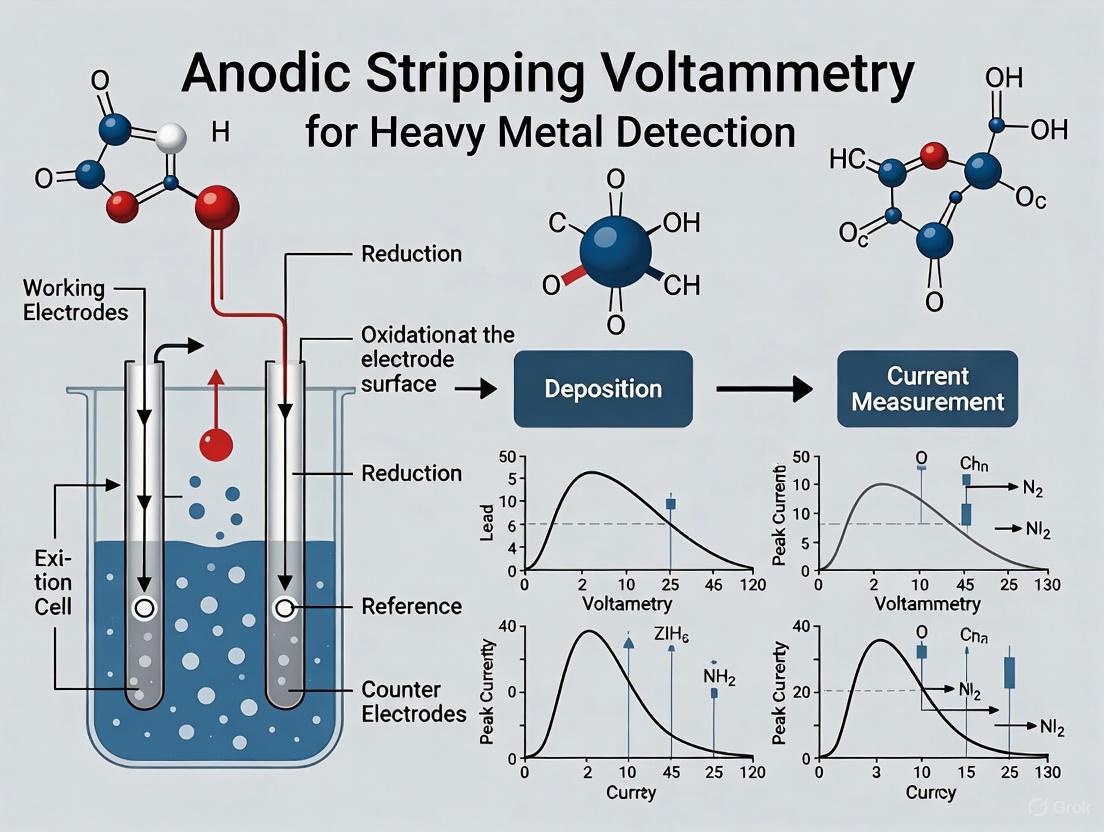
This article provides a comprehensive overview of Anodic Stripping Voltammetry (ASV), a highly sensitive electrochemical technique for detecting trace heavy metals.
Anodic Stripping Voltammetry for Heavy Metal Detection: Principles, Advances, and Biomedical Applications
Abstract
This article provides a comprehensive overview of Anodic Stripping Voltammetry (ASV), a highly sensitive electrochemical technique for detecting trace heavy metals. Tailored for researchers and drug development professionals, it covers the foundational principles of ASV, including its two-step pre-concentration and stripping process that enables part-per-billion (ppb) detection. The review details modern methodological advances, such as the development of environmentally friendly bismuth and nanomaterial-modified electrodes, and explores applications from environmental monitoring to clinical analysis. It also addresses key practical challenges—including electrode selection, interference, and sample preparation—and offers optimization strategies. Finally, the article validates ASV's performance against traditional spectroscopic methods, highlighting its unique advantages for portable, cost-effective, and real-time analysis in complex matrices relevant to biomedical and pharmaceutical research.
Understanding Anodic Stripping Voltammetry: Core Principles and Electrochemical Fundamentals
Anodic Stripping Voltammetry (ASV) is a highly sensitive electrochemical technique primarily used for the detection of trace heavy metals at sub-part-per-billion (ppb) concentrations [1]. Its capability for portable, cost-effective analysis makes it particularly valuable for environmental monitoring, pharmaceutical quality control, and on-site heavy metal detection [1] [2]. The technique's exceptional sensitivity stems from its two-step design, which physically separates the analyte preconcentration step from the measurement step, effectively overcoming diffusion limitations that constrain other voltammetric methods [1] [3]. This protocol details the practical implementation of the ASV process, framed within research on heavy metal detection, providing researchers with the foundational methodology required for experimental application.
The core principle of ASV involves the electrochemical reduction and preconcentration of metal ions from solution onto the working electrode surface, followed by their subsequent oxidative dissolution (stripping) back into solution [1]. The current generated during this stripping process is proportional to the concentration of the metal in the original sample [3]. While approximately 20 different metal ions can be determined by ASV—including lead, copper, cadmium, and zinc—the technique is not applicable to all metals and requires optimization for specific analytes and sample matrices [3] [2].
Theoretical Foundations of the Two-Step Process
The Pre-concentration (Deposition) Step
The first step in ASV is the pre-concentration or deposition step, which serves to amplify the analytical signal. During this stage, the working electrode is held at a constant potential, sufficiently negative to reduce the target metal ions (Mn+) to their metallic state (M0) [1]. The reduction process is represented by the reaction:
Mn+(aq) + ne− → M(s) [1]
The metallic atoms then accumulate on the electrode surface. In the case of mercury electrodes, this involves the formation of an amalgam; for solid electrodes, the metals form thin films or deposits [1] [3]. The efficiency of this step is critical to achieving low detection limits. Key parameters controlling deposition include the deposition potential (Edep), which must be more negative than the formal reduction potential (E°′) of the target metal couple, the deposition time, and the mass transport conditions [1] [3]. To enhance mass transfer and reduce analysis time, the solution is typically stirred, or the electrode is rotated during deposition [3]. The preconcentration factor—the ratio of the metal concentration at the electrode surface to its bulk solution concentration—can reach 100 to 1000 times, enabling the exceptional sensitivity of ASV [4].
The Equilibrium (Quiet) Period
Following the deposition step, stirring or rotation ceases, and a brief quiet time (typically 10-15 seconds) is observed [3]. This pause allows the system to reach a state of hydrodynamic equilibrium, ensuring a reproducible diffusion layer for the subsequent stripping step. During this period, faradaic processes are minimal, allowing the capacitive current to decay, which improves the signal-to-noise ratio during stripping.
The Stripping (Measurement) Step
The final step is the anodic stripping itself. The potential of the working electrode is scanned in a positive direction, oxidizing the accumulated metal back into solution:
M(s) → Mn+(aq) + ne− [1]
The resulting anodic current is measured as a function of the applied potential. The peak potential at which stripping occurs is characteristic of the specific metal, aiding in identification, while the peak current or charge (area under the peak) is proportional to the original concentration of the metal ion in the solution [1] [3]. Various potential waveforms can be employed for the stripping scan, including Linear Sweep Stripping Voltammetry (LSSV), Differential Pulse Stripping Voltammetry (DPSV), and Square Wave Stripping Voltammetry (SWSV). Pulse techniques like DPSV and SWSV are generally preferred as they minimize capacitive background currents, leading to lower detection limits [3].
Table 1: Core Steps of the ASV Process
| Step | Key Action | Primary Objective | Typical Parameters |
|---|---|---|---|
| 1. Pre-concentration | Apply negative potential; reduce metal ions to metal | Accumulate analyte on electrode surface | Edep: More negative than E°′; Time: Seconds to minutes; Stirring: On |
| 2. Equilibrium | Stop stirring; wait | Stabilize diffusion layer | Quiet Time: 10-15 seconds |
| 3. Stripping | Scan potential positively; oxidize metal back to ions | Measure analyte concentration | Scan Mode: LSSV, DPSV, or SWSV |
Experimental Protocol for ASV Analysis of Heavy Metals
Materials and Reagents
- Supporting Electrolyte: A high-ionic-strength buffer is essential to carry current and control pH. Acetate buffer (0.1 M, pH ~4.5-5.0) is common for many metals like Pb, Cd, and Zn. Other buffers include Britton-Robinson or acetic acid/acetate mixtures [5]. The choice of electrolyte and pH can influence metal speciation and the stripping signal [1].
- Standard Solutions: Prepare stock solutions (e.g., 1000 ppm) of target metals (e.g., Pb²⁺, Cd²⁺, Cu²⁺) from high-purity salts. Dilute serially with the supporting electrolyte to prepare calibration standards.
- Purified Water: Use double-distilled deionized water (e.g., 18 MΩ·cm resistivity) for all solutions to minimize contamination [6].
- Inert Gas: High-purity argon or nitrogen for deoxygenating solutions prior to analysis.
Equipment and Instrument Setup
- Potentiostat: The primary instrument for controlling potential and measuring current.
- Electrochemical Cell: A three-electrode configuration is standard.
- Working Electrode: The choice is critical (see Section 4.1). For this protocol, a Thin Mercury Film Electrode (TMFE) on a glassy carbon support or a Bismuth Film Electrode (BiFE) is assumed [3] [2].
- Reference Electrode: Ag/AgCl (3 M KCl) or Saturated Calomel Electrode (SCE).
- Counter/Auxiliary Electrode: Platinum wire or coil.
- Mass Transport Control: Magnetic stirrer with stir bar or rotating electrode assembly.
Step-by-Step Analytical Procedure
Electrode Preparation:
- For a TMFE: Polish the glassy carbon electrode surface with successively finer alumina slurries (e.g., 1.0, 0.3, and 0.05 µm) to a mirror finish. Rinse thoroughly with purified water. The mercury film is typically formed in-situ by adding a small amount of Hg²⁺ (e.g., 10-20 ppm) to the sample/standard solution and depositing at an appropriate potential along with the target analytes [3].
- For a solid Bismuth electrode: An activation step at a negative potential (e.g., -2.4 V to -2.5 V for 20-45 s) may be required to reduce any surface oxide before the accumulation step [5].
Solution Preparation and Deaeration:
- Pipette a known volume (e.g., 10 mL) of supporting electrolyte or standard/sample into the electrochemical cell.
- Purge the solution with inert gas (argon/nitrogen) for 8-10 minutes before analysis to remove dissolved oxygen, which can interfere electrochemically.
- Maintain a gentle stream of gas over the solution during the deposition step to prevent oxygen re-entry.
Pre-concentration/Deposition:
- Set the deposition potential (
Edep). This must be optimized but is typically 0.3-0.5 V more negative than the formal potential of the least easily reduced target metal. For a mixture of Cd, Pb, and Cu, a potential of around -1.2 V vs. Ag/AgCl is common. - Set the deposition time (
tdep). This depends on the analyte concentration and desired sensitivity. For ppb-level analysis, 60-300 seconds is typical. Start with 120 s. - Initiate the deposition step with constant stirring (e.g., 400-600 rpm) to ensure efficient mass transfer.
- Set the deposition potential (
Equilibrium Period:
- At the end of the deposition time, stop stirring and wait for a pre-set quiet time of 10-15 seconds [3]. This allows the solution to become quiescent.
Stripping and Measurement:
- Immediately after the quiet period, initiate the potential scan. For Differential Pulse ASV (DPASV), recommended for its sensitivity, use parameters such as:
- Initial Potential: Same as
Edep. - Final Potential: ~+0.2 to -0.1 V (to avoid oxidation of mercury/bismuth).
- Pulse Amplitude: 50 mV.
- Pulse Width/Pulse Period: 50 ms / 200 ms.
- Scan Rate/Step Height: Effectively 2-5 mV/s.
- Initial Potential: Same as
- The instrument will record the current versus potential, producing a voltammogram with peaks for each metal present.
- Immediately after the quiet period, initiate the potential scan. For Differential Pulse ASV (DPASV), recommended for its sensitivity, use parameters such as:
Electrode Cleaning:
- After the scan, hold the electrode at a more positive potential (e.g., +0.2 V to +0.5 V) for 30-60 seconds with stirring to ensure complete removal of any residual deposited metal. This prevents carryover between runs.
- Rinse the electrode thoroughly with purified water before the next analysis.
Calibration and Quantification:
- Run a series of standard solutions with known concentrations of the target metals using the above procedure.
- Construct a calibration curve by plotting the peak current (or peak area) against concentration for each metal.
- Analyze the unknown sample and determine its concentration from the calibration curve. The standard addition method is often preferred for complex sample matrices to account for matrix effects [1].
Table 2: Key Research Reagent Solutions for ASV
| Reagent / Material | Function / Explanation | Example / Comment |
|---|---|---|
| Supporting Electrolyte | Carries current; defines ionic strength & pH; influences metal speciation. | 0.1 M Acetate buffer (pH 4.5); Britton-Robinson buffer. |
| Working Electrode | Surface for analyte reduction & oxidation; critical for sensitivity & selectivity. | Thin Mercury Film (TMFE), Bismuth Film Electrode (BiFE), Solid Gold Electrode. |
| Complexing Agents | Selective masking of interferents or enabling analysis of non-amalgam-forming metals. | Cupferron for AdSV of In(III), Cr; Sulfide to complex Copper during Zinc analysis. |
| Standard Solutions | Calibration and method validation. | 1000 ppm AAS-grade stock solutions of target metals (e.g., Pb, Cd, As). |
| Oxygen Scavenger | Removes electroactive interference from dissolved O₂. | High-purity Argon or Nitrogen gas for deaeration. |
Critical Practical Considerations for Researchers
Electrode Material Selection
The working electrode is the heart of the ASV system. While mercury (as HMDE or TMFE) has historically been the preferred material due to its wide cathodic window, reproducible surface, and ability to form amalgams, toxicity concerns have driven the search for alternatives [1] [2]. Bismuth-based electrodes are now widely regarded as the most promising "green" alternative, offering a well-defined stripping signal, low toxicity, and the ability to form "fused" alloys with multiple metals [5] [2]. Gold electrodes are particularly suited for detecting metals like arsenic and mercury, which form intermetallic compounds with mercury or have stripping potentials positive of mercury oxidation [7] [2]. Gold nanoparticles can further enhance sensitivity and lower detection limits [2]. The choice of electrode material must be tailored to the specific analytes and sample matrix.
Optimization and Troubleshooting
- Optimizing Deposition Time and Potential: A longer deposition time increases sensitivity but can lead to saturation of the electrode surface and peak broadening. The deposition potential must be sufficiently negative to reduce all target metals but not so negative as to cause excessive hydrogen evolution or co-deposition of interfering species [1].
- Intermetallic Compounds: A significant interference occurs when two deposited metals form an intermetallic compound in the electrode (e.g., Cu-Zn), which alters their stripping behavior (peak potential and current) [3] [4]. This can be mitigated by choosing a different electrode material, adding a complexing agent to mask one of the metals, or adjusting deposition conditions [4].
- Organic Fouling: Real-world samples often contain surfactants and organic matter that can adsorb to the electrode surface, blocking active sites and suppressing the signal. Sample pretreatment (e.g., UV digestion, acidification) or the use of protective membranes may be necessary [1].
- Calibration Method: For complex matrices like biological fluids or environmental waters, the standard addition method is strongly recommended over external calibration. This method helps compensate for matrix effects that can alter the stripping response [1].
ASV Workflow Visualization
The following diagram illustrates the logical sequence of the two-step ASV process and the key parameters affecting each stage.
Diagram 1: The ASV Experimental Workflow. This diagram outlines the core sequence of steps in an Anodic Stripping Voltammetry experiment, highlighting the key parameters that must be optimized at the deposition and stripping stages.
Anodic Stripping Voltammetry is a powerful and versatile technique for ultra-trace metal analysis. Its distinctive two-step process—pre-concentration followed by stripping—is the foundation of its remarkable sensitivity. Successful implementation requires careful attention to experimental parameters, including electrode selection, deposition conditions, and stripping waveform. While challenges such as intermetallic interferences and electrode fouling exist, they can be managed through appropriate optimization and sample preparation. As research continues to develop more robust and environmentally friendly electrode materials, the applicability of ASV for on-site monitoring and routine analysis in fields ranging from environmental science to pharmaceutical development is expected to expand further.
The evolution of electrodes for anodic stripping voltammetry (ASV) represents a critical paradigm shift in electrochemical analysis, driven by both necessity and innovation. For decades, mercury-based electrodes were the cornerstone of ASV for heavy metal detection, prized for their exceptional electrochemical properties [1]. However, mounting concerns over the severe toxicity of mercury, culminating in international regulations like the Minamata Convention, rendered these electrodes commercially obsolete and scientifically undesirable [1]. This compelled the research community to develop safer, robust, and high-performing alternatives. The transition from mercury to modern solid electrodes marks a significant advancement, expanding the application of ASV in environmental monitoring, clinical diagnostics, and food safety [8] [9]. This application note details the historical context, performance metrics, and practical protocols for employing contemporary electrode materials, providing researchers with the tools to implement state-of-the-art ASV methodologies.
Historical Context and the Demise of Mercury Electrodes
Mercury Electrodes: The Former Gold Standard Mercury electrodes, particularly the hanging mercury drop electrode (HMDE) and the mercury film electrode (MFE), were historically dominant in ASV due to their unique properties [8] [1]. They offered a wide cathodic potential window, high reproducibility, and the ability to form homogenous amalgams with many metal analytes, which resulted in well-defined, sharp stripping peaks [1]. MFEs, often plated in situ onto an inert substrate like glassy carbon, provided enhanced sensitivity due to their high surface-to-volume ratio [8].
The Driving Force for Change Despite their analytical prowess, the profound toxicity of mercury and the associated handling, storage, and disposal hazards led to a global push for alternatives [10] [1]. The 2013 Minamata Convention on Mercury effectively phased out commercial mercury-based electrochemical instruments, creating an urgent need for mercury-free electrodes (MFEs) that could match or surpass mercury's performance [1].
Modern Solid Alternative Electrodes
The research community has successfully developed a range of non-mercury metal thin film electrodes (MTFEs) and modified solid electrodes. These alternatives are not only safer but also offer distinct advantages in specific analytical contexts.
Bismuth-Based Electrodes
Bismuth has emerged as one of the most successful and widely adopted replacements for mercury [8]. Its low toxicity, ability to form multicomponent "fused" alloys with heavy metals, and performance comparable to mercury make it highly attractive [8] [1]. A key advantage of bismuth MTFEs is their compatibility with alkaline media, where mercury electrodes fail due to the formation of insoluble oxides [8]. For instance, Bi MTFEs can achieve a limit of detection (LoD) for Pb²⁺ of 1.93 nM in 0.1 M NaOH, a feat impossible with mercury [8].
Noble Metal and Other Metal Oxide Electrodes
- Gold Nanoparticles (AuNPs): Gold electrodes and AuNP composites are particularly valuable for detecting metals like arsenic and mercury, which form strong intermetallic compounds with gold [11]. A recent sensor using a composite of cobalt oxide (Co₃O₄) and AuNPs on a glassy carbon electrode demonstrated simultaneous detection of As³⁺ and Hg²⁺ with wide dynamic ranges (10–900 ppb and 10–650 ppb, respectively) and excellent recovery in real water samples [11].
- Antimony and Tin: Antimony film electrodes represent another alternative, though concerns over their toxicity and cost relative to bismuth exist [10]. Tin-based electrodes have also been explored and show promise for ASV applications [8].
Chemically Modified Electrodes
A significant trend in modern ASV involves coating base electrodes with functional films or nanomaterials to enhance sensitivity and selectivity.
- Polymer Films: Electrodes modified with polymers like poly(zincon) (PZF) provide a mercury-free platform for preconcentrating metal ions via complexation [10]. A PZF-modified electrode achieved a detection limit of 0.98 µg L⁻¹ for Pb(II) and could be easily regenerated with EDTA, allowing for multiple uses [10].
- Carbon Nanomaterials: Graphene and its derivatives (graphene oxide, reduced graphene oxide) are extensively used to modify electrodes [9]. Their high surface area, excellent conductivity, and abundant functional groups enhance electron transfer and provide more active sites for metal deposition, leading to lower detection limits [9]. For example, graphene sensors decorated with gold nanoparticles have achieved Hg²⁺ detection down to 6 ppt [9].
Table 1: Performance Comparison of Modern Solid Alternative Electrodes
| Electrode Material | Target Analyte(s) | Linear Range | Limit of Detection (LoD) | Key Advantages |
|---|---|---|---|---|
| Bismuth (Bi) MTFE [8] | Pb²⁺ | 9.6–290 nM | 1.93 nM | Low toxicity, works in alkaline media, facile in situ plating |
| Poly(Zincon) Film [10] | Pb²⁺ | 3.45–136.3 µg L⁻¹ | 0.98 µg L⁻¹ | Mercury-free, selective complexation, easy regeneration |
| AuNPs/Co₃O₄ Composite [11] | As³⁺, Hg²⁺ | 10–900 ppb (As), 10–650 ppb (Hg) | Not Specified | Simultaneous detection, high accuracy in real water samples |
| Graphene/AuNPs [9] | Hg²⁺ | Not Specified | 6 ppt (≈0.006 µg L⁻¹) | Exceptional sensitivity, high surface area |
Experimental Protocols
Protocol 1:In SituBismuth Film Electrode for Detection of Cd, Pb, and Cu
This protocol is adapted from established procedures for using bismuth as a mercury replacement [8] [1].
Research Reagent Solutions
| Reagent | Function |
|---|---|
| Bi(III) Stock Solution (e.g., Bi(NO₃)₃ in 0.1 M HNO₃) | Source of bismuth for co-deposition with analytes to form the thin film. |
| Acetate Buffer (0.1 M, pH ~4.5) | Electrolyte and pH buffer; provides optimal conditions for deposition of many heavy metals. |
| Standard Solutions of Cd(II), Pb(II), Cu(II) | Analytes for calibration and quantification. |
| High-Purity Deionized Water (>18 MΩ·cm) | Prevents contamination and interference from ionic impurities. |
| Nitrogen Gas (O₂-free) | For deaerating the solution to remove dissolved oxygen, which can interfere. |
Workflow
- Electrode Preparation: Polish a glassy carbon (GC) working electrode successively with 1.0, 0.3, and 0.05 µm alumina slurry on a microcloth. Ricate thoroughly with deionized water between each step and sonicate for 5 minutes to remove any adhered particles.
- Solution Preparation: Prepare the sample or standard solution in an electrochemical cell. Add the supporting electrolyte (e.g., acetate buffer) and a known concentration of Bi(III) ions (typically in the range of 100–500 µg L⁻¹) to the solution.
- Deaeration: Purge the solution with nitrogen gas for at least 10 minutes to remove dissolved oxygen. Maintain a slight nitrogen blanket over the solution during analysis.
- Deposition/Pre-concentration: While stirring the solution, hold the working electrode at a deposition potential (e.g., -1.2 V vs. Ag/AgCl) for a set time (60–300 s). This step simultaneously reduces and deposits both the bismuth and the target heavy metal ions onto the GC surface, forming a Bi-M alloy film.
- Equilibration: Stop stirring and allow the solution to become quiescent for a brief period (e.g., 10–15 s).
- Stripping: Initiate the anodic potential scan. A linear sweep, square wave, or differential pulse waveform can be applied from the deposition potential to a more positive potential (e.g., -0.2 V). The square wave voltammetry is often preferred for its sensitivity and speed [12].
- Stripping Analysis: Identify the metals based on their characteristic stripping peak potentials. Quantify the concentration by measuring the peak current or charge and comparing it to a calibration curve.
- Electrode Cleaning/Regeneration: Apply a positive potential (e.g., +0.3 V) with stirring for 30-60 seconds to ensure complete stripping of the residual film and analytes before the next run.
The following workflow diagram illustrates the key steps of the ASV process using a modern solid electrode:
Protocol 2: Fabrication of a Poly(Zincon) Modified Electrode for Lead Detection
This protocol provides a methodology for creating a chemically modified electrode for selective metal ion detection [10].
Workflow
- Electrode Pre-treatment: Follow the same polishing and cleaning procedure as in Protocol 1 for a graphite or GC electrode.
- Electropolymerization: Immerse the electrode in a solution containing ~1 mM zincon in a suitable buffer (e.g., phosphate buffer, pH 7). Using cyclic voltammetry, cycle the potential (e.g., between -0.8 V and +1.2 V) for a set number of scans (e.g., 10 cycles) to electropolymerize the zincon and form a stable poly(zincon) film (PZF) on the electrode surface.
- Electrode Rinsing: Rinse the modified electrode thoroughly with deionized water to remove any unreacted monomer.
- Preconcentration: Immerse the PZF-modified electrode in the sample or standard solution containing Pb(II) under open-circuit conditions or at an applied potential for a fixed time. The PZF film preconcentrates Pb(II) ions via complexation.
- Reduction: Transfer the electrode to an electrochemical cell containing only a clean supporting electrolyte (e.g., acetate buffer, pH 6). Apply a reduction potential (e.g., -1.0 V) to reduce the preconcentrated Pb(II) to Pb(0).
- Stripping: Perform an anodic stripping voltammetry scan (e.g., from -1.0 V to -0.2 V). Measure the stripping peak current for Pb at approximately -0.64 V.
- Regeneration: Regenerate the electrode surface by immersing it in 0.1 M EDTA solution for 2 minutes to chelate and remove any residual lead, followed by thorough washing with deionized water [10].
The Scientist's Toolkit: Essential Research Reagents
Table 2: Key Reagent Solutions for ASV with Modern Electrodes
| Research Reagent | Function in ASV | Example Use Case |
|---|---|---|
| Bismuth (III) Nitrate | Source of Bi ions for forming in situ bismuth film electrodes. | Co-deposited with target metals on a GC electrode for multi-metal detection [8]. |
| Gold Nanoparticle (AuNP) Dispersion | Electrode modifier to enhance conductivity and catalytic activity. | Modified on GC electrodes for sensitive detection of As³⁺ and Hg²⁺ [11]. |
| Graphene Oxide (GO) / Reduced GO | High-surface-area nanomaterial to increase active sites and electron transfer. | Used as a substrate in composite electrodes to lower detection limits [9]. |
| Zincon | Monomer for creating a selective polymer film for metal complexation. | Electropolymerized on graphite electrodes for mercury-free Pb(II) detection [10]. |
| Acetate Buffer | Common electrolyte and buffering agent for optimal deposition of many metals. | Used for analysis of Cd, Pb, and Cu in acidic pH conditions (e.g., pH 4.5) [10] [1]. |
| EDTA (Ethylenediaminetetraacetic acid) | Strong chelating agent for electrode cleaning and regeneration. | Used to strip residual metals from a poly(zincon)-modified electrode after analysis [10]. |
The historical shift from mercury electrodes to modern solid alternatives is a resounding success story in analytical chemistry. Driven by environmental and safety concerns, this transition has spurred innovation, leading to the development of high-performing materials like bismuth, gold nanoparticles, and graphene-based nanocomposites. These materials not only match the sensitivity of traditional mercury electrodes but also offer new functionalities, such as operation in alkaline media and selective complexation. The provided protocols and reagent toolkit equip researchers to robustly implement these modern ASV techniques. As the field continues to evolve, the integration of novel nanomaterials and smart sensing layers promises to further enhance the portability, selectivity, and application scope of anodic stripping voltammetry for heavy metal detection.
Key Thermodynamic and Kinetic Parameters Governing ASV Sensitivity
Anodic Stripping Voltammetry (ASV) is a powerful electrochemical technique renowned for its exceptional sensitivity in detecting trace levels of heavy metals, often reaching parts per billion (ppb) and sub-ppb concentrations. This sensitivity is governed by a complex interplay of thermodynamic and kinetic parameters that control the pre-concentration and stripping processes. This application note provides a detailed examination of these critical parameters, including deposition potential, mass transfer conditions, electrode material properties, and solution composition. We present optimized experimental protocols for various analytical scenarios, structured data tables for parameter comparison, and visual workflows to guide researchers in maximizing ASV sensitivity for their specific applications in environmental monitoring, pharmaceutical development, and clinical diagnostics.
Anodic Stripping Voltammetry (ASV) is a highly sensitive electrochemical technique capable of detecting trace metal ions at sub-parts per billion (ppb) levels, making it invaluable for environmental monitoring, food safety, and pharmaceutical quality control [1] [12]. The technique's exceptional sensitivity stems from its two-step process: an initial pre-concentration step where metal ions are electrodeposited onto an electrode surface, followed by a stripping step where the deposited metals are re-oxidized, generating a measurable current signal [8] [1].
The sensitivity of ASV is not inherent but is governed by a delicate balance of thermodynamic and kinetic parameters that influence both deposition and stripping efficiency. Thermodynamic factors determine the driving forces for electrodeposition and stripping, while kinetic parameters control the rates of these processes [1]. Understanding and optimizing these parameters is essential for developing robust ASV methods capable of reliable detection in complex matrices. This application note systematically examines these critical parameters, providing researchers with practical guidance and protocols to maximize ASV sensitivity for their specific analytical challenges.
Critical Thermodynamic Parameters
Thermodynamic parameters in ASV establish the fundamental feasibility and driving force for the electrodeposition and stripping reactions. These parameters determine the theoretical limits of sensitivity and selectivity achievable under given experimental conditions.
Formal Potential (E°′)
The formal potential (E°′) of the Mn+/M redox couple represents the thermodynamic equilibrium potential for the reduction and oxidation processes central to ASV. This parameter determines the minimum deposition potential required for effective pre-concentration and influences the stripping peak potential used for metal identification [1].
- Deposition Potential Selection: The applied deposition potential (Edep) must be sufficiently negative of E°′ to drive the reduction reaction at a practical rate. Typically, Edep is set 0.15-0.30 V more negative than E°′ for the target metal to ensure efficient deposition while avoiding excessive hydrogen evolution or reduction of interfering species [1].
- Metal Identification: The stripping peak potential is thermodynamically related to E°′, providing a characteristic identifier for different metal ions. However, for non-Hg electrodes, this relationship can be complicated by alloy formation or kinetic effects, necessitating careful calibration [1].
Metal Solubility in Electrode Material
For mercury-based electrodes, the solubility of the analyte metal in mercury to form an amalgam is a crucial thermodynamic parameter that directly impacts sensitivity. Metals with higher solubility in mercury generally yield higher sensitivity [13] [1].
Table 1: Solubility of Selected Metals in Mercury and Their Typical ASV Performance
| Metal | Solubility in Hg (Atomic %) | Relative ASV Sensitivity on Hg |
|---|---|---|
| Cadmium (Cd) | High | Excellent |
| Lead (Pb) | High | Excellent |
| Zinc (Zn) | High | Excellent |
| Bismuth (Bi) | 0.015 [13] | Good (as electrode material) |
| Copper (Cu) | 0.066 [13] | Good (potential for intermetallics) |
For solid electrodes like bismuth or antimony, the formation of alloys or intermetallic compounds replaces amalgamation. The thermodynamics of these alloy formation reactions can similarly affect the stripping behavior and sensitivity [8] [14].
Critical Kinetic Parameters
Kinetic parameters control the rates of mass transport and electron transfer during ASV, directly influencing the efficiency of the pre-concentration step and the characteristics of the stripping signal.
Deposition Time (tdep)
The deposition time is a primary kinetic parameter controlling the amount of metal accumulated on the electrode surface. The total quantity of deposited metal, [M(Hg)]tot, is proportional to the deposition time for a given set of conditions, following the relationship derived from Fick's law of diffusion [13]: [M(Hg)tot] ∝ [Mn+] √(DMn+ tdep) A / δ where [Mn+] is the bulk concentration, DMn+ is the diffusion coefficient, tdep is the deposition time, A is the electrode area, and δ is the diffusion layer thickness [13].
- Sensitivity vs. Analysis Time: Increasing tdep enhances sensitivity by increasing the quantity of deposited metal, but it also lengthens the total analysis time. Typical deposition times range from 30 seconds to 30 minutes, depending on the required detection limit and analyte concentration [1].
- Linear Range: The relationship between signal and tdep is linear only for short deposition times or dilute solutions. At longer times or higher concentrations, surface saturation can occur, leading to non-linearity [1].
Mass Transport Rate
The rate at metal ions reach the electrode surface during deposition is a kinetic parameter critical for controlling the pre-concentration efficiency. This is typically enhanced by implementing convective mass transport [1].
- Methods: Solution stirring, electrode rotation, or flow-through systems are employed to increase the mass transfer coefficient.
- Benefit: Enhanced mass transfer increases the rate of deposition, improving the pre-concentration factor (up to 10,000x reported in flow systems [13]) and allowing for shorter deposition times or lower detection limits.
- Reproducibility: Controlled and reproducible hydrodynamic conditions are essential for achieving repeatable results between experiments [1].
Electrode Kinetics and Charge Transfer
The kinetics of the electron transfer reactions themselves (both during deposition and stripping) can influence the ASV response, particularly for metals like cobalt and nickel which exhibit slower electrode kinetics [13]. The choice of electrode material significantly influences these kinetics.
Experimental Optimization Protocols
Protocol: Optimization of Deposition Potential and Time
Objective: To determine the optimal deposition potential (Edep) and time (tdep) for the sensitive detection of a target metal (e.g., Pb) using a Bismuth Film Electrode (BiFE).
Materials:
- Electrochemical workstation
- Three-electrode system: Glassy Carbon working electrode (for in-situ BiFE), Ag/AgCl reference electrode, Pt counter electrode
- Supporting electrolyte: 0.1 M Acetate Buffer (pH 4.5)
- Standard solutions: 1000 ppm Bi(III), 1000 ppm Pb(II)
- Purified water and analytical grade chemicals
Procedure:
- Electrode Preparation: Polish the glassy carbon electrode with 0.05 μm alumina slurry on a microcloth, rinse thoroughly with purified water, and dry.
- Solution Preparation: In the electrochemical cell, prepare 20 mL of supporting electrolyte containing 400 ppb Bi(III) and 50 ppb Pb(II). Deoxygenate with nitrogen or argon for 10 minutes.
- Deposition Potential Optimization:
- Set the deposition time to a fixed value (e.g., 120 s) with stirring.
- Perform ASV measurements using a series of deposition potentials, starting from -0.8 V and progressing to more negative values in 0.05 V increments (e.g., -0.8, -0.85, -0.9, -1.0, -1.1 V).
- For each experiment, apply the Edep for 120 s with stirring, followed by a quiet period of 10 s, then record the stripping voltammogram (e.g., using Square-Wave Voltammetry from -1.0 V to -0.2 V).
- Data Analysis: Plot the Pb stripping peak current versus the applied Edep. The optimal Edep is the most positive potential that yields the maximum peak current, minimizing competing reactions like hydrogen evolution.
- Deposition Time Optimization:
- Set Edep to the optimized value from step 4.
- Perform ASV measurements using a series of deposition times (e.g., 30, 60, 120, 180, 300 s) with stirring.
- Data Analysis: Plot the Pb stripping peak current versus tdep. Determine the time that provides a sufficient signal for your detection needs while maintaining a practical analysis time. Check for linearity to ensure the surface is not saturated.
Protocol: Method for Evaluating and Mitigating Intermetallic Interferences
Objective: To identify and address interferences caused by the formation of intermetallic compounds between co-deposited metals (e.g., Cu-Zn), which can suppress or shift stripping peaks [1].
Materials: (As in Protocol 4.1, with additional standard solutions for potential interferents like Cu(II) and Zn(II)).
Procedure:
- Baseline Measurement: Prepare a solution containing a fixed concentration of the target metal (e.g., 50 ppb Zn(II)) in the supporting electrolyte with Bi(III). Record the ASV signal.
- Interference Test: To separate aliquots of the solution from step 1, add increasing concentrations of the potential interferent (e.g., Cu(II) at 10, 50, 100, 200 ppb). Record the ASV signal for each addition.
- Observation: Note any changes in the peak shape, potential, or current for the target metal. The formation of a Cu-Zn intermetallic compound, for instance, will typically suppress the Zn peak and may enhance the Cu peak.
- Mitigation Strategies:
- Chemical Masking: Add a complexing agent selective for the interferent. For Cu-Zn interference, adding gallium ions or iron cyanide complexes can selectively bind Cu, preventing its reduction and intermetallic formation [1].
- Potential Masking: Adjust the deposition potential to be less negative, so that the interferent metal (Cu) does not deposit, while the target metal (Zn) still does. This requires careful optimization of Edep.
- Standard Addition: Use the method of standard addition for quantification in complex samples, as it can help compensate for some matrix effects.
The Scientist's Toolkit: Essential Research Reagents & Materials
Table 2: Key Reagent Solutions and Materials for ASV Experiments
| Item | Function/Description | Key Considerations |
|---|---|---|
| Supporting Electrolyte | Conducting medium to minimize ohmic drop (iR drop). Common choices: Acetate buffer (pH ~4.5), nitric acid (pH ~2), KCl, KNO3. | Choice affects metal speciation, background current, and potential window [1]. |
| Buffer Solution | Maintains constant pH, which controls metal hydrolysis and speciation. | Essential for reproducible results. Acetate buffer is common for BiFE [1]. |
| Bi(III) Stock Solution | Source of bismuth for in-situ plating of Bismuth Film Electrodes (BiFE). | A common "environmentally-friendly" alternative to Hg with good performance for many metals [8] [1]. |
| Hg(II) Stock Solution | Source of mercury for in-situ plating of Mercury Film Electrodes (MFE). | Highly toxic but offers a wide negative potential window and forms amalgams [1]. Use is now discouraged. |
| Standard Metal Ion Solutions | Calibration standards for target analytes (e.g., Pb(II), Cd(II), Zn(II), Cu(II)). | Used for constructing calibration curves. High-purity, single-element standards are recommended. |
| Complexing Agent | Selective masking of interferents (e.g., to prevent Cu-Zn intermetallic formation) [1]. | Example: Gallium ions or iron cyanide complexes for copper masking. |
| Antifouling Agents | To minimize adsorption of organic surfactants onto the electrode surface. | Example: Addition of activated carbon to sample for pre-adsorption of organics (requires removal before measurement) [1]. |
Workflow and Parameter Relationships
The following diagram illustrates the core ASV process and the interrelationships between the key thermodynamic and kinetic parameters discussed, highlighting how they influence the final analytical signal.
Figure 1: Workflow diagram illustrating the two-step process of Anodic Stripping Voltammetry (ASV) and the key thermodynamic and kinetic parameters that govern each stage, ultimately determining the sensitivity and characteristics of the analytical signal.
The sensitivity of Anodic Stripping Voltammetry is governed by a sophisticated interplay of thermodynamic and kinetic parameters. Key thermodynamic factors include the formal potential of the metal redox couple and the solubility or alloying behavior of the metal in the electrode material. Critical kinetic parameters encompass deposition time, mass transport rate, and electrode kinetics, which collectively control the efficiency of the pre-concentration and stripping steps.
Successful implementation of ASV for ultra-trace analysis requires systematic optimization of these parameters, guided by the protocols and data tables provided in this note. The choice of electrode material, particularly the move toward "green" alternatives like bismuth, and a thorough understanding of potential interferences are also vital for obtaining reliable and reproducible results. By mastering the parameters detailed herein, researchers can harness the full power of ASV for sensitive and accurate heavy metal detection across diverse application fields.
Anodic Stripping Voltammetry (ASV) is a highly sensitive electrochemical technique widely used for the trace-level detection of heavy metals. Its exceptional sensitivity, often at parts-per-billion (ppb) or sub-ppb levels, stems from a two-step process: an initial electrochemical deposition (pre-concentration) of metal ions onto a working electrode, followed by a stripping step where the deposited metals are oxidized back into solution, generating a measurable current [15]. This technique is particularly valuable for environmental monitoring, food safety, and pharmaceutical development, where accurate measurement of toxic metals is crucial. This application note details the specific heavy metals detectable by ASV, their respective detection limits, and provides standardized protocols for their determination in various matrices, supporting rigorous research and compliance activities.
Heavy Metals Detectable by ASV and Performance Data
ASV is highly effective for detecting several toxic heavy metals. The following table summarizes key metals and their achievable detection limits as reported in recent research.
Table 1: Heavy Metals Detectable by Anodic Stripping Voltammetry
| Heavy Metal | Oxidation State | Reported Detection Limit | Key Experimental Conditions |
|---|---|---|---|
| Arsenic (As) | As(III) | 0.8 µg/L (ppb) [16] | Gold macroelectrode, Underpotential Deposition (UPD) |
| As(III) | 2.4 µg/L (ppb) [17] | Nanocomposite-modified Screen-Printed Electrode (SPE) | |
| Cadmium (Cd) | Cd(II) | 0.5 ng/kg (ppt) [18] | Mercury Film Electrode (MFE), Differential Pulse ASV (DPASV) |
| Cd(II) | 0.8 µg/L (ppb) [17] | Nanocomposite-modified Screen-Printed Electrode (SPE) | |
| Lead (Pb) | Pb(II) | 1.2 µg/L (ppb) [17] | Nanocomposite-modified Screen-Printed Electrode (SPE) |
| Copper (Cu) | Cu(II) | Not explicitly quantified (detected simultaneously) [18] | Mercury Film Electrode (MFE), Differential Pulse ASV (DPASV) |
The sensitivity for arsenic detection is highly dependent on its speciation. Methods can be tailored to selectively detect the more toxic As(III) or total inorganic arsenic by adjusting the deposition potential. For total arsenic, As(V) is indirectly measured by reducing it to As(III) prior to analysis [16] [18]. While not included in the quantitative table above, mercury (Hg) is also documented as a target for ASV analysis, though its determination often involves related techniques like Cathodic Stripping Voltammetry (CSV) [18] [19].
Detailed Experimental Protocols
Protocol 1: Detection of Total Arsenic and As(III) in Water Using Gold Macroelectrodes
This protocol is adapted from a method capable of sub-10 ppb measurement of arsenic, suitable for monitoring drinking water against the WHO guideline of 10 µg/L [16].
1. Principle: The method uses Underpotential Deposition (UPD) on a gold electrode. The deposition potential is selectively chosen to either deposit only As(III) or to reduce and deposit both As(III) and As(V) for total arsenic measurement. The deposited arsenic is then stripped, generating an analytical signal.
2. Reagents and Materials:
- Water sample: Aqueous solution, filtered if particulate matter is present.
- Supporting electrolyte: Suprapure hydrochloric acid (HCl) or other suitable electrolyte.
- Gold macroelectrode: serves as the Working Electrode.
- Reference Electrode: e.g., Ag/AgCl.
- Counter Electrode: e.g., Platinum wire.
- Purified gases: Nitrogen or Argon for deaeration.
3. Procedure:
- Step 1: Sample Pre-treatment. Acidify the sample to pH 2-3 using suprapure HCl. If organic matter is present, perform UV-irradiation in the presence of 0.01 M HCl and 0.03% H₂O₂ to mineralize interfering compounds [18].
- Step 2: Speciation-Specific Deposition.
- For As(III) detection: Set the deposition potential to -0.9 V (vs. Ag/AgCl).
- For Total Arsenic detection: Set the deposition potential to -1.3 V (vs. Ag/AgCl). At this potential, As(V) is reduced and deposited along with As(III).
- Step 3: Deposition. Immerse the gold electrode in the stirred sample solution and apply the chosen deposition potential for a specified time (e.g., 60-300 seconds) to pre-concentrate arsenic on the electrode surface.
- Step 4: Stripping. After the deposition period, cease stirring and initiate a positive potential sweep (e.g., using linear sweep, differential pulse, or square wave voltammetry). The deposited arsenic is oxidized (stripped) back into solution, producing a characteristic current peak.
- Step 5: Quantification. Measure the peak current. The concentration is determined by comparing against a calibration curve prepared with standard arsenic solutions.
- Step 6: As(V) Calculation. The As(V) concentration is calculated by subtracting the As(III) concentration from the Total Arsenic concentration.
Protocol 2: Multiplexed Detection of As(III), Cd(II), and Pb(II) using Nanocomposite-Modified Screen-Printed Electrodes in a Flow System
This protocol describes a high-throughput, multiplexed approach for simultaneous detection of multiple heavy metals, integrated with a 3D-printed flow cell [17].
1. Principle: Screen-Printed Electrodes (SPEs) are modified with catalytic nanocomposites to enhance sensitivity and selectivity. The flow system allows for automated, high-throughput analysis of samples with minimal volume.
2. Reagents and Materials:
- Working Electrodes: Screen-printed electrodes with dual working electrodes.
- Electrode Modifiers:
(BiO)₂CO₃-rGO-Nafionnanocomposite.Fe₃O₄-Au-IL(Fe₃O₄ magnetic nanoparticles decorated with Au nanoparticles and Ionic Liquid) nanocomposite.
- Flow Cell: A 3D-printed flow cell integrated with the SPE.
- Portable Potentiostat: For on-site measurements.
- Carrier/Electrolyte solution: Appropriate buffer or acidic solution.
3. Procedure:
- Step 1: Electrode Modification. Modify the working electrodes of the SPE by drop-casting the
(BiO)₂CO₃-rGO-NafionandFe₃O₄-Au-ILnanocomposites onto separate working electrodes and allowing them to dry. - Step 2: System Integration. Assemble the modified SPE into the 3D-printed flow cell, ensuring a leak-proof seal and strategic placement of the sensing area within the flow channel.
- Step 3: Optimization of Parameters. Optimize experimental parameters using Computational Fluid Dynamics (CFD) and empirical testing:
- Deposition potential: Typically several tenths of a volt more negative than the reduction potential of the target metal.
- Deposition time: 60-300 seconds, depending on required sensitivity.
- Flow rate: Optimized to ensure efficient electrodeposition (e.g., 1-5 mL/min).
- Step 4: Analysis. Use the Square Wave ASV (SWSV) technique. The sample is pumped through the flow cell, and the optimized deposition potential is applied. After deposition, the stripping step is performed, and the current is measured simultaneously at both modified working electrodes.
- Step 5: Data Analysis. The peak currents for As(III), Cd(II), and Pb(II) are measured at their characteristic stripping potentials. Quantification is achieved via a calibration curve in the range of 0–50 µg/L.
The Scientist's Toolkit: Essential Research Reagents and Materials
The following table lists key materials and their functions for setting up ASV experiments for heavy metal detection.
Table 2: Key Research Reagent Solutions and Materials for ASV
| Item | Function/Application |
|---|---|
| Gold Macroelectrode | Preferred working electrode for arsenic detection due to its favorable electrochemistry with As(0)/As(III) [16]. |
| Mercury Film Electrode (MFE) | Historically classic electrode for Cd, Pb, Cu detection via DPASV, offering high sensitivity and a renewable surface [18]. |
| Screen-Printed Electrodes (SPE) | Disposable, low-cost, planar electrodes ideal for portable, on-site analysis and flow-cell integration [17]. |
| Nanocomposite Modifiers (e.g., (BiO)₂CO₃-rGO, Fe₃O₄-Au) | Enhance electrode sensitivity, selectivity, and stability by increasing surface area and providing catalytic properties [17]. |
| Suprapure Acids (HCl, etc.) | Used as supporting electrolyte and for sample acidification to prevent hydrolysis and adsorption of metal ions onto container walls [15] [18]. |
Workflow and Signaling Visualization
The following diagram illustrates the logical workflow and key electrochemical processes involved in a typical ASV analysis.
ASV Principle: Deposition and Stripping
The core signaling pathway in ASV is the electrochemical reaction at the electrode-solution interface. The diagram below details the specific processes for arsenic speciation detection.
ASV Arsenic Speciation Detection Pathway
Modern ASV Methods and Applications in Environmental and Clinical Analysis
Anodic stripping voltammetry (ASV) is a powerful electrochemical technique known for its high sensitivity in detecting trace levels of heavy metals, coupling a preconcentration step with advanced electrochemical stripping protocols [20] [21]. The choice of working electrode material is critical to the success of ASV. For decades, mercury electrodes were the standard due to their excellent electroanalytical performance, but their high toxicity has driven the search for safer alternatives [20] [22]. Bismuth-based electrodes have emerged as the most successful replacement, offering a comparable negative potential window, well-defined stripping signals, and minimal toxicity [21] [22]. Recent research has focused on enhancing the performance of bismuth electrodes through nanostructuring and composite formation, leading to the development of bismuth nanoparticles, nanocomposites, and novel solid-state sensors. These next-generation materials provide increased surface area, improved sensitivity, and enhanced mechanical stability, making them suitable for applications ranging from environmental monitoring to analysis of complex biological samples [23] [24] [25]. This document outlines the application and protocols for these advanced bismuth-based electrode materials.
Application Notes
Performance of Bismuth-Based Electrodes
The following table summarizes the analytical performance of various state-of-the-art bismuth-based electrodes for the detection of key heavy metal ions.
Table 1: Analytical performance of various bismuth-based electrodes for heavy metal detection.
| Electrode Material | Analyte | Linear Range (μg/L) | Limit of Detection (LOD, μg/L) | Technique | Reference |
|---|---|---|---|---|---|
| In-situ Bi Film Electrode (BiFE) | Sn(II) | 1 - 100 | 0.26 | ASV | [20] |
| In-situ Bi Film Electrode (BiFE) | Ag(I) | 10 - 90 | 2.1 | ASV | [26] |
| Solid Bi Microelectrode Array | Cd(II) | 0.56 - 22.5 | 0.26 | ASV | [23] |
| Pb(II) | 0.41 - 41.4 | 0.18 | ASV | [23] | |
| GO-BiNPs Nanocomposite | Cd(II) | 11.2 - 157.2 | 3.0 | ASV | [24] |
| Pb(II) | 20.7 - 290.0 | 6.2 | ASV | [24] | |
| Bi-Chitosan Nanocomposite (SPE) | Cd(II) | - | 0.1 | SWASV | [25] |
| Pb(II) | - | 0.2 | SWASV | [25] | |
| Zn(II) | - | 0.1 | SWASV | [25] | |
| Bi₂O₃@NPBi | Cd(II) | - | 0.03 | SWASV | [27] |
| Pb(II) | - | 0.02 | SWASV | [27] |
The Scientist's Toolkit: Key Research Reagents and Materials
Table 2: Essential reagents and materials for fabricating and operating bismuth-based electrodes.
| Reagent/Material | Function/Application | Example Notes |
|---|---|---|
| Bismuth Nitrate (Bi(NO₃)₃) | Precursor for in-situ and ex-situ bismuth film formation. | Used in "built-in" precursor composite electrodes [28]. |
| Acetate Buffer (pH ~4.5) | Common supporting electrolyte for ASV of heavy metals. | Optimized concentration is critical; 0.05 M was found ideal for some systems [23]. |
| Chitosan | Biopolymer for forming mechanically stable nanocomposites. | Enhances metal ion chelation and sensor sensitivity; co-deposited with Bi [25]. |
| Graphene Oxide (GO) | Nanocarbon substrate to enhance surface area and electron transfer. | Forms nanocomposites with BiNPs, improving sensitivity for Cd(II) and Pb(II) [24]. |
| Catechol | Complexing agent for specific metal analytes like tin. | Facilitates the accumulation and well-defined stripping of Sn(II) on BiFE [20]. |
| Screen-Printed Electrode (SPE) | Disposable, planar substrate for portable sensor design. | Enables integration into flow cells and point-of-care devices [17] [25]. |
| Nanoporous Bismuth (NPBi) | High-surface-area electrode substrate. | Prepared by dealloying; can be decorated with Bi₂O₃ for ultrasensitive detection [27]. |
Detailed Experimental Protocols
Protocol 1: Fabrication and Use of anIn-SituBismuth Film Electrode (BiFE) for Tin Detection
This protocol is adapted from the method developed for determining trace tin in seawater using a bismuth film electrode plated on a glassy carbon (GC) substrate [20].
3.1.1 Materials and Equipment
- Electrochemical Workstation: Potentiostat with GPES or equivalent software.
- Electrochemical Cell: Standard three-electrode configuration.
- Working Electrode: Glassy carbon electrode (GCE, 2-3 mm diameter).
- Counter Electrode: Platinum wire or coil.
- Reference Electrode: Ag/AgCl (sat. KCl).
- Chemicals: Bi(III) standard solution, Sn(II) standard solution, catechol, acetic acid, sodium acetate, nitric acid. All chemicals should be analytical grade. Use high-purity deionized water (≥18 MΩ·cm).
3.1.2 Procedure
- Electrode Pretreatment: Polish the GCE surface with 0.3 μm and then 0.05 μm alumina slurry on a microcloth. Rinse thoroughly with deionized water between polishing steps and after the final polish. Sonicate the electrode in deionized water and ethanol for 2 minutes each to remove any adhered alumina particles.
- Solution Preparation: Prepare a 0.1 M acetate buffer solution (pH ~4.5) as the supporting electrolyte. To this buffer, add Bi(III) ions (to a final concentration of 0.5 - 5 mg/L), catechol (as a complexing agent, concentration must be optimized, e.g., 0.01 M), and the sample or standard solution containing Sn(II).
- Film Deposition and Analysis:
- Transfer the solution to the electrochemical cell. Place the electrodes into the solution.
- Deposition Step: Apply a deposition potential of -1.2 V to -1.4 V (vs. Ag/AgCl) to the GCE for a defined deposition time (60-300 s), with solution stirring. During this step, Bi(III) and Sn(II)-catechol complexes are simultaneously reduced, forming a bismuth film on the GCE in which tin is incorporated.
- Equilibration Step: After deposition, stop stirring and allow the solution to equilibrate for 10-15 s.
- Stripping Step: Initiate an anodic potential scan using square-wave voltammetry. Scan from the deposition potential to -0.4 V. The stripping peaks for tin will appear at approximately -0.5 V and -0.7 V (vs. Ag/AgCl).
- Calibration: Repeat the procedure with standard solutions of Sn(II) to construct a calibration curve for quantitative analysis.
Protocol 2: Preparation of a Bismuth-Chitosan Nanocomposite Screen-Printed Electrode
This protocol details the co-electrodeposition of a bismuth-chitosan nanocomposite on a screen-printed carbon electrode (SPCE) for simultaneous detection of Pb(II), Cd(II), and Zn(II) [25].
3.2.1 Materials and Equipment
- Screen-Printed Electrodes (SPEs): With carbon working and counter electrodes, and Ag/AgCl reference electrode.
- Potentiostat/Galvanostat
- Chemical Reagents: Bismuth nitrate pentahydrate (Bi(NO₃)₃·5H₂O), medium molecular weight chitosan, acetic acid (glacial, 100%), cadmium nitrate, lead nitrate, zinc chloride.
3.2.2 Procedure
- Electrodeposition Solution Preparation:
- Dissolve 24 mg of chitosan in 20 mL of 0.1 M acetic acid solution. Stir continuously until the chitosan is completely dissolved.
- Add 0.1 M Bi nitrate (e.g., 0.485 g of Bi(NO₃)₃·5H₂O) to the chitosan solution. The resulting weight ratio of Bi to chitosan is approximately 16:1.
- Stir the mixture for 24 hours at room temperature to ensure a homogeneous, well-mixed solution.
- Nanocomposite Electrodeposition:
- Connect the SPCE to the potentiostat. Use an external Ag/AgCl reference electrode and a platinum counter electrode if higher precision is required, though the integrated SPCE electrodes can be used.
- Immerse the SPCE in the electrodeposition solution.
- Apply a constant current density of -100 mA/cm² for 30 to 180 seconds to co-deposit Bi and chitosan onto the carbon working electrode. Alternatively, a higher current density of -200 mA/cm² for 120 seconds can be used.
- Sensor Post-treatment: After deposition, gently rinse the modified sensor with deionized water to remove any loosely adsorbed material. Dry the sensor under ambient conditions and store it in a dry place before use.
- Heavy Metal Detection:
- Use Square-Wave Anodic Stripping Voltammetry (SWASV).
- Deposition: Immerse the sensor in the sample/standard solution and apply a deposition potential of -1.3 V to -1.4 V for 60-300 s with stirring.
- Stripping: Record the stripping signal by scanning from the deposition potential to about -0.2 V. Well-separated peaks for Zn, Cd, and Pb are typically observed at approximately -1.1 V, -0.7 V, and -0.5 V (vs. Ag/AgCl), respectively.
Workflow for Bismuth-Based ASV Heavy Metal Sensing
The following diagram illustrates the generalized logical workflow for heavy metal detection using anodic stripping voltammetry with bismuth-based electrodes.
Bismuth-based electrodes, particularly those incorporating nanoparticles and nanocomposites, represent a mature and high-performance alternative to toxic mercury electrodes for anodic stripping voltammetry. The protocols outlined herein provide researchers with robust methodologies for fabricating and utilizing these next-generation materials. The key advantages of bismuth—its environmental friendliness, wide negative potential window, and ability to form alloys with heavy metals—are enhanced in nanostructured composites, leading to superior sensitivity, stability, and applicability in real-world samples. Continued development in this field is paving the way for highly sensitive, disposable, and portable sensors for on-site monitoring of toxic heavy metals.
Anodic Stripping Voltammetry (ASV) is a powerful electrochemical technique renowned for its exceptional sensitivity in detecting trace levels of heavy metals, often reaching parts-per-billion (ppb) concentrations [4]. Its application is critical for environmental monitoring, food safety, and industrial process control. The core strength of ASV lies in its two-stage process: a preconcentration step where metal ions are electrochemically reduced and deposited onto a working electrode, followed by a stripping step where the deposited metals are re-oxidized back into solution. The current measured during this stripping phase provides the analytical signal. The selectivity and sensitivity of this stripping step are vastly enhanced by the use of advanced pulsed voltammetric waveforms, primarily Square-Wave Voltammetry (SWV) and Differential Pulse Voltammetry (DPV). This application note details the principles, protocols, and practical considerations for employing these advanced waveforms within the context of heavy metal detection research.
Principle of Pulsed Voltammetric Techniques
Pulsed techniques like SWV and DPV significantly improve upon linear sweep methods by effectively separating the faradaic current (from the redox reaction of the analyte) from the capacitive current (from charging the electrode-electrolyte interface). This separation dramatically enhances the signal-to-noise ratio, enabling lower detection limits [29] [30].
Square-Wave Voltammetry (SWV)
SWV applies a symmetrical square wave pulse superimposed on a staircase potential ramp. The current is sampled twice during each cycle: once at the end of the forward pulse (Iforward) and once at the end of the reverse pulse (Ireverse) [30]. The key analytical signal is the difference between these two currents (ΔI = Iforward - Ireverse), which is plotted against the base staircase potential. This differential plot results in a peak-shaped voltammogram where the peak potential is close to the formal potential of the redox couple, and the peak current is proportional to the analyte concentration [30]. A major advantage of SWV is its speed, as the entire scan can be completed rapidly, and its ability to regenerate the reactant during the reverse pulse, preventing diffusional decay [30].
Differential Pulse Voltammetry (DPV)
In DPV, a fixed-amplitude pulse is superimposed on a slowly changing base potential. The current is sampled twice: just before the pulse is applied (i1) and again near the end of the pulse (i2) [29]. The difference between these two currents (i2 - i1) is plotted versus the base potential, yielding a peak-shaped output. DPV is exceptionally effective at minimizing capacitive current contributions, leading to very sharp, well-defined peaks, which is particularly beneficial for resolving closely spaced stripping peaks [29]. Compared to SWV, DPV generally requires slower scan rates and can be more susceptible to interference from dissolved oxygen [29].
Table 1: Comparative Overview of Square-Wave and Differential Pulse ASV
| Feature | Square-Wave Voltammetry (SWV) | Differential Pulse Voltammetry (DPV) |
|---|---|---|
| Waveform | Staircase ramp with superimposed symmetrical square wave [30]. | Linear staircase ramp with superimposed fixed-height pulses [29]. |
| Current Sampling | Measured at end of forward (Iforward) and reverse (Ireverse) pulses [30]. | Measured before pulse (i1) and at end of pulse (i2) [29]. |
| Analytical Signal | Difference current, ΔI = Iforward - Ireverse [30]. | Difference current, ΔI = i2 - i1 [29]. |
| Key Advantage | Very fast scan speed; inherent background suppression [30]. | Excellent peak resolution for closely spaced species [29]. |
| Typical Application | Simultaneous determination of multiple heavy metals (e.g., Cd, Pb, Cu) [31]. | Determination of metals with closely positioned peaks [29]. |
Experimental Protocols
Protocol 1: Determination of Lead and Cadmium in Water by Differential Pulse ASV
This protocol outlines the determination of Pb(II) and Cd(II) in tap water using a hanging mercury drop electrode (HDME) and the standard addition method [29].
Research Reagent Solutions
Table 2: Essential Reagents and Materials for DPV ASV
| Item | Function / Specification |
|---|---|
| Acetate Buffer (1 M ammonium acetate + 1 M acetic acid) | Provides a consistent pH and electrolyte conductivity [29]. |
| Nitrogen Gas (N₂) | Purges dissolved oxygen from the solution to prevent interference [29]. |
| Standard Solutions (Pb and Cd, 1 mg/L) | Used for standard addition quantitation [29]. |
| Hanging Dropping Mercury Electrode (HDME) | Working electrode; forms amalgams with heavy metals [29]. |
| Ag/AgCl Reference Electrode | Provides a stable and reproducible reference potential [29]. |
Step-by-Step Procedure
- Sample Preparation: Pipette 10 mL of the water sample into the electrochemical cell. Add 0.5 mL of the acetate buffer solution to provide the supporting electrolyte [29].
- Purge and Precondition: Purge the solution with nitrogen gas for several minutes to remove oxygen. Simultaneously, form a fresh mercury drop at the working electrode [29].
- Preconcentration/Deposition: While stirring the solution, hold the working electrode at a deposition potential of -0.9 V (vs. Ag/AgCl) for a defined time (e.g., 60-180 seconds). This reduces Pb²⁺ and Cd²⁺ ions to their metallic forms (Pb⁰ and Cd⁰), which accumulate in the mercury drop as amalgams [29].
- Equilibration: Stop the stirring and allow the solution to become quiescent for a brief period (typically 10-15 seconds) [29].
- Stripping Scan: Initiate the DPV scan from -0.9 V to -0.2 V. Key DPV parameters include a pulse height of 50 mV and a step duration of 100-500 ms [29]. The deposited metals are oxidized back into solution, generating characteristic current peaks: Cd at approximately -0.58 V and Pb at -0.40 V [29].
- Standard Additions: Repeat steps 2-5 after making two successive standard additions (e.g., 100 μL and 200 μL of the 1 mg/L Pb and Cd standard solutions) to the same cell [29].
- Quantification: Measure the peak heights for Cd and Pb in the original sample and after each standard addition. Plot the peak height versus the concentration of the added standard for each metal. The absolute value of the x-intercept of the linear regression line corresponds to the original concentration of the analyte in the sample [29]. The concentration can be calculated using the formula accounting for sample and cell volumes [29].
Figure 1: DPV ASV Experimental Workflow for Pb and Cd Detection.
Protocol 2: Multi-Element Analysis in Soil and Airborne Particulates by Square-Wave ASV
This protocol describes the simultaneous determination of multiple heavy metals in solid samples like soil and airborne particulates using Square-Wave ASV [31].
Research Reagent Solutions
Table 3: Essential Reagents and Materials for SWV ASV of Solid Samples
| Item | Function / Specification |
|---|---|
| Nitric Acid (HNO₃) / Aqua Regia | For sample digestion and extraction of metals from solid matrices [32]. |
| Acetate Buffer or KNO₃ Electrolyte | Supporting electrolyte for the voltammetric measurement [31] [32]. |
| Mercury Film Electrode (MFE) | An alternative to HDME; a thin mercury film plated on a solid substrate like carbon [31]. |
| Bismuth-based Electrodes | A non-toxic alternative to mercury electrodes with comparable performance [17]. |
Step-by-Step Procedure
- Sample Digestion: Digest the solid sample (e.g., 0.1-0.5 g soil or particulate matter) with a mixture of concentrated acids (e.g., HNO₃ or Aqua Regia) using a hotplate or microwave digester. Cool the digestate, filter if necessary, and dilute to a known volume with high-purity water [32].
- Electrode Preparation: If using a mercury film electrode (MFE), plate a fresh mercury film onto the carbon substrate from a solution containing Hg(II) ions prior to the analysis [31]. Bismuth-film electrodes can be prepared similarly.
- Sample Introduction: Transfer an aliquot of the digested and diluted sample to the electrochemical cell. Add the appropriate supporting electrolyte (e.g., 0.1 M acetate buffer, pH ~4.5) [31] [32].
- Purge and Deposition: Purge the solution with nitrogen. While stirring, apply a suitable deposition potential (e.g., -1.2 V to reduce Cd, Pb, Cu, Zn) for a set time to concentrate the metals onto the working electrode [31].
- Square-Wave Stripping: After the equilibration period, initiate the SWV anodic scan. Key SWV parameters include frequency (5-50 Hz), amplitude (5-50 mV), and step potential (1-10 mV) [30].
- Peak Identification and Quantification: Identify metals based on their characteristic stripping potentials (e.g., Zn, Cd, Pb, Cu). Quantify the concentration using the standard addition method as described in Protocol 3.1 [31].
Figure 2: SWV ASV Workflow for Multi-Element Analysis in Solid Samples.
Advanced Applications and Recent Developments
The field of ASV is evolving with a strong focus on miniaturization, portability, and enhanced sensor design.
- Nanocomposite-Modified Electrodes: The sensitivity and selectivity of screen-printed electrodes (SPEs) are being dramatically improved through modification with nanomaterials. For example, electrodes modified with (BiO)₂CO3-reduced graphene oxide (rGO)-Nafion and Fe₃O4-Au-ionic liquid nanocomposites have been successfully integrated into a 3D-printed flow cell for the multiplexed detection of As(III), Cd(II), and Pb(II) with detection limits as low as 0.8 μg/L for Cd(II) [17].
- Flow-Based Analysis: Integrating ASV with flow injection systems enables automated, high-throughput, and near-real-time monitoring of water samples. This approach reduces analysis time and minimizes human intervention, making it ideal for on-site environmental monitoring [17].
- Electrode Material Innovations: Due to the toxicity of mercury, significant research is dedicated to finding robust alternatives. Bismuth-film electrodes are now a well-established and environmentally friendly substitute [17]. Other developments include electrodes modified with carbon nanotubes, graphene, and various polymers to boost electron transfer and provide specific binding sites for heavy metals [32].
Troubleshooting and Practical Considerations
- Optimizing SWV Parameters: If metal oxidation peaks are not observed in SWV, verify the potential window spans the oxidation potentials of the target metals. Key parameters to optimize include deposition potential and time, as well as SWV-specific settings like frequency, amplitude, and step potential [33] [31]. Higher frequencies increase sensitivity but can broaden peaks, reducing resolution [30].
- Intermetallic Interferences: The formation of intermetallic compounds in the electrode (e.g., between Cu and Zn in a mercury amalgam) can distort results. This can be mitigated by using a different electrode material, adjusting the deposition potential, or adding selective complexing agents [4] [15].
- Complex Matrices: Analysis of real-world samples (e.g., soil extracts, biological tissues) is complicated by the presence of organic matter, surfactants, and other inorganic species that can foul the electrode or bind metal ions. Sample pretreatment, UV digestion, and the method of standard additions are essential to address these challenges and ensure accurate quantification [15] [32].
The contamination of environmental matrices—water, soil, and food—by heavy metals poses a significant threat to global public health and ecosystem stability. Toxic elements such as lead (Pb), cadmium (Cd), mercury (Hg), and arsenic (As) are non-degradable, bioaccumulative, and often carcinogenic, leading to severe health outcomes including neurological damage, kidney failure, and cancer upon prolonged exposure [34] [32]. Traditional analytical methods for heavy metal detection, such as atomic absorption spectroscopy (AAS) and inductively coupled plasma mass spectrometry (ICP-MS), provide high sensitivity and precision. However, their operational constraints, including high costs, large instrumentation, complex workflows, and the need for skilled personnel within laboratory settings, severely limit their practicality for widespread, real-time, and on-site monitoring [34] [35] [17].
Within this context, anodic stripping voltammetry (ASV) has emerged as a powerful and compelling electrochemical alternative. ASV offers an exceptional combination of high sensitivity, selectivity, portability, and cost-effectiveness [12] [32]. The core principle of ASV involves a two-step process: first, a pre-concentration step where target metal ions are electrochemically reduced and deposited onto a working electrode; second, a stripping step where the deposited metals are re-oxidized, generating a measurable current signal. The intensity of this current is proportional to the concentration of the metal in the sample [17] [36]. Recent advancements, particularly the integration of nanomaterials and the development of solid-state and screen-printed electrodes, have significantly enhanced the performance and field-deployability of ASV-based sensors, making them indispensable tools for modern environmental monitoring and research [34] [12]. This application note details the latest protocols and applications of ASV for detecting heavy metals across critical sample types, framed within the ongoing research and development of this promising technology.
Experimental Protocols & Workflows
The accurate determination of heavy metals via ASV requires careful sample preparation and optimized electrochemical procedures. The following protocols are adapted from recent research for application across different environmental matrices.
Sample Preparation Protocols
Proper sample preparation is critical to ensure analytical accuracy and minimize matrix interference.
Water Samples (Surface, Ground, and Drinking Water): Collection should be performed using acid-washed containers. For direct analysis, filtration through a 0.45 µm membrane filter is recommended to remove suspended particulates. The filtrate is then acidified to a pH of approximately 2.0 using high-purity hydrochloric acid (HCl) or nitric acid (HNO₃) to prevent metal adsorption onto container walls and to mimic the required acidic electrolyte conditions [32] [36]. A supporting electrolyte, such as 0.1 M acetate buffer (pH 4.5), is typically added to the sample to ensure sufficient conductivity [17].
Soil and Sediment Samples: Air-dry the collected soil and homogenize it using an agate mortar and pestle. Sieve the soil through a 2-mm nylon sieve to remove large debris, followed by a 63-µm sieve for finer analysis [37]. For total metal analysis, digest 0.1 g of the sieved soil in a polytetrafluoroethylene (PTFE) crucible using a mixture of concentrated acids, typically HNO₃ and HCl, often assisted by microwave heating [32] [37]. After digestion, cool the sample, dilute to volume with deionized water, and centrifuge or filter to obtain a clear supernatant for analysis.
Plant and Food Samples: Oven-dry or freeze-dry the samples and grind them into a fine powder. Digest 0.5-1.0 g of the powdered material using a similar acid digestion procedure as for soils, often employing Aqua Regia (a 3:1 mixture of HCl:HNO₃) or concentrated nitric acid alone [32]. The resulting digest must be clear and fully dissolved before appropriate dilution and analysis.
Core ASV Analysis Procedure
The following workflow, also depicted in Figure 1, outlines the general steps for ASV analysis using modern electrode systems.
Figure 1. Generalized workflow for Anodic Stripping Voltammetry (ASV) analysis.
Electrode Preparation and Activation: For solid electrodes like the solid bismuth microelectrode (SBiµE), an activation step is crucial. Apply a negative potential (e.g., -2.4 V to -2.5 V for 20-45 s) to reduce any oxide layer on the electrode surface, ensuring a fresh, active metallic surface for deposition [5].
Deposition/Pre-concentration: Introduce the prepared sample into the electrochemical cell. Under controlled stirring or flow conditions, apply a constant negative deposition potential (typically between -1.2 V to -1.0 V) for a fixed time (from 60 s to 400 s). During this step, target metal cations (e.g., Pb²⁺, Cd²⁺) in the solution are reduced to their metallic form (Pb⁰, Cd⁰) and accumulated onto the working electrode surface [5] [36].
Equilibrium Period: After deposition, cease stirring or stop the flow (in flow systems) for a short period (e.g., 20 s) to allow the solution to become quiescent. This minimizes convective effects during the subsequent stripping step [36].
Stripping Scan: Apply a positive-going potential sweep (e.g., from -1.0 V to 0 V) using a sensitive technique like Square Wave Voltammetry (SWV). As the potential reaches the oxidation potential of each deposited metal, the metal is stripped back into the solution as ions, generating a characteristic current peak. The peak potential identifies the metal species, and the peak current or peak area is proportional to its concentration [12] [36].
Data Analysis and Electrode Regeneration: Analyze the resulting voltammogram to identify and quantify the heavy metals present. The electrode is then cleaned by applying a potential to remove any residual deposits, making it ready for the next analysis [17].
The Scientist's Toolkit: Research Reagent & Material Solutions
The performance of ASV is heavily dependent on the materials used, particularly the working electrode and modifying nanocomposites. The table below summarizes key reagents and their functions in modern ASV setups.
Table 1: Essential Research Reagents and Materials for ASV-based Heavy Metal Detection.
| Item Name | Function/Application | Key Characteristics |
|---|---|---|
| Solid Bismuth Microelectrode (SBiµE) | Environmentally friendly alternative to mercury electrodes; used as a working electrode. | High sensitivity, favorable signal-to-noise ratio, no need to add Bi(III) to sample [5]. |
| Screen-Printed Electrodes (SPEs) | Disposable, planar three-electrode systems for portable, on-site sensing. | Low cost, mass-produced, integrable with flow cells, suitable for small volumes [17] [36]. |
| Acetate Buffer (pH ~4.5) | Commonly used supporting electrolyte for the detection of Pb, Cd, and others. | Provides optimal pH and ionic conductivity for deposition and stripping processes [5] [17]. |
| Nanocomposites (e.g., (BiO)₂CO₃-rGO-Nafion, Fe₃O₄-Au-IL) | Working electrode modifiers to enhance sensor performance. | Improve sensitivity, selectivity, and stability via increased surface area and catalytic properties [34] [17]. |
| Hydrochloric Acid (HCl) | Sample acidification and electrolyte component. | Prevents hydrolysis and adsorption of metal ions during storage and analysis [37] [36]. |
Performance Data & Comparative Analysis
The integration of advanced materials and flow systems has enabled ASV to achieve detection limits that meet or exceed regulatory requirements for many toxic metals. The following table compiles performance metrics from recent experimental studies.
Table 2: Analytical performance of recent ASV-based methods for heavy metal detection.
| Target Analyte | Electrode/Sensor Configuration | Sample Matrix | Detection Limit (μg/L) | Linear Range (μg/L) | Citation Context |
|---|---|---|---|---|---|
| Lead (Pb²⁺) | IJP-MW-CNT modified SPE | Drinking Water | Below WHO/EPA limit [32] | Not specified | Achieved detection below 10 μg/L without complex sample prep [32]. |
| Lead (Pb²⁺) | Fe₃O₄-Au-IL Nanocomposite SPE | River Water (Simulated) | 1.2 μg/L | 0–50 μg/L | Part of a multiplexed flow system [17]. |
| Cadmium (Cd²⁺) | Fe₃O₄-Au-IL Nanocomposite SPE | River Water (Simulated) | 0.8 μg/L | 0–50 μg/L | Part of a multiplexed flow system [17]. |
| Arsenic (As(III)) | (BiO)₂CO₃-rGO-Nafion SPE | River Water (Simulated) | 2.4 μg/L | 0–50 μg/L | Part of a multiplexed flow system [17]. |
| Indium (In(III)) | SBiµE with AdSV | Environmental Waters | ~0.04 μg/L* | ~0.01-11.5 μg/L* | Used cupferron as chelating agent; AdSV showed better LOD than standard ASV [5]. |
| Selenium (Se(IV)) | Gold Microelectrode Array | Water | ~0.07 μg/L* | ~0.24-2.37 μg/L* | Featured a double activation procedure for signal enhancement [38]. |
| Note: Values marked with * were converted from molar concentrations reported in the original research for easier comparison. WHO permissible limit for Pb in drinking water is 10 μg/L. |
Advanced Application: Autonomous Environmental Monitoring
The ultimate validation of ASV's field-readiness is its integration into fully automated monitoring platforms. Recent research demonstrates this capability powerfully. As illustrated in Figure 2, an autonomous sensing boat was developed, equipped with a fluidic sensing system (FSS) that automatically mixes water samples with a prestored electrolyte (HCl) and performs SWASV using integrated SPEs [36].
This system successfully mapped the spatial distribution of lead in a stream affected by a galena-enriched mine effluent, clearly distinguishing the pollution plume from background levels [36]. This application underscores the potential of ASV to move beyond single-point measurements towards continuous, high-resolution spatial and temporal monitoring of water bodies, bridging a critical gap between laboratory analysis and real-world environmental assessment.
Figure 2. System architecture for an autonomous sensing boat used for spatial assessment of heavy metals in water.
Anodic Stripping Voltammetry has firmly established itself as a robust, sensitive, and highly adaptable analytical technique for the detection of toxic heavy metals in water, soil, and food samples. The ongoing integration of novel nanocomposite materials, environmentally friendly solid-state electrodes, and miniaturized, automated fluidic systems continues to push the boundaries of what is possible outside the traditional laboratory [34] [17] [36].
Future research directions in this field will likely focus on several key areas: the development of new nanocomposites with even greater selectivity for specific metal ions, the creation of multi-analyte sensor arrays for simultaneous detection of a broader panel of contaminants, and the deeper integration of artificial intelligence for data analysis and system control [35]. Furthermore, the pursuit of standardized calibration and validation protocols will be crucial for ensuring the reproducibility and reliability of these advanced sensors across diverse field conditions [34]. As these innovations mature, ASV-based platforms are poised to become indispensable tools for researchers and environmental professionals, enabling near-real-time, data-driven decisions to protect public health and the environment.
Anodic Stripping Voltammetry (ASV) is a powerful electrochemical technique renowned for its high sensitivity, enabling the detection of trace metal ions at sub-parts-per-billion (ppb) levels [15]. Its portability, low cost, and accuracy make it an attractive alternative to traditional spectroscopic methods like atomic absorption spectroscopy (AAS) or inductively coupled plasma mass spectrometry (ICP-MS) for elemental analysis [13] [17]. While historically applied to environmental matrices such as water and soil, the potential of ASV for analyzing complex clinical and pharmaceutical samples like urine and plasma remains a significant emerging frontier [13]. These biological matrices are critical for therapeutic drug monitoring, diagnosing metal-related toxicity, and understanding disease biomarkers.
This application note details protocols and methodologies for adapting ASV to the challenging analysis of urine and plasma. The presence of organic surfactants, proteins, and other interferents in these samples necessitates careful optimization of electrode selection, sample preparation, and electrochemical parameters to ensure accurate and reliable results [15] [13].
Experimental Protocols
Sensor Fabrication and Modification Protocol
The performance of ASV in complex matrices heavily depends on the working electrode. Solid electrodes, particularly screen-printed electrodes (SPEs) modified with nanocomposites, are recommended for disposable, point-of-care clinical applications.
Materials:
- Screen-printed electrode (SPE) systems (e.g., graphite working and counter electrodes, Ag/AgCl reference electrode) on a polyimide substrate [17].
- Nanocomposite materials: (BiO)₂CO₃-reduced Graphene Oxide (rGO)-Nafion dispersion or Fe₃O₄-Au-Ionic Liquid (IL) nanocomposite [17].
- Acetate buffer (0.1 mol L⁻¹, pH 3.0 ± 0.05) [39].
- Ultrasonic bath.
Procedure:
- Electrode Modification: Deposit 5 µL of the (BiO)₂CO₃-rGO-Nafion nanocomposite dispersion onto the working electrode surface of the SPE.
- Drying: Allow the modified electrode to dry overnight at room temperature under ambient conditions to form a stable film [17].
- Activation (Conditioning): Prior to the first measurement and when required, activate the electrode surface. For a solid bismuth microelectrode (SBiµE), a typical activation step involves applying a potential of -2.4 V to -2.5 V for 20-45 seconds in the supporting electrolyte to reduce any surface oxides and ensure a clean, metallic surface [39].
Sample Preparation Protocol for Urine and Plasma
Proper sample preparation is critical to minimize matrix effects and avoid electrode fouling.
Materials:
- Clinical sample (urine or plasma).
- Ultrapure nitric acid (HNO₃).
- Centrifuge and centrifuge tubes.
- Acetate buffer (0.1 mol L⁻¹, pH 3.0 ± 0.05) or another suitable supporting electrolyte.
- Filtration units (0.45 µm pore size).
Procedure:
- Digestion: To break down organic complexes and release metal ions, mix 1 mL of urine or plasma with 1 mL of concentrated HNO₃. Heat the mixture at 95°C for 60 minutes in a heating block or water bath [40].
- Dilution and Buffering: After cooling, dilute the digested sample 1:10 with the acetate buffer (pH 3.0). This step lowers the acidity, introduces the supporting electrolyte, and reduces the concentration of interfering organics [13] [40].
- Clarification: Centrifuge the diluted sample at 10,000 rpm for 10 minutes and filter the supernatant through a 0.45 µm membrane to remove any particulate matter [13].
- Analysis: The clarified supernatant is now ready for ASV analysis.
Anodic Stripping Voltammetry Measurement Protocol
This protocol uses Square-Wave (SW) ASV for its high sensitivity and speed.
Materials:
- Portable or benchtop potentiostat.
- Modified SPE integrated into a flow cell or a standard electrochemical cell.
- Supporting electrolyte (Acetate buffer, pH 3.0).
- Standard solutions of target metal ions (e.g., Pb²⁺, Cd²⁺, As³⁺).
Procedure:
- Instrument Setup: Place the modified SPE in the cell containing the prepared sample. Connect the electrodes to the potentiostat.
- Preconcentration/Deposition: Under solution stirring or a controlled flow rate, apply a deposition potential of -1.2 V vs. Ag/AgCl for 60-120 seconds. This reduces and accumulates the target metal ions onto the working electrode surface [17] [39].
- Equilibration: Stop stirring and allow the solution to become quiescent for 10 seconds.
- Stripping Scan: Initiate the Square-Wave Anodic Stripping Voltammetry (SWASV) scan from -1.0 V to -0.3 V (for metals like Pb and Cd) or other suitable potential windows. Record the resulting current vs. potential curve (voltammogram) [17] [39].
- Electrode Cleaning: Between measurements, apply a positive potential (+0.5 V) for 30 seconds in a clean supporting electrolyte to strip off any residual metal and regenerate the electrode surface.
The workflow below summarizes the entire analytical process.
Results and Data Presentation
Analytical Performance in Complex Matrices
The following table summarizes the typical detection performance achievable with optimized ASV protocols for heavy metals in water, which serves as a benchmark for clinical application development. With appropriate sample preparation, similar performance can be targeted in biological matrices.
Table 1: ASV Detection Performance for Selected Heavy Metal Ions [17]
| Metal Ion | Linear Range (μg/L) | Limit of Detection (LOD, μg/L) | Supported Electrode |
|---|---|---|---|
| Cd(II) | 0–50 | 0.8 | (BiO)₂CO₃-rGO-Nafion/SPE |
| Pb(II) | 0–50 | 1.2 | (BiO)₂CO₃-rGO-Nafion/SPE |
| As(III) | 0–50 | 2.4 | Fe₃O₄-Au-IL/SPE |
| In(III) | 0.11–57.5 (nM) | 0.012 (nM) | Solid Bismuth Microelectrode [39] |
Troubleshooting: The Impact of Interferents
Clinical samples contain substances that can suppress the ASV signal. The table below categorizes common interferents and proposed mitigation strategies.
Table 2: Common Interferents in Clinical Matrices and Mitigation Strategies [15] [13] [39]
| Interferent Category | Example | Effect on ASV Signal | Recommended Mitigation |
|---|---|---|---|
| Surfactants | Proteins, Lipids | Adsorption on electrode, blocking active sites | Sample digestion; Medium exchange; Use of Nafion coating |
| Complexing Agents | EDTA, Citrate | Binding of metal ions, reducing labile fraction | Acid digestion; Standard addition method |
| Organic Matter | Humic Substances, Urea | Signal suppression via surface passivation | UV digestion; Dilution with supporting electrolyte |
| Inorganic Ions | Cu(II), Fe(III) | Formation of intermetallic compounds | Use of Bi-based electrodes; Chelation; pH optimization |
The Scientist's Toolkit
A selection of key reagents and materials is crucial for implementing robust ASV methods in pharmaceutical and clinical analysis.
Table 3: Essential Research Reagent Solutions and Materials
| Item | Function/Description | Application Note |
|---|---|---|
| Screen-Printed Electrodes (SPEs) | Disposable, planar three-electrode systems for portable analysis. | Ideal for single-use clinical tests to prevent cross-contamination [17]. |
| Bismuth-Based Materials | Environmentally friendly electrode coating or solid electrode material. | Forms alloys with metals, excellent for Cd, Pb, Zn detection; less toxic than mercury [13] [39]. |
| Nanocomposites (e.g., rGO, AuNPs) | Enhance electrode surface area, conductivity, and catalytic activity. | Improves sensitivity and lowers detection limits; can be tailored for specific metals like As(III) [17]. |
| Acetate Buffer (pH ~3.0) | Common supporting electrolyte for acidic deposition. | Provides optimal pH for the analysis of many heavy metals using bismuth electrodes [39]. |
| Nafion Polymer | Cation-exchange polymer coating. | Reduces fouling from surfactants and proteins in urine/plasma by repelling anions and large molecules [13] [17]. |
| Nitric Acid (HNO₃) | Digestion reagent for biological samples. | Oxidizes and destroys organic matter, releasing bound metal ions for accurate total metal quantification [40]. |
This application note demonstrates that Anodic Stripping Voltammetry is a highly viable technique for the sensitive detection of heavy metals in complex pharmaceutical and clinical matrices like urine and plasma. Success hinges on a triad of optimized factors: the use of modern, nanocomposite-modified solid electrodes; rigorous sample preparation involving digestion and dilution; and carefully controlled voltammetric parameters. The provided protocols for sensor modification, sample preparation, and SWASV measurement offer a foundational framework for researchers and scientists in drug development and clinical chemistry to deploy ASV for applications ranging from therapeutic metal monitoring to toxicological studies. Future developments will likely focus on creating integrated, automated microfluidic systems for direct, high-throughput analysis of untreated biological fluids [17].
Optimizing ASV Performance: Overcoming Practical Challenges and Interferences
Within the framework of developing robust anodic stripping voltammetry (ASV) methodologies for heavy metal detection, the critical optimization of electrochemical parameters is paramount. ASV is a highly sensitive electrochemical technique capable of detecting metal ions at parts-per-billion (ppb) levels, leveraging a preconcentration step followed by a stripping voltammogram [4]. The sensitivity, selectivity, and reproducibility of ASV analysis are profoundly influenced by the choice of electrolyte, the pH of the measurement solution, the applied deposition potential, and the deposition time [41]. These parameters are not independent; complex interactions exist between them, necessitating a systematic optimization approach to achieve the lowest possible detection limits and highest accuracy, especially in complex matrices such as environmental, biological, and food samples [17] [42]. This application note provides a detailed, protocol-oriented guide for researchers to optimize these core parameters, supported by experimental data and structured workflows.
The Scientist's Toolkit: Essential Research Reagents & Materials
The following table details key reagents and materials essential for experimental setup in ASV for heavy metal detection.
Table 1: Key Research Reagent Solutions and Essential Materials
| Item | Function/Application | Examples & Notes |
|---|---|---|
| Supporting Electrolyte | Provides ionic conductivity, fixes pH, can influence metal speciation and deposition efficiency. | Acetate buffer (HAc-NaAc), HCl, NaOH [41] [16]. Choice depends on target metal and required pH. |
| Standard Metal Solutions | Used for calibration curves, method development, and validation. | Commercial AAS standards (e.g., 1000 mg/L Mn²⁺, Pb²⁺, Cd²⁺) [43] [42]. Dilute to desired concentrations daily. |
| Electrode Modifying Nanocomposites | Enhance sensitivity, selectivity, and stability of the working electrode. | (BiO)₂CO₃-rGO-Nafion, Fe₃O₄-Au-IL nanocomposites [17], magnetic poly(allylthiourea) polymers [42]. |
| Working Electrodes | Surface for electrochemical deposition and stripping of metal analytes. | Screen-printed electrodes (SPE), indium tin oxide (ITO), glassy carbon (GC), mercury film electrodes (MFE) [17] [43] [8]. |
| Charge-Selective Polymer Films | Coated on electrodes to pre-concentrate analytes and reject interferences. | Polystyrene-block-poly(ethylene-ran-butylene)-block-polystyrene-sulfonate (SSEBS), Nafion [43]. |
Core Parameter Optimization: Data and Protocols
Optimizing ASV methods requires careful attention to the interdependent experimental parameters. The following section summarizes quantitative findings and provides detailed protocols.
Electrolyte and pH
The electrolyte composition and pH are among the most critical factors, as they affect the metal ion speciation, the stability of the deposited metals, and the hydrogen evolution overpotential.
Table 2: Optimization of Electrolyte and pH for Specific Metal Ions
| Metal Ion | Recommended Electrolyte & pH | Observed Effect & Optimization Notes |
|---|---|---|
| Lead (Pb²⁺) | 0.1 mol/L HCl or 0.1 mol/L Acetate Buffer (pH ~4.6) | HCl electrolyte yielded a lower detection limit and better R.S.D. for Pb²⁺ after multivariate optimization [41]. The pH in acetate buffer has a quadratic effect, with an initial current increase followed by a decrease due to hydrogen evolution at negative potentials or incomplete reduction at positive potentials [41]. |
| Arsenic (As(III)/Total As) | Deposition at -0.9 V for As(III); -1.3 V for Total As on Au electrodes | The deposition potential selectively determines the arsenic species detected. The total arsenic (As(III)+As(V)) is measured at a more negative potential (-1.3 V), while As(III) alone is measured at -0.9 V. As(V) concentration is calculated by subtraction [16]. |
| Manganese (Mn²⁺) | Acidic buffers (e.g., Acetate) | Cathodic stripping voltammetry (CSV) is used due to the highly negative reduction potential of Mn. Bare and SSEBS-coated ITO electrodes are effective, with the polymer film increasing sensitivity and lowering the detection limit to 1 nM (0.06 ppb) [43]. |
| Cadmium (Cd²⁺) | Various, often with nanocomposite-modified electrodes | A magnetic graphite-epoxy composite electrode (m-GEC) combined with dispersive magnetic solid-phase extraction (DMSPE) demonstrated high sensitivity for Cd²⁺ in complex samples like water and cocoa beans [42]. |
Experimental Protocol: Optimizing Electrolyte and pH via Univariate Screening
- Preparation: Prepare a series of 20 mL solutions containing a fixed, low concentration of your target metal ion (e.g., 20 µg/L Pb²⁺) in different electrolyte matrices (e.g., 0.1 M HCl, 0.1 M acetate buffer, 0.1 M NaOH).
- pH Adjustment: For a single buffer system like acetate, prepare solutions at different pH levels (e.g., 3.5, 4.0, 4.6, 5.5, 6.0).
- Measurement: Using a standardized set of other ASV parameters (e.g., deposition potential: -1.0 V, deposition time: 120 s), perform the ASV measurement for each electrolyte/pH condition.
- Analysis: Plot the obtained stripping peak current against the pH or electrolyte type. The condition yielding the highest, sharpest, and most reproducible peak current is optimal.
Deposition Potential and Time
The deposition potential must be sufficiently negative to reduce the target metal ions without causing excessive hydrogen evolution. The deposition time controls the amount of analyte preconcentrated on the electrode, directly impacting sensitivity.
Table 3: Optimization of Deposition Potential and Time
| Parameter | Optimization Principle | Experimental Evidence |
|---|---|---|
| Deposition Potential (Edep) | Must be 0.3 to 0.5 V more negative than the formal potential of the target metal ion. Must avoid co-reduction of interfering ions and excessive H₂ evolution. | In CSV for Mn²⁺, a positive deposition potential is used to oxidize Mn²⁺ to MnO₂ on the electrode surface [43]. For As speciation, the potential is strategically chosen to differentiate between As(III) and As(V) [16]. |
| Deposition Time (tdep) | Longer times increase the amount of deposited metal, enhancing sensitivity. However, this relationship can saturate, and very long times can lead to electrode fouling or excessive growth of the metal film. | For Pb²⁺ in HCl, the deposition time showed a significant linear effect, with peak current increasing up to an optimum of 180 s [41]. In a flow-based system for Cd, Pb, and As, parameters like deposition time were optimized to achieve low detection limits (e.g., 0.8 µg/L for Cd) [17]. |
Experimental Protocol: Systematic Optimization Using Box-Behnken Design (BBD) Multivariate techniques like BBD are superior to univariate methods as they identify interactions between parameters [41].
- Define Parameters and Ranges: Select key parameters (e.g., Deposition Potential, Deposition Time, Pulse Amplitude) and define a low, middle, and high value for each based on preliminary experiments.
- Generate Experimental Design: Use statistical software to generate a Box-Behnken design matrix. This design efficiently explores the parameter space with a reduced number of experiments.
- Execute Experiments: Perform the ASV measurements for each unique combination of parameters specified by the design matrix, using the peak current as the response variable.
- Model and Analyze: Fit the experimental data to a quadratic model. The software will identify significant parameters and their interactions (e.g., "pulse amplitude × pulse width" was significant in HCl [41]).
- Determine Optima: Use the model's response surface to pinpoint the combination of parameter values that maximizes the peak current.
Comprehensive Workflow for ASV Optimization
The diagram below illustrates the logical workflow for optimizing an ASV method, integrating the parameters and protocols discussed.
Detailed Experimental Protocols
Protocol: Determination of Lead in Aqueous Samples Using Optimized DPASV
This protocol is adapted from the work that utilized Box-Behnken design for optimization [41].
I. Materials and Reagents
- Electrolyte: 0.1 mol/L HCl (prepared from trace metal grade concentrate and ultrapure water).
- Standard Solution: 1000 mg/L Pb²⁺ atomic absorption standard.
- Working Electrode: Hanging Mercury Drop Electrode (HMDE) or Mercury Film Electrode (MFE).
- Reference Electrode: Ag/AgCl (3 M KCl).
- Counter Electrode: Platinum wire.
II. Instrumentation Setup
- Portable or benchtop Potentiostat capable of Differential Pulse Anodic Stripping Voltammetry (DPASV).
- Electrochemical cell (20 mL volume).
III. Step-by-Step Procedure
- Sample Preparation: Mix the water sample with an equal volume of 0.2 mol/L HCl to achieve a final concentration of 0.1 mol/L HCl. For solid samples, perform a microwave-assisted acid digestion followed by dilution in 0.1 mol/L HCl.
- Decxygenation (Optional): Purge the solution with high-purity nitrogen or argon for 300 seconds to remove dissolved oxygen. The cited study demonstrated that with optimization and background subtraction, this step could be eliminated [41].
- Electrodeposition: Immerse the electrodes in the solution. Apply a deposition potential of -0.55 V vs. Ag/AgCl for an electrodeposition time of 180 seconds while stirring the solution.
- Equilibration: After deposition, stop stirring and allow the solution to equilibrate for 30 seconds (balance time).
- Stripping Scan: Initiate the DPASV scan from -0.55 V to -0.25 V vs. Ag/AgCl using the optimized pulse parameters (e.g., pulse amplitude, pulse width, interval time).
- Quantification: Use the standard addition method for quantification. Record the stripping peak current for lead (typically around -0.45 V vs. Ag/AgCl).
Protocol: Speciation of Arsenic in Water Using Underpotential Deposition
This protocol is based on the method for sub-10 ppb measurement of total arsenic and As(III) [16].
I. Materials and Reagents
- Electrolyte: Ultrapure water, acidified as needed.
- Standard Solutions: 1000 mg/L As(III) and As(V) standards.
- Working Electrode: Gold macroelectrode (requires careful cleaning/polishing before use).
- Reference Electrode: Ag/AgCl.
- Counter Electrode: Platinum wire.
II. Step-by-Step Procedure
- Electrode Preparation: Clean the gold electrode according to standard procedures (e.g., mechanical polishing, electrochemical cycling in acid).
- As(III) Determination: Place the sample into the electrochemical cell. Apply a deposition potential of -0.9 V vs. Ag/AgCl for a fixed time (e.g., 60-120 s) with stirring. Perform the anodic stripping scan. The resulting peak current corresponds to As(III) concentration.
- Total Arsenic Determination: Using the same or a fresh aliquot of the sample, apply a deposition potential of -1.3 V vs. Ag/AgCl for the same duration with stirring. Perform the anodic stripping scan. The resulting peak current corresponds to the total inorganic arsenic content.
- Calculation: Calculate the As(V) concentration by subtracting the As(III) concentration from the total arsenic concentration.
The critical optimization of electrolyte, pH, deposition potential, and time is a non-negotiable phase in the development of any reliable ASV method for heavy metal detection. As demonstrated, these parameters are deeply interconnected, and their optimization should not be performed in isolation. While univariate screening provides a starting point, employing multivariate statistical designs like the Box-Behnken design offers a more efficient and insightful path to a truly optimized method, revealing significant interactions that would otherwise be missed [41]. The provided protocols and data tables serve as a foundational guide for researchers to systematically enhance the sensitivity, selectivity, and robustness of their ASV analyses, directly contributing to the advancement of electrochemical sensing within environmental monitoring, food safety, and public health research.
Anodic Stripping Voltammetry (ASV) is a powerful electrochemical technique renowned for its high sensitivity in detecting trace levels of heavy metals. However, its analytical performance in real-world samples is frequently compromised by three major classes of interferences: organic matter, surfactants, and intermetallic compounds. These interferents can suppress stripping signals, alter peak potentials, and generate erroneous quantitative data, presenting significant challenges for researchers and analysts. This application note provides a structured overview of these interferences and details validated protocols to mitigate their effects, enabling more accurate and reliable heavy metal detection in complex matrices.
Organic Matter Interference and Mitigation
Nature of the Interference
Natural organic matter (NOM), such as humic and fulvic acids, is ubiquitous in environmental samples like soil extracts and natural waters. These macromolecules can complex with target heavy metal ions (e.g., Pb(II), Cd(II)), forming stable complexes that are not electrochemically labile. Consequently, the metal ions are unavailable for electrodeposition during the pre-concentration step of ASV, leading to a significant suppression or complete loss of the stripping signal [44] [45]. This complexation poses a substantial risk of underestimating metal concentrations.
Protocol: UV-H₂O₂ Advanced Oxidation Photolysis
A highly effective strategy for overcoming this interference is the pre-treatment of samples using Advanced Oxidation Processes (AOPs) to degrade organic matter and liberate bound metal ions.
Principle: The combination of low-pressure ultraviolet (LPUV) light and hydrogen peroxide (H₂O₂) generates highly reactive hydroxyl radicals (•OH). These radicals non-selectively oxidize and mineralize complex organic molecules, breaking the metal-organic complexes and restoring the free, electrochemically detectable metal ions [44] [45].
Materials:
- LPUV Photoreactor: Equipped with low-pressure mercury lamps (primary emission at 254 nm).
- Hydrogen Peroxide (H₂O₂): 30% (w/w) analytical grade.
- Sample Vessels: Quartz or UV-transparent containers.
- pH Meter.
Procedure:
- Sample Preparation: Adjust the pH of the sample (e.g., soil extract) to approximately 3.0 using dilute sulfuric acid (H₂SO₄) or nitric acid (HNO₃). The acidic pH enhances the efficiency of •OH generation.
- H₂O₂ Dosing: Add an optimized quantity of H₂O₂ to the sample. A typical initial concentration is 10-50 mg/L, which may require optimization based on the sample's organic load [44].
- Photolysis: Transfer the sample to the photoreactor and initiate UV irradiation. The treatment duration can vary from several minutes to an hour, depending on the initial concentration of organic matter.
- Analysis: Upon completion, analyze the treated sample directly using ASV.
Typical Results: This method has demonstrated exceptional efficacy in restoring ASV signals. In studies with real soil extracts, the detectable amounts of Cd(II) and Pb(II) were restored to 92.5% and 93.7%, respectively, achieving nearly complete recovery of the target metals [44] [45].
Table 1: Efficacy of LPUV-H₂O₂ Photolysis for Signal Restoration
| Target Metal | Matrix | Signal Restoration Efficiency (%) | Key Analysis Techniques |
|---|---|---|---|
| Cd(II) | Real Soil Extract | 93.7% | SWASV, TOC, UV-Vis [45] |
| Pb(II) | Real Soil Extract | 92.5% | SWASV, TOC, Fluorescence Spectroscopy [45] |
| Pb(II), Cd(II) | Simulated Soil Sample | ~100% | SWASV, FTIR [44] |
The following workflow diagram illustrates the UV-H₂O₂ photolysis process and its role in enabling accurate ASV detection.
Surfactant Interference and Mitigation
Nature of the Interference
Surface-active agents (surfactants), including detergents (e.g., Triton X-100), proteins (e.g., albumin, gelatin), and other organic surfactants, are common contaminants in industrial and biological samples. Their amphiphilic nature causes them to adsorb strongly onto electrode surfaces. This adsorption can block active sites, hinder the mass transport of metal ions, and inhibit the electron transfer kinetics required for both deposition and stripping, leading to severe signal depression [46].
Protocol: Fumed Silica Purification
A simple, rapid, and low-cost method to remove surfactant interference involves the use of fumed silica as a scavenger.
Principle: Fumed silica, a high-surface-area amorphous silica, possesses a high density of surface silanol groups. These groups can adsorb organic surfactants through polar and hydrogen-bonding interactions. When added to the sample, the silica "scavenges" the surfactants, purifying the solution and restoring the electrode's accessibility [46].
Materials:
- Fumed Silica: High-purity grade.
- Nitrogen Gas: High-purity for purging.
Procedure:
- Dosing: Add a small, optimized amount of fumed silica directly to the sample solution containing the target heavy metals and interfering surfactants.
- Purge and Mix: Purge the solution with nitrogen gas. The bubbling action serves a dual purpose: it provides the inert atmosphere required for ASV and simultaneously agitates the solution, ensuring thorough mixing and contact between the silica and surfactants.
- Settling: Allow the silica with adsorbed surfactants to settle to the bottom of the cell. Alternatively, a brief centrifugation step can be used.
- Analysis: Perform the ASV measurement directly on the clarified supernatant. The silica does not need to be filtered out before analysis, simplifying the procedure.
Typical Results: This method is remarkably effective. Studies show that the addition of fumed silica allows for accurate ASV determination of Cd, Pb, and Zn in the presence of up to 6 ppm of surfactants like Triton X-100, gelatin, albumin, and Liqui-Nox at a hanging mercury drop electrode. The method demonstrated a relative standard deviation of 5.5% for 20 successive measurements of 1 x 10⁻⁷ M Pb(II), highlighting its excellent repeatability [46].
Table 2: Performance of Fumed Silica Against Common Surfactants
| Surfactant | Tolerated Concentration (at Hg Electrode) | Target Metals | Key Performance Metric |
|---|---|---|---|
| Triton X-100 | ≥ 6 ppm | Cd, Pb, Zn | RSD of 5.5% for Pb [46] |
| Gelatin | ≥ 6 ppm | Cd, Pb, Zn | Effective signal restoration [46] |
| Albumin | ≥ 6 ppm | Cd, Pb, Zn | Effective signal restoration [46] |
| Liqui-Nox | ≥ 6 ppm | Cd, Pb, Zn | Effective signal restoration [46] |
Intermetallic Compound Interference and Mitigation
Nature of the Interference
When multiple metals are co-deposited into a mercury or bismuth film electrode, they can form intermetallic compounds within the electrode matrix. A classic example is the formation of Cu-Zn compounds (e.g., CuZn, CuZn₂) [47]. These compounds alter the thermodynamics of the stripping process, leading to phenomena such as peak shifts, peak broadening, the appearance of new peaks, or signal depression. For instance, the presence of copper can significantly suppress the zinc stripping signal, making accurate quantification of zinc particularly challenging [47] [1].
Protocol: Chemometric Modeling with BP-ANN
When the physical elimination of an interfering metal is not feasible, mathematical correction using chemometrics provides a powerful software-based solution.
Principle: A Back-Propagation Artificial Neural Network (BP-ANN) can be trained to recognize the complex, non-linear relationship between the measured stripping signals (e.g., peak currents of both the target and interferent) and the actual concentration of the target metal. Once trained, the model can predict the true concentration of the target metal in the presence of the interferent [48].
Procedure:
- Data Set Generation: Collect a comprehensive set of SWASV data from solutions containing a wide range of known concentrations of the target metal (e.g., Pb(II)) and the interfering metal (e.g., Cd(II)).
- Network Construction: Design a BP-ANN with:
- Input Layer: Two nodes (for the stripping peak currents of Pb(II) and Cd(II)).
- Hidden Layer: An optimized number of neurons (determined empirically).
- Output Layer: One node (for the predicted concentration of Pb(II)).
- Network Training: Train the BP-ANN using a significant portion of the generated data set. The network adjusts its internal weights to minimize the difference between its predictions and the known concentrations.
- Model Validation: Test the predictive performance of the trained model using the remaining, unseen data.
- Deployment: Use the validated BP-ANN model to predict Pb(II) concentrations in unknown samples based on their measured stripping peak currents.
Typical Results: The BP-ANN approach has proven highly successful in managing the Cd(II) interference on Pb(II) detection. Studies show that a well-trained BP-ANN model exhibits superior prediction accuracy compared to a simple direct calibration model, with lower mean absolute error (MAE), root mean square error (RMSE), and average relative error (ARE) when quantifying Pb(II) in the presence of varying concentrations of Cd(II) [48].
Table 3: Overview of Major Interferences and Resolution Strategies
| Interference Type | Mechanism of Interference | Primary Resolution Strategy | Key Advantage of Strategy |
|---|---|---|---|
| Organic Matter | Complexation of metal ions | LPUV-H₂O₂ Photolysis | Near-complete signal restoration (>92%) [44] |
| Surfactants | Adsorption on electrode surface | Fumed Silica Purification | Simple, rapid, and low-cost [46] |
| Intermetallic Compounds | Formation of alloys in the electrode | Chemometric Modeling (BP-ANN) | High prediction accuracy without complex chemistry [48] |
The Scientist's Toolkit: Essential Reagents & Materials
Table 4: Key Reagents and Materials for Addressing ASV Interferences
| Item | Primary Function | Exemplary Application |
|---|---|---|
| Hydrogen Peroxide (H₂O₂) | Source of hydroxyl radicals in AOPs. | Oxidative degradation of humic acid in soil extracts [44] [45]. |
| Fumed Silica | Adsorbent for organic surfactants. | Removal of Triton X-100 and proteins from solution prior to ASV [46]. |
| Bismuth Film | Environmentally-friendly electrode coating. | In-situ formation on GCE for detection of Pb and Cd; reduces intermetallic effects compared to mercury [48]. |
| Acetate Buffer | Supporting electrolyte and pH control. | Provides optimal pH (~5.0) for the deposition of many heavy metals [48]. |
| Ion-Imprinted Polymers | Synthetic receptors for selective metal binding. | Used in modified electrodes for selective recognition of Cd(II) ions [49]. |
The following diagram summarizes the decision-making process for selecting the appropriate interference mitigation strategy based on sample composition.
Anodic Stripping Voltammetry (ASV) is a highly sensitive electrochemical technique for detecting trace levels of heavy metals. However, its application to complex environmental matrices—such as wastewater, soil extracts, and biological fluids—is challenging due to the presence of interfering substances, primarily Dissolved Organic Matter (DOM) and suspended particulate matter [50] [51]. These substances can bind metal ions, suppressing the electrochemical signal, or adsorb onto the electrode surface, fouling it and reducing analytical accuracy and reproducibility. Consequently, robust sample pre-treatment and digestion are not merely preparatory steps but are critical determinants for the success and reliability of any ASV-based heavy metal monitoring protocol within a research setting. This document outlines validated strategies to overcome these challenges.
Pre-treatment & Digestion Methodologies
The choice of pre-treatment strategy depends on the sample matrix and the nature of the target analytes. The following methods have been demonstrated as effective for ASV analysis.
UV Digestion
This method uses ultraviolet radiation to photo-oxidize and destroy interfering organic matter, liberating bound metal ions.
- Principle: The sample is acidified and mixed with an oxidant (e.g., hydrogen peroxide). Exposure to high-energy UV light generates hydroxyl radicals, which mineralize complex DOM into carbon dioxide and water, thereby breaking metal-organic complexes [51].
- Applications: Ideal for water samples with high DOM content, such as river water, wastewater, and soil leachates [51].
Table 1: Comparison of Key Pre-treatment Methods for ASV
| Method | Principle | Best For | Key Advantages | Key Limitations |
|---|---|---|---|---|
| UV Digestion | Photo-oxidation of organics by UV light & oxidants [51] | Water samples with high DOM [51] | Effective DOM destruction; low contamination risk [51] | Requires specialized equipment; processing time can be long [51] |
| Solar UV Digestion | Uses natural sunlight as UV source for photo-oxidation [51] | Field-based analysis of water samples [51] | Low-cost, sustainable, suitable for resource-limited settings [51] | Dependent on weather/season; longer irradiation times required (e.g., 24 h) [51] |
| Acid Digestion | Oxidative decomposition of organics using heat & strong acids [32] | Solid matrices (soils, sediments, plant tissues) [32] | Complete matrix destruction; suitable for total metal analysis [32] | High risk of contamination/volatilization; requires skilled operation [32] |
| Filtration & Acidification | Physical separation & stabilization of dissolved metals [51] | All liquid samples as a primary step [51] | Simple, rapid, prevents analyte loss & precipitation [51] | Does not address DOM interference [51] |
Solar UV Digestion
A sustainable and field-deployable variant of UV digestion that utilizes sunlight.
- Principle: The process is identical to artificial UV digestion but leverages solar UV-A radiation. The efficiency is enhanced by using a reflective backing and chemical additives [51].
- Protocol: A field trial in Ethiopia demonstrated that filtered and acidified water samples placed in UV-transparent polyethylene bags and exposed to sunlight for 24 hours achieved DOM destruction comparable to a laboratory UV digester [51].
Acid Digestion
A classical method for digesting solid and complex biological matrices.
- Principle: Samples are heated with concentrated acids (e.g., HNO₃, HCl, HF) and oxidants (H₂O₂) in a closed vessel to decompose the organic matrix and dissolve metals into a liquid phase for analysis [32].
- Applications: Essential for preparing soil, sediment, and plant tissue samples for ASV analysis [32].
- Protocol (for plant tissues): Digest dried and homogenized plant material with a mixture of Aqua Regia (HCl:HNO₃, 3:1 v/v) or concentrated nitric acid alone. Heating is often performed using a microwave-assisted digestion system to improve speed and safety. The resulting digestate is then diluted and analyzed [32].
Filtration and Acidification
A mandatory first step for all liquid samples.
- Principle: Filtration (e.g., using a 0.45 µm membrane) removes suspended particulates that could otherwise adsorb metals or foul the electrode surface. Subsequent acidification to pH ~2 with high-purity nitric acid prevents the adsorption of metal ions onto container walls and limits microbial growth, thereby stabilizing the sample [51].
Integrated Workflow for Sample Pre-treatment
The diagram below illustrates a decision-making workflow for selecting and applying the appropriate pre-treatment strategy based on sample matrix.
Sample Pre-treatment Workflow
The Scientist's Toolkit: Essential Research Reagents & Materials
Table 2: Essential Research Reagents and Materials
| Item | Function & Application | Specific Example/Note |
|---|---|---|
| High-Purity Acids (HNO₃, HCl) | Digestion of organic matrices and sample acidification; essential for minimizing blank contamination [51] [32]. | Use "TraceSelect" or "ULTREX" grades. |
| Hydrogen Peroxide (H₂O₂) | Oxidizing agent used in conjunction with UV or acid digestion to enhance the breakdown of organic matter [51]. | |
| Ultrapure Water (18 MΩ·cm) | Preparation of all standards, reagents, and sample dilution; critical for maintaining low background signals [51]. | Produced via systems like Millipore Milli-Q or SG Water. |
| Supporting Electrolyte | Conducts current and controls ionic strength during ASV analysis; choice depends on target metals [4] [32]. | Acetate buffer (pH 4.5), HCl/KCl mixture, or KNO₃. |
| UV-Transparent Containers | Vessels for solar and artificial UV digestion that allow UV light penetration [51]. | Polyethylene bags or quartz glass tubes. |
| Membrane Filters (0.45 µm) | Removal of suspended particulate matter from liquid samples to prevent electrode fouling [51]. |
Experimental Protocol: Solar UV-Assisted Sample Digestion for Field ASV
This protocol is adapted from a field study on Ethiopian river water [51].
Scope
This procedure details the steps for pre-treating water samples containing Dissolved Organic Matter (DOM) using solar UV irradiation to enable subsequent Anodic Stripping Voltammetry (ASV) analysis of heavy metals.
Materials and Equipment
- Filtered (0.45 µm) and homogenized water sample
- High-Purity Nitric Acid (HNO₃, TraceSelect grade)
- Hydrogen Peroxide (H₂O₂, 30%)
- UV-A transparent polyethylene bags (e.g., 20 x 15 cm)
- Aluminum foil or reflector sheet
- Pipettes and gloves
Step-by-Step Procedure
- Acidification and Oxidant Addition: To 1 liter of filtered sample in a clean container, add 1 mL of high-purity HNO₃ to lower the pH to approximately 2. Then, add 100 µL of H₂O₂ (30%) to a final concentration of ~100 µM [51].
- Sample Transfer: Transfer the prepared sample into a UV-A transparent polyethylene bag. Expel as much air as possible and seal the bag securely.
- Solar Irradiation: Place the sealed bag on a reflective aluminum surface to maximize UV exposure. Leave the sample to irradiate in direct sunlight for a defined period, ideally between 10:00 and 16:00 hours for maximum intensity.
- Critical Parameter: The required irradiation time is 24 hours (which may be split over consecutive days) [51].
- Post-Irradiation Handling: After irradiation, the sample is stable for ASV analysis. If immediate analysis is not possible, store the samples at 4°C prior to voltammetric determination [51].
Validation and Quality Control
- Blank Samples: Process ultrapure water blanks identical to the samples to monitor for contamination.
- Reference Method: Validate the effectiveness of solar digestion by comparing results with those obtained from the same sample pre-treated using a classical artificial UV digestion system [51].
Ensuring Reproducibility and Long-Term Electrode Stability
Reproducibility and long-term stability of electrodes are fundamental challenges in the application of anodic stripping voltammetry (ASV) for heavy metal detection [34]. These factors directly impact the reliability, accuracy, and field-deployability of electrochemical sensors for environmental monitoring [17] [34]. This document outlines standardized protocols and application notes to address these critical issues, framed within research on detecting heavy metal ions (HMIs) such as Cd(II), Pb(II), As(III), and Hg(II) [17] [52].
A primary obstacle to reproducibility is the intricate interplay between electrode material, surface modification, and the complex sample matrix [34]. Furthermore, long-term stability is often compromised by electrode fouling, passivation, and the physical degradation of sensitive modifier layers [34]. The following sections provide a structured approach to quantifying, understanding, and mitigating these challenges through detailed protocols and standardized reporting.
The table below summarizes key performance metrics related to the reproducibility and stability of various electrode systems as reported in recent literature. This data serves as a benchmark for expected outcomes.
Table 1: Performance Metrics for Electrode Stability and Reproducibility in HMI Detection
| Electrode Modification / Type | Target Analyte(s) | Linear Range | Limit of Detection | Reproducibility (RSD) | Stability / Reusability | Citation |
|---|---|---|---|---|---|---|
| (BiO)₂CO₃-rGO-Nafion & Fe₃O₄-Au-IL nanocomposites on SPE | As(III), Cd(II), Pb(II) | 0–50 μg/L | 0.8 - 2.4 μg/L | Not explicitly stated | High recovery (95-101%) in river water; integrated with 3D-printed flow cell. [17] | |
| Sol-gel synthesized BiVO₄ nanospheres on GCE | Cd²⁺, Pb²⁺, Cu²⁺, Hg²⁺ | 0 - 110 μM | 1.20 - 2.75 μM | Not explicitly stated | Exhibits antimicrobial activity, potentially reducing biofouling. [52] | |
| Solid Bismuth Microelectrode (SBiµE) | In(III) | 5×10⁻⁹ - 5×10⁻⁷ mol/L (ASV) | 1.4×10⁻⁹ mol/L (ASV) | Not explicitly stated | "Green" electrode; no need to introduce Bi ions into solution, simplifying protocol. [5] | |
| Bismuth Film Electrodes (various) | Various metals | Varies | Comparable to Hg electrodes | Good | Environmentally friendly alternative to mercury electrodes. [53] |
Experimental Protocols
Protocol: Fabrication and Modification of a Nanocomposite-Modified Screen-Printed Electrode (SPE)
This protocol is adapted from the work on multiplexed ASV detection of heavy metals [17].
- 3.1.1 Principle: Screen-printing creates disposable, planar, and reproducible electrode platforms. Modification with nanocomposites enhances sensitivity and selectivity while the integrated flow cell minimizes fouling and improves analysis throughput [17].
- 3.1.2 Materials & Reagents:
- Substrate: Polyimide film.
- Inks: Commercial graphite paste (WE/CE), Ag/AgCl paste (quasi-RE).
- Modifying Nanocomposites: (BiO)₂CO₃-rGO-Nafion suspension; Fe₃O₄-Au-IL suspension.
- Equipment: Screen-printer, 3D-printed flow cell, potentiostat.
- 3.1.3 Step-by-Step Procedure:
- Fabricate SPEs: Screen-print the dual working electrode, counter electrode, and reference electrode patterns onto the polyimide substrate using the appropriate pastes. Cure according to the ink manufacturer's specifications.
- Modify Working Electrodes: Deposit a precise volume (e.g., 2-5 µL) of the (BiO)₂CO₃-rGO-Nafion suspension onto one working electrode and the Fe₃O₄-Au-IL suspension onto the second working electrode. Allow to dry under ambient conditions or in a mild oven.
- Integrate with Flow Cell: Assemble the 3D-printed flow cell onto the SPE platform, ensuring a leak-proof seal and that the working electrodes are correctly positioned within the flow channel. The flow cell geometry should be optimized via computational fluid dynamics (CFD) to ensure efficient electrodeposition and minimal dead volume [17].
- Electrochemical Measurement: Connect the integrated sensor to a potentiostat and a flow injection system. Use Square Wave ASV (SWASV) with optimized parameters (deposition potential: -1.2 V, deposition time: 120 s, flow rate: 1.5 mL/min) for simultaneous detection [17].
Protocol: Assessing Electrode-to-Electrode Reproducibility and Operational Stability
- 3.2.1 Principle: Reproducibility is quantified by measuring the relative standard deviation (RSD) of the analytical signal across multiple independently fabricated electrodes. Operational stability is assessed by monitoring signal degradation over repeated measurement cycles.
- 3.2.2 Procedure:
- Reproducibility Test: Fabricate a batch of at least five electrodes following the same protocol. Measure the stripping peak current for a standard solution of a target heavy metal (e.g., 20 μg/L Pb(II)) under identical conditions.
- Calculations: Calculate the RSD (%) for the peak currents across the electrode batch. An RSD of <5% is typically considered excellent for disposable sensors.
- Stability Test: Using a single electrode, perform continuous or repeated SWASV measurements in the standard solution over a defined period (e.g., 20 cycles over 4 hours).
- Data Analysis: Plot the normalized peak current against the cycle number. The operational stability is often reported as the percentage of initial signal retained after a specific number of cycles (e.g., >90% signal retention after 50 cycles).
Protocol: Mitigating Fouling in Complex Matrices
- 3.3.1 Principle: Soil and wastewater samples contain surfactants and humic substances that adsorb to the electrode surface, causing fouling and signal suppression [34] [5]. This can be countered by electrode material selection and surface renewal strategies.
- 3.3.2 Procedure:
- Electrode Activation: Prior to each measurement, apply an activation potential (e.g., -2.4 V for 20 s for ASV on a bismuth electrode) to reduce any oxide layers and clean the surface [5].
- Standard Addition Method: For complex samples, use the standard addition method for quantification instead of a calibration curve in pure standard. This accounts for matrix effects.
- Anti-fouling Modifications: Employ nanocomposites with inherent anti-fouling properties. For instance, BiVO₄ nanospheres exhibit antimicrobial activity, which can mitigate biofouling [52].
- Surface Renewal: For solid electrodes, implement a mechanical or electrochemical polishing step between measurements if the sensor design allows.
Signaling Pathways and Workflow Diagrams
The following diagrams illustrate the critical pathways and workflows for ensuring electrode stability and reproducibility.
Electrode Signal Degradation Pathways
Stability & Reproducibility Assessment Workflow
The Scientist's Toolkit: Key Research Reagent Solutions
Table 2: Essential Materials for Reproducible ASV Sensor Development
| Item Name | Function / Application in Research | Key Characteristics |
|---|---|---|
| Screen-Printed Electrodes (SPEs) | Disposable, planar substrate for sensor fabrication. Enables mass production and high reproducibility [17]. | Polyimide substrate for flexibility; configurations with dual WEs, CE, and Ag/AgCl RE. |
| Bismuth-based Materials | Environmentally friendly alternative to mercury electrodes for forming alloys with heavy metals [5] [53]. | Available as pre-formed films, bulk electrodes (SBiµE), or salts (e.g., Bi(NO₃)₃) for in-situ plating. |
| Carbon Nanomaterials | Electrode modifiers to increase active surface area and enhance electron transfer [17] [34]. | Includes reduced Graphene Oxide (rGO), single/multi-walled carbon nanotubes (SWCNTs/MWCNTs). |
| Metal/Metal Oxide Nanoparticles | Electrode modifiers to enhance catalytic activity, specificity, and signal amplification [17] [34]. | Includes Fe₃O₄ MNPs, Au nanoparticles (AuNPs), and BiVO₄ nanospheres. |
| Ionic Liquids (ILs) & Nafion | Binders and conducting matrices for modifier immobilization; Nafion also confers cation-exchange properties [17]. | Provide a stable, biocompatible environment for modifiers on the electrode surface. |
| 3D-Printed Flow Cell | Houses the SPE for flow-injection analysis, enabling automation and reducing fouling via controlled hydrodynamics [17]. | Design optimized by CFD to ensure efficient electrodeposition and minimal dead volume. |
Validating ASV Methods and Comparative Analysis with Traditional Techniques
The validity of an analytical method is the cornerstone of reliable data in scientific research and regulatory compliance. For techniques as sensitive as anodic stripping voltammetry (ASV), used in the detection of trace heavy metals, a rigorously validated method is non-negotiable. Proper validation ensures that the analytical procedure is fit for its intended purpose, providing confidence in the results generated for environmental monitoring, pharmaceutical development, and clinical diagnostics. This protocol outlines the core components of method validation—calibration, determination of the Limit of Detection (LOD) and Limit of Quantification (LOQ), and recovery studies—within the specific context of a thesis on ASV for heavy metal detection. The procedures are aligned with standards from the International Council for Harmonisation (ICH) and the Clinical and Laboratory Standards Institute (CLSI) to ensure scientific and regulatory robustness [54] [55].
Theoretical Foundations of LOD and LOQ
The Limit of Blank (LoB), Limit of Detection (LoD), and Limit of Quantitation (LoQ) are distinct parameters that define the lower capability of an analytical procedure.
- Limit of Blank (LoB): The highest apparent analyte concentration expected to be found when replicates of a blank sample (containing no analyte) are tested. It is calculated as
LoB = mean_blank + 1.645(SD_blank), assuming a Gaussian distribution where 95% of blank values fall below this limit [54]. - Limit of Detection (LoD): The lowest analyte concentration that can be reliably distinguished from the LoB. Detection is feasible at this level, but quantitative accuracy is not guaranteed. According to CLSI EP17, it is determined using both the LoB and test replicates of a sample with low analyte concentration:
LoD = LoB + 1.645(SD_low concentration sample)[54]. The ICH Q2(R1) guideline also describes a method based on the calibration curve, whereLOD = 3.3σ / S, with σ being the standard deviation of the response and S being the slope of the calibration curve [55]. - Limit of Quantitation (LoQ): The lowest concentration at which the analyte can not only be reliably detected but also quantified with acceptable precision and bias (accuracy). It is set equal to or higher than the LoD. The ICH guideline defines it as
LOQ = 10σ / S[55]. The LoQ is functionally equivalent to "functional sensitivity," often defined as the concentration that yields a coefficient of variation (CV) of 20% [54].
Table 1: Definitions and Formulae for Key Detection and Quantitation Parameters [54] [55].
| Parameter | Definition | Sample Type | Common Calculation Formulae |
|---|---|---|---|
| Limit of Blank (LoB) | Highest apparent analyte concentration expected from a blank sample. | Sample containing no analyte. | LoB = meanblank + 1.645(SDblank) |
| Limit of Detection (LoD) | Lowest concentration reliably distinguished from LoB; detection is feasible. | Sample with a low concentration of analyte. | LoD = LoB + 1.645(SD_low concentration sample) or LOD = 3.3σ / S |
| Limit of Quantitation (LoQ) | Lowest concentration quantified with acceptable precision and bias. | Sample with analyte concentration at or above the LoD. | LOQ = 10σ / S and LOQ ≥ LoD |
Calibration in Anodic Stripping Voltammetry
Calibration is the process of establishing a relationship between the analytical response (e.g., peak current in ASV) and the analyte concentration. For ASV, this typically involves a calibration curve constructed from standard solutions.
Experimental Protocol: ASV Calibration Curve
- Preparation of Standard Solutions: Prepare a series of standard solutions with known concentrations of the target metal ion (e.g., Zn²⁺, Pb²⁺, Cd²⁺) in the appropriate supporting electrolyte (e.g., 0.1 M acetate buffer, pH 4.5-5.3). The concentration range should bracket the expected concentrations in unknown samples [56].
- Instrumental Parameters: Set the optimized ASV parameters. For a bismuth-film electrode used in zinc determination, this may include:
- Deposition Potential (Eacc): -1.15 V vs. Ag/AgCl [56].
- Deposition Time (tacc): 60-180 seconds (longer times increase sensitivity) [56] [57].
- Equilibration Time: 5-15 seconds.
- Stripping Mode: Differential Pulse (DP) or Square Wave (SW).
- Scan Parameters: e.g., DP amplitude of 30 mV, scan rate of 25 mV/s [56].
- Measurement Sequence:
- Transfer 5-10 mL of the supporting electrolyte to the electrochemical cell. Purge with an inert gas (e.g., argon) for 5-7 minutes to remove dissolved oxygen [56].
- Run the voltammetric procedure on the blank solution.
- Sequentially add known aliquots of the standard solution to the cell, running the full voltammetric procedure after each addition. Ensure a constant argon atmosphere over the solution.
- Data Analysis:
Determining LOD and LOQ
This protocol details the determination of LOD and LOQ using both the calibration curve method and the empirical method involving low-concentration samples.
Protocol 1: Calibration Curve Method (per ICH Q2(R1))
This method is efficient and uses data generated during calibration [55].
- Procedure:
- Perform a calibration curve with a minimum of 5-6 standard concentrations, ideally in the low range of the instrument's response.
- Using linear regression software (e.g., in Excel), obtain the slope (S) of the calibration curve and the standard error (SE) of the regression, which is used as the estimate for the standard deviation of the response (σ).
- Calculation:
- LOD = 3.3 × σ / S
- LOQ = 10 × σ / S
- Validation: The calculated LOD and LOQ must be verified experimentally. Prepare and analyze a minimum of 6 replicates at the estimated LOD and LOQ concentrations. The LOD should yield a signal distinguishable from the blank, and the LOQ should demonstrate a precision (CV) of ≤20% and accuracy (bias) within ±20% [54] [55].
Table 2: Example LOD and LOQ from Recent ASV Studies for Heavy Metal Detection.
| Analyte | Electrode Type | Method | Reported LOD | Reported LOQ | Citation |
|---|---|---|---|---|---|
| Thallium(I) | Bismuth-plated gold microelectrode array | DPASV | 8 × 10⁻¹¹ mol L⁻¹ | - | [57] |
| Zinc(II) | Hanging Mercury Drop Electrode (HMDE) | DPASV | 0.1 ppb (≈1.5 × 10⁻⁹ mol L⁻¹) | - | [56] |
| Platinum | Hanging Mercury Drop Electrode (HMDE) | AdSV | 0.76 ng/L | 2.8 ng/L | [58] |
| Platinum | Bismuth Film Solid State Electrode | AdSV | 7.9 μg/L | 29.1 μg/L | [58] |
Protocol 2: Empirical Method (per CLSI EP17)
This method is more rigorous and directly measures the distribution of blank and low-level samples [54].
- Determine the Limit of Blank (LoB):
- Procedure: Analyze at least 20 replicate blank samples (samples containing no analyte but with the same matrix).
- Calculation: Calculate the mean and standard deviation (SD_blank) of the blank responses.
LoB = mean_blank + 1.645(SD_blank)(for a one-sided 95% confidence interval).
- Determine the Limit of Detection (LoD):
- Procedure: Prepare a sample with a low concentration of analyte (expected to be near the LoD). Analyze at least 20 replicates of this low-concentration sample.
- Calculation: Calculate the mean and standard deviation (SD_low) of these results.
LoD = LoB + 1.645(SD_low).
- Determine the Limit of Quantitation (LoQ):
- Procedure: The LoQ is the lowest concentration where predefined goals for bias and imprecision (e.g., CV ≤ 20%) are met. Test samples at various concentrations above the LoD to find the lowest concentration that meets these performance criteria.
- If bias and imprecision at the LoD are acceptable, then
LoQ = LoD. Otherwise, a higher concentration must be established as the LoQ [54].
Flowchart of LOD/LOQ Determination
Conducting Recovery Studies
Recovery studies evaluate the accuracy of the method by determining the proportion of analyte added to a real sample that is recovered by the analytical procedure. This is critical for assessing matrix effects.
Experimental Protocol: Standard Addition Method
The standard addition method is particularly suited for ASV analysis of complex matrices like biological or environmental samples [56].
- Sample Preparation: Prepare the real sample (e.g., brain microdialysate, water sample) according to the validated procedure (e.g., acidification with nitric acid) [56].
- Baseline Measurement:
- Transfer a known volume (e.g., 50 μL) of the prepared sample into the electrochemical cell containing the supporting electrolyte.
- Run the voltammetric procedure and record the peak current (Ip1). This corresponds to the concentration of the native analyte in the sample (Cx).
- Standard Spiking:
- To the same cell, add a known volume of a standard solution with a known, high concentration of the analyte.
- Run the voltammetric procedure again and record the new, increased peak current (I_p2).
- Repeat this spiking and measurement process 2-3 more times.
- Data Analysis and Recovery Calculation:
- Plot the peak current (Ip) against the concentration of the added standard. The absolute value of the x-intercept of the extrapolated line corresponds to Cx, the concentration of the analyte in the original sample.
- To calculate the percent recovery, use the formula:
% Recovery = (Measured Concentration / Spiked Concentration) × 100%Where "Measured Concentration" is the concentration found after spiking minus the native concentration (C_x), and "Spiked Concentration" is the known amount added. - Acceptable recovery ranges are typically 80-120% for trace analysis, with more stringent limits (e.g., 90-110%) required for high-accuracy applications [56].
Table 3: Example Recovery Study Results from ASV Analysis of Zinc in Brain Microdialysate [56].
| Sample Type | Zinc Added | Zinc Found | Recovery (%) | Precision (CV%) |
|---|---|---|---|---|
| Brain Microdialysate | Not specified | Not specified | 82 - 110% | ≤ 7.6% |
The Scientist's Toolkit: Essential Reagents and Materials
Table 4: Key Research Reagent Solutions for ASV Method Validation.
| Reagent/Material | Function/Purpose | Example/Notes |
|---|---|---|
| Certified Reference Material (CRM) | Calibration and validation with an Accepted Reference Value (ARV); used to establish trueness and accuracy [59] [60]. | Certified lead standard solution (e.g., 1000 mg/L from NIST). |
| Supporting Electrolyte | Provides ionic conductivity, fixes pH, and may complex with the analyte to optimize stripping response. | 0.05 M KNO₃ [56] or acetate buffer (pH 5.3) [57]. |
| High-Purity Acids | Sample preservation and digestion to destroy organic complexants before analysis [56]. | Suprapur nitric acid (HNO₃) to minimize contamination. |
| Bismuth Film Precursor | Forms an in-situ or ex-situ bismuth film on the working electrode, serving as a non-toxic alternative to mercury [57] [58]. | Bismuth(III) nitrate or other soluble Bi(III) salts. |
| Quality Control (QC) Sample | A stable, homogeneous material used for long-term monitoring of method precision and stability via control charts [59] [60]. | A synthetic sample with a known, fixed concentration of the target analyte in the relevant matrix. |
| Inert Gas | Removal of dissolved oxygen from the solution to prevent interference with the electrochemical reduction of metal ions. | Argon (99.995% purity) [56] or high-purity nitrogen. |
Establishing method validity through rigorous calibration, LOD/LOQ determination, and recovery studies is a systematic process that underpins the credibility of analytical data generated by anodic stripping voltammetry. By adhering to the detailed protocols outlined in this document, researchers can demonstrate that their ASV methods are sensitive, accurate, precise, and robust, thereby fulfilling the core requirements for a valid analytical procedure within a research thesis and for broader scientific application. The consistent application of these practices, supported by appropriate statistical quality control tools, ensures that measurements of heavy metals at trace levels are both reliable and defensible.
The accurate detection of heavy metals is a critical requirement across environmental monitoring, pharmaceutical development, and clinical diagnostics. While established laboratory techniques like Inductively Coupled Plasma Mass Spectrometry (ICP-MS) and Atomic Absorption Spectroscopy (AAS) are considered gold standards, Anodic Stripping Voltammetry (ASV) presents a compelling alternative for decentralized analysis. This application note provides a critical, evidence-based comparison of these techniques, focusing on their operational principles, performance metrics, and practical applicability. The content is framed within a broader research thesis on advancing ASV for heavy metal detection, providing protocols and data to guide method selection for scientists and drug development professionals.
Fundamental Principles and Instrumentation
Anodic Stripping Voltammetry (ASV)
ASV is an electrochemical technique renowned for its exceptional sensitivity towards electroactive species, particularly heavy metals. The analysis is a two-step process ( [1]):
- Pre-concentration/Deposition: Labile metal ions (Mn+) in solution are electrochemically reduced to their metallic state (M(s)) and deposited onto the working electrode surface. This step concentrates the analytes onto the electrode.
- Stripping: The potential is scanned in an anodic (positive) direction, oxidizing the deposited metal back into solution (M(s) → Mn+ + ne–). The resulting current is measured, producing a peak whose potential is characteristic of the metal and whose area or height is proportional to its concentration [1].
The choice of working electrode material is paramount. While historically mercury was preferred for its superior performance, toxicity concerns have driven the development of solid-state alternatives like bismuth, antimony, and gold, as well as carbon-based electrodes (glassy carbon, carbon paste) often modified with nanomaterials to enhance sensitivity and selectivity [1] [61].
Inductively Coupled Plasma Mass Spectrometry (ICP-MS)
ICP-MS uses a high-temperature argon plasma (∼6000-10,000 K) to atomize and ionize sample constituents. The resulting ions are then separated and quantified based on their mass-to-charge ratio by a mass spectrometer. Its key features include ( [62] [63] [64]):
- Multi-element capability with the ability to analyze over 70 elements simultaneously.
- Exceptionally low detection limits, often in the parts-per-trillion (ppt) range.
- A wide linear dynamic range (up to 9 orders of magnitude).
- Capability for isotopic analysis.
Atomic Absorption Spectroscopy (AAS)
AAS quantifies elements by measuring the absorption of optical radiation by free atoms in the gaseous state. The sample is atomized in a flame (FAAS) or graphite furnace (GFAAS). GFAAS provides lower detection limits than FAAS because the entire sample is atomized in a small, heated tube, leading to greater analyte density in the light path [63] [65].
- FAAS is simpler and more cost-effective but has higher detection limits (e.g., for Selenium, FAAS LOD is 0.896 mg/L versus GFAAS LOD of 5.2 μg/L) [65].
- GFAAS offers superior sensitivity but can be slower and more prone to matrix interferences that require careful background correction [65].
Critical Performance Comparison
The table below summarizes the key performance characteristics of ASV, ICP-MS, and AAS for heavy metal analysis, synthesizing data from multiple studies.
Table 1: Performance comparison of ASV, ICP-MS, and AAS for heavy metal detection.
| Feature | Anodic Stripping Voltammetry (ASV) | ICP-MS | AAS (GFAAS) |
|---|---|---|---|
| Typical Detection Limits | Sub-ppb to ppt (e.g., Cd: 0.8 μg/L, Pb: 1.2 μg/L, As: 2.4 μg/L) [61] | ppt (ng/L) range [64] [1] | Low ppb (μg/L) range (e.g., GFAAS for Se: 5.2 μg/L) [65] |
| Linear Dynamic Range | 4-6 orders of magnitude [1] | Up to 9 orders of magnitude [64] | 2-3 orders of magnitude |
| Multi-element Analysis | Possible, but can be limited by intermetallic compound formation and peak overlap [1] | Excellent for simultaneous multi-element analysis [62] [64] | Essentially single-element |
| Sample Throughput | Medium (minutes per sample) | High | Low to Medium (GFAAS is slower than FAAS) |
| Capital & Operational Cost | Low (portable potentiostats) | Very High (instrumentation, maintenance, gases) | Medium |
| Portability | Excellent (field-deployable systems available) [34] [61] | None (laboratory-bound) | Limited (specialized mobile labs exist) |
| Sample Volume | Microliters to milliliters [61] | Milliliters | Milliliters |
| Metal Speciation | Directly possible (measures labile/bioavailable fraction) [1] | Requires coupling with chromatography (e.g., HPLC-ICP-MS) [64] | Only total element after digestion |
| Sample Matrix Effects | Susceptible to fouling by organics; requires optimization of electrolyte and pH [1] | Minimal with appropriate sample introduction and interference correction | Can be significant, requires matrix modifiers |
Experimental Protocols
Protocol for Multiplexed ASV Detection of Cd, Pb, and As
This protocol is adapted from a study demonstrating simultaneous detection using a flow cell integrated with screen-printed electrodes (SPEs) [61].
Research Reagent Solutions:
- Electrode: Screen-printed electrode (SPE) with dual working electrodes (graphite), a graphite counter electrode, and an Ag/AgCl quasi-reference electrode.
- Working Electrode Modifiers: (BiO)₂CO₃-rGO-Nafion nanocomposite and Fe₃O₄-Au-IL (ionic liquid) nanocomposite.
- Standards: 1000 mg/L stock solutions of Cd(II), Pb(II), and As(III) in 1% HNO₃.
- Supporting Electrolyte: 0.1 M acetate buffer, pH 4.5.
- Purified Water: Deionized water (18.2 MΩ·cm).
Procedure:
- Electrode Modification: Dispense 5 μL of (BiO)₂CO₃-rGO-Nafion suspension onto one working electrode and 5 μL of Fe₃O₄-Au-IL suspension onto the second. Air-dry for 30 minutes.
- Flow Cell Assembly: Integrate the modified SPE into a 3D-printed flow cell with an optimized channel geometry to minimize dead volume and ensure efficient mass transport.
- System Calibration:
- Prepare standard mixtures of Cd(II), Pb(II), and As(III) in the concentration range of 0–50 μg/L in 0.1 M acetate buffer.
- Pump standards through the flow cell at a constant rate (e.g., 1.0 mL/min).
- Apply a deposition potential of -1.2 V (vs. Ag/AgCl) for 120 seconds with stirring.
- After a 15-second equilibration period, record the square-wave anodic stripping voltammogram by scanning from -1.2 V to +0.5 V.
- Plot the peak current against metal concentration for each analyte to generate a calibration curve.
- Sample Analysis:
- Filter the environmental water sample (e.g., river water) through a 0.45 μm membrane filter.
- Mix the sample 1:1 with 0.2 M acetate buffer (pH 4.5) to ensure consistent pH and ionic strength.
- Introduce the buffered sample into the flow system and analyze using the calibrated method.
- Quantify concentrations using the standard addition method for complex matrices to account for potential interferences.
Protocol for Total Metal Analysis via ICP-MS
This protocol outlines the standard procedure for determining total metal content in water samples [62] [64].
Research Reagent Solutions:
- Internal Standards: A solution of elements not present in the sample (e.g., Sc, Ge, In, Bi) at a concentration of 10-100 μg/L.
- Calibration Standards: Multi-element standard solutions, serially diluted in 2% (v/v) high-purity nitric acid.
- Tuning Solution: A solution containing Li, Y, Ce, Tl for optimizing instrument performance.
- Acid for Digestion: High-purity concentrated HNO₃ and optionally H₂O₂.
Procedure:
- Sample Pre-treatment:
- For liquid samples, acidify an aliquot with concentrated HNO₃ to a final concentration of 2% (v/v).
- For solid samples (e.g., soil, ash), digest 0.1-0.5 g with 5 mL of concentrated HNO₃ using a hotblock or microwave digester. Cool and dilute to 50 mL with deionized water.
- Instrument Setup:
- Tune the ICP-MS instrument using the tuning solution to maximize sensitivity and minimize oxides (CeO⁺/Ce⁺ typically < 3%) and doubly charged ions (Ba²⁺/Ba⁺ typically < 2%).
- Set the plasma RF power, nebulizer gas flow, and lens voltages according to the manufacturer's guidelines.
- Calibration:
- Analyze a blank (2% HNO₃) and a series of calibration standards (e.g., 0.1, 0.5, 1, 10, 100 μg/L).
- Ensure the correlation coefficient (R²) for each calibration curve is >0.999.
- Sample Analysis:
- Introduce all samples, blanks, and quality control standards with an internal standard online.
- The internal standard corrects for signal drift and matrix suppression/enhancement.
- Run samples and report total metal concentrations.
Operational Workflows and Logical Pathways
The decision to use ASV or a gold standard technique like ICP-MS/AAS depends on the analytical question, available resources, and required data output. The workflow below outlines the logical decision-making process.
Diagram 1: Technique selection workflow.
The Scientist's Toolkit: Essential Research Reagents and Materials
Successful implementation of these analytical methods relies on specific reagents and materials. The following table details key solutions and their functions.
Table 2: Essential research reagents and materials for heavy metal detection.
| Item | Primary Function | Example Application |
|---|---|---|
| Screen-Printed Electrodes (SPEs) | Low-cost, disposable platform integrating working, counter, and reference electrodes; ideal for field analysis. | Multiplexed ASV detection in a flow cell [61]. |
| Bismuth-based Nanocomposites | Environmentally friendly electrode modifier for ASV that forms alloys with metals, enhancing sensitivity and peak resolution. | (BiO)₂CO₃-rGO-Nafion composite for Cd/Pb detection [61]. |
| Acetate Buffer (pH ~4.5) | A common supporting electrolyte for ASV; provides optimal pH for the deposition and stripping of many heavy metals. | Analysis of Cd, Pb, and As in water samples [61] [1]. |
| High-Purity Nitric Acid (HNO₃) | Used for sample acidification and digestion to dissolve and stabilize metals, converting them to a uniform free ionic state. | Sample pre-treatment for ICP-MS and AAS [62] [64]. |
| Internal Standard Mix (e.g., Sc, Ge, In, Bi) | Added to all samples and standards in ICP-MS to correct for instrument drift and matrix effects. | Ensuring quantitative accuracy in ICP-MS analysis [64]. |
| Graphite Furnace Tubes & Matrix Modifiers | The atomization device for GFAAS. Modifiers (e.g., Pd/Mg(NO₃)₂) stabilize volatile analytes to allow higher pyrolysis temperatures. | Determination of selenium by GFAAS, improving LOD [65]. |
The choice between ASV, ICP-MS, and AAS is not a matter of identifying a single superior technique, but rather selecting the right tool for a specific application. ICP-MS remains the undisputed reference for ultra-trace multi-element analysis in a central laboratory setting, offering unparalleled sensitivity and breadth of analysis. AAS provides a robust and cost-effective solution for routine determination of total metal content. ASV, however, carves out a critical niche with its unique capability for on-site, speciation-sensitive analysis at a low operational cost, making it ideal for real-time monitoring and bioavailability studies. Advances in electrode materials and fluidic system integration continue to bridge the performance gap between ASV and the gold standards, solidifying its role in the modern analytical toolkit.
The contamination of water resources by heavy metals poses a significant global threat to public health and environmental safety. Among the most toxic elements are arsenic (As(III)) and mercury (Hg(II)), which exhibit severe toxicity even at trace concentrations. The World Health Organization (WHO) has established strict maximum allowable concentrations for these metals in drinking water at 10 parts per billion (ppb) for arsenic and 1 ppb for mercury [11]. Traditional analytical techniques for monitoring these contaminants, including atomic absorption spectroscopy and inductively coupled plasma methods, often involve high operational costs, complex instrumentation, and limited suitability for field analysis [66] [67].
Electrochemical methods, particularly anodic stripping voltammetry (ASV), have emerged as powerful alternatives due to their exceptional sensitivity, portability, and cost-effectiveness [66] [13]. The simultaneous detection of multiple heavy metals represents a particular challenge, as it requires careful selection of electrode materials and experimental conditions to resolve individual stripping peaks. This case study examines the successful development and validation of a novel electrochemical sensor for the simultaneous determination of As(III) and Hg(II), detailing the experimental protocols, performance characteristics, and practical applications of this advanced analytical platform.
Performance Comparison of ASV Sensors
Recent research has focused on developing modified electrodes to enhance the sensitivity and selectivity of simultaneous arsenic and mercury detection. The table below summarizes the performance characteristics of various sensor configurations documented in the literature.
Table 1: Performance comparison of sensors for simultaneous detection of As(III) and Hg(II)
| Sensor Modification | Linear Range (ppb) | Detection Limit (ppb) | Reference |
|---|---|---|---|
| Gold Nanoelectrode Ensembles (GNEEs) | Up to 15 (for As(III) & Hg(II)) | 0.02 (for As(III) & Hg(II)) | [68] |
| Co₃O₄ and Au Nanoparticles | 10-900 (As(III)); 10-650 (Hg(II)) | Not specified | [11] |
| Bimetallic Au-Pt Nanoparticles/Organic Nanofibers | Not specified | 0.008 (Hg(II)) | [69] |
| Thiosemicarbazone/ERGO Electrode | Not specified | 0.8 (Hg(II)) | [67] |
The exceptional sensitivity of the GNEE sensor demonstrates the capability of nanomaterial-based electrodes to achieve detection limits well below WHO guideline values [68]. The Co₃O₄/AuNP-based sensor shows an excellent wide dynamic range, suitable for monitoring across varying contamination levels [11].
Experimental Protocol: Co₃O₄/AuNP-Modified Glassy Carbon Electrode
Reagents and Materials
- Glassy carbon electrode (GCE): 3 mm diameter
- Cobalt oxide nanoparticles (Co₃O₄): Porous semiconductor substrate
- Gold salt (HAuCl₄): Source for Au nanoparticle electrodeposition
- Acetic acid and sodium acetate: For preparing acetate buffer electrolyte (0.1 M, pH 4.5)
- Standard solutions: As(III) and Hg(II) stock solutions (1000 ppm)
- Ultrapure water: Resistivity of 18.2 MΩ·cm
Sensor Fabrication Procedure
- GCE Pretreatment: Polish the glassy carbon electrode sequentially with 1.0, 0.3, and 0.05 μm alumina slurry on a microcloth pad. Rinse thoroughly with ultrapure water between each polishing step and after the final polish.
- Electrochemical Cleaning: Subject the polished GCE to potential cycling in 0.5 M H₂SO₄ from -0.2 V to +1.0 V (vs. Ag/AgCl) at a scan rate of 100 mV/s until a stable cyclic voltammogram is obtained.
- Co₃O₄ Modification: Disperse 1 mg of Co₃O₄ nanoparticles in 1 mL of dimethylformamide (DMF) and sonicate for 30 minutes to form a homogeneous suspension. Drop-cast 5 μL of this suspension onto the clean GCE surface and allow to dry under ambient conditions.
- Au Electrodeposition: Immerse the modified electrode in a solution containing 1 mM HAuCl₄ in 0.1 M KCl. Perform electrodeposition by applying a constant potential of -0.4 V for 60 seconds under gentle stirring.
- Sensor Activation: Cycle the completed sensor in blank acetate buffer (0.1 M, pH 4.5) between -0.5 V and +0.8 V at 50 mV/s for 10 cycles to stabilize the electrochemical response.
Measurement Parameters
- Supporting Electrolyte: 0.1 M acetate buffer, pH 4.5
- Accumulation Potential: -0.8 V (vs. Ag/AgCl)
- Accumulation Time: 180 seconds with solution stirring
- Stripping Technique: Square wave anodic stripping voltammetry (SWASV)
- Square Wave Parameters: Frequency 25 Hz, amplitude 25 mV, step potential 4 mV
- Potential Window: -0.8 V to +0.8 V (vs. Ag/AgCl)
Analysis Procedure
- Transfer 10 mL of supporting electrolyte into the electrochemical cell.
- Deoxygenate the solution by purging with high-purity nitrogen gas for 600 seconds.
- Perform a blank measurement using the specified SWASV parameters to establish baseline response.
- Introduce appropriate aliquots of As(III) and Hg(II) standard solutions.
- Execute the preconcentration and stripping steps under the optimized parameters.
- Record the anodic stripping voltammogram, identifying As(III) and Hg(II) by their characteristic peak potentials at approximately +0.06 V and +0.53 V, respectively [68].
- Quantify concentrations using the method of standard additions for real sample analysis.
Diagram 1: Experimental workflow for simultaneous As(III) and Hg(II) detection.
The Scientist's Toolkit: Essential Research Reagents
Table 2: Key research reagents and materials for ASV sensor development
| Reagent/Material | Function in Sensor Development | Application Example |
|---|---|---|
| Gold Nanoparticles (AuNPs) | Provide high surface area and catalytic activity; enhance electron transfer for arsenic oxidation [11] | Co₃O₄/AuNP composite for simultaneous As(III) and Hg(II) detection [11] |
| Electrochemically Reduced Graphene Oxide (ERGO) | Improves electron transfer properties and increases number of surface binding sites [67] | Thiosemicarbazone-modified ERGO electrode for Hg(II) detection [67] |
| Metal Oxide Nanoparticles (Co₃O₄, SnO₂) | Porous substrates with high surface area for nanoparticle deposition; enhance stability and sensitivity [11] | Co₃O₄ platform for AuNP distribution in As(III) and Hg(II) sensor [11] |
| Bimetallic Nanostructures (Au-Pt) | Create microelectrode ensembles with enhanced sensitivity and selectivity [69] | Au-Pt nanoparticle/organic nanofiber composite for Hg(II) detection [69] |
| Functional Ligands (Thiosemicarbazone) | Selective complexation agents for target metal ions; improve selectivity [67] | Hg(II) selective electrode via click chemistry immobilization [67] |
Detection Mechanism and Signaling Pathways
The simultaneous detection mechanism relies on the distinct electrochemical behavior of As(III) and Hg(II) at the modified electrode surface. The process involves several key stages:
Diagram 2: Electrochemical detection mechanism for As(III) and Hg(II).
During the accumulation step, both As(III) and Hg(II) ions are reduced to their metallic states and deposited onto the electrode surface. The cobalt oxide framework provides a high-surface-area scaffold, while the gold nanoparticles serve as preferential sites for metal deposition [11]. The distinct oxidation potentials of arsenic and mercury enable their simultaneous quantification in a single stripping sweep, with well-resolved peaks appearing at approximately +0.06 V for As(III) and +0.53 V for Hg(II) [68].
The superior performance of the Co₃O₄/AuNP-modified electrode arises from the synergistic effects between its components: the porous metal oxide structure prevents nanoparticle aggregation and enhances surface area, while the gold nanoparticles facilitate electron transfer and provide specific interaction sites for the target analytes [11].
Validation in Real Sample Analysis
The practical applicability of the simultaneous detection method was demonstrated through analysis of real water samples. The Co₃O₄/AuNP sensor achieved recovery rates between 96% and 116% for both As(III) and Hg(II) in river and drinking water matrices, confirming the method's accuracy and reliability for environmental monitoring [11]. Similarly, gold nanoelectrode ensembles (GNEEs) were successfully applied to arsenic-contaminated water samples from West Bengal, India, demonstrating the method's effectiveness in challenging real-world scenarios [68].
The validation process typically involves:
- Standard addition method to compensate for matrix effects
- Comparison with reference techniques (AAS, ICP-MS) for verification
- Recovery studies at multiple concentration levels
- Precision assessment through replicate measurements
These comprehensive validation protocols confirm that the developed sensors maintain their performance characteristics when applied to complex environmental samples, making them suitable for routine monitoring applications.
Anodic Stripping Voltammetry (ASV) is a powerful electrochemical technique that has emerged as a superior solution for the detection of heavy metal ions (HMIs) in environmental, food, and public health monitoring. Its advantages are particularly evident when compared to traditional spectroscopic methods, which are often laboratory-bound, costly, and require skilled personnel [70]. This document, framed within a broader thesis on ASV for heavy metal detection, elucidates the core strengths of this technique: its portability for on-site analysis, its cost-effectiveness, and its unique capability for speciation analysis, which allows for the differentiation of toxicological and environmental behaviors of different metal species. The following sections provide a detailed examination of these advantages, supported by quantitative data from recent research, and culminate in detailed application protocols for the detection and speciation of key heavy metals.
Table 1: Core Advantages of ASV vs. Traditional Spectroscopic Techniques
| Feature | Traditional Techniques (ICP-MS, AAS, etc.) | Anodic Stripping Voltammetry (ASV) |
|---|---|---|
| Portability | Generally benchtop, requires laboratory setting [17] | Portable potentiostats enable on-site analysis [7] [71] [72] |
| Cost | High equipment cost, high operational cost [70] | Low-cost instrumentation, minimal reagent use [7] [15] |
| Speciation Capability | Requires hyphenated techniques (e.g., HPLC-ICP-MS), complex and costly [73] [72] | Direct electrochemical speciation possible; often integrated with simple separation methods [7] [72] [74] |
| Analysis Speed & Throughput | Lengthy analysis, complex sample prep [49] | Rapid analysis; high throughput possible with flow systems [49] [17] |
| Operational Complexity | Requires trained specialists [17] | Simpler operation, suitable for field use [49] [70] |
| Sensitivity | Excellent (sub-ppb) [70] | Excellent (sub-ppb to low ppb) [7] [49] [17] |
Advantages in Detail
Portability for On-Site Analysis
The capability to perform reliable, sensitive analysis directly in the field is a paramount advantage of ASV. This eliminates the need for sample transportation and overcomes issues associated with sample preservation, such as the progressive oxidation of As(III) to As(V) in water samples [72]. Recent research has successfully demonstrated the use of portable potentiostats for the on-site determination of arsenic [7] and iron speciation [71]. Furthermore, the integration of ASV with compact, disposable screen-printed electrodes (SPEs) and 3D-printed flow cells creates a robust, miniaturized platform for automated, on-site, and near-real-time monitoring of heavy metals in water [17].
Cost-Effectiveness
ASV presents a significantly more economical alternative to large-scale spectroscopic instruments. The core instrumentation (potentiostat) is less expensive, and operational costs are minimized due to lower power consumption and reduced reagent requirements. For instance, a method for arsenic speciation was developed specifically to be "cost-effective" by using electrochemical reduction instead of chemical reagents to reduce As(V) to As(0) [7]. The use of unmodified, standard gold electrodes further underscores cost-effectiveness by avoiding the expense and complexity of modified electrode materials [49] [15].
Speciation Analysis
Understanding the specific chemical form, or species, of a heavy metal is crucial for accurate risk assessment, as toxicity and mobility vary dramatically. For example, inorganic As(III) is considerably more toxic and mobile than As(V) [73] [72]. ASV enables speciation through several strategies. A prominent method involves the selective detection of one species, such as As(III) on a gold electrode, followed by the quantification of total inorganic arsenic after a reduction step, with the concentration of the other species (e.g., As(V)) determined by difference [7]. This approach is also successfully applied to mercury speciation [74]. Alternatively, ASV can be coupled with selective chemisorbent materials, like ImpAs, which selectively removes As(V) from a sample, allowing for the separate measurement of As(III) [72].
Table 2: Quantitative Performance of Recent ASV-based Methods for Heavy Metal Detection
| Analytic | Electrode / Sensor Configuration | Technique | Linear Range (μg/L) | Limit of Detection (LOD) (μg/L) | Application & Notes | Ref. |
|---|---|---|---|---|---|---|
| As(III) & As(V) | Solid Gold Electrode (SGE) | DPASV | N/R | 0.10 (for As(tot)) | Natural waters; Speciation by electrochemical reduction of As(V) | [7] |
| Cd(II) | Standard Gold Electrode | ASV-PLSR | 10 - 50 | 0.63 | Chemometric optimization; High sensitivity (0.281 μA/ppb) | [49] |
| Fe(III) | Sb-Bi Film on GCE | SW-AdCSV | N/R | N/R | Tap, lake, seawater; Excellent recovery (103.16%) vs. SRM | [71] |
| As(III), Cd(II), Pb(II) | Nanocomposite-modified SPEs | SWASV | 0 - 50 | 2.4 (As), 1.2 (Pb), 0.8 (Cd) | Multiplexed detection in a 3D-printed flow cell | [17] |
| Hg(II) & CH₃Hg | Solid Gold Electrode (SGE) | SWASV | N/R | N/R | Food samples; Speciation with selective sorbent (CYXAD) | [74] |
Application Notes & Experimental Protocols
Protocol 1: Speciation of Inorganic Arsenic in Water
This protocol details the determination of As(III) and total inorganic arsenic using a portable potentiostat and a solid gold electrode (SGE), with As(V) concentration calculated by difference [7].
Research Reagent Solutions
Table 3: Essential Reagents for Arsenic Speciation via ASV
| Item | Function / Explanation |
|---|---|
| Solid Gold Working Electrode | The working electrode. Gold surfaces provide excellent electrocatalytic activity for arsenic detection. |
| Portable Potentiostat | Instrument for applying potential and measuring current. Enables on-site analysis. |
| Ag/AgCl Reference Electrode | Provides a stable, known reference potential for the electrochemical cell. |
| Platinum Counter Electrode | Completes the electrical circuit in the three-electrode setup. |
| Acetate or Acetate Buffer | Serves as the supporting electrolyte, controlling pH and ionic strength. |
| As(III) and As(V) Stock Standards | For calibration; prepared from Na₂HAsO₄·7H₂O (As(V)) and As₂O₃ (As(III)). |
Experimental Workflow
The following diagram illustrates the multi-step analytical procedure for arsenic speciation.
Procedure:
- Electrode Preparation: Clean the solid gold electrode according to the manufacturer's protocol to ensure a reproducible surface.
- Calibration: Calibrate the system using standard solutions of As(III) in the appropriate supporting electrolyte (e.g., acetate buffer).
- Selective As(III) Measurement:
- Transfer the water sample to the electrochemical cell.
- Perform Differential Pulse Anodic Stripping Voltammetry (DPASV) with a deposition potential of -0.3 V and analyze the stripping peak at approximately +0.1 V. This peak current corresponds to the concentration of As(III) in the sample [7].
- Total Inorganic Arsenic Measurement:
- Without changing the sample, apply an electrochemical reduction potential of -1.2 V to the solution. This step uses nascent hydrogen to reduce all dissolved As(V) to As(0) [7].
- Perform a second DPASV measurement under the same conditions as Step 3. The resulting peak current now corresponds to the concentration of total inorganic arsenic (As(III) + As(V)).
- Data Analysis and Speciation:
- The concentration of As(V) is determined indirectly by subtracting the As(III) concentration (from Step 3) from the total inorganic arsenic concentration (from Step 4).
Protocol 2: Sensitive Detection of Cadmium Ions
This protocol describes a method for Cd(II) detection using a standard gold electrode, optimized with a chemometric (Partial Least Squares Regression - PLSR) approach for enhanced sensitivity and reliability [49].
Research Reagent Solutions
Table 4: Essential Reagents for Cadmium Detection via ASV
| Item | Function / Explanation |
|---|---|
| Standard Gold Working Electrode | Unmodified electrode; chosen for simplicity, cost-effectiveness, and reusability. |
| Ag/AgCl Reference Electrode | Provides stable reference potential. |
| Platinum Counter Electrode | Serves as the auxiliary electrode. |
| Acetate Buffer (pH ~4.6) | Common supporting electrolyte for Cd(II) detection, provides optimal pH. |
| Nitrogen Gas | For de-aerating the solution to remove dissolved oxygen, which can interfere. |
| Cd(II) Stock Standard Solution | For calibration and preparation of standard solutions. |
Experimental Workflow
The following diagram outlines the key steps for the optimized Cd(II) detection method.
Procedure:
- Parameter Optimization: Key ASV parameters, including deposition potential (Dp), deposition time (Dt), pulse amplitude, and scan rate (SR), should be optimized using a chemometric approach like the weighted regression coefficients (Bw) method to achieve maximum peak current with minimal noise [49].
- Sample Preparation: Add the water sample and supporting electrolyte (e.g., acetate buffer) to the electrochemical cell.
- De-aeration: Purge the solution with nitrogen gas for several minutes to remove dissolved oxygen.
- Pre-concentration / Deposition: While stirring the solution, apply a controlled negative deposition potential (e.g., -1.2 V) for a fixed time (e.g., 60-120 seconds). This reduces Cd(II) ions to Cd(0), which are deposited onto the surface of the gold electrode.
- Stripping Analysis: After a brief equilibration period, initiate a square-wave anodic stripping voltammetry (SWASV) scan from the deposition potential to a more positive potential. The deposited Cd(0) is oxidized back to Cd(II), producing a characteristic stripping peak current at approximately -0.6 V (vs. Ag/AgCl).
- Quantification and Validation: Measure the Cd(II) peak current. The concentration is determined by referring to a calibration curve. The use of a Partial Least Squares Regression (PLSR) model is recommended to validate the sensor's performance, discriminate the Cd(II) signal from potential interferences, and ensure accurate, reliable predictions [49].
The application notes and protocols presented herein affirm that Anodic Stripping Voltammetry is a formidable analytical technique that successfully addresses the critical needs for portability, cost-effectiveness, and speciation in heavy metal detection. The ability to perform sensitive, on-site analysis with minimal infrastructure, combined with the power to differentiate between toxic metal species, makes ASV an indispensable tool for environmental monitoring, food safety, and public health protection. The continued development of portable systems, novel sensor materials, and intelligent data analysis models will further solidify the role of ASV in the researcher's toolkit.
Conclusion
Anodic Stripping Voltammetry stands as a powerful and versatile analytical technique, uniquely positioned to address the growing need for sensitive, selective, and on-site heavy metal detection. Its foundational principles, combined with modern innovations in electrode materials and method optimization, enable reliable quantification of toxic metals at clinically and environmentally relevant trace levels. When validated against traditional methods, ASV demonstrates compelling advantages in portability, cost, and the ability to provide information on metal lability and speciation. For biomedical and clinical research, the future of ASV is bright, pointing toward the development of integrated, portable biosensors for point-of-care diagnostics, therapeutic drug monitoring, and the study of metal biomarkers in complex biological fluids. Continued interdisciplinary collaboration will be key to unlocking its full potential in safeguarding public health.
References
- 1. Addressing the practicalities of anodic stripping voltammetry ... [https://pubs.rsc.org/en/content/articlehtml/2019/an/c9an01437c]
- 2. Modified Electrodes Used for Electrochemical Detection of ... [https://pmc.ncbi.nlm.nih.gov/articles/PMC4493548/]
- 3. Stripping Voltammetry [https://www.basinc.com/manuals/EC_epsilon/Techniques/Stripping/stripping]
- 4. Metals Analysis by Anodic Stripping Voltammetry [https://chem.libretexts.org/Bookshelves/Analytical_Chemistry/Supplemental_Modules_(Analytical_Chemistry)/Analytical_Sciences_Digital_Library/Contextual_Modules/Environmental_Analysis__Lake_Nakuru_Flamingos/Heavy_Metals/03_Metals_Analysis_by_Anodic_Stripping_Voltammetry]
- 5. Development and Comparison of New Voltammetric ... [https://www.mdpi.com/1420-3049/30/22/4377]
- 6. Adsorptive stripping voltammetric methods for ... [https://pmc.ncbi.nlm.nih.gov/articles/PMC5760885/]
- 7. Development of a portable method for monitoring and ... [https://www.sciencedirect.com/science/article/pii/S0039914025003704]
- 8. Thin Film Electrodes for Anodic Stripping Voltammetry - PMC [https://pmc.ncbi.nlm.nih.gov/articles/PMC8847685/]
- 9. Electrochemical Detection of Heavy Metals Using ... [https://www.mdpi.com/2079-6374/15/8/505]
- 10. A mercury free electrode for anodic stripping voltammetric ... [https://www.sciencedirect.com/science/article/abs/pii/S0169433217314769]
- 11. Electrochemical sensor based on Co 3 O 4 and Au ... [https://www.nature.com/articles/s41598-025-25076-3]
- 12. A review article on: Voltammetric detection of lead, mercury ... [https://www.sciencedirect.com/science/article/pii/S1388248125001353]
- 13. Anodic Stripping Voltammetry - an overview [https://www.sciencedirect.com/topics/chemistry/anodic-stripping-voltammetry]
- 14. Insights into the anodic stripping voltammetric behaviour of ... [https://www.sciencedirect.com/science/article/abs/pii/S0026265X18316382]
- 15. Addressing the practicalities of anodic stripping ... [https://pubs.rsc.org/en/content/articlelanding/2019/an/c9an01437c]
- 16. Anodic stripping voltammetry using underpotential ... [https://www.sciencedirect.com/science/article/pii/S0039914022003745]
- 17. Multiplexed Anodic Stripping Voltammetry Detection of ... [https://www.frontiersin.org/journals/chemistry/articles/10.3389/fchem.2022.815805/full]
- 18. Differential Pulse Anodic Stripping Voltammetry - an overview [https://www.sciencedirect.com/topics/chemistry/differential-pulse-anodic-stripping-voltammetry]
- 19. Evaluation of x-ray florescence analysis for the determination of... | NIST [https://www.nist.gov/publications/evaluation-x-ray-florescence-analysis-determination-arsenic-vanadium-cadmium-lead-and]
- 20. Bismuth film electrode for anodic stripping voltammetric ... [https://www.sciencedirect.com/science/article/abs/pii/S0003267006016825]
- 21. Lab-on-a-chip sensor for detection of highly ... [https://pmc.ncbi.nlm.nih.gov/articles/PMC3824972/]
- 22. Insights into the anodic stripping voltammetric behavior of ... [https://www.sciencedirect.com/science/article/abs/pii/S0003267001008182]
- 23. A Novel Approach to the Design of a Solid Bismuth ... [https://pmc.ncbi.nlm.nih.gov/articles/PMC12251056/]
- 24. Design of a new nanocomposite between bismuth ... [https://pubmed.ncbi.nlm.nih.gov/28629017/]
- 25. A Novel Bismuth-Chitosan Nanocomposite Sensor for ... [https://www.mdpi.com/2072-666X/10/8/511]
- 26. Bismuth film electrode for anodic stripping voltammetric ... [https://www.sciencedirect.com/science/article/abs/pii/S0013468615308823]
- 27. Stripping voltammetric determination of cadmium and lead ... [https://www.sciencedirect.com/science/article/pii/S1388248122000352]
- 28. Sensitive stripping voltammetry of heavy metals by using a ... [https://yonsei.elsevierpure.com/en/publications/sensitive-stripping-voltammetry-of-heavy-metals-by-using-a-compos/]
- 29. Detection of heavy metals with differential pulse voltammetry [https://www.metrohm.com/en/applications/application-notes/autolab-applikationen-anautolab/an-sens-002.html]
- 30. Multiple Species Analysis with Square Wave Voltammetry [https://www.palmsens.com/knowledgebase-article/detection-of-multiple-heavy-metals-multiple-species-analysis-with-square-wave-voltammetry/]
- 31. Square-wave stripping voltammetry for direct determination ... [https://pubmed.ncbi.nlm.nih.gov/15589231/]
- 32. Analytical Applications of Voltammetry in the Determination ... [https://www.mdpi.com/2673-4532/5/3/23]
- 33. Square wave voltammetry for heavy metal ion Detection [https://ez.analog.com/mems/f/q-a/590881/square-wave-voltammetry-for-heavy-metal-ion-detection]
- 34. Recent Trends in Electrochemical Methods for Real-Time ... [https://www.sciencedirect.com/science/article/abs/pii/S2451910325001085]
- 35. Innovative Microfluidic Technologies for Rapid Heavy ... [https://www.mdpi.com/2227-9040/13/4/149]
- 36. Development of a Heavy Metal Sensing Boat for Automatic ... [https://pmc.ncbi.nlm.nih.gov/articles/PMC8669633/]
- 37. Current state of the heavy metal pollution, microbial diversity ... [https://pubs.rsc.org/en/content/articlehtml/2025/ra/d4ra07920e]
- 38. Anodic stripping voltammetric determination of Se(IV) by ... [https://www.sciencedirect.com/science/article/pii/S1944398624008701]
- 39. Development and Comparison of New Voltammetric ... [https://pmc.ncbi.nlm.nih.gov/articles/PMC12655099/]
- 40. Quantitative Analysis of Heavy Metals and Organic ... [https://pmc.ncbi.nlm.nih.gov/articles/PMC7271233/]
- 41. Application of Box-Behnken designs in parameters ... [https://www.nature.com/articles/s41598-017-03030-2]
- 42. Voltammetric determination of cadmium using magnetic ... [https://www.sciencedirect.com/science/article/abs/pii/S0039914025004722]
- 43. Bare and Polymer-Coated Indium Tin Oxide as Working ... [https://pmc.ncbi.nlm.nih.gov/articles/PMC4889440/]
- 44. Low-pressure ultraviolet-H2O2 photolysis for restoring the anodic ... [https://pubmed.ncbi.nlm.nih.gov/36640238/]
- 45. Low-pressure ultraviolet-H2O2 photolysis for restoring the anodic ... [https://link.springer.com/article/10.1007/s11356-023-25242-y]
- 46. - Anodic of stripping in the presence of... voltammetry heavy metals [https://pubmed.ncbi.nlm.nih.gov/18964813/]
- 47. Intermetallic compounds and the determination of copper ... [https://www.sciencedirect.com/science/article/abs/pii/S0003267000859103]
- 48. Optimization of Stripping Voltammetric Sensor by a Back ... [https://www.mdpi.com/1424-8220/16/9/1540]
- 49. An Advanced and Sensitive Cadmium Detection using ... [https://www.sciencedirect.com/science/article/abs/pii/S0019452225005965]
- 50. Applying Anodic Stripping Voltammetry to Complex ... [https://www.netl.doe.gov/node/5992]
- 51. Solar UV-treatment of water samples for stripping ... [https://pmc.ncbi.nlm.nih.gov/articles/PMC4946072/]
- 52. Simultaneous electrochemical detection of heavy metal ions ... [https://pubs.rsc.org/en/content/articlehtml/2025/na/d5na00102a]
- 53. Stripping Voltammetry in Trace Ga(III) Analysis Using ... [https://www.mdpi.com/1996-1944/18/4/769]
- 54. Limit of Blank, Limit of Detection and Limit of Quantitation [https://pmc.ncbi.nlm.nih.gov/articles/PMC2556583/]
- 55. Determining LOD and LOQ Based on the Calibration Curve [https://www.sepscience.com/hplc-solutions-126-chromatographic-measurements-part-5-determining-lod-and-loq-based-on-the-calibration-curve-6959]
- 56. Development and Validation of an Anodic Stripping ... [https://pmc.ncbi.nlm.nih.gov/articles/PMC3152703/]
- 57. Anodic Stripping Voltammetric Procedure of Thallium(I) ... [https://www.mdpi.com/1424-8220/24/4/1206]
- 58. Validation of Voltammetric Methods for Online Analysis ... [https://www.mdpi.com/2673-3293/3/4/48]
- 59. Process analyzer validation ASTM D3764 & D6299 guide [https://www.asap.nl/process-analyzer-validation-astm-d3764-and-d6299-step-by-step-guide/]
- 60. Understanding Key Terms in ASTM D6299 [https://info.asistandards.com/blog/key-terms-in-astm-d6299]
- 61. Multiplexed Anodic Stripping Voltammetry Detection ... [https://pmc.ncbi.nlm.nih.gov/articles/PMC8892198/]
- 62. Comparison of AAS, EDXRF, ICP-MS and INAA ... [https://www.sciencedirect.com/science/article/abs/pii/S0026265X16300200]
- 63. From contamination to detection: The growing threat of ... [https://www.sciencedirect.com/science/article/pii/S2405844025000933]
- 64. Progress in ICP-MS Analysis of Minerals and Heavy Metals in ... [https://pmc.ncbi.nlm.nih.gov/articles/PMC9274010/]
- 65. Determination of selenium using different techniques [https://www.sciencedirect.com/science/article/abs/pii/S0039914025016169]
- 66. Nanomaterials for the removal and detection of heavy metals [https://pubs.rsc.org/en/content/articlehtml/2025/en/d4en01041h]
- 67. Improving the Voltammetric Determination of Hg(II) [https://pmc.ncbi.nlm.nih.gov/articles/PMC7729478/]
- 68. Gold nanoelectrode ensembles for the simultaneous electrochemical... [https://pubmed.ncbi.nlm.nih.gov/18444693/]
- 69. Stripping voltammetric detection of mercury(II) based on a ... [https://pubmed.ncbi.nlm.nih.gov/20014816/]
- 70. Advancements in electrochemical sensingTechnology for ... [https://pmc.ncbi.nlm.nih.gov/articles/PMC11795542/]
- 71. A Promising Approach for Iron Speciation Analysis [https://pubmed.ncbi.nlm.nih.gov/37959823/]
- 72. Portable and rapid arsenic speciation in synthetic ... [https://www.sciencedirect.com/science/article/abs/pii/S004313542030186X]
- 73. COMPARISON OF ARSENIC SPECIATION TECHNIQUES [https://www.scielo.cl/scielo.php?pid=S0717-97072024000206135&script=sci_arttext&tlng=es]
- 74. Development of an easy portable procedure for on-site ... [https://pubmed.ncbi.nlm.nih.gov/33071191/]