Redox Titration vs. Potentiometric Methods: A Comprehensive Guide for Pharmaceutical Analysis
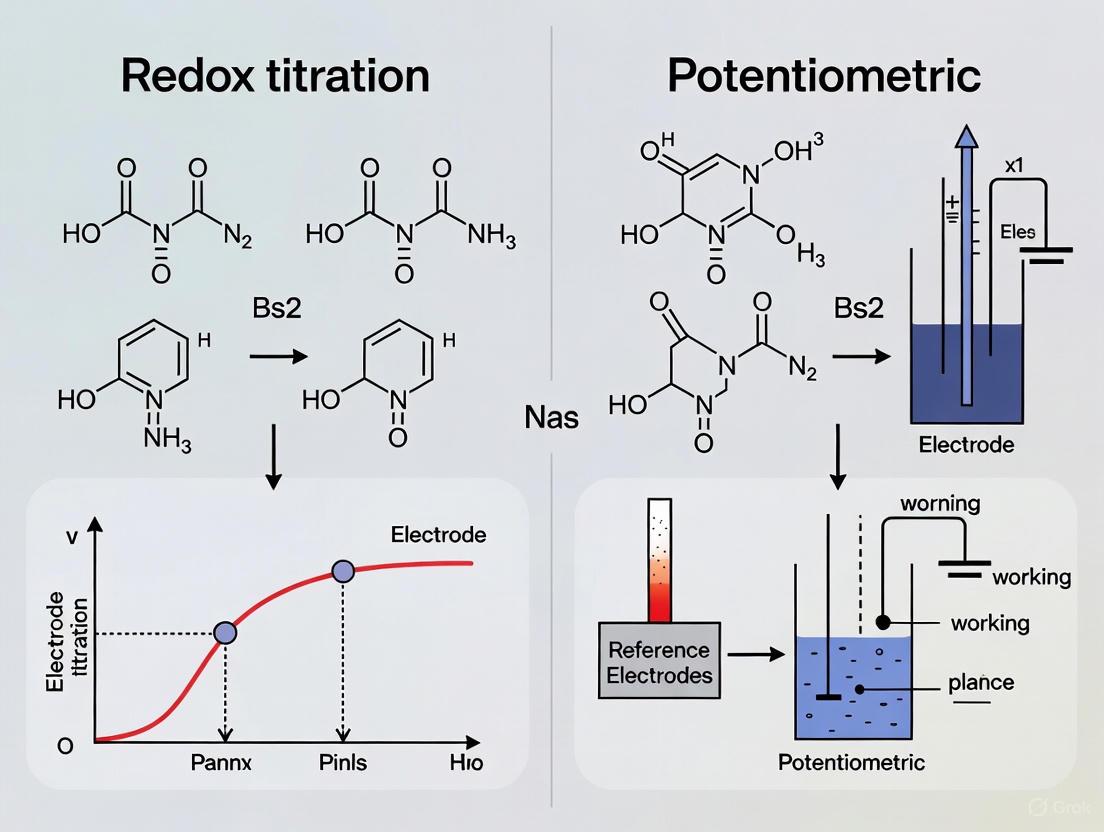
This article provides a detailed comparative analysis of redox titration and potentiometric methods, tailored for researchers and professionals in drug development.
Redox Titration vs. Potentiometric Methods: A Comprehensive Guide for Pharmaceutical Analysis
Abstract
This article provides a detailed comparative analysis of redox titration and potentiometric methods, tailored for researchers and professionals in drug development. It explores the fundamental principles of electrochemical reactions and the Nernst equation, delves into specific methodological applications for Active Pharmaceutical Ingredients (APIs) and excipients as per pharmacopeia standards, addresses common troubleshooting scenarios in complex matrices, and offers a direct validation framework for selecting the optimal analytical technique. The scope is designed to equip scientists with the knowledge to enhance accuracy, efficiency, and compliance in pharmaceutical analysis.
Core Principles: Understanding Electrochemical Foundations and Titration Curves
Redox titration is a volumetric analytical technique based on oxidation-reduction (redox) reactions between the analyte and a standard titrant. These reactions involve the transfer of electrons from a reducing agent to an oxidizing agent, enabling the quantitative determination of various analytes. Potentiometric titration represents a refined approach to redox titration that utilizes potential measurements to identify the endpoint objectively, eliminating the subjectivity of visual indicators. Within pharmaceutical research and development, these methods provide critical tools for drug substance quantification, excipient analysis, and quality control testing of active pharmaceutical ingredients (APIs). The evolution from visual to potentiometric endpoint detection has significantly enhanced the accuracy, precision, and applicability of titration methods in analytical laboratories, with modern pharmacopeias now officially accepting automated titration procedures [1] [2].
Fundamental Principles: Electron Transfer and Measurement
Core Concepts in Redox Chemistry
Oxidation-reduction reactions involve complementary processes where one species loses electrons while another gains them. Oxidation is defined as the loss of electrons, resulting in an increase in oxidation state, while reduction involves the gain of electrons, decreasing the oxidation state. The species that causes oxidation by accepting electrons is termed the oxidizing agent (oxidant), and the species that causes reduction by donating electrons is the reducing agent (reductant). These electron transfer processes form the fundamental basis for all redox titrations [1].
The tendency of a species to gain or lose electrons is quantified by its electrode potential, with the overall driving force for a redox reaction being the difference in potential between the participating half-reactions. The Nernst equation mathematically describes the relationship between electrode potential and concentration of electroactive species:
E = E⁰ - (RT/nF) ln(Q)
where E represents the electrode potential under non-standard conditions, E⁰ is the standard electrode potential, R is the ideal gas constant, T is absolute temperature, n is the number of electrons transferred, F is the Faraday constant, and Q is the reaction quotient. At 25°C, this simplifies to:
E = E⁰ - (0.05916/n) log([products]/[reactants]) [1]
This equation is fundamental to potentiometric measurements, as it enables the determination of analyte concentrations from measured potential values.
Comparative Analysis: Redox Titration vs. Potentiometric Methods
Methodological Distinctions and Applications
| Feature | Classical Redox Titration | Potentiometric Titration |
|---|---|---|
| Endpoint Detection | Visual indicators (color change) | Potential measurement via electrode system |
| Primary Instrumentation | Burette, visual assessment | Electrodes, potentiometer, automated buret |
| Key Components | Titrant, indicator, analyte | Indicator electrode, reference electrode, titrant, analyte |
| Quantification Basis | Volume at visual color change | Volume at potential inflection point |
| Sensitivity | Limited by visual detection | Can detect below 10⁻⁶ M concentrations [3] |
| Objective Precision | Subject to analyst interpretation | Highly objective and reproducible |
| Applicable Solutions | Clear, colorless ideal | Colored, turbid, and complex matrices |
| Automation Potential | Manual execution | Fully automatable systems |
| Data Acquisition | Single endpoint | Continuous potential-volume data points |
| Reference Electrode | Not applicable | Essential (e.g., Ag/AgCl, SCE) [1] |
| Indicator Electrode | Not applicable | Critical (e.g., Pt, Au, ion-selective) [1] |
Advantages and Limitations in Pharmaceutical Settings
Potentiometric titration offers significant advantages for pharmaceutical analysis, particularly in regulated environments. The transition from manual to automated titration improves accuracy, precision, and efficiency while reducing human influence on analytical results [2]. Modern automated titration systems consist of four key components: an automatic piston buret for precise titrant delivery, a sample homogenization system, an endpoint detection electrode that removes subjectivity, and automated result calculation and display [2].
The sensitivity of potentiometric methods has been demonstrated in research settings, with detection limits reaching approximately 2 meq/kg for hydroperoxide determination in degraded polypropylene—significantly superior to conventional UV and manual titration methods [4]. This enhanced sensitivity enables applications in challenging matrices and trace analysis scenarios common in pharmaceutical development.
Experimental Protocols and Methodologies
Fundamental Redox Titration Procedure
Principle: This protocol outlines the determination of an analyte using a standardized redox titrant with visual endpoint detection. The procedure is based on the quantitative electron transfer between the titrant and analyte.
Materials:
- Standardized redox titrant (e.g., KMnO₄, K₂Cr₂O₇, I₂, or Na₂S₂O₃)
- Appropriate visual indicator (e.g., starch, ferroin, diphenylamine sulfonate)
- Analytical balance, volumetric flasks, burette, and Erlenmeyer flasks
- Sample solution containing the analyte of interest
Procedure:
- Standardization: Pre-standardize the titrant against a primary standard if necessary (e.g., potassium dichromate for sodium thiosulfate).
- Sample Preparation: Accurately weigh and transfer the sample to a titration vessel, dissolving in appropriate solvent.
- Condition Setting: Adjust solution conditions (pH, ionic strength) as required for the specific redox reaction.
- Indicator Addition: Add the appropriate visual indicator to the sample solution.
- Titration: Slowly add the titrant from the burette with continuous swirling.
- Endpoint Determination: Record the titrant volume at the first permanent color change indicative of the equivalence point.
- Calculation: Determine the analyte concentration using reaction stoichiometry and titrant volume [1] [5].
Advanced Potentiometric Titration Protocol
Principle: This method employs potential measurements to objectively identify the titration endpoint, particularly suited for colored, turbid, or complex samples where visual indicators are ineffective.
Materials:
- Potentiometric titrator or manual setup with potentiometer
- Appropriate electrode pair (indicator and reference electrode, or combined electrode)
- Standardized titrant solution
- Magnetic stirrer and stir bars
Procedure:
- System Setup: Install and calibrate the appropriate electrode system based on the titration type.
- Electrode Selection: Choose indicator electrode based on the reaction:
- Pt electrode for redox titrations (e.g., antibiotic assays, peroxide value)
- Ag electrode for precipitation titrations (e.g., chloride, iodide determination)
- Ion-selective electrode for complexometric titrations (e.g., calcium with EDTA) [2]
- Solution Preparation: Transfer the analyte solution to the titration vessel and immerse the electrodes.
- Data Collection: Begin titration with continuous recording of potential (E) versus titrant volume (V).
- Endpoint Determination: Identify the equivalence point using:
- First Derivative Plot (ΔE/ΔV vs. Vavg): Peak maximum indicates equivalence point
- Second Derivative Plot (Δ²E/ΔV² vs. Vavg): Zero crossing indicates equivalence point
- Result Calculation: Automatically compute analyte concentration from equivalence point volume [1].
Figure 1: Potentiometric Titration Workflow. This diagram illustrates the systematic procedure for performing potentiometric titrations, from electrode setup through final calculation.
Essential Research Reagent Solutions
Critical Reagents and Materials for Redox and Potentiometric Methods
| Reagent/Equipment | Function/Purpose | Application Examples |
|---|---|---|
| Potassium Permanganate (KMnO₄) | Strong oxidizing titrant, self-indicating | Redox titrations in acidic medium |
| Potassium Dichromate (K₂Cr₂O₇) | Primary standard oxidizing agent | Standardization of reducing titrants |
| Sodium Thiosulfate (Na₂S₂O₃) | Reducing titrant for iodine | Iodometric analyses, peroxide value |
| Iodine (I₂) | Moderate oxidizing titrant | Direct iodimetry, API assays |
| Platinum Electrode | Redox indicator electrode | Potentiometric redox titrations |
| Reference Electrodes | Stable potential reference (Ag/AgCl, SCE) | All potentiometric measurements |
| Ferroin Indicator | Redox indicator (color change at ~1.14 V) | Visual redox endpoint detection |
| Starch Solution | Specific indicator for iodine | Visual detection in iodometry |
| Ion-Selective Electrodes | Selective ion detection | Specific cation/anion determination |
Data Interpretation and Analytical Validation
Titration Curve Analysis and Equivalence Point Determination
Redox titration curves plot the electrochemical potential (y-axis) against the volume of titrant added (x-axis), typically producing a sigmoidal curve with a steep potential jump at the equivalence point. The region before the equivalence point is dominated by the redox couple of the analyte, while the region after the equivalence point is controlled by the redox couple of the titrant. At the equivalence point, neither the analyte nor titrant is in significant excess, and the potential can be calculated based on the standard potentials of both half-reactions [1].
For potentiometric titrations, the equivalence point is mathematically determined from the inflection point of the sigmoidal curve. The first derivative plot (ΔE/ΔV vs. Vavg) peaks at the equivalence point, while the second derivative plot (Δ²E/ΔV² vs. Vavg) crosses zero at this critical point. These mathematical approaches provide objective and precise equivalence point detection, eliminating the subjective judgment associated with visual color changes [1].
Method Validation in Pharmaceutical Context
For pharmaceutical applications, validation of titration methods follows regulatory guidelines such as USP General Chapter <1225>. Key validation parameters include accuracy, precision, specificity, linearity, range, detection limit, quantitation limit, and robustness. Automated titration systems significantly enhance method validation capabilities through improved data integrity, traceability, and reduced analyst variability [2]. Compliance with electronic records requirements (e.g., 21 CFR Part 11) is essential for pharmaceutical implementation, with modern titration software providing the necessary security, audit trails, and data protection features.
The selection between classical redox titration and modern potentiometric approaches depends on multiple factors including required precision, sample matrix, available instrumentation, and regulatory considerations. While visual redox titration remains valuable for routine analyses with clear endpoints, potentiometric methods offer superior objectivity, sensitivity, and applicability to challenging matrices. The demonstrated ability of potentiometric titration to achieve detection limits below 10⁻⁶ M, coupled with its compatibility with automated systems, positions it as the preferred technique for pharmaceutical research and quality control [3] [2].
The continued evolution of titration methodology, including the development of digital electrodes with integrated data storage and advanced detection systems, further enhances the capabilities of electrochemical analysis for drug development professionals. By understanding the fundamental principles, comparative advantages, and practical implementation details of both approaches, researchers can make informed decisions to optimize analytical workflows in pharmaceutical settings.
Potentiometry is an electroanalytical technique in which the potential (electromotive force) of an electrochemical cell is measured under static conditions where little to no current flows through the sample [6] [7]. This fundamental principle distinguishes potentiometry from other electrochemical methods and forms the basis for its application across various scientific domains, including clinical diagnostics, pharmaceutical analysis, and environmental monitoring [8] [9] [10]. In a typical potentiometric measurement, an indicator electrode responds to changes in the activity (effective concentration) of the analyte, while a reference electrode provides a stable, known potential against which changes can be measured [6] [9]. The measured potential is proportional to the logarithm of the analyte's activity, as described by the Nernst equation, allowing for quantitative determinations [1] [9].
The instrumentation required for potentiometry is notably straightforward, consisting primarily of an indicator electrode, a reference electrode, and a potential measuring device [6]. This simplicity contributes to the technique's relatively low cost compared to other analytical methods such as atomic spectroscopy or ion chromatography [6]. Additionally, because potentiometric measurements cause minimal perturbation to the sample and are not affected by color or turbidity, they are particularly valuable for analyzing complex matrices like blood, urine, and environmental samples [6] [8].
Fundamental Principles: The Nernst Equation and Zero-Current Condition
The theoretical foundation of potentiometry rests upon the Nernst equation, which relates the potential of an electrochemical cell to the activities of the electroactive species involved [1] [9]. For a general half-reaction written as a reduction: [ aA + bB + ne^- \rightleftharpoons cC + dD ] The Nernst equation is expressed as: [ E = E^0 - \frac{RT}{nF} \ln \frac{[C]^c[D]^d}{[A]^a[B]^b} ] where E is the electrode potential under non-standard conditions, E⁰ is the standard electrode potential, R is the ideal gas constant (8.314 J·K⁻¹·mol⁻¹), T is the absolute temperature in Kelvin, n is the number of electrons transferred in the half-reaction, F is the Faraday constant (96,485 C·mol⁻¹), and the terms in square brackets represent the activities of the species involved [1]. At 25°C (298.15 K), the equation can be simplified using base-10 logarithms: [ E = E^0 - \frac{0.05916}{n} \log \frac{[products]}{[reactants]} ] for reduction reactions [1].
The "zero-current condition" is a critical aspect of potentiometric measurements that ensures the composition of the electrochemical cell remains unchanged during analysis [7]. Unlike voltammetric or amperometric techniques where current flows as a result of an applied potential, potentiometry measures the potential that naturally develops at the electrode-solution interface when no significant current passes between the electrodes [10]. This equilibrium measurement provides significant advantages, including minimal sample perturbation, reduced susceptibility to interferent effects, and avoidance of ohmic drop problems associated with current flow [10].
Instrumentation and Electrode Systems
Reference Electrodes
The reference electrode maintains a constant, known potential against which the indicator electrode's potential is measured [1] [9]. To serve this function effectively, reference electrodes must exhibit stable potential over time, reproducibility, and minimal temperature dependence [1].
Table 1: Common Reference Electrodes in Potentiometry
| Electrode Type | Half-Reaction | Potential vs. SHE (25°C) | Applications and Notes |
|---|---|---|---|
| Standard Hydrogen Electrode (SHE) | 2H⁺(aq) + 2e⁻ ⇌ H₂(g) | 0.000 V (by definition) | Primary standard; impractical for routine use due to need for H₂ gas [1] |
| Saturated Calomel Electrode (SCE) | Hg₂Cl₂(s) + 2e⁻ ⇌ 2Hg(l) + 2Cl⁻(aq) | +0.241 V | Widely used; contains mercury (toxic); potential depends on Cl⁻ concentration [1] |
| Silver/Silver Chloride (Ag/AgCl) | AgCl(s) + e⁻ ⇌ Ag°(s) + Cl⁻ | +0.197 V (for saturated KCl) | Common in clinical applications; often used as internal reference in ISEs [9] |
Indicator Electrodes
Indicator electrodes respond to changes in the activity of the target analyte [6]. Their potential varies with the concentration of the species of interest, following the Nernst equation [9].
Table 2: Types of Potentiometric Indicator Electrodes
| Electrode Type | Principle | Key Applications | Selectivity Considerations |
|---|---|---|---|
| Ion-Selective Electrodes (ISEs) | Membrane-based potential development | pH, Na⁺, K⁺, Ca²⁺, Li⁺, Cl⁻ [6] [9] | High selectivity achieved through membrane composition [6] |
| Redox Electrodes | Electron transfer reactions | Redox titrations [1] | Response depends on standard potential of redox couple [9] |
| Glass Membrane Electrodes | Ion exchange at glass surface | pH, Na⁺ [9] | Special glass formulations provide selectivity [9] |
| Polymer Membrane Electrodes | Ionophores in PVC matrix | K⁺, Ca²⁺, Mg²⁺, pharmaceuticals [9] [10] | Selectivity determined by ionophore structure [9] |
Ion-Selective Electrodes (ISEs)
Ion-selective electrodes represent the most important class of indicator electrodes in modern potentiometry due to their high selectivity for specific ions [6]. The potential developed across an ISE membrane (EMEM) can be expressed as: [ E{MEM} = E^0 + \frac{0.0592}{n} \log a_1 ] where a₁ is the activity of the ion of interest in the external sample solution [9]. The constant E⁰ incorporates the potential of the internal reference electrode, the liquid junction potential, and the fixed activity of the ion in the internal solution [9].
ISEs are classified based on their membrane composition and mechanism of operation. Glass membrane electrodes, primarily used for pH and sodium ion measurements, employ specially formulated glass compositions that determine their selectivity [9]. Polymer membrane electrodes incorporate ionophores (ion-recognition molecules) in a plasticized PVC matrix that selectively complex with target ions [9]. Solid-contact ISEs represent an advancement that eliminates the internal solution, improving mechanical stability and facilitating miniaturization [10].
Diagram 1: Working principle of a potentiometric ion-selective electrode (ISE) showing the complete electrochemical cell with zero-current measurement.
Potentiometric Methods Versus Redox Titration: A Comparative Analysis
Fundamental Differences in Approach
While both potentiometric methods and redox titrations utilize electrochemical principles, they represent fundamentally different approaches to chemical analysis. Redox titrations are volumetric methods based on oxidation-reduction reactions between the analyte and a standard titrant, where the endpoint is determined by a sharp change in potential measured potentiometrically or through color-changing indicators [1] [11]. In contrast, direct potentiometry measures the equilibrium potential of an electrochemical cell to determine analyte activity without reagent consumption or chemical transformation of the analyte [6] [7].
Comparison of Performance Characteristics
Table 3: Comprehensive Comparison of Redox Titration and Potentiometric Methods
| Parameter | Redox Titration | Direct Potentiometry |
|---|---|---|
| Principle | Monitoring potential change during titrant addition [1] | Direct potential measurement at zero current [6] [7] |
| Measurement Type | Dynamic process monitoring | Equilibrium measurement |
| Endpoint Detection | Inflection point in sigmoidal curve [1] | Direct reading from calibration curve |
| Precision | High (0.1-1%) [11] | Moderate to high (1-3%) |
| Accuracy | Dependent on titrant standardization and indicator selection [11] | Dependent on calibration and electrode stability |
| Sensitivity | Millimolar range | Micromolar to nanomolar for some ISEs [10] |
| Selectivity | Dependent on redox potential differences | Determined by membrane selectivity [9] |
| Sample Consumption | Moderate to high (mL range) | Low (μL to mL) |
| Analysis Time | Minutes to tens of minutes | Seconds to minutes [10] |
| Automation Potential | High with automated burettes [11] | High, suitable for continuous monitoring [10] |
| Cost Considerations | Moderate (burettes, titrants) | Low to moderate (electrode costs) [6] |
Endpoint Detection in Titrimetry
In potentiometric redox titrations, the endpoint is determined by identifying the point of maximum slope on the potential versus titrant volume curve [1]. This can be accomplished through mathematical treatment of the data:
- First Derivative Plot: The change in potential with respect to the change in titrant volume (ΔE/ΔV) is plotted against the average titrant volume. The peak maximum corresponds to the equivalence point [1].
- Second Derivative Plot: The second derivative (Δ²E/ΔV²) is plotted against volume. The point where this plot crosses zero (changing from positive to negative) indicates the equivalence point [1].
This mathematical approach to endpoint detection provides significant advantages over visual indicators, including objectivity, applicability to colored or turbid solutions, and suitability for automation [1] [11].
Diagram 2: Workflow of a potentiometric redox titration showing the sequence from electrode setup to equivalence point determination.
Experimental Protocols and Methodologies
Protocol for Direct Potentiometric Measurement
Objective: Determination of ion concentration (e.g., K⁺) in aqueous solution using an ion-selective electrode.
Materials and Equipment:
- Ion-selective electrode (K⁺-ISE)
- Reference electrode (e.g., Ag/AgCl)
- Potentiometer or pH/mV meter
- Magnetic stirrer and stir bars
- Standard solutions for calibration (e.g., 10⁻¹ M, 10⁻² M, 10⁻³ M, 10⁻⁴ M KCl)
- Sample solutions of unknown concentration
- Temperature control bath (optional, for high-precision work)
Procedure:
- Electrode Preparation: Condition the ISE in a solution of intermediate concentration (e.g., 10⁻² M KCl) for 30 minutes prior to first use. For subsequent uses, rinse thoroughly with deionized water and blot dry with laboratory tissue.
- Calibration Curve:
- Immerse the ISE and reference electrode in the lowest concentration standard.
- Measure the potential after stabilization (typically 1-3 minutes).
- Repeat with increasing standard concentrations, measuring potential for each.
- Plot potential (mV) versus log₁₀[K⁺] to obtain calibration curve.
- Sample Measurement:
- Rinse electrodes with deionized water between measurements.
- Immerse electrodes in sample solution.
- Measure potential after stabilization.
- Determine concentration from calibration curve.
- Validation: Check electrode response with a standard solution after sample measurements to verify no drift has occurred.
Data Analysis: The potential should follow the Nernstian relationship: [ E = E^0 + \frac{0.05916}{1} \log [K^+] ] A slope of 59.16 mV per decade concentration change indicates ideal Nernstian behavior for a monovalent ion at 25°C [9].
Protocol for Potentiometric Redox Titration
Objective: Determination of iron(II) concentration by titration with cerium(IV).
Materials and Equipment:
- Platinum indicator electrode
- Reference electrode (e.g., SCE or Ag/AgCl)
- Burette or automated titrator
- Magnetic stirrer and stir bar
- Cerium(IV) sulfate titrant (standardized, ~0.1 M)
- Sample solution containing unknown Fe²⁺ concentration
- Sulfuric acid (1 M) for pH adjustment
Procedure:
- Solution Preparation:
- Transfer 25.00 mL of unknown Fe²⁺ solution to titration vessel.
- Add 25 mL 1 M H₂SO₄ to provide appropriate acidic medium.
- Add deionized water to bring total volume to approximately 100 mL.
- Electrode Setup:
- Immerse platinum indicator electrode and reference electrode in solution.
- Connect electrodes to potentiometer.
- Titration:
- Begin stirring at constant rate.
- Record initial potential.
- Add titrant in small increments (0.5-1.0 mL), recording potential after each addition.
- Near the equivalence point (indicated by larger potential changes), decrease increment size to 0.1-0.2 mL.
- Continue titration until well past equivalence point (approximately 1.5 times the expected equivalence volume).
- Endpoint Determination:
- Plot potential (E) versus volume (V) of titrant added.
- Calculate first derivative (ΔE/ΔV) and second derivative (Δ²E/ΔV²).
- Identify equivalence point from the maximum in the first derivative plot or zero-crossing in the second derivative plot.
Data Analysis: The equivalence point volume is used to calculate the Fe²⁺ concentration: [ C{Fe^{2+}} = \frac{C{Ce^{4+}} \times V{eq}}{V{sample}} ] where C is concentration and V is volume [1].
The Scientist's Toolkit: Essential Research Reagents and Materials
Table 4: Key Research Reagents and Materials for Potentiometric Analysis
| Item | Function/Application | Specific Examples | Technical Considerations |
|---|---|---|---|
| Ion-Selective Electrodes | Direct potentiometric measurement | pH glass electrode, valinomycin-based K⁺-ISE, Ca²⁺-ISE with ETH 1001 ionophore | Selectivity coefficients should be checked regularly; requires proper conditioning [6] [9] |
| Reference Electrodes | Stable potential reference | Ag/AgCl with KCl electrolyte, double-junction reference electrodes | Electrolyte concentration affects potential; requires periodic refilling [1] [9] |
| Redox Indicators | Visual endpoint detection in redox titrations | Ferroin (E° = 1.14 V), Diphenylamine sulfonate | Must have standard potential between analyte and titrant potentials [1] |
| Titrants for Redox Titrations | Oxidizing/reducing agents for titrimetry | KMnO₄, K₂Cr₂O₇, Ce(SO₄)₂, Na₂S₂O₃ | Require standardization; stability varies (KMnO₄ not primary standard) [1] |
| Ionic Strength Adjusters | Constant background ionic strength | Ionic strength adjustment buffers (ISA) | Critical for direct potentiometry to fix activity coefficients [9] |
| Supporting Electrolytes | Provide conductivity in non-aqueous media | Tetraalkylammonium salts, lithium perchlorate | Electrochemically inert over potential window of interest |
| Solid-Contact Materials | Ion-to-electron transduction in solid-contact ISEs | Conducting polymers (PEDOT), carbon nanomaterials, nanocomposites | High capacitance materials reduce potential drift [10] |
Advanced Applications and Emerging Trends
Clinical and Pharmaceutical Applications
Potentiometric methods have found extensive application in clinical chemistry and pharmaceutical analysis due to their ability to measure ions and drug molecules directly in complex biological matrices [8] [9]. In clinical laboratories, ISEs are routinely used for measuring electrolytes (Na⁺, K⁺, Cl⁻, Ca²⁺, Li⁺) in blood serum and urine [9]. Abnormalities in electrolyte balance are frequent in hospitalized patients and associated with higher mortality and morbidity, making reliable monitoring crucially important [10]. For pharmaceutical analysis, potentiometric sensors have been developed for therapeutic drug monitoring (TDM), particularly for drugs with narrow therapeutic indices or high inter-individual pharmacokinetic variability [10]. These sensors enable direct measurement of drug concentrations in biofluids without extensive sample preparation, offering advantages for point-of-care testing [8].
Environmental Monitoring
Environmental monitoring represents another significant application area for potentiometric sensors, particularly for determining heavy metals (copper, iron, lead, mercury) in soil and water samples [10]. Additionally, potentiometric sensors have been developed for monitoring nitrate, ammonium, and chloride ions, which impact human health and agricultural practices through effects on eutrophication, soil salinity, and water quality [10]. The ability of ISEs to provide continuous monitoring with minimal sample perturbation makes them valuable tools for environmental assessment.
Emerging Technologies and Future Directions
Recent advancements in potentiometric sensors include the development of 3D-printed electrodes, paper-based analytical devices, and wearable sensors for continuous monitoring [10]. Three-dimensional printing offers improved flexibility and precision in manufacturing ISEs, while rapid prototyping decreases optimization time [10]. Paper-based sensors provide cost-effective platforms for point-of-care analysis, permitting rapid determination of various analytes in field settings [10]. Wearable potentiometric sensors represent one of the most promising developments, allowing continuous monitoring of biomarkers, electrolytes, and pharmaceuticals in biological fluids [10]. These devices typically incorporate solid-contact ISEs with high-capacitance transduction layers to ensure signal stability during movement and extended use [10].
Nanocomposite materials have shown particular promise as transducers in solid-contact ISEs, with synergistic effects enhancing sensing performance [10]. For instance, MoS₂ nanoflowers filled with Fe₃O₄ nanoparticles have been used to stabilize structure and increase capacitance, while tubular gold nanoparticles with tetrathiafulvalene (Au-TTF) have demonstrated high capacitance and stability for potassium ion determination [10]. These material advances address key challenges in potentiometric sensing, including signal drift, response time, and detection limits.
Potentiometry, characterized by its fundamental principle of measuring potential under zero-current conditions, offers distinct advantages for chemical analysis across diverse applications. When compared to redox titration methods, direct potentiometry provides more rapid analysis, minimal sample perturbation, and capability for continuous monitoring, while potentiometric redox titrations offer high precision and well-defined endpoints for quantitative analysis. The ongoing development of novel materials, miniaturized designs, and wearable formats promises to expand further the applications and capabilities of potentiometric methods in research, clinical, and field settings.
The Role of the Nernst Equation in Relating Potential to Concentration
In the realm of quantitative chemical analysis, redox titration and potentiometric methods represent two principal approaches for determining analyte concentrations, each with distinct operational principles and performance characteristics. The Nernst equation serves as the fundamental theoretical bridge connecting measured electrical potential to chemical concentration in both methodologies. This electrochemical relationship, formulated by Walther Nernst in 1889, provides the mathematical foundation for understanding how the potential of an electrochemical cell relates to the activities (and thus concentrations) of electroactive species undergoing reduction and oxidation [7] [12]. While both techniques leverage this same fundamental principle, their implementation, precision, and applicability differ significantly across various research contexts, particularly in pharmaceutical development where accurate quantification of active compounds is paramount.
The Nernst equation expresses the dependence of the electrode potential (E) on the standard electrode potential (E°), temperature, and the activities of the oxidized and reduced species involved in the electrochemical reaction. For a general half-reaction: Ox + ze⁻ ⇌ Red, the Nernst equation is expressed as:
[E = E^0 - \frac{RT}{zF} \ln \frac{a{\text{Red}}}{a{\text{Ox}}}]
Where E is the electrode potential, E° is the standard electrode potential, R is the universal gas constant, T is the absolute temperature, z is the number of electrons transferred in the half-reaction, F is Faraday's constant, and aRed and aOx represent the activities of the reduced and oxidized species, respectively [12]. At room temperature (25°C), this equation simplifies to:
[E = E^0 - \frac{0.05916}{z} \log \frac{[\text{Red}]}{[\text{Ox}]}]
When concentrations are used as approximations for activities [1] [13]. This simplified form reveals that for each tenfold change in the concentration ratio, the electrode potential changes by approximately 59/z mV, establishing a direct quantitative relationship between measurable potential and analyte concentration that forms the basis for both analytical techniques compared in this guide.
Theoretical Foundation: The Nernst Equation
Fundamental Principles and Mathematical Expression
The Nernst equation operates as the cornerstone of electrochemical analysis by providing a quantitative relationship between the measurable potential of an electrochemical cell and the concentrations of electroactive species present in solution. This equation derives from thermodynamic principles, specifically relating the actual free-energy change (ΔG) for a reaction under non-standard conditions to the standard free-energy change (ΔG°) [14]:
[ΔG = ΔG° + RT \ln Q]
where Q is the reaction quotient. Substituting the relationships ΔG = -nFEcell and ΔG° = -nFE°cell yields the Nernst equation for a complete electrochemical cell:
[E{\text{cell}} = E^\circ{\text{cell}} - \frac{RT}{nF} \ln Q]
where Ecell is the actual cell potential, E°cell is the standard cell potential, n is the number of electrons transferred in the overall redox reaction, F is Faraday's constant (96,485 C/mol), and Q is the reaction quotient representing the ratio of product and reactant activities [14]. For the half-cell reaction Ox + ne⁻ → Red, this translates to the familiar form:
[E = E^\circ - \frac{RT}{nF} \ln \frac{a{\text{Red}}}{a{\text{Ox}}}]
The equation accurately predicts that the potential becomes identical to the standard electrode potential when the activities of the oxidized and reduced species are equal (Q = 1), as the logarithmic term becomes zero [12] [13].
Formal Potential and Practical Considerations
In practical analytical applications, the use of concentrations rather than activities necessitates introduction of the formal potential (E°'), a modified standard potential that incorporates activity coefficients and other chemical effects [12]. The practical form of the Nernst equation thus becomes:
[E = E^{\circ'} - \frac{0.05916}{n} \log \frac{[\text{Red}]}{[\text{Ox}]} \quad \text{(at 25°C)}]
The formal potential represents the experimentally observed potential when the concentration ratio [Red]/[Ox] equals 1 and all other solution conditions (ionic strength, pH, complexing agents) are specified [12]. This modification is particularly important in pharmaceutical applications where complex matrices can significantly affect electrochemical behavior. The Nernst equation enables prediction of cell potentials under non-standard conditions, determines spontaneous reaction direction, and calculates equilibrium constants [14]. For redox titrations, it predicts the potential change throughout the titration curve, while for direct potentiometry, it provides the direct mathematical relationship between measured potential and analyte concentration.
Visualizing the Electrochemical Relationship
The following diagram illustrates how the Nernst equation provides the fundamental theoretical connection between concentration measurements and potential measurements in electrochemical analysis:
Methodological Comparison: Experimental Protocols
Redox Titration Methodology
Protocol Title: Determination of Ascorbic Acid by Redox Titration with Dichlorophenolindophenol
Principle: This method quantifies reducing analytes through titration with a standardized oxidizing agent, using the distinct potential change at the equivalence point, as predicted by the Nernst equation, for endpoint detection [1] [15].
Materials:
- Analytical balance
- Burette (25 mL)
- Erlenmeyer flasks (250 mL)
- Measuring cylinders
- Pipettes
Reagents:
- Standardized dichlorophenolindophenol (DCPIP) solution (0.01 M)
- Ascorbic acid standard solution
- Sample solution (e.g., fruit juice or pharmaceutical preparation)
- Sulfuric acid (0.1 M) for pH adjustment
Procedure:
- Standardize the DCPIP titrant against a primary ascorbic acid standard (1.0 mM) in triplicate.
- Transfer 25.0 mL of sample solution to a clean Erlenmeyer flask.
- Acidify with 10 mL of 0.1 M sulfuric acid to maintain proper redox conditions.
- Fill the burette with standardized DCPIP solution and record initial volume.
- Titrate with continuous swirling, observing the color change from colorless to pink.
- Record the burette reading at the endpoint and calculate titrant volume.
- Repeat in triplicate for statistical reliability.
Calculations: [C{\text{sample}} = \frac{V{\text{titrant}} \times C{\text{titrant}}}{V{\text{sample}}}]
Where C represents concentration and V represents volume. The Nernst equation governs the abrupt potential change at the endpoint, though visual detection relies on indicator color change [1] [11].
Potentiometric Methodology
Protocol Title: Direct Potentiometric Determination of Iron(II) Concentration
Principle: This method directly relates the measured potential of an indicator electrode to analyte concentration via the Nernst equation, without titrant addition [7] [16].
Materials:
- Potentiometer or pH/mV meter
- Platinum indicator electrode
- Reference electrode (Ag/AgCl or calomel)
- Magnetic stirrer with stir bar
- Volumetric flasks and pipettes
Reagents:
- Standard solutions of Fe²⁺ (0.001 M, 0.01 M, 0.1 M)
- Sample solution containing unknown Fe²⁺ concentration
- Supporting electrolyte (e.g., 0.1 M HCl)
Procedure:
- Prepare standard solutions covering the expected concentration range (0.001-0.1 M).
- Place the electrode system in the lowest concentration standard with continuous stirring.
- Allow potential reading to stabilize (approximately 1-2 minutes) and record value.
- Rinse electrodes thoroughly with deionized water between measurements.
- Repeat potential measurements for all standard solutions in order of increasing concentration.
- Measure the sample solution following the same procedure.
- Construct a calibration curve of potential vs. log[Fe²⁺].
Calculations: For direct Nernstian application: [E = E^{\circ'} - \frac{0.05916}{1} \log \frac{[\text{Fe}^{2+}]}{[\text{Fe}^{3+}]}]
In the absence of Fe³⁺, the potential is directly proportional to log[Fe²⁺], enabling concentration determination from the calibration curve [7] [13].
Experimental Workflow Comparison
The following diagram illustrates the key procedural differences between redox titration and direct potentiometric methods:
Performance Comparison and Experimental Data
Quantitative Method Comparison
The table below summarizes the key performance characteristics of redox titration versus potentiometric methods based on experimental data and theoretical considerations:
Table 1: Comprehensive Comparison of Redox Titration and Potentiometric Methods
| Parameter | Redox Titration | Direct Potentiometry |
|---|---|---|
| Theoretical Basis | Nernst equation predicts equivalence point potential [1] | Nernst equation directly relates E to concentration [7] |
| Accuracy | High (0.5-2% error) with proper indicator selection [11] | Moderate to high (1-5% error) depending on matrix effects [15] |
| Precision | Excellent (RSD < 1%) with experienced analyst [11] | Good (RSD 2-5%) with proper calibration [16] |
| Sensitivity | Moderate (≥10⁻⁴ M typical) [1] | High (down to 10⁻⁶ M possible) [7] |
| Analysis Time | 5-15 minutes per sample [11] | 1-5 minutes per sample after calibration [16] |
| Cost | Low (basic glassware required) [11] | High (electrode and meter investment) [11] |
| Sample Volume | Moderate to large (10-50 mL typical) [1] | Small (1-10 mL possible) [7] |
| Matrix Effects | Moderate susceptibility [15] | High susceptibility requiring ISAB [7] |
| Operator Skill | Higher requirement for endpoint detection [11] | Lower requirement with automation [11] |
| Applications | Well-defined redox systems [1] | Broad including reversible systems [7] |
Experimental Data Comparison
The following table presents representative experimental data obtained from pharmaceutical analysis applications for both techniques:
Table 2: Experimental Data from Pharmaceutical Analysis Applications
| Analyte | Method | Titrant/Electrode | Linear Range | Recovery (%) | RSD (%) |
|---|---|---|---|---|---|
| Ascorbic Acid | Redox Titration | DCPIP [15] | 0.1-10 mM | 98-102 | 0.8-1.5 |
| Ascorbic Acid | Potentiometric | Pt electrode [15] | 0.01-1 mM | 95-105 | 2.1-3.5 |
| Iron(II) | Redox Titration | Cerium(IV) [1] | 0.5-50 mM | 99-101 | 0.5-1.2 |
| Iron(II) | Potentiometric | Pt electrode [7] | 0.001-10 mM | 97-103 | 1.8-2.9 |
| Polyphenols | Redox Titration | Ti(III) [15] | 0.05-5 mM | 90-110 | 3.5-5.0 |
| Polyphenols | Potentiometric | Pt electrode [15] | 0.01-2 mM | 85-115 | 5.0-8.0 |
The Scientist's Toolkit: Essential Research Reagents and Materials
Table 3: Essential Research Reagents and Materials for Electrochemical Analysis
| Reagent/Material | Function | Application Examples |
|---|---|---|
| Platinum Electrode | Inert indicator electrode for redox potential measurements [1] | Potentiometric detection of Fe³⁺/Fe²⁺ ratio [15] |
| Ag/AgCl Reference Electrode | Stable reference potential with constant chloride concentration [1] | Provides reference potential in potentiometric cells [16] |
| Calomel Electrode | Alternative reference electrode (Hg/Hg₂Cl₂) [1] | Reference electrode in non-biological applications [16] |
| Potassium Permanganate | Strong oxidizing titrant with self-indicating properties [1] | Determination of iron(II) and other reductants [11] |
| Cerium(IV) Sulfate | Powerful oxidizing agent, primary standard [1] | Quantitative oxidation of organic pharmaceuticals [11] |
| Sodium Thiosulfate | Reducing titrant for iodine-based titrations [1] | Iodometric determination of oxidizing agents [11] |
| Dichlorophenolindophenol | Oxidizing titrant and redox indicator [15] | Specific determination of ascorbic acid [15] |
| Titanium(III) Chloride | Strong reducing titrant [15] | Determination of oxidized compounds in complex matrices [15] |
| Ferroin Indicator | Redox indicator (E° = 1.06 V) [1] | Visual endpoint detection in cerimetric titrations [11] |
| Ionic Strength Adjuster | Minimizes activity coefficient variations [7] | Standardization of medium in direct potentiometry [7] |
Critical Evaluation in Research Applications
Limitations and Practical Considerations
While both techniques derive their theoretical foundation from the Nernst equation, significant practical limitations emerge in research applications, particularly with complex sample matrices. Potentiometric methods face challenges when dealing with irreversible redox systems or samples containing multiple interfering species that can adsorb onto electrode surfaces, fundamentally violating the Nernstian assumptions [15]. Research on wine analysis highlights that adsorption of tannins and polyphenols on platinum electrodes creates mixed potentials, making Nernst equation application problematic and resulting in poor reproducibility [15].
Redox titrations encounter limitations with slow reaction kinetics, particularly when analyzing complex organic antioxidants. The titration of polyphenols with DCPIP demonstrates significant time dependence, where the slow reaction kinetics make identification of the true equivalence point challenging, regardless of the detection method [15]. This limitation is particularly relevant in pharmaceutical analysis where many active compounds exhibit slow electron transfer kinetics.
Method Selection Guidelines
Selection between these analytical approaches depends on multiple factors:
- For well-defined, fast redox systems with adequate analyte concentration, redox titration provides excellent accuracy and precision with minimal equipment investment [11].
- For dilute solutions or rapid analysis, direct potentiometry offers advantages despite higher initial costs [11].
- For complex matrices with multiple redox components, neither method may provide accurate quantitative results without preliminary separation, though redox titration often shows better robustness [15].
- When developing methods for new pharmaceutical compounds, preliminary assessment of reaction reversibility (via cyclic voltammetry) is recommended before selecting an electrochemical quantification approach [15].
The Nernst equation provides the fundamental theoretical connection between electrical potential and chemical concentration that underpins both redox titration and potentiometric methods. While sharing this common theoretical foundation, these techniques represent distinct approaches with complementary strengths and limitations in pharmaceutical research and drug development. Redox titration excels in accuracy, precision, and cost-effectiveness for standardized analyses of well-behaved redox systems, while direct potentiometry offers superior sensitivity, rapid analysis, and automation potential despite higher equipment costs and greater matrix susceptibility. The choice between methodologies must consider the specific analytical requirements, sample matrix complexity, available resources, and required throughput. Advances in electrode design and digital instrumentation continue to expand the applications of both techniques in pharmaceutical analysis, maintaining the Nernst equation's central role in converting electrical measurements to chemical concentration data nearly a century after its formulation.
Titrimetric analysis serves as a cornerstone of quantitative chemical analysis in research and industrial laboratories. Within this framework, redox titrimetry and potentiometric methods represent two powerful, yet distinct, approaches for determining analyte concentrations. Redox titrations monitor the transfer of electrons between reacting species, while potentiometric titrations measure the potential difference across an electrochemical cell to identify the titration's endpoint. For researchers and drug development professionals, the choice between these methods can significantly impact the precision, accuracy, and applicability of analytical results. This guide provides a detailed comparison of these two titrimetric techniques, focusing on the characterization of redox titration curves, with supporting experimental data and protocols to inform method selection for specific analytical challenges.
Theoretical Foundations
Redox Titration Curves
Redox titrations leverage oxidation-reduction reactions where the titrand in a reduced state reacts with a titrant in an oxidized state (or vice versa). The progression of the reaction is monitored by tracking the potential of the reaction mixture, which is governed by the Nernst equation [17].
For a generalized redox reaction: [A{red} + B{ox} \rightleftharpoons B{red} + A{ox}] the reaction's potential, (E{rxn}), is the difference between the reduction potentials of the involved half-reactions [17]: [E{rxn} = E{B{ox}/B{red}} - E{A{ox}/A{red}}]
The resulting titration curve is a plot of the measured potential (in mV or V) versus the volume of added titrant. Its characteristic sigmoidal shape features a steep inflection point at the equivalence point, where the number of moles of titrant added stoichiometrically equals the number of moles of analyte in the sample [17]. To clarify the identity and abundance of species in solution, it is fundamental to know these formation constants, which are primarily determined through techniques like potentiometry [18].
Potentiometric Titration Methods
Potentiometric titration is a quantitative analytical technique that determines the concentration of an analyte by measuring the potential difference between two electrodes (indicator and reference) in the solution as titrant is added [19]. The endpoint is identified by a significant change in this potential difference. A titration curve is plotted, and the endpoint can be precisely determined from the maximum of the first derivative curve or the zero point of the second derivative curve [19].
This method is highly versatile and can be applied to acid-base, precipitation, complexometric, and redox reactions [19]. For redox titrations, inert metal electrodes like platinum are typically employed [19].
Comparative Analysis: Redox vs. Potentiometric Titrations
The table below summarizes the core characteristics of redox and potentiometric titration methods for the analysis of redox-active species.
Table 1: Core Characteristics of Redox and Potentiometric Titration Methods
| Feature | Redox Titration (with Visual Indicators) | Potentiometric Redox Titration |
|---|---|---|
| Fundamental Principle | Monitoring electron transfer via color change of a redox indicator [17] | Measurement of potential difference between indicator and reference electrode [19] |
| Endpoint Detection | Visual observation of indicator color change [17] | Graphical analysis of potential vs. volume curve; use of 1st or 2nd derivatives for precision [19] |
| Data Output | Qualitative visual cue; single volume reading at endpoint for calculation [17] | Quantitative, full titration curve ((E) vs. (V)) providing complete reaction progress data [7] [19] |
| Key Equipment | Burette, conical flask, redox indicator [17] | Potentiometer, inert indicator electrode (e.g., Pt), reference electrode (e.g., Ag/AgCl) [19] |
| Advantages | Simple, rapid, requires minimal equipment [17] | Applicable to colored/turbid solutions; provides entire reaction profile; higher objectivity and precision [19] |
| Limitations | Subjective; requires clear visual endpoint; unsuitable for colored solutions [17] | Requires more sophisticated and costly instrumentation [19] |
Experimental Protocols
Protocol 1: Characterizing a Redox Titration Curve Potentiometrically
This protocol outlines the steps to generate a full redox titration curve using potentiometric detection, allowing for precise determination of the equivalence point without a visual indicator [19].
Workflow Overview:
Materials and Reagents:
- Analyte Solution: The solution containing the redox-active species of unknown concentration.
- Titrant Solution: Standardized solution of a strong oxidizing or reducing agent (e.g., KMnO₄, K₂Cr₂O₇, Fe²⁺).
- Supporting Electrolyte: (e.g., 1 M H₂SO₄) to maintain ionic strength and provide suitable pH.
- Potentiometer (or pH meter capable of measuring mV) [19].
- Indicator Electrode: Platinum wire or foil electrode [19].
- Reference Electrode: Saturated Calomel Electrode (SCE) or Silver/Silver Chloride (Ag/AgCl) [19].
- Magnetic stirrer and stir bar.
- Burette.
Step-by-Step Procedure:
- Solution Preparation: Transfer a known, precise volume of the analyte solution into the titration vessel. Add the supporting electrolyte to ensure sufficient conductivity and a stable pH environment for the redox reaction [7].
- Instrument Setup: Place the titration vessel on the magnetic stirrer. Immerse the cleaned platinum indicator electrode and the reference electrode into the solution. Connect both electrodes to the potentiometer. Begin gentle stirring to ensure homogeneity without vortex formation [19].
- Perform Titration:
- Record the initial potential reading before any titrant is added.
- Add the titrant in small, measured increments. Before each addition, ensure the potential reading has stabilized.
- After each addition, record the precise volume of titrant added and the corresponding stable potential (in mV). In regions where the potential change is slow, larger increments can be used. Decrease the increment size significantly in the region of the anticipated equivalence point (where the potential change per volume unit becomes large).
- Continue the titration several milliliters past the equivalence point, noting that the potential change will again become gradual [19].
- Data Analysis and Plotting:
- Plot the measured potential (E) against the volume of titrant added (V) to obtain the sigmoidal titration curve.
- Calculate the first derivative (ΔE/ΔV) of the curve and plot it against the volume. The volume corresponding to the maximum of this derivative plot is the equivalence point [19].
- For the highest precision, a second derivative plot can be used, where the equivalence point is where the value crosses zero [19].
Protocol 2: Direct Redox Titration with a Visual Indicator
This traditional method is suitable when a sharp, unambiguous color change is available and the solution is not colored.
Workflow Overview:
Materials and Reagents:
- Analyte Solution
- Standardized Titrant Solution (e.g., Cerium(IV) salts in acidic medium)
- Visual Redox Indicator (e.g., Ferroin, Diphenylamine sulfonic acid) selected to change color near the reaction's equivalence point [17].
- Burette, conical flask, burette stand, pipette.
Step-by-Step Procedure:
- Titrant Standardization: If not using a commercially prepared standard solution, standardize the titrant against a primary standard (e.g., sodium oxalate for KMnO₄).
- Sample Preparation: Using a volumetric pipette, transfer a known, precise volume of the analyte solution into a clean conical flask.
- Add Indicator: Add a few drops of the appropriate redox indicator to the flask [17].
- Titration: Slowly add the titrant from the burette to the analyte solution with continuous swirling. Initially, the color change upon mixing may be transient. Continue until a single drop of titrant causes a persistent color change throughout the solution. This is the visual endpoint [17].
- Recording: Note the final burette reading.
- Calculation: Use the reaction stoichiometry, the concentration of the titrant, and the volume of titrant used to calculate the concentration of the analyte. For monoprotic acids, this can utilize the relationship (C1V1 = C2V2), though this must be adapted for the specific redox reaction stoichiometry [20].
The Scientist's Toolkit
Table 2: Essential Reagents and Materials for Redox Titration Analysis
| Item | Function / Application Notes |
|---|---|
| Potentiometer | Measures the potential difference (in mV) between the indicator and reference electrodes. Modern models may interface directly with software for data acquisition [19]. |
| Inert Indicator Electrode (Pt) | Serves as the sensor for the solution's redox potential. Platinum is ideal due to its inertness and conductivity. It does not participate in the reaction but provides a surface for electron exchange [19]. |
| Reference Electrode (e.g., Ag/AgCl) | Provides a stable, known, and fixed potential against which the indicator electrode's potential is measured, completing the electrochemical cell [19]. |
| Standardized Titrants | Common oxidizing agents include KMnO₄, K₂Cr₂O₇, and Ce(IV) salts. Common reducing agents include Fe(II) salts and sodium thiosulfate (Na₂S₂O₃) [17]. |
| Visual Redox Indicators | Compounds that change color upon being oxidized or reduced (e.g., Ferroin). The midpoint of their color change should be close to the formal potential of the analyte reaction for accurate results [17]. |
| Data Analysis Software | Specialized software is used for refining constants from potentiometric data, though current tools can suffer from limitations and require careful data generation [18]. |
Critical Factors Influencing Titration Curves
Several factors are crucial for obtaining accurate and precise results from both redox and potentiometric titrations.
Reaction Completeness and Formal Potential: The magnitude of the change in potential at the equivalence point is directly related to the difference between the formal potentials of the titrant and analyte half-reactions. A larger difference results in a more pronounced inflection in the curve, making the endpoint clearer and the analysis more robust [17].
Measurement Precision (pH and Volume): The precision of calculated concentrations and constants is highly dependent on the standard errors in measuring both pH (or potential) and the volume of titrant added. Meticulous technique and calibrated instrumentation are non-negotiable for high-quality data [21].
Ionic Strength and Activity Coefficients: The Nernst equation is defined in terms of ion activities, not concentrations. Variations in ionic strength during a titration can alter activity coefficients, potentially introducing errors in refined constants if not accounted for. Using a high and relatively constant concentration of an inert supporting electrolyte can mitigate this effect [7] [18].
Systematic Errors: Errors from electrode calibration, inaccurate knowledge of reagent concentrations, or improper electrode handling can systematically bias the results. Rigorous calibration and standardized protocols are essential to minimize these errors [18].
The characterization of redox titration curves is a fundamental skill in analytical chemistry, with critical applications from drug development to environmental monitoring. While direct redox titration with visual indicators offers simplicity, the potentiometric method provides a superior level of objectivity, precision, and rich data, making it the preferred choice for research and method development. The decision to use one approach over the other, or a hybrid of both, should be guided by the specific requirements of the analysis, including the required precision, the nature of the solution, and the available resources. By understanding the principles outlined in this guide and adhering to the detailed protocols, researchers can effectively leverage these powerful techniques to obtain reliable and meaningful analytical data.
In electrochemical analysis, the accurate measurement of potential or current relies on a complete cell comprising three fundamental components: an indicator electrode, a reference electrode, and a salt bridge. These elements form the cornerstone of both potentiometric methods and redox titrations, techniques indispensable to modern chemical analysis, pharmaceutical development, and clinical diagnostics. In potentiometry, the potential of an electrochemical cell is measured under static (zero-current) conditions to determine analyte activity or concentration, guided by the Nernst equation [22] [1]. Redox titrations, in contrast, monitor the progress of an oxidation-reduction reaction between an analyte and a titrant, with the endpoint often determined potentiometrically by tracking the potential change of the indicator electrode relative to the reference electrode [1] [11]. The performance, accuracy, and reliability of these analytical techniques are critically dependent on the proper selection and function of these three key components. This guide provides a detailed comparison of their characteristics, supported by experimental data and standardized testing protocols, to inform researchers and scientists in their method development.
Performance Comparison of Key Components
The following tables summarize the core functions, ideal characteristics, and common types of indicator electrodes, reference electrodes, and salt bridges, providing a consolidated overview for informed selection.
Table 1: Comparison of Indicator and Reference Electrodes
| Feature | Indicator Electrode (Working Electrode) | Reference Electrode |
|---|---|---|
| Primary Function | Responds to the activity of the analyte of interest [22] [1]. | Provides a stable, constant, and known reference potential [22] [1]. |
| Potential | Varies with analyte concentration (Nernstian response) [1]. | Stable and invariant under measurement conditions [23]. |
| Key Characteristic | High sensitivity and selectivity for the target species [24] [25]. | Minimal junction potential; insensitive to sample composition [23]. |
| Common Types | - Inert Metal (Pt, Au): For redox titrations [1] [11].- Ion-Selective Electrodes (ISE): e.g., glass pH electrode [22].- Modified Carbon Electrodes: e.g., CPE, GCE, SPCE [24] [25]. | - Saturated Calomel Electrode (SCE) [1].- Silver/Silver Chloride (Ag/AgCl) [1].- Liquid-junction free with polymer membranes [26] [23]. |
Table 2: Composition and Characteristics of Salt Bridges
| Aspect | Details |
|---|---|
| Primary Function | Completes the electrical circuit between the two half-cells while preventing mixing of solutions [22]. |
| Key Requirement | Contains an inert electrolyte (e.g., KCl, KNO₃) with ions of similar mobility (equitransferent) to minimize liquid junction potential [22] [23]. |
| Ideal Characteristics | - Chemically inert.- High concentration of electrolyte.- Stable and reproducible junction potential [23]. |
| Common Materials | Agar or gelatin gels saturated with an electrolyte like KCl [22]. |
Experimental Protocols for Performance Evaluation
To ensure reliable and reproducible electrochemical measurements, standardized testing of these key components is essential. The following protocols are adapted from rigorous research methodologies.
Protocol for Reference Electrode Stability and Interference Testing
A comprehensive evaluation of reference electrode performance should assess its stability and susceptibility to sample-induced errors [23].
1. Experimental Workflow: The logical sequence for testing is outlined below.
2. Methodology:
- Electrode Fabrication: Prepare polymer-based reference electrodes by dispersing an equitransferent salt (e.g., KCl or a highly lipophilic organic salt) into a polymer matrix such as polyvinyl chloride (PVC) or polyurethane (PU). The mixture is then cast and cured into a membrane [23].
- Stability Over Time: Immerse the reference electrode and a validated external reference (e.g., SCE) in a stable electrolyte solution. Measure the potential difference between them over a period of several hours to days. A stable electrode will show a potential drift of less than ±1 mV [23].
- pH Sensitivity Test: Place the reference electrode in a series of buffer solutions with identical ionic strength but varying pH (e.g., from pH 3 to 9). Measure the potential. An ideal reference electrode shows less than ±0.5 mV change per pH unit, indicating no significant pH sensitivity [23].
- Ionic Strength/Interference Test: Test the electrode in solutions with a fixed background of interfering ions but varying ionic strength (e.g., 0.01 M to 0.1 M NaCl or CaCl₂). The potential should remain constant. As highlighted in recent studies, even a minimal excess (0.11%) of lipophilic cationic sites in the membrane can induce a significant anionic response, converting a reference membrane into an anion-selective membrane [26].
- Data Analysis: Plot the measured potential versus the parameter tested (time, pH, ionic strength). The slope of the trendline quantifies the electrode's stability and susceptibility to interference.
Protocol for Potentiometric Redox Titration
This protocol details a standard method for using the key components to detect the endpoint of a redox titration, such as the determination of iron(II) with cerium(IV) [1] [11].
1. Experimental Workflow: The key steps for performing a potentiometric redox titration are as follows.
2. Methodology:
- Cell Assembly: Construct an electrochemical cell. The indicator electrode is typically an inert wire such as platinum or gold. The reference electrode can be a SCE or Ag/AgCl electrode. A salt bridge (e.g., filled with KNO₃ or KCl agar) connects the two half-cells, completing the circuit without mixing the solutions [1] [11].
- Titrant Addition & Potential Measurement: Add the titrant (e.g., 0.1 M Ce⁴⁺) incrementally to the analyte solution (e.g., Fe²⁺ in acidic medium). After each addition, measure the equilibrium cell potential (E_cell) under static conditions. The potential is given by
E_cell = E_indicator - E_reference + E_liquid_junction[1]. - Endpoint Determination: Record the potential (E) and the volume of titrant added (V). Plot the data to generate a titration curve (E vs. V). The equivalence point is identified as the volume at the steepest point of the sigmoidal curve. This can be precisely located by calculating the first derivative (ΔE/ΔV vs. V) and finding its maximum, or the second derivative (Δ²E/ΔV² vs. V) and finding its zero-crossing [1].
The Scientist's Toolkit: Essential Research Reagents & Materials
Successful experimentation requires high-quality materials. The following table lists key items used in the construction and use of the three key components.
Table 3: Essential Research Reagents and Materials
| Item | Function / Application |
|---|---|
| Platinum (Pt) or Gold (Au) Wire | Serves as an inert indicator electrode for redox titrations, providing a surface for electron transfer without participating in the reaction [1] [11]. |
| Carbon Paste Electrode (CPE) | A versatile and renewable substrate for indicator electrodes; can be modified with conductive materials to enhance sensitivity for specific drugs [24]. |
| Silver/Silver Chloride (Ag/AgCl) Wire | A common, robust internal element for reference electrodes of the second kind [1] [23]. |
| Potassium Chloride (KCl), High Purity | The standard electrolyte for salt bridges and reference electrode fillers due to its nearly equitransferent ions, minimizing liquid junction potential [22] [23]. |
| Agarose / Agar | A gelling agent used to solidify electrolyte solutions within salt bridges, preventing convective mixing while allowing ionic conduction [22]. |
| Polyvinyl Chloride (PVC) & Plasticizers | Polymers used to fabricate robust, solid-contact membranes for both ion-selective indicator electrodes and reference electrodes [23]. |
| Lipophilic Salts (e.g., ETH 500) | Incorporated into polymer membranes to impart high lipophilicity, which enhances the lifetime of reference electrodes and alleviates ion-exchange interference. Note: Purity is critical, as minor impurities can dominate performance [26]. |
| Standard Buffer Solutions | Required for the calibration of pH indicator electrodes and for testing the pH sensitivity of reference electrodes [27] [23]. |
Applied Techniques: Implementing Titration Methods in Pharmaceutical Workflows
Redox titrations are a cornerstone of quantitative chemical analysis, with specific titrants like potassium permanganate (KMnO4), potassium dichromate (K2Cr2O7), iodine, and sodium thiosulfate being indispensable in various industrial and research settings. Within the broader context of analytical chemistry, the choice between classical redox titration methods and modern potentiometric methods is crucial. Potentiometry, which measures the potential between a reference and an indicator electrode under static conditions, offers a complementary approach that can enhance precision, enable automation, and provide insights into reaction fundamentals [28] [7]. This guide objectively compares the performance of these four common redox titrants and examines the experimental data supporting their use in advanced research and drug development.
Comparative Analysis of Common Redox Titrants
The table below summarizes the key characteristics, applications, and performance data of the four titrants, providing a basis for objective comparison.
Table 1: Key Characteristics and Performance of Common Redox Titrants
| Titrant | Primary Role & Nature | Standardization Requirements & Stability | Common Analytes & Applications | Key Performance Notes |
|---|---|---|---|---|
| KMnO₄ | Strong oxidizing agent [29] | Not a primary standard; requires standardization against sodium oxalate, arsenic trioxide, or iron wire [30] [29]. Solution decomposes slowly and needs restandardization [29]. | Oxalic acid, hydrogen peroxide, iron (II) salts [30] [29]. Widely used in environmental and chemical analysis. | Serves as a self-indicator [30] [29]. Oxidizing power depends on the medium (acidic, alkaline, or neutral) [29]. Cannot be used in HCl solutions as it oxidizes Cl⁻ [29]. |
| K₂Cr₂O₇ | Moderately strong oxidizing agent [31] | Primary standard; can be used to prepare a solution directly by dissolving dried solid [29]. Highly stable [29]. | Iron (II) [29]. Used for the indirect determination of oxidants like nitrates and peroxides [29]. | Requires a redox indicator (e.g., diphenylamine sulfonic acid) [29]. A key advantage is that it does not oxidize HCl, allowing its use in hydrochloric acid media [29]. |
| Iodine (I₂) | Weak oxidizing agent [29] [31] | Not a primary standard; requires standardization with sodium thiosulfate or arsenic trioxide [30] [29]. Volatile; solutions require restandardization [29]. | Strong reducing agents like arsenite, sulfite, and ascorbate (in iodimetry) [29]. | Starch is used as an indicator, forming a deep-blue complex [30] [29]. Titrations must be performed in neutral or weakly alkaline conditions to prevent side reactions [30]. |
| Sodium Thiosulfate (Na₂S₂O₃) | Moderately strong reducing agent (for iodine titrations) [29] | Not a primary standard; requires standardization with potassium iodate or potassium dichromate [30] [29]. Affected by pH, microorganisms, and light; requires restandardization [29]. | Oxidizing agents like KIO₃, K₂Cr₂O₇, and Cu²⁺ (in iodometry) [30] [29]. | Used indirectly in iodometry to titrate iodine liberated from redox reactions [29] [31]. The reaction produces the colorless tetrathionate ion [30]. |
Experimental Protocols and Applications
Detailed methodologies are critical for obtaining accurate and reproducible results. Below are standardized protocols for key experiments involving these titrants.
Standardization of KMnO₄ with Sodium Oxalate
This protocol ensures the accurate determination of KMnO₄ concentration, which is unstable over time.
- Workflow Overview:
- Detailed Procedure:
- Primary Standard Solution: Dissolve an accurately weighed quantity of pure, dry sodium oxalate (approximately 6.7 g for a 1L 0.05 M solution) in water and make up to the mark in a volumetric flask [30].
- Titration Setup: Pipette 20 mL of the sodium oxalate solution into a conical flask. Add approximately 5 mL of concentrated sulfuric acid [30].
- Titration: Warm the solution to about 70°C to facilitate the reaction. Titrate with the KMnO₄ solution while hot, until a faint pink color persists for at least 30 seconds. The purple color of MnO₄⁻ disappears as it is reduced to nearly colorless Mn²⁺, with the endpoint signaled by the first trace of excess titrant [30] [29].
- Calculation: The reaction stoichiometry is 2 KMnO₄ to 5 Na₂C₂O₄. Use the mass of sodium oxalate and the volume of KMnO₄ consumed to calculate the exact molarity of the KMnO₄ solution [30].
Iodometric Determination of an Oxidizing Agent (K₂Cr₂O₇)
This indirect method is a classic example of iodometry, used to determine strong oxidizing agents.
- Workflow Overview:
- Detailed Procedure:
- Liberation of Iodine: To an acidic solution of the oxidizing analyte (e.g., K₂Cr₂O₇) in an iodine flask, add a known excess of potassium iodide (KI). The oxidizing agent (e.g., Cr₂O₇²⁻) will quantitatively oxidize I⁻ to I₂ [30] [29]. Stoichiometric example: Cr₂O₇²⁻ + 6I⁻ + 14H⁺ → 2Cr³⁺ + 3I₂ + 7H₂O [30].
- Titration: Titrate the liberated iodine with a standardized sodium thiosulfate solution. The solution will change from brown to pale yellow [30].
- Endpoint Detection: When the color becomes a faint straw-yellow, add a few milliliters of a fresh starch solution. Starch forms an intense blue complex with I₂. Continue titration until the blue color disappears, leaving a colorless solution [30] [29]. The reaction is: I₂ + 2S₂O₃²⁻ → 2I⁻ + S₄O₆²⁻ [30] [29].
- Calculation: Based on the stoichiometry of the initial oxidation reaction and the thiosulfate titration, calculate the concentration of the original oxidizing agent.
Redox Titration vs. Potentiometric Methods
The integration of potentiometric methods represents a significant advancement in redox analysis. Potentiometry measures the potential of an electrochemical cell under static conditions (with negligible current), relating this potential to analyte activity via the Nernst equation [7]. This framework allows for a direct comparison with classical indicator-based titrations.
Table 2: Comparison of Redox Titration and Potentiometric Methodologies
| Aspect | Classical Redox Titration | Potentiometric Method |
|---|---|---|
| Principle | Visual or indicator-based detection of the titration endpoint [30] [29]. | Measurement of electrochemical potential change using an indicator electrode versus a reference electrode [7]. |
| Endpoint Detection | Subjective; relies on color change of self-indicators (KMnO₄) or added redox indicators [30] [27]. | Objective; endpoint is the maximum slope (inflection point) on a potential vs. titrant volume curve, determined instrumentally [7]. |
| Automation & Data Handling | Manual titration is labor-intensive. Automated systems are available but require specific setup [27]. | Highly amenable to automation; systems can be controlled by software for high precision and reproducibility [28] [32]. |
| Sample Versatility | Effective for colored or turbid solutions where visual detection is still possible [27]. | Electrode performance can be compromised by high-salt, oily, or viscous samples that foul the electrode surface [27]. |
| Accuracy & Precision | High accuracy in well-controlled systems, but precision can be affected by subjective endpoint interpretation [27]. | Capable of very high precision and accuracy (e.g., uncertainties < 0.01% with coulometric titration), reducing human error [32]. |
| Primary Applications | Routine quality control in various industries (food, beverage, pharmaceuticals) where cost and simplicity are key [29] [27]. | Research, development, and high-stakes quality control requiring traceable data (e.g., certified reference materials) [32] [33]. |
The decision-making process for method selection can be visualized as follows:
Modern research increasingly leverages the strengths of both methods. For instance, Python is now used to automate and simulate potentiometric redox titrations, enhancing precision and providing a framework for data analysis that bridges the gap between classical technique and computational chemistry [28]. Furthermore, the market for potentiometric titrators is growing, with the redox segment holding a major share, driven by demand from pharmaceutical and chemical manufacturing for accurate and automated analysis [33].
The Scientist's Toolkit: Essential Research Reagents and Materials
A well-equipped lab requires specific, high-purity materials to ensure analytical accuracy.
Table 3: Essential Reagents and Materials for Redox Experiments
| Item | Function & Importance |
|---|---|
| Primary Standards (e.g., Sodium Oxalate, Potassium Dichromate, Arsenic Trioxide) | High-purity compounds used to determine the exact concentration (standardize) of titrant solutions [30] [29]. |
| Redox Indicators (e.g., Ferroin, Diphenylamine sulfonic acid) | Compounds that change color at a specific electrode potential, used to detect the endpoint of titrations where no self-indicator is present [29]. |
| Starch Indicator | Forms a deep-blue complex with iodine, used as a highly sensitive indicator in iodometric and iodimetric titrations [30] [29]. |
| Potentiometric System (Reference Electrode, Indicator Electrode e.g., Pt, Potentiometer) | Used to measure the electrochemical potential of a solution without a visual indicator, allowing for objective endpoint detection [7] [29]. |
| Specialized Glassware (Iodine Flasks, Burettes with glass stoppers) | Iodine flasks prevent volatile iodine from escaping. Glass-stoppered burettes are essential for KMnO₄, which can degrade rubber [30] [29]. |
The selection of an appropriate titrant—KMnO₄, K₂Cr₂O₇, I₂, or Na₂S₂O₃—is governed by the analyte's properties, required precision, and practical considerations like stability and cost. The broader methodological choice between classical redox titration and potentiometry is equally critical. While classical methods with visual indicators remain robust and cost-effective for many applications, potentiometric methods offer superior objectivity, precision, and automation capabilities, making them indispensable in modern research and drug development. The ongoing integration of computational tools like Python with potentiometry signifies the evolution of this classical technique into a highly precise and automated field, solidifying its relevance for future scientific innovation [28] [33].
Titration is a fundamental quantitative technique in pharmaceutical analysis, employed to determine the purity and concentration of Active Pharmaceutical Ingredients (APIs) and excipients. The United States Pharmacopeia-National Formulary (USP-NF) and European Pharmacopoeia (EP) provide standardized monographs that define the analytical methods for these substances. Potentiometric titration has emerged as a powerful and widely adopted technique, using the measurement of an electrochemical potential to identify the titration's endpoint objectively [34]. In contrast, classical redox titration relies on visual observation of a color change using indicators. This guide provides a comparative analysis of these methods within the context of USP/EP monograph testing, focusing on their application for the assay of APIs and excipients.
Theoretical Foundations and Methodological Comparison
Principles of Redox Titration
Redox titrations are volumetric analyses based on a oxidation-reduction (redox) reaction between the analyte and the titrant. The equivalence point is reached when the stoichiometric reaction is complete, traditionally signaled by a color change from an indicator or the titrant itself [1].
- Fundamental Reactions: These titrations involve the transfer of electrons, with one species being oxidized (losing electrons) and another being reduced (gaining electrons) [1].
- Common Titrants: Frequently used oxidizing agents include potassium permanganate (KMnO₄), potassium dichromate (K₂Cr₂O₇), and cerium(IV) sulfate (Ce(SO₄)₂). Common reducing agents include sodium thiosulfate (Na₂S₂O₃) and iron(II) salts [1].
- Visual Endpoint Detection: The classical approach uses indicators that change color at a specific electrode potential (e.g., Ferroin) or self-indicating titrants like potassium permanganate, which changes from purple to colorless [1].
Principles of Potentiometric Titration
Potentiometric titration is an instrumental technique that measures the potential difference between an indicator electrode and a reference electrode under zero-current conditions. The endpoint is determined by tracking the potential change as a function of the titrant volume, identifying the point of maximum change on the titration curve [34] [1].
- Electrochemical Cell: The system consists of an indicator electrode (e.g., platinum, or ion-selective) whose potential depends on the analyte's concentration, and a reference electrode (e.g., Ag/AgCl) that provides a constant, stable potential [1].
- The Nernst Equation: This equation, ( E = E^0 - \frac{RT}{nF} \ln Q ), governs the relationship between the electrode potential (E) and the concentration of the electroactive species, forming the theoretical basis for the measurement [1].
- Automated Endpoint Detection: Modern automated titrators identify the equivalence point objectively by calculating the inflection point (maximum slope) on the S-shaped titration curve, often using first or second derivative methods [2] [35].
Comparative Workflow: Redox vs. Potentiometric Titration
The following diagram illustrates the key procedural differences between classical redox titration and modern potentiometric titration.
Performance Comparison: Experimental Data and Applications
Quantitative Comparison of Key Analytical Parameters
The following table summarizes the performance of redox and potentiometric titration methods across several critical parameters for pharmaceutical analysis.
| Parameter | Redox Titration (Visual) | Potentiometric Titration |
|---|---|---|
| Endpoint Detection | Visual color change of indicator [1] [36] | Potential inflection point via electrode [34] [1] |
| Subjectivity | High (Dependent on analyst's perception) [36] | Low (Objective, instrument-based) [34] [2] |
| Accuracy & Precision | Moderate, susceptible to human error [34] | High, improved repeatability [34] [2] |
| Suitable Samples | Clear, colorless solutions [36] | Colored, turbid, or opaque solutions [1] [36] |
| Automation Capability | Low | High (Full automation possible) [34] [2] |
| Data Traceability | Low (Manual recording) | High (Digital results and curves) [2] |
| Throughput | Low | High [34] |
| USP/EP Monographs | Classical methods | ~630 APIs & ~110 excipients [34] |
Specific Monograph Application Case Studies
Experimental data from USP monograph methods demonstrate the practical advantages of potentiometric titration.
Table 2: Experimental Case Studies of API Assay via Potentiometric Titration [34]
| API / Substance | Titrant | Electrode | Medium | Analysis Time | Key Advantage |
|---|---|---|---|---|---|
| Sulfanilamide | Sodium Nitrite (0.1 mol/L) | Pt Titrode | Aqueous (with KBr catalyst) | 3-5 minutes | Rapid analysis for diazotization titration [34] |
| Ketoconazole | Perchloric Acid (0.1 mol/L) | Solvotrode easyClean | Non-aqueous | 3-5 minutes | Handles low solubility APIs in non-aqueous media [34] |
| Lidocaine in Ointments | Sodium Tetraphenylborate | Nonionic Surfactant Electrode | Methanol/Acetic Acid | Not Specified | Accurate analysis in complex emulsion formulations [34] |
| Fats & Oils (Acid Value) | Potassium Hydroxide (KOH) | Solvotrode | Alcoholic | Not Specified | Determines age and quality of excipients [34] |
Application in Excipient Analysis
Excipients are critical components of drug products, and their purity directly impacts product quality and performance.
- Surfactants: Potentiometric titration has replaced the classic manual Epton method for determining the concentration of anionic, cationic, and nonionic surfactants. Specific ion-selective electrodes are available for each type, improving accuracy and simplifying analysis [34].
- Fats, Edible Oils, and Waxes: USP chapter <401> recommends several quality tests, including acid value, iodine value, and peroxide value, all of which can be determined precisely by automated potentiometric titration. These values are critical for assessing the rancidity and shelf-life of formulation components [34].
The Scientist's Toolkit: Essential Reagents and Equipment
Successful implementation of pharmacopeial methods requires the correct selection of materials and equipment.
Table 3: Key Research Reagent Solutions for Potentiometric Titration
| Item | Function/Description | Example Applications |
|---|---|---|
| Combined pH Electrode (e.g., Unitrode) | For acid-base titrations in aqueous media; contains both reference and indicator electrode [2]. | Water-soluble acidic/basic APIs and excipients [2]. |
| Solvent-Resistant Electrode (e.g., Solvotrode) | Features an alcoholic reference electrolyte for titrations in non-aqueous or mixed solvents [34] [2]. | Water-insoluble APIs (e.g., Ketoconazole), acid value of fats [34] [2]. |
| Metal Electrodes (Pt Titrode, Ag Titrode) | Inert Pt for redox reactions; Ag for precipitation titrations (e.g., argentometry) [2]. | Sulfanilamide assay (Pt) [34]; chloride content (Ag) [2]. |
| Sodium Nitrite (0.1 mol/L) | Common titrant for diazotization reactions of primary aromatic amines [34]. | Assay of sulfonamide APIs [34]. |
| Perchloric Acid (0.1 mol/L) | Standard titrant for non-aqueous titration of weak bases [34]. | Assay of base APIs like Ketoconazole and Caffeine [34] [2]. |
| Sodium Thiosulfate (0.1 mol/L) | Common reducing titrant used in redox titrations [1]. | Determination of peroxide value in oils [34]. |
Advanced Data Processing and Endpoint Determination
The accuracy of potentiometric titration hinges on sophisticated methods for evaluating the titration curve data.
- Traditional vs. Advanced Methods: Traditional analysis involves plotting potential vs. volume and visually identifying the inflection point. However, this can be subjective. Advanced methods use mathematical algorithms for precise, objective endpoint determination [37] [35].
- Comparison of Evaluation Methods: A critical study compared various data processing techniques and found that implicit regression (e.g., the Gauss-Newton-Marquardt method) was the most powerful, though computationally intensive. The second-best method was differentiation with a smoothing spline function, which is faster and highly effective for automated systems [35].
- Automation with Python: The integration of programming languages like Python is emerging as a tool for automating data processing for potentiometric titrations. Python libraries such as NumPy and Matplotlib can be used to simulate titrations, process numerical data, and plot titration curves, enhancing precision and accessibility [28].
Within the framework of USP/EP monograph testing, potentiometric titration offers demonstrable advantages over classical redox titration for the assay of APIs and excipients. Its objective, instrument-based endpoint detection translates to superior accuracy, precision, and efficiency, as evidenced by its widespread adoption for hundreds of monographs. The ability to analyze challenging samples—such as colored, turbid, or non-aqueous solutions—along with full automation capabilities and robust data traceability, makes potentiometric titration the modern technique of choice for pharmaceutical quality control and research. While redox reactions remain chemically fundamental, the detection method has decisively shifted from subjective visual assessment to objective potentiometric measurement to meet the stringent demands of modern pharmaceutical analysis.
Within pharmaceutical development, the selection of an analytical technique for drug substance quantification is critical, balancing factors such as speed, accuracy, and applicability to diverse chemical structures. This guide objectively compares redox titration and potentiometric methods, framing the analysis through two concrete case studies: the determination of purity for Sulfanilamide and Ketoconazole [34]. Redox titrations, relying on visual endpoint detection via color-changing indicators, represent a classical approach [11]. In contrast, modern potentiometric titrations utilize electrode potential measurements to determine the endpoint with greater objectivity and precision [1] [11]. The following analysis, supported by experimental data and detailed protocols, demonstrates how the choice of method impacts performance in real-world pharmaceutical analysis, providing a practical resource for researchers and drug development professionals.
Experimental Comparison: Key Performance Data
The quantitative data from the featured case studies are summarized in the table below for direct comparison.
Table 1: Performance Data for the Titration of Sulfanilamide and Ketoconazole
| Parameter | Sulfanilamide (Potentiometric) | Ketoconazole (Potentiometric) | Typical Redox Titration (Visual Endpoint) |
|---|---|---|---|
| Analytical Method | Diazotization titration [34] | Non-aqueous acid-base titration [34] | Indicator-based (e.g., starch-iodine, phenolphthalein) [11] |
| Titrant | Sodium Nitrite (0.1 mol/L) [34] | Perchloric Acid (0.1 mol/L) [34] | Varies (e.g., KMnO₄, I₂, Na₂S₂O₃) [1] |
| Sample Matrix | Aqueous solution with catalysts [34] | Non-aqueous solution [34] | Aqueous or non-aqueous |
| Analysis Time | 3–5 minutes [34] | 3–5 minutes (up to 10 min with conditioning) [34] | Variable, often longer |
| Endpoint Detection | Potential jump measured by Pt Titrode [34] | Potential jump measured by Solvotrode [34] | Visual color change [11] |
| Key Advantage | Accuracy in complex matrices; automated [34] | Handles low-solubility compounds [34] | Simplicity, low equipment cost [11] |
Detailed Experimental Protocols
Protocol 1: Potentiometric Titration of Sulfanilamide
The following workflow outlines the key steps for the potentiometric determination of Sulfanilamide purity.
Figure 1: Sulfanilamide assay workflow.
1. Principle: This assay determines the purity of sulfanilamide via a diazotization reaction, where the primary aromatic amine group of sulfanilamide reacts with sodium nitrite (NaNO₂) [34] [38]. The reaction is catalyzed by bromide ions (KBr), which facilitates a faster and more reliable titration process [34].
2. Sample Preparation: - The sulfanilamide sample is dissolved in an aqueous solution. - Hydrochloric acid (20%) is added to create a strongly acidic medium, which is essential for the diazotization reaction to proceed. - Potassium bromide solution (2.5 mol/L) is added to act as a catalyst [34].
3. Instrumentation and Titration: - Equipment: An automatic titrator (e.g., Metrohm Titrando) is used [34]. - Electrode: A Pt Titrode is employed to monitor the potential change during the titration [34]. - Titrant: Sodium nitrite (0.1 mol/L) is used as the standard titrant solution [34]. - The automated system adds the titrant incrementally while measuring the potential between the indicator and reference electrodes. The endpoint is determined not by a color change, but by identifying the steepest point of the potential jump on the titration curve, often via first or second derivative calculations [1].
Protocol 2: Potentiometric Titration of Ketoconazole
The assay for Ketoconazole requires a different approach due to the drug's solubility properties.
Figure 2: Ketoconazole assay workflow.
1. Principle: Ketoconazole, an antifungal drug with a low solubility point (less than 1 mg/mL in water), is assayed using a non-aqueous acid-base titration [34]. Its imidazole group acts as a base and is titrated with a strong acid in a non-aqueous solvent [34].
2. Sample Preparation: - Ketoconazole is dissolved in a suitable non-aqueous organic solvent (e.g., glacial acetic acid) to ensure complete dissolution and a sharp endpoint [34]. - Heat may be applied to facilitate dissolution if necessary.
3. Instrumentation and Titration: - Equipment: An automatic titrator (e.g., Metrohm Titrando 907) [34]. - Electrode: A Solvotrode easyClean is used, which is specifically designed for robust performance in non-aqueous solvents and requires minimal maintenance [34]. - Titrant: Perchloric acid (0.1 mol/L) dissolved in acetic acid is the standard titrant [34]. - The total analysis time, including electrode conditioning, is approximately 10 minutes [34].
The Scientist's Toolkit: Essential Research Reagents & Materials
The successful execution of these titrations relies on specific reagents and instrumentation.
Table 2: Key Reagent Solutions and Materials
| Item | Function/Application |
|---|---|
| Sodium Nitrite (0.1 mol/L) | Titrant for diazotization of sulfanilamide and other primary aromatic amines [34]. |
| Perchloric Acid in Acetic Acid (0.1 mol/L) | Standard titrant for non-aqueous titration of basic nitrogen-containing groups in compounds like ketoconazole [34]. |
| Potassium Bromide (KBr) Solution | Catalyst used in sulfanilamide titration to accelerate the diazotization reaction [34]. |
| Hydrochloric Acid (20%) | Provides the required acidic medium for the diazotization reaction in sulfanilamide assay [34]. |
| Pt Titrode | Indicator electrode for redox titrations (e.g., diazotization); resistant to chemical attack [34]. |
| Solvotrode easyClean | Combination electrode designed for titrations in non-aqueous and harsh chemical media [34]. |
| Automatic Titrator (e.g., Titrando) | Automated system that adds titrant, records potential, and calculates the endpoint, improving precision and throughput [34]. |
Critical Comparison: Redox vs. Potentiometric Methods
The case studies above concretely illustrate the operational differences and advantages between modern potentiometric and classical redox methods.
- Objectivity and Precision: Potentiometric titration eliminates the subjective judgment required in visual color change detection [11]. The endpoint is determined mathematically from the titration curve's inflection point, leading to superior precision and reproducibility [1] [11]. This is crucial in pharmaceutical quality control where exact quantification is mandatory.
- Application Versatility: Potentiometry can be applied to colored or turbid solutions where visual indicators are ineffective [11]. It also adapts easily to various reaction types (acid-base, redox, precipitation, complexometric) by simply changing the electrode [11]. The ketoconazole case highlights its ability to handle non-aqueous chemistry seamlessly [34].
- Efficiency and Automation: Automated potentiometric systems improve lab throughput by reducing human intervention and error [34] [11]. They can also process results faster, as seen in the 3-5 minute analysis times for both active pharmaceutical ingredients (APIs), not including electrode conditioning [34].
- Cost and Complexity: The primary advantage of classical redox titration with visual indicators is its simplicity and low upfront equipment cost, requiring little more than a burette and glassware [11]. This makes it suitable for educational purposes or labs with limited resources. However, this can be offset by the higher costs of indicators and potential for greater material waste due to human error.
For pharmaceutical manufacturers operating under the FDA's Quality by Design (QbD) initiative, which requires preemptive control of variation, the accuracy, precision, and robustness of automated potentiometric titration make it a preferred choice for the assay of hundreds of APIs and excipients as listed in pharmacopeias like the USP [34].
In pharmaceutical development, the rigorous analysis of excipients—surfactants, fats, oils, and water—is critical for ensuring drug product stability, safety, and efficacy. The analytical methods chosen must provide precise, reliable, and reproducible data to characterize these essential components fully. This guide objectively compares two principal analytical techniques: redox titration and potentiometric titration. Framed within broader research on analytical method comparison, this article provides experimental data, detailed protocols, and practical insights to help researchers, scientists, and drug development professionals select the optimal method for their specific excipient analysis needs.
Theoretical Foundations of Titration Methods
Titration is a cornerstone volumetric analysis technique used to determine the concentration of an analyte in a solution. In the context of pharmaceutical excipients, the choice of titration method is often dictated by the chemical nature of the analyte and the required precision.
Redox Titration relies on a reduction-oxidation (redox) reaction between the analyte and the titrant. This method involves the transfer of electrons, changing the oxidation states of the reactants. The equivalence point is marked by a change in the electrical potential of the solution, which can be detected visually using a color-changing indicator or instrumentally. Its versatility makes it suitable for analyzing a range of excipients, particularly those with oxidizing or reducing properties [1].
Potentiometric Titration is an instrumental technique that measures the potential difference between two electrodes—an indicator electrode and a reference electrode—under zero-current conditions. As the titrant is added, the change in potential is monitored and plotted against the volume added. The equivalence point is identified as the steepest point of the resulting sigmoidal curve, often determined mathematically using first or second-derivative plots [1]. This method is applicable to all types of titration reactions, including acid-base, redox, precipitation, and complexometric, offering remarkable versatility [11].
The fundamental relationship governing potentiometric measurements is the Nernst equation, which describes the electrode potential under non-standard conditions: E = E⁰ - (RT/nF) ln(Q) where E is the electrode potential, E⁰ is the standard electrode potential, R is the gas constant, T is the temperature, n is the number of electrons transferred, F is the Faraday constant, and Q is the reaction quotient [1]. This equation is pivotal for understanding how changes in analyte concentration affect the measured potential.
Comparative Experimental Analysis: Performance and Data
Direct comparison of analytical methods requires a structured evaluation of their performance against key metrics such as precision, accuracy, cost, and speed. The following experimental data and observations, drawn from controlled studies and literature, provide a foundation for this comparison.
Quantitative Performance Comparison
The table below summarizes the core performance characteristics of redox titration (using visual indicators) and potentiometric titration.
Table 1: Performance Comparison of Redox Titration and Potentiometric Titration
| Performance Metric | Redox Titration (Visual) | Potentiometric Titration |
|---|---|---|
| Precision & Accuracy | Lower; subjective color perception introduces error [11]. | Higher; objective endpoint determination via electrode potential and curve analysis [1] [11]. |
| Cost & Complexity | Lower upfront cost; requires only burette, flask, and indicators [11]. | Higher upfront cost; requires electrodes, potentiometer, and potentially automated titrator [11]. |
| Analysis Speed | Faster for single, simple analyses with clear endpoints. | Faster in automated systems for high-throughput labs; reduces manual labor [11]. |
| Versatility & Application Range | Limited by availability of suitable color-changing indicators [11]. | High; a single set of electrodes can often be used for various reaction types [11]. |
| Data Output | Single data point (endpoint volume). | Full titration curve, providing rich data for analysis and validation [1]. |
Experimental Data in Excipient Analysis
Surfactant Analysis: The critical micelle concentration (CMC) is a vital parameter for surfactants. Experimental studies, such as the one using Sodium Dodecyl Sulfate (SDS), determine CMC by measuring properties like surface tension as a function of concentration. While not a titration, this exemplifies the need for precise measurement of chemical parameters. One study found SDS effectively reduced surface tension to 28 mN/m and achieved up to 80% liquid removal in gas well deliquification, highlighting the importance of accurate surfactant characterization [39]. Large-scale databases like SurfPro, which contains thousands of entries for CMC and surface tension, underscore the need for robust and reproducible analytical data in this field [40].
Fat and Oil Stability Analysis: The thermo-oxidative stability of fats and oils is crucial for excipients used in lipid-based formulations. A systematic evaluation of frying oils provides a proxy for stability under stress. One meta-analysis introduced the "Rate of Parameter Change" (RPC) to compare degradation across studies, finding that palm olein (PO) had higher stability against thermo-oxidative alterations compared to canola (CNL), soybean (SBO), and sunflower (SFO) oils [41]. For instance, the mean RPC for polyunsaturated fatty acids (PUFA), a key degradation marker, was lowest for PO, indicating slower breakdown.
Table 2: Stability of Vegetable Oils During Deep-Frying (RPC of PUFA, %/cycle)
| Vegetable Oil | Mean RPC of PUFA | Experimental Conditions |
|---|---|---|
| Palm Olein (PO) | 0.15 | Meta-analysis of 32 studies; frying temps 155-200°C [41]. |
| Canola Oil (CNL) | 0.31 | Meta-analysis of 32 studies; frying temps 155-200°C [41]. |
| Sunflower Oil (SFO) | 0.43 | Meta-analysis of 32 studies; frying temps 155-200°C [41]. |
| Soybean Oil (SBO) | 0.42 | Meta-analysis of 32 studies; frying temps 155-200°C [41]. |
Further experimental studies corroborate these trends. Another study frying French fries at 175°C found that high-oleic-acid rapeseed oils (HHRO and CHRO) exhibited lower acid values, peroxide values, p-anisidine values, and total polar compounds compared to soybean, rice bran, and palm oils over an 18-hour frying process, demonstrating superior oxidative stability linked to their high monounsaturated fatty acid content [42].
Detailed Experimental Protocols
To ensure reproducibility and provide a clear technical roadmap, this section outlines standardized protocols for key analytical procedures relevant to excipient analysis.
Protocol: Potentiometric Titration for Oil Acid Value
The acid value (AV) is a critical quality parameter for fats and oils, indicating the level of free fatty acids resulting from hydrolysis or degradation.
1. Principle: The sample is dissolved in an organic solvent and titrated with an alcoholic potassium hydroxide (KOH) solution. The neutralization of free fatty acids is monitored potentiometrically, and the acid value is calculated from the titrant volume at the equivalence point.
2. Equipment & Reagents:
- Potentiometric Titrator: Equipped with a combination pH electrode or a dedicated electrode for non-aqueous titrations.
- Reference Electrode: Typically silver/silver chloride (Ag/AgCl) [11].
- Indicator Electrode: Glass pH electrode [11].
- Titrant: 0.1 M Alcoholic KOH solution (standardized).
- Solvent Mixture: Toluene and isopropanol in a 1:1 ratio.
3. Procedure: a. Accurately weigh approximately 5-10 g of the oil sample into a clean, dry titration beaker. b. Add 50 mL of the toluene-isopropanol solvent mixture and stir magnetically to dissolve the sample completely. c. Immerse the cleaned electrodes into the solution, ensuring the sensing parts are fully covered. d. Begin the titration, adding the KOH titrant in small increments. The automated system will record the potential (E) after each addition (ΔV). e. Continue the titration until well past the equivalence point, as indicated by a large jump in potential and a subsequent plateau. f. Plot the titration curve (E vs. V) and use the first-derivative (ΔE/ΔV vs. Vavg) or second-derivative method to pinpoint the equivalence point volume (Veq).
4. Calculation: AV (mg KOH/g) = (Veq × M × 56.1) / W Where: Veq = Volume of KOH used at equivalence point (mL) M = Molarity of the KOH solution (mol/L) W = Mass of the oil sample (g) 56.1 = Molecular weight of KOH (g/mol)
Protocol: Redox Titration with Iodometry
Iodometry is a common redox method for determining oxidizing agents, which can be adapted for certain excipients or preservatives.
1. Principle: The analyte (oxidizing agent) is reacted with an excess of iodide (I⁻) to produce iodine (I₂). The liberated I₂ is then titrated with a standard sodium thiosulfate (Na₂S₂O₃) solution, using starch as an indicator near the endpoint.
2. Equipment & Reagents:
- Burette for titrant delivery.
- Iodine Flask to prevent iodine loss.
- Titrant: 0.1 M Sodium thiosulfate (Na₂S₂O₃), standardized.
- Reagents: Potassium iodide (KI) solution, Starch indicator solution (1% w/v).
3. Procedure: a. Introduce the prepared sample solution into an iodine flask. b. Add an excess of KI solution (e.g., 10-20 mL) and acidify with dilute hydrochloric acid (HCl). Swirl to mix. c. Stopper the flask and allow it to stand in the dark for a few minutes to complete the reaction, liberating I₂. d. Titrate the liberated I₂ with the standard Na₂S₂O₃ solution until the solution becomes a pale yellow. e. Add 1-2 mL of the starch indicator solution, which will produce a deep blue color. f. Continue titrating carefully until the blue color just disappears, indicating the endpoint. Record the volume of titrant used.
4. Calculation: The calculation is based on the stoichiometry of the specific reaction. For a generic oxidizing agent (Ox), the moles of Ox are proportional to the moles of I₂ liberated, which are equivalent to the moles of Na₂S₂O₃ used.
Visualizing Method Selection and Workflows
The following diagrams, created using Graphviz, illustrate the logical decision-making process for method selection and the core workflow for potentiometric titration.
Analytical Method Selection Logic
Figure 1: Logic for selecting a titration method.
Potentiometric Titration Workflow
Figure 2: Workflow for a potentiometric titration.
The Scientist's Toolkit: Essential Research Reagents and Materials
A well-equipped lab is fundamental for conducting high-quality analytical work. The following table lists key reagents and materials essential for the titration methods and excipient analysis discussed.
Table 3: Essential Research Reagents and Materials for Excipient Analysis
| Item Name | Function/Application | Key Characteristics |
|---|---|---|
| Sodium Dodecyl Sulfate (SDS) | Model anionic surfactant for studying critical micelle concentration (CMC) and surface tension [39]. | High purity; effective at reducing surface tension. |
| High-Oleic Acid Oils (e.g., Rapeseed) | Model lipids for oxidative stability studies in formulation development [42]. | High monounsaturated fatty acid content confers stability. |
| Potassium Permanganate (KMnO₄) | Strong oxidizing titrant for redox reactions; can act as a self-indicator [1] [11]. | High standard potential; color change from purple to colorless. |
| Sodium Thiosulfate (Na₂S₂O₃) | Common reducing titrant used in iodometric titrations [1]. | Requires standardization; not a primary standard. |
| Starch Indicator | Specific indicator for titrations involving iodine; forms a deep blue complex [1] [11]. | Must be added near the endpoint to avoid complex decomposition. |
| Ferroin Indicator | General redox indicator; changes from red to light blue at ~1.14 V [1]. | Useful for a range of redox couples. |
| Potentiometric Electrodes (pH, Pt, ISE) | Measure potential change in potentiometric titrations for multiple reaction types [11]. | Selection depends on reaction (e.g., Pt for redox, ISE for specific ions). |
| Reference Electrode (e.g., Ag/AgCl) | Provides a stable, constant reference potential in potentiometric cells [1] [11]. | Stable potential over time; requires proper maintenance. |
The comparative analysis of redox and potentiometric titration methods reveals a clear trade-off between simplicity and precision. Redox titration with visual indicators offers a low-cost, straightforward approach suitable for rapid analysis of samples with clear endpoints and where ultimate precision is not critical. However, for the rigorous demands of modern pharmaceutical development—including the analysis of colored/turbid solutions, the need for objective and high-precision data, and the generation of auditable results—potentiometric titration is demonstrably superior. Its versatility across different reaction types and its compatibility with automation make it an indispensable tool in the scientist's toolkit for characterizing critical excipients like surfactants, fats, oils, and water, thereby ensuring the quality, safety, and stability of final drug products.
Potentiometric titration represents a fundamental advancement in volumetric analysis, moving beyond the subjective visual endpoints of manual methods to provide precise, objective determination of reaction equivalence points. This technique measures the potential difference between an indicator and a reference electrode, plotting this value against titrant volume to pinpoint the equivalence point with high accuracy at the steepest section of the resulting curve [11]. The selection of appropriate electrodes is not merely a procedural step but a critical determinant of analytical success, directly influencing measurement precision, method reliability, and experimental validity across diverse chemical reaction platforms.
The superiority of potentiometric methods over traditional manual titrations is well-established. Manual titrations relying on color-changing indicators are inherently prone to subjective interpretation and human error, whereas potentiometric systems offer objective data acquisition, reduced analyst dependency, and enhanced reproducibility [11]. Furthermore, potentiometric titration extends analytical capabilities to colored or turbid solutions where visual indicators fail, enables automation for high-throughput environments, and provides clearer endpoints for reactions involving weak electrolytes or dilute solutions [1]. Within this methodological framework, electrode selection emerges as the pivotal factor dictating overall performance, with optimal choices varying significantly across acid-base, redox, precipitation, and complexometric reaction types based on their unique electrochemical characteristics and matrix considerations.
Comparative Electrode Selection Guidelines
Systematic Electrode Selection by Titration Type
The relationship between titration type and electrode requirements is governed by the underlying reaction chemistry and the specific ions or electron transfers involved. The following table provides a comprehensive overview of recommended electrode types for major titration categories, synthesized from manufacturer guidelines and experimental practices [43] [44].
Table 1: Electrode Selection Guide by Titration Type and Application
| Titration Type | Recommended Electrode Types | Key Applications | Technical Considerations |
|---|---|---|---|
| Acid-Base | Glass membrane pH electrode [11] [45] | Alkalinity, total acidity, pharmaceutical assays [45] | For aqueous (Pt diaphragm) vs. non-aqueous (ground-joint diaphragm) solutions; temperature compensation critical for fixed-endpoint titrations [45] |
| Redox | Platinum (Pt) or Gold (Au) ring electrodes [43] | Iodine value, peroxide value, COD, chlorine [44] | Inert metals serving as electron transfer surface; Pt Titrode maintenance-free but requires constant pH [43] |
| Precipitation | Silver (Ag) ring electrode, Silver Titrode [43] | Chloride, bromide, iodide, cyanide determination [44] | Ag/AgCl reference system; specific electrodes for mercaptans/sulfide (AgS) and fluoride (F ISE) [44] |
| Complexometric | Ion-Selective Electrodes (ISEs): Cu, Ca, Pb [43] | Water hardness (Ca, Mg), heavy metal detection [46] [43] | High specificity to target ion; requires selective ionophore (e.g., MOF for Pb2+) [46] |
| Surfactant | Ionic surfactant electrode, Surfactrode [43] | Anionic/cationic surfactant quantification [43] | Specialized membranes; solvent compatibility critical (aqueous vs. non-aqueous) [43] |
Performance Characteristics and Experimental Data
Electrode performance varies significantly across different chemical environments, with key operational parameters including detection limits, response time, and sensitivity defining their applicability for specific analytical scenarios. The following table quantifies these characteristics for selected specialized electrodes, highlighting their performance under optimized conditions.
Table 2: Quantitative Performance Metrics of Specialized Electrodes
| Electrode Type | Detection Limit | Response Time | Sensitivity (Slope) | Linear Range | Reference |
|---|---|---|---|---|---|
| Pb²⁺ ISE (MOF-based) | 7.5 × 10⁻⁸ mol/L [46] | 5 seconds [46] | 30.3 mV/decade [46] | 1.0 × 10⁻⁷ to 1.0 × 10⁻¹ mol/L [46] | [46] |
| Ca²⁺ ISE (BAPTA-based polymer) | - | - | 20.0 ± 0.3 mV/decade [47] | 0.1 to 1.0 mM [47] | [47] |
| Ca²⁺ ISE (PEDOT-PSS) | 1.0 × 10⁻⁴ M [47] | <20 seconds [47] | 37.7 mV/decade [47] | 10⁻⁴ to 10⁻¹ M [47] | [47] |
The data reveals that advanced materials significantly enhance electrode capabilities. The metal-organic framework (MOF)-based Pb²⁺ ISE demonstrates exceptional sensitivity with a detection limit of 75 nmol/L, attributable to the strong interaction between the ZMTE-MOF ionophore and lead ions, as confirmed by density functional theory computations [46]. Similarly, conducting polymers like PEDOT-PSS and BAPTA-functionalized polythiophenes provide stable potentiometric responses with near-Nernstian behavior, making them suitable for biomedical applications such as inflammation detection through calcium monitoring [47].
Experimental Protocols for Electrode Validation
Performance Verification Protocol for Silver Electrodes
Regular performance verification is essential for maintaining measurement integrity, particularly for electrodes prone to surface contamination or degradation. The following standardized protocol for silver electrodes, recommended by Metrohm, exemplifies a robust validation approach applicable across electrode types [43].
- Titrant and Sample Preparation: Prepare standardized solutions of silver nitrate (c(AgNO₃) = 0.1 mol/L) as titrant and hydrochloric acid (c(HCl) = 0.1 mol/L) as sample. Use analytical grade reagents and ultrapure water (18.2 MΩ·cm) to minimize contamination.
- Instrumental Parameters: Set titration parameters to constant stirring at 500 rpm, titrant addition rate of 1 mL/min with dynamic equivalence point recognition, and temperature stabilization at 25±0.5°C.
- Titration Procedure: Perform a minimum of three replicate determinations using identical sample volumes (e.g., 10.00 mL HCl). Record the entire titration curve (potential vs. volume).
- Performance Evaluation: Calculate mean and standard deviation for (1) titrant volume at equivalence point, (2) time to reach equivalence point, and (3) potential jump (ΔmV) between 90% and 110% of equivalence point volume.
- Acceptance Criteria: Compare results to established benchmarks: potential jump >50 mV, relative standard deviation (RSD) of equivalence point volume <1%, and response time <60 seconds. Failure to meet criteria necessitates electrode cleaning or replacement [43].
Standardized Electrode Maintenance and Storage Procedures
Proper maintenance extends electrode lifetime and ensures measurement consistency. The table below outlines standardized procedures derived from manufacturer recommendations [43].
Table 3: Electrode Maintenance and Storage Protocols
| Electrode Type | Cleaning Protocol | Storage Conditions | Maintenance Frequency |
|---|---|---|---|
| pH Glass Electrodes | Rinse with deionized water; for proteins: 5% pepsin in 0.1 M HCl [43] | Special pH storage solution or deionized water [43] | Refill electrolyte weekly; replace monthly [43] |
| Metal Electrodes (Pt, Ag) | Polish with alumina slurry (0.3 μm) for uncoated surfaces; rinse thoroughly [43] | Dry storage for separate indicators; reference electrolyte for combined electrodes [43] | Visual inspection before use; polish when response slows [43] |
| Ion-Selective Electrodes (ISEs) | Wipe membrane with damp cloth; soak in dilute standard if contaminated [43] | Dilute solution of primary ion (0.001 M) or as manufacturer recommends [43] | Check membrane integrity daily; recalibrate weekly [43] |
| Reference Electrodes | Clean diaphragm with ultrasonic bath in warm water; replace frit if clogged [43] | Filled with correct reference electrolyte [43] | Daily electrolyte level check; complete electrolyte change monthly [43] |
The Scientist's Toolkit: Essential Research Reagents and Materials
Successful potentiometric titration requires not only appropriate electrodes but also supporting reagents and materials that maintain system integrity and measurement accuracy. The following toolkit compiles essential components referenced across experimental methodologies.
Table 4: Essential Research Reagents and Materials for Potentiometric Titration
| Item | Specification/Function | Application Notes |
|---|---|---|
| Potassium Chloride (KCl) | 3 mol/L electrolyte solution for reference electrodes [43] | Maintains stable liquid junction potential; saturated solution used in calomel electrodes [1] |
| Lithium Chloride (LiCl) | Non-aqueous electrolyte in ethanol or glacial acetic acid [45] | Precribes precipitation in non-aqueous titrations; use LiCl/ethanol for universal non-aqueous, LiCl/acetic acid for glacial acetic acid only [45] |
| Ionophores | Selective molecular recognition elements in ISEs [46] | e.g., ZMTE-MOF for Pb²⁺ detection [46]; BAPTA for Ca²⁺ sensing [47]; covalent bonding to polymer matrix extends lifetime |
| Poly(vinyl chloride) PVC | Polymer matrix for ISE membranes [46] | Provides structural integrity; requires plasticizers (e.g., nitrobenzene) for flexibility and mobility of ions [46] |
| Plasticizers | Nitrobenzene, o-NPOE used in PVC membranes [46] | Enables ion mobility in polymer membranes; affects selectivity and response time [46] |
| Standard Buffer Solutions | pH 4.01, 7.00, 10.01 for electrode calibration [45] | Essential for accurate pH measurement; use fresh solutions to avoid contamination [45] |
| Ionic Strength Adjuster | High concentration inert salt solution [48] | Fixes ionic strength across standards and samples; minimizes liquid junction potential fluctuations [48] |
Methodological Workflow and Decision Pathways
The electrode selection process follows a logical sequence of decisions based on titration chemistry, sample matrix, and operational requirements. The workflow below visualizes this decision pathway, integrating multiple factors discussed in this guide.
Figure 1: Electrode Selection and Implementation Workflow
Strategic electrode selection forms the cornerstone of successful potentiometric titration across diverse reaction platforms. This comprehensive analysis demonstrates that optimal electrode choice is multifaceted, requiring simultaneous consideration of reaction chemistry, sample matrix properties, operational constraints, and methodological requirements. The integration of advanced materials—including metal-organic frameworks, conductive polymers, and specialized ionophores—continues to expand analytical capabilities, offering enhanced selectivity, sensitivity, and operational stability.
As potentiometric methodologies evolve within research and industrial contexts, the systematic approach outlined in this guide provides a foundational framework for electrode selection, validation, and maintenance. By aligning technical specifications with application requirements through the documented decision pathways, analysts can ensure robust measurement systems capable of delivering precise, reliable data across the spectrum of acid-base, redox, precipitation, and complexometric titration applications.
Overcoming Challenges: Optimization and Problem-Solving in Complex Matrices
Accurate endpoint detection is a fundamental challenge in quantitative chemical analysis, particularly in redox titrations. Traditional methods that rely on visual indicators are susceptible to subjective interpretation and fail in colored or turbid samples, where color changes are obscured [49]. Potentiometry, an electroanalytical technique that measures the potential (voltage) between two electrodes, provides a powerful solution to these limitations [50]. Within the context of a broader thesis comparing redox titration methods, this guide objectively evaluates the performance of potentiometry against traditional visual titration. By presenting structured experimental data and detailed protocols, we demonstrate how potentiometry offers superior objectivity, precision, and versatility for researchers and drug development professionals dealing with complex sample matrices.
Comparative Performance: Potentiometry vs. Visual Redox Titration
The core advantages of potentiometry become evident when its performance is directly compared with visual titration methods across key analytical metrics. The following table summarizes this comparative performance data, synthesized from experimental findings.
Table 1: Performance Comparison of Visual and Potentiometric Redox Titration Methods
| Analytical Metric | Visual Redox Titration | Potentiometric Redox Titration | Supporting Experimental Data |
|---|---|---|---|
| Objectivity & Accuracy | Subjective; prone to analyst error in color perception [11]. | Objective; endpoint determined mathematically from inflection point, eliminating human bias [49] [19]. | In wine analysis, visual titration curves were often distorted by adsorption and slow kinetics, while potentiometry provided true curves for calibration [15]. |
| Precision | Lower precision due to subjective endpoint determination [11]. | High precision; identifies equivalence point from the maximum slope (ΔE/ΔV) [19]. | A sensor for Cr(III) exhibited a Nernstian slope of 19.20 ± 0.39 mV/decade, indicating excellent precision [51]. |
| Use in Colored/Turbid Solutions | Not applicable; color changes are invisible [49]. | Ideal; measurement is based on potential, unaffected by sample color or clarity [49] [51]. | Successfully determined Cr(III) in complex food samples [51] and Malachite green dye in aquaculture water [52] without interference. |
| Endpoint Detection Limit | Limited by indicator chemistry and visual acuity. | Can be used for weak/dilute solutions where visual indicators provide poor color change [1]. | Enables titration of analytes in very dilute concentrations, with detection limits for some ions as low as 2.00 × 10⁻⁷ M [52]. |
| Automation Potential | Low; requires constant visual monitoring. | High; easily integrated into automated titration systems for high-throughput analysis [27] [11]. | Automated potentiometric titrators can modulate titrant addition rate based on real-time slope calculation [15]. |
Experimental Protocols for Potentiometric Analysis
To illustrate the practical application of potentiometry, two validated experimental protocols are detailed below. The first is a general method for redox titration, and the second is a specific sensor-based application for determining a metal ion.
General Potentiometric Redox Titration Protocol
This protocol outlines the general steps for performing a potentiometric redox titration, suitable for reactions such as the classic determination of Fe²⁺ with Ce⁴⁺ or Cr₂O₇²⁻ [49] [1].
1. Principle: The concentration of an analyte (e.g., a reducing agent) is determined by measuring the change in electrochemical potential of the solution as an oxidizing titrant is added. The endpoint is the point of maximum potential change, corresponding to the equivalence point [19].
2. Equipment and Reagents:
- Potentiometer: A high-impedance voltmeter or automated titrator (e.g., Metrohm Titrino) [15].
- Indicator Electrode: Platinum wire or foil electrode (99.99% purity) [15] [1].
- Reference Electrode: Silver/Silver Chloride (Ag/AgCl) or Saturated Calomel Electrode (SCE) [15] [1].
- Salt Bridge: Contains an inert electrolyte like KCl to complete the circuit [50] [1].
- Titrant: Standardized solution of an oxidizing agent (e.g., Cerium(IV) sulfate) or reducing agent [1].
- Analyte Solution: The solution containing the species to be determined.
3. Procedure: 1. Setup: The Pt indicator electrode and reference electrode are connected to the potentiometer and immersed in the sample solution containing the analyte. The salt bridge links the two electrode compartments [50] [1]. 2. Stirring: The solution is stirred continuously to ensure homogeneity [49]. 3. Baseline Measurement: The initial potential is recorded before any titrant is added. 4. Titrant Addition & Data Recording: The titrant is added in small increments. After each addition, the solution is allowed to reach equilibrium, and the potential (E) and cumulative titrant volume (V) are recorded. Additions are made smaller near the expected endpoint to better define the inflection point [49]. 5. Endpoint Determination: The potential (E) is plotted against the titrant volume (V). The equivalence point is identified as the volume at the steepest part of the sigmoidal curve. For higher precision, the first derivative (ΔE/ΔV) or second derivative (Δ²E/ΔV²) is plotted, with the peak or zero-crossing indicating the endpoint, respectively [19].
Protocol for Determination of Cr(III) Using a Modified Carbon Paste Electrode
This protocol is based on a validated method for determining chromium(III) ions in food samples, showcasing the use of ion-selective sensors [51].
1. Principle: A Carbon Paste Electrode (CPE) is modified with a selective ionophore (Benazepril, BNZ). The electrode potential responds selectively to the activity of Cr(III) ions in solution, following the Nernst equation [51].
2. Equipment and Reagents:
- Electrode: Modified Carbon Paste Electrode (MCPE) prepared with graphite powder, benazepril ionophore (2.70% wt/wt), and tricresyl phosphate (TCP) plasticizer [51].
- Potentiometer: Standard potentiometer for measuring potential.
- Reference Electrode: Double-junction Ag/AgCl reference electrode.
- Standard Solutions: Chromium chloride hexahydrate for preparing Cr(III) standard solutions (8.0 × 10⁻⁶ – 1.0 × 10⁻¹ mol L⁻¹).
3. Procedure: 1. Sensor Preparation: The MCPE is prepared by thoroughly mixing the graphite powder, TCP plasticizer, and BNZ ionophore in the optimized mass ratio. The paste is packed into an electrode body [51]. 2. Calibration: The MCPE is calibrated by immersing it along with the reference electrode into standard Cr(III) solutions of known concentration. The potential is recorded after stabilization (response time ~10 seconds). A calibration curve of potential (mV) vs. log[Cr(III)] is plotted. The sensor should exhibit a Nernstian slope of approximately 19.20 mV/decade [51]. 3. Sample Measurement: The calibrated electrode pair is immersed in the prepared sample solution (e.g., digested food sample). The potential is measured and the concentration of Cr(III) is determined from the calibration curve [51]. 4. Validation: The method was validated against Inductively Coupled Plasma-Optical Emission Spectroscopy (ICP-OES), showing good agreement [51].
The Scientist's Toolkit: Essential Research Reagent Solutions
The following table lists key materials and their functions for setting up potentiometric determinations, based on the cited experimental work.
Table 2: Essential Reagents and Materials for Potentiometric Analysis
| Item | Function/Description | Experimental Context |
|---|---|---|
| Platinum Indicator Electrode | Inert metal electrode that serves as a surface for electron transfer in redox titrations without participating in the reaction [1]. | Used as the standard indicator electrode in the potentiometric titration of wines and model compounds like catechin [15]. |
| Ion-Selective Electrode (ISE) | Sensor that generates a potential selective to a specific ion's activity; can be a glass pH electrode or a modified membrane electrode [50]. | A Cr(III)-selective carbon paste electrode was used for direct measurement in food samples [51]. |
| Reference Electrode (Ag/AgCl) | Provides a stable, constant potential against which the indicator electrode's potential is measured [49] [1]. | Used as the reference electrode in the critical evaluation of wine titrations [15]. |
| Ionophore (e.g., Benazepril) | A molecular host that selectively binds to a target ion, facilitating the function of an ion-selective electrode [51]. | Benazepril was used as the selective ionophore in the carbon paste sensor for Cr(III) ions [51]. |
| Potentiometric Titrator | Automated instrument that controls titrant addition, measures potential, and calculates the endpoint based on derivative curves [15]. | A Metrohm Titrino 716 was used for automated recording of titration curves in wine analysis [15]. |
Visualizing the Potentiometric Electrode System and Data Analysis
The fundamental setup and data analysis of potentiometry can be visualized through the following diagrams.
Diagram 1: Potentiometric Electrode System. The indicator and reference electrode form an electrochemical cell with the sample. The potentiometer measures the potential difference between them, which changes as the titrant is added [50] [1].
Diagram 2: Potentiometric Data Analysis Workflow. The raw titration curve is processed through first and second derivative plots to mathematically pinpoint the equivalence point with high precision, removing subjectivity [19].
The experimental data and protocols presented confirm the distinct advantages of potentiometry over visual methods for redox titration. Its objectivity, derived from mathematical endpoint detection, and its precision, enabled by derivative curve analysis, make it a superior analytical technique [49] [19]. Crucially, its independence from optical properties allows for the accurate analysis of colored or turbid solutions that would thwart visual methods [49] [51]. For research and drug development laboratories where reliability, precision, and the ability to handle complex real-world samples are paramount, potentiometry represents an indispensable tool in the modern analytical toolkit.
In analytical chemistry, the determination of an endpoint—the conclusive moment when a titrant has fully reacted with the analyte—is fundamental. The methods for detecting this endpoint fall into two broad categories, echoing a classic dichotomy in measurement science: subjective and objective measures [53]. Subjective measures rely on the human interpretation of a sensory cue, most commonly the visual observation of a color change initiated by a chemical indicator. In contrast, objective measures depend on an instrumental signal, such as an abrupt change in electrical potential, which is independent of the analyst's perception [53].
This article objectively compares these two paradigms within the context of redox titrations, a critical technique for quantifying oxidizing and reducing agents. The central thesis is that while visual indicators offer simplicity and low cost, potentiometric methods provide superior precision, objectivity, and applicability in complex or colored solutions, making them increasingly indispensable in modern research and development laboratories, including those in the pharmaceutical industry.
The Mechanism and Inherent Subjectivity of Visual Indicators
Visual indicators in redox titrations are compounds that change color at a specific electrode potential, typically within the potential jump occurring near the equivalence point [1]. This color change is due to the indicator itself undergoing a reversible redox reaction between its oxidized (Inox) and reduced (Inred) forms, which have different colors [1].
The core limitation of this method is its reliance on human judgment, which introduces subjectivity. The perception of a color change can be influenced by multiple factors:
- Individual Differences in Vision: Observers vary in their optical and neural processing of color, including differences in the spectral sensitivity of their cone photoreceptors and the density of macular and lens pigments [54]. This means two analysts may disagree on the exact moment of color transition.
- Context and Expectations: An observer's perception can be biased by expectations, a phenomenon studied in visual science where perception is enhanced for expected stimuli when signals are unreliable [55]. In a titration context, an analyst expecting the endpoint at a certain volume might be predisposed to "see" the color change at that point.
Systematic Errors in Visual Indicator Methods
The total systematic error in redox titrations with visual indicators is not merely a function of subjective perception; it also has quantifiable physicochemical components [56]. The table below summarizes and quantifies the key sources of systematic error.
Table 1: Systematic Error Components in Redox Titrations with Visual Indicators
| Error Component | Description | Impact on Titration Error |
|---|---|---|
| End-Point Error (ΔV₁) | Arises from the difference between the theoretical equivalence point potential and the potential at which the indicator changes color [56]. | Directly shifts the perceived endpoint away from the true equivalence point. |
| Indicator Consumption Error (ΔV₂) | Caused by the finite amount of titrant required to oxidize or reduce the indicator itself to its colored form [56]. | Introduces a positive error, as extra titrant is consumed without reacting with the analyte. |
| Irreversibility Error | A component of indicator consumption error stemming from side reactions, decomposition of indicator products, or slow kinetics [56]. | Generally increases the positive error in an uncontrolled manner, depending on titration speed and stirring. |
The combined effect of these errors means that expressions for calculating the total systematic error often yield higher values than those derived from idealized models [57].
The Objective Principle of Potentiometry
Potentiometric titrations eliminate the need for a visual indicator by directly measuring the potential of an electrochemical cell under zero-current conditions [1]. The setup involves an indicator electrode (e.g., an inert Platinum electrode) whose potential depends on the concentration ratio of the redox couple, and a reference electrode (e.g., Saturated Calomel Electrode, Ag/AgCl) that provides a constant, known potential [1].
The potential is related to concentration by the Nernst equation: For a half-reaction: aA + bB + ne⁻ ⇌ cC + dD E = E⁰ - (RT/nF) * ln ( [C]^c [D]^d / [A]^a [B]^b ) At 25°C, this simplifies to: E = E⁰ - (0.05916/n) * log ( [Products] / [Reactants] ) [1]
The equivalence point is identified not by a color change, but by a sharp inflection in the sigmoid-shaped titration curve of potential (E) vs. titrant volume. This endpoint can be precisely located using mathematical derivatives, removing human subjectivity from the decision [1].
Comparative Experimental Data and Protocols
To illustrate the practical differences between the two methods, the following section presents standardized protocols and synthesized comparative data.
Experimental Protocol: Visual Indicator Method
Title: Determination of Iron(II) with Potassium Dichromate using Diphenylamine Sulfonate.
- Principle: Fe²⁺ is oxidized to Fe³⁺ by Cr₂O₇²⁻ in an acidic medium. The diphenylamine sulfonate indicator is colorless in its reduced state and turns violet at the endpoint.
- Reagents: Potassium dichromate (K₂Cr₂O₇, primary standard), iron(II) sample solution, sulfuric acid (H₂SO₄, 1 M), diphenylamine sulfonate indicator solution (0.1% w/v) [1].
- Procedure:
- Pipette a known volume of the iron(II) sample solution into a conical flask.
- Add 10 mL of 1 M H₂SO₄ to acidify the solution.
- Add 2-3 drops of diphenylamine sulfonate indicator. The solution will appear faint green.
- Titrate with the standard K₂Cr₂O₇ solution from a burette with continuous swirling.
- The endpoint is reached when a single drop of titrant causes the solution to change from faint green to a permanent violet or blue color. Record the volume used.
Experimental Protocol: Potentiometric Method
Title: Potentiometric Determination of Iron(II) with Potassium Dichromate.
- Principle: The same redox reaction is monitored by measuring the potential between a Platinum indicator electrode and a Saturated Calomel Reference electrode.
- Reagents: Potassium dichromate (K₂Cr₂O₇, primary standard), iron(II) sample solution, sulfuric acid (H₂SO₄, 1 M) [1].
- Apparatus: Potentiometer (or pH/mV meter), Pt indicator electrode, Saturated Calomel Electrode (SCE), magnetic stirrer.
- Procedure:
- Transfer a known volume of the iron(II) sample solution and 10 mL of 1 M H₂SO₄ into a beaker.
- Immerse the Pt and SCE electrodes in the solution and begin stirring magnetically.
- Connect the electrodes to the potentiometer and set it to measure potential (mV).
- Titrate with standard K₂Cr₂O₇ solution, recording the potential after each addition. Add smaller volumes as you approach the expected equivalence point to better define the curve.
- After the titration, plot E (mV) vs. titrant volume (V). The equivalence point is the volume at the point of maximum slope (the inflection point), which can be found precisely by calculating the first derivative (ΔE/ΔV vs. V_avg) and locating its maximum [1].
Quantitative Comparison of Performance
The following table synthesizes data from the literature to provide a direct comparison of the two methods' capabilities.
Table 2: Objective Comparison of Redox Titration Methods
| Parameter | Visual Indicator Method | Potentiometric Method |
|---|---|---|
| Endpoint Determination | Subjective visual detection of color change [53]. | Objective mathematical analysis of the titration curve [1]. |
| Systematic Error | Higher; includes endpoint, indicator consumption, and irreversibility errors [56]. | Lower; primarily dependent on instrumental precision and electrode stability. |
| Detection Limits | Limited by visibility of color change. | Can be significantly improved; demonstrated for titrations below 10⁻⁶ M total concentration with optimized electrodes [3]. |
| Applicability in Colored/Turbid Solutions | Poor; color change is obscured [1]. | Excellent; unaffected by solution color or clarity [1]. |
| Automation Potential | Low, requires human operator. | High, easily integrated into automated titration systems [1]. |
A critical limitation of the potentiometric technique, particularly for determining fundamental properties like proton active site density on mineral surfaces, is its sensitivity to small measurement errors at extreme pH and interference from dissolution and liquid junction effects [58]. This underscores that while highly objective, the method is not infallible and requires careful experimental control.
The Scientist's Toolkit: Essential Research Reagent Solutions
Table 3: Key Reagents and Materials for Redox Titrations
| Item | Function & Application |
|---|---|
| Potassium Dichromate (K₂Cr₂O₇) | A primary standard oxidizing titrant. Used for the determination of Fe²⁺, I⁻, and other reducing agents [1]. |
| Potassium Permanganate (KMnO₄) | A strong, self-indicating oxidizing titrant (color change: purple to colorless). Must be standardized and used in acidic conditions [1]. |
| Sodium Thiosulfate (Na₂S₂O₃·5H₂O) | A common reducing titrant, primarily used in iodometric titrations to titrate iodine. Not a primary standard [1]. |
| Diphenylamine Sulfonate | A redox indicator. Colorless in reduced state, turns violet at endpoint (E⁰ ~ 0.85 V). Used for titrations with K₂Cr₂O₇ [1]. |
| Ferroin | A redox indicator. Red in reduced state (Fe²⁺), light blue in oxidized state (Fe³⁺). E⁰ ~ +1.14 V [1]. |
| Platinum (Pt) Indicator Electrode | An inert electrode that serves as a surface for electron transfer in potentiometric redox titrations [1]. |
| Saturated Calomel Electrode (SCE) | A common reference electrode with a stable and known potential (+0.241 V vs. SHE) [1]. |
Visualizing the Workflows and Error Mechanisms
The following diagrams, generated using Graphviz, illustrate the logical workflows of the two titration methods and the mechanism behind a key error in visual detection.
Visual Titration Workflow
Potentiometric Titration Workflow
Sources of Subjective Visual Error
The evidence clearly demonstrates that the limitations of visual indicators—primarily their subjectivity and susceptibility to quantifiable systematic errors—are significant. For applications demanding high precision, such as pharmaceutical quality control or research into surface complexation reactions where small errors in proton concentration can drastically affect results [58], the potentiometric method is objectively superior.
While visual indicators remain a valuable tool for teaching and rapid, qualitative assessments, the future of quantitative redox analysis lies in the further development and application of objective potentiometric techniques. Continued advancements, such as the optimization of ion-selective electrodes to minimize ion fluxes and thereby lower detection limits [3], will only widen the performance gap. For the modern researcher, the choice between a subjective visual cue and an objective electrical signal is fundamental to ensuring the accuracy and reliability of their scientific data.
Addressing Slow Reaction Kinetics and Adsorption Issues in Complex Samples
In the realm of analytical chemistry, researchers and pharmaceutical development professionals frequently encounter significant challenges when analyzing complex samples, particularly issues related to slow reaction kinetics and adsorption of interfering substances. These challenges are especially pronounced in biological, pharmaceutical, and environmental samples where multiple components compete for reaction sites and can significantly impact method accuracy, precision, and reliability. Redox titration and potentiometric methods represent two fundamentally different approaches to quantitative analysis, each with distinct advantages and limitations when dealing with problematic samples [27] [11].
Redox titration, a traditional wet chemistry technique, involves adding a titrant of known concentration to a sample until a chemical reaction reaches completion, typically indicated by a color change or a detected endpoint via an electrode [27]. In contrast, potentiometry is an electrochemical technique that measures the voltage between two electrodes immersed in a sample solution, providing continuous monitoring of analyte activity without the need for chemical indicators [27] [7]. When applied to complex matrices—including turbid suspensions, viscous solutions, or samples with multiple buffering components—each method demonstrates unique capabilities and vulnerabilities regarding kinetic limitations and adsorption interference.
This comparison guide objectively evaluates the performance of redox titration versus potentiometric methods for addressing slow reaction kinetics and adsorption issues, providing experimental data and methodological frameworks to inform analytical strategy selection for challenging sample types.
Performance Comparison: Quantitative Data Analysis
The comparative performance of redox titration and potentiometric methods for managing kinetic and adsorption challenges is quantified across multiple parameters in Table 1.
Table 1: Performance Comparison for Challenging Samples
| Performance Parameter | Redox Titration | Potentiometry |
|---|---|---|
| Analysis Time for Complex Samples | 10-30 minutes (manual); 5-15 minutes (automated) | 2-5 minutes (direct measurement) |
| Kinetic Limitation Management | Excellent for slow reactions (endpoint detection after completion) | Limited (requires stable, relatively fast responses) |
| Adsorption Interference Resistance | High (minimal effect on overall titration curve) | Low (direct membrane fouling affects measurements) |
| Sample Versatility | Excellent for buffered, turbid, viscous, and colored samples [27] | Limited to clear aqueous solutions [27] |
| Accuracy in Complex Matrices | High for systems with multiple buffering agents [27] | Compromised by high-salt, oily, or viscous samples [27] |
| Precision (Relative Standard Deviation) | 0.5-2% (depending on operator skill) [11] | 0.1-0.5% (with proper calibration) [27] |
| Method Development Time | Longer (indicator selection, endpoint optimization) | Shorter (direct measurement after calibration) |
| Operator Skill Requirement | High (especially for manual methods with complex samples) [27] | Moderate (primarily focused on calibration and maintenance) [27] |
Methodological Approaches: Experimental Protocols for Challenging Samples
Redox Titration Protocol for Slow Kinetics
For samples with inherently slow reaction kinetics, redox titration offers significant advantages through its endpoint detection approach. The following protocol has been validated for pharmaceutical samples with complex matrices:
Sample Preparation: For turbid or viscous samples, initial filtration or dilution may be required. For colored samples, select an indicator with a contrasting color change or use potentiometric endpoint detection [11].
Indicator Selection: Choose appropriate redox indicators based on the expected potential at the equivalence point. Ferroin (E° ≈ 1.14 V) is suitable for Fe²⁺/Ce⁴⁺ titrations, while diphenylamine sulfonate (E° ≈ 0.85 V) works well for dichromate titrations [1]. For samples where adsorption may interfere with indicators, consider potentiometric endpoint detection even in manual titrations.
Titration Procedure:
- Transfer 50 mL of sample to a titration vessel
- Add appropriate indicators or prepare electrode system
- Slowly add titrant with continuous stirring
- For particularly slow reactions, implement a delay of 10-30 seconds between additions near the anticipated endpoint
- Record the volume at which the persistent endpoint color change occurs
Data Interpretation: For sluggish reactions, the titration curve may show a more gradual slope rather than a sharp inflection. The equivalence point can be determined using the first or second derivative of the titration curve [1].
This approach is particularly effective for samples with multiple buffering components or mixed acid-base systems where direct potentiometric readings would be unstable [27].
Potentiometric Protocol with Kinetic Enhancement
While potentiometry generally requires faster electrode responses, kinetic methods can enhance its application for challenging samples:
Electrode Selection and Preparation: Select electrodes appropriate for the target analyte. Platinum indicator electrodes with silver/silver chloride reference electrodes are typically used for redox reactions [11]. For complex samples prone to adsorption, consider using specially designed electrodes with renewable surfaces.
Kinetic Method Implementation:
- Utilize the initial rate method where the change in potential during a fixed time interval (e.g., 1 minute) is proportional to analyte concentration [59]
- For fluoride ion-selective electrode determination of Al³⁺, monitor the potential-time curves during Al-F complex formation [59]
- Measure initial rates of complex formation reactions calculated from non-steady-state potential values
Fixed-Time Method:
- Record potentials at precisely timed intervals after reagent addition
- Construct calibration curves based on potential changes at fixed times rather than equilibrium values
- This approach accommodates slow electrode responses in complex matrices
Medium Modification: For samples with significant adsorption tendencies, employ non-aqueous or mixed solvent systems (e.g., 2-propanol + water mixtures) to alter reaction kinetics and reduce interference [59].
Table 2: Research Reagent Solutions for Challenging Sample Analysis
| Reagent/Equipment | Function/Purpose | Application Notes |
|---|---|---|
| Potassium Permanganate (KMnO₄) | Strong oxidizing titrant | Self-indicating (purple to colorless); useful for colored samples where visual indicators fail [11] [1] |
| Ferroin Indicator | Redox indicator (E° ≈ 1.14 V) | Distinct color change from red to light blue; ideal for Fe²⁺/Ce⁴⁺ systems [1] |
| Platinum Indicator Electrode | Potentiometric measurements | Inert electrode for redox potential monitoring; requires cleaning to prevent adsorption effects [11] [1] |
| Silver/Silver Chloride Reference Electrode | Stable reference potential | Maintains constant potential in various sample matrices [1] |
| Fluoride Ion-Selective Electrode | Kinetic potentiometric detection | Enables indirect determination of cations forming strong fluoride complexes (Al³⁺, Fe³⁺) [59] |
| Ion-Selective Electrodes (Various) | Target-specific detection | Copper, cadmium, and other ion-selective electrodes available for complexometric titrations [11] |
Technical Workflows: Method Selection and Implementation
The decision pathway for selecting and implementing the appropriate analytical approach for samples with kinetic and adsorption challenges is illustrated below:
Diagram 1: Method Selection for Challenging Samples
Advanced Applications: Kinetic Potentiometry and Hybrid Approaches
Kinetic Potentiometry for Enhanced Selectivity
Kinetic potentiometric methods represent a powerful hybrid approach that leverages the advantages of both techniques while addressing their limitations:
Principle: Kinetic potentiometry monitors the evolution of the analytical signal with reaction time rather than relying solely on equilibrium measurements, offering improved selectivity for complex samples [59].
Implementation:
- For fluoride ion-selective electrode determination of Fe(III), monitor the formation kinetics of FeF²⁺ complexes in acidic solution (pH = 1.8-2.5) [59]
- Calculate initial rates of complex formation from non-steady-state potential values recorded after analyte addition
- Construct calibration graphs using initial reaction rates or potential changes during fixed time intervals
Performance: This approach demonstrates good linearity (r = 0.9979) for iron determination in the range of 3.5×10⁻⁵ to 1.4×10⁻³ mol L⁻¹, successfully addressing interference challenges [59].
Automated System Integration
Both methods benefit from automation, particularly for handling complex samples:
Automated Titration Systems:
- Utilize automated titrators with sophisticated endpoint detection algorithms
- Implement dynamic titration rates that slow near the anticipated endpoint
- Incorporate multiple detection methods (e.g., potentiometric with photometric backup)
Continuous Monitoring Systems:
- Integrate potentiometric sensors into process analytical technology (PAT) frameworks
- Implement drift correction algorithms for long-term monitoring
- Use multiple electrode arrays with cleaning systems to address adsorption
The comparative analysis demonstrates that redox titration and potentiometric methods offer complementary strengths for addressing slow reaction kinetics and adsorption issues in complex samples. Redox titration provides superior performance for turbid, viscous, or highly colored samples with complex buffering systems or slow reaction kinetics, as it detects reaction completion rather than requiring continuous equilibrium [27]. Potentiometry offers advantages for clear aqueous samples where real-time monitoring, automation, and precision are prioritized, though it requires additional strategies like kinetic methods or medium modification to address its limitations with challenging matrices [27] [59].
For pharmaceutical researchers and development professionals, the selection criteria should prioritize sample characteristics over theoretical method advantages. Complex biological samples with multiple interfering components, slow reaction kinetics, or significant adsorption potential benefit from the endpoint detection approach of redox titration, while well-characterized aqueous systems with stable, relatively fast electrode responses are ideal for potentiometric monitoring. Emerging hybrid approaches, particularly kinetic potentiometry, offer promising avenues for maintaining the precision of potentiometric methods while enhancing their applicability to challenging samples through time-resolved signal analysis.
Within chemical analysis, titration is a fundamental technique for determining the concentration of an analyte in a solution. The accurate identification of the equivalence point, the stage at which the amount of titrant added is chemically equivalent to the amount of analyte in the sample, is critical for precision. The methods for determining this endpoint are broadly divided into two categories: those using visual indicators in traditional titrations and those using instrumental detection in potentiometric methods.
This guide provides a direct comparison between these two paradigms, with a specific focus on the precision offered by first and second derivative methods used in potentiometric titration. For researchers in drug development, selecting the appropriate endpoint detection method is not merely a procedural choice but a fundamental decision impacting data reliability, reproducibility, and regulatory compliance. The objective of this article is to objectively compare the performance, applications, and limitations of these techniques, providing a clear framework for method selection in pharmaceutical research and development.
Fundamental Principles and Comparative Workflow
Redox Titration with Visual Endpoint Detection
Redox titrations are volumetric analyses based on a reduction-oxidation (redox) reaction between the analyte and titrant. The endpoint is typically identified visually using a redox indicator, which changes color at a specific electrode potential, or a self-indicating titrant like potassium permanganate [1]. The process relies on the subjective judgement of the analyst to observe a persistent color change.
Potentiometric Titration with Derivative Endpoint Detection
Potentiometric titration replaces the visual indicator with an electrochemical cell. This cell consists of an indicator electrode (e.g., platinum) whose potential depends on the activity of the redox species, and a reference electrode (e.g., Ag/AgCl) with a constant potential [1]. The potential difference across the cell is measured after each titrant addition, generating a sigmoid-shaped titration curve of potential (E) versus titrant volume (V). The true equivalence point is determined mathematically from this curve. The first derivative (ΔE/ΔV) plots the rate of change of potential, with its maximum value corresponding to the equivalence point. The second derivative (Δ²E/ΔV²) plots the rate of change of the first derivative, crossing zero at the equivalence point [1]. This provides an objective and precise endpoint location.
The workflows for these two approaches are fundamentally different, as illustrated below.
Visual vs. Instrumental Endpoint Detection Workflow
Performance Comparison: Quantitative Data Analysis
The core difference between visual and derivative methods lies in their precision, objectivity, and applicability. The following table summarizes a quantitative and qualitative comparison based on experimental data.
Table 1: Comprehensive Comparison of Visual and Derivative Endpoint Detection Methods
| Performance Characteristic | Redox Titration (Visual Indicator) | Potentiometric Titration (Derivative Methods) |
|---|---|---|
| Primary Detection Principle | Visual color change of a chemical indicator [1] | Measurement of electrochemical potential change [1] |
| Endpoint Determination | Subjective analyst judgement | Objective mathematical calculation (Max of 1st derivative or zero-crossing of 2nd derivative) [1] |
| Typical Precision (Coefficient of Variation) | Highly variable (>5%), dependent on analyst skill [60] | High precision (typically <5%) when optimized [61] |
| Impact of Noisy Data | Not applicable to the method | Significant; derivatives amplify noise, requiring smoothing or advanced processing (e.g., Wavelet Transform) [61] |
| Applicability to Colored/Turbid Solutions | Poor to impossible [1] | Excellent; unaffected by solution color or clarity [1] |
| Automation Potential | Low | High; easily integrated into automated titration systems [1] [33] |
| Data Output | Single endpoint volume | Complete titration curve (E vs. V) for full data analysis |
| Best For | Simple, rapid analyses with clear, sharp color changes; educational settings | Complex mixtures, colored solutions, research, and quality control requiring high accuracy and data traceability [1] |
Experimental data confirms that while derivative methods are highly precise with clean data, their performance can degrade with signal noise. For instance, a study on continuous wavelet transform as an alternative noted that in the case of noisy or badly shaped curves, their proposed approach worked well (relative error mainly below 2% and coefficients of variability below 5%) while traditional derivative procedures fail [61]. This highlights a key limitation of derivative methods that researchers must consider.
Experimental Protocols
To ensure reproducibility and provide a clear guide for researchers, detailed protocols for both the traditional redox and modern potentiometric methods are outlined below.
Detailed Protocol: Visual Redox Titration of Fe²⁺ with KMnO₄
This protocol describes the determination of ferrous ion concentration using potassium permanganate, a self-indicating titrant [28] [1].
- Objective: To determine the concentration of Fe²⁺ in an aqueous sample solution.
- Principle: The purple MnO₄⁻ ion is reduced to nearly colorless Mn²⁺ in acidic medium. Once all Fe²⁺ is oxidized, the first excess drop of titrant imparts a persistent pale pink color to the solution.
- Reaction: MnO₄⁻ + 5Fe²⁺ + 8H⁺ → Mn²⁺ + 5Fe³⁺ + 4H₂O
- Materials and Reagents:
- Sample solution containing Fe²⁺
- Standardized KMnO₄ titrant solution (~0.02 M)
- Dilute H₂SO₄ (1 M)
- Burette, pipette, conical flask, burette stand
- Procedure:
- Pipette a known volume (e.g., 25.00 mL) of the Fe²⁺ sample solution into a clean conical flask.
- Add approximately 20 mL of dilute H₂SO₄ to acidify the solution.
- Fill the burette with the standardized KMnO₄ solution and record the initial volume.
- Titrate the sample while constantly swirling the flask. The purple color of KMnO₄ will disappear initially upon mixing.
- Slow the titration near the expected endpoint. The endpoint is reached when the first permanent pale pink color persists for at least 30 seconds.
- Record the final burette reading. Repeat the titration to achieve consistent results.
- Calculation:
- Moles of KMnO₄ used = Molarity of KMnO₄ × Volume used (L)
- Moles of Fe²⁺ in sample = Moles of KMnO₄ × 5
- Concentration of Fe²⁺ = Moles of Fe²⁺ / Volume of sample (L)
Detailed Protocol: Potentiometric Redox Titration with Derivative Endpoint
This protocol uses instrumental measurement for the same Fe²⁺/KMnO₄ system, enabling objective endpoint detection [1] [18].
- Objective: To determine the concentration of Fe²⁺ in an aqueous sample and precisely locate the endpoint via first and second derivative methods.
- Principle: The potential of a platinum indicator electrode relative to a reference electrode is monitored. The potential jump at the equivalence point is identified mathematically from the titration curve derivatives.
- Materials and Reagents:
- Sample solution containing Fe²⁺
- Standardized KMnO₄ titrant solution (~0.02 M)
- Dilute H₂SO₄ (1 M)
- Potentiometer (or automated titrator)
- Indicator Electrode: Platinum wire or ring electrode
- Reference Electrode: Silver/Silver Chloride (Ag/AgCl) or Saturated Calomel Electrode (SCE)
- Magnetic stirrer and stir bar
- Procedure:
- Prepare the sample as in the visual method (steps 1-2) in a beaker. Place it on the magnetic stirrer.
- Immerse the cleaned indicator and reference electrodes into the solution. Start gentle stirring.
- Connect the electrodes to the potentiometer and ensure a stable potential reading.
- Begin the titration. For manual operation, add the KMnO₄ titrant in small, decremental volumes (e.g., 1.0 mL increments initially, reducing to 0.1 mL near the endpoint). After each addition, wait for the potential to stabilize and record the cumulative volume and corresponding potential (E).
- Continue titration until well past the equivalence point (evident from a large, sustained potential change).
- Plot the primary curve: Potential (E, in mV) vs. Titrant Volume (V, in mL).
- Endpoint Determination (Derivative Analysis):
- First Derivative Plot: Calculate ΔE/ΔV for each volume interval. Plot these values against the average volume, Vavg = (Vₙ + Vₙ₊₁)/2. The volume corresponding to the maximum peak on this plot is the equivalence point.
- Second Derivative Plot: Calculate Δ²E/ΔV² from the first derivative values. Plot these against Vavg. The point where this plot crosses zero (changes from positive to negative) is the equivalence point. This method offers higher precision.
Table 2: Key Research Reagent Solutions for Redox Titrations
| Reagent/Equipment | Function and Key Characteristics |
|---|---|
| Potassium Permanganate (KMnO₄) | Strong oxidizing titrant; self-indicating. Must be standardized as it is not a primary standard [1]. |
| Potassium Dichromate (K₂Cr₂O₇) | Strong oxidizing titrant; primary standard (high purity). Requires an indicator like diphenylamine [1]. |
| Ferroin Indicator | Common redox indicator; color change from light blue to red at a potential of ~+1.14 V [1]. |
| Platinum Indicator Electrode | Inert electrode that serves as a surface for electron transfer in potentiometry without participating in the reaction [1]. |
| Ag/AgCl Reference Electrode | Provides a stable, constant reference potential for the electrochemical cell in potentiometric measurements [1]. |
| Sulfuric Acid (H₂SO₄) | Provides the acidic medium required for many redox titrations (e.g., with KMnO₄) [1]. |
Advanced Data Processing and Modern Context
The transition from visual to potentiometric methods is part of a broader trend toward automation and digital data processing in analytical chemistry. The market for automated potentiometric titrators is growing significantly, driven by demand from pharmaceuticals, food and beverage, and environmental sectors for precision and compliance [33].
A critical challenge with derivative methods is their sensitivity to noise in the potential signal, as derivatives can amplify high-frequency noise [61]. This has led to the development of advanced signal processing techniques. Continuous Wavelet Transform (CWT) with a dedicated mother wavelet, for example, has been shown to be a powerful tool for precise endpoint detection, effectively handling signal imperfections and random noise where traditional derivative methods fail [61]. Furthermore, the integration of programming languages like Python with libraries such as NumPy and Matplotlib allows for sophisticated simulation, data analysis, and automation of titration procedures, representing the cutting edge of methodological innovation [28].
The following diagram illustrates the logical decision process for selecting an appropriate endpoint detection method based on the sample and analytical requirements.
Strategic Method Selection Workflow
The comparison between visual redox titration and potentiometric titration with derivative endpoint detection reveals a clear trade-off between simplicity and precision. Visual methods, while straightforward and low-cost, are susceptible to subjective error and are unsuitable for colored solutions or high-precision requirements. In contrast, potentiometric methods offer an objective, mathematical approach to endpoint determination.
The first and second derivative methods are the cornerstone of precise endpoint detection in potentiometry, providing unambiguous volume data that is essential for research and quality control, particularly in drug development. However, their susceptibility to noise is a recognized limitation, spurring the adoption of more robust advanced signal processing techniques like wavelet transforms [61] and custom Python scripts [28].
For the modern scientist, the choice is not merely between visual and potentiometric titration, but rather how to best implement and process potentiometric data. The strategic integration of derivative methods with modern digital tools and noise-handling algorithms represents the state of the art for achieving maximum precision in endpoint determination.
Strategies for Non-Aqueous Titrations and Sample Preparation
Non-aqueous titrations are indispensable analytical techniques in modern laboratories, particularly when analyzing substances that are insoluble, reactive, or demonstrate weak acidity/basicity in water. These methods utilize organic solvents instead of water as the reaction medium, significantly expanding the range of analyzable substances beyond the limitations of aqueous systems. Within pharmaceutical development and chemical research, two primary methodologies dominate: redox titration and potentiometric titration. Each approach offers distinct advantages and operational parameters that researchers must carefully consider when designing analytical protocols.
The fundamental principle of non-aqueous titration relies on acid-base reactions occurring in organic solvents that can enhance the apparent strength of weak acids or bases by stabilizing ionic forms differently than water [62] [63]. This principle applies to both visual indicator-based methods (typically redox) and instrumental detection methods (potentiometric). While redox titrations often employ visual indicators to detect endpoint through color change, potentiometric titrations measure potential differences between electrodes to identify the equivalence point with greater precision [11]. The selection between these methods depends on multiple factors including required accuracy, sample characteristics, available equipment, and the necessity for quantitative data recording.
Comparative Analysis of Titration Techniques
Methodological Comparison
Table 1: Core Characteristics of Redox and Potentiometric Titration Methods
| Parameter | Redox Titration | Potentiometric Titration |
|---|---|---|
| Fundamental Principle | Oxidation-reduction reaction with electron transfer [1] | Measurement of potential difference between indicator and reference electrodes [1] [11] |
| Endpoint Detection | Visual color change using indicators or self-indicating titrants [11] | Measurement of potential jump at equivalence point [1] [11] |
| Primary Applications | Determination of oxidizing/reducing agents, metal ions, organic compounds with unsaturated bonds [64] | Acid-base, redox, precipitation, and complexometric titrations [11] |
| Accuracy & Precision | Moderate; susceptible to subjective color interpretation [11] | High; objective measurement with accurate endpoint determination [11] |
| Sample Limitations | Requires clear solutions for visual detection; incompatible with colored or turbid samples [11] | Suitable for colored, turbid, and non-aqueous samples [11] |
| Equipment Requirements | Basic glassware (burette, flask), indicators [63] | Electrodes (indicator and reference), potentiometer, automated titrator [1] [11] |
| Automation Potential | Low; primarily manual operation [11] | High; easily integrated into automated titration systems [11] |
Performance Metrics Comparison
Table 2: Quantitative Performance Metrics for Titration Methods
| Performance Metric | Redox Titration | Potentiometric Titration |
|---|---|---|
| Typical Accuracy Variance | ±0.5-1% for experienced analysts; highly user-dependent [11] | ±0.1-0.2%; minimal user dependence [11] |
| Sensitivity Limit | ~10⁻³ M for most applications [1] | ~10⁻⁵-10⁻⁶ M with proper electrode selection [1] |
| Analysis Time | 5-10 minutes per sample (manual) [11] | 3-7 minutes per sample (automated) [11] |
| Method Development Time | Shorter; primarily indicator selection [11] | Longer; requires electrode and solvent optimization [62] |
| Operational Costs | Lower initial investment; recurring indicator costs [11] | Higher initial equipment investment; lower consumable costs [11] |
| Data Documentation | Manual recording; subjective endpoint notation [11] | Digital recording of full titration curve; objective data [1] [11] |
Experimental Protocols
Protocol for Non-Aqueous Redox Titration
Principle: This procedure quantifies basic pharmaceuticals through oxidation-reduction reactions in non-aqueous media using visual indicator-based endpoint detection [65].
Materials Required:
- 0.1N Perchloric acid in glacial acetic acid (titrant)
- Glacial acetic acid (solvent)
- Crystal violet indicator (0.5% w/v in glacial acetic acid)
- Mercuric acetate solution (for amine salts)
- Standard laboratory glassware: burette, volumetric flask, pipette, beaker
Step-by-Step Procedure:
Sample Preparation: Accurately weigh approximately 400 mg of sample (e.g., atenolol) and transfer to a clean, dry titration vessel [65].
Dissolution: Add 50 mL of glacial acetic acid to the vessel. For amine salt samples (e.g., ethambutol hydrochloride), add 10 mL of mercuric acetate solution to prevent interference from chloride ions [65].
Indicator Addition: Add 2 drops of crystal violet indicator solution. The mixture will initially exhibit a violet color indicating basic conditions [65].
Titration: Titrate with 0.1N perchloric acid while continuously swirling the vessel. Add titrant gradually until the color changes from violet through blue to blue-green [65].
Endpoint Determination: Consider the blue-green color as the titration endpoint. Record the volume of titrant consumed [65].
Blank Correction: Perform a blank titration using all reagents except the sample and subtract the blank value from the sample titration volume [65].
Calculation: Calculate the analyte concentration using the formula: [ \text{Analyte concentration} = \frac{(Vs - Vb) \times N \times MW}{W \times n} ] Where: (Vs) = sample titrant volume, (Vb) = blank titrant volume, (N) = titrant normality, (MW) = molecular weight of analyte, (W) = sample weight, (n) = number of equivalents.
Protocol for Non-Aqueous Potentiometric Titration
Principle: This method determines the equivalence point by measuring the potential change between a reference electrode and an indicator electrode during titration in non-aqueous media [62] [1].
Materials Required:
- Potentiometric titrator system
- Solvotrode or equivalent non-aqueous pH electrode
- Reference electrode (Ag/AgCl or calomel)
- 0.1N Perchloric acid in glacial acetic acid (titrant)
- Glacial acetic acid, methanol, or other appropriate solvent
- Magnetic stirrer and stir bars
Step-by-Step Procedure:
Electrode Preparation:
Electrode Conditioning: Before first measurement, condition the glass membrane by placing only the pH bulb in deionized water (polar solvents) or corresponding solvent (nonpolar solvents) for exactly 1 minute [62].
System Calibration: Calibrate the potentiometric system according to manufacturer instructions using appropriate non-aqueous buffer solutions if available [62].
Sample Preparation: Accurately weigh the sample and transfer to the titration vessel. Add the appropriate non-aqueous solvent (typically 50-100 mL) and ensure complete dissolution [62].
Titration Setup: Immerse the electrodes in the sample solution, start magnetic stirring at a constant rate, and begin titrant addition.
Data Collection: Use an automated burette to add titrant in small increments (0.1-0.2 mL), recording the potential reading after each addition. Continue until well past the equivalence point [1].
Endpoint Determination: Plot the titration curve (potential vs. titrant volume). Identify the equivalence point as the steepest point of the curve or through first/second derivative analysis [1].
Electrode Maintenance: After titration, rinse the electrode with appropriate solvent (50-70% ethanol for polar solvents, glacial acetic acid for nonpolar solvents) [62].
The Scientist's Toolkit: Essential Research Reagents and Equipment
Table 3: Essential Materials for Non-Aqueous Titration Laboratories
| Item | Function & Application | Technical Specifications |
|---|---|---|
| Solvotrode Electrode | Specialized pH electrode for non-aqueous titrations with easyClean technology to prevent diaphragm blockage [62] | Large membrane surface, small membrane resistance, flexible ground-joint diaphragm [62] |
| Perchloric Acid in Glacial Acetic Acid | Most common acidic titrant for non-aqueous titrations [62] [65] | 0.1N concentration, stabilized with acetic anhydride to remove water [65] |
| Glacial Acetic Acid | Primary solvent for acidic non-aqueous titrations [62] [65] | Water-free, acts as both solvent and proton donor/acceptor [65] |
| Crystal Violet Indicator | Visual indicator for non-aqueous acid-base titrations [63] [65] | 0.5% solution in glacial acetic acid; changes from violet (basic) to blue-green (acidic) [65] |
| Tetraethylammonium Bromide | Electrolyte for non-aqueous titrations with alkaline titrants [62] | 0.4 mol/L in ethylene glycol [62] |
| Lithium Chloride in Ethanol | Electrolyte for non-aqueous titrations with acidic titrants [62] | 2 mol/L in ethanol [62] |
| Potassium Hydroxide in Isopropyl Alcohol | Common basic titrant for non-aqueous titrations [62] | 0.1N concentration in dry isopropyl alcohol [62] |
Workflow and System Diagrams
Non-Aqueous Titration Method Selection
Potentiometric Electrode System Setup
The selection between redox and potentiometric titration methods in non-aqueous environments represents a critical decision point in analytical method development. Each technique offers distinct advantages that cater to different research requirements and constraints. Redox titration provides a straightforward, cost-effective approach suitable for high-throughput screening and qualitative analysis where extreme precision is not paramount. Conversely, potentiometric titration delivers superior accuracy, objective endpoint detection, and comprehensive data documentation essential for regulatory submissions and quantitative research.
For research and drug development professionals, strategic implementation should consider both immediate analytical needs and long-term data requirements. The experimental protocols and comparison data presented herein provide a foundation for evidence-based method selection. As non-aqueous titration methodologies continue to evolve, particularly with advances in electrode technology and automated systems, the precision and applicability of these techniques will further expand, solidifying their essential role in pharmaceutical and chemical analysis.
Strategic Comparison: Selecting the Right Method for Analytical Validation
Titration remains a cornerstone analytical technique in pharmaceutical and chemical research. Within this field, a significant methodological divide exists between traditional manual redox titration and modern automated potentiometric titration. Manual redox titration relies on a visual color change for endpoint detection, a technique rooted in the earliest practices of volumetric analysis [66]. In contrast, automated potentiometric titration uses an electrode to detect the endpoint by measuring a potential change, eliminating visual subjectivity and enabling full automation of the titration process [2] [11].
This guide provides an objective, data-driven comparison of these two methods, focusing on their performance, applications, and suitability for the stringent demands of modern research and drug development.
Performance Comparison: Key Metrics
The choice between manual and automated titration involves balancing cost, precision, and operational efficiency. The table below summarizes the core differences based on key performance metrics.
Table 1: Direct performance comparison of manual redox and automated potentiometric titration.
| Performance Metric | Manual Redox Titration | Automated Potentiometric Titration |
|---|---|---|
| Endpoint Detection | Visual (color change of an indicator) [11] | Potentiometric (electrode measures potential change) [2] [11] |
| Precision (Dosing) | ~50 µL (one drop) [66] | As precise as 0.5 µL [66] |
| Typical Standard Deviation | ~0.04 mL (relative 0.4%) [66] | ~0.009 mL (relative 0.09%) [66] |
| Data Integrity | Manual transcription, prone to error [67] | Automated electronic capture, full audit trails [2] [68] |
| Analyst Hands-on Time | High (entire process is manual) [68] | Low (minimal presence after setup) [66] |
| Upfront Cost | Low [11] [68] | High [11] |
| Operator Dependency | Very High (technique and color perception) [66] | Low (minimal technique required) [68] |
| Throughput | Low | High, especially with autosamplers [68] [67] |
Automated titration significantly enhances accuracy and precision. While manual titration is limited by the analyst's ability to discern a color change and a drop size of approximately 50 µL, automated systems use a motor-driven piston burette that can dispense titrant in increments as small as 0.5 µL [68] [66]. This improves precision by a factor of 100. Quantitative studies show that automated titration can achieve a relative standard deviation of 0.09%, compared to 0.4% for manual methods [66].
Furthermore, automation drastically reduces operator involvement and error. Automated systems handle titrant addition, endpoint detection, and data calculation, freeing the analyst for other tasks and removing subjectivity [2]. One comparison found the total duration for five titrations was longer for the automated system (32 min 33 s vs. 14 min 53 s), but the time requiring the analyst's presence was only 1 min 33 s, compared to the full 14 min 53 s for the manual method [66].
Experimental Protocols
Protocol for Manual Redox Titration
This protocol outlines the determination of an unknown concentration of iron(II) ions using a standard potassium permanganate solution, a classic redox reaction where the titrant also acts as its own indicator [11].
1. Materials and Reagents:
- Standardized potassium permanganate (KMnO₄) solution (~0.02 M)
- Iron(II) sample solution (unknown concentration)
- Dilute sulfuric acid (H₂SO₄, ~1 M)
- Class A burette (50 mL)
- Volumetric pipette (25 mL)
- Conical flask (250 mL)
- White tile (for background)
2. Procedure: 1. Using the volumetric pipette, transfer a known volume (e.g., 25.00 mL) of the iron(II) sample solution into a clean conical flask. 2. Add approximately 20 mL of dilute sulfuric acid to the flask. The acid is required to create the acidic medium necessary for the reaction and must be in excess [69]. 3. Fill the burette with the standardized potassium permanganate solution. Record the initial burette reading. 4. While constantly swirling the conical flask, titrate the sample with the KMnO₄ solution. Initially, the purple color of the permanganate will decolorize upon contact as it is reduced to nearly colorless manganese(II) ions (Mn²⁺). 5. As the reaction nears its endpoint, the decolorization will slow. Begin adding the titrant dropwise. 6. The endpoint is reached when the first permanent pale pink color persists in the solution for about 30 seconds [11]. Record the final burette reading. 7. Repeat the titration until at least two concordant results (within 0.10 mL of each other) are obtained.
3. Data Analysis: The reaction is based on the following stoichiometry: 5Fe²⁺ + MnO₄⁻ + 8H⁺ → 5Fe³⁺ + Mn²⁺ + 4H₂O The moles of MnO₄⁻ used are calculated from the titrant volume and concentration. Using the 5:1 mole ratio, the moles and thus the concentration of Fe²⁺ in the original sample can be determined.
Protocol for Automated Potentiometric Titration
This protocol describes the automated assay of sulfanilamide, an active pharmaceutical ingredient (API), using sodium nitrite titrant, as compliant with pharmacopeial methods [34].
1. Materials and Reagents:
- Standardized sodium nitrite (NaNO₂) solution (0.1 M)
- Sulfanilamide sample
- Hydrochloric acid (HCl, 20%)
- Potassium bromide (KBr) solution (2.5 mol/L), acts as a catalyst
- Automated titration system (e.g., Metrohm Titrando) with a piston burette
- Potentiometric electrode (e.g., Pt Titrode)
- Magnetic stirrer
2. System Setup and Procedure: 1. Sample Preparation: Accurately weigh a known mass of the sulfanilamide API and dissolve it in a defined volume of hydrochloric acid. Add a specified volume of potassium bromide catalyst [34]. 2. Instrument Preparation: Prime the automated titrator's piston burette with the standardized sodium nitrite titrant. Mount the Pt Titrode electrode and ensure it is properly calibrated. 3. Method Programming: Load the pre-defined titration method. The method parameters for this diazotization reaction would typically include: * Endpoint Recognition: Equivalence point detection via the first or second derivative of the potentiometric curve. * Titrant Addition: A dynamic control mode that adds larger volumes far from the endpoint and very small, precise increments (e.g., 0.5 µL) near the equivalence point to prevent overshooting [70]. * Stirring: Constant, controlled stirring to ensure homogenization. 4. Execution: Start the automated method. The instrument will add titrant, record the potential after each addition, and automatically identify the equivalence point based on the steepest section of the potential vs. volume curve [11]. 5. Analysis: The system automatically calculates and reports the purity of the sulfanilamide sample based on the titrant consumption. All data—volume, potential, temperature, and calculated result—are stored electronically with a full audit trail [2].
Workflow and Signaling Pathways
The fundamental difference between the two methods lies in their signaling and decision-making pathways. The following diagrams illustrate the distinct workflows.
The manual workflow is a closed-loop system dependent on human judgment [66]. The analyst continuously performs a visual check and makes the decision on whether the endpoint has been reached, introducing subjectivity.
The automated workflow is a computer-controlled feedback system [2]. The electrode's potential measurement feeds into a control logic unit (the titrator's software), which uses an algorithm (e.g., based on the derivative of the titration curve) to decide how much titrant to add and to determine the exact equivalence point without human intervention [11].
The Scientist's Toolkit: Essential Research Reagent Solutions
Selecting the correct reagents and sensors is critical for success in both manual and automated titration. The following table details key materials and their functions.
Table 2: Key reagents, sensors, and their functions in redox and potentiometric titration.
| Item | Function | Application Example |
|---|---|---|
| Potassium Permanganate (KMnO₄) | A self-indicating redox titrant. Purple in its oxidized form and colorless when reduced [11]. | Standard titrant for determining Fe²⁺ concentration in manual redox titration [11] [69]. |
| Sodium Nitrite (NaNO₂) | A common titrant for diazotization reactions in pharmaceutical analysis [34]. | Assay of sulfanilamide and other primary aromatic amines via automated potentiometric titration [34]. |
| Starch Indicator | Forms a dark blue complex with iodine, used to detect the endpoint in iodometric and iodimetric titrations [11]. | Manual determination of peroxide value or antibiotic assays [2] [11]. |
| Platinum (Pt) Electrode | An inert metal electrode used to measure the potential in redox titrations [2] [11]. | Potentiometric endpoint detection for titrations involving cerium, iron, or sulfanilamide assays [2] [34]. |
| Combined pH Electrode | Contains both indicator and reference cells; measures pH/ potential in acid-base titrations [2]. | Determination of acid or base value in APIs and excipients [2]. |
| Solvotrode | A combined pH electrode with a special reference system designed for non-aqueous and mixed solvents [2]. | Titration of water-insoluble weak acids/bases, like Ketoconazole, in glacial acetic acid [2] [34]. |
| Potassium Bromide (KBr) | Acts as a catalyst in diazotization reactions, improving reaction kinetics [34]. | Added to the sample solution during the potentiometric titration of sulfanilamide with NaNO₂ [34]. |
Regulatory and Validation Considerations
In the pharmaceutical industry, regulatory compliance is paramount. Major pharmacopeias, such as the United States Pharmacopeia (USP), have officially updated their chapters (e.g., USP <541>) to accept automated titration as an equivalent or superior modern method [2] [67]. The USP General Notices state that automated procedures are considered equivalent to manual ones provided the system is properly qualified and the procedure is verified [67]. This facilitates a straightforward method transfer from manual to automated.
For compliance with standards like the European Pharmacopoeia (Ph. Eur.), a more extensive method validation may be required to demonstrate that the automated method performs as well as or better than the manual one [67]. A case study on sodium citrate assay showed that after validation, the automated potentiometric method was deemed equivalent to the manual method, with the added benefits of objectivity and traceability [67]. Furthermore, modern automated titration software is designed to be compliant with 21 CFR Part 11, meeting all ALCOA+ (Attributable, Legible, Contemporaneous, Original, and Accurate) principles for data integrity [2].
The choice between manual redox and automated potentiometric titration is a trade-off between initial cost and analytical performance. Manual titration offers low startup costs and simplicity, making it suitable for educational settings or applications where high precision is not critical. However, it suffers from inherent subjectivity, lower precision, and significant demands on analyst time and skill.
Automated potentiometric titration represents the modern standard for research and quality control. It provides superior accuracy, precision, and objectivity, along with full data traceability and compliance with regulatory requirements. While the initial investment is higher, the long-term benefits of increased efficiency, reduced labor costs, and superior data integrity make automated titration the definitive choice for drug development professionals and scientists requiring reliable, high-quality results.
This guide provides an objective comparison between traditional redox titration and modern potentiometric methods, focusing on the critical parameters of accuracy, precision, cost, and throughput. As laboratories increasingly transition from manual to automated processes, understanding the performance characteristics of these analytical techniques becomes essential for researchers, scientists, and drug development professionals. The analysis reveals that while redox titration remains a fundamental technique with specific applications, potentiometric methods offer significant advantages in precision, data integrity, and operational efficiency, particularly in regulated environments like pharmaceutical quality control.
Table 1: Key Performance Indicators at a Glance
| Parameter | Manual Redox Titration | Automated Potentiometric Titration |
|---|---|---|
| Typical Accuracy (Burette) | Limited by burette tolerance (≈0.05 mL) [67] | High (Dispenser accuracy to 0.0001 mL) [67] |
| Typical Precision (RSD) | Variable, operator-dependent | Excellent (<0.05% RSD) [67] |
| Initial Instrument Cost | Low (burettes, stands) | High (instrument, software, electrodes) |
| Operational Cost & Efficiency | Low throughput, high labor cost | High throughput, reduced labor, autosamplers [67] |
| Data Integrity & Compliance | Manual transcription, requires second-person verification [67] | Automated, audit-trailed electronic data capture, 21 CFR Part 11 compliant [2] [67] |
| Subjectivity | High (visual endpoint detection) [67] | Low (instrumental endpoint detection) [67] |
Detailed Parameter Analysis and Experimental Data
Accuracy and Precision
Accuracy and precision are fundamental for reliable quantitative analysis, and the two methods differ significantly in their approach and performance.
- Endpoint Detection: The core difference lies in endpoint detection. Manual redox titration relies on a visual color change (e.g., using starch or o-phenanthroline indicators), which introduces subjectivity based on the analyst's perception and experience [67] [60]. In contrast, potentiometric titration uses sensors to measure a potential change at the equivalence point, providing an objective, quantitative measurement [2]. This eliminates the "subjectivity in endpoint selection" inherent to visual methods [67].
- Dispensing Precision: The precision of titrant delivery is another critical factor. Manual titration uses a glass burette with a typical tolerance of ±0.05 mL [67]. Automated potentiometric titrators use precision piston burettes with accuracies as low as 0.0001 mL, drastically reducing volume-related errors [67].
- Experimental Evidence: A case study on the assay of sodium citrate demonstrated that a potentiometric method could perform equally to or better than a manual method, with the automated method offering superior traceability [67]. Furthermore, a study on an automated machine vision system for titration reported no statistically significant difference from manual results at a 95% confidence level, while achieving a titration error of less than 0.2 mL [60].
Cost and Operational Efficiency
The cost analysis extends beyond initial purchase price to encompass total cost of ownership and operational efficiency.
- Initial Investment: Manual titration requires a minimal initial investment in basic glassware (burettes, stands, flasks) [67]. Automated potentiometric titrators represent a significant capital expenditure, including the instrument, software, and specific electrodes, with added costs for installation and qualification in a GMP environment [67].
- Operational and Labor Costs: Manual titration is labor-intensive, requiring an analyst's full attention for setup, titration, and data recording. It also carries a higher risk of human error, potentially leading to costly repeat analyses [67] [60]. Automated titrators increase throughput, often through the use of autosamplers, and reduce labor costs per sample [67]. They also mitigate risks associated with handling hazardous chemicals by automating the process [60].
- Regulatory Compliance Costs: For regulated industries, data integrity is paramount. Manual methods require a second-person verification for manually transcribed data, adding to resource constraints [67]. Automated systems with 21 CFR Part 11 compliant software automatically capture audit-trailed electronic data, ensuring integrity and reducing compliance overhead [2] [67].
Throughput and Automation
Throughput is a measure of analytical efficiency, directly impacting project timelines.
- Analysis Time: Manual titration is inherently sequential and time-consuming, as the analyst must perform each step for every sample [60]. Automated titrators can operate unattended, often processing samples outside of business hours. Features like "predispensing" allow methods to be optimized for speed by adding the majority of the titrant rapidly before slowing down near the endpoint [67].
- Automation Potential: Manual titration offers no automation. Fully automated potentiometric systems can integrate autosamplers for batch processing of dozens of samples, leading to "increased throughput" [67]. Emerging technologies, such as machine vision-based automation, are being developed to further enhance the efficiency of titration processes that are not suitable for traditional potentiometric electrodes [60].
Table 2: Comprehensive Method Comparison
| Aspect | Manual Redox Titration | Automated Potentiometric Titration |
|---|---|---|
| Principle | Visual detection of indicator color change at endpoint [67] | Measurement of potential difference between electrodes at equivalence point [2] |
| Typical RSD | Higher, variable | < 0.05% [67] |
| Burette/Dispenser Accuracy | ≈ ±0.05 mL [67] | ±0.0001 mL [67] |
| Data Recording | Manual entry into notebook/software [67] | Automatic electronic capture [2] |
| Initial Investment | Low ($) | High ($$$$) |
| Long-Term Operational Cost | High (labor, reagents, repeat analyses) | Lower (reduced labor, higher first-time success) |
| Sample Processing | Sequential, low throughput | High throughput, batch processing with autosamplers [67] |
| Method Conversion | N/A | Requires verification/validation (e.g., USP, JP, Ph. Eur.) [67] |
| Subjectivity | High [67] | Negligible [67] |
| Regulatory Compliance | Challenging (manual data verification) [67] | Simplified (electronic records with audit trail) [2] [67] |
| Handling of Hazardous Reagents | Direct exposure to analyst [60] | Enclosed system, reduced exposure [60] |
Experimental Protocols and Methodologies
Protocol for Manual Redox Titration (Potassium Dichromate Method)
This protocol, used for determining organic matter content, exemplifies the challenges of manual redox methods [60].
- Sample Preparation: Weigh an air-dried sample (containing ≤15 mg organic carbon) into a 500 mL conical flask.
- Oxidation: Precisely add a known volume of potassium dichromate sulfuric acid solution. Attach a bent-neck funnel and heat in a boiling water bath for 30 minutes.
- Dilution: After cooling, quantitatively transfer the mixture to a 250 mL volumetric flask and dilute to volume with water.
- Titration: Pipette a 50 mL aliquot into a clean conical flask and add water to ~100 mL. Add 8-10 drops of o-phenanthroline indicator.
- Endpoint Detection: Titrate with standardized ferrous sulfate (FeSO₄) solution from a burette. The initial orange solution (from Cr⁶⁺) turns green (to Cr³⁺) and finally to a brick-red color at the endpoint. Continuously swirl the flask and observe the color change visually.
- Calculation: Record the titrant volume used. The organic carbon content is calculated based on the amount of potassium dichromate consumed in the oxidation reaction, with the organic matter content derived by multiplying by an empirical factor (1.724) [60].
Protocol for Automated Potentiometric Titration (Pharmaceutical Assay)
This general protocol for an acid-base titration, as per USP-NF <541>, highlights the automated workflow [2] [67].
- System Setup and Calibration: Install and calibrate the combined pH electrode according to the instrument and application requirements. Prime the automated piston burette with the standardized titrant (e.g., NaOH or HCl).
- Method Selection and Parameter Input: Load the validated electronic method. Key parameters include:
- Titrant: Identity and concentration.
- Sensor Parameters: Signal stability for endpoint recognition.
- Dosing Parameters: Initial volume, step size, and rate of addition, optimized to quickly approach the endpoint and then add slowly to avoid overshooting [67].
- Sample Information: Expected concentration range and sample weight.
- Automated Titration Execution: Place the sample beaker on the stir station. The instrument automatically:
- Homogenizes the sample with an integrated stirrer.
- Adds titrant via the precision piston burette.
- Monitors the potential response of the electrode in real-time.
- Identifies the equivalence point based on the maximum slope of the potential vs. volume curve (dpH/dV).
- Data Analysis and Reporting: The system software automatically calculates and reports the analyte concentration. All data—including titrant volumes, potential curve, and calculated results—are saved as audit-trailed electronic records [2].
Essential Research Reagent Solutions
The selection of reagents and equipment is critical for method performance and reproducibility.
Table 3: Key Research Reagents and Materials
| Item | Function | Application Notes |
|---|---|---|
| Potassium Dichromate (K₂Cr₂O₇) | Strong oxidizing agent for organic carbon oxidation [60] | Handling requires caution due to toxicity and environmental concerns [60] |
| Ferrous Sulfate (FeSO₄) | Reducing titrant for back-titration of excess oxidant [60] | Standard solution requires periodic re-standardization |
| o-Phenanthroline Indicator | Redox indicator for visual endpoint detection (color change to brick-red) [60] | Specific to the Fe²⁺/Fe³⁺ redox couple |
| Combined pH Electrode | Potentiometric sensor for H⁺ ion activity measurement [2] | Choice depends on matrix (e.g., Solvotrode for non-aqueous solvents) [2] |
| Pt Titrode | Potentiometric sensor for redox reactions [2] | Used for antibiotic assays, peroxide value, etc. [2] |
| Standardized Titrants (e.g., NaOH, HCl) | Reactant of known concentration for potentiometric titration [2] | Concentration and purity are critical for accuracy |
| Piston Burette | Precision dispenser for automated titrant delivery [2] | High accuracy (to 0.0001 mL) is key for precision [67] |
Workflow and Signaling Pathways
The fundamental difference between the two methods can be visualized as a decision flow for selecting the appropriate analytical technique.
The experimental workflow for automated potentiometric titration demonstrates its systematic and software-driven nature.
Future Outlook and Emerging Trends
The field of titration is evolving beyond traditional automation. Key trends include the development of solid-contact ion-selective electrodes (SC-ISEs) that are easier to miniaturize and offer greater stability, facilitating their use in portable devices [10]. Wearable potentiometric sensors are emerging for continuous monitoring of biomarkers and electrolytes, opening new possibilities for therapeutic drug monitoring (TDM) and personalized medicine [10]. Furthermore, machine vision and AI are being applied to automate titration types where potentiometric sensors are not suitable, using cameras and algorithms to detect color changes with high accuracy, thus bringing automation to a wider range of chemical analyses [60]. Finally, 3D printing is being explored for rapid prototyping and customization of electrodes and fluidic parts, potentially accelerating sensor development and optimization [10].
Potentiometry is an electrochemical method that measures the electrical potential between two electrodes in an electrochemical cell under static (zero-current) conditions [7] [1] [71]. This technique relies on the Nernst equation, which establishes the relationship between the measured electrode potential and the activity (or concentration) of ionic species in solution [1] [72]. In contrast, redox titrations are volumetric analytical techniques based on oxidation-reduction reactions between an analyte and a standard titrant, typically using color-changing indicators to detect the endpoint [1] [73].
The fundamental distinction between these approaches lies in their operational principles: potentiometry directly measures potential to determine ion activity, while redox titrations measure the volume of titrant required to complete a chemical reaction [7] [1] [73]. Potentiometry offers unique advantages for applications requiring continuous monitoring, minimal sample perturbation, or analysis of colored or turbid solutions where visual endpoint detection is problematic [1] [71].
Comparative Analysis: Technical Specifications and Applications
Table 1: Comparison of key technical aspects between potentiometry and classical redox titration
| Parameter | Potentiometry | Classical Redox Titration |
|---|---|---|
| Principle | Measurement of electrode potential at zero current [7] [71] | Volume measurement of titrant to reaction completion [1] [73] |
| Governing Equation | Nernst equation: E = E° - (RT/nF)ln(Q) [1] [72] | Stoichiometric calculations: CTITR × VTITR = CAN × VAN [73] |
| Endpoint Detection | Potential measurement vs. reference electrode [7] [72] | Visual indicators (e.g., ferroin, diphenylamine) [1] |
| Primary Output | Ion activity/concentration [7] [71] | Total analyte concentration [1] [73] |
| Sensitivity | Can detect down to 10-7 to 10-8 M for some ions [74] | Typically 10-3 to 10-4 M [1] |
| Sample Suitability | Clear, colored, or turbid solutions [1] | Preferably clear solutions for visual detection [1] |
Table 2: Application scope across different reaction types and analytical scenarios
| Reaction Type/Analyte | Potentiometric Approach | Redox Titration Approach |
|---|---|---|
| Acid-Base Reactions | Glass pH electrode; alkaline error at high pH [72] [75] | Not typically used |
| Metal Ion Determination | Ion-selective electrodes (ISE) with specific ionophores [74] [75] | Complexometric titrations with metal indicators |
| Fe(II) Determination | Schiff base ionophore with MWCNT-modified electrode [74] | Cerimetric titration with ferroin indicator [1] [72] |
| Chloride Determination | Ag/AgCl indicator electrode [72] [75] | Argentometric titration with chromate indicator |
| Redox Species Monitoring | Inert metal electrodes (Pt, Au) [72] [75] | Direct titrations with oxidizing/reducing agents [1] |
| Clinical Analysis | Direct potentiometry for electrolytes (Na+, K+, Cl-) [71] [75] | Limited to specific analytes like blood glucose |
Experimental Methodologies and Workflows
Potentiometric Measurement Protocol
The fundamental setup for potentiometric measurements requires an electrochemical cell consisting of a reference electrode with a stable, known potential and an indicator electrode whose potential varies with the analyte concentration [7] [72] [75]. The overall cell potential is described by:
Ecell = Eind - Eref + Ej
Where Eind is the indicator electrode potential, Eref is the reference electrode potential, and Ej is the liquid junction potential [72] [75].
For specialized applications such as Fe(II) detection, researchers have developed modified ion-selective electrodes incorporating specific ionophores. A representative protocol involves:
Electrode Preparation: A Schiff base ionophore (E)-3-((2-aminoethylimino)methyl)-4H-chromen-4-one is incorporated into a PVC matrix membrane along with plasticizers and multi-walled carbon nanotubes (MWCNTs) to enhance performance [74].
Calibration: The electrode is calibrated with standard Fe(II) solutions across a concentration range of 1 × 10⁻⁷ to 1 × 10⁻¹ mol L-1 [74].
Measurement: Potential readings are recorded and plotted against the logarithm of Fe(II) concentration, typically yielding a Nernstian slope of approximately 27 mV per decade [74].
Interference Testing: Selectivity coefficients are determined against potentially interfering ions to validate sensor specificity [74].
Redox Titration with Potentiometric Endpoint Detection
Potentiometric endpoint detection provides an objective alternative to visual indicators in redox titrations, particularly valuable for colored solutions or when suitable visual indicators are unavailable [1] [72].
A typical experimental protocol for the potentiometric titration of Fe(II) with Ce(IV) involves:
Electrode System: A platinum indicator electrode and a saturated calomel reference electrode (SCE) are immersed in the analyte solution containing Fe(II) [72].
Titration: Standardized Ce(IV) solution is added incrementally while measuring the potential after each addition [72].
Endpoint Determination: The equivalence point is identified from the titration curve by locating:
- The point of maximum slope in the sigmoidal curve (E vs. V)
- The peak in the first derivative plot (ΔE/ΔV vs. Vavg)
- The zero crossing in the second derivative plot (Δ²E/ΔV² vs. Vavg) [1]
Data Analysis: For the Fe(II)/Ce(IV) system, the equivalence point potential is theoretically calculated at 1.23 V (vs. NHE) or 0.99 V vs. SCE, independent of reactant concentrations [72].
Advanced Potentiometric Techniques
Potentiometric Titrations for pKa Determination: This method involves titrating a compound with standardized strong acid or base while monitoring pH changes [76]. The pKa is determined from the buffered region of the titration curve, specifically at the half-neutralization point where the concentrations of acidic and basic forms are equal [76].
Coulometric Titrations: This variation eliminates the need for standardized titrant solutions by electrochemically generating the titrant in situ [73]. A constant current is applied to generate the titrant, and the endpoint is detected potentiometrically. The amount of analyte is calculated using Faraday's law, based on the current and time required to reach the endpoint [73].
Essential Research Reagent Solutions
Table 3: Key reagents and materials for potentiometric and redox titration experiments
| Reagent/Material | Function/Application | Technical Specifications |
|---|---|---|
| Reference Electrodes | Provides stable reference potential [72] [75] | Saturated Calomel Electrode (SCE): E = +0.241 V vs. SHEAg/AgCl: E = +0.197 V vs. SHE (sat'd KCl) [72] |
| Indicator Electrodes | Responds to target ion activity [72] [75] | Glass electrode (H⁺)Ion-selective electrodes (specific ions)Inert metals (Pt, Au) for redox [72] [75] |
| Ionophores | Selective ion recognition in ISEs [74] [75] | Schiff bases (e.g., for Fe²⁺) [74]Valinomycin (for K⁺)Various crown ethers |
| Ion-Exchange Membranes | Selective barrier in ISEs [72] [75] | Glass membranes (H⁺, Na⁺)Crystalline membranes (e.g., LaF₃ for F⁻) [72]Liquid polymer membranes [72] |
| Supporting Electrolytes | Maintain constant ionic strength [77] | Inert salts (KCl, KNO₃)Concentration: 0.1-1.0 M |
| Standard Buffer Solutions | Electrode calibration [76] [77] | pH 4.01, 7.00, 10.01 standardsIonic strength adjusters |
Error Analysis and Method Validation
Systematic and random errors significantly impact the accuracy and precision of both potentiometric and redox titration methods [77]. Key error sources include:
- Electrode Calibration: Improper calibration introduces systematic errors, particularly when comparing duplicate titration curves [77].
- Liquid Junction Potentials: Arise from differing ion mobilities at solution interfaces, potentially contributing several millivolts of uncertainty to potentiometric measurements [72] [75].
- Volume Delivery: Burette inaccuracies affect both classical titrations and potentiometric titrations [77].
- Temperature Effects: Influence equilibrium constants, electrode potentials, and junction potentials [72] [77].
- Alkaline and Acid Errors: Glass pH electrodes exhibit deviations in strongly alkaline (apparent pH lower than actual) and strongly acidic (apparent pH higher than actual) conditions [72].
Method Validation and Quality Control
For reliable results, researchers should implement the following quality control measures:
- Electrode Calibration: Regular calibration with standard solutions across the intended measurement range [77].
- Selectivity Coefficients: Determination for ion-selective electrodes to quantify susceptibility to interfering ions [72].
- Error Estimation: For potentiometric data, estimates of volume delivery error and electrode reading error are essential for proper data refinement and stability constant determinations [77].
Potentiometry demonstrates remarkable versatility across diverse reaction types, offering distinct advantages for direct ion activity measurements, continuous monitoring applications, and analysis of challenging samples where traditional visual indicators fail. While classical redox titrations remain valuable for straightforward concentration determinations, potentiometric methods provide enhanced sensitivity, minimal sample perturbation, and adaptability to automated systems.
The integration of modern materials such as MWCNTs and specialized ionophores continues to expand the application scope of potentiometric sensors, enabling highly selective detection of specific ions at increasingly lower concentrations. For researchers and drug development professionals, understanding the comparative strengths and limitations of these techniques ensures appropriate method selection based on analytical requirements, sample characteristics, and desired measurement outcomes.
In the stringent environment of pharmaceutical Quality Control (QC), the selection of an appropriate analytical technique is paramount to ensuring product safety, efficacy, and compliance. Titrimetric methods are cornerstone techniques for quantitative analysis, with redox and potentiometric titrations being particularly prominent for specific applications. This guide provides an objective, head-to-head comparison between classical redox titration using visual indicators and modern potentiometric titration, framing the analysis within the broader thesis of method selection for drug development and quality assurance. The comparison is grounded in experimental data and practical considerations relevant to researchers, scientists, and drug development professionals.
Fundamental Principles and Instrumentation
Classical Redox Titration
Classical redox titration is a volumetric analysis based on an oxidation-reduction reaction between the analyte and a standard titrant [1]. The endpoint is typically determined using a visual indicator that undergoes a distinct color change. These indicators can be specific substances added to the solution or, in some cases, the titrant itself [11]. For instance, potassium permanganate acts as a self-indicator, changing from purple to colorless upon reduction [1].
Potentiometric Titration
Potentiometric titration is an electroanalytical technique that measures the potential difference between two electrodes immersed in the sample solution as a function of the added titrant volume [78]. This method does not rely on a visual color change but instead monitors the change in electrochemical potential throughout the titration. The apparatus consists of an indicator electrode (e.g., platinum for redox reactions) and a reference electrode (e.g., Ag/AgCl or calomel) with a constant potential, connected via a salt bridge [1] [78]. The potential data is used to generate a titration curve, from which the equivalence point is accurately determined.
Table 1: Core Principles and Instrumentation
| Feature | Classical Redox Titration | Potentiometric Titration |
|---|---|---|
| Basic Principle | Oxidation-reduction reaction with visual endpoint detection [1] | Measurement of electrochemical potential change to find equivalence point [78] |
| Endpoint Detection | Visual color change of a chemical indicator [11] | Plot of potential vs. volume; equivalence point is the steepest slope [1] [11] |
| Key Instrumentation | Burette, flask, visual indicators [11] | Electrode system (indicator & reference), pH/mV meter, automated titrator [1] [78] |
| Typical Electrodes | Not Applicable | Redox: Pt or Au indicator electrode with calomel or Ag/AgCl reference [11] [43] |
The following diagram illustrates the core workflow and logical relationship for the two titration methods, highlighting key decision points.
Head-to-Head Performance Comparison
Quantitative Performance Data
Direct experimental comparisons and theoretical analyses demonstrate significant differences in method performance.
Table 2: Experimental Performance Comparison
| Performance Metric | Classical Redox Titration | Potentiometric Titration | Experimental Context |
|---|---|---|---|
| Accuracy (Error) | >15% error [79] | <5% error [79] | Quantification of ascorbic acid in colored fruit juice [79] |
| Precision | Subject to user perception; higher variability [11] | High precision; objective endpoint determination [78] [11] | Systematic study of endpoint determination methods [80] [11] |
| Sensitivity (LOD) | Higher LOD ~0.010 mg/mL [79] | Lower LOD ~0.002 mg/mL [79] | Comparison of spectrophotometric vs. titrimetric Vitamin C analysis [79] |
| Systematic Error | Higher systematic error [80] | Lower systematic error; methods based on mass-balance equations are most accurate [80] | Computer-calculated titration curve analysis [80] |
Applicability and Practical Considerations
The suitability of each method varies depending on the sample matrix and application requirements.
Table 3: Applicability and Practical Considerations
| Consideration | Classical Redox Titration | Potentiometric Titration |
|---|---|---|
| Ideal for Colored/Turbid Solutions | No; visual endpoint is obscured [1] [79] | Yes; unaffected by sample color or turbidity [1] [79] |
| Analysis Speed | Fast for routine, clear samples | Rapid analysis; faster in automated systems [78] |
| Automation Potential | Low [11] | High; easily integrated into automated systems [1] [11] |
| Operational Costs | Low upfront equipment cost [11] | Higher upfront investment; lower long-term labor cost [11] |
| User Dependency | High; subjective to user's color perception [11] | Low; objective measurement [1] [11] |
Experimental Protocols
Representative Protocol: Potentiometric Determination of Tramadol HCl
The following harmonized monograph method is prescribed for the assay of tramadol hydrochloride [81].
- Sample Preparation: Dissolve an accurately weighed quantity of tramadol hydrochloride in a suitable non-aqueous solvent (e.g., glacial acetic acid).
- Instrumentation Setup: Use a potentiometric titrator equipped with a glass indicator electrode and a suitable reference electrode (e.g., Ag/AgCl) [43].
- Titration: Titrate with 0.1 mol/L perchloric acid (HClO₄) as the titrant under continuous stirring.
- Endpoint Determination: Monitor the change in potential. The endpoint is identified as the point of maximum slope (ΔE/ΔV) on the potentiometric titration curve [1] [11].
- Calculation: Each milliliter of 0.1 mol/L HClO₄ is equivalent to 29.98 mg of tramadol hydrochloride. The method is reported to be fast, accurate, and reproducible [81].
Factors Influencing Accuracy and Precision
- Electrode Care: Contaminated or poorly maintained electrodes are a primary source of error in potentiometry. Regular cleaning and polishing of metal electrodes (e.g., Pt) are essential for a quick and stable response. The reference electrolyte must be kept clean and at the proper level [43].
- Error Propagation in Potentiometry: The reliability of calculated parameters from potentiometric curves is influenced by random errors in measuring potential and titrant volume, the difference between the real potentials of the reacting redox couples, and the stoichiometry of the reaction [82].
- Indicator Selection in Redox Titration: For classical methods, an inappropriate indicator that does not match the expected potential at the equivalence point will lead to a false endpoint and systematic error [11].
The Scientist's Toolkit: Essential Research Reagent Solutions
Selecting the correct reagents and materials is critical for obtaining valid and reliable results.
Table 4: Essential Reagents and Materials
| Item | Function in Analysis | Application Notes |
|---|---|---|
| Potassium Permanganate (KMnO₄) | Strong oxidizing titrant; self-indicating [1] | Not a primary standard; requires standardization. Used in acidic medium [1]. |
| Iodine (I₂) | Moderately strong oxidizing titrant [1] | Used in iodimetry/iodometry. Often with starch indicator [1] [11]. |
| Sodium Thiosulfate (Na₂S₂O₃) | Common reducing titrant [1] | Used to titrate iodine in iodometry; not a primary standard [1]. |
| Platinum (Pt) Indicator Electrode | Inert electrode for redox potential measurement [1] [43] | Standard for redox potentiometric titrations. Requires regular maintenance [43]. |
| Silver/Silver Chloride (Ag/AgCl) Ref. Electrode | Provides a stable, constant reference potential [1] | Common reference electrode. Requires periodic refilling with correct electrolyte [43]. |
| Perchloric Acid (HClO₄) in Glacial Acetic Acid | Titrant for non-aqueous acid-base titration of bases [81] | Used for assay of APIs like tramadol HCl. Handling requires care [81]. |
| Starch Solution | Specific indicator for titrations involving iodine [1] | Forms deep blue complex with I₂; signals endpoint in iodometry [1] [11]. |
| Ferroin | General redox indicator [1] | Changes from red to blue at a potential of ~1.06 V [1] [11]. |
The following workflow synthesizes the comparative data into a logical decision path for selecting the optimal titration method in a pharmaceutical QC context.
This head-to-head analysis demonstrates that potentiometric titration generally holds a performance advantage over classical redox titration in the modern pharmaceutical QC laboratory, particularly where precision, automation, and the ability to analyze challenging matrices are required. However, classical redox titration remains a viable, cost-effective option for routine analyses of clear solutions where utmost precision is not critical and budget for capital equipment is limited. The final choice should be guided by a systematic evaluation of the sample characteristics, regulatory requirements, and available laboratory resources.
In the highly regulated field of pharmaceutical development, the choice of analytical methods for drug assay is not merely a technical decision but a fundamental aspect of quality by design. Titration methods, particularly redox and potentiometric techniques, serve as essential tools for quantitative analysis of active pharmaceutical ingredients (APIs) and raw materials. These methods must demonstrate not only scientific validity but also strict compliance with regulatory standards set forth by agencies including the U.S. Food and Drug Administration (FDA) and the European Medicines Agency (EMA), guided by principles from the International Council for Harmonisation (ICH) [83].
This guide provides an objective comparison between redox titration and potentiometric methods, evaluating their performance, validation requirements, and suitability within a modern regulatory framework. The analysis is structured to assist researchers, scientists, and drug development professionals in selecting the most appropriate method based on scientific merit and compliance needs.
Methodological Fundamentals and Principles
Redox Titration
2.1.1 Core Principle Redox titrations are based on a chemical reaction between an oxidizing agent and a reducing agent. The endpoint is determined visually by a color change using a redox indicator or by the self-indicating properties of the titrant itself [11]. For example, potassium permanganate serves as its own indicator, changing from purple to colorless when reduced and producing a pink color upon the first excess titrant [11].
2.1.2 Common Applications in Pharma
- Analysis of ascorbic acid in formulations
- Quantification of iron supplements
- Determination of hydrogen peroxide in disinfectant products
- Assay of thiol-containing compounds
Potentiometric Titration
2.2.1 Core Principle Potentiometric titration measures the potential difference between two electrodes (indicator and reference) under static conditions with no significant current flow [50]. The potential is related to the concentration of electroactive species via the Nernst equation, and the equivalence point is identified from the steepest section of the potential versus volume curve [11].
2.2.2 Electrode Systems The selection of electrode systems depends on the reaction type:
- Acid-base reactions: pH electrodes (glass indicator electrode with silver/silver chloride reference)
- Redox reactions: Platinum indicator electrodes with calomel or silver/silver chloride reference
- Precipitation titrations: Silver indicating electrodes
- Complexometric titrations: Ion-selective electrodes (ISEs) specific to the analyte [11]
Comparative Performance Analysis
Quantitative Data Comparison
Table 1: Direct Method Comparison for Key Performance Indicators
| Performance Indicator | Redox Titration (Visual) | Potentiometric Titration |
|---|---|---|
| Precision & Accuracy | Subject to human perception error; improved with training [11] | Higher precision; equivalence point pinpointed mathematically from curve [11] |
| Sensitivity | Limited by visual detection of color change [11] | Can detect subtle potential changes; superior for low-concentration analytes [11] |
| Specificity | May be compromised by interfering colored compounds | Enhanced specificity through electrode selection [11] |
| Titration Error | Typically >0.2 mL in manual formats [60] | Generally <0.2 mL with automated systems [60] |
| Throughput | Lower due to manual operation [60] | Higher in automated systems; continuous operation [11] |
| Operator Dependency | High (subjective color interpretation) [11] | Low (objective measurement) [11] |
Regulatory Compliance and Validation
Both methods require rigorous validation to meet regulatory standards for pharmaceutical assays. Key validation parameters include [83]:
- Analytical Specificity: The assay must be specific for the intended analyte without cross-reactivity
- Analytical Sensitivity: Ability to detect the analyte at low concentrations
- Precision and Accuracy: Reproducible and accurate results across multiple experiments
- Range and Linearity: Broad dynamic range with linear response across concentrations
- Robustness and Ruggedness: Consistent performance under varying conditions
Potentiometric methods generally provide superior documentation for regulatory submissions due to automated data capture and digital record-keeping, enhancing data integrity and traceability [83].
Experimental Protocols
Protocol for Manual Redox Titration
4.1.1 Materials and Reagents
- Standardized titrant solution (e.g., potassium permanganate, potassium dichromate)
- Appropriate redox indicator (e.g., ferroin, starch indicator for iodine)
- Analytical balance (±0.0001 g)
- Burette (Class A)
- Volumetric flasks and pipettes
- Sample solution of unknown concentration
4.1.2 Procedure
- Precisely weigh and dissolve the analyte in appropriate solvent
- Transfer quantitatively to a clean titration flask
- Add the recommended amount of indicator if required
- Fill the burette with standardized titrant solution and record initial volume
- Titrate with continuous swirling until the first permanent color change
- Record the final burette reading
- Repeat in triplicate for statistical significance
4.1.3 Calculation Calculate the analyte concentration using the stoichiometry of the balanced redox equation and the titrant volume at the equivalence point.
Protocol for Automated Potentiometric Titration
4.2.1 Materials and Reagents
- Automated titrator system with appropriate electrodes
- Standardized titrant solution
- Magnetic stirrer and stir bars
- Appropriate solvent system
- Standard buffers for electrode calibration (if pH-dependent)
4.2.2 Procedure
- Calibrate the electrode system according to manufacturer protocols
- Prepare the sample solution as in 4.1.2
- Transfer to the titration vessel and immerse electrodes
- Set titration parameters in the software (endpoint potential, increment volume, equilibrium time)
- Initiate automated titration with continuous stirring
- System records potential vs. volume data and identifies equivalence point
- Software automatically calculates results based on predefined models [18]
4.2.3 Data Analysis The equivalence point is determined from the first derivative (ΔE/ΔV) or second derivative (Δ²E/ΔV²) of the titration curve, providing mathematical objectivity to the endpoint detection.
Workflow and Decision-Making Visualization
Diagram 1: Method Selection Decision Pathway
The Scientist's Toolkit: Essential Research Reagent Solutions
Table 2: Key Reagents and Materials for Titration Methods
| Item | Function | Application Notes |
|---|---|---|
| Platinum Indicator Electrode | Measures potential changes in redox reactions | Required for potentiometric redox titrations; compatible with various analytes [11] |
| pH Electrode with Ag/AgCl Reference | Measures hydrogen ion activity | Essential for acid-base potentiometric titrations [11] |
| Ion-Selective Electrodes (ISEs) | Selective measurement of specific ions | Used in complexometric titrations; specific to target ion [11] |
| Redox Indicators (Ferroin, etc.) | Visual endpoint detection through color change | Selected based on expected potential at equivalence point [11] |
| Standardized Titrant Solutions | Reacts quantitatively with analyte | Must be precisely standardized and stored properly [60] |
| Automated Titrator System | Delivers titrant and records data | Reduces human error; improves precision and documentation [11] |
Regulatory Framework and Compliance Strategy
Current Regulatory Landscape
Pharmaceutical assays must comply with Good Laboratory Practices (GLP) and Good Clinical Practices (GCP) guidelines, ensuring quality, integrity, and traceability of data [83]. Recent regulatory trends emphasize:
- Data Integrity: Complete, consistent, and accurate records throughout the data lifecycle
- Method Robustness: Consistent performance under varying conditions
- Risk-Based Approaches: Proactive identification and mitigation of potential issues [83]
Documentation and Audit Preparedness
Successful regulatory compliance requires [83]:
- Comprehensive SOPs: Detailed standard operating procedures for all analytical methods
- Equipment Validation: Proper maintenance, calibration, and documentation of instruments
- Personnel Training: Records of staff qualifications and ongoing training
- Data Traceability: Ability to trace results from final report back to raw data
Automated potentiometric systems typically generate more comprehensive electronic records, facilitating audit processes and reducing compliance risks [11].
The choice between redox and potentiometric titration methods represents a balance between practical considerations and regulatory requirements. While visual redox titration offers simplicity and lower initial costs, potentiometric methods provide superior precision, objectivity, and regulatory documentation capabilities.
For drug assays requiring high precision, compliance with stringent regulatory standards, and minimal subjectivity, potentiometric titration represents the preferred choice. For routine quality control where visual endpoints are distinct and resources are constrained, validated redox methods remain fit-for-purpose.
The evolving regulatory landscape continues to emphasize data integrity, method validation, and risk management, factors that increasingly favor automated, objectively-measured techniques like potentiometric titration for critical pharmaceutical applications.
Conclusion
The comparison between redox and potentiometric methods reveals a clear evolution in titrimetric analysis, with potentiometry offering superior objectivity, precision, and versatility for modern pharmaceutical applications, particularly in quality control and compliance with pharmacopeial standards. While classical redox titration with visual indicators remains a fundamental technique, the automated, indicator-free nature of potentiometry makes it indispensable for analyzing complex matrices, weak solutions, and for high-throughput environments. The future of titration in biomedical research lies in the continued integration of automation, advanced electrode materials, and method optimization to tackle increasingly complex formulations, ensuring robust and reliable data for drug development and clinical research.
References
- 1. Redox and Potentiometric Titrations [https://studychem.in/redox-and-potentiometric-titrations/]
- 2. Understanding potentiometric titration: A vital technique in ... [https://www.metrohm.com/en/discover/blog/2025/titration-pharma-analysis.html]
- 3. Improved detection limits and sensitivities of potentiometric ... [https://pubmed.ncbi.nlm.nih.gov/11510846/]
- 4. Development of a novel potentiometric titration method for ... [https://www.sciencedirect.com/science/article/abs/pii/S0142941805001261]
- 5. Redox Titration [https://chem.libretexts.org/Ancillary_Materials/Demos_Techniques_and_Experiments/General_Lab_Techniques/Titration/Redox_Titration]
- 6. Analytical Electrochemistry: Potentiometry [https://chem.libretexts.org/Bookshelves/Analytical_Chemistry/Supplemental_Modules_(Analytical_Chemistry)/Analytical_Sciences_Digital_Library/Courseware/Analytical_Electrochemistry%3A_Potentiometry]
- 7. 11.2: Potentiometric Methods [https://chem.libretexts.org/Bookshelves/Analytical_Chemistry/Analytical_Chemistry_2.1_(Harvey)/11%3A_Electrochemical_Methods/11.02%3A_Potentiometric_Methods]
- 8. Applications of Potentiometric Sensors for the ... [https://pubmed.ncbi.nlm.nih.gov/32991203/]
- 9. Potentiometry - an overview [https://www.sciencedirect.com/topics/medicine-and-dentistry/potentiometry]
- 10. New trends in potentiometric sensors: From design to ... [https://www.sciencedirect.com/science/article/abs/pii/S0039914025001092]
- 11. Titration Methods: Manual vs. Potentiometric vs. ... [https://www.labcompare.com/10-Featured-Articles/594760-Titration-Methods-Manual-vs-Potentiometric-vs-Thermometric/]
- 12. Nernst equation [https://en.wikipedia.org/wiki/Nernst_equation]
- 13. Nernst Equation explained (practical example included) [https://www.palmsens.com/knowledgebase-topic/nernst-equation/]
- 14. 17.3: Concentration Effects and the Nernst Equation [https://chem.libretexts.org/Bookshelves/General_Chemistry/Map%3A_Principles_of_Modern_Chemistry_(Oxtoby_et_al.)/Unit_4%3A_Equilibrium_in_Chemical_Reactions/17%3A_Electrochemistry/17.3%3A_Concentration_Effects_and_the_Nernst_Equation]
- 15. Critical evaluation of potentiometric redox titrations in ... [https://www.sciencedirect.com/science/article/abs/pii/S0003267005007634]
- 16. Potentiometric Titration Principle [https://byjus.com/chemistry/potentiometric-titration/]
- 17. 9.4: Redox Titrations [https://chem.libretexts.org/Courses/BethuneCookman_University/B-CU%3A_CH-345_Quantitative_Analysis/Book%3A_Analytical_Chemistry_2.1_(Harvey)/09%3A_Titrimetric_Methods/9.04%3A_Redox_Titrations]
- 18. A tutorial on potentiometric data processing. Analysis of ... [https://www.sciencedirect.com/science/article/pii/S0003267024002770]
- 19. Video: Potentiometric Titration: Overview [https://www.jove.com/science-education/v/14557/potentiometric-titration-overview]
- 20. Titration Curves & Equivalence Points - AP Chemistry Guide [https://www.savemyexams.com/ap/chemistry/college-board/22/revision-notes/unit-8-acids-and-bases/acid-base-titrations/titration-curves-and-equivalence-points/]
- 21. Factors affecting the precisions of analyses, by ... [https://www.sciencedirect.com/science/article/abs/pii/S0003267000824447]
- 22. 2.2: Potentiometric Methods [https://chem.libretexts.org/Bookshelves/Analytical_Chemistry/Analytical_Chemistry_Volume_II_(Harvey)/02%3A_Electrochemical_Methods/2.02%3A_Potentiometric_Methods]
- 23. Reference Electrodes with Polymer-Based Membranes— ... [https://www.mdpi.com/2077-0375/9/12/161]
- 24. Recent advances in electrochemical sensors and biosensors ... [https://pmc.ncbi.nlm.nih.gov/articles/PMC10262219/]
- 25. Recent Advances in Electrochemical Sensors for the ... [https://www.mdpi.com/2079-6374/15/10/676]
- 26. Critical influence of organic salt purity on the performance ... [https://www.sciencedirect.com/science/article/pii/S0925400525005702]
- 27. Titration vs. Potentiometry: Which Method is Better for pH ... [https://www.labmanager.com/titration-vs-potentiometry-which-method-is-better-for-ph-analysis-33658]
- 28. Utilizing python for potentiometric redox titrations [https://www.ijfsab.com/index.php/fsab/article/view/468]
- 29. – Analytical chemistry Redox Titrations [https://ebooks.inflibnet.ac.in/esp02/chapter/redox-titrations/]
- 30. Oxidation reduction titration | PPTX [https://www.slideshare.net/slideshow/oxidation-reduction-titration/120785677]
- 31. Video: Redox : Other Oxidizing and Reducing Agents Titration [https://www.jove.com/science-education/v/14556/redox-titration-other-oxidizing-and-reducing-agents]
- 32. Evaluation of certified reference materials for oxidation– ... [https://www.sciencedirect.com/science/article/abs/pii/S0003267006005630]
- 33. Potentiometric Titrators Market | Global Market Analysis ... [https://www.futuremarketinsights.com/reports/potentiometric-titrators-market]
- 34. Assay by Potentiometric Titration in Pharmaceutical ... [https://blog.metrohmusa.com/assay-potentiometric-titration-pharmaceutical-production]
- 35. Critical comparison of evaluation methods of potentiometric ... [https://link.springer.com/article/10.1007/BF01207330]
- 36. Recognition of endpoints (EP) [https://www.metrohm.com/en/discover/blog/20-21/recognition-of-endpoints--ep-.html]
- 37. Processing and analysis of potentiometric data - PMC [https://pmc.ncbi.nlm.nih.gov/articles/PMC1329515/]
- 38. Automatic potentiometric titration of sulfanilamide [https://www.metrohm.com/en/applications/application-notes/aa-t-001-100/an-t-157.html]
- 39. Optimizing gas well deliquification: Experimental analysis ... [https://www.sciencedirect.com/science/article/pii/S2666519025000664]
- 40. SurfPro – a curated database and predictive model of ... [https://pubs.rsc.org/en/content/articlehtml/2025/dd/d4dd00393d]
- 41. Systematic comparison on the deep-frying performance of ... [https://www.sciencedirect.com/science/article/abs/pii/S0956713522001153]
- 42. Comparative Analysis of Frying Performance [https://www.mdpi.com/2304-8158/13/17/2788]
- 43. Best practice for electrodes in titration [https://www.metrohm.com/en/discover/blog/20-21/best-practice-for-electrodes-in-titration.html]
- 44. Which electrodes can still be used for titration? [https://www.xylemanalytics.com/en/company/blog/blog/2023/08/which-electrodes-can-still-be-used-for-titration]
- 45. Which kind of pH electrode do I need for my acid-base ... [https://www.xylemanalytics.com/en/company/blog/blog/2024/06/which-kind-of-ph-electrode-do-i-need-for-my-acid-base-titration-application]
- 46. A potentiometric sensor for highly selective and sensitive ... [https://www.sciencedirect.com/science/article/abs/pii/S0026265X25008501]
- 47. BAPTA-based potentiometric polymer sensor - RSC Publishing [https://pubs.rsc.org/en/content/articlehtml/2025/tb/d4tb02586e]
- 48. Ion-selective electrodes in potentiometric titrations; a new ... [https://research.abo.fi/en/publications/ion-selective-electrodes-in-potentiometric-titrations-a-new-metho/]
- 49. Potentiometric Titration Explained: Principles, Curve & Steps [https://www.vedantu.com/chemistry/potentiometric-titration]
- 50. 11.2: Potentiometric Methods [https://chem.libretexts.org/Courses/BethuneCookman_University/B-CU%3A_CH-345_Quantitative_Analysis/Book%3A_Analytical_Chemistry_2.1_(Harvey)/11%3A_Electrochemical_Methods/11.02%3A_Potentiometric_Methods]
- 51. A validated potentiometric method for the rapid ... [https://www.sciencedirect.com/science/article/abs/pii/S0308814621013303]
- 52. Applications of potentiometric sensors for the determination ... [https://www.sciencedirect.com/science/article/pii/S2666351122000316]
- 53. The Relation Between Subjective and Objective Measures ... [https://journalofcognition.org/articles/10.5334/joc.381]
- 54. Individual differences in visual science: What can be learned ... [https://pmc.ncbi.nlm.nih.gov/articles/PMC5730466/]
- 55. Subjective perception of objects depends on the interaction ... [https://www.sciencedirect.com/science/article/pii/S0042698923000159]
- 56. Total systematic error in redox titrations with visual indicators [https://pubmed.ncbi.nlm.nih.gov/18961651/]
- 57. Systematic titration errors in redox titrations [https://www.sciencedirect.com/science/article/abs/pii/S0003267001955709]
- 58. Limitations of the potentiometric titration technique in ... [https://www.sciencedirect.com/science/article/pii/S0016703702009481]
- 59. Kinetic Methods of Analysis with Potentiometric and ... [https://www.intechopen.com/chapters/40717]
- 60. Automatic titration detection method of organic matter content ... [https://pmc.ncbi.nlm.nih.gov/articles/PMC12212985/]
- 61. End-point detection in potentiometric titration by continuous ... [https://www.sciencedirect.com/science/article/abs/pii/S0039914009004329]
- 62. Nonaqueous acid-base titrations – Common mistakes and ... [https://www.metrohm.com/en/discover/blog/20-21/nonaqueous-acid-base-titrations---common-mistakes-and-how-to-avo.html]
- 63. Aqueous and Non-Aqueous titration [https://unacademy.com/content/nta-ugc/study-material/pharmaceutical-analysis/aqueous-and-non-aqueous-titration/]
- 64. Beyond Acid-Base: Other Titration Types - PASCO Blog [https://www.pasco.com/resources/blog/418?srsltid=AfmBOopDOgB4YjIf8ggT9RKRxs_PcmNWP8mANdpphkWhojjuaPNvE9bb]
- 65. What Is Nonaqueous Titration: Learn Quickly With Case ... [https://pharmaguru.co/what-is-nonaqueous-titration/]
- 66. Automated vs Manual Titration, Which Should You Use? [https://www.azom.com/article.aspx?ArticleID=19010]
- 67. A More Modern and Robust Approach to Titration [https://www.americanpharmaceuticalreview.com/Featured-Articles/613573-Instrument-Based-Testing-A-More-Modern-and-Robust-Approach-to-Titration/]
- 68. Which is Better - Manual or Automated Titrations? [https://www.ysi.com/ysi-blog/water-blogged-blog/2020/01/which-is-better-manual-or-automated-titrations?srsltid=AfmBOopxM_0fKhMGbH4OUbqi_EkCvxHnO87OLXocXTbiMxy0ou5FjLbx]
- 69. Transition Metals - Redox Titrations (A-Level Chemistry) [https://studymind.co.uk/notes/redox-titrations/]
- 70. Choosing a Titrator for Your Lab - Life in the Lab [https://www.thermofisher.com/blog/life-in-the-lab/choosing-a-titrator-for-your-lab/]
- 71. Understanding Potentiometry: Principles and Applications [https://www.ai-futureschool.com/en/chemistry/understanding-potentiometry-techniques.php]
- 72. Ch2 potentiometry and redox titrations | PDF [https://www.slideshare.net/slideshow/ch2-potentiometry-and-redox-titrations/83924293]
- 73. 7.4: Titrimetic Methods of Analysis [https://chem.libretexts.org/Bookshelves/Analytical_Chemistry/Supplemental_Modules_(Analytical_Chemistry)/Analytical_Sciences_Digital_Library/In_Class_Activities/Electrochemical_Methods_of_Analysis/02_Text/7%3A_Electrochemical_Analytical_Methods/7.4%3A_Titrimetic_Methods_of_Analysis]
- 74. Improved performance of Schiff based ionophore modified with... [https://pubs.rsc.org/en/content/articlelanding/2017/ra/c7ra00393e]
- 75. : Principle, Types, Electrodes, Advantages Potentiometry [https://scienceinfo.com/potentiometry-types-electrodes-advantages/]
- 76. Potentiometric Method - an overview [https://www.sciencedirect.com/topics/chemistry/potentiometric-method]
- 77. Experimental [http://www.hyperquad.co.uk/step_by_step/exp1.htm]
- 78. Potentiometric Titration: Learn Definition, Types & ... [https://testbook.com/chemistry/potentiometric-titration]
- 79. Comparison between titrimetric and spectrophotometric ... [https://www.sciencedirect.com/science/article/abs/pii/S0308814616320635]
- 80. The precision and accuracy of some current methods for ... [https://www.sciencedirect.com/science/article/abs/pii/S0003267001801410]
- 81. Potentiometric Titration - an overview | ScienceDirect Topics [https://www.sciencedirect.com/topics/medicine-and-dentistry/potentiometric-titration]
- 82. Factors affecting the accuracy of redox titration [https://link.springer.com/article/10.1007/BF02757743]
- 83. Meeting Regulatory Standards Assay Development [https://www.infinixbio.com/how-to-meet-the-regulatory-requirements-for-preclinical-assay-development/]